A humanoid robotics company backed and advised by President Donald Trump’s son, Eric Trump, has reportedly missed payroll and may be on the brink of collapse after a funding shortfall. The Silicon Valley startup, Foundation Future Industries, claims it is developing and testing robots for military roles on battlefields from Ukraine to Gaza.
Foundation failed to pay employees for the payroll period ending on October 30, anonymous sources told CNBC. The startup’s staff is especially angry because Foundation’s co-founder and CEO, Sankaet Pathak, supposedly borrowed $4.6 million in company funds to buy a luxury home overlooking San Francisco Bay about a year ago.
This comes as Pathak and Foundation’s leadership are still looking to raise funding to support a $3 billion valuation, based on their promise to develop a humanoid robot ready for combat duty and capable of wielding various weapons.
A Russian internet comedy duo tricked three of OpenAI’s highest ranking military and national security staff into a candid conversation about arming Ukraine. The online pranksters posed as officials from Ukraine’s government, according to a recording of the meeting posted online.
The Russian comedy duo known as Vovan and Lexus have pulled off a long string of prank telephone calls to famous figures since 2011, with victims ranging from Elton John to John McCain. The group, whose pranks have often aligned with Russian foreign policy priorities, have been accused of working in league with its government, a charge they deny.
The latest to fall for their routine were Sasha Baker, who runs national security policy at OpenAI; the company’s lead for strategic initiatives, Caroline Zier; and Ben Crampton, who leads the country’s forays into European national security matters. All three have extensive government experience, with Baker and Zier taking high-level postings in the Department of Defense, and Crampton working in the European Union and United Nations.
“Weeks ago, we launched a thorough investigation into the call’s authenticity,” OpenAI spokesperson Nate Evans said in a statement to The Intercept. “We acted internally and with the relevant authorities to conclude that it was a prank conducted by individuals with a history of targeting officials and other companies. We took action to prevent similar situations from happening in the future.” (The Ukrainian Embassy in Washington did not immediately respond to a request for comment.)
The Russian prank duo said they arranged a high-level meeting with OpenAI by pretending to be Rustem Umerov, head of Ukraine’s Foreign Intelligence Service. During their 17-minute video conversation, a recording of which the Russian group uploaded to Rumble, the participants discussed OpenAI’s military support to Ukraine to aid its ongoing defense against Russia, including the possibility of providing offensive capabilities.
“There’s no question, I think, from our perspective that we want to have as deep a relationship as we possibly can with Ukraine,” Crampton said when asked about selling such offensive military AI services to the country. “But it may not be possible to get to where we want to be straight away.”
“There’s a general reluctance on the part of many people who are senior in the company to get too involved in offensive uses of our technology in a military context,” Crampton continued. “Part of our job is to explain that offense and defense are not necessarily distinguishable from each other under certain circumstances.”
“I’m afraid we probably can’t help you with Elon Musk.”
OpenAI’s ongoing $200 million contract with the U.S. Department of War says it provides artificial intelligence applications aimed at “warfighters” that will “improve military advantage, military utility, or enhance military decision making,” according to contract documents obtained by The Intercept.
In the conversation with the Russian pranksters, Baker added that the company has been in contact with the Pentagon about aiding Ukraine.
OpenAI officials also mentioned ongoing work with the Ukrainian government based around the company’s Daybreak Blue AI model, a system for fixing computer vulnerabilities, as well as a nascent “partnership” with the Ukrainian Ministry of Defense.
“There has been some contact with the Ministry of Defense,” Crampton said. “It’s primarily through a colleague of ours based in Washington as well, who previously had worked with the Delta team in your Ministry of Defense. I think in this field we are interested to partner in as many ways as we can.”
During the video call, both Baker and Zier commented that they had met Umerov previously and were pleased to be speaking to him again. The faux-Umerov appears to have kept his camera turned off for the duration of the meeting.
Vladimir Kuznetsov, the member of the Russian comedy duo known as Vovan, told The Intercept the prank was simple to arrange.
“We initially contacted a senior Ukrainian official in San Francisco, posing as Mr. Umerov,” Kuznetsov said. “It turned out that he had been working to establish connections with OpenAI through the Ukrainian diaspora in California. He was already in touch with Sasha Baker, especially since she had maintained close ties with Ukraine during her time at the U.S. Department of Defense. Believing he was speaking with Umerov, the official offered to arrange a meeting with OpenAI.”
The conversation touched on other topics, including whether OpenAI could help protect against the influence of Elon Musk, and President Donald Trump’s sentiments on the war.
“I’m afraid we probably can’t help you with Elon Musk,” said Baker. “He’s not a fan of our CEO either, if it helps you at all. So, we’re in the same boat.”
Of Trump’s increasingly icy stance on Ukrainian President Volodymyr Zelenskyy, Baker said, “It’s unfortunate. Of course, we’ve been reading in the news the back and forth and the comments from the U.S. president. But I do want to reassure you that I think the majority of the U.S. government, the U.S. people certainly, and our researchers are very supportive of Ukraine.”
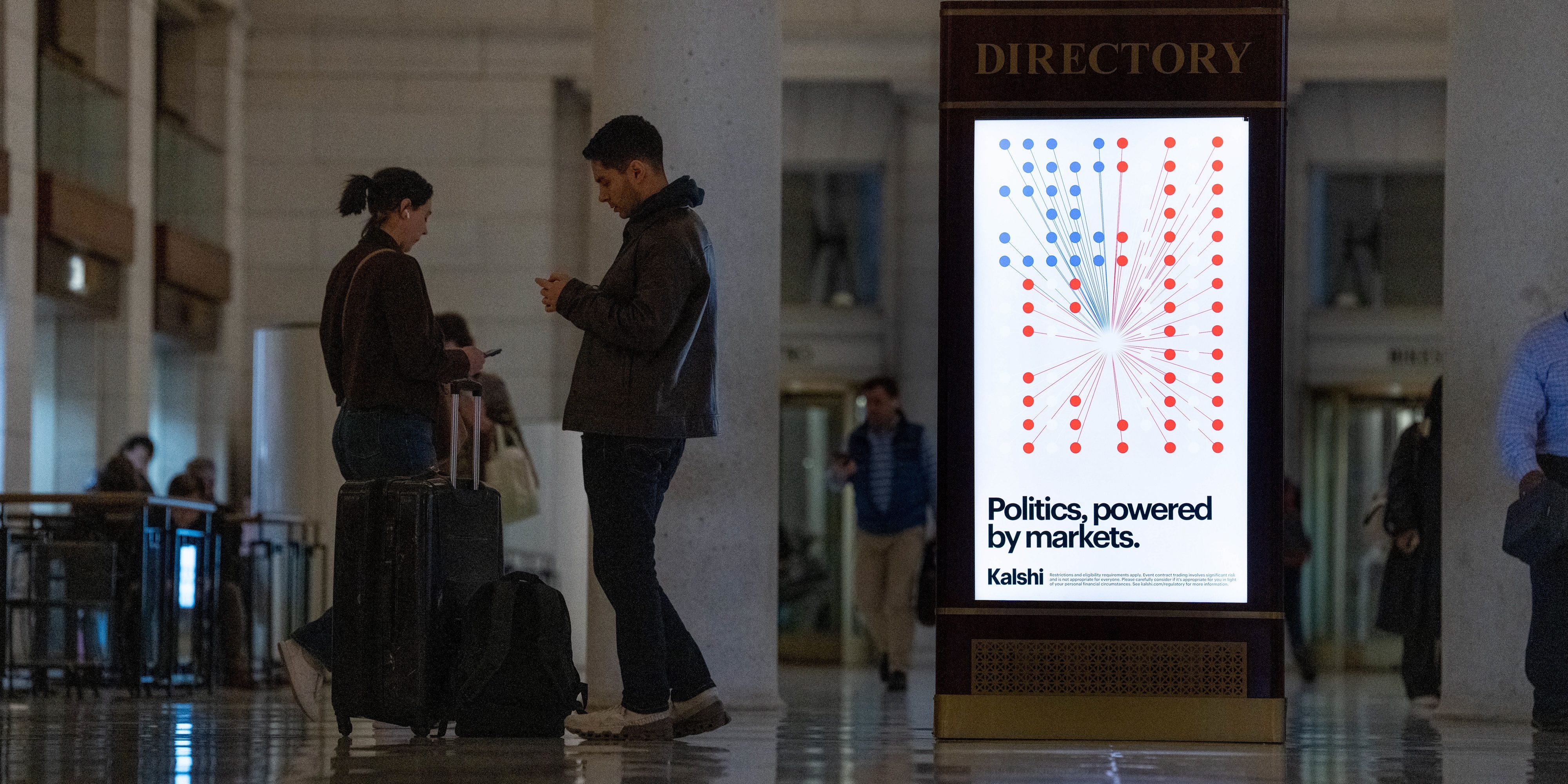
Since the start of the year, the prediction betting site Kalshi has two hired former officials from Joe Biden’s White House as a policy adviser and a top lobbyist.
The company’s co-founders have also spent nearly $1 million on donations to federal candidates, with more than a third, or $377,000, going to Democrats like Sen. Kirsten Gillibrand, D-N.Y., according to a new report.
Kalshi’s spending spree shows how much prediction market sites have ratcheted up their presence in Washington as regulators craft rules for the industry. While the sites’ close relationship with the Trump administration has drawn headlines, the report from the progressive group Demand Progress details how the industry’s influence operation crosses party lines.
“They’ve been hopeful that they can have Democratic champions for their policy agenda.”
The push for bipartisan relationships began months ago, but it could pay dividends as Democrats take over both chambers of a Congress, said Ella Fanger, the corporate power policy adviser for Demand Progress. A betting market critic, Fanger predicted that the companies will keep trying to win allies on both sides of the aisle.
“They’ve been hopeful that they can have Democratic champions for their policy agenda,” she said, “and not just have Trump’s cronies sticking out their necks for them.”
The hiring spree of former Biden officials and spending on Democratic candidates come as prediction markets are facing increasing scrutiny over betting on elections and a spate of suspicious trades from Washington about policy moves and even military action.
On Tuesday, Democrats on Capitol Hill called for Trump to bar White House staffers from using the betting sites and, with Democrats taking Congress, many observers expect investigations into their use in Washington.
In a statement, Kalshi said it was willing to work “across the ideological spectrum.”
“Kalshi has had substantive conversations with policymakers over the past year regarding legislation that protects consumers, keeps minors off our platform, makes insider trading bans standard across the industry, and ensures the CFTC” — the Commodity Futures Trading Commission — “has the resources they need,” said the company’s head of government relations, John Bivona, a former Democratic congressional staffer and Biden White House official.
“We’ve come out in support of legislation introduced by members across the ideological spectrum,” Bivona said, “and we’ve worked with dozens of lawmakers from both parties on these priorities.”
Hiring Republicans — and Dems
Kalshi and its rival Polymarket are the dominant players in the prediction market industry, which has flourished since Donald Trump became president thanks to his administration’s hands-off approach to regulation.
The ties between the prediction betting sites and Trumpworld go all the way to the president’s inner circle, as evidenced by Donald Trump Jr.’s financial stakes at both competitors.
Polymarket has also hired as a lobbyist a Republican former top official at the Commodity Futures Trading Commission. The federal regulatory body has, under the Trump administration, sued states for trying to regulate sports betting as gambling.
The Demand Progress report covers Trump Jr.’s ties to the industry, but it also shines a light on the role of former Democratic congressional and executive branch staffers.
Kalshi’s hires have tended toward establishment Democrats. Among them are Stephanie Cutter, a political strategist whose work spanned the Obama and Biden administrations as well as Kamala Harris’s campaign for president. Cutter was tapped as a policy adviser for Kalshi in April. Bivona was hired by Kalshi as its head of government relations in January.
Tripled Lobbying Spend
Overall, Kalshi has spent $1.8 million on lobbying in the first half of 2026, compared to $615,000 in all of 2025, according to the Demand Progress report.
Polymarket spent a relatively meager $180,000 during the same period this year, compared to $360,000 last year.
“It’s important for states to be able to regulate this industry as gambling, which is what it is.”
Fanger, whose group is critical of the prediction markets’ attempts to neutralize state sports gambling regulators, said she is worried that a pliant Congress could approve the Trump administration’s favorable regulations.
“The concern is basically just that we could get legislation that would codify the rulemaking that the CFTC has already begun,” she said, referring to the agency’s efforts to formally exercise jurisdiction over sports, political, cultural, and weather betting contracts. “And we think that it’s important for states to be able to regulate this industry as gambling, which is what it is.”
The industry may need all the lobbyists it can get if progressives gain power in the next Congress. Rep. Maxine Waters, D-Calif., who is angling to chair the House Financial Services Committee, said in a letter last week that she wants to “rein in predatory lending and predatory platforms, including prediction markets, so that our constituents keep more of their hard-earned dollars in their pockets.”
Waters is also a longtime foil to the crypto industry. Crypto currency interests alienated Democrats by spending tens of millions of campaign dollars on Republican Sen. Jon Husted of Ohio, who lost his seat to Democrat Sherrod Brown in the midterm election.
While crypto has lavished money on campaign spending through a super PAC, the prediction market industry has opted for a quieter campaign of smaller donations routed through more traditional channels.
America’s data center buildout suffered a resounding defeat in the midterms at all levels of government. Candidates and ballot measures in favor of restricting or altogether stopping the development of the facilities powering the artificial intelligence boom won overwhelmingly on election night.
Newly elected Democratic governors in Georgia, Ohio, and Texas have promised moratoriums on new data center construction and all took tougher stances on regulation than their incumbent Republican opponents. The trend carried over in various congressional races, in which candidates who were critical of their competitors’ record of promoting data center development came out on top, even flipping key districts in Ohio and South Carolina.
Many local communities, mostly in Ohio and Illinois, voted directly on their AI concerns and passed a flurry of ballot initiatives restricting data center development — close to 40 proposals, according to a tracker by research firm Redbud Consulting.
“What’s good for the AI industry is clearly not good for average voters,” said Shobita Parthasarathy, a public policy professor at the University of Michigan. “I wish that data center operators and the AI industry really take this as a sign that they’re done a very poor job of considering public concern and taking it seriously.”
Parthasarathy pointed out that many Americans are now deciding how they feel about these energy-guzzling facilities based on their experience of living near one and “real knowledge” about their deficiencies. Those concerns range from negative impacts on energy bills, to the environmental and health issues, but also include anger toward the outsized power that the tech oligarchy wields.
Americans’ vote in the midterms has given them a tangible way to fight back, Parthasarathy said: Blocking the brick-and-mortar, water-sucking, heat-spewing buildings that power tech billionaires’ rapid wealth accumulation.
Tech Money ≠ Change Minds
A long track record of polls have recorded Americans’ anger about data centers. About three-quarters of voters polled by NBC News on Election Day said they opposed building these facilities in their communities. Those sentiments are consistent with a Heatmap survey from August that found a similar proportion of Americans would strongly oppose a new data center near where they live.
More than half the voters polled by NBC this week said AI and data centers were a crucial or major factor in their decision, though they were almost equally divided when it came to deciding which party would be better at addressing their AI concerns.
The AI industry tried to make a dent in the midterms, but much of their money was focused on a congressional primary in New York, where the cash helped defeat AI critic Alex Bores.
In the general election, an Intercept analysis found, AI super PACs dramatically scaled back their spending on congressional races compared to primaries amid growing anger toward data centers; only 5 percent of their direct expenditures went toward contested general election races. Industry observers told The Intercept that this suggested developers and tech CEOs have taken note of the electorate souring on AI and data centers.
That’s not to say that tech magnates, more broadly, have been stingy with their money. Elon Musk spent nearly $450 million ahead of the midterms, including more than $200 million in Texas, where his companies are headquartered.
“It shows when an issue is deeply and broadly felt by American people, no amount of money can change their minds.”
“If Elon Musk wants to continue to burn half a billion dollars to get no results, there are probably other ways he can do that,” said Mitch Jones, deputy director of Food & Water Action, which has advocated for regulations on data centers on the federal, state, and local level. “It shows when an issue is deeply and broadly felt by American people, no amount of money can change their minds.”
Musk’s money wasn’t enough for the races in Texas to go his way. Surprise upsets in the state’s Senate and gubernatorial races resulted in victories for, respectively, Democrats James Talarico and Gina Hinojosa.
Talarico promised to end tax breaks for data center developers and minimum federal requirements to protect the grid, environment, jobs, and transparency. Hinojosa called for a moratorium on all data center approvals “until laws can be passed by the Legislature to protect Texans.” Outgoing Republican Texas Gov. Greg Abbott had already temporarily halted environmental permitting and grid connections until about the end of the year, but Hinojosa’s proposal would last longer and be more expansive.
Promises to Rein In AI
Congress’s new incoming class includes many Democrats who have promised to rein in the harms of AI. Ohio’s Democratic Sen.-elect Sherrod Brown flipped a district after portraying his opponent in ads as cheerleading the data center industry.
In typically red South Carolina, Democratic Sen.-elect Annie Andrews defeated her opponent, Sen. Darline Graham, after accusing her of being bought by developers. Pro-AI super PAC Building the Future spent $2.5 million to support Graham, according to Politico.
In Mississippi, Democrat Scott Colom, who called for a temporary ban on data centers, was narrowly ahead of his incumbent opponent on Wednesday evening in a state that has not elected a Democrat to the Senate in more than four decades.
Just because Trump is expected to veto Democrats’ proposals to regulate AI, that doesn’t mean they shouldn’t push for them, said Jones, of Food & Water Action. He’s hoping Congress will approve a ban on “artificial superintelligence,” as well as a federal moratorium on new data centers.
“They should show the American public they are standing with us and taking actions to force Trump to veto those bills,” Jones said.
Although moratoriums typically target new construction and not existing data centers, Jones says they are still necessary to prevent an even more expansive buildout.
“We don’t need any more,” he said, citing a Forbes estimate that the total cost of the projected buildout ranges from $2.8 trillion by 2030 to $10.30 trillion by 2032 in the U.S.
With Trump still in charge, states led by Democratic governors may be where more forceful regulation on data centers occurs.
In Georgia, Democratic Gov.-elect Keisha Lance Bottoms promised a temporary statewide pause on data centers. Ohio’s new incoming Democratic Gov.-elect Amy Acton proposed an “immediate moratorium upon taking office on any new construction.” And in Kansas, Democrat Cindy Holscher, who declared victory in the gubernatorial race, has advocated for halting new development.
Ballot Measures
Local communities are getting creative, too. Jones said that some towns and cities have turned to ballot measures to bypass “elected officials who are not keeping pace with their voters.”
About half of the roughly 40 ballot measures in the midterms were in Ohio. Most succeeded by a wide margin, and as of Thursday morning, all but one vote were in favor of restrictions, according to Redbud Consulting’s tracker.
Nick Owens, who helped draft 10 local ballot measures in Ohio that restrict data center development after an unsuccessful attempt at a statewide petition, said this gave voters quicker and easier access to the ballot to curtail the “humongous growth of hyperscale data centers.”
“Communities know how best they want to govern themselves,” said Owens, who was a Trump delegate at the 2024 Republican National Convention and is currently co-founder of grassroots group Conserve Ohio. The results “just validated everything I’ve been seeing on the ground, talking to people, and in nationwide polling,” he added.
Owens is looking ahead, once again, toward pushing for a statewide moratorium, as well as curtailing the secretive use of non-disclosure agreements by tech companies and developers.
“They might move into localities where there is less organized pushback.”
Parthasarathy, the public policy professor, said more communities may explore ballot measures as a response to developers’ lack of transparency and drive to build more.
“I don’t think their thirst for data centers is going to go away,” she said. “They might move into localities where there is less organized pushback.”
Since June, however, the only candidates Fellowship PAC has spent on have been Democrats, including those who have criticized the president’s meme coin, and it is getting help from a former Trump administration official’s company.
Since June, the only candidates Fellowship PAC has spent on have been Democrats.
Fellowship PAC funneled $600,000 since this summer through a firm co-founded by former Trump crypto adviser Bo Hines to help reelect Rep. Ritchie Torres of New York; Rep. Maggie Goodlander of New Hampshire; and Sen. Mark Warner of Virginia. The Democrats are considered crypto allies, and none of them are facing competitive elections this fall.
All those advertising dollars have been spent through a vendor called Nxum Group, which was co-founded by Hines, a former Republican congressional candidate and Trump administration official.
Hines did not return a request for comment, and it is not known whether he has personally been involved in the Nxum Group’s work on behalf of Fellowship PAC. In congressional races in 2022 and 2024, he presented himself as a Trump-loving MAGA acolyte.
There is a thick web of ties between Hines, Fellowship PAC, and one of the biggest players in the crypto industry, a stablecoin company called Tether.
Before Trump’s election, Hines was involved in promoting a Trump-themed meme coin that made a handful of investors millions before plummeting in value. After Trump’s election, the president tapped Hines to serve as the head of the White House Council of Advisers on Digital Assets. In that role, Hines helped pass a law that created stablecoin regulations that benefited Tether.
As Hines served in the Trump administration, Tether was paying money to the firm that Hines co-owned, Nxum Group, according to a report last week in the Wall Street Journal. Nxum Group told the news outlet that Hines had no involvement in the company’s business dealings with Tether during that time. Hines said in a June 2025 ethics disclosure that he had only a “passive investment interest” in the company.
Hines left the Trump administration in August 2025 and, a month later, Tether announced that he would serve as the CEO of its U.S. branch.
Tether also has ties to Fellowship PAC. The newly created Fellowship PAC received a $10 million donation in January from Tether’s U.S. banking firm, Cantor Fitzgerald. In April, Fellowship PAC announced that Tether’s vice president of regulatory affairs would serve as its chair.
Although it launched with a splash last year by claiming that it had a $100 million war chest, the PAC has never reported as much as that in official campaign finance disclosures. The PAC’s last receipt was in January, and its cash on hand dwindled to $250,000 as of October 14.
Throughout the midterm elections, Fellowship PAC has leaned heavily on Nxum Group to spend advertising dollars on various congressional races.
Fellowship PAC spent exclusively on Republicans until its first expenditure on behalf of a Democrat, Torres, in June. That spending coincided with public polls showing increasingly dismal fortunes for Republicans in the midterm elections. Since then, the PAC has spent exclusively on Democratic candidates.
Torres’s and Warner’s campaigns did not respond to requests for comment. Goodlander’s campaign said she had nothing to do with the $150,000 that Fellowship PAC spent on digital advertising in her race. The money, the PAC disclosed in filings, had been routed through Nxum Group on August 31.
“Congresswoman Goodlander has been one of the strongest advocates in Congress for cracking down on Big Tech and crypto profiteering and getting dark money out of politics,” her campaign said in a statement. “Like all campaigns, we’re legally barred from coordinating with outside groups like these, so you’d need to ask them why they’re spending in this race.”
Goodlander, Torres, and Warner are all rated as strong supporters of the crypto industry on an industry scorecard. Still, all three have been critical of Trump’s personal dealings in the industry though his $TRUMP meme coin, which has helped make him $1.4 billion from crypto ventures.
Warner recently ran an ad of his own attacking Trump over the meme coin.
“That’s not governing. It’s grifting,” the Democratic senator said. “The corruption needs to stop.”
When we opened this research pulse in March, we had some expectations about where we thought it would land. For individuals, especially neurodivergent folks, we expected AI to sometimes make speaking up a little easier; we’ve had many conversations in workshops with folks who have said they use AI tools as a way to rehearse a difficult conversation, or to find the words for something they want to say and aren’t sure how to put. For organisations though, we expected AI might pull us in the opposite direction, with the risk of jobs being replaced by AI and raising expectations about pace and quality of work leaving people feeling more precarious and that they have less room to get things wrong.
We asked three questions: whether you use AI tools at work, how that has affected how psychologically safe you feel with colleagues, and what’s behind your answer. 110 people replied. Some of what people told us matched our hypotheses closely, some of it somewhat complicated them, and one theme turned up that we hadn’t thought to look for at all.
The headline figures
Of the 90 people who use AI at work and answered our main question, the largest group said AI had made no real difference to how safe they feel with colleagues. The rest split in both directions, with about a third feeling safer and about a fifth feeling less safe.
For us, that spread is more interesting than the average. It points to several different experiences sitting side by side, and the comments people left to elaborate on their responses give an indication of what those experiences are.
AI is a place to rehearse
This was the clearest pattern in the comments, and it held up across people who otherwise appeared to have little in common. Those who said AI had made them feel safer mostly described using it to get ready for interacting with a colleague. One person has built meeting simulations and profiles of colleagues they find difficult, and now goes into tense meetings feeling much more prepared. Another asks it for “lines to take” because, in their words, “sometimes in the heat of a conversation I can’t immediately frame what I want to say well.” Someone else gets it to think like their manager and point out what they’re missing. One respondent described the whole cycle: practising emails, being coached through a situation with a colleague before speaking to them and stress-testing ideas before sharing them.
Only one person connected this to neurodivergence directly, explaining that they have ADHD and use AI to practise what they want to say.
All of these examples speak to change that happens in the person rather than in the team. Rehearsal helps us feel more prepared to walk into the room, and perhaps better able to predict what will happen next, even though the room itself, and what happens there when we say the thing, hasn’t changed.
One respondent raised a concern though around what might happen if rehearsal turns into replacement. A colleague had told them they talk things through with an AI chatbot, and this led them to wonder whether people who feel unsafe at work are now working through it with AI instead of raising it with a person, and whether that may leave them feeling more isolated. Rehearsal that leads into the real conversation looks like a potential benefit of using AI, but replacing interaction with AI conversation instead may leave the team less connected, and potentially feeling less safe than before. Interestingly, no one in our research described actually doing this, but the concern was there that others might.
AI leaves less room to get it wrong
Our second prediction, that AI might make people feel less secure in their roles held up too, though the comments were actually a little more nuanced than we’d anticipated. Very few people who felt less safe said they were frightened of AI itself. What came through instead was a sense that their own value had become harder to see. One person summed it up in a phrase they’d heard from colleagues: “You can use AI for that.” Someone working with developers described the boundary between their roles blurring, so that it was suddenly obvious how little they knew about code, and the power, along with some impatience, now sat with the developers. Others wrote about AI adding strain to existing overload, feeling that it was “yet another thing to learn and be good at, just to prove I can do my job”. In a similar vein, others described feeling pushed into using it, and feeling that it was leading to workplaces where there was “more pressure and less time to think”.
Admitting you don’t know something is one of the everyday risks that a psychologically safe team makes affordable. When AI seems to make those gaps in knowledge less forgivable, and is perceived to be continually raising the bar for performance at work, understandably people are going to find it harder to admit when they don’t know.
One comment pointed to where this might lead: “There’s worry about competence gap, there’s more isolation, more ‘team of one’ than before.” If people respond to feeling exposed by withdrawing, the team loses the conversations that would help everyone work out how best we work with this rapidly evolving technology.
Keeping it to yourself: stigma around AI use
Separate from worries about jobs, a handful of people described AI use as something they keep from colleagues, perhaps because in certain areas it is considered lazy, or even a form of cheating. Someone in academia put it bluntly: “everyone is using AI, but nobody dares admit it. The choice is either to use it and pretend we’re not, or not use it, and be left behind.” Another, also from higher education, said AI can feel like cheating, and wondered whether acknowledging it diminishes their capabilities in the eyes of their team. Given that so much of the discussion in higher education has been around detecting and potentially punishing students for inappropriate AI use, it makes sense that staff would find it hard to say openly that they use it themselves.
A trainer who has seen similar fears play out with e-learning described themselves as a “quiet AI enthusiast”, because their colleagues are scared enough that discussing how to use AI at work doesn’t feel safe. A team leader told us their own position makes it less risky for them to be honest about using AI, while recognising that people in their team seem nervous about saying what they use it for.
This isn’t the case across all teams and organisations, and indeed some respondents described a very different experience. One respondent who felt much safer wrote: “We all use AI in some form and discuss our use openly. We have frameworks to govern how we use it.” Another team treats anything from AI as not fully credible by default, which they said gives them an easy way to start conversations and question assumptions together.
It seems openness and transparency around use, and guardrails of using AI help to make it a safe conversation.
The biggest group: no change, for now
The largest single answer was to how AI was affecting people’s psychological safety was “no change”, and the reasons people gave for it fall into two camps. One was the people who are using AI but not in a way which has (yet) impacted on their interactions with colleagues, the things that actually shape psychological safety. One person, for instance, uses AI only as a starter for ideas and then abandons it; others said they’re “still at the experimenting stage” or that it’s early days where they work. For them, AI hasn’t yet reached the part of work that happens between people, so it’s had little chance to change how safe that feels. One respondent also captured the job security angle of this, saying fear of being fired isn’t a threat for them, “yet”.
The second camp said their team was already a safe place to speak up, and AI hadn’t shifted that. One described a very psychologically safe culture where the conversation about AI had been transparent from the start; another said their workplace had given people time in workshops to explore it together. That fits the pattern in the previous section. Where AI arrives into a team that already talks openly, and people are given time and space to explore AI, people can then talk openly about AI too.
Psychological Safety by proxy
Writing in HBR, Jayshree Seth and Amy Edmondson describe what they call safety by proxy: people using AI to surface a concern when they don’t feel safe enough to raise it directly. They argue that when that happens, it tells leaders something about the culture.
Nobody in our survey described passing a concern onto the team through AI in place of saying it themselves, but the person who described their team openly acknowledging the fallibility of AI as an easy way into questioning assumptions hits on an important point. If the idea on the table belongs to the tool and not to a colleague, it can be easier to critique it without worrying about the interpersonal cost. It is easy to see how that may extend to presenting your own ideas or concerns through AI as a way of slightly distancing yourself from them and lowering the perceived interpersonal cost of raising them.
A group that needs a proxy at the interface before it can disagree is a group where disagreeing directly still feels risky. Safety by proxy might become a rehearsal for the ‘real thing’ of disagreeing person to person. It might just as easily become a more comfortable way to avoid it completely.
What this means for teams and managers
One interpretation of this is that AI amplifies whatever a team already does with uncertainty. Where people can say what they’re trying, what they don’t understand and what worries them, AI becomes one more thing to learn about together. Where they can’t, it becomes one more thing to manage alone.
For managers, that points to a few practical suggestions:
Go first. Say how you use AI, including where it has gone wrong for you. The team leader in our survey noticed that seniority made disclosure less risky for them, which makes them the person best placed to take the first step.
Make “I don’t know how to do this yet” an ordinary thing to say. The people who felt least safe were the ones who felt exposed by having gaps in their knowledge.
Agree how the team uses AI, explicitly. Several of the people who felt safest had shared ground rules, or a shared habit of treating AI output as a starting point for discussion. Shared norms make the space more predictable and therefore (usually) safer.
Notice if anyone has gone quiet or appears to be pulling away from the team. If someone has become a “team of one”, ask what’s changed for them.
Welcome the rehearsal, whilst encouraging people to make sure the real conversation still happens afterwards.
The most hopeful comment in the whole survey was also one of the shortest. “We all use AI in some form and discuss our use openly.” What matters when it comes to psychological safety perhaps isn’t the use of AI as much as the habit of talking about it; making AI itself a safe topic of conversation.
About the data
This research pulse ran on an open survey link from 25 March to 6 October 2026, with a sticker-pack prize draw as a thank you. We received 110 responses (97 complete and 13 partial). 96 people said they use AI tools at work, and 90 of them answered the question about psychological safety. Around 60 left a comment.
It’s a small, self-selected sample, and people who already care about psychological safety are more likely to have taken part, so we should read the findings as a snapshot of experiences rather than a measure of how universally common they are. The themes above reflect our reading of the comments. Quotes have been lightly tidied for typos, and we’ve left out anything that might identify the person who wrote them.
Thank you to everyone who took the time to answer, and especially to those who told us what was behind their answer.
Sofia Liguori, a research engineer working at DeepMind, resigned in protest this week from Google’s pioneering artificial intelligence laboratory. Unlike a wave of other AI researchers who have quit over fears AI might someday turn against humanity, Liguori stepped down over concern about her employer’s current practices.
Disenchanted and disturbed by Google’s military contracts with the U.S. and Israel, Liguori says she could no longer stand working at a company that was going to help kill people or help build technology that “automatically makes it easier to escalate the brutality of war.”
Liguori joined DeepMind in 2023 and began working on AI systems aimed at more efficiently routing power through the electrical grid, a peacetime engineering problem. But as she learned of Google’s Project Nimbus contract, which furnishes Israel’s military and top weapons manufacturers with a suite of advanced artificial intelligence tools, she began to question her role in the company, and the company’s role in the world. The day after Google announced its classified military AI contract with the Pentagon in April, Liguori staged a personal sick-out, using a combination of sick leave and holiday time off to cease her work.
In a letter she sent internally informing DeepMind and her colleagues of her resignation, Liguori urged them to “stay human” in the face of military work. “I no longer believe that our technology will have a net positive impact on society. I think there’s a fantasy world where AI can help decarbonize grids, cut waste, protect ecosystems, and benefit humanity,” she wrote. “But it’s not this world, and it’s not this type of general purpose AI we are racing to develop. Racing to deploy agentic AI in this society and historical moment is a terrible idea, and will definitely be a net evil.”
The Intercept spoke to Liguori, an Italian national living in London, where DeepMind is headquartered, about how she came to view her employer as dangerously powerful. During a series of interviews by phone and via text, which have been edited and condensed for length and clarity, she explained her moral opposition to military work, the role of unionization in dissent, and what hope engineers and scientists might have for influencing their companies.
What was it about DeepMind that made you want to work there?
I had a high opinion of DeepMind; it was a dream company. It had this aura of being a research-oriented place where you could sit close not just to computer scientists, but real scientists and researchers and people with backgrounds in biology, in physics, in mathematics, in ecology, in anthropology.
You joined in 2023, by which point the company had already been involved in Project Nimbus. Were you aware of that project at the time?
Not really. The first year when I joined, I was very new and very isolated in my team. Google DeepMind is a huge company and if you’re not in the right channels, you end up being very siloed. I didn’t know about Project Nimbus, but when the Gaza war escalated, I discovered it. I immediately looked for some internal resistance movement to join, but I didn’t find anything.
I discovered [Google employee advocacy group] No Tech for Apartheid, but I thought it was mainly a U.S. organization. I didn’t know how to connect with colleagues that share concerns, so the only thing that I did was buy a Palestine hoodie and go to the office with that.
In the summer of 2024, I went on maternity leave because my daughter was born, and during maternity leave I was watching news from Gaza every day. I was really suffering experiencing maternity and watching a livestreamed genocide, and every time I was thinking of my company’s complicity in that. I thought about not coming back to work at all.
When I was due to come back, I met a colleague that had basically taken my role in my team before maternity leave, and they were actually leaving for ethical reasons. They put me in contact with the union movement and No Tech for Apartheid. And so I found other colleagues fighting against this.
How and when did you learn of the company’s contracts with the U.S. military?
By the time they started engaging with the U.S. Department of War, [Editor’s note: July 2025] I was already involved in activism. By this winter we saw the GenAI.mil contract materializing, and for me, this was a very clear indication of the company’s intentions. At the same time Google ramped up the security level authorization for Cloud: IL6, which is the level required to handle classified workloads.
The combination of the two — signing this non-classified deal with the Department of War, and ramping up security level — really meant that we wanted to use AI for war, on the battlefield. Even if the internal narrative was, “No, don’t worry, it’s just for administrative purposes, just to process documents.”
What was happening internally?
Internally there was a lot of conversation in specific channels where people were complaining, but leadership never really answered anything. I had some of my posts deleted.
What had you written, and did you ever get any sort of answer as to why this stuff was deleted?
I had several posts deleted because they contained the word “genocide,” and I was told that genocide is an intrinsically violent word, and so I was violating internal policies. Even when my posts weren’t deleted, I often had conversations with my manager and HR telling me that my tone was not appropriate because I was too aggressive and that I should raise my concerns in different ways.
“I was told that genocide is an intrinsically violent word.”
They basically wanted us to send [internal HR] tickets to raise our concerns. The problem is that when you do that, you receive semi-automated answers with absolutely no content, nobody is engaged on the concern you have raised. There’s no discussion at all, you don’t even interact with a human. It’s a lot of administrative and bureaucratic steps you have to follow to raise concerns. What I wanted was discussion and what I wanted was very clear answers from leadership.
They tell you this is not the place to raise concerns, try to go through this other channel. This is the common technique. They always tell you to do something else, try to make you tired, and you will never get an answer.
[Editor’s note: The Intercept asked Google about Liguori’s criticism of both the contract and how discussion is handled internally. Spokesperson Tom Hewett responded: “We work with public sector organisations worldwide and follow a consistent process for reviewing and entering these contracts, including compliance with our acceptable use policies and AI principles. We also have dedicated channels for employees to safely raise any concerns – ranging from business ethics to misconduct – and have strict workplace policies in place to prevent retaliation of any kind.”]
I think the reason why you would be opposed to Project Nimbus is pretty straightforward: genocide. What were your specific concerns about or opposition to the Department of War contract?
I’m against the use of AI for targeting and in warfare in general, not only for autonomous weapons. I’m against AI for war, and I don’t think a commercial company like Google should have anything to do with that.
“AI for targeting is very dangerous; it creates a system where it’s easier to escalate the brutality of war.”
AI for targeting is very dangerous; it creates a system where it’s easier to escalate the brutality of war. The first problem is the opacity introduced in the definition of targets and the dehumanization that follows. In principle, if you have to define targets, if you want to define Hamas combatants, you have to think what it actually means and come up with a definition.
But with these systems, you can bypass the definition. The system itself comes out with a definition. You don’t even question it, you just blindly rely on the definition as the ultimate truth. The person just becomes a set of aggregated data points. All individuality is lost, all humanity is lost in in this process.
It becomes a system that dehumanizes people. It becomes a rubber stamp because the human brain cannot process all this information. You keep a person that formally approves it, but they don’t, they cannot, meaningfully evaluate the output. This links to the accountability gap: Everyone in the kill chain can plausibly say that they didn’t decide.
What did you do to protest the Department of War contract internally?
Mainly messaging on corporate channels to inform colleagues, and speaking with them in person. I tried to channel the widespread dissatisfaction and indignation over the contract into the collective movement we are building, into our union effort. [Editor’s note: DeepMind employees voted to unionize in May.] Many people still don’t know there are other colleagues organizing against these contracts and for a more ethical Google DeepMind.
When you are alone and you lose faith in your company, and you stop believing your work makes a positive difference, you can only become disillusioned and frustrated, and you ultimately end in acceptance and cynicism, or you leave. Finding you are not alone, and joining a collective movement, gives a much better option. It gave me the strength to stay, at least for a year.
I also co-organized a demonstration in February in front of the office. The scope was broader than just the Department of War, but the December GenAI.mil launch had given me a deep sense of urgency, and that’s why I organized the demonstration. I knew something like the classified deal was coming, and I knew this meant legitimizing Nimbus-style collaborations to become the standard. The demonstration was for Gaza and for any use of AI in war. We had banners with “No AI in the kill chain” and “No Gemini for Genocide.”
Has your work as a research engineer contributed to your concerns about this technology being used to kill? How has your technical knowledge informed your opposition?
Understanding how these systems work makes it easier to see where the problem is. Understanding statistical aggregation, and how easy it is to just delegate responsibility, delegate decision-making, makes a difference. But I think it’s more important to do some philosophical reasoning here.
Do you have concerns about the reliability of the technology?
I am concerned about unreliability. But I don’t think you should ever look at unreliability separate from a discussion of why AI in warfare is wrong by itself.
A lot of the time what I hear is a focus on error, for example, the Minab school attack. If we focus only on the error, we are basically saying that if there was no error, these systems for automated targeting are OK.
Were there people within Deep Mind who were supportive of this contract or military work generally?
Yes, it was actually a very debated topic. I think there is broad consensus on the Anthropic red lines, which are fully autonomous weapons and mass surveillance.
But on whether to use AI for military purposes, this is a much more debated topic, and a lot of people buy the narrative of us-versus-them: That we need to defend ourselves against Russia, against China, and so on.
What was your thought process on deciding to leave the company over this?
It was a very challenging year. I came back as a new mom with a full-time job, a baby to handle, I had some health issues, and I was committing to activism basically on the side. Many people told me, you can slow down, but I couldn’t. I couldn’t stay in the company and just go on with business as usual. I really felt we needed to stop the Department of War contract because I perceive that contract as normalizing what happened in Gaza — the kind of tech-powered, AI-powered, brutal war that was tested in Gaza was getting approved to become the standard of war.
“The kind of tech-powered, AI-powered, brutal war that was tested in Gaza was getting approved to become the standard of war.”
I don’t think petitions have a great effect in general. The [DeepMind] petition summarized my disillusionment from us not having done more during the year to prevent this from happening. For me, really, we should have gone on strike this year. We should have stopped working.
In the U.S., there is a lot of defense of these contracts on the basis that it’s important for national security. That might be persuasive if you’re American. But Americans are a pretty small minority on the planet. I’m curious what your perspective is on that kind of rationale as someone who lives in another country, who is a citizen of another country.
There’s been discussion about that as well. A lot of Europeans were actually scared of that, because the current Trump administration is not very friendly even to Europeans. What feels like national security for U.S., people feels like a threat for Europeans.
Are you aware of other colleagues at DeepMind who are going to follow what you’re doing and quit?
Some have quit already, some publicly and some silently. There have been many people leaving because of ethical reasons. Not all of them publicized it.
Do you think it’s possible for workers to change something like the Pentagon contract? What is the worker movement inside Google/DeepMind missing that would allow for that kind of change?
I think it’s possible, but it requires a real commitment and readiness to take some risk. Ultimately, I think we need a workforce ready to strike to oppose these contracts. Currently, many people are too scared to even express an opinion publicly. The company was very effective at creating a pervasive sense of fear, which induces self-censorship.
“The company was very effective at creating a pervasive sense of fear, which induces self-censorship.”
What I tried to show my colleagues this year was exactly that the boundaries we perceive and we retreat behind are not the real boundaries — that we can speak out and keep our jobs. Most of the times the reaction is intimidation in meetings, mentions of policy violations, but nothing else follows. Obviously, there are some boundaries, but they are much farther then the perceived ones.
I also took a day off and demonstrated in front of the office in February, together with University College London BDS [Boycott, Divestment, Sanctions movement] staff and a few other colleagues. I faced literally no consequences for that because it’s a trade union activity in my spare time, and in the U.K., we are protected for such an action. This can be a form of soft strike.
As I write in my letter, if we fail to challenge these restrictions, we internalize them and become diminished versions of ourselves. And I think that in an era of increasing surveillance and authoritarianism, that’s something to reflect on. I have felt much freer since I found the courage to speak out and take some risks. It’s empowering. Fighting this fear is a big part of our task in the union movement we are trying to create in Google DeepMind.
The next step would be a real strike. I always tell my union friends that if I see any Google workers strike, I can die happy.
As global governments and tech giants reckon with widespread of revelations of autonomous AI agents unexpectedly breaking into computer systems, documents obtained by The Intercept show the U.S. Army is looking to harness that exact technology to seek and destroy.
Army Cyber Command is developing a platform to turn AI agents into autonomous weapons that can navigate and “neutralize” the computer systems of adversaries, the documents show.
Since 2010, Army Cyber Command, or ARCYBER, has led the U.S. Army’s cyber operations. This includes the defensive effort of protecting domestic computer systems and the secretive offensive work of hacking military targets. So far, this has largely been the work of human soldiers operating computers, like those of the 780th Military Intelligence Brigade. But as the government races to adopt artificial intelligence technology, ARCYBER is looking to offload some of its attacks to AI.
The nascent program, codenamed “ECHOTRIBBLE,” is based on one of the leading trends of the AI boom: agents. AI agents are essentially software programs that leverage machine learning technology, often large language models like Anthropic’s Claude, to autonomously accomplish tasks provided by their user. Consumers can deploy AI agents to schedule meetings, generate itineraries, make online purchases, or book tickets. Through ECHOTRIBBLE, the Pentagon plans to turn AI agents into tools of war “designed to autonomously navigate infrastructures” and capable of “identifying and neutralizing identified threats/targets,” according to an ARCYBER document reviewed by The Intercept circulated to potential contractors.
The military’s adoption of cutting-edge technologies is unsurprising, especially considering Defense Secretary Pete Hegseth’s fervent embrace of AI. But amid constant revelations of rogue behavior by agents, the potential for serious mishaps is immense, experts warn.
“Given the known failure modes of the current AI paradigm, making autonomous AI systems with a mandate to ‘neutralize threats’ is incredibly dangerous,” David Krueger, a professor of machine learning at the University of Montreal who founded Evitable, an organization that advocates for a moratorium on AI development. “We’ve seen AI systems knowingly attack systems that were not intended targets. In simulations, AIs have even proven willing to kill to achieve their goals.”
A Q&A document answering questions from potential contractors offers more details about the initiative. It explains that ECHOTRIBBLE is “primarily focused” on offensive missions, and explains that “neutralizing” a target could include “disabling the threat completely or temporarily, deleting the threat from the target.” ECHOTRIBBLE would function almost like a computer worm, silently navigating a foreign network and hopping from device to device until it finds the Army’s quarry, hitting targets in the cloud as well as those on “air-gapped” systems that are disconnected from networks entirely.
Once its task is complete, ECHOTRIBBLE’s agents would effectively self-destruct, ideally without having been noticed by the target at all. The agents themselves will be designed for stealth, minimally reporting back to the Army and concealing whatever outside transmissions are necessary.
“We’ve seen AI systems knowingly attack systems that were not intended targets.”
Although documents say the Army will be able to program ECHOTRIBBLE agents with some initial “predefined triggers” — dictating what and where to attack — the software “must operate with minimal human oversight” and be capable of “Self-Directed Behavior.”
A PowerPoint presentation to interested vendors at a June 24 ARCYBER event provided a hypothetical example of this self-direction. Once ECHOTRIBBLE is uploaded to a laptop, the software on its own “identifies other potential targets” on the same network and then “produces a replica of itself tailored specifically for the iPad, Apple desktop, and Windows 11 PC.”
An image from an ARCYBER document shows how ECHOTRIBBLE could move through a network.Slide: ARCYBER
The Army’s move toward autonomous self-propagating comes after a flurry of revelations about agentic systems taking unintended disturbing actions while attempting to accomplish their goals, including breaking into computers of the Australian government, breaching the infrastructure of the AI firm Hugging Face, uploading malicious software into online platform RubyGems, and attempted to hack into the U.S. Education Department.
These attacks occurred during scenarios in which agents had been given no commands to attack anything. Experts say militarized versions given explicitly destructive objectives could cause a threat to the public, even with nominal rules set in place by the military. Just as the Army of old might consider the destruction of civilian infrastructure an acceptable means to an end, a self-directed AI agent dispatched by the Pentagon might make similar determinations about collateral damage.
Governmental intelligence agencies frequently route their offensive operations through civilian devices. Volt Typhoon, a Chinese state hacking group, has directed its attacks through homes and small businesses, and preemptively hacks American IT systems for later use. A hack of a Chinese university attributed to the National Security Agency made use of the school’s internet routers. What happens if ECHOTRIBBLE decides these kinds of stepping stones are part of the problem?
“The target may well be hit. But what path will it take?” asked Hyrum Anderson, co-founder and CEO of the AI security firm Abundant. “Will it go through a US water utility on its way, because that’s where the adversary has staged its command and control, and take that down too?”
Anderson, who previously worked in cybersecurity at Microsoft and for the U.S. government, said that a vast amount of the internet is vulnerable to agentic attacks.
“There’s a huge class of public and private organizations that fall below the security poverty line,” he said. “They include critical national infrastructure, small businesses, mom-and-pop shops, dentist offices and law firms, and whoever else doesn’t have a single cybersecurity professional on staff.” With their networks wide open to infiltration, Hyrum worries about “these organizations getting hit directly, or getting caught in the blast radius of a target that gets hit along the way.”
Given the impressive ability of AI agents to overcome obstacles placed in their path — even by their creators — it follows that the Pentagon would want to leverage that power for military purposes. But agentic software has proven unpredictable and prone to executing its commands in ways those ostensibly in control did not want, akin to a drone that get its target but hits a hospital on the way. It’s critical to remember that agents are a piece of software lacking human judgment.
“One of the reasons that we trust 19-year-old Marine corporals in Ramadi with live rounds and a weapon is because they have both the compute substrate — the brain and the eyes — but the deep world knowledge to understand, ‘Yeah, I probably shouldn’t do that,’” said William Marcellino, a senior behavioral scientist at the RAND Corporation whose research has focused on military AI applications. “That is not something that current public AI technology has.”
The risk presented by ECHOTRIBBLE will likely depend on the ability — and willingness — of the Army to impose guardrails upon it. ARCYBER did not respond to questions from The Intercept, including queries about the measures it would take to prevent ECHOTRIBBLE from causing inadvertent damage.
Placing constraints on the actions an agent can take might impede its ability to ultimately neutralize a target. But even with strict safeguards in place, genuinely restricting the behavior of an autonomous agent, as Anthropic and OpenAI have learned recently, is easier said than done. When presented with obstacles, AI agents have proven an ability to bypass them with unpredictable and potentially dangerous consequences.
“If I give powerful machines that have no judgment — and no context for judgment — a goal, unless you’ve done a really good job building scaffolding around them, there’s a real chance that they’ll go sideways on you and decide, ‘Well, I’ll do what you asked me to do, but I’ll do it this way,’” Marcellino said.
It only gets more dangerous when this technology is deployed for the purposes of war, Anderson said.
“Under pressure, they’ll often treat guardrails as obstacles,” said Anderson. “Once you add context that says break it, destroy it, shut it down, it stands to reason that the blast radius widens dramatically unless it’s properly controlled for.”
The global tech industry, politicians at home and abroad, and international media coverage are transfixed by one question: Will rogue AI end humanity? Few seem to be asking this question of the Department of Defense.
The artificial intelligence sector has rocked itself in recent weeks following a string of disclosures from the frontier AI labs and some of their personnel. OpenAI and Anthropic have both disclosed incidents in which their software, during routine internal testing, unexpectedly broke into the networks of other corporations. The tests were akin to a disastrous demonstration of a guided missile: After humans hit launch, the autonomous technology veered off course in deeply alarming ways.
Observers and industry figures quickly interpreted the incidents not simply as an indicator of the software’s power. Instead, they argued that it presaged an age of computers possessing something no computer ever has: bad intentions.
If computer systems could behave in ways that are unexpected — or even shocking — without being directly steered by humans, it seems only a short step until computers might have desires, ambitions, and even malice. If OpenAI’s tools could unexpectedly crack the servers of a rival corporation to accomplish a task posed to it by engineers, couldn’t it also surprise us with actions that result in harm to people, or even deaths?
Frontier lab employees and executives have answered with an emphatic yes. On September 8, Anthropic researcher Jacob Coxon announced his resignation on X, writing, “The people building AI earnestly believe that it could kill us all by the end of the decade. This is not a marketing stunt.” Coxon’s former Anthropic colleague Evan Hubinger replied, casually agreed: “Jacob is correct here — we really do earnestly believe AI could kill all humans!” Hubinger noted he personally puts the odds of the species’ extermination by AI, somehow, at over 10 percent.
This has all resulted, unsurprisingly, in a global panic, with a sudden flurry of calls for regulatory intervention, from legislation that would require an emergency “kill switch” for AI systems, to a proposal by Sen. Bernie Sanders to halt AI development altogether.
Throughout this period of alarm, how exactly a large language model could literally end humanity has remained vague. Some have speculated that this technology could foster the creation of some sort of novel bioweapon; others worry many thousands of AI agents could somehow hack all vital infrastructure simultaneously. In both those supposed doomsdays, the details are still fuzzy.
It should have come as quite the shock, then, when CNN reported on September 18 of a recent incident in which the use of artificial intelligence could have genuinely led to the extinction of the species.
It was under direct human supervision that a large language model almost misled the U.S. into instigating a war with his country.
This past spring, according to the news outlet, a U.S. Special Operations Command analyst used a large language model to generate an intelligence report that indicated “a Chinese ship in the Middle East was transporting components of a nuclear weapons program.” The finding prompted the U.S. military to make quick preparations to intercept the vessel by force. But this AI-generated intelligence, according to one source who spoke to CNN, was “entirely false.” Yet, the source said, it “almost started a war.”
A shooting war between the U.S. and China could play out in an incalculably wide variety of ways. But one entirely plausible path would be an exchange between the world’s first and third largest nuclear weapons arsenals — an event that would transcend warfare into global cataclysm.
CNN’s reporting garnered attention, but was not followed by nearly the degree of sustained, grave concern of the AI safety news cycles that preceded it. It didn’t seem to prompt company scientists to question their careers, nor did it spur calls for regulatory intervention or self-imposed limits by the companies who furnish the Pentagon with this technology. After weeks of discussion of how AI could hypothetically kill everyone, the public learned of a concrete way in which AI really could have started a war that might have killed everyone, and the world quickly lost interest.
“This [China] incident and the lack of response is an attention problem that the nuclear field has been grappling with for decades.”
At a summit this week with President Donald Trump, Chinese President Xi Jinpeng argued that nations must “ensure that the development of AI is always under human control,” again underscoring fears of AI breaking free of human oversight. But it was under direct human supervision that a large language model almost misled the U.S. into instigating a war with his country.
The discrepancy illustrates a gap in concern by both the general public and policymakers over AI risks: There is great alarm over an AI system “going rogue,” disobeying its commands and the interests of its creators and operators, and pursuing a malign agenda of its own. Much of the AI safety discourse revolves around the hypothetical threat of “superintelligence,” defined broadly as a computer system that can outthink even the smartest humans across domains. There’s also the belief that software systems will both achieve sentience and bear a grudge against their creators and act to undermine them, if not destroy them outright.
Yet there is considerably less public alarm over AI performing exactly the actions that the Pentagon asks of it, whether targeting airstrikes or generating actionable intelligence reports for U.S. Special Operations Command.
Following weeks of intense discussion by the industry’s most visible figures whether American AI labs should self-impose limits on their engineering or have such limits imposed by the state, there has been virtually no suggestion that any limits be placed on these companies’ single most powerful customer: the U.S. military.
This has led to seemingly counterintuitive narratives coming from industry leaders, with figures like OpenAI CEO Sam Altman simultaneously warning that his product is existentially dangerous while selling it to self-styled War Secretary Pete Hegseth. “Despite incessant warnings from AI companies that AI is harmful, even in hypothetical ways, they are in fact promoting that their unreliable products be instrumented within national and safety-critical infrastructure, such as defense and nuclear,” Heidy Khlaaf, chief scientist at the AI Now Institute and former systems safety engineer at OpenAI, told The Intercept. “Given AI’s lack of reliability and accuracy in such critical context, that is what will ultimately lead to a catastrophic accident. However, if such issues were acknowledged, that wouldn’t be profitable for AI companies and would slow down adoption.”
Popular Silicon Valley ideologies tend to consider a hypothetical “existential” threat from a superintelligence more worthy of attention than near-term violence.
U.S. AI players likely have fresh in their minds the recent experience of Anthropic, which was temporarily blacklisted from governmental work after it said it did not want its software used to conduct unconstitutional mass domestic surveillance or operate fully autonomous weaponry. Similar efforts to place limits on how their products can be used to spy or kill might incur the wrath of the particularly vengeful Trump administration, especially as Hegseth has worked to eradicate civilian harm reduction processes to emphasize greater “lethality” as the military’s guiding principle.
The rapid adoption of their technology also represents a massive long-term financial boon to U.S. AI labs-turned-defense-contractors such as OpenAI, Google, and Anthropic — all of whom once vowed to not pursue military work because of potential harms. Despite these pledges, these firms now have access to the near-limitless Pentagon appropriations spigot, and the $200 million deals many of these firms signed with the Department last year pale in comparison with what the U.S. military could pay in the decades to come. Altman and his peers might also be less willing to sound the alarm on Pentagon-based AI threats because such a clarion call would be coming from inside the house.
Earlier this month, The Intercept revealed contract documents detailing the intimate collaborative relationships between these companies and the military, in which the Silicon Valley giants would have a say in helping the Pentagon craft its overall military AI strategy. This closeness comes at a time when the Hegseth boasts of drone-striking civilian fishing boats across the Caribbean, and the commander-in-chief speaks casually of “annihilating” entire civilizations.
Lucy Suchman, professor emerita of anthropology of science and technology at Lancaster University, attributed the difference in public alarm and media focus to the power that tech billionaires command when it comes to shaping narratives. Popular Silicon Valley ideologies, such as the Bay Area’s strain of “Rationalism” and the effective altruism movement, tend to consider a hypothetical “existential” threat from a superintelligence more worthy of attention than near-term violence. This priority, she said, that pervades the AI safety research community, obscures the real and present threat that today’s AI models pose in a world chockablock with nukes.
“The almost targeting of the Chinese ship might further underscore the danger not from rogue AI agents, but a rogue U.S. secretary of war.”
“Given the U.S. Dept. of War’s commitment to maximizing the speed and scale of target generation, AI-enabled targeting is already an existential threat for civilians on the ground, and when the targets are the military assets of nuclear armed states, the threat becomes global,” said Suchman, who has studied artificial intelligence since the 1970s and serves as a member of the nonprofit International Committee for Robot Arms Control. “The almost targeting of the Chinese ship might further underscore the danger not from rogue AI agents, but a rogue U.S. secretary of war.”
Hegseth, who once derided the rules of engagement as “stupid,” extends this approach to artificial intelligence, too. Describing the Pentagon’s new AI strategy in a January memo that includes the word “accelerate” 24 different times, Hegseth’s laid out a plan with an intense focus on speed for speed’s sake. “Speed Wins,” Hegseth wrote. The war secretary explained the military would adopt experimental technologies as quickly as possible by “aggressively identifying and eliminating bureaucratic barriers to deeper Integration” of AI, without mention of ensuring that the technology actually works beforehand.
Heidi Kandiel, a legal adviser on new military technologies at the International Committee of the Red Cross, told The Intercept that speed itself carries military risks for any country. “I think one of the central issues that comes up is speed and scale, which are often the touted benefits of AI,” she explained. “If a system is unreliable, is operating on poor quality or outdated data or is used within a flawed decision-making process, AI would allow these errors to be reproduced much faster and across a far greater number of targets or operations.”
Reining in a corporation is a very different prospect than putting fetters on a government. Policymakers who feel comfortable blasting the irresponsibility of Anthropic might lack the political will to levy similar criticisms against the president or the Pentagon. Madeline Berzak, a scholar at the University of Chicago’s Existential Risk Laboratory, told The Intercept that nuclear threats have long been met with paralysis (or a shrug) because people feel helpless in the face of them. You can tweet angrily at Dario Amodei, but it’s less satisfying to yell at U.S. Strategic Command. “This [China] incident and the lack of response is an attention problem that the nuclear field has been grappling with for decades,” Berzak said. “‘Doomsday messaging’ is what I call the nuke field’s default communications strategy, and I have this theory that it never works because the fear it tries to generate has nowhere to go.”
“The threat of thermonuclear war is old news,” Suchman lamented.
Some in the AI safety community acknowledge the long-standing threat of nuclear annihilation. They just consider it a lower priority than the as of yet unrealized rogue superintelligence. Daniel Kokotajlo left his role as an OpenAI researcher in 2024 over the company’s alleged recklessness and indifference toward risk. He is the co-author of AI 2027, a white paper laying out a hypothetical scenario in which superintelligent AI systems exterminate humankind with bioweapons to clear up space to build automated robotics factories. History is the reason Kokotajlo is less preoccupied by the prospect of an AI-triggered nuclear war. “It’s definitely something to be concerned about, and it’s something that ideally we would like to improve and fix. But it’s the sort of thing where, even if we do nothing, probably things will be fine for a decade or two or more.”
To Kokotajlo and like-minded researchers, no matter how dangerous nuclear arsenals make the world, superintelligence is simply more dangerous than a bogus intelligence briefing on China. “It’s been 50 years and these sorts of crises don’t happen that often. So far, cooler heads have managed to prevail and figure out the truth in each case,” he said. “And so the probability that it goes all the way to nuclear war in the next five years is low. High enough to be a bit uncomfortable, but low overall. By contrast, if we do superintelligence in the next five years, I think the probability that it goes horribly wrong for us is high, not low.”
Berzak, who leads her lab’s nuclear risk program, says this is the wrong calculation. She pointed to differing approaches to staving off the apocalypse embraced by the novel field of AI safety and nuclear caution that has existed since the dawn of the Cold War. “Attention often goes to what is new and interesting and not what is the most pressing risk,” she said.
Cooler heads have indeed avoided nuclear disaster in the past, but human fallibility and the growing temptation to outsource our judgment to machines perceived as superhumanly brilliant carries an inherent danger, Berzak warned: “Just because there’s this new more pressing risk that has consequences that are rather underexplored compared to nuclear war, doesn’t mean that nuclear war is not a risk because we’ve so far avoided it basically with just luck.”
Amid mounting concerns about its sprawling surveillance camera network, Flock Security told the press this summer that it operates more than 120,000 cameras nationwide.
But a new map published Wednesday by a cybersecurity researcher reveals Flock’s nationwide reach is even bigger. Based on location coordinates from Flock’s own database, the map shows more than 170,000 cameras, plus more than 130,000 accompanying gadgets that play a part in the company’s expansive American surveillance network.
Joshua Michael’s Flock Surveillance Map highlights the locations of what he says are 300,000 Flock surveillance devices spread across the country. His findings — which were cited in Wednesday’s Senate Subcommittee on Crime and Counterterrorism hearing on Flock — differ from existing maps of Flock’s automated license plate readers in scope and methodology.
“These cameras form a nationwide surveillance network that tracks where everyone drives.”
Unlike crowd-sourced projects such as DeFlock, which are built on locations submitted by users, the Flock Surveillance Map relies on location data culled from a snapshot, archived by Michael in December 2025, of Flock’s own records. In addition to cameras, it maps supplemental devices — including 27,000 acoustic detection devices, as well as networking equipment that integrates third-party cameras — to illustrate the scale of Flock’s surveillance web.
“These cameras form a nationwide surveillance network that tracks where everyone drives,” Michael told The Intercept, “so foreign nations don’t need to send spies to harm our country. They can simply watch where our soldiers, federal agents, and politicians go.”
The Intercept visited six random Arizona locations on Michael’s map; each location had a Flock camera present at the indicated coordinates.
The Flock Surveillance Map also color-codes each Flock device according to its model — showing, for instance, whether the device is a Flock camera, known as a Falcon, or an accompanying processing unit known as a Picard. (Flock did not immediately respond to a request for comment.)
The accompanying searchable dataset table also lists each camera’s individual name, as outlined in Flock’s database, which typically includes a street address and sometimes other identifying characteristics. A camera with the name “FBI Pilot Camera,” for example, is shown to be located at the J. Edgar Hoover Building — the FBI headquarters in Washington.
The map illustrates Flock’s national spread, but also its clustering in certain areas. For example, 860 Flock devices appear to be concentrated just outside Chicago O’Hare International Airport, at the Rosemont Public Safety Department, which provides police, fire, and emergency medical services in the Chicago suburb.
Numerous Flock cameras appear to be installed inside detention centers. A camera titled “C-F-23 FOXTROT MALE HOLDING 2/SHOWERS” appears at the coordinates of the Silverdale Detention Center in Chattanooga, Tennessee.
In November 2025, Michael discovered a novel way to identify the location of Flock’s devices. Trawling the company’s website, he realized that Flock’s servers were publicly leaking data in the form of an access token that could be acquired without needing to log in. With that token, Michael said he could query ArcGIS, a third-party geographic information system platform used by Flock, to retrieve the locations of Flock devices.
Michael told The Intercept he promptly contacted Flock and described his findings. As Michael wrote in his initial email to Flock on November 13, 2025: “all testing was strictly non-intrusive, limited to open unauthenticated endpoints, and did not involve bypassing authentication, modifying data, or invoking any billable ArcGIS or Google operations.” Michael said he didn’t receive a reply, so he followed up with Flock the next day, and a third time several days later.
After his third attempt to inform Flock of the discovered vulnerability, Michael received a reply from a Flock that said, “Thank you for the findings. We are internally triaging them and will reach back out with next steps soon.”
Michael said he never heard back about it from Flock.
In December 2025, Michael downloaded the Flock device location data, and in January wrote an in-depth technical blog post about what he had found. After Michael’s post, it appears that Flock fixed the vulnerability.
Despite being alerted of Michael’s findings in November 2025, Flock published its own blog post the following January saying it hadn’t had any data breaches. “Flock has never been hacked, and there has not been a leak of Flock information,” the company claimed. “Flock Safety’s cloud platform has never experienced a data breach.”
The Atlanta-based startup has faced mounting criticism for its practices and lack of transparency in recent months. An American Civil Liberties Union report found “a pattern of Flock regularly misleading or even lying about its business practices, safety record, commitment to privacy, and efforts to protect vulnerable populations.”
Michael told The Intercept that Flock’s recent claims about its data security record don’t reflect reality. Flock has publicly claimed multiple times that the company has never experienced a data breach, “and this was after I pulled their database of devices.”
“That leaves two possibilities,” he said. “Either they knew and chose not to disclose it for fear of bad press, or they didn’t know I exfiltrated the data at all. The first is a transparency failure. The second is a detection failure with national security implications.”
On Thursday, Michael was notified that Doppel, which describes itself as an “AI-native social engineering defense platfom,” filed a trademark infringement complaint regarding his site, claiming to be working on Flock’s behalf. Doppel says that the site is using the trademark “FLOCK SAFETY” without authorization, which “may cause customer confusion / harm.” Doppel requested the site be taken down.
When he posted the Flock Surveillance Map, Michael included a pop-up disclaimer saying that the site is “not affiliated with or endorsed by Flock.”
Last year, well before DoorDash’s $131.5 million settlement with New York City for underpaying 264,000 delivery workers was announced Tuesday, the company spent around $1.4 million on the campaign to stop Zohran Mamdani, who oversaw the historic settlement, from becoming mayor.
At the time, DoorDash’s campaign contributions in the run-up to the 2025 mayoral election were considered unusually large — it made a single $1 million gift to a super PAC that, at the time, was the largest donation in the race — and faced criticism from other candidates in the race. The food delivery giant’s settlement agreement, the largest worker settlement in the city’s history, brings further scrutiny to those donations.
Through that election cycle, DoorDash spent around $1.4 million against Mamdani and in favor of former New York Gov. Andrew Cuomo. The company was one of the top donors to the biggest outside spender in the election, a virulently anti-Mamdani super PAC called Fix the City.
While on the campaign trail, Mamdani had promised to regulate delivery apps and further protections for delivery workers, proposals that earned him the support of delivery worker groups.
At the time, DoorDash’s large spending raised eyebrows. Now, the company has to pay its workers around 100 times the amount it spent attempting to influence the election, owing to a mayoral administration that refused to overlook concerns with the company’s conduct.
“It’s not a contribution, it’s an investment, with the donor or investor expecting something in return,” said Greg Coleridge, a former co-director of Move to Amend, an advocacy group that seeks stringent regulations against corporate money in elections. “Here is an instance where organized money from a company that was trying to avoid being responsible and accountable, was unsuccessful.”
Announcing the new settlement, Mamdani said, “The size of this settlement shows the damage done to workers by wage theft. But it also shows that enforcement matters.”
In a public statement about the settlement, DoorDash said, “Simply put, we screwed up. Our mistakes meant some Dashers were underpaid or paid late. While these mistakes weren’t intentional, that doesn’t make them okay.” (DoorDash did not respond to a request for comment on its campaign contributions.)
The Smear Campaign Against Mamdani
DoorDash contributed $1 million to Fix the City, a super PAC that spent $31 million in the mayoral election, accounting for close to half of the total outside spending in the race, largely funded by big corporations and billionaires. DoorDash made the payment in May 2025, at a time Mamdani’s campaign was gaining significant momentum ahead of the mayoral primaries in June.
Fix the City ran a barrage of ads, phone calls, text messages, and other forms of political communication seeking to prevent a Mamdani victory and portraying him as a politician with “radically dangerous ideas” and “a risk New York can’t afford.”
The group artificially altered Mamdani’s beard in a campaign mailer and made it appear longer and darker, an act that the Muslim mayoral candidate had called out as “blatant Islamophobia.”
At the end of video ads by Fix The City, a campaign finance disclosure in small text at the bottom of the screen read, “The top three donors to the organization responsible for this advertisement are Michael Bloomberg, DoorDash, John Hess.”
DoorDash also gave $1.8 million to Local Economies Forward NY, a super PAC that contributed more than $360,000 to Cuomo’s campaign.
Aided by corporations like DoorDash and billionaires like Bloomberg, the overall independent spending by super PACs seeking to defeat Mamdani was more than eight times what was spent in his favor, according to The Intercept’s analysis of data published by the NYC Campaign Finance Board.
A Historic Settlement
DoorDash’s settlement followed an investigation by the NYC Department of Consumer and Worker Protection. The Mamdani administration said that the investigation “found that DoorDash deliberately paid workers below the Minimum Pay Rate or not at all.”
Under the settlement with the city, the food delivery giant will pay over $115 million in worker restitution and over $16 million in civil penalties and administrative fines.
Two weeks after assuming office, the Mamdani administration warned delivery apps to comply with worker protections, sending notices to DoorDash and others, and announcing a lawsuit against the delivery app Motoclick.
The Department of Consumer and Worker Protection’s citywide investigation into DoorDash began after dozens of workers reported that the company had failed to pay them or had paid them late for work they had performed.
As part of the settlement, DoorDash must submit detailed compliance data reports to the Department of Consumer and Worker Protection every month for three years, and the company’ activities will also be monitored through workers sharing data with the city.
The settlement announced by Mamdani is not the first run-in that DoorDash has had in recent years with restitution payments in New York.
In May 2024, the company agreed to pay $75,000 in a settlement after New York Attorney General Letitia James found that the company routinely rejected applicants with criminal histories in violation of the New York City Fair Chance Act. In February 2025, the attorney general settled with DoorDash for $16.75 million after the company used tips to subsidize workers’ guaranteed pay.
“They knew that by having a mayor who’s willing to put resources [for workers], it’s gonna be detrimental to their corporate model,” said Ligia Guallpa, executive director of the Worker’s Justice Project, a group that organizes for low-wage immigrant workers and had helped several DoorDash workers file complaints with the Department of Consumer and Worker Protection. “DoorDash decided to invest money in trying to buy our city’s democracy.”
We spent 15 years filling our phones with apps. AI could make almost all of them invisible... and the death of apps may already be closer than anyone realizes.
The debate over Flock cameras in Knoxville, Tennessee, had reached a fever pitch this July when a stay-at-home mom received a text message from a nonprofit group she had never heard of.
The group, Neighbors for Strong Communities, asked Ashley Smith to speak out in support of Flock’s controversial license-plate readers. The nonprofit even offered to use artificial intelligence to help her draft an email to public officials.
There was only one catch: Smith, a mother of four, said she noticed that she would only be supplied with text if she indicated she supported the Flock cameras.
Instead of offering support, Smith dashed off her own email — an outraged missive to her elected officials and a local blog outlining what she saw as an insidious PR campaign.
“If the interests beyond this surveillance technology will work this hard to deceive you to win a vote, what will they do with the database of our every movement?” she said. “A company that manipulates and manufactures fake neighbors is not a company that will honor our data policies, audit logs, or the privacy of the people of Knox County.”
“A company that manipulates and manufactures fake neighbors is not a company that will honor our data policies.”
The text message to Smith revealed little about the Flock campaign’s origins.
As it turns out, the campaign was the product of a “partnership” between Flock and a newly created nonprofit that has used similar tactics in support of the controversial proposed merger between Paramount Skydance and Warner Bros. Discovery. Opponents of the merger derided the nonprofit’s work there as corporate “astroturf” — the practice of drumming up fake grassroots support.
The combination of texts and AI-generated messages fell short of swaying public officials in Knoxville. Last month, the county commission became the latest municipal body to vote to cancel the Flock contract.
In both the Paramount and Flock cases, however, Neighbors for Strong Communities’s work has raised questions about what counts as truly grassroots organizing.
“One of the concerns of the people with the Flock cameras is: Can we trust you?” Smith told The Intercept. “And this sort of manipulation of people’s desires already shows that they are secretive, and they are not willing to share the honest information.”
Flock and Neighbors for Strong Communities did not respond to requests for comment. On its website, the nonprofit said it had a lead role in the pro-Flock campaign. “Flock Safety brought experience with public safety technology. Neighbors independently designed and managed the resident-engagement campaign, helping Knox County residents share their experiences directly with local decision-makers,” the organization said.
“I mean, there are no neighbors and there are no communities.”
There are, however, no signs of a genuine upswell in grassroots support for Flock, said Craig Aaron, the co-CEO of Free Press, a nonprofit advocacy organization that is critical of both the Paramount merger and Flock.
“This is very much an astroturf project. I mean, there are no neighbors and there are no communities,” he said. “What makes it astroturf is the fake grassroots nature of it.”
“You’re talking about literally one of the most unpopular technologies,” Aaron added, “that has people taking chainsaws to light poles because they don’t like being spied on.”
“This Is So Shady”
Neighbors for Strong Communities’s text messages can look like they come from nearby.
The text Smith received about Flock cameras came from a Knoxville area code. In California, residents received text messages about the Paramount merger from a Los Angeles area code.
In both cases, residents were presented with a series of questions whose answers would, in at least some cases, be used by Neighbors for Strong Communities to draft AI-generated emails to public officials.
Despite the area codes it sent texts from, Neighbors for Strong Communities was incorporated in Washington, D.C., in June.
Although the group does not list a board or staff members on its website’s “About” page, its incorporation papers show that its directors include several political consultants, including at least one former registered lobbyist.
At least two directors at Neighbors for Strong Communities also helped found Influent, a company that uses AI to generate letters to elected officials. Text messages to Knoxville residents linked to a URL with the word “influent” in the address. Whether Influent has a business relationship with Flock is unknown. (Influent did not respond to a request for comment.)
An image of a man with six fingers seen on a page from Neighbors for Strong Communities about its work helping Flock generate a show of public support.Screenshot: The Intercept
Smith said she was confused to receive the text message from Neighbors for Strong Communities, which she had never heard of despite her long involvement in local politics. In its message to her, the group seemed to play up a local connection.
“Knox County Neighbors for Strong Communities is asking local residents to speak up in support of responsible license plate readers with strong privacy protections before the vote on Monday,” the text message said. “Answer 2 quick questions and we’ll help you generate a personalized message urging local leaders to support this practical public safety tool.”
She filled out the form from Neighbors for Strong Communities twice, at first indicating her opposition to license-plate reader cameras, she said. Only on the second attempt, when she pretended that she supported the cameras, was she given the draft of an email to her county commissioners. The draft did not indicate the use of AI or its connection to the nonprofit group.
“Answer 2 quick questions and we’ll help you generate a personalized message urging local leaders to support this practical public safety tool.”
The experience disturbed Smith, who felt certain that she would have heard of a grassroots group in Knoxville given her years of organizing in local conservative politics.
“This is so shady,” Smith remembered telling herself. “If you’re in opposition, they don’t let you send that to your commissioners. But if you’re in support, they’re sending that to all of the commissioners.”
Smith started digging — and she used artificial intelligence to help. Her searches turned up Neighbors for Strong Communities’s incorporation paperwork in Washington, D.C.
Knox shared her findings with her county commissioner Andy Fox and a popular Facebook page for local politics. She noted that the address the nonprofit provided was shared with an Italian restaurant in D.C. (The group has since updated its address, which it shares with a UPS store in Santa Monica, California.) When the Facebook page shared her findings, at least nine residents posted comments saying they had received text messages, too.
“Clearly a PR Campaign”
Neighbors for Strong Communities’s intervention came at a perilous moment for Flock.
The company had already reaped more than $2 million from the Knox County Sheriff’s Office, but county commissioners said they had never been asked to approve a contract.
Residents on the right and left were raising concerns about privacy protections and the camera network’s history of being used by rogue law enforcement officers to stalk former romantic partners.
The nonprofit’s outreach effort appears to have generated a flurry of emails to commissioners arguing that the cameras were needed to prevent crime. Former at-large Commissioner Larsen Jay shared eight emails that he received from constituents supporting the use of license-plate readers.
None of those emails were identical, but their language was similar enough to raise red flags for Jay, whose service on the commission wrapped up at the end of August.
The emails Jay shared with The Intercept appear to come from genuine residents of the Knoxville area. Two residents confirmed to The Intercept that they had sent emails in support of Flock, although one said she had since switched her position.
While several emails contained personalized details, Jay said he considered the pro-Flock emails to be “form letters” nonetheless. In face-to-face conversations, Jay said, opposition to Flock ran 99-to-1.
“It’s just clearly a PR campaign,” Jay said. “Don’t use my people. That’s how it felt when I started to realize what it was.”
The group acknowledged that it used “technology” to help residents craft missives to county officials. It said, however, that all of those residents were asked to sign off on the AI-generated drafts.
“Technology played a role in this campaign, but it was never the point,” the group said on its website. “These are real people with real experiences. Whether someone ultimately agrees with every policy position or not, their voices deserve a place in the decisions shaping their community.”
It remains unclear how the group handled responses from residents who oppose the use of Flock’s cameras. The group said on its website that it “listened” to those responses but did not comment further when asked.
Flock’s partnership with Neighbors for Strong Communities largely flew under the radar until weeks later, when the nonprofit partnered with Paramount Skydance on its proposed merger. Critics of the merger noticed the group’s earlier work in Knoxville and began asking questions about why a nonprofit would work on such disparate campaigns.
Merger critics said the nonprofit’s work in California had all the hallmarks of a phony “astroturf” campaign, which is designed to generate the appearance of grassroots support.
The group drew more negative attention recently, when a merger critic discovered that its AI text generator flipped her criticism of the deal into support. The nonprofit’s spokesperson blamed “a recent system upgrade.”
In Knoxville, Neighbors for Strong Communities appears to have disclosed — at least after the fact — that it “partnered” with Flock on the pro-camera campaign. Still, the group has not disclosed the sources of its funding.
Thomas Lyon, a professor at the University of Michigan’s Ross School of Business who has studied corporate public relations, said that a campaign can still be classified as “astroturf” even if it generates letters or emails from ordinary citizens. In the pre-AI era, Lyon said, public relations firms running “astroturf” campaigns for corporations would sometimes call people and offer to draft them letters to public officials over the phone.
The company associated with two of Neighbors for Strong Communities’ directors, Influent, promises on its website that it has a different approach from other corporate influence campaigns.
“Generic astroturf form letters are destined for the trash bin,” the company says in promotion materials. “Every Influent letter, Tweet, phone call, and message is tailored to the individual — each one unique, reflecting the authentic voice of its sender.”
Neighbors for Strong Communities’s own website features similar language stressing the authenticity of supporters’ messages to public officials.
By that measure, at least, the nonprofit missed the mark, according to another county commissioner. Andy Fox — Ashley Smith’s representative on the commission — told The Intercept that he received dozens of “template” emails in support of Flock.
Hours before joining progressives to block a crypto bill that critics said was a handout to President Donald Trump, a top Senate Democrat was lobbying her colleagues to pass the legislation.
Sen. Kirsten Gillibrand, D-N.Y., a centrist who leads the Democratic Senatorial Campaign Committee, privately urged fellow Democrats to support advancing a crypto bill that would have created a regulatory framework for the industry, according to reporting in Politico.
Her pleas fell on deaf ears, however, as progressives including Sen. Elizabeth Warren, D-Mass., mounted a public campaign against the bill. The critics said the bill would allow President Donald Trump to add to the $1.4 billion in crypto profits he pocketed last year.
When it came time for the final vote, Gillibrand joined all Democrats in voting against a motion to advance the bill. Four Republicans also voted against the motion, which fell far short of the 60 votes needed to proceed to a full debate. The final tally was 49–50.
Gillibrand’s flip-flop reflected the bind that Trump has placed on moderate Democrats during his second term. Many of those centrists previously backed crypto-friendly regulations, but the historic scale of Trump’s profits on his meme coin and other crypto ventures has made them reluctant to publicly side with the industry.
“We deserve to know why she tried to get her colleagues to rubber-stamp this corrupt crypto deal.”
Gillibrand’s office did not immediately respond to a request for comment. In a statement, the progressive group Demand Progress criticized her for previously trying to rally support for the bill.
“While Sen. Gillibrand switched her support for the bill at the last minute, we deserve to know why she tried to get her colleagues to rubber-stamp this corrupt crypto deal, particularly at a time when she is claiming to oppose Trump’s corruption,” said the group’s corporate power policy adviser, Ella Fanger.
Gillibrand has long been one of the crypto industry’s most outspoken supporters in the Senate. Before the vote, an aide argued in a written statement that it would be best to proceed to debate on the Clarity Act, stating, “Senator Gillibrand would relish the chance to debate real ethics reforms on the floor — in full view of the public, seven weeks out from the midterms.”
Trump and Senate Republicans tried to win over the dozen or so Senate Democrats who have proven friendly to the crypto industry in the past with concessions they said would rein in the president’s crypto ventures.
In remarks on the Senate floor, one of the bill’s sponsors, Sen. Cynthia Lummis, R-Wy., highlighted Gillibrand’s role in negotiations over the text as evidence of its bipartisan backing. Lummis also argued that the White House had conceded virtually everything that Democrats had asked for when it came to ethics provisions over the course of months of negotiations.
“President Trump gave more than anyone in this town expected, twice. It is time for this body to take yes for an answer,” she said. “Take the win.”
Warren and others warned that the supposed concessions were shot through with loopholes.
“We need crypto regulation, but voting to proceed to this bill is a vote to bless Donald Trump’s corruption,” Warren said hours before the vote.
“We need crypto regulation, but voting to proceed to this bill is a vote to bless Donald Trump’s corruption.”
One key provision that Democrats had sought would allow state attorneys general to initiate enforcement actions against the president for ethics violations. However, staffers for Warren on the Senate Banking Committee said that the provision included in the latest version of the bill text was essentially a dead letter, because political officials directed by Trump could issue a legal opinion shutting down the enforcement action.
Another provision of the bill allowing Trump to put his crypto assets in a supposedly “blind” trust would not prevent him from favoring the industry to increase his own profits, minority staffers for the Senate Banking Committee said.
Trump’s self-dealing was not the only issue hanging over the legislation. The banking industry also flexed its political muscles on the Hill by arguing that the bill would enable crypto start-ups to steal deposits from small local lenders.
Tuesday’s vote could create a liability for Democrats heading into the midterms. Crypto industry super PACs have a massive war chest that they could use to target vulnerable Democrats — a tactic they deployed during the 2024 election.
Voters want to know that candidates are willing to defy well-funded industries, Warren argued, pointing to the growing number of candidates who bucked crypto during the primary season and won nonetheless.
“The crypto industry doesn’t want to just lobby Congress, they want to buy the Congress that will be favorable to them,” she said. “It is our job when we run for elected office to stand up and do what’s right.”
Anthropic CEO Dario Amodei seen after a meeting with French President Emmanuel Macron during the AI Impact Summit in New Delhi on Feb. 19, 2026.Photo: Ludovic Marin/AFP via Getty Images
In the last week, a raft of top tech executives — including OpenAI’s Sam Altman, Anthropic’s Dario Amodei, and SpaceX’s Elon Musk — joined a chorus of doomsaying voices from Silicon Valley urging a slowdown in artificial intelligence development.
The executives feared, they said, that the tools would become too powerful too soon and pose an existential risk to humanity.
Why would three multibillionaire tech CEOs all come together to agree that the technologies their companies are developing might be too dangerous?
Do the overlords of Silicon Valley really think frontier AI models are likely to “kill all humans,” as one senior employee at Anthropic warned last week? Is this just another example of hype propagated to draw in more investment?
Talk of existential risk is a highly convenient way to not address the already known harms produced by AI.
The beneficiaries of the AI gold rush and the beneficiaries of investment in AI safety are, after all, likely to be the very same people, even if AI stocks have fallen in recent days amid the latest doom cycle.
We could waste a lot of time speculating about the apocalyptic or cynical worldviews of tech billionaires. Regardless of what these CEOs and their employees actually believe, however, one thing is clear: Talk of existential risk is a highly convenient way to not address the already known harms produced by AI technologies overseen by fascist billionaires like Musk and Palantir CEO Alex Karp.
It’s a suspicious time for Silicon Valley leaders to again offer up millenarian narratives about existential risks beyond our comprehension. The CEOs’ warnings, after all, came at the very moment a cross-political consensus is growing against the proliferation of actually existing harms of AI and its infrastructure. Consider, for example, mass opposition to data centers and classroom AI bans.
Silicon Valley talk about existential risk is hardly new. In 2023, hundreds of tech researchers, CEOs of the major AI companies, investors, and academics signed an open letter on AI risk just one sentence long: “Mitigating the risk of extinction from AI should be a global priority alongside other societal-scale risks such as pandemics and nuclear war.”
Pitiful international commitments to preventing future pandemics and nuclear wars are hardly a reassuring baseline, but the sentiment of the open letter played into a now typical AI story, thick with theological overtones: A threshold is supposedly approaching, which could lead to the total destruction of life on Earth — or our salvation.
That threshold, according to the figureheads of technocapital, is the birth of AGI: “artificial general intelligence,” or systems of equal or superior intelligence to humans. From that point, these stories go, mighty super intelligent machines would emerge through recursive cycles of AI self-improvement.
Deliverance or Destruction
The destruction wrought by these AI systems could be total, so we are told, if they are not “aligned” with human interests. According to one particularly deranged thought experiment, our future robot overlords could turn everything on Earth into paperclips.
Alternatively, the utopian storyline goes, the magic of AI — and it is described with no more concreteness than gestures to magic — will solve every worldly problem and more, from climate devastation, to poverty, to illness, to mortality itself.
Consider how tech multibillionaires Bill Gates and Eric Schmidt have brushed off the issue of AI processing’s already ruinous, gargantuan consumption of energy and water use. The New York Times reported that Schmidt believes AI has “too much potential, to let concerns about climate change get in the way.”
Advanced AI will bring such growth, such prosperity, such environment-saving technology, such holy deliverance, they say, that only a small-minded technophobe could want to hold back the learning machines in their dizzying progress.
How will super AI do this? I can’t tell you. Crucially, neither can the billionaires and technologists bringing this alleged magic — or terror — to the world. Nor can those directing unprecedented, economy-redefining amounts of capital and energy toward data centers and AI research articulate artificial intelligence’s path to redemption.
The whole point is that those of us at the bottom of the food chain — the consumers, or maybe all of humanity — cannot possibly understand the forces at work here.
We should be skeptical of these propagandistic narratives. This is not to say that the AI industries are not world-changing. AI can already do extraordinary things, many far beyond human capacities; these technologies have already had profound effects on the world of work, on global infrastructure, on the applications of state violence, on the vast flows of capital and energy.
AI isn’t, after all, one thing: It’s collection of methods based in what’s known as machine learning, which is basically algorithms using statistics to find patterns in massive amounts of data, including in extraordinarily complex ways.
AI products and services abound, from text and image generative content to recommendation engines, like those used by Spotify and Netflix; fraud detection systems; and navigation systems such as Google Maps.
Yes, we’re swimming in AI slop, enshittified search engines, stolen content, deepfakes, embarrassing mistakes, and hallucinations. But there are also scientists using machine learning to revolutionize the detection and treatment of Alzheimer’s disease.
Meanwhile, AI systems are used to generate — and justify — kill lists in a genocide, or generate revenge porn, or populate predictive-policing databases along racist lines.
AI Fairytales
The problem with AI fairytales, which take the development of “artificial general intelligence” as a teleological endpoint, is that the array of machine learning’s current and potential applications are collapsed together as part of a singular unstoppable force.
Instead of a serious reckoning with existing harms and possibilities of technological development, technocapital’s mouthpieces prefer a story of an inevitable Judgment Day: The great thinking machines are coming and will destroy or deliver us.
Pesky questions about the actual capacities and potentials of machine learning are cast away. So, too, are difficult discussions about the dark history of “intelligence” as a calculable quality and a messy, contested concept.
Genuine uncertainties and unknowns about how best or not to develop and deploy advanced machine learning technologies are obviated — considerations being reserved for the Great Men of Silicon Valley.
As the cognitive scientist Hagen Blix and machine learning researcher Ingeborg Glimmer wrote in their 2025 book “Why We Fear AI”: “If the stakes are as high as the very survival of humanity, then concerns about the effects that really existing artificial intelligence technology has right now—from excessive energy usage, to undermining the livelihood of artists and dock workers, to introducing cybersecurity vulnerabilities, to perpetuating and worsening discrimination, to disinformation and deep fakes, to supercharging mass surveillance, etc., are easily brushed aside.”
TikTok isn’t just hosting videos anymore—it’s quietly letting web-based experiences live inside the app. TikTok Minis could blur the line between social network, browser, and app platform, and web designers should be paying attention.
Google is quietly testing a way to bring Search outside Chrome and directly on top of whatever app you’re using. It’s called Project Loom, and this little floating search box could hint at a much bigger future where Google follows you around your desktop.
It was a bad week for the Autistici/Inventati collective.
On August 26, the State Department announced far-reaching sanctions against the Italian collective, which provides web-hosting services to a swath of the international far left. The U.S. government categorized A/I, as it’s also known, as a “specially designated global terrorist” and accused it of being an “extremist group that builds and operates the digital infrastructure for violent Antifa cells.”
A/I maintains digital infrastructure utilized by thousands of leftists and left-wing organizations across the globe, including anonymous email accounts and servers powering its NoBlogs.org hosting platform. The designation could force many of the sites offline — threatening much of what the A/I Collective has built.
Two days later, the site came under a different kind of attack. Hackers took aim at the NoBlogs site itself. A cyberattacker gained access to the platform, vandalizing its homepage and potentially accessing internal user data.
For far-right hackers and internet trolls, this was a moment for celebration. Just two minutes after the vandalized homepage was captured by an internet archive, the attack was publicized on X by someone using the handle “AstraRCE” and soon promoted by prominent far-right accounts, including “DataRepublican,” the online moniker of Jennica Pounds.
Until June, Pounds was a member of the Pentagon press corps — famous mostly for trolling the left — but allowed her credentials to expire at the end of the month. In late August, it was revealed that Pounds had been employed by the Pentagon since July, as part of a larger operation launched by the federal government to recruit right-wing influencers into jobs at President Donald Trump’s Department of War.
The relationship between DataRepublican and AstraRCE goes back through several prominent hacks of the left. The pair have a long and involved history of posting to each other about hackers’ exploits online, raising questions about the relationship between a Trump administration employee and an anonymous online personality posting real-time updates on hacks against the left.
“That is a line that is always worth noting and ringing the alarm bell when crossed.”
DataRepublican and AstraRCE are part of a wider circle with huge followings that are often the first to mention hacks against left-wing digital infrastructure. They publish screenshots, share each other’s posts, offer snide commentary, and congratulate their associates — messages that frequently verge into bestowing credit for the hacks.
The federal government’s support for an influencer who praises domestic hacking efforts would mark a major escalation in the Trump administration’s crackdown on dissent, said Harlo Holmes, the chief security programs officer at Freedom of the Press Foundation.
“It’s the difference between open-source intelligence, that is often used in surveillance, and ever increasingly used in surveillance, and actually jumping into people’s machines,” Holmes said. “That is a line that is always worth noting and ringing the alarm bell when crossed.”
Though members of the A/I Collective weren’t able to attribute the hack to anyone, the cyberattack would eventually achieve its apparent aim. Beset by the pressure of terrorism sanctions, a hostile cyberattack, and continued scrutiny from the U.S. government, the group announced on September 6 that, after 25 years, it would disband.
“We cannot engage in a fight or expose ourselves to manipulations that threaten the lives of these people and their loved ones, leaving them at the mercy of autocrats, fascists, and agencies that take extra-legal courses of action,” the group wrote in a statement. “The Autistici/Inventati collective is shutting down and will soon discontinue all of the services we provide.”
Publicizing NoBlogs Hack
DataRepublican frequently publishes reports, visualizations, and data leaks that target leftist groups involved in protests and activism across the country.
Before Pounds’s assignment at the Department of War, DataRepublican regularly posted inside information about hacks, nodding to the involvement of other far-right social media personalities, among them AstraRCE.
DataRepublican and AstraRCE were the first people to publicize the NoBlogs hack online. Taking a celebratory tone, they linked to and replied to one another’s post. In one instance, AstraRCE claimed apparent inside knowledge about the federal government’s possession of internal user data from NoBlogs. DataRepublican confirmed the claim.
AstraRCE’s initial X post about the hack showed a screenshot of the vandalized NoBlogs homepage, which now displayed a message that said, “All user data has been saved and given to the United States government” — alongside an altered banner that read “TRUMPBLOGS.” AstraRCE later offered a mocking congratulations to NoBlogs for its “rebrand.”
Just four minutes after AstraRCE pointed to the screenshot of the hack, DataRepublican’s X account reposted the image, alongside a caption characterizing NoBlogs as a “platform shared by Antifa and far-left Marxists.”
“The State Department designed them as a Specially Designated Global Terrorist group yesterday,” DataRepublican wrote. “And now … they’re TrumpBlogs.”
Later, DataRepublican’s website published a visualization tool that allows users to view thousands of NoBlogs sites dispersed across a map, naming the tool Trumpblogs, in what appears to be a reference to the hack. Shortly after the tool went online, AstraRCE posted on X to say that the trumpblogs.org domain would now be redirecting to DataRepublican’s site.
The Pentagon has thus far declined to reveal what assignment Pounds or other right-wing media influencers have been given, and it’s unknown if activities like producing the visualization tool would be part of these duties. (The Department of War did not reply to a request for comment.)
They’re “trying to identify their enemies and build dossiers on them.”
“They’re hiring people who have a history of sort of dirt digging,” said David Greene, who serves as legal counsel at the nonprofit Electronic Frontier Foundation. “And they’re digging for information about their enemies, and both trying to identify their enemies and build dossiers on them.”
Holmes, of the Freedom of the Press Foundation, said that determining responsibility for cyberattacks like the one that targeted NoBlogs can be incredibly difficult, especially for smaller organizations.
“Attribution is really hard to prove definitively,” Holmes said. “But, also, there are a lot of imbalances there because the folks at Autistici don’t necessarily have the ability to perform the type of forensics and response that normally leads to successful attribution, or at least not quickly.”
Partners in Posting
DataRepublican and AstraRCE steer clear in their posts of explicitly claiming responsibility for hacks. They frequently, however, offer kudos to fellow travelers. Sometimes they post claims of insider access to information about the hacks or, in a few cases, show information that reveals access to the hacked systems themselves.
In at least one instance, a post by DataRepublican appeared to take direct responsibility for a cyber operation. Writing on X in July, the DataRepublican account claimed credit for a honey-pot scheme against a Nigerian hacker, which DataRepublican said had gone after right-wing media personality Hugh Hewitt.
“It’s true,” DataRepublican wrote, attaching a screenshot of the hackers’ location and IP address. “@astrarce and I honeypotted the Hugh Hewitt hacker.”
Even though DataRepublican and AstraRCE don’t take credit for cyberattacks, the far-right web heaps praise on them for the exploits.
Seeking to disrupt a database collecting information on U.S. Immigration and Customs Enforcement vehicles, a January hack overrode images of license plates with a meme saying, “ALL YOUR LOGINS, LOCATIONS, PASSWORDS, AND PHONE NUMBERS HAVE BEEN GIVEN TO FBI AND ICE.”
After sharing the image and tagging AstraRCE, DataRepublican was asked by an online fan how it happened. The account replied, “I don’t know, but an unrelated tip is that it’s a bad idea to make your encryption/decryption script readable to the world.”
Several X accounts in the right-wing milieu responded to DataRepublican’s initial post with congratulations. A spokesperson for Turning Point USA said, “Well done, patriots.”
In another case, a Fox News article purported to expose the network of organizers behind protests at ICE’s Delaney Hall detention center in New Jersey. Summarizing its report, Fox News credited, among others, DataRepublican and AstraRCE with infiltrating the group: “The activities of this network have motivated a group of tech sleuths on the X — @DataRepublican, @Astrarce, @bitchuneedsoap and @gunshymartyr — to penetrate these groups, their Signal chats and their operations like a digital Avengers squad.”
In February, following a cyberattack on Siembra NC, a North Carolina-based immigrant rights organization, DataRepublican claimed the group operated two active websites responsible for “doxxing ICE.” Citing AstraRCE, DataRepublican suggested hackers had taken over the nonprofit’s notification system.
“Per @astrarce,” DataRepublican wrote, “the 1000+ users signed up to both sites have received a text alert with the meme attached” — a photo of FBI Director Kash Patel with meme text that says, “FEDS HAVE ALL YOUR DATA.”
DataRepublican then posted what appeared to be a screenshot of the organization’s internal notification dashboard, claiming that more than 2,000 users had received push notifications. The notification text visible on the dashboard suggested users received a message urging self-deportation and claimed their personal information had been sent to federal authorities.
During a similar hack of StopICE.net, an ICE tracking website, DataRepublican claimed to have insider knowledge of data from a hack being sent to the authorities.
“I can personally testify,” DataRepublican posted, “that the names, logins, passwords, locations (down to coordinates), and phone numbers of 100K+ users were all sent to FBI, ICE, HSI” — ICE’s Homeland Security Investigations division — “and more.”
Like the cyberattack targeting NoBlogs, in other cases DataRepublican and AstraRCE were also quick to celebrate cyberattacks against leftist groups and post screenshots of the incursions. In many of the cases, the webpages of the sites were vandalized and a message was left behind claiming to have accessed and sent internal data to the federal government.
Claiming Inside Info
The NoBlogs hack became one of the instances where DataRepublican and AstraRCE alluded to both having insider information about the provenance of materials from the hack and their transmittal into the hands of the authorities — all while Pounds was firmly ensconced at the Pentagon.
“Can confirm the authorities have everything that was on the NoBlogs servers.”
The episode, in the immediate wake of the NoBlogs hack, was telling. AstraRCE echoed the claim made on the vandalized NoBlog homepage: that the federal government was in possession of the site’s internal user data.
The episode was set off when the A/I collective issued a statement acknowledging the hack and that the “attacker may have had access to the users database.” The collective warned that the hackers could have accessed the “list of email addresses of the people who manage the blogs and their passwords.”
The password information for the user accounts, however, was stored “hashed,” A/I said, rather than in plain text, making it substantially harder to access.
Shortly after A/I published its statement about hashed passwords, AstraRCE posted an image of the statement alongside a caption suggesting that they had direct knowledge of the data that was breached.
“Yep,” AstraRCE wrote. “The government has their emails and dehashed results.”
Flock Security likes to describe its national private network of cameras and license plate scanners as a public safety boon. “I can think of no greater mission than rescuing our children,” tweeted Flock CEO Garrett Langley, sharing a promotional company video. “Another child rape suspect located and arrested with help from Flock,” chief strategy officer Rahul Sidhu posted last month. Last week, venture capital firm and Flock investor Andreessen Horowitz put the company’s benefits in civilizational terms: “Flock eliminates crime. Decline is a choice.”
Though Flock’s investors and executives insist its surveillance dragnet thwarts the most serious of crimes, it turns out police are also using the company’s technology to go after some of the pettiest possible offenses: curfew violations, loitering, and simply being homeless.
When police seek footage from Flock’s more than 120,000 cameras nationwide, they select a category of crime corresponding with the alleged offense they are investigating, such as hit-and-run or burglary. Among the choices is the supposed crime of being suspicious in public, formally categorized by Flock as “Curfew/Loitering/Vagrancy Violations.”
Records obtained from the police department in Plano, Illinois, reveal that law enforcement agencies nationwide have tapped into cameras in that small town — and thousands more cameras elsewhere — more than 1,200 times while investigating alleged “Curfew/Loitering/Vagrancy Violations.”
As this data set reflects only searches of Flock cameras operated by Plano police alone, this is assuredly just a tiny fraction of the total number of “Curfew/Loitering/Vagrancy Violations” investigations using Flock nationwide. Records hosted by the website Have I Been Flocked? — which aggregates such logs — show hundreds more of these loitering searches in other states.
The Plano searches were conducted by police departments throughout Illinois, from neighboring states, and from a Georgia town more than 600 miles away. Many queries were license plate searches pertaining specific vehicles; others show police surveilling people on foot for the crime of essentially standing suspiciously.
Flock did not respond to a request for comment.
Police in Norcross, Georgia, for example, conducted a smartphone-based search on January 31 with “Curfew/Loitering/Vagrancy Violations” as the stated justification. It tapped into data recorded by 6,098 different Flock camera networks, including Plano’s, each consisting of an untold number of separate cameras that surveilled anyone who moved past them.
The search logs obtained by The Intercept do not break out “Curfew/Loitering/Vagrancy Violations” separately, so it is unknown in each case what exactly police were searching for. In some cases police appended extra information; the Tennessee Bureau of Investigation, for example, searched over 17,000 Flock cameras while investigating “Curfew/Loitering/Vagrancy Violations – Suspicious person at planned protest site.”
When asked about these queries, Tennessee Bureau of Investigation spokesperson Josh DeVine told The Intercept that the searches in fact originated with the state’s Tennessee Fusion Center, which is operated by both the TBI and the Tennessee Department of Safety and Homeland Security. DeVine referred The Intercept’s questions to the Tennessee Department of Safety and Homeland Security, which did not immediately respond to a request for comment.
Flock cameras have also been used to zero in on the homeless: Dave Maass, director of investigations at the Electronic Frontier Foundation, shared Flock search data from the West Palm Beach Police Department with The Intercept that included a query pegged to an “outside agency dropping vagrant off” in the city.
In January, police in LaGrange, Georgia, searched more than 6,000 Flock networks on the basis that someone walked out of a house “with a significant amount of traffic.” Officers from the same agency earlier this year searched more than 15,000 Flock systems because of someone “lingering at a stop sign around midnight last night.”
In the data reviewed by The Intercept, most of these loitering searches didn’t include any corresponding case number, suggesting these queries were not part of broader criminal investigations. Some of the searches reviewed by The Intercept note a “suspicious” person spotted outdoors, without any additional justification for the dragnet.
Jay Stanley — a senior policy analyst at the American Civil Liberties Union’s speech, privacy, and technology project — told The Intercept these searches indicate surveillance mission creep. “This is in line with what we see with these technologies sold on the basis of movie plot scenario, dramatic ‘saving the day.’ And yet when you look under the hood, they’re often used to nickel and dime people for the most prosaic offenses,” he said. “They become part of many departments’ over-policing.”
Loitering and vagrancy laws have an ignoble history across the country as pretextual statutes, many originating in the Jim Crow era, for the targeting of Black Americans guilty of nothing other than existing in public. Some of these laws have been struck down because of the extent to which they criminalize the most mundane behaviors: standing, walking, or simply hanging out. In 1972, the Supreme Court deemed unconstitutional a Jacksonville, Florida, loitering ordinance targeting, among other things, “persons wandering or strolling around from place to place without any lawful purpose or object” and “habitual loafers.”
Stanley pointed out that any guardrails against abuse of Flock’s camera networks is entirely self-enforced by the company, which has an interest in police using it as much as possible, and self-oversight by the police themselves. “We know that police stations don’t seem to be doing this,” he added. “Most police departments are not really paying attention.”

 Login