Asked at a Wednesday confirmation hearing whether the law allowed people to give the president a $1 million bribe in exchange for a pardon, a White House attorney up for a major intelligence job said it was a “complicated legal question.”
Gary Lawkowski, who advised President Donald Trump in office and on the campaign trail, faced tough questioning from Democrats during his Wednesday hearing to serve as general counsel to the Office of Director of National Intelligence.
“You were just the lawyer. But so many times, ‘I was just the lawyer’ kind of becomes the default answer.”
The hearing came as Senate Intelligence Committee Chair Tom Cotton, R-Ark., sought to rush Lawkowski’s confirmation to the top intelligence posting before the end of the year, when Democrats take over Congress.
Although Lawkowski drew no hostile questions from Republicans, Democratic senators were concerned about Lawkowski’s role in Trump’s pardon spree, as well as his involvement in controversial executive orders that directed federal law enforcement to crack down on the left and designate antifa as a domestic terror organization.
“We’re looking for judgment here,” said Sen. Mark Warner, D-Va., vice chair of the Senate Select Committee on Intelligence. “And I understand: You were just the lawyer. But so many times, ‘I was just the lawyer’ kind of becomes the default answer.”
Lawkowski’s current position is deputy assistant and deputy counsel to the president. He was little known outside the White House before Trump nominated him earlier this month to serve at the Office of the Director of National Intelligence, a Cabinet-level department where he would coordinate legal advice for the 18 different agencies making up the intelligence community.
According to a questionnaire, Lawkowski has not held jobs at intelligence agencies before. His prior national security experience involves advising Trump on classified matters over the past two years.
He also has a long-standing relationship with Trump. During Trump’s time out of the White House, he helped provided legal advice to the president’s reelection campaign and defended him from lawsuits brought by people harmed during the January 6 insurrection.
Questioning His Record
During the Senate hearing, Warner criticized Trump’s pardons for January 6 rioters and for crypto mogul Changpeng Zhao. The crypto tycoon’s company Binance was involved in a transaction that benefited one of the Trump family’s crypto ventures.
Lawkowski suggested that prior reporting in the New York Times had exaggerated his role in the pardon process.
“My main focus was litigation and policy,” he said. “I’m actually not our primary pardon counsel. I have worked on some pardon issues.”
Sen. Angus King, an independent from Maine who caucuses with the Democrats, pressed Lawkowski on whether it would be illegal for someone to walk into the Oval Office and hand the president a $1 million bribe for a pardon.
“That’s OK?” King said.
“Well, bribery itself would be a separate statutory crime. How that would interact with presidential immunity would be a complicated legal question that I think the court kind of reserved in that case,” he said, referring to a 2024 Supreme Court decision that granted the president broad immunity from prosecution for official acts.
Another senator zeroed in on Lawkowski’s role in crafting National Security Presidential Memorandum-7, commonly known as NSPM-7, the executive order directing federal law enforcement agencies to target “antifa” and other boogeymen of the far right.
In the written questionnaire, Lawkowski said he was involved in “communications” regarding that order and another that purported to designate antifa — the loose-knit anti-fascist movement — as a domestic terror group. He declined to explain further, citing the confidentiality of his legal conversations with the president.
“There is no basis in law to designate a domestic terrorist organization, but you have claimed the president can just do it.”
“There is no basis in law to designate a domestic terrorist organization, but you have claimed the president can just do it anyways based on some magical constitutional authority,” said Sen. Ron Wyden, D-Ore. “Once he’s operating outside the law, are there any limits to how Donald Trump can persecute Americans?”
“I don’t agree with the premise that the president is acting outside of the law,” Lawkowski said. “Of course, the president is constrained by the limits of the Constitution.”
As Texas Republicans pursued their crusade against the Council on American-Islamic Relations, they ran into an unexpected obstacle: voters.
Republicans Gov. Greg Abbott and Attorney General Ken Paxton had carried out their crackdown on the largest Muslim civil rights group in the U.S., hoping to ban CAIR’s operations in the state and label it a terrorist organization. That agenda suffered a crippling blow in the midterm elections, when Democratic candidates beat Abbott and Paxton in stunning upsets — with both their current offices set to be led by Democrats.
Gov.-elect Gina Hinojosa promised to reverse Abbott’s designation of CAIR as a foreign terrorist organization. She told the Washington Post last week, “We have to use public safety measures for public safety” — decrying Abbott’s designation as “nonsense.” Paxton, who lost a bid for an open U.S. Senate seat, dropped a lawsuit, filed in February, that would have banned CAIR from operating in Texas.
“Don’t underestimate the power of the vote to create the administration that creates and enforces these laws,” said Chelsea Glover, a lawyer with the Muslim Legal Fund of America, who is representing CAIR Texas in litigation challenging Abbott’s designation. “Lots of times we don’t think it’s possible but, as Texas has shown, anything is possible.”
The Muslim Legal Fund of America said the lawsuit is ongoing and will be until Abbott’s terror designation is formally withdrawn by Hinojosa.
CAIR’s suit was necessary, said Glover, but acknowledged that the ballot box can be a faster way to shut down bigotry than drawn out court cases.
The proclamation classified CAIR and its Texas chapter, as well as the Muslim Brotherhood, as foreign terrorist groups; it also banned designated groups from buying or acquiring land in the state.
“When you get the right person in power, who is going to follow the Constitution, it’s like — poof, the designation is gone almost overnight,” said Imran Ghani, director of digital communications for CAIR Texas and operations director for the Houston branch.
Ghani said CAIR Texas noticed a chilling effect after Abbott’s proclamation last November. Some donors stopped giving money, and a few mosques became hesitant to platform CAIR. He said the organization quickly rebuilt trust and also won over new supporters who were invigorated by the state’s targeting of CAIR and wanted to help.
“I tend to look at it rather positively,” Ghani said. “The designation gave CAIR more publicity than we have ever received.”
CAIR Texas officials pointed out that Republican candidates leaned heavily into fabricated fears about Muslims taking over Texas and enforcing sharia law.
“We had to send a strong message,” said Shaimaa Zayan, Austin director for CAIR Texas. “If we allow them to say all of that and stay home that would be a green light for them to continue harassing our community.”
CAIR Texas says the organization scaled up its engagement around the elections this year by showing up weekly to dozens of mosques in Houston, Austin, and Dallas, from August until early October, during Friday prayers, to encourage voter registration.
CAIR Action, the group’s political wing, reported historic turnout for Texas Muslims voting early in a general election—marking a 78.6 percent increase since 2018.
State-Level Bigotry
Republican candidates’ anti-Muslim rhetoric came alongside the state education board approving an anti-Islamic rewrite of Texas social studies lessons and exclusions on a voucher program for K-12 Islamic schools.
Islamophobia has also led to violence against Texas’s Muslim population in recent years. In 2024, the Justice Department sentenced a Dallas man to 37 years in prison after he killed one person and tried to kill four others during a mass shooting at a Muslim-owned business; the FBI said he intentionally targeted Muslims.
While designating terrorist organizations is normally a power reserved for the federal government, Texas and Florida have taken unprecedented actions to allow state officials to apply those labels.
CAIR and its Florida chapter suspended operations in Florida earlier this month after Gov. Ron DeSantis and four state officials designated the groups as domestic terror organizations under a new, unprecedented administrative process approved by the legislature this summer.
The American Civil Liberties Union and CAIR sued DeSantis, alleging free speech and due process violations. The civil rights groups also argued that the debilitating penalties associated with the designations effectively force targeted groups to shut down.
On Monday, DeSantis commented on X about news of Hinojosa’s promised reversal and said, “This would be a huge contrast with Florida, where CAIR has disbanded.”
“Elections have consequences,” said Shirin Sinnar, a law professor at Stanford University.
She pointed out that the different outcomes in Florida and Texas “show the power of electoral consequences on the same issue.”
“A Loaded Gun”
Sinnar cautioned that the federal government may have plans of its own to crack down on nonprofits.
The Wall Street Journal reported on November 6 that the Trump administration is considering an executive order that would list some nonprofits as being tied to terrorists, effectively shutting down their operations.
Sinnar said that while Texas may be backing off from the executive order and lawsuit against CAIR, there’s more work to be done at the state level.
“It’s a good moment for civil rights advocates and communities to push the legislature to repeal the laws that enabled these designations,” she said. “Otherwise, they’re a loaded gun available to be used in the future against CAIR or another disfavored target.”
Those laws include measures that created the category of Texas foreign terrorist organizations and authorized state and local officials, as well as private residents, the ability to bring civil suits against them without having to prove any personal injury.
Youssef Chouhoud, a research scientist for the Texas-based nonprofit Yaqeen Institute for Islamic Research, which focuses on issues related to Muslims, said Republicans in the state will likely continue engaging in Islamophobic rhetoric and policies. Attacking the Muslim community was “very much a winning strategy” in the Republican primaries, he said.
Though 95percent of Republican primary voters said they supported a ballot proposition asking if “Texas should prohibit sharia law,” critics pointed out that the state’s anti-Muslim hysteria has led to an overblown focus on Muslim religious law.
“It’s a badge of honor to be targeted by extremists in the government.”
Ghani, in Houston, had left a corporate job for more meaningful work and joined CAIR only about two months before Abbott’s terror designation. He took solace in his five daily prayers and hoped the past would become precedent.
“History has shown this is the path of many civil rights groups,” Ghani said of the persecution — and perseverance — of other civil rights groups like the NAACP in the 1950s and 60s, and the ACLU itself during the McCarthy era.
“It’s a badge of honor,” Ghani said, “to be targeted by extremists in the government.”
When Chris Van Hollen first ran for Senate in 2016, he was considered the pro-Israel, Democratic establishment pick with the backing of AIPAC-aligned donors. He was a U.S. representative who regularly voted to approve military aid to Israel; his opponent, Rep. Donna Edwards, was an outspoken critic of the Israeli government and the pro-Israel lobby. He outspent her 3 to 1 and won the Maryland Democratic primary by about 130,000 votes.
A decade later, Van Hollen has evolved into one of the harshest critics of Israel in the Senate. He’s staked his criticism of Israel’s genocide in Gaza and apartheid rule of Palestinians as a key argument behind his run against staunch Israel-defending Sen. Chuck Schumer, D-N.Y., for Senate majority leader.
Politicians often update their stances with the times, leaving voters to sort out what’s a genuine change of heart and what’s opportunism. In Van Hollen’s case, advocates for Palestine who seek to end U.S. military support for Israel told The Intercept that his evolution is a sign that he can be pushed by public pressure.
“Before this evolution, Van Hollen had looked a lot more like a mainstream Democrat on Israel,” said Yousef Munayyer, a senior fellow at the Arab Center Washington D.C. and a longtime advocate for Palestinian rights. “Times have changed in a lot of ways, where the Democratic base has changed in a lot of ways, and he has changed along with it — I don’t know that the same can be said for a lot of other folks, like Chuck Schumer.”
Van Hollen was elected to the House in 2002, in the feverish early years of the war on terror, and joined the vast majority of his colleagues from both parties in unconditionally supporting arms transfers to Israel. In 2010 and 2012, he co-sponsored the initial round of funding for U.S. support of Israel’s Iron Dome missile defense systems and called for additional cooperation between Israel and the Pentagon for weapons development, such as enhancing Israel’s F-35 fighter jet program. In 2016, the year he was elected to the Senate, he co-sponsored a House resolution affirming a 10-year memorandum of understanding between the U.S. and Israel to continue providing State Department funds for Israel to buy weapons. The MOU, inked by President Barack Obama, was widely seen by observers as a concession to Israel to alleviate pressure over his Iran nuclear agreement — which Van Hollen supported and Schumer famously opposed.
Van Hollen’s Maryland House district had a large pro-Israel voter base, Munayyer pointed out, and some of his pro-Israel stances may have been the product of being responsive to his constituents. But in the Senate, Van Hollen continued to support Israel, backing a 2018 bill that authorized extending military aid to the country until at least 2028, as well as guarantees to loans and access to U.S. military stockpiles until 2023.
His most notable shift has followed the October 7, 2023, attacks. While that year, Van Hollen supported a resolution that “reaffirms Israel’s right to self-defense” and promised military equipment resupply, he has since co-sponsored resolutions and bills that invoked the use of Biden-era sanctions against Israeli settlers in the West Bank, voted several times to block the sale of some weapons to Israel, and is leading an effort to strip a Pentagon spending bill of its provisions that more closely tie the U.S. and Israeli militaries. He also introduced a resolution demanding a State Department report on Israeli detention of Palestinian children and Israeli military and settler killings of American citizens in the West Bank.
Margaret DeReus, executive director of the pro-Palestine lobbying group Institute for Middle East Understanding Policy Project, which collaborated with Van Hollen on the recent State Department resolution, said she is supporting his run for majority leader, arguing that he would help rein in some of the least popular excesses of the Trump administration.
“Senate Democrats should be led by a Majority Leader who is committed to fighting the Trump Administration on the Iran war, stopping the lawless ICE raids on American cities, and ending US aid to Israel,” she told The Intercept in a statement. “Senator Van Hollen is a leader in the Senate for enforcing US laws around military assistance to countries committing human rights violations, including in Palestine and Sudan, and for ending this illegal war.”
And unlike Schumer, Van Hollen’s past support for Israel was not unequivocal.
During Israel’s war on Lebanon in 2006, he wrote a letter to then-Secretary of State Condoleezza Rice criticizing the Bush administration’s decision not to push for an end to Israel’s bombing of civilians, which drew backlash from supporters of Israel. In 2019, Van Hollen took to the Senate floor to blast then-Sen. Marco Rubio’s bill to crack down on the Boycott, Divestment, and Sanctions movement in the U.S., saying he disagreed with the boycott but wanted to uphold constitutional rights. The following year, he gave a floor speech to oppose Israeli Prime Minister Benjamin Netanyahu’s plan to unilaterally annex parts of the West Bank, and he introduced a 2021 Pentagon-spending amendment that would have prohibited Israel from using U.S. aid for its annexation efforts. After Israeli forces killed Palestinian American journalist Shireen Abu Akleh, he pushed the Biden administration to seek accountability.
This marks a contrast with Schumer, DeReus said. She said the current minority leader has a “long record of paving the way for this disastrous war [on Iran] as the only current Senate Democrat who voted against Obama’s JCPOA,” which placed agreed-upon restraints on Iran’s nuclear development. And he has continued to support military assistance to Israel.
During recent resolutions to block sales of certain weapons to Israel, Schumer was among the minority of Senate Democrats who voted against it.
Schumer and Van Hollen’s offices did not respond to The Intercept’s requests for comment.
On a press tour over the weekend after announcing his run for the leadership position, Van Hollen differentiated himself from Schumer on Israel and Palestine, criticizing Schumer for siding with the pro-Israel lobby against progressive Senate candidates in the Democratic midterm primaries and speaking against “a blank check” to the Israeli government.
“We’re seeing violent settlers push Palestinians off their land with the complicity of the Israeli government,” Van Hollen said Sunday on Fox News. “I don’t think American taxpayer dollars should be going to that purpose.”
While Van Hollen’s strong stand against Israel appears to be, in part, motivated by personal moral conviction and a desire to “look yourself in the mirror at the end of the day,” whether or not he continues to push for Palestinian rights if elected leader will depend on how much Palestine remains a litmus test in the Democratic Party, said Tariq Kenney-Shawa, an associate fellow at Palestinian think tank Al-Shabaka.
“I really think it’ll come down to whether and how [Van Hollen] continues to be pressured by the movement and the Democratic base,” Kenney-Shawa said.
Munayyer also credits the gains made in Congress to a global organizing movement against Israel’s genocide and apartheid rule, which he said has made the issue into something beyond even Palestine and Israel.
“It’s seen as a proxy for authenticity,” he said. “And if you say that you’re going to do something on this issue, then you back away from it, it looks like you just don’t have the integrity to do the things that you need to do.”
The recent midterm election cycle marked by historic levels of pro-Israel spending saw an emerging trend that aimed to counter their influence: a new crop of pro-Palestine PACs.
Led by American Priorities PAC, which formed in January as part of an effort by donors, including supporters of New York City Mayor Zohran Mamdani, who opposed U.S. military support for Israel, a cadre of pro-Palestine organizations spent more than $14.4 million on races this cycle. Almost all of their candidates won.
“In the midst of the genocide, we felt compelled to push every lever and engage in every way possible to push candidates and the [Democratic] party to catch up to its base,” said Margaret DeReus, who leads the Institute for Middle East Understanding Policy Project and the Peace, Accountability, and Leadership political action committee, or PAL PAC. Both groups spent on pro-Palestine ads for the first time this cycle.
As DeReus and other leaders of the emergent pro-Palestine lobby told The Intercept, voters, especially Democratic ones, have become increasingly disillusioned with Israel and frustrated with politicians who support unchecked military aid to the country. “I don’t think there is an issue that I can think of where the party position, the mainstream party position, is so out of step with the base,” DeReus said.
The new pro-Palestine spending is a drop in the bucket compared to the more than $84 million the pro-Israel lobby poured into elections this cycle. AIPAC’s super PAC outspent pro-Palestine groups almost 6 to 1 — and that doesn’t include the more than $50 million AIPAC funneled directly to candidates. The pro-Palestine side may never match their opponents dollar for dollar.
“The point is, nobody has to outspend AIPAC,” said Beth Miller, political director at the advocacy group Jewish Voice for Peace Action. Her group doesn’t spend directly on elections and instead focuses on mobilizing anti-Zionist Jewish voters. “AIPAC is spending this much money because the message they are trying to force down voters’ throats is unpopular.”
“AIPAC is spending this much money because the message they are trying to force down voters’ throats is unpopular.”
The pro-Israel lobby long dominated the discourse on Israel policy before its flagship group, the American Israel Public Affairs Committee, started spending directly on elections for the first time in the 2022 cycle. But as AIPAC and other pro-Israel groups find their brand growing increasingly toxic amid public outcry over U.S. military support for Israel’s genocide in Gaza, pro-Palestine money is shifting the terrain when it comes to election spending.
Simply put, Miller said, “Their message goes further because it’s popular.”
Whether the spending is for or against the pro-Israel lobby, it’s rare to see political ads that directly address U.S. policy toward Israel. For one thing, the topic can be controversial — even if the controversy is manufactured.
When Rebellion PAC, a committee founded to back the 2020 congressional campaign of left-wing commentator Cenk Uygur, ran an ad supporting Abdul El-Sayed and connecting high grocery prices to U.S. support for Israel, the fallout threatened to upend the Michigan Senate race. Rep. Haley Stevens, D-Mich., called the ad antisemitic and took it as an opportunity to air her grievances with her former primary opponent, eventually switching her endorsement to Republican Mike Rogers. The PAC originally ran a version of the ad during Uygur’s short-lived 2024 presidential bid.
Voters didn’t seem to be swayed by the controversy, and El-Sayed beat Rogers by a comfortable 7 percentage points. “The drama comes from a handful of elected officials and an establishment that, at best, takes an outdated view of how Israel and AIPAC operate,” said Greg Krieg, spokesperson for American Priorities, which was not affiliated with the Rebellion PAC ad but did produce other ad spots that criticized the U.S. relationship with Israel.
“Not every ad we ran was about Israel, obviously, but the topic came up often because it united Democrats across the party’s ideological spectrum,” Krieg said. “This is not a controversial issue at a grassroots level.”
That new, vocally pro-Palestine PACs are backing successful candidates alongside veteran left organizations is a sign of health for a nascent effort, Miller said.
The midterms were “a test case of: Will this message resonate with voters? And the answer overwhelmingly was yes,” Miller said. “This is a sign of the increasing power and mobilization of the Palestinian rights movement in the political and electoral space.”
Groups like American Priorities and PAL PAC often endorsed the same candidates as progressive bench-builders like Justice Democrats and the Working Families Party. In some cases, the Palestine solidarity movement seemed to breathe a much-needed new life into the electoral left.
The pro-Israel lobby doled out bruising defeats last cycle, after making a promise to unleash its full arsenal to oust critics of Israel from Congress. AIPAC’s super PAC spent more than $25 million to unseat then-Reps. Cori Bush, D-Mo., and Jamaal Bowman, D-N.Y. — a quarter of the $100 million it spent on primaries in 2024.
Reeling from those losses, progressive and Democratic strategists went back to the drawing board. Alone, they could never hope to have the same infrastructure or wield the same influence as a group like AIPAC. But together, they could more effectively pool their resources to tap into public opinion shifting further each year in their favor.
One of the new pro-Palestine groups, American Priorities, was born out of a desire to leverage that shifting public opinion against U.S. support for Israel into electoral wins. As the first truly pro-Palestine super PAC, the group spent $8.15 million backing 15 candidates this cycle, 13 of whom won. (The group also considered spending for Angie Nixon, a Florida democratic socialist who narrowly lost her bid for U.S. Senate, but ended up putting the money into another race.)
The growing networks allowed groups like Justice Democrats to get involved in more races. It came back from its losses and had its most successful cycle yet, electing eight of the 15 candidates it endorsed, four of whom unseated Democratic incumbents. The group spent $5.5 million in total this cycle, including $4.6 million on ads across all its races. And it went much further: Last cycle, Justice Democrats spent a combined $3.3 million alone backing Bush and Bowman before they lost.
Together, IMEU Policy Project and PAL PAC spent $2.15 million on ads and bundling for candidates. “We ran on proud anti-genocide and pro-freedom platforms,” DeReus said. “We knew that this was a cycle where that platform could win, and we wanted to be a part of making that happen.”
Meanwhile, AIPAC and other pro-Israel groups saw diminishing returns on election spending this cycle, as they battled waning public opinion and increasingly concealed their spending in races.
“Their names often tell you very little about who’s behind them or what they’re actually trying to do — and their ads almost never mention Israel,” Krieg said. “Everybody is looking at the same polling. We have voters who agree with us, so we’re willing to say plainly what we stand for and put our names on it. When you’re pushing a position that voters don’t support, you’re naturally going to be a lot less transparent about what you’re doing.”
“When you’re pushing a position that voters don’t support, you’re naturally going to be a lot less transparent about what you’re doing.”
The general public had a greater knowledge of AIPAC’s brand and its role in maintaining a pro-Israel U.S. policy this time around, said Justice Democrats spokesperson Usamah Andrabi. This cycle also saw more candidates willing to translate public agitation against U.S. support for Israel into campaigns, he said, pointing to other efforts he said helped voters understand AIPAC’s role in elections from groups like TrackAIPAC.
“Voters’ awareness and opposition to Israel’s genocide and apartheid was raised so much higher due to grassroots movements and groups that organized against it,” Andrabi said. “We were able to — across every single one of our campaigns — talk about AIPAC as AIPAC, and talk about the genocide as something we wanted to end, and connect the dots for people.”
It’s a stark contrast to 2024, when Justice Democrats met with candidates whose top concerns were avoiding AIPAC’s wrath, Andrabi said. “Even then, in 2024, we were telling these campaigns, ‘Look, there’s no going under, around, behind, over AIPAC. The only way to defeat this lobby is to go right through them,” he said. “The political courage amongst a lot of Democratic candidates and a lot of people within the Democratic Party was just not there in 2024.”
As the 2028 presidential race begins to take shape, the same pro-Palestine groups are preparing to push candidates to meet voters where they are on Israel policy.
“Particularly with Abdul’s victory in Michigan, that win capped off a year that has really proved that Palestinian rights is an asset, not just in safe blue districts, but in the most critical of swing states,” DeReus said. Even President Donald Trump knows how much of a liability being pro-Israel has become, she added, pointing to his late-breaking claim on Election Day that the U.S. would end military support to Israel.
Potential Democratic contenders in 2028 would do well to take that lesson to heart, DeReus said, as groups like hers gear up to push candidates to support an arms embargo, sanction Israel, and recognize the genocide. She said the group hopes to see someone like Sen. Chris Van Hollen, D-Md., enter the race, but that it would also support Rep. Alexandria Ocasio-Cortez, D-N.Y., should she decide to run.
In DeReus’s view, “2024 was the last presidential election we will see where Palestinian rights were disregarded.”
Clutching a Shake Shack bag in the Denver airport Saturday, Lis Smith held forth on her “do’s and don’ts” for the Democrats. Do: Focus on cost of living and accountability for the excesses of the Trump administration. Don’t: Prioritize revenge on Trump before hitting your affordability goals.
“The voters who helped us get this majority were voters that said we want you to lower our costs, we want you to listen to us, we want you to root out corruption,” said Smith, a prominent strategist for the centrist wing of the Democratic Party. “We’re living in the middle of a cost-of-living-crisis, and if you’re not talking to voters about that issue, not meeting them where they are in terms of their anger at the system, at both the economic and political system, like, you’re doing it wrong.”
Smith was among the flotsam and jetsam of exhausted Democratic politicos swirling about Denver International Airport in a surreal coda to a gathering she’d helped organize: a two-day conference of moderate and center-left Democrats exploring the future of the party, aptly dubbed “What’s Next.”
It was organized by the self-styled pragmatists of Majority Democrats, a hybrid political action committee and super PAC bankrolled by the hedge fund tycoon Stephen Mandel and his wife, Sue, and to a lesser extent by James and Katherine Murdoch, per FEC data. The conference was co-signed by the Searchlight Institute, a centrist think tank launched by former staffers of John Fetterman who have sought to quash the party’s focus on more left-leaning policy. It was seen as a practice ground for stump speeches from potential 2028 presidential candidates, heavy on party unity and light on ideological debate.
Within the confines of the Mission Ballroom complex in Denver’s River North neighborhood, it was a safe space for hopefuls like former Transportation Secretary Pete Buttigieg, Sen. Elissa Slotkin of Michigan, Sen. Ruben Gallego of Texas, Gov. Josh Shapiro of Pennsylvania, and Sen. Corey Booker of New Jersey to test out their lines for next cycle — before they have to go in front of the public.
But now, it was stuck.
On Friday, the Federal Aviation Administration issued a rare nationwide ground stop order, throwing the nation’s airports into chaos and canceling thousands of flights. As the situation was unfolding, Buttigieg joked onstage that he’d be available to help anyone looking to rebook their flight. On Saturday, 24 hours later, that joke might have been less funny to the likes of Georgia Sen. Raphael Warnock, who told The Intercept he had been unceremoniously deplaned from a flight canceled at the last minute.
Despite the airline chaos, Smith was feeling good. To her, the attendees represent the future in a post-Blue Tsunami landscape — and you better not call them the establishment.
“Majority Democrats does not consider itself a centrist organization,” said Smith, who worked on Buttigieg’s 2020 presidential run, former New York Gov. Andrew Cuomo’s 2018 reelection campaign, and Cuomo’s 2021 response to sexual harassment allegations. “So we want to be an alternative to the stale establishment that puts up candidates like Joe Biden or like Andrew Cuomo for mayor.”
Smith said she welcomed it when “What’s Next” became the scene of early shots in a battle over Democratic leadership in the Senate. On Thursday, the first night of the conference, at about 7 p.m. Mountain time, news broke that Sen. Chris Van Hollen — a Maryland Democrat, conference invitee, and rumored 2028 hopeful — planned to mount a challenge to Sen. Chuck Schumer, D-N.Y., for party leadership.
“I think a little democracy in the United States Senate caucus is a good thing,” he said at his first press conference on the matter on Friday. “I think it’s important that we give Senate Democrats a choice. We gave voters all over the country a choice, and they chose change.”
Van Hollen, who has differentiated himself from Schumer with his critical stance on Israel, told reporters he had decided to abandon a go for the White House in 2028 in favor of shaking up the party’s presence in the Senate.
It was a slight departure from the celebratory mood in Denver, where the words “big tent” were frequently bandied about. At the airport, Smith told The Intercept she and other organizers were as surprised as anyone by Van Hollen’s announcement. “We invited Van Hollen just as we invited anyone who was on the list of potential 2028ers,” she said. “But what better place to do it, I guess!”
Aside from Van Hollen positioning himself as a progressive challenger to Schumer, there was a noted absence of the party’s left flank. The progressives who did make the invite list stayed on message with the “takes all kinds” approach to Democratic victory.
“It’s a really good time to be a Democrat right now,” said Morris Katz, a campaign adviser to New York City Mayor Zohran Mamdani and, later, to Maine Senate candidate Graham Platner. “I think if you look at the historic wins that we had across the country and the way those candidates spoke, they sound a lot more like Bernie Sanders in 2016 than Hillary Clinton in 2016.”
But not everyone was feeling the love. Shelby Green, an organizer for a campaign in Florida to turn the state’s bankrupt Brightline railroad service into a public asset, criticized the conference organizers for having few Black women speakers on the main stage. She spoke bitterly of what she described as the party’s failure to properly support Angie Nixon, a Democratic Socialists of America-backed candidate who narrowly lost her contest for Senate in Florida.
“They waited until just weeks before the election to do a get-out-the-vote push, when they should have been doing voter registration,” Green said. “I think there should have been a space to apologize to Angie Nixon and to apologize to the South and say, ‘I’m sorry we underinvested, what can we do to make sure we don’t miss the ball next time?’”
Perhaps the most heated moments came when the conference attendees were forced to interact with members of the public — particularly those who disagreed with them.
On Friday morning, moments into a sit-down interview on the main stage between Jessica Tarlov, a token Democrat on Fox News, and New York Rep. Hakeem Jeffries, heir apparent to the Democratic leadership in the House, a small group of protesters stood up and started to shout for some of the left-wing policies that had gone largely unmentioned inside the conference.
“When is it time for Medicare for all?” one protester called out, prompting boos and jeers from the crowd. “When is it time for an arms embargo?”
As the protesters were ushered out, Jeffries began to speak of the honor he felt at “the trust placed in us by the American people.”
“Nobody trusts you!” another protester called out.
The conference shielded its attendees from most of the dissent. On the drive into the city on Thursday morning, The Intercept spotted a gaggle of protesters from the group Indivisible hoisting a huge banner on a highway overpass declaring “No Schumer Coronation,” objecting to the New York Democrat’s presumed rise as Senate majority leader. The group reappeared outside the convention center on Friday morning alongside protesters from Sunrise Movement demanding a Green New Deal, while police in riot gear milled around an armored vehicle looking bored and over-equipped. Onboard a shuttle bus ferrying conference-goers from their hotels to the convention center, one battle-hardened Democratic operative derided the protesters as “wacktivists,” expressing a distaste for the so-called “groups” blamed by many in the Democratic establishment for dragging the party left on social issues, to its detriment in 2024.
On the street corner on Friday morning, Tammy Butters, a retired teacher, told The Intercept that she was merely there to encourage those inside to not “chicken out” of holding the Trump administration accountable.
“There’s all this talk of compromise and talking to the other side, and I get that,” Butters said. “But I think we the people are screaming for accountability, and accountability and affordability are not separate issues. We are capable of doing both.”
Update: November 16, 2026, 5:55 p.m. ET This story has been updated to note that James and Katherine Murdoch fund Majority Democrats.
A proposed “buffer zone” around religious facilities across the country — touted as protecting the right to worship — is alarming free-speech advocates who say the Trump administration could use it to crack down on protests.
The new bill, a national version of a controversial law passed in smaller jurisdictions, could hamper demonstrations against illegal sales of land in the West Bank to Jewish settlers that occur inside U.S. synagogues, the advocates say.
The bipartisan legislation could face another layer of opposition from a surprise corner, however, in the form of reproductive rights groups worried it would undermine an existing law that protects abortion clinics.
“Protecting religious freedom must not come at the expense of other Constitutional rights.”
Called the Right to Worship Act, the bill cosponsored by Sens. Ted Cruz, R-Texas, and Elissa Slotkin, D-Mich., will be the subject of a Tuesday hearing in the Senate Judiciary Committee.
The bill has drawn backing from Christian, Jewish, and minority religious leaders who say it could be used to prevent hate crimes. Major Muslim groups, however, have been notably absent from supporter lists.
That isn’t just because Cruz regularly demonizes Muslims. Muslim leaders also worry that while in theory the law would be used to promote religious freedom, in practice it would be used to punish non-violent, pro-Palestine protesters, said Dahlia Taha, the director of the First Amendment Center at the Muslim Public Affairs Council.
“Protecting religious freedom must not come at the expense of other Constitutional rights,” she said. “We believe that this can have very detrimental and long-term impacts. And under this administration, specifically, we’re concerned about those long-term implications.”
Slotkin and Cruz’s offices did not respond to requests for comment.
Land Sales as “Religious Services”?
Under the bill, the Department of Justice could seek civil fines or injunctions against anyone who engages in a “course of conduct” that disrupts religious services, or disrupts access to them, within 100 feet of a church, mosque, synagogue, or other religious facility. Worshippers and state attorneys general could also file lawsuits.
Numerous states have already passed similar legislation creating “buffer zones” around religious buildings. In New York City, Mayor Zohran Mamdani vetoed a buffer zone for protests near schools and colleges, while allowing another one for religious institutions to pass.
Supporters of the federal bill argue that it is needed to protect worshippers from harassment or worse.
“Attacks on synagogues, mosques, churches, and other houses of worship are unfortunately on the rise in Michigan, and across the country,” Slotkin said in an August press release. “No one should ever fear going to their house of worship. Period.”
The law’s authors tout it as a narrowly tailored guardrail, but critics say that the “course of conduct” subject to fines and lawsuits is so ill-defined that the Trump administration could use it to target peaceful protesters.
“There is no relationship between this legislation and the prevention of violent acts at synagogues, mosques, or churches.”
One of critics’ top fears is the “religious services” protected by the law could be defined to include real-estate pitches for land illegally seized from Palestinian people in the West Bank. In a press release, the Anti-Defamation League cited two West bank land-sale protests in New York City as examples of the need for the legislation, along with the March ramming attack on Temple Israel in West Bloomfield, Michigan.
When it comes to violent attacks, argued Eli Williams-Szenes, the director of advocacy and political affairs at the progressive Jewish group Bend the Arc, synagogues are better protected by an existing federal law called the Freedom of Access to Clinic Entrances Act. The FACE Act makes a federal crime out of force, threats, or physical obstruction near both religious institutions and abortion clinics.
“There is no relationship between this legislation and the prevention of violent acts at synagogues, mosques, or churches,” Williams-Szenes said of the new bill. “The idea that telling someone that if they wave a pamphlet 97 feet from the entrance to a synagogue, they’ll get a $10,000 fine would be the reason that someone didn’t try to drive a car into Temple Israel is crazy.”
Abortion Rights Angle
The Right to Worship Act faces long odds in the final weeks of the Republican-controlled Congress. Still, Williams-Szenes said he is concerned that even a hearing could set the stage for eventual passage.
Abortion rights groups are also worried. They fear that if the Right to Worship Act passes, Republicans will be inclined to repeal or weaken the FACE Act because of its protections for abortion clinics.
One of President Donald Trump’s first actions upon taking office last year was to pardon anti-abortion rights protesters convicted of blockading a clinic under the FACE Act.
“The Right to Worship Act is a wolf in sheep’s clothing,” Kelsey Ryland, a policy counsel at the National Abortion Federation, said in a statement. “The impact of this policy could become a backdoor FACE Act repeal, weakening enforcement against violent disruptors at abortion clinics.”
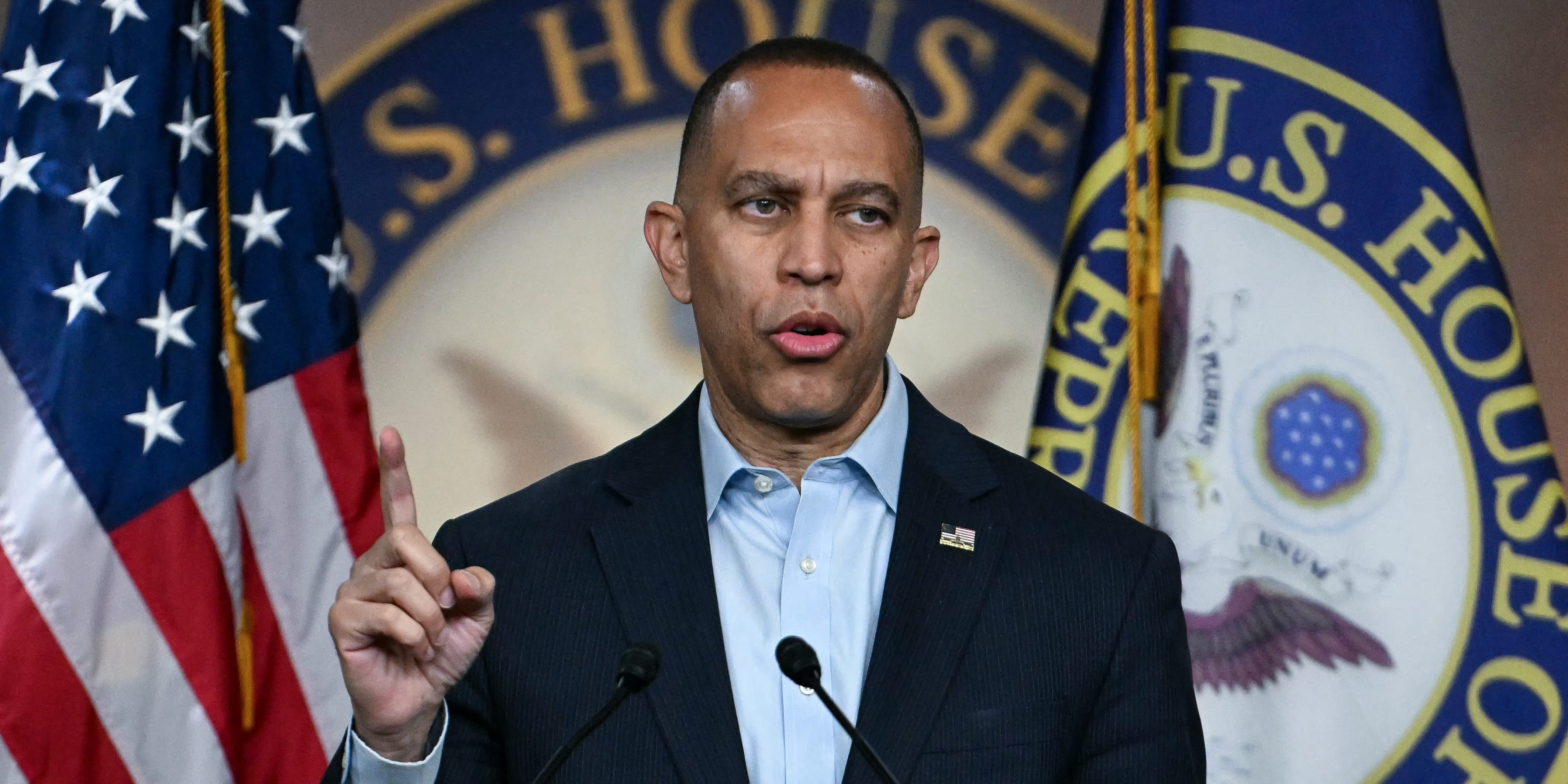
House Minority Leader Hakeem Jeffries, D-N.Y., speaks during a news conference at the Capitol in Washington, D.C., on November 12, 2026.Photo: Jim Watson/AFP via Getty Images
Democrats rolled into Washington this week fresh off a generational sweep election on the promise of affordability for Americans and accountability for the Trump administration.
But on Tuesday night, Democrats in the House failed the first test of their incoming majority. An impeachment resolution introduced Monday by Rep. Thomas Massie, R-Ky., targeting Secretary of War Pete Hegseth, one of the main architects of the U.S.-Israeli war on Iran, provided Republicans with a chance to score an early victory.
House Minority Leader Hakeem Jeffries and the chamber’s Democratic leadership failed to take advantage, as 11 Democrats missed a critical vote that would have kept the resolution alive. The attempt failed by a slim margin, 211 to 204; Massie told The Intercept on Wednesday that even if the missing Democrats showed up he was sure House Speaker Mike Johnson could have rallied his members and made up the difference anyway. Until the new term begins, the chamber is still controlled by the GOP.
Nonetheless, the vote was a chance to send a message to the White House. One was sent: that of a disorganized, dysfunctional caucus. Other Democrats sought to take advantage of the misstep, noting that they were unwilling to miss the vote—Rep. Jasmine Crockett of Texas said she rerouted around traffic, and Rep. Pat Ryan of New York made it the day after back surgery.
“No matter what, I wasn’t going to allow traffic to keep me from that vote,” Crockett told MS NOW. “It was just that important to me.”
When asked about the absences, Rep. Alexandria Ocasio-Cortez, who was present for the vote, offered only “someone may have had a health issue” as an explanation.
House members who missed the vote blamed a number of factors for their absence, including traffic. On Wednesday, all of those same House Democrats save Rep. Haley Stevens (Mich.) began to offer explanations. Rep. Jonathan Jackson (Ill.) told TMZ DC that his “traffic jam”-related absence was “inexcusable.” He wasn’t the only one to blame traffic — Reps. Marilyn Strickland (Wa.) and Laura Gillen (N.Y.) also cited D.C. gridlock as the reason they missed the vote; Rep. Julia Brownley (Calif.) said she was “rushing” to the vote but missed it. Reps. Nancy Pelosi (Calif.), Lou Corea (Calif.), and Frederica Wilson (Fla.) were all out of town.
Momentum lost can’t be regained. If Jeffries doesn’t understand that, he’s not the man for the job.
Rep. Melanie Stansbury (N.M.) offered a front-facing video apology to constituents. Rep. Steven Horsford (Nev.) took “full responsibility” in a floor speech. And Rep. Brittany Pettersen (Colo.) acknowledged that she was at a super PAC event and said there was “no excuse” for missing the vote.
Expressing regret is a good start. It shows these lawmakers are aware that their actions are antithetical to where their voters are at this moment and are adjusting accordingly. It’s not enough.
Leadership was asleep at the wheel. As whip, Rep. Katherine Clark should have kept the caucus in line. (It’s worth noting that Clark officially launched a bid for majority leader last week.) A number of reps who blamed traffic were previously at an event hosted by the group Elect Democratic Women, which receives some of its funding from AIPAC. The event overlapped with the impeachment resolution vote; Clark is a cofounder of the group.
“Republicans just blocked the House from impeaching Pete Hegseth,” Clark posted on X after the vote—failing to take responsibility for her party’s own lack of discipline.
Democrats missing a vote to hold one of the main figures in the war on Iran accountable so they could attend a fundraiser is so tailor-made for progressive complaints over the state of party leadership, it’s hard to believe.
Jeffries tried to spin the vote as only a temporary reprieve for Hegseth, but he didn’t telegraph much willingness about holding his caucus to account.
“I haven’t had a conversation with anyone on the floor team about what may or may not have happened in terms of the Hegseth resolution, but this is not the end of it. It’s just the beginning,” he told Politico. Most critically, he accepted no responsibility for the stunningly bad optics of having members of his caucus no-show, even if it likely wouldn’t have moved the needle.
This never should have happened in the first place. It was the result of a series of decisions by Jeffries and Clark about the vote that made clear it wasn’t important.
Momentum lost can’t be regained. If Jeffries doesn’t understand that, he’s not the man for the job purely on tactical grounds, and he should lay no claim to being a party standard-bearer to steer us through the next two years of Trump’s America.
Jeffries and his party seem doomed to repeat the past. In 2009, when President Barack Obama came into the White House on the back of a change election that gave Democrats huge majorities in Congress, including a filibuster-proof supermajority in the Senate, the party hobbled itself out of the gate by preemptively declining to pursue justice for the many crimes of eight straight years of George W. Bush.
“We need to look forward as opposed to looking backwards,” Obama told ABC News’s George Stephanopoulos in January 2009, effectively ending any hope of accountability for the outgoing administration’s torture program and myriad other misdeeds. The ramifications of that decision arguably led to the war on Iran, a bipartisan immigration-deportation regime, and the end of Roe.
Democratic voters don’t want the party to rest on its laurels, they want blood.
Now, with a Republican president who is hated even more than W—something that would have seemed impossible to imagine almost 18 years ago—the Democratic Party’s establishment wing appears ready to repeat those failures. Taking on Trump and his corrupt, violent administration was one of the main messages that flipped House and Senate seats across the country but the party’s current leaders are allergic to action.
Entrenched Democrats also don’t seem interested in any sort of accountability. Stevens, the Michigan Democrat who broke ranks with her party and endorsed Republican Mike Rogers for Senate rather than back Abdul El-Sayed, was under pressure in the days before and after the election, with even establishment kingmaker Rep. Jim Clyburn signaling openness to expelling her from the caucus. By Tuesday morning, Pelosi — always in touch with party leadership — seemed to throw cold water on the idea: “I’m not supporting kicking her out…. Let’s focus on the very positive.”
This is such a complete misunderstanding of the mood of the electorate, one wonders if it’s intentionally obtuse. Democratic voters don’t want the party to rest on its laurels, they want blood. Anyone who’s been to a liberal rally since the start of the second Trump term can tell you that the signage is calling for, at minimum, accountability, not immediate compromise.
If Democrats rubber-stamp Jeffries as speaker and fail to adopt a more aggressive legislative and investigative approach, frustrations within the caucus and among the base will only continue to mount.
Jeffries is downplaying dissent, but this is more than just a battle between two wings of the Democratic Party. Democrats in New York have been looking to unseat the leader for years, frustrated with his closeness to AIPAC and financial institutions. He’s the kind of Democrat the base is fed up with, and that exasperation is widespread; polling shows just how deeply unpopular he is.
There is an alternative gaining steam: Rep. Ayanna Pressley, the Massachusetts progressive and member of the original “Squad” who were first elected in 2018. Pressley has an uphill battle and has not yet announced that she’s interested in the job. The left is interested.
Voters gave Democrats a clear mandate on Election Day for what they want to see in Washington. Holding this administration accountable should be one of the top priorities. If the party fails to do all it can to advance that goal, it will once again earn its reputation for preferring failure to action. We should all push the next Congress to act as the exception to that rule—and they can start by picking a new speaker to meet the moment.
The Trump administration is preparing to kick nearly 80,000 people, about half of them children, off federal housing assistance over their family’s immigration status, threatening to drive thousands into homelessness.
On Thursday, the Department of Housing and Urban Development published a final rule that’s on track to effectively bar families of mixed immigration status from receiving most federal housing assistance, which allow people to receive housing vouchers to reside in privately owned rental homes or in government-owned or -assisted public housing units.
As it stands, undocumented immigrants and temporary non-residents in the United States already are barred from personally receiving most forms of federal housing assistance. But if some members of the family are eligible, the eligible members can receive prorated assistance to help cover their housing, and the non-eligible family member can live with them.
The new rule, which goes into effect in mid-December, would disqualify an entire family if one member is ineligible after a temporary grace period, forcing them to choose between separation and eviction.
Families are “going to be faced with the impossible choice of deciding whether they want to split up so that some people can stay housed, or to stay together and risk homelessness and eviction,” said Marie Claire Tran-Leung, Evictions Initiative Project director at the National Housing Law Project.
Children will bear a disproportionate burden, Tran-Leung said. Of the nearly 80,000 people who could be affected, according to estimates from Center on Budget and Policy Priorities, nearly 37,000 are children.
Of the nearly 80,000 people who could be affected, nearly 37,000 are children.
Many families have one parent who doesn’t qualify, one parent who’s a citizen or otherwise eligible immigrant — i.e. a permanent resident — and kids who hold U.S. citizenship. According to Tran-Leung, the typical mixed-status family in HUD housing is a family of four that fits that profile.
This rule is “going to tear families apart and take adults away from their children,” said Deborah Thrope, chief program officer at the National Housing Law Project.
Beyond potentially leaving tens of thousands of families and children homeless or separated, the change could cost the already beleaguered federal housing agency hundreds of millions of dollars, housing experts told The Intercept. This would likely worsen conditions across the board for the roughly 9 million people in federal housing, who would now be subject to onerous documentation requirements.
“The impacts are not just limited to mixed-status families,” said Renee Williams, senior advisor for public policy at the National Low Income Housing Coalition.
This rule is “going to tear families apart and take adults away from their children.”
Currently, both U.S. citizens and non-citizens are required to submit a declaration under penalty of perjury attesting that their citizenship or immigration status makes them eligible for housing assistance. Non-citizens under age 62 must submit a document that proves their immigration status. And additional documentation can be requested by local housing agencies or landlords.
The rule change would upend the current system. U.S. citizens would have to go through the Systematic Alien Verification for Entitlements program, also known as SAVE, to verify their eligibility status.
“It’s a system that hasn’t been used to verify citizenship before but now is because of the work that DHS and DOGE did together on a very expedited timeline at the beginning of the Trump administration,” said Tran-Leung. “This causes a lot of concern for us about the very significant risks of residents who are citizens being caught up in verification issues and potentially losing their housing.”
If SAVE cannot verify someone’s eligibility, the new rule requires the person to provide documentation proving their status. The rule would give families 30 days to obtain evidence of immigration status, in addition to the initial 30-day grace period where families can receive pro-rated assistance before having to go through verification.
Tran-Leung and other experts worry that the new documentation requirements could make it harder for low-income tenants — particularly older immigrants over the age of 62, who were previously exempted from verification requirements — to access the program.
Older people, low-income people, and people who’ve experienced homelessness are far more likely to lack access to proof of citizenship such as a passport, valid photo ID, or birth certificate. That means an untold number of the millions of eligible people in federal housing programs could lose assistance just for lack of documentation.
“For folks who may not have easy documentation accessible, who may not have access to a birth certificate, who may not have access to a passport, we’re really worried,” said Williams.
The changes would also burden housing agencies financially by requiring their staff to review documents that were previously not required by federal law.
It is unclear just how expensive these additional administrative costs will be for HUD. But an analysis from HUD itself found that because mixed-status families receive assistance prorated, it would cost the federal government $300 million in additional funds to serve the same number of families as it does now.
For example, a family of four with one ineligible member currently receives 75% of a full household subsidy. A family of four that is not mixed status receives 100% of the subsidy, making it more expensive for the agency to house the non-mixed-status family even though the two families have the same number of people.
“At the same time, HUD is requesting fewer funds from Congress to end homelessness,” said Kayla Blackwell, senior housing policy analyst at the National Low Income Housing Coalition. President Donald Trump recently proposed cutting $3.8 billion from the agency’s affordable housing, homelessness, and community development programs.
HUD Secretary Scott Turner has justified the rule by claiming that mixed-status families are “pushing aside hardworking U.S. citizens” for housing. But experts said the changes will make the system worse for everyone.
“This is scapegoating immigrant families, and HUD is doing less,” said Blackwell.
For the families who either are forced out of the program or leave willingly due to fears around their status, the road ahead is difficult. The majority of mixed-status families live in California, Texas, and New York, where the cost of living can be incredibly high.
“It’s going to be really difficult, I think, for families to be able to stay in their communities and not be displaced if they lose their access to HUD assistance,” said Blackwell.
As a lawyer on President Donald Trump’s 2024 reelection bid, Gary Lawkowski filed a complaint against the Washington Post for supposedly making an in-kind contribution to the Kamala Harris campaign by buying social media advertising for its articles.
In the White House, he played a pivotal role in the pardons process that rewarded Trump cronies and donors.
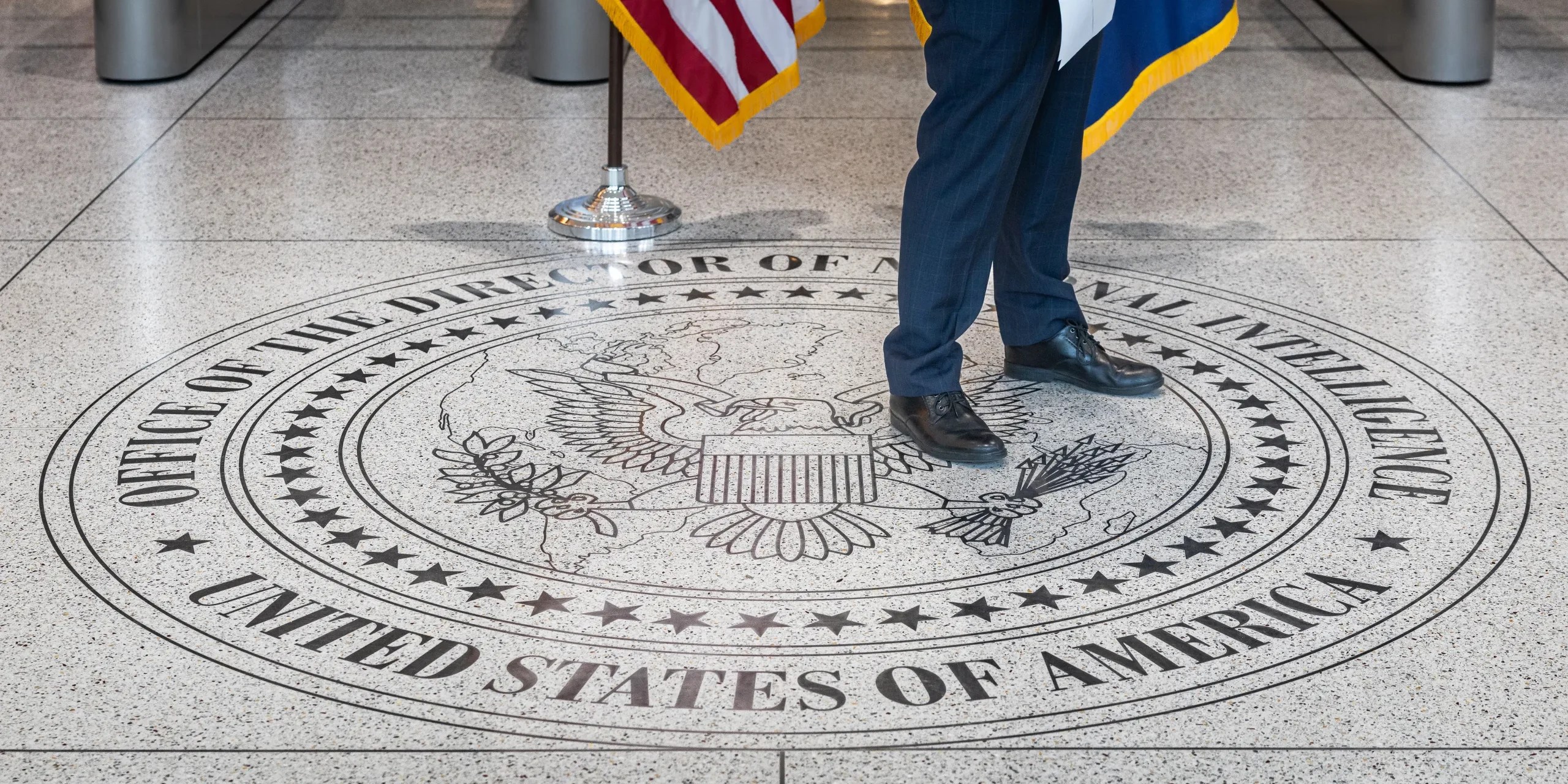
Now, Lawkowski could serve in an obscure but crucial role within the nation’s top intelligence agency, the Office of the Director of National Intelligence. On Monday, Trump nominated Lawkowski to serve as general counsel of ODNI.
It is unclear when Lawkowski will appear before a confirmation hearing or whether Democrats will look favorably upon him when they take control of the Senate in January. His nomination is already drawing pushback, however, from a progressive group that says it represents another attempt to politicize the ODNI after Trump’s bid to install loyalist Bill Pulte as its director fizzled.
“Lawkowski has been a key player in Trump’s corrupt pardon scheme and his nomination tells us that the administration is trying to stack the intelligence community with cronies so they can further weaponize it against their perceived political opponents and innocent Americans,” Hajar Hammado, senior policy adviser at Demand Progress, said in a statement. “Senators must oppose his nomination.”
The ODNI is a relatively small agency, and it doesn’t hoover up its own raw data. As the only intelligence body operating at the Cabinet level, however, it is tasked with coordinating and overseeing intelligence collection and analysis at other spy agencies like the CIA and National Security Agency.
The general counsel plays an important role in interpreting spying law — meaning that Lawkowski could either facilitate or block intelligence community abuses.
In recent months, Trump has displayed an unusual interest in the ODNI, installing housing czar Pulte to replace Gabbard before bipartisan pushback forced him to tap former prosecutor Jay Clayton as a permanent replacement.
In his current role at the White House, Lawkowski serves as deputy assistant and deputy counsel to the president, according to his most recent ethics disclosure, and it is unclear whether he has relevant national security experience.
There is ample evidence that he is a loyalist to Trump. As a lawyer on the Trump campaign, he blasted off a complaint to the Federal Election Commission claiming that the Washington Post’s online advertisements about stories on Trump represented an in-kind contribution to Harris’s campaign. Campaign finance law experts said the claim was baseless. Lawkowski also represented Trump in litigation over the January 6, 2021, attack on the Capitol.
In the White House, he has helped decide who does and does not receive pardons, according to reporting last year in the New York Times. Under Trump, the White House has asserted authority over a pardons process that traditionally flowed through the Department of Justice.
Trump’s blanket clemency for January 6, 2021, insurrectionists preceded a parade of pardons for people who donated to his campaign or causes, or Republican officials who had been convicted of corruption, drawing widespread criticism.
One of the many who received a Trump pardon was former Tennessee state senator Brian Kelsey, who had been represented by Lawkowski before the lawyer went to the White House. Lawkowski did not respond to a request for comment on whether he recused himself from that pardon.
It is unclear whether Senate Select Committee on Intelligence Chair Tom Cotton, R-Ark., will push to have Lawkowski confirmed before the next Senate is sworn in on January 3. The Senate is dealing with a cramped calendar before the end of the year. (Cotton’s office declined to comment.)
The likely incoming intelligence chair, Sen. Mark Warner, D-Va., was harshly critical of Trump’s temporary appointment of Pulte at the ODNI. He ultimately voted against Clayton’s nomination after touting him as a more acceptable alternative to Pulte. (Warner’s office did not respond to a request for comment.)
Lawkowski was tapped to replace John “Jack” Dever, who was confirmed by the Senate to serve as general counsel a little over a year ago. Dever joined the government-backed mortgage finance company Freddie Mac as its executive counsel and vice president in September, according to its website. (Dever left the ODNI with Director Jay Clayton’s blessing and remains well-respected at the agency, an ODNI spokesperson said.)
Dever’s resume included extensive work in the national security realm as a Korean linguist for the U.S. Army, an assistance general counsel at the FBI, and a counter-terror prosecutor in Illinois.
Self-styled Secretary of War Pete Hegseth narrowly avoided impeachment Tuesday night, as solidarity from House Republicans blocked a bill introduced by Rep. Thomas Massie, R-Ky., charging Hegseth with “high crimes and misdemeanors.”
Though Democrats overwhelmingly joined Massie’s effort following their midterm election landslide, the House voted 211 to 204 to refer the charges to a committee, allowing Republicans to slow the process. With 11 Democrats absent, they lacked the numbers. Massie, however, dismissed the impact of Democratic absences to The Intercept. “No, there were enough Republicans to rally to get here,” he said.
The procedural vote spared Republicans a more difficult vote on whether to impeach Hegseth on Massie’s eight charges, including waging wars without congressional authorization and undercutting measures to prevent civilian casualties. It followed a week of increasingly desperate efforts by the Pentagon chief to shore up congressional and White House support, including a campaign-style video intended to influence Trump, a social media campaign by underlings, and a rare appearance by Hegseth himself before the Pentagon press corps.
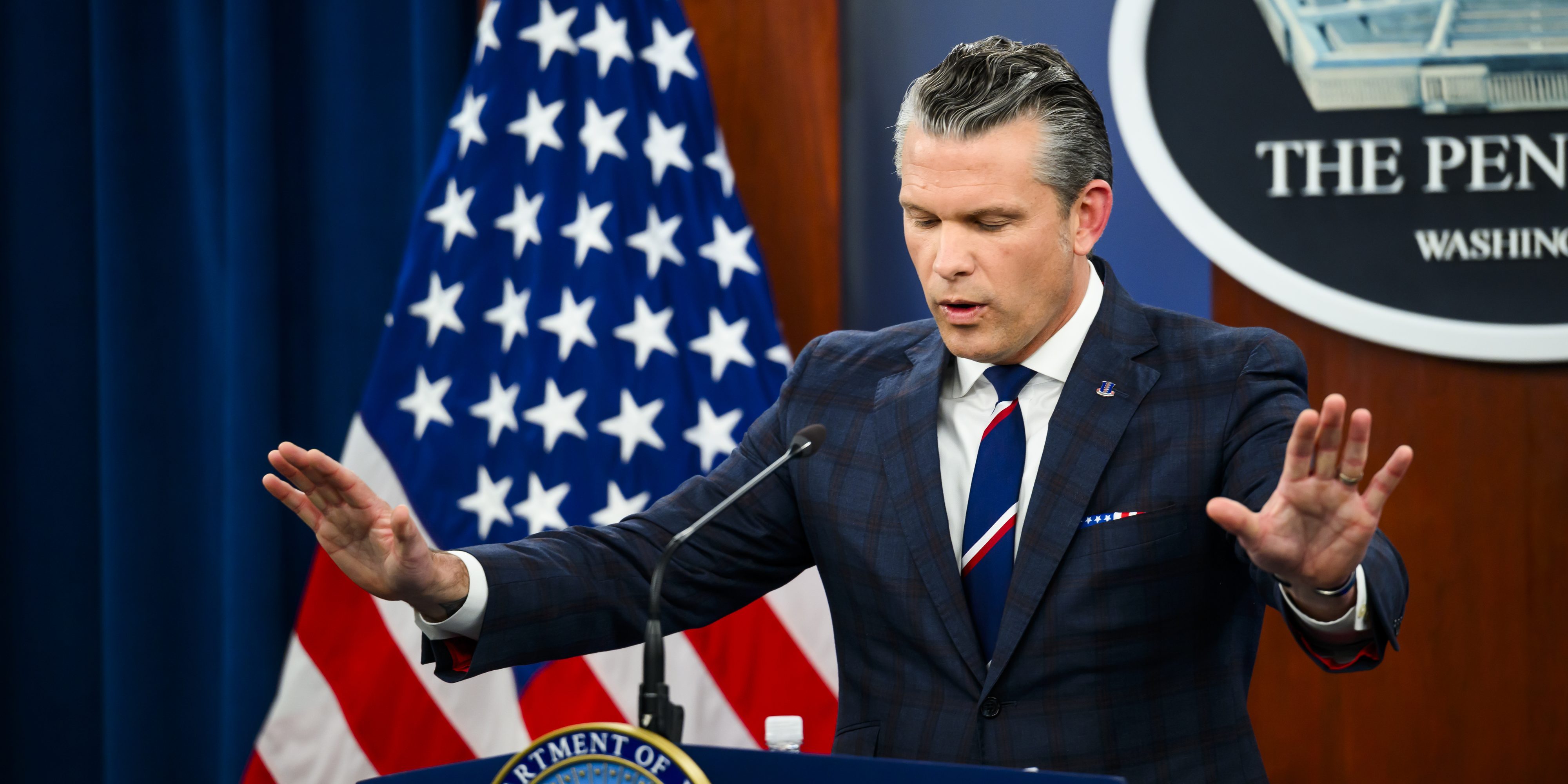
For half an hour on Tuesday morning’s news conference, Hegseth wove a web of lies designed to refute or obfuscate Massie’s eight charges. He claimed that the effort to impeach him was a stunt by just “one disgruntled congressman.” That, too, turned out to be false as 203 members of Congress voted with Massie.
On Tuesday, a coalition of more than 40 civil society organizations — including Oxfam America, Citizens for Responsibility and Ethics in Washington (CREW), Common Defense, Demand Progress, MoveOn, and the Quincy Institute for Responsible Statecraft — sent a letter calling on all House members to vote for every article of impeachment filed against Hegseth.
“Pete Hegseth’s time at the Pentagon has done grievous harm to the nation and to the Constitution,” said Demand Progress senior policy adviser Cavan Kharrazian. “This is a man who ignored the will of Congress to execute an illegal war in Iran, kidnapped a foreign leader for oil, restarted war on Yemen, sent missiles to kill suspected drug traffickers and weaponized the Pentagon against a political enemy.”
The House has only impeached two Cabinet secretaries: William Belknap, the secretary of war, in 1876; and Alejandro Mayorkas, the secretary of homeland security, in 2024. In neither case did the Senate vote to convict.
“They diagnosed why they lost the election. But tonight they were paralyzed to do anything about it.”
After the vote, Massie called out the display of inaction from his Republican colleagues.
“They diagnosed why they lost the election,” Massie said of fellow Republicans, following the vote on Tuesday night. “But tonight they were paralyzed to do anything about it. And that’s the story of Congress.”
Absent from the vote were Democratic Reps. Julia Brownley, Lou Correa and Nancy Pelosi, of California; Laura Gillen of New York; Steven Horsford of Nevada; Jonathan Jackson of Illinois; Brittany Pettersen of Colorado; Melanie Stansbury of New Mexico; Haley Stevens of Michigan; Marilyn Strickland of Washington; and Frederica Wilson of Florida. The absent Republicans were Reps. Monica De La Cruz of Texas; Neal Dunn of Florida; Russell Fry of South Carolina; Julia Letlow of Louisiana; Tom Tiffany and Derrick Van Orden of Wisconsin; and Rudy Yakym of Indiana.
A senior congressional staffer predicted that Hegseth would face a very rough road if he survived impeachment. “Oversight is going to come crashing down on his head,” that staffer said. “Will Hegseth continue to obstruct? Yes. But wait until the subpoenas start.”
Congressional committees have broad investigative powers, including the authority to subpoena administration officials to testify under oath and compel them to turn over documents. Rep. Adam Smith, D-Wash., who will head the House Armed Services Committee in the next Congress, said Hegseth and Deputy Secretary of Defense Steve Feinberg would be first on the list to testify.
Rep. Yassamin Ansari, D-Ariz., one of the leading voices for Hegseth’s impeachment, told The Intercept there were “many ways” for Democrats to hold him accountable in the next session, specifically compelling him to testify before the American people. “I would be surprised to see him last the next two years in this administration,” she told The Intercept. “I think that he is not only one of the most incompetent members of the administration, but also the most unpopular — and it’s on a bipartisan basis. So the pressure will continue to grow for there to be some change at the Pentagon.”
“I want Pete Hegseth not just impeached, I want him prosecuted.”
Rep.-elect Richard Ojeda, D-N.C., told The Intercept that the incoming Democrats have Hegseth in their sights. “I want Pete Hegseth not just impeached, I want him prosecuted. They murdered people in the Caribbean. And we killed 163 little girls in Iran,” he said. “Everybody in my class is ready for him to go. We tried it. It didn’t work. We’ll do it again.”
In a Truth Social post, President Donald Trump celebrated the outcome while expressing confusion over the vote. Trump called it the “Democrats’ attempt to impeach” Hegseth, despite the fact the effort was introduced by Massie, a Republican, who he called “a major LOSER.” He claimed it was an “EXONERATION” of Hegseth and added: “The Democrats continue to weaponize and abuse the United States of America. They must be stopped!”
On the eve of a House impeachment vote, self-styled Secretary of War Pete Hegseth made a rare appearance before the Pentagon press corps. Over half an hour, he declared every military operation he has overseen “lawful” and claims of civilian harm “slander.” He said the Iran war was a great victory and only 18 Americans have died in the conflict. He also claimed that the effort to impeach him was a stunt by just “one disgruntled congressman.”
None of it is true.
Rep. Thomas Massie, R-Ky., introduced articles of impeachment on the House floor Monday afternoon, charging Hegseth with “high crimes and misdemeanors.” Democrats are overwhelmingly expected to join Massie’s effort following their midterm election landslide. “I am a hard yes on the Hegseth resolution,” said Rep. Hakeem Jeffries of New York, the presumed next House speaker.
Massie wrote on X that if his impeachment resolution advances Tuesday evening, he will request a separate vote on each of the eight articles. “I’ve heard from several members they agree with some of the Articles of Impeachment but not all of them,” Massie wrote. “If the motion to kill my resolution by referring it to committee fails, and we proceed to the Articles themselves, I’ll request a vote on each of the Articles separately.”
As Hegseth steels himself for a vote that could see him put on trial in the Senate and sink his chances of serving for the rest of Trump’s term, The Intercept is dissecting his self-defense and examining Hegseth’s false claims about his disastrous war-making.
Everything Was “Lawful” and “Notified to Congress”
“Iran, the cartels, Maduro, Yemen — every one was a lawful operation ordered by the commander-in-chief, then ordered by myself, notified to Congress, and executed by American warriors who did their jobs.”
Experts in the laws of war, a Pentagon official, and members of Congress from both parties say Hegseth’s boat strikes against “cartels,” which have now killed upward of 240 people, are illegal extrajudicial killings. The military is not permitted to deliberately target civilians — even suspected criminals — who do not pose an imminent threat of violence.
Sarah Harrison, who previously advised Pentagon policymakers on issues related to human rights and the law of war, said that the attack on Venezuela was also a clear violation of international law and that the administration’s justifications for the raid were baseless.
Of the Iran war, Air Force Lt. Col. Rachel VanLandingham, a former chief of international law at U.S. Central Command, said the opening strike “clearly violates the U.S. Constitution and the War Powers Resolution,” which requires the president to seek congressional approval to start a war in most cases. Harrison Mann, a former U.S. Army officer and intelligence official and now the associate director for campaigns and policy at Win Without War, drew specific attention to the attacks on the bridges and water reservoirs in Iran. It is “quite dangerous to be conditioning the U.S. military to carry out orders that are clearly war crimes,” he warned.
Hegseth’s claims about notifications are also spurious. Congress never authorized the Iran war, and a call to the congressional “Gang of Eight” the night before is not the formal report experts say the law requires. Following the January attack on Venezuela, Republicans privately complained they were not told in advance.
“The Terrorists That We Hunt”
“As to the claim that the American military targets civilians, well, that is a lie and that is a slander against every professional who flew, sailed, and fought on these missions. The only people who target civilians are the terrorists that we hunt.”
The U.S. boat strike campaign has only targeted civilians. The summary executions of more than 240 people are a significant departure from standard practice in the long-running U.S. war on drugs, in which law enforcement agencies detained suspected drug smugglers and brought them to trial on criminal charges.
A U.S. military investigation also found U.S. forces attacked an elementary school in Minab, Iran, killing more than 150 people, most of them children. One official called it “colossal negligence.”
For months, Central Command has failed to answer questions about additional civilian casualties, including eight members of a family — the youngest, a 20-day-old infant — killed in an attack documented in an Intercept investigation.
These attacks came after Hegseth conducted a comprehensive campaign to undermine efforts to prevent and mitigate civilian harm. The Pentagon’s Civilian Protection Center of Excellence, for example, slashed its staff from 40 personnel in January 2025 to just nine by the end of the year, according to the report.
“Dead Where They Should Be”
“More than 70 narco vessels sunk. 218 narco-terrorists dead where they should be. Maritime smuggling down at least 65 percent and dropping even further.”
Hegseth misstates the toll of his own boat strike campaign. The Intercept’s tracker counts 72 strikes and at least 243 dead. Sen. Tim Kaine, D-Va., after reviewing classified material, wrote that the evidence suggests the military killed people not involved in drug trafficking. A top Pentagon Joint Staff official told lawmakers in a classified briefing that victims of human trafficking could be among the dead of the first strike.
The drug claims fare no better. Deputy Assistant Secretary of War for Americas Security Affairs Joseph Humire, for example, offered completely different numbers to Congress, telling the House Armed Services Committee in March that there “has been a 20 percent reduction of movements of drug vessels in the Caribbean and an additional 25 percent reduction in the Eastern Pacific.”
The Pentagon’s latest civilian casualty report, meanwhile, claims no civilians were killed in the boat strikes. One U.S. official said it had “absolutely no credibility.”
Iran Was a “Historic Military Victory”
“By every measure, we achieved a historic military victory. Under 40 days of sustained combat…”
The Iran war, by all objective measures, is an abject failure. The conflict undermined the decades-old U.S. security framework, as well as America’s archipelago of bases, in the Middle East. Iran determined how to overwhelm U.S. air defenses, offering up a playbook for U.S. adversaries around the world. This, in turn, damaged U.S. military security across the globe. From Jordan to Kuwait to the United Kingdom, U.S. outposts are now increasingly vulnerable to attack. As a result, the Iran war has left the military on the brink of a “breakdown.”
The Trump administration’s attempt to rebrand its faltering forever war hasn’t slowed the mounting toll of U.S. casualties, either. While Hegseth focused on the conflict’s first 40 days, the U.S. has suffered more casualties as a result of the conflict since the war formally ended and, in July, underwent a name change to “Overseas Operations.”
Voters did not see a victory either: About 6 in 10 told The Associated Press the war was the wrong decision, and Vice President JD Vance agreed, writing of the GOP’s crushing defeat in last week’s midterms: “The reason we lost is the war.”
18 Americans
“Eighteen Americans have given their lives in Operation Epic Fury.”
Hegseth spent his rare press conference using the troops under his leadership as a shield, claiming that indictments of him were actually indictments of them. When not using them for cover, Hegseth praised them. “They are the best of our nation. Like the president, I will defend them with every fiber of my being every single day,” he crowed.
What he didn’t care enough to do was offer an accurate count of the war’s toll. The official Pentagon count of deaths during Epic Fury is 15, not 18 — but that’s misdirection at best and a lie at worst. At least 23 military personnel have died in Operation Epic Fury and “Overseas Operations,” the new moniker for the war introduced in July, according to the Pentagon’s official count. (This includes 11 killed by hostile fire.) The actual number of troop deaths in the region since the war began is higher.
“One Disgruntled Congressman”
“This is one disgruntled guy who drew up some really flimsy articles.”
In Hegseth’s telling, Massie is pursuing his impeachment out of resentment over the loss of his Kentucky congressional seat to Trump-backed far-right candidate Ed Gallrein, a former Navy SEAL. But Massie’s impeachment effort has strong bipartisan support. The entire House Democratic caucus is widely expected to vote in favor of the impeachment effort. While no House Republicans aside from Massie have openly committed to voting yes, the outgoing congressman said Monday that he believes “several” Republicans will vote for the measure.
Republican Texas Sen. Ted Cruz agreed. So did Rep. Yassamin Ansari, D-Ariz., one of the leading voices for Hegseth’s impeachment. “I think there’s a high chance that it will be successful,” she told The Intercept of Massie’s effort. In April, Ansari filed six articles of impeachment against Hegseth, including violations of the law of armed conflict and targeting of civilians, abuse of power, and obstructing congressional oversight.
Discontent with Hegseth is widespread within the military establishment as well. The Intercept recently spoke with six current and former defense officials who said Hegseth had undermined the rule of law; irreparably harmed the U.S. military through purges of top commanders; spurred religious extremism; and diminished the department he leads due to an almost endless raft of scandals and culture-war clownishness. In fact, 64 percent of active-duty service members, veterans, and military families disapprove of Hegseth, according to a recent poll conducted by Common Defense, a grassroots veterans organization.
The American people, writ large, appear to agree with Ansari, Massie, the U.S. officials, and those in the military’s orbit. Just 32 percent of voters approve of the way Hegseth is handling his job, while 57 percent disapprove, according to a Quinnipiac University poll in September.
Since the start of the year, the prediction betting site Kalshi has two hired former officials from Joe Biden’s White House as a policy adviser and a top lobbyist.
The company’s co-founders have also spent nearly $1 million on donations to federal candidates, with more than a third, or $377,000, going to Democrats like Sen. Kirsten Gillibrand, D-N.Y., according to a new report.
Kalshi’s spending spree shows how much prediction market sites have ratcheted up their presence in Washington as regulators craft rules for the industry. While the sites’ close relationship with the Trump administration has drawn headlines, the report from the progressive group Demand Progress details how the industry’s influence operation crosses party lines.
“They’ve been hopeful that they can have Democratic champions for their policy agenda.”
The push for bipartisan relationships began months ago, but it could pay dividends as Democrats take over both chambers of a Congress, said Ella Fanger, the corporate power policy adviser for Demand Progress. A betting market critic, Fanger predicted that the companies will keep trying to win allies on both sides of the aisle.
“They’ve been hopeful that they can have Democratic champions for their policy agenda,” she said, “and not just have Trump’s cronies sticking out their necks for them.”
The hiring spree of former Biden officials and spending on Democratic candidates come as prediction markets are facing increasing scrutiny over betting on elections and a spate of suspicious trades from Washington about policy moves and even military action.
On Tuesday, Democrats on Capitol Hill called for Trump to bar White House staffers from using the betting sites and, with Democrats taking Congress, many observers expect investigations into their use in Washington.
In a statement, Kalshi said it was willing to work “across the ideological spectrum.”
“Kalshi has had substantive conversations with policymakers over the past year regarding legislation that protects consumers, keeps minors off our platform, makes insider trading bans standard across the industry, and ensures the CFTC” — the Commodity Futures Trading Commission — “has the resources they need,” said the company’s head of government relations, John Bivona, a former Democratic congressional staffer and Biden White House official.
“We’ve come out in support of legislation introduced by members across the ideological spectrum,” Bivona said, “and we’ve worked with dozens of lawmakers from both parties on these priorities.”
Hiring Republicans — and Dems
Kalshi and its rival Polymarket are the dominant players in the prediction market industry, which has flourished since Donald Trump became president thanks to his administration’s hands-off approach to regulation.
The ties between the prediction betting sites and Trumpworld go all the way to the president’s inner circle, as evidenced by Donald Trump Jr.’s financial stakes at both competitors.
Polymarket has also hired as a lobbyist a Republican former top official at the Commodity Futures Trading Commission. The federal regulatory body has, under the Trump administration, sued states for trying to regulate sports betting as gambling.
The Demand Progress report covers Trump Jr.’s ties to the industry, but it also shines a light on the role of former Democratic congressional and executive branch staffers.
Kalshi’s hires have tended toward establishment Democrats. Among them are Stephanie Cutter, a political strategist whose work spanned the Obama and Biden administrations as well as Kamala Harris’s campaign for president. Cutter was tapped as a policy adviser for Kalshi in April. Bivona was hired by Kalshi as its head of government relations in January.
Tripled Lobbying Spend
Overall, Kalshi has spent $1.8 million on lobbying in the first half of 2026, compared to $615,000 in all of 2025, according to the Demand Progress report.
Polymarket spent a relatively meager $180,000 during the same period this year, compared to $360,000 last year.
“It’s important for states to be able to regulate this industry as gambling, which is what it is.”
Fanger, whose group is critical of the prediction markets’ attempts to neutralize state sports gambling regulators, said she is worried that a pliant Congress could approve the Trump administration’s favorable regulations.
“The concern is basically just that we could get legislation that would codify the rulemaking that the CFTC has already begun,” she said, referring to the agency’s efforts to formally exercise jurisdiction over sports, political, cultural, and weather betting contracts. “And we think that it’s important for states to be able to regulate this industry as gambling, which is what it is.”
The industry may need all the lobbyists it can get if progressives gain power in the next Congress. Rep. Maxine Waters, D-Calif., who is angling to chair the House Financial Services Committee, said in a letter last week that she wants to “rein in predatory lending and predatory platforms, including prediction markets, so that our constituents keep more of their hard-earned dollars in their pockets.”
Waters is also a longtime foil to the crypto industry. Crypto currency interests alienated Democrats by spending tens of millions of campaign dollars on Republican Sen. Jon Husted of Ohio, who lost his seat to Democrat Sherrod Brown in the midterm election.
While crypto has lavished money on campaign spending through a super PAC, the prediction market industry has opted for a quieter campaign of smaller donations routed through more traditional channels.
On paper, the second-largest city in the country has its first democratic socialist mayor.
Los Angeles City Councilmember Nithya Raman declared victory on Thursday over the embattled incumbent Karen Bass, joining a list of socialist mayors who have risen to power in recent years, including Zohran Mamdani in New York; Seattle’s Katie Wilson; and most recently Janeese Lewis George in Washington, D.C., who won in a landslide this week.
Raman, however, did not campaign unabashedly as a socialist. Though she ran as an endorsed member of the Democratic Socialists of America’s Los Angeles chapter, the national DSA threatened to override the local chapter and rescind the endorsement over concerns around her stances on Israel and Palestine.
Unlike her counterpart in New York, to whom she drawsmostcomparisons, Raman did not make sweeping socialist promises, such as free public transit, universal childcare, or taxing the rich. Instead, she focused on what’s wrong with the city. Riding a wave of resentment for Bass’s alleged mismanagements of the Palisades fire and the Lineage Logistics warehouse fire in Boyle Heights, Raman talked about filling potholes, fixing street lights, and making roads safer for pedestrians and cyclists.
In addition to DSA-LA support, she earned the endorsements of popular anti-corruption City Controller Kenneth Mejia and Unite Here 11, a major local hospitality workers union, whose large membership canvassed for her in the general. But she lacked endorsements from most key labor groups and social justice nonprofits, and the organizing base they provide. Her fellow DSA members on the Los Angeles City Council all pulled for Bass, forcing Raman to battle back the perception that she struggles to build coalitions.
While Mamdani, 10 months into his term, now finds himself under pressure from New York’s left for refusing to fire NYPD’s police commissioner, his massive base of organizer support offers a buffer to criticism. Raman won over the city’s voters, but it’s not clear how much time that will buy her to tackle the city’s most vexing problems once she takes office.
“Folks in New York are willing to cut Mamdani more slack on the movement side, because he was one of them on a bunch of issues,” said David Levitus, executive director of LA Forward, a progressive nonprofit that endorsed Raman in the general election. ”I think Nithya” — who did not come from the ranks of DSA organizing like Mamdani — “has more skepticism from parts of the left because of that.”
Raman will face scrutiny from LA’s progressive left on a host of issues: bloated police department spending amounting to roughly a quarter of the city’s nearly $15 billion budget; fear of collaboration between ICE and law enforcement agencies; the 2028 Olympics prompting an expansion of surveillance; rising homelessness; and failing infrastructure.
Weeks before the November election, Raman seemed less concerned with movement-based allegiances or ideological labels, saying she is “a capitalist and I’m also a democratic socialist.” Before the primary in June, she said she was “one of the most independent voices in City Hall” when asked about her membership with DSA. The statements and her votes in city council have prompted intense debate among DSA-LA’s members over whether Raman holds up to democratic socialist ideals.
While most Angelenos do not care about such fine distinctions, Raman’s measured embrace of socialist mantle has created among some activists the perception of a more responsive audience in city hall compared to previous administrations. Yet to others on LA’s progressive left, Raman’s ideological elusiveness reads as political unreliability.
“I don’t think Nithya Raman is accountable to anyone in the movement,” said Kris Rehl, an activist who volunteered for Raman during her 2020 city council run and now runs the mutual aid group LA Street Care. “If you do not subscribe to any ideology, you can’t be held accountable to it.”
Rehl, who advocates for abolishing anti-camping bans that criminalize homeless encampments near schools and daycares, expressed dismay over Raman’s previous votes on expanding the police department despite running on defunding the police in 2020.
Others like Tal Levy, a member of DSA-LA’s electoral politics committee, remain more optimistic about what Raman can deliver as mayor. While DSA-LA is pushing for reallocating funds from the police budget into social services, Levy sees the value of Raman’s pledge to support LA Forward’s initiative of citywide expansion of unarmed crisis response teams, which divert certain 911 calls to teams of social workers and clinicians, rather than police.
“Even if Nithya were a fire-breathing abolitionist, it would still be a long fight to make those changes,” said Levy, who has been organizing with DSA-LA for nearly a decade. “But I believe there is plenty of room for us to make material wins in the short term.”
Room to Push
While there is debate over how much power DSA-LA has within LA’s political landscape, the group provided Raman additional attention and credibility among leftist voters, which was only bolstered by the successes of other DSA-endorsed candidates in New York and in congressional races across the nation.
The DSA’s National Political Committee, however, spurred one of the biggest public rifts during Raman’s campaign. The committee held a vote to un-endorse Raman over her perceived lack of support for the Palestinian-led Boycott, Divestment, and Sanctions movement, which hadn’t been included by the DSA-LA on its endorsement questionnaire. After a week of debate and dueling resolutions, and an email from Raman, in which she wrote, “the best way for working Angelenos to stand in solidarity with Gaza is through non-violent protest, legislative action, and diplomatic pressure, including BDS,” the national committee decided against rescinding its endorsement of Raman by a narrow margin.
Frances Gill, one of three DSA-LA members on the DSA national political committee, voted against rescinding the group’s endorsement. She opposed the idea of alienating the organization’s second largest chapter as “bad organizing and bad leadership,” especially in a high-profile race when the stakes for the regional and national chapters were so closely intertwined.
“The public ties us to one another,” Gill said of the DSA and Raman, “and there’s not a lot of other key players who have also played such a critical role in her being able to win. So I think that gives us an outsized seat at the table.”
She was a part of the faction among national leadership that instead called for a long-term pressure campaign on Raman on the issue of Israel and Palestine. The group is planning to push Raman on what she can do as mayor to halt the transportation of military hardware that makes its way through the Los Angeles International Airport to Israel. Organizers also plan to call for an end to real estate events in LA facilitating the sale of housing illegally built in the occupied West Bank. They will also examine whether the city itself is invested in companies that are profiting off Israel’s genocide in Gaza and apartheid rule of Palestinians.
“I think there is room to push,” Gill said.
Another major public spat between progressives and Raman took place in January before she announced her candidacy for mayor.
Catching housing advocates by surprise, Raman introduced a motion to reform the city’s “mansion tax” to make exemptions for developers. Raman claimed that the tax, known as Measure ULA, was inadvertently preventing construction of new multi-family housing. Organizers opposed the idea, since the tax generates funds for services to support existing affordable housing and keep people housed, and that carveouts for developers would only fuel displacement of low-income renters, possibly pushing more people to the streets.
LA Forward was among those blindsided by the motion, which she eventually withdrew. Before endorsing Raman, Levitus and the group met with the candidate alongside organizers in an activist’s home.
“She talked about, ‘The times when I’ve succeeded, it’s because I built a coalition, the times when I failed, it’s because I didn’t, and I didn’t bring people along,’” Levitus recalled from the July meeting. “She really owned her mistake. I don’t know how much her mind has changed intellectually about the policy, but think clearly she recognizes that she needed to do something different — and that might lead to her pushing for a policy that is different from what she had pushed for before.”
Police Chief Dilemma
Among Raman’s early tests progressives will be watching for is how she fulfills her pledge to fire LAPD police chief Jim McDonnell. Raman was among the councilmembers who approved his appointment in 2024, despite concerns around his track record of collaborating with ICE as LA County sheriff. She has since said she would fire McDonnell over his response to the ICE raids and his refusal to enforce a state law that banned federal agents from wearing masks.
Yet the pledge to replace McDonnell may present a political quagmire for Raman, given that the mayor in LA cannot unilaterally force out a police chief. The city’s police commission, consisting of five civilians appointed by the mayor, must make that decision. Raman first will need to assemble her own commission, but that process also requires approval from a city council that remains largely supportive of the police department.
William Gude, a vocal police accountability advocate who supported Raman in the election, said he planned to push the mayor to circumvent the process by asking McDonnell to resign. “I’m putting pressure on her from day one,” he said. “There’s some promises that she made, and those promises need to be kept.”
In her first press conference as mayor-elect, Raman sidestepped a question about whether she still planned to fire McDonnell, amid public threats from the police union warning of “Armageddon.” “Public safety is the most important service the city is delivering to its people,” said Raman, noting the chief was one of her first phone calls after winning.
Activist pressure could be a burden for Raman — or a tool she could use to force legislation through a city council she knows well, according to Gude. “Does she want to have activists coming after her, also while battling 15 council members?” said Gude, who goes by @FilmthePoliceLA on social media. “Or would she rather have the activist base going after the council members that are coming after her, to create a buffer, to do a lot of her heavy lifting? It’s a choice she has to make.”
Hamid Khan, who heads the Stop Spying LAPD Coalition, is among those who is closely watching who Raman appoints to her police commission. But he sees Raman’s pledge of firing McDonnell as “a band-aid” for the more glaring structural issues of the department. While crediting Raman’s opposition to automated license plate readers from Flock Safety and Axon, Khan also pointed to Raman’s historic support for expanding the police department.
While in city council, Raman voted to expand LAPD’s budget three times: in 2021, 2022, and 2023. But she also voted against police raises in 2023, and this year, she opposed a plan by Bass to hire 170 more officers. She has said on the campaign trail she does not wish to expand the police budget, but also said she would not cut into it either.
In the span of her time in city council, the LAPD has expanded its surveillance reach, Khan said. The department is slowly unrolling its Real-Time Crime Centers, which meld automated license plate reader technology, social media monitoring software, and CCTV cameras into a constant surveillance tool. He warned such a technology, while marketed to curb retail theft, will disproportionately harm Black and brown Angelenos.
“We have to situate the people’s expectations in Los Angeles that they’re not based upon the comment, ‘I’m gonna fire Jim McDonald,’” said Khan, who advocates for abolishing the budding police outposts. “What does that do? The fundamentals still remain the same.”
A True Outsider
There is a notion among some on the left that Raman is very much a part of the political machine that bred some of LA’s ongoing problems. She has served on city council for five years and was an ally to Bass, having endorsed Bass just weeks before jumping in the race herself. Yet Raman, a Harvard-educated urban planner and former entertainment director of Time’s Up, is in many respects an outsider to the political establishment.
Former City Councilmember Mike Bonin called Raman’s victory a “reordering of the governing class in Los Angeles.” For the past several decades, LA politics has been run by establishment Democrats, such as Bass or her predecessor, Eric Garcetti, son of a former LA County district attorney; the chambers of commerce; lobbyists; longtime city hall staffers; all riding the influence of homeowners.
For Lex Steppling, an organizer with Los Angeles Community Action Network and a critic of Raman’s time in city council, the “political recalibration” with her victory in city hall was a welcome sight.
Steppling grew up in a generation of LA political activists who got their start organizing with Community Coalition, which Bass founded in 1990 and for a long time was the only progressive organization in the city offering paid political work. He watched as his peers grew to leading campaigns on issues such as policing and mass incarceration, then began running for elected office. They brought with them their organizing chops, but also their relationships with the organizations that gave them their start. Steppling described this as a “relational ecosystem,” in which movements would be co-opted into electoral politics — in which scoring political points became more important than addressing the issues.
He blamed the lack of gains on policing and mass incarceration since the 2020 George Floyd uprising on such a relational ecosystem. A victory for Raman could mark a reset to such an establishment, and he hopes activists will capitalize on the opening.
“The right kind of openings to do the right kind of work will reemerge,” said Steppling, who helped lead a successful anti-incarceration measure in 2020. “It’s gonna once again start to be about the demands.”
Raman’s election evoked for Bonin memories of the last time an LA incumbent mayor was ousted. In 2005, then-state Assembly member Antonio Villaraigosa beat James Hahn, becoming the city’s first Latino mayor. Villaraigosa, previously director of Southern California ACLU, was seen as a progressive candidate at the time. That’s not how he governed. An early sign of his establishment politics was hiring a longtime political insider as his chief of staff.
Raman will also signal her governing priorities with the hires for her transition team and cabinet.
Some organizers were encouraged to see progressive figures added to her campaign, such as Faizah Malik, a civil rights attorney and former city council candidate also endorsed by DSA-LA, and Jamie York, an advocate for greater transparency in city politics whose high-profile rejection by the city council as an ethics commission appointee drew public scrutiny. It remains unclear what if any role they would play in city hall.
The LA Times reported that Rick Cole, former deputy mayor, is expected to supervise Raman’s transition team alongside Andrea Conant, Raman’s chief of staff in city council.
“How big is the table,” Bonin said, “and how much of the activist community is at the table?”
Socialists will soon govern three of the United States’ most influential cities: Los Angeles, New York City, and the District of Columbia.
Janeese Lewis George joins Zohran Mamdani and Nithya Raman as part of a new wave of socialist local executives. But unlike Mamdani and Raman, Lewis George will govern a city under federal rule.
D.C. is a “federal district,” subject to the whims and micromanagement of the president and Congress. If the federal government doesn’t like the city’s legislation, it can override it. This poses additional challenges if Lewis George wants to change how things are done in the nation’s capital.
Lewis George, a current D.C. city councilmember, has promised to usher in sweeping reforms centered around affordability, including stronger tenant protections, investments in affordable childcare, and long-sought-after reforms on the city’s restrictive zoning laws. She rose to political prominence as the first socialist on the city council, winning her seat on a platform of defunding the police in the wake of George Floyd and Breonna Taylor protests in 2020. (She has since called for hiring additional Metropolitan Police officers.)
For Lewis George to fulfill her campaign promises is “going to require Janeese to use her position and her longstanding reputation as an organizer to convince members of Congress that we can exercise Home Rule and that we deserve the dignity of any other collective body, like a state, in this country,” said Kurtis Hagans, chair of Metro DC Democratic Socialists of America, which endorsed Lewis George in the primary.
All local D.C. bills are required to go through a congressional review period of 30 working days for civil legislation and 60 working days for criminal bills. If Congress doesn’t like the bill, it can either decide to let that review period lapse, allowing the legislation to go into effect, or pass a joint disapproval resolution in both the House and the Senate. If they pass a disapproval resolution, it goes to the president’s desk, where they can choose to veto and let the new law stand or sign it and override the legislation.
Speaking to The Intercept on Election Day, voters said they supported Lewis George because they wanted to elect someone who would fight for everyday Washingtonians.
“I was certainly motivated by wanting really strong leadership for D.C. and people who are going to put D.C. first, in the sense of the residents and the community members and not solely as our role as the capital city,” said Izetta Mobley, a voter in Ward 4, where Lewis George serves as a councilmember.
For Mobley and other voters, that primarily means tackling issues of affordability. “Affordable housing and the rise in unhoused folks, and making sure that unhoused folks have support and city resources …those were very important to me,” said Mobley.
Although Democrats took both houses of Congress on Tuesday, paving a clearer path for the district to flex its autonomy, Lewis George will still have to contend with Democratic leaders like Chuck Schumer and Hakeem Jeffries, both moderates, who are likely to lead the Senate and the House next session. Schumer and Jeffries were often critical of Mamdani when he was running for mayor in their home state of New York, though they seized primarily on his stance on Israel.
Hagans pointed out that Lewis George has the longtime support of former at-large councilmember Robert White, who was elected as Washington’s non-voting delegate on Tuesday. But Hagans said the DC Metro DSA is also preparing to organize residents to put pressure on Congress, given ”the relative powerlessness of the district in the face of Congress.”
Governing Washington has other pitfalls. The district is hamstrung by the fact that the D.C. Council is required to pass a balanced budget and is prohibited from carrying it over into the following year. (Congress also gets to approve it.) The city is already struggling to close a $1.1 billion budget deficit for the upcoming fiscal year — caused by Congress.
In order to achieve her agenda, Lewis George has suggested raising taxes on businesses and the city’s wealthiest residents. For that, she’ll need the support of the city council.
Lewis George is aided by the fact that Tuesday also ushered in a record number of socialists on the city council, adding two, Aparna Raj and Oye Owolewa. “A big part of the vision for the district is to have these organizers on the council as well as an organizer-in-chief at the executive level,” said Hagans.
Aside from bold economic policies, many voters who spoke to The Intercept said they want the new administration to prioritize resistance to the federal takeover of Washington, D.C., and ending the scourge of Immigration and Customs Enforcement. “We’ve seen ICE raids in our neighborhood, literally where our kids used to go to school,” said Jason Cherkis, another Ward 4 voter. “That’s one reason we voted for Janeese for mayor because she was out front and speaking about ICE in a way our current mayor never did.”
Despite the restrictions placed on a D.C. mayor, immigrant advocacy and civil rights groups concerned about the incursion of ICE in the district are pushing for Lewis George to take a stand.
“We want to see the next mayor doing everything possible to protect these most vulnerable communities from continued attacks,” said Peggy Ramin, policy counsel at the American Civil Liberties Union of the District of Columbia. “Whether that is legislation or the mayor ensuring that the administration’s agencies are well educated as to what that means in terms of limiting cooperation and even prohibiting cooperation.”
In particular, Ramin said that her organization is calling on the D.C. council and Lewis George to pass legislation that would allow residents to sue any officer — local or federal — who violates constitutional rights.
Ramin is aware of the challenges facing the district to pass this type of legislation without incurring interference from Congress or President Donald Trump — who has personally vowed to oppose Lewis George.
“No matter what Congress ends up doing, whether it disapproves or passes a disapproval resolution or not, I think people here in D.C. are really demanding and asking our council to step up and pass this sort of legislation,” said Ramin.
Aside from federal immigration officials, residents also complained about the National Guard, whose presence was felt even on Election Day. “I have two boys, Black men,” said one voter, Tamika Jackson, “and the harassment is out of control.”
As evidenced by the record number of socialists winning power across the country, Hagans says it’s clear both D.C. and the nation are looking for fighters.
“Democrats have promised a lot for a long time, but they seem unwilling to stand up to Trumpism,” said Hagans. Voters are noticing “this new class of democratic socialists,” he said, concluding, “Maybe I don’t know what that means entirely, but let’s give it a shot.”
Vice President JD Vance delivers remarks during a midterm campaign rally at JRJ Construction on Oct. 29, 2026, in Weatherford, Texas.Photo: Evan Vucci-Pool/Getty Images
To say that Americans were pissed off is an understatement.
On Tuesday, Democrats didn’t just seize control of both houses of Congress. They redrew the American political map, capturing offices that had remained reliably Republican for generations, from the Deep South to Kansas and Texas. The Lone Star State alone, with its 40 Electoral College votes, now raises the possibility of a seismic shift in the calculus of future presidential elections.
The sheer scale of the historic Democratic surge delivered an unmistakable rebuke to America’s supposedly populist president. The message was clear and simple: We do not like you.
Much of Americans’ rapid disillusionment with the Trump administration can be traced to a single word — Iran — and the cascading economic hardships Americans have endured as the war has dragged on.
The Iran war has gone from a Republican loyalty test to a political albatross.
For the GOP, the threat is existential. The war has gone from a Republican loyalty test to a political albatross for many of its former supporters, one that many Republicans are now jettisoning themselves away from to salvage their own political futures.
By Wednesday, it had become the chief explanation for the party’s sweeping electoral defeat, with Vice President JD Vance declaring unequivocally on X that “the reason we lost is the war.”
“If you’d like to argue it was worth it, that losing the Senate for the next 6 years was worth it, then do so. Argue it was a worthwhile cost to pay. Agree or disagree, that’s at least honest,” he wrote. “But everyone knows why we lost. And any honest conversation about where we go from here must start there.” Coming from Trump’s own vice president, it was a striking about-face.
The tirade also raised an awkward question ahead of the 2028 presidential race: How does a potential successor to the MAGA mantle campaign against a war waged by his own administration?
Trump, however, has not gone nearly as far as his VP. Although the president acknowledged the war hurt Republicans, he still defended it on its merits. Speaking with reporters Wednesday after expounding at length about his White House ballroom, Trump said, “The Iran thing we had to do, and we continue to do it.”
Where Did All the Warmongers Go?
But on the campaign trail, Republicans were not completely oblivious to Americans’ collective frustration with the Iran war.
In September, ABC News identified 17 Republican lawmakers and candidates who had called for ending the war through public statements or votes. Much of the pressure came in competitive midterms races, as the conflict’s effects on oil, diesel, and fertilizer prices reached American households.
In Iowa, Republican Senate candidate Ashley Hinson called for a “successful and immediate end” to the war in September, warning that voters were paying the price at gas pumps and grocery stores. Yet she voted six times against House measures directing Trump to halt the attacks. During an October 25 ABC interview, Hinson said she would not rule out a post-election U.S. offensive and said she trusted Trump and the military to choose the right timetable. Despite the president praising her weight loss at a recent rally, tepidly breaking with Trump wasn’t enough to get Hinson over the line, and she lost to Democrat Josh Turek by 4.5 percentage points.
Michigan also had its share of Iran backtrackers. Republican Senate hopeful Mike Rogers described Iran as an “imminent threat” when the bombing began on February 28. In May, he called the conflict a potential “win-win-win.” But with the midterms fast approaching, Rogers released a campaign ad declaring “the war with Iran needs to end” quickly and warned Michigan families could no longer afford the economic fallout.
Rep. John James, the Republican candidate for Michigan governor, likewise praised Trump’s use of force early in the war, saying the president “had the balls” to “assure the survival and success of liberty.” He voted against six House war-powers resolutions, including as recently as September. Days after that vote, he said the war needed to wrap up “quickly.” He went on to declare in an interview, “the position has always been, I hate war.”
Even Florida Gov. Ron DeSantis, a possible contender in the Republican Party’s next presidential contest who could reportedly be up for Pete Hegseth’s job, warned Monday that the war was a “big, big drag” on his party. Trump, DeSantis pointed out, campaigned against another Middle Eastern war. Now voters are dealing with higher fuel costs, and Republicans who refuse to acknowledge the connection are “gaslighting” them. But back in spring, DeSantis defended the strikes on Iranian leadership, describing its government as “a fanatical, apocalyptic, militant Islamist regime.”
The polling helps explain the Republican panic. An Associated Press poll found roughly 6 in 10 voters believed the U.S. made a “wrong decision” in attacking Iran. And it’s not as though Republicans weren’t warned. A handful within their own ranks, including Thomas Massie and Rand Paul, opposed the war from its earliest days and backed efforts to rein it in. But those criticisms seemed to fall on deaf ears.
A Hasty Retreat
With plenty of blame to go around, the criticism has gone beyond candidates and into the conservative media ecosystem.
During the network’s primetime Election Night coverage, Fox News host Sean Hannity told his colleague Bret Baier that the results would have been different without the Iran war. Conservative commentator Matt Walsh called the war a betrayal of America First principles, demanded new Republican leadership, and labeled the conflict a “catastrophically stupid decision.”
Other commentators placed the responsibility squarely on Trump himself for sucking his own party into a political quagmire. In The Federalist, senior editor John Daniel Davidson blamed the party’s collapse on Trump’s undermining of a GOP coalition built upon rejecting the interventionist politics of the George W. Bush era.
Some prominent Republican operatives are sure to be thrown under the bus by their own party in the retreat. The first to get the boot may be none other than Hegseth, America’s chief “warfighter,” who has been one of the war’s most enthusiastic, and public, cheerleaders. The defense secretary responded to the criticisms in a nearly six-minute-long video posted online on Thursday, in which he seemed to make the case for keeping his job, touting his elimination of the “Marxist ideology” of diversity, equity, and inclusion initiatives and tarring transgender troops as having a “mental illness.”
“Regardless of how people care about the war, which I believe is a courageous and historic effort that will ensure Iran never gets a nuclear weapon, we need to continue, as President Trump did in his first term, to rebuild our military,” he said. “This is not about me, but of course, the other side, in case you noticed, they’re obsessed.”
Already facing growing Republican dissatisfaction and a ballooning roster of disgruntled and ousted senior military officials, Hegseth now faces the prospect of investigations by a Democratic-controlled Congress and an impeachment effort led by Massie. And while Trump has so far publicly defended his defense secretary, he has also reportedly consulted allies about whether to hit the ejector seat on Pete.
Tuesday’s results show voters are increasingly willing to hold politicians accountable for needless war.
But while Republicans and Democrats read polls and calculate the political currency of war and economic hardship, the human cost cannot be measured in votes. At least 3,636 people had been killed in Iran as of early April, including 1,701 civilians and 254 children, according to human rights monitors. More fighting has followed and likely driven that number far higher.
At least 23 American service members have died in operations connected to the war, with almost 900 wounded by enemy fire. But these are estimates, and the Trump administration has worked to actively obfuscate the true casualty rates of the war. These are not electoral statistics. They are lives lost, families shattered, and consequences that will endure long after administrations swap office spaces.
For Republicans now scrambling to distance themselves from a deeply unpopular war, the political consequences may be harder to escape than their own voting records. Tuesday’s results show voters are increasingly willing to hold politicians accountable for needless wars, and the suffering inherited from them.
The race for 2028 is already starting, and progressives are all asking one question: Who will take up the left’s mantle in the next presidential election?
An obvious first choice for many self-described leftists, Rep. Alexandria Ocasio-Cortez, D-N.Y., has said she is seriously considering a run. Ocasio-Cortez laid the groundwork for a potential presidential bid rooted in economic populism and “fighting oligarchy” while campaigning alongside Sen. Bernie Sanders, I-Vt., for midterm candidates around the country this cycle.
Democratic strategists, however, have pointed out it would be far easier for Ocasio-Cortez to run for Democratic New York Sen. Chuck Schumer’s seat in 2028; and it’s even possible the 75-year-old presumptive majority leader will retire.
There isn’t a clear pick for another Democratic candidate with star power who could mount a truly progressive campaign — presenting the left with the threat of losing the momentum that fueled a democratic socialist wave during the primaries and animated campaigns across the ideological spectrum on Tuesday.
That, said her former spokesperson Lauren Hitt, is not Ocasio-Cortez’s problem.
“The wrong reason to run would be because nobody else is running in the progressive lane.”
“I think the wrong reason to run would be because nobody else is running in the progressive lane,” said Hitt, who now advises progressive and moderate candidates. “She has made a lot of good investments in the midterms and in helping build up the progressive bench, but it was not her job to make sure we had another person to run.”
(Representatives for Ocasio-Cortez did not immediately respond to a request for comment.)
So if Ocasio-Cortez doesn’t run from the left, who will?
The Field So Far
Candidates exploring potential presidential bids include a few newer faces alongside a very similar cast of moderates who campaigned for the Democratic nomination in the 2016 and 2020 primaries.
Names like New Jersey Sen. Cory Booker, former Transportation Secretary Pete Buttigieg, and even the party’s former nominee Kamala Harris are making the rounds; Sen. Chris Van Hollen, D-Md., has also laid the groundwork for a run. The recently reelected Pennsylvania Gov. Josh Shapiro has long been viewed as a potential contender, as has Georgia Sen. Jon Ossoff, though he said last month he’s not planning on a run.
None of them are people you would necessarily liken to someone like Ocasio-Cortez or the grandfather of the movement behind her, Sanders himself.
Rep. Ro Khanna of California is so far the most “progressive” person openly considering a run. Khanna served as national co-chair of Sanders’s 2020 presidential campaign, and he’s long been a voice for an anti-interventionist foreign policy. He drew the ire of tech billionaires for supporting a wealth tax in California.
Yet there’s a palpable skepticism around Khanna among leftists, even if they can’t quite put their finger on why. Some weren’t impressed when he defended his support for funding Israel’s Iron Dome missile defense system after publicizing an arrest in the West Bank earlier this year. (Khanna later came out against funding the Iron Dome). And as a multimillionaire, he’s also drawn criticism from the right and the left for his personal wealth.
There’s a palpable skepticism around Khanna among leftists, even if they can’t quite put their finger on why.
Like Ocasio-Cortez, Khanna has said he will back Rep. Hakeem Jeffries, D-N.Y., for House Speaker despite pledges from other candidates to withhold their support for either Jeffries or Schumer, both moderates, for leadership positions next session.
Leveraging Economic Populism
It’s still incredibly early, but there’s one unifying theme emerging from Tuesday’s results for whichever candidate decides to try to court the progressive vote.
“All I know is that the populist lane is wide open for someone to seize it,” said Ravi Mangla, the spokesperson for the Working Families Party.
Victories over the past two years, from Zohran Mamdani’s election as mayor of New York City to the clutch of democratic socialists and progressives heading to Congress in January, show that Democrats can marshal discontent with Donald Trump and the far right to elect candidates running on progressive policies.
”Voters were very clear: People are very, very angry,” said Greg Krieg, a progressive Democratic strategist who works with Slingshot Strategies and is the spokesperson for the pro-Palestine super PAC American Priorities. “There is a focus on economic populism that transcends the ideological splits in the party.”
With the rising cost of living, and candidates tapping into that populism, the question for progressives is how to best wield the blue version of economic populism against the right-wing version that powered Trump’s rise.
“Right-wing populism didn’t really defeat left-wing populism, it just ran against a kind of corporate slop for many years,” Krieg said.
This era’s new “kitchen table” issues are a constellation of economic woes that voters are increasingly connecting to the forces concentrating wealth and political power in the hands of the few. Democrats should respond to that by fighting, visibly, against the things that take money out of people’s pockets, corruption and price-gouging among them, Krieg said.
“I think that the American people, if they are presented a choice of right-wing populism and left-wing populism, will opt for the left-wing populism,” Krieg said. “And I think that’s quadruply true now that we’ve done the right-wing populism experiment and it’s been such a fiasco — so let’s give them that option.”
The factors influencing how Democrats approach 2028 are taking shape now. They include the debate over who will lead the party in the House and Senate, though any effort to stop Schumer or Jeffries from leading roles would face long odds. And how Democrats fare in the next presidential race will depend in large part on what they do with their control of Congress during the last two years of Trump’s final term in office.
DSA Endorsement?
Then there is the group that helped power the rise of Ocasio-Cortez, Mamdani, the next mayors of Washington and Los Angeles, and the largest incoming bloc of socialist members of Congress in history: the Democratic Socialists of America.
Any candidate that gets buy-in from DSA will have to support policies like Medicare for All, taxing the rich, a Green New Deal, and an embargo on U.S. arms to Israel. DSA, which endorsed both Sanders’s 2016 and 2020 primary bids, is running a presidential exploratory committee that will eventually vote to endorse a candidate after collecting input from its members.
DSA passed a resolution to explore a 2028 endorsement at its national convention last year. And there isn’t necessarily a consensus among its members — more than 125,000 people across 130 chapters in 43 states — on whether or not they want to see Ocasio-Cortez run, said Ella Teevan, who chairs the group’s presidential exploratory group and sits on its National Political Committee.
“The Bernie case feels just a little bit different because I think the membership was a little bit more united around Bernie, although by no means unanimously,” Teevan said. “If and when we do consider an AOC endorsement, hers will be a little bit more contentious. But like I said, that’s the beauty of DSA.”
Though Ocasio-Cortez is no shoo-in, DSA members haven’t coalesced around any other candidate — and it’s not clear they will.
“I know that there are other quote-unquote progressives who might be considering a presidential run in 2028, but I think it’s really clear for us that they need to support DSA’s core demands that most people in the United States support,” Teevan said.
“If a candidate were to come along who supported those policies, I think a considerable portion of membership would think about whether we should endorse them,” she said. “But yeah, I don’t think that there’s a natural other person with name recognition in the field that, at least, I can think of right now.”
And there may yet be candidates who enter the race who aren’t yet on the radar, said Hitt, Ocasio-Cortez’s former spokesperson: “It’s totally possible there’s a progressive champion who could fill that lane that we aren’t even thinking of yet.”
One senator out of the 100 who will fill the upper chamber of the 120th Congress was elected to his seat on a loud campaign promise to end U.S. complicity in Israel’s genocide in Gaza.
Abdul El-Sayed will walk into a newfound Democratic majority after animating his base with pro-Palestine pledges seldom heard from a U.S. Senate contender. As a first-term senator, he’ll lack seniority on the committees to which he’s assigned. And although his critiques of the U.S. relationship with Israel have proven overwhelmingly popular in public opinion surveys and among voters at the polls, the same can’t be said for most of his soon-to-be colleagues.
“It’s going to be a fight,” said Beth Miller, political advocacy director for Jewish Voice for Peace Action, which supported El-Sayed’s campaign. “The Democratic establishment, when it’s in control, has not taken measures in support of Palestine in the past. And so this is about making sure that now they finally start listening to what the overwhelming majority of their bases say.”
El-Sayed’s run marked the first time the Jewish-led, anti-Zionist group backed a Senate campaign. Pro-Palestine lobbying groups like JVP Action have been pushing for legislation to block weapons transfers to Israel for years, aligning themselves with a small but growing number of left-leaning House members. The group helped author the Block the Bombs Act, introduced by Delia Ramirez, D-Ill., which netted 82 co-sponsors and became a pro-Palestine litmus test in some Democratic primary campaigns.
Building consensus around a single bill in the Senate is harder, but the upper chamber offers stronger levers to pull. Senators can force votes called Joint Resolutions of Disapproval that would block foreign security assistance, such as weapons sales to Israel. Sen. Bernie Sanders, I-Vt., has exercised this option repeatedly throughout the genocide in Gaza to try and block the sale of certain bombs, firearms, and other military equipment to Israel. While his resolutions failed in the Republican-controlled Senate, the most recent ones drew support from wide majorities of Democrats — soon to be the party in power.
Yet with the looming threat that Democrats might actually be able to pass legislation, El-Sayed would find himself under pressure from the likely Senate majority leader, Chuck Schumer, who has long maintained the support of the pro-Israel lobby, to fall in line with party priorities.
“The question is, ‘Who does he want to be?’ Does he want to be someone like Bernie, who is willing to sometimes stand up to leadership?” said Hamid Bendaas, communications director for the Institute for Middle East Understanding Policy Project, which also backed El-Sayed’s run. “It’s hard to do that as a freshman and someone who’s just getting in there.”
Bendaas expressed confidence that the Michigan senator would be a champion of pro-Palestine legislation, but he noted that El-Sayed would have to balance his priorities, especially after running a campaign focused on economic populism and providing universal healthcare through Medicare for All.
Shifting Winds
There is a tension revealed by the dilemma facing Sen.-elect El-Sayed: While a growing share of Americans — and an overwhelming majority of Democrats — disapprove of the U.S. spending billions of dollars on aid to Israel, voters’ clear No. 1 concern in the 2026 election cycle was the cost of living and their own economic precarity.
Some pundits have encouraged pro-Palestine candidates like El-Sayed to put their anti-genocide principles aside, arguing that more moderate Democrats performed better on Tuesday night. They compare El-Sayed’s 7-percentage-point defeat of Mike Rogers to James Talarico’s 12-point win over Ken Paxton in Texas — and some have already asked Talarico to defy his new colleague.
But on the campaign trail, El-Sayed often connected the issues of a high cost of living and outsized U.S. spending on aid to Israel. “We ought to be spending our money here, to build schools and provide healthcare and child care here, rather than sending our money abroad to a foreign government that’s done terrible things with our money,” he said in a September interview with Bloomberg TV. El-Sayed’s approach made him the target of nearly $40 million in outside spending from the super PAC for the American Israel Public Affairs Committee, which supported widespread anti-Arab and Islamophobic attacks and accusations of antisemitism in an attempt to keep a vocal critic of Israel out of the Senate.
“None of it mattered,” said Yousef Munayyer, a senior fellow at the Arab Center Washington D.C. who likened the gravity of El-Sayed’s win to that of New York City Mayor Zohran Mamdani. “And this is not the Commie Corridor. This is a swing state. A lot of taboos here have been shattered, and people are going to learn from this and be emboldened now.”
“This is not the Commie Corridor. This is a swing state. A lot of taboos here have been shattered, and people are going to learn from this and be emboldened now.”
In addition to bringing joint resolutions to block future weapons transfers — like the Trump administration’s planned sale of $2.8 billion in 2,000-pound bombs to Israel — El-Sayed could introduce resolutions citing the Foreign Assistance Act; Sen. Chris Van Hollen, D-Md., used one to demand a State Department report on Israeli detention of Palestinian children and Israeli military and settler killings of American citizens in the West Bank. He would also be able to introduce amendments to the Pentagon’s annual spending bill that carves out billions of dollars in joint U.S.–Israel weapons research. (The Senate is currently sitting on this year’s $1.15 trillion National Defense Authorization Act, which would even more deeply enmesh Israeli technology within the Pentagon’s programs and supply chain.)
Munayyer, the former head of the U.S. Campaign for Palestinian Rights, said that despite the uncertainty over whether moderate Democrats will be willing to link arms with progressives next session, El-Sayed’s win creates an environment ripe for accountability over Israel.
“You have a climate now where there’s going to be a lot less intimidation felt by people who had previously been hesitant to speak out on these issues because they thought it was political suicide,” he said.
Even Republicans are beginning to feel the shifting winds. On the morning of Election Day, President Donald Trump made a surprise announcement on Fox News that the U.S. would halt the annual $4 billion in military aid to Israel. The move would only cut off one path for Israel to get weapons from the U.S. — still allowing direct weapons sales to Israel from U.S. companies and weapons development and sharing with the Pentagon — and Trump said it was made in agreement with Israeli Prime Minister Benjamin Netanyahu, who had been previewing it for months. Tactically, Trump said the goal was to take a “talking point” away from Democrats. He cited El-Sayed by name.
While ballots were still being counted on Wednesday, Vice President JD Vance, an expected 2028 presidential contender, posted on X an early post-mortem of the massive GOP losses across the country. He wrote that the party could bring back “voters who had abandoned us” if they “End the war” in Iran and “Change our relationship to Israel.”
Such recognition from the Trump White House is new territory for U.S. politics, Munayyer said.
“We are about to witness, in my view, something we have never seen before in American politics,” Munayyer said. “A robust debate in the presidential primary campaigns in both parties, where the question of the U.S.-Israel relationship is going to come up time and again. That’s never happened before, and it’s gonna be seismic.”
“We are about to witness, in my view, something we have never seen before in American politics.”
The question is whether Democrats will stay on top of the wave. If Schumer, a staunch supporter of Israel, remains in charge of the Senate majority, he’ll have power over appointments to key committees — giving him the opportunity to curb the influence of a figure like El-Sayed.
“I don’t think that Democrats want to have a messy fight about this stuff when the base is largely in agreement on it,” Munayyer said. But while Senate Democrats have evolved on the issue of Israel and Palestine — even Sanders expressed far weaker critiques of the Israeli state a few years ago — it’s one thing to be the dissenting party when you’re in the minority. It’s another to wield serious power.
Constant Pressure
El-Sayed is perhaps the most vocal supporter of Palestinian rights of any U.S. senator elected since James Abourezk of South Dakota, who in the late 1970s became the first Arab American to serve in the Senate. Abourezk frequently advocated for a Palestinian state and was an early critic of the pro-Israel lobby. After his time in Congress, he founded the American-Arab Anti-Discrimination Committee.
El-Sayed, now the first Muslim elected to the U.S. Senate, frequently referred to Israel on the campaign trail as an “ethnostate” and said he opposes any nation that organizes its government by ethnicity and religion. In an appearance on ABC News, El-Sayed argued Israel was not a U.S. ally. Two days before the election, he spent a large portion of his sit-down with “60 Minutes” calling for Palestinians’ right of self-determination and repudiated the question of whether Israel had a right to exist. In his victory speech, he criticized attempts by pro-Israel critics to conflate advocacy for Palestinians rights as “hate.”
Even so, in the lead-up to the general election, El-Sayed started being subjected to pressure from some on the pro-Palestine left. Critics chastised his decision to stump with former Vice President Kamala Harris over her complicity in the Biden administration’s support for the genocide in Gaza. Similar ire was directed at his partnership with former President Barack Obama, who has yet to name or condemn the genocide and governed over U.S. wars in the Middle East that saw the United States kill thousands of civilians.
Advocates for Palestinian rights, however, told The Intercept they recognized the utility in El-Sayed’s campaigning with the highest-profile members of the Democratic Party, and they counted it as a success that he earned their support. But they said they were not pinning all their hopes on a single individual.
On top of all the other calcified interests and long-standing political biases that shape the U.S. Senate, there’s the influence of the sprawling U.S. weapons industry, with manufacturing giants like Lockheed Martinand Boeing lobbying for their interests and showering politicians in campaign cash. That industry wants to keep profiting off the genocide in Gaza, said JVP Action’s Miller, and El-Sayed alone is not enough to stop that.
“This is not gonna be that one man comes into the Senate and changes everything,” she said. “This is that one person has been elected with a mandate that has demonstrated where the masses of people are at on this issue, and now we have to keep fighting harder than ever before.”
America’s data center buildout suffered a resounding defeat in the midterms at all levels of government. Candidates and ballot measures in favor of restricting or altogether stopping the development of the facilities powering the artificial intelligence boom won overwhelmingly on election night.
Newly elected Democratic governors in Georgia, Ohio, and Texas have promised moratoriums on new data center construction and all took tougher stances on regulation than their incumbent Republican opponents. The trend carried over in various congressional races, in which candidates who were critical of their competitors’ record of promoting data center development came out on top, even flipping key districts in Ohio and South Carolina.
Many local communities, mostly in Ohio and Illinois, voted directly on their AI concerns and passed a flurry of ballot initiatives restricting data center development — close to 40 proposals, according to a tracker by research firm Redbud Consulting.
“What’s good for the AI industry is clearly not good for average voters,” said Shobita Parthasarathy, a public policy professor at the University of Michigan. “I wish that data center operators and the AI industry really take this as a sign that they’re done a very poor job of considering public concern and taking it seriously.”
Parthasarathy pointed out that many Americans are now deciding how they feel about these energy-guzzling facilities based on their experience of living near one and “real knowledge” about their deficiencies. Those concerns range from negative impacts on energy bills, to the environmental and health issues, but also include anger toward the outsized power that the tech oligarchy wields.
Americans’ vote in the midterms has given them a tangible way to fight back, Parthasarathy said: Blocking the brick-and-mortar, water-sucking, heat-spewing buildings that power tech billionaires’ rapid wealth accumulation.
Tech Money ≠ Change Minds
A long track record of polls have recorded Americans’ anger about data centers. About three-quarters of voters polled by NBC News on Election Day said they opposed building these facilities in their communities. Those sentiments are consistent with a Heatmap survey from August that found a similar proportion of Americans would strongly oppose a new data center near where they live.
More than half the voters polled by NBC this week said AI and data centers were a crucial or major factor in their decision, though they were almost equally divided when it came to deciding which party would be better at addressing their AI concerns.
The AI industry tried to make a dent in the midterms, but much of their money was focused on a congressional primary in New York, where the cash helped defeat AI critic Alex Bores.
In the general election, an Intercept analysis found, AI super PACs dramatically scaled back their spending on congressional races compared to primaries amid growing anger toward data centers; only 5 percent of their direct expenditures went toward contested general election races. Industry observers told The Intercept that this suggested developers and tech CEOs have taken note of the electorate souring on AI and data centers.
That’s not to say that tech magnates, more broadly, have been stingy with their money. Elon Musk spent nearly $450 million ahead of the midterms, including more than $200 million in Texas, where his companies are headquartered.
“It shows when an issue is deeply and broadly felt by American people, no amount of money can change their minds.”
“If Elon Musk wants to continue to burn half a billion dollars to get no results, there are probably other ways he can do that,” said Mitch Jones, deputy director of Food & Water Action, which has advocated for regulations on data centers on the federal, state, and local level. “It shows when an issue is deeply and broadly felt by American people, no amount of money can change their minds.”
Musk’s money wasn’t enough for the races in Texas to go his way. Surprise upsets in the state’s Senate and gubernatorial races resulted in victories for, respectively, Democrats James Talarico and Gina Hinojosa.
Talarico promised to end tax breaks for data center developers and minimum federal requirements to protect the grid, environment, jobs, and transparency. Hinojosa called for a moratorium on all data center approvals “until laws can be passed by the Legislature to protect Texans.” Outgoing Republican Texas Gov. Greg Abbott had already temporarily halted environmental permitting and grid connections until about the end of the year, but Hinojosa’s proposal would last longer and be more expansive.
Promises to Rein In AI
Congress’s new incoming class includes many Democrats who have promised to rein in the harms of AI. Ohio’s Democratic Sen.-elect Sherrod Brown flipped a district after portraying his opponent in ads as cheerleading the data center industry.
In typically red South Carolina, Democratic Sen.-elect Annie Andrews defeated her opponent, Sen. Darline Graham, after accusing her of being bought by developers. Pro-AI super PAC Building the Future spent $2.5 million to support Graham, according to Politico.
In Mississippi, Democrat Scott Colom, who called for a temporary ban on data centers, was narrowly ahead of his incumbent opponent on Wednesday evening in a state that has not elected a Democrat to the Senate in more than four decades.
Just because Trump is expected to veto Democrats’ proposals to regulate AI, that doesn’t mean they shouldn’t push for them, said Jones, of Food & Water Action. He’s hoping Congress will approve a ban on “artificial superintelligence,” as well as a federal moratorium on new data centers.
“They should show the American public they are standing with us and taking actions to force Trump to veto those bills,” Jones said.
Although moratoriums typically target new construction and not existing data centers, Jones says they are still necessary to prevent an even more expansive buildout.
“We don’t need any more,” he said, citing a Forbes estimate that the total cost of the projected buildout ranges from $2.8 trillion by 2030 to $10.30 trillion by 2032 in the U.S.
With Trump still in charge, states led by Democratic governors may be where more forceful regulation on data centers occurs.
In Georgia, Democratic Gov.-elect Keisha Lance Bottoms promised a temporary statewide pause on data centers. Ohio’s new incoming Democratic Gov.-elect Amy Acton proposed an “immediate moratorium upon taking office on any new construction.” And in Kansas, Democrat Cindy Holscher, who declared victory in the gubernatorial race, has advocated for halting new development.
Ballot Measures
Local communities are getting creative, too. Jones said that some towns and cities have turned to ballot measures to bypass “elected officials who are not keeping pace with their voters.”
About half of the roughly 40 ballot measures in the midterms were in Ohio. Most succeeded by a wide margin, and as of Thursday morning, all but one vote were in favor of restrictions, according to Redbud Consulting’s tracker.
Nick Owens, who helped draft 10 local ballot measures in Ohio that restrict data center development after an unsuccessful attempt at a statewide petition, said this gave voters quicker and easier access to the ballot to curtail the “humongous growth of hyperscale data centers.”
“Communities know how best they want to govern themselves,” said Owens, who was a Trump delegate at the 2024 Republican National Convention and is currently co-founder of grassroots group Conserve Ohio. The results “just validated everything I’ve been seeing on the ground, talking to people, and in nationwide polling,” he added.
Owens is looking ahead, once again, toward pushing for a statewide moratorium, as well as curtailing the secretive use of non-disclosure agreements by tech companies and developers.
“They might move into localities where there is less organized pushback.”
Parthasarathy, the public policy professor, said more communities may explore ballot measures as a response to developers’ lack of transparency and drive to build more.
“I don’t think their thirst for data centers is going to go away,” she said. “They might move into localities where there is less organized pushback.”
Orders for what one official called a “national no enforcement day” began circulating on Monday inside U.S. Immigrations and Customs Enforcement.
Handed down through ICE’s Enforcement and Removal Operations division through internal group chats and verbal commands, the directive called for a halt to all immigration enforcement operations on Election Day, according to ICE officials across the country who spoke to The Intercept.
“We were told all operations are canceled for Election Day.”
“We were told all operations are canceled for Election Day,” said one ICE immigration official, who operates in the south and requested anonymity to protect their livelihood. “Word of mouth from our first-line supervisors, no official email notice.”
According to multiple ICE officials who spoke to The Intercept, the orders were handed down quietly to avoid media attention.
“Yesterday was the least amount of activity observed from ICE ERO throughout the entire year so far,” said Sherman Austin, the creator of StopICE.net, a crowdsourced platform tracking reported ICE activity across the United States. “You can kind of tell like from the morning. Usually, ICE gets started really early, and there’s a huge spike in activity between 5 a.m. and 10 a.m. That spike wasn’t there on Election Day.”
Another ICE official, who works in the Great Lakes region, confirmed the orders ahead of Election Day, referring to it as “National No Enforcement Day.”
“We were told to do ‘admin’ shit,” the official said. They said that ICE deportation officers who regularly do street-level operations were diverted to administrative office work: “I’ll be drinking coffee at the office for the first time in a year.”
In total, ICE officials working in four areas of responsibility — ICE’s jurisdictional regions — coving parts of the northeastern, midwestern, northern, and south-central U.S. regions told The Intercept that they had received orders to stand down on Election Day.
“Something Unusual Was Going On”
StopICE, the tracking website, which has roughly half a million subscribers, did record some ICE activity on Election Day, according to Austin, although most of the reports stemmed from sightings unrelated to any immigration enforcement activities.
“There were a few reports that came in about ICE being at usual spots like the jails,” Austin said, “or seen driving in certain areas in in the city, but it wasn’t the same type of activity that’s usually seen on the site. It was pretty clear that something unusual was going on.”
AntiFreeze, another crowdsourced ICE-tracking platform that allows users to report and receive real-time alerts about ICE raids, also saw abnormally low levels of ICE activity on November 3, according to Josh, the creator and developer behind the site, who requested to keep his last name anonymous.
“On Election Day, our network only logged about 56 reported ICE sightings nationwide, which is one of the quietest Tuesdays we’ve ever seen,” Josh said. “We did get about three sightings that did report ICE activity near polling stations, but most of the reports were observations of vehicles associated with ICE. We barely got any reports about actual ICE arrests yesterday.”
Local activists also observed a low level of ICE activity on the street level.
“There was no evidence of street abductions,” said an activist working with the rapid-response network in Minnesota’s Twin Cities.
“ICE, in some capacity, was still out and about, but we did not see any reports of off-the-street detainments by ICE or attempts at detainments,” said the activist, who said they got word of ICE arrests at jails, but not targeted operations among the general public. “There were a lot of folks, probably more than usual, observing, and so I think we can be pretty confident that this wasn’t due to lack of observation.”
Leo Martinez, who volunteers with VC Defensa in Southern California, told The Intercept that no one in his rapid-response group reported any sightings of ICE activity on Tuesday.
It is still unclear exactly where the orders to halt immigration enforcement operations on Election Day originated from, although some ICE officials believe the orders stemmed from ICE Enforcement and Removal Operations leadership — and not directly from the White House.
“Nobody from the SDDO level” — a reference to Supervisory Detention and Deportation Officer, part of ICE’s upper management — “expected it to happen until the very last moment,” said another ICE official familiar with the matter. “But I think some of us caught on that senior leadership was making this call with fears of us being at the polls.”
The official said, “It’s crazy that The White House didn’t catch on.”

 Login