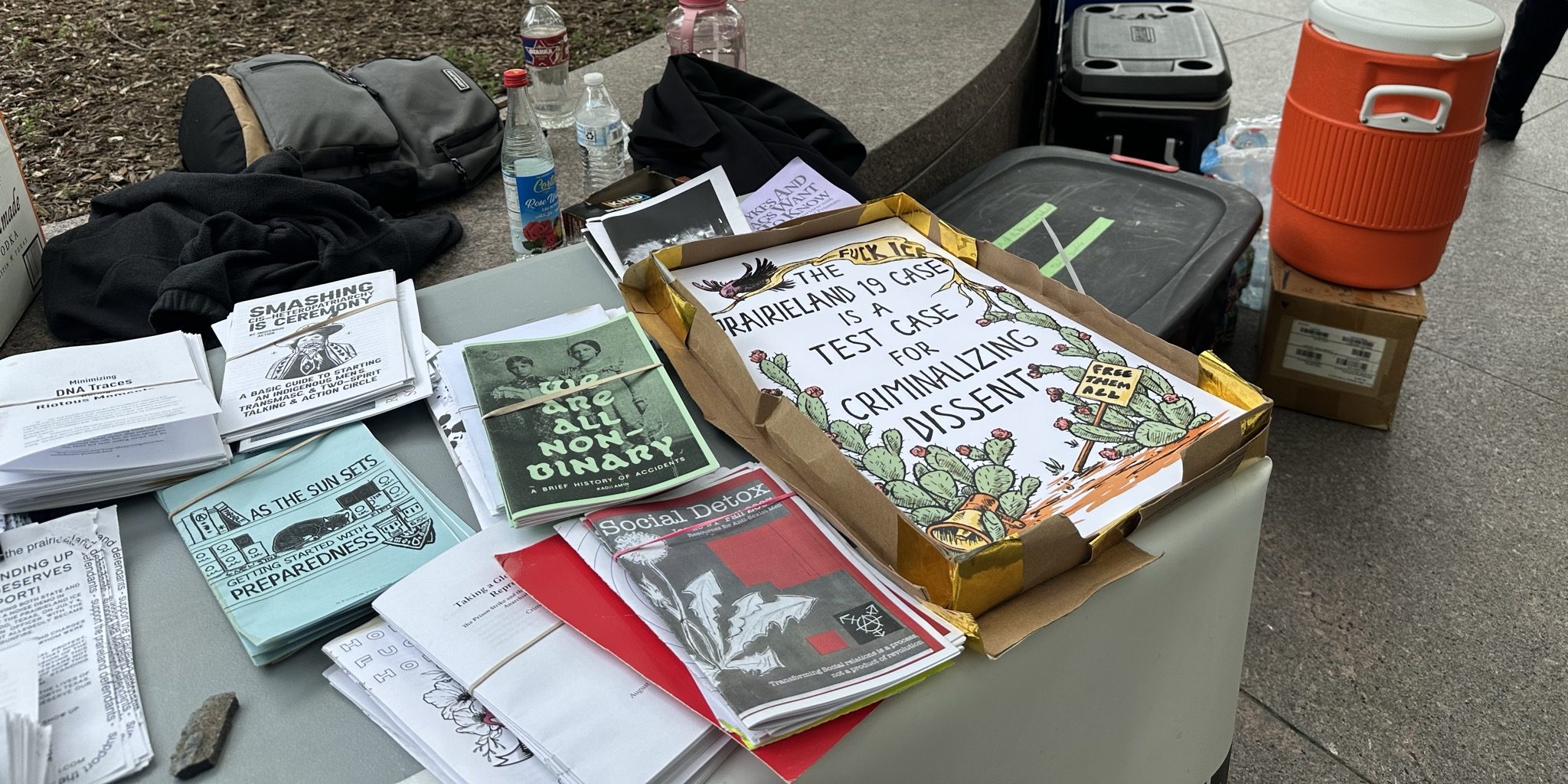
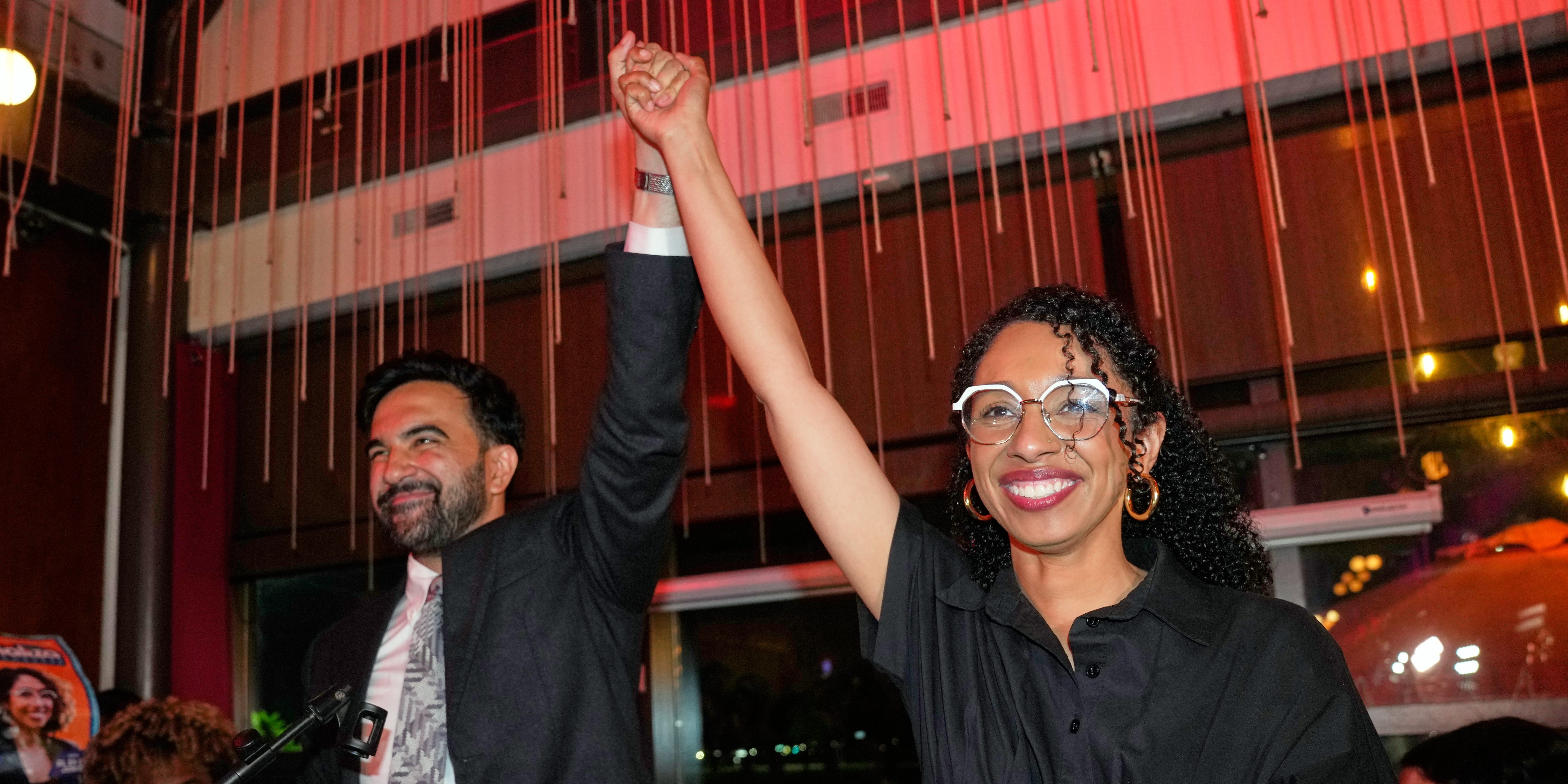
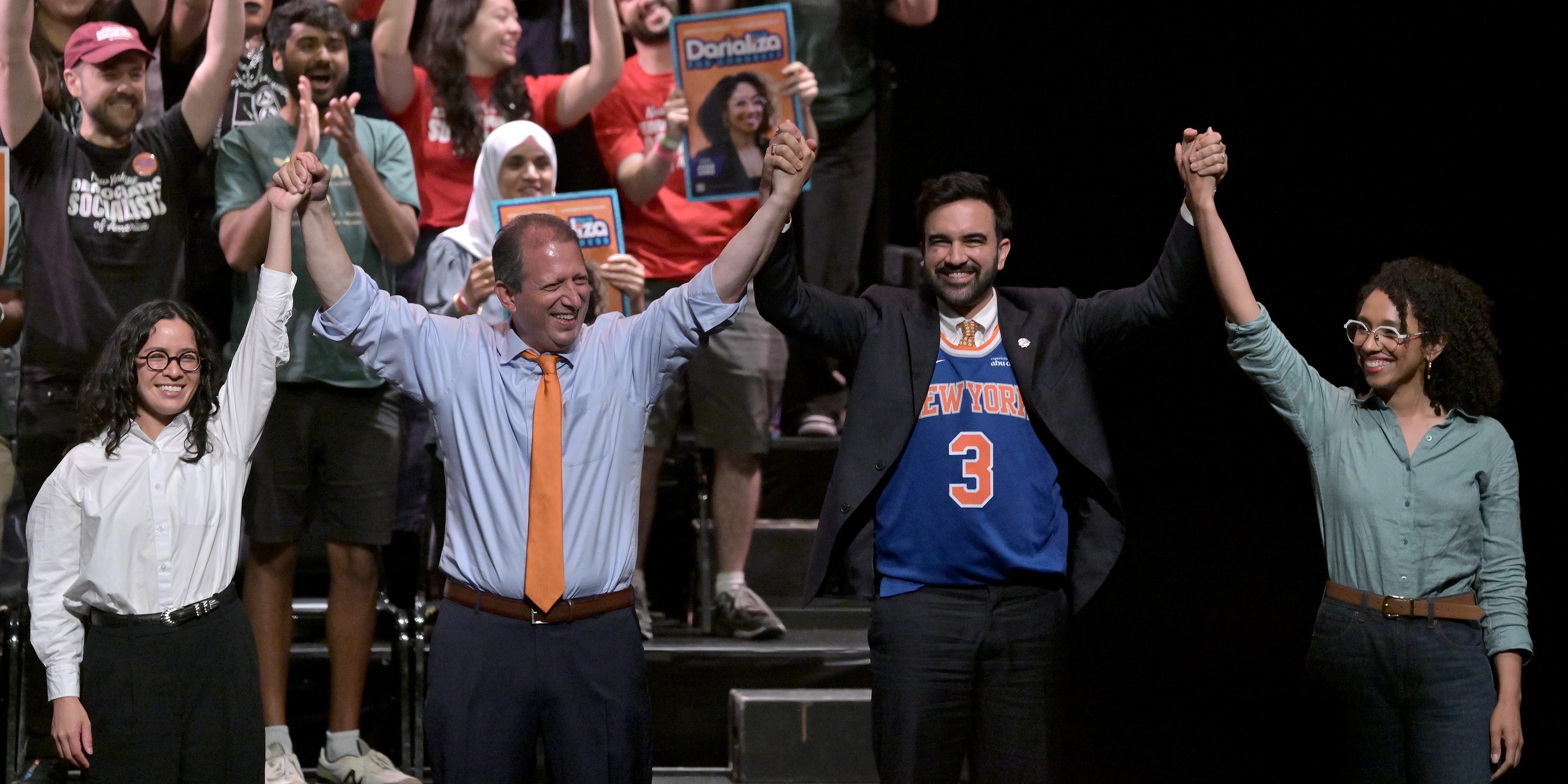
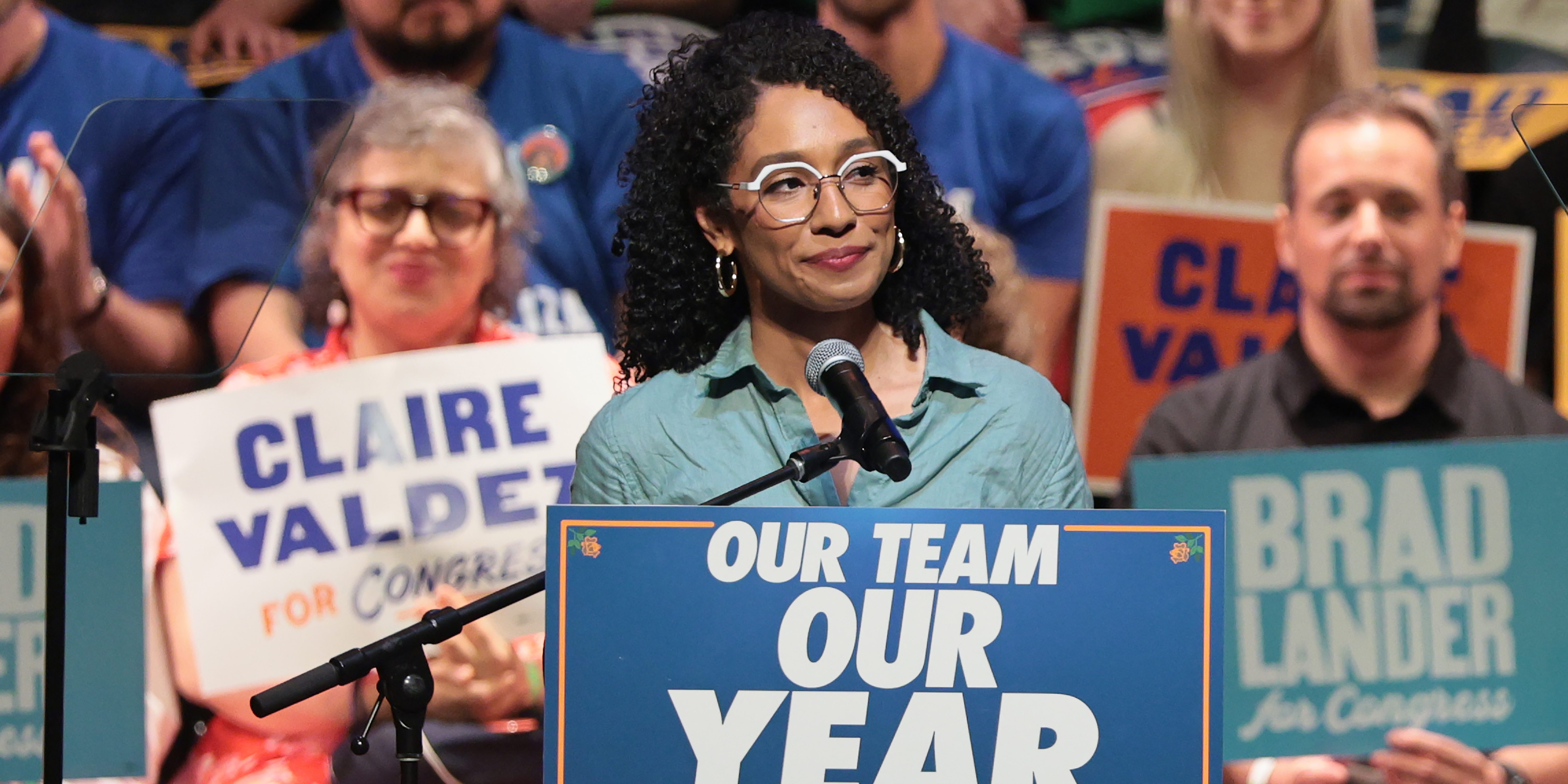
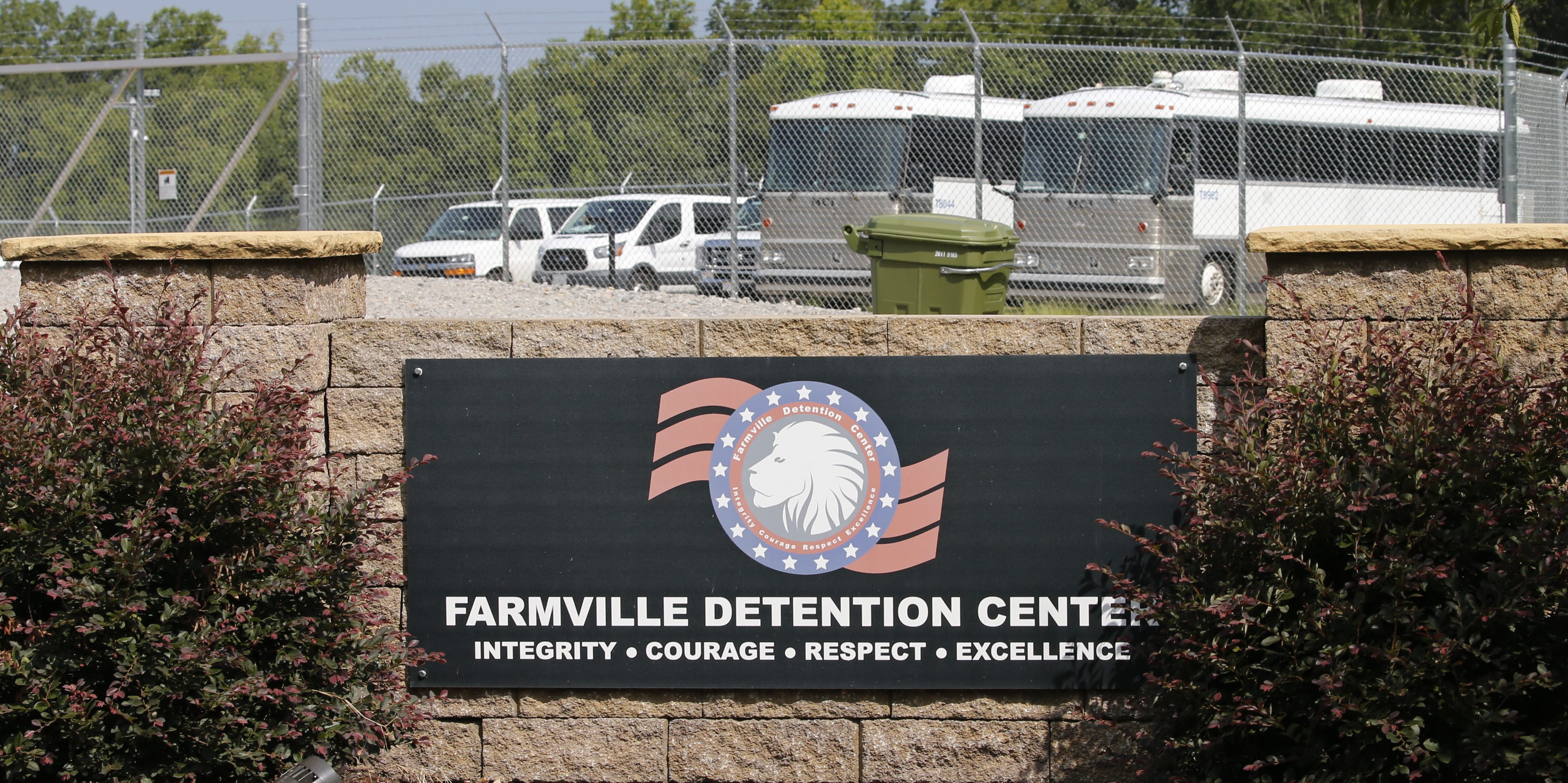
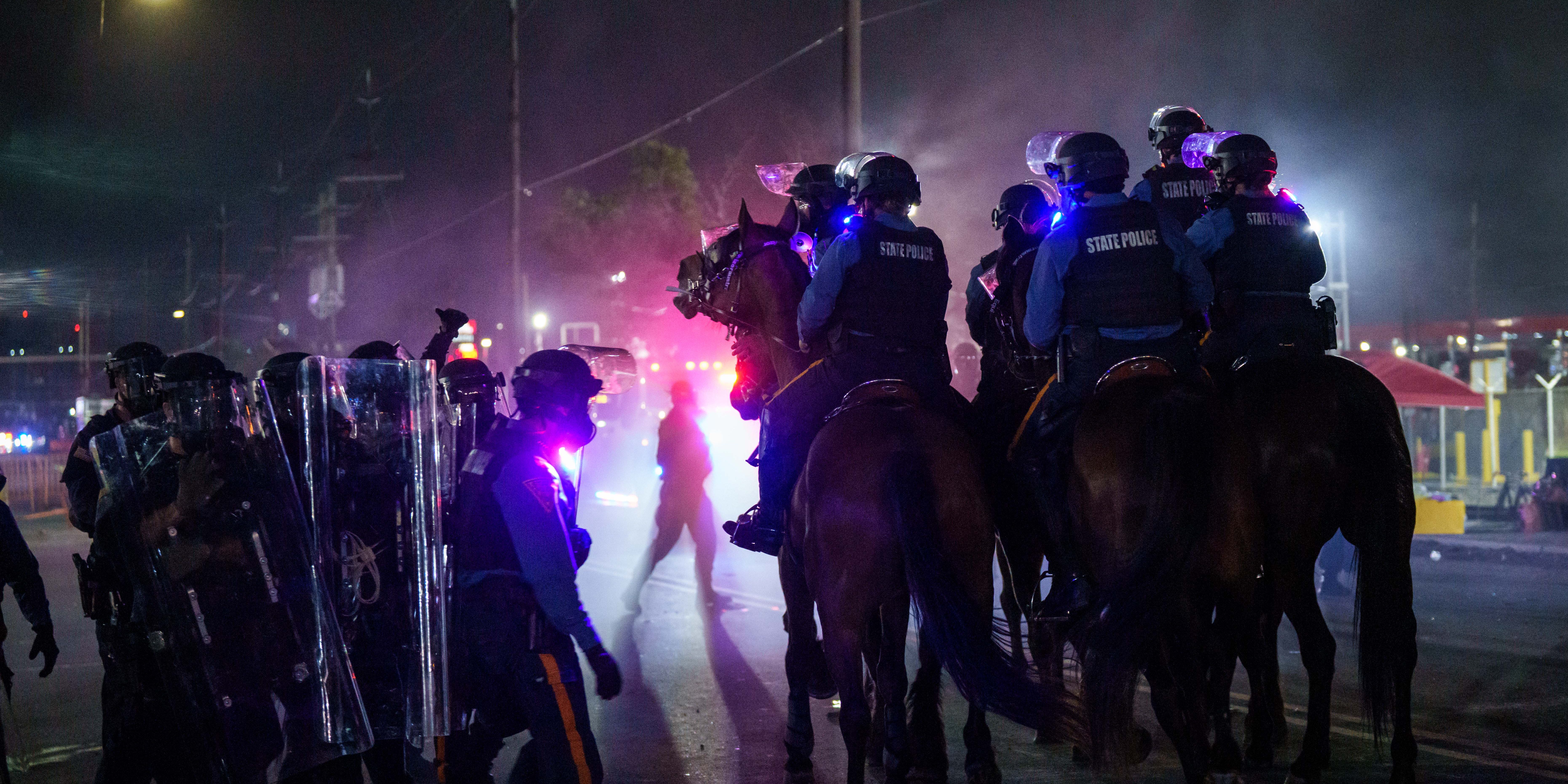
Supporters of the Prairieland defendants display pamphlets and artwork after their sentencing outside a Fort Worth, Texas, courthouse on June 23, 2026.Photo: Matt Sledge/The Intercept
The Trump administration attacking the right to publish or report information is a given at this point. The president has threatened journalists for everything from questioning the wisdom of his failed war with Iran to touching the peeled lining of his renovated reflecting pool.
Tantrums like those may now feel routine, but this week marked a new front in Trump’s war on information: Daniel “Des” Sanchez Estrada was sentenced to 30 years in federal prison for transporting a box of zines he didn’t even write. He’s one of eight defendants sentenced on Tuesday to a combined 450 years — the first prison sentences against so-called “antifa” handed down under the framework of NSPM-7, President Donald Trump’s sweeping “counterterrorism” memorandum to clamp down on dissent from the left.
The prosecution’s theory was that Sanchez moved the zines, which discussed anarchism and other anti-government ideas, to conceal evidence in the case against his wife, Maricela Rueda. Rueda attended a July 4, 2025, protest at the Prairieland immigration jail in Texas where a police officer was shot. (She was not accused of shooting him or having anything to do with the shooting but was herself sentenced to 70 years.)
But that nuance is cold comfort: It assumes that simply possessing years-old political pamphlets that said nothing about the protest or shooting could somehow constitute evidence of a crime. Sharing the political ideology of the shooter, the government contended, meant Rueda and her co-defendants were culpable for the shooter’s actions — and by allegedly attempting to prevent officers from finding out about Rueda’s ideology, Sanchez shared in the blame as well.
We’ve reached the point in the erosion of the First Amendment where the government considers possession of anarchist zines and membership in a terrorist cell to be more or less the same thing. Once the box of zines was discovered, there was no need to prove Rueda planned or had any idea that anyone would be shot at the protest.
What’s worse is that this will likely only ramp up the administration’s efforts to criminalize being in possession of information. Whatever you may think of former CNN host Don Lemon, he’s no anarchist or extremist, and the content of his broadcasts bears little resemblance to the zines Sanchez was convicted of transporting. And yet, after indicting him and independent journalist Georgia Fort on frivolous charges relating to their livestreaming of a protest at a Minnesota church, the government sought a warrant to obtain the identities of subscribers to their YouTube channels.
This will likely only ramp up the administration’s efforts to criminalize being in possession of information.
Fortunately, a judge rejected that warrant. But it’s a chilling revelation of the administration’s modus operandi. Lemon and Fort’s YouTube subscribers would, of course, have no knowledge of what happened at the church protest beyond what was publicly broadcast. Their identities are as irrelevant to whether Lemon and Fort committed a crime as the box of zines was to Rueda’s case. The only conceivable reason the government might want a list of YouTube subscribers is to keep an eye on people who watch disfavored shows.
And let’s say someone who’d watched Lemon and Fort’s livestreams and then heard about their arrests had cleared their browser history because they (rightly) feared the administration might target them. Could they then be prosecuted for concealing evidence under the same logic applied to Sanchez? If they’d downloaded the video, could they be accused of possessing contraband? Would forwarding a link equate to trafficking?
It all sounds preposterous, but virtually nothing is too absurd for this Department of Justice. In fact, it’s already argued that documents investigative reporters receive from whistleblower sources can constitute contraband. (It’s worth pointing out that Joe Biden’s DOJ used this same logic when it pursued its own ridiculous “transporting” of information case against Project Veritas for moving Ashley Biden’s diary across state lines).
These frivolous actions create a catch-22 for all Americans. The more people are investigated for engaging with ideas the administration deems dangerously anti-government, the more likely others are to conceal evidence of their own controversial beliefs — not because they are evidence of any real crime but because prosecutors are out of control. But if they do so, they risk incriminating themselves.
NSPM-7, which was issued last September, tasks federal agencies with dismantling networks of “anti-fascist” actors, a purposely overly broad term since expanded to include those with “extreme viewpoints on immigration, radical gender ideology, and anti-American sentiment.”
Given that antifa, as a singular, cohesive organization, is a figment of the right’s imagination, agents cannot accomplish that task by uncovering a membership registry. They can only do so by identifying people with viewpoints they consider “extreme,” like anti-ICE protesters officers have told they’re being added to watchlists, or pro-Palestine opinion writers they’ve sought to deport.
In Chicago and other cities ICE invaded, activists and organizers packaged whistles and zines to distribute to residents. Under the logic of NSPM-7 and Sanchez Estrada’s conviction, that is a network of actors engaged in organized political violence. If you read one of their zines, you could be deemed a member of an illicit enterprise, and if you hide one, you’re covering for criminals.
The government argued that the Prairieland defendants are different. One prosecutor said: “People with that kind of extremist beliefs need extra time in prison. They believe violence is justified.” U.S. District Judge Reed O’Connor, in handing down the sentences, reportedly said he wanted to “send a message to anyone who shares a similar ideology.” But lots of people believe political violence is sometimes justified. If someone who believes punching Nazis is justified attends an anti-Nazi protest where someone else punches a Nazi, are they at risk of being convicted of assault alongside the actual assailant, particularly if they have some anti-Nazi literature on their bookshelf? The answer is far less obvious than it used to be.
The administration has vowed the Prairieland case “will not be the last” of its kind. We must take it at its word. The next one might also involve protesters from the political fringes rather than ordinary Americans reading, say, The Intercept, or watching Don Lemon on YouTube. But what about the one after that? We’re not as far away as you might think. Stephen Miller has called the whole Democratic Party a “domestic extremist organization” — clearly invoking the language of NSPM-7. Trump has labeled his political opponents “the enemy within” and the press “the enemy of the people.”
Whoever said slippery slopes are a fallacy never met Donald Trump. If Sanchez Estrada indeed moved the zines because he foresaw their being used to tie his wife to a nonexistent terrorist network and a shooting, he should be commended for his prescience. Maybe more of us should think like Sanchez Estrada.
After abducting Venezuela President Nicolás Maduro, U.S. President Donald Trump declared that America would “run” Venezuela. When asked in January who was leading Venezuela, Trump said, “We’re in charge.”
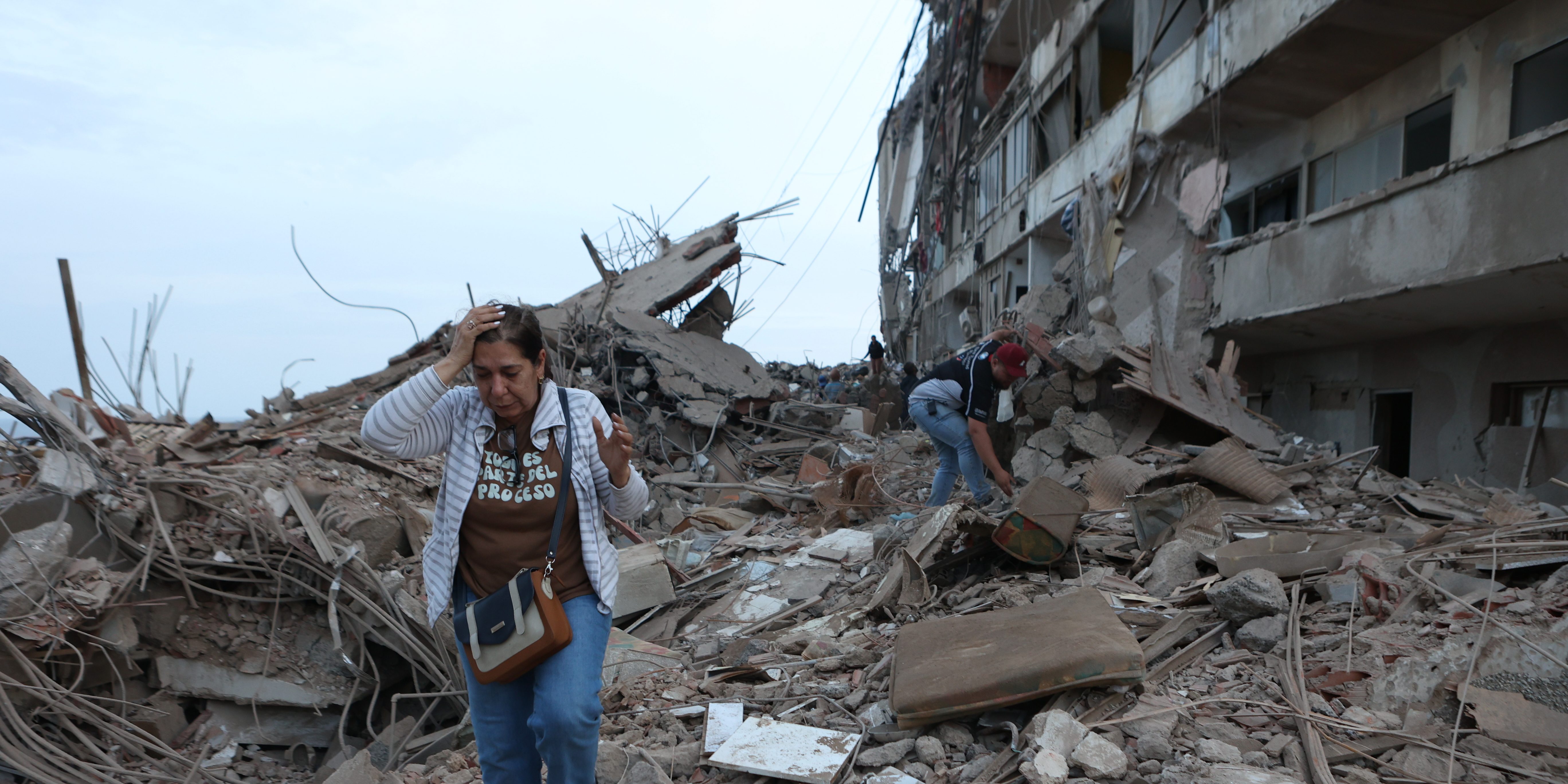
Yet after back-to-back earthquakes rocked multiple Venezuelan cities on Wednesday, toppling scores of buildings and killing at least 188 people and injuring at least 1,520, Trump merely offered assistance.
“The U.S.A. stands ready, willing, and able to help! I have instructed all agencies of our government to get ready to move quickly,” he wrote in a Truth Social post. “We will be there for our new and great friends.”
One U.S. government official told The Intercept that Trump’s offer doesn’t go far enough since Venezuela is now a U.S. “vassal state.” “Don’t we run that country?” the official asked, speaking on background and referencing Trump’s comments. “That’s an obligation that exceeds friendship.”
At the same time, Venezuelan American organizations and progressive foreign policy groups are about to circulate a letter calling on the Trump administration to provide massive, unconditional humanitarian aid to Venezuela in the wake of the 7.2 foreshock and 7.5-magnitude quake, as well as long-term economic damage from U.S. sanctions, according to details of the letter shared exclusively with The Intercept by Just Foreign Policy, one of the groups that drafted the letter. The organizations argue that the United States bears a unique obligation to Venezuela and that U.S. aid “must match the scale of the harm the United States has played a role in creating.”
This all comes after Trump seemed to suggest earlier this week that the U.S. has reaped billions of dollars of Venezuelan oil wealth in the last six months.
After ousting Maduro, Trump’s installed a puppet government run by former Maduro ally Delcy Rodriguez. She has carried out day-to-day governance under the threat of a looming U.S. criminal indictment alleging corruption and money laundering charges. Trump also warned that the U.S. might attack again if Rodriguez did not comply with his demands.
“Should the U.S. be responsible for rebuilding? Any word from Trump on that?”
The costs of Absolute Resolve — the military operation and abduction of Maduro — topped $206 million, according to an analysis by Brown University’s Costs of War Project. Since then, the Trump administration has seized control of Venezuela’s oil industry and claims to be exploiting it for massive returns. This week, Trump said that the U.S. has recovered its war costs 28 times over through oil extraction; this equates to roughly $5.7 billion.
“The people are happy in the country. They have smiles,” Trump said of Venezuelans on Tuesday, prior to the earthquakes. He claimed Venezuela has shared in the economic rewards.
But the letter being drafted by the Venezuelan American and progressive groups cites a recent economic analysis by Venezuelan economist Francisco Rodríguez showing that U.S. policy has failed to produce the economic recovery Trump has claimed. The letter notes that sanctions have left Venezuela operating at a “diminished capacity,” that “the buildings that collapsed were not maintained,” and “the hospitals that must now treat nearly a thousand injured were not adequately supplied” as a direct result.
In the port city of La Guaira, for example, more than 100 buildings were destroyed in the twin earthquakes. “Should the U.S. be responsible for rebuilding?” the U.S. government official mused. “Any word from Trump on that?”
The White House did not respond to a request for comment on whether the U.S. would ease sanctions or help to rebuild Venezuela.
U.S. Southern Command, which spearheaded the war on Venezuela earlier this year said on Thursday that it was “working with the Department of State to support U.S. government relief operations in Venezuela.” The command added that it “has established an operational planning team that includes experienced subject matter experts from the Bureau for Humanitarian Assistance, who are advising staff and leadership responsible for disaster relief planning and mission-related decisions.”
But disaster aid is inadequate, according to Just Foreign Policy and the other groups. “Emergency relief alone will not be enough. Venezuela’s recovery will require access to its own financial resources and the ability to import the equipment, construction materials, medicine, fuel, spare parts and other goods needed to rebuild homes, hospitals, schools, roads, ports and critical infrastructure,” they wrote.
Even before the earthquakes, almost 8 million people in Venezuela were in need of humanitarian aid, according to the United Nations. The letter from Just Foreign Policy and others calls on the Trump administration to “provide immediate, massive humanitarian assistance with no political conditions attached,” to release Venezuelan oil revenues currently held in U.S.-controlled accounts, and to suspend remaining sanctions impeding disaster response and reconstruction.
All three congressional candidates that New York City Mayor Zohran Mamadani endorsed won their primaries on Tuesday. The races were widely viewed as a test of just how much influence the left would have in charting the next chapter for the Democratic Party — and a referendum on Mamdani’s power.
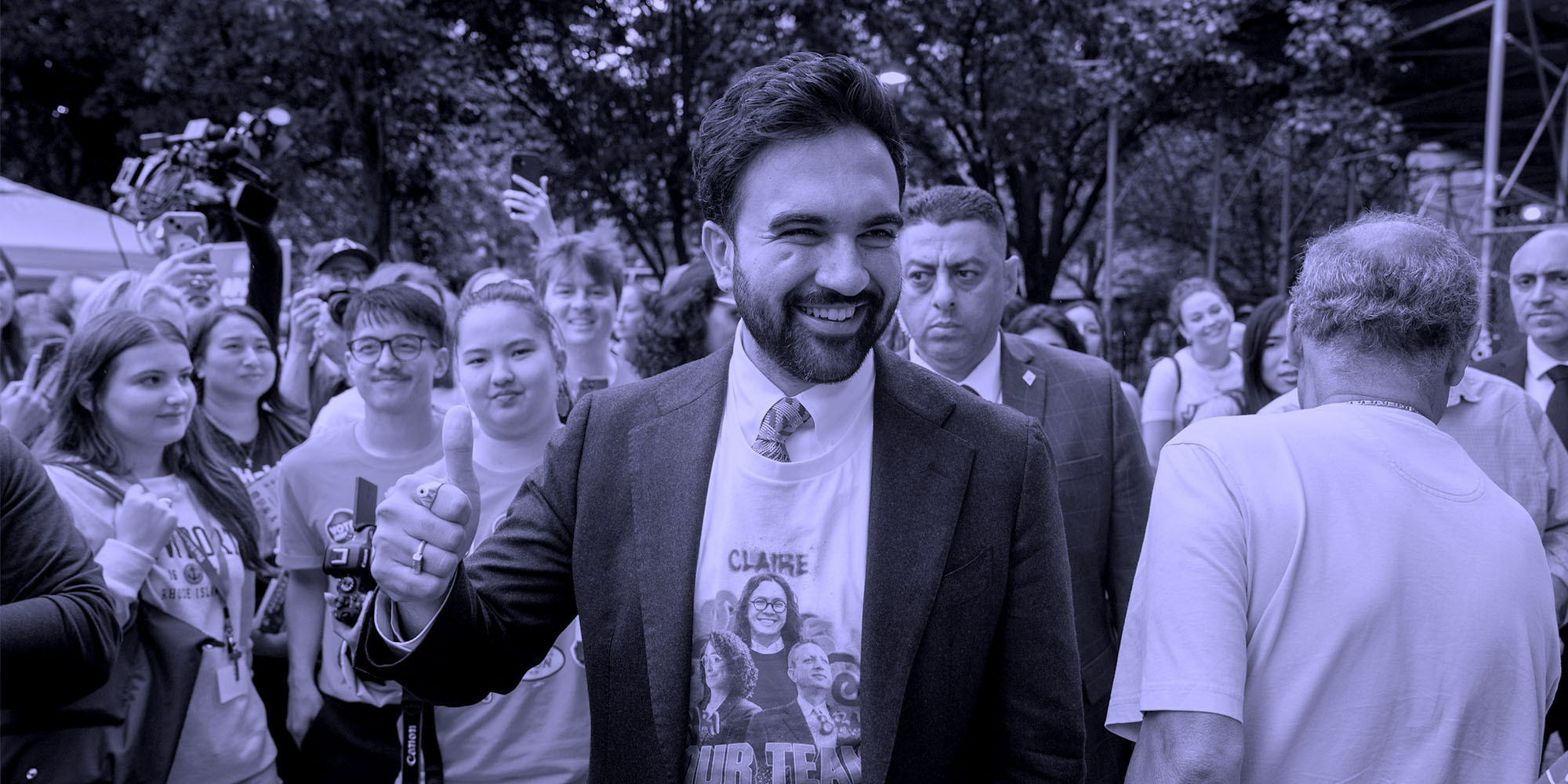
“Mamdani is the one variable that truly matters,” Michael Lange, political writer and elections analyst of The Narrative Wars Substack, tells The Intercept Briefing as he breaks down the wins of Claire Valdez, Brad Lander, and Darializa Avila Chevalier by district. “You pair that type of broad cultural political figure with the block-by-block organizing of New York City DSA — it’s a very powerful thing.”
“You had a candidate who said ‘Fuck Kamala Harris’ win the historic capital of Black America,” says Lange, of Avila Chevalier’s win over five-term incumbent Rep. Adriano Espaillat. “If that is not a distillation of the ‘Democratic tea party,’ I don’t quite know what is.”
This week on the podcast, host Akela Lacy speaks to Lange and Intercept managing editor Maia Hibbett about the strategic mistakes of the traditionally progressive Working Families Party, the growing influence of the Democratic Socialists of America on the Democratic Party, and how the DSA is upending electoral politics from the left.
“Here in New York, a lot of the momentum is being driven by the DSA, of course, but there are these progressive and insurgent candidates across the country who are trying to change the course of the Democratic Party,” says Hibbett, “and excite voters who might not have been into the Democratic establishment in past cycles.”
Lange notes how demographic changes and pressures on the Democratic Party base are impacting voters’ priorities. “The party’s becoming younger, more educated, and increasingly squeezed financially,” says Lange. “There’s just this broad alienation of people who have not really been able to get ahead, not for their own fault, and I think it’s like downstream of our economy, and that’s why the affordability zeitgeist is so potent.” He adds, “You spin the wheels up in two years, what could this look like in a Democratic presidential primary?”
For more, listen to the full conversation of The Intercept Briefing on Apple Podcasts, Spotify, YouTube or wherever you listen.
Transcript
Akela Lacy: Welcome to the Intercept Briefing. I’m Akela Lacy, senior politics reporter at The Intercept.
Maia Hibbett: And I’m Maia Hibbett, managing editor of The Intercept.
AL: Maia, did you see what House Minority Leader Hakeem Jeffries had delivered to his House office on Wednesday morning?
MH: Yes, they were beautiful.
AL: The Republicans’ House campaign arm delivered flowers and a card offering their condolences to Jeffries after candidates that he endorsed lost to socialists on Tuesday night in primaries in New York.
This is what the card said. “Three losses in one night is tough. We wanted so-called ‘Leader,’” — in quotes — “Jeffries to know our thoughts are with him, his candidates, and whatever remains of his influence in the Democratic Party.” Maia, let’s get your thoughts on this.
MH: On one hand, Jeffries probably felt a little bit of relief that no one did end up challenging him, so he wasn’t one of the people facing that challenge. But it was a really bad night for establishment Democrats. Ally of Jeffries and lots of other Democratic old guard, Rep.Greg Meeks in Queens, was also mad, and he was giving comments on Wednesday morning implying that New York City was going to suffer, it wasn’t going to get as much resources from the federal government because it was losing one of its really powerful incumbents.
You’ve covered the race that toppled Espaillat pretty closely. It represents a different kind of power coming into play in New York and in Democratic politics.
AL: One of the candidates most considered a long shot prior to Tuesday is Darializa Avila Chevalier, who ousted the powerful chair of the Congressional Hispanic Caucus, Rep. Adriano Espaillat. Avila Chevalier was notably an organizer of the Columbia pro-Palestine protest alongside Mahmoud Khalil. She cited Espaillat’s refusal to help Khalil in the aftermath of his arrest as one of the main reasons that she even decided to challenge him in the first place. And she came on the national stage after writing an op-ed in support of [Khalil] and being recruited by Justice Democrats.
MH: That result was really striking, especially because if you think back to a little over a year ago, before Zohran Mamdani won the primary for New York City mayor, you were covering the arrests of these student protesters in solidarity with Palestine, and that storyline has changed so dramatically.
It seemed at the time like their power was going to fade, or that these protests were getting crushed — and now one of them is going to become a member of Congress.
AL: This was definitely not on Democrats’ bingo card, particularly Espaillat, who was a large recipient of money from the pro-Israel lobby and faced a lot of criticism for how little he did to support those students at the time.
While Avila Chevalier’s win on Tuesday was one of the biggest surprises, both liberal and conservative critics of the Democratic Socialists of America, of which she is a member, framed her success as part of this narrative that we’re seeing come out from some reactions — that Ivy League transplants are taking over the Democratic Party and don’t actually reflect the working-class interests they’re claiming to represent.
MH: That was a huge criticism in another race on Tuesday night in New York, which was the competition between Claire Valdez and Antonio Reynoso for Nydia Velázquez’s seat. Velázquez was retiring, and she had chosen Brooklyn Borough President Antonio Reynoso as her successor. Velázquez was considered a progressive.
She was early to support Zohran Mamdani’s campaign. And in some ways, the DSA’s choice to run someone against her chosen successor was being presented as this betrayal and this attempt to usurp the progressive power base that had begun to grow in New York City.
AL: And then, of course, in the middle of all this, there’s Brad Lander, who many of our listeners may recall ran against Mamdani for mayor and then formed a coalition with him.
He ousted incumbent Rep. Dan Goldman in lower Manhattan and parts of Brooklyn less than 10 minutes after the polls closed. That was less of a shock, as Goldman had lagged behind in the polls for some months, but I think with the quickness that they called the results was another twist of the knife for Democrats in the establishment who had stood by Goldman.
MH: Yeah, and it’s funny because not that long ago, I think Goldman was considered a pretty powerful and a pretty popular politician. People talked before the 2025 mayoral race about the possibility that he could run for mayor of New York City. Maybe now he will because he’s free to do stuff.
Here in New York, a lot of the momentum is being driven by the DSA, of course, but there are these progressive and insurgent candidates across the country who are trying to change the course of the Democratic Party and excite voters who might not have been into the Democratic establishment in past cycles.
Next week in Colorado, there’s a race that you’ve been covering really since it started, which is an insurgent candidate named Melat Kiros, who is endorsed by Justice Democrats and is also a DSA member backed by the national DSA. She’s running to take out longtime incumbent Rep. Diana DeGette in Denver.
There’s also Graham Platner in Maine. There’s Abdul El-Sayed in Michigan, both candidates we’ve covered a lot, running for Senate. Another DSA candidate is Francesca Hong, who’s running for governor of Wisconsin. In some of these races, the DSA is a huge driving force behind these insurgent candidates, and in other cases, they’re not actually DSA candidates, but they’re adopting this similar populist working-class-focused politics that has been elevating politicians in these races across the country.
It does seem like the story of the Trump era is that people want change. There’s the pearl-clutching version of this that’s, “Oh, God, there’s populism. There will be a Trump of the left.” But perhaps there needs to be, and populism is just governance by the people.
AL: Next, we’re going to go deeper on all of this and more with political writer and analyst Michael Lange. He writes about politics in New York City on his Substack “The Narrative Wars” and is the author of a recent piece called “The (Not So) Civil War for the Commie Corridor.” We’ll discuss the growing influence of DSA and how the group is upending electoral politics from the left.
Michael, welcome to The Intercept Briefing.
Michael Lange: Oh, it’s so great to be here. Thank you for having me.
AL: Michael, we are speaking on Wednesday afternoon. I know you’ve had a busy day talking about the results from Tuesday night’s primaries in New York. Leftists are ecstatic right now. The primaries on Tuesday night were widely viewed as a test of just how much influence the left would have on charting the next chapter of the Democratic Party and New York City Mayor Zohran Mamdani’s abilities as kingmaker.
I want to go through some of these results with you, some of which were absolutely stunning. We have former New York City Comptroller Brad Lander, who beat Rep. Dan Goldman, which was somewhat expected. But two socialists came out on top in congressional races that were far less predictable.
ML: Certainly the scale of it, yes. There was always a world in which — let’s start with New York 7 — where Antonio Reynoso, the candidate that Claire Valdez was facing, he’s more of an institutional progressive supported by the Working Families Party, Brooklyn borough president, was in the City Council.
There was a scenario in which his support fell off to a certain degree with younger voters, and younger voters, Claire Valdez-friendly, came to the polls en masse and broke the outcome for that way. But I was still surprised because there is a part of this district, in addition to a lot of the institutional and labor support that someone like Antonio Reynoso has, and he does also have a genuinely progressive record, and he was running on a very left-wing policy plank.
AL: Virtually indistinguishable from Valdez’s.
ML: 100 percent right. The contrast between the candidates was very coalitional and institutional and also cultural, to a certain degree. So he kinda had these bona fides, and I thought that in some places, he can at least dent her margins.
And then the big kind of wild card is that this district is also home to a very large Orthodox Jewish community, the Satmar of South Williamsburg. Interestingly, even though they’re Orthodox Jews, they’re religious anti-Zionists. But they’ve known Reynoso for a very long time, and those folks were turning out in quite large numbers. They block vote in accordance with the whims of the rabbinical leaders there.
So Reynoso had 10 percent of the electorate that was basically giving him close to 100 percent of the vote. So he started off with 10, and she started off with zero. And I was like, well, to claw back from that, it won’t be entirely easy. And there were public and private polls that showed this race within 2 or 3 points. So maybe I paid a little bit too much attention to that.
But Claire Valdez had a very strong close and was able to engineer a lot of young voter turnout, especially proportionally to the amount of people turning out in this lower turnout congressional primary.
And she really ran away with it. Voters under 50 of all races, I think, supported her pretty substantially. There were some neighborhoods in this district where she was getting the same margins that Zohran Mamdani was getting versus Andrew Cuomo. Although instead of Cuomo being this fossil of the Democratic establishment, she was getting them against someone who’s lived his entire life in the district and does have other progressive and institutional validators.
I’m a little less surprised, actually, by Darializa’s win because I’ve been covering that race pretty closely and I had talked at length about how this was a prime opportunity district. Adriano Espaillat was, to some degree, in my estimation, a paper tiger and also that he was someone who was operating with a pretty hard ceiling. However they seemed to — and by they, I mean the political establishment, Hakeem Jeffries, a lot of labor unions, a lot of outside spending — seemed to really realize that there was quite a lot of vulnerability to him with one month left. Then of course, Mayor Mamdani endorsed Darializa, and that really raised the salience of the race, and then all of a sudden she’s getting attacked a lot.
There was a deleted Twitter account where they found her tweets. She said a bunch of different things, ranging from like, F Kamala Harris, to she attended an October 8 rally in New York. I thought to a certain extent that might hurt her with older voters who, again, white and Black who may not have much love for Adriano Espaillat, but I thought when you project that amount of money and negative spending onto a relatively unknown candidate, it can, in certain instances, have very drastic implications.
But she was able to really weather that, and also he was someone who had spent much of his career appealing to building Dominican American political power in Upper Manhattan. That was a stronger strategy 10 years ago when the Dominican electorate was half or even a little more than half of what this district is.
“He was very focused on a third of the electorate, and it left him very vulnerable.”
But it has been redrawn. It has experienced demographic change to a certain extent, and now it’s basically one-third Hispanic, one-third white, one-third Black. And so he was very focused on a third of the electorate, and it left him very, very vulnerable. Darializa was able to — again, for someone who had not held office before — against a 10-year Democratic incumbent, she did quite well with Black voters, and she did very well with white voters as well, of all ages and also religions.
This district has a lot of, I would say, progressive, older Jewish voters. A lot of this spending was geared at getting them to flip toward Adriano Espaillat or at least sit the race out. But they didn’t, and they backed her by considerable margins, and she paired that with real inroads with the white, Black, and Hispanic renter class, and that was enough for her to win by 3 points.
So it’s an incredible accomplishment.
AL: Yeah, I’m really glad you brought up the money piece because this was one of the most expensive congressional cycles in the history of New York, with more than $50 million spent. And obviously, not every seat, every congressional seat in New York was up for election. We’re talking about the handful that were up.
Also down the ballot, super PACs spent almost five times what they spent on state legislative races in 2024, according to a report on Wednesday from New York Focus. A total of $9.6 million — including more than $2.5 million spent against DSA candidates alone, almost every single one of whom won their races.
What is the upshot here? We also saw some of the biggest national investments ever from pro-Palestine groups spending to support progressives in these races. How has all of that money changed how elections work in New York, both for the establishment and for this insurgent class?
ML: The value that this spending has is clearly diminishing. But I also think it’s worth highlighting American Priorities and Justice Democrats and some of the money that they used to support Darializa. Darializa was spent, I think, 3 or 4 to 1. Which is not great, but it’s not a margin that I guess can truly make or break a campaign.
She was not getting out-spent 10 to 1, 20 to 1, things like that. So I think, again, stabilized some of the potential bleeding that could have come with a really hefty independent expenditure advantage one way or the other. There was, as you mentioned, tremendous super PAC spending in these downballot races. But those largely flopped.
One of the things that New York City DSA and also Mayor Mamdani did quite well this cycle is there was a lot of emphasis — and, some of this was happenstance in the way that incumbents retired and things like that, and what came available. But for Claire Valdez running in the 7th Congressional District, there was one DSA-endorsed state Senate candidate farther down the ballot, and then there were, I believe, three competitive or open incumbent challenges, Assembly races that overlapped with the 7th District.
Basically, Claire’s race really helped raise spend, engagement, turnout in a lot of these crucial districts down the ballot. And then Claire, of course, blows it out of the water. I don’t want to say that she carried all these other folks to victory, but the dynamics of her race, campaign, and blowout certainly helped folks at the bottom of the ballot get turnout.
AL: I find it interesting that the national discourse around getting out of money in politics, which is still very strong and a big part of these candidates’ campaigns, but they’re also recognizing and being very candid about the fact that they do need money to combat some of the spending.
And obviously it’s not going to be equivalent, but you had Valdez and Reynoso trading barbs about dark money or super PAC money in the race. And she said something to the effect of, and you hear this argument all the time, “We’re not going to fight this fight with one hand tied behind our back.” I think that’s an interesting tension that’s come out in the aftermath of this.
[Break]
AL: Another big discourse talking point, if you will, is about whether this marks the end of the relevance of traditional progressives, many of whom voters see as beholden to the Democratic establishment.
We see this nationally with the declining relevance of the Congressional Progressive Caucus, despite the election of more and more progressives to Congress. Most people might think of the left flank of the national Democratic Party as strictly progressive. Think Kamala Harris versus Bernie Sanders. But it’s a little bit more nuanced than that, especially in New York.
You wrote recently, “It isThe Socialists vs. The Progressives: NYC-DSA, the volunteer army that went from study hall to City Hall in a decade; versus the Working Families Party [WFP], the progressive third party that dominated the anti-establishment lane of New York politics for twenty years before the socialists arrived on the scene.”
For our listeners who might not be as familiar with the nuances of how this works in New York, can you break down those lanes on the left? Who is in each camp, where do they diverge, and how are they pushing Democrats to the left?
ML: I think some of the biggest differences between DSA and WFP is ideological. It is an outgrowth of that Sanders versus Warren 2020 presidential primary, but I think it’s also in structure of the organization.
I don’t think it’s unfair to say that DSA is just a more democratic, member-driven organization. The way the Working Families Party does their endorsements and things like that, it is a little more top-down. As a rank-and-file member of DSA, you have a lot more input on the direction of the organization. Some of that manifests in terms of the number of people who actively participate, the number of people who are dues-paying members, who volunteer, things like that.
DSA — they push a very class-focused politics. Not that the Working Families Party does not. Also DSA’s led quite significantly on Palestine and those issues, especially after October 7.
Not to say that the Working Families Party doesn’t talk about class. I mean, it’s literally in their name, but there is a bit more of an identitarian bent to that. Even today, the leader of the Working Families Party, Jasmine Gripper, was talking about, well, Antonio built a multiracial coalition. She was saying things like that — whereas if DSA just lost a race of that magnitude, they wouldn’t say, well, we built a multiracial coalition. That type of thing. Never mind that Claire Valdez won Hispanic voters by a very large amount.
“Especially in this Trump 2.0 world, people are hungry for a different type of politics.”
Anyhoo, I do think that it was a very difficult evening for the more traditional progressive wing of the party. And again, we saw this in the mayoral race last year with the rise of Zohran Mamdani and the stagnation of Brad Lander — who, of course, was just elected to Congress. And then especially in this Trump 2.0 world, people are hungry for a different type of politics. I foregrounded this race, the 7th District, as a battle to see who leads to left in New York. It’s very clear that after last night, DSA is the one leading the left. And I think that will have wider repercussions as well.
AL: This is a great segue because I do want to ask you about this piece that you wrote on the 7th District, where I am a resident.
ML: Oh, there you go.
AL: And in talking about that, talk a little bit about how progressives whose candidates lost last night are reacting to the results. You already mentioned Jasmine Gripper, state director for the New York Working Families Party. But you dubbed this race a “civil war in the commie corridor.”
The “commie corridor” branding has really taken off in the past couple of months. I just wanted to tip my hat to you.
ML: It has, for sure. Thank you.
AL: But what’s going on here, and how did this race in particular become such a referendum on Mamdani’s power?
ML: Very early on, Mamdani and a lot of New York City DSA leadership and rank and file wanted to support Claire Valdez.
I’m a DSA member. I’ve known Claire Valdez for years before anyone cared that I said the “commie corridor” or I wrote books or anything like that. She has a lot of goodwill in the organization with just normal members. She’s a union organizer. People really just like her.
So when Congresswoman Nydia Velázquez — who, I should also say I used to work for her when I first graduated college — when she retired, there were a lot of people who went to Claire, a reluctant candidate, and said, “Oh, I think you would be really great.” And clearly the mayor shared that sentiment. A lot of people close to the mayor did as well.
But of course, Congresswoman Velázquez, I think there was some appetite on her part to support another DSA candidate, one that she was more familiar with. But then she did not want to support Claire, so then she really went all-in on Antonio Reynoso. Those two are very close. Antonio was born and raised in the South Side of Williamsburg, which is a historically Puerto Rican area. And credit to Nydia and Antonio: They were waging fights against the machines of old in that part of town prior to 2016, prior to 2018, before DSA really asserted themselves politically.
But then, I think, she was upset that the mayor wanted to go a different route than her. She made some comments to The New York Times. It got bitter. It felt like both sides were waging a lot of capital on this outcome. There was a lot of media sparring and things like that. Obviously with hindsight, potentially the Working Families Party and the Reynoso camp, they might have raised the stakes of this race too much. Now, they probably didn’t know what was going to happen but I think probably they’re sitting here on Wednesday regretting it.
“Obviously — with hindsight — potentially the Working Families Party and the Reynoso camp, they might have raised the stakes of this race too much.”
But I think that the most important thing is that Mamdani is the one variable that truly matters. And New York City DSA, for all of the local nonprofits and relationships that Antonio Reynoso had, New York City DSA out organized them.
They knocked over 300,000 doors. They knocked the entire district, and you really felt those results on Tuesday night. To pick that district to have a very high-stakes proxy war was a strategic mistake on the part of the Reynoso–Working Families Party world, because this was not like a fight in Park Slope or Carroll Gardens.
Not that it would’ve gone differently, but those are a little more progressive, granola, Brad Lander-coded areas. They were really having this fight on some of these blocks where 93 percent of voters are under the age of 50, and where Mamdani is not just a political giant, but a cultural figure.
You walk around Greenpoint or Bushwick with him, and there are women just tumbling over themselves, running out of the bar to get a picture with him. He did a selfie line at McCarren Park. And ironically, someone I went to college with who also reports on this stuff, he was saying that everyone he spoke to who said they were voting for Clara Valdez was like, “I’m doing it because of Mamdani.”
And you pair that type of broad cultural political figure with the block-by-block organizing of New York City DSA — it’s a very powerful thing. It’s how they were able to basically create a very favorable electorate even without the big highly salient mayoral race, the wall-to-wall media coverage, things like that.
I won’t get the voting data for probably a couple days or a week or so, but I have a hunch that the voting base this year in the 7th District was even younger than it was last year. Were the same amount of young voters, like raw, going to turn out? Not necessarily, but proportion-wise, it was pretty robust and it really cascaded on election day.
AL: You mentioned DSA sort of outorganizing the Working Families. I also want to mention that New York DSA co-chair Gustavo Gordillo told Hasan Piker at a watch party last night that his phone bank for Darializa Avila Chevalier could have identified 2,000 voters, which was the margin by which she won. A pretty spectacular effect.
ML: Yeah, it’s funny, I thought they were going to make fun of me because I was like, “Oh, I think Adriano might eke it out.” But they were like, “Actually, we saw that you said that and we were like, all right, we gotta go into overdrive.”
AL: There you go, data-driven.
ML: I obviously wanted Darializa to win. I quite literally voted for her. I owe it to the people who read and trust what I say to share that.
And I do think that there was a broad sentiment, like, “Oh, she’s probably like pretty close, but will she get across the finish line?” That type of push that they were able to engineer, it’s just no other mass-member organization that I can really think of could do that. They called through every Democrat who had voted in Upper Manhattan in the last six years. I think the first list they did, they burned through it in 12 minutes. Really remarkable organizing that is exactly the type of thing that decides a race at the margins like this.
“They called through every Democrat who had voted in Upper Manhattan in the last six years.”
AL: The other big question coming out of last night is and really, this is in response to the way that both Democratic Party leaders and Republicans are spinning this, which is that Hakeem Jeffries has lost control of the party and that there’s a communist takeover of the Democratic Party that is out of step with the vast majority of voters outside of the coasts.
But is this something that can work outside of New York City? There are several races with progressives and socialists on the ballot coming up. Midterms are not over, I’m sorry to our listeners. Next week in Denver, Melat Kiros is challenging Rep. Diana DeGette. Kiros is a DSA member endorsed by the Denver DSA chapter and the national DSA.
Later this summer, Assembly Member Francesca Hong is running for Wisconsin governor. She’s a member of the Assembly Socialist Caucus and a DSA member. On the nonsocialist but progressive populist side, there’s also Graham Platner’s Senate race against Republican Susan Collins in Maine.
Is this a coastal formula? Why or why not?
ML: It’s funny. This is the question that’s at the heart of my forthcoming Mamdani book.
AL: Oh, wonderful.
ML: But it won’t be out for a bit because we’re living through his effect on the Democratic Party. I do think the party’s becoming younger, more educated, and increasingly squeezed financially.
There’s this growing precarious middle class that’s really not getting ahead, really disillusioned with — it’s funny talking about this, it’s like I sound like Morris Katz because he says similar stuff.
AL: Morris Katz is a Mamdani adviser who’s also working with other progressive candidates, including Graham Platner. But Michael, continue.
ML: But yeah, you have this youngerish, but also middle-aged, we’ve even seen races where progressives and leftists have won Gen X suburbanites because even these mortgaged homeowners are really feeling squeezed by affordability. But it’s also a broader cultural alienation. It’s downstream from the loss of community, the rise of oligarchy. I think technology as well, like the tech oligarchs, it’s all intertwined. Two years from now, artificial intelligence and that type of stuff could be the number one, the number two, or the number three issue.
But I think there’s just this broad alienation of people who have not really been able to get ahead, not for their own fault, and I think it’s like downstream of our economy, and that’s why the affordability zeitgeist is so potent. And so yes, does the “commie corridor” like literally travel to Michigan? Not exactly. But also the Democratic Party is pretty urbanized. It’s getting even more urbanized, especially in a primary setting.
What you’re asking is what a lot of us are asking right now? Is like, OK, you spin the wheels up in two years, what could this look like in a Democratic presidential primary?
“ Ironically, the rest of the Democratic Party is copying Mamdani’s message with respect to affordability, almost verbatim.”
What was very interesting about New York 7 and New York 13 is that ironically, the rest of the Democratic Party is copying Mamdani’s message with respect to affordability, almost verbatim. But in 7 and 13, Claire Valdez and Darializa, and I was thinking like, oh, if maybe they underperform or maybe one of them doesn’t win, this is a tweak to make in the future cycles. They weren’t going super hard on affordability. There was a lot of talk about Palestine and AIPAC, things of that sort. Darializa also leaned into Adriano’s voting for omnibus bills that increase ICE funding, things like that.
So my thesis was like undoubtedly those were motivating issues to Mamdani doing so well in those areas, but particularly in Upper Manhattan, that’s the heart of the multiracial working class. And I was like, a huge part of it was affordability. But what was really fascinating is that, it’s one thing to win in Ridgewood with that, but in Upper Manhattan — more tenants than any other district in the country. And Darializa won by talking a lot about Palestine and a lot about ICE. If she didn’t win, it would’ve been maybe we should’ve talked more about affordability. But she did win — in spite of all the spending. That’s like quite a, I don’t want to say a narrative buster, but it’s a very interesting, data point.
AL: It flies in the face of the claims by centrist strategists that those things are not popular with the base that they need, particularly that working-class base where they’re saying that those issues are not the bread-and-butter issues that working people come home and think about at night.
But I do think you’re touching on a key point here, which is that those issues tie into the broader frustration with not even just the positions that they’re taking, but the shutting down of discourse or the lack of teeth, particularly on the ICE thing, the lack of a response to really differentiate themselves from Republicans in the longer term.
You did mention a socialist presidential candidate.
ML: Oh, boy.
AL: That is the perfect segue to my final question for you which is, again, echoing a big question that came out of last night, which was where was Rep. Alexandria Ocasio-Cortez?
ML: To her credit, she did support four state—
AL: Assembly members, yes.
ML: Who were all challenging incumbents, and they all did win.
AL: Yes. And so this is the strategy. So the criticism here, for our listeners, was that Mamdani did the work in the congressional races, and AOC did the work in the state legislature races. Both of them supported all DSA candidates in the respective races that they did endorse in.
But many people were taking shots at AOC saying that she should regret that she didn’t endorse Valdez or Avila Chevalier.
I find the argument that they were splitting their clout in a race where the left had limited resources to be a compelling one. I also find the argument that AOC is looking at building bridges with the people who will help her potentially run either for the Senate or for the presidency one day, and that it wasn’t worth her while to step into these races where Mamdani was already clearly carrying a lot of the weight.
What did you make of that strategy?
ML: Yeah. I think it’s just downstream of the nature of the relationships and the institutions that both of them have. Mayor Mamdani not endorsing any insurgent challengers in the state legislature in an effort to, not piss off, for lack of a better word, Carl Heastie, who’s the Assembly speaker.
“Darializa’s thing — that was big to take on the chair of the Congressional Hispanic Caucus.”
The inverse, though, pushing a lot of chips in with respect to Congress. I mean, Claire — it’s an open seat. Everyone needs to be adults about it. But the Darializa’s thing — that was big to take on the chair of the Congressional Hispanic Caucus.
With the congresswoman, it’s probably just the inverse of that. There’s also a special Nydia Velázquez connection there.
But plenty of people running had either the mayor or they had AOC. And then I think a lot of them also had Bernie Sanders as well, and New York City DSA. So it was like, you had almost everybody with one or two or three really famous folks on their lit, and the institutional heft.
Regrettably, Conrad Blackburn was running for an Assembly seat in Harlem. He was the only candidate to lose last night.
AL: The only DSA candidate to lose.
ML: It was partially because he was the only one who did not have a Mamdani or an AOC endorsement.
It was a tricky race. I think just to zoom in and out, there was a lot of money spent against him at the beginning. When he was in Florida and a law student, he had that two-month internship in the Florida attorney general’s office, but the Florida attorney general was Pam Bondi. That, I think, hurt him considerably. But after months, I think he was able to claw back.
I think also Darializa being on the top of the ballot was able to help him. But the Darializa versus Conrad thing is a very interesting dynamic in how their spending was treated. Whereas with Darializa, they opened the floodgates late with all these attacks, and with Conrad, they started earlier. I’m sure if they could do it over again with Darializa, they would’ve taken her much more seriously, because now, of course, Adriano Espaillat, someone who is, I don’t want to contribute to a myth here, but he is someone who built a Dominican political machine, while I don’t really agree with the politics of it, over the course of 30 years. It was a 30-year-old machine being defeated by a 32-year-old Columbia graduate student who had never run for office before.
“It was a 30-year-old machine being defeated by a 32-year-old Columbia graduate student who had never run for office before.”
AL: Who said, “Fuck Kamala Harris.”
ML: Well, yeah, if I can curse. You had a candidate who said “Fuck Kamala Harris” win the historic capital of Black America. If that is not a distillation of the “Democratic tea party,” I don’t quite know what is. For as much anti-incumbent sentiment as there just is broadly now, there has been that with Adriano Espaillat, particularly in the southern parts of his district for a while, which was another reason that he was vulnerable and he played it poorly, and I think she ran a gutsy race.
AL: Michael, we’re going to leave it there. Thank you so much for helping us make sense of the wild ride that was Tuesday night. I look forward to reading your book when it comes out and looking forward to more of your — I don’t know if you’ll beat “commie corridor,” but we’re excited for whatever comes next.
ML: I appreciate that a lot. It was great to be here. Thanks for having me.
AL: We want to know what issues you are following in this exciting midterm cycle, send us an email at podcasts@theintercept.com or leave us a voice mail at 530-POD-CAST that’s 530-763-2278
That does it for this episode of The Intercept Briefing.
This episode was produced by Laura Flynn. Ben Muessig is our editor-in-chief. Maia Hibbett is our managing editor. Fei Liu is our product and design manager. Nara Shin is our copy editor. Will Stanton mixed our show. Legal review by David Bralow.
Slip Stream provided our theme music.
This show and our reporting at The Intercept do not exist without you. Your donation, no matter the amount, makes a real difference. Keep our investigations free and fearless at theintercept.com/join.
And if you haven’t already, please subscribe to The Intercept Briefing wherever you listen to podcasts. And leave us a rating or a review, it helps other listeners to find our reporting.
After rattling some observers by staying out of a slew of competitive congressional primaries in her home state this week, Rep. Alexandria Ocasio-Cortez, D-N.Y., endorsed a candidate in Tennessee on Thursday.
Ocasio-Cortez is backing Tennessee state Rep. Justin J. Pearson in the 9th Congressional District, which will be a tough win for Democrats after Republicans scrambled to gerrymander it earlier this year thanks to the Supreme Court’s gutting of a key portion of the Voting Rights Act. The district covering parts of Memphis and its suburbs is one of more than a dozen that Republicans have redrawn at President Donald Trump’s demand to ward off what many in the GOP see as the increasingly likely prospect that they lose both congressional chambers to Democrats in November.
An endorsement from democratic socialist Ocasio-Cortez is a coveted stamp of approval for progressive insurgents looking to challenge incumbents or capture open congressional seats. She has endorsed several Democratic primary candidates running for open seats in other states this cycle including Chris Rabb, who won his primary in Pennsylvania; Analilia Mejia, who won in New Jersey; and Junaid Ahmed, who lost his primary in Illinois. But critics raised eyebrows at her decision to stay out of key congressional primaries in New York; she opted instead to endorse a slate of democratic socialist candidates in the state Assembly.
The endorsement is a major boost to Pearson, who is also backed by Justice Democrats, the progressive group that first backed Ocasio-Cortez in 2018 against longtime incumbent Rep. Joe Crowley, and Sen. Bernie Sanders, I-Vt. Pearson originally launched his campaign with the intention of ousting two-decade incumbent Rep. Steve Cohen, the last remaining Democrat in Tennessee’s congressional delegation. Cohen dropped out of the race in May after state lawmakers split up his district into three neighboring districts, saying it was “drawn to beat” him.
Observers theorized that Ocasio-Cortez’s absence from New York’s congressional primaries reflected a desire not to butt heads with Democratic Party leaders who endorsed against leftist challengers, potentially signaling her plans to run for higher office in a future cycle. Others argued that she stayed out to split her efforts with New York City Mayor Zohran Mamdani to maximize the left’s political currency in a cycle with historic outside spending against their candidates. Mamdani emerged as a kingmaker in Tuesday’s elections, backing three congressional candidates who won their primaries on Tuesday: socialists Clare Valdez and Darializa Avila Chevalier, and progressive Brad Lander, and several — but not all — of the New York City DSA’s endorsed candidates.
On Wednesday, Ocasio-Cortez said the left’s wins in New York’s House primaries were part of both “a moment” and “a movement” of voters demanding more from the Democratic Party after major losses in 2024.
Endorsing in the races would have pitted Ocasio-Cortez against her congressional colleagues whose support she might need in a run for higher office, including House Minority Leader Hakeem Jeffries, poised to become House speaker if the Democrats retake the chamber in November. She’s made most of her other endorsements this cycle in open seats with no incumbent, including Rabb, Mejia, Ahmed, Adelita Grijalva in Arizona, Adam Hamawy in New Jersey, and Sam Forstag in Montana. She endorsed Democratic candidate Randy Villegas against the incumbent Republican, Rep. David Valadao, in California. Her former chief of staff, Saikat Chakrabarti, said her decision not to endorse him likely contributed to his loss in an open California primary to replace retiring Rep. Nancy Pelosi, D-Calif., by fueling attacks from his opponents.
In New York City, Avila Chevalier and Lander ousted incumbents backed by Jeffries and Democratic leaders: Congressional Hispanic Caucus Chair Adriano Espaillat and Rep. Dan Goldman. Valdez won her primary in an open seat where retiring Rep. Nydia Velázquez had endorsed her preferred successor, Brooklyn Borough President Antonio Reynoso. Velázquez bemoaned Mamdani’s endorsement of Valdez against her pick in the months leading up to the race. And even after their candidates lost on Tuesday, Jeffries and other party leaders aired their disappointment in Mamdani’s decision to go against them.
But in Tennessee, Pearson emerged as the frontrunner when the incumbent dropped out. He’s hoping to tap into voters’ frustrations with both parties by campaigning on economic change for the working class — a message that boosted both Ocasio-Cortez and Sanders.
A law enforcement intelligence hub in New Jersey fretted that the growing class divide in the U.S. could drive a wave of lone-wolf attacks on high-flying corporate executives, according to a report obtained by The Intercept.
The New Jersey Regional Operations and Intelligence Center, one of the so-called fusion centers that serve as intelligence clearinghouses for cops, warned in a bulletin earlier this year that disaffected Americans were increasingly blaming society’s ills on rich people and corporate bigwigs.
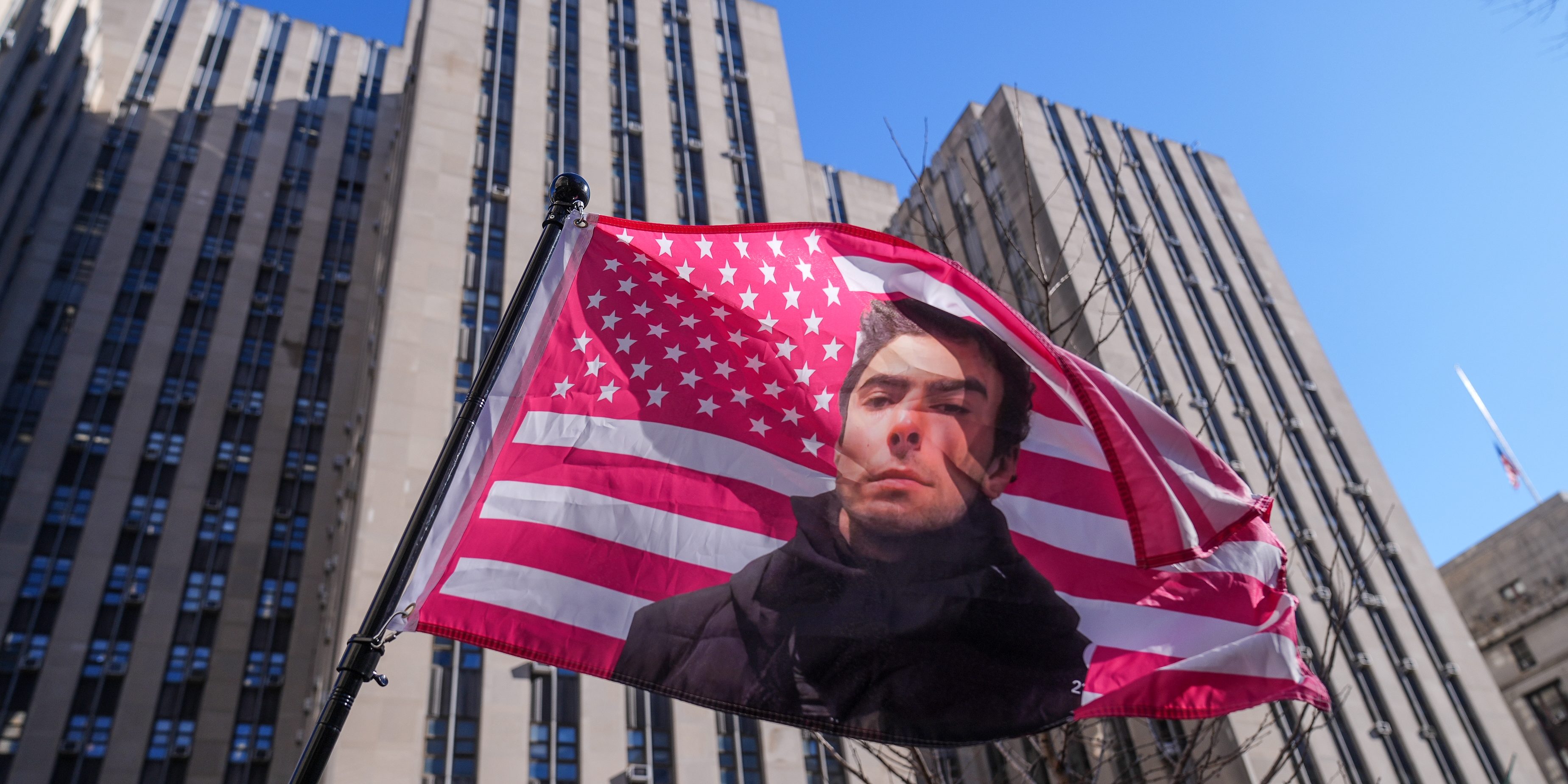
The report specifically cited the killing of UnitedHealthcare CEO Brian Thompson in December 2024 — allegedly by Luigi Mangione — as an expression of anti-fat-cat rhetoric. To the analysts at the New Jersey fusion center, Thompson’s killing hinted at a larger trend.
“Public discourse increasingly attributes the challenges faced by the middle and lower classes to the actions and influence of wealthy corporate executives,” the fusion center memo says.
By warning corporate security outfits of the danger posed by average Americans who blame their problems on the actions of corporate executives, the report effectively dedicates public resources to securing a private system that has made the few extremely wealthy at the expense of the many.
“The report seems to be putting forth the view that that is an extremist viewpoint, rather than something that the state has some responsibility in correcting.”
Michael German, a former FBI agent specializing in domestic terrorism and longtime critic of fusion centers, said that by warning CEOs of threats, the bulletin was effectively taking the side of the rich and powerful over ordinary people who are critical of inequality — a typical dynamic at fusion centers.
“The way it’s written, the report seems to be putting forth the view that that is an extremist viewpoint, rather than something that the state has some responsibility in correcting,” German said. “All the resources of the national network of fusion centers, which includes federal resources along with state and local resources, are devoted toward providing security information to private entities.”
Brian Thompson Murder
The “Quarterly Executive Threat Watch” bulletin warned corporate bodyguards to switch up the daily routines of execs, limit information on public engagements, and remove bosses’ personal information from the web. The report says bosses should “remain vigilant of lone offenders with personal grievances.”
“Following the fatal shooting of UnitedHealthcare CEO Brian Thompson and the current political climate, there is a heightened threat environment surrounding corporate executives,” the report says. “Online glorification of the murder of Brian Thompson and calls for violence are still apparent and further create a risk for a lone offender attack.”
A spokesperson for New Jersey’s Office of Homeland Security and Preparedness, the agency that oversees the fusion center, did not respond to a request for comment.
The report went on to cite a list of seemingly disparate incidents to highlight a possible surge in threats to the wealthy, including a satirical Christmas wishlist that called for sabotaging CEOs; a handful of 4chan posts calling for violence against executives at Netflix and elsewhere; a “far-left forum” calling for a campaign against people tied to a mining project in Michigan; and an act of vandalism by pro-Palestine activists at the home of a New York Times executive.
Another incident that made the list was the federal case against the so-called Turtle Island Liberation Front, a group of left-wing activists arrested last year whose alleged bomb plot appears to have been largely driven by a member of their group who was a longtime paid FBI informant.
“The problem with a lot of these fusion center reports is that they take a handful of incidents, not necessarily related to one another, and use them to justify and amplify these threats without any kind of analysis,” said German. “Rather than actually looking at data, their performance is measured by the number of reports they produce.”
Fusion Centers
Fusion centers, which bring together state and federal law enforcement agencies to share intelligence on potential terror threats, rose to prominence in the wake of the 9/11 attacks. The centers operate under state authority, often with grants from federal agencies like the Department of Homeland Security.
New Jersey’s only fusion center, officially known as the New Jersey Regional Operations and Intelligence Center, has been criticized for operating outside the typical oversight to which most state agencies are subject.
A 2023 report by Rutgers Law School’s Center for Security, Race, and Rights warns of the potential for abuse in the New Jersey fusion center. The report cited the fusion center’s practice of drafting dossiers on “known troublemakers” and its reliance on so-called “intelligence-led policing,” a practice of surveilling and data collection that the American Civil Liberties Union has cited as a potential violation of the right to due process.
The Quarterly Executive Threat Watch, the bulletin that included the warning for CEOs, appears to be internally categorized as terrorism-related intelligence and was later disseminated by a U.S. Customs and Border Protection officer to recipients across the country. (CBP did not immediately respond to a request for comment.)
Then there is the issue of the center’s shadowy public-private partnership. The New Jersey fusion center does not make public which private agencies or organizations it partners with, or to whom it disseminates reports.
“It’s very ambiguous who is actually in charge and who is responsible.”
The January report drew heavily on the work of SITE Intelligence, a for-profit firm that has come in for criticism because of its labeling Islamic charities as terror fronts and mistakenly identifying video game footage as terror propaganda.
Like its counterparts across the country, the New Jersey fusion center feeds its reports into a national network of public and private agencies dedicated to the gathering and dissemination of information about potential threats — a practice that frequently crosses the line into surveillance of political speech, according to German and other critics of fusion centers.
“There is a lack of public accountability here,” German said. “Because they’re joint enterprises, it’s very ambiguous who is actually in charge and who is responsible for ensuring that the participants within these centers are acting in accordance with the law.”
House Minority Leader Hakeem Jeffries joins Speaker Mike Johnson and colleagues to unveil the Semiquincentennial Congressional Time Capsule at the U.S. Capitol on June 24, 2026, the day after democratic socialists swept elections in New York. Photo: Saul Loeb/AFP via Getty Images
When Hakeem Jeffries, who’s positioning himself to be House speaker if the Democrats retake the chamber come November, was shown on the screen at an election party full of socialists in Brooklyn Tuesday night, the crowd chanted, “You’re next! You’re next!” Before polls closed on the night that would see the Jeffries-endorsed candidates fall and Mayor Zohran Mamdani’s candidates win, the New York congressman told reporters that he and the mayor have “agreed to strongly disagree” and that “a handful of primaries that go in one direction or the other in a given state or two aren’t going to reshape who we are as House Democrats.”
He may be right in the short term; it will take many nights like Tuesday to remake the face of the party. But what’s underway is nothing less than an existential threat to the version of the party that has made Jeffries its standard-bearer. If middle-of-the-road Democrats fail to reckon with this escalating reality and shift to the left, they risk making themselves irrelevant forever — and ceding even more ground to the Republicans as they cut off their nose to spite their face.
After all three congressional candidates that earned Mamdani’s endorsement — Darializa Avila Chevalier, Brad Lander, and Claire Valdez — won handily, as did nearly all of the Democratic Socialists of America’s down-ballot slate in New York, Jeffries and his ilk were quick to discount Mamdani’s political project as one that could never take root beyond the New York City meeting halls of Williamsburg and Bushwick. But as other primary races this cycle have shown us, that’s simply not true.
In Maine, Graham Platner delivered a crushing defeat in the Democratic Senate primary to Gov. Janet Mills, whom Chuck Schumer reportedly “aggressively recruited” to enter the race at all (and as we’vecovered, her campaign never really got off the ground or found anything approximating grassroots support). Platner’s victory — amid a spate of scandals over his online posts and alleged mistreatment of women — is now exposing the lie of one of his party’s favorite refrains for disciplining the left: that for all our differences, we must “vote blue no matter who.”
These candidates stand for actual policy, not just mealy-mouthed “messaging.”
In the Senate race in Michigan, polling is strong for Abdul El-Sayed, a former public health official pushing Medicare for All and centering Israel’s genocide of Palestinians while competing with a both-sides-ing progressive and an outright AIPAC Democrat. Philadelphia nominated Chris Rabb, an outspoken anti-genocide democratic socialist, over the party’s political machine-mined candidate in Philadelphia, and Dr. Adam Hamawy, a 9/11 first responder who saved Sen. Tammy Duckworth’s life as an Army medic but was also tarred with Islamophobic attacks that tried to frame him as a supporter of terrorism, won a crowded 12-way primary in New Jersey earlier this month. (The latter three have all appeared on the trail with Hasan Piker, the popular streamer who’s become a potent political force for left-wing Democrats, much to the dismay of centrists who condemn him as “controversial” and worse.)
If you care to pay attention, there’s an obvious through line with all these candidates: They all stand for actual policy, not just mealy-mouthed “messaging,” and they have been unequivocal in their criticism of Israel. Mainstream Democrats have long lacked that moral clarity as America’s ally in the Middle East committed a genocide in Gaza and dragged the U.S. into an instantly unpopular war with Iran, and they’re being handed the losses they so richly deserve by candidates running to the left. For now, they’ve responded by making overtures of progressive change without meaningful or widespread policy shifts.
The idea that the party should respond to the will of its voters has become so foreign to the Democrats that Jeffries’s political operation has sneeringly referred to even the notion of a party challenge from the left as coming from “Team Gentrification.” On no issue is the division between voters and the national party as stark as it is when it comes to Israel.
A party that wants to defeat the rise of the far right in this country should look to bring the left in, especially as it continues to win at the ballot box. But instead, establishment Democrats have continued to bash and attempt to marginalize the growing left consensus. “If you hate the Democratic Party, then please don’t run for our nomination,” former Democratic National Committee chair Jaime Harrison wrote on social media on Tuesday.
But you can only condescend and disregard your party’s supporters for so long until they look for another vision of the future — one that doesn’t include you.
Socialists and Republicans agree on one thing: The insurgent left flank of the Democratic Party is ascendant.
After primary election night in New York marked a high-water point for the left, a GOP prankster left a bouquet of flowers at the door of House Minority Leader Hakeem Jeffries, who was widely seen as one of the night’s biggest losers.
“Three losses in one night is tough,” said Mike Marinella, the spokesperson for the National Republican Congressional Committee, in a statement. “We wanted so-called ‘Leader’ Jeffries to know our thoughts are with him, his candidates, and whatever remains of his influence in the Democrat Party.”
In New York’s 7th Congressional District, state Assembly Member Claire Valdez handily beat Antonio Reynoso, a progressive backed by outgoing Rep. Nydia Velázquez; in NY-10, former City Comptroller Brad Lander swept away Rep. Dan Goldman; and in the closest and perhaps most surprising result of the night, former Columbia University pro-Palestine student organizer Darializa Avila Chevalier narrowly edged out Rep. Adriano Espaillat, a powerful figure in Manhattan Democratic circles and chair of the Democratic Party’s Congressional Hispanic Caucus.
In the wake of the stunning sweep, Republicans spent Tuesday evening and Wednesday morning gloating at the electoral headache they foresee the insurgent strain of left-wing populism causing for the Democratic Party. Or rubbing salt in the wounds of their enemies: President Donald Trump seemed giddy on Wednesday over the loss by Goldman, a centrist pro-Israel Democrat and an old foe from Trump’s first term who worked as lead counsel in his first impeachment inquiry.
“Weak and pathetic Congressman Dan Goldman just lost, BIG!” Trump wrote on social media. “I guess people didn’t like him illegally targeting President TRUMP. In any event, this jerk is finally GONE!”
Not everyone on the right was laughing, however. Christopher Rufo, the messaging wiz who helped build a comprehensive conservative rebuttal to 2020-era “wokeness,” took to X to mutter darkly about therising threat of socialism, a phenomenon he described as the left moving “from ‘woke’ to Third-Worldism.”
“Third-Worldism is a more serious threat to life, liberty, and property,” Rufo wrote.
Trump, too, took a moment to be serious and call the candidates “communists,” making an impassioned pledge: “America the Beautiful will NEVER be a Communist Country!!!” he wrote Wednesday.
The victories of all three left-wing congressional candidates appeared to confirm a staying power for Mamdani’s popularity and power six months into his term in office, with numerous commentators declaring him a kingmaker. But Republicans predicted his profile is just as high at a national level — and not in a way that some Democrats would like.
“Republicans need a national boogeyman,” said one GOP operative in the House. “I think it’s going to be very difficult for your mainstream Democrat in a toss-up district to separate themselves from Mamdani and those kinds of socialist insurgents who are running in these primaries. And our view is that they are just unelectable in a swing district where you’re trying to win voters in the middle.”
Corbin Trent, a former aide to Bernie Sanders and Alexandria Ocasio-Cortez, said he thought that GOP strategy was destined to backfire.
“These ideas that [democratic socialists are] lifting up again are very divisive, but I think we’re misinterpreting who they’re divisive with,” Trent told The Intercept Wednesday. “They’re divisive with people that are going to D.C. dinners, they’re divisive to people at fundraisers, they’re divisive to people in Beltway, and they’re certainly divisive among the big donor class. But I think what [Republicans are] going to be surprised by is how they’re not divisive among the electorate, among the 80 percent of Americans that have been struggling to understand how it is they live in the richest nation in history — and yet they can barely scrape by.”
In the attacks, Trent saw a potential for the class-based politics of affordability championed by the Democratic Socialists of America slate in New York, along with other insurgent primary winners like Maine Senate nominee Graham Platner, who was so successful in winning over supporters that his establishment-backed opponent stopped campaigning weeks before the primary.
That sense of hope did not appear to be shared by centrist Democrats, who in the wake of the political upset in New York appeared every bit as gloomy as the GOP was gloating. Sen. John Fetterman, D-Pa., took to Fox News Tuesday night to denounce the pro-Palestine bent of the DSA winners in New York, while Jeffries told Spectrum News NY1 that he was more focused on swing states than on his own backyard.
“We’re not in the business of winning Democratic primaries and state seats that are going to be blue regardless of who wins a primary,” he said. “In order for us to be able to take back control of the House of Representatives, we got to flip seats in tough areas.”
On Wednesday, when The Intercept sought comment from Jeffries, a reporter found him busy, standing shoulder to shoulder in the U.S. Capitol with Speaker of the House Mike Johnson, R-La., unveiling a giant congressional time capsule for the country’s 250th birthday.
The Intercept is challenging the U.S. Department of Homeland Security’s refusal to release public documents relating to an unlawful database intended to stifle protest and punish people who exercise their First Amendment rights. In a complaint filed in U.S. District Court for the Southern District of New York today, The Intercept is asking the court to compel the government to release documents requested through the Freedom of Information Act regarding increased surveillance and travel restrictions for protesters. The Intercept is represented by Democracy Forward in the case.
“It’s not illegal to monitor the activity of immigration agents inside your community,” said Ben Muessig, editor-in-chief of The Intercept. “What is illegal is the U.S. government’s secret list of activists — and its refusal to turn over information about that database to the American public.”
Sweeping immigration enforcement actions performed by DHS and its component agencies — including Immigration and Customs Enforcement and Customs and Border Protection — in recent months have led to a countermovement of civilians protesting and recording immigration enforcement actions in cities and towns across the United States. In response to the swell of public support for democracy, news reports and social media posts about encounters with ICE and CBP agents have suggested that by using photos, video, license plates, hotel check-in information, and more to create a database of lawful protesters, the government may be taking concerning action affecting the rights of those exercising their First Amendment rights. There are other indications that DHS may have used its authority over traveler programs to retaliate against protesters.
In one example, a video posted to social media on January 23, 2026, depicts federal agents recording a protester, saying that they were recording her “because we have a nice little database, and now you’re considered a domestic terrorist.” In another example, a court hearing regarding immigration enforcement actions in Minnesota reportedly included an exhibit of a recording of a federal agent saying, “Well, this person is gonna have a hard time traveling from now on” after taking a photo of an ICE observer’s license plate. In a separate court case, a civilian observing ICE submitted a declaration stating that her TSA PreCheck and Global Entry statuses were revoked three days after an encounter with immigration enforcement officials. Additionally, at least one prominent supporter of transgender rights has reportedly had her Global Entry access and U.S. passport canceled in the past few months.
In order to shed light on these reported abuses of power, earlier this year, The Intercept filed FOIA requests to help uncover important information about DHS’s efforts to increase surveillance of protesters and unlawful retaliation against people exercising their rights. Despite acknowledging the receipt of the requests, DHS has not produced the requested public documents, as required by law.
“The government is not allowed to selectively hide information about its actions that impact protected First Amendment activity,” said Skye Perryman, president and CEO of Democracy Forward. “The surveillance and retaliation being reported would be egregious violations of core constitutional principles, and we are honored to represent a storied news organization as it fights to demand the public have access to the information we need to protect our democracy.”
The case is The Intercept v. DHS et al., and the legal team at Democracy Forward working on the case includes Amy Vickery, Daniel McGrath, Ron Fein, and Robin Thurston.
THree key primaries in New York City delivered whopping victories for an emboldened left led by Mayor Zohran Mamdani on Tuesday, as democratic socialists sought to define the future of the Democratic Party.
All three candidates Mamdani backed — democratic socialists Claire Valdez and Darializa Avila Chevalier, and his onetime mayoral competitor Brad Lander — won their races in the heat of a midterm cycle that could see Democrats take back the House of Representatives. One message from the results was clear: The left isn’t just having a moment — it’s dictating how Democrats play the game of electoral politics.
“A year ago, it was not the end of a political movement. It was the beginning,” Mamdani said at a victory party for Valdez and several down-ballot socialists who also won Tuesday. “Let’s hear it for a politics that will never forget working people. For a politics that is ready to write a new chapter in our party’s history. And for a politics that realizes the old politics that got us into this crisis is not gonna get out of this crisis.”
Several races played out as proxy wars between the Democratic Party establishment and progressive insurgents, or even between progressives and socialists, to prove who would do more to disrupt the status quo. In hotly contested primaries spanning four out of five NYC boroughs, candidates touted endorsements from Mamdani and Sen. Bernie Sanders, I-Vt., as well as their proximity to the most unconventional wings of the Democratic Party.
“Even when we are outspent, our agenda and operation bring out voters in a way the Democratic Party establishment no longer aspires to,” Gustavo Gordillo, co-chair of the New York City chapter of the Democratic Socialists of America, told The Intercept. “It is democratic socialists who are defining much of the political terrain in New York.”
“If you’re an establishment Democrat, that’s spent,” streamer Hasan Piker told local outlet Hell Gate. “We’re not giving another dime to Israel, hopefully an arms embargo, or at least pushing for one. We’re gonna make sure that we change the American trajectory.”
Avila Chevalier, a former organizer in the Columbia University encampments for Palestine, was considered a long-shot candidate when she launched her campaign against the powerful incumbent Rep. Adriano Espaillat in the 13th Congressional District. She won the tightest race of the three Tuesday night, saying in a statement: “We deserve leadership in Washington that will fight tooth and nail for every single one of us, and I can’t wait to get to work with our community to deliver on that promise.”
Lander, who is not a DSA member but represents the clearest bridge between socialists and progressives out of the three Mamdani-endorsed congressional candidates, was the first to sail to victory, defeating Rep. Dan Goldman, D-N.Y., less than 10 minutes after polls closed with roughly a third of votes counted in the 10th Congressional District. Goldman, an heir to the Levi Strauss fortune and a staunch supporter of Israel, had lagged in public polling for months, suggesting the energy on the ground was firmly against the incumbent.
“This campaign was born out of solidarity. Solidarity is not the same as unity. Unity means we already agree. Solidarity is a practice of building bridges, even when we don’t,” Lander said Tuesday. “When I launched this race, I said it wasn’t progressives versus moderates. It’s fighters versus folders.”
The momentum among progressives and the left in New York forced Democrats close to the party’s establishment to change the way they campaign. And the rise of the DSA chapter in New York following Mamdani’s upset win last year has also raised questions about how the progressive and socialist wings of the party will share power as they seek to expand their coalition beyond New York and across the country. Some critics condemned socialist darling Rep. Alexandria Ocasio-Cortez, who rose to fame eight years ago with her own insurgent campaign against an influential incumbent, for staying out of New York’s congressional primaries — while others theorized that the congresswoman and the mayor were dividing their political clout across competitive federal and state-level races.
The primaries also created an unusual lane for the progressive New York Working Families Party, which found itself siding with the establishment it has long fought by backing Brooklyn Borough President Antonio Reynoso, outgoing Rep. Nydia Velázquez’s handpicked successor, against DSA candidate Valdez.
Jasmine Gripper, co-state director for the New York Working Families Party, said the efforts to sow division with DSA or to separate WFP from the left’s rise erased its legacy — helping to defeat efforts to gut the party and fight conservative Democrats like former Gov. Andrew Cuomo; winning a $15 minimum wage; and expanding investments in pre-K and paid sick and family leave — and ignored that WFP was part of a much broader coalition that helped Mamdani beat Cuomo last year.
“The Working Families Party has been at the forefront of literally every major victory that has actually tangibly helped working families, and so to call us establishment is to not know our history and to not know the history of New York,” Gripper said.
She said WFP’s role moving forward was to work in tandem with DSA, not to compete with it.
“There was a point where there was no one to the left of the [Working Families] party, and if you were to the left of the party, you were crazy,” she said. “Now we’re in a moment where there’s a whole entity that’s to the left of the WFP, and that is OK.”
The democratic socialists’ growing power seems to have inspired fear among liberals and conservatives alike. Outside groups spent heavily ahead of Tuesday’s primary, widely seen as a test of where the Democratic Party stands after its 2024 failures and ahead of the November midterms, to ward off the possibility that democratic socialists would chart the party’s next chapter.
Special interests including the pro-Israel lobby and dark-money groupsspent a collective $8.4 millionin the three races against Mamdani’s endorsed candidates. In response, progressive groups made their biggest investments in recent history, with American Priorities, a new pro-Palestine super PAC, investing $2 million to back Mamdani’s picks and the progressive outfit Justice Democrats spending a combined $1.8 million backing Valdez and Chevalier. In total, progressive groups spent $1.3 million backing Valdez and $2.9 million backing Chevalier.
“This year we’ve continued to show that in New York, it is the democratic socialist movement that is leading a transformative agenda with popular support,” said Gordillo, the NYC DSA co-chair.
“Even when we are outspent, our agenda and operation bring out voters in a way the Democratic Party establishment no longer aspires to.”
Having more groups organized, resourced, and willing to fight the establishment makes the left stronger, WFP’s Gripper said.
“Not only are the establishment Dems looking over their back for one of us, they’re now looking over their back for two of us,” she said. “At the end of the day, we build more power in our unity than we do being divided.”
As she spoke to The Intercept, Gripper was on her way to meet two democratic socialists who won elections at the state level Tuesday night. State Sen. Jabari Brisport comfortably held onto his seat, while challenger Eon Huntley toppled an incumbent in the state Assembly. Both were endorsed by WFP and DSA.
“I think it’s naive for anyone to expect that 100 percent of the time we’ll all be on the same page,” Gripper said. “But that doesn’t mean we’re each other’s enemy either.”
Or, as Pennsylvania Sen. John Fetterman put it to CNN on Tuesday, “The dirtbag left is surging.”
FORT WORTH, TEXAS — Daniel Sanchez Estrada wasn’t accused of attempted murder or material support of terrorism after a protest turned catastrophically wrong outside an ICE detention center in Alvarado, Texas. He was merely convicted of obstructing the investigation by moving a box full of antifascist zines after the protest. Giving him a long prison term would make a mockery of justice, his defense attorney, Christopher Weinbel, told U.S. District Judge Reed O’Connor on Tuesday.
“The punishment must fit the crimes — not the headlines, not the politics, not the fears that have been mongered about the case,” he said.
Instead, O’Connor gave Sanchez Estrada a 30-year term.
The lengthy sentence was among the eight harsh terms handed down by judges in two courtrooms in Fort Worth on Tuesday to activists who played roles at or after the July 4, 2025, protest at Prairieland Detention Center. Their sentences — longer than any of those received by members of the January 6, 2021 assault on the U.S. Capitol — capped a case that is widely regarded as the Trump administration’s first major victory in its crackdown on left-wing activism.
The defendants were convicted at trial in March. Prosecutors convinced a jury that the fact that the eight defendants present at the protest wore all black and used the Signal encrypted messaging app supported their material support of terrorism charges. Sanchez Estrada, who was not at the protest, was convicted of corruptly concealing a document or record and conspiracy to conceal documents.
Only one of the defendants, Benjamin Hanil Song, was accused of firing a gun at a police officer, who left the scene with an injury to his neck; Song was convicted of attempted murder. Still, federal guidelines calling for harsher sentences for all because of links to terrorism — which were applied by O’Connor, a George W. Bush appointee, and U.S. District Judge Mark Pittman, a Donald Trump appointee — meant that all the defendants faced long prison terms.
Their only hope ahead of the simultaneous twin hearings was that the two judges might break sharply with federal guidelines. Instead, O’Connor and Pittman chose to make an example of the defendants.
Several defendants said Tuesday that they never intended to hurt anyone. Their only hope was to show solidarity with the detainees by staging a noise demonstration with fireworks, they said.
“When I went to protest on the night of July 4, it seemed more like a party to me than anything else,” Autumn Hill told the court Tuesday. “We didn’t expect or want any violence or destruction of property to occur.”
Prosecutors, however, seized on the fact that the protesters arrived at the scene with guns and fireworks. O’Connor, the judge, said several times that the defendants had committed an “assault on democracy.”
“What happened here was not by any stretch of the imagination a protest,” he said during the sentencing of one defendant.
So it went repeatedly in the two courtrooms as the judges brushed aside the defendants’ assertions that they were attempting simply to show solidarity with the detainees inside the ICE facility. Song, the sole defendant convicted of attempted murder, received a 100-year prison sentence.
The other defendants’ arguments that they should be distinguished from Song because they never fired a gun won them little relief.
Sanchez Estrada’s wife, Maricela Rueda, received a 70-year sentence, longer than most of the other defendants because of her alleged role in a conspiracy to commit obstruction by asking Sanchez Estrada to move the zines after her arrest.
Hill, Savanna Batten, Zachary Evetts, Meagan Morris, and Elizabeth Soto all received 50-year sentences for their roles in protest at the Prairieland detention facility. A ninth defendant, Ines Soto, awaits a July sentencing.
The defendants’ relatives and supporters said at a press conference after the sentencing that they had harbored few illusions about their likely sentences. They have now placed their hopes on appeals.
The Prairieland case should be placed in the context of a larger crackdown on anti-government protesters, supporters said.
The Prairieland Detention Center in Alvarado, Texas, seen on March 16, 2026. Photo: Tony Gutierrez/AP
In a press release Tuesday, the Justice Department hailed the case as “the first sentencing of defendants affiliated with Antifa following President Donald J. Trump’s executive order designating the group as a Domestic Terrorist Organization in September 2025.”
“Today’s sentencings show the FBI remains committed to identifying, locating, and dismantling Antifa and its funding networks across the country,” Patel said in a statement.
More indictments against activists have followed since the issuing of NSPM-7, most recently the charges in Minnesota earlier this month against 15 people accused of trying to impede federal agents during the immigration crackdown there.
“It’s not just here in the north Texas area,” said Tamera Hutcherson, a local activist who served as a member of Batten’s defense team. “This is also now in other parts of our country, and it concerns me what this means for our free speech, as well as our right to protest. If we are to bring a medical kit to a protest, does that mean we are a criminal now? If we are to even just attend a noise demonstration, does that mean we are a criminal now, and we may not return home to our loved ones?”
“ If we are to bring a medical kit to a protest, does that mean we are a criminal now? ”
Justice Department prosecutors pushed back against the idea that the defendants had been convicted merely for expressing their First Amendment rights. What distinguished them from other protesters was their belief that they were justified in using violence to accomplish their goals, said Frank Gatto, an assistant U.S. attorney for the northern district of Texas.
“The very crux here is their firm belief that the use of violence is justified,” Gatto said during the sentencing of Evetts.
Although the case centered on the government’s claim that the defendants were affiliated with antifa, prosecutors offered little evidence of that at trial. Even Pittman, the judge who oversaw the trial, questioned whether he needed to mention antifa in his jury instructions.
Still, the movement of various anti-government and antifascist zines led directly to the conviction of Sanchez Estrada, whose case stood out from the others because he was not accused of attending the July 4 protest at the ICE detention center.
Weinbel, the public defender, said the zines that Sanchez Estrada moved were his own and protected by the First Amendment. None of it helped convict the other defendants at trial, Weinbel said.
“At the heart of this case is a simple truth: Mr. Sanchez moved a box,” Weinbel said. “He is not a murderer, he is not ISIS, he is not a foreign terrorist.”
“He is not a murderer, he is not ISIS, he is not a foreign terrorist.”
Sanchez Estrada said he still could not understand why he was convicted.
“I am a father, I am a husband, I am a teacher, a poet — I am many things, Your Honor, but I am not a terrorist,” he told the court.
O’Connor said he disagreed with the idea that moving the box of the zines was harmless. At the time of Sanchez Estrada’s actions, Song was still on the run from police.
“What was at stake at that time was a known terrorist was on the run for shooting a police officer during a terrorist attack,” he said.
Eleven months after unidentified Immigration and Customs Enforcement agents arrested Mahmoud Khalil from his home in Morningside Heights, he met with his congressional representative, Adriano Espaillat, D-N.Y., for the first time.
The February meeting was scheduled as Espaillat, a fifth-term incumbent, was trying to improve his relationship with Khalil while a challenger against himgained steam. Darializa Avila Chevalier, an organizer from the Columbia University student encampments and a friend of Khalil’s, was at the time considered a long-shot challenger for the 13th Congressional District seat. But she was on her way to outraising Espaillat that quarter, and outside groups that anticipated a tough race for the incumbent had already started pouring money to bolster his campaign.
Espaillat now faces an unexpectedly heated battle to keep his House seat in New York’s primary election on Tuesday. Avila Chevalier is campaigning on criticizing Espaillat’s close ties to the pro-Israel lobby and the American Israel Public Affairs Committee — whose super PAC gave $650,000 to a group backing Espaillat last month — and what she says was his reticence to go after ICE when the Trump administration first began targeting pro-Palestine students.
Outside groups have poured millions of dollars into the race — most of it, a reported almost $7 million, in support of Espaillat. Nearly $2 million has come in support of Avila Chevalier, most of it from the new pro-Palestine super PAC American Priorities and Justice Democrats PAC.
The race has aggravated an already strained relationship between progressive New York Democrats and an emboldened movement to their left, pitting the overwhelmingly popular democratic socialist Mayor Zohran Mamdani against leaders once considered progressive stalwarts and now finding themselves lumped in with the establishment. Mamdani has bucked the preferences of House Minority Leader Hakeem Jeffries — poised to become House speaker if the Democrats take the House in November — and retiring Rep. Nydia Velázquez, who endorsed Mamdani early in his mayoral primary campaign and helped guide progressive ideas into New York’s mainstream for more than 30 years in Congress. Espaillat, sworn in to the House in 2017, is the longest-serving incumbent Democrat in New York facing a serious challenger on Tuesday.
Avila Chevalier has pointed to Khalil’s detention as a key inspiration for her decision to run. On the campaign trail, she has slammed Espaillat for what she frames as a lacking response to the activist’s detention and targeting by the Trump administration for the better part of a year.
“Mahmoud’s case is really emblematic of a lot of what’s wrong with our system,” she told The Intercept. She pointed to Espaillat’s refusal to meet with Khalil’s wife, Noor Abdalla, as a continuation of his failure to address suppression of speech on Palestine in his district happening at Columbia and on the campuses of the City University of New York. “The fact that it was happening to a Palestinian man advocating for an end to the genocide of his people really highlights how all of this converges.”
In recent debates, Espaillat has responded to barbs from Avila Chevalier over his handling of the Khalil case by congratulating her for her work to assist his family and citing his meeting with Khalil and his attorneys in February. That month, when another Columbia student was detained on campus by ICE, Espaillat said the school needed to beef up its protections for students and described the Trump administration’s actions as “lawless,” calling on them to stop immediately.
Espaillat’s campaign did not provide comment for this story.
According to a member of his legal team present at the February meeting, the goal for Khalil was to use the meeting to allow the former organizer of the pro-Palestine encampment at Columbia University to vent his frustration that Espaillat had ignored multiple pleas to meet with Abdalla. A slew of progressive members from other districts, including Velázquez and Rep. Rashida Tlaib, D-Mich., had launched efforts to free Khalil and support family in the immediate aftermath of the arrest. Several visited him in detention in Louisiana. But when Khalil’s legal and advocacy team asked Espaillat to meet with Abdalla, they never heard back, according to two people with knowledge of the events who spoke to The Intercept.
“When one of Espaillat’s constituents was kidnapped from his home by Trump’s ICE, he failed to take any action to protect or stand up for Mahmoud Khalil and his safety,” said Amira Hassan, political director for PAL PAC, another pro-Palestine political action committee backing Avila Chevalier. PAL PAC is affiliated with the Institute for Middle East Understanding Policy Project, which has supported Khalil since his arrest.
“He did not meet with Mr. Mahmoud Khalil or his wife, Dr. Noor Abdalla, until after he was released from ICE detention,” Hassan said. “Why was it that he chose to abandon his constituents? Was it because he was more invested in serving the interests of his AIPAC donors who spearheaded the campaigns attacking students like Mahmoud Kahlil who were protesting Israel’s genocide in Gaza?”
Velázquez, Espaillat’s retiring colleague, was one of 14 House Democrats who signed a letter to former Secretary of Homeland Security Kristi Noem three days after Khalil’s arrest demanding his immediate release. She was joined by Tlaib; Ilhan Omar D-Minn.; Summer Lee, D-Pa.; and Ayanna Pressley, D-Mass. Another letter the same day included Velázquez and more than two dozen other New York state and city politicians, like Rep. Alexandria Ocasio-Cortez, Brooklyn Borough President Antonio Reynoso, then-New York City Comptroller Brad Lander, and State Assembly Member Claire Valdez.
But Velázquez has since sided with Espaillat in an effort to hold onto power in key New York congressional races. She was upset with Mamdani for endorsing Valdez, another democratic socialist, for the 7th Congressional District seat Velázquez is vacating over Reynoso, her handpicked successor.
The mayor further angered Velázquez and Espaillat when he endorsed Avila Chevalier, after he had reportedly promised Espaillat he would endorse him after the congressman backed the mayor in the general mayoral election. Espaillat had at first backed former Gov. Andrew Cuomo but switched his support to Mamdani after he won the Democratic mayoral primary last summer.
Espaillat has said Avila Chevalier’s campaign has misrepresented his record on ICE by saying he cooperated with the agency and voted to fund it. His campaign has touted his work to help immigrants build political power in New York and fight the Trump administration’s attacks on immigrant communities. He has conducted oversight visits at ICE facilities and supported detainees who held a hunger strike to protest inhumane conditions at a New Jersey detention center.
After a December visit to an ICE facility at Federal Plaza in New York with Rep. Dan Goldman — who is facing his own powerful challenger from the left in Brad Lander — Espaillat said President Donald Trump was creating a humanitarian crisis. “The White House’s unhinged expectations are forcing DHS officials to cut corners,” he said. “This is not how America should enforce its laws.”
While Avila Chevalier has called to abolish ICE, Espaillat, who was previously an undocumented immigrant and built his political career on helping to expand Latino power among Democrats in New York, has said ICE should be “dismantled” and voted against funding the agency in January. Espaillat previously co-sponsored a bill in 2018 to dissolve the agency and transfer its “critical functions” to other agencies, but he has also voted with most Democrats to fund ICE in appropriations bills over his time in Congress.
At the time of Khalil’s arrest, in response to questions from The Intercept, Espaillat said that he expected Trump’s Department of Justice “to work within the confines of the law and that due process is guaranteed to him and his family.”
During the February meeting, Espaillat offered to do whatever he could to help Khalil and his family. By that point, after Khalil had already been secretly moved to a detention facility in Louisiana and later released from ICE custody after three months, during which he missed the birth of his son, there was not much Espaillat’s office could do except press the Trump administration to drop the charges.
No help for Khalil materialized after the offer, according to one person present at the meeting. Abdalla, his wife, has since appeared in an ad for Avila Chevalier.
Also running on Tuesday are Oscar Romero, chief information officer of the NYC Civic Engagement Commission, and Theo Chino-Tavarez, a socialist and computer engineer. Espaillat is the top fundraiser, with $2.6 million so far. Avila Chevalier has raised just over $1.1 million, a haul that slowed after an eye-popping first quarter that made her the only primary challenger that quarter to outraise an incumbent in New York City.
“This election is much bigger than this primary, it is much bigger than this seat, it is much bigger than this political moment,” Avila Chevalier said. “This campaign needs to be a vehicle to engage people in their own politics, in their own government, and if we build this coalition right, people will be able to find their political home as a result.”
In his dreams, Aliaksei Shcharbachenia is on a plane with an immigration agent’s hands wrapped around his neck. When he wakes up, he’s freed from the memory of his traumatic and botched deportation attempt last month — but then he’s stuck languishing in Farmville, Virginia.
The 35-year-old asylum-seeker from Belarus has spent nearly a year at Farmville Detention Center. There, he says, he’s experiencing medical neglect as a tumor grows on his arm.
“It hurts when you touch it,” Shcharbachenia told The Intercept, holding his arm up on a video call to show a growth the size of an egg. He said he’d lost feeling in the fingers on his right hand, and though he requested to see a specialist in December, as of last week he hadn’t seen one nor received a diagnosis. Instead, as Shcharbachenia attested in an internal oversight complaint to the Department of Homeland Security, the U.S. government illegally tried to deport him back to Belarus, where he fled political persecution in 2021.
Shcharbachenia is one of thousands of immigrants being held in detention facilities where the federal government or private contractors control their access to food and medical care. Soon tens of thousands more could be joining him, as the Trump administration and Congress move to rapidly expand the deportation and detention machine. And advocates warn that Farmville, purchased last year by private prison contractor CoreCivic for $67 million, has long been dogged by allegations of neglectful and unsanitary conditions.
“Dogs” live better than detainees there, Shcharbachenia told The Intercept. “I want people to know what really happens inside here.”
The Intercept spoke to Shcharbachenia via a Russian translator arranged by an abolitionist organization, Free Them All VA, and reviewed several complaints he submitted to the DHS Office of Inspector General about the lack of medical attention for the enlarged mass on his arm and his treatment on the attempted deportation flight. When The Intercept called the inspector general’s office to discuss Shcharbachenia’s case, the number was no longer in service.
Earlier this month, Congress approved roughly $70 billion for immigration enforcement efforts. Last year, the One Big, Beautiful Bill Act allocated more than $170 billion over the next four years for immigration enforcement. And the Trump administration has been rapidly purchasing detention centers with a plan to have the capacity to detain 100,000 immigrants at once.
“They’re using detention as a form of punishment as a way to get people to relinquish their rights to remain in this country.”
“What we expect is that the mass infusion of cash will only put online more detention facilities that are going to be run as private businesses, and offer the bare minimum at the cost of human life and human suffering,” said Sophia Gregg, senior immigrants’ rights attorney at the American Civil Liberties Union of Virginia.
Gregg said that there’s no indication that the administration will manage these new facilities, many of which are converted warehouses and “temporary shelters,” any better than the current ones in operation.
“They’re using detention as a form of punishment as a way to get people to relinquish their rights to remain in this country and creating conditions that ultimately create suffering in order to induce people to elect to be removed,” she said. “And so with that being the goal of the administration to deport people as quickly as possible, they have no incentive in creating conditions that are humane.”
“They have no incentive in creating conditions that are humane.”
In fact, Shcharbachenia believes he was targeted for just that reason. In May, he was caught sharing “know your rights” information with new detainees, and guards soon placed him in solitary confinement. He was there for two weeks, Shcharbachenia recalled, and only let out of his cell with his legs and arms bound by chains.
In a statement to The Intercept, CoreCivic spokesperson Brian Todd said the contractor does not use solitary confinement and instead opts for “restrictive housing,” a term that describes confining a detained person in isolation from other people. He denied allegations of retaliatory treatment.
ICE did not respond to The Intercept’s requests for comment.
When Farmville Detention Center opened in 2010, its initial owners, Immigration Centers of America, argued that private management would be more humane than what the government could provide. They sold it to the community as “almost a summer camp environment,” said a spokesperson for Free Them All VA, which has been monitoring the facility for years.
Instead, advocates argue they created a hellscape for immigrants.
In 2015, a guard pepper-sprayed a detainee while he was in full restraints and confined to a medical isolation cell, according to U.S. Immigration and Customs Enforcement records released under the Freedom of Information Act. In another instance from the same records, a detainee was restrained to a bed and chair for over four days. The “vendor” at the time, Immigration Centers of America, did not deny the incident but said that the action was justified. ICE responded that they would not sanction the facility for the use of force.
The facility did receive a “one-time deduction” of its monthly invoice after detainees found “white worms” in their food, but only because Immigration Centers of America had posted a memorandum threatening anyone who “attempted to degrade the reputation of” the facility, which the government interpreted as threatening complainants.
In 2020, detainees initiated a hunger strike to demand their release as Covid swept through the facility. In August ofthat year, 72-year-old Canadian man James Hill died after contracting the disease inside. Instead of responding to the growing concerns about the spread of the coronavirus, guards reportedly used pepper spray against detainees on hunger strike.
Then CoreCivic bought the facility in 2025.
“Things since [the facility] moved to CoreCivic have only gotten worse,” said Gregg. “Medical services are difficult to get for individuals, if not impossible.”
Shcharbachenia, who was picked up by immigration agents at a truck stop in Virginia in August 2025, agreed with Gregg’s assessment of the care. He said the facility’s ventilation system is dirty, and it’s often freezing inside. The water is “undrinkable,” he said, and the food is disgusting and “artificial.”
Shcharbachenia, who primarily speaks Russian, said CoreCivic staff have denied access to a translator or any assistance in filing his asylum claim. He said he had received documents related to his claims while in detention, but without a translator, he was unable to do anything about it.
In February, two months after he requested urgent medical attention, Shcharbachenia said he was finally seen by an onsite doctor about his arm, but he claims that she only measured the growth on his arm and did not provide any treatment, and that he still has not seen a specialist. He said he also had a telehealth appointment, but it was for mental health care. In a letter from Shcharbachenia to the DHS Office of Inspector General in March, he detailed his medical condition and repeated requests to receive outside “specialist evaluation and imaging.”
Todd, the CoreCivic spokesperson, told The Intercept that he was unable to comment on whether Shcharbachenia had seen a specialist or received a diagnosis but said he was seen multiple times by onsite medical staff.
“The safety, health and well-being of the individuals entrusted to our care is our top priority, and we take seriously our responsibility to adhere to all applicable federal detention standards at our Farmville Detention Center (FDC),” Todd wrote in a statement to The Intercept. He denied Shcharbachenia’s claims about his lack of access to a translator as well as the state of the drinking water and ventilation system, arguing that it’s the same “clean drinking water” that supplies the local community, and that the staff drink the same water and use the same ventilation systems.
On May 20, after his two weeks in isolation, ICE moved Shcharbachenia to a facility in Chantilly, Virginia, according to a separate complaint filed with the DHS Joint Intake Center. He recalled an agent asking him if he was ready to fly to Belarus.
ICE flew him to Turkey, where he begged not to be returned to Belarus as best he could in English. He said he showed officers documents he’d printed out on human rights abuses in his home country and warned that if he returned, he would likely be murdered, leaving his two daughters fatherless.
But it was to no avail. He was flown from Turkey to Azerbaijan, where was able to speak with immigration officers who understood his native Russian. He refused to board the next plane to Belarus.
Shcharbachenia said that agents from the United States and Azerbaijan began to argue, but because he did not have his passport, he was unable to leave the airport. ICE eventually escorted him back to Turkey, where he was placed in a cell in the airport.
What happened next still haunts his dreams.
“They took out of their backpacks some white plastic collars, like dog collars,” he said, referring to U.S. immigration agents. As they entered the cell, Shcharbachenia said he begged a Turkish police officer who was present for asylum. He said a U.S. immigration agent approached him from behind and hit him across the head, causing him to lose consciousness.
Shcharbachenia said he woke up on the floor with another officer “choking him so hard he couldn’t breathe.” Shcharbachenia passed out again and awoke with the plastic collars around his legs and arms, Shcharbachenia told The Intercept and wrote in three complaints filed with internal DHS oversight agencies.
Shcharbachenia was eventually transferred back to Farmville, where he said he received no medical treatment for the injury he sustained from being hit on the back of the head. Todd, the CoreCivic spokesperson, said that the assault and head injury were not reflected in Shcharbachenia’s medical records.
As for the growing mass on his arm, Shcharbachenia said he has made multiple grievance requests for treatment. He said staff at first promised to get him an appointment within the month, but eventually, Farmville Detention Center stopped responding.
Update: June 23, 2026, 10:53 a.m. ET This story has been updated with an additional statement from CoreCivic spokesperson Brian Todd sent after publication.
A man passes a mural in Tehran on June 18, 2026, following the signing of a memorandum of understanding between the U.S. and Iran. Photo: Fatemeh Bahrami/Anadolu via Getty Images
The White House has been desperate to find a way out of the quagmire of its own making in Iran, leading to the remote signing on June 15 of a memorandum of understanding that promises extraordinary concessions to the Islamic Republic. Stipulations once deemed a “nightmare for Israel” by American politicians and dismissed by President Donald Trump as “not acceptable” — such as total sanctions relief and the unfreezing of billions of dollars of funds held abroad — are now reality. Despite attempts by the Trump administration to spin this as an achievement of all of America’s goals and an “unconditional surrender” by Iran, the deal has been met with skepticism, derision, anger, and mockery by Democrats and even some Republicans, pushing close Trump allies such as Fox News host Mark Levin and Texas Sen. Ted Cruz to admonish the president for doing the “unthinkable” by capitulating to Iran.
In Israel, the deal has been seen far more uniformly across the political spectrum as an immense and almost incomprehensible betrayal by the United States, an unforeseen cruelty by Trump, and an incalculable failure by Prime Minister Benjamin Netanyahu. Only 11 percent of Israelis say that their country won the war against Iran, and a whopping 71 percent do not expect Trump to look out for Israeli interests in future negotiations. One Likud member of the Knesset expressed his frustration by filming himself taking off his “Make America Great Again” hat and instead putting on a “Total Victory” hat, a phrase invoked by Netanyahu to justify the wholesale destruction of the Gaza Strip.
In Iran, the atmosphere is still not entirely jubilant. Much of Iran’s media and many officials have indeed taken a triumphant attitude: The front page of Javan, an Islamic Revolutionary Guard Corps-aligned newspaper, depicted a crowd of Iranians breaking through a wall of threats made by the Trump administration, and Mohammad Bagher Ghalibaf, Iran’s chief negotiator, claimed that “everything we wanted to achieve through military action, we achieved many times over through negotiation.” But past betrayals are, after all, far too recent to forget.
It was only in April, for instance, when Israel unilaterally insisted it wasn’t party to the ceasefire in Lebanon and continued its war there. Previous negotiations with America only served as a cover for war preparations in June 2025 and February 2026. This has resulted in a national mood that is much more cautious than the elation that many felt after the Joint Comprehensive Plan of Action, the Iran nuclear deal negotiated under Barack Obama and agreed to by the Rouhani administration, was adopted in 2015.
While an overwhelming majority of the country has backed the diplomatic track, criticism of the efforts of the team lead by Ghalibaf and Foreign Minister Abbas Araghchi has burned subtly in the background since early April. Supporters of the coalition known as the Front of Islamic Revolution Stability, representing the largest faction of the conservatives in the Iranian Parliament, have begun making their objections known, countering previous attempts by those in power to present a united front and to dispense with hardliner-versus-reformist politicking amid the war.
Criticism of current diplomatic efforts on the Iranian state television program “Soraya” in late May led to the suspension of the program days later. In response, its host, Mohsen Maqsoodi, held live conversations in Tehran’s Valiasr Square, where political commentator Ali Abdi criticized the state for not striking Israel as its army continues to bulldoze Lebanon, which led to that series’ cancellation as well. Rumors swirled online that the cancellation was owed to an intervention by an adviser to Ghalibaf.
After Araghchi gave an interview on state TV on June 12 saying that Iran would have to make concessions in its dealings, angry demonstrators who were attending nightly state-sponsored rallies demanded the diplomatic corps remember the “blood of the Leader [Khamenei],” with one speaker in Tehran’s Enghelab Square leading marchers in chants of “Death to the compromiser,” against those who think “America has something to offer [Iran].”
In Parliament, conservatives affiliated or allied with the Front have made their criticism vocal, with members calling for Araghchi to be barred from contacting Trump administration negotiator Steve Witkoff and demanding Parliament see the deal before it is signed. One representative called the agreement worse than “the JCPOA and [the Treaty of] Turkmenchay,” referring to the 1828 treaty that ceded swathes of Iranian territory to the Russian Empire.
Tehran representative Mahmoud Nabavian has been arguably the most prominent member of Parliament criticizing the government’s diplomats, castigating Araghchi for leaving gaps in the memorandum of understanding that America could exploit, namely the immediate reopening of the Strait of Hormuz erasing Iran’s economic leverage, and the lack of clarity in the document about timelines for the lifting of sanctions and the exit of American forces from the region.
The public criticism has less so outlined how exactly Iran could extract more concessions. But it appears such sentiment is now being expressed at the highest level of government: Supreme Leader Mojtaba Khamenei. In a statement announcing his approval of the deal, Mojtaba raised the eyebrows of some analysts by saying that he “had a different view” than what was agreed to by his negotiators, but nevertheless acceded to the wishes of President Masoud Pezeshkian on the condition that Iran rejects “excessive demands” made by the United States, remarking that the nation “await[s] the realization of the aforementioned conditions.”
This kind of public and immediate skepticism of a deal agreed to by the elected government was not the type of messaging made by Mojtaba’s father, Ali Khamenei, who reserved public criticism of the red lines crossed in JCPOA negotiations until the deal had been torn up years later by the Trump administration. Coverage in Axios from an Israeli analyst speculated that Mojtaba means to place any failure of the deal firmly on the shoulders of the Iranian president.
While the deal has yielded extraordinary concessions for Iran, there are already dark clouds looming. Concerns are emerging among other members of Parliament about the agreement requiring cooperation with the International Atomic Energy Agency, which was suspended last year by the elected legislature. More importantly, the first clause of the agreement — which requires an immediate and permanent end to the war in Lebanon — is already being shattered.
Israel, as it did when the ceasefire was initially achieved in early April, has again argued that it must remain in southern Lebanon for as long as Israel’s national security demands it. A ceasefire apparently brokered between Hezbollah and Israel on Friday was broken within minutes as Israel continued to bombard the Lebanese south. An order has apparently come down on Saturday from Netanyahu and Defense Minister Israel Katz for the Israeli military to cease firing in Lebanon, but not withdraw from any of its positions and respond to any Hezbollah attack on its occupying forces. This leaves open the question of how Israeli military doctrine in southern Lebanon is actually supposed to change.
The United States has also taken active steps to secure more concessions from Iran outside of the explicit directives of the deal, with Vice President JD Vance saying that the $300 billion in reconstruction funds would not be released to Iran unless the nation stopped funding “terrorist organization[s]” like Hezbollah. The memorandum of understanding includes no mention of Iran’s support for allied organizations abroad, nor its ballistic missile program, both of which were primary targets of the Israeli–American war.
Iran, for its part, closed the Strait of Hormuz on Saturday in response to Israel’s refusal to stop the war. While it is still sending negotiators to Switzerland to speak with Vance, Iran is apparently not going there to negotiate a final deal just yet but instead demand U.S. compliance with the terms of the agreement. There is, as of now, still little indication at this time that the U.S. will agree to the demand for a total withdrawal of Israeli forces from Lebanon, despite surprising recent criticism from Trump and Vance of Israel’s scorched-earth tactics in the country.
For the moment, Israeli officials continue to dig in their heels, demanding further and further action, and stirring tension on other fronts like the West Bank, in an attempt to divert attention and lessen the blow that the majority of Israeli society agrees the country has suffered. For National Security Minister Itamar Ben-Gvir, there is no possibility of acceptance of the diplomatic track, remarking on Friday: “For every tear of an Israeli mother, a thousand Lebanese mothers must weep. All of Lebanon must burn!”
John Mark Rozendaal was just trying to play music.
On May 29, along with scores of others, Rozendaal responded to calls on social media to gather outside of Delaney Hall, the immigration detention facility in Newark, New Jersey.
The privately run U.S. Immigration and Customs Enforcement facility had, in recent weeks, become the site of daily protests, spurred by a detainee hunger strike against alleged ghastly conditions inside.
When Rozendaal went to Delaney Hall, he took his cello with him.
“I consider music to be a de-escalatory thing to do,” he told The Intercept. “I sat down on the concrete barricade facing north and started to play.”
“The agent said, ‘We’re calling because you were arrested at Delaney Hall.’”
That night, however, the scene outside Delaney Hall quickly took a violent turn. New Jersey State Police and ICE agents issued a dispersal order and began to clear protesters from the area by force — with officers deploying chemical weapons and charging protesters on horseback.
“As I played, I saw this wall of plastic riot shields and cops in tactical gear advancing,” Rozendaal recalled. “There were tear gas canisters flying overhead. I could see horses behind the riot shields, flash-bangs. So it was quite dramatic.”
Moments later, Rozendaal was arrested by the New Jersey State Police and, according to an arrest report viewed by The Intercept, charged with one count of obstructing law enforcement. The charge was minor — but a week later, things took a strange turn when Rozendaal received a call from the FBI.
“The agent said, ‘We’re calling because you were arrested at Delaney Hall,’” Rozendaal told The Intercept. (The FBI declined to comment.)
In the following minutes, Rozendaal said the agents asked if he would be willing to provide the FBI with information on protesters that they described as “anybody planning to go to Delaney Hall with not the right intentions.”
“So, I mean, they were asking me to inform,” Rozendaal said.
Mainstay FBI Tactic
Rozendaal is not the only Delaney Hall protester to receive a call from the FBI.
In the weeks since arrests began stacking up at the protests — approximately 90 people have been arrested so far — at least half of those taken into custody have received calls from federal agents looking for information, according to Benjamin Van Meter, a deputy public defender with the Essex County Public Defender’s Office who represents a number of protesters facing charges.
Van Meter lodged a complaint with authorities over the matter, claiming the FBI contact with his clients violated their constitutional rights.
The phone number used to contact Rozendaal, according to call history logs reviewed by The Intercept, is registered to the FBI’s New York field office and is posted online as an anonymous tipline.
Rozendaal said he rejected the offer immediately and, when the agent attempted to question him further, invoked his right to remain silent, ending the conversation.
The FBI has a long track record of trying to turn protesters, political dissidents, and ethnic and religious minorities into informants. The strategy, which is still commonly used today, can serve agents by both collecting information while stoking distrust among members of political movements and religious communities, according to Amol Sinha, executive director of the American Civil Liberties Union’s New Jersey chapter.
“With every major protest movement in United States history, there have been attempts at infiltration.”
“With every major protest movement in United States history, there have been attempts at infiltration and attempts to disrupt them and to sow discord,” Sinha said. “The FBI has repeatedly been on the wrong side of history every time they’ve tried these tactics of infiltration.”
Sinha said it was important for anyone approached by federal agents to remember their right to remain silent and to ask for an attorney to be present for any questioning.
“Unless the FBI produces a warrant, you have the right to refuse entry, ” Sinha said. “You certainly have the right to stay silent and to demand a lawyer. You are not under any obligation to speak to them about anything — especially if they are charging you with a crime.”
“The Rights of Our Clients”
Samuel Becker, another protester facing local charges after an arrest outside Delaney Hall, told The Intercept he too got a visit from federal agents in the days following his arrest.
“The FBI would rather intimidate and punish the people protesting outside of Delaney Hall than investigate the physical, sexual, and psychological violence that ICE agents and their auxiliaries are inflicting on detainees across this country every day,” Becker said.
Van Meter, the public defender, wrote a letter to Robert Frazer, the U.S. attorney for the District of New Jersey, and two high-ranking FBI officials in New York and New Jersey, demanding that the FBI stop their attempts to question his clients without an attorney present. (The Department of Justice did not respond to a request for comment.)
“These attempts at contacting our clients at their homes and by phone violate their right to counsel and we ask that you immediately cease and desist from all attempts to question or interrogate our clients without their counsel present,” Van Meter wrote in the letter, dated June 9. “Any further efforts to question our clients are a continued violation of their constitutional right to counsel and our office remains ready to seek all available relief under both state and federal law.”
In a statement to The Intercept, Karen Paff, a spokesperson for the New Jersey Office of the Public Defender, said Van Meter and his colleagues were simply looking “to ensure that the rights of our clients are respected.”
“When law-enforcement officers seek to question individuals who are represented by counsel about matters within the scope of that representation, it is our responsibility to notify the appropriate agencies that counsel has been assigned and that any such communications must comply with the law,” Paff said. “This is not a new or case-specific practice. It is a routine part of our responsibility to clients in any matter where represented individuals may be approached for questioning.”
For Rozendaal, the intent of the FBI agents who sought him out seemed to go beyond just fishing for information.
“I think the real intent is to divide us, to make us scared to talk to each other, too scared to talk in general, scared to go to Delaney Hall,” Rozendaal said. “It won’t work.”
Dalton Eatherly, who goes by the moniker Chud the Builder, attends a hearing at the Montgomery County Courthouse on May 21, 2026, in Clarksville, Tenn.Photo: Adin Parks/AP Photo
The situation has only gotten worse for Dalton Eatherly, the race-baiting online pest better known as “Chud the Builder.” Earlier this spring, Eatherly was out on bond after being arrested in Nashville on theft, disorderly conduct, and resisting arrest charges after allegedly walking out of a restaurant on an almost $400 tab. Days later, prosecutors say he went on to do something far more serious: allegedly shooting and nearly killing a man outside the Montgomery County Courthouse in Clarksville, Tennessee.
On Wednesday, a Davidson County judge revoked his bond after reviewing his conduct and new evidence surrounding the shooting.
“It sounds premeditative, like he’s going to kill somebody,” one Montgomery County investigator said at the hearing, pointing to Eatherly’s videos and social media posts.
There’s no mystery about what drives Eatherly, who livestreamed his violent, racist goals to thousands of supporters every step of the way.
In an age where racist rhetoric can not only be mainstreamed but can also be monetized, Dalton Eatherly represents its newest and lowest violent common denominator. He’s part of a new wave of right-wing streamers who profit by coaxing donations to push out racist hate speech via social media.
Dalton Eatherly poses for a police booking photo on May 9, 2026, in Nashville.Photo: Metropolitan Nashville Police Department via Getty Images
But Chud has taken the gambit even further than his counterparts. He’d carry out his antics in public, streaming himself hurling the N-word at minorities while armed with a pistol and pepper spray. His videos show him threatening to blow his targets’ “brains out,” often fantasizing that his escalation would end in violence, legal impunity, and the start of a race war. “Series finale is dead chimp on the pavement and you monkeys rioting when I walk free,” he wrote in a now-deleted X post on May 7.
A week later, he’d be strapped to a gurney after allegedly shooting a Black man, as well as himself, during the courthouse altercation.
Both men survived, but Eatherly now faces a torrent of charges, including attempted murder, aggravated assault, reckless endangerment with a deadly weapon, and employing a firearm during a dangerous felony. He also faces up to 60 years in prison.
Eatherly’s online notoriety has also translated into real-world support. In the weeks since the shooting, supporters descended on Tennessee courtrooms, turning routine hearings into spectacles. At one appearance, Jake Lang, the Trump-pardoned January 6 rioter and far-right activist, was removed by bailiffs after disrupting the court proceedings. (He received a 10-day jail sentence for contempt, the maximum sentence under state law.)
Jake Lang is escorted out of a hearing at the Montgomery County Courthouse on May 21, 2026, in Clarksville, Tenn.Photo: Adin Parks/AP Photo
All this attention has done little to improve Eatherly’s legal position. A judge set Eatherly’s bond at $1 million in the Montgomery County shooting case. While supporters raised more than $300,000 for his defense, judges repeatedly rejected efforts to leverage that support into his release before his bail was revoked.
Part of Chud’s online appeal rests in how this new generation of white supremacists have morphed into online personalities to reach new followers. The far-right internet has spent the last decade learning how to refine the raw materials of extremism into entertainment.
Trump institutionalized hate speech into a legit political currency, but the new brand of online white supremacy often eschews institutions or electoral politics completely. Instead of espousing militant insular doctrine, figures like Nick Fuentes have used social media to soften their appeal to a broad group of nihilistic young men.
Young conservatives came of age during a period of collapsing institutional trust. Surveys from Gallup, Harvard, and Johns Hopkins have found young Americans increasingly distrust government, media, political parties, and other traditional institutions. For a segment of the online right, that disillusionment has curdled into political alienation — a belief that the system is not merely failing, but fundamentally incapable of delivering the future they were promised. Figures like Chud offer them convenient explanations for why those promises have been broken by pointing to anyone who isn’t a white American.
The far-right internet has spent the last decade learning how to refine the raw materials of extremism into entertainment.
They have also seized on this edgelord disillusionment for their own personal gain and notoriety. Envisioning an America that isn’t white or right fast enough. Often wrapping their rhetoric in a plausible deniability of shock content and prank. In this era, online racist rhetoric did not simply become more visible, it became more permissible, migrating from the internet’s fringe communities into mainstream political and social media culture.
Chud frequently targeted Black neighborhoods in his livestreaming, constantly hurling racial epithets and labeling his enemies “chimps” while framing these racist stunts as renegade expressions of “free speech.” In one video, he’d antagonized a pedestrian before pepper-spraying him and a crowd of onlookers.
In the initial Nashville incident, Chud livestreamed himself hurling racist insults at a restaurant before staff kicked him out. Police later arrested him for allegedly leaving without paying his sizable bill.
Eatherly’s story is less remarkable than many would like to believe.
The internet is now littered with young men and women chasing some version of the same racist, rage baiting, and accelerationist fantasy. Chasing hate can now yield significant online clout and even revenue. Researchers who study online hate have found social media’s reward systems can reinforce and escalate extremist behavior, with an audience’s approval often encouraging users to produce more hateful content.
Federal prosecutors have spent the last several years prosecuting people who movedbeyond posting. In September 2025, prosecutors charged organizers of “Terrorgram,” a white supremacist online group, with soliciting hate crimes and soliciting the murder of public officials. Authorities have subsequently linked recent racially motivated shooters in San Diego and Buffalo as adherents of the online extremist ecosphere.
Fortunately, Chud the Builder was blunted before any stunt went too far off the rails.
In this era, online racist rhetoric did not simply become more visible, it became more permissible, migrating from the internet’s fringe communities into mainstream political and social media culture.
Now, instead of broadcasting from a sidewalk, Eatherly sits in custody facing charges that could keep him behind bars for decades. He didn’t start the “race war” he framed as inevitable, and the legal immunity he joked about has yet to materialize. What remains is a criminal case and a growing pile of evidence documenting months of public provocation.
Eatherly’s days of online shock content may be over, at least for now, but there are hundreds, if not thousands, of others ready and willing to step up to fill the void. We exist in a social media-driven world that rewards the Chuds of the world, and where, at a moment’s notice, you too could be unwillingly cast as the subject of someone’s livestreamed hate stunt.
The result is a generation of online personalities chasing attention through violent escalation, with each trying to outdo the last for their chance at virality. Most will never pull a trigger. But as Eatherly’s case demonstrates, when your audience rewards and even craves confrontation, eventually someone will try to turn the fantasy into reality.
Over the last few years, the world has seen unspeakable violence, death, and devastation from Israel’s war on Gaza. During that time, global perception has shifted as the scale of Israel’s destruction grew, with the death toll climbing to more than 73,000 people. Since the October 2025 “ceasefire,” Israeli military attacks have killed more than 1,000 Palestinians in Gaza.
“Spending years building a movement for an end to this genocide around the slogan ‘Ceasefire now’ alone, it was successful in building quite a substantial following,” Tariq Kenney-Shawa, an associate fellow at Palestinian think tank Al-Shabaka, tells The Intercept Briefing. “It was vague enough to bring a lot of people into the movement against genocide — because who’s going to disagree with calling for an end to war?”
“But at the end of the day, what it really laid the groundwork for was … the potential of signing this empty ceasefire agreement, in which there is an agreement on paper, there is a framework, and a phased approach to this.”
Since the U.S.-brokered ceasefire last year between Israel and Hamas, Gaza has largely fallen out of the news, as Israel, along with the U.S., launched attacks on Iran and Lebanon. But Israel’s genocidal assault on Palestinians never really stopped. “Palestinians continue to be killed every single day, albeit at a more piecemeal slower pace that is more difficult for the international community to oppose,” says Kenney-Shawa.
This week on the podcast, Intercept reporter Jonah Valdez speaks to Kenney-Shawa about how the fight for Palestinian rights and sovereignty can’t end at demands for ceasefires and conditioning aid — and should shift to sanctions and arms embargoes — and about how Gaza fits into Israel’s ambitions for the region and efforts to more deeply enmesh the U.S. and Israeli military.
“This is the most important thing to look at in the course of the next few months and few years,” says Kenney-Shawa, warning of new Israel-led initiatives like Section 224, an unprecedented integration of the U.S. military–industrial complex and Israeli defense and technology sectors. Israel and American leaders “recognize the fact that criticism of Israel in the U.S. is skyrocketing. … In many ways, they’ve recognized the need to shift this U.S.–Israel relationship from one of dependency, both militarily and financially, to one of further entrenchment.”
“Obviously, it’s a very strategic move by the Israelis to take advantage of this period in time where there is this huge chasm between public opinion and actual policy,” says Kenney-Shawa. “They’re essentially recognizing that, ‘Hey, we might not have total impunity in the United States forever, but we do for now while establishment Democrats and Republicans are running the ship. We have a Trump administration that’s essentially willing to do whatever we want.’ So what they’re trying to do now is essentially push this process through while Trump is in power, while Republicans have a majority in the Senate and the House.”
For more, listen to the full conversation of The Intercept Briefing on Apple Podcasts, Spotify, YouTube or wherever you listen.
Transcript
Jessica Washington: Welcome to The Intercept Briefing, I’m Jessica Washington, politics reporter at The Intercept.
Jonah Valdez: I’m Jonah Valdez, also a reporter at The Intercept, and I cover politics and Israel and Palestine.
JW: Glad to have you here, Jonah.
So on Wednesday, President Donald Trump signed an interim ceasefire to end military operations in both Iran and Lebanon for 60 days. The agreement would reopen the Strait of Hormuz, and bars Iran from having a nuclear weapon. The White House agreed to end their blockade and waive economic sanctions against Iran.
The deal also requires the U.S. and regional partners to develop a “mutually” agreed upon reconstruction and economic development fund worth at least $300 billion. However, the U.S. is not required to contribute.
Jonah, earlier this week on a special live Intercept Briefing, you spoke to Al-Shabaka U.S. Policy Fellow Tariq Kenney-Shawa about the particulars of ceasefires especially when it comes to Iran, Lebanon, and most notably Gaza.
In your conversation, you talk about the role the term “ceasefire” plays in our political imagination. Jonah, should a “ceasefire” be the end goal, or is there something more we need to push for here if what we’re really looking for is an end to the suffering?
JV: I think anyone should see even the recent deal between the U.S. and Iran with some skepticism as far as whether it will hold, given previous ceasefires it’s been a part of.
The term “ceasefire” has been weaponized against those that it’s supposed to bring peace to.
Something that Tariq Kenney-Shawa and I talk at length about during our conversation is how this term “ceasefire” has been — in many ways, in an Orwellian way — weaponized against those that it’s supposed to bring peace to. That’s exactly what we saw in Gaza.
The term “ceasefire” was this massive slogan — a very effective slogan — throughout the 2024 presidential campaign cycle, as well as congressional races that year. Pro-Palestinian protesters, the movement at large, was really pushing and using a ceasefire as a rallying cry to get people to care about Palestinian rights.
What conversely happened is you get this Trump-concocted ceasefire with a lot of hands from the Israeli government, which is essentially a fake ceasefire. They’ve continued the bombing campaign in Gaza. Since the ceasefire that was signed in October of last year, more than 1,000 Palestinians have been killed in Israeli strikes. So I think the term “ceasefire” just completely doesn’t apply in Gaza.
As a part of the Iran war, they have also invaded and are occupying southern Lebanon, and of course, Israel and the U.S. and their joint strikes in Iran. I think it’s important to see Gaza in this context of a broader conflict that Israel is trying to push on the region.
JW: On a related note, I know that you’ve consistently covered a lot of the momentum around calls for an arms embargo to Israel. I know this came up in your conversation with Tariq as well.
Are we giving an arms embargo too much weight, or to put another way, are we giving politicians who say they agree with an arms embargo the ability to skirt the actual issue here, which is our decades of perpetuating and being complicit in violence in the Middle East? What’s your take on that?
JV: This is a difficult one that Tariq and I had a really good back and forth about. An arms embargo, similar to a ceasefire, has been a huge rallying cry for the movement for Palestinian rights, for Palestinian sovereignty, really for decades now. Past U.S. governments have used an arms embargo [at] varying degrees of effectiveness of leverage against the Israeli government when the U.S. government wants Israel to do certain things.
It is still worth mentioning that Israel is still very reliant on the U.S. government for its military capabilities. Just the very fact of defending against Iranian attacks, that’s made possible because of U.S. weapons. Its ability to have a chokehold on Gaza and the West Bank, also due to U.S. weapons. Its ability to even strike in Iran and Lebanon, a lot of that is U.S. weapons capabilities. A lot of the aggression we’re seeing is because of its partnership with the U.S.
Again, there’s this danger, though, similar with the ceasefire, where an arms embargo might not be enough, and that’s what Tariq gets at as well, which is something he’s been saying since even before October 7, which is, the movement might have to go further than an arms embargo.
The reason is what we’re already seeing with certain conversations in Congress is there’s real efforts by Israel supporters and the Israeli government to further enmesh the U.S. and Israeli militaries in a way where even if we were to have a halt to weapon sales to Israel, even if we were to stop the flow of taxpayer dollars to Israel, they can still acquire weapons through a new kind of partnership they’re trying to form through the Pentagon directly.
This is something where, it could also be the case, where the movement gets what it wants. Again, this is a very effective rallying cry. We’re having an arms embargo, at least calls for stopping offensive weapons to Israel as a huge litmus test in the midterm elections. And it’s I think affecting the outcome of a lot of elections as we’ve seen in Pennsylvania and New Jersey and beyond.
It is having a lot of ripple effects in U.S. politics right now, and halting it would be a big deal. But, further down the line, Israel is already anticipating the halt of the flow of weapons or at least the flow of taxpayer dollars to Israel and is looking to create an even deeper relationship with the U.S. that could last indefinitely, really.
JW: This does really seem to be a cyclical issue in U.S. politics and in organizing. You pick an endpoint and of course, your enemies, they move around that endpoint. So, you may reach the goal, but what you actually wanted to achieve still feels elusive.
Jonah, thanks for giving us that preview. We’re going to hear your conversation with Tariq Kenney-Shawa, an Al-Shabaka U.S. policy fellow and co-host of Al-Shabaka’s Policy Lab series. Let’s listen to that now.
JV: Tariq, to start, I just want to give a little background on when you and I first connected. It was last summer, so July 2025, thereabouts, and it was the height of Israel’s manufactured famine in Gaza that, at the time, there seemed to be a huge shift toward how people in the U.S. were viewing Gaza.
You had mainstream media airing images of starving Palestinians. You had even more moderate Democratic leaders criticizing Israel. More lawmakers were referring to the conflict as a genocide for the first time. In the Senate, a historic vote, a majority of Democrats for the first time voted to block some weapon transfers to Israel.
But amid all that, you told me even then you were worried about a scenario where Israel would enact what you called a “performative ceasefire,” where Israel would continue the bombing and the blockades on humanitarian aid, the ethnic cleansing, but in your words, “a bit more piecemeal and gradual.”
So sure enough, several months later, last October, we got this iteration of a ceasefire, and here we are. The scenario you worried about is unfolding. So question to you, I’m wondering: In the last seven months, what’s been affirmed for you, and what has been more surprising?
Tariq Kenney-Shawa: It’s pretty clear that, yeah, everything that we were as a movement warned about — that these meaningless, toothless ceasefires can be agreed to and then not actually implemented — that has actually, as we’ve seen over the last couple months since October ’25, that’s played out exactly as expected.
What it’s really showed me was that, or what it’s really confirmed, was that spending years building a movement for an end to this genocide around the slogan “Ceasefire now” alone, it was successful in building quite a substantial following. It was vague enough to bring a lot of people into the movement against genocide because who’s going to disagree with calling for an end to war, calling for a ceasefire, right?
But at the end of the day, what it really laid the groundwork for was — again, like you just mentioned, and like I said last year — the potential of signing this empty ceasefire agreement, in which there is an agreement on paper, there is a framework, and a phased approach to this.
However, Israel has refused to implement any steps of the ceasefire agreement, and that includes continued carrying out daily airstrikes across the Gaza Strip. They’ve continued expanding the land they control. At the beginning Israel controlled about 53 percent of the Gaza Strip, delineated with that yellow line that people keep talking about that chopped Gaza in half. And now they’ve been, bit by bit, inching that line further and further westward and forcing 2 million Palestinians into an ever-shrinking strip of land that is now about 40, 30 percent of what the Gaza Strip was prior to the genocide.
Israel has also refused to let in the full agreed amount of humanitarian aid. They flood the Strip with commercial aid that people can’t really afford, but they refuse to let in sustainable products and things that people need to survive. Tents, building material, equipment to dig people’s bodies out of the rubble. What that has done is put those 2 million Palestinians who are caged in on that other side of the yellow line into a state of deliberate purgatory.
Since October 2025, that’s what we’ve seen. Palestinians continue to be killed every single day — albeit at, again, a more piecemeal slower pace that is more difficult for the international community to oppose. A lot of people within the now quite large movement in support of Palestinian rights and an end to a genocide, they look at the situation now and they say, “Well, they agreed to a ceasefire. What else can we do? What’s the next step for us?” At the end of the day, this is exactly what we were worried about last year.
Now we’re in this really difficult position in which other regional issues have come to the fore in terms of attention and media coverage, and Gaza has really slipped away from the public’s attention. Not that at the end of the day that really stopped a genocide, but there was a lot of movement in terms of this gradual push to hold Israel accountable.
The fact that we really predicated our entire movement around nothing really more than achieving a ceasefire has really come at the detriment of the Palestinians who are now living under this pseudo-ceasefire, while the movement in support of them abroad is a little bit in limbo, immobilized, and unsure of how to move forward.
“The fact that we really predicated our entire movement around nothing really more than achieving a ceasefire has really come at the detriment of the Palestinians now living under this pseudo-ceasefire.”
JV: It’s this Orwellian situation of language being weaponized in a way.
TKS: Absolutely.
JV: Out of that came the “Board of Peace” set up by the Trump administration that is supposed to govern this so-called ceasefire. Speaking of deals, this week we’re seeing a deal between the U.S. and Iran in, supposedly, ending the war there.
That war itself dominated the headlines and drew a lot of the attention away from Gaza. But now that the U.S. and Iran seem very close on this deal to end the war, Netanyahu, for his part, he said that he won’t withdraw Israeli troops from Lebanon despite this deal. And of course, the Israeli military continues to occupy more than half of Gaza.
How should we be viewing Gaza in the context of the Iran war or vice versa?
TKS: It’s important to see Gaza as the elephant in the room and just really part of this cycle of war. The fact that Israel was able to agree to this pseudo-ceasefire in Gaza allowed it to direct and move a lot of its attention, a lot of its resources, a lot of its military manpower to these other fronts that opened up. It was able to dedicate more time and energy to fighting this war in Iran, to going on this offensive against Hezbollah in Lebanon. And also, can’t ignore the fact that Israel is also holding occupied territory in Syria. So it’s really important to view this as a cycle.
It’s obviously very early, we don’t quite know what’s going to happen with the MOU [memorandum of understanding] between the U.S. and Iran. But if it does move forward, and if that front does shut down and quiet down — unfortunately, what that likely means is that Israel is going to have a lot more resources, a lot more manpower to turn its attention back to Gaza.
“The fact that Israel was able to agree to this pseudo-ceasefire in Gaza allowed it to direct and move a lot of its attention, a lot of its resources … to fighting this war in Iran.”
That shift in the regional wars that are ongoing is also coinciding with the fact that we’re basically in the run-up to Israeli election season. The opposition is really in a dead heat against the current far-right Israeli government. But the opposition in Israel isn’t criticizing Netanyahu because they’re against these forever wars that Israel is fighting. They’re criticizing Netanyahu because they just don’t like the way he’s conducting them. Just the other day, one of the main opposition candidates posted about how basically the war against Iran is going to basically reignite when there’s a new government in power in Israel.
“Israelis … are supportive of this concept of total victory that is quite elusive.”
That just goes to show that Israelis by and large are supportive of these war processes. They are supportive of this concept of total victory that is quite elusive. Netanyahu in particular, and the far-right coalition that he leads, is going to be particularly thirsty to, again, prove themselves in the face of these narratives that are coming out in light of the potential Iran deal that this was a strategic loss for Israel.
What Netanyahu and his coalition are thinking is, “OK, if we have to wind down our offensive activities in Iran and potentially even Lebanon, how else are we going to prove that we are the right party and the right people to defend Israel from our perceived threats?” They’re going to do that by reigniting their assault and genocide in the Gaza Strip. How they’re going to justify that is where we are at right now in terms of the ceasefire process itself. Despite the fact that Israel has not implemented any of the phase one parts of the agreement, they’re now demanding that Hamas agree to a component of phase two, which was disarmament.
But Hamas is basically putting its foot down and saying, “Listen if you guys aren’t going to adhere to stopping the bombing campaigns, if you guys aren’t going to let in humanitarian aid like you allowed to, if you guys are still eating up land every single day and not even adhering to phase one of the agreement, then basically why should we agree to phase two if there’s no mutual engagement on that side?”
Unfortunately, it does not bode well for Palestinians in Gaza because they’re the punching bag that Israel will turn its attention to undoubtedly.
“It does not bode well for Palestinians in Gaza because they’re the punching bag that Israel will turn its attention to.”
JV: Thanks for walking us through the political landscape in Israel. Sometimes we in the U.S. run the risk of overstating the influence of U.S. politics on Israel, specifically when it comes to Netanyahu’s decision-making and how he’s coming to those decisions. And we don’t talk enough about Israeli politics.
But I wanted to zoom in on something that you mentioned just a second ago about Hamas and their position right now and why ongoing negotiations with the “Board of Peace” continue to fall apart. For those who don’t know: The “Board of Peace” was set up as a part of the ceasefire and is supposed to, on paper, move the ceasefire process and rebuilding process of Gaza forward. It has a footnote essentially of like toward some further-off notion of Palestinian statehood.
I don’t think we talk enough about Hamas as a political entity and what its position is right now. What leverage does it have right now? What are they actually trying to argue for? Also, with other Palestinian factions, as trying to be a voice of what they see as this is the last remaining resistance of Palestinian freedom, in this context here, what does that look like? And, how is that stalling within this “Board of Peace,” very flawed structure?
TKS: It’s pretty obvious that Hamas itself doesn’t really have much leverage at all. They never had many offensive weapons to begin with. If you could consider the homemade makeshift rockets that they fire at Israel to be offensive; many of them have been depleted. I think it’s also important to be clear that Hamas is open, has explicitly stated that they are open to handing over their offensive weapons.
But they have clearly tied this to the process that was agreed upon. They very much see that as the only tidbit of leverage that they have left in this process. Basically, their argument is saying, “Listen, we’re open to handing over our weapons, but Israel has to withdraw as agreed upon in the ceasefire agreement, or there have to be steps that make it clear that Israel will be held accountable to the standards that was agreed upon.”
It’s really important to bring in the role of the “Board of Peace” here. It’s a misconception that the “Board of Peace” has been designed and will operate with the objective of building a new Gaza for Palestinians. What the “Board of Peace” exists to achieve is to create, effectively, this wonderland that Trump and Israel have agreed to.
What that looks like if you look at the presentations that, for example Jared Kushner has pushed out and the Trump administration has presented on how they view the Gaza Strip in 10, 20 years down the line — very little of it is actually for the Palestinians who live there, who will be basically concentrated into these disparate camps that are spread out throughout the Gaza Strip, put under intense surveillance, and basically serve as cheap labor for these luxury resorts and hotels and apartment complexes and data centers that Israel and the U.S. envision building in the Gaza Strip.
Palestinians will “basically serve as cheap labor for these luxury resorts and hotels and apartment complexes and data centers that Israel and the U.S. envision building in the Gaza Strip.”
When we think about the “Board of Peace” is, that shrinking territory that Hamas does still control of is basically the only thing that is stopping the Trump administration and Israel from embarking further on that dystopian future of, again, herding Palestinians into these effectively concentration camps distributed throughout the Gaza Strip and having them just serve as cheap labor for this personal enrichment opportunity for the Trump administration and his Israeli partners.
JV: You’ve written about your own experiences growing up a Palestinian American. Your grandfather, I believe, was the former mayor of Gaza City, Rashad Shawa. Your father is from Gaza. Your aunt, Laila Shawa, is a renowned Palestinian visual artist, also from Gaza. You have another aunt, Rawya Shawa, a Palestinian journalist and legislator.
There’s a lineage to the work you do. Could you talk a bit about your family, your father, how you came to start doing this work advocating for Palestine?
TKS: I’m Palestinian American. I was born in New York. Something that I’ve asked my parents about — they never wanted to make me feel like I had to advocate for Palestinian rights. They were always hoping that I wouldn’t have to do any of this and that eventually it would be figured out someday, and that we wouldn’t have to make this our lives or our careers. But I first started becoming aware of the politics of my heritage when I was very young.
I was in middle school. I remember this one time I went to a friend’s place. He introduced me to his parents, and his dad asked where I was from, and I said, “Palestine.” He said, “What is that? It doesn’t exist.” I was a middle schooler, so at the time it was shocking, and I didn’t really understand it. Only later in life did I realize that that was pointed and had a lot of history behind it.
As you mentioned, my father grew up in Gaza until he was about college age and came to the U.S. Just hearing about the stories about growing up in Gaza and then seeing his reaction to later events, for example, the 2008 Israeli offensive on the Gaza Strip — really, that kind of ended up awakening me to the real weight behind being Palestinian and pushed me to obviously get involved.
“That’s been one of the most difficult parts of, in addition to obviously just all the loss, is just knowing that we might never, never go back.”
The past two years have been extremely difficult just because there’s always been that hope of being able to return to Gaza and see the land that my father grew up in, my grandfather grew up in, my great-grandfather grew up in and played these really central roles in governance.
But it’s now — Gaza effectively doesn’t exist in the way it once did. So part of that process is just wrapping your mind around that as well. That’s been one of the most difficult parts of, in addition to obviously just all the loss, is just knowing that we might never, never go back. And if we do, it won’t be the Gaza that my father left and my grandfather led and all that.
JV: Your Aunt Rawya, she lost her home in that 2008 offensive from an Israeli strike?
TKS: Yep. And it wasn’t the first time. Israeli tanks had shelled her home before. That was the culmination of that whole process.
“ I very quickly had to become an expert in Palestinian history in order to defend myself.”
So it was very visceral for me at a very young age. But also, the fact that I was witnessing it all from a distance also played another role too. Because as a Palestinian American growing up in New York City, again, it very quickly became about defending myself. I very quickly had to become an expert in Palestinian history in order to defend myself from the people like my friend’s father who claimed I didn’t exist and my people didn’t exist.
Something that gives me hope in terms of the direction things are headed is that back in 2011, 2012, when I was a high schooler, the parameters for discussion around the Palestinian right to resist occupation, around some of the myths of Israel’s existence — for example, the myth that they made the desert bloom, or that it was a land without a people for a people without a land — so much of those have been eroded.
So much of American public opinion has, over the course of obviously two and a half years of genocide, shifted. There is much more space for having real conversations about this. More importantly, sharing the Palestinian perspective, which is very fundamentally different than it was even five, 10 years ago.
JV: Those shifts are incredible. Recent polling has shown time and time again that the vast majority of Democratic voters, somewhere north of 70 — more than 70 percent — in the U.S. see Israel unfavorably.
It’s playing a big role in U.S. electoral politics, whether or not a candidate supports blocking military aid to Israel has really become a litmus test in many of these races.
Some Democrats have found success in their primary elections running on that as a part of their platform and winning. You have Adam Hamawy in New Jersey, former Army surgeon who volunteered in Gaza; he won his primary against a moderate Democrat a couple weeks ago. Last month in Pennsylvania, you have Chris Rabb, whose campaign not only called for an arms embargo on Israel, but also — controversially for a lot of people — the right of return for Palestinians under international law.
I’m wondering, how would you diagnose this moment the Democratic Party is in with its attitude toward Israel–Palestine? Or do you see this as more than a moment? I’m curious how lasting you think these shifts will be.
TKS: I definitely see this as more than just a moment. It’s not just Democrats and people on the left who are feeling more pro-Palestinian than ever before. It’s across the political spectrum. It was Pew or Gallup, I forget which one, their most recent poll on where American sympathies lie between Israelis and Palestinians. For the first time ever, more Americans sympathize with Palestinians than with Israelis, and that’s across the political spectrum. Obviously that’s a lot more skewed when it comes to Democratic voters or progressives and people on the left. But it very much is across the political spectrum.
It’s more useful to look at the polling that we’re seeing around actual policy measures. For example, arms embargo or “block the bombs” and calls to actually either at the very least condition U.S. military aid to Israel, but, even better, cut it entirely. We’re seeing upwards of 60, 65 percent of Americans, again, across the political spectrum, who support these types of actual, solid policies.
That’s the difference right now between when you’re looking at just sympathy and people who are actually willing to potentially even make voting decisions out of what they’re seeing right now and out of the outrage that they’ve been witnessing when it comes to two and a half years of genocide. They also are now more cognizant of the fact that we send Israel billions of dollars to do that genocide and to engage in forever wars across the region that many Americans see or believe Israel is dragging the U.S. into. That is the bigger change that we’re seeing, and that arguably might be a little bit more lasting, is that more and more Americans today are critical of Israel and critical of that “special U.S.–Israel relationship.”
What concerns me sometimes is that a lot of the shift in public opinion isn’t necessarily tied to support for Palestinians, and we’re obviously seeing that on the right. On the far right, where we’re seeing a rise in actual antisemitism. Across the right, we’re seeing just a general rise in the “America-first — MAGA — we don’t want to be sending anyone our tax dollars,” and they’re now starting to include Israel in that.
But the other thing I will mention is, what we’re seeing right now in the Democratic Party is really a widening chasm between the Democratic establishment and the voting base. The Democratic establishment, some of the older representatives that we have in Congress — Chuck Schumer is a great example of some of these more old-school politicians who are resistant to recognizing this new reality. What I’m trying to say is that, there is this very, very big generational gap that is emerging. So despite the fact that we are seeing such a substantial shift in U.S. public opinion, we’re not seeing it in policy. That’s largely because these establishment Democrats remain in power.
But what I hope to see over the next five, 10 years is that that starts to fundamentally change when the younger generation emerges as the bigger voting bloc. Unfortunately, these policy changes are glacial. It’s too late to end the genocide.
The one thing I am hopeful for in that long-term process, is that long-term movement that we have built and are continuing to build that will be borne out by these younger generations as they rise into political power.
JV: All this discussion around blocking military aid to Israel is as old as the state of Israel itself. You had President Dwight D. Eisenhower in the 1950s threatening an arms embargo as leverage against Israel and other presidents after that.
We’ve been mostly talking about a post-October 7 world where it’s been this rallying cry for anti-genocide protesters, progressive lawmakers in the U.S., and, as I’ve mentioned, we saw Democrats win primary elections running on this. The message is pretty clear: Our taxpayer dollars are being used to help Israel acquire weapons from American companies to commit a genocide. All the while, there’s this economic side of it — all the while our economy suffers, people are struggling to afford rent, just daily life, healthcare. So let’s use the leverage we have as Americans and stop the flow of weapons.
To your point, a lot of it is leaning toward anti-Israel, not so much for the Palestinian people. And yet there is this huge shift. But now we’re increasingly hearing Netanyahu and the Israeli government, and supporters of the Israeli government signal that they are getting ready and almost championing a world without the same funding from the U.S., and basically a post-State Department funding mechanism where the same amount of taxpayer dollars isn’t flowing into Israel as much so that they could buy these weapons.
And in Congress you’re seeing a lot of pro-Israel lobbying happening around a new bill, and it would essentially intertwine the U.S. and Israeli militaries and weapons industries in a new way — we don’t do this with any other ally, it’s worth mentioning — in a new way that will reshape how Israel gets weapons. Could you talk about the dangers of that and where things are headed?
TKS: To be completely honest with you, and we’ve talked about this before, this is the most important thing to look at in the course of the next few months and few years. That’s the difference between conditioning U.S. military funding and aid to Israel, and completely cutting U.S. military weapons to Israel through an arms embargo.
I argued as early as summer 2023 — and this was before the genocide — that even conditioning U.S. military aid to Israel would not go far enough if the objective is for Israel to end the occupation. And that was prior to the genocide. It’s also important to recognize that the Israeli military is deeply dependent on U.S. weapons, U.S. military cooperation, intel sharing.
If the U.S. withdrew that relationship or fundamentally changed it or stopped providing Israel with the weapons — whether through conditioning that aid or cutting it entirely — that would fundamentally alter Israel’s ability to get away with whether it’s genocide in Gaza or regional wars.
However, conditioning doesn’t go far enough because if Israel’s committing a genocide, and if we recognize that, then selling Israel the weapons on the open market is arguably just as bad as giving those weapons to Israel for free with U.S. tax dollars.
“Selling Israel the weapons on the open market is just as bad as giving those weapons to Israel for free with U.S. tax dollars.”
It’s avoiding another movement trap that is reminiscent of the “Ceasefire now” trap. Because if we get stuck in limiting ourselves — our movement — to simply calling for conditioning U.S. military aid to Israel on Israel adhering to international law, or U.S. law even, then there are so many ways for Israel to wriggle around that.
More importantly, at the end of the day, Israel can continue to buy the weapons it needs to get away with genocide on the open market, and that’s the problem.
Right now, there are a couple Israel-led initiatives that actually recognize this moment we’re in. So Israel’s leaders Benjamin Netanyahu, and a lot of American — some of the most stalwart pro-Israel figures in the U.S., Lindsey Graham comes to mind — recognize the fact that criticism of Israel in the U.S. is skyrocketing; and potentially the future of this formerly special “U.S.–Israel relationship” is not sustainable in the long run, especially as more Republicans turn against this status quo. In many ways, they’ve recognized the need to shift this U.S.-Israel relationship from one of dependency, both militarily and financially, to one of further entrenchment.
How they’re going to do that, there’s basically two concurrent initiatives that are ongoing right now. The first and the most important one probably, is the fiscal year 2027 National Defense Authorization Act, or NDAA. In specific, Section 224, which is proposing basically an unprecedented integration of the U.S. military–industrial complex and Israeli defense and technology sectors. That’s dangerous because what that does is that entrenches the U.S. military within the United States military–industrial complex, and gives it access that no country has, not even the U.K., not even France, not even these core allies that the U.S. has built their relationships with over decades.
Apart from that, why that is dangerous is that it becomes much harder for the pro-Palestine movement, or the movement in support of Palestinian rights and an end to genocide, to decouple that new much more entrenched relationship. That would mean that we would have to then go up against the U.S. military as well as the Israeli military and make that case to Americans.
Obviously, it’s a very strategic move by the Israelis to take advantage of this period in time where there is this huge chasm between public opinion and actual policy. Because they’re essentially recognizing that, “Hey, we might not have total impunity in the United States forever, but we do for now while establishment Democrats and Republicans are running the ship. We have a Trump administration that’s essentially willing to do whatever we want.” So what they’re trying to do now is essentially push this process through while Trump is in power, while Republicans have a majority in the Senate and the House.
Another example is the negotiations that are ongoing around the memorandum of understanding, the MOU, between Israel and the US. The last one being signed under the Obama administration, which was a 10-year MOU that agreed to basically be giving Israel $3.8 billion every year of U.S. tax dollars. What the new MOU that they’re thinking about is a 20-year MOU in which a couple years of increase in U.S. military aid before it eventually decreases. They also pursue this entrenchment approach, making the two militaries more dependent on each other rather than this Israel dependency relationship.
JV: There’s this really fantastic archival footage you shared on Twitter sometime last year showing your grandfather, former mayor of Gaza City — again, Rashad Shawa — talking about the annexation of Gaza. This was in the 1980s, more than 40 years ago. Here we are having similar discussions, if not in a more dire place.
I’m wondering where you think the movement goes from here. And, with thinking about BDS — Boycott, Divestment, Sanctions — if Israel doesn’t care about its place on the international stage as much as it used to, as that increasingly isn’t playing a factor, as the U.S. is more officializing its entrenchment with the Israeli military, where do you see the movement going from here?
TKS: Israel remains very much dependent on the United States and its relationship with the West, and I’m talking about mainly Western Europe. Yes, they are recognizing that their relationships based on impunity are not a given forever, which very much explains why they are effectively going so hard across the region right now. They very much see this as a moment of opportunity for them that they might not have forever. They might not have a Trump administration in the White House forever that is effectively willing to allow them to get away with whatever they want. That’s why they are taking these unprecedented steps ranging from the genocide in Gaza to the war in Iran that no other U.S. president agreed to, except for Trump.
“That’s why I spend so much time advocating for arms embargoes, for economic sanctions, anything that goes past these previous demands that we’ve had.”
That is why it’s all the more important that we recognize that the movement itself — the movement in support of Palestinian rights — has made huge strides over the last couple of years. And now, however, it’s increasingly important to shift our efforts to punitive measures — sanctions — everything in our power to hold Israel accountable through actual punitive measures like economic sanctions, arms embargoes that make it more difficult for Israel to get away with the war crimes and atrocities and genocides it’s committing.
That’s why I spend so much time advocating for arms embargoes, for economic sanctions, anything that goes past these previous demands that we’ve had — the “Ceasefire now” demands, the conditioning aid demands.
It’s increasingly important now that we take these steps and hold Israel accountable through arms embargoes and sanctions so that we don’t get to the point in the future where Israel can live its “super Sparta” strategy that it is really investing in. Basically creating a world in which Israel can carry out these forever wars and these genocides without the U.S.’s and the West’s permission. It’s really imperative that we see these changes sooner than later because time is not on our side in terms of that process.
JV: I hate to be the pessimist in the room here, but aren’t we there already where Israel can just — maybe it’s not its fullest iteration, not fully evolved Sparta form, as you mentioned — but aren’t we there already where they’re acting outside of the U.S. interest?
TKS: Yeah. Everything we’re doing, it’s too late to stop the genocide in Palestine. An inconceivable number of Palestinians have been killed, and they’re not coming back. Gaza is — we’ve lost so much of it. A lot of this accountability is already too little too late.
But it’s also very important to recognize that, again, Israel remains very much dependent on the United States in particular, not even to mention just Europe and Western Europe, for its military activity and military prowess and being shielded on the international stage.
Just look at the Iran war, for example. There’s no way that Israel would have been able to sustain this type of regional conflagration without the U.S. This ranges from the offensive strikes that the U.S. was partnering directly with Israel on, the intelligence sharing, and the defensive capabilities that the U.S., its vassal states in the region, like Jordan, Saudi Arabia, and then even other European countries that ended up sending missile defense systems and naval ships to defend Israel from the rockets that were coming from Iran.
“Israel is very much still basically like a U.S. military outpost.”
So it’s very much like, we’re in this moment right now — and we will be for many years to come — in which Israel is still extremely dependent on U.S. on the U.S. military umbrella. Israel is very much still basically like a U.S. military outpost. So these types of actions — arms embargo and sanctions — can have an effect on Israel.
The timeline for Israel to be fully self-sufficient in its military procurement system and its own economy — that’s a far way off. Israel is a very integrated economy, and economic sanctions would have a very substantial effect on Israel’s ability to wage war and genocide. However, it is imperative that the sooner we can do this, the better.
JW: That was Intercept reporter Jonah Valdez and Al-Shabaka U.S. Policy Fellow Tariq Kenney-Shawa speaking at a special live Intercept Briefing earlier this week. If you don’t want to miss the next Intercept Briefing live, sign up for our newsletter at theintercept.com.
This episode was produced by Laura Flynn. Ben Muessig is our editor-in-chief. Maia Hibbett is our managing editor. Fei Liu is our product and design manager. Nara Shin is our copy editor. William Stanton mixed our show. Legal review by David Bralow.
Slip Stream provided our theme music.
This show and our reporting at The Intercept doesn’t exist without you. Your donation, no matter the amount, makes a real difference. Keep our investigations free and fearless at theintercept.com/join.
And if you haven’t already, please subscribe to The Intercept Briefing wherever you listen to podcasts. Do leave us a rating or a review, it helps other listeners to find us.
Let us know what you think of this episode, or If you want to send us a general message, email us at podcasts@theintercept.com.
A crypto super PAC that has praised President Donald Trump and previously endorsed an all-Republican slate of candidates has finally found a Democrat it can get behind: New York Rep. Ritchie Torres.
The Fellowship PAC dropped $300,000 on Monday to boost Torres in the final days of his reelection primary campaign, funneling its ad spend through a firm co-founded by Trump’s former top crypto adviser.
The super PAC’s largest funder is Cantor Fitzgerald, the investment bank helmed by the sons of Commerce Secretary Howard Lutnick.
Torres is not expected to face serious opposition in the June 23 primary in New York. The sole public poll of the race put him far ahead of his leading opponent, former Democratic National Committee vice chair Michael Blake.
Torres, the Fellowship PAC, and Blake did not immediately respond to requests for comment.
The spending is another sign of bond between crypto firms and Torres, a member of the key House Committee on Financial Services who has been one of the industry’s most vocal Democratic supporters. Torres was a co-founder of the Congressional Crypto Caucus.
Still, the primary intervention still comes as something of a surprise given that, in the past, the Fellowship PAC only doled out campaign funds on behalf of Republicans. Reporting on its creation, the New York Times described the PAC as “more aligned with the Republican Party and President Trump than Fairshake, which is the dominant, pro-crypto super PAC.”
The PAC signaled support for Trump in a press release announcing its creation in September, praising him for putting “America on the path to become the global crypto capital.” In the months since then, however, the odds that Republicans will control the House after the midterm elections have dimmed.
The Fellowship PAC, which spends on ads rather than giving directly to campaigns, put Torres’s picture on its endorsement page in recent weeks, according to an archive of its website. Other candidates the group has endorsed include Sen. Lindsey Graham, R-S.C., and Texas Attorney General Ken Paxton, R-Texas, in their Senate races.
Big Crypto Bucks for Shoo-in
The Fellowship PAC is not the only crypto campaign organization spending on behalf of Torres. Protect Progress, which is affiliated with the juggernaut crypto super PAC Fairshake, buoyed the Bronx Democrat with nearly $1.4 million in advertising.
The two super PACs are aligned with different factions of the crypto industry. The Fellowship PAC’s chair is the vice president of regulatory affairs for Tether, a massive stablecoin company that is trying to break into the U.S. market after years of scrutiny over its use by money launderers, including terror groups.
Although Tether has not donated directly to the Fellowship PAC, the PAC received $10 million from the financial services firm Cantor Fitzgerald, which is the custodian of billions of dollars of U.S. Treasury bills on behalf of Tether. Lutnick, Trump’s commerce secretary, stepped down as the head of the banking firm and divested his assets to join the Cabinet.
The media buy on behalf of Torres was made through Nxum Group, which was co-founded by Bo Hines, a former Republican congressional candidate who served as the executive director of Trump’s Council of Advisers on Digital Assets last year. Hines is the CEO of Tether U.S., the American division of the El Salvador-based firm.
Protect Progress and Fairshake, meanwhile, have been funded by the crypto exchange Coinbase and the venture capital firm Andreessen Horowitz. Fairshake and its affiliates have spent money on both sides of the aisle, although it was criticized in 2024 for helping tip the Senate in favor of Republicans.
Detectives with the Newark Police Division of the city’s Department of Public Safety went undercover to infiltrate protests outside U.S. Immigration and Customs Enforcement’s Delaney Hall detention facility earlier this month, according to court records obtained by The Intercept.
At the June 3 protests outside the detention center sparked by a hunger strike inside, detectives in plainclothes worked alongside uniformed officers to arrest Samuel Becker, a protester alleged to have thrown items into a fire days earlier, according to a criminal complaint.
The protests had taken place for nearly a month outside Delaney Hall, a privately run ICE facility located on an industrial corridor in Newark, New Jersey, where detainees and their families have complained of poor conditions and retaliation by staff.
“The use of plainclothes officers presents the concern of people constantly being surveilled when they are engaging in First Amendment-protected activity.”
The operation was strictly aimed at arresting Becker, 30, who is accused of dragging a tarp into a fire during a raucous protest several days earlier, according to the complaint filed in Newark Municipal Court by police officer Elddy Torres.
“A PLAN WAS DEVISED TO DEPLOY TWO UNDERCOVER NEWARK POLICE DETECTIVES TO MONITOR AND REPORT REAL TIME INFORMATION TO SURVEILLANCE UNITS,” Torres wrote, describing what happened after Becker was identified. “AS THE UNDERCOVER DETECTIVES REMAINED WITHIN THE CROWD, BECKER WAS OBSERVED COORDINATING PROTESTERS PAST THE BARRICADED PROTEST ZONE.”
Law enforcement presence at protests can have a chilling effect, said Amol Sinha, the executive director of the New Jersey chapter of the American Civil Liberties Union, who declined to discuss the specifics of the arrest, with which he was not familiar. The psychological effect of undercover officers — and the fear of undercovers — stands out as especially problematic.
“The use of plainclothes officers presents the concern of people constantly being surveilled when they are engaging in First Amendment-protected activity,” Sinha told The Intercept. “These are moments that should be celebrated as part of democracy and not viewed through the lens of suspicion.”
While the use of undercover officers at protests is not unusual, advocates said the tactic could raise questions about suppression of speech if the aim goes beyond keeping the peace, according to Aedan Neary, a defense attorney in Kearny, who is not involved in the case.
“The concern arises out of the question of, at what point do the actions of these undercover agents become a pressure tactic as opposed to a law enforcement tactic?” Neary told The Intercept. “Is this being used to ensure that things remain peaceful? Or is this more about gathering intelligence?”
ICE Role Unmentioned
The arrest and police report also raise thorny questions about cooperation between ICE and local authorities, which is prohibited for immigration matters by a New Jersey state law passed in March.
According to Becker and two eyewitnesses to the arrest, ICE agents led the ambush that led to Becker’s detention and initially took him into custody.
“An ICE agent chased and grabbed me and quickly handed me over to an NPD officer,” Becker told The Intercept in a written statement. “The NPD officer brought me back over to the other side of the street and sat me down on the side of the ICE minivan that led the ambush.”
“An ICE agent chased and grabbed me and quickly handed me over to an NPD officer.”
While Newark police and Becker’s accounts align on basic details — such as the time and location of the arrest behind Delaney Hall, where protesters had gone to monitor vehicle traffic in and out of the facility — the complaint by Torres, the officer, says the arrest was the work of Newark police with the support of Essex County Police, omitting ICE’s role.
“ONE OF THE NPD UNDERCOVER DETECTIVES ADVISED US THAT THE GROUP WAS PLANNING TO LIGHT THE DUMPSTER ON FIRE AND PUSH IT IN THE REAR FENCE EXIT. A PLAN WAS DEVISED TO INTERRUPT THE GROUPS CONDUCT AND DISPERSE THEM BEFORE THEY COULD HURT ANYONE OR CAUSE ANY DAMAGE,” said Torres’s complaint. “NUMEROUS NPD DETECTIVES AND ESSEX COUNTY SHERIFF’S OFFICE SWAT PERSONNEL RESPONDED TO THE AREA TO MOVE THE GROUP ALONG.”
At least one of the vehicles that arrived in the convoy to make the arrest, Becker told The Intercept, was driven by ICE agents, converging on the group at the rear of Delaney Hall.
According to Becker, his interaction with that initial ICE agent making the arrest indicated some degree of intelligence sharing between federal authorities and local police.
“As I was surrounded by ICE agents and the arresting officer, one of the ICE agents accused me of [setting a] fire a different night,” Becker told The Intercept in a statement. “The ICE agent’s words matched the language NPD used when it put out a statement about my arrest the next day.”
In a statement made in a Facebook post announcing Becker’s arrest, Newark Public Safety Director Emanuel Miranda said, “He was identified by Newark Police as the individual responsible for setting a dumpster fire during the weekend protest at Delaney Hall and also attempting to start a second fire there on Wednesday night.”
The two eyewitnesses, who asked for anonymity for fear of retribution, confirmed Becker’s account of the arrest in interviews with The Intercept.
No Sanctuary
While no law in New Jersey prohibits local police from cooperating with ICE on non-immigration matters, such collaboration has become a hot button for Newark Mayor Ras Baraka, who oversaw a zealous crackdown on protests outside the facility despite publicly opposing President Donald Trump’s deportation blitz.
The recent sanctuary law prohibits New Jersey police from assisting immigration agents in enforcement of federal immigration law, but leaves room for exceptions, including the enforcement of state criminal law.
The ACLU’s Sinha said that his organization had pushed for a broader version of the law that would have prohibited any collaboration between police and ICE.
“This is why we were advocating for an end to collaboration, period,” said Sinha. “We wanted to make sure that there was no instance of collaboration between immigration enforcement and law enforcement, and the fuller version of the law that did not ultimately make its way through the legislature would have prevented that sort of collaboration.”
Catherine Adams, a spokesperson for Miranda, the public safety director, told The Intercept, “To ensure that public safety is provided to peaceful protesters in accordance with their First Amendment rights, and for the safety of other members of the public, as well as the Officers at Delaney Hall, we deploy plainclothes officers, cameras, drones, etc., to identify those at the protest site who unlawfully damage property, start fires, or commit other crimes.”
Over the course of several weeks, ICE agents repeatedly charged protesters in an effort to clear them from the entrance to allow vehicles to move in and out of the facility, often deploying batons, pepper spray, and pepper balls against demonstrators, as well as taking some into custody.
Becker suffered an injury during a charge by ICE agents, when one agent swung a baton so hard that it fractured Becker’s shoulder, according to his account. On the night of his arrest, Becker’s arm was in a sling.
After initially keeping a wide berth from the clashes, state and local police operating under orders from Baraka and New Jersey Gov. Mikie Sherrill — both of whom are Democrats who have spoken out against ICE crackdowns — involved themselves in policing the protesters in late May. The scene immediately became even more volatile, with police firing tear-gas canisters, charging protesters on horseback, and kettling dozens of protesters for mass arrest.
On May 31, Baraka instituted a curfew in the vicinity of Delaney Hall, and Newark police set up barricades to keep protesters more than half a mile away from the facility for several days. In the weeks since the curfew ended, protests have continued sporadically, but with less intensity or energy as in the initial weeks.
Baraka has repeatedly sought to minimize the city’s role in policing the protests, claiming he was trying to “bring down the temperature,” not bring an end to protests. That posture eventually shifted.
“It is not the responsibility of the Newark Police Division to secure a private facility,” Baraka said in a June 4 statement. “Our intention was never to protect Delaney Hall or HSI” — ICE’s Homeland Security Investigations division — “but to bring calm. It is a clear contradiction to the city’s position with GEO group to remain there.”
For Becker and many other protesters, the presence of police from various agencies in New Jersey were a godsend to ICE and GEO Group — not to public safety.
“State and local police ramped up their repression of the protestors because ICE agents were having an increasingly difficult time carrying out their daily operations at Delaney Hall by themselves,” Becker said. “Without the ramped-up support of the state and local police, ICE and GEO would have continued to encounter growing difficulty suppressing the strike and operating the concentration camp.”
In the early hours of January 6, 2026, two 911 callers near Ypsilanti, Michigan, reported a white van driving erratically.
Within an hour, police had found a white van, crashed into it twice on purpose, and fired 27 shots at the driver while the vehicle lay on its side, burning. At least eightcops watched as 34-year old Navy veteran John Andrew Jenuwine bled out and died inside.
Of several inconsistencies in the police response, one stood out: The only physical description provided to the dispatcher was that “two Black guys” were driving the van, and a caller said they’d brandished a handgun at his wife. Jenuwine was white, driving alone, and unarmed.
That’s not what police told Jenuwine’s parents when they contacted them the following evening, 17 hours after killing their son.
“We were told that there was an exchange of gunfire, and that John was killed,” John’s father, Larry Jenuwine, told The Intercept. “Call it naïveté or whatever you want to call it, but our first thoughts were, ‘Oh my God, what did he do, why did he cause this?’”
On the phone with Larry and Kelly, John’s mother, a deputy with the Washtenaw County Sheriff’s Office claimed their recently deceased son had a gun. But Jenuwine, an industrial field engineer traveling to repair million-dollar lasers, just had his work equipment; no gun was ever found in his van. And the officers who caused two intentional collisions appear to have violated their own policies, which the department updated after the police killing of George Floyd — testing the limits of post-2020 police reforms.
“We were told that there was an exchange of gunfire, and that John was killed. Come to find out, he didn’t do anything to cause any of this.”
The Jenuwine family is now suing Washtenaw County and eight sheriff’s deputies who responded to the case for wrongful death; for violating John’s constitutional rights to protection under the law, and against unreasonable searches and seizures; and for gross negligence and willful misconduct, including improper use of deadly force. The suit seeks to hold the county responsible for what it calls the sheriff’s failures to train officers and enforce its policies.
“Come to find out, he didn’t do anything to cause any of this,” Larry said. “He was not the guy that they were supposed to be chasing.”
Less than 15 minutes elapsed between the time Washtenaw County Sheriff’s deputies incorrectly identified Jenuwine’s van and when they started shooting. Officers fired their first shots seconds after causing Jenuwine’s vehicle to flip on its side and catch fire.
Only seven out of the 27 shots fired hit Jenuwine. None of them alone was responsible for killing him, according to an independent autopsy obtained by Jenuwine’s family and described by their attorneys in a press conference last week, which found he bled out and died over time. While Jenuwine struggled and died, dashcam footage shared with The Intercept recorded officers outside discussing whether any of the shots had hit him.
After several minutes had passed, one officer said over the radio, “He’s kicking around inside the vehicle right now.” None of them called for emergency services.
According to the footage, an edited version of which was viewed by The Intercept, Jenuwine lay dying in the van for at least five minutes.
“The cruelty of it, I suppose, is what strikes me the most,” said Maura Battersby, one of the attorneys representing the family. “If aid had been rendered, he may have survived this.”
Of the four deputies attorneys said fired shots, two names have been publicly released: Jacob Gombos and Jonathan Early. Both received awards in 2024 for distinguished service; Gombos got the department’s Life Saving Award.
“If aid had been rendered, he may have survived this.”
The sheriff’s office placed Gombos, Earley, and the other deputies involved on paid administrative leave pending an investigation by Michigan State Police, which was completed last month and is now pending review by the Michigan attorney general. The state AG will decide whether to bring criminal charges against any of the officers in the case.
A spokesperson for the Michigan State Police confirmed that their investigation is closed and referred questions to the attorney general’s office, which did not respond to a request for comment. Spokespeople for the Washtenaw County Sheriff’s Office and the Ypsilanti Police Department did not respond to requests for comment.
One of the officers who shot at Jenuwine had received the department’s Life Saving Award.
The case has brought renewed scrutiny to the Washtenaw County Sheriff’s Office, which is currently facing dual lawsuits from whistleblowers who claimed the department hired unqualified officers and fired them in retaliation for reporting it. Both plaintiffs are former office staff who said they were fired after raising concerns that Sheriff Alyshia Dyer and other staff pushed them to hire candidates who had lied about their qualifications and in one case had an “extensive” criminal history. Another sheriff’s deputy resigned in March while under investigation for allegedly having a sexual relationship with a subordinate officer. Dyer herself was also independently investigated last year after a partially burned cannabis cigarette was found in her county-issued vehicle. (She denied it was hers, and an independent report could not determine whether the joint belonged to Dyer.)
“It seems like every day we hear something about the Washtenaw Sheriff’s department,” Kelly Jenuwine told The Intercept. “They are in the news constantly, and it’s not for a good reason.”
Jenuwine’s killing raises a new round of questions about the efficacy of police reform. In 2024, Michigan implemented new statewide guidelines restricting vehicle pursuits to “protect the lives of innocent bystanders.” Following the police killing of George Floyd in 2020, the Washtenaw County Sheriff’s office released a memo outlining how its policies aligned with a series of proposed reforms pushed by activists against police violence that grew out of 2014 protests in Ferguson, Missouri. And the sheriff’s office adopted a new use of force policy in 2022, which classifies intentional vehicle collisions — known as a “PIT” maneuver, a precision immobilization technique — as deadly force.
“That’s something you’re trained not to do,” said Todd Flood, the lead attorney on the Jenuwines’ case.
The new policy also guides officers to “seek voluntary compliance and operate with minimal reliance on the use of force,” using techniques in crisis intervention and “rapport-building communication,” and try to de-escalate, even after using force. It requires a mandatory medical evaluation when deadly force is applied, if an officer observes an injury, or if they believe one has occurred; and it ties the degree of appropriate force to how certain they are that the subject committed a crime. The policy states: “Sheriff’s Office employees shall never employ excessive force.”
Officers did not verbally engage with Jenuwine a single time, Battersby told The Intercept.
“I would have expected them to be calling out over the loudspeaker,” Battersby said. “There were many instances in which they were in close proximity to him, and it doesn’t appear that they did that.”
At a press conference after the shooting, the Washtenaw County Sheriff’s Office played a dashcam video that showed Jenuwine reversing his van and driving on the wrong side of the road. Before the sheriffs hit Jenuwine’s van in the first PIT maneuver, the dashcam video cuts ahead, with the video timestamp jumping forward 30 seconds.
The Jenuwines said what they describe as John’s “execution” changed the way they look at law enforcement after having considered themselves generally supportive of police. “I want the people that executed my son to never have the opportunity to work in law enforcement again,” said Kelly.
“They ran around with those guns like they were playing video games, guns held sideways,” Larry said, referring to the dashcam footage. “I’m still struggling with this and I anticipate that’s going to be a continuing struggle.”
Despite believing the vast majority of police were “good, honest, hard-working people,” he said, “I don’t believe these guys that were involved in this shooting were. And that’s the kind of people we need to get out of that system.”
“We want to make sure that the people involved in this, in John’s death, are held accountable,” Larry said. “We’re hoping that there will be criminal charges as well, but we can’t count on that.”
Jenuwine liked to spend his time outdoors fishing and hunting with his family, his parents told The Intercept. He was on his high school football team, spent six years in the Navy, and was a member of a Detroit motorcycle club. When he was growing up, he and Larry worked on cars and tractors together.
On what would have been Jenuwine’s 35th birthday last month, his parents said they spent the evening crying over a birthday cake.
“Those officers get to go home to their families every night,” Kelly said. “What Larry and I get, we get a box of ashes and a lock of my son’s hair.”

 Login
Login