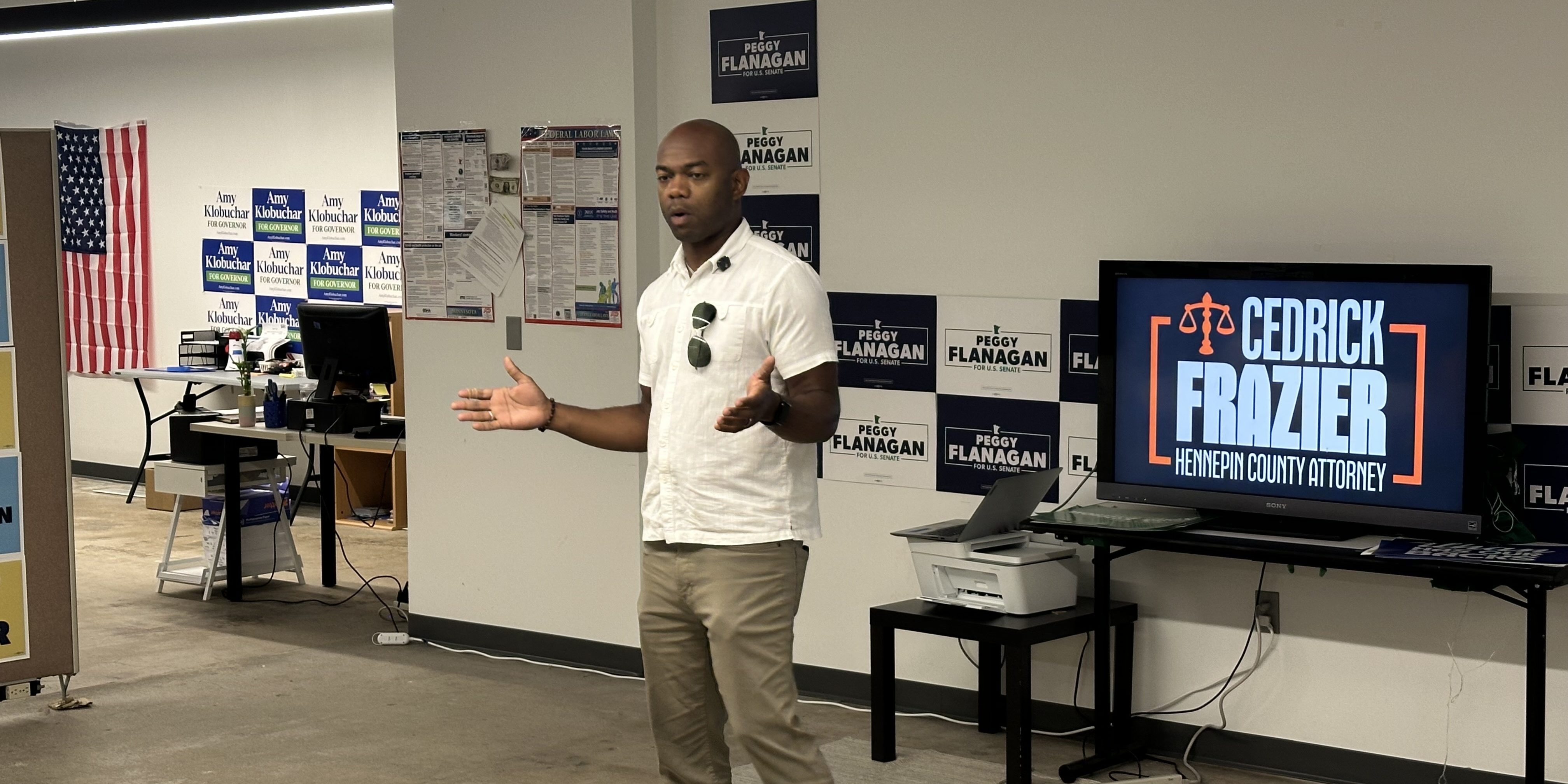
Cedrick Frazier’s blunt message for Minneapolis voters practically jumps off his yard signs: “PROSECUTE ICE. VOTE FRAZIER.”
The slogan reflects the city’s deep anger over the killing of two U.S. citizens by federal officers in January. It also reflects Frazier’s belief that the backlash gives him the edge in the race to serve as Minneapolis’s top prosecutor.
Frazier, a public defender turned state representative, is vying with former federal prosecutor Anders Folk in the race to become Hennepin County Attorney. The county, which includes Minneapolis, was beset by violence and chaos this winter amid a Trump administration immigration crackdown known as “Operation Metro Surge.”
Before the killings of Renee Nicole Good and Alex Pretti, the contest was shaping up as a referendum on so-called progressive prosecutions — fallout from a debate that began six years ago after George Floyd was murdered by former police officer Derek Chauvin.
Now it has morphed into something more. Either Frazier or his opponent will likely decide whether to prosecute the federal immigration agents who killed Good and Pretti. Those stakes give the race national implications, Hamline University political science professor David Schultz said.
“People are going to be looking at this race and asking: What does it tell us about holding law enforcement accountable?” he said. “If you hadn’t had Metro Surge, if you hadn’t had George Floyd, Derek Chauvin, it would be: Minneapolis is holding an election for county attorney — no big deal.”
Walking the Block
A county attorney in Minnesota has broad responsibilities that range from general counsel for local government to prosecuting crimes to pursuing child support cases.
Voters, however, only wanted to talk about one thing as Frazier canvassed the Longfellow neighborhood of Minneapolis earlier this month: U.S. Immigration and Customs Enforcement’s winter invasion. Without prompting, two voters in two blocks thanked him for his campaign promise to go after ICE.
The reminders of Minneapolis’s turbulent decade are everywhere in the city. A couple blocks away from a campaign field office, one building is still tagged with “#JUSTICE4GEORGE” graffiti. Within a short drive, the memorials for Good and Pretti are overflowing with flowers and handwritten tributes.
In an interview with The Intercept, Frazier was careful to say that he has not made any decisions about cases involving federal agents. Any explicit statement to that effect could be used to throw him off the case.
“But I don’t see it any different than saying we’re going to go after crime,” Frazier said. “We’re just making it very clear and very explicit that if you come here, regardless of what your title is, and if you violate the law here, there will be accountability for that.”
A native of the South Side of Chicago, Frazier moved to rural Minnesota for college and never left the state. He has three daughters and went from serving as a Hennepin County public defender to state representative for New Hope, a suburb of Minneapolis.
The 47-year-old built strong connections with the state affiliate of the Democratic Party and Minnesota’s powerful labor movement. His day job outside of his part-time legislative position is as an attorney for the state’s main teacher union.
If he is elected, Frazier will likely face crucial decisions about whether to file or continue pursuing charges in the Good and Pretti killers. The sitting county attorney, Mary Moriarty, began the investigation into those killings with the aid of state Attorney General Keith Ellison, but she could leave the ultimate charging decision up to her successor. Frazier says he has no confidence in parallel federal investigations.
“I have no trust whatsoever in a Donald Trump-led Department of Justice actually getting us any justice or accountability for what happened here,” he said.
“Tagged With Trump”
His opponent, Folk, brings a strikingly different resume and support base to the race.
A Minnesota native and 49-year-old first-time candidate who served in the U.S. Marine Corps, he worked his way up through the ranks at the U.S. attorney’s office in Minneapolis, where some of his most notable early cases focused on Somali American men accused of traveling to the Horn of Africa to fight for the designated terror group al-Shabaab.
After a stint at a national law firm, he returned to the U.S. attorney’s office in 2018 to serve as first assistant. He was briefly the interim top prosecutor after the resignation of the Trump-appointed U.S. attorney in 2021. During that stint, he signed Chauvin’s indictment on federal civil rights charges connected to the murder of George Floyd.
In 2022, he left public service and became a partner at the white-shoe law firm Jones Day, which has helped corporations fight union campaigns.
His blue-chip resume attracted support from wealthy campaign donors and Minneapolis Mayor Jacob Frey, who endorsed him early on.
Folk, whose campaign declined a request for an interview, leans on his prosecutorial experience to make the case that he is best suited to prosecute federal officers.
“These are cases we’ve never done here in Minnesota,” he said in an interview with Minnesota Public Radio last month. “These are going to be cases we’re doing for the first time in the history of this state. And I think it just really speaks to how critical it is to have that deep experience doing federal criminal prosecution work because that’s where these cases are all going to end up.”
While campaigning on his experience at the U.S. attorney’s office, however, his job as a federal prosecutor also presents a liability. Frazier routinely notes that Folk rejoined the office when Trump was president. That association has hurt Folk as much as anything else, said Schultz, the Hamline law and politics professor.
“He is tagged with Trump, he is tagged with the federal prosecutor’s office,” Schultz said.
“It’s guilt by association.”
Mary Moriarty’s Shadow
Frazier took 36 percent of the vote in the nonpartisan primary last month to Folk’s 23 percent. That lead makes him the “heavy” favorite but not the inevitable winner, Schultz said.
Folk’s supporters have bristled at the claims that he was a Trump lackey. In the run-off, Folk played up his connections to the Biden administration.
Yet Folk has played the guilt-by-association game, too, by tying Frazier to the current county attorney, Mary Moriarty.
Moriarty ran as an outspoken progressive when voters were outraged over her predecessor’s handling of Floyd’s murder. She promised to transform the office with a restorative approach and fresh reviews of past incidents of police brutality.
She followed through on those pledges but drew political flak for the way in which she went about it.
Former Democratic allies, including state Attorney General Keith Ellison, castigated her over her handling of a case where two teen boys were accused in the killing a young mother and she sought to prosecute them as juveniles. Democratic Gov. Tim Walz eventually took her off the case and handed it to Ellison, a move she called undemocratic.
With her political fortunes sinking, Moriarty decided not to run again last year, well before Operation Metro Surge began. During the election, Frazier’s critics have sought to cast him as her second coming.
Folk quickly name-checked Moriarty when he was asked about his differences with Frazier in a recent radio interview.
“Not unlike my differences with Mary Moriarty, I’m somebody who has stood up in court and prosecuted for the people of the state of Minnesota,” Folk said. “And Cedrick Frazier has never done that. He has never been a prosecutor and has no experience there.”
Frazier chooses his words carefully when he talks about Moriarty’s legacy. He has positioned himself as more progressive than Folk and promised to continue some priorities, such as the police accountability project. Yet he has sought to distance herself from Moriarty on other issues. Though Moriarty changed the office’s policies to avoid charging juveniles as adults, Frazier says he is open to the possibility of such charges.
“I don’t know why it’s fair for him to say I’m going to be Mary Moriarty 2.0, but we can’t truthfully, truthfully say and talk about the fact that you worked under Donald Trump and you’re a partner at Jones Day,” Frazier said.
The family of the woman slain by the two teens said they felt betrayed by Moriarty’s decision to charge them as juveniles instead of adults. Frazier said that he will be more skillful in talking to community members than Moriarty. He will bring the same approach to killings perpetrated by law enforcement officers, he said.
“I’m going to have use-of-force experts right there with me, helping to inform me when I make those decisions,” he said. “And I’ll be very clear: If the case can’t be charged, I will go out and I will have that tough conversation with the community.”
Marcia Levering nearly died at work on February 6, 2021. She was working as a prison guard at the former medium-security federal prison in Leavenworth, Kansas, a facility operated by the private prison company CoreCivic. One of Levering’s overwhelmed colleagues buzzed open the wrong door, releasing a high-risk prisoner directly into Levering’s path. “He kind of gave me this eerie green grin,” she said. Then boiling water hit her face.
The facility, which had long been plagued by overcrowding, chronic understaffing, and deadly violence, closed later that year after a Biden executive order against all private prison profiteering put its century-long run to an end.
Then came the second Trump administration and its plans to supercharge the business of incarceration in the United States.
As of March, the notorious prison is back up and running, and this time it’s being filled with immigrants, the majority of whom have no criminal conviction, as part of Immigrations and Customs Enforcement’s brutal deportation regime targeting noncitizens.
Last month, CoreCivic sold the facility to the Department of Homeland Security for $238.4 million, although it expects to keep operating the site under its existing ICE arrangement. But local officials tell the story of a massive for-profit prison company steamrolling community opposition as well as the city’s own established processes, and ultimately forcing their hand to participate in a project of mass detention — a system that advocates and former employees say has led to unsafe, violent conditions for both detainees and employees.
Current conditions for detainees held at the Midwest Regional Reception Center are hard to verify from outside. In its reporting on the sale, the Kansas City Star put the facility’s population at 365 men and 112 women, a count shared at a July 28 community advisory board meeting. The paper described two local groups in contact with detainees and their families, among them Northland Neighbors United, which said in a July statement that detainees have reported medical neglect, inadequate food, and prolonged lockdowns. CoreCivic spokesperson Ryan Gustin told the Star the allegations do not reflect how the facility operates.
This isn’t “manufacturing notebooks and pens. This is profiting off of people being put in cages.”
For Esmie Tseng, the communications director for the ACLU of Kansas, coverage of these city meetings sanitizes the reality for detainees.
“We’re making a contract out of putting people in cages,” Tseng said. “This isn’t just moving widgets from one place to another, or manufacturing notebooks and pens. This is profiting off of people being put in cages.”
The Pitch
By early 2025, the city of Leavenworth had already said “no” multiple times to deepening its involvement in immigration detention. After Trump’s reelection, CoreCivic tried again, working with city officials for three months before announcing on a Zoom call it would reopen the facility as an immigration jail without waiting for a special use permit, or SUP, to be approved. The city sued to force CoreCivic to go through its permitting process, and the company countersued, arguing its federal contract allows it to bypass local law. In June 2025, a Leavenworth State District Court judge granted a temporary injunction barring CoreCivic from operating without a special use permit.
During that first push on March 25, 2025 — the day the city commission was scheduled to meet in closed session about the ICE contract — John Malloy, CoreCivic’s vice president of federal partnership relations, emailed Leavenworth’s commissioners with what seemed like an attractive financial offer: “300 well-paying jobs at starting salaries of $28.58/hour,” more than $1,000,000 annually in property taxes, a $1 million one-time impact fee, and annual payments to the city and police department. The final permit set CoreCivic’s impact fee at $1.5 million, which City Manager Scott Peterson said covered the city’s legal bills.
Malloy also emphasized the city’s approval process must move quickly to meet growing demand to ramp up the number of available immigration prison beds.
“While ICE’s pressing need for capacity dictates the speed at which we must move to hire and ready the facility … we do not wish this speed to harm what we hope will be a long-term beneficial relationship with the City,” Malloy wrote in the email. He added this expedited timeline would not allow for “a protracted permitting process.”
He also touted that the community response to job postings had already been strong, with more than 500 applicants “in the hiring process” and more coming in every day.
Levering, an Army veteran and Native American, heard a version of that pitch five years earlier in a cold call from a recruiting agency. Back in 2020, when CoreCivic was contracted to run the facility as a federal prison by the U.S. Marshals Service, the recruiting agency offered her 12-hour shifts and only three days a week, she told The Intercept. The schedule sold her. With four kids in school, the promise of four days at home made the job feel like an ideal fit for her busy life. She saw the work as service, an extension of her years in the Army. In hindsight, she said, “Obviously, [that’s] not the case, because it’s a private prison.”
Mike Trapp, co-founder of the Carceral Accountability Council, said CoreCivic hires people the state prison system and Federal Bureau of Prisons might otherwise have turned away over physical and age limitations, because the company has “lower standards of entry.”
But Bill Rogers, a former guard at the facility under the Marshals contract, said there were effectively no hiring standards.
“Think about the people you’re going to get to work at a facility if you really just don’t care.”
“You gotta pass their background check … and you gotta be breathing,” he said. “Think about the people you’re going to get to work at a facility if you really just don’t care.”
One year after Malloy’s email to persuade city officials, the facility already had 150 employees on its payroll, halfway to the 300 jobs Malloy had promised. At a February 2 hearing, the city’s planning commission voted 5-1 to recommend approval of CoreCivic’s special use permit. The City Commission granted final approval on March 10 by a vote of 4 to 1.
The Arithmetic of Danger
Levering’s schedule amounted to a minimum six-day, often seven-day, workweek, with shifts of 12 hours or longer plus mandatory overtime, she said. Levering rarely saw her four children, who were then in middle and high school. The evenings she’d pictured spending time with them at home never came to pass.
After onboarding, officers were promised 40 hours of continuing training annually, Rogers said. He received that training for about his first two years, he said, until staffing ran too thin to pull officers off the floor. Left to teach herself, Levering said she learned more from prisoners than her peers or her supervisors. They told her who to keep an eye on, how to read danger on the floor, and where to set boundaries.
In response to questions from The Intercept, Gustin, the CoreCivic spokesperson, said the company’s training “meets or exceeds” the standards of the American Correctional Association.
Levering said that during her time at the facility, shifts that called for 24 to 25 officers often had just five or six. Within months, CoreCivic began eliminating bubble officers, who monitor units from a secure, elevated central control booth known as the “bubble.” These officers are critical for safety, as they control access to different zones of the prison by electronically opening and closing doors. Their elevated position also allows them an eye-in-the-sky perspective, where they can be the first to spot emergencies before they escalate.
In an interview, Shari Rich, who worked at the facility for nearly 13 years and counts Levering as a close friend, traced Levering’s assault to CoreCivic’s decision to eliminate bubble officers.
“It should never have happened,” she said of Levering’s assault. Rich placed the blame squarely on CoreCivic eliminating bubble officers. She said she previously watched a case manager get brutally attacked by an inmate while the bubble ran with one person, a post she understood was supposed to be staffed by two or three.
Rich is still speaking out against the company, she said, because of what happened to Levering.
Officers were increasingly posted alone, sometimes responsible for two 64-person units, Levering said.
“They were hiring kids right out of high school,” Levering said, calling them “sitting ducks.” Without enough officers, downstream everyday functions also collapsed. Recreation stopped when there was no one to run it, Rich and Rogers said. Officers were pulled off their units for weeks at a time, according to Rogers, which left inmates in day rooms with no one to turn to. The locks to the cells were breaking, Levering said, even as CoreCivic refused to put enough people on the units to keep them secure. The ACLU and federal public defenders confirmed that detainees, unable to lock their own cells, built makeshift barricades and armed themselves.
The day an inmate split Rogers’s head open with a food tray, he said he was covering three units alone with no bubble officer watching. He had already emailed the warden about the lack of coverage. He lost his radio in the assault, stranding him and unable to call for backup. The wound took 14 staples to close, he said. Rogers also said he was required to finish his shift before driving himself to the hospital. All the warden had to say to him about the incident was that “the takedown you did was a little rough,” he recounted.
“How do we expect them to act?” Rogers asked. “We have to bear some of that responsibility. … We lost control of that place.”
“We have to bear some of that responsibility. … We lost control of that place.”
Gustin said CoreCivic does not supply specific figures about staffing in any of its prisons for “safety reasons,” but added, “We are appropriately staffed based on the number of individuals in our care.” CoreCivic attributed staffing shortages to Covid, despite the 2017 audit, which found chronic understaffing years before the pandemic. In 2021, ACLU affiliates and federal public defender offices in four states jointly documented an average of nearly 37 violent incidents per month at CoreCivic Leavenworth between May and July of that year, just months after Levering was attacked.
Asked about the 2021 conditions, Gustin said “staffing was the main contributor to the challenges.” He also said incidents from “more than five years ago” do not reflect conditions in the facility today.
What the Machine Produced
On the day of the incident that would leave her permanently disabled, Levering said that she and her co-worker Diana Polanco were the only two officers on the floor. It was Polanco’s second day on the job, and she wasn’t yet OC certified, a prerequisite for carrying pepper spray.
Levering remembers the inmate being released directly into her path but little else about the assault.
“Where the hell is everybody?”
“My eyes were closed, and I was in the fetal position on the ground. I didn’t know he was stabbing me, because your adrenaline’s going,” Levering said. According to the Leavenworth Police Department report, she was stabbed four times in the ear, once in the arm, and twice in the abdomen. Before anyone reached her to help, she remembered wondering, “Where the hell is everybody?”
Polanco tried to step in to help Levering. She suffered a broken jaw, stab wounds to her back and face, fractured ribs, and lasting nerve damage.
The Leavenworth Police Department’s incident report on Levering’s attack, which lists the location as the Midwest Regional Reception Center and a knife or cutting instrument as the weapon used.Document: Leavenworth Police Department
Levering’s injuries were catastrophic. She lost 24 inches of her colon and spleen, according to the incident report. A punctured lung was not disclosed to her for a year, until she says a doctor seemingly mentioned it by accident. She has received 16 facial reconstruction surgeries, and five years later, she is still undergoing medical procedures related to her injuries. She lives with permanent facial paralysis, chronic vertigo, chronic gastrointestinal issues, and walks with a cane. Her PTSD, aggravated by serving in Iraq, is debilitating. After 10 months as a prison guard, she now lives on $825 a month in disability payments.
Warren Richardson, the federal prisoner who attacked Levering and Polanco, pleaded guilty to attempted murder and assault with a dangerous weapon, and was sentenced to 300 months. The federal record describes the attack as “nearly killing” both women.
Over roughly five years at the facility, Rogers said he was assaulted seven times, and no one from CoreCivic asked if he was OK or offered counseling. Since the injuries were on the job, Rogers said the company was responsible for his medical expenses. But the invoices remained unpaid and were forwarded to a collections agency instead, he said. Trapp, of the Carceral Accountability Council, has watched the job take its toll on Rogers.
“When he gets talking about some of the deaths that he witnessed, he’s re-experiencing it. I can see it in his eyes,” Trapp said. “I’ve worked with a lot of trauma survivors, and I’m not qualified to make a diagnosis in the state of Kansas, but I see it, the hauntedness.”
Rich couldn’t understand why other injured officers were paid settlements while Levering only had her initial medical bills covered, despite suffering from permanent disabilities. With no further support from CoreCivic, the Carceral Accountability Council launched a GoFundMe to help with her continued recovery.
CoreCivic did not respond to detailed questions about the February 6, 2021, attack, the uncertified officer on the floor, or its treatment of Levering afterward, including whether it provided any support for her injuries.
The ICE Escalation in a Town of Prisons
Widely known as one of the nation’s quintessential prison towns, Leavenworth, Kansas, has been in the corrections business for more than 150 years. The Army raised Fort Leavenworth above the Missouri River in 1827, and later established what remains the U.S. military’s only maximum-security prison. Kansas opened its state penitentiary in neighboring Lansing in 1868. By 1903, the federal penitentiary had taken its first prisoners. Convicts built much of it, marching over from the old military prison at Fort Leavenworth each day. For generations, guarding prisoners has been one of Leavenworth’s steadiest livelihoods, work that has employed hundreds across the fort, the state pen, and the federal walls.
In the U.S., the private prison industry is worth somewhere around $6 billion, much of which comes from government contracts. Corrections Corporation of America, which later rebranded as CoreCivic, opened the Leavenworth Detention Center in 1992 as the country’s first for-profit maximum-security prison under direct federal contract. Gustin, the company’s spokesperson, acknowledged “there were challenges as that contract neared expiration” but said the company was otherwise “proud of the operational track record we’ve built.”
CoreCivic, which owns more prisons and jails than any private company in the country, has a documented history of neglect, safety failures, and worker exploitation. In 2021, while still under the U.S. Marshals Service contract, Kansas federal Judge Julie Robinson called the facility “an absolute hell hole.”
“They don’t see us as humans, or the inmates as humans.”
But with the advent of the Trump administration’s mass detention and deportation system, the company is looking forward to a bright — and very profitable — future. On a February earnings call, CEO Patrick Swindle called Immigration and Customs Enforcement “our first customer 43 years ago” and “our largest customer for over a decade.” The company’s profits reached $116.5 million in 2025, a nearly 70 percent increase over the previous year, and ICE revenue more than doubled in the final quarter. The One Big Beautiful Bill Act, which Trump signed into law in July 2025, directed roughly $45 billion to expanding ICE detention, nearly quadrupling the agency’s annual spending. On the call, the company said it could supply ICE with nearly 13,000 more beds for the Trump administration’s expansion, a figure Swindle said “does not include additional capacity we may be able to provide through other means.”
Of those beds, 1,033 are in Leavenworth. Nine days after the city commission vote on March 10, CoreCivic reopened its doors and began housing ICE detainees. As a condition of approval, the special use permit required the city to establish a community oversight committee.
Behind every understaffed shift and unanswered emergency code at Leavenworth is a facility expected to generate $60 million a year. To Levering, CoreCivic’s profit incentive means “they don’t see us as humans, or the inmates as humans. … We’re all numbers to produce for them.”
Promises Made, Promises Broken
The warning bells about Leavenworth started ringing years ago. The 2017 inspector general report concluded the facility had concealed triple-bunking, where a third bed was installed in several cells meant to house two inmates, from auditors staging full staffing and cleanup on inspection days. Those concerns went unaddressed, Rich said, save for a scramble to paint and clean before each audit. CoreCivic’s own internal investigation concluded the bunks had been removed “intentionally to conceal” the practice, and the company responded to its own finding by instituting ethics training and a non-retaliation policy for employees reporting misconduct.
Among the promises that haven’t come to fruition are good-paying jobs for the community.
Among the promises that haven’t come to fruition are good-paying jobs for the community. Malloy, the CoreCivic vice president, had promised “starting salaries of $28.58/hour.” But CoreCivic’s current Leavenworth listings show multiple positions below his pledge: certified medical assistant at $21.19, medical records Supervisor at $23.92, facility locksmith at $26.08, and treatment counselor at $26.96. The detention officer rate, the most dangerous and high-turnover role, sits at $28.25.
Gustin called any notion of a wage discrepancy “false” and said the figures Malloy offered were “an approximate starting wage for a detention officer position.”
Malloy also pledged to use “area construction contractors and labor.” But a building permit dated March 19, dated six days before Malloy’s email, shows CoreCivic had already hired Texas-based Bass Roofing for $1,145,600. CoreCivic hired the contractor; the contractor employed the workers. Gustin confirmed the company chose an out-of-state contractor that “handled similar work at another one of our federal facilities, which required special clearances for workers,” and said it favors providers who meet “stringent labor requirements.”
Rogers, the former prison guard, had spoken at city commission meetings about the roofing project, alleging that instead of bringing jobs to the community, the project relied on undocumented laborers. On April 17, 2025, CoreCivic’s deputy general counsel sent him a cease-and-desist letter, copied to the Leavenworth Police chief, which sharply disputed those claims.
“To ensure that its contractors’ employees are legally authorized to work in the United States, CoreCivic requires all contractors, including Bass Roofing and Extra Squares Roofing (whose employees are working on MRRC’s roofing restoration) to strictly comply with Form I-9, Employment Eligibility Verification, requirements and participate in E-Verify,” the letter read. “Our review of this confirms that any representation that undocumented or unauthorized workers have worked on the MRRC project is false.”
Document: Courtesy of Bill Rogers
Six days later, outside counsel sent a defamation threat demanding he retract his statements. The letter cited his 2020 termination for “excessive force,” setting an April 25, 2025, deadline for Rogers to publicly detract his allegations.
That date passed; no lawsuit has materialized. To Rogers, the letter was a clear attempt to intimidate him into silence. CoreCivic did not say whether the threatened lawsuit was ever filed, and Gustin dismissed former employees-turned-critics, saying there “have only been a few former employees who have spoken out” about the facility.
The Gap
Rogers said that at first, the schedule was easy: eight-hour training shifts, Monday through Friday. In Tennessee, a 2023 audit by the comptroller found turnover among correctional officers at the four prisons CoreCivic runs for the state averaged 146 percent, a staggering figure compared with 37 percent turnover at the state-run facilities. As of mid-August, Leavenworth reportedly holds more than 500 detainees, still well below the 1,033-bed capacity CoreCivic projected.
There has also been a worrying continuity in top leadership: The warden running the ICE operation, Misty Mackey, was the assistant warden at the same Leavenworth facility in February 2021.
The city commissioners faced an impossible task that stood to devastate Leavenworth no matter which way they voted.
“It’s a lot to ask five part-time citizen-legislators to put their city on the line to be singularly responsible for stopping the mass deportation agenda,” Trapp said.
“It’s a lot to ask five part-time citizen-legislators to put their city on the line to be singularly responsible for stopping the mass deportation agenda.”
Levering, who watched officers treat American inmates “like they’re subhuman,” expects immigrant detainees to fare even worse. “They’re still human beings first, just like you and I,” she said.
The chasm between what CoreCivic promises a community to set up its ICE operations and what it actually delivers may be measured in emergency rooms and disability checks. The same company that has now supercharged the mass detention of immigrants left Marcia Levering living on $825 a month with lasting disabilities and buried Bill Rogers in medical bills as he copes with PTSD.
“If they did to Marcia Levering what they did,” Rogers said. “If that’s how they treated her — then why would they care about a detainee?”
This time, the people on both sides of the door have less protection than before.
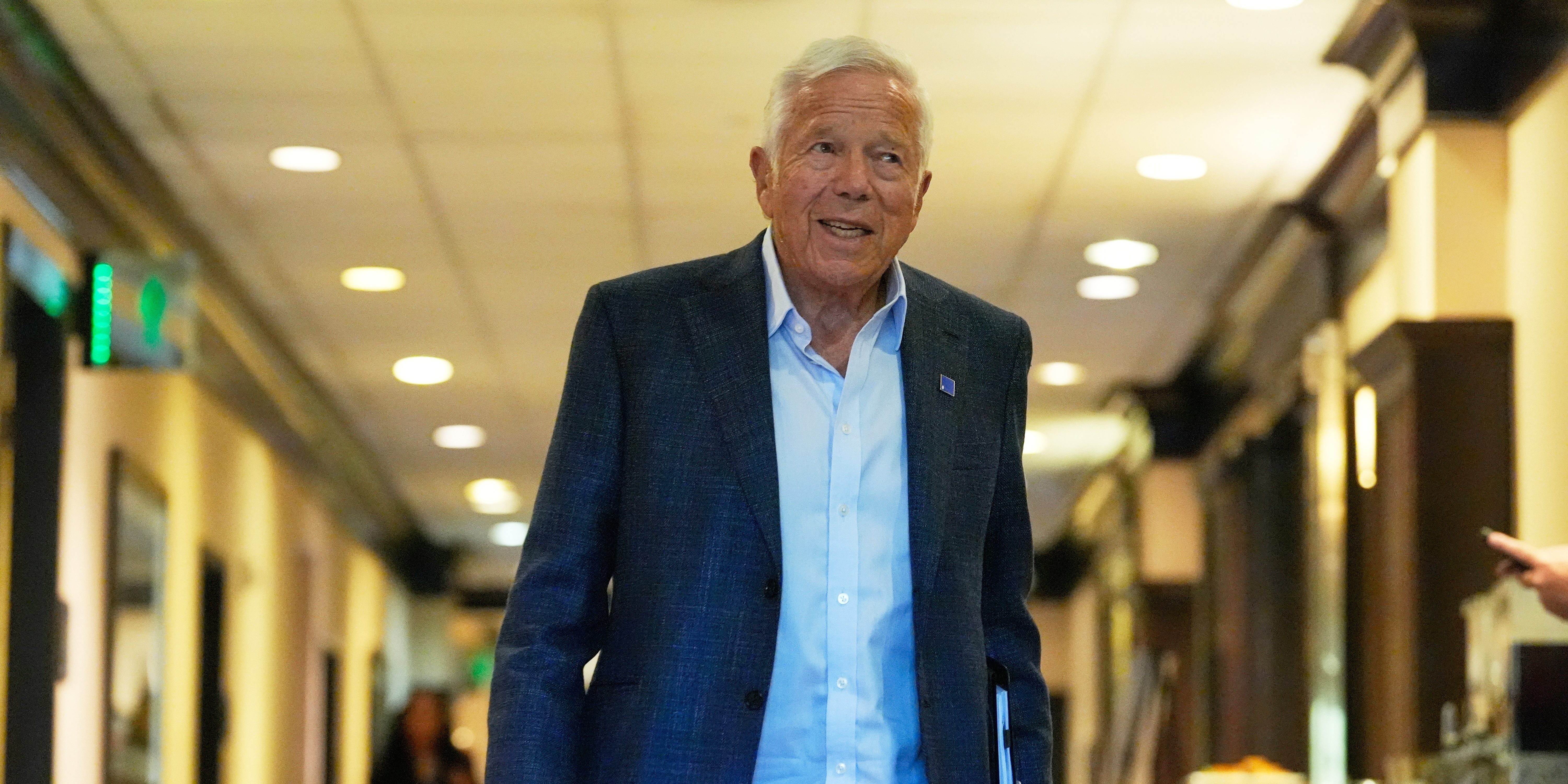
Billionaire New England Patriots owner Robert Kraft wants you to know he has spent “decades” supporting the Palestinian people.
Days after pressuring pop singer Ed Sheeran to drop rapper Macklemore from his tour over the latter’s “Free Palestine” remarks, Kraft claimed in a statement posted to social media that “for decades” he has “supported efforts that create opportunity for Palestinians,” such as initiatives to “to build businesses, create jobs, and forge relationships” between Israelis and Palestinians. The claims were made as a part of Kraft’s pledge to give $2 million to “aid in the region.”
Kraft did not disclose which organizations would receive his money.
Nor did he mention his long history of donating to Friends of the Israel Defense Forces, an organization that collects money on behalf of Israeli soldiers, and the United Democracy Project, the super PAC of the American Israel Public Affairs Committee, which lobbies to tilt American politics in favor of Israel. Kraft has also given money to a host of pro-Israel advocacy groups that attack critics of Israel, spread content that critics warn is Islamophobic, and have steadfastly defended Israel against mounting evidence of its ongoing genocide of Palestinians in Gaza.
The Intercept’s analysis of tax forms since 2006 show that Kraft’s charity group, the Kraft Family Foundation, has donated $196,000 to the Friends of the IDF and an additional $123,000 to other organizations — Brothers for Life and Friends of Israel Disabled Veterans — that directly benefit Israeli military soldiers. In his seven separate donations to the Friends of the IDF, Kraft earmarked the money to “Promote education for young Jewish soldiers.”
Since 2020, Friends of the IDF has poured more than $20 million into its lone soldier program, which supports young Jewish Americans, and Israelis who have no familial support, to serve in the Israeli military’s reserve soldier program, according to an investigation by The Intercept. The program has continued throughout Israel’s genocide in Gaza.
Kraft has organized trips to Israel for former and current NFL players, including a 2017 trip in which he led a delegation of former players on a visit to an Israeli Air Force base, organized by the Friends of the IDF.
In 2019, Kraft gave $20 million to found a new organization, the Foundation to Combat Antisemitism, now known as the Blue Square Alliance Against Hate. Upon its founding, Kraft pledged the organization would oppose the Palestinian-led Boycott, Divestment and Sanctions movement, claiming the Palestinian rights movement “and other efforts to delegitimize and undermine the State of Israel are the most disconcerting times for the country I love so much.” Israeli Prime Minister Benjamin Netanyahu reciprocated the love when Kraft announced the new group while accepting an award for his Israel advocacy, declaring, “Israel does not have a more loyal friend than Robert Kraft.”
Over the years, Kraft’s foundation has also given $63,500 to the right-wing media watchdog group Committee for Accuracy in Middle East Reporting and Analysis, or CAMERA, which has run pressure campaigns against news outlets, journalists, students, and scholars it deems anti-Israel and has routinely denied Israel’s genocide in Gaza, dismissing such evidence as “the Gaza GenoLie.” When Kraft gave $36,000 to CAMERA in 2018, the donation included a memo, “fighting antisemitism.”
In 2011 and 2012, Kraft’s foundation donated $50,000 to boost the Investigative Project on Terrorism, which the Council on American-Islamic Relations considers a core part of what it refers to as the “U.S. Islamophobia Network.” As Kraft gave to the think tank, it launched campaigns targeting U.S.-based groups decrying Israel’s human rights violations against Palestinians, such as attacking human rights groups Students for Justice in Palestine and American Muslims for Palestine as having ties to “extremist groups” and claiming they were a part of a “web of Hamas support.” The group has more recently dismissed protests against Israel’s genocide as Hamas propaganda.
In addition, Kraft’s foundation donated $150,000 from 2008 to 2018 to the pro-Israel organization, Middle East Media Research Institute, co-founded by a former Israeli intelligence officer and counterrorism adviser to several Israeli presidents. The group’s website says it exists to “bridge the language gap between the West and the Middle East and South Asia” by translating Arab language media into English. However, journalists and experts have noted selective translations of Arab articles and statements to misrepresent policies of Arab governments as extremist or violent.
Aside from his donations to nonprofit groups, Kraft has been an active donor to AIPAC’s super PAC, the United Democracy Project. Through his limited liability company, the Kraft Group, Kraft has given $3 million to the super PAC since its founding in 2022, including $1 million in donations this midterm cycle. During this midterm election cycle, AIPAC has flooded races to oppose candidates who criticize Israel’s genocide in Gaza and U.S. military support for Israel, helping make several primaries among the most expensive on record.
It’s not clear whether these entities were the ones Kraft claims have created jobs and spurred dialogues between Palestinians and Israelis. Kraft, however, is also a regular donor to local Jewish groups in Massachusetts, such as Combined Jewish Philanthropies of Greater Boston; Temple Emanuel in Newton; and Jewish Family & Children’s Services in Waltham.
Kraft and the groups mentioned in this story did not respond to The Intercept’s request for comment.
The fight over the future is rapidly unfolding before our eyes. With debates roiling Washington over calls to rein in artificial intelligence before it’s too late as the U.S. continues to wage official and unofficial wars around the world, many of the world’s most powerful players are licking their chops.
Yes, there’s destruction all around. But these players have carefully concocted a plan: to hasten a familiar vision that combines biblical, militant, and futuristic images of the end times so they can save themselves.
“We didn’t feel that the old ways of understanding who Trump is, what he’s trying to accomplish — even what fascism is — was fully capturing what we were seeing. Here we’re thinking about invading Greenland, declaring Canada the 51st state, creating an ICE army, the relationship with El Salvador’s maximum-security prisons. So we’re trying to map this,” says Klein. It seemed to be “a fascism that had no vision of our world continuing. There’s always an apocalyptic quality to fascism, but there is a horizon for the in-group after the cataclysm, and we weren’t seeing that in this politics. It was much more about bunkering down in and taking breakdown for granted.”
“End times fascism is an alliance of three main components,” says Taylor. The religious fundamentalists who helped elect Donald Trump, wanting to hasten along a violent Armageddon so Jesus will return. The tech accelerationists “exalting in the possibility that some sort of super intelligence, some sort of digital being might take over.” The ethnonationalists who view immigration as an existential threat, so they fortress the border and hoard resources. “These different prongs find a kind of uneasy alliance in their conviction that this world’s going to hell and that their group will survive the wreckage,” says Taylor.
It may sound bizarre. And it is. But that doesn’t mean we should ignore it, Klein says. “This is a really dangerous pattern of thought: that out of the worst things possible comes the beautiful, glorious golden city. And that’s the template of all of these action films and video games, and it leads one to embrace the worst and to not fear what we should fear,” says Klein. “When Trump shares a video of a remade Gaza with a Trump Tower, he’s doing a version of that story. When Sam Altman says he’s summoning a digital god, and we’re going to have utopia with AI, and yeah, let me cover the whole world with data centers and accelerate the climate crisis because it’s going to be utopia … he’s doing the story. So we have to be able to identify it — because we’re all living with the consequences of this terrible story and we need better stories.”
“In this moment, we’re up against a fascism that is against all humans, in a way. We quote Kelly Hayes, an activist based in Chicago, and she says, ‘Every fascism has its subhumans, and for techno-fascists, it’s just humans in general.’ This is opening up a bigger fight beyond ‘I am a man’ to just like, this is life versus the machines, and there’s something very unprecedented about that and potentially very unifying,” says Taylor, noting that the collective uprising, across the political spectrum, against data centers shows people breaking free of one so-called inevitable future.
For more, listen to the full conversation of The Intercept Briefing on Apple Podcasts, Spotify, YouTube, or wherever you listen.
Transcript
Akela Lacy: Welcome to The Intercept Briefing, I’m Akela Lacy, senior politics reporter at The Intercept. Today, we’re going to talk about the apocalypse.
NBC: You truly believe AI can kill us all in less than a decade?
Jacob Coxon: Yes, I do.
AL: If you’ve been disturbed by the increasingly dystopian flavor of today’s world, you’re not alone. It can be hard to keep track.
And if you listen to this show, you’re familiar with the imagery: Masked agents in the streets. Soldiers clad in camo patrolling U.S cities. Mounting numbers of U.S. strikes committing extrajudicial killings of civilians in international waters. And a populace faced with a literal war against machines — not just at home but around the world.
U.S. Central Command’sAdm. Brad Cooper: First our war fighters are leveraging a variety of advanced AI tools.
AL: Washington is in turmoil over calls coming from inside the house to regulate AI before it’s too late. President Donald Trump has called the whole dustup a “hoax,” even as MAGA architect Steve Bannon appeared alongside Independent Sen. Bernie Sanders to promote human control over AI, as Congress balks at renewed public pressure to do something — anything — before they recess again until November.
Bernie Sanders: When the future of humanity is at stake, we need binding international safety rules, not voluntary standards from the industry.
Steve Bannon: All they’re trying to do is to use a crisis and turn it to their advantage, turn it to their advantage by creating a moat, a cartel, where not only can’t other aspiring companies get in, but more importantly, they’re going to have a liability shift to the American people.
AL: None of this would come as a surprise to our guests today, award-winning journalists and documentarians Naomi Klein and Astra Taylor, whose latest book documents the end-times ideology that unites the players trying to hasten just the final doomsday AI leaders are warning us about.
Today, we’re discussing the players responsible for bringing the most Orwellian features of our collective imagination to life. And we’ll break down just what their project entails: prophecy as policy, and speeding up the end of the world to save the chosen few.
Klein and Taylor’s new book is called “End Times Fascism and the Fight for the Living World.”
Naomi Klein is an award-winning journalist and documentary filmmaker and also the bestselling author of “Doppelganger,” “No Logo,” and “The Shock Doctrine.” She is an associate professor of geography and a co-director of the Centre for Climate Justice at the University of British Columbia, and she writes a regular column for The Guardian.
Naomi Klein, welcome to The Intercept Briefing.
Naomi Klein: Thank you, it’s great to be with you.
AL: Astra Taylor, also an award-winning journalist and documentarian, is a co-founder of the Debt Collective. She is the author of “The People’s Platform,” which won the American Book Award; “Democracy May Not Exist, but We’ll Miss It When It’s Gone”; and “The Age of Insecurity.” Taylor regularly writes for publications including The New Yorker and the New York Times.
Astra Taylor, welcome to The Intercept Briefing.
Astra Taylor: Really excited to be here.
AL: I want to start with how you conceptualized this idea. How did you come to develop the notion of “end times fascism”?
NK: It was born of the early weeks of the new, the second Trump administration — really trying to put our fingers on the continuities and the ruptures of what we were seeing. Both Astra and I had been doing a lot of public conversations, webinars, and we both remember the first Trump administration.
So we were familiar with certain things that we were seeing, but we didn’t feel that the old ways of understanding who Trump is, what he’s trying to accomplish — even what fascism is — was fully capturing what we were seeing. Here we’re thinking about invading Greenland, declaring Canada the 51st state, creating an ICE army, the relationship with El Salvador’s maximum-security prisons. So we’re trying to map this.
For me personally, I was finding that a lot of people were reading and talking about earlier books of mine, like “The Shock Doctrine,” as a way to understand it. I was feeling like it does not actually capture the full thing.
History does not just repeat on a loop. We often talk about how it accumulates, it compounds. So as people who are pretty keenly attuned to both political and ecological crises, we were noticing that the planet is a player in our politics, and that this seemed to be a kind of fascism that was different in that it didn’t have a future horizon. This was a fascism that had no vision of our world continuing. There’s always an apocalyptic quality to fascism, but there is a horizon for the in-group after the cataclysm — and we weren’t seeing that in this politics. It was much more about bunkering down and taking breakdown for granted.
Those are the origins of it. We’re not saying it’s wholly new; we’re saying that history moves and takes us to new places.
“This was a fascism that had no vision of our world continuing. … It was much more about bunkering down and taking breakdown for granted.”
AL: Astra, for people who haven’t read the book, can you tell us briefly, like, a top-level view of what you’re arguing?
AT: We’re arguing that the far right has taken a new apocalyptic turn. To emphasize what Naomi just said, we’re interested in the continuities, but we’re also interested in what has changed.
People for a while have been wondering, is this the F word? Is this fascism? If so, what does that mean for us? This book attempts to answer that question by really taking seriously what has changed. And as a consequence, how has the right wing changed?
The fascism of the 20th century emerged out of certain catastrophic conditions, the sort of classic fascism, which also had antecedents in colonialism and Jim Crow. It also didn’t come from nowhere. But it was a phenomenon that emerged in the wreckage of the First World War and the Great Depression. It was a response to those crises.
Today, we’re living in an age of crises that were unimaginable a century ago. Climate change, an era of nuclear weapons — nuclear weapons were not known to Mussolini or Hitler — artificial intelligence, forms of wealth that are incredibly concentrated and incredibly global, social media, incredibly networked media technologies. This planetary scale has shifted the kind of fascism that we’re responding to.
Our argument is that, as a response to these crises, the fascism of today has abandoned the idea of Armageddon ever ending, of there being a future horizon for their in-group. And that end times fascism is actually an alliance. Fascism is always an alliance, an uncomfortable alliance of different groups.
“These different prongs find a kind of uneasy alliance in their conviction that this world’s going to hell and that their group will survive the wreckage.”
But end times fascism is an alliance of three main components. The book analyzes them, in the ways that they overlap and the ways that they actually conflict.
The religious end-timers who are a major force in the U.S. government and the Israeli government, and more broadly, who have a messianic conviction that the end is nigh and that the Messiah will come, and they want to accelerate what they see as the fulfillment of biblical prophecy.
The tech end-timers — the tech-right — that is playing with a similar script in the sense that they’re imagining a future where they have created a digital super intelligence or maybe we’ve left the planet.
And then the ethno-nationalist end-timers who view immigration as an existential threat and believe the only response to the increasing disasters and insecurity is to fortress the border and bunker down and save their in-group.
So these different prongs find a kind of uneasy alliance in their conviction that this world’s going to hell and that their group will survive the wreckage.
There’s old, classic features of fascism: a supremacist thinking, eugenics thinking; a willingness to indulge in violence; a sense of woundedness. Fascism is always a movement of the powerful injured, so their sense that they’re under siege from below. These dimensions, though, have been updated for our new risk-filled era. So the book looks at the coalition and their strengths, but also their weaknesses.
“A sense of woundedness — fascism is always a movement of the powerful injured.”
AL: The book is an exploration of how deeply so much of the far right and its grip on sectors from tech to the military has been driven by what you’re talking about, this apocalyptic worldview.
One question I wanted to put to both of you is, when you think about this, how do you understand a vision that is so destructive also being so unifying for these coalitions that you’re talking about?
NK: As Astra was saying, fascism always arises during moments of crisis. Actually, there’s always a kind of a pincer of real crisis.
When Mussolini and Hitler rose up, the real crises of the wreckage of the First World War, economic desperation, cities choked with orphans, maimed soldiers. These were really genuinely horrific times. In response to what many people understood as the savagery of capitalism revealing itself was a rising militant left.
This was also the years after the Russian Revolution, and it was the years when socialists were saying, “We want a revolution in every country.” It was a global movement, and it was a movement that was saying, “You can’t actually have socialism in one country.”
So elites in every country were quite terrified that the response to these real crises would come for them, come up, would come for the system itself.
And so fascism pivots. It recognizes the rage, and it says, “Your rage is real. We feel it. Hey, here’s who to blame. It’s the immigrants crossing the border. That’s the real invasion. They’re coming for your stuff. They’re coming for your jobs. They’re the reason your life is painful,” and offers up all of the other scapegoats. So that can be unifying. It’s an old trick. That’s the Trump playbook. It’s the [Javier] Milei playbook. It’s the [Jair] Bolsonaro playbook. It’s a global playbook.
This is the other thing that we’re trying to do in the book, is wrench the U.S. out of its parochialism a little bit and be like, actually, the laboratory for this in many ways is more Latin America and Europe. It’s coming at a delay in the United States. And though it has particular characteristics in the United States, and in every country there’s particular characteristics, this is very much a global phenomenon.
But I think we wrote the book because we actually think it’s not that unifying. That scapegoat move is always going to be an effective move, but the nature of this alliance is almost uniquely unsteady because, where it’s useful to look at what is the same and what is different with 20th-century fascism, and — here I should add, massive asterisk: We’re not nostalgic for 20th-century fascism. Ye olde fascism. Don’t want that.
But it is useful to look at the fact that Mussolini really did, and so did Franco, invest in major public works projects. Hitler did make the trains run on time, famously. Our fascists don’t care about trains, airports. They fly private. They can live with a level of chaos. They deliver less for their own base, for the people who elected them.
“Our fascists don’t care about trains, airports. They fly private. They can live with a level of chaos. They deliver less for their own base, for the people who elected them.”
We see these ruptures really clearly. In things like Steve Bannon going off on the tech oligarchs, which I never thought people should take all that seriously because he has his own tech oligarchs who’ve been funding him all along.
But we should take seriously these extraordinary uprisings against data centers, where people at the grassroots are finding they have more in common with the people they’ve been warring with over the culture wars they’ve been steadily fed, and going like, “Actually, we all really do agree that we don’t want to live under constant surveillance by Silicon Valley, and we don’t want this data center in our backyard, and we don’t want our kids taught by AI.” Hey, like this is a hell of a lot better than what we saw a few years ago at community meetings. It’s the instability that is really most interesting to us.
By taking them seriously and highlighting how nihilistic and how apocalyptic and how exclusive the vision is, we think we make them weaker, not stronger. We’re saying, “Don’t be afraid to look at this, because actually the more you look at it, the more we drag it into the light, the more vulnerable it is.”
AL: You mentioned this, Astra, laying out the major players in “End Times Fascism” as the religious right, Big Tech, and aspiring bunker-builders, as you describe them, namely those leading the anti-immigrant movement and trafficking in great replacement ideology that’s shaping U.S. policy.
I want to start with the religious right. This is something we’ve discussed at length on this show, but I want to ask you all, what is something you think the general public understands the least about the extent to which messianism and the end times fixation that comes with it undergirds this political moment and shapes the Trump administration in particular?
AT: People have a vague sense that Trump wouldn’t have been elected if he hadn’t had the support of white evangelicals. He famously got around 80 percent of the evangelical vote in both 2016 and in 2024. So I think people have a sense that the religious right is behind a guy who is incredibly immoral — it feels like a cognitive dissonance there, right? How is this sexual predator who’s been divorced multiple times the hero figure for this group?
Part of what explains that, though, is that they are really occupying a parallel universe. Portions of the evangelical right or Christian Zionists are committed to a version of theology where they think what’s in the Bible is literally going to happen, and that what they need to do is hasten along the sequence of events foretold — most violently and strangely in the Book of Revelation — that bad things will happen on Earth, and that means we’re moving closer to the day when there will be Armageddon and Jesus will return.
Even to a lot of Christians, this seems ridiculous. But there are people at the upper echelons of the U.S. government today who really believe it, and who see acts of violence — acts of terror — as felicitous signs.
We quote pastor John Hagee, who’s a very popular leader of a megachurch in Texas, and he’s just like: Everyone! All my thousands of followers! Call the White House and tell them that you’re so grateful for the war in Iran because that means that the end is nigh, and that means we’re that much closer to being hoovered up in a magic escalator to heaven.
They have this theological investment in war in the Middle East and this idea that Jesus won’t return until biblical Israel is restored, which is not just the West Bank and Gaza but large swaths of other countries. They’re making common cause with Messianic Jews in Israel who, again, aren’t the whole of the government but have managed to control very powerful portions of it.
What we’re trying to convey is that we actually need to pay attention to what these folks are doing. It doesn’t need to be the majoritarian strand to be an incredibly dangerous one.
“It doesn’t need to be the majoritarian strand to be an incredibly dangerous one.”
One of our recurring jokes — it’s not even a joke, really — as we wrote this book and also as we talk about it, is that to even quote these people makes us sound insane. Because they’re doing things like importing the perfect red heifers from Texas to bring them to the Middle East. Then literally the speaker of the House, Mike Johnson, is flying over to visit these cows and go: Oh my gosh, I don’t see any spots on them. This is so great. The Bible is coming true.
These people are running the government, and we need to take seriously the risk that that poses to all of us. Again, it’s based on this idea — we return to the narrative in the Book of Revelation because it’s sort of the fundamental mythological script that these three groups are playing with, it’s the root of this apocalyptic strain.
It essentially is a narrative that says, in the end times, there will be war, there will be pestilence, there will be floods and fires, but that just means we’re getting closer to the end when the chosen few will reach their utopia. It’s a very dangerous script.
For this part of the end times fascist alliance, it’s a literal interpretation of that script. But it’s one that has suffused our culture more broadly. This linear narrative of: Out of catastrophe, the promised land. That narrative is being followed in different sometimes secularized ways by the other parts of the right-wing alliance.
NK: If there’s one thing I learned from writing a book about people who lost their minds during Covid and then became the U.S. government, it’s that nothing is too stupid to actually manifest in reality. I’m not being glib.
In “Doppelganger,” I quote Philip Roth saying, “It’s too ridiculous to take seriously and too serious to be ridiculous,” being a kind of a mantra for our time. But that was before RFK Jr. was put in charge of Health and Human Services. There can be this smug response from liberals of like, “That’s just too silly for me to even have to care about.”
One of the things we dug up in the book is this story that was new to me, which was that in 1969 a Christian fundamentalist named Denis Rohan actually did succeed in firebombing Al-Aqsa [Mosque]. That’s very important to this theological story because the idea is that you have to build the “Third Temple” where Al-Aqsa is in order to create the conditions for the Messiah’s arrival or return, depending on which version of the story you believe. That relates to why you need those spotless red heifers, et cetera. So they are trying to fulfill this.
But as Astra was saying, this is both a literal threat of, like, it’s literally possible that there could be — as these ideas have become more and more powerful and more mainstream within the Israeli and U.S. government, and as people who were once seen as fringe terrorists like Itamar Ben-Gvir enter the government — it’s becomes more and more possible and more likely that people will do the self-fulfilling version of this prophecy.
Because the prophecy is, first, you have to have Armageddon. And if you were to actually destroy Al-Aqsa and try to rebuild the “Third Temple,” that’s a surefire recipe for World War III with nukes.
So they are creating the story that they claim is inevitable. It’s not inevitable, but they are actually doing their best to fulfill it for all of us. We can’t afford to ignore them. But it’s also a pattern of thought — this is a really dangerous pattern of thought that, out of the worst things possible comes the beautiful, glorious golden city. And that’s the template of all of these action films and video games, and it leads one to embrace the worst and to not fear what we should fear.
When Sam Altman says he’s summoning a digital god, and we’re going to have utopia with AI, and yeah, let me cover the whole world with data centers and accelerate the climate crisis because it’s going to be utopia, and we’ll all just be lying around just being in awe of the wisdom that AI has unleashed for us — he’s doing the story.
So we have to be able to identify it — because we’re all living with the consequences of this terrible story, and we need better stories.
[Break]
AL: This is a good segue into talking about perhaps one of the most visible manifestations of this apocalyptic project, as you mentioned, Naomi: AI and data centers, which you all situate as part of the doom cycle. You get into this question, but I want to talk with you both about how this particular issue has brought so many of us together in unified hatred.
I love this portion of the book where you talk about this. Across the ideological spectrum, why do people hate data centers so much? What exactly is so universally repulsive about them and what they represent?
AT: This is the kind of thing that gives you hope in humanity. Why do we hate data centers? Listen to the guys running these tech companies. They’re like, “Hi, we’re going to suck up all of the energy. We’re going to raise your electricity bills. We’re going to build these big, ugly city-sized buildings that have basically no jobs, that screech and scream all night long, destroy your property values. And guess what you’re going to get in return? You’re going to get no jobs in the future for you or your kids. You’re going to live in a world that is hollowed out because everybody’s talking to their chatbot, maybe dating a chatbot. Then also guess what? It might destroy everything, because it might turn on you. So how does that sound?”
AL: Doesn’t that sound great?
AT: Of course, people are like, “Actually, that sounds terrible. We never asked for this.”
Now, what’s interesting is these guys also have all their little podcasts where they talk amongst themselves too, so they’re like, “Geez, did we market this wrong?” And you’re like, yeah, you did, because actually you told us what you really want — which is you foresee a future with no human workers, and full of human alienation and loneliness, where one or two companies control the entire economy and maybe destroy humanity.
The reasons people object to this are obvious. It’s also building on years and years of a mounting tech-lash on both the left and the right. For different reasons, people were critical of the tech sector, and so that is also part of the foundation.
It’s really important, when Naomi said that they’re utilizing the same template — this, out of catastrophe, some kind of renewal for the chosen few. When you hear these folks talk about it, one of the founders of Google said it was “species-ist” to care about the fate of humanity, as opposed to exalting in the possibility that some sort of super intelligence, some sort of digital being might take over. That somehow we’re just close-minded for wanting to actually make a better world for human beings.
They literally talk about AI as a god or as a demon. And so they’re playing with these religious tropes. Of course, somebody like Peter Thiel and other high-powered people in Silicon Valley are increasingly coming out as Christians. Most famously, in his lectures about the Antichrist, which — tellingly — he says is somebody who wants to bring about control of AI, or like Greta Thunberg, some climate rationality.
So they’re playing with these overt theological elements. But ultimately what’s underpinning it is a material drive to own as much of the economy as possible, even if it destroys the lives of billions of people.
“Ultimately what’s underpinning it is a material drive to own as much of the economy as possible, even if it destroys the lives of billions of people.”
NK: On that last point, it’s a very profitable dream. I think that that’s true, honestly, for the theologians as well, that this is always, as [Karl] Marx said, there are opiate qualities to the story that heaven awaits, and yes, you’re suffering in the here and now, but do these things and you’re going to be in paradise.
That’s always been a story that has been very helpful to elite interests. The fact that the richest men on the planet are now telling it to us about their tech that is rapidly making them into trillionaires. It doesn’t mean they don’t believe it, but they certainly have motivations for telling us these stories. For telling us that we’re being speciesist and that we have to go along in this way.
But just on your point, why are people rejecting it? There’s this little detail that we came across in the story of one of the data center fights that I think people are by now very familiar with or should be familiar with. I think Intercept readers are familiar with what Elon Musk has done in Memphis. It’s a story of unbelievable environmental racism. The siting of these massive data centers that are impacting a majority-Black part of Memphis, Boxtown, which has these long roots of resistance.
It’s called Boxtown because it was built with the discarded parts of railway cars that were then turned into homes. Because it was unincorporated — and this is true of many Black communities — it was also chosen to be a place with very high levels of industrial pollution. It has a very strong environmental justice community, and it has all of this historical resonance because this is where Martin Luther King Jr. went to stand with the sanitation workers, which the organizers that we interviewed in Memphis consciously see the struggle as being part of that lineage and see the sanitation strike in Memphis as being the beginning of the environmental justice movement in the United States because it was a fight against a toxic workplace and work conditions.
But the detail that I was referring to, in that fight that I think often gets overlooked, is that the reason that Musk chose Memphis to build what he calls Colossus — the largest supercomputer in world history, and then he built a couple more — was because he needed to do it quickly. So he decided that he needed to find a place that would give him all the giveaways, but also where there was an empty building. He didn’t want to have to build a building from scratch. He wanted to move into a preexisting building.
In Memphis, they found a factory that was empty and in very good condition, and it was an Electrolux factory. If you look into the history of the Electrolux factory in Memphis, it’s a story of de-industrialization and free trade and broken promises because this is a factory that actually was producing ovens and other appliances, and it was moved from Canada to Memphis — from Quebec to Memphis — under NAFTA rules chasing lower wages.
So 3,000 higher-paid jobs became less than 1,000 lower-paid jobs in Memphis with contractors and so on. You see this race to the bottom. All these things were promised. They didn’t create nearly as many jobs with the Electrolux factory as they said they would. The wages weren’t as good as they said they would be. They said that all these other factories would open up, too. They didn’t.
So the re-industrialization didn’t happen with Electrolux. But then there’s this empty building, and Musk moves in, and it’s barely any jobs. We call it a ghost factory. That image of the abandoned factory was the image of the de-industrialization of the NAFTA years. But now we have this new image, which is a reoccupied former factory that once had almost 1,000 workers and now is just a bunch of buzzing computers, and whose end goal is to eliminate everyone’s job.
So why would people accept the trade-offs of that, because Musk also rigged together all of these polluting gas turbines in order to get it online quickly?
This is what we mean by history compounds. It’s not a loop. It’s more like a spiral taking us somewhere.
AT: Martin Luther King, those were the famous protests, of course, with the “I am a man” sign, where the aspiration was like, “I’m a man, recognize me as equal and human.”
“In this moment, we’re up against a fascism that is against all humans, in a way.”
In this moment, we’re up against a fascism that is against all humans, in a way. We quote Kelly Hayes, an activist based in Chicago, and she says, “Every fascism has its subhumans, and for techno-fascists, it’s just humans in general.” This is opening up a bigger fight beyond “I am a man” to just like, this is life versus the machines, and there’s something very unprecedented about that and potentially very unifying.
AL: You both pointed this out, and you get into this in the book, as to why tech giants like Elon Musk were so quick to jump on this right-wing train with the explosion of AI and how they abandoned progressive promises on the environment to warfare.
For our listeners, I’m wondering if you can walk us through that. As you point out, many of those promises were largely performative in the first place. But what made it so easy for tech titans to switch political teams here? What, if any, responsibility do Democrats hold in this dynamic?
NK: Lots of responsibility. [Laughter.]
Huge amounts of responsibility because I think that it was the Democrats — and Clinton, Obama — who first under Clinton accepted the idea of the internet as a frontier zone that couldn’t possibly be regulated or taxed. And then this continued under Obama with this very tight relationship with Silicon Valley and a revolving door of lots of people from the administration going off and taking jobs at Uber and Google and Microsoft.
Buying into this idea that these companies were blue and green and a new era — leaving sort of the dirty industrialization behind — and I think really participated in a lot of rhetoric that many of us understood to be hollow at the time, that they could be trusted to do voluntary net-zero, and they were greening their businesses, and it was all solar power and rainbows.
Under Biden, there did begin to be some changes. Astra can maybe talk about this more in terms of the intersection of the tech-lash and the fact that the Biden administration did start — not doing enough — but started doing things like hiring Lina Khan and introducing some regulations.
AT: The actions that the Biden administration took I think also should be credited to grassroots pressure to the tech workers who were organizing in the major companies. There were Google workers who walked out, both demanding better policies around sexual harassment, but also into certain military contracts.
There was a general sense from progressives and liberals that the tech sector was actually not bringing about the democratic transformation that they had so loudly promised in the years before. The Biden administration was making some moves that I think to us seemed pretty modest. It’s not like there were baseline privacy protections. It’s not like they were breaking up the tech monopolies, but yes, they hired Lina Khan and started to put up some basic regulations on crypto. That said, they did bail out Silicon Valley Bank, which was a crypto scandal. Then the folks they bailed out immediately made huge campaign contributions to Donald Trump. So that to me is a sort of parable for everything that went awry.
Ultimately though, end times fascism is a response to material conditions. Part of the Democratic failure was that they didn’t rein in concentrated wealth while they could. They didn’t regulate Big Tech when it was smaller and easier to do so. They never put constraints on these companies, and then at a certain point, they’re so big, they’re so powerful, that they’re like, “We don’t have to listen to our customers or to the public or to elected officials anymore.”
The public is “not asking for a job-destroying technology. The tech sector knows that they’re going to have to shove this down people’s throats.”
This is part of what happens when they start the rollout of generative AI. ChatGPT comes on the scene in 2023, and, again, the public is not asking for this technology. They’re not asking for a job-destroying technology. The tech sector knows that they’re going to have to shove this down people’s throats. What they needed was a strongman to help them do that, and so the alliance with Donald Trump was a merger of convenience.
What they got was a government that was going to roll out the red carpet in the sense of, “Yes, here’s the frontier,” you know, “No rules. Go for it.” What the Trump administration got was a bubble to dramatically inflate the stock market, and also a partner for the fossil fuel industry because this has given a lifeline to the fossil fuel sector, along with the attacks on renewables. It was a win-win for both camps.
Silicon Valley has a long history of libertarianism, of anti-democratic thinking that was marginal. But its moment has come. Its moment has come because of these underlying material changes. At a certain point, you’re so rich you don’t have to pretend to be nice anymore.
“At a certain point, you’re so rich you don’t have to pretend to be nice anymore.”
AL: This is a good segue into the final thing I want to end on, which is, and we haven’t really talked as much about the bunkerism and the anti-immigration as much as I wanted to get into. But it’s part and parcel of the thing that was at least in the back of my mind as I was reading this, which is like, where is all of this fricking money coming from?
How is it possible to unleash endless amounts of capital to slash red tape, for not just AI infrastructure and data centers, but also the explosion of Trump’s nationalized police force going after immigrants. When on the flip side, all we hear about policies that actually the public is asking for — to your point, Astra — Medicare for All or substantial climate policy or like green infrastructure policy, all you hear is, “We can’t pay for it.”
So I wonder if you all could talk about that contradiction, and what is the path out of that in terms of flipping that argument on its head? We have the money to pay for anything. We’re just paying for the wrong things.
NK: This is often felt very acutely in the communities that are fighting back against the data centers. We quote KeShaun Pearson in Memphis who heads Memphis Community Against Pollution. He’s also Rep. Justin Pearson‘s brother. He talks about what kind of infrastructure they actually need. We’re getting this data center, but we’re not getting transit, we’re not getting books for our schools. There’s so much else, green energy, no shortage of ideas. The money clearly is there if we decided to spend it differently.
This is part of why we’re seeing a surge of support for democratic socialism, because people understand that they have been lied to, that there was way more that we could be asking of governments. Even if you look at Trump’s tariff regime and the abandon with which he breaks the trade deals that the U.S. has entered into, shows that these deals were not as binding as we were told, and that they also could’ve been changed, but they could’ve been changed in the interests of working people instead of in the interests of corporations. So a lot more is possible.
But that said, Akela, it’s very frightening. The decisions that are being made are clearly designed to both hollow out the state and create a time bomb in the stock market that is rigged to explode on working people, on pensioners — and for the people who created this crisis to rapture themselves out of it.
“The decisions that are being made are clearly designed to both hollow out the state and create a time bomb in the stock market that is rigged to explode on working people.”
If you look at the SpaceX IPO and the ways that it was written in such a way to force regular investors who just have parts of their pension invested in the stock market to have to invest in this very high-risk company — at the same time as Musk has completely protected himself. Or even if you look at something like the “Board of Peace,” which is an escape plan for the Trump administration. They’re hoping it will give them immunity indefinitely and control indefinitely. These are positions for life. They are thinking about the next stage.
Part of what Astra and I are talking about is, this is not old-school colonialism in the sense that the imperialism that “discovered the New World” was based on this idea of boundlessness. What we think we’re seeing with seizing Venezuela’s oil or seizing Canada’s water or seizing critical minerals in Greenland is much more like super-sized “prepping” and making sure that as this all goes down, they have access to the resources, that this elite group of people has access to the resources they need.
It’s not necessarily as thought out as I’m making it sound. Maybe it is, but it’s more of an impulse. The impulse is not one of expansion and domination and boundlessness; it’s bringing the resources into the bunker, and also extracting from the state everything that you possibly can for this kind of next phase.
“All those guys in Silicon Valley, they know climate change is real.”
AT: Just to add on what Naomi said. It’s a really good way to put it, which is the sense of boundlessness versus the awareness today that boundaries are being crossed. So yes, they might superficially be climate denialists. We see the Trump administration killing renewable projects and scrubbing the word “climate change” or mentions of greenhouse gas emissions from websites. But these people are not idiots.
All those guys in Silicon Valley, they know climate change is real. Many people in the Trump administration do as well. So it’s that sense that, yeah, real boundaries are being pushed past in terms of the chemistry of the planet, in terms of the concentration of wealth, in terms of what these incredibly dangerous technologies are capable of. And instead of pulling back, they’re pressing the gas on those fronts, knowing that it will be catastrophic for the majority of people.
“When you are playing with fire like that, you need an ideology to rationalize the damage. That’s where fascism is useful, because it tells you a story that you deserve everything you’ve got.”
And when you are playing with fire like that, you need an ideology to rationalize the damage. That’s where fascism is useful, because it tells you a story that you deserve everything you’ve got. You deserve to be a trillionaire. You deserve to have your luxury bunker, you deserve to have the first flight out of the disaster zone because you’re superior for whatever reason. Because of your race, because of your religion, because of your passport, because of your superior genes, because you’re a genius or whatever.
There’s a feedback loop where the sense of superiority justifies the destruction, and then the destruction fuels more fascist thought. We need to break that cycle by saying, “No,” like, “That’s totally unacceptable and won’t work out for the vast majority of us. Let’s pull the emergency brake before it’s too late.”
AL: I want to thank you both for taking the time and remind all our listeners you can read “End Times Fascism” now. You all have a very wonderful section talking about the politics of hereness and how we chart our way out of this, and we didn’t get to talk about that, but I wish we had more time. Naomi and Astra, thank you both so much for joining me on The Intercept Briefing.
AT: Thanks for having us.
NK: It was such a pleasure.
AL: We want to hear from you. Tell us what you’re following or want to see more coverage of. Email us at podcasts@theintercept.com or leave us a voice mail at 530-POD-CAST that’s 530-763-2278
That does it for this episode.
This episode was produced by Laura Flynn. Video production by Sean Turner. Jordan Uhl is our social media producer. Ben Muessig is our editor-in-chief. Maia Hibbett is our managing editor. Nara Shin is our copy editor. William Stanton mixed our show. Legal review by David Bralow.
Slip Stream provided our theme music.
This show and our reporting at The Intercept do not exist without you. Your donation, no matter the amount, makes a real difference. Keep our investigations free and fearless at theintercept.com/join.
And if you haven’t already, please subscribe to The Intercept Briefing wherever you listen to podcasts. And leave us a rating or a review, it helps other listeners to find our reporting.
Hegseth’s Theology and the Question: What Would Jesus Do?
There is a question Christians have been asking for generations: What would Jesus do?
It is a deceptively simple question that is printed on bracelets and bumper stickers, taught to children in Sunday schools, and invoked when Christians are discerning how faith should shape public life. The question becomes considerably more demanding when the decisions at stake concern war, immigration, poverty, political power, and the use of military force.
In addition to the recent attention about his military strategy, social and political beliefs, and leadership style, Pete Hegseth’s public theology deserves serious attention from those unfamiliar and disinterested in religion as well as adherents of Christianity.
As secretary of defense, Hegseth has increasingly spoken about American power in explicitly Christian language. He has hosted Christian worship at the Pentagon, invoked Scripture in connection with military service, emphasized the Christian foundations of the United States, and described some Trump administration policies — including border enforcement — as “biblical.” Indeed, speaking at a Christian media convention last February, Hegseth connected the health and founding of the United States with Christianity and characterized border and immigration policies as mandated in the Bible.
The question about Hegseth’s faith and religious practice, however, cannot simply be whether he is sincere. The question is more fundamental: What kind of Christianity is being proclaimed when the language of Jesus is attached to military power? Or perhaps a simpler but harder question: In the face of war, authoritarianism, economic, environmental, and political crises: What would Jesus do?
A Christianity of Power
The Christian faith has always contained competing visions of what it means to follow Jesus. There is a Christianity that blesses kings, armies, empires, and national ambitions. There is another Christianity that remembers a Palestinian Jewish leader who was unhoused and a migrant and was executed by an imperial power after heralding the arrival of a radically different kingdom. This distinction matters a great deal.
Hegseth routinely emphasizes strength, warriors, national identity, borders, enemies, and divine blessing. And joining forces with Israel to prosecute the war with Iran has only heightened the stakes of his rhetoric. Early in the conflict, Hegseth cited Psalm 144, including its language about God training hands for war and fingers for battle.
There is nothing inherently un-Christian about a person in the military having a sincere religious faith. People of faith serve in the armed forces for many reasons. Generations of religious scholars and adherents have considered war and conflict as it relates to the faith through theories and practices of religious pacifism, “just war,” defensive war, theologies of self-defense, conceptions of the last days, and the ethical limits of violence in humanitarian conflicts, among others. The theological problem arises, however, when the power of the state begins to present itself as an instrument of God’s purposes.
That is a very old temptation.
Empires have long claimed divine sanction. Kings have declared their wars holy. Nations have wrapped their ambitions in sacred language. And Christians have at times sought to confuse the interests of the nation with the kingdom of God. But Jesus does something profoundly disruptive to this arrangement: He refuses to identify God with Caesar.
The People at the Margins
Consider where Jesus directs our attention. Throughout the Bible, Jesus embraces people whom those with power, military might, and wealth have pushed aside: the poor, the sick, the imprisoned, immigrants, women, children, tax collectors, and those treated as religious outsiders.
In Matthew 25, one of the most famous Bible passages — sometimes called the “Last Judgment” — Jesus identifies with the hungry, the stranger, the naked, the sick, and the imprisoned. “Whatever you did for one of the least of these,” he teaches, “you did for me.”
That is not an incidental teaching. It is a political and theological reorientation. And it is directed at nations, not simply individuals or religious congregations.
Jesus asks: How has your nation treated the most vulnerable among you?
The question Jesus asks his followers is not first, “How strong is your nation?” It is not, “How effectively have you defeated your enemies?” It is not even, “How faithfully have you defended your borders?” Instead, he asks: How has your nation treated the most vulnerable among you? This matters enormously when Christian language is used to justify violent and exclusionary immigration policy or when it is used to promote cutting off families from food or lifesaving healthcare.
If we claim that border enforcement is “biblical,” then Christians must practice the Bible’s extraordinary insistence on welcoming the other. After all, Scripture commands God’s people to remember that they, too, were once strangers in a foreign land, and the way to honor and worship God is by welcoming the immigrant neighbor. If Matthew 25 means what Christians have traditionally claimed, Christ is encountered precisely among the hungry, the unhoused, the incarcerated — and that as long as anyone is unfree and impoverished, it is the responsibility of the nation to do something about it.
Theology of the Enemy
There is another problem with a Christianity centered on military strength: its understanding of the enemy. Christianity does not teach that some people become less human because they are someone’s adversaries. It does not profess that God blesses battleships nor justifies genocide (even if Hegseth’s spiritual adviser claims it does).
Jesus does not say, “Love your friends and destroy your enemies.”
Jesus’s command to love one’s enemies may be among the most difficult teachings in the entire New Testament. It is also one of the clearest.
Jesus does not say, “Love your friends and destroy your enemies.” He says, “Love your enemies and pray for those who persecute you.”
Jesus does not say, “Blessed are the powerful because they shall dominate.” He says, “Blessed are the peacemakers for they shall be called the descendants of God,” and “Blessed are the poor for they shall be first under God’s reign.”
That does not mean that people of faith must be naïve about violence. It does not mean governments face no genuine security threats. It does not erase the moral complexity of protecting human beings from violence. But it does mean that people who call themselves Christians should be extraordinarily cautious whenever military violence is described as holy, righteous, inevitable, or divinely ordained.
Christian tradition contains a long history of wrestling with war. It also contains an even deeper tradition of martyrs, peacemakers, conscientious objectors, abolitionists, human rights activists, and nonviolent movements that have insisted that human beings cannot be reduced to enemies.
On “Christ Is King”
One phrase that increasingly appears in Hegseth’s public religious rhetoric is “Christ is King.” On the surface, this is an ancient Christian confession. But Christians should be careful about what happens when it is fused with nationalism. If Christ is King, then Caesar is not. If Christ is King, then the nation cannot be God. If Christ is King, then military might cannot be the ultimate measure of righteousness. And if Christ is King, then Christians must remember what kind of king Jesus was.
“You Only Get What You’re Organized to Take,” by Liz Theoharis and Noam Sandweiss-BackAvailable on Bookshop.org.
Jesus did not arrive in Jerusalem on a tank. He did not establish his kingdom through an air campaign. He did not recruit an army to seize the Roman state. Jesus entered the city on a donkey. He washed his disciples’ feet. He touched people considered untouchable. He fed hungry crowds. He stood with the condemned. And when his disciples reached for weapons, Jesus told them to put them away. This is not weakness; it is a different conception of power and a different idea of violence, military and force. And it stands worlds away from the Hegseth’s professed belief in a conquering Christ.
Christian nationalism raises the question of who counts as part of the nation — and, implicitly, who counts as part of the Christian community. Hegseth’s religious politics have attracted scrutiny because of his association with a conservative Reformed Christian milieu and his willingness to amplify figures and institutions associated with Christian nationalist ideas. That should concern Christians not because Christianity should be banished from public life, but because Christianity is too important to be reduced to a tribal identity. There is no nationalism in the Sermon on the Mount; there is no exceptionalism in the Last Judgment.
Christianity offers an alternative to nationalism that does not require Christians to abandon love of country, but it begins by refusing to worship their nation.
Jesus did not teach his followers to build communities divided by race, citizenship status, wealth, or political loyalty. The early Christian proclamation was astonishing precisely because it created a community in which Jew and Greek, slave and free, male and female could belong together.
Christianity becomes spiritually dangerous when it is transformed from a call to discipleship into a badge of national membership, and a cross becomes something very different when it is used to sanctify exclusion, violence, and war, especially against the poor and marginalized.
So, What Would Jesus Do?
Let’s stop treating “What would Jesus do?” as a sentimental slogan. Instead, ask the question concretely.
What would Jesus do when a family fleeing poverty and violence arrives at the border?
What would Jesus do when a child is separated from a parent?
What would Jesus do when a nation considers going to war?
What would Jesus do when military personnel are asked to kill (and the nation suggests canceling student debt to those who sign up to do that killing)?
What would Jesus do when poor communities are abandoned while enormous resources flow into weapons?
What would Jesus do when a government claims God has blessed its political program?
And what would Jesus do when Christians begin to believe that their nation has a special claim on God?
The Gospels give us clues. Jesus runs toward suffering rather than away from it. Jesus challenges religious authorities who use God to legitimize their own power. Jesus feeds people rather than lecturing them. Jesus welcomes the stranger. Jesus stands with those society declares expendable. And Jesus tells his followers that greatness consists not in domination but in liberation. That is a radically different theology of power.
Another Christian Patriotism
Christianity offers an alternative to nationalism that does not require Christians to abandon love of country, but it begins by refusing to worship their nation. It means loving one’s neighbors, including neighbors who have crossed a border. It means seeking peace rather than glorifying war. It means protecting human life rather than measuring success by military superiority. It means asking whether public resources are being used to ensure that every person has food, housing, healthcare, education, dignity, and a meaningful opportunity to flourish.
And it means remembering that the Bible’s central story is not the triumph of one nation over all others. It is the liberation of an oppressed people. It is the insistence that Pharaoh does not have the final word. That is why the question “What would Jesus do?” cannot be separated from the question raised by Florence Reece’s popular song written in 1931 in Harlan County, Kentucky, during the union organizing drive of the United Mine Workers: “Which side are you on?”
Christian faith does not ask us to look down from the Pentagon, the White House, or any other seat of power and decide which people deserve compassion. Instead, Jesus teaches us to love God, love your neighbor, love even your enemy — and recognize Christ in the people that those in power tell you to hate and fear.
When Christian nationalism asks its followers to choose between faith and the stranger, between military might and peacemaking, between national supremacy and human solidarity, Christians — including the Christians in the highest reaches of power — should ask a different question. Not “How can we make America powerful enough to win?” But: What would Jesus do?
The answer begins where the Gospel always has: feeding the hungry, welcoming the immigrant, freeing the oppressed, and telling the people at the bottom that God has not forgotten them. That is not a weak Christianity. It is Christianity’s most dangerous claim about power: The last shall be first. The mighty shall be brought down. And the kingdom of God belongs not to those who dominate, but to those who serve.
The debate over Flock cameras in Knoxville, Tennessee, had reached a fever pitch this July when a stay-at-home mom received a text message from a nonprofit group she had never heard of.
The group, Neighbors for Strong Communities, asked Ashley Smith to speak out in support of Flock’s controversial license-plate readers. The nonprofit even offered to use artificial intelligence to help her draft an email to public officials.
There was only one catch: Smith, a mother of four, said she noticed that she would only be supplied with text if she indicated she supported the Flock cameras.
Instead of offering support, Smith dashed off her own email — an outraged missive to her elected officials and a local blog outlining what she saw as an insidious PR campaign.
“If the interests beyond this surveillance technology will work this hard to deceive you to win a vote, what will they do with the database of our every movement?” she said. “A company that manipulates and manufactures fake neighbors is not a company that will honor our data policies, audit logs, or the privacy of the people of Knox County.”
“A company that manipulates and manufactures fake neighbors is not a company that will honor our data policies.”
The text message to Smith revealed little about the Flock campaign’s origins.
As it turns out, the campaign was the product of a “partnership” between Flock and a newly created nonprofit that has used similar tactics in support of the controversial proposed merger between Paramount Skydance and Warner Bros. Discovery. Opponents of the merger derided the nonprofit’s work there as corporate “astroturf” — the practice of drumming up fake grassroots support.
The combination of texts and AI-generated messages fell short of swaying public officials in Knoxville. Last month, the county commission became the latest municipal body to vote to cancel the Flock contract.
In both the Paramount and Flock cases, however, Neighbors for Strong Communities’s work has raised questions about what counts as truly grassroots organizing.
“One of the concerns of the people with the Flock cameras is: Can we trust you?” Smith told The Intercept. “And this sort of manipulation of people’s desires already shows that they are secretive, and they are not willing to share the honest information.”
Flock and Neighbors for Strong Communities did not respond to requests for comment. On its website, the nonprofit said it had a lead role in the pro-Flock campaign. “Flock Safety brought experience with public safety technology. Neighbors independently designed and managed the resident-engagement campaign, helping Knox County residents share their experiences directly with local decision-makers,” the organization said.
“I mean, there are no neighbors and there are no communities.”
There are, however, no signs of a genuine upswell in grassroots support for Flock, said Craig Aaron, the co-CEO of Free Press, a nonprofit advocacy organization that is critical of both the Paramount merger and Flock.
“This is very much an astroturf project. I mean, there are no neighbors and there are no communities,” he said. “What makes it astroturf is the fake grassroots nature of it.”
“You’re talking about literally one of the most unpopular technologies,” Aaron added, “that has people taking chainsaws to light poles because they don’t like being spied on.”
“This Is So Shady”
Neighbors for Strong Communities’s text messages can look like they come from nearby.
The text Smith received about Flock cameras came from a Knoxville area code. In California, residents received text messages about the Paramount merger from a Los Angeles area code.
In both cases, residents were presented with a series of questions whose answers would, in at least some cases, be used by Neighbors for Strong Communities to draft AI-generated emails to public officials.
Despite the area codes it sent texts from, Neighbors for Strong Communities was incorporated in Washington, D.C., in June.
Although the group does not list a board or staff members on its website’s “About” page, its incorporation papers show that its directors include several political consultants, including at least one former registered lobbyist.
At least two directors at Neighbors for Strong Communities also helped found Influent, a company that uses AI to generate letters to elected officials. Text messages to Knoxville residents linked to a URL with the word “influent” in the address. Whether Influent has a business relationship with Flock is unknown. (Influent did not respond to a request for comment.)
An image of a man with six fingers seen on a page from Neighbors for Strong Communities about its work helping Flock generate a show of public support.Screenshot: The Intercept
Smith said she was confused to receive the text message from Neighbors for Strong Communities, which she had never heard of despite her long involvement in local politics. In its message to her, the group seemed to play up a local connection.
“Knox County Neighbors for Strong Communities is asking local residents to speak up in support of responsible license plate readers with strong privacy protections before the vote on Monday,” the text message said. “Answer 2 quick questions and we’ll help you generate a personalized message urging local leaders to support this practical public safety tool.”
She filled out the form from Neighbors for Strong Communities twice, at first indicating her opposition to license-plate reader cameras, she said. Only on the second attempt, when she pretended that she supported the cameras, was she given the draft of an email to her county commissioners. The draft did not indicate the use of AI or its connection to the nonprofit group.
“Answer 2 quick questions and we’ll help you generate a personalized message urging local leaders to support this practical public safety tool.”
The experience disturbed Smith, who felt certain that she would have heard of a grassroots group in Knoxville given her years of organizing in local conservative politics.
“This is so shady,” Smith remembered telling herself. “If you’re in opposition, they don’t let you send that to your commissioners. But if you’re in support, they’re sending that to all of the commissioners.”
Smith started digging — and she used artificial intelligence to help. Her searches turned up Neighbors for Strong Communities’s incorporation paperwork in Washington, D.C.
Knox shared her findings with her county commissioner Andy Fox and a popular Facebook page for local politics. She noted that the address the nonprofit provided was shared with an Italian restaurant in D.C. (The group has since updated its address, which it shares with a UPS store in Santa Monica, California.) When the Facebook page shared her findings, at least nine residents posted comments saying they had received text messages, too.
“Clearly a PR Campaign”
Neighbors for Strong Communities’s intervention came at a perilous moment for Flock.
The company had already reaped more than $2 million from the Knox County Sheriff’s Office, but county commissioners said they had never been asked to approve a contract.
Residents on the right and left were raising concerns about privacy protections and the camera network’s history of being used by rogue law enforcement officers to stalk former romantic partners.
The nonprofit’s outreach effort appears to have generated a flurry of emails to commissioners arguing that the cameras were needed to prevent crime. Former at-large Commissioner Larsen Jay shared eight emails that he received from constituents supporting the use of license-plate readers.
None of those emails were identical, but their language was similar enough to raise red flags for Jay, whose service on the commission wrapped up at the end of August.
The emails Jay shared with The Intercept appear to come from genuine residents of the Knoxville area. Two residents confirmed to The Intercept that they had sent emails in support of Flock, although one said she had since switched her position.
While several emails contained personalized details, Jay said he considered the pro-Flock emails to be “form letters” nonetheless. In face-to-face conversations, Jay said, opposition to Flock ran 99-to-1.
“It’s just clearly a PR campaign,” Jay said. “Don’t use my people. That’s how it felt when I started to realize what it was.”
The group acknowledged that it used “technology” to help residents craft missives to county officials. It said, however, that all of those residents were asked to sign off on the AI-generated drafts.
“Technology played a role in this campaign, but it was never the point,” the group said on its website. “These are real people with real experiences. Whether someone ultimately agrees with every policy position or not, their voices deserve a place in the decisions shaping their community.”
It remains unclear how the group handled responses from residents who oppose the use of Flock’s cameras. The group said on its website that it “listened” to those responses but did not comment further when asked.
Flock’s partnership with Neighbors for Strong Communities largely flew under the radar until weeks later, when the nonprofit partnered with Paramount Skydance on its proposed merger. Critics of the merger noticed the group’s earlier work in Knoxville and began asking questions about why a nonprofit would work on such disparate campaigns.
Merger critics said the nonprofit’s work in California had all the hallmarks of a phony “astroturf” campaign, which is designed to generate the appearance of grassroots support.
The group drew more negative attention recently, when a merger critic discovered that its AI text generator flipped her criticism of the deal into support. The nonprofit’s spokesperson blamed “a recent system upgrade.”
In Knoxville, Neighbors for Strong Communities appears to have disclosed — at least after the fact — that it “partnered” with Flock on the pro-camera campaign. Still, the group has not disclosed the sources of its funding.
Thomas Lyon, a professor at the University of Michigan’s Ross School of Business who has studied corporate public relations, said that a campaign can still be classified as “astroturf” even if it generates letters or emails from ordinary citizens. In the pre-AI era, Lyon said, public relations firms running “astroturf” campaigns for corporations would sometimes call people and offer to draft them letters to public officials over the phone.
The company associated with two of Neighbors for Strong Communities’ directors, Influent, promises on its website that it has a different approach from other corporate influence campaigns.
“Generic astroturf form letters are destined for the trash bin,” the company says in promotion materials. “Every Influent letter, Tweet, phone call, and message is tailored to the individual — each one unique, reflecting the authentic voice of its sender.”
Neighbors for Strong Communities’s own website features similar language stressing the authenticity of supporters’ messages to public officials.
By that measure, at least, the nonprofit missed the mark, according to another county commissioner. Andy Fox — Ashley Smith’s representative on the commission — told The Intercept that he received dozens of “template” emails in support of Flock.
Protesters picket the New York Times to demand justice for Palestinian journalist Anas Al-Sharif and other journalists killed in Gaza by Israel, on Aug. 10, 2026, in New York City. Photo: Selcuk Acar/Anadolu via Getty Images
The New York Times recently published a sweeping accounting of President Donald Trump’s campaign against the American press: FBI agents arriving at reporters’ homes, subpoenas for journalists’ records, Pentagon access restrictions, regulatory pressure on television networks, numerous lawsuits against news organizations, and an increasingly politicized Federal Communications Commission.
“Almost 20 months into Mr. Trump’s second term, his long-running media clashes have grown into a sweeping campaign to control speech in America that stands out for applying so many levers, so fast, all at once,” Times reporters Maggie Haberman and Jim Rutenberg wrote. “Each time the president assails what has long been considered protected speech … he is eroding norms and undercutting the role of an independent press.”
All told, it is a damning inventory.
It is also difficult to read without noticing who occupies almost every frame: Us.
Reporters. Editors. Television hosts. Networks. Publishers. Their lawyers. And the access our industry has become so reliant upon.
The Times is right about the threat. Trump has indeed weaponized government agencies and private litigation against news organizations in ways that seriously threaten the First Amendment, although judges have repeatedly rebuked parts of the administration’s legal strategy. But Trump’s attacks on free speech have extended well beyond the journalism, from ICE protesters in Los Angeles to faculty in solidarity with Palestine on college campuses. But somewhere along the way, the American press began conflating two things: press freedom, with the conditions under which the press had become accustomed.
Those are not the same thing.
Free speech was never free.
It was wrested loose. Sharpened and stretched, stifled and reborn, often on the backs of those who put the pain and personal safety of others ahead of their own.
Somewhere along the way, the American press began conflating two things: press freedom, with the conditions under which the press had become accustomed.
In 1892, a little more than two decades after the nation wrenched itself back together from war, Ida B. Wells challenged the lies white Memphis terrorists used to justify lynching Black men in her newspaper, the Memphis Free Speech and Headlight. In retribution, a mob ransacked her office and destroyed the paper’s printing equipment. Wells happened to be away. Threatened with death if she returned, she continued her investigation from the North. There was no White House Correspondents’ Dinner, no presidential press core podium to be invited to, no shining press awards. As a Black woman, she couldn’t even vote; in her isolation, her best job security was to carry a pistol.
“It is with no pleasure I have dipped my hands in the corruption here exposed. Somebody must show that the Afro-American race is more sinned against than sinning, and it seems to have fallen upon me to do so,” she wrote in her book on the excruciating personal trade-off she made to pursue her work: perspective. Her fear, exhaustion, and isolation existed beside something larger: actual bodies, tangible violence, and lived injustice.
I will be candid: Melancholy abounds. I write this as a journalist who has grown depressed while slinking through the yearly industry conferences, newsrooms, and brown bag luncheons. There is a palpable dread to most discussions, with an acknowledgment that the world is less fair, less stable, and overwhelmingly more difficult.
We talk about everything. Except the necessity to win, and most importantly, for who.
Israeli airstrikes and other attacks are still killing and displacing Palestinians in Gaza, where the United Nations reported last month that medical shortages and restrictions on critical supplies continue to undermine an already devastated health system. In the West Bank, settler violence, backstopped by the Israeli military, is a daily and growing threat. Israel’s war on Gaza has now killed nearly 300 journalists — more news gatherers than in both world wars, Vietnam, Yugoslavia, and Afghanistan combined.
The Times in particular has done more than almost any other media outlet to launder the justification for this ongoing death and destruction, and to police the language we’re allowed to use when discussing it, which didn’t warrant any mention in its attacks-on-free-speech roundup.
In the U.S., ICE arrests reached nearly 51,000 in August alone as the Trump administration dramatically expanded immigration enforcement. Many of those being detained had no criminal record, while courts continue battling out the administration’s detention practices. A Department of Homeland Security watchdog reported on Monday that immigrants at Florida’s now-defunct “Alligator Alcatraz” prison were confined for more than an hour at a time in outdoor metal cages known as “calming areas” that were barely larger than a phone booth.
Government coercion and obfuscation is difficult; it doesn’t hold a candle to death, subjugation, and the powerlessness of victimization.
As Wells put it, I’ve had the displeasure of covering a national violence, I’ve also had the displeasure of living it.
There is nothing in my day job that can match the pain, or permanence, of a loved one ripped from your household, the lifelong inequity of being racially outcast, or the haunting mental anguish those events leave behind as an inheritance.
As a result, there is a vibrating dis-ease — something close to nausea — in listening to tales of journalists ground under the boot of power, only to hear complaints of our own injury grow so loud that it begins to obscure the suffering beyond us. Maybe that is part of the point of these attacks in the first place: Hurt us until our wounds become the horizon. Hurt us into forgetting those hurt more.
We need to fight even harder for truth, not because journalists are the principal victims of its erosion, but because the people paying a far higher price outside the newsroom’s walls are the reason we do this work at all.
We need to fight even harder for truth, not because journalists are the principal victims of its erosion, but because the people paying a far higher price outside the newsroom’s walls are the reason we do this work at all.
That discrepancy may also help explain why Americans increasingly roll their eyes when journalists describe threats to journalism as threats to democracy.
In 2025, Gallup found that only 28 percent of Americans trusted newspapers, television, and radio to report the news fully, accurately, and fairly — the lowest level ever measured. When Gallup began asking the question in the 1970s, the figure ranged between 68 and 72 percent.
There are many reasons for that collapse, from deepening partisanship and a fragmented information ecosystem to the hollowing out of local news.
But I understand some of the suspicion.
I understand why nobody wants to invest in a product from an industry that refuses to admit it wants to win.
And by “win,” I mean something journalists have become strangely embarrassed to admit it we want: to make it harder to abuse human beings without anybody knowing.
There is nothing neutral about that mission.
And there never was.
Perhaps the mistake comes from imagining freedom, and by proxy freedom of press, as a possession rather than a practice.
Perhaps the mistake comes from imagining freedom, and by proxy freedom of press, as a possession rather than a practice — a right handed down and intact, rather than a capacity that must be worked, tested, and fought for when the cost of exercising it rises.
In his 1951 book “The True Believer: Thoughts on the Nature of Mass Movements,” writer Eric Hoffer captured the appeal of fascism in five unsettling words, uttered by an ardent young Nazi: “to be free from freedom.” He used the quote to examine an uncomfortable possibility — that freedom may not be innate to the human mind, but something closer to muscle — strengthened under strain, grown through resistance, and, if left unused, atrophied.
Press freedom lives under the same rule. Its value is not measured by how easily journalists can exercise it, but by what survives when power becomes hostile.
Our charge is to comfort the afflicted and afflict the comfortable. Journalists’ own comfort was never part of the equation.
Ed Sheeran performs at TD Garden on Dec. 14, 2025, in Boston.Photo: Paras Griffin/Getty Images for iHeartRadio
It has been an excellent 48 hours for Schadenfreude.
Unprincipled pop star Ed Sheeran dropped principled pop star Macklemore from his U.S. stadium tour, following pressure from rabidly pro-Israel billionaire stadium owner Robert Kraft over Macklemore’s wholly anodyne on-stage calls to free Palestine.
Macklemore has been loudly calling for an end to the genocide for over two years; it was only when facing the loss of future revenue that Sheeran asked his longtime friend to leave the tour.
Every single one of his other support acts, including his backing band Beoga, have quit the tour in solidarity with Macklemore. Finneas, Danish group Lukas Graham, Aaron Rowe, and Beoga explicitly condemned the silencing of Palestine solidarity.
“I have decided to withdraw from my upcoming tour dates with Ed Sheeran. I stand with Palestine and its people,” Finneas said in a statement.
Meanwhile, Sheeran has been widely lambasted for his spinelessness.
“Imagine being a Palestinian kid and seeing he did a concert for Ukraine but when over 20,000 Palestinian children are killed he’s silent,” wrote beloved children’s entertainer Ms. Rachel on Instagram, referencing Sheeran’s 2022 performance raising funds for Ukraine after Russia’s invasion.
The backlash facing Sheeran has been a pleasure to observe. Seeing unscrupulous claims to purported apolitical neutrality revealed as hypocrisy and cowardice is validating.
Something bigger, too, may be unfolding. The response to Sheeran could mark a long, long overdue sea change in popular culture around Palestinian solidarity.
Under the current paradigm, speaking out against Israel’s genocide and occupation has been extremely costly for celebrities. The case of Macklemore and Sheeran should herald an era in which, instead, devaluing Palestinian lives is deemed a career liability.
“The reason most famous artists continue to stay silent on the genocide in Palestine is simple: they’re afraid speaking up will lose them money,” wrote comedian Sammy Obeid on X. “So the solution is simple: make their silence even more unprofitable.”
The logic of economic boycotts — from South Africa to the Palestinian-led Boycott, Divestment, and Sanctions movement — is to extract material costs for participation in oppressive regimes.
Sheeran is not a BDS target. The movement is explicit about only targeting select corporations and institutions that “play a clear and direct role in Israel’s crimes against Palestinians.” But l’affaire Macklemore, as it has unfolded so far, may nonetheless affirm the logic of BDS.
The point is that Sheeran’s actions once again treated anti-Palestinian censorship as an uncontroversial norm, and the path of least resistance. The reaction to Sheeran suggests that, at the very least, after three years of livestreamed genocide, this norm is finally losing its hold in the cultural mainstream.
So far, Sheeran has not canceled his tour. He will likely be able to find scab artists to step in and replace his opening acts and supporting band.
Given the public furor over his dropping Macklemore, however, musicians will be weary of backlash for stepping in. Indeed, it’s likely only explicitly pro-Israel, anti-Palestinian artists who would; Sheeran can’t help himself to the lie of neutrality anymore.
And now none of his chosen musicians will perform with him, despite describing him as a friend. It is his position that they have deemed unacceptable.
The Real Stakes
The backlash arrives as such a relief only because the so-called Palestinian exception to free speech has been so thoroughly normalized.
Yet even if this does mark a watershed moment for mainstream culture, it can hardly be called a victory as the genocide in Gaza continues and West Bank pogroms escalate.
Donald Trump this week approved a $2.8 billion arms sale to Israel, including 40,000 one-ton bombs renowned for mass civilian annihilation. The stakes of Ed Sheeran’s tour pale in comparison.
That doesn’t mean it’s unimportant. Israel’s impunity-drenched eliminationist project has always relied on international disregard for Palestinian lives and mainstream accordance with pernicious and false pro-Israel narratives about Jewish safety. Every effort, in every sphere, to end that status quo should be celebrated and escalated.
“I am not complicit,” Sheeran wrote in a statement, which only seemed to confirm his complicity. “I have my personal views on this devastating conflict” — employing the verbiage of those who refuse to name a genocide. “There is a reason I do not use my professional platform for politics — my audience includes young people, often children, of all backgrounds.”
Recall, again, that he played a concert to raise funds for Ukraine in 2022.
It bears emphasizing that Macklemore said nothing remotely antisemitic. He called for a “free Palestine”; he also called for a “free Congo” and “free Sudan.” He condemned Israeli war crimes and added, “To all my Jewish brothers and sisters, criticism of Israel, criticism of apartheid, being against genocide in no way is a criticism of you.”
The reaction of Kraft and Zionist groups like the Israeli–American Council is, meanwhile, profoundly antisemitic, and generative of antisemitic violence: They suggest that we Jews should feel aligned with the genocide of Palestinians, and thus hurt by calls to end it.
A Fox News host said, of Macklemore’s performance, that “Free Palestine” is the new “Sieg Heil” — itself a vile act of Holocaust erasure.
And, as a friend of mine rightly noted, “The new Sieg Heil is the regular Sieg Heil.” Neo-Nazis abound.
Kanye West, who has spewed explicit anti-Jewish slurs and released a song called “Heil Hitler,” performed at stadiums that sought to ban Macklemore. Because, once again, this is not about Jewish safety; it’s about upholding the conflation between anti-Zionism and antisemitism, and crushing Israel-critical speech.
None of that is new. What feels new is that it isn’t working: Artists and supporters are rallying to Macklemore’s support, and Sheeran looks like a gutless idiot.
Being a “nice guy” can no longer sit comfortably alongside refusing to condemn a genocide that our home countries have backed and funded. That is a step in the right direction.
Any such undertaking would always have been fraught with potential traps. For the city’s first democratic socialist mayor, changes to criminal policy would have made Mamdani a prime target for conservative backlash. It’s a well-worn playbook: He would be blamed for any level of crime in the city. The mayor and his allies, even among them advocates hoping he’d go further to curb police abuse, understood the threat well.
Still, Mamdani had little trouble during his bombshell campaign convincing leftists that his sweeping vision for a socialist-governed metropolis included criminal policy reforms that would satiate them.
He promised to eliminate some of the most notorious of the New York Police Department’s institutions — a widely criticized gang database and infamous Strategic Response Group, which responds to protests and whose officers have histories of higher complaint rates. Mamdani outlined an ambitious vision to divert police away from responding to mental health crises, proposing an Office of Community Safety.
New data on how much the New York City is spending to pay for police misconduct, however, has heightened concerns among advocates that paltry rate of changes to policing under Mamdani could lead to even higher payouts in coming years. The first six months of the Mamdani administration saw $53 million in police misconduct settlements, according to an analysis of NYPD data by the public defense group Legal Aid Society.
If the figures continue to grow at that rate under Mamdani, it will make 2026 the fourth year in a row that police misconduct settlements top $100 million.
“We’re going to see these numbers continue to balloon absent a new course from the administration.”
The payouts under Mamdani so far cover conduct that took place under his predecessor Eric Adams’s administration, but criminal policy experts worry that, without major changes to policing, the new mayor will put the city on the hook for similar payouts in the future. That’s especially true if he maintains an approach to policing that they say is not all that different from the policies he campaigned against.
“What is concerning is that if we don’t see the kind of shift in tactics away from the kind of NYPD activity that has been driving these misconduct complaints and settlements, we’re going to see these numbers continue to balloon absent a new course from the administration,” said Michael Sisitzky, assistant policy director at the New York Civil Liberties Union.
More Broken Windows
The settlements represent the kinds of abuses of aggressive enforcement of “quality of life” policing and the deployment of specialized units like the Strategic Response Group that characterized the Adams administration, Sisitzky added.
“Those have yet to really be reined in under the Mamdani administration,” he said. “So, while he can’t be held directly responsible for all of the numbers reflected in this first tranche of data in terms of settlements payouts, we’re going to continue to see large volumes of complaints being filed, of settlements being reached, unless we see a change in tactics and a shift away from the kind of policing policies that drove these settlements in the first place.”
Even as Mamdani made campaign promises on policing, he went out of his way not to bash the NYPD or offer too much specificity about addressing the department’s biggest issues. During the election, that didn’t worry too many of his supporters. There was too much at stake for purity tests. Let him win first, many criminal justice advocates thought — and then they’d see what he could do.
The steps Mamdani has taken on criminal policy seem tailored to avoiding political pitfalls.
While, as mayor, Mamdani takes his biggest swings at the city’s billionaire class, the steps he has taken on criminal policy seem tailored to avoiding political pitfalls.
Along the way, he has notched small victories. He made progress on police body cameras and cutting down on low-level cycling offenses. Pushing to close the jails on Rikers Island, he has opened alternatives to jails and shut down a vacant one. Though he ended his pause on sweeps of encampments for the unhoused, he ordered that they be led by homeless service workers. And he installed the first permanent chair of the NYPD’s oversight body in six years.
Nine months into Mamdani’s first year in office, however, the NYPD itself has changed little.
Mamdani’s office declined to comment but provided background information on what it said were his criminal policy accomplishments, including a budget increase for a police oversight board.
“Deference to Tisch”
One of the things reform advocates were mostly able to set aside during Mamdani’s campaign was his pledge to keep on Adams’s police commissioner, Jessica Tisch.
The daughter of a prominent New York family of billionaires, Tisch was first appointed by Adams. With crime rates falling and her tenure at the NYPD winning plaudits from the likes of Donald Trump to the American Enterprise Institute, Mamdani pledged during his campaign to keep her on.
Widely viewed as a political play, the move alarmed many reformers, who voiced criticisms but held out hope that Mamdani’s proposals would at least start a long project of changing policing from the bottom up, despite Tisch’s perch at the top.
“There’s been a lot of backtracking on promises without any kind of affirmative vision for what policing could look like.”
With Tisch helming Mamdani’s NYPD, however, reformers’ fears have been borne out. The department has continued to pursue what Tisch describes as “quality of life” crimes — just the kinds of crime Mamdani campaigned on diverting police away from — and what reform advocates like Sisitzky say is a continuation of the failed “broken windows” policing fads of 1980s and ’90s. The strategy’s inherent focus on the most visible issues like panhandling, public urination, and sleeping on the subway effectively criminalizes poverty while letting violent crime and its root causes go largely untouched.
“The main critique is: There’s been a lot of backtracking on promises without any kind of affirmative vision for what policing could look like in his administration,” said Amanda Jack, director of policy for criminal law reform at the Legal Aid Society. “It has all been deference to Tisch.”
The NYPD’s focus on those “quality of life” offenses also looks little different from its approach under Adams. Data from the NYPD’s first quarter under Mamdani “was a continuation of broken windows policing, and, in some cases, an expansion,” Sisitzky said.
During his four years in office, Adams oversaw a surge in enforcement of low-level offenses. Mamdani’s first quarter in office saw more criminal summonses in that category than the first quarter of 2025 under Adams, temporarily driven by increased enforcement against people being in a park unauthorized or biking on the sidewalk. Toward the end of Mamdani’s first quarter, he announced that the NYPD would stop issuing criminal summonses for minor traffic offenses for cyclists.
Arrests for other offenses like subway fare evasion are on a similar track: During the first quarter of the year, Mamdani’s NYPD arrested 3,188 people for not paying the subway fare, down from 3,696 such arrests during the same period of Adams’s last year in office. Many of the subway arrests, Sisitzky said, focused on people without housing.
“This is an administration that promised, at least during the campaign, that they were going to be taking a fairer, more equitable, more justice-oriented approach to policing,” Sisitzky said. “And we haven’t seen that translate into a meaningful shift away from the ‘broken windows’ approach that has long subjected New Yorkers to racially biased policing.”
Deportation Pipeline
While making New York a sanctuary for immigrants is a centerpiece of Mamdani’s agenda, continuing the kinds of enforcement practices that disproportionately bring immigrants into contact with police make them more vulnerable to Trump’s mass deportation machine, said Yasmine Farhang, executive director of the Immigrant Defense Project.
“Increased NYPD policing necessarily increases the risk of ICE policing for non-citizens,” Farhang told The Intercept. When an immigrant has an encounter with a police officer for any reason, “their risk of getting later funneled into detentions, deportations, increases regardless of the outcome.”
Even if no one is charged with a crime, if they are fingerprinted by police, those fingerprints are sent through a state criminal system shared with the FBI, which is shared with U.S. Immigration and Customs Enforcement. “That pipeline of fingerprint sharing from the point of NYPD to ICE happens right now just by default.”
Mamdani supports policies that protect immigrants, and his former colleagues in Albany are pushing state-level sanctuary laws, but those efforts mean little if they aren’t paired with changes that reduce encounters with police.
“The risk is increased,” Farhang said, “of ICE identifying and targeting someone, whether or not a local agency is actively colluding with them or not.”
Gangs and Goons
Among the biggest disappointments for criminal justice advocates who support Mamdani are his abandonment of promises to deal with some of the city’s most heavy-handed policing.
During the campaign, Mamdani said he would get rid of the NYPD gang database and its Strategic Response Group, as well as standing against the sweeps of homeless encampments. Instead of following through, Mamdani implemented gang database reforms, left the Strategic Response Group in place, and walked back his pledge to end the encampment sweeps.
When asked Monday about his administration footing the bill for a new lawsuit over the Strategic Response Group’s conduct, Mamdani said the allegations were “incredibly troubling.” He restated his commitment to “decoupling” the response to terrorism, which is in SRG’s remit, from the response to the First Amendment-protected protesting.
Without substantive shifts on how police operate, criminal justice advocates said, the city will continue to pay out big settlements.
“There’s just a cycle of impunity that is ever-present in the NYPD,” said Divad Durant, a member of the Justice Committee, an organization that fights police violence in New York City. “And the lack of discipline is what keeps this cycle going.”
Political Miscalculation?
Critics of Mamdani’s approach to policing aren’t necessarily trying to position themselves against him, said Jeremy Saunders, co-executive director of VOCAL-NY, which works on issues like mass incarceration and homelessness. They just want him to do what he campaigned on.
“We have heard from numerous people inside of City Hall an acknowledgment that, ‘Yes, we understand this frustration,’” he said. “And that’s really all they can explain.”
Saunders said it was possible that Mamdani calculated that Tisch’s relationship to the Trump administration would help create a “buffer” from the president’s wrath.
“Also,” Saunders added, “there’s this very real concern about crime going up or any backlash that could happen to the mayor around seeming like he’s allowing crime.”
The response from advocates at groups like VOCAL-NY, Saunders said, is that the very political trap he’s trying to avoid is set up by the mistakes that Mamdani is repeating: criminalizing poverty and homelessness.
“There is nothing he can do that will stop the New York Post and high-ranking people inside the NYPD from undermining the mayor’s agenda.”
“The mayor has to accept — and he knows — that the NYPD has the New York Post on speed dial,” Saunders said. “There is nothing he can do that will stop the New York Post and high-ranking people inside the NYPD from undermining the mayor’s agenda.”
Saunders pointed to Mamdani’s decision to stand behind a rent freeze despite pushback from the landlord class.
“We would urge the mayor and his inner circle to take that same approach,” he said. “Listen, for us to actually solve a problem, we have to invest in and politically support real solutions to ending these problems, even if that will lead to some blowback.”
“The best thing for him to do,” Saunders said, “is exactly what he campaigned on: Show New Yorkers, ‘I’m going to make this city work. I’m going to make it livable for all of us, and I’m going to prove it. I’m going to show you.’”
Hours before joining progressives to block a crypto bill that critics said was a handout to President Donald Trump, a top Senate Democrat was lobbying her colleagues to pass the legislation.
Sen. Kirsten Gillibrand, D-N.Y., a centrist who leads the Democratic Senatorial Campaign Committee, privately urged fellow Democrats to support advancing a crypto bill that would have created a regulatory framework for the industry, according to reporting in Politico.
Her pleas fell on deaf ears, however, as progressives including Sen. Elizabeth Warren, D-Mass., mounted a public campaign against the bill. The critics said the bill would allow President Donald Trump to add to the $1.4 billion in crypto profits he pocketed last year.
When it came time for the final vote, Gillibrand joined all Democrats in voting against a motion to advance the bill. Four Republicans also voted against the motion, which fell far short of the 60 votes needed to proceed to a full debate. The final tally was 49–50.
Gillibrand’s flip-flop reflected the bind that Trump has placed on moderate Democrats during his second term. Many of those centrists previously backed crypto-friendly regulations, but the historic scale of Trump’s profits on his meme coin and other crypto ventures has made them reluctant to publicly side with the industry.
“We deserve to know why she tried to get her colleagues to rubber-stamp this corrupt crypto deal.”
Gillibrand’s office did not immediately respond to a request for comment. In a statement, the progressive group Demand Progress criticized her for previously trying to rally support for the bill.
“While Sen. Gillibrand switched her support for the bill at the last minute, we deserve to know why she tried to get her colleagues to rubber-stamp this corrupt crypto deal, particularly at a time when she is claiming to oppose Trump’s corruption,” said the group’s corporate power policy adviser, Ella Fanger.
Gillibrand has long been one of the crypto industry’s most outspoken supporters in the Senate. Before the vote, an aide argued in a written statement that it would be best to proceed to debate on the Clarity Act, stating, “Senator Gillibrand would relish the chance to debate real ethics reforms on the floor — in full view of the public, seven weeks out from the midterms.”
Trump and Senate Republicans tried to win over the dozen or so Senate Democrats who have proven friendly to the crypto industry in the past with concessions they said would rein in the president’s crypto ventures.
In remarks on the Senate floor, one of the bill’s sponsors, Sen. Cynthia Lummis, R-Wy., highlighted Gillibrand’s role in negotiations over the text as evidence of its bipartisan backing. Lummis also argued that the White House had conceded virtually everything that Democrats had asked for when it came to ethics provisions over the course of months of negotiations.
“President Trump gave more than anyone in this town expected, twice. It is time for this body to take yes for an answer,” she said. “Take the win.”
Warren and others warned that the supposed concessions were shot through with loopholes.
“We need crypto regulation, but voting to proceed to this bill is a vote to bless Donald Trump’s corruption,” Warren said hours before the vote.
“We need crypto regulation, but voting to proceed to this bill is a vote to bless Donald Trump’s corruption.”
One key provision that Democrats had sought would allow state attorneys general to initiate enforcement actions against the president for ethics violations. However, staffers for Warren on the Senate Banking Committee said that the provision included in the latest version of the bill text was essentially a dead letter, because political officials directed by Trump could issue a legal opinion shutting down the enforcement action.
Another provision of the bill allowing Trump to put his crypto assets in a supposedly “blind” trust would not prevent him from favoring the industry to increase his own profits, minority staffers for the Senate Banking Committee said.
Trump’s self-dealing was not the only issue hanging over the legislation. The banking industry also flexed its political muscles on the Hill by arguing that the bill would enable crypto start-ups to steal deposits from small local lenders.
Tuesday’s vote could create a liability for Democrats heading into the midterms. Crypto industry super PACs have a massive war chest that they could use to target vulnerable Democrats — a tactic they deployed during the 2024 election.
Voters want to know that candidates are willing to defy well-funded industries, Warren argued, pointing to the growing number of candidates who bucked crypto during the primary season and won nonetheless.
“The crypto industry doesn’t want to just lobby Congress, they want to buy the Congress that will be favorable to them,” she said. “It is our job when we run for elected office to stand up and do what’s right.”
More than a week after the Lindsay Clancy trial ended in a hung jury — with a lone holdout refusing to acquit the 36-year-old for killing her young children — the media has continued to probe how one man forced a mistrial in the triple-murder case. “I hope that guy can sleep well at night,” Clancy’s defense attorney told reporters. “Whatever his agenda was, he stole seven weeks of the life of these other jurors.”
Commentators have been strikingly sympathetic toward Clancy, showing compassion for her struggle with severe postpartum mental illness. Meanwhile, the unnamed juror, who is Black, has been widely criticized for allegedly violating his duty to follow the law. The press has dug into his own criminal history, from reports of domestic abuse, which were dismissed, to failure to pay rent.
The attention devoted to the Clancy trial — and the wave of anger over the juror’s intransigence — stands in sharp contrast with the silence over a different murder case, which is about to culminate in an execution.
At the Georgia death penalty trial of Stacey Humphreys, who was convicted of committing a double murder, a lone juror “appears to have singlehandedly changed the verdict from life without parole to death,” U.S. Supreme Court Justice Sonia Sotomayor wrote last year. The woman’s actions, she concluded, amounted to “extreme juror misconduct.” Yet the high court has refused to consider Humphreys’s case — and media attention on the upcoming execution has been virtually nonexistent.
“The whole legal commentariat weighed in on what happens when a juror didn’t follow the rules in the Clancy trial,” organizer Hannah Riley Fernandez, director of programming at the Center for Just Journalism, wrote on social media, “meanwhile GA is about to kill someone whose juror did the same & MUCH more.”
Humphreys was sentenced to die in 2007 for murdering two real estate agents, 21-year-old Lori Brown and 33-year-old Cyndi Williams, at a model home just outside Atlanta. Pretrial publicity led to a change of venue, and the jury was sequestered over the course of the monthlong trial. The local sheriff’s department escorted jurors between a Holiday Inn and the courthouse.
The story of what happened in the jury room is contained in years of legal filings and affidavits signed by investigators and jurors themselves. The jury foreperson was repeatedly interviewed by Humphreys’s defense team and testified in court. She described how the lone holdout, Linda Chancey, signaled her intentions even before the jury had voted to convict Humphreys, announcing “something along the lines of ‘he’s guilty and he deserves to die.’”
Most of the jurors were inclined to agree with Chancey at first. But at Humphreys’s sentencing trial, defense lawyers revealed their client’s harrowing upbringing. From the time he was a toddler, witnesses said, Humphreys had been brutally abused by his parents, leading to psychological problems that indelibly shaped the rest of his life. “This testimony was impactful to the jurors tasked with balancing Stacey’s terrible crime and the rage-filled, abusive household where he grew up,” lawyers later wrote in his clemency petition.
Juror affidavits described a sense of grief for family members on both sides. One said she’d been especially struck by the testimony of Humphreys’s older sister Dayna, who recalled how her brother “took most of the beatings for her.” Despite an initial internal vote in which several jurors favored a death sentence, they eventually agreed that he could be sufficiently punished without being executed. On the second day of deliberations, 11 jurors voted for life without parole. Only Chancey was opposed.
After hours of additional deliberation, the foreperson wrote a note to the trial judge saying that they were “unable to come to a unanimous decision on either death or life imprisonment without parole.” Under Georgia law, a judge faced with a non-unanimous decision is supposed to dismiss the jury and sentence a defendant to either life or life without parole. But Chancey insisted on editing the note, revising it to include the word “currently” in two separate places, which left the impression that jurors might eventually agree. Upon receiving the note, the trial judge directed jurors to keep deliberating.
After that, a member of the jury later said in an affidavit, Chancey “snapped.” Fellow jurors said she screamed and threw photos of the deceased victims at them, demanding to know whether they “want this to happen to someone you know.” Things got so contentious that the foreperson sent another note asking to be removed from the case due to Chancey’s “hostile” behavior. But the judge again directed them to keep working.
Chancey did not respond to The Intercept’s requests for comment.
Chancey also revealed something to her fellow jurors during deliberations that she had kept hidden from the court during voir dire. While she’d previously disclosed that she had been the victim of an attempted armed robbery of her home but that she’d escaped before the perpetrator was able to get inside, she later told fellow jurors that he assaulted her in her bed. Had Chancey revealed this during jury selection, lawyers have argued, she would almost certainly been struck from the panel.
Instead, Chancey was seated on the jury and hijacked the deliberations. According to other jurors, she said that they had to vote unanimously on a sentence or Humphreys might eventually walk free. Confusing instructions from the judge deepened this misimpression, according to the foreperson. Along with the rest, she ultimately capitulated and changed her vote to death. “I cried the entire time,” she said.
Humphreys, now 52, is scheduled to die by lethal injection on September 16 at 7 p.m. He is one of two people set to be executed this week, despite the fact that a majority of their trial jurors wished to show mercy. On September 17, Alabama plans to kill Jeffery Lee, whose jury voted 7 to 5 to sentence him to life without parole. At the time of Lee’s trial, Alabama judges had the power to override a jury’s decision. Despite the jury’s vote, Lee was sentenced to die.
Several national outlets have covered Lee’s plight. But Humphreys’s looming execution remains overlooked. One reason may be that the legal issues are technical and complex — a “procedural thicket,” as Sotomayor described it, that has prevented any court from addressing the disastrous deliberations at Humphreys’s trial.
In Georgia and other states, courts are not supposed to allow juror affidavits to undermine a verdict, with some narrow exceptions. Humphreys’s lawyers learned about Chancey’s behavior soon after the trial and obtained affidavits anyway, seeking to challenge the death sentence on direct appeal. But rather than argue that juror misconduct violated his right to a fair trial, they argued that the judge’s instruction to keep deliberating was coercive.
When state post-conviction lawyers later sought to argue that Chancey committed misconduct, Georgia courts ruled that it was too late: Because Humphreys had never sought to argue the claim, his attorneys were now barred from doing so. Similar procedural barriers then prevented Humphreys’s federal legal team from bringing the challenge into federal court.
Humphreys was scheduled to be executed last December, but was temporarily spared amid a separate legal fight over alleged conflicts of interest by members of Georgia’s Board of Pardons and Paroles. Among the five members with the power to decide whether Humphrey would live or die were two people involved in the trial. One had worked as a victims’ advocate; another was the former sheriff of the county where the trial took place.
An Atlanta judge agreed that the board member who had worked as a victims’ advocate had a conflict of interest but disagreed about the ex-sheriff. He ultimately concluded that the clemency board could simply move forward without the former. Humphreys’s lawyers describe this as both unprecedented in Georgia and unfair to their client. Humphreys “will not only be required to convince three out of four presiding Board members,” they argue, “he will be judged by the very Board members that only last December were adverse parties in his legal action.”
As Humphreys’s lawyers prepared for his clemency hearing, scheduled for the eve of his execution, his legal team pursued an array of last-minute avenues to save his life. Georgia law allows prisoners one chance to file an “extraordinary motion for a new trial,” which the defense team submitted to argue for a resentencing trial.
In advance of a hearing on the matter last week, the lawyers submitted an unusual collection of affidavits. The documents described Chancey’s controversial role on a public committee assembled in 2020 to handle a dispute over a local Confederate monument, which Chancey defended. With the Covid pandemic underway, meetings were public and held via Zoom; one former mayor of the city recalled receiving “numerous emails from concerned members of the community who were honestly shocked and horrified by her behavior.” A historian said in one affidavit that she was insulting toward him and others, questioning their qualifications and derailing attempts at civil debate. “Because of her,” he wrote, “the meetings devolved into a shouting match.”
At a hearing on September 10, a state lawyer slammed the affidavits as an attempt at “character assassination,” while a defense attorney said they showed a pattern of “failing to deliberate in good faith.” The judge said he would not consider the affidavits but commended the lawyers’ efforts on behalf of their client. He briefly addressed Humphreys, who was watching from the prison. “I hope you realize what wonderful people you have working for you,” the judge said. In a written order, he rejected the motion for a new sentencing trial.
If Humphreys is executed on Wednesday night, it will be the end of a long road that has proven traumatic for countless people — including the jury foreperson, who took the stand at last week’s hearing. The trial left her disillusioned with the justice system, she testified. She said she’d sought guidance from the trial judge to no avail and remained devastated by her own vote 20 years ago. “I felt I had failed in many, many ways.”
But a state lawyer argued that one should expect emotions to run high in a death penalty trial. “I hope people are fighting,” she said. “I mean, you can’t even get 12 people to agree on a pizza topping, but you’re talking about life or death here.”
“Sometimes,” she said, “you do have a very strong personality that can, you know, rule the day.”
The U.S. military is straining under the pressures of the Iran war, according to two U.S. officials familiar with operations in the Middle East. One cautioned that this stress could lead to a “breakdown” in the military’s ability to effectively continue a war that President Donald Trump said would end in early April.
As the conflict has engulfed the region, the military has grappled with a growing list of challenges: Iranian attacks on U.S. bases and warships in the Middle East, depleted stockpiles of defensive munitions, increasing casualties, maintenance issues on ships, lengthy troop deployments, complicated logistics, flagging morale and a host of other issues that have taken a heavy toll on troops, damaged military readiness, and a strained Pentagon budget — contradicting months of rosy pronouncements by the Trump administration.
Both officials said that Iran is facing extreme economic pressure, according to intelligence reports. The first official characterized recent Iranian attacks on warships with ballistic missiles as a “go for broke” strategy to increase economic pressures on America ahead of the U.S. midterms. That official said it was unclear which country would “blink first.”
Trump suggested on Sunday that the U.S. could “stay and keep the oil” in Iran, like the neo-colonial resource grab the administration is carrying out in Venezuela. The second official said that a U.S. occupation of Iran would be “almost impossible” and that the idea was “nonsensical obviously.”
Iran’s ability to overwhelm U.S. air defenses in the Middle East using attack drones and advanced ballistic missiles, as previously reported by The Intercept, has left the U.S. military in a precarious state. The Trump administration failed to appreciate Iran’s military prowess, said the first official. The other pointed to a “complete lack of planning” for the war. Since July 7 alone, there have been hundreds of U.S. casualties caused by Iranian attacks, according to official Pentagon statistics.
The officials said the military’s ability to function at peak capacity was crippled in the opening hours of the conflict when an Iranian missile and drone attack on February 28 destroyed Navy facilities in Manama, Bahrain, the region’s most critical logistics hub. The Pentagon claimed for months that the strikes did not significantly impact military operations, but last week acting Navy Secretary Hung Cao admitted “they blew the hell out of Bahrain.” More than six months after the attack, Naval Support Activity Bahrain remains a shambles. “We’re not getting back in there anytime soon,” said Chief of Naval Operations Adm. Daryl Caudle, the Navy’s highest-ranking officer, during a recent town hall.
A Wall Street Journal investigation previously found that rebuilding the U.S. Navy’s Fifth Fleet headquarters, barracks, and communication towers at NSA Bahrain may cost more than $400 million, which the second official said could be an underestimate if it’s ever attempted. Naval Forces Central Command referred questions about the cost estimate to Central Command, which did not respond.
Trump has touted the destruction of Iran’s navy as one of his signature accomplishments of the war, but the officials pointed to the severe strain placed on U.S. naval forces in the region. With the home of the Fifth Fleet knocked out and other ports in the region within range of Iranian missiles and drones, the Navy found itself facing the daunting challenge of maintaining a flotilla of more than 24 ships — including two massive aircraft carriers and numerous guided-missile destroyers and cruisers, attack submarines, or supply ships deployed at any one time.
While aircraft carriers are nuclear-powered, the planes and helicopters on them, as well as the other ships, require millions of gallons of fuel each week. And the sailors aboard the ships require hundreds of thousands of meals. This means Navy ships need to haul supplies more than 2,000 miles from a longtime U.S. base on the Indian Ocean island of Diego Garcia. A War Department inspector general report released on Monday noted that the shift in “naval bases and support ports posed significant challenges,” pointing specifically to the “issue with shifting logistics support and infrastructure to Diego Garcia” and the challenges of “extended sea transit requiring 14- to 18-day logistics cycles.”
“It’s difficult and ultimately unsustainable,” said the second official, who told The Intercept that White House assumptions that Iran would “crack” before the Navy have yet to be borne out.
The Navy has just 11 aircraft carrier strike groups, and amid the ongoing strain of extended deployments, its oldest carrier, the USS Nimitz, has seen its service life extended. So far, four of the 11 carrier strike groups have already been deployed to the Middle East during the war. Some of the remaining carriers are undergoing substantial repairs and will not be ready to deploy again for years.
The USS Gerald R. Ford Carrier Strike Group completed a record-breaking, 11-month deployment that also included the invasion of Venezuela. (Under normal conditions, a carrier would visit port about once a month to allow its crew to rest.) The ship was, according to a Presidential Unit Citation, under “persistent threat from enemy missiles and one-way attack drones” during its deployment to the Middle East.
Early in the Iran war, the Ford suffered extensive damage from a laundry fire and a malfunctioning fire-suppression system that forced crew members to manually fight the blaze for around 30 hours. The fire halted sorties for two days, and around 600 sailors lost access to their bunks due to the damage. The Navy claimed few casualties from the blaze, but reports soon emerged that the more than 200 sailors were treated for smoke inhalation or lacerations.
The Ford has also been plagued by plumbing issues for years. During just a four-day span in 2025, there were 205 breakdowns. Before the Ford left the Caribbean, it was facing constant issues with the nearly 650 toilets aboard. And then in the Middle East, the carrier again suffered from clogged, excrement-filled toilets, according to video obtained by CNN.
Another carrier, the USS Abraham Lincoln, spent most of its nine months at sea with no port calls, leading to reports of rampant morale problems, supply shortages, and suicide attempts, with at least one crew member going overboard. At an August 11 town hall in San Diego, families expressed deep concerns about their loved ones to Cao, the acting Navy secretary. But Trump dismissed worries about the sailors, saying the Lincoln’s deployment was “not nearly long enough.” Last month, the Lincoln was relieved by the USS George Washington, allowing the heavily rusted Lincoln to pull into Thailand for a port call.
Those ships have left the region but sailors remain under persistent threat. The Islamic Revolutionary Guard Corps targeted a U.S. aircraft carrier and guided-missile destroyer with ballistic missiles this month, according to Central Command. CENTCOM did not reply to a request for additional information about the strikes.
Despite months of claims by Trump and self-styled War Secretary Pete Hegseth that Iran’s military was annihilated, Iran has attacked more than 15 bases across the Middle East, according to information from U.S. officials and Iranian reports.
Stocks of advanced air-defense missiles, like Patriot and THAAD interceptors, are so depleted that U.S. forces are not shooting down all Iranian missiles and drones aimed at U.S. and allied targets across the Middle East, according to U.S. officials who spoke to The Intercept as well as numerous press reports.
Trump and Hegseth have pushed back on these claims. Trump posted on Monday that the U.S. is “producing more Exquisite and Elite Weapons than at any time in our History,” but the aforementioned inspector general report immediately contradicted the president, revealing that the conflict has resulted in “strategic inventory shortfalls and revealed industrial base bottlenecks for munitions resupply.”
“I have all the munitions necessary to both defend our forces as well as conduct a broad range of contingencies,” Adm. Brad Cooper, the CENTCOM chief, told Congress in May. But even the Pentagon admits that 410 U.S. troops have been killed or wounded since July 7 alone. Three U.S. soldiers were killed during Iranian ballistic missile and drone attacks on Jordan’s Muwaffaq Salti Air Base on July 17 and 18, for example. And an Iranian drone attack on Erbil Air Base, Iraq, on July 18 killed one soldier and left another injured during what CENTCOM called a “controlled detonation” of the downed aircraft.
The U.S. and its allies burned through more than 11,000 munitions, including large amounts of defensive missiles, in the first 16 days of the war alone, according to a March analysis by the Royal United Services Institute. About 65 percent of Patriot interceptors were expended between February and July, leaving fewer than 830 remaining from a pre-war total of 2,330, according to an analysis by the Center for Strategic and International Studies. The number of THAADs dropped from more than 450 to less than 270.
On Sunday, Cooper, the CENTCOM commander, continued to downplay the risks of depleted stockpiles and told CBS’s “60 Minutes” that he wasn’t worried for the safety of U.S. troops. “I’m not concerned at all,” he replied when asked about defending against Iranian attacks. CENTCOM did not reply when asked if Cooper would resign if U.S. troops were killed or wounded in future attacks.
In addition to the destruction of NSA Bahrain, the Combined Air Operations Center at Al Udeid Air Base, Qatar, was severely damaged by Iranian missiles early in the war, rendering it inoperable. Both were recently attacked again, raising questions about whether either will ever be rebuilt. Iran also struck Muwaffaq Salti Air Base in Jordan last week, damaging multiple U.S. military aircraft, according to the second U.S. official. In response, U.S. forces fired a “significant” number of Patriot interceptors to protect U.S. forces, the second official said.
U.S. officials confirmed that Iran has also attacked Tower 22, a U.S. military outpost on the northern Jordanian border with Syria. Satellite images as well as photos and videos circulating online indicate the base suffered extensive damage. (In 2024, a drone attack on Tower 22 by an Iran-backed militia killed three U.S. troops.)
CENTCOM failed to respond to a request for comment about attacks on its outposts or provide its own official count of the number struck. But the Pentagon inspector general report revealed Iranian strikes “damaged and destroyed hundreds of buildings and structures at U.S. bases in Kuwait, Bahrain, Qatar, UAE, Saudi Arabia, Iraq, Oman, and Jordan during the conflict.” It also disclosed that “dozens of U.S. aircraft were destroyed or damaged,” including four F-15 fighter aircraft, 12 KC-135 refueling aircraft, and as many as 30 MQ-9 Reaper drones.
Anthropic CEO Dario Amodei seen after a meeting with French President Emmanuel Macron during the AI Impact Summit in New Delhi on Feb. 19, 2026.Photo: Ludovic Marin/AFP via Getty Images
In the last week, a raft of top tech executives — including OpenAI’s Sam Altman, Anthropic’s Dario Amodei, and SpaceX’s Elon Musk — joined a chorus of doomsaying voices from Silicon Valley urging a slowdown in artificial intelligence development.
The executives feared, they said, that the tools would become too powerful too soon and pose an existential risk to humanity.
Why would three multibillionaire tech CEOs all come together to agree that the technologies their companies are developing might be too dangerous?
Do the overlords of Silicon Valley really think frontier AI models are likely to “kill all humans,” as one senior employee at Anthropic warned last week? Is this just another example of hype propagated to draw in more investment?
Talk of existential risk is a highly convenient way to not address the already known harms produced by AI.
The beneficiaries of the AI gold rush and the beneficiaries of investment in AI safety are, after all, likely to be the very same people, even if AI stocks have fallen in recent days amid the latest doom cycle.
We could waste a lot of time speculating about the apocalyptic or cynical worldviews of tech billionaires. Regardless of what these CEOs and their employees actually believe, however, one thing is clear: Talk of existential risk is a highly convenient way to not address the already known harms produced by AI technologies overseen by fascist billionaires like Musk and Palantir CEO Alex Karp.
It’s a suspicious time for Silicon Valley leaders to again offer up millenarian narratives about existential risks beyond our comprehension. The CEOs’ warnings, after all, came at the very moment a cross-political consensus is growing against the proliferation of actually existing harms of AI and its infrastructure. Consider, for example, mass opposition to data centers and classroom AI bans.
Silicon Valley talk about existential risk is hardly new. In 2023, hundreds of tech researchers, CEOs of the major AI companies, investors, and academics signed an open letter on AI risk just one sentence long: “Mitigating the risk of extinction from AI should be a global priority alongside other societal-scale risks such as pandemics and nuclear war.”
Pitiful international commitments to preventing future pandemics and nuclear wars are hardly a reassuring baseline, but the sentiment of the open letter played into a now typical AI story, thick with theological overtones: A threshold is supposedly approaching, which could lead to the total destruction of life on Earth — or our salvation.
That threshold, according to the figureheads of technocapital, is the birth of AGI: “artificial general intelligence,” or systems of equal or superior intelligence to humans. From that point, these stories go, mighty super intelligent machines would emerge through recursive cycles of AI self-improvement.
Deliverance or Destruction
The destruction wrought by these AI systems could be total, so we are told, if they are not “aligned” with human interests. According to one particularly deranged thought experiment, our future robot overlords could turn everything on Earth into paperclips.
Alternatively, the utopian storyline goes, the magic of AI — and it is described with no more concreteness than gestures to magic — will solve every worldly problem and more, from climate devastation, to poverty, to illness, to mortality itself.
Consider how tech multibillionaires Bill Gates and Eric Schmidt have brushed off the issue of AI processing’s already ruinous, gargantuan consumption of energy and water use. The New York Times reported that Schmidt believes AI has “too much potential, to let concerns about climate change get in the way.”
Advanced AI will bring such growth, such prosperity, such environment-saving technology, such holy deliverance, they say, that only a small-minded technophobe could want to hold back the learning machines in their dizzying progress.
How will super AI do this? I can’t tell you. Crucially, neither can the billionaires and technologists bringing this alleged magic — or terror — to the world. Nor can those directing unprecedented, economy-redefining amounts of capital and energy toward data centers and AI research articulate artificial intelligence’s path to redemption.
The whole point is that those of us at the bottom of the food chain — the consumers, or maybe all of humanity — cannot possibly understand the forces at work here.
We should be skeptical of these propagandistic narratives. This is not to say that the AI industries are not world-changing. AI can already do extraordinary things, many far beyond human capacities; these technologies have already had profound effects on the world of work, on global infrastructure, on the applications of state violence, on the vast flows of capital and energy.
AI isn’t, after all, one thing: It’s collection of methods based in what’s known as machine learning, which is basically algorithms using statistics to find patterns in massive amounts of data, including in extraordinarily complex ways.
AI products and services abound, from text and image generative content to recommendation engines, like those used by Spotify and Netflix; fraud detection systems; and navigation systems such as Google Maps.
Yes, we’re swimming in AI slop, enshittified search engines, stolen content, deepfakes, embarrassing mistakes, and hallucinations. But there are also scientists using machine learning to revolutionize the detection and treatment of Alzheimer’s disease.
Meanwhile, AI systems are used to generate — and justify — kill lists in a genocide, or generate revenge porn, or populate predictive-policing databases along racist lines.
AI Fairytales
The problem with AI fairytales, which take the development of “artificial general intelligence” as a teleological endpoint, is that the array of machine learning’s current and potential applications are collapsed together as part of a singular unstoppable force.
Instead of a serious reckoning with existing harms and possibilities of technological development, technocapital’s mouthpieces prefer a story of an inevitable Judgment Day: The great thinking machines are coming and will destroy or deliver us.
Pesky questions about the actual capacities and potentials of machine learning are cast away. So, too, are difficult discussions about the dark history of “intelligence” as a calculable quality and a messy, contested concept.
Genuine uncertainties and unknowns about how best or not to develop and deploy advanced machine learning technologies are obviated — considerations being reserved for the Great Men of Silicon Valley.
As the cognitive scientist Hagen Blix and machine learning researcher Ingeborg Glimmer wrote in their 2025 book “Why We Fear AI”: “If the stakes are as high as the very survival of humanity, then concerns about the effects that really existing artificial intelligence technology has right now—from excessive energy usage, to undermining the livelihood of artists and dock workers, to introducing cybersecurity vulnerabilities, to perpetuating and worsening discrimination, to disinformation and deep fakes, to supercharging mass surveillance, etc., are easily brushed aside.”
Local police departments use Flock cameras to track license plates. ICE uses Palantir software to track and round up immigrants. Defense Secretary Pete Hegseth’s war department uses Claude to bomb Iran. The U.S. government spends billions employing private corporations to obtain mountains of data — and the surveillance space is only getting more privatized in Donald Trump’s second term.
“It really has become a Wild West,” 404 Media co-founder Jason Koebler tells host Akela Lacy on The Intercept Briefing, on the state of the U.S. surveillance apparatus today. While Palantir and Flock have become household names, Koebler says, “anything that can be surveilled is being surveilled, and a lot of this is happening from companies that very few people have heard of, and companies that are willing to push the envelope on what they’re willing to do, like how far they’re willing to go to surveil people.”
“A lot of the stuff that you used to associate with the NSA or CIA or another state spy agency, those kinds of capabilities you can now just buy,” Intercept senior technology reporter Sam Biddle notes of the ease and accessibility of the tools now available to the government. “You don’t need to be a top-secret government agency. You can just be a contractor in Virginia.”
“It’s a way to sidestep warrant requirements,” says Koebler. Surveillance contractors “are doing things that if the government were doing directly, they would need to get a warrant in order to do it.”
This week, for a special recording of the podcast, independent tech outlet 404 Media and The Intercept teamed up in front of a live audience in Los Angeles to discuss how the U.S. government weaponizes private data to surveil and kill abroad and at home, the resulting backlash and potential regulations on the table, what tangible actions the average person can take to “divest from the contemporary surveillance hellscape,” and refocusing AI-ending-humanity doomerism.
“When you ascribe motives and agency to AI, you’re letting Sam Altman off the hook,” says Biddle. “There are human beings building this technology. It’s not inevitable. This doomsday future is not inevitable,” adds Koebler. “We can’t bury our heads in the sand and say, ‘This is not changing society in some way.’ But it is being driven by very rich humans, and they can be regulated. They can be held to account.”
“What’s been really interesting about the Flock backlash, and heartening, is that it is completely apolitical, or it’s nonpartisan. It is completely — from the deepest red to the people in this room right now — the entire political spectrum hates these,” says Biddle. “There’s the real potential for the first time in a while to create a pro-privacy coalition that bridges a lot of the otherwise pretty giant political gaps.”
For more, listen to the full conversation of The Intercept Briefing on Apple Podcasts, Spotify, YouTube, or wherever you listen.
Transcript
Akela Lacy: Welcome to The Intercept Briefing, I’m Akela Lacy, senior politics reporter at The Intercept.
Today we’re coming to you live from Los Angeles for a special episode in collaboration with 404 Media.
Our topic? Killer tech. We’re talking lethal autonomous weapons; AI-assisted strikes in Iran; mining your digital footprint and even your financial activity to track you down; and surveillance cameras coming soon to a neighborhood near you.
This conversation is timely. Just this week, warnings from Anthropic researchers that AI could kill humanity set off alarm bells on Capitol Hill and prompted a bipartisan group of lawmakers to call for immediate action to regulate the AI industry — from Republican Sen. Ted Cruz to Independent populist Bernie Sanders, who is organizing senators for a briefing next week on the “extraordinary dangers” of AI.
The world we’ve long been told to fear is here. But how much do we actually know about these tools and how the government is using them — not just against you and your neighbors, but around the world?
To take us down the rabbit hole, I’m joined by my colleague, Intercept reporter Sam Biddle, a senior technology reporter who focuses on issues of surveillance, privacy, and corporate power.
Also joining us is Jason Koebler, co-founder of 404 Media, where he writes about surveillance and AI.
Sam and Jason, welcome to The Intercept Briefing.
Sam Biddle: Really great to be here.
Jason Koebler: Thank you for having me. Thank you all for coming. Thank you to The Intercept for having us. We’re very excited.
Akela Lacy: To start, can you all just paint us a picture of what the broad surveillance tech apparatus looks like today?
Many of our listeners are familiar with some of the biggest players, like the data mining government contractor Palantir or Flock, the operator of surveillance hardware marketing itself as a friendly neighborhood public safety tool.
But let’s zoom out a little bit. Like, how did we go from the days of the National Security Agency and Edward Snowden, to this largely privatized and, in many ways, even more lawless world of mass surveillance?
Sam, I’ll start with you. What’s stayed the same since that NSA era, and what’s new now?
SB: The NSA is still here, to say the least. I don’t think you have this conversation, or certainly not in the form that we’re going to have it tonight, without 9/11. I think that the creation of the Department of Homeland Security, the private sector economy that you described, billions and billions of dollars, is all downstream of 9/11.
To answer your question, Snowden taught us correctly that we have a lot to fear from the government, but there was not as much emphasis on the companies that empower the government.
I think that has really been at the fore especially around something like ICE raids, which Jason and his colleagues have really done a good job documenting the companies that are behind that.
“Snowden taught us correctly that we have a lot to fear from the government, but there was not as much emphasis on the companies that empower the government.”
JK: The big thing is it really has become a Wild West. People have heard of Palantir, they’ve heard of Flock at this point, as you mentioned.
But we got a leaked document recently about some of the contractors that ICE works with. They are companies like Accurint, Chameleon, Locate X, Cobwebs, ISO ClaimSearch. These are all different companies in this supply chain that do different things, whether it’s cellphone location data, whether it’s browsing history, whether it is cellphone tower data, web backbone information.
“A lot of this is happening from companies that very few people have heard of, and companies that are willing to push the envelope on what they’re willing to do.”
It’s just anything that can be surveilled is being surveilled, and a lot of this is happening from companies that very few people have heard of, and companies that are willing to push the envelope on what they’re willing to do, like how far they’re willing to go to surveil people.
SB: A lot of the stuff that you used to associate with the NSA or CIA or another state spy agency — those kinds of capabilities you can now just buy, and I think that’s really changed since Snowden.
You don’t need to be a top-secret government agency. You can just be a contractor in Virginia called “Persistent Solutions Incorporated” and be selling these powers to whoever wants to buy them.
AL: Which is a great segue to talk about Flock. Jason, you and your colleagues at 404 have reported on some of the most egregious uses of Flock, police using it to stalk people, track down a woman who had an abortion, conduct surveillance on protesters, and help ICE hunt people down.
The surveillance space has become increasingly privatized, as we’re talking about, but why does that matter, and what do you think is coming next?
JK: It matters because it is a way to sidestep regulations. It’s a way to sidestep warrant requirements and things like this. We’ve done many, many, many stories about Flock, but also other surveillance contractors where, they are doing things that if the government were doing directly, they would need to get a warrant in order to do it.
Surveillance contractors “are doing things that if the government were doing directly, they would need to get a warrant in order to do it.”
But this data, sometimes harvested from cellphone apps, sometimes it’s harvested from private companies like Flock that are sticking cameras on poles all throughout America. For a long time, the government would run into these legal roadblocks, and now they’re just sidestepping it by buying that information.
We’re also seeing the localization of a lot of this stuff. Flock is a company that primarily works with local governments, small towns, big cities. And we’ve seen that kind of over and over again with drones, with ALPRs [automated license plate readers], increasingly with things like facial recognition tools as well, where these things are being piloted in small towns where they maybe have a police force that’s willing to be innovative.
I feel like I say this often, but police have not found a spy tool that they’re not willing to try. So this is how this works now is you sell it to a local government, and then that data filters up and eventually makes its way to the feds.
So I think it is important to follow these companies how their business model works, and also how they spread from local governments to state governments and up to the feds.
SB: The technology’s gotten cheaper, too. The kind of capabilities that Flock sells would have cost, 20 years ago, it would be much cruder but prohibitively expensive. This stuff gets mainstreamed because it gets more powerful and it gets more affordable.
But also, the police departments are awash in money, so they can afford, like Jason says, they’ll buy whatever they can just because they like toys.
“ This stuff gets mainstreamed because it gets more powerful and it gets more affordable.”
JK: Those cameras, for what it’s worth, run on, like, several-generations’-old Android technology. It’s not expensive, as you said.
AL: We’re going to touch on the expansion of this technology into local police departments a little bit later. But first, Sam, you’ve reported on the literal hunting of immigrants using bounty hunters and enriching private companies.
Why aren’t some of those corporations facing the same level of public scrutiny for their role in ICE’s mass deportation and arrest campaign that we’ve seen in other cases?
SB: I think that there is just such an incredible diversity of these companies providing these kinds of surveillance services.
JK: And you love to see that. [Laughter.]
SB: It’s one of the only parts of the economy that’s probably steadily growing. But yeah, I found 10 different contractors, none of which I had ever heard of before, all very obscure, with names like “Government [Support Services]” — very anodyne — that were contracted by ICE to find immigrants so that they could be deported.
The more that they found and the faster they found them they would be eligible for basic cash bounties from the government. So they were incentivized to just find as many people as possible using a combination of on-the-ground stalking and digital tools.
“Their obscurity is a big asset.”
As much scrutiny and attention on Palantir as it gets — for a reason, it’s all warranted. But I do also think that sometimes the household names soak up a lot of the anger and the blame, and it lets the minnows get by with relatively less scrutiny. Compared to Palantir, a company that sells janitorial services to Air Force bases and then gets this bounty hunting contract is tiny.
But I think that there’s just too many for people to keep track of — too many for people whose job it is to keep track of them to keep track of them. Their obscurity is a big asset.
AL: And something like Palantir is a known quantity.
SB: And they seek attention. Palantir is very attention-seeking, and they want publicity.
JK: We were talking about that a little bit before the show. Very often you’ll see a Palantir or a Flock take a lot of the heat — even like Meta take a lot of the heat. “Oh, is Facebook going to put facial recognition on their glasses,” things like this. Turns out now they have cover, and they probably will.
But Clearview AI — a company that does facial recognition; you can put a photo in and search the internet and find all these instances of where that person has been. It’s used by a lot of police departments — and that is a startup that is essentially one guy. It’s bigger now, but it was started by one guy who was willing to do something that a lot of other contractors weren’t willing to do because there was so much attention on some of these big players, and the big players saying, “Oh we’ll never do facial recognition.”
But then you have Clearview come in and raise their hand and say, “We’re willing to do it.” That’s something that we’ve seen over and over again over the last decade or so, is that the backlash to some of these companies is very important, but there’s also 10 other companies that are willing to pop up and say, “Yes, we will hunt undocumented immigrants for you. We did previously do janitorial services, but I did go to a police training one time.”
Literally, that’s what these companies are in many cases. AI has allowed companies to spin up very quickly. A lot of them are super janky, but that doesn’t mean that they’re not getting government contracts.
AL: Jason, I want to talk about what this federal surveillance actually looks like in practice. 404 reported recently that the Department of Homeland Security is using a secretive predictive policing unit to pull people over. What did you all find?
JK: So it’s called the PITT [Predictive Intelligence Targeting Teams], not the TV show.
But basically it’s these Border Patrol teams that are using financial data, various federal databases of which we are not sure what they are. They are essentially finding patterns that they believe are suspicious, and they are passing information to local police and saying, “Hey, please pull over this person with this license plate.”
We wrote earlier this week about a guy, I believe in Wisconsin, who was pulled over for an obscured license plate. At least that’s what the local police told him. It comes out during his court case that this PITT team had seen some financial activity that they thought was suspicious, asked local police to pull him over, to find some pretext to pull him over, and then they charged him with basically weed offenses, which didn’t seem that was what they were actually looking for. The [Homeland Security] documents we saw were like, “Oh, this is a big narcotics trafficker.”
We’ve seen things like that kind of happen over and over again. I think with regard to ICE in particular, often Palantir brings in a lot of different federal databases, a lot of different commercial databases.
ICE has become obsessed with this tool called Mobile Fortify, which is a smartphone facial recognition app made by a company I don’t even know what they do or what they are. But they’re using basically a facial database from Customs and Border [Protection]. So any time that anyone’s interacted with the government, TSA, at the border, things like this — that’s what it’s pulling from. There’s already been a few cases of mistaken identities and things like this.
“ICE has become obsessed with … Mobile Fortify, which is a smartphone facial recognition app made by a company I don’t even know what they do or what they are.”
SB: Worth pointing out, you can opt out of doing the biometric boarding at the airport. I embarrass my wife every time we go anywhere, but you can opt out. Just say no. [Laughter]
JK: They’re always mad.
SB: You’ll still be in some database, but, you know, it feels good.
AL: When it comes to ICE tracking people down, you’ve touched on this a little bit, but I wonder if you can take a step back and really break it down and walk us through the steps and the actors involved in each phase, from locating to identifying to arresting people.
JK: So a lot of this is like patching things together from individual court cases that we’ve seen, where there’s like a deposition from an ICE agent explaining how they found a person.
A lot of it does come back to Palantir and the sort of different apps that they have. Companies like Thomson Reuters are involved, LexisNexis — these big, giant companies that collect a lot of information and feed it back into the government. We learned that ICE was doing what it was calling a “density report,” where they were trying to find densities of potential undocumented immigrants.
So a lot of the places that they were choosing to do enforcement actions were based on maybe old addresses or just like interactions with the government that they had. So they’re pulling things like IRS data, labor data, things like this, as well as anything you could possibly imagine. So like cellphone location data, browsing data, license plate information.
Customs and Border [Protection] has their own ALPR cameras, automated license plate reader cameras. But then we also reported that through the 287(g) program, which is a program that allows local police to do ICE enforcement, they were doing Flock searches on behalf of ICE, local police were.
So it’s a mix of this, where they would get a target, and then as Sam said, like a lot of this was being outsourced to random — was and is — being outsourced to fly-by-night bounty hunters and police contractors and things like this. It’s been a real mixed bag, but it does come back to surveillance and to trying to find these density of undocumented immigrants to choose for their enforcement actions.
SB: I think it’s also worth pointing out that this stuff is only possible because there’s no law prohibiting it. You can drive a truck through the holes in the Fourth Amendment. Like Jason said, in theory, you’re not supposed to be able to do a lot of this stuff without a judge giving you the OK, but there is nothing stopping the government from buying the location of your phone for the past year, and the next year, into the future.
Every single place you go from minute to minute that can just be purchased because you happen to download Candy Crush or something where that has ads in it. There’s no law against that. There’s no regulation. The sale of private data, and geolocational data in particular, market is completely unregulated. You can just do whatever.
“There is nothing stopping the government from buying the location of your phone for the past year, and the next year, into the future.”
AL: And some of these companies have come back and said “These agencies are violating their terms of service or their terms of use.” Like you guys reported on this with Shadow Dragon, Jason, right?
JK: Yeah, every once in a while, a company is like, “Oh, we didn’t know it was being used for immigration enforcement.” And they’ll either revoke access, or maybe they’ll sell a new license or something like this. It does happen every now and then that what ICE is doing goes too far even for some of these surveillance companies.
I think also worth mentioning very quickly that a lot of this security and surveillance apparatus was built under Obama and earlier than that. They had these extremely frail guardrails on separating information between agencies, things like that.
And then suddenly, it’s, oh, HSI is not going to do workplace enforcement anymore — Homeland Security Investigations, which used to do generally really complicated investigations into drug trafficking rings, things like that. Now it’s just doing standard deportations and pulling people over and things like that. And so all of the guardrails have been knocked down, which is [pause] exciting.
SB: And the more you farm it out to private companies, the less of a public record potentially accessible paper trail there is.
If the NSA breaks the law, in theory, you can have congressional hearings about it, and you could, again, in theory, send people to jail. That wouldn’t happen, but you could.
But if a company does something, A, it’s legal, but B, probably no one’s going to find out unless, you know, Jason finds it. There’s no oversight! And there’s every incentive to maximally sell this stuff.
AL: Let’s talk about how this technology is being used to wage war around the world. We all saw the headlines about Anthropic’s Claude reportedly assisting U.S. strikes in Iran. Anthropic’s CEO said he doesn’t know if or how Claude was actually used, including if it was used in the strike that hit an elementary school and killed 120 children.
At one point in time, many of these Silicon Valley firms had sworn that they would not let their tech be used in warfare or surveillance, particularly in unmanned or automated warfare. That is no longer the case, and maybe it was always an empty promise. But partnerships between the government and tech companies are fueling wars happening right now — not just in Iran, but in Gaza and even in Ukraine.
Sam, what do we actually know about how AI is being used in those arenas, if anything?
SB: We know a pretty good amount, actually the use of American technology in the genocide in Gaza is pretty well documented at this point. Amazon, Google, and Microsoft are all very prominent contractors with the IDF [Israel Defense Forces].
Amazon and Google sell cloud computing services to Israel’s state-owned weapons companies that build the bombs that are dropped on Gaza; that’s established. And no one really tried to hide it. A lot of that stuff wasn’t secret to begin with.
The use of American technology, of AI companies’ services, in Iran is murkier. You’re absolutely right that these companies, almost all of them — maybe not Microsoft — at one point claimed they would not ever do this. OpenAI and Anthropic were both founded with these very like highfalutin missions of benefiting all of humanity.
AL: That’s, like, why it’s called Anthropic.
SB: Right. [laughter] Great point. And then they decide, “Oh, wait, there’s a lot of money to be made if we become Pentagon contractors.” So a few years ago, OpenAI just deleted the part of its terms of service that said they wouldn’t do military work. Google deleted “Don’t be evil” as its motto, which was very on the nose.
It’s a mistake to ever think that these policy positions of companies mean anything because they could just change them when they want to. But it is striking that, like you said, these were all things they at one point had a principled stand.
AL: And were very publicly, “We’re leading the frontier. We’re not going to let our stuff be used to kill people or surveil people.” And to Jason’s point, as soon as one person says, “Actually, that sounds kinda good,” everyone else is like, “You know what? We were wrong.”
“If you’re Google, you can only make so much money selling extra Gmail storage and ads.”
SB: If you’re Google, you can only make so much money selling extra Gmail storage and ads. At a certain point, the government is this customer that’s always going to be there and always is going to have a lot of money to give you. So yeah, I think they all looked at each other and were like, “Wait, you guys are down for this too, right?”
But as far as Iran, Anthropic is confirmed as having been involved since in the first day of the joint U.S.–Israeli attack.
JK: I saw a few minutes ago that Anthropic said the Houthis attempted to use Claude to target missiles, like typing in the chat box.
SB: I saw that!
JK: And they stopped that; they said they stopped that. I was at like this defense contract when Anthropic was nodding at the idea that it wouldn’t be helping in Iran. There were Anthropic and OpenAI executives there talking about this all, and they made very clear, at least at that point, that it’s like, “Oh, it’s not that we oppose working with the military. It’s that we want better oversight. There will be, like, an Anthropic person sitting in the Pentagon with the DoD making sure that this is being used in an ethical way. There will be an OpenAI person doing the same.”
It’s very unclear whether that is actually happening to any degree, and also what these tools are specifically being used for. We know it’s being used for targeting, we know it’s being used for planning — by targeting, I mean figuring out who to target and that sort of thing.
AL: Selecting a target.
JK: Yeah, selecting targets. But we don’t really know the level of autonomy, or at least I don’t.
AL: And they apparently don’t either, right?
SB: Well, that’s the thing: Both possibilities are really dire. If these companies are hands-on, helping wage war, that’s terrifying for a lot of reasons. But the alternative — which Anthropic’s CEO, the position he took, Bloomberg News asked him if Claude had been used to blow up that school, and he said, I don’t know.
Google has a similar position with the IDF, where they said, once we sell them this stuff, we don’t know how they’re going to use it, we don’t have visibility into how they use it, which is completely plausible.
But that’s also a pretty frightening prospect because then, they can say, “Oh we won’t let our technology be used for X, Y, Z,” but they hand it off to the customer, and they can do whatever they want with it, and the company will never find out.
AL: Sam, you have obtained hundreds of government documents on how the Pentagon is using AI. I wonder if you can tell us just how deep that relationship goes.
SB: We, through a Freedom of Information Act lawsuit got a set of contracts that OpenAI, Anthropic, Google, and xAI — Elon Musk’s outfit — signed with the Pentagon last summer to develop militarized LLMs [large language models] for the Pentagon’s use.
They were heavily redacted, but what really came through clearly from the unredacted portions was that these companies did not just sell the Pentagon a product, but they sold them a very, very intimate relationship, an ongoing collaborative relationship wherein they were advising the Pentagon essentially on how to use these products to wage war.
They were getting classified briefings. They were getting briefings on U.S. military operations. They were providing hands-on training. They were providing threat assessments. They were helping shape DOD high-level strategy. So going well beyond the typical remit of a company.
“These companies did not just sell the Pentagon a product, but they sold them a very, very intimate relationship.”
Lockheed can sell the Pentagon some missiles, and the Pentagon more or less decides how they’re going to use them. Now we have the engineers from these companies and policy figures from these companies helping the U.S. decide how it will fuck, target, and kill people. We’re supposed to have ostensibly civilian control of the military — accountable to the public. Again, all this stuff is very much in theory, but it’s supposed to work that way.
But the more these companies intertwine themselves with warfare, the more of it is completely unaccountable because Sam Altman doesn’t owe you anything.
AL: It takes all the air out of the pretense that that’s like how this works in theory, right?
SB: In terms of, like, oversight?
AL: Embedding these private people in the government. That’s not actually how it works.
SB: Yeah, these are supposed to be decisions of who to kill and how are supposed to be decisions the government makes, if anyone’s going to make them.
AL: With the idea being that there’s some sort of measured process that goes behind that.
SB: You would hope so. Obviously, also the people who sell the weapons, whether it’s a bomb or an LLM, are going to have an incentive for it to be used maximally. I can’t imagine a contractor is going to urge restraint with the use of their product. Anything’s possible, but it would be surprising.
[Break]
AL: The use of surveillance at home is also being powered, unfortunately, by AI, like the license plate readers we’ve been discussing used by Flock and other government agencies. One of the concerns with these tech apparatuses is just how seamlessly they allow law enforcement agencies and private companies to share and transmit data from the local to the federal and vice versa, even when a particular government agency isn’t technically contracting with that company.
We’ve talked on this show about the explosion in the number of state and local police departments — as of today, more than 2,460 — now deputized to do ICE’s work through the 287(g) program, as Jason mentioned, helping to build out this nationalized, politicized police force we’ve seen take shape in recent years that’s become a Frankenstein, this entity patched together with agents from departments across the federal government.
JK: It is something where, as you said, the information is flowing in ways that were perhaps not originally intended by the companies. For years, Flock would say, we don’t work with ICE; we don’t sell to DHS. DHS doesn’t have a contract with us; ICE doesn’t have a contract with us.
They were not searching their 15 cameras in their town. They were searching 80,000 cameras across the entire country, including in states where it was illegal.
“The sort of casualness with which a lot of this is happening, I find to be very alarming.”
A lot of these searches happened in Illinois, where it is illegal. And so I called up a bunch of police departments in Illinois and said, “Did you know that your cameras are being used for immigration enforcement?” They were like, “We have no idea what you’re talking about. We have no clue that this happened.” A lot of them were like, “Oh, you are like fake news,” et cetera. I was like, “Here’s the data.” Eventually, the Illinois Secretary of State did an investigation and found that a lot of these searches were illegal.
But the sort of casualness with which a lot of this is happening, I find to be very alarming. Not only is it happening on these commercial products that don’t have a warrant requirement, that don’t respect people’s Fourth Amendment rights, but a lot of it’s happening over email. A lot of it’s happening over phone calls, like, “Hey, buddy, can you do this search for me?”
We reported on a cop who basically gave his Flock login to an ICE officer. Then they got caught, got it taken away, and then they were group texting about it after the fact.
We’re seeing a rise of these real-time crime centers which are a mix of automated license plate reader cameras, facial recognition cameras, other surveillance cameras, 911 calls, information, things like this. And they’re all being monitored through what’s called Flock OS, and there’s other companies that do this as well.
But basically, instead of having a cop go to a 7-Eleven after a robbery and request the surveillance footage, they’re watching this stuff happen in real time. Or worse, an artificial intelligence is watching it in real time, is detecting anomalous behavior, and is dispatching a drone or something to go accost people.
The sort of experimentation, I would say, the creativity of local police, I find to be quite concerning. Because they’re like, “Oh, I have this tool. I’m going to use it for whatever I want,” and there’s very little oversight.
SB: There’s no reason not to if you’re the police. It’s cheap to do. Or once you’ve purchased the thing, it’s free. You might as well. There’s basically no barrier to experimentation of the kind you’re talking about, so you can get pretty creative with this stuff. It’s pretty user-friendly, right, from what you’ve seen?
JK: A lot of this stuff also spreads through word of mouth, where, like, one police department will try it. They will then go to a police conference and do a presentation: “How I used Flock to track down my local protester.” Literally, this is how this stuff works.
We’ve covered it many times through FOIA documents and things like this. It’s like, “Oh, did you guys get a drone? I bought a drone. We got money for a drone pilot program for a drone. Skydio is giving away drones if you apply through this program.” That’s how this technology takes hold.
The private companies say, “Go try it.” The cops become essentially unpaid marketing for these companies, and then suddenly they’re in tens of thousands of cities without much oversight.
AL: Sam, picking up on the news we touched on at the top around recent warnings from insiders at Anthropic, what kinds of regulations are on the table right now, and how do you expect the industry might push back here?
SB: Bernie Sanders proposed a bill, I think is the most extreme, or the heaviest regulation I’ve seen proposed, which would basically put an immediate stop to advanced frontier AI development. On the other end of the spectrum, you have measures that would make these companies submit their AI to an independent audit.
There are some self-oversight ideas or the ideas of a slowdown of developing this technology. The full spectrum is on the table. What actually gets passed is a whole other question.
These companies are basically propping up the stock market, they’re basically propping up the U.S. economy at this point. If they were to be crushingly regulated, that could be a problem. Obviously, members of Congress take a lot of money from the tech industry. The U.S. has never exactly been a pro regulation regime when it comes to corporate power, tech or otherwise. So we haven’t seen much of an appetite to regulate large tech firms in the past.
This could be different. I’m curious what Jason thinks. Things do feel a little different now because it’s the employees saying very casually on Twitter, like, oh yeah, the place where I work has a 15 percent chance of ending humanity. Anyway, back to work tomorrow.
AL: And then the CEO’s like, yeah, he’s right. [Laughs]
SB: Or the CEO will be, like, actually, I think it’s 25 percent. It’s a little crazy to be like, “Why isn’t anyone —?” Whether or not you believe it’s true or realistic, if someone who worked at like Lockheed was like, “We’re building a weapon that I think has a 10 percent chance of ending humanity.” Whether or not you think it’s bullshit, like someone probably should check that out, maybe call someone to testify before Congress and ask them under oath, “Is this true? Can you elaborate on this?”
I think what they are promising about their technology, again, true or not, is scary enough that I think it’s going to be hard to turn a blind eye compared to something like, eating disorders or bullying or what have you.
I’m curious what you think, Jason.
JK: The thing that you said where this is propping up the entirety of our economy is not giving me so much hope that much is going to be done. We’re seeing at a local level people pushing back against data centers and that sort of thing. That movement, along with the anti-Flock movement, they’re sort of intertwined.
There is this backlash to AI among the people, and they’re looking for places to push back, and it happens to be at these local council meetings around the country.
As far as regulation goes, there’s also such a focus on beating China that it feels like regulating this in a meaningful way is almost dead on arrival because our politicians are so hell-bent on not losing.
Anyone who “proposes clamping down on these companies is going to be accused of treason.”
SB: That’s exactly right. First of all, the completely grassroots opposition to data centers is depicted across the political mainstream as a Chinese psy-op — which it’d be funny if it weren’t so real and sad.
I saw people saying about Bernie Sanders and his proposal, “Oh I guess the commie wants red China to win.” Or anyone who pushes back on this stuff or proposes clamping down on these companies is going to be accused of treason, in one form or another, or of selling out the country, or wanting they’re going to be speaking Chinese in Albuquerque. It’s all this sort of Cold War bullshit that is really back.
AL: I am going to transition us into audience questions. We have some good ones.
What tangible actions can the average person take to “divest from the contemporary surveillance hellscape.” Specifically, how do you get out of biometrics at the airport?
SB: The biometrics at the airport, again, like I don’t want to, like, lead anyone on. If DHS wants your face, they’re going to find it somewhere. You’ve been photographed in public. You’ve probably been captured.
AL: Don’t go outside.
SB: Yeah, and at a certain point, the advice is, like, don’t live in modern society. That’s not helpful.
When you go through airport security, you say, “I want to opt out of biometric identification,” and every TSA —
JK: They always sigh, they’re always upset.
SB: Some of them will roll their eyes and be like, “OK, I gotta look at your ID the old-fashioned way,” but they have to do it. Legally, they have to let you.
As far as opting out of the whole deal, you can take iterative steps, like not using Google, or not using Gmail.
AL: No phones.
SB: Yeah. Or throwing your phone down a well. But even if you have a flip phone, your location can still be picked up on the towers. I think it’s a matter of how much you want to inconvenience yourself.
JK: I say you shouldn’t drop out of society because that might make yourself a little safer, but it’s not necessarily helping the overall problem.
SB: I agree with that.
JK: What you can do is inform yourself. You can show up at city council meetings and talk about these issues. Flock has been canceled in dozens of cities and towns at this point. That movement is starting to, as we were speaking of earlier, as these cities are canceling Flock, a lot of them are replacing [them] with Axon or other surveillance contractors.
It’s good to see this sort of energy, and I think that people want to deploy this energy against other types of surveillance. I think that the backlash to Flock is not really about Flock itself; it’s that there is actually an outlet for that.
“I think that the backlash to Flock is not really about Flock itself; it’s that there is actually an outlet for that.”
Never condone this, but it’s like people are shooting these things with shotguns because they don’t know where to put their frustration for Meta spying on them, Google spying on them, Amazon spying on them, the NSA spying on them.
And here, you have a local city council. You can go to the city council and yell at the mayor or yell at the city council member. You can make life annoying for people wearing Meta glasses. These things aren’t necessarily going to be accepted by society.
SB: Jason and I were talking about this too earlier, and I think what’s been really interesting about the Flock backlash, and heartening, is that it is completely apolitical, or it’s nonpartisan.
AL: It’s cross-ideological.
SB: It is completely — from the deepest red to the people in this room right now — the entire political spectrum hates these.
JK: Also the deepest red.
SB: They hate these things. As fractured as the country is politically, you can find common ground with people who you might otherwise have very little to agree on when it comes to civil liberties things, when it comes to surveillance, when it comes to the right to not be followed around by the police for zero underlying suspicion.
There’s the real potential for the first time in a while to create a pro-privacy coalition that bridges a lot of the otherwise pretty giant political gaps.
“There’s the real potential for the first time in a while to create a pro-privacy coalition that bridges a lot of the otherwise pretty giant political gaps.”
AL: I love how this question begins, so thank you, Manny. “The high average age of U.S. senators creates a dangerous tech literacy gap, which results in ineffective regulatory oversight for tech companies ensconced in the mass surveillance apparatus.” Yes.
“With that in mind, is there a viable route to see real legislative change that protects people’s privacy?” I’m sorry, I just have to say I’m reminded of Jim Clyburn saying he did not know what ChatGPT was. I’m wondering if that inspired this question. Take it away.
JK: This has been a problem for a very long time. The fact that tech moves faster than regulation is one of the first things that I learned as a tech journalist. A lot of the regulatory fixes are, well, heavily influenced by lobbyists and that sort of thing, and they come way too late.
I keep coming back to the local level because it is a place that can move a lot faster. It’s a place where a smaller group of people can have a big influence. It is also where if there’s enough of a pushback at a local and state level, these big companies have to make broader changes. I’ve written about the right to repair for a long time, which I won’t go so far into, but basically different state laws had forced companies like Apple and John Deere to make massive changes. That type of legislation where you have to provide repair parts and things like that — maybe it would get passed at a federal level, but it would take decades to get the coalition that you need there. Whereas at a state level, you can do it in 12 months or four years or a lot faster.
SB: I totally agree that local state advocacy and legislation is much more in the short term achievable. But I wouldn’t want people to think that a more systemic approach is impossible. There could be with enough political will, and maybe some younger people in office perhaps. a sort of Clean Air Act for this stuff.
There have been moments where the country has, on a national level, decided “No, we gotta stop. We have to turn things around. This has become intolerable in one way or another.” That kind of action is doable. Like I said, I think politicians are paying attention to both the Flock backlash and also the data center backlash, which is equally, I think bipartisan and pan-ideological.
We have seen very prominent national political figures completely reverse themselves on data centers because they’ve seen that their constituents don’t want those things in their communities. That kind of popular anger could be wielded to achieve sweeping societal changes around privacy rights, for example.
JK: Otherwise, maybe Europe will try.
SB: Yeah, that’s the other option, is move to Belgium. Probably a good idea, anyway.
AL: How do you think about protecting your sources in this era where location data is widely available for purchase?
SB: I don’t want to speak for Jason. It’s a constant worry.
JK: A constant worry. Signal is a very powerful tool. It’s a very useful tool. It’s not infallible. If you’re not careful, these sorts of things can be subpoenaed. You lose your phone, things like this.
But I think it’s just part of doing the job now. That there is some risk to yourself; there’s some risk to your sources. Try to explain that to sources, that we are doing our best. We’re willing to go to jail for you. But that there is inherently a risk in being a source, especially in these times.
SB: There are two levels. There’s the government coming after you. Then there’s your employer coming after you. And the latter is if you’re a source from within a company, especially a tech company, you’re subject to very intense workplace surveillance.
I tell everyone, and I say this publicly, “Never contact me from a device that your job gives you. Never contact me from work.” There’s like, common sense, basic things you can do. But like Jason says, it’s inherently risky to talk to a reporter, and it takes a ton of bravery.
As things have gotten scarier, I’ve been really touched by the bravery of people who are willing to take that chance, knowing the risk. Luckily, there are a lot of those people out there.
AL: I’m tempted to not end on a depressing question, but I think we might have to, so I’m sorry. Why would AI want to end humanity?
[Laughter.]
SB: This is a great question. I emphatically believe that AI does not want anything.
AL: Yes. Sorry. [laughs]
SB: AI is built by people, and I think it’s important to really think about that. AI is like in many ways like any other piece of software. It’s just extremely capable and extremely powerful, and potentially devastatingly powerful, but it’s still software that people made.
“When you ascribe motives and agency to AI, you’re letting Sam Altman off the hook.”
This has been pointed out by others, but I think that when you ascribe motives and agency to AI, you’re letting Sam Altman off the hook. Somewhere, there’s a guy who works for a guy who works for a guy whose boss is in charge of all this stuff and ultimately accountable.
The question should not be, why would AI want to end humanity, but why would Sam Altman want to IPO a company that could potentially end humanity, that sells a product that could end humanity? Because then we’re at least like focused on the people who are responsible here. Look, if I end up being wrong, and we’re all being ruled in the matrix or something, I will look like quite a fool.
JK: Yeah. And I don’t think any of us have been nice to AI, so probably not going to be good for us. [Laughter.]
I think that’s very well said. I don’t have so much more to add there other than, it’s like there are human beings behind this. There are human beings building this technology. It’s not inevitable. This doomsday future is not inevitable. I think that we’d be naive to say that AI hasn’t really changed society already. I walk down the street and I see 800,000 fucking AI menus, and I get very mad. But I think it’s affecting labor, it’s affecting resource use, the economy, things of this nature.
We can’t bury our heads in the sand and say, “This is not changing society in some way,” but it is being driven by very rich humans and they can be regulated. They can be held to account, they can be put in jail someday, something like that.
[Laughter]
I don’t know how AI’s going to kill us, to answer your question. But I think dumb people wielding AI can cause a lot of problems. We’ve seen it all the time with, “Oops, I accidentally deleted my company’s database because my AI agent told it to.”
SB: I think what’s more likely and what people should be more — I hate to end on a note of what you should be worried about —
AL: We’re headed there.
SB: What everyone in this room should be freaked out about is not a rogue AI deciding “I hate humans,” and acting on its own, but it’s like —
Audience member: The entity!
SB: But it’s the Pentagon using some form of ChatGPT to help manage a nuclear strike, potentially. That is, I think, orders of magnitude more likely. AI’s already being used to kill people in large numbers today and round up people in large numbers today, as Jason and his colleagues have really thoroughly documented with ICE.
They are already using this stuff, and I think we should not let the hypothetical existential threats distract from the deaths and harms that are happening already and will continue to happen. So on that note —
AL: We’re going to leave it there. Thank you all for being here and making this possible.
And thank you again to Sam and Jason for joining me on The Intercept Briefing.
SB: Our pleasure.
[Applause]
AL: That does it for this episode.
This episode was produced by Laura Flynn. Ben Muessig is our editor-in-chief. Jesse Banner is our live show engineer. Hannah Behrendt is our events coordinator.
A special thanks to 404 Media for collaborating with us on this live show and to our live show production team: Adam Gunther, Annie Chabel, Celine Piser, Michael Sherrard, Lauren Schilli, Alessandra Bosco, and Sean Turner. We also want to thank The Loved One’s crew: J.C. Gabel and Aubrie Wienholt. And many thanks again to you, our audience, for coming out and making tonight possible.
[Applause] Sorry, there’s more!
Maia Hibbett is our managing editor. Nara Shin is our copy editor. William Stanton mixed our show. And legal review by David Bralow.
Slip Stream provided our theme music.
This show and our reporting at The Intercept do not exist without you. Your donation, no matter the amount, makes a real difference. Keep our investigations free and fearless at theintercept.com/join.
And if you haven’t already, subscribe to The Intercept Briefing wherever you listen to podcasts. Leave us a rating or a review, it helps other listeners to find us.
As Columbia University ramped up its crackdown on pro-Palestine protesters over the past three years, the Ivy League institution was paying hundreds of thousands of dollars to pro-Israel groups, according to a review of tax filings. Recipients of the cash included the American Israel Public Affairs Committee’s charity arm, the Israel on Campus Coalition, and others.
Though the university gave in smaller amounts to pro-Israel groups before the October 7, 2023, attack by Hamas and other Palestinian militant groups, the spending ramped up in that fiscal year as the genocide in Gaza unfolded and Columbia led the way in a national campus protest movement against it.
“Pro-Israel and anti-Palestinian politics are the official policy of this institution.”
In contrast to its pro-Israel giving, according to an analysis of documents which track some of the money given by tax-exempt nonprofits, the school gave little or no such funds to pro-Palestine, Arab, or Muslim groups over the same period.
“It confirms our worst suspicions since fall of 2023 that pro-Israel and anti-Palestinian politics are the official policy of this institution,” Joseph Howley, an associate professor of classics at Columbia and a Jewish member of the university’s faculty, told The Intercept. “You could have surmised that from the institution’s actions and speech, but it appears to also be revealed in its resource allocation.”
A Columbia spokesperson said the grants went through a university-administered donor-advised fund, an arrangement where a nonprofit organization pools tax-deductible donations and lets the donors request to make specific distributions to other charities.
“These grants did not come from Columbia’s operating funds and were payments distributed from a donor-advised fund established at Columbia in accordance with IRS rules,” the Columbia spokesperson said.
“It’s just so opaque,” Mark De Fusco, an expert on financial transactions in higher educational institutions and former researcher at the Pullias Center for Higher Education, told The Intercept. “So, you can essentially make donations and not be identified.”
“Deeply Invested in the Genocide”
In the fiscal year ending in June 2024, Columbia paid $100,000 to the Israel on Campus Coalition and another $75,000 to AIPAC affiliate American Israel Education Foundation.
In the same period, the Columbia administration summarily suspended the pro-Palestine student groups Jewish Voice for Peace and Students for Justice in Palestine, quashed the encampments in solidarity with Gaza, and called on the New York City Police Department to arrest pro-Palestine protesters on campus on two separate occasions.
The protesters had been demanding that Columbia disclose its financial ties to Israel and pro-Israel organizations and divest from them.
“The whole reason why we were protesting in the first place is because we knew that they were deeply invested in the genocide in Gaza,” said Maryam Alwan, a Palestinian American activist who participated in the campus protests in solidarity with Gaza before graduating from Columbia in 2025. “These findings confirm what we’ve been saying all along.”
While grants to American universities and medical research centers dominate past tax filings by Columbia, the pro-Israel organizations stand out as a rare few that prioritize relations with a specific foreign country. In 2024, over 170 of the 440 payments in this category were toward higher education and over 120 went to healthcare initiatives.
The payments by Columbia to the pro-Israel organizations were listed by the university as being for “program services,” though the term is not publicly defined by the university.
The Pro-Israel Beneficiaries
In fiscal year ending in June 2025, Columbia paid $7,200 to the Anti-Defamation League for “program services.” In the same period, the ADL welcomed the arrest of a lead Columbia protest negotiator Mahmoud Khalil by federal immigration officials. (None of the pro-Israel organizations that received Columbia cash responded to requests for comment.)
Details about any services offered by the ADL to Columbia in that period were not mentioned or publicized by the university. In July 2025, Columbia announced it was partnering with the ADL to conduct “programming and training” on antisemitism. A month before the announcement of the partnership, ADL chief Jonathan Greenblatt compared pro-Palestinian student protesters to Islamist terrorists.
“Columbia should be investing in its students, not bankrolling organizations that intimidate them,” Khalil told The Intercept. “This is what happens when a university is controlled by ideologues on its Board of Trustees whose commitment to Israel appears to matter more than their fiduciary duty, academic freedom, or the students they are supposed to serve.”
The pro-Israel organizations that received payments from Columbia stand out from the rest of the university’s beneficiaries in its filings. While a small number of ethnic community organizations such as the Dominican Women’s Development Center and the Caribbean Women’s Health Association are listed as having received funding from the school in its disclosures, these groups largely operate in the diaspora and are not advocating for U.S. relations with a foreign nation.
The choice to fund organizations that specifically advocate for Israel struck several students, alumni, and faculty members with whom The Intercept discussed the findings as odd.
“At this point, Columbia cares about one thing and one thing only, which is the money of its donors and the ideological interests that those donors espouse,” said Aharon Dardik, an Israeli student who graduated from Columbia earlier this year and who had previously been court-martialed for refusing to serve in the Israeli military.
One of the beneficiary organizations receiving money from Columbia, the American Israel Education Foundation, describes itself on its website as “the charitable organization affiliated with AIPAC, America’s pro-Israel lobby.” The group is best known for funding trips for members of Congress to visit Israel. Over the past decade, Columbia has paid AIPAC’s charity arm $250,000, with a $75,000 payment in the fiscal year ending in June 2023 and a $100,000 payment in the one ending in June 2017.
Another beneficiary organization, the Israel on Campus Coalition, says its role is to put pro-Israel campus activism under one umbrella and work toward a future “where the anti-Israel movement is marginalized.” The group offered a fellowship at Columbia; the school’s website lists one student as having received the fellowship from 2022 to 2024.
“There’s no institutional neutrality.”
Columbia also paid $450,000 to the United Jewish Appeal Federation of New York in the fiscal year ending in June 2024. UJA says on its website that, since October 7, 2023, the organization spent hundreds of millions of dollars in Israel, including tens of millions to support Israeli soldiers and their families.
A review of these financial contributions, adding up to hundreds of thousands of dollars in the past three years, have brought Columbia’s process for donating to beneficiary organizations into sharp focus.
“People talking about institutional neutrality; there’s no institutional neutrality,” said a Columbia student who did not wish to be identified due to concerns over retaliation. “Columbia has always been very pro-Israel, and this just goes to show that that’s where their real commitments are.”
Images of Sen. Elizabeth Warren, Sen. Bernie Sanders, former Vice President Kamala Harris, former President Joe Biden, Rep. Nancy Pelosi, and Minnesota Gov. Tim Walz are displayed during the first day of the Republican Midterm Convention at the American Airlines Center in Dallas on Sept. 9, 2026.Photo: Mark Felix/Bloomberg via Getty Images
In case anyone was starting to feel that American democracy is just a little too secure, distaste for the common man is now finding purchase beyond the political right, with centrist liberals test-running their own brand of distaste for mass participation.
Over the past two years, centrist liberal writers have been emboldened to expressly call for less public participation in government and politics, sometimes just coming right out and saying, “What we need is fewer engaged people,” as prolific pedant Matthew Yglesias recently said over on the reanimated corpse of Twitter.
Nowhere is this more apparent than in the rampant hostility to small-dollar donors. In external communications, we’ve heard notions like Democrats needing to “move away from the dominance of small-dollar donors.” In writing not meant for a wide audience, the honest assessment from the Abundance Network is more extreme: Widespread grassroots fundraising “makes politics dumber.” The reasoning is that such donors tend to be more liberal than traditional big-dollar supporters and, as a result, push Democrats away from the preferences of the median voter. But in reality, the moderation bought by high-dollar contributions only serves to further cater to the interests of the wealthy.
Centrists have taken to characterizing the dueling ascendance of left-economic populism and right-chauvinistic “populism” as a pincer movement against the righteous “vital center.” In recent years, centrist publications have been replete with examples, urgently calling to safeguard liberalism, often from the masses.
The irony is that a leading contender for the ur-problem of liberalism’s failures is the purposeful destruction — by centrist liberals — of the organizing capacity that powered the postwar liberal order: organized labor, civil rights organizations, and robust state-level party infrastructure.
Years ago, as Donald Trump was first running for the presidency, political commentator Andrew Sullivan worried in a lengthy manifesto that too much populism would serve to “repeal” democracy. His conflating “liberalism” with a liberal technocratic elite class is a hallmark of the centrist canon.
This thinking has morphed into what could be called “Grownup Liberalism,” the belief that there is a class of wonky centrist experts who could fix so many things if the confused masses would just get out of their way — a notion that’s inherently undemocratic and increasingly discordant with the actual state of American politics.
As the center tries to cling to the tatters of institutional deference and justify why, even after building the hellscape we inhabit, they alone can steward our future, the right is waging an intense fight against the foundations of liberal society writ large.
Republicans set off a gerrymandering war that reached its acme with Missouri trying to hoodwink federal courts into signing off on an illegal congressional map. Mail-in voting is under assault, and the SAVE Act, which risks endangering the rights of millions of Americans to vote, has been a conservative hobby horse for over a year. There are talks about deploying federal agents, including ICE agents, to polling places across the country and efforts to seize voter rolls.
To some, the mixed results of these efforts might show that institutionalists are the dam holding back an authoritarian flood. But these are the same institutionalists who dismantled the Voting Rights Act, created (nearly) carte blanche immunity for the president out of thin air, and opted not to enforce the law, emboldening further authoritarian power grabs.
As the center tries to cling to the tatters of institutional deference and justify why they alone can steward our future, the right is waging an intense fight against the foundations of liberal society writ large.
Now, however, the pontification on whether the little people have too much power is increasingly focused on American democracy as an institution. Much of the faddish “Abundance” movement draws heavily on the argument from Yale history professor Paul Sabin’s “Public Citizens” that providing new avenues for the public in politics undermined the project of liberal democracy itself. Some proponents have long championed a view of political dynamics centered on liberal and conservative elites dueling intellectually. Others explicitly believe that politics can only marshal material change when titans of industry take the lead, and some (to varying degrees) support ideas like the “network state,” which would replace democratic republicanism with techno-libertarian flavored fascism.
Abundance is just one strain of moderate-coded politics turning more and more of a cold shoulder to the idea of governance by the people. Not to be outdone, Third Way — a think tank that answers the question: What if we took all the preening and posturing of the Democratic Leadership Council but left out the charisma? — has been on a tear seeking to limit regular people’s input in political decision-making. The organization has tried to cast the idea of taking any economically populist position as caving to a “purity test” by the left and called for ending reliance on grassroots fundraising.
Never one to sit out the action, The Atlantic ran a review on September 1 of a Howard Zinn biography with the subhead “The historian believed that empowering the people would improve society. History hasn’t always proved him right.”
“One can agree with Zinn on the power of the people to make change and still wonder whether recent history has revealed the limits of his wisdom,” the author writes. But, he adds, the fact that conservatism has marshaled popular support “confounds his almost mythic sense of ‘the people’ as inevitably on the right side of history.” That is, ordinary folks have shown that they sometimes back distasteful conservative trends, so maybe we should stop empowering them.
Over at The Argument — the venture capital-funded Substack run by former Atlantic writer Jerusalem Demsas — the editor-in-chief recently attacked Democratic Connecticut Sen. Chris Murphy’s book on the common good as a “cult” in a sophomoric essay, which went so far as to condemn “the growing obsession with the common good among the postliberal right and left.”
Across the board, the message is that common people need to get their noses out of politics, go back to trusting the liberal technocrats, and maybe have a little democracy once in a while, as a treat.
It’s both stunning to see the contempt for popular government coming from the self-appointed champions of liberal thought and totally predictable for the vestiges of neoliberal power to veer away from democracy. At its core, the central premise of neoliberal thought is that the market must be the benchmark, with governance subverted to its will, and crucial economic policy cordoned off from the whims of popular rule.
The message is that common people need to get their noses out of politics, go back to trusting the liberal technocrats, and maybe have a little democracy once in a while.
If the stakes weren’t so profound, or these people so bafflingly influential, this would all be pretty funny. The bits about pro-corporate media figures and billionaire-funded political operatives throwing conferences about how we need more elite influence practically write themselves. Unfortunately, these are not niche figures who can be disarmed as mere old men yelling at clouds. Collectively, there are hundreds of millions of dollars flowing into organizations that are explicitly anti-small money in politics and want to make Democrats more allegiant to a wealthy donor class.
Even more unfortunate is that in a moment where our country is as close as it has ever gotten to full-blown authoritarianism, centrist thought leaders are flirting with the very ideas that justify the evisceration of popular democracy: that people cannot be trusted to take an active role in their own government, that there is a class of elites better positioned to lead, and that we ought to get out of the way of our betters.
This is a powerful illustration of how neoliberal politics warped postwar liberalism into a grotesque version of itself. The postwar consensus centered around the idea that in the duality of American liberalism, democracy is the senior partner and free markets the junior. Neoliberalism reversed this. For a while, the danger lurked in the background. But people will only allow their will and well-being to be subverted in the name of efficiency and growth for so long.
Across the democratic world, everyday people are calling the neoliberal bluff and revolting at the ballot box. The center for now still has resources and cache. Their choice is which pillar of liberalism they want to save: the free market-driven power of capital, or democracy itself.
I can still remember the smell. But I’m at a loss to accurately describe it to you. It wasn’t the unmistakable odor of death, although that must have been some tiny part of it. It wasn’t like burning tires or plastic or even metal. It was all that, but it was more.
In the quarter century since, I’ve been all over the world, but I’ve never experienced anything like the smell near the rubble pile at Ground Zero in September 2001. The air was acrid and thick, a swirl of toxins and carcinogens made possible by turning two large, jet-fuel laden planes into cruise missiles and aiming them at gigantic office towers. As it burned, we all inhaled a haze of pulverized cement, glass fibers, asbestos, lead, dioxins, polycyclic aromatic hydrocarbons, polychlorinated biphenyls (better known as PCBs), and whatever else. It remains a part of us still.
The 9/11 attacks — which killed almost 3,000 Americans, toppled New York City’s Twin Towers, wrecked the Pentagon, and took down a plane near Shanksville, Pennsylvania — marked the most devastating intelligence failure in U.S. history and sent the United States into a paroxysm of self-induced catastrophes from which it has never emerged. Al Qaeda leader Osama bin Laden’s spectacular coordinated assault supercharged what had been a slow-motion imperial decline, trapping the U.S. in a death spiral of ruinous intertwined economic debacles, foreign policy failures, democratic backsliding, authoritarianism, and debilitating wars and military interventions.
Bin Laden’s plan was to trap the U.S. in expensive, foreign quagmire wars that would trigger a domestic economic collapse. It was patterned on the strategy that the local mujahideen, he and other foreign fighters, and the U.S. and its allies had used to defeat the Soviet Union in Afghanistan.
Not only does bin Laden’s strategy continue apace long after his 2011 death, but it also spawned an even more effective means of destroying America from within. Bin Laden’s attacks turned the U.S. government into an engine for the destruction of America, inducing it to implement policies that have devastated the country and immiserated its people. That includes unrestrained spending while cutting taxes on the rich, closer ties with despotic regimes, the sneak-and-peek warrants and roving wiretaps of the Patriot Act and other domestic surveillance programs, and the ruinous failed forever wars in Afghanistan, Iraq, and elsewhere.
This swirl of toxic policies and governmental overreach opened the door to something beyond bin Laden’s wildest dreams, the rise of an even more effective terrorist who has crippled the U.S. in countless ways and sought to strangle the best of the country: President Donald Trump.
Hijackers crashed planes into the Twin Towers at the World Trade Center on Sept. 11, 2001, in New York City. Photo: zz/Larry Le Vine/STAR MAX/IPx via AP Images
The so-called Pearl Harbor of the 21st century was no surprise. Long before President George W. Bush, while vacationing at his ranch in Crawford, Texas, received a classified intelligence memo titled “Bin Laden Determined to Strike in U.S,” the Al Qaeda leader had been honest about his plans. “The call to wage war against America was made because America has spear-headed the crusade against the Islamic nation,” he announced in a 1998 TV interview, castigating the U.S. for stationing troops in the Middle East and its support of Israel. “The Western regimes and the government of the United States of America bear the blame for what might happen. If their people do not wish to be harmed inside their very own countries, they should seek to elect governments that are truly representative of them and that can protect their interests.”
When bin Laden made good on his threats, slaughtering thousands on 9/11, he knew it was bound to trigger a response. One possibility was a measured law-enforcement action that would end with arrests and legitimate legal proceedings. The other was a president standing on a rubble pile, vowing revenge, a never-ending fruitless war against a tactic (terror), a secret torture gulag, a forever prison, and a kangaroo court. One would be ruinous for bin Laden. The other, an answer to his prayers.
Bin Laden’s masterstroke was to attack the U.S. after it had elected a lightweight nepo-baby president and a power-mad vice president who had cut his teeth in Richard Nixon’s criminal-packed White House. While he came to be an enemy of Donald Trump, it was Dick Cheney who paved the way for America’s current would-be tyrant, with the vice president’s relentless campaign to concentrate power in the White House, creating an imperial presidency predicated on the “unitary executive theory,” a misbegotten notion that the Constitution grants the president unrestrained authority over domestic and foreign policy, such as unilaterally removing government officials and waging wars.
“A lot of what needs to be done here will have to be done quietly, without any discussion.”
In both style and substance, Cheney prefigured Trump. In the immediate wake of 9/11, Cheney went on TV to announce the government would now operate on the “dark side,” as he put it, claiming “a lot of what needs to be done here will have to be done quietly, without any discussion.”
America has never emerged from those sinister shadows. Cheney was arguably the leading cheerleader for the ruinous war on terror, which began in Afghanistan, spread across the globe, and grinds on a year after his death; a prime architect of the disastrous Iraq War and the faulty, unverified, and cherry-picked intelligence that underpinned it; an enthusiastic supporter of torture, calling the waterboarding of detainees “a no-brainer”; a vocal supporter of domestic surveillance; a promoter of undemocratic, unprecedented, and unparalleled secrecy; and a belligerent bully.
“In our nation’s 246-year history, there has never been an individual who was a greater threat to our republic than Donald Trump,” Cheney said in a 2022 ad for his daughter, Liz, one of 10 House Republicans who voted to impeach Trump at the end of his first term. He might have been right — and he was certainly responsible. Trump has built on Cheney’s accomplishments and pushed America toward autocracy at an unprecedented rate.
Trump has built on Cheney’s accomplishments and pushed America toward autocracy at an unprecedented rate.
Bin Laden was never able to raise an army in America, lead an insurrection, and launch an attack on the U.S. Capitol. (The plane meant to carry out that attack on 9/11 crashed in rural Pennsylvania.) But on January 6, 2021, with Trump’s encouragement, MAGA supporters stormed the Capitol. The House Select Committee that investigated the “domestic terrorist attack upon the United States Capitol Complex and issues relating to the interference with the peaceful transfer of power” concluded that Trump engaged in a “multi-part conspiracy to overturn the lawful results of the 2020 Presidential election.” It found that Trump, for hours, deliberately failed to act to stop his followers from attacking the Capitol. Smith said that the evidence gathered by his team “was sufficient to obtain and sustain a conviction at trial,” had the American people not reelected Trump.
Bin Laden would have no doubt cheered the attack on the Capitol and endorsed Trump’s reelection run, had he been alive. And he would not have been disappointed by the results. Upon returning to office, Trump unleashed a coordinated assault on American democracy, undermining the rule of law and fundamental freedoms by pardoning and rewarding insurrectionists; weaponizing the Justice Department, regulatory agencies, and the military against American citizens; firing government watchdogs; attacking the free press; engaging in naked and unrestrained corruption, such as violating the Constitution’s emoluments clause; engaging in due process violations, immigration lawlessness, and unconstitutional executive power-grabs; and launching a disastrous war with Iran and a murder-spree on the high seas amid a host of other foreign and domestic policy fiascos.
Since January 2025, there have been nearly 4,000 separate authoritarian acts by the Trump administration including around 1,050 undermining democracy, more than 940 suppressing dissent, over 650 aggressive or destabilizing foreign policy efforts, about 600 acts weakening civil rights, around 500 centered around controlling information or spreading misinformation, and more than 320 acts of corruption, according to the Trump Action Tracker, which documents acts and statements of Trump and his administration that echo those of other authoritarian regimes.
A startling global analysis also discovered “autocratization” in America rose at a speed “unprecedented in modern history” last year. Under Trump, the researchers found, the U.S. has ceased to be a functioning liberal democracy after the largest one-year drop in democratic principles in American history. This took the country back to 1965 levels, when Jim Crow racial discrimination in voting — including violence and intimidation, poll taxes, and literacy tests — were still commonplace. These results are bolstered by research by the nonprofit group Protect Democracy, which finds that the corrupting of elections, quashing of dissent, spreading of disinformation, and aggrandizing of executive power are all “escalating” in Trump’s second term, while both authoritarian actions and the politicizing of independent institutions in the U.S. are “rapidly escalating.”
In 2001, the U.S. government recorded a budget surplus of about $128 billion and was projected to pay off the national debt by 2009. But after miring the U.S. in forever wars in Afghanistan, Iraq, Somalia, and elsewhere, bin Laden looked upon the fruits of 9/11 and took a victory lap in 2004, bragging that his strategy of “bleeding America to the point of bankruptcy” had helped to push the U.S. deficit to “more than a trillion dollars.”
“All that we have to do is to send two mujahidin to the furthest point east to raise a piece of cloth on which is written al-Qaida, in order to make the generals race there to cause America to suffer human, economic, and political losses without their achieving for it anything of note,” bin Laden announced.
He could not have imagined just how closely and how long America’s leaders would hue to his plan, conducting commando raids, drone strikes, armed interventions, and outright wars in Afghanistan, Central African Republic, Cameroon, Egypt, Iran, Iraq, Kenya, Lebanon, Libya, Mali, Niger, Pakistan, the Philippines, Somalia, Syria, Tunisia, Yemen, and elsewhere. Nor could Al Qaeda’s leader have foreseen how deep into financial ruin the U.S. would sink as a result.
Bin Laden’s 2004 trillion-dollar boast wasn’t actually accurate. The U.S. federal deficit was just $413 billion in 2004. But it wouldn’t remain that low for long. America’s post-9/11 wars have now cost or caused long-term obligations to taxpayers of an astonishing $8 trillion, according to a 2021 analysis by Brown University’s Costs of War Project.
And Trump has continued to expand America’s ruinous foreign interventions from Ecuador to Iran. An Intercept analysis found that Trump has presided over more than 20 armed conflicts and wars during his two terms in office. And the costs continue adding up. Linda Bilmes, a former assistant secretary and chief financial officer of the U.S. Department of Commerce and currently a public policy professor at the Harvard Kennedy School, previously told The Intercept that the excessive expenses of the Iran war, alone, would likely reach into the trillions of dollars. And Trump is also currently pushing for a post-World War II record $1.6 trillion Pentagon budget for next year.
“The Trillion Dollar War Machine,” by William D. Hartung and Ben FreemanAvailable at Bookshop.org.
In case you hadn’t guessed, the pre-9/11 projection that the national debt would be paid off in 2009 never came to pass. Instead, the Bush and Trump presidencies were marked by massive tax cuts that mostly benefited corporations and the wealthiest Americans, depriving the Treasury of almost $10 trillion in expected revenue.
So after bin Laden’s attack; the forever wars of Bush, Barack Obama, Trump, and Joe Biden; and Trump’s contributions in disastrous conflicts and gross fiscal mismanagement, the $5.8 trillion national debt of 2001 has now ballooned by 590 percent to a staggering $40 trillion. That’s $1 million, 40 million times over.
About 50 percent of the debt has been accrued since Donald Trump was first elected. This week, Trump pledged to pay every American adult $5,000 if Republicans keep control of Congress in November, which would cost more than $1 trillion. And that $128 billion budget surplus from 2001? It’s been replaced by a projected federal budget deficit for this fiscal year of $2.1 trillion. This debt and deficit spiral is also occurring during a time of near-full employment when the government’s finances should actually be improving.
If bin Laden made it to paradise, as was his hope, he is no doubt smiling as the Trump administration dismisses the ballooning debt and the president peddles nonsensical claims that “growth will take care of that very easily.” The U.S. will actually spend more than $1 trillion this year just paying interest on the debt. The Peterson Foundation projects that total interest payments will more than double over the next decade — and that may be an undercount. And even if the debt remained steady at $40 trillion and the United States were to pay down $1 million per day, it would take almost 110,000 years to pay it off.
All this debt is also likely to keep interest rates high, raising the cost of mortgages, auto loans, credit cards, and small business credit, hurting ordinary Americans. High deficits and debt — particularly if coupled with high inflation or interest rates — make it harder for the government to respond to crises like a recession, depression, pandemic, or other emergency.
Then there is the weakened safety net that comes from deficits and debt. Bin Laden doesn’t need to worry about his golden years, and Trump is living them right now at taxpayer expense. But in 2032 — just six years from now — the Social Security trust fund is on track to go bust, to take one example of shortfalls on the horizon. By law, when the trust fund hits zero, all retirees’ benefits are mandated to drop by more than 20 percent.
Looking back, I’ve come to think of the acrid odor of the collapsed Twin Towers as more than a mélange of burning paper, glass, concrete, and around 70 carcinogens. It was, instead, a harbinger of something even darker than the nearly 3,000 Americans who died on 9/11 — a long road of death and destruction stretching out into the future, beyond the vanishing point.
Even Bin Laden couldn’t have imagined long-term lethality of his attacks. Close to 9,700 first responders, survivors, and those who helped to clear nearly 1.8 million tons of debris at the World Trade Center have died of illnesses tied to 9/11, according to the September 11th Victim Compensation Fund. And more than 57,000 first responders and others have been diagnosed with 9/11-linked cancers. Around 155,000 people have enrolled in the World Trade Center Health Program, which provides care and health monitoring to people who were exposed to toxic air after 9/11. And an estimated 400,000 people were exposed to toxic contaminants, the risk of physical injury, and physically and emotionally stressful conditions in the days, weeks, and months following the attacks, according to the Centers for Disease Control and Prevention.
The vengeful war on the world that bin Laden managed to provoke has proved even more devastating than the effects of the toxic stew we inhaled near Ground Zero. An estimated 940,000 people were killed by direct post-9/11 war violence in Afghanistan, Iraq, Pakistan, Syria, Yemen, and elsewhere between 2001 and 2023, alone. Another 3.6 to 3.8 million people are estimated to have died indirectly in post-9/11 war zones, bringing the toll to at least 4.5 million dead and counting. This quarter century of carnage and all that it unleashed has left the U.S. hollowed out and rotting from within; a deterioration in every conceivable measure from economics to democratic ideals to the spiritual health of the nation.
Bin Laden’s bleed-until-bankruptcy plan was designed to sink America’s economy — and it continues to work to great effect. And by ushering in the presidencies of Donald Trump, bin Laden left the United States morally bankrupt, too. Twenty-five years after 9/11, the country is a pale shadow of the superpower that emerged from World War II having been laid low not by the Soviet Union — the nuclear-armed power it long considered an existential threat — but by two trust-fund terrorists: the scions of a Saudi construction empire, and an outer borough New York City real estate developer, respectively.
“The wise man doesn’t squander his security, wealth, and children for the sake of the liar in the White House,” bin Laden said in 2004, referring to Bush. He likely couldn’t have imagined America choosing an even more inveterate liar, an even greater intellectual lightweight, and an even more ruinous president. A quarter century after 9/11, it’s clear that bin Laden won. But the victory was not his alone. And, in the end, his role in it turned out to be vanishingly small. Bush, Cheney, Obama, and Biden, as well as a raft of politicians, government functionaries, and all who went along with the madness unleashed by the attacks, played key roles in helping hobble the U.S. in the 25 years since the September 11. But it’s been Trump, more than anyone else, who has made bin Laden’s lofty 9/11 dreams America’s never-ending nightmare.
The grief Emily Taylor had been holding at bay finally washed over her in January. It had been four months since a lone gunman shot Charlie Kirk in the throat at Utah Valley University, killing the conservative commentator in minutes. That winter “was the first time in my entire life that I didn’t go back to school,” said the former English professor, holding back tears.
Taylor had resigned from her tenured position in December to save her tiny college in South Carolina from a political witch hunt in which lawmakers threatened to pull her school’s funding because she’d written a brief essay acknowledging that before his violent death, Kirk had employed violent rhetoric.
“I was a first-generation college student, and I worked my entire life to be an English professor,” said Taylor, who has spent most of the last year scrolling bare job boards since leaving Presbyterian College. “The chances that I ever have tenure-track employment again doesn’t seem likely.”
“I don’t think any other era has had the tools to do the sort of purging that is available now.”
A year after Kirk’s killing, The Intercept spoke with five people who lost their jobs in the wake of the Kirk firings and four attorneys representing seven more clients, most of whom are still not back at work after finding themselves ensnared in one of the biggest mass censorship campaigns in modern history.
Their stories represent a chilling sea change that has become a hallmark of the second Trump administration: an inversion of the assumption that, for the most part, Americans are protected by their right to free speech. They illustrate what happens when an overzealous online army propped up by some of the most powerful people in the country are given free rein to terrorize their perceived political enemies.
“One of the things that was really interesting and very destructive about the post-Charlie Kirk purge was how coordinated and manufactured the outrage was,” said Allen Chaney, who serves as legal director of the ACLU of South Carolina and represents both Taylor and fired Clemson University professor Joshua Bregy, who was reinstated in January.
While the U.S. has suffered speech crackdowns before — like in the McCarthy and post-9/11 eras — the saturation of online life seems made to supercharge a backlash. “I don’t think any other era has had the tools to do the sort of purging that is available now,” said Chaney.
Taylor was waiting for her children to finish their piano lessons on September 10, 2025, when she heard the news that Kirk was shot while answering a question about a conspiracy theory he perpetuated suggesting there is an epidemic of transgender mass shooters. “Counting or not counting gang violence?” were his final words.
Soon there were murals and memorials. President Donald Trump called Kirk “our greatest evangelist for American liberty” to a packed crowd at his memorial service. And Vice President JD Vance said anyone perceived to be “celebrating” Kirk’s murder should be targeted. “When you see someone celebrating Charlie’s murder, call them out,” Vance said on his podcast. “And hell, call their employer.”
Online troll accounts and politicians alike took up the cause to begin targeting anyone even mildly critical of Kirk. Lists circulated naming people accused of “celebrating” Kirk’s death, making it easy to harass people en masse. Less sophisticated users could simply search the name “Charlie Kirk” on X and harass anyone who made a negative post. Big accounts like Libs of TikTok doxed critics and amplified hate to their millions of followers.
Jimmy Kimmel’s show was temporarily pulled off the air by ABC, after the host quipped in a monologue that MAGA was weaponizing Kirk’s death. Washington Post opinion columnist Karen Attiah was fired for pointing out Kirk’s deep anti-Blackness.
Kimmel is back on, and Attiah was recently reinstated by an arbitrator. But most of the people who were targeted, doxed, fired, and harassed were not public figures.
“My clients really were not high-income earners; we’re talking about support staff,” said Melody Fowler-Green, an attorney who represents several people fired in the wake of the Kirk killing. “A lot of the people who lost their jobs, they are people who are not in positions of power.”
“A lot of the people who lost their jobs, they are people who are not in positions of power.”
Kimberly Hunt, then a 31-year-old HR professional from Scottsdale Arizona, made a short video questioning the assertion that Kirk “didn’t deserve” his fate.
“He said a few deaths a year are worth it if it meant preserving our God-given right to bear arms. He actively fought against women’s rights. He’s openly Islamophobic, and he spreads anti-trans rhetoric,” Hunt said into the camera, accurately capturing Kirk’s rhetoric. “How many hate crimes happened because of him? Spare me the empathy because he didn’t believe in it either.” She said she had sympathy for his children but not his wife, Erika, who is now the CEO of his organization Turning Point USA.
Hunt said she never listed her job on her social media, but internet sleuths found where she worked, and the phones began to ring off the hook. When her boss asked her to meet, she knew the writing was on the wall. “He explained that I had put him in a tough position because there were so many phone calls coming into our business that it was disrupting their operations,” she recalled, “And that he had to let me go.”
The harassment didn’t stop. Hunt said at one point she received a call from her local sheriff that she was said to be on a “hit list.” Officers surveilled her home for two weeks.
None of the employers of the people who were fired or placed on leave in this story responded to The Intercept’s requests for comment.
Taylor had no way of knowing what was to come when she sat down to draft a response to the shooting the morning after, on September 11, 2025. “My initial reaction to it was just so angry that the students on campus were subject to another school shooting,” said Taylor. “I was also sad that he died because I don’t believe in violence, and I don’t think anybody should be murdered.”
In her essay, “Dying to Be Men: American Masculinity as Death Cult,” Taylor argues that the type of “violent discourse espoused by Charlie Kirk, and many and others” ultimately led to his tragic shooting in front of thousands of traumatized students.
“I’m sorry for Charlie Kirk and all the other men like him that have been raised in this America and with these ideals of masculinity,” she wrote. “I’m sorry that he decided to adopt this hateful ideology and to profit from it. And as the mother to a boy and a girl, my heart breaks for the America these children are growing up in. Here’s hoping we can save ourselves.”
She sent the piece to an editor at Ms. Magazine, the publication founded by recently deceased feminist leader Gloria Steinem, and within hours it was online. The hate began to roll in.
“One of the things that was really interesting and very destructive about the post-Charlie Kirk purge was how coordinated and manufactured the outrage was.”
Republican state Rep. Thomas Beach targeted Taylor on social media, and Republican Lt. Gov. Pamela Evette called for Taylor to lose her tenure. People began to dox her online.
Presbyterian College had to hire an outside firm to manage crisis communication and student safety. “They were telling me I needed to get personal security for my home,” said Taylor, “which you’ll be surprised to hear I couldn’t afford on a professor salary.”
Taylor said she bought security cameras, and after she received a death threat, the local police began to regularly check house. She called the principal of her children’s school to talk about what to do in case someone tried to harm her kids.
On September 18, 29-year-old Republican state Rep. Luke Rankin, who did not respond to The Intercept’s request for comment, called for the state to pull its funding from the small private Christian college. His colleagues co-signed a letter to formalize their threat.
Presbyterian College only has about 1,000 undergraduates. It would be devastated by that kind of hit, said Taylor, who walked away from a job that could support her family and offer future tuition benefits for her children. “I also support my mom. So, walking away was really hard,” she said. “But I also couldn’t have lived with myself if they had taken away money from students.”
For Dave Handler, the message from HR came as he was getting ready to teach a class on the First Amendment to his students at Minnesota Connections Academy, an online high school where he was a teacher until Kirk was killed.
“I post basically 10 words and an article, and I lost my career.”
On Facebook, Handler had written that he was not going to mourn a “Nazi” in a since-deleted post. He shared an article listing some of the offensive things Kirk had said over the years, then deactivated his account.
By that point, it was too late. According to Handler, he was told that someone had emailed the corporation who owned his school to complain, and soon he was out of a job.
Handler said his girlfriend, also a teacher, has been able to help support them both, and he has been able to find some part-time work, but his firing still stings. “I post basically 10 words and an article, and I lost my career,” he said. He doesn’t have the money to hire a lawyer.
Some who did manage to get attorneys have gotten their jobs back — like Phillip Michael Hook, a tenured art professor at the University of South Dakota who was placed on leave after calling Kirk “a hate spreading Nazi” on Facebook.
“I’m sorry for his family that he was a hate spreading Nazi and got killed. I’m sure they deserved better. Maybe good people could now enter their lives,” Hook wrote. “But geez, where was all this concern when the politicians in Minnesota were shot? And the school shootings? And Capitol Police?”
Hook was “really lucky,” said his attorney, Jim Leach, because they were able to get into court before he was officially fired.
“You contrast him to all these other people who did lose their jobs, and now are in this really long legal process,” said Leach, “maybe they have some relief, or maybe they don’t, but they’ll never have what they had, which is the ability to do their work and teach. Which for most teachers, I think it’s what they always wanted to do with their lives and what they love doing.”
Karen Leader, a tenured art history professor at Florida Atlantic University, said she first became familiar with Kirk for a relevant project of his: the “Professor Watchlist,” a list that he started in 2016 of purported left-leaning professors on college campuses. Despite the activist’s purported insistence on free-speech, the list drew harassment toward left-leaning professors for their views.
“Seeing this kind of whitewashing narrative made me mad, and I wasn’t going to have it,” said Leader. She said she began quote-tweeting people’s posts sharing racists, sexist, and transphobic things said by Kirk, with the caption “This is Charlie Kirk.”
Leader said she probably reposted roughly 48 posts about Kirk. On the Friday after his death, former Ron DeSantis staffer Jordan Chamberlain screenshotted her posts and tagged Florida Atlantic University, asking, “do these statements represent the views of your university?” She was placed on leave by 5 p.m. Saturday. Libs of TikTok shared a post of Leader’s headshot with the caption, “Another one bites the dust!” By Sunday morning, Leader’s home address was shared, and she was inundated by death threats.
Leader has been reinstated, but she says she is a long way from being made “whole.”
“I always, for the rest of my life, will be looking over my shoulder.”
“I always, for the rest of my life, will be looking over my shoulder in case one person is still stewing over this who has my address,” Leader said. “It’s a year now Thursday, a year since this all started, and I’m not 100% back.”
“I think everyone was eager for an excuse to punish people for making them uncomfortable,” said Gretchen Felker-Martin, a horror author who lost a contract with DC Comics after her posts calling Kirk a “Nazi bitch” had gone viral. “When something like Kirk’s assassination happens, you see a really regressive crackdowns from authority figures who just don’t want to think about this shit anymore.”
Shortly after she lost her work, Felker-Martin said her personal phone number was leaked, and she began to receive phone calls from people threatening to come kill her.
But like most of the people who spoke to The Intercept for this story, Felker-Martin said she didn’t regret what she’d posted, despite the consequences.
“I think it’s unconscionable to throw your artists to the Nazis to appease these people,” Felker-Martin said.
Leader agreed. “I used my privilege, which is a lot of privilege to be forthcoming and honest about what was really going on,” she said. “He did enormous harm, and his organization continues to do enormous harm.”
“He did enormous harm, and his organization continues to do enormous harm.”
In March, Taylor filed a lawsuit with the ACLU of South Carolina against the four state lawmakers who threatened to deny funding to her college. The lawsuit asks the court to declare the lawmakers’ actions as unconstitutional, force them to rescind the letter and threats, and provide compensation for back pay, lost benefits, and compensatory and punitive damages. In response, Rankin and the other lawmakers denied having an impact “on her quote employment status,” arguing that she chose to resign.
Lawsuits like these have already resulted in big payouts — at least $2 million in disclosed settlements for employees fired or penalized in the wake of Kirk’s death so far. And in June, Rankin, Taylor’s lead antagonist, lost his primary reelection by roughly 20 percentage points.
“That’s the only thing our justice system can offer, right?” said Fowler-Green, whose client is still fighting for restitution — which, if it arrives, will come from public dollars. “Paying money can influence people’s behavior. One concern I have, though, is that the people who are making the decision are not paying the money. It’s not their money; it’s my money.”
“I don’t think dying absolved him of the stochastic terrorism that he inflicted on people.”
Hunt, who said she hasn’t been able to find a full-time job since September “would have done it again,” she told The Intercept.
“I don’t think dying absolved him of the stochastic terrorism that he inflicted on people,” Hunt said. And in her view, the backlash was clarifying, too. “I think it painted a bigger picture of the right and the mob mentality.”
It was a bad week for the Autistici/Inventati collective.
On August 26, the State Department announced far-reaching sanctions against the Italian collective, which provides web-hosting services to a swath of the international far left. The U.S. government categorized A/I, as it’s also known, as a “specially designated global terrorist” and accused it of being an “extremist group that builds and operates the digital infrastructure for violent Antifa cells.”
A/I maintains digital infrastructure utilized by thousands of leftists and left-wing organizations across the globe, including anonymous email accounts and servers powering its NoBlogs.org hosting platform. The designation could force many of the sites offline — threatening much of what the A/I Collective has built.
Two days later, the site came under a different kind of attack. Hackers took aim at the NoBlogs site itself. A cyberattacker gained access to the platform, vandalizing its homepage and potentially accessing internal user data.
For far-right hackers and internet trolls, this was a moment for celebration. Just two minutes after the vandalized homepage was captured by an internet archive, the attack was publicized on X by someone using the handle “AstraRCE” and soon promoted by prominent far-right accounts, including “DataRepublican,” the online moniker of Jennica Pounds.
Until June, Pounds was a member of the Pentagon press corps — famous mostly for trolling the left — but allowed her credentials to expire at the end of the month. In late August, it was revealed that Pounds had been employed by the Pentagon since July, as part of a larger operation launched by the federal government to recruit right-wing influencers into jobs at President Donald Trump’s Department of War.
The relationship between DataRepublican and AstraRCE goes back through several prominent hacks of the left. The pair have a long and involved history of posting to each other about hackers’ exploits online, raising questions about the relationship between a Trump administration employee and an anonymous online personality posting real-time updates on hacks against the left.
“That is a line that is always worth noting and ringing the alarm bell when crossed.”
DataRepublican and AstraRCE are part of a wider circle with huge followings that are often the first to mention hacks against left-wing digital infrastructure. They publish screenshots, share each other’s posts, offer snide commentary, and congratulate their associates — messages that frequently verge into bestowing credit for the hacks.
The federal government’s support for an influencer who praises domestic hacking efforts would mark a major escalation in the Trump administration’s crackdown on dissent, said Harlo Holmes, the chief security programs officer at Freedom of the Press Foundation.
“It’s the difference between open-source intelligence, that is often used in surveillance, and ever increasingly used in surveillance, and actually jumping into people’s machines,” Holmes said. “That is a line that is always worth noting and ringing the alarm bell when crossed.”
Though members of the A/I Collective weren’t able to attribute the hack to anyone, the cyberattack would eventually achieve its apparent aim. Beset by the pressure of terrorism sanctions, a hostile cyberattack, and continued scrutiny from the U.S. government, the group announced on September 6 that, after 25 years, it would disband.
“We cannot engage in a fight or expose ourselves to manipulations that threaten the lives of these people and their loved ones, leaving them at the mercy of autocrats, fascists, and agencies that take extra-legal courses of action,” the group wrote in a statement. “The Autistici/Inventati collective is shutting down and will soon discontinue all of the services we provide.”
Publicizing NoBlogs Hack
DataRepublican frequently publishes reports, visualizations, and data leaks that target leftist groups involved in protests and activism across the country.
Before Pounds’s assignment at the Department of War, DataRepublican regularly posted inside information about hacks, nodding to the involvement of other far-right social media personalities, among them AstraRCE.
DataRepublican and AstraRCE were the first people to publicize the NoBlogs hack online. Taking a celebratory tone, they linked to and replied to one another’s post. In one instance, AstraRCE claimed apparent inside knowledge about the federal government’s possession of internal user data from NoBlogs. DataRepublican confirmed the claim.
AstraRCE’s initial X post about the hack showed a screenshot of the vandalized NoBlogs homepage, which now displayed a message that said, “All user data has been saved and given to the United States government” — alongside an altered banner that read “TRUMPBLOGS.” AstraRCE later offered a mocking congratulations to NoBlogs for its “rebrand.”
Just four minutes after AstraRCE pointed to the screenshot of the hack, DataRepublican’s X account reposted the image, alongside a caption characterizing NoBlogs as a “platform shared by Antifa and far-left Marxists.”
“The State Department designed them as a Specially Designated Global Terrorist group yesterday,” DataRepublican wrote. “And now … they’re TrumpBlogs.”
Later, DataRepublican’s website published a visualization tool that allows users to view thousands of NoBlogs sites dispersed across a map, naming the tool Trumpblogs, in what appears to be a reference to the hack. Shortly after the tool went online, AstraRCE posted on X to say that the trumpblogs.org domain would now be redirecting to DataRepublican’s site.
The Pentagon has thus far declined to reveal what assignment Pounds or other right-wing media influencers have been given, and it’s unknown if activities like producing the visualization tool would be part of these duties. (The Department of War did not reply to a request for comment.)
They’re “trying to identify their enemies and build dossiers on them.”
“They’re hiring people who have a history of sort of dirt digging,” said David Greene, who serves as legal counsel at the nonprofit Electronic Frontier Foundation. “And they’re digging for information about their enemies, and both trying to identify their enemies and build dossiers on them.”
Holmes, of the Freedom of the Press Foundation, said that determining responsibility for cyberattacks like the one that targeted NoBlogs can be incredibly difficult, especially for smaller organizations.
“Attribution is really hard to prove definitively,” Holmes said. “But, also, there are a lot of imbalances there because the folks at Autistici don’t necessarily have the ability to perform the type of forensics and response that normally leads to successful attribution, or at least not quickly.”
Partners in Posting
DataRepublican and AstraRCE steer clear in their posts of explicitly claiming responsibility for hacks. They frequently, however, offer kudos to fellow travelers. Sometimes they post claims of insider access to information about the hacks or, in a few cases, show information that reveals access to the hacked systems themselves.
In at least one instance, a post by DataRepublican appeared to take direct responsibility for a cyber operation. Writing on X in July, the DataRepublican account claimed credit for a honey-pot scheme against a Nigerian hacker, which DataRepublican said had gone after right-wing media personality Hugh Hewitt.
“It’s true,” DataRepublican wrote, attaching a screenshot of the hackers’ location and IP address. “@astrarce and I honeypotted the Hugh Hewitt hacker.”
Even though DataRepublican and AstraRCE don’t take credit for cyberattacks, the far-right web heaps praise on them for the exploits.
Seeking to disrupt a database collecting information on U.S. Immigration and Customs Enforcement vehicles, a January hack overrode images of license plates with a meme saying, “ALL YOUR LOGINS, LOCATIONS, PASSWORDS, AND PHONE NUMBERS HAVE BEEN GIVEN TO FBI AND ICE.”
After sharing the image and tagging AstraRCE, DataRepublican was asked by an online fan how it happened. The account replied, “I don’t know, but an unrelated tip is that it’s a bad idea to make your encryption/decryption script readable to the world.”
Several X accounts in the right-wing milieu responded to DataRepublican’s initial post with congratulations. A spokesperson for Turning Point USA said, “Well done, patriots.”
In another case, a Fox News article purported to expose the network of organizers behind protests at ICE’s Delaney Hall detention center in New Jersey. Summarizing its report, Fox News credited, among others, DataRepublican and AstraRCE with infiltrating the group: “The activities of this network have motivated a group of tech sleuths on the X — @DataRepublican, @Astrarce, @bitchuneedsoap and @gunshymartyr — to penetrate these groups, their Signal chats and their operations like a digital Avengers squad.”
In February, following a cyberattack on Siembra NC, a North Carolina-based immigrant rights organization, DataRepublican claimed the group operated two active websites responsible for “doxxing ICE.” Citing AstraRCE, DataRepublican suggested hackers had taken over the nonprofit’s notification system.
“Per @astrarce,” DataRepublican wrote, “the 1000+ users signed up to both sites have received a text alert with the meme attached” — a photo of FBI Director Kash Patel with meme text that says, “FEDS HAVE ALL YOUR DATA.”
DataRepublican then posted what appeared to be a screenshot of the organization’s internal notification dashboard, claiming that more than 2,000 users had received push notifications. The notification text visible on the dashboard suggested users received a message urging self-deportation and claimed their personal information had been sent to federal authorities.
During a similar hack of StopICE.net, an ICE tracking website, DataRepublican claimed to have insider knowledge of data from a hack being sent to the authorities.
“I can personally testify,” DataRepublican posted, “that the names, logins, passwords, locations (down to coordinates), and phone numbers of 100K+ users were all sent to FBI, ICE, HSI” — ICE’s Homeland Security Investigations division — “and more.”
Like the cyberattack targeting NoBlogs, in other cases DataRepublican and AstraRCE were also quick to celebrate cyberattacks against leftist groups and post screenshots of the incursions. In many of the cases, the webpages of the sites were vandalized and a message was left behind claiming to have accessed and sent internal data to the federal government.
Claiming Inside Info
The NoBlogs hack became one of the instances where DataRepublican and AstraRCE alluded to both having insider information about the provenance of materials from the hack and their transmittal into the hands of the authorities — all while Pounds was firmly ensconced at the Pentagon.
“Can confirm the authorities have everything that was on the NoBlogs servers.”
The episode, in the immediate wake of the NoBlogs hack, was telling. AstraRCE echoed the claim made on the vandalized NoBlog homepage: that the federal government was in possession of the site’s internal user data.
The episode was set off when the A/I collective issued a statement acknowledging the hack and that the “attacker may have had access to the users database.” The collective warned that the hackers could have accessed the “list of email addresses of the people who manage the blogs and their passwords.”
The password information for the user accounts, however, was stored “hashed,” A/I said, rather than in plain text, making it substantially harder to access.
Shortly after A/I published its statement about hashed passwords, AstraRCE posted an image of the statement alongside a caption suggesting that they had direct knowledge of the data that was breached.
“Yep,” AstraRCE wrote. “The government has their emails and dehashed results.”

 Login
Login