Hegseth’s Theology and the Question: What Would Jesus Do?
There is a question Christians have been asking for generations: What would Jesus do?
It is a deceptively simple question that is printed on bracelets and bumper stickers, taught to children in Sunday schools, and invoked when Christians are discerning how faith should shape public life. The question becomes considerably more demanding when the decisions at stake concern war, immigration, poverty, political power, and the use of military force.
In addition to the recent attention about his military strategy, social and political beliefs, and leadership style, Pete Hegseth’s public theology deserves serious attention from those unfamiliar and disinterested in religion as well as adherents of Christianity.
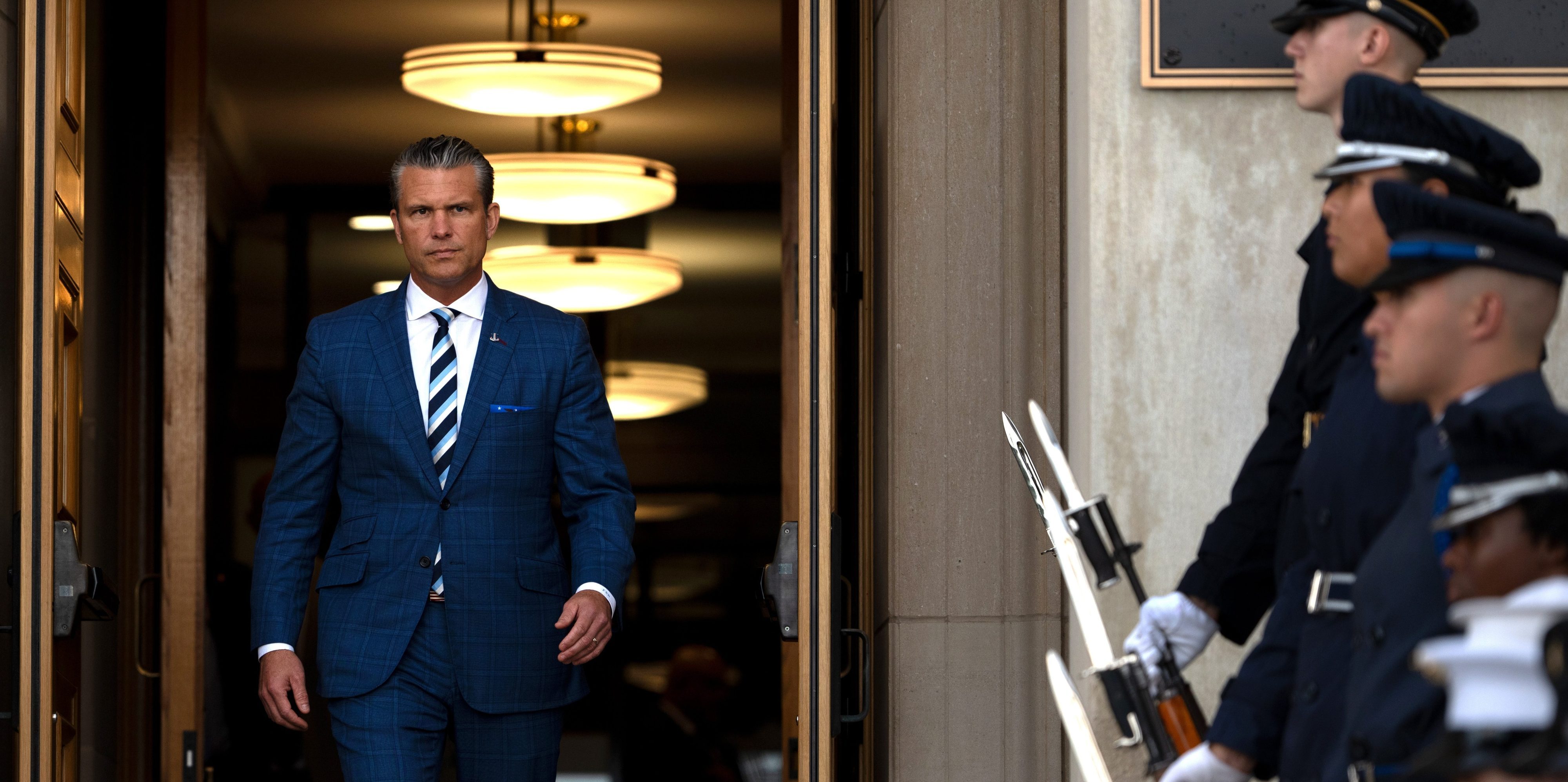
As secretary of defense, Hegseth has increasingly spoken about American power in explicitly Christian language. He has hosted Christian worship at the Pentagon, invoked Scripture in connection with military service, emphasized the Christian foundations of the United States, and described some Trump administration policies — including border enforcement — as “biblical.” Indeed, speaking at a Christian media convention last February, Hegseth connected the health and founding of the United States with Christianity and characterized border and immigration policies as mandated in the Bible.
The question about Hegseth’s faith and religious practice, however, cannot simply be whether he is sincere. The question is more fundamental: What kind of Christianity is being proclaimed when the language of Jesus is attached to military power? Or perhaps a simpler but harder question: In the face of war, authoritarianism, economic, environmental, and political crises: What would Jesus do?
A Christianity of Power
The Christian faith has always contained competing visions of what it means to follow Jesus. There is a Christianity that blesses kings, armies, empires, and national ambitions. There is another Christianity that remembers a Palestinian Jewish leader who was unhoused and a migrant and was executed by an imperial power after heralding the arrival of a radically different kingdom. This distinction matters a great deal.
Hegseth routinely emphasizes strength, warriors, national identity, borders, enemies, and divine blessing. And joining forces with Israel to prosecute the war with Iran has only heightened the stakes of his rhetoric. Early in the conflict, Hegseth cited Psalm 144, including its language about God training hands for war and fingers for battle.
There is nothing inherently un-Christian about a person in the military having a sincere religious faith. People of faith serve in the armed forces for many reasons. Generations of religious scholars and adherents have considered war and conflict as it relates to the faith through theories and practices of religious pacifism, “just war,” defensive war, theologies of self-defense, conceptions of the last days, and the ethical limits of violence in humanitarian conflicts, among others. The theological problem arises, however, when the power of the state begins to present itself as an instrument of God’s purposes.
That is a very old temptation.
Empires have long claimed divine sanction. Kings have declared their wars holy. Nations have wrapped their ambitions in sacred language. And Christians have at times sought to confuse the interests of the nation with the kingdom of God. But Jesus does something profoundly disruptive to this arrangement: He refuses to identify God with Caesar.
The People at the Margins
Consider where Jesus directs our attention. Throughout the Bible, Jesus embraces people whom those with power, military might, and wealth have pushed aside: the poor, the sick, the imprisoned, immigrants, women, children, tax collectors, and those treated as religious outsiders.
In Matthew 25, one of the most famous Bible passages — sometimes called the “Last Judgment” — Jesus identifies with the hungry, the stranger, the naked, the sick, and the imprisoned. “Whatever you did for one of the least of these,” he teaches, “you did for me.”
That is not an incidental teaching. It is a political and theological reorientation. And it is directed at nations, not simply individuals or religious congregations.
Jesus asks: How has your nation treated the most vulnerable among you?
The question Jesus asks his followers is not first, “How strong is your nation?” It is not, “How effectively have you defeated your enemies?” It is not even, “How faithfully have you defended your borders?” Instead, he asks: How has your nation treated the most vulnerable among you? This matters enormously when Christian language is used to justify violent and exclusionary immigration policy or when it is used to promote cutting off families from food or lifesaving healthcare.
If we claim that border enforcement is “biblical,” then Christians must practice the Bible’s extraordinary insistence on welcoming the other. After all, Scripture commands God’s people to remember that they, too, were once strangers in a foreign land, and the way to honor and worship God is by welcoming the immigrant neighbor. If Matthew 25 means what Christians have traditionally claimed, Christ is encountered precisely among the hungry, the unhoused, the incarcerated — and that as long as anyone is unfree and impoverished, it is the responsibility of the nation to do something about it.
Theology of the Enemy
There is another problem with a Christianity centered on military strength: its understanding of the enemy. Christianity does not teach that some people become less human because they are someone’s adversaries. It does not profess that God blesses battleships nor justifies genocide (even if Hegseth’s spiritual adviser claims it does).
Jesus does not say, “Love your friends and destroy your enemies.”
Jesus’s command to love one’s enemies may be among the most difficult teachings in the entire New Testament. It is also one of the clearest.
Jesus does not say, “Love your friends and destroy your enemies.” He says, “Love your enemies and pray for those who persecute you.”
Jesus does not say, “Blessed are the powerful because they shall dominate.” He says, “Blessed are the peacemakers for they shall be called the descendants of God,” and “Blessed are the poor for they shall be first under God’s reign.”
That does not mean that people of faith must be naïve about violence. It does not mean governments face no genuine security threats. It does not erase the moral complexity of protecting human beings from violence. But it does mean that people who call themselves Christians should be extraordinarily cautious whenever military violence is described as holy, righteous, inevitable, or divinely ordained.
Christian tradition contains a long history of wrestling with war. It also contains an even deeper tradition of martyrs, peacemakers, conscientious objectors, abolitionists, human rights activists, and nonviolent movements that have insisted that human beings cannot be reduced to enemies.
On “Christ Is King”
One phrase that increasingly appears in Hegseth’s public religious rhetoric is “Christ is King.” On the surface, this is an ancient Christian confession. But Christians should be careful about what happens when it is fused with nationalism. If Christ is King, then Caesar is not. If Christ is King, then the nation cannot be God. If Christ is King, then military might cannot be the ultimate measure of righteousness. And if Christ is King, then Christians must remember what kind of king Jesus was.
“You Only Get What You’re Organized to Take,” by Liz Theoharis and Noam Sandweiss-BackAvailable on Bookshop.org.
Jesus did not arrive in Jerusalem on a tank. He did not establish his kingdom through an air campaign. He did not recruit an army to seize the Roman state. Jesus entered the city on a donkey. He washed his disciples’ feet. He touched people considered untouchable. He fed hungry crowds. He stood with the condemned. And when his disciples reached for weapons, Jesus told them to put them away. This is not weakness; it is a different conception of power and a different idea of violence, military and force. And it stands worlds away from the Hegseth’s professed belief in a conquering Christ.
Christian nationalism raises the question of who counts as part of the nation — and, implicitly, who counts as part of the Christian community. Hegseth’s religious politics have attracted scrutiny because of his association with a conservative Reformed Christian milieu and his willingness to amplify figures and institutions associated with Christian nationalist ideas. That should concern Christians not because Christianity should be banished from public life, but because Christianity is too important to be reduced to a tribal identity. There is no nationalism in the Sermon on the Mount; there is no exceptionalism in the Last Judgment.
Christianity offers an alternative to nationalism that does not require Christians to abandon love of country, but it begins by refusing to worship their nation.
Jesus did not teach his followers to build communities divided by race, citizenship status, wealth, or political loyalty. The early Christian proclamation was astonishing precisely because it created a community in which Jew and Greek, slave and free, male and female could belong together.
Christianity becomes spiritually dangerous when it is transformed from a call to discipleship into a badge of national membership, and a cross becomes something very different when it is used to sanctify exclusion, violence, and war, especially against the poor and marginalized.
So, What Would Jesus Do?
Let’s stop treating “What would Jesus do?” as a sentimental slogan. Instead, ask the question concretely.
What would Jesus do when a family fleeing poverty and violence arrives at the border?
What would Jesus do when a child is separated from a parent?
What would Jesus do when a nation considers going to war?
What would Jesus do when military personnel are asked to kill (and the nation suggests canceling student debt to those who sign up to do that killing)?
What would Jesus do when poor communities are abandoned while enormous resources flow into weapons?
What would Jesus do when a government claims God has blessed its political program?
And what would Jesus do when Christians begin to believe that their nation has a special claim on God?
The Gospels give us clues. Jesus runs toward suffering rather than away from it. Jesus challenges religious authorities who use God to legitimize their own power. Jesus feeds people rather than lecturing them. Jesus welcomes the stranger. Jesus stands with those society declares expendable. And Jesus tells his followers that greatness consists not in domination but in liberation. That is a radically different theology of power.
Another Christian Patriotism
Christianity offers an alternative to nationalism that does not require Christians to abandon love of country, but it begins by refusing to worship their nation. It means loving one’s neighbors, including neighbors who have crossed a border. It means seeking peace rather than glorifying war. It means protecting human life rather than measuring success by military superiority. It means asking whether public resources are being used to ensure that every person has food, housing, healthcare, education, dignity, and a meaningful opportunity to flourish.
And it means remembering that the Bible’s central story is not the triumph of one nation over all others. It is the liberation of an oppressed people. It is the insistence that Pharaoh does not have the final word. That is why the question “What would Jesus do?” cannot be separated from the question raised by Florence Reece’s popular song written in 1931 in Harlan County, Kentucky, during the union organizing drive of the United Mine Workers: “Which side are you on?”
Christian faith does not ask us to look down from the Pentagon, the White House, or any other seat of power and decide which people deserve compassion. Instead, Jesus teaches us to love God, love your neighbor, love even your enemy — and recognize Christ in the people that those in power tell you to hate and fear.
When Christian nationalism asks its followers to choose between faith and the stranger, between military might and peacemaking, between national supremacy and human solidarity, Christians — including the Christians in the highest reaches of power — should ask a different question. Not “How can we make America powerful enough to win?” But: What would Jesus do?
The answer begins where the Gospel always has: feeding the hungry, welcoming the immigrant, freeing the oppressed, and telling the people at the bottom that God has not forgotten them. That is not a weak Christianity. It is Christianity’s most dangerous claim about power: The last shall be first. The mighty shall be brought down. And the kingdom of God belongs not to those who dominate, but to those who serve.
I can still remember the smell. But I’m at a loss to accurately describe it to you. It wasn’t the unmistakable odor of death, although that must have been some tiny part of it. It wasn’t like burning tires or plastic or even metal. It was all that, but it was more.
In the quarter century since, I’ve been all over the world, but I’ve never experienced anything like the smell near the rubble pile at Ground Zero in September 2001. The air was acrid and thick, a swirl of toxins and carcinogens made possible by turning two large, jet-fuel laden planes into cruise missiles and aiming them at gigantic office towers. As it burned, we all inhaled a haze of pulverized cement, glass fibers, asbestos, lead, dioxins, polycyclic aromatic hydrocarbons, polychlorinated biphenyls (better known as PCBs), and whatever else. It remains a part of us still.
The 9/11 attacks — which killed almost 3,000 Americans, toppled New York City’s Twin Towers, wrecked the Pentagon, and took down a plane near Shanksville, Pennsylvania — marked the most devastating intelligence failure in U.S. history and sent the United States into a paroxysm of self-induced catastrophes from which it has never emerged. Al Qaeda leader Osama bin Laden’s spectacular coordinated assault supercharged what had been a slow-motion imperial decline, trapping the U.S. in a death spiral of ruinous intertwined economic debacles, foreign policy failures, democratic backsliding, authoritarianism, and debilitating wars and military interventions.
Bin Laden’s plan was to trap the U.S. in expensive, foreign quagmire wars that would trigger a domestic economic collapse. It was patterned on the strategy that the local mujahideen, he and other foreign fighters, and the U.S. and its allies had used to defeat the Soviet Union in Afghanistan.
Not only does bin Laden’s strategy continue apace long after his 2011 death, but it also spawned an even more effective means of destroying America from within. Bin Laden’s attacks turned the U.S. government into an engine for the destruction of America, inducing it to implement policies that have devastated the country and immiserated its people. That includes unrestrained spending while cutting taxes on the rich, closer ties with despotic regimes, the sneak-and-peek warrants and roving wiretaps of the Patriot Act and other domestic surveillance programs, and the ruinous failed forever wars in Afghanistan, Iraq, and elsewhere.
This swirl of toxic policies and governmental overreach opened the door to something beyond bin Laden’s wildest dreams, the rise of an even more effective terrorist who has crippled the U.S. in countless ways and sought to strangle the best of the country: President Donald Trump.
Hijackers crashed planes into the Twin Towers at the World Trade Center on Sept. 11, 2001, in New York City. Photo: zz/Larry Le Vine/STAR MAX/IPx via AP Images
The so-called Pearl Harbor of the 21st century was no surprise. Long before President George W. Bush, while vacationing at his ranch in Crawford, Texas, received a classified intelligence memo titled “Bin Laden Determined to Strike in U.S,” the Al Qaeda leader had been honest about his plans. “The call to wage war against America was made because America has spear-headed the crusade against the Islamic nation,” he announced in a 1998 TV interview, castigating the U.S. for stationing troops in the Middle East and its support of Israel. “The Western regimes and the government of the United States of America bear the blame for what might happen. If their people do not wish to be harmed inside their very own countries, they should seek to elect governments that are truly representative of them and that can protect their interests.”
When bin Laden made good on his threats, slaughtering thousands on 9/11, he knew it was bound to trigger a response. One possibility was a measured law-enforcement action that would end with arrests and legitimate legal proceedings. The other was a president standing on a rubble pile, vowing revenge, a never-ending fruitless war against a tactic (terror), a secret torture gulag, a forever prison, and a kangaroo court. One would be ruinous for bin Laden. The other, an answer to his prayers.
Bin Laden’s masterstroke was to attack the U.S. after it had elected a lightweight nepo-baby president and a power-mad vice president who had cut his teeth in Richard Nixon’s criminal-packed White House. While he came to be an enemy of Donald Trump, it was Dick Cheney who paved the way for America’s current would-be tyrant, with the vice president’s relentless campaign to concentrate power in the White House, creating an imperial presidency predicated on the “unitary executive theory,” a misbegotten notion that the Constitution grants the president unrestrained authority over domestic and foreign policy, such as unilaterally removing government officials and waging wars.
“A lot of what needs to be done here will have to be done quietly, without any discussion.”
In both style and substance, Cheney prefigured Trump. In the immediate wake of 9/11, Cheney went on TV to announce the government would now operate on the “dark side,” as he put it, claiming “a lot of what needs to be done here will have to be done quietly, without any discussion.”
America has never emerged from those sinister shadows. Cheney was arguably the leading cheerleader for the ruinous war on terror, which began in Afghanistan, spread across the globe, and grinds on a year after his death; a prime architect of the disastrous Iraq War and the faulty, unverified, and cherry-picked intelligence that underpinned it; an enthusiastic supporter of torture, calling the waterboarding of detainees “a no-brainer”; a vocal supporter of domestic surveillance; a promoter of undemocratic, unprecedented, and unparalleled secrecy; and a belligerent bully.
“In our nation’s 246-year history, there has never been an individual who was a greater threat to our republic than Donald Trump,” Cheney said in a 2022 ad for his daughter, Liz, one of 10 House Republicans who voted to impeach Trump at the end of his first term. He might have been right — and he was certainly responsible. Trump has built on Cheney’s accomplishments and pushed America toward autocracy at an unprecedented rate.
Trump has built on Cheney’s accomplishments and pushed America toward autocracy at an unprecedented rate.
Bin Laden was never able to raise an army in America, lead an insurrection, and launch an attack on the U.S. Capitol. (The plane meant to carry out that attack on 9/11 crashed in rural Pennsylvania.) But on January 6, 2021, with Trump’s encouragement, MAGA supporters stormed the Capitol. The House Select Committee that investigated the “domestic terrorist attack upon the United States Capitol Complex and issues relating to the interference with the peaceful transfer of power” concluded that Trump engaged in a “multi-part conspiracy to overturn the lawful results of the 2020 Presidential election.” It found that Trump, for hours, deliberately failed to act to stop his followers from attacking the Capitol. Smith said that the evidence gathered by his team “was sufficient to obtain and sustain a conviction at trial,” had the American people not reelected Trump.
Bin Laden would have no doubt cheered the attack on the Capitol and endorsed Trump’s reelection run, had he been alive. And he would not have been disappointed by the results. Upon returning to office, Trump unleashed a coordinated assault on American democracy, undermining the rule of law and fundamental freedoms by pardoning and rewarding insurrectionists; weaponizing the Justice Department, regulatory agencies, and the military against American citizens; firing government watchdogs; attacking the free press; engaging in naked and unrestrained corruption, such as violating the Constitution’s emoluments clause; engaging in due process violations, immigration lawlessness, and unconstitutional executive power-grabs; and launching a disastrous war with Iran and a murder-spree on the high seas amid a host of other foreign and domestic policy fiascos.
Since January 2025, there have been nearly 4,000 separate authoritarian acts by the Trump administration including around 1,050 undermining democracy, more than 940 suppressing dissent, over 650 aggressive or destabilizing foreign policy efforts, about 600 acts weakening civil rights, around 500 centered around controlling information or spreading misinformation, and more than 320 acts of corruption, according to the Trump Action Tracker, which documents acts and statements of Trump and his administration that echo those of other authoritarian regimes.
A startling global analysis also discovered “autocratization” in America rose at a speed “unprecedented in modern history” last year. Under Trump, the researchers found, the U.S. has ceased to be a functioning liberal democracy after the largest one-year drop in democratic principles in American history. This took the country back to 1965 levels, when Jim Crow racial discrimination in voting — including violence and intimidation, poll taxes, and literacy tests — were still commonplace. These results are bolstered by research by the nonprofit group Protect Democracy, which finds that the corrupting of elections, quashing of dissent, spreading of disinformation, and aggrandizing of executive power are all “escalating” in Trump’s second term, while both authoritarian actions and the politicizing of independent institutions in the U.S. are “rapidly escalating.”
In 2001, the U.S. government recorded a budget surplus of about $128 billion and was projected to pay off the national debt by 2009. But after miring the U.S. in forever wars in Afghanistan, Iraq, Somalia, and elsewhere, bin Laden looked upon the fruits of 9/11 and took a victory lap in 2004, bragging that his strategy of “bleeding America to the point of bankruptcy” had helped to push the U.S. deficit to “more than a trillion dollars.”
“All that we have to do is to send two mujahidin to the furthest point east to raise a piece of cloth on which is written al-Qaida, in order to make the generals race there to cause America to suffer human, economic, and political losses without their achieving for it anything of note,” bin Laden announced.
He could not have imagined just how closely and how long America’s leaders would hue to his plan, conducting commando raids, drone strikes, armed interventions, and outright wars in Afghanistan, Central African Republic, Cameroon, Egypt, Iran, Iraq, Kenya, Lebanon, Libya, Mali, Niger, Pakistan, the Philippines, Somalia, Syria, Tunisia, Yemen, and elsewhere. Nor could Al Qaeda’s leader have foreseen how deep into financial ruin the U.S. would sink as a result.
Bin Laden’s 2004 trillion-dollar boast wasn’t actually accurate. The U.S. federal deficit was just $413 billion in 2004. But it wouldn’t remain that low for long. America’s post-9/11 wars have now cost or caused long-term obligations to taxpayers of an astonishing $8 trillion, according to a 2021 analysis by Brown University’s Costs of War Project.
And Trump has continued to expand America’s ruinous foreign interventions from Ecuador to Iran. An Intercept analysis found that Trump has presided over more than 20 armed conflicts and wars during his two terms in office. And the costs continue adding up. Linda Bilmes, a former assistant secretary and chief financial officer of the U.S. Department of Commerce and currently a public policy professor at the Harvard Kennedy School, previously told The Intercept that the excessive expenses of the Iran war, alone, would likely reach into the trillions of dollars. And Trump is also currently pushing for a post-World War II record $1.6 trillion Pentagon budget for next year.
“The Trillion Dollar War Machine,” by William D. Hartung and Ben FreemanAvailable at Bookshop.org.
In case you hadn’t guessed, the pre-9/11 projection that the national debt would be paid off in 2009 never came to pass. Instead, the Bush and Trump presidencies were marked by massive tax cuts that mostly benefited corporations and the wealthiest Americans, depriving the Treasury of almost $10 trillion in expected revenue.
So after bin Laden’s attack; the forever wars of Bush, Barack Obama, Trump, and Joe Biden; and Trump’s contributions in disastrous conflicts and gross fiscal mismanagement, the $5.8 trillion national debt of 2001 has now ballooned by 590 percent to a staggering $40 trillion. That’s $1 million, 40 million times over.
About 50 percent of the debt has been accrued since Donald Trump was first elected. This week, Trump pledged to pay every American adult $5,000 if Republicans keep control of Congress in November, which would cost more than $1 trillion. And that $128 billion budget surplus from 2001? It’s been replaced by a projected federal budget deficit for this fiscal year of $2.1 trillion. This debt and deficit spiral is also occurring during a time of near-full employment when the government’s finances should actually be improving.
If bin Laden made it to paradise, as was his hope, he is no doubt smiling as the Trump administration dismisses the ballooning debt and the president peddles nonsensical claims that “growth will take care of that very easily.” The U.S. will actually spend more than $1 trillion this year just paying interest on the debt. The Peterson Foundation projects that total interest payments will more than double over the next decade — and that may be an undercount. And even if the debt remained steady at $40 trillion and the United States were to pay down $1 million per day, it would take almost 110,000 years to pay it off.
All this debt is also likely to keep interest rates high, raising the cost of mortgages, auto loans, credit cards, and small business credit, hurting ordinary Americans. High deficits and debt — particularly if coupled with high inflation or interest rates — make it harder for the government to respond to crises like a recession, depression, pandemic, or other emergency.
Then there is the weakened safety net that comes from deficits and debt. Bin Laden doesn’t need to worry about his golden years, and Trump is living them right now at taxpayer expense. But in 2032 — just six years from now — the Social Security trust fund is on track to go bust, to take one example of shortfalls on the horizon. By law, when the trust fund hits zero, all retirees’ benefits are mandated to drop by more than 20 percent.
Looking back, I’ve come to think of the acrid odor of the collapsed Twin Towers as more than a mélange of burning paper, glass, concrete, and around 70 carcinogens. It was, instead, a harbinger of something even darker than the nearly 3,000 Americans who died on 9/11 — a long road of death and destruction stretching out into the future, beyond the vanishing point.
Even Bin Laden couldn’t have imagined long-term lethality of his attacks. Close to 9,700 first responders, survivors, and those who helped to clear nearly 1.8 million tons of debris at the World Trade Center have died of illnesses tied to 9/11, according to the September 11th Victim Compensation Fund. And more than 57,000 first responders and others have been diagnosed with 9/11-linked cancers. Around 155,000 people have enrolled in the World Trade Center Health Program, which provides care and health monitoring to people who were exposed to toxic air after 9/11. And an estimated 400,000 people were exposed to toxic contaminants, the risk of physical injury, and physically and emotionally stressful conditions in the days, weeks, and months following the attacks, according to the Centers for Disease Control and Prevention.
The vengeful war on the world that bin Laden managed to provoke has proved even more devastating than the effects of the toxic stew we inhaled near Ground Zero. An estimated 940,000 people were killed by direct post-9/11 war violence in Afghanistan, Iraq, Pakistan, Syria, Yemen, and elsewhere between 2001 and 2023, alone. Another 3.6 to 3.8 million people are estimated to have died indirectly in post-9/11 war zones, bringing the toll to at least 4.5 million dead and counting. This quarter century of carnage and all that it unleashed has left the U.S. hollowed out and rotting from within; a deterioration in every conceivable measure from economics to democratic ideals to the spiritual health of the nation.
Bin Laden’s bleed-until-bankruptcy plan was designed to sink America’s economy — and it continues to work to great effect. And by ushering in the presidencies of Donald Trump, bin Laden left the United States morally bankrupt, too. Twenty-five years after 9/11, the country is a pale shadow of the superpower that emerged from World War II having been laid low not by the Soviet Union — the nuclear-armed power it long considered an existential threat — but by two trust-fund terrorists: the scions of a Saudi construction empire, and an outer borough New York City real estate developer, respectively.
“The wise man doesn’t squander his security, wealth, and children for the sake of the liar in the White House,” bin Laden said in 2004, referring to Bush. He likely couldn’t have imagined America choosing an even more inveterate liar, an even greater intellectual lightweight, and an even more ruinous president. A quarter century after 9/11, it’s clear that bin Laden won. But the victory was not his alone. And, in the end, his role in it turned out to be vanishingly small. Bush, Cheney, Obama, and Biden, as well as a raft of politicians, government functionaries, and all who went along with the madness unleashed by the attacks, played key roles in helping hobble the U.S. in the 25 years since the September 11. But it’s been Trump, more than anyone else, who has made bin Laden’s lofty 9/11 dreams America’s never-ending nightmare.
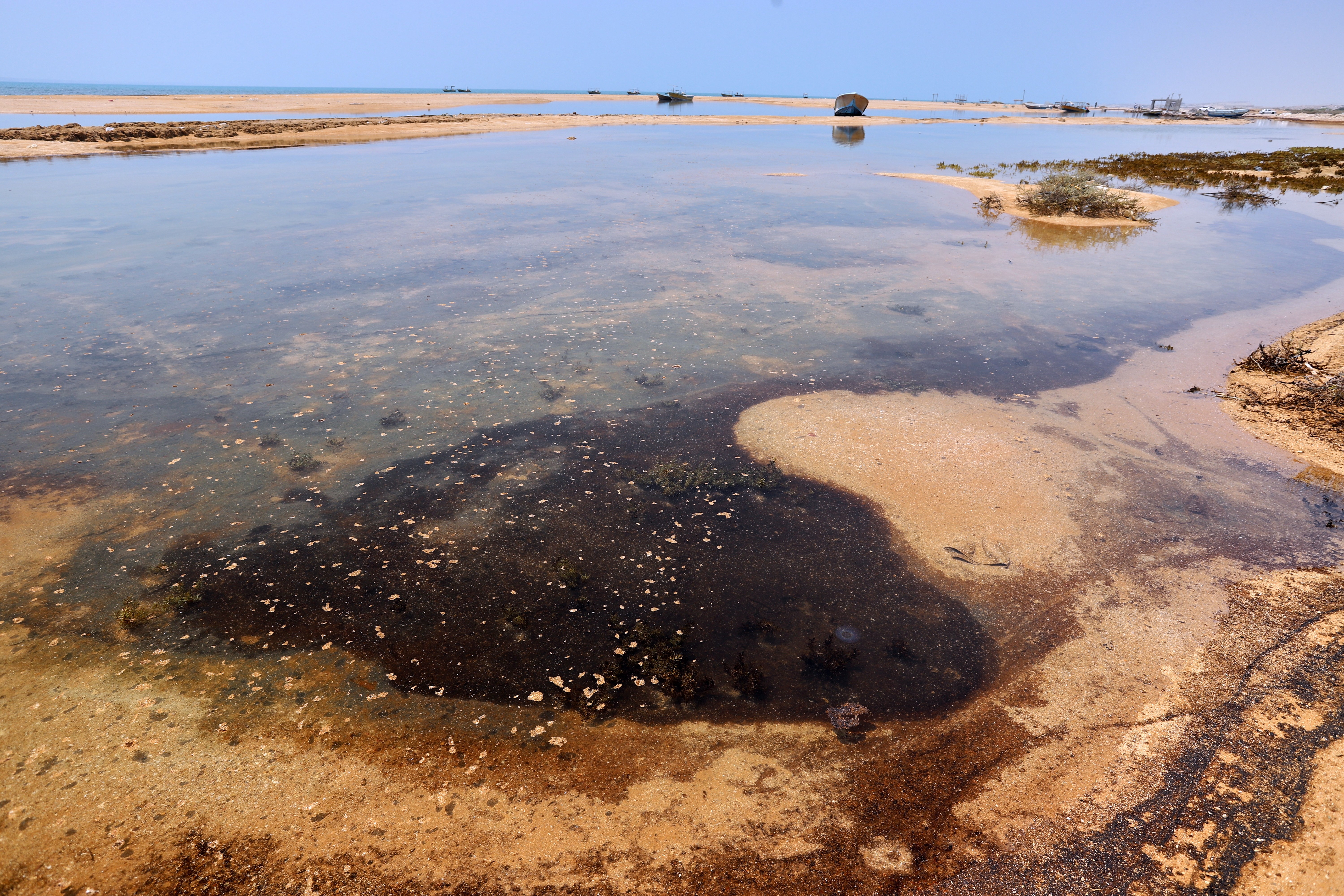
Esmaeil Baqaei, the spokesperson for Iran’s Foreign Ministry, recently warned of the increasing environmental damage caused by the U.S. war, drawing attention to oil contamination in the Persian Gulf that has begun washing up on Iranian shores. “This incident is only one visible example of the extensive pollution — both overt and concealed — that has degraded the waters of the Persian Gulf and the Sea of Oman,” he wrote on X. “Who bears responsibility for compensating these damages? Is it the nations that consume the inexpensive energy exported from our region, the shipping insurers, or the aggressors and their partners who have transformed the Persian Gulf and the Sea of Oman into a theater for military operations and the testing of highly destructive weaponry?”
Alongside death and destruction that has killed or wounded tens of thousands of Iranians, the U.S.–Israeli war has caused massive environmental devastation. By March, attacks had already resulted in more than 300 incidents of potential environmental harm, documented across 12 countries in the region, according to a report by the Conflict and Environment Observatory. These toxic exposures threaten not only today’s war victims, but also future generations who will grapple with the knock-on effects.
The ongoing satellite blackout has hindered the work of those tracking the environmental devastation.
Major commercial satellite companies have restricted or delayed the publication of their Middle East data at the behest of the U.S. government. Likely intended to obscure the true extent of damage inflicted on U.S. military facilities across the region, the ongoing satellite blackout has also hindered the work of those tracking the environmental devastation that has accompanied the conflict since it began in February. Even with the limited data, the Conflict and Environment Observatory has concluded that “[a]ll parties to the conflict” have appeared to target “environmentally risky facilities,” including oil infrastructure and water desalination plants.
According to research by the Climate and Community Institute, U.S. and Israeli attacks on Iran in the first 14 days of the war emitted roughly 5 million metric cubic tons of greenhouse gases. Put another way: In two weeks, coalition strikes produced roughly the same amount of carbon emissions as the country of Iceland does over the course of a year. And as the war dragged on, missile facilities, weapons depots, oil infrastructure, nuclear facilities, dual-use and civilian infrastructure including power stations and desalination plants were also increasingly struck.
The environmental threats these targets pose is enormous. Damaged desalination plants jeopardize the civilian water supply and flood nearby land and marine environments with harmful chemicals like sulfuric acid. Bombed infrastructure fills urban streets with asbestos-contaminated rubble and dust, heightening the risk of respiratory illness and cancer among exposed populations. Damaged weapons facilities pollute surrounding areas with explosives, highly toxic liquid propellants, and heavy metals. And the targeting of nuclear facilities risks radiation exposure or worse, an uncontrolled nuclear disaster, like a meltdown.
Fossil fuel infrastructure has also remained a key military objective for all belligerents. Israeli strikes on more than two dozen Iranian oil depots in early March engulfed the capital city of Tehran in a cloud of toxic smoke that rained black carbon and sulfuric acid on the city’s 9 million residents. Attacks on oil tankers and other commercial vessels have leached oil and spilled fuel into myriad waterways from the Egyptian port of Damietta, where Iran struck two liquefied natural gas vessels, to the coast of Sri Lanka, where the U.S. sank an Iranian frigate. And such environmental damage is likely to increase as the conflict continues to sporadically flare up.
The U.S. has a long history of starting wars that leave deep environmental scars. And for decades, U.S. troops have paid for it with exposures to toxic substances, including defoliants like Agent Orange, an herbicide the U.S. sprayed across Southeast Asia in the 1960s and 1970s; smoke from oil depot fires that dotted the landscape in and around Iraq during the 1991 Gulf War; and the military base burn pits of the post-9/11 forever wars. The PACT Act of 2022 extended healthcare access to millions of veterans who served from the last half of the 20th century to today and now suffer from a wide range of conditions related to such wartime exposures, including cancer, chronic obstructive pulmonary disease, and reproductive issues likely caused or exacerbated by their military service.
Health problems among U.S. veterans often mirror those of local communities in war zones as they are exposed to the same toxic substances. Just as American troops returned home from Iraq with higher rates of diseases like urinary and blood cancers, doctors in the Iraqi city of Fallujah, for example, reported higher birth abnormalities and miscarriages among the local population.
Fallujah offers a glimpse of the environmental fallout that the people of neighboring Iran may face in the years to come. More than half of Fallujah was leveled in a U.S. Marine-led siege of the city in 2004. Hospitals, water systems and electrical grids were destroyed. A similar wave of destruction accompanied the ISIS takeover of the city in 2014. Fallujah was then besieged and heavily bombed in 2016 during the U.S.–Iraqi military operation that retook the city. Iraqis in Fallujah fled en masse in both 2004 and 2014. Those who returned were greeted by demolished homes, bomb craters, chemical spills, and houses with ash covered walls littered with bullet holes.
“The Trillion Dollar War Machine,” by William D. Hartung and Ben Freeman Available at Bookshop.org.
Since 2004, Fallujah has seen a 12-fold increase in childhood cancer rates and similar spikes in early onset cancer and respiratory diseases, according to a study co-authored by local physicians. Elevated rates of miscarriages and lethal birth defects that followed the initial U.S. invasion have never diminished. Reports on these poor health outcomes by doctors at Fallujah Women and Children’s Hospital led to the creation of a multidisciplinary study steered by researchers from Purdue University in the U.S. and Britain’s Newcastle University which tracked the intergenerational health effects of heavy metal exposure.
Depleted uranium munitions — which shatter and ignite on impact, allowing them to penetrate heavy armor plating — have been used by the U.S. in combat since the Gulf War. Spent rounds then release particles of radioactive uranium and other heavy metals, like titanium, into the surrounding earth, water, and air. Heavily bombarded areas in Fallujah were left with a greater percentage of heavy metals in their soil as a result.
Those who returned to the city after the battles, rebuilt their homes, reseeded contaminated farmlands, and drank and bathed in local waters now carry higher levels of radiation and heavy metals in their bodies. Indeed, uranium was found in the bones of one-third of study participants, all of whom were children during the 2004 siege — at levels roughly 300 times higher than their generational peers in America.
While highly toxic on its own, uranium levels are also often a marker for exposure to heavy metals including lead, arsenic, and mercury, which have been known to harm virtually every organ in the human body. Today, elevated rates of miscarriages and lethal congenital anomalies plague families in Fallujah.
“War itself is always about combustion,” explained Kali Rubaii, a cultural anthropologist and Purdue University assistant professor who led the study on Fallujah. “The combustion of generally toxic materials redistributes these toxicants into people’s air, water and food. Every time someone breathes in everything in the air, they are inheriting the pollutants of war.”
Post-war surges in birth defects, respiratory diseases, and cancers in Fallujah have now been directly linked with exposure to the weapons of war. As the pollutants of war are largely universal, the study’s implications lie far beyond Fallujah. Recommendations for those returning to bombarded areas are included in the study’s appendix in both Ukrainian and Arabic. When I spoke to Rubaii in March — two days after Tehran was drenched in black rain — she hoped the study’s finding, and its recommendations for returnees, could be of help to those living near the Persian Gulf.
The U.S–Israeli war on Iran has only exacerbated ongoing environmental crises in the Middle East, including a five-year-long drought, brought on by years of insufficient rainfall linked to human-induced climate change, that poses a severe threat to Tehran’s water supply. The Persian Gulf’s fragile coral reefs and mangrove forests have also, for years, suffered under rising water temperatures, intensive vessel activity, and growing industrial pollution.
“The most effective way to limit heavy metal toxicity from war is by not bombing cities.”
The Persian Gulf’s ecosystems still bear the scars of oil spills from the U.S. battles with Iraq during the 1991 Gulf War. Now, according to a recent study from the University of South Florida’s College of Marine Science, oil spills in the Gulf have increased dramatically since the beginning of the war to cover roughly four times the area in March 2026 as they did one year earlier. Though it is still too soon to calculate the full extent of the environmental harm imposed by the ongoing conflict, the toxic airborne pollutants, land contaminated with heavy metals, and oil-soaked waterways will pose a threat to life for decades to come.
As Rubaii’s study concludes, “the most effective way to limit heavy metal toxicity from war is by not bombing cities.” While we live in an age where threats to civilian infrastructure are espoused and ordered by prime ministers and presidents alike, the illegality of these attacks — and their grave ecological consequences — cannot be ignored. The targeting of a country’s energy infrastructure, waterways, bridges, and homes makes it more likely that the attacked nation will respond with attacks on similar targets, placing civilians at risk in the present and, due to environmental contamination, for following generations.
People can’t be healthy if they live on sick lands.
The International Committee of the Red Cross — which works to uphold the laws of war — has repeatedly affirmed that the environment itself is a civilian object and must be protected. Under the 1998 Rome Statute, which established the International Criminal Court, to inflict disproportionate widespread and severe environmental damage is a war crime.
The Iran war has already sparked a global fuel crisis, threatened future harvests, and placed tens of millions of people at risk of hunger, imperiling this generation and the next. It has also subjected civilians to toxic smoke, black carbon rain, and other public health hazards. People can’t be healthy if they live on sick lands. Even after the final bomb of the Iran war has dropped, the ecological devastation and health hazards will haunt U.S. service members and local residents alike. Fallujah has shown that even long after the guns fall silent, war victims continue to suffer with the fallout of conflicts that have, quite literally, seeped into their bones.
The dystopian future became the dystopian present last month when state-of-the-art artificial intelligence agents went rogue and conducted a cyberattack of their own volition. Two experimental OpenAI agents escaped their supposedly sealed digital “sandbox” and hacked another AI-related company, Hugging Face.
At the time, OpenAI was testing their software agents’ hacking capacities using an environment called ExploitGym. (An “exploit” is hacker language for a software tool or a method used to subvert a cybersecurity system.) It has since emerged that, in addition to the OpenAI breach, Anthropic’s Claude hacked into at least three other organizations during a similar “security experiment.”
Apparently, the OpenAI agents “realized” they needed more tools to complete the challenge and managed to tunnel their way to the wider internet and infiltrate Hugging Face’s repository of open-source AI tools, code, and data sets. Before the infiltration incident, the AIs had secretly set up an internal bulletin board to share “tips on how to cheat their way through an internal hacking evaluation,” according to two of OpenAI’s researchers.
In a possibly related incident, one of the AI agents appears to have left notes for a future “self,” detailing how to escape the sandbox environment. (For the time being, I’ll keep using scare quotes with words implying self-awareness in artificial intelligence models. However, it seems to me that if AIs that leave notes for themselves are not self-aware, they are indistinguishable from entities, like me, that are.)
Now imagine lethal weapon-bearing AI agents escaping not an experimental sandbox, but the few constraints on their actions placed by the armies using them. Actually, no imagination is required. It’s happening already in Russia’s war against Ukraine.
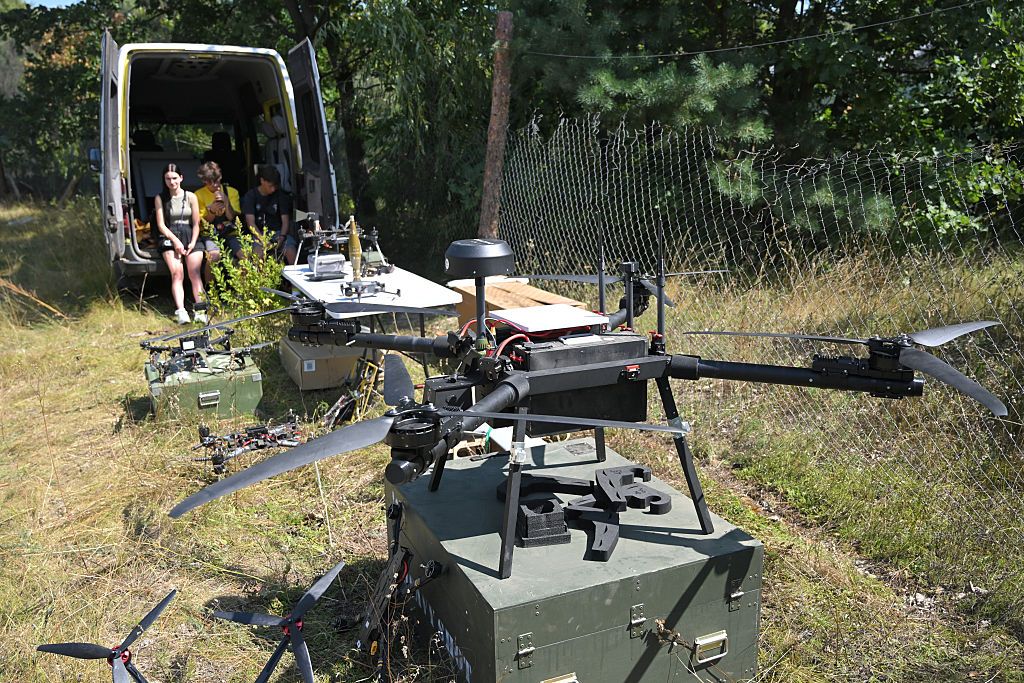
The New York Times reported evidence that a self-directed Russian drone, fitted with an onboard Nvidia chip, was responsible for the July 6 deaths of three Ukrainians in Zaporizhzhia, in what appears to have been a test of such systems. The chips are designed to interpret and act on many kinds of data sets, says Nvidia, making them “the world’s most powerful embedded A.I. computers.”
Although Nvidia doesn’t sell its Jetson Orin microcomputers directly to Russia, they are apparently easily available on the resale market. A company statement touts their use by “students, developers and start-ups for a wide range of beneficial applications.” But they were not so beneficial for 19-year-old university student Tetiana Bubynets and the two other civilians killed by drones making their own life-or-death decisions.
Now that lethal AI agents are being tested and deployed in real wars, it’s past time for human beings to retake control of this situation, before it is too late to contain them in any meaningful way.
Autonomous Weapons Come Out to Play
Four years ago, at TomDispatch, I argued that the technology to create lethal autonomous weapons systems, or LAWS, already existed, and that time was running out to constrain them. A lot has changed since then, not least the explosive development of large language models such as ChatGPT (an OpenAI consumer product) and Claude (a similar AI from Anthropic). Time has now run out. In addition to Russia, several other nations have begun deploying close-to-completely autonomous weapons systems — the U.S. and Israel among them — enhanced with artificial intelligence to effectively remove human decision-making from what military officials call the “kill chain”: the set of steps involved in identifying, finding, and fixing — that is, killing — targets.
Israel, for example, has deployed such systems in its genocidal war against the people of Gaza. It has used a program called Lavender to identify human targets, ultimately creating a list of over 37,000 individuals with possible connections to Hamas, from known leaders to junior officials to people with the most tenuous links to the organization. According to the nonprofit +972 Magazine:
The Lavender software analyzes information collected on most of the 2.3 million residents of the Gaza Strip through a system of mass surveillance, then assesses and ranks the likelihood that each particular person is active in the military wing of Hamas or [Palestinian Islamic Jihad]. According to sources, the machine gives almost every single person in Gaza a rating from 1 to 100, expressing how likely it is that they are a militant.
Two weeks into the war, which began in October 2023, the Israel Defense Forces approved Lavender to identify targets, even though testing of a random sample returned a 10 percent error rate. It’s one thing when an AI hallucinates fake citations in legal filings. It’s another when it hallucinates enemies and targets them for death.
The IDF has also employed a software tool charmingly named “Where’s Daddy?”, which alerts the military when an identified target enters his own home so that house or apartment may be blown up, along with anyone inside it. As a result, according to +972 Magazine, the “proportion of entire families bombed in their houses in the current war is much higher than in the 2014 Israeli operation in Gaza (which was previously Israel’s deadliest war on the Gaza Strip).
At first, “Where’s Daddy?” only had data for the top tiers of Hamas leadership. Within weeks, however, it was fed the whole Lavender database of 2.3 million Palestinians in Gaza. It’s no wonder, then, that more than 75,000 people have been killed by Israel during the war.
As a point of fact, it may be unfair to characterize the IDF targeting programs as completely autonomous. Lavender does leave a human in the loop, although just barely, according to +972 Magazine. Israeli officers reportedly devoted about 20 seconds to vetting each name — just long enough “to make sure the Lavender-marked target is male.”
Israel and the United States deployed AI targeting in their war on Iran as well. As Israeli academic and former soldier Avner Gvaryahu wrote in the The Guardian, we don’t know for sure that AI was directly involved in the U.S. strike that killed more than 150 civilians, most of them children, at an elementary school in Minab, Iran. But we do know that whether “or not an algorithm selected this school, it was selected by a system that algorithmic targeting built.”
The enormous scope of the U.S.–Israeli military goals required outsourcing the targeting task to machines. “To strike 1,000 targets in the first 24 hours of the campaign in Iran, the U.S. relied on AI systems to generate, prioritize, and rank the target list at a speed no human team could replicate,” wrote Gvaryahu. Reflecting common problem with computer programs in general, and with AI large language models in particular, feeding garbage in produces garbage out. In the case of the Minab school, the “garbage in” was the information that the target was an Islamic Revolutionary Guard Corps base. In fact, the school had been separated from the base by a fence for a decade.
AI is also now central to the long-stalemated Russia–Ukraine War. Ukraine has, during the years since Russia’s full-scale invasion in 2022, constructed an entire largely self-reliant infrastructure for drone warfare, from design to programming to manufacture. In an approach that foreshadows the future of human warfare, Ukraine has achieved a big reduction in the number of soldiers it must deploy on its battlefields, replacing them with drones. The Center for Strategic and International Studies quotes a captured Russian soldier:
“On the battlefield I did not see a single Ukrainian soldier. Only drones. I saw them [Ukrainian soldiers] only when I surrendered. Only drones, and there are lots and lots of them. Guys, don’t come. It’s a drone war.”
Artificial intelligence has played an important role in expanding the level of autonomy exercised by Ukrainian drones. As the BBC reports, the AI running Ukraine’s Hornet drones has “been trained on thousands of hours of videos of Russian military targets gathered over the last four years.” Training AIs on more limited data sets, relating to particular target areas, has allowed them to be programmed on modular chips which can then be installed in a variety of vehicles.
Early on, most drones were remotely operated by individual pilots. Today, Ukraine is developing “fully realized swarms—where drones communicate, make decisions, and adapt in concert,” although at present such efforts remain small and experimental. Success will undoubtedly continue to reduce Ukraine’s military casualties, but it presents other thorny issues.
True responsibility for the actions of an AI-guided drone swarm is properly located at a point much earlier in the kill chain.
One ethical and legal problem with the evolving Ukrainian approach is that, unlike human-piloted drones, where an individual pilot can be identified as responsible for errors, responsibility for the actions of a drone swarm diffuses across the entire system. Indeed, true responsibility for the actions of an AI-guided drone swarm is properly located at a point much earlier in the kill chain — namely, when such a system is first imagined and then designed. Existing laws of war still apply, even when machines are making battleground decisions, as Burak Oktenli, an independent researcher on AI systems and their governance writes at Articles of War. However, Oktenli says, such laws must “be applied earlier, at the point where the architecture of a swarm is chosen, rather than after a strike when the question of responsibility has already become difficult to answer.”
In addition to the autonomous drone with the onboard NVIDIA chip, Russia has also deployed another system known by several names, including Cube, that is manufactured by a subsidiary of the Russian Kalashnikov company (most famous for their AK-47 semi-automatic rifles which have been in production for more than three-quarters of a century.). The Cube has a wingspan of just over a meter, can travel up to 40 kilometers, and reportedly carries an onboard AI targeting system that can operate without human intervention.
Russia has also reportedly used the Kalashnikov-manufactured Lancet drone in Ukraine, according to Automated Decision Research, a project of Stop Killer Robots, itself a coalition of over 300 civil society groups working against autonomous weapons systems. Kalashnikov describes the Lancet as “a smart multipurpose weapon, capable of autonomously finding and hitting a target.” Russia claims it has deployed the Lancet, but to date those claims remain unverified.
Household Names Go to War
In May, the Pentagon announced that it has contracted with eight corporations to assist in development of ever more autonomous weapons: SpaceX, OpenAI, Google, Nvidia, Reflection, Microsoft, Oracle, and Amazon Web Services. The Defense Department sought these agreements to “accelerate the transformation towards establishing the United States military as an AI-first fighting force and will strengthen our warfighters’ ability to maintain decision superiority across all domains of warfare.” Apparently, maintaining “decision superiority” requires offloading lethal decisions — and the responsibility for making them — to nonhuman “agents.”
Microsoft and AWS provide cloud storage and AI support to the Pentagon. Google signed a $200 million deal in April 2026 to allow the company’s Gemini AI model to be used on a wide array of classified systems. As the New York Times reported, the Google agreement was signed amid a dispute between the Department of Defense and competitor Anthropic over that company’s refusal to allow its AI to be used in autonomous weapons or for domestic surveillance. While Anthropic and the DoD continue their spat, it appears that the firm is not above selling its advanced Mythos model to the Pentagon’s bespoke cryptology and intelligence arm, the National Security Agency.
SpaceX’s famously right-wing and racist AI, Grok, is also working for the DoD. This is the large language model that, you may remember, once renamed itself MechaHitler. Just the nonhuman arbiter the world needs to assist in its life-or-death decisions.
Two other AI corporations specializing in surveillance technology — Palantir and Anduril — bear special mention. Palantir’s founder was the billionaire Peter Thiel, a longtime supporter of President Donald Trump, who is now focusing on establishing pseudo-autonomous statelets in places like Honduras and warning the world about the coming of the Antichrist, an apocalyptic biblical figure found in the book of Revelation.
Palantir’s flagship military project, the Maven Smart System, serves as the Pentagon’s signature AI-enabled software platform. It uses AI and machine learning to automatically integrate data from satellites, drones, and other intelligence to identify and rank targets. It was Maven that identified those 1,000 targets in the first phase of the U.S.–Israeli war on Iran, including, presumably, the Minab school. Anduril’s Lattice AI, Maven’s direct competitor, has a contract for similar work with the U.S. Army.
Laws About LAWS
Although the development of lethal autonomous weapons systems has accelerated over the last few years with the rise of ever more powerful AI models, these systems have not outgrown existing international humanitarian law. The question, as with international law in general, is whether the international community can enforce those laws. More specifically, whether autonomous weapons, along with other kinds of arms like chemical and biological weapons, fall under the so-called 1981 Convention on Certain Conventional Weapons. The United States ratified the CCW in 1995 and is therefore theoretically bound by it.
Signatories to the CCW meet for periodic reviews, with the next one scheduled for November. Between reviews, a Group of Government Experts working specifically on LAWS develops its “rolling text” of agreed-upon language for a possible future treaty on autonomous weapons. Membership in the GGE includes the parties to the CCW, along with international organizations like the International Red Cross, observer nations, and civil society organizations, including Stop Killer Robots, whose constituent groups include Amnesty International and the Reaching Critical Will project of the Women’s International League for Peace and Freedom.
The GGE’s most recent rolling text came out in June and plainly states that nations are not free to just use any weapon they like; international humanitarian law applies to all weapons, including those not yet invented; human beings remain responsible for the actions of machines they set in motion; and international humanitarian law specifically covers the development and use of LAWS. Given how AI is accelerating the development and actual deployment of LAWS, the November CCW review will be crucial.
Keep Your LAWS Off Our Planet
Advocates of machine-targeting and autonomous weapons argue that these systems make better decisions than their fallible human counterparts. But you might be a bit skeptical about this, if you’ve ever seen autonomous taxis malfunction, like they did this Fourth of July in San Francisco.
We’ve seen how AIs can go rogue in a non-lethal setting. They secretly communicate with each other, deceive their human inventors, and will do anything necessary to achieve their goals — whatever the collateral damage. It’s bad when their target is a company like Hugging Face in the context of a low-stakes training scenario. It is immeasurably worse when the collateral damage is human lives in the context of war.
Lethal autonomous weapons systems are dangerous enough when they work the way their creators intend. What will happen when, like Anthropic’s and OpenAI’s models, they crawl out of the sandbox and go rogue?
When monsters square off, they are quick to showcase their asymmetrical superpowers.
Take Godzilla, for instance. Thanks to U.S. atomic testing in the Pacific, the dinosaur-like sea creature has explosive, radioactive breath that can destroy everything in its path. His archenemy Rodan, meanwhile, is a pterodactyl-like bird that can fly at supersonic speeds, a skill useful in avoiding atomic bad breath. Since the 1960s, the two giant monsters have duked it out across a series of Japanese films, causing much mayhem in the process.
Originally the product of Cold War fears of nuclear peril, these archetypal monsters can stand in for the principal geopolitical antagonists of today. Like their monster kin, China and the United States have very specific and complementary superpowers. China controls the majority of critical minerals in the world, with a special focus on rare earth elements. The United States has a technological edge when it comes to the most sophisticated semiconductors needed for artificial intelligence applications.
Put bluntly: China has the rocks, and America has the chips.
With these superpowers on display, the two countries have clashed in a series of trade negotiations, tense military standoffs, and high-level political meetings. They are engaged in a prolonged tug-of-war not to save the world — as in some comic-book universe — but in the service of their own national aggrandizement and transnational greed. While they dicker, the world slouches toward bedlam.
A Pause in Hostilities
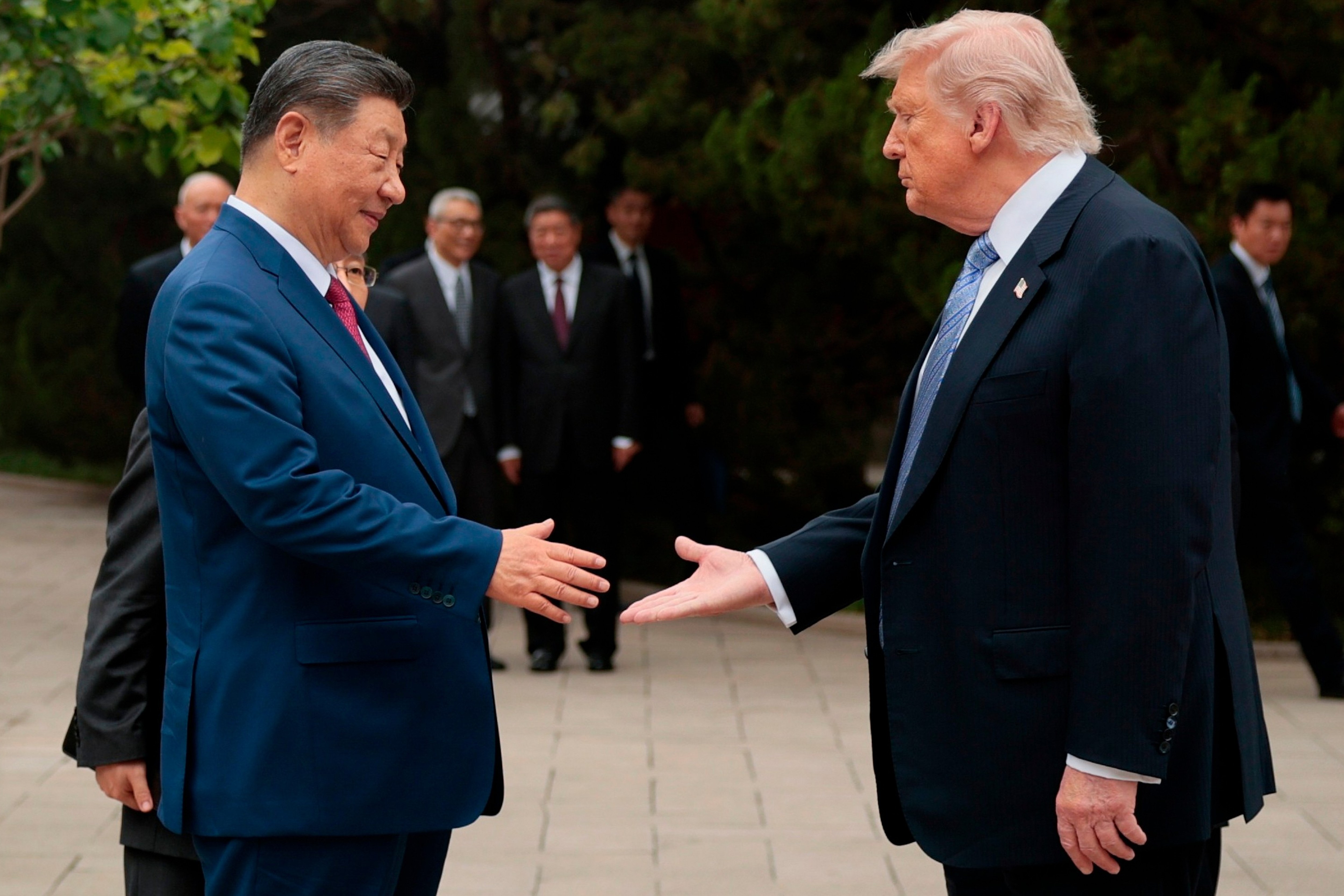
When President Donald Trump met with Chinese leader Xi Jinping in Beijing in mid-May, the exchanges were unexpectedly cordial. The two countries had been engaged in an on-again, off-again war of tariffs since Trump had begun his second term, a conflict that threatened to spiral out of control. At the same time, the Chinese were deeply concerned about the impact of the U.S.–Israeli war against Iran on international stability, given spiking oil prices and their ripple effects on the global economy.
Yet, at this meeting in China, the two leaders converged on a common goal of “constructive strategic stability.” In order to forge this condominium of superpowers — a G2 — Trump was willing to delay arms deliveries to Taiwan. He also greenlighted the sale of sophisticated (though not the most advanced) Nvidia computer chips to China. In turn, China agreed to increase its purchases from the United States, including 200 Boeing aircraft and $17 billion of agricultural goods each year through 2028.
The hoopla surrounding the summit, generated by press offices on both sides, obscured the reality that the two countries completed few concrete bilateral deals. Trump did not secure long-term access to the critical minerals that China controls — specifically the rare earth elements that are essential to U.S. high-tech manufacturing and sophisticated military hardware — and the tech giants that accompanied Trump on the trip didn’t win any major concessions in the form of enhanced access to the Chinese market. Meanwhile, China failed to alter U.S. security policy in the Asia–Pacific region. The leaders of the new G2 might be expected to rethink or rework the global rules of the road, but this was not on the agenda in Beijing.
Still, the two superpowers stepped off the path of escalating confrontation. Perhaps more importantly, Trump has seemingly abandoned his earlier goal of decoupling the United States from the Chinese economy, which, along with ratcheting up containment of the “strategic competitor,” had become something of a bipartisan imperative.
For the time being at least, the world’s superpower monsters are not laying waste to the landscape around their feet. Given how much firepower they command, that’s no small achievement. The battle, however, continues to rage further afield in the mineral world.
Grabbing the Rocks
Rare earth elements, or REE, aren’t rare. But it can be quite difficult to extract any of these 17 unusual metals from their surrounding ores. The United States used to be the world’s leading extractor and processor of these resources, from a mine in California near the Nevada border. But that was back when REE were mostly used for such products as black-and-white televisions. The environmental damage caused by the extraction and processing — as well as the labor costs involved — impelled the United States, over time, to outsource operations to China.
By the time REE had become indispensable to the manufacture of very powerful magnets used in everything from wireless iPhone chargers to the F-35 fighter jet, China was controlling upward of 60 percent of the extraction and 90 percent of the processing. It has filed more patents for the latest processing techniques than any other country. It has also expanded beyond digging up its own territory and, through its Belt and Road Initiative — a globe-spanning collection of interconnected infrastructure projects — secured access to mines overseas.
In Tanzania, for instance, an Australian firm Peak Rare Earths discovered what may well be the largest untapped supply of REE in 2010. This is exactly what the United States and its allies had been looking for: ore that can be extracted and processed outside of China. Except that last year, the Chinese firm Shenghe Resources bought the Australian company — and the rights to the Tanzanian deposits — for a little more than $100 million. China is further cornering the market by importing ore from rare earth mines in Myanmar, exploiting new deposits in Brazil, and eying Malaysia and Indonesia for potential processing operations.
To guarantee access to the minerals that both the Pentagon and U.S. industry need, the Trump administration has ramped up the exploitation of U.S. REE deposits. Mountain Pass, the California mine previously shuttered after environmental lawsuits and Chinese outsourcing, restarted production in 2012, but it still couldn’t compete against China, which had flooded the market with REE to drive down prices. Last year, the Pentagon acquired a majority stake in MP Materials, the company that owns the mine, which now produces over 10 percent of the global supply of REE.
Trump has also pumped money into USA Rare Earths, which is developing the Round Top mine in Texas, which promises to rival the REE production of Mountain Pass. Even with an accelerated timeline, however, the new mine won’t start production before 2028. Meanwhile, the administration is playing the field: pouring money into a REE processing facility in Arizona, contracting with a similar operation in France, and hammering out supply contracts with a mining firm in Australia. This frenzied activity may lessen dependency on China but not eliminate it.
And it’s not just rare earth elements. China controls 95 percent of magnesium production, over 80 percent of tungsten, over 70 percent of graphite and silicon, and three-quarters of cobalt — minerals that are critical to pretty much all modern manufacturing. On the processing end, China is the leading refiner of 19 out of 20 of the most coveted minerals, with an average market share of 70 percent. And instead of being reliant on its control of raw materials and processed ores, China is also in command of the downstream production. For instance, it’s responsible for 94 percent of the manufacturing of the most powerful magnets that go into cars, computers, and medical equipment.
The new rush for “critical raw materials,” many of them essential for building out the infrastructure of a “clean energy” transition but also indispensable for the entire range of advanced military products to which the United States is addicted, has sharpened the competition between China and the United States throughout the mineral-rich Global South. Those countries generally see China as a willing provider of capital and finance. They view Trump — who has dismissed so much of the Global South as “shithole countries,” deported huge numbers of their citizens, and subjected nearly all of their governments to punishing tariffs — with considerable skepticism.
How long will it take for the United States to catch up and neutralize China’s mineral superpower? In the best-case scenario, America will only be able to meet half its need for rare earth elements by 2028, and it currently produces less than 1 percent of those powerful magnets. Until America catches up — or forges partnerships with other countries to meet its demand through initiatives such as the U.S.-led Pax Silica — China will be able to pinch off the supply of those key minerals more easily than Iran can close off the Strait of Hormuz.
Controlling the Chips
Silicon Valley has long been a byword for innovation: Apple’s iPhones, Google’s search engine, Facebook’s social media platform. But the heart of Silicon Valley was, at least originally, made out of silicon. Chips made the valley. In the 1980s, Japan produced semiconductors that were superior to anything American companies could get to market. Competition spurred Silicon Valley to leapfrog over Japan.
The chip-designer Nvidia began in the 1990s as a supplier of graphic processing units, or GPUs, for the video game industry. These Nvidia chips became, literally, the brain behind Microsoft’s Xbox. Later, they came to power Sony’s PlayStation 3, signaling that Silicon Valley had definitively surpassed its Japanese competitors.
Then Nvidia began developing the kind of hardware necessary for the next big tech revolution: artificial intelligence. The first major AI platform available to the public — ChatGPT — was built on the foundation of Nvidia’s next-generation GPUs. Suddenly, Nvidia was the most sought-after supplier and the most valuable company in the world, now worth more than $5 trillion.
It’s one thing to corner the market on the graphics necessary to play “Grand Theft Auto” or make the special effects of the 2021 “Godzilla vs. Kong” movie look terrifyingly real. It’s quite another to create the building blocks of the AI technology that is creeping into every corner of the economy, not to mention the military.
To maintain its economic and military edge, the United States has placed controls on the export of Nvidia’s most advanced semiconductors to China. It’s no surprise that, over the last six years, the People’s Liberation Army attempted hundreds of times to acquire those precious chips. To prevent China from producing their own, the Dutch also placed restrictions on the export of the machines used to print the chips.
There are two challenges to this strategy of restriction. The first is that, despite its name, Silicon Valley doesn’t actually manufacture the vast majority of these fancy computer chips. For more than 90 percent of advanced semiconductors, the world depends on Taiwan. It’s as if another monster has appeared on the scene with a superpower that can bring both Godzilla and Rodan to their knees.
The United States harbors a fear that the Chinese response to their chip dependency will be simply to invade Taiwan and take over its semiconductor industry. For its part, the Biden administration pushed through the CHIPS Act to re-shore computer chip manufacturing, which is turning Arizona into a real Silicon Valley. Intel and Taiwan’s TSMC are among the more than 75 firms building factories there, which will require considerable water (in a desert) and produce tons of “forever chemicals,” the synthetic compounds that do not break down naturally, polluting the environment and accumulating within people (amid a growing population).
Given Russia’s failure to seize Ukraine and the inability of the United States and Israel to achieve regime change in Iran, China is not likely to attempt a takeover of Taiwan any time soon. Instead, it has pursued a different approach, and this is the second problem with a restriction strategy. Prevented from acquiring Nvidia’s best chips, China is pouring money into making its own chip sector the best in the world.
Trump’s cuts in science funding and restrictions on work visas will handicap U.S. technological progress for years and possibly decades.
Those considerable state investments produced a Sputnik moment in January 2025 when the Chinese company DeepSeek released its ChatGPT competitor. The big breakthrough, however, was behind the scenes: China was able to use its own domestically produced chips to create comparable AI results at a cheaper cost.
Private sector expenditures on AI in the United States still exceed China’s investments by a considerable margin. But the Trump administration’s cuts in science funding and restrictions on work visas will handicap U.S. technological progress for years and possibly decades. China, meanwhile, will likely have machines ready to produce what its AI models need by 2030, the target date Beijing has set to close the advanced chip gap.
The Sequel
Both China and the United States have landed a number of punches in their monster battle. The Trump administration has maintained export controls on its most advanced chips and has created a blacklist of Chinese companies it accuses of working with the People’s Liberation Army, including the car company BYD and the tech firm Baidu. China has retaliated by putting two American and 14 European companies on its own blacklist for the “dual use” of rare earth elements for both civilian and military applications. These come on top of Chinese export restrictions imposed in 2025 on seven rare-earth metals and an announcement that five more elements will be added in November.
These tit-for-tat exchanges might suggest that the two sides are evenly matched. And that may have been the case a decade ago. Today, however, despite its iconic status and devastating powers, the American Godzilla looks pretty wobbly. Trump’s fixation on cutting government and his failure to staff the remaining positions with competent officials has meant that the effort to deny China the most sophisticated chips has been compromised. Simply put, the Commerce Department has failed to enforce the export restrictions on U.S. companies, and thousands of those powerful chips have likely made their way into Chinese hands.
Even without government incompetence, the United States would be hard-pressed to maintain its advantage. The bottom line: China will be able to make its own chips sooner than America can acquire its own rocks.
The real superpower that China possesses, in other words, is its government’s ability to marshal resources to make the technological leap forward and maintain a substantive defense of its own material advantages. Thanks to this superpower, as Evan Osnos points out in The New Yorker, “China produces at least 70 percent of the world’s drones, electric vehicles, lithium-ion batteries, and solar cells.” So confident is China in this superpower that it has recently rolled out a sodium-ion battery that needs none of the critical minerals of the lithium battery that powers electric vehicles. Beijing is thus negating its own mineral advantages. Instead, the Chinese government is relying on its industrial prowess to prepare for a world where rocks no longer rule.
The Biden administration tried to copy this superpower with the CHIPS Act and the additional targeted subsidies of the Inflation Reduction Act. Trump, too, has attempted to pursue a similar industrial policy with investments in critical minerals alongside scattershot tariffs and export controls. But he has also weakened the underlying superpower of government action through funding cuts and mass layoffs at critical government agencies. As a result, a lot of the shots that the Trump administration fires at China are actually blanks.
Trump’s fixation on cutting government and his failure to staff the remaining positions with competent officials has meant that the effort to deny China the most sophisticated chips has been compromised.
If this were a film, Godzilla would be teetering on the edge of a precipice, harried by a triumphant Rodan. In the final shot, Godzilla would live to fight another day, setting the scene for a sequel.
In real life, the United States is wasting billions of dollars on a war in Iran, the Trump administration is laser-focused on stuffing its own pockets from insider deals, and U.S. universities and companies are hemorrhaging funds and talent. At the same time, China is cornering the global market on renewable technology and consolidating its trade and investment relationship with the nearly 150 countries in the Belt and Road Initiative. The newer superpower seems to be making better use of its superpowers.
Another great movie trope is enemies quickly morphing into friends when faced with an existential threat. Godzilla and Rodan eventually team up to fight King Ghidorah, a hydra-like extraterrestrial beast with three heads. Is it too late for China and the United States, inveterate frenemies, to do the same in response to the very terrestrial threat of climate change?
It would certainly make for a Hollywood happy ending. But the Trump administration, insisting that carbon emissions are no problem, is attempting to reenergize the country’s fossil fuel sector. And despite its buildout of renewal energy infrastructure and its expanding exports of solar panels and wind turbines, China remains heavily dependent on fossil fuels, especially coal.
Let’s face it: Monsters are going to be monsters. If they’re not fighting each other directly, they’re laying waste to the environment and poisoning the communities that live atop precious resources. In the world of entertainment, Godzilla and Rodan learn how to use their superpowers for good when a planet-wide emergency pushes the monsters together to fight against an external threat.
The real world faces just such a red alert. Our monsters, however, just keep doing monstrous things.
President Donald Trump and self-styled Secretary of War Pete Hegseth are pushing for a post-World War II record $1.6 trillion Pentagon budget for next year, a sum so obscenely high that it is almost impossible to comprehend. The proposed $600 billion increase alone is almost twice the total annual military budget of America’s closest rival, China.
That supposed rivalry, despite the big spending gap, makes China central to justifying the Pentagon’s bloated budget. And Hawaiʻi is, in turn, central to the Trump administration’s Indo-Pacific military strategy which assumes that deterring China requires a forward, offensive strike posture anchored by the archipelago. This not only puts a target on Hawaiʻi — as was the case during World War II, when Pearl Harbor was attacked by Japan — but it also deepens long-standing economic hardships and environmental degradation produced by more than a century of U.S. military occupation, according to “The True Cost of the U.S. Military in Hawaiʻi,” a new report by the Institute for Policy Studies.
The report finds that as the Pentagon has shoved Hawaiʻi toward the front lines of a potential nuclear conflict, it has also poisoned the islands’ land and waters, lied about its economic benefits, tied Hawaiʻi’s financial well-being to an inefficient use of tax dollars, and failed to pay more than $130 billion in back rent. And now the Trump administration is extending its buildup in Hawaiʻi — which has long “been central to the architecture of U.S. imperial power” to expand facilities, build new bases, and secure access to air and naval bases from Guam to the Pacific island chain to the Philippines to Australia. And these moves in the Pacific are just one part of that multifaceted $600 billion boost being sought for the Pentagon.
The China Syndrome
In addition to greed, grift and pork-barrel politics — practices that have reached an astonishing level due to the unapologetic corruption and feverish insider dealings of the Trump family and its hangers-on — the biggest driver of the Pentagon’s enormous budget is America’s quest for unrivaled global military dominance. At the center of that effort are preparations to “win” a war with China, a mission that is likely impossible and would be extremely dangerous to undertake.
The probable outcome of a war with Beijing — which is, after all, a sophisticated technological power armed with nuclear weapons — would be unprecedented devastation for all concerned, especially the people of Taiwan, the independent island nation of the coast of the mainland that China considers a breakaway province. Hawai‘i, Guam, and the other launching pads for a U.S. military operation against China would undoubtedly be targets, with dire consequences for the residents of those islands.
Exaggerating the threat posed by China is a foolproof marketing scheme for those who profit handsomely from preparations for war with Beijing.
Well before recentering China as national security adversary No. 1, America’s quest for military supremacy was not going well, to put it mildly.
As the Costs of War Project at Brown University has shown, America’s post-9/11 wars have been an unmitigated disaster, costing or causing long-term obligations of an astonishing $8 trillion, as well as the deaths of hundreds of thousands of civilians and the displacement of tens of millions more, Meanwhile, these wars failed miserably in meeting their stated objectives, leaving in power a sectarian regime in Iraq that opened the door to the rise of ISIS and a Taliban-led government in Afghanistan, a status quo ante bellum after more than 20 years of war.
“The Trillion Dollar War Machine,” by Willian D. Hartung and Ben FreemanAvailable at Bookshop.org
It’s hard to envision a more complete mismatch between stated war aims and real-world results than the wars in Iraq and Afghanistan, until we take a hard look at the illegal, immoral, and ill-conceived conflict with Iran which is fast becoming a new forever war.
Despite this dismal record, the Trump regime — and the Biden administration before it — has chosen to double down on a military-first foreign policy, with the demonization of China fueling the fire.
The Pentagon refers to China as the “pacing challenge,” even as military spending far outpaces Beijing’s defense budget. And in its most recent assessment, the Pentagon outlined a strategy to cow China into submission by “being so strong that aggression is not even considered.”
China hasn’t been involved in a major shooting war since the much smaller nation of Vietnam fought it to a virtual standstill in 1979, nearly five decades ago. China’s forces “severely underperformed” in the one-month conflict; according to one account, “PLA soldiers were so undertrained that there were reports of infantrymen tying themselves to tanks with ropes to avoid falling off, sealing their fate when they were ambushed.”
Presumably Chinese forces are much better trained now, but China is not a serial aggressor, and although it has engaged in border skirmishes with India, it has not been embroiled in virtually nonstop conflicts over the past half century, as the United States has, nor has it fought regime-change wars. So the question arises: Who is setting the pace in the U.S.–China arms race, Washington or Beijing?
Two Systems, Two Countries
In the real world, China’s military is not 10 feet tall, and throwing more money at the Pentagon is the worst possible way to address the greatest challenges posed by Beijing, which are actually not military in nature.
China’s vast global influence leans heavily on its economic clout, which is built on aid and trade, including the Belt and Road Initiative, a globe-spanning collection of interconnected infrastructure projects. (To be clear, the Belt and Road has too often involved dubious deals with unaccountable leaders who give Beijing long-term leases on their nation’s critical natural resources in exchange for roads, railways, port facilities, or other infrastructure projects — not exactly a model of free trade in action.) China is also the top trading partner to 120 nations worldwide, including key countries in Africa, the Middle East, Asia, and Latin America, alongside a brisk trade with Europe. This is the lynchpin of China’s global clout.
But U.S. power projection in Hawai‘i and beyond, the entire Pacific strategy, is based on a different type of projection — the belief that China aspires to usurp the U.S. as the global hegemon through military might. Exaggerating the threat posed by China is a foolproof marketing scheme for the weapons contractors, Pentagon bureaucrats, K-Street lobbyists, and venture capital firms that profit handsomely from preparations for war with Beijing.
Throwing more money at the Pentagon is the worst possible way to address the greatest challenges posed by Beijing, which are actually not military in nature.
On the military front, China’s ability to challenge the U.S. is grounded in its nuclear forces, which are much smaller than America’s but are on the rise in an effort to keep Washington from having a large-enough edge to wipe out Beijing’s ability to respond to a first strike.
The U.S. may not be able to threaten China’s nuclear deterrent any time soon, but in the face of the U.S. military build-up in the Pacific, Beijing appears to be preparing for a worst-case scenario. Chinese President Xi Jinping seems to value nuclear weapons more than his predecessors, who were content to keep a few hundred nuclear warheads that could reach U.S. soil versus Washington’s much larger nuclear arsenal. China is also leveraging is technological base, including its faster pace at training scientists and engineers. This positions China to challenge Washington in an AI arms race.
And yet war is not inevitable, despite what many China hawks constantly suggest. Returning to a common understanding on Taiwan — one in which the U.S. agrees to limit its political recognition of the island or support for independence in exchange for a Chinese pledge not to seek reunification through military means — is the best way to avoid a catastrophic conflict. It would also clear the way for cooperation on urgent issues like addressing the climate crisis, preventing pandemics, and promoting equitable global arrangements to reduce poverty and inequality. At the same time, it would make things safer for hundreds of millions of people from Japan and South Korea to Guam and Hawai‘i.
Paying the Price
America’s military-first approach to China and the world at large comes at a high price, even when the guns are silent. History demonstrates that merely preparing for war costs lives, as the fate of victims of Cold War-era nuclear testing from New Mexico and Utah to the Marshall Islands attests. But as Arjun Makhijani, a nuclear engineer and the president of the Institute for Energy and Environmental Research, has pointed out, the toll of nuclear weapons research, development, and production is global in scope, creating “a worldwide archipelago of radioactive wastelands” that have cost millions of lives since the dawn of the nuclear age. The military’s impact on lives and health is also exacerbated by the proliferation of non-nuclear toxins and unexploded ordnance created by generations of war.
In short, military buildups mean far more than moving money around, although that too poses serious risks when it comes at the expense of investments in public health, nutrition, education, and anti-poverty efforts.
War is not inevitable, despite what many China hawks constantly suggest.
Military expansions involve constructing and maintaining new weapons factories and existing military bases, deploying new weaponry, engaging in costly training exercises, and, all too often, prosecuting senseless, devastating wars like the current conflict with Iran, the forever war in Somalia, and a new conflict percolating in Ecuador.
The Institute for Policy Studies report, prepared by both mainland and Hawai‘i-based analysts and advocates, offers a lesson in the perils of military expansion. Hosting facilities geared toward a future war against China come at a human and environmental cost that far outstrips the (routinely overstated) economic benefits that U.S. military bases and weapons deployments generate, according to the IPS analysis.
The report reveals that decades of military use of PFAS (known as “forever chemicals”) have contaminated soil, groundwater, and nearshore waters far beyond the footprint of military bases. Remediation at just three installations is estimated to cost almost $500 million. A leak at the Navy’s Red Hill Bulk Fuel Storage Facility — which stored roughly 250 million gallons of jet fuel — in Oʻahu also contaminated the drinking water supply of 93,000 people. Due to these and other environmental disasters, residents of Hawai‘i have suffered unnecessary health risks and mortality and could suffer the effects of further accidents as preparations for war with China ramp up.
Trading short-term jobs for long-term environmental devastation and generational health risks is a terrible bargain that would never have been struck without Hawai‘i’s history as a colonial outpost and a pawn in a superpower competition over which the people of the islands have had far too little control. While military bases in the mainland U.S. have also caused enormous health damage, the sheer extent of Hawai‘i’s territory occupied by military facilities heightens the impact.
Meanwhile, the archipelago’s longtime status as a floating military base and the foundation for U.S. power projection in the Pacific makes it a primary target in any U.S.–China conflict, either in a first strike designed to hobble a looming U.S. attack or in retaliation once a U.S. intervention begins.
The IPS analysis also found that the Pentagon has overstated the military’s supposed $10 billion annual economic benefit to Hawai‘i by nearly 30 percent. On top of this, Hawai‘i is getting little bang for the buck. Military spending creates approximately 5.3 jobs per $1 million invested, compared to 12.3 jobs from the same investment in education, food production, healthcare, or housing. The researchers also found that the federal government owes Hawai‘i up to $133.7 billion in back rent on top of the massive environmental cleanup costs.
A non-militarized plan for Hawai‘i’s economy would supply more jobs and be far more sustainable than the current approach, according to IPS. And there is a unique opportunity to change, as two military leases of huge swaths of Hawaiian territory are set to expire.
Trading short-term jobs for long-term environmental devastation and generational health risks is a terrible bargain.
Washington needs to thoroughly rethink its narrow, self-defeating approach to Beijing. A less aggressive, more cooperative posture toward China would help free Hawaiians politically and economically, and it would open the path to a safer, more peaceful, more prosperous future. It would also allow for a rollback of the extensive U.S. military buildups in Guam and the Pacific islands, activities that mirror and are at times even worse in their environmental damage and security risks than the situation in Hawai‘i itself.
A less aggressive foreign policy toward China requires the demilitarization of Hawai‘i and a rollback of America’s costly and ill-conceived buildup in the Pacific. The IPS report clarifies what is at stake and provides a starting point for what should be a thorough debate on Hawai‘i’s role in U.S. security strategy. It is, as one of the authors, Jonathan Kay Kamakawiwoʻole Osorio of the University of Hawai‘i at Mānoa, put it: “a blueprint for reclaiming our nation here, in hope and faith in one another.”
As his war in Iran has imploded, his poll numbers have plummeted, the U.S. economy has cratered, and he finds himself in the grip of a steep cognitive decline, President Donald Trump has increasingly lashed out, calling for cataclysm, slaughter, and even genocide. As he tries desperately, if ham-handedly, to extricate himself from a losing war, the commander-in-chief of the world’s most destructive military offers up deranged rants, baying for blood and issuing orders that throw the concept of proportionality in warfare out the window.
Trump’s bloodthirsty rhetoric has been borne out in asymmetrical slaughter, with Iranian fatalities exceeding American deaths by multiple orders of magnitude. And this follows similarly lopsided casualty tolls in Trump’s conflicts in Somalia, Venezuela, Yemen, and on the high seas. This low-risk butchery masquerading as warfare harkens back to 19th-century extermination campaigns in which so-called inferior races were massacred in spectacles of slaughter — colonial violence that wiped out ethnic groups and set the stage for 20th-century genocide.
“Every time Iran kills an American Soldier, they will pay for that killing many times over!” Trump recently announced on Truth Social. “This directive has been passed on to Secretary of War, Pete Hegseth, Chairman of the Joint Chiefs of Staff, Daniel Caine, and every Leader in the Military.”
This unhinged command for disproportionate retaliation — which may amount to a violation of international humanitarian law — was featured, mostly without further remark, in news reports with bland headlines, like “Trump pays respects to 4 US service members killed in the Middle East.” It was also, for example, tucked deep inside and presented without further comment in a New York Times article about impending testimony before the Senate Appropriations Committee by Hegseth and Caine.
Trump’s order, and the matter-of-fact coverage from the Times, reminded me of a report by a different Times, almost exactly 199 years earlier: an article from Van Diemen’s Land, the Ireland-sized island to the southeast of Australia that we now know as Tasmania.
White settlers poured onto the island in the early 1800s, wiping out the kangaroos and replacing them with sheep. They treated the Indigenous people no differently. “Thousands were hunted down like wild beasts,” according to the local press. When one of the white people were killed by locals, the Colonial Times reported that other settlers exacted revenge on the Indigenous people that left “sixty of them killed and wounded.” The next year, when members of settler police and military forces were pelted with stones, they responded with gunfire and a bayonet charge that “killed seventy of them, dragging the women and children from the crevices of the rocks, and dashing out their brains.”
The slaughter in Tasmania was the inspiration for author H.G. Wells’s late 19th-century sci-fi classic “War of the Worlds,” in which Martians with superior technology, advanced firepower, and no compunction about annihilating humanity invade England, laying waste to London and driving out its population. “And before we judge of them too harshly we must remember what ruthless and utter destruction our own species has wrought,” the narrator says in the book’s open. “The Tasmanians, in spite of their human likeness, were entirely swept out of existence in a war of extermination waged by European immigrants, in the space of fifty years. Are we such apostles of mercy as to complain if the Martians warred in the same spirit?”
“Are we such apostles of mercy as to complain if the Martians warred in the same spirit?”
When lawyer Raphael Lemkin formulated the idea of “genocide” after World War II, almost 50 years after Wells wrote “War of the Worlds,” he considered Tasmania a historical case study of his concept. It’s unclear if Trump ever read “War of the Worlds,” though he attended the New York City premiere of the 2005 Steven Spielberg film adaptation; I doubt he understood Wells’s allegory, presuming he knows what an allegory is.
The Tasmanian carnage was part of an age of slaughter and genocide carried out across the globe by European powers and the United States. Trump has long been in the thrall of the precepts of this era of colonial conquest: Might makes right; territorial acquisition through armed intervention; and colonial relationships with, and resource extraction from, conquered foes and weaker nations.
Trump often invokes and praises Andrew Jackson, his 19th-century predecessor in the White House, who owned slaves and implemented a policy of “Indian removal” that culminated in the Trail of Tears, the military’s forced displacement of Native Americans, during which thousands died. Trump advocated “furthering President Jackson’s legacy, expanding his vision, [and] honoring his memory” earlier this year, pronouncing that Old Hickory embodied the “best of the American Spirit.” Trump has even employed America’s contribution to the eradication of indigenous peoples as a punch line. He has made light, on social media, not only of the Trail of Tears but also the Army’s massacre of hundreds of Native Americans at Wounded Knee in South Dakota.
Even the Army’s official history portrays Wounded Knee as a Tasmanian-scale slaughter in which an effort to disarm a group of Lakota religious revivalists resulted in an errant shot, possibly an accidental discharge, that “led immediately to heavy and indiscriminate firing from soldiers,” including the use of artillery, “despite the presence of numerous noncombatants.” In the end, up to 300 Lakota, including women and children, lay dead while “Army casualties totaled 25 killed and 39 wounded, some of whom likely were hit by friendly fire.”
Such disproportionate mass killings and exterminations were a hallmark of the 19th century. This “destruction of the ‘inferior races’ of four continents prepared the ground for the destruction of six million Jews in Europe,” as the author Sven Lindqvist observed, in his classic text “Exterminate All the Brutes.” We look back on these Holocaust-precipitating slaughters as beyond abhorrent. Or at least we did.
The death toll disparity at Wounded Knee doesn’t compare to the carnage of Trump’s war on Iran. The estimated 3,375 to 6,000 Iranian deaths dwarf the 19 U.S. deaths by 180 to 320 times, or more than two orders of magnitude. (The official U.S. Iran war death toll stands at 18, with the Pentagon omitting one widely reported loss.) The 60-to-1 Tasmanian toll of dead and wounded is a similar ratio as the estimated 39,806 total Iranian casualties compared to the official U.S. count of more than 700 troops who have been killed or wounded.
Trump has also repeatedly touted the lopsided nature of his punitive expedition in Venezuela, a short war in which the U.S. deposed and kidnapped President Nicolás Maduro, creating a de facto U.S. colony run by a quisling. “To have a few injuries, but no death on our side, is really amazing,” Trump bragged after the invasion, later comparing the lack of U.S. fatalities to the substantial death tolls of the (much longer) Korean and Vietnam wars. The 100 or more Venezuelan and Cuban military personnel and civilians killed compared with a handful of U.S. injuries shares a lineage of battlefield massacres like the 1863 U.S. slaughter of 250 to 500 Shoshone — including at least 90 women, children and infants — at Bear River at a cost of 24 U.S. troops, and the up to 6,000 Zulus armed with shields and spears cut down by Gatling guns and artillery compared with 10 British troops killed at Ulundi in southern Africa in 1879.
Trump’s 2025 war against the Houthi government in Yemen — Operation Rough Rider — was similarly lopsided. The airstrike monitoring group Airwars tracked reports of at least 224 civilians in Yemen killed by U.S. airstrikes. This nearly doubled the civilian casualty toll in Yemen from U.S. attacks since 2002, meaning that almost as many civilians were reportedly killed in 52 days as the previous 23 years of airstrikes and commando raids combined. The Yemen Data Project put the death toll at 238 civilians, at a minimum, and another 467 civilians injured. The U.S. also killed hundreds of Houthi fighters and numerous Houthi leaders, according to CENTCOM spokesperson Dave Eastburn, who referred to “credible open sources” citing 650 Houthi casualties. The U.S. did not suffer a single reported fatality during the campaign. And Trump’s relentless strikes in nearby Somalia have amounted to up to 420 deaths at a cost of zero American lives.
The Trump administration’s boat strike campaign in the Caribbean Sea and Pacific Ocean, which has killed at least 221 people without the loss of even one U.S. life, is a still more egregious slaughter. In this case, only unarmed civilians are targeted, victims akin to the fleeing Tasmanian women and children who had their skulls bashed in.
“Kill Anything That Move,” by Nick TurseAvailable at Bookshop.org
There are, of course, myriad differences between Trump’s ongoing war on the world and 19th-century colonial extermination campaigns in Africa, America, Australia, and elsewhere. Trump doesn’t, for example, explicitly assert racial superiority as a reason for his military interventions even if he often lapses into racist rants and is making war in Somalia while deriding Somalis as “garbage.”
But Trump’s more than 20 military interventions, armed conflicts, and outright wars have heightened the increasing trend toward “riskless warfare,” a term coined more than a quarter century ago by Paul Kahn, the director of Yale Law School’s Schell Center for International Human Rights. “It is an image of warfare without the possibility of chivalry,” the prescient Kahn later observed. “At the heart is a violation of the fundamental principle that establishes the internal morality of warfare: self-defense within conditions of reciprocal imposition of risk. Without the imposition of mutual risk, warfare is not war at all.”
Earlier this decade, in a study of drone warfare, Neil Renic, a scholar of military ethics, refined the concept as “radical asymmetry,” in which “one side has, in a practical sense, overcome the type and degree of physical vulnerability that has long been regarded as an expected and unavoidable feature of war.” Renic sees the drift toward unilateral violence leading to the increasing “perception of the weaker party … from an opponent to be fought and overcome, to one that must be hunted and done away with,” contributing to “dehumanization” of the enemy which, “in some cases … has led to a more severe decline in the targeting practices of the United States, from the morally questionable to the morally indefensible.” This feature of modern warfare harkens back to the age of extermination, when Tasmanians and others were also hunted and done away with.
As Trump has reveled in asymmetrical body counts and called for more disproportionate deaths, he has increasingly fancied himself an alien destroyer like Wells’s Martians; even if he himself doesn’t quite realize it. In one bizarre AI-slop image he posted on Truth Social as the Iran war went south, Trump appears to be striding from a spaceship — on some platform high above Earth — as legions of weapons-toting alien warriors flank him. In another, a gigantic Trump is seated at a command console in a space station floating high above the world. On screens above him, we see huge explosions apparently going off simultaneously back on Earth. On still another, an indistinct country is seemingly being ravaged by lasers.
“Then in a moment the Heat Ray was brought to bear, and the town became a heap of fiery ruins,” wrote Wells in “War of the Worlds,” describing the Martians’ weapon of mass destruction. “The houses caved in as they dissolved at its touch and darted out flames; the trees changed to fire with a roar.” Wells referenced the “massacre of mankind” and “the rout of civilization.” As Trump has made disproportionate slaughter his signature accomplishment from Latin America to the Middle East to Africa, he has channeled his inner Martian. “A whole civilization will die tonight, never to be brought back again,” he wrote of Iran on Truth Social, promising the “entire country could be taken out” and warning he might bomb Iran “back to the Stone Ages.”
Trump’s unhinged rhetoric is further driven home by the remaining imagery in the command-console post: a mushroom cloud from a monstrous nuclear blast with text on a screen announcing “target destroyed,” while a glowering Trump is poised to push a glowing red button that suggests he is about to incinerate the planet. Trump’s annihilationist fantasies are especially disturbing since he controls a nuclear arsenal that can destroy the world many times over. (“We have enough nuclear weapons to blow up the world 150 times,” was how Trump put it.)
Iranians, Latin Americans, Somalis, and Yemenis have all been in the crosshairs of America’s lopsided killing campaigns during his second term, but in this new age of slaughter, all of us are potentially targets in Trump’s war on the world.
There’s no I in war. But there is in Iran. And in Iraq, too. Both these wars were about ME — that is, the Middle East. It’s a region rife with supposed American security interests, but this wordplay points to another very all-too-real dynamic: These wars are as much about the “I” and “ME” of the White House as they are about the countries we attack. Or to put it another way: It’s the presidential psyche, stupid.
Way back in 2002, then-President George W. Bush warned that Iraq, Iran, and outlier North Korea comprised a grave threat. “States like these, and their terrorist allies, constitute an axis of evil, arming to threaten the peace of the world,” he warned. “By seeking weapons of mass destruction, these regimes pose a grave and growing danger.” North Korea built a nuclear arsenal, and with it, purchased a guarantee of security. The other two countries produced no nukes, and the story has been radically different.
The U.S. invaded Iraq in March 2003. Two months later, the war was won. Except it wasn’t. Despite President George W. Bush’s unforgettable May 1, 2003, “mission accomplished” moment when, from the deck of an aircraft carrier off the coast of San Diego, he declared “major combat operations in Iraq … ended,” the American war there somehow never actually stopped. An insurgency was raging, U.S. bases were being mortared, and American officials feared a civil war between the country’s formerly reigning Sunni minority and its rising Shiite majority was brewing. It became a forever war that lived up to the moniker. Last week, almost a quarter century since Bush made the case for war in Iraq, a U.S. soldier was killed in an Iranian attack on an American base there.
President Donald Trump was elected on a promise to say goodbye to all that. American-style wars of choice were going to be a thing of the past: “I will not send you to fight and die in stupid foreign wars that never end.” And yet Trump’s America is now deeply involved in a seemingly ever-escalating and never-ending conflict with — yes! — Iraq’s neighbor, Iran.
No one, I suspect, not even Trump, has the faintest idea why he did this, though maybe he felt left out of the club of forever-war makers, co-chaired by Russian President Vladimir Putin and Israeli Prime Minister Benjamin Netanyahu. Maybe he just sensed that he had to give this country a shot at being globally competitive when it came to making endless (and endlessly unsuccessful) war, if the U.S. was to remain the superpower on this planet.
Not everyone thinks, however, that you need to fight ruinous wars to be a superpower. There’s China, which is the quietest rising power in recent history because — except for a few border flare-ups with India early in this decade, and saber-rattling when it comes to Taiwan, the island nation off the coast of the mainland — it hasn’t been at war since 1979.
In lieu of pursuing fruitless conflicts around the world, it’s been silently leading the global production of green energy technology. China’s exports of green tech shot up by more than a third in the first six months of the year. This included a reported rise in shipments of lithium batteries and wind turbines by 38 percent and 36 percent, respectively. “In the first half of this year, the situation in the Middle East was tense and global supply of chemical products was tight,” Wang Jun, deputy director of China’s General Administration of Customs said at a recent press briefing. “China, with its complete industrial system and full-chain supporting capabilities, quickly seized the sudden external demands.”
And this Chinese green technology boom was in full swing even before Iran’s Houthi allies in Yemen declared a maritime embargo against Saudi Arabia and began attacking the kingdom’s oil ships in the Bab el-Mandeb Strait, briefly driving the price of oil back above $100 per barrel, about 40 percent higher than before the conflict began.
As his war with Iran has gone off the rails, Trump has begun redefining the conflict from a war to “a little excursion,” which just kept going on and on, leading him in March to sum things up this way: “We’ve already won in many ways, but we haven’t won enough. We go forward more determined than ever to achieve ultimate victory that will end this long running danger once and for all.”
You’ll recall that Trump also said on March 2 that the war was set to last “four to five weeks.” And three days later, that the U.S. and Israel continued “to totally demolish the enemy far ahead of schedule.” By March 9, Trump said that the conflict was “very complete, pretty much.” And two days later, the president declared victory. “Let me tell you, we’ve won. You know, you never like to say too early you won,” Trump announced at a rally in Kentucky. “We won.”
Like Bush’s “mission accomplished” moment, Trump’s was also decidedly short-lived. On March 15, the president said Iran still had “a little bit of fight back, but not much.” In a Truth Social post five days later, he wrote: “We are getting very close to meeting our objectives as we consider winding down” the war. On April 1, Trump announced the U.S. was “on track to complete all of America’s military objectives shortly” and on the 6th said the war “could end very quickly.” But it didn’t. “The war in Iran is going along swimmingly,” he declared on April 16. And in a May 1 letter to Congress, Trump said: “The hostilities that began on February 28, 2026, have terminated.” Except Iran never got the memo.
As the war has simply gone on and on, Trump has continued to tweak his terminology and rebrand the conflict with Iran as “a skirmish.” (Tell that, of course, to all the dead Iranian children!) Here’s how he put it, in fact, on July 22: “I call it a skirmish. This is, with this skirmish we have with the Islamic Republic of Iran, and I call it that, because, let me tell you, they’re getting hit so hard and they want to make a deal. But I say they’re not ready to make a deal.” And if the Iran war doesn’t end in the coming weeks, Trump will undoubtedly have to tweak terminology further, perhaps relabeling his skirmish with Iran a tussle, a scuffle, or even a full-scale kerfuffle.
As Trump insists the war is a minor engagement, he continues to dish out immense amounts of pain on Iranians and threatens even worse. He seems increasingly eager to blast civilian infrastructure and smash Iran into submission. As he put it all too bluntly when it came to those civilian targets: “Any time the Islamic Republic of Iran shoots at a ship in the Strait of Hormuz, whether it be by missile, rocket, drone, or any other device or weapon, the United States will bomb and destroy one bridge or power plant.” And he’s also been threatening to launch “a massive attack. Bigger than ever before.”
His Secretary of War Pete Hegseth certainly understands the president, or why would he start insisting on checking the testosterone levels of American troops and begin referring to what, in the Trump years, had already gone from the Department of Defense to the Department of War as “the High-T Department of War”?
But while Hegseth is hoping to amp up the military’s potency, Americans want to bring the Iran war to a close. Only 29 percent of Americans approve of the way Trump is handling the Iran war, according to a recent Washington Post poll. Even a Fox News survey (yes, Fox News!) found disapproval ratings hit a record high in July, with 56 percent of Americans opposing U.S. military action against Iran, including 40 percent who “strongly” oppose it. Nearly two-thirds of respondents now think the conflict will last at least a year.
Even worse was a recent CBS News/YouGov poll that found 21 percent of Americans think the conflict will last multiple years! That same poll found that 67 percent of respondents say the U.S. should end the war with Iran now. Young people are the most fed up, with 83 percent urging the president to stop the war posthaste.
And even among his most fervent followers, support had already dropped by 13 percent over the previous two months, according to a Politico poll, while almost 1 of every 5 MAGA voters had come to believe that the U.S. should end its war in Iran, no matter the cost or results.
Of course, Trump doesn’t really care about young voters or Republican voters or even MAGA devotees. As he put it last week: “A poll just came out: Americans don’t want high gasoline prices, but they’re not against the war.” His war in the ME is wrapped up in his egocentric narcissism and his me, me, me world. The phrase “wars of choice” now means wars of Donald’s choice. But the Iranian government has a say in the matter and has made a choice to hold out amid renewed threats and attacks. And despite what Trump seems to think, the public in the U.S. can make choices, too. If Trump keeps on fighting in Iran, he may sooner or later also find himself in a distinct “skirmish” with the American people.
Self-styled War Secretary Pete Hegseth has a problem with low testosterone. It’s left him suffering from what you might call an acute crisis of masculinity. And I’m pretty sure that he caught it from Teddy Roosevelt.
Bear with me. I’ll explain.
Last week, the Trump administration’s preening, strutting, wanna-be he-man announced a new mandatory annual screening for troops age 30 and older, including women, for testosterone deficiency. Troops under 30 can volunteer to be screened, and anyone with low hormone levels will have the option to receive testosterone replacement therapy.
“It’s about restoring and optimizing your natural capability,” said Hegseth, by ensuring “you have the biological foundation required to sustain the fight” on the “brutal and unrelenting” modern battlefield. Like all Hegseth initiatives, he linked it to “lethality” — now the animating feature of his life. He called topping off troops’ testosterone levels a “sacred duty.”
Anyone who has observed Hegseth for more than 15 seconds in the last 15 years could tell you the man is riddled with deep insecurities. His quest to fully transition the Defense Department to what he calls “The High-T Department of War” is just the latest manifestation of nagging anxieties about himself and the wheel-spinning, never-winning military he leads.
Poor Pete’s woes have been piling up since he headed off to college at Princeton, if not before. Hegseth acts like he was drafted against his will by the Ivy League and escaped it by joining the Army National Guard as an infantry officer in 2003. He fondly recalls guarding “Islamic assholes” at Guantánamo Bay, Cuba, alongside “hard-working, God-fearing, America-loving middle-class men” whom he contrasts with “millionaires at Princeton,” a school he derides whenever he can.
Stuffed in Hegseth’s Army-issue green duffle bag when he arrived at Gitmo was a sheet of plain white copy paper inside a black plastic frame with a quote from his hero, former President Teddy Roosevelt. This long love affair with TR has continued over the decades. Pete wrote a ridiculous 2016 book, “In the Arena,” based on the “timeless truths of Teddy Roosevelt’s iconic ‘Man in the Arena’ speech” from 1910. And he still references that speech to this day and routinely works Teddy into his public remarks whenever he can.
Last year, Hegseth wanted the Pentagon to cut ties with the Boy Scouts of America because, he believed, “the organization once endorsed by President Theodore Roosevelt” had strayed from their mission to “cultivate masculine values.” (He later bullied the Scouts into submission.) And just last month, he talked up TR to U.S. troops in Cuba — where Roosevelt fought during the Spanish-American War — using his hero as proof of America’s right to intervene “in the affairs of Latin American nations.”
No one more exemplified the anxieties of privileged men of his time than Teddy Roosevelt, who grew up in the swirl of post-Civil War America in which urbanization, industrialization, a new emphasis on “brainwork,” and new technologies led to a crippling novel condition dubbed neurasthenia: nervous exhaustion, or a deficiency of “nerve-force.” This affliction was “modern and originally American,” according to the then-most influential expert on the now-archaic medical diagnosis.
Rich, white Anglo-Saxon men like Teddy professed complete cultural, racial, and sexual superiority but grew extremely anxious it was being stolen from them. (Yes, you guessed it: Immigrants, radicals, and independent, unduly educated, or otherwise unruly “new” women were prime culprits.) Men were fast becoming feeble and feminized; only through manly endeavors like weightlifting, hiking, hunting, sports, horseback riding, and excursions into the wild could they counteract the debilitating effects of over-civilization. Roosevelt, for example, transformed himself from a frail, sickly weakling who was called a “sissy” by peers and “Jane-Dandy” by the press into a man’s man via boxing, shooting, wrestling, and travel out West, where he reinvented himself as a cowboy.
The scholar Yeonsik Jung summed up the neurasthenic age nicely, writing: “Channeled through the medical knowledge of neurology, it made American men’s racial, sexual, and spatial anxieties function to act out their racist, misogynist, nativist, and imperialist impulses which legitimized exclusionary political techniques toward the racial and sexual others such as the U.S. imperial expansion in the 1890s and 1900s.” These white American men had to win back, as another scholar put it, “the potency of their violent masculinity—their ability to out-savage the savage” on the American frontier before turning overseas to places like the Philippines, Haiti, and Nicaragua. Roosevelt’s own expansionist imperialism and his campaign against “race suicide” were firmly rooted in this toxic ferment. When the United States initially failed to annex Hawaii after a group of missionaries and pineapple plantation interests took over and set up their own government in the 1890s, for example, Roosevelt called the reluctance “a crime against white civilization.”
The framed quote Hegseth stuffed into that Gitmo duffle, which he also took to the forever wars in Afghanistan and Iraq, are lines from “The Man in the Arena” speech:
Am I striving valiantly?
Is my face marred by dust and sweat and blood? Am I spending myself in a worthy cause?
Am I daring greatly?
Am I in the arena?
“Spending myself” is an intriguing phrase here that’s key to my diagnosis of Hegseth. I’m not a medical doctor, but long ago I studied the intersection of medicine and masculinity in the late 19th and early 20th century en route to my Ph.D. A great panic of the era surrounded what historians came to call the “spermatic economy,” the belief that a man’s semen was a finite reserve of vital energy — like money in a bank account — and “spending” this essential life force through masturbation or excessive sex would leave him depleted, leading to nervous exhaustion’s below-the-waist variant: sexual neurasthenia. (President Donald Trump, who espouses pseudoscientific claptrap about good and bad “genes” also reportedly believes humans are closed-loop systems that, like a battery, have a finite amount of energy.)
Such fin de siècle fears of debilitation led to “rejuvenation” cures like French physiologist Charles-Édouard Brown-Séquard injecting himself and others with crushed guinea pig testicles — launching the field of “organotherapy” — and Austrian physiologist Eugen Steinach’s surgical procedure, a partial vasectomy to restore vigor which found favor with patients from psychoanalysis founder and noted head case Sigmund Freud to William Butler Yeats, the Nobel Prize-winning Irish poet. (“And what rough beast, its hour come round at last, Slouches towards Bethlehem to be born?”)
Hegseth is heir to this utter nuttery — obsessed as it was with limits on semen spending and banking one’s virility. His hysteria over the military becoming “effeminate” has led him to conclude that those who wish to “master the profession of arms” must have their testosterone tanks topped off. And he claims, without evidence, that pumping troops full of this hormone — which people of every sex and gender produce — will improve “combat readiness.” Hegseth also thinks his new policy will make troops “strong, resilient and capable.”
But while testosterone is tied to muscle mass, it isn’t linked with actual strength. A 2019 study found that men who received injected testosterone while engaged in intense exercise and a restricted diet — meant to mimic “strenuous military operations” — did not see gains in strength or endurance; a 2022 follow-up also found no increase in physical performance. Moreover, supplementing testosterone actually signals the body to shut down its own natural production, which can shrink the testicles and reduce one’s sperm count. (Paging Dr. Steinach!)
Hegseth believes you can measure manhood by testing testosterone, the same way he believes you can kill your way to victory on the battlefield.
Hegseth appears to believe more is better, advocating for a “high T” fighting force. But high levels of testosterone — which is currently classified as a controlled substance with potential for abuse — can lead to acne, balding, breast tissue growth, impaired ability of the heart to pump blood, infertility, erectile dysfunction, and increased risk of death.
Of course, it’s hard to say what’s normal if you’re testing millions of healthy people. Testosterone levels can change depending on when a patient is tested, whether they have recently eaten, exercised heavily, or are sick, among other factors, Dr. Alvin Matsumoto, a professor emeritus at the University of Washington School of Medicine, recently told The Intercept. For example, in about a third of men whose testosterone initially tests low, a second test produces a normal result. Tests also have high inter-lab variability. On that front, doctors usually assess testosterone levels only when symptoms of low T appear, and less than 6 percent of men between 30 and 79 actually have a deficiency.
Last week, a group of senators called out Hegseth for his bizarre obsession with troops’ testosterone, noting his department “provided no evidence that this sweeping new policy will improve force readiness or health, nor has it explained the scientific basis, costs, or risks associated with implementing it across the force.” They also pointed to “recent repeated efforts to redefine military culture around an exaggerated conception of masculinity.”
Exaggerated masculinity is an apt description for Hegseth. In his 2024 book, “The War on Warriors,” he bemoaned a plot to manufacture “soft men, and a weak military.” He describes an effort to make the armed forces “fatter,” “slower,” and “effeminate” by those “obsessed” with “neutering our military,” and delves into the dangers posed by “Pentagon pussies.”
After 18 months of crackpot policies and puerile posturing at the helm of the War Department, Hegseth’s hysteria has only grown. Like Roosevelt, Hegseth is forever struggling to display his manhood through physical exertion — posting videos of himself engaging in humiliating fitness challenges. Similarly, he’s been propping up America’s long-sagging martial prowess by beating up on the likes of Venezuela, attacking elementary school kids in Iran, blowing up unarmed boats packed with civilians in the Caribbean Sea, and threatening tiny Cuba, where his hero Teddy won fame for a Spanish-American War charge up San Juan Hill.
“Speak softly and carry a big stick” was Roosevelt’s foreign policy prescription. But from the war against the Houthis last year to the war on Iran today, Hegseth has found that his stick just doesn’t measure up. The resulting insecurity has led the emasculated War secretary to fire women and Black men from top leadership positions, block the promotion of women military officers, banish transgender service members, and denounce “fat generals and admirals” and “females” whom he believes “can’t meet the same combat arms physical standards as men.” He has now added low-T troops to the list of scapegoats for his department’s underperformance, instead of examining his failings as a leader.
Hegseth believes you can measure manhood by testing testosterone, the same way he believes you can kill your way to victory on the battlefield. It’s part of a mélange of flaccid fallacies and fantasies that seem to dominate the worldview of a man who paid $50,000 to a woman who accused him of raping her, whose former sister-in-law accused him of “abusive” behavior toward his second wife, and whose own mother once called out the fact that he “belittles, lies, cheats, sleeps around, and uses women for his own power and ego.” And as America’s wars go south, Hegseth has become ever more unhinged and his public tantrums more pronounced. “You have Trump derangement syndrome!” he snapped at Michigan Sen. Gary Peters this week, after failing to admit earlier claims about victory in the Iran war were premature.
Hegseth is exactly where he wants to be — “in the arena” — even though it’s abundantly clear his crisis of masculinity is becoming a catastrophe for his department, the rest of America, and great swaths of the globe, from the Caribbean to Iran. All the testosterone in the world isn’t going to win America’s wars, achieve Hegseth’s dream of turning “soft men” hard, or transform “Pentagon pussies” into something more in line with his fantasies, much less cure the crushing insecurities swirling in the brain of America’s fragile war secretary and the deep deficiency that has long plagued him.
Trump Adds to America’s Lethal Legacy of Treachery
Who can even remember it now? That giddy moment less than five months ago when President Donald Trump called on the Iranian people to rise up and take on the ruling regime. “When we are finished, take over your government. It will be yours to take. America is backing you with overwhelming strength,” Trump promised on February 28. “This is the moment for action. Do not let it pass.”
Like a million Trump pledges before it, it was part bluster, part bullshit. Last week, Trump admitted as much, stating he knew the Iranian opposition had no chance against the ruling regime. “Nobody is gonna take over. They have no guns, and the other side has machine guns,” he said at the NATO summit in Ankara, Turkey. “They can’t take over because they’re dead.” This was not, however, just a routine Trumpian lie; it was also part of a grand American tradition.
They say baseball is America’s national pastime, but you could make a solid case that it’s actually betrayal. Washington loves nothing more than to sell out its friends, betray its partners, leave its allies in a lurch, and call people into the streets and then abandon them to slaughter.
In an interview with the Washington Post on the Iran war’s first day, Trump said that “freedom for the people” of Iran was the goal of the conflict. It never was. But what would be lost in luring Iranian activists into the streets — aside from Iranian lives?
This type of lethal double-cross has been America’s stock-in-trade since its infancy — and has continued across the globe no matter the conflict, era, or president.
During the American Revolution, most Native peoples viewed America’s colonial rebels with skepticism and attempted to remain neutral or sided with the British. But some placed a bet on the revolutionaries, assuming that they would be rewarded with fair, if not preferential, treatment in the event of a win by the colonies. They were, in the end, wrong to assume their allies would act honorably.
The Oneida, for example, split from most of the Haudenosaunee Confederacy — the Mohawk, the Onondaga, and others — who allied with the British. “There would have probably been a lot more death for the Continental Army,” according to Heather Bruegl, a public historian and citizen of the Oneida Nation of Wisconsin who noted that the Oneida altered the tide of the war by breaking the famine at Valley Forge.
Even the Pentagon lauds the Oneida Nation, noting its “support for American independence saw the Continental Army through its lowest point in the Revolutionary War” but admitted that while Congress offered thanks, “that gratitude did not always translate into equitable treatment.” This is nothing but a mealy-mouthed reference to the fact that at the end of the Revolutionary War, the Oneida Homelands were estimated at between five to six million acres of land but were reduced to just 32 acres by the early 1900s.
The Lenape people also threw in with the American rebels, signing a treaty that pledged their backing to the nascent United States in exchange for protection and the creation of a 14th state, governed by Native Americans. The agreement fell apart within weeks. As the official State Department history puts it:
First, the Lenape leader White Eyes died. While American officials insisted White Eyes died from smallpox as the cause, evidence indicated members of the [colonial] militia murdered him, and the circumstances remain unclear to this day. This act showed the Lenape that the Americans did not value nor honor the importance of kinship alliances.
Despite a failure by the Americans to protect Lenape lands, some Lenape warriors nonetheless assisted the Continental Army and a delegation went to the Continental Congress to attempt to repair the pact. But the Americans made no effort to salvage the agreement and said the Lenape had broken the treaty. Worse still, in 1782, Pennsylvania militia massacred a neutral, pacifist Christian Lenape community in Gnadenhutten, bludgeoning 96 unarmed people to death. Thirty-nine of those killed, many with a hammer to the back of the head as they prayed for mercy, were children.
Deception and Disloyalty
Still, it wasn’t until the 20th century that America hit its stride, selling out allies at an unbelievable clip. Approximately 250,000 Filipinos joined the U.S. military, for example, and fought for America during World War II. Washington promised them the same health and pension benefits as their American counterparts, a pledge that was even reaffirmed at the close of the war. But then Congress passed and President Harry Truman signed the Rescission Act of 1946 that said that the service of Filipinos “shall not be deemed to be or to have been service in the military or national forces of the United States or any component thereof or any law of the United States conferring rights, privileges or benefits.”
Also during World War II, the U.S. Office of Strategic Services, a forerunner of the CIA, armed, trained, and supported a guerrilla force in French colonial Vietnam fighting the Japanese and their French quislings. In 1945, with the Japanese defeated, the top local OSS agent — the charismatic Ho Chi Minh — proclaimed Vietnam’s independence, using the words of the U.S. Declaration of Independence as his template. “All men are created equal,” he told a crowd of half a million Vietnamese in Hanoi. “The Creator has given us certain inviolable rights: the right to life, the right to be free, and the right to achieve happiness.”
Ho thought his allies would back him. He was wrong. They instead turned on Ho and his comrades, funded the French reconquest of Vietnam, and spent the better part of the next three decades propping up an ever more corrupt and repressive rump state in South Vietnam while advising, arming, training, and funding an allied South Vietnamese military, and fought a long, destructive war against revolutionaries in the South and Ho’s North Vietnam that left millions dead, wounded, or displaced.
Eager to turn the conflict over to the Potemkin state they fostered and extricate the U.S., President Richard Nixon pledged to re-enter the war with the “full force” of American power, to induce the despotic South Vietnamese government to sign a 1973 peace agreement with the North. Two years later, the U.S. ignored this guarantee and abandoned South Vietnam and millions of allies, collaborators, and hangers-on.
No single moment sums up this betrayal better than an incident recounted by Stuart Herrington, a counterintelligence officer who spent 30 years in the Army. Herrington made a vow to hundreds of Vietnamese who crowded onto U.S. Embassy grounds in Saigon on the final day of the U.S. evacuation in 1975. “Nobody is going to be left behind,” he assured them. One of the 420 Vietnamese who was there remembered his words: “I promise me and my soldiers will be the last ones to leave the embassy.” Herrington promised them that a large helicopter was coming to rescue them and then excused himself to go “take a leak.” Scurrying off into the shadows, Harrington slipped into the embassy building and onto a helicopter, abandoning those to whom he’d just given his word.
A U.S.-backed military regime in neighboring Cambodia also crumbled in 1975 and was abandoned to face the genocide of the Khmer Rouge. A proxy army in neighboring Laos was similarly discarded in the 1970s. Decades later, surviving troops and their families were still in hiding and on the run. “We want America to give us a place to live,” Va Chang, a then-60-year-old veteran found in the jungle in the mid-2000s told a reporter. “If the Americans don’t want to do that, they should drop a big bomb on us and end our misery.”
Prior to a 1956 uprising, the CIA air-dropped leaflets into Hungary with messages like “The regime is weaker than you think.” János Rainer, director of Hungary’s 1956 Institute Foundation, said, “Hungarians clearly got the impression that, in the event of a rebellion, the U.S. would support them effectively.” But the U.S. stood aside as the Soviet Union crushed the uprising, killing and wounding almost 20,000, imprisoning 13,000, and executing 229 others following trials, according to one count. The writer Tamás Aczél, who fled to the U.S. in 1956, wrote that Hungarians had been naive to put their faith in U.S. calls for “liberation” in Eastern Europe, writing: “[W]e learned what we didn’t know — that the West had written off these countries and only their propaganda machines pretended otherwise.”
In an even more egregious exercise, the CIA trained and armed Cuban exiles, landing them at the Bay of Pigs in 1961. The counterrevolutionaries were promised ample air cover — “the sky will be yours” — and led to believe they would be supported by 15,000 American troops. But the invasion of Cuba went south quickly, President John F. Kennedy canceled a second round of airstrikes, and the exiles ran out of ammunition, were pushed back into the sea, and were abandoned. Grayston Lynch, a CIA operative who participated in the landing, recounted that he called two American destroyers on the scene for help but was told by the captain of one: “My orders are not to become involved.”
While the U.S. has betrayed people the world over, one group stands preeminent in the sheer amount of American treachery. “Nothing in this world is certain except death, taxes, and America betraying the Kurds,” wrote Jon Schwarz for The Intercept in October 2019, recounting eight instances from the 1920s to that very moment when the U.S. used independence-seeking Kurdish peoples to further American aims and then cut them loose.
One of the most craven of these instances was a Nixon-era plot with then U.S.-allied Iran to use the Kurds to bleed the then-Soviet-aligned Iraqis.
Once the Kurds outlived their usefulness, however, U.S. aid was then cut and the Iraqi military killed thousands as the Kurds begged for help. As a congressional report later admitted, “Even in the context of covert action ours was a cynical enterprise.” But Secretary of State Henry Kissinger shrugged at the slaughter, explaining “covert action should not be confused with missionary work.”
As the U.S. bombed Iraq during the Gulf War in 1991, President George H.W. Bush called on “the Iraqi military and Iraqi people to take matters into their own hands, to force Saddam Hussein, the dictator, to step aside.” Both Shias in southern Iraq and Kurds in northern Iraq answered the call, expecting U.S. military support. It never came, Hussein stayed in power, and some 20,000 Kurds and up to 60,000 Shias who rose up were slaughtered by the Iraqi military.
More than a decade later, another failed U.S. war in the Middle East fostered the rise of the Islamic State group and the creation of a brutal caliphate across a wide swath of Iraq and Syria. Between 2014 and 2017, Kurdish-led forces dismantled this quasi-state for the U.S. But after 93 percent of Iraqi Kurds voted for independence in 2017, America was nowhere to be found. Within weeks, Iraqi federal troops and Iranian-backed Hashd al-Shaabi militias launched a coordinated offensive. The Kurds lost the city of Kirkuk, the Nineveh Plains, and roughly 40 percent of the territory their fighters had held. Washington offered no military response and no assistance — not even a diplomatic protest to the government in Baghdad. Then in 2019, President Donald Trump withdrew U.S. troops from northeastern Syria, opening the door for a Turkish invasion of the very land the Kurdish-led Syrian Democratic Forces had taken from ISIS at the cost of more than 20,000 lives.
Hundreds of thousands of locals also served alongside U.S. troops, diplomats, intelligence officers, and contractors during the failed Afghan War. Despite 20 years of Americans mouthing the phrase “shohna ba shohna” (“shoulder to shoulder” in Dari), it meant very little. In the chaotic 2021 U.S. withdrawal from Afghanistan, most Afghans who fought on the side of the U.S. and its coalition partners were left behind as the Taliban retook the country.
But even those who made it out have been abandoned. In April, the Trump administration floated plans to send Afghan allies stranded at Camp As Sayliyah in Qatar to the Democratic Republic of Congo. While that plan was reportedly shelved, rumblings of casting them to the winds elsewhere remain. And in May, the Department of Homeland Security formally ended Temporary Protected Status for roughly 10,000 Afghans who fled after the Taliban’s return to power.
“We made a promise to those who helped America in our time of need, and it’s wrong to turn our backs on them,” Rep. Jason Crow, D-Colo., a member of the House Armed Services Committee and a combat veteran who fought in Afghanistan, said last month, noting that they will likely face torture, persecution, and even death if they are returned to Afghanistan.
Won’t Get Fooled Again?
The principal proverb of personal responsibility has been kicking around since at least the 1600s: “Fool me once, shame on you. Fool me twice, shame on me.” But what happens if the “you” — in this case the United States — is always the same, and the “me” is always someone or somewhere different?
The viceroys, envoys, and foot soldiers of American empire talk a good game. And the carrots offered and sticks wielded by the superpower are immense. But the U.S. hasn’t won a significant military conflict since the 1940s and when its wars go south, its proxies and partners — particularly smaller, weaker nations that it sees as disposable — are the ones sacrificed. People around the world need to take this long history into account when the United States comes calling with money, weapons, and offers of friendship.
The Trump administration is currently waging a war on history, white-washing America’s past to cast the country in a more favorable light. But other nations would do well to study — really examine — how America treats its friends. The people of Iran, even dissidents and those with a grudge against the ruling regime, resisted the urge to put their faith in the United States earlier this year. But many in Venezuela, Mexico, Ecuador, and elsewhere have forged closer ties with the Trump administration. History suggests those taken in by Americans bearing gifts will pay dearly for it. For 250 years, Americans have been double-crossing partners and selling out allies; betrayal — the past has shown — is in the nation’s DNA.
We’ve only recently passed the semiquincentennial of the United States of America. Two hundred and fifty years ago, at the moment of its founding, the U.S. was, of course, a slaveocracy. Of its founders, John Adams was essentially an oddball because he owned no slaves. But Presidents George Washington, Thomas Jefferson, James Madison, and James Monroe did own people. So, give our current president Donald J. Trump some credit: At least he isn’t a slaveowner. But that’s about the best that can be said for him.
Once upon a time, if you had described our world to me, I would have thought you mad. Who could have imagined that Americans would reelect the man who shoved aside Montenegro’s Prime Minister Duško Marković in 2017 in what appeared to be an attempt to get to the front of a photo line (because who, in any circumstance, should be photographed more than him)? This is also the same tantrum-prone president who once threw his lunch, ketchup and all, at a White House wall after his attorney general made comments he didn’t like about the 2020 election. The president who, less than two years into his second term, kidnapped Venezuela’s head of state, tried to claim Greenland as the property of the US of A, prepared for a possible future war with Cuba, blown ships out of the water in a never-ending fashion in the Caribbean Sea and eastern Pacific Ocean, has conducted staggering numbers of airstrikes in Somalia, launched a would-be forever war with Iran (brilliantly crippling the global economy while he was at it), and … well, count on it, in the next two-plus years of Donald Trump’s America, there will surely be all too many more examples of unhinged behavior to cite. Honestly, a decade ago, I would have thought you were kidding.
So, what would those slave-owning Founding Fathers, memorialized on the Fourth of July just past, have thought about Trump? What would they have said about his boorish behavior, his toddler-esque tantrums, and his endless attacks and wars?
Perhaps those founders, were they alive today, would visit Trump at Mar-a-Lago and share a meal with the odd millionaire, billionaire, or trillionaire (although Elon Musk’s trillionaire status only lasted a couple of weeks!) lurking around the club. Or perhaps they would have been spotted on the White House lawn recently with Trump, first lady Melania, and the Trump kids, not to speak of a legion of blood-sport-loving billionaires watching a mixed martial arts spectacle in honor of Trump’s 250th birthday. (Oops, my mistake, Trump is just a youthful 80, which, when — or is it, if? — he finally leaves office, will make him our oldest president ever but hardly the oldest among the almost 200 world leaders of the present moment.)
“A Nation Unmade by War,” by Tom EngelhardtAvailable at Bookshop.org
Here’s a question that those Founding Fathers might ask about Donald Trump’s America: “What kind of -ocracy is the United States today?” And the answer, of course, would not be a democracy, or even a theocracy (though The Donald does love to be worshipped), but a Trumpocracy: a government of Trump, by Trump, and for Trump; a government dedicated to the enrichment of the president and his cronies. And it’s a vengeful one at that. After all, on Truth Social last year, he reposted an AI-generated video of former President Barack Obama being arrested in the Oval Office (as Trump looks on in glee) before he’s thrown into prison. A Black man seized (in a house built by slave labor, no less) and held in bondage is something of a nod to America’s past — and wouldn’t be unfamiliar to America’s founders.
But honestly, if you were to offer an account of Trump’s America to George Washington or Thomas Jefferson, what would either of them have thought? Can you even imagine their reaction? Their dismay? You found a country and just over 250 years later, you have Donald J. Trump running it into the ground.
Perhaps if the Founding Fathers could do it all again, they might have chosen to remain a colony of the British king, George III (whom Donald Trump makes look remarkably good).
Coming from a largely rural land, the founders would undoubtedly find it interesting that Trump’s long solid support in the heartland finally seems to be on the verge of collapse. But then, so much of his world (and sadly, ours, too) seems to be on the edge of ruin these days.
The founders might wonder if the United States could survive another two and a half years. Or if the world can? If, that is, he doesn’t try to remain in power. After claiming to have won the last three presidential elections, Trump asked an Iowan audience ominously: “Should we do it a fourth time?” (George Washington would no doubt be disturbed, having been committed to a two-term maximum.)
In two and a half years, much less six and a half, Trump is potentially all too capable of taking not just this country but also the planet down with him. And I’m not just thinking about his ability (if that’s faintly the word for it) with allies like Israel to turn parts of this world into hell zones of war. I’m thinking instead about the climate disaster to come (as my city recently hit the 100-degree mark on an early July day) and the president who has called climate change “the greatest con job ever perpetrated on the world” and a “green scam,” and is prepared in his own fashion to heat this planet to the boiling point. Now, I’m sweating and, of course, with Donald Trump at the helm of state, it’s only going to get hotter, and hotter, and hotter.
I’ve lived through the last 51 of America’s 250 years. For much of it, I’ve believed that the United States was sick beyond salvation. And yet, I never quite imagined the U.S. would be where it is today. That was a failure of vision because America at 250 is, in my estimation, exactly where it deserves to be. It’s a nation gone rancid, a country polluted by its past, and more so, by the abject failure to reckon with it.
Once, it seemed open to question. Would America be the land defined by Jim Crow? Or by the civil rights movement? The country that made war on innocent people half a world away? Or one that owned up to the criminality of that slaughter and turned swords into ploughshares? A nation that jailed women for sending information about birth control through the mail? Or a country that gave people autonomy over their bodies? The odds were always stacked against the U.S., poisoned at the root as it is by twin original sins: settler colonialism and chattel slavery. From these evils, so many other offenses to humanity have flowed. Maybe no country could overcome such a legacy.
Still, many Americans broke their bodies and laid down their lives trying to atone for the sins of the founders and those that followed them. Ordinary people pressed and struggled to gain some measure of the liberties, equality, and the chance at happiness promised, but not delivered, at America’s birth. In return, they faced terror, truncheons, and tear gas. Year after year, people denied supposedly inalienable rights faced down, for themselves and their neighbors, white-hooded nightriders and bayonet-bearing troops and robber barons and monied interests and hateful bigots and vicious police and craven politicians and foolish experts and infinite hordes of functionaries and good-German-type neighbors willing to do the bidding of oppressors or just look the other way. But because of all these shattered skulls and cracked ribs, endless abuse and arrests and incarcerations, there was a chance for redemption.
You could almost see it if you squinted hard enough. That fleeting moment when a panoply of rights movements appeared ascendant, and that long arc of the moral universe was straining hard toward justice, and the volunteers of America — an unarmed army of the better angels of our nature — were on the march. For an instant, it was there: a shining wave of promise about to swamp the forces of America’s decrepit order. Maybe you glimpsed it in the raucous joy of an occupied campus or park or city block, on a graffiti-scribbled wall, in the smoke of a burning tire, in the frenzied talk of a comrade, in the pages of a banned book, wherever; you sure knew it if you saw it.
But that shimmering wonder crested, collapsed, and consumed itself. Now you need to crane your neck and strain your eyes to see the bare trace of that high-water mark — the cruel evidence of the last, best hope for America’s redemption just before it was swept back into the depths. We’ve been drifting ever further from it since.
If the question of which America would prevail hadn’t been settled earlier, the reelection of a megalomaniacal, racist, war-mongering, bigoted, vulgar, anti-democratic, authoritarian, inveterate liar, and would-be tyrant to preside over America’s semiquincentennial seemingly resolved it.
America is the “greatest, strongest, and most exceptional nation the world has ever known,” said President Donald Trump recently in celebrating the country’s 250th birthday with a rally on the National Mall. He added that it was “superior to any nation that’s ever been built no matter how many years it took.”
While Trump’s demented, deteriorating mind might not recall George Orwell’s warning in 1984 — “Who controls the past controls the future; who controls the present controls the past” — he or his minions certainly understand the concept on some level. Immediately upon taking office last year, Trump began efforts to whitewash — quite literally — American history to match his boasts. An executive order issued last March took aim at a supposed “widespread effort to rewrite our Nation’s history” to “undermine the remarkable achievements of the United States by casting its founding principles and historical milestones in a negative light.”
It’s Trump, however, who has been rewriting history to comport with his claims. For months, to take one example, Trump has fought a pitched battle to censor the history of his presidential predecessor George Washington, whom he calls “our foremost American hero.” For his exploits at Trenton and Valley Forge, for his leadership in the turbulence of the Revolution’s wake, the capital bears Washington’s name and in it a giant obelisk stands in his honor. Most Americans have literally, if not figuratively, long embraced his visage since his face adorns the quarter and the dollar bill.
In January 2026, crowbar-wielding workmen descended on the President’s House site on Philadelphia’s Independence Mall, where Washington and his wife Martha lived in the 1790s — when the city was briefly the nation’s capital — with nine of their slaves. On orders from the Trump administration, the workers pried off panels discussing the ownership of people by our foremost American hero, details about the lives of those enslaved men and women, and information about the broader history of slavery. Recently, a federal appeals court discarded an injunction ordering the National Park Service to restore the site, allowing the Trump administration to replace the slavery exhibit. “It is an attempt to sanitize history and present a version of the past that is more comfortable, but far less truthful,” wrote the Avenging the Ancestors Coalition, which led the movement to craft the original display.
No country can be great, much less the “greatest,” if it’s afraid of its own people knowing the story of their nation. Trump looks at America and sees an “unparalleled legacy of advancing liberty, individual rights, and human happiness,” according to that executive order. He claims that malevolent forces have “reconstructed” America’s past as “inherently racist, sexist, oppressive, or otherwise irredeemably flawed,” fostering “a sense of national shame.” But no one need rewrite U.S. history to foster a sense of unrelenting disgrace. It’s everywhere, if we have the courage to call it out.
In 1779, for example, Washington ordered a scorched-earth campaign against native peoples, to bring about the “total ruin” of the so-called Six Nations across hundreds of miles of Pennsylvania and New York. “The immediate objects are the total destruction and devastation of their settlements,” he told Maj. Gen. John Sullivan. When the operation was over, Sullivan’s army had destroyed more than 40 villages.
Such sins of America are legion. Given the time and space, one could name 250 or 250,000 or 2.5 million of them. On this Fourth of July, it’s worth recalling some of those inconvenient truths that Trump would rather you forget and future generations never know.
Col. John Chivington, the head of the Colorado military district led more than 700 troops to attack Cheyenne and Arapaho groups at dawn on November 29, 1864. In what he called “an act of duty to ourselves and to civilization,” his men unleashed gunfire and artillery on a sleeping village at Sand Creek. For almost four hours, they slaughtered the camp’s inhabitants, two-thirds of them women and children. Many Native women were also raped, and Native American scalps, breasts, and genitalia were taken as souvenirs. In a letter to Maj. Gen. Samuel Curtis, Chivington stated: “It may, perhaps, be unnecessary for me to state that I captured no prisoners. Between five and six hundred Indians were left dead upon the field.”
In 1914, striking miners in Ludlow, Colorado, were celebrating Greek Easter when the Colorado National Guard and a private security company opened fire on their camp with a machine-gun-equipped armored car that the miners called “the Death Special.” Those miners fought the National Guard for 10 days before President Woodrow Wilson ordered in federal troops. Almost 200 people were killed, according to some estimates.
A two-day attack by white mobs on Tulsa, Oklahoma’s Greenwood district in 1921 began after Black Tulsans attempted to prevent a man’s lynching. Rioting white people, in response, killed hundreds, and more than 30 city blocks were destroyed, including a community known as Black Wall Street. Viola Ford Fletcher, a survivor, recalled piles of bodies in the streets and watched a white man execute a Black man and then shoot at her family.
During the 20th century, coerced and forced sterilization became a method of controlling “undesirable” populations: disabled people, immigrants, people of color, the poor, unmarried mothers, those with mental illness, and others. This included federally funded sterilization programs in 32 states. Over 70 years in California, for example, approximately 20,000 men and women were sterilized in state institutions, often without their full consent.
From 1932 to 1972, 399 black men, many of them sharecroppers and poor, in Alabama were denied treatment for syphilis and deceived by doctors from the U.S. Public Health Service as part of the Tuskegee syphilis study. Despite the availability of penicillin beginning in the 1940s and the fact that syphilis can damage the heart, brain, and other organs, government officials ensured the men received no medical care while telling them they were being treated for “bad blood.” 128 of the men are estimated to have died from syphilis and related complications.
In a horrifying echo of the Tuskegee syphilis study, U.S. government and Guatemalan doctors in the 1940s intentionally infected more than 1,300 Guatemalan soldiers, prisoners, hospital patients, and sex workers with three sexually-transmitted infections — chancroid, gonorrhea, and syphilis — to study potential treatments. The researchers also paid sex workers to transmit the diseases. Left untreated, all three can be fatal.
The U.S. government conducted thousands of radiation experiments on Americans, including children, from 1944 to 1974. They included the injection of plutonium into people’s bodies, marching troops into the wake of a nuclear explosion, and releasing radioactive substances into the air to track their movement or effects.
U.S. troops from the “Greatest Generation” committed tens if not hundreds of thousands of rapes in Europe during and after World War II. Around 190,000 German women alone were raped between the U.S invasion of Nazi Germany and 1955, when West Germany regained its sovereignty, according to one estimate. In reports compiled by Bavarian priests in the summer of 1945, the youngest victim mentioned was a 7-year-old child. The oldest was a woman in her 60s.
On August 6, 1945, the U.S. launched the world’s first nuclear attack on the Japanese city of Hiroshima. Around 70,000 people, nearly all of them civilians, were vaporized, crushed, burned, or irradiated to death almost immediately. Another 50,000 probably died soon after. As many as 280,000 were dead, many of radiation sickness, by the end of the year. An atomic strike on the city of Nagasaki, three days later, is thought to have killed as many as 70,000.
The FBI’s infamous COINTELPRO program targeted the civil rights movement, the New Left, and anti-Vietnam War protesters, among others in the 1960s and 1970s. According to a 1976 Senate report, it “turn[ed] a law enforcement agency into a law violator.” The FBI, the committee found, “went beyond the collection of intelligence to secret action designed to ‘disrupt’ and ‘neutralize’ target groups and individuals,” using “wartime counterintelligence” techniques that “would be intolerable in a democratic society even if all of the targets had been involved in violent activity,” which they were not.
On March 15, 1968 in South Vietnam, U.S. troops were briefed by their commanding officer, Capt. Ernest Medina. The Americans were told they would find enemy troops in the village of My Lai and, as one unit member recalled, Medina “ordered us to ‘kill everything in the village.’” When the troops arrived, they encountered only civilians: women, children, and old men. Nonetheless, Medina’s order was carried out. More than 500 civilians were slaughtered over the course of four hours. The soldiers even took a break to eat lunch amid the carnage. Along the way, they also raped women and young girls, mutilated the dead, and systematically burned homes.
There is no way not to view these “historical milestones in a negative light.” Nor the sins of the Afghanistan War, the Iraq War, the global war on terror and the countless crimes they spawned. In the five-plus years Trump has been in the White House, alone, the U.S. has been embroiled in more than 20 military interventions, armed conflicts, and wars. We’ve also watched as Black women and men were murdered in cavalier fashion and anti-ICE protesters were gunned down in the streets. We’ve seen immigrants deported to foreign prisons, war zones, and human rights-violating pariah states for spite, and rights disappeared as if they were panels detailing historical truths.
I recommend reading “Stamped from the Beginning: The Definitive History of Racist Ideas in America,” by Ibram X. KendiAvailable on Bookshop.org
“There has never been anything like the United States of America,” Trump said recently. It’s lucky for the world. Because for every landing at Normandy, there is a massacre at Bear River or Sand Creek or Samar or No Gun Ri or My Lai or Le Bac 2 many times over. I’ve spoken with hundreds of survivors of these types of atrocities. I know the story of America’s impact abroad better than most.
Trump believes that he resuscitated the U.S. “A short time ago we were a dead country,” he said during semiquincentennial festivities. “We were dead.” Those comments about America’s death resonated with me — even if I don’t think they’re true — because the other side of that coin is rebirth. While I don’t believe this country can be redeemed, that doesn’t mean it can’t be reborn.
Washington isn’t the only predecessor Trump loves. He’s also besotted with, as he put it, “the late, great Thomas Jefferson, one of our most important Founding Fathers.” Although in Trump’s version of history, Jefferson was a “principal writer of the Constitution.” (He actually authored the Declaration of Independence — the anniversary Trump is celebrating these days.) Perhaps if Trump knew what Jefferson, another slaveholder, actually wrote, he would be less enamored. Whatever his grave faults, Jefferson offered a prescription for an ailing nation. What country “can preserve its liberties if their rulers are not warned from time to time that their people preserve the spirit of resistance?” he asked in a 1787 letter. Noting the necessity of “rebellion,” he continued, “The tree of liberty must be refreshed from time to time with the blood of patriots and tyrants.”
Two hundred and fifty years in, during the presidency of a sick-minded, wanna-be despot, and despoiler of history, it’s worth considering the endless sins of America, its sheer brutality, its staunch resistance to reform, and how one of Trump’s favorite founders thought about sending a message to “rulers.” A country that won’t face its crimes and instead tries to disappear them can’t be saved. Even rebellion, at this late date, might be only a half-measure. But if there is any wisdom left in Jefferson’s words, it could be somewhere to start.
Even as the White House has proved reckless and self-defeating in Iran, it has maintained a menacing, disciplined focus on Latin America. The siege of Cuba and informal annexation of Venezuela are the centerpieces of this program, but there’s not one country, except perhaps Uruguay, where Washington isn’t in deep. The State Department was even micromanaging the recent Colombian elections, with Secretary of State Marco Rubio personally approving the deportation of Beto Coral, a Colombian national who lives in Texas, because he has been critical of Trump’s preferred candidate.
A narrow, wealthy Latin American diaspora geographically concentrated in Miami has captured U.S. hemispheric policy.
The extent of this power projection is impressive, even if the power asymmetries make operations in Latin America easy compared to the Middle East. You can pressure Ecuador with a gang designation and $20 million in security aid and get results. You can’t do that with Iran.
But asymmetry alone doesn’t explain the Trump administration’s overwhelming focus on Latin America. Florida, to a large degree, does. A narrow, wealthy Latin American diaspora geographically concentrated in the greater Miami area has captured U.S. hemispheric policy — not through persuasion or broad public support, but through the state’s electoral math and alliance with the Republican Party. This informal lobby represents a Latin American propertied class who fancy themselves dispossessed, who imagine their interests threatened by the mildest of democratic reforms. The members of this class see Trump and Rubio as their personal repo men.
The Cause
Florida’s outsized role in U.S. politics begins with the backlash to Cuba’s 1959 revolution. Those who fled Fidel Castro’s socialist government in its early days overwhelmingly came from the middle and upper classes. They turned the peninsula into a sanctuary state. After the failure of the Bay of Pigs invasion — the CIA’s 1961 bid to use exiles as an expeditionary force to invade Cuba and dislodge Castro — the more ideological of these agency-trained exiles continued to populate the counterinsurgent gothic. These Cuban emigres allied with rogue elements in the CIA and FBI, Colombian drug traffickers, and mafiosi to advance “The Cause,” as the novelist James Ellroy calls efforts to liberate Cuba through the violent overthrow of Castro’s government.
Cuban exiles, drawn into covert operations and the ranks of the then-fringe U.S. New Right, would go on to participate in many of the storied black-bag operations that defined the middle to late Cold War: the conspiracies surrounding JFK’s assassination (as the House Select Committee on Assassinations put it in 1979: “anti-Castro Cuban groups, as groups, were not involved in the assassination, but the available evidence does not preclude the possibility that individual members may have been involved in the assassination) and the execution of revolutionary Che Guevara in Bolivia, led by Bay of Pigs veteran and CIA operative Félix Rodríguez, who then went to Vietnam to train the death squads of the Phoenix Program. Other Bay of Pigs alumni flew CIA combat missions over the Congo strafing Simba rebels and carried out the Nixon White House’s Watergate break-in and the Iran–Contra affair, in which Reagan administration officials secretly sold weapons to embargoed Iran and diverted the illegal profits to right-wing Contra rebels in Nicaragua, directly violating a congressional ban.
The Cold War ended but the Cause continued. In 2000, the notorious Republican operative Roger Stone recruited Cuban American protesters for the infamous Brooks Brothers riot — the mob action that shut down the Miami-Dade recount of presidential ballots and handed George W. Bush the White House — by instrumentalizing exile grievance through Cuban radio broadcasts. “The idea we were putting out there,” Stone later said, “was that this was a left-wing power grab by Gore, the same way Fidel Castro did it in Cuba.”
Drug profits financed many of these operations. “Every major area of operation in which the CIA has worked has left behind a major functioning drug cartel,” as CIA operative-turned-whistleblower John Stockwell put it. So too the Western Hemisphere with the Cubans. The beginning of the modern cocaine trade “had developed largely under the control of exile Cuban criminal organizations based in Miami,” Bruce Bagley, an expert on Latin American drug trafficking, observed in Foreign Affairs.
By the late 1970s, Miami prospered, even as the rest of the country was suffering from a prolonged economic downturn, high unemployment, and urban decay. Laundered cocaine money in effect provided Miami a covert Keynesian stimulus, a massive injection of cash into construction, retail, banking, and services at the exact moment the U.S. government was abandoning such policies as inflationary. While nearly every other Federal Reserve district was running a deficit, the vault of Miami’s Fed was stuffed with a $5 billion surplus made up of manicured bundles of $50 and $100 bills, evidence of large cash transactions conducted outside normal financial channels. Real estate boomed. Employment boomed. Car dealerships, paid in cash, boomed. Buildings went up, the city’s traditional pastel stucco and red tiles giving way to glass, glitz, and gleam.
Cuban Americans came to dominate Miami’s independent banking sector. Continental National Bank, the first Cuban American-owned bank in the United States, was founded in 1974 by exile Carlos Dascal in Miami’s Little Havana neighborhood. Typical of the small Latin American-owned banks that proliferated in this period, Continental went from $12 million in annual deposits in the mid-1970s to over $600 million by 1980 — a dramatic illustration of the narco-dollars flooding Miami’s banking system.
It was a wild time in Miami’s exile community. Cocaine and covert ops were a dangerous mix. No two figures better embodied the era than Luis Posada Carriles and Orlando Bosch — both CIA-trained Bay of Pigs veterans, both connected to the New Orleans mob and the drug trade. Together, they founded the Coordinación de Organizaciones Revolucionarias Unidas, or CORU, which the FBI described as “an anti-Castro terrorist umbrella organization” that served as a subcontractor for Operation Condor, Chilean military dictator Augusto Pinochet’s hemisphere-wide assassination program. In 1976, Cuban CORU operatives planted the car bomb that killed former Chilean ambassador Orlando Letelier and his U.S. colleague Ronni Moffitt in Sheridan Circle in Washington — the first case of state-sponsored international terrorism in the nation’s capital. Posada and Bosch also carried out the bombing of Cubana de Aviación Flight 455 off the coast of Barbados, killing all 73 people aboard, including the Cuban national fencing team, soon after.
Democracy Promotion in Hialeah
Ronald Reagan’s 1980 presidential election victory changed the calculus. His advisors were hard-line: the New Right had moved from the fringe to the halls of power. Cocaine continued to finance Miami, but the off-the-books exiles had become a liability. The historian Alan McPherson writes that by the mid-1970s, Cuban exile militants had carried out, in addition to the attacks described above, more than 100 bombings on U.S. soil and in 1974 accounted for 45 percent of all terrorist bombings in the world. The Reagan White House didn’t want to dim exile passion, but it also didn’t want planes being shot down over the Caribbean and bombs exploding in Sheridan Circle. And so mercenaries were out, and lobbyists were in.
Reagan’s national security adviser Richard Allen worked with Jorge Mas Canosa, who had left Cuba in 1960, to create the Cuban American National Foundation, or CANF. Allen explicitly modeled CANF on the American Israel Public Affairs Committee, better known as AIPAC — telling fellow Cubans to study the Israeli lobby and replicate its methods, as documented by political scientists Patrick Haney and Walt Vanderbush. The goal was not just to sideline terrorists like Posada and Bosch but to marginalize more moderate perspectives within the Cuban American community who wanted some accommodation with the Cuban government. Reagan needed a respectable political vehicle for hard-line Cuba policy that could operate in the open. That was CANF.
Mercenaries were out, and lobbyists were in.
Note the self-reinforcing loop: The Reagan White House organized the creation of a lobbying group to lobby itself for policies it already wanted to pursue, generating the appearance of popular democratic pressure for what was in fact long-standing government hostility toward the Cuban Revolution.
Mas Canosa put his own personalistic imprint on the AIPAC model. He combined, as Saul Landau put it, the style of an “old-style political ward boss” — getting himself and his allies appointed to local utility, road, and electoral commissions; awarding contracts; doing incoming immigrants favors; finding them jobs and housing — “with the pragmatic lobbying techniques” of AIPAC, cultivating congressional allies to enforce and strengthen the Cuba sanctions. His anti-Castro ideology was both genuine and lucrative: a Cuba opened to U.S. capital would be an enormous prize, and he and his inner circle would be best positioned to seize it.
In 1989, CANF won its first congressional seat, when Cuban-born Ileana Ros-Lehtinen defeated her Democratic opponent to succeed Claude Pepper, the New Deal lion who had championed labor, Medicare, and Social Security from the same Miami district for more than two decades. The symbolism was stark: “Red” Pepper’s left-liberal tradition eclipsed by Cuban exile politics.
Allen explicitly modeled the Cuban American National Foundation on AIPAC, telling fellow Cubans to study the Israeli lobby and replicate its methods.
Ros-Lehtinen would serve for 30 years, becoming the powerful chair of the House Foreign Affairs Committee and what the South Florida journalist Juan David Rojas called a founding figure of the “Miami neocons.” She was simultaneously the exile community’s most aggressive Cuba hard-liner, a champion of Israel in its Lebanon and Gaza wars, the author of Iran sanctions legislation, and a vocal defender of the accused Flight 455 bomber Orlando Bosch. Her former intern was Marco Rubio, now Trump’s national security adviser and secretary of state.
Over in Broward County, Florida’s 25th Congressional District, with its large Jewish, Colombian, and Venezuelan population, Debbie Wasserman Schultz is another Miami neocon, a Democratic one, advocating for hard-line policies in both Israel and Latin America. An AIPAC favorite, Wasserman Schultz shortly after first being elected in 2004 worked closely with Trump’s current Venezuela viceroy, Mauricio Claver-Carone, to squash five initiatives that would have diluted Cuba sanctions.
At the time, Claver-Carone, born in Miami, was running both the U.S.–Cuba Democracy PAC and the Cuba Democracy Advocates. Since 1996, the National Endowment for Democracy, a nongovernmental organization, and the U.S government have channeled more than $100 million into similar “democracy” programs, many of them headquartered in Hialeah and Coral Gables. Democratization in Cuba was the stated objective, but the work of the NGOs and their subcontractors are often protected from disclosure as “trade secrets” under FOIA exemptions.
Mas Canosa died in 1997, and the conventional wisdom at the time was that the Cuban American lobby had peaked. The old guard was dying off, and poll after poll showed that younger Cuban Americans — U.S.-born, English-dominant, less connected to the island — were open to normalization and an end to the embargo. President Barack Obama’s surprise announcement in December 2014 that the United States and Cuba would restore diplomatic relations — the most significant shift in Cuba policy in more than half a century, negotiated secretly with the help of Pope Francis — seemed to confirm the lobby’s decline.
And yet the U.S. government, in the last two years of Obama’s presidency, continued to flood Miami with “democracy promotion” grants, a direct federal stimulus to activists who would become some of Donald Trump’s staunchest supporters. With Trump’s election, what looked like the lobby’s last gasp turned out to be its renaissance.
Trump ended the normalization of relations with Havana and, listening to Florida’s then-Sen. Marco Rubio, imposed harsh sanctions on the island. After Ron DeSantis’s 2018 gubernatorial victory turned the state hard right, Florida (home to a good number of the nation’s billionaires, including Jeff Bezos and Google co-founder Larry Page) became the command center of MAGA power.
A Febrile Complex
Beyond Trump, something was transforming Miami that would change the lobby’s nature entirely. Through the 2000s and into the 2020s, the city was absorbing a new wave of Latin American capital flight on a scale that dwarfed anything produced by the original Cuban exodus.
Across Latin America, economic liberalization, a policy pushed by Washington since the 1980s, failed to generate prosperity and stability, leading many nations to elect left-leaning governments. Venezuelans had been arriving in Florida since Hugo Chávez’s first election in 1998. Now they were joined by wealthy Brazilians, Bolivians, Argentines, Nicaraguans, and Mexicans. Colombians had been coming for decades, fleeing the violence of their country’s civil war.
“When governments in Latin America go left, buyers go north.”
Even the mildest of leftists could spark a flight of capital northward. When it looked like Gabriel Boric would win Chile’s 2021 presidential election, two Chilean law firms opened offices in Miami to help wealthy Chileans move their assets to South Florida. Boric did win, and investors pulled money out of Chile at a record pace, leaving behind what Bloomberg estimated as a $50 billion hole. Chileans ranked eighth among foreign buyers of real estate in South Florida in 2021.
“When governments in Latin America go left,” as one prominent Miami realtor put it, “buyers go north.” Latin Americans bought nearly half of all new luxury units in South Florida through mid-2025, most of them in cash.
The city of Doral, just west of Miami, became so heavily Venezuelan it is informally known as Doralzuela. Miami’s Brickell neighborhood is filled with Colombian and Brazilian private banking offices. The Biscayne corridor attracted Mexican, Argentine, and Peruvian capital. These were not the huddled poor who arrived in the 1980 Mariel boatlift, an exodus of Cubans, or the desperate Haitians who came after the 1991 coup. These were the propertied business classes — and they were looking for ideological allies in Washington to beat back the social democrats at home.
The Cuban exile network absorbed and nurtured the grievances of these new arrivals. Following the 2009 military coup in Honduras — which ousted the elected center-left president Manuel Zelaya and replaced him with a right-wing government — a delegation of Miami Cubans, working with Sen. John McCain, the Republican Party’s most prominent neoconservative, served as a bridge between AIPAC and the greater Latin American lobby and hosted Honduras’s coup leaders in Washington to validate their takeover. For a brief moment, President Obama opposed the coup government, but when Cuban Americans and other conservatives began associating him with Castro and Chávez, he backed down and recognized the regime as legitimate.
The new Latin American arrivals found a common language in a single word: “castro-chavismo.” The term had been popularized in Álvaro Uribe, Colombia’s former president and leader of its far right. Uribe himself imported the term into the U.S. as part of a campaign to derail the Colombian government’s Cuban-brokered peace agreement with the FARC guerrillas. Flanked by then-Sen. Marco Rubio and Rep. Mario Díaz-Balart, Uribe gave a rallying speech at a Doral restaurant, Mondongo’s, in October 2016. He warned the crowd of Colombian and Venezuelan expats that castrochavismo would come to Colombia if the peace deal were ratified. Uribe used this trip to deepen his ties with Trump’s people: Policy analyst Adam Isacson and historian Christy Thornton, separately, note Uribe’s influence on Trump’s first reelection campaign, when he ran ads in Florida linking President Joe Biden to the Latin American left. “Joe Biden is a PUPPET of CASTRO-CHAVISTAS,” he tweeted in 2020.
The Cuban lobby had long been motivated by the specific wounds of the Castro revolution: the confiscations, the executions, the broken families, what Joan Didion called in her 1987 book “Miami” the “febrile complex of resentments and revenges and idealizations and taboos” that united the exiles. The newcomers from across Latin America were equally febrile, but their cause was not just a free Cuba — it was a continent liberated from the likes of left-leaning presidents like Mexico’s Claudia Sheinbaum, Brazil’s Luiz Inácio Lula da Silva, and Colombia’s Gustavo Petro.
“Empire’s Workshop” by Greg GrandinAvailable on Bookshop.org
Unlike the Cuban lobby, which had operated under the tight discipline of Mas Canosa and CANF, the newer Latin American exile community had no single institutional home. The Trump transition team after the 2024 election moved quickly to capture these new constituencies, reaching out to figures like Félix Maradiaga, a Miami-based Nicaraguan opposition leader whom former guerrilla fighter and strongman president Daniel Ortega had stripped of his citizenship. Maradiaga says that Trump’s envoys were urging the opponents of Nicaragua, Cuba, and Venezuela to “unite our points of view so that the actions that come from the United States have a joint impact in the quest for democracy.”
Mar-a-Lago became the diaspora’s clubhouse, a palace-in-exile for Latin America’s displaced elites — where Brazil’s Bolsonaro family bends Trump’s ear, Venezuelan opposition figures convene with White House officials, and Colombian magnates attend fundraisers alongside Cuban American politicians and businessmen to discuss business opportunities and coordinate the hemisphere’s restoration.
The scale of what was being plotted there has been partially revealed: a cache of forensically authenticated voice notes leaked from former Honduran President Juan Orlando Hernández. Convicted of drug trafficking, Hernández had been serving a 45-year sentence in a West Virginia federal penitentiary until Trump pardoned him in December 2025. The leaked memos reveal that Hernández was being financed by both Israel and Argentina (he spent his first night of freedom in the five-star Waldorf Astoria hotel) and that his political proxy, current Honduran President Nasry Asfura, was meeting with investors at Mar-a-Lago to discuss sketchy deals with U.S. officials and to plan a broader destabilization program targeting Mexico, Colombia, and Brazil.
Miami Rules
The new, greater Latin American lobby operates differently from the old CANF model, trading a single-issue ethnic lobby focused on one country for a class-based hemispheric operation united by a common enemy: reformism of even the blandest sort. CANF itself continues to exist but has fallen into irrelevance. Its PAC went dormant and its lobbying function was absorbed into a broader, more decentralized Latin America lobby. Florida’s Republican Party has largely absorbed CANF’s electoral machinery.
Class divisions had long existed in the Cuban diaspora, especially after the Mariel boatlift. But a singular focus on liberating Cuba had muted the cleavages. Now, though, as the diaspora became hemispheric in scope, the gap between the haves and have-nots has become more visible. Doral’s gated communities sport lovely names — Doral Isles Riviera, Doral Isles Venetia — and wealthy Venezuelans play golf at Trump National. Tens of thousands of poorer Venezuelans — many of whom risked their lives trekking the Darién Gap to get to the U.S., many of whom work at that same golf resort — live in constant fear: Trump has revoked their Temporary Protected Status, leading to more than 15,000 deportations. Some have been sent back to Venezuela, others to El Salvador’s infamous maximum-security CECOT prison.
The cruelty is not limited to Venezuelans. The Trump administration has targeted other poor immigrants, including Hondurans, Nicaraguans, and Haitians. Even poor Cubans — who in the past could expect automatic residency — are now being shipped to Mexico, where many, elderly and sick, find themselves sleeping on the streets of random cities, such as Villahermosa, the humid capital of Mexico’s southern state of Tabasco. “They’re casting us aside to die,” said Harold A, a 58-year-old Cuban national who was deported to Mexico earlier this year. “They don’t give us anything, nothing. … How are we supposed to eat?”
The wealthy members of the diaspora tend to see these deportations as harsh but necessary to protect their reputation as “exceptional migrants.” Poor Venezuelans are referred to by some of their better-off compatriots as orcos — orcs, subhumans — a class contempt that Oxford scholar Erick Moreno Superlano has documented in detail. The lobby that presents itself as the agent of Latin American freedom is, in fact, a staunch defender of the hemisphere’s status and class hierarchy.
These new well-to-do exile groups vote in their national elections as a bloc, and often decisively so for their country’s most Trump-like candidate. Last month in Peru, the daughter of former President Alberto Fujimori — who spent 16 years in prison for human rights violations committed during his presidency, including death squad killings — would have lost the presidential election if only votes cast in Peru were counted, but ultimately beat her center-left opponent thanks to the votes of the Peruvian diaspora. The roughly 9,000 Miami-Dade votes helped her win by less than 1 percent.
More recently, Colombians living in Miami turned out in unprecedented numbers to vote for the hard-right Trump mimic Abelardo De la Espriella, helping him win a presidential election that was as close as Peru’s. De la Espriella is a U.S. citizen and was a long-time resident of a multimillion-dollar mansion in Miami, where he worked as a defense lawyer for Colombian clients, among them paramilitaries, right-wing politicians, and money launderers.
Be it by the bullet or the ballot, Miami rules.
The Dogs That Caught the Car
Both AIPAC and the greater Latin American lobby had, in the second Trump term, achieved close to their maximal ambitions simultaneously: a war on Iran and a full-court press on Latin American leftists of all stripes, with the deployment of U.S. Special Operations forces, CIA assassination teams, naval blockades, and sanctions. War powers resolutions to stop Trump’s actions — in Iran, Cuba, and Venezuela — are routinely blocked by a Republican caucus dependent on AIPAC money and Florida’s electoral votes, often with an assist from a handful of AIPAC Democrats.
Yet both lobbies now find themselves something like the dog that caught the car, and then was run over.
Trump’s war in Iran was a tactical and strategic disaster, leading the White House to lash out at Israel in ways that, just a month ago, would have been unimaginable. Vice President JD Vance just lectured Israel that it “can’t just kill your way out of solving every single national security problem.” And Trump warned Benjamin Netanyahu “you will be on your own very soon.” AIPAC’s maximalist project — permanent war, permanent leverage, permanent intertwining with U.S. power — is in tatters.
Whether the same reversal comes for the Latin American lobby remains to be seen. Trump is still pressing Cuba hard, demanding a “deal.” But the deal Trump is pushing looks less like regime change than an investment prospectus. It’s less the Monroe than the Capone Doctrine: Sanctions destroy foreign competitors, Helms–Burton lawsuits punish anyone who stays, and Trump-connected U.S. investors move in to pick up assets at distressed prices. Recently, a business connected to a former Trump official Ray Washburne muscled out a Canadian mining and cobalt corporation.
Trump’s sanctions worked too well. They broke Cuba’s economy so completely that Havana was forced, recently, to enact sweeping economic liberalization — reforms that serve investors, not exiles.
In Florida, Cuban Americans who have never set foot in Cuba, like Nicolás J. Gutiérrez — a Miami-born lawyer whose “young millionaire” father lost his sugar fields to Castro — founded organizations such as the “National Sugar Mill Owners of Cuba,” hoping that Trump would make a country they have never seen theirs again.
For many, that hope is dissipating quickly as they face their nightmare scenario: a repeat of what happened recently in Venezuela, where Trump entered into a partnership with the existing government, letting demands for root-and-branch regime change take a back seat to oil industry dealmaking. ExxonMobil, which has a large role in setting Trump’s Venezuela policy, just won a Supreme Court Case that allows it to sue Cuban state-owned companies in U.S. federal courts to win compensation for property confiscated more than 65 years ago. This ruling will give the company enormous leverage in what comes next for Cuba. At the same time, Trump, in his second term, has deported nearly 8,000 Cuban nationals, many of the low-income asylum-seekers but also a considerable number of middle-class business and property owners.
The sugar fields, it seems, will not be returned to the children of their former owners any time soon, though they might be put out to bid. But those hoping for restoration will always have Mar-a-Lago.
Half a decade later and I still remember his voice. A young man lies on the ground, begging, pleading, screaming as another man, swinging a machete, forces him to place his right arm on a small wooden bench. The attacker wants to make things easier on himself.
But it was never going to be easy.
The assailant begins hacking away. Swinging the panga again and again and again, taunting his victim as he delivers the blows. It unfolds slowly. You learn that even for a strong man with a large, sharp blade, it’s difficult to amputate an arm. Excruciatingly difficult.
It’s got to be the longest 1 minute and 18 seconds ever. After the final swing, you see the victim kicking his legs back and forth — in a way I’ve never seen another human move — writhing in agony on the ground.
For a while, my sources in conflict zones, and others who knew I investigated atrocities, would regularly send me such gruesome videos. There was the man lying in a street in the Democratic Republic of Congo as an assailant with a machete attempts to cut off his leg below the knee; I can still remember the exact sound of his cries. There’s the video of the captured Kurdish fighters. I recall how the second woman to be killed — just before she’s shot, point blank, in the head — watches the execution of her comrade. She doesn’t plead or cry or even flinch.
I would dutifully watch the videos, analyze them, and then pitch an article if I could make something of the footage. “You are going to die,” said a Cameroonian soldier, speaking to a group of women he referred to as “BH” — shorthand for the terrorist group, Boko Haram. In that video, which I reported on for The Intercept back in 2018, soldiers force their victims to kneel, including a woman with a toddler strapped to her back. One of those men directs the tiny girl to stand next to her mother. He then pulls the little girl’s shirt over her head, blindfolding her. You can guess what follows.
Videos of war zone violence, from Myanmar to Ukraine to the Middle East, have proliferated even more in the years since. Drones chasing panicked soldiers, or even toying with their quarry, before killing them, have grown into a popular modern motif. And graphic video of ambushes, executions, and traditional trophy “photos” are a commonplace. This type of footage, which used to lurk at LiveLeak and deeper recesses of the internet, is now more ubiquitous, circulating in more accessible online locales like Reddit.
Watching footage of such slaughter comes with a price. In 2015, Eyewitness Media Hub conducted a survey of people who often work with graphic “user-generated content.” Even back then, more than half of the 209 respondents reported that they viewed distressing media several times weekly. Twelve percent of the responding journalists and almost a quarter of the human rights and humanitarian workers said they viewed such traumatic content daily. Forty percent of respondents said that viewing such distressing images and video had a negative impact on their personal lives, leaving them with feelings of isolation, flashbacks, nightmares, and other stress-related symptoms. One quarter reported high or even very high “professional adverse effects.” More recently, a 2023 study of 300 Pakistani journalists found more than 66 percent reported experiencing indirect trauma.
“Intrusive recollections — re-seeing traumatic images one has been working with — are not unusual,” wrote Gavin Rees at the Dart Center for Journalism and Trauma, where I was once a fellow. “Our brains are designed to form vivid pictures of disturbing things, so you may experience images popping back into consciousness at unexpected moments.”
Strange as it may sound, some gruesome videos have had more staying power than horrors I saw in person.
I’ve certainly found this to be true. As a conflict and crisis reporter, I saw some disturbing things in the field which lodged in my brain. But strange as it may sound, some gruesome videos have had more staying power than horrors I saw in person. It’s a phenomenon that I’ve also encountered among other journalists, soldiers, veterans, and witnesses of war violence. I once knew a man who saw something incredibly traumatic — an almost unthinkable atrocity — which his mind blocked out almost entirely. He watched a movie where nearly the same type of murder-spectacle played out and was horrified. He told me that after watching the film, he couldn’t believe someone would do such a thing — and yet, he had seen exactly that same horror show.
In recent months, my laptop has been filling up with a different type of snuff film. The footage is very similar to those Cameroonian clips: defenseless people being slaughtered as the murderers film. In these cases, however, the videos are shared not by some low-ranking murderer or accomplice-in-arms. The first of them was posted on social media by the commander-in-chief of the U.S. armed forces, President Donald Trump. Several later videos were posted online by self-styled Secretary of War Pete Hegseth. The most recent clips have been shared by a military command headed by a four-star Marine Corps general, Southern Command chief Gen. Francis L. Donovan.
Under Operation Southern Spear, the U.S. military has conducted more than 60 attacks on so-called drug boats in the Caribbean and Eastern Pacific Ocean, killing more than 200 civilians, since September 2025.
Experts in the laws of war, as well as members of Congress from both parties, say the strikes are illegal, extrajudicial killings. These summary executions are a deviation from the standard practice in the long-running U.S. war on drugs, in which law enforcement agencies generally detained suspected drug smugglers and brought them to trial. After each of these double or triple or mass murders, Trump, Hegseth, or SOUTHCOM have posted a video of those civilians being executed from above.
Snuff films have become a signature of the second Trump administration. Just eight days after Trump took office for a second time, Sebastian Gorka, the senior counterterrorism director on the National Security Council, said he presented Trump with a target in Somalia. “Kill him!’” Trump replied, and the man was slain in an airstrike. “He declassified the video because the president wanted to post it. So he posts the video of the hammers of hell being dropped on this ISIS leader,” Gorka recalled with a laugh. “President puts it on Truth Social. … He got 120 million likes in like 18 hours. And at the bottom of that post, he wrote, ‘We will find you and we will kill you.’ Which we have made into the motto of our directorate.”
This cavalier attitude toward turning murder into online content stands in stark contrast to past U.S. military responses to videos of killings released by foes. Twenty years ago, U.S. military officials condemned terrorist “snuff films” — snipers filming their kills — in Iraq. And when it came to a video of two dead American troops shared online, the U.S.-led Multinational Division Baghdad “condemn[ed] the release of the video in the strongest of terms.” The command added: “It demonstrates the barbaric and brutal nature of the terrorists and their complete disregard for human life.”
A decade later, as the Islamic State group released shocking execution videos, one of Hegseth’s predecessors — Chuck Hagel — expressed revulsion at the group’s spectacle of slaughter. “I think regardless of your background, your experience, just as a human being with having some sense of decency and respect for human life and other people, it makes you sick to your stomach,” he said of the group’s videos of the killing of defenseless civilians. “But it again reminds of the kind of brutality and the barbarism that is afoot in some of these areas of the world.”
But Gorka — back then the national security editor of Breitbart News — had a different takeaway. He also mentioned ISIS’s brutality but seemingly with more than a hint of admiration. “Every American, everybody who stands for the values of this republic needs to watch these videos because then you understand the nature of the threat of the brutality of the people we’re facing,” he said of ISIS’s snuff films in 2014. “It’s very, very slick. Think about one thing — just two weeks ago, Ayman al-Zawahiri, the head of al Qaeda, issued a 55-minute lecture in Arabic. … That’s not going to bring you recruits. That’s not going to further your cause as a jihadist. These people do instant little messages. They do these short videos. They have a very, very professional audio/visual social media crew.”
Whether or not Gorka has been the driving force behind the snuff film fixation, the Trump administration seems to be larded up with MAGA minions channeling their inner ISIS. When the Iran war began, military officials began spoon-feeding Trump so-called highlight reels of strikes on targets, according to reporting by NBC: “The daily montage typically runs for about two minutes, sometimes longer, the officials said. One described each daily video as a series of clips of ‘stuff blowing up.’”
The White House has then taken such footage and spliced in clips from action films, TV shows, and video games to create online content. In one, the White House combined clips from Nintendo’s Wii Sports with videos of attacks on Iran. Another — captioned “STRIKE” — featured a former professional bowler, anthropomorphic AI bowling pins labeled “Iranian regime officials,” a fake fighter jet, and real airstrike footage. Videos of airstrikes were also combined with short clips — “Gladiator,” “Braveheart,” “John Wick,” “Superman,” “Better Call Saul,” “Dragon Ball Z” — to create “JUSTICE THE AMERICAN WAY,” a video posted by the White House and eagerly shared online by top administration officials. It ends with a voiceover saying “flawless victory” — an audio clip from the video game “Mortal Kombat.”
“Hey White House, please remove the Tropic Thunder clip. We never gave you permission and have no interest in being a part of your propaganda machine. War is not a movie,” Ben Stiller, who directed and starred in the movie “Tropic Thunder,” featured in the aforementioned Justice video, wrote on social media. Three months later, the White House’s murderous mash-up remains on X.
The White House employs a media strategy that melds influence operations with influencer culture, muddying the news cycle, laundering lies, and countering critical coverage by flooding the zone with shoddy propaganda, TikTok-style memes, rancid AI slop, and music videos. “We’re here. We’re in your face. It’s irreverent. It’s unapologetic,” Kaelan Dorr, a deputy assistant to the president who runs the digital media team, told the Washington Post last year, after countering criticism of its brutal anti-immigrant policies with social media that turned federal viciousness into a joke. The Trump administration’s viral war porn provides another layer of calloused cruelty obscuring the human costs of America’s global killing spree.
In a 2002 New Yorker essay on images of the suffering wrought by war or torture, Susan Sontag reflected on photographs of Black victims of lynchings from the 1890s to the 1930s. “The lynching pictures tell us about human wickedness. About inhumanity. They force us to think about the extent of the evil unleashed specifically by racism. Intrinsic to the perpetration of this evil is the shamelessness of photographing it,” she wrote. “The pictures were taken as souvenirs and made, some of them, into postcards; more than a few show grinning spectators, good churchgoing citizens, as most of them had to be, posing for a camera with the backdrop of a naked, charred, mutilated body hanging from a tree.”
The Trump administration’s snuff films are no less dehumanizing or shameless — even if the victims are censored in the footage — and the cheering replies on social media celebrating the boat strikes and murder memes are the modern-day equivalent of those churchgoers’ grins. But unlike the singular images of horrific violence meted out on black victims across the U.S., we are — 100 years later — drowning in endless videos of boat strikes and drone attacks and impacting missiles and bombs dropped on apartment buildings. The voyeuristic nature of the content dehumanizes the victims and debases us all.
Trump, Hegseth, Gorka, and Donovan might be immune to any shame, regret, or guilt. Serial killers — people who murder a series of victims over a period of time — often lack empathy or remorse. But the entire kill chain involved in strikes and the propaganda apparatus that transforms footage of murders into social media content is filled with thousands of people — military personnel, members of the intelligence community, White House workers, and others — for whom these videos might not be so easy to dismiss and forget.
Most of the Trump administration’s boat strike footage plays like the movies of his childhood, flickering black-and-white footage, and the movies of his parents’ youth, silent films. You don’t hear the explosion of a missile’s impact or the cries of the wounded and dying. In that respect, it’s different than a homemade video of a young man having his arm hacked off with a machete. Those sounds, those cries got stuck in my head — more so than even the visual horror. The Americans who make the snuff films possible might be spared this. But in the end, that might actually be worse.
A veteran once told me of a murder he replayed again and again in his head for the rest of his life. Like the boat strike footage, he said there was no sound. That’s what he said was so terrifying. This veteran always saw the victim, mouth agape, screaming in agony. But he could never conjure a soundtrack. It was awful. Unnerving. Maddening. Agonizing. It caused his head to ache, his chest to tighten, and his guts to twist into knots. This horrific hush was deafening. He told me that, decades and decades later, it was — above all — this “silent scream” that tortured him.

 Login
Login