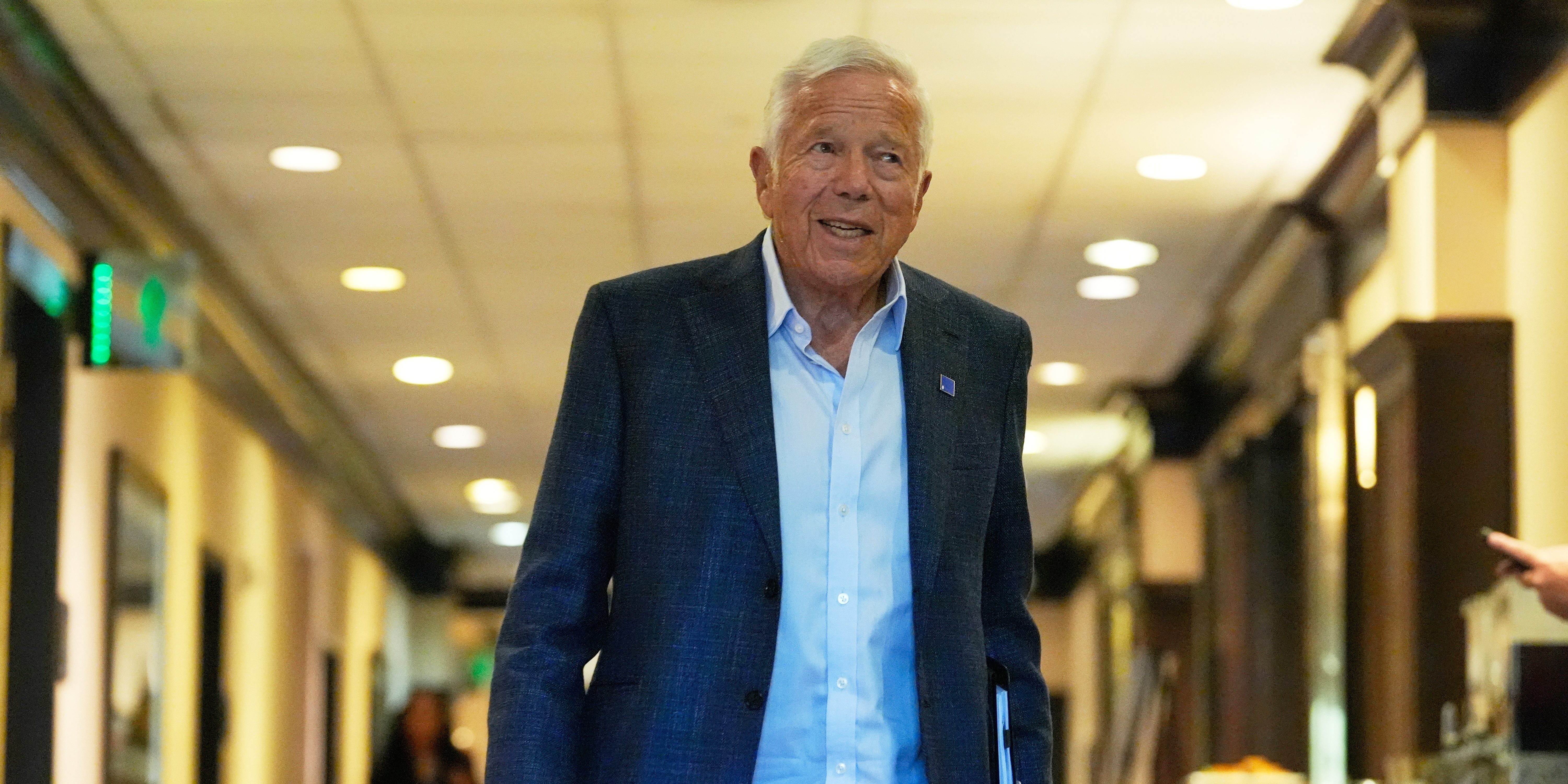
Billionaire New England Patriots owner Robert Kraft wants you to know he has spent “decades” supporting the Palestinian people.
Days after pressuring pop singer Ed Sheeran to drop rapper Macklemore from his tour over the latter’s “Free Palestine” remarks, Kraft claimed in a statement posted to social media that “for decades” he has “supported efforts that create opportunity for Palestinians,” such as initiatives to “to build businesses, create jobs, and forge relationships” between Israelis and Palestinians. The claims were made as a part of Kraft’s pledge to give $2 million to “aid in the region.”
Kraft did not disclose which organizations would receive his money.
Nor did he mention his long history of donating to Friends of the Israel Defense Forces, an organization that collects money on behalf of Israeli soldiers, and the United Democracy Project, the super PAC of the American Israel Public Affairs Committee, which lobbies to tilt American politics in favor of Israel. Kraft has also given money to a host of pro-Israel advocacy groups that attack critics of Israel, spread content that critics warn is Islamophobic, and have steadfastly defended Israel against mounting evidence of its ongoing genocide of Palestinians in Gaza.
The Intercept’s analysis of tax forms since 2006 show that Kraft’s charity group, the Kraft Family Foundation, has donated $196,000 to the Friends of the IDF and an additional $123,000 to other organizations — Brothers for Life and Friends of Israel Disabled Veterans — that directly benefit Israeli military soldiers. In his seven separate donations to the Friends of the IDF, Kraft earmarked the money to “Promote education for young Jewish soldiers.”
Since 2020, Friends of the IDF has poured more than $20 million into its lone soldier program, which supports young Jewish Americans, and Israelis who have no familial support, to serve in the Israeli military’s reserve soldier program, according to an investigation by The Intercept. The program has continued throughout Israel’s genocide in Gaza.
Kraft has organized trips to Israel for former and current NFL players, including a 2017 trip in which he led a delegation of former players on a visit to an Israeli Air Force base, organized by the Friends of the IDF.
In 2019, Kraft gave $20 million to found a new organization, the Foundation to Combat Antisemitism, now known as the Blue Square Alliance Against Hate. Upon its founding, Kraft pledged the organization would oppose the Palestinian-led Boycott, Divestment and Sanctions movement, claiming the Palestinian rights movement “and other efforts to delegitimize and undermine the State of Israel are the most disconcerting times for the country I love so much.” Israeli Prime Minister Benjamin Netanyahu reciprocated the love when Kraft announced the new group while accepting an award for his Israel advocacy, declaring, “Israel does not have a more loyal friend than Robert Kraft.”
Over the years, Kraft’s foundation has also given $63,500 to the right-wing media watchdog group Committee for Accuracy in Middle East Reporting and Analysis, or CAMERA, which has run pressure campaigns against news outlets, journalists, students, and scholars it deems anti-Israel and has routinely denied Israel’s genocide in Gaza, dismissing such evidence as “the Gaza GenoLie.” When Kraft gave $36,000 to CAMERA in 2018, the donation included a memo, “fighting antisemitism.”
In 2011 and 2012, Kraft’s foundation donated $50,000 to boost the Investigative Project on Terrorism, which the Council on American-Islamic Relations considers a core part of what it refers to as the “U.S. Islamophobia Network.” As Kraft gave to the think tank, it launched campaigns targeting U.S.-based groups decrying Israel’s human rights violations against Palestinians, such as attacking human rights groups Students for Justice in Palestine and American Muslims for Palestine as having ties to “extremist groups” and claiming they were a part of a “web of Hamas support.” The group has more recently dismissed protests against Israel’s genocide as Hamas propaganda.
In addition, Kraft’s foundation donated $150,000 from 2008 to 2018 to the pro-Israel organization, Middle East Media Research Institute, co-founded by a former Israeli intelligence officer and counterrorism adviser to several Israeli presidents. The group’s website says it exists to “bridge the language gap between the West and the Middle East and South Asia” by translating Arab language media into English. However, journalists and experts have noted selective translations of Arab articles and statements to misrepresent policies of Arab governments as extremist or violent.
Aside from his donations to nonprofit groups, Kraft has been an active donor to AIPAC’s super PAC, the United Democracy Project. Through his limited liability company, the Kraft Group, Kraft has given $3 million to the super PAC since its founding in 2022, including $1 million in donations this midterm cycle. During this midterm election cycle, AIPAC has flooded races to oppose candidates who criticize Israel’s genocide in Gaza and U.S. military support for Israel, helping make several primaries among the most expensive on record.
It’s not clear whether these entities were the ones Kraft claims have created jobs and spurred dialogues between Palestinians and Israelis. Kraft, however, is also a regular donor to local Jewish groups in Massachusetts, such as Combined Jewish Philanthropies of Greater Boston; Temple Emanuel in Newton; and Jewish Family & Children’s Services in Waltham.
Kraft and the groups mentioned in this story did not respond to The Intercept’s request for comment.
The debate over Flock cameras in Knoxville, Tennessee, had reached a fever pitch this July when a stay-at-home mom received a text message from a nonprofit group she had never heard of.
The group, Neighbors for Strong Communities, asked Ashley Smith to speak out in support of Flock’s controversial license-plate readers. The nonprofit even offered to use artificial intelligence to help her draft an email to public officials.
There was only one catch: Smith, a mother of four, said she noticed that she would only be supplied with text if she indicated she supported the Flock cameras.
Instead of offering support, Smith dashed off her own email — an outraged missive to her elected officials and a local blog outlining what she saw as an insidious PR campaign.
“If the interests beyond this surveillance technology will work this hard to deceive you to win a vote, what will they do with the database of our every movement?” she said. “A company that manipulates and manufactures fake neighbors is not a company that will honor our data policies, audit logs, or the privacy of the people of Knox County.”
“A company that manipulates and manufactures fake neighbors is not a company that will honor our data policies.”
The text message to Smith revealed little about the Flock campaign’s origins.
As it turns out, the campaign was the product of a “partnership” between Flock and a newly created nonprofit that has used similar tactics in support of the controversial proposed merger between Paramount Skydance and Warner Bros. Discovery. Opponents of the merger derided the nonprofit’s work there as corporate “astroturf” — the practice of drumming up fake grassroots support.
The combination of texts and AI-generated messages fell short of swaying public officials in Knoxville. Last month, the county commission became the latest municipal body to vote to cancel the Flock contract.
In both the Paramount and Flock cases, however, Neighbors for Strong Communities’s work has raised questions about what counts as truly grassroots organizing.
“One of the concerns of the people with the Flock cameras is: Can we trust you?” Smith told The Intercept. “And this sort of manipulation of people’s desires already shows that they are secretive, and they are not willing to share the honest information.”
Flock and Neighbors for Strong Communities did not respond to requests for comment. On its website, the nonprofit said it had a lead role in the pro-Flock campaign. “Flock Safety brought experience with public safety technology. Neighbors independently designed and managed the resident-engagement campaign, helping Knox County residents share their experiences directly with local decision-makers,” the organization said.
“I mean, there are no neighbors and there are no communities.”
There are, however, no signs of a genuine upswell in grassroots support for Flock, said Craig Aaron, the co-CEO of Free Press, a nonprofit advocacy organization that is critical of both the Paramount merger and Flock.
“This is very much an astroturf project. I mean, there are no neighbors and there are no communities,” he said. “What makes it astroturf is the fake grassroots nature of it.”
“You’re talking about literally one of the most unpopular technologies,” Aaron added, “that has people taking chainsaws to light poles because they don’t like being spied on.”
“This Is So Shady”
Neighbors for Strong Communities’s text messages can look like they come from nearby.
The text Smith received about Flock cameras came from a Knoxville area code. In California, residents received text messages about the Paramount merger from a Los Angeles area code.
In both cases, residents were presented with a series of questions whose answers would, in at least some cases, be used by Neighbors for Strong Communities to draft AI-generated emails to public officials.
Despite the area codes it sent texts from, Neighbors for Strong Communities was incorporated in Washington, D.C., in June.
Although the group does not list a board or staff members on its website’s “About” page, its incorporation papers show that its directors include several political consultants, including at least one former registered lobbyist.
At least two directors at Neighbors for Strong Communities also helped found Influent, a company that uses AI to generate letters to elected officials. Text messages to Knoxville residents linked to a URL with the word “influent” in the address. Whether Influent has a business relationship with Flock is unknown. (Influent did not respond to a request for comment.)
An image of a man with six fingers seen on a page from Neighbors for Strong Communities about its work helping Flock generate a show of public support.Screenshot: The Intercept
Smith said she was confused to receive the text message from Neighbors for Strong Communities, which she had never heard of despite her long involvement in local politics. In its message to her, the group seemed to play up a local connection.
“Knox County Neighbors for Strong Communities is asking local residents to speak up in support of responsible license plate readers with strong privacy protections before the vote on Monday,” the text message said. “Answer 2 quick questions and we’ll help you generate a personalized message urging local leaders to support this practical public safety tool.”
She filled out the form from Neighbors for Strong Communities twice, at first indicating her opposition to license-plate reader cameras, she said. Only on the second attempt, when she pretended that she supported the cameras, was she given the draft of an email to her county commissioners. The draft did not indicate the use of AI or its connection to the nonprofit group.
“Answer 2 quick questions and we’ll help you generate a personalized message urging local leaders to support this practical public safety tool.”
The experience disturbed Smith, who felt certain that she would have heard of a grassroots group in Knoxville given her years of organizing in local conservative politics.
“This is so shady,” Smith remembered telling herself. “If you’re in opposition, they don’t let you send that to your commissioners. But if you’re in support, they’re sending that to all of the commissioners.”
Smith started digging — and she used artificial intelligence to help. Her searches turned up Neighbors for Strong Communities’s incorporation paperwork in Washington, D.C.
Knox shared her findings with her county commissioner Andy Fox and a popular Facebook page for local politics. She noted that the address the nonprofit provided was shared with an Italian restaurant in D.C. (The group has since updated its address, which it shares with a UPS store in Santa Monica, California.) When the Facebook page shared her findings, at least nine residents posted comments saying they had received text messages, too.
“Clearly a PR Campaign”
Neighbors for Strong Communities’s intervention came at a perilous moment for Flock.
The company had already reaped more than $2 million from the Knox County Sheriff’s Office, but county commissioners said they had never been asked to approve a contract.
Residents on the right and left were raising concerns about privacy protections and the camera network’s history of being used by rogue law enforcement officers to stalk former romantic partners.
The nonprofit’s outreach effort appears to have generated a flurry of emails to commissioners arguing that the cameras were needed to prevent crime. Former at-large Commissioner Larsen Jay shared eight emails that he received from constituents supporting the use of license-plate readers.
None of those emails were identical, but their language was similar enough to raise red flags for Jay, whose service on the commission wrapped up at the end of August.
The emails Jay shared with The Intercept appear to come from genuine residents of the Knoxville area. Two residents confirmed to The Intercept that they had sent emails in support of Flock, although one said she had since switched her position.
While several emails contained personalized details, Jay said he considered the pro-Flock emails to be “form letters” nonetheless. In face-to-face conversations, Jay said, opposition to Flock ran 99-to-1.
“It’s just clearly a PR campaign,” Jay said. “Don’t use my people. That’s how it felt when I started to realize what it was.”
The group acknowledged that it used “technology” to help residents craft missives to county officials. It said, however, that all of those residents were asked to sign off on the AI-generated drafts.
“Technology played a role in this campaign, but it was never the point,” the group said on its website. “These are real people with real experiences. Whether someone ultimately agrees with every policy position or not, their voices deserve a place in the decisions shaping their community.”
It remains unclear how the group handled responses from residents who oppose the use of Flock’s cameras. The group said on its website that it “listened” to those responses but did not comment further when asked.
Flock’s partnership with Neighbors for Strong Communities largely flew under the radar until weeks later, when the nonprofit partnered with Paramount Skydance on its proposed merger. Critics of the merger noticed the group’s earlier work in Knoxville and began asking questions about why a nonprofit would work on such disparate campaigns.
Merger critics said the nonprofit’s work in California had all the hallmarks of a phony “astroturf” campaign, which is designed to generate the appearance of grassroots support.
The group drew more negative attention recently, when a merger critic discovered that its AI text generator flipped her criticism of the deal into support. The nonprofit’s spokesperson blamed “a recent system upgrade.”
In Knoxville, Neighbors for Strong Communities appears to have disclosed — at least after the fact — that it “partnered” with Flock on the pro-camera campaign. Still, the group has not disclosed the sources of its funding.
Thomas Lyon, a professor at the University of Michigan’s Ross School of Business who has studied corporate public relations, said that a campaign can still be classified as “astroturf” even if it generates letters or emails from ordinary citizens. In the pre-AI era, Lyon said, public relations firms running “astroturf” campaigns for corporations would sometimes call people and offer to draft them letters to public officials over the phone.
The company associated with two of Neighbors for Strong Communities’ directors, Influent, promises on its website that it has a different approach from other corporate influence campaigns.
“Generic astroturf form letters are destined for the trash bin,” the company says in promotion materials. “Every Influent letter, Tweet, phone call, and message is tailored to the individual — each one unique, reflecting the authentic voice of its sender.”
Neighbors for Strong Communities’s own website features similar language stressing the authenticity of supporters’ messages to public officials.
By that measure, at least, the nonprofit missed the mark, according to another county commissioner. Andy Fox — Ashley Smith’s representative on the commission — told The Intercept that he received dozens of “template” emails in support of Flock.
Protesters picket the New York Times to demand justice for Palestinian journalist Anas Al-Sharif and other journalists killed in Gaza by Israel, on Aug. 10, 2026, in New York City. Photo: Selcuk Acar/Anadolu via Getty Images
The New York Times recently published a sweeping accounting of President Donald Trump’s campaign against the American press: FBI agents arriving at reporters’ homes, subpoenas for journalists’ records, Pentagon access restrictions, regulatory pressure on television networks, numerous lawsuits against news organizations, and an increasingly politicized Federal Communications Commission.
“Almost 20 months into Mr. Trump’s second term, his long-running media clashes have grown into a sweeping campaign to control speech in America that stands out for applying so many levers, so fast, all at once,” Times reporters Maggie Haberman and Jim Rutenberg wrote. “Each time the president assails what has long been considered protected speech … he is eroding norms and undercutting the role of an independent press.”
All told, it is a damning inventory.
It is also difficult to read without noticing who occupies almost every frame: Us.
Reporters. Editors. Television hosts. Networks. Publishers. Their lawyers. And the access our industry has become so reliant upon.
The Times is right about the threat. Trump has indeed weaponized government agencies and private litigation against news organizations in ways that seriously threaten the First Amendment, although judges have repeatedly rebuked parts of the administration’s legal strategy. But Trump’s attacks on free speech have extended well beyond the journalism, from ICE protesters in Los Angeles to faculty in solidarity with Palestine on college campuses. But somewhere along the way, the American press began conflating two things: press freedom, with the conditions under which the press had become accustomed.
Those are not the same thing.
Free speech was never free.
It was wrested loose. Sharpened and stretched, stifled and reborn, often on the backs of those who put the pain and personal safety of others ahead of their own.
Somewhere along the way, the American press began conflating two things: press freedom, with the conditions under which the press had become accustomed.
In 1892, a little more than two decades after the nation wrenched itself back together from war, Ida B. Wells challenged the lies white Memphis terrorists used to justify lynching Black men in her newspaper, the Memphis Free Speech and Headlight. In retribution, a mob ransacked her office and destroyed the paper’s printing equipment. Wells happened to be away. Threatened with death if she returned, she continued her investigation from the North. There was no White House Correspondents’ Dinner, no presidential press core podium to be invited to, no shining press awards. As a Black woman, she couldn’t even vote; in her isolation, her best job security was to carry a pistol.
“It is with no pleasure I have dipped my hands in the corruption here exposed. Somebody must show that the Afro-American race is more sinned against than sinning, and it seems to have fallen upon me to do so,” she wrote in her book on the excruciating personal trade-off she made to pursue her work: perspective. Her fear, exhaustion, and isolation existed beside something larger: actual bodies, tangible violence, and lived injustice.
I will be candid: Melancholy abounds. I write this as a journalist who has grown depressed while slinking through the yearly industry conferences, newsrooms, and brown bag luncheons. There is a palpable dread to most discussions, with an acknowledgment that the world is less fair, less stable, and overwhelmingly more difficult.
We talk about everything. Except the necessity to win, and most importantly, for who.
Israeli airstrikes and other attacks are still killing and displacing Palestinians in Gaza, where the United Nations reported last month that medical shortages and restrictions on critical supplies continue to undermine an already devastated health system. In the West Bank, settler violence, backstopped by the Israeli military, is a daily and growing threat. Israel’s war on Gaza has now killed nearly 300 journalists — more news gatherers than in both world wars, Vietnam, Yugoslavia, and Afghanistan combined.
The Times in particular has done more than almost any other media outlet to launder the justification for this ongoing death and destruction, and to police the language we’re allowed to use when discussing it, which didn’t warrant any mention in its attacks-on-free-speech roundup.
In the U.S., ICE arrests reached nearly 51,000 in August alone as the Trump administration dramatically expanded immigration enforcement. Many of those being detained had no criminal record, while courts continue battling out the administration’s detention practices. A Department of Homeland Security watchdog reported on Monday that immigrants at Florida’s now-defunct “Alligator Alcatraz” prison were confined for more than an hour at a time in outdoor metal cages known as “calming areas” that were barely larger than a phone booth.
Government coercion and obfuscation is difficult; it doesn’t hold a candle to death, subjugation, and the powerlessness of victimization.
As Wells put it, I’ve had the displeasure of covering a national violence, I’ve also had the displeasure of living it.
There is nothing in my day job that can match the pain, or permanence, of a loved one ripped from your household, the lifelong inequity of being racially outcast, or the haunting mental anguish those events leave behind as an inheritance.
As a result, there is a vibrating dis-ease — something close to nausea — in listening to tales of journalists ground under the boot of power, only to hear complaints of our own injury grow so loud that it begins to obscure the suffering beyond us. Maybe that is part of the point of these attacks in the first place: Hurt us until our wounds become the horizon. Hurt us into forgetting those hurt more.
We need to fight even harder for truth, not because journalists are the principal victims of its erosion, but because the people paying a far higher price outside the newsroom’s walls are the reason we do this work at all.
We need to fight even harder for truth, not because journalists are the principal victims of its erosion, but because the people paying a far higher price outside the newsroom’s walls are the reason we do this work at all.
That discrepancy may also help explain why Americans increasingly roll their eyes when journalists describe threats to journalism as threats to democracy.
In 2025, Gallup found that only 28 percent of Americans trusted newspapers, television, and radio to report the news fully, accurately, and fairly — the lowest level ever measured. When Gallup began asking the question in the 1970s, the figure ranged between 68 and 72 percent.
There are many reasons for that collapse, from deepening partisanship and a fragmented information ecosystem to the hollowing out of local news.
But I understand some of the suspicion.
I understand why nobody wants to invest in a product from an industry that refuses to admit it wants to win.
And by “win,” I mean something journalists have become strangely embarrassed to admit it we want: to make it harder to abuse human beings without anybody knowing.
There is nothing neutral about that mission.
And there never was.
Perhaps the mistake comes from imagining freedom, and by proxy freedom of press, as a possession rather than a practice.
Perhaps the mistake comes from imagining freedom, and by proxy freedom of press, as a possession rather than a practice — a right handed down and intact, rather than a capacity that must be worked, tested, and fought for when the cost of exercising it rises.
In his 1951 book “The True Believer: Thoughts on the Nature of Mass Movements,” writer Eric Hoffer captured the appeal of fascism in five unsettling words, uttered by an ardent young Nazi: “to be free from freedom.” He used the quote to examine an uncomfortable possibility — that freedom may not be innate to the human mind, but something closer to muscle — strengthened under strain, grown through resistance, and, if left unused, atrophied.
Press freedom lives under the same rule. Its value is not measured by how easily journalists can exercise it, but by what survives when power becomes hostile.
Our charge is to comfort the afflicted and afflict the comfortable. Journalists’ own comfort was never part of the equation.
Any such undertaking would always have been fraught with potential traps. For the city’s first democratic socialist mayor, changes to criminal policy would have made Mamdani a prime target for conservative backlash. It’s a well-worn playbook: He would be blamed for any level of crime in the city. The mayor and his allies, even among them advocates hoping he’d go further to curb police abuse, understood the threat well.
Still, Mamdani had little trouble during his bombshell campaign convincing leftists that his sweeping vision for a socialist-governed metropolis included criminal policy reforms that would satiate them.
He promised to eliminate some of the most notorious of the New York Police Department’s institutions — a widely criticized gang database and infamous Strategic Response Group, which responds to protests and whose officers have histories of higher complaint rates. Mamdani outlined an ambitious vision to divert police away from responding to mental health crises, proposing an Office of Community Safety.
New data on how much the New York City is spending to pay for police misconduct, however, has heightened concerns among advocates that paltry rate of changes to policing under Mamdani could lead to even higher payouts in coming years. The first six months of the Mamdani administration saw $53 million in police misconduct settlements, according to an analysis of NYPD data by the public defense group Legal Aid Society.
If the figures continue to grow at that rate under Mamdani, it will make 2026 the fourth year in a row that police misconduct settlements top $100 million.
“We’re going to see these numbers continue to balloon absent a new course from the administration.”
The payouts under Mamdani so far cover conduct that took place under his predecessor Eric Adams’s administration, but criminal policy experts worry that, without major changes to policing, the new mayor will put the city on the hook for similar payouts in the future. That’s especially true if he maintains an approach to policing that they say is not all that different from the policies he campaigned against.
“What is concerning is that if we don’t see the kind of shift in tactics away from the kind of NYPD activity that has been driving these misconduct complaints and settlements, we’re going to see these numbers continue to balloon absent a new course from the administration,” said Michael Sisitzky, assistant policy director at the New York Civil Liberties Union.
More Broken Windows
The settlements represent the kinds of abuses of aggressive enforcement of “quality of life” policing and the deployment of specialized units like the Strategic Response Group that characterized the Adams administration, Sisitzky added.
“Those have yet to really be reined in under the Mamdani administration,” he said. “So, while he can’t be held directly responsible for all of the numbers reflected in this first tranche of data in terms of settlements payouts, we’re going to continue to see large volumes of complaints being filed, of settlements being reached, unless we see a change in tactics and a shift away from the kind of policing policies that drove these settlements in the first place.”
Even as Mamdani made campaign promises on policing, he went out of his way not to bash the NYPD or offer too much specificity about addressing the department’s biggest issues. During the election, that didn’t worry too many of his supporters. There was too much at stake for purity tests. Let him win first, many criminal justice advocates thought — and then they’d see what he could do.
The steps Mamdani has taken on criminal policy seem tailored to avoiding political pitfalls.
While, as mayor, Mamdani takes his biggest swings at the city’s billionaire class, the steps he has taken on criminal policy seem tailored to avoiding political pitfalls.
Along the way, he has notched small victories. He made progress on police body cameras and cutting down on low-level cycling offenses. Pushing to close the jails on Rikers Island, he has opened alternatives to jails and shut down a vacant one. Though he ended his pause on sweeps of encampments for the unhoused, he ordered that they be led by homeless service workers. And he installed the first permanent chair of the NYPD’s oversight body in six years.
Nine months into Mamdani’s first year in office, however, the NYPD itself has changed little.
Mamdani’s office declined to comment but provided background information on what it said were his criminal policy accomplishments, including a budget increase for a police oversight board.
“Deference to Tisch”
One of the things reform advocates were mostly able to set aside during Mamdani’s campaign was his pledge to keep on Adams’s police commissioner, Jessica Tisch.
The daughter of a prominent New York family of billionaires, Tisch was first appointed by Adams. With crime rates falling and her tenure at the NYPD winning plaudits from the likes of Donald Trump to the American Enterprise Institute, Mamdani pledged during his campaign to keep her on.
Widely viewed as a political play, the move alarmed many reformers, who voiced criticisms but held out hope that Mamdani’s proposals would at least start a long project of changing policing from the bottom up, despite Tisch’s perch at the top.
“There’s been a lot of backtracking on promises without any kind of affirmative vision for what policing could look like.”
With Tisch helming Mamdani’s NYPD, however, reformers’ fears have been borne out. The department has continued to pursue what Tisch describes as “quality of life” crimes — just the kinds of crime Mamdani campaigned on diverting police away from — and what reform advocates like Sisitzky say is a continuation of the failed “broken windows” policing fads of 1980s and ’90s. The strategy’s inherent focus on the most visible issues like panhandling, public urination, and sleeping on the subway effectively criminalizes poverty while letting violent crime and its root causes go largely untouched.
“The main critique is: There’s been a lot of backtracking on promises without any kind of affirmative vision for what policing could look like in his administration,” said Amanda Jack, director of policy for criminal law reform at the Legal Aid Society. “It has all been deference to Tisch.”
The NYPD’s focus on those “quality of life” offenses also looks little different from its approach under Adams. Data from the NYPD’s first quarter under Mamdani “was a continuation of broken windows policing, and, in some cases, an expansion,” Sisitzky said.
During his four years in office, Adams oversaw a surge in enforcement of low-level offenses. Mamdani’s first quarter in office saw more criminal summonses in that category than the first quarter of 2025 under Adams, temporarily driven by increased enforcement against people being in a park unauthorized or biking on the sidewalk. Toward the end of Mamdani’s first quarter, he announced that the NYPD would stop issuing criminal summonses for minor traffic offenses for cyclists.
Arrests for other offenses like subway fare evasion are on a similar track: During the first quarter of the year, Mamdani’s NYPD arrested 3,188 people for not paying the subway fare, down from 3,696 such arrests during the same period of Adams’s last year in office. Many of the subway arrests, Sisitzky said, focused on people without housing.
“This is an administration that promised, at least during the campaign, that they were going to be taking a fairer, more equitable, more justice-oriented approach to policing,” Sisitzky said. “And we haven’t seen that translate into a meaningful shift away from the ‘broken windows’ approach that has long subjected New Yorkers to racially biased policing.”
Deportation Pipeline
While making New York a sanctuary for immigrants is a centerpiece of Mamdani’s agenda, continuing the kinds of enforcement practices that disproportionately bring immigrants into contact with police make them more vulnerable to Trump’s mass deportation machine, said Yasmine Farhang, executive director of the Immigrant Defense Project.
“Increased NYPD policing necessarily increases the risk of ICE policing for non-citizens,” Farhang told The Intercept. When an immigrant has an encounter with a police officer for any reason, “their risk of getting later funneled into detentions, deportations, increases regardless of the outcome.”
Even if no one is charged with a crime, if they are fingerprinted by police, those fingerprints are sent through a state criminal system shared with the FBI, which is shared with U.S. Immigration and Customs Enforcement. “That pipeline of fingerprint sharing from the point of NYPD to ICE happens right now just by default.”
Mamdani supports policies that protect immigrants, and his former colleagues in Albany are pushing state-level sanctuary laws, but those efforts mean little if they aren’t paired with changes that reduce encounters with police.
“The risk is increased,” Farhang said, “of ICE identifying and targeting someone, whether or not a local agency is actively colluding with them or not.”
Gangs and Goons
Among the biggest disappointments for criminal justice advocates who support Mamdani are his abandonment of promises to deal with some of the city’s most heavy-handed policing.
During the campaign, Mamdani said he would get rid of the NYPD gang database and its Strategic Response Group, as well as standing against the sweeps of homeless encampments. Instead of following through, Mamdani implemented gang database reforms, left the Strategic Response Group in place, and walked back his pledge to end the encampment sweeps.
When asked Monday about his administration footing the bill for a new lawsuit over the Strategic Response Group’s conduct, Mamdani said the allegations were “incredibly troubling.” He restated his commitment to “decoupling” the response to terrorism, which is in SRG’s remit, from the response to the First Amendment-protected protesting.
Without substantive shifts on how police operate, criminal justice advocates said, the city will continue to pay out big settlements.
“There’s just a cycle of impunity that is ever-present in the NYPD,” said Divad Durant, a member of the Justice Committee, an organization that fights police violence in New York City. “And the lack of discipline is what keeps this cycle going.”
Political Miscalculation?
Critics of Mamdani’s approach to policing aren’t necessarily trying to position themselves against him, said Jeremy Saunders, co-executive director of VOCAL-NY, which works on issues like mass incarceration and homelessness. They just want him to do what he campaigned on.
“We have heard from numerous people inside of City Hall an acknowledgment that, ‘Yes, we understand this frustration,’” he said. “And that’s really all they can explain.”
Saunders said it was possible that Mamdani calculated that Tisch’s relationship to the Trump administration would help create a “buffer” from the president’s wrath.
“Also,” Saunders added, “there’s this very real concern about crime going up or any backlash that could happen to the mayor around seeming like he’s allowing crime.”
The response from advocates at groups like VOCAL-NY, Saunders said, is that the very political trap he’s trying to avoid is set up by the mistakes that Mamdani is repeating: criminalizing poverty and homelessness.
“There is nothing he can do that will stop the New York Post and high-ranking people inside the NYPD from undermining the mayor’s agenda.”
“The mayor has to accept — and he knows — that the NYPD has the New York Post on speed dial,” Saunders said. “There is nothing he can do that will stop the New York Post and high-ranking people inside the NYPD from undermining the mayor’s agenda.”
Saunders pointed to Mamdani’s decision to stand behind a rent freeze despite pushback from the landlord class.
“We would urge the mayor and his inner circle to take that same approach,” he said. “Listen, for us to actually solve a problem, we have to invest in and politically support real solutions to ending these problems, even if that will lead to some blowback.”
“The best thing for him to do,” Saunders said, “is exactly what he campaigned on: Show New Yorkers, ‘I’m going to make this city work. I’m going to make it livable for all of us, and I’m going to prove it. I’m going to show you.’”
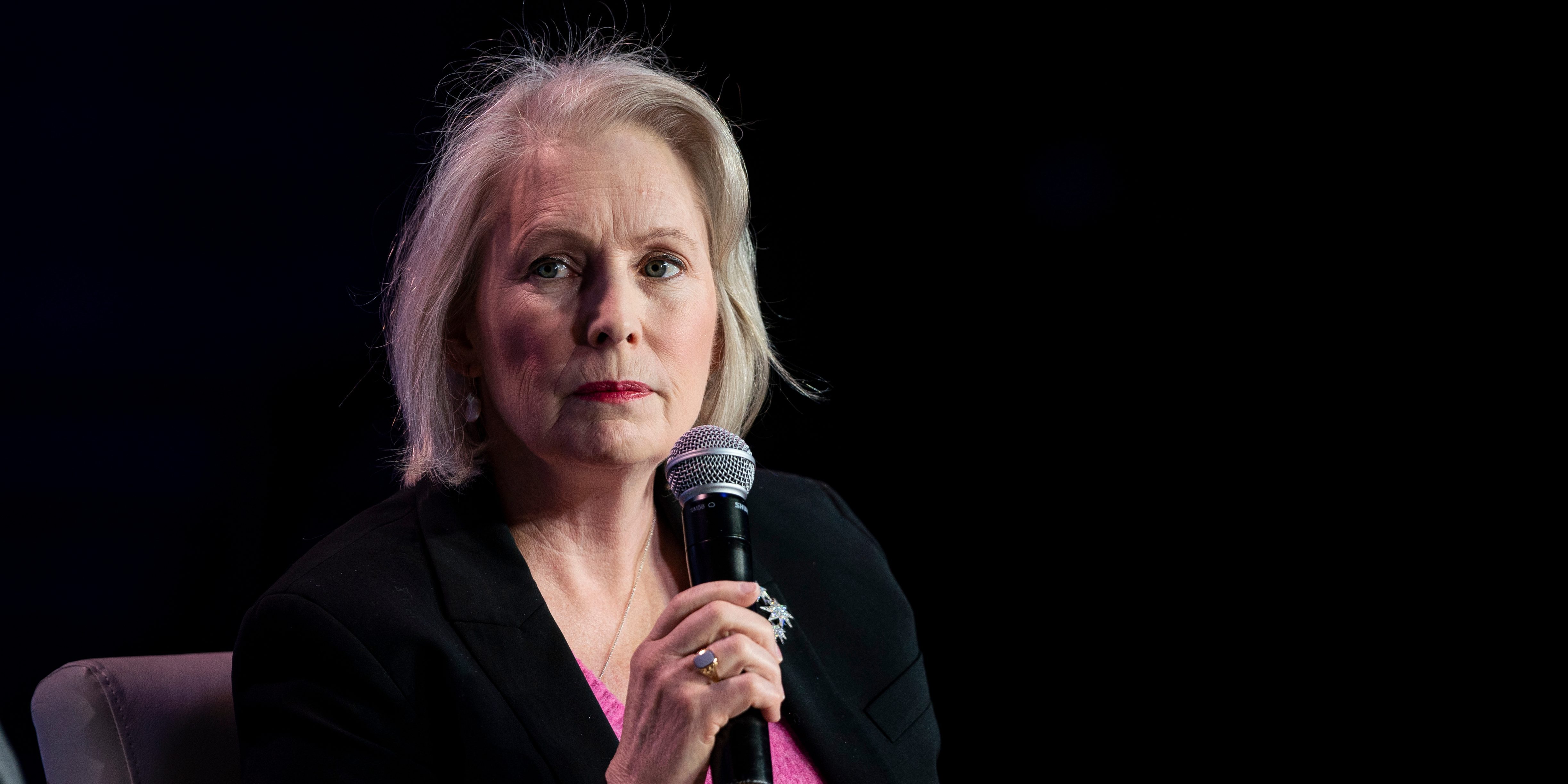
Hours before joining progressives to block a crypto bill that critics said was a handout to President Donald Trump, a top Senate Democrat was lobbying her colleagues to pass the legislation.
Sen. Kirsten Gillibrand, D-N.Y., a centrist who leads the Democratic Senatorial Campaign Committee, privately urged fellow Democrats to support advancing a crypto bill that would have created a regulatory framework for the industry, according to reporting in Politico.
Her pleas fell on deaf ears, however, as progressives including Sen. Elizabeth Warren, D-Mass., mounted a public campaign against the bill. The critics said the bill would allow President Donald Trump to add to the $1.4 billion in crypto profits he pocketed last year.
When it came time for the final vote, Gillibrand joined all Democrats in voting against a motion to advance the bill. Four Republicans also voted against the motion, which fell far short of the 60 votes needed to proceed to a full debate. The final tally was 49–50.
Gillibrand’s flip-flop reflected the bind that Trump has placed on moderate Democrats during his second term. Many of those centrists previously backed crypto-friendly regulations, but the historic scale of Trump’s profits on his meme coin and other crypto ventures has made them reluctant to publicly side with the industry.
“We deserve to know why she tried to get her colleagues to rubber-stamp this corrupt crypto deal.”
Gillibrand’s office did not immediately respond to a request for comment. In a statement, the progressive group Demand Progress criticized her for previously trying to rally support for the bill.
“While Sen. Gillibrand switched her support for the bill at the last minute, we deserve to know why she tried to get her colleagues to rubber-stamp this corrupt crypto deal, particularly at a time when she is claiming to oppose Trump’s corruption,” said the group’s corporate power policy adviser, Ella Fanger.
Gillibrand has long been one of the crypto industry’s most outspoken supporters in the Senate. Before the vote, an aide argued in a written statement that it would be best to proceed to debate on the Clarity Act, stating, “Senator Gillibrand would relish the chance to debate real ethics reforms on the floor — in full view of the public, seven weeks out from the midterms.”
Trump and Senate Republicans tried to win over the dozen or so Senate Democrats who have proven friendly to the crypto industry in the past with concessions they said would rein in the president’s crypto ventures.
In remarks on the Senate floor, one of the bill’s sponsors, Sen. Cynthia Lummis, R-Wy., highlighted Gillibrand’s role in negotiations over the text as evidence of its bipartisan backing. Lummis also argued that the White House had conceded virtually everything that Democrats had asked for when it came to ethics provisions over the course of months of negotiations.
“President Trump gave more than anyone in this town expected, twice. It is time for this body to take yes for an answer,” she said. “Take the win.”
Warren and others warned that the supposed concessions were shot through with loopholes.
“We need crypto regulation, but voting to proceed to this bill is a vote to bless Donald Trump’s corruption,” Warren said hours before the vote.
“We need crypto regulation, but voting to proceed to this bill is a vote to bless Donald Trump’s corruption.”
One key provision that Democrats had sought would allow state attorneys general to initiate enforcement actions against the president for ethics violations. However, staffers for Warren on the Senate Banking Committee said that the provision included in the latest version of the bill text was essentially a dead letter, because political officials directed by Trump could issue a legal opinion shutting down the enforcement action.
Another provision of the bill allowing Trump to put his crypto assets in a supposedly “blind” trust would not prevent him from favoring the industry to increase his own profits, minority staffers for the Senate Banking Committee said.
Trump’s self-dealing was not the only issue hanging over the legislation. The banking industry also flexed its political muscles on the Hill by arguing that the bill would enable crypto start-ups to steal deposits from small local lenders.
Tuesday’s vote could create a liability for Democrats heading into the midterms. Crypto industry super PACs have a massive war chest that they could use to target vulnerable Democrats — a tactic they deployed during the 2024 election.
Voters want to know that candidates are willing to defy well-funded industries, Warren argued, pointing to the growing number of candidates who bucked crypto during the primary season and won nonetheless.
“The crypto industry doesn’t want to just lobby Congress, they want to buy the Congress that will be favorable to them,” she said. “It is our job when we run for elected office to stand up and do what’s right.”
As Columbia University ramped up its crackdown on pro-Palestine protesters over the past three years, the Ivy League institution was paying hundreds of thousands of dollars to pro-Israel groups, according to a review of tax filings. Recipients of the cash included the American Israel Public Affairs Committee’s charity arm, the Israel on Campus Coalition, and others.
Though the university gave in smaller amounts to pro-Israel groups before the October 7, 2023, attack by Hamas and other Palestinian militant groups, the spending ramped up in that fiscal year as the genocide in Gaza unfolded and Columbia led the way in a national campus protest movement against it.
“Pro-Israel and anti-Palestinian politics are the official policy of this institution.”
In contrast to its pro-Israel giving, according to an analysis of documents which track some of the money given by tax-exempt nonprofits, the school gave little or no such funds to pro-Palestine, Arab, or Muslim groups over the same period.
“It confirms our worst suspicions since fall of 2023 that pro-Israel and anti-Palestinian politics are the official policy of this institution,” Joseph Howley, an associate professor of classics at Columbia and a Jewish member of the university’s faculty, told The Intercept. “You could have surmised that from the institution’s actions and speech, but it appears to also be revealed in its resource allocation.”
A Columbia spokesperson said the grants went through a university-administered donor-advised fund, an arrangement where a nonprofit organization pools tax-deductible donations and lets the donors request to make specific distributions to other charities.
“These grants did not come from Columbia’s operating funds and were payments distributed from a donor-advised fund established at Columbia in accordance with IRS rules,” the Columbia spokesperson said.
“It’s just so opaque,” Mark De Fusco, an expert on financial transactions in higher educational institutions and former researcher at the Pullias Center for Higher Education, told The Intercept. “So, you can essentially make donations and not be identified.”
“Deeply Invested in the Genocide”
In the fiscal year ending in June 2024, Columbia paid $100,000 to the Israel on Campus Coalition and another $75,000 to AIPAC affiliate American Israel Education Foundation.
In the same period, the Columbia administration summarily suspended the pro-Palestine student groups Jewish Voice for Peace and Students for Justice in Palestine, quashed the encampments in solidarity with Gaza, and called on the New York City Police Department to arrest pro-Palestine protesters on campus on two separate occasions.
The protesters had been demanding that Columbia disclose its financial ties to Israel and pro-Israel organizations and divest from them.
“The whole reason why we were protesting in the first place is because we knew that they were deeply invested in the genocide in Gaza,” said Maryam Alwan, a Palestinian American activist who participated in the campus protests in solidarity with Gaza before graduating from Columbia in 2025. “These findings confirm what we’ve been saying all along.”
While grants to American universities and medical research centers dominate past tax filings by Columbia, the pro-Israel organizations stand out as a rare few that prioritize relations with a specific foreign country. In 2024, over 170 of the 440 payments in this category were toward higher education and over 120 went to healthcare initiatives.
The payments by Columbia to the pro-Israel organizations were listed by the university as being for “program services,” though the term is not publicly defined by the university.
The Pro-Israel Beneficiaries
In fiscal year ending in June 2025, Columbia paid $7,200 to the Anti-Defamation League for “program services.” In the same period, the ADL welcomed the arrest of a lead Columbia protest negotiator Mahmoud Khalil by federal immigration officials. (None of the pro-Israel organizations that received Columbia cash responded to requests for comment.)
Details about any services offered by the ADL to Columbia in that period were not mentioned or publicized by the university. In July 2025, Columbia announced it was partnering with the ADL to conduct “programming and training” on antisemitism. A month before the announcement of the partnership, ADL chief Jonathan Greenblatt compared pro-Palestinian student protesters to Islamist terrorists.
“Columbia should be investing in its students, not bankrolling organizations that intimidate them,” Khalil told The Intercept. “This is what happens when a university is controlled by ideologues on its Board of Trustees whose commitment to Israel appears to matter more than their fiduciary duty, academic freedom, or the students they are supposed to serve.”
The pro-Israel organizations that received payments from Columbia stand out from the rest of the university’s beneficiaries in its filings. While a small number of ethnic community organizations such as the Dominican Women’s Development Center and the Caribbean Women’s Health Association are listed as having received funding from the school in its disclosures, these groups largely operate in the diaspora and are not advocating for U.S. relations with a foreign nation.
The choice to fund organizations that specifically advocate for Israel struck several students, alumni, and faculty members with whom The Intercept discussed the findings as odd.
“At this point, Columbia cares about one thing and one thing only, which is the money of its donors and the ideological interests that those donors espouse,” said Aharon Dardik, an Israeli student who graduated from Columbia earlier this year and who had previously been court-martialed for refusing to serve in the Israeli military.
One of the beneficiary organizations receiving money from Columbia, the American Israel Education Foundation, describes itself on its website as “the charitable organization affiliated with AIPAC, America’s pro-Israel lobby.” The group is best known for funding trips for members of Congress to visit Israel. Over the past decade, Columbia has paid AIPAC’s charity arm $250,000, with a $75,000 payment in the fiscal year ending in June 2023 and a $100,000 payment in the one ending in June 2017.
Another beneficiary organization, the Israel on Campus Coalition, says its role is to put pro-Israel campus activism under one umbrella and work toward a future “where the anti-Israel movement is marginalized.” The group offered a fellowship at Columbia; the school’s website lists one student as having received the fellowship from 2022 to 2024.
“There’s no institutional neutrality.”
Columbia also paid $450,000 to the United Jewish Appeal Federation of New York in the fiscal year ending in June 2024. UJA says on its website that, since October 7, 2023, the organization spent hundreds of millions of dollars in Israel, including tens of millions to support Israeli soldiers and their families.
A review of these financial contributions, adding up to hundreds of thousands of dollars in the past three years, have brought Columbia’s process for donating to beneficiary organizations into sharp focus.
“People talking about institutional neutrality; there’s no institutional neutrality,” said a Columbia student who did not wish to be identified due to concerns over retaliation. “Columbia has always been very pro-Israel, and this just goes to show that that’s where their real commitments are.”
Zack Polanski will win the Holborn and St Pancras by-election, the Green Party’s deputy leader Rachel Millward has claimed. She made the comments in an interview with Left Foot Forward at this year’s TUC Congress in Brighton.
When asked what she thought was going to happen in the by-election, Millward was clear – she said Polanski was “going to be the sixth Green MP”.
Pressed on whether she was certain of this, Millward went on to tell Left Foot Forward: “We’ve got a fantastic ground campaign. I was there on Saturday – hundreds of people coming, massive energy on the ground.”
She would go on to concede that “there are a lot of people who aren’t decided”, but added: “what’s really clear is that when people understand that they can give Burnham a chance and also get a sixth Green MP. And actually the impact of that is that they then might get the Burnham they actually want. When that lands, people understand it. They really do.”
While some in the media have been getting over-excited about what might happen if Polanski doesn’t win the by-election, Millward downplayed this. She told LFF: “We would absolutely just continue to do the work that we’re doing”, adding: “There is no way that the the the message and the demands of the Green Party are going to seem irrelevant over the rest of this Labour term.”
Millward was at TUC Congress to speak at a fringe meeting hosted by the Green Party. The meeting was organised to explain the Green Party Workers’ Charter.
The Charter was launched in May 2026 and sets out the Green Party’s policy commitments on workers’ rights, pay, pay and trade unions. Among them are a £15 an hour minimum wage, a pay ratio no greater than 10:1 in all organisations, ‘fairer parental leave’, and the scrapping of all anti-union laws introduced since 1979.
Speaking to LFF about the Charter, Millward said that what she wanted to “really emphasise today is that all of this has been in our policy since the 1990s” and that to “make sure that everyone does realise that we were the PEOPLE Party before we were the Ecology Party”. She added that “care for workers’ rights” is “literally in our roots, the DNA of the party”.
Alongside Millward, BFAWU general secretary Sarah Wooley and Meg de Meo from Unite also addressed the fringe meeting.
Chris Jarvis is head of strategy and development at Left Foot Forward
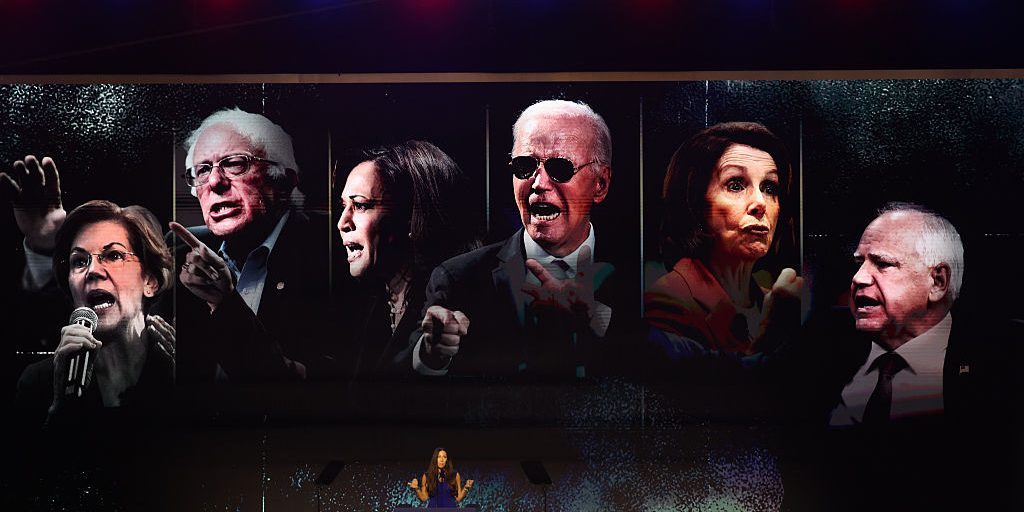
Images of Sen. Elizabeth Warren, Sen. Bernie Sanders, former Vice President Kamala Harris, former President Joe Biden, Rep. Nancy Pelosi, and Minnesota Gov. Tim Walz are displayed during the first day of the Republican Midterm Convention at the American Airlines Center in Dallas on Sept. 9, 2026.Photo: Mark Felix/Bloomberg via Getty Images
In case anyone was starting to feel that American democracy is just a little too secure, distaste for the common man is now finding purchase beyond the political right, with centrist liberals test-running their own brand of distaste for mass participation.
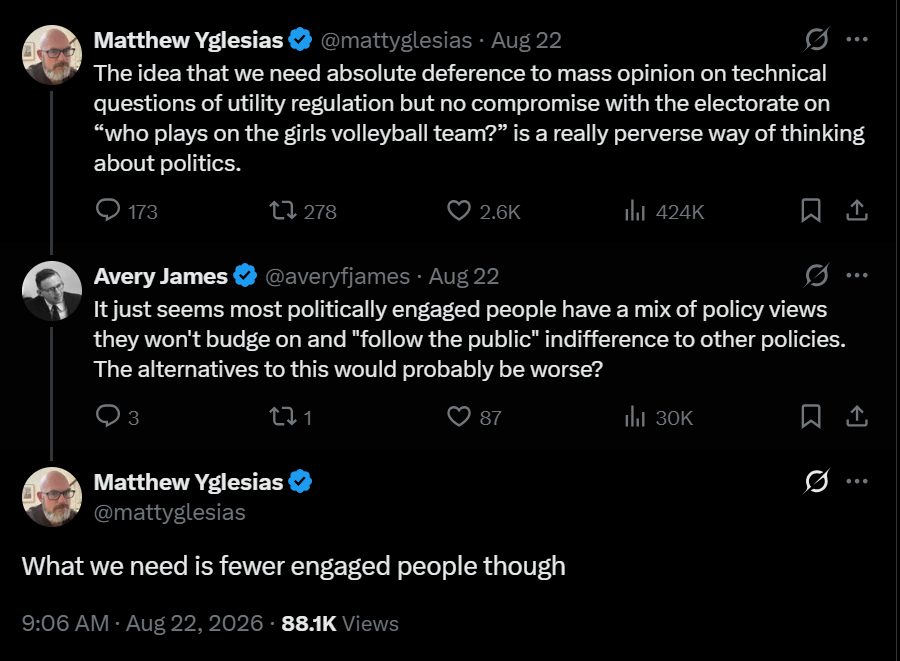
Over the past two years, centrist liberal writers have been emboldened to expressly call for less public participation in government and politics, sometimes just coming right out and saying, “What we need is fewer engaged people,” as prolific pedant Matthew Yglesias recently said over on the reanimated corpse of Twitter.
Nowhere is this more apparent than in the rampant hostility to small-dollar donors. In external communications, we’ve heard notions like Democrats needing to “move away from the dominance of small-dollar donors.” In writing not meant for a wide audience, the honest assessment from the Abundance Network is more extreme: Widespread grassroots fundraising “makes politics dumber.” The reasoning is that such donors tend to be more liberal than traditional big-dollar supporters and, as a result, push Democrats away from the preferences of the median voter. But in reality, the moderation bought by high-dollar contributions only serves to further cater to the interests of the wealthy.
Centrists have taken to characterizing the dueling ascendance of left-economic populism and right-chauvinistic “populism” as a pincer movement against the righteous “vital center.” In recent years, centrist publications have been replete with examples, urgently calling to safeguard liberalism, often from the masses.
The irony is that a leading contender for the ur-problem of liberalism’s failures is the purposeful destruction — by centrist liberals — of the organizing capacity that powered the postwar liberal order: organized labor, civil rights organizations, and robust state-level party infrastructure.
Years ago, as Donald Trump was first running for the presidency, political commentator Andrew Sullivan worried in a lengthy manifesto that too much populism would serve to “repeal” democracy. His conflating “liberalism” with a liberal technocratic elite class is a hallmark of the centrist canon.
This thinking has morphed into what could be called “Grownup Liberalism,” the belief that there is a class of wonky centrist experts who could fix so many things if the confused masses would just get out of their way — a notion that’s inherently undemocratic and increasingly discordant with the actual state of American politics.
As the center tries to cling to the tatters of institutional deference and justify why, even after building the hellscape we inhabit, they alone can steward our future, the right is waging an intense fight against the foundations of liberal society writ large.
Republicans set off a gerrymandering war that reached its acme with Missouri trying to hoodwink federal courts into signing off on an illegal congressional map. Mail-in voting is under assault, and the SAVE Act, which risks endangering the rights of millions of Americans to vote, has been a conservative hobby horse for over a year. There are talks about deploying federal agents, including ICE agents, to polling places across the country and efforts to seize voter rolls.
To some, the mixed results of these efforts might show that institutionalists are the dam holding back an authoritarian flood. But these are the same institutionalists who dismantled the Voting Rights Act, created (nearly) carte blanche immunity for the president out of thin air, and opted not to enforce the law, emboldening further authoritarian power grabs.
As the center tries to cling to the tatters of institutional deference and justify why they alone can steward our future, the right is waging an intense fight against the foundations of liberal society writ large.
Now, however, the pontification on whether the little people have too much power is increasingly focused on American democracy as an institution. Much of the faddish “Abundance” movement draws heavily on the argument from Yale history professor Paul Sabin’s “Public Citizens” that providing new avenues for the public in politics undermined the project of liberal democracy itself. Some proponents have long championed a view of political dynamics centered on liberal and conservative elites dueling intellectually. Others explicitly believe that politics can only marshal material change when titans of industry take the lead, and some (to varying degrees) support ideas like the “network state,” which would replace democratic republicanism with techno-libertarian flavored fascism.
Abundance is just one strain of moderate-coded politics turning more and more of a cold shoulder to the idea of governance by the people. Not to be outdone, Third Way — a think tank that answers the question: What if we took all the preening and posturing of the Democratic Leadership Council but left out the charisma? — has been on a tear seeking to limit regular people’s input in political decision-making. The organization has tried to cast the idea of taking any economically populist position as caving to a “purity test” by the left and called for ending reliance on grassroots fundraising.
Never one to sit out the action, The Atlantic ran a review on September 1 of a Howard Zinn biography with the subhead “The historian believed that empowering the people would improve society. History hasn’t always proved him right.”
“One can agree with Zinn on the power of the people to make change and still wonder whether recent history has revealed the limits of his wisdom,” the author writes. But, he adds, the fact that conservatism has marshaled popular support “confounds his almost mythic sense of ‘the people’ as inevitably on the right side of history.” That is, ordinary folks have shown that they sometimes back distasteful conservative trends, so maybe we should stop empowering them.
Over at The Argument — the venture capital-funded Substack run by former Atlantic writer Jerusalem Demsas — the editor-in-chief recently attacked Democratic Connecticut Sen. Chris Murphy’s book on the common good as a “cult” in a sophomoric essay, which went so far as to condemn “the growing obsession with the common good among the postliberal right and left.”
Across the board, the message is that common people need to get their noses out of politics, go back to trusting the liberal technocrats, and maybe have a little democracy once in a while, as a treat.
It’s both stunning to see the contempt for popular government coming from the self-appointed champions of liberal thought and totally predictable for the vestiges of neoliberal power to veer away from democracy. At its core, the central premise of neoliberal thought is that the market must be the benchmark, with governance subverted to its will, and crucial economic policy cordoned off from the whims of popular rule.
The message is that common people need to get their noses out of politics, go back to trusting the liberal technocrats, and maybe have a little democracy once in a while.
If the stakes weren’t so profound, or these people so bafflingly influential, this would all be pretty funny. The bits about pro-corporate media figures and billionaire-funded political operatives throwing conferences about how we need more elite influence practically write themselves. Unfortunately, these are not niche figures who can be disarmed as mere old men yelling at clouds. Collectively, there are hundreds of millions of dollars flowing into organizations that are explicitly anti-small money in politics and want to make Democrats more allegiant to a wealthy donor class.
Even more unfortunate is that in a moment where our country is as close as it has ever gotten to full-blown authoritarianism, centrist thought leaders are flirting with the very ideas that justify the evisceration of popular democracy: that people cannot be trusted to take an active role in their own government, that there is a class of elites better positioned to lead, and that we ought to get out of the way of our betters.
This is a powerful illustration of how neoliberal politics warped postwar liberalism into a grotesque version of itself. The postwar consensus centered around the idea that in the duality of American liberalism, democracy is the senior partner and free markets the junior. Neoliberalism reversed this. For a while, the danger lurked in the background. But people will only allow their will and well-being to be subverted in the name of efficiency and growth for so long.
Across the democratic world, everyday people are calling the neoliberal bluff and revolting at the ballot box. The center for now still has resources and cache. Their choice is which pillar of liberalism they want to save: the free market-driven power of capital, or democracy itself.
The grief Emily Taylor had been holding at bay finally washed over her in January. It had been four months since a lone gunman shot Charlie Kirk in the throat at Utah Valley University, killing the conservative commentator in minutes. That winter “was the first time in my entire life that I didn’t go back to school,” said the former English professor, holding back tears.
Taylor had resigned from her tenured position in December to save her tiny college in South Carolina from a political witch hunt in which lawmakers threatened to pull her school’s funding because she’d written a brief essay acknowledging that before his violent death, Kirk had employed violent rhetoric.
“I was a first-generation college student, and I worked my entire life to be an English professor,” said Taylor, who has spent most of the last year scrolling bare job boards since leaving Presbyterian College. “The chances that I ever have tenure-track employment again doesn’t seem likely.”
“I don’t think any other era has had the tools to do the sort of purging that is available now.”
A year after Kirk’s killing, The Intercept spoke with five people who lost their jobs in the wake of the Kirk firings and four attorneys representing seven more clients, most of whom are still not back at work after finding themselves ensnared in one of the biggest mass censorship campaigns in modern history.
Their stories represent a chilling sea change that has become a hallmark of the second Trump administration: an inversion of the assumption that, for the most part, Americans are protected by their right to free speech. They illustrate what happens when an overzealous online army propped up by some of the most powerful people in the country are given free rein to terrorize their perceived political enemies.
“One of the things that was really interesting and very destructive about the post-Charlie Kirk purge was how coordinated and manufactured the outrage was,” said Allen Chaney, who serves as legal director of the ACLU of South Carolina and represents both Taylor and fired Clemson University professor Joshua Bregy, who was reinstated in January.
While the U.S. has suffered speech crackdowns before — like in the McCarthy and post-9/11 eras — the saturation of online life seems made to supercharge a backlash. “I don’t think any other era has had the tools to do the sort of purging that is available now,” said Chaney.
Taylor was waiting for her children to finish their piano lessons on September 10, 2025, when she heard the news that Kirk was shot while answering a question about a conspiracy theory he perpetuated suggesting there is an epidemic of transgender mass shooters. “Counting or not counting gang violence?” were his final words.
Soon there were murals and memorials. President Donald Trump called Kirk “our greatest evangelist for American liberty” to a packed crowd at his memorial service. And Vice President JD Vance said anyone perceived to be “celebrating” Kirk’s murder should be targeted. “When you see someone celebrating Charlie’s murder, call them out,” Vance said on his podcast. “And hell, call their employer.”
Online troll accounts and politicians alike took up the cause to begin targeting anyone even mildly critical of Kirk. Lists circulated naming people accused of “celebrating” Kirk’s death, making it easy to harass people en masse. Less sophisticated users could simply search the name “Charlie Kirk” on X and harass anyone who made a negative post. Big accounts like Libs of TikTok doxed critics and amplified hate to their millions of followers.
Jimmy Kimmel’s show was temporarily pulled off the air by ABC, after the host quipped in a monologue that MAGA was weaponizing Kirk’s death. Washington Post opinion columnist Karen Attiah was fired for pointing out Kirk’s deep anti-Blackness.
Kimmel is back on, and Attiah was recently reinstated by an arbitrator. But most of the people who were targeted, doxed, fired, and harassed were not public figures.
“My clients really were not high-income earners; we’re talking about support staff,” said Melody Fowler-Green, an attorney who represents several people fired in the wake of the Kirk killing. “A lot of the people who lost their jobs, they are people who are not in positions of power.”
“A lot of the people who lost their jobs, they are people who are not in positions of power.”
Kimberly Hunt, then a 31-year-old HR professional from Scottsdale Arizona, made a short video questioning the assertion that Kirk “didn’t deserve” his fate.
“He said a few deaths a year are worth it if it meant preserving our God-given right to bear arms. He actively fought against women’s rights. He’s openly Islamophobic, and he spreads anti-trans rhetoric,” Hunt said into the camera, accurately capturing Kirk’s rhetoric. “How many hate crimes happened because of him? Spare me the empathy because he didn’t believe in it either.” She said she had sympathy for his children but not his wife, Erika, who is now the CEO of his organization Turning Point USA.
Hunt said she never listed her job on her social media, but internet sleuths found where she worked, and the phones began to ring off the hook. When her boss asked her to meet, she knew the writing was on the wall. “He explained that I had put him in a tough position because there were so many phone calls coming into our business that it was disrupting their operations,” she recalled, “And that he had to let me go.”
The harassment didn’t stop. Hunt said at one point she received a call from her local sheriff that she was said to be on a “hit list.” Officers surveilled her home for two weeks.
None of the employers of the people who were fired or placed on leave in this story responded to The Intercept’s requests for comment.
Taylor had no way of knowing what was to come when she sat down to draft a response to the shooting the morning after, on September 11, 2025. “My initial reaction to it was just so angry that the students on campus were subject to another school shooting,” said Taylor. “I was also sad that he died because I don’t believe in violence, and I don’t think anybody should be murdered.”
In her essay, “Dying to Be Men: American Masculinity as Death Cult,” Taylor argues that the type of “violent discourse espoused by Charlie Kirk, and many and others” ultimately led to his tragic shooting in front of thousands of traumatized students.
“I’m sorry for Charlie Kirk and all the other men like him that have been raised in this America and with these ideals of masculinity,” she wrote. “I’m sorry that he decided to adopt this hateful ideology and to profit from it. And as the mother to a boy and a girl, my heart breaks for the America these children are growing up in. Here’s hoping we can save ourselves.”
She sent the piece to an editor at Ms. Magazine, the publication founded by recently deceased feminist leader Gloria Steinem, and within hours it was online. The hate began to roll in.
“One of the things that was really interesting and very destructive about the post-Charlie Kirk purge was how coordinated and manufactured the outrage was.”
Republican state Rep. Thomas Beach targeted Taylor on social media, and Republican Lt. Gov. Pamela Evette called for Taylor to lose her tenure. People began to dox her online.
Presbyterian College had to hire an outside firm to manage crisis communication and student safety. “They were telling me I needed to get personal security for my home,” said Taylor, “which you’ll be surprised to hear I couldn’t afford on a professor salary.”
Taylor said she bought security cameras, and after she received a death threat, the local police began to regularly check house. She called the principal of her children’s school to talk about what to do in case someone tried to harm her kids.
On September 18, 29-year-old Republican state Rep. Luke Rankin, who did not respond to The Intercept’s request for comment, called for the state to pull its funding from the small private Christian college. His colleagues co-signed a letter to formalize their threat.
Presbyterian College only has about 1,000 undergraduates. It would be devastated by that kind of hit, said Taylor, who walked away from a job that could support her family and offer future tuition benefits for her children. “I also support my mom. So, walking away was really hard,” she said. “But I also couldn’t have lived with myself if they had taken away money from students.”
For Dave Handler, the message from HR came as he was getting ready to teach a class on the First Amendment to his students at Minnesota Connections Academy, an online high school where he was a teacher until Kirk was killed.
“I post basically 10 words and an article, and I lost my career.”
On Facebook, Handler had written that he was not going to mourn a “Nazi” in a since-deleted post. He shared an article listing some of the offensive things Kirk had said over the years, then deactivated his account.
By that point, it was too late. According to Handler, he was told that someone had emailed the corporation who owned his school to complain, and soon he was out of a job.
Handler said his girlfriend, also a teacher, has been able to help support them both, and he has been able to find some part-time work, but his firing still stings. “I post basically 10 words and an article, and I lost my career,” he said. He doesn’t have the money to hire a lawyer.
Some who did manage to get attorneys have gotten their jobs back — like Phillip Michael Hook, a tenured art professor at the University of South Dakota who was placed on leave after calling Kirk “a hate spreading Nazi” on Facebook.
“I’m sorry for his family that he was a hate spreading Nazi and got killed. I’m sure they deserved better. Maybe good people could now enter their lives,” Hook wrote. “But geez, where was all this concern when the politicians in Minnesota were shot? And the school shootings? And Capitol Police?”
Hook was “really lucky,” said his attorney, Jim Leach, because they were able to get into court before he was officially fired.
“You contrast him to all these other people who did lose their jobs, and now are in this really long legal process,” said Leach, “maybe they have some relief, or maybe they don’t, but they’ll never have what they had, which is the ability to do their work and teach. Which for most teachers, I think it’s what they always wanted to do with their lives and what they love doing.”
Karen Leader, a tenured art history professor at Florida Atlantic University, said she first became familiar with Kirk for a relevant project of his: the “Professor Watchlist,” a list that he started in 2016 of purported left-leaning professors on college campuses. Despite the activist’s purported insistence on free-speech, the list drew harassment toward left-leaning professors for their views.
“Seeing this kind of whitewashing narrative made me mad, and I wasn’t going to have it,” said Leader. She said she began quote-tweeting people’s posts sharing racists, sexist, and transphobic things said by Kirk, with the caption “This is Charlie Kirk.”
Leader said she probably reposted roughly 48 posts about Kirk. On the Friday after his death, former Ron DeSantis staffer Jordan Chamberlain screenshotted her posts and tagged Florida Atlantic University, asking, “do these statements represent the views of your university?” She was placed on leave by 5 p.m. Saturday. Libs of TikTok shared a post of Leader’s headshot with the caption, “Another one bites the dust!” By Sunday morning, Leader’s home address was shared, and she was inundated by death threats.
Leader has been reinstated, but she says she is a long way from being made “whole.”
“I always, for the rest of my life, will be looking over my shoulder.”
“I always, for the rest of my life, will be looking over my shoulder in case one person is still stewing over this who has my address,” Leader said. “It’s a year now Thursday, a year since this all started, and I’m not 100% back.”
“I think everyone was eager for an excuse to punish people for making them uncomfortable,” said Gretchen Felker-Martin, a horror author who lost a contract with DC Comics after her posts calling Kirk a “Nazi bitch” had gone viral. “When something like Kirk’s assassination happens, you see a really regressive crackdowns from authority figures who just don’t want to think about this shit anymore.”
Shortly after she lost her work, Felker-Martin said her personal phone number was leaked, and she began to receive phone calls from people threatening to come kill her.
But like most of the people who spoke to The Intercept for this story, Felker-Martin said she didn’t regret what she’d posted, despite the consequences.
“I think it’s unconscionable to throw your artists to the Nazis to appease these people,” Felker-Martin said.
Leader agreed. “I used my privilege, which is a lot of privilege to be forthcoming and honest about what was really going on,” she said. “He did enormous harm, and his organization continues to do enormous harm.”
“He did enormous harm, and his organization continues to do enormous harm.”
In March, Taylor filed a lawsuit with the ACLU of South Carolina against the four state lawmakers who threatened to deny funding to her college. The lawsuit asks the court to declare the lawmakers’ actions as unconstitutional, force them to rescind the letter and threats, and provide compensation for back pay, lost benefits, and compensatory and punitive damages. In response, Rankin and the other lawmakers denied having an impact “on her quote employment status,” arguing that she chose to resign.
Lawsuits like these have already resulted in big payouts — at least $2 million in disclosed settlements for employees fired or penalized in the wake of Kirk’s death so far. And in June, Rankin, Taylor’s lead antagonist, lost his primary reelection by roughly 20 percentage points.
“That’s the only thing our justice system can offer, right?” said Fowler-Green, whose client is still fighting for restitution — which, if it arrives, will come from public dollars. “Paying money can influence people’s behavior. One concern I have, though, is that the people who are making the decision are not paying the money. It’s not their money; it’s my money.”
“I don’t think dying absolved him of the stochastic terrorism that he inflicted on people.”
Hunt, who said she hasn’t been able to find a full-time job since September “would have done it again,” she told The Intercept.
“I don’t think dying absolved him of the stochastic terrorism that he inflicted on people,” Hunt said. And in her view, the backlash was clarifying, too. “I think it painted a bigger picture of the right and the mob mentality.”
It was a bad week for the Autistici/Inventati collective.
On August 26, the State Department announced far-reaching sanctions against the Italian collective, which provides web-hosting services to a swath of the international far left. The U.S. government categorized A/I, as it’s also known, as a “specially designated global terrorist” and accused it of being an “extremist group that builds and operates the digital infrastructure for violent Antifa cells.”
A/I maintains digital infrastructure utilized by thousands of leftists and left-wing organizations across the globe, including anonymous email accounts and servers powering its NoBlogs.org hosting platform. The designation could force many of the sites offline — threatening much of what the A/I Collective has built.
Two days later, the site came under a different kind of attack. Hackers took aim at the NoBlogs site itself. A cyberattacker gained access to the platform, vandalizing its homepage and potentially accessing internal user data.
For far-right hackers and internet trolls, this was a moment for celebration. Just two minutes after the vandalized homepage was captured by an internet archive, the attack was publicized on X by someone using the handle “AstraRCE” and soon promoted by prominent far-right accounts, including “DataRepublican,” the online moniker of Jennica Pounds.
Until June, Pounds was a member of the Pentagon press corps — famous mostly for trolling the left — but allowed her credentials to expire at the end of the month. In late August, it was revealed that Pounds had been employed by the Pentagon since July, as part of a larger operation launched by the federal government to recruit right-wing influencers into jobs at President Donald Trump’s Department of War.
The relationship between DataRepublican and AstraRCE goes back through several prominent hacks of the left. The pair have a long and involved history of posting to each other about hackers’ exploits online, raising questions about the relationship between a Trump administration employee and an anonymous online personality posting real-time updates on hacks against the left.
“That is a line that is always worth noting and ringing the alarm bell when crossed.”
DataRepublican and AstraRCE are part of a wider circle with huge followings that are often the first to mention hacks against left-wing digital infrastructure. They publish screenshots, share each other’s posts, offer snide commentary, and congratulate their associates — messages that frequently verge into bestowing credit for the hacks.
The federal government’s support for an influencer who praises domestic hacking efforts would mark a major escalation in the Trump administration’s crackdown on dissent, said Harlo Holmes, the chief security programs officer at Freedom of the Press Foundation.
“It’s the difference between open-source intelligence, that is often used in surveillance, and ever increasingly used in surveillance, and actually jumping into people’s machines,” Holmes said. “That is a line that is always worth noting and ringing the alarm bell when crossed.”
Though members of the A/I Collective weren’t able to attribute the hack to anyone, the cyberattack would eventually achieve its apparent aim. Beset by the pressure of terrorism sanctions, a hostile cyberattack, and continued scrutiny from the U.S. government, the group announced on September 6 that, after 25 years, it would disband.
“We cannot engage in a fight or expose ourselves to manipulations that threaten the lives of these people and their loved ones, leaving them at the mercy of autocrats, fascists, and agencies that take extra-legal courses of action,” the group wrote in a statement. “The Autistici/Inventati collective is shutting down and will soon discontinue all of the services we provide.”
Publicizing NoBlogs Hack
DataRepublican frequently publishes reports, visualizations, and data leaks that target leftist groups involved in protests and activism across the country.
Before Pounds’s assignment at the Department of War, DataRepublican regularly posted inside information about hacks, nodding to the involvement of other far-right social media personalities, among them AstraRCE.
DataRepublican and AstraRCE were the first people to publicize the NoBlogs hack online. Taking a celebratory tone, they linked to and replied to one another’s post. In one instance, AstraRCE claimed apparent inside knowledge about the federal government’s possession of internal user data from NoBlogs. DataRepublican confirmed the claim.
AstraRCE’s initial X post about the hack showed a screenshot of the vandalized NoBlogs homepage, which now displayed a message that said, “All user data has been saved and given to the United States government” — alongside an altered banner that read “TRUMPBLOGS.” AstraRCE later offered a mocking congratulations to NoBlogs for its “rebrand.”
Just four minutes after AstraRCE pointed to the screenshot of the hack, DataRepublican’s X account reposted the image, alongside a caption characterizing NoBlogs as a “platform shared by Antifa and far-left Marxists.”
“The State Department designed them as a Specially Designated Global Terrorist group yesterday,” DataRepublican wrote. “And now … they’re TrumpBlogs.”
Later, DataRepublican’s website published a visualization tool that allows users to view thousands of NoBlogs sites dispersed across a map, naming the tool Trumpblogs, in what appears to be a reference to the hack. Shortly after the tool went online, AstraRCE posted on X to say that the trumpblogs.org domain would now be redirecting to DataRepublican’s site.
The Pentagon has thus far declined to reveal what assignment Pounds or other right-wing media influencers have been given, and it’s unknown if activities like producing the visualization tool would be part of these duties. (The Department of War did not reply to a request for comment.)
They’re “trying to identify their enemies and build dossiers on them.”
“They’re hiring people who have a history of sort of dirt digging,” said David Greene, who serves as legal counsel at the nonprofit Electronic Frontier Foundation. “And they’re digging for information about their enemies, and both trying to identify their enemies and build dossiers on them.”
Holmes, of the Freedom of the Press Foundation, said that determining responsibility for cyberattacks like the one that targeted NoBlogs can be incredibly difficult, especially for smaller organizations.
“Attribution is really hard to prove definitively,” Holmes said. “But, also, there are a lot of imbalances there because the folks at Autistici don’t necessarily have the ability to perform the type of forensics and response that normally leads to successful attribution, or at least not quickly.”
Partners in Posting
DataRepublican and AstraRCE steer clear in their posts of explicitly claiming responsibility for hacks. They frequently, however, offer kudos to fellow travelers. Sometimes they post claims of insider access to information about the hacks or, in a few cases, show information that reveals access to the hacked systems themselves.
In at least one instance, a post by DataRepublican appeared to take direct responsibility for a cyber operation. Writing on X in July, the DataRepublican account claimed credit for a honey-pot scheme against a Nigerian hacker, which DataRepublican said had gone after right-wing media personality Hugh Hewitt.
“It’s true,” DataRepublican wrote, attaching a screenshot of the hackers’ location and IP address. “@astrarce and I honeypotted the Hugh Hewitt hacker.”
Even though DataRepublican and AstraRCE don’t take credit for cyberattacks, the far-right web heaps praise on them for the exploits.
Seeking to disrupt a database collecting information on U.S. Immigration and Customs Enforcement vehicles, a January hack overrode images of license plates with a meme saying, “ALL YOUR LOGINS, LOCATIONS, PASSWORDS, AND PHONE NUMBERS HAVE BEEN GIVEN TO FBI AND ICE.”
After sharing the image and tagging AstraRCE, DataRepublican was asked by an online fan how it happened. The account replied, “I don’t know, but an unrelated tip is that it’s a bad idea to make your encryption/decryption script readable to the world.”
Several X accounts in the right-wing milieu responded to DataRepublican’s initial post with congratulations. A spokesperson for Turning Point USA said, “Well done, patriots.”
In another case, a Fox News article purported to expose the network of organizers behind protests at ICE’s Delaney Hall detention center in New Jersey. Summarizing its report, Fox News credited, among others, DataRepublican and AstraRCE with infiltrating the group: “The activities of this network have motivated a group of tech sleuths on the X — @DataRepublican, @Astrarce, @bitchuneedsoap and @gunshymartyr — to penetrate these groups, their Signal chats and their operations like a digital Avengers squad.”
In February, following a cyberattack on Siembra NC, a North Carolina-based immigrant rights organization, DataRepublican claimed the group operated two active websites responsible for “doxxing ICE.” Citing AstraRCE, DataRepublican suggested hackers had taken over the nonprofit’s notification system.
“Per @astrarce,” DataRepublican wrote, “the 1000+ users signed up to both sites have received a text alert with the meme attached” — a photo of FBI Director Kash Patel with meme text that says, “FEDS HAVE ALL YOUR DATA.”
DataRepublican then posted what appeared to be a screenshot of the organization’s internal notification dashboard, claiming that more than 2,000 users had received push notifications. The notification text visible on the dashboard suggested users received a message urging self-deportation and claimed their personal information had been sent to federal authorities.
During a similar hack of StopICE.net, an ICE tracking website, DataRepublican claimed to have insider knowledge of data from a hack being sent to the authorities.
“I can personally testify,” DataRepublican posted, “that the names, logins, passwords, locations (down to coordinates), and phone numbers of 100K+ users were all sent to FBI, ICE, HSI” — ICE’s Homeland Security Investigations division — “and more.”
Like the cyberattack targeting NoBlogs, in other cases DataRepublican and AstraRCE were also quick to celebrate cyberattacks against leftist groups and post screenshots of the incursions. In many of the cases, the webpages of the sites were vandalized and a message was left behind claiming to have accessed and sent internal data to the federal government.
Claiming Inside Info
The NoBlogs hack became one of the instances where DataRepublican and AstraRCE alluded to both having insider information about the provenance of materials from the hack and their transmittal into the hands of the authorities — all while Pounds was firmly ensconced at the Pentagon.
“Can confirm the authorities have everything that was on the NoBlogs servers.”
The episode, in the immediate wake of the NoBlogs hack, was telling. AstraRCE echoed the claim made on the vandalized NoBlog homepage: that the federal government was in possession of the site’s internal user data.
The episode was set off when the A/I collective issued a statement acknowledging the hack and that the “attacker may have had access to the users database.” The collective warned that the hackers could have accessed the “list of email addresses of the people who manage the blogs and their passwords.”
The password information for the user accounts, however, was stored “hashed,” A/I said, rather than in plain text, making it substantially harder to access.
Shortly after A/I published its statement about hashed passwords, AstraRCE posted an image of the statement alongside a caption suggesting that they had direct knowledge of the data that was breached.
“Yep,” AstraRCE wrote. “The government has their emails and dehashed results.”
People outside Turning Point USA’s headquarters commemorate the conservative activist Charlie Kirk on Sept. 20, 2025, in Phoenix, Ariz.Photo: Qian Weizhong/VCG via Getty Images
Charlie Kirk will live forever — at least online.
In the year since he was gunned down at an event at Utah Valley University, the Turning Point USA founder has gone from a man cut down in his prime to a recurring internet meme, complete with an AI-generated song, “We Are Charlie Kirk,” which hit No. 1 on Spotify’s Viral 50 U.S. ranking. Audio of his killing became a TikTok sound for girlie outfit transformation videos; he’s been inserted into movies like “Avatar” and “The Odyssey”; he’s been AI’d into Studio Ghibli-style art, the final scene of “The Sopranos,” and the video game “Grand Theft Auto.” Even the moment of his death has gotten the meme treatment, with parodies depicting him with Jeffrey Epstein and Benjamin Netanyahu.
The ridicule comes as a product of the American right’s insistence that Kirk’s violent death be taken seriously. They fought back hard against the meme-making and serious critique alike, weaponizing the conservative college-whisperer’s death to broadly crack down on free speech.
President Trump and his allies almost immediately blamed Democrats and “the radical left,” without evidence, for Kirk’s assassination. At the Department of Defense, Secretary Pete Hegseth promised to investigate whether members of the armed forces were inadequately mournful and terminate them. The State Department revoked visas of noncitizens who “celebrated” Kirk’s death. Local cops got in on the civil rights-bashing fun, too: A Tennessee man was arrested for posting a meme in the wake of Kirk’s death, amid a wave of firings in the state on similarly unstable grounds.
No sector of society was untouched by the rising tides of brain-dead McCarthyism: Dozens of educators were terminated for having their say about the killing; an MSNBC political analyst as well as a Washington Post columnist were fired (an arbitrator has since ordered the latter be rehired); workers at Office Depot, the major airlines, and a prominent law firm were axed; ABC suspended Jimmy Kimmel for his on-air remarks.
Kirk’s legacy has also been consecrated in the public square. An artist plans to unveil a busted statue of the TPUSA founder in New York City’s Times Square on the anniversary of his death. His legacy of ire for basically any oppressed group you can name has been enshrined by changing the names of roads to “Charlie Kirk Memorial Highway” in Naples, Florida, and outside Nashville — displacing Vietnam Veterans Boulevard — and “Charlie Kirk Way” in the red part of California. As I was writing this, a pickup truck with a sticker that reads “In Loving Memory of Charlie Kirk” passed me on the highway outside Chappaqua, New York.
All of these efforts have failed spectacularly. One year after Kirk’s killing, the conservative movement has descended into in-fighting, and although Kirk’s wife, Erika, took the reins at Turning Point, there is no heir apparent to energizing young conservatives (although the antisemitic streamer Nick Fuentes would like to throw his hat in the ring). Rifts have quite publicly opened between some of the movement’s most recognizable figures — Ben Shapiro, Candice Owens, Steve Bannon, and Tucker Carlson among them.
Many of Kirk’s disciples have descended into the realm of conspiracy theory, variously blaming Israel, the left, or even Erika for his demise instead of Tyler Robinson, the 23-year-old suspect who will soon stand trial for his killing. Owens, who by all appearances actually was close friends with Kirk, has actively stoked these flames of division, pushing the conspiracy theory that Israel had him killed while waging open war on his widow.
MAGA conservatives expected Kirk’s death to be a kind of Reichstag fire that would galvanize and consolidate the right to move against the supposed threat of an organized — and politically violent — left. But to stick with Germany, Kirk is no Horst Wessel, and by insisting on total deference to the notion that the “Change My Mind” guy was a sainted national hero, they’ve given up the game entirely and opened themselves up to be relentlessly mocked.
When you center your political movement on cruelty and your online presence on dunking on the most vulnerable, your critics will respond by delighting in your misfortunes.
Conservatives routinely post their pleasure at videos of families being torn apart by ICE agents. When Renee Good and Alex Pretti were killed in cold blood by Trump’s occupying immigration forces in Minneapolis, conservatives celebrated and blamed the victims — for driving a car and carrying a legal firearm, respectively — to defend the deportation regime. They got many, many months of mileage out of laughing at Rep. Nancy Pelosi’s husband nearly being bludgeoned to death with a hammer in their San Francisco home, and everyone from Elon Musk to the president himself stirred up innuendo about the true motive behind the attack — because it certainly couldn’t be the case that the suspect was radicalized by the far-right internet.
When you center your political movement on cruelty, your critics will respond by delighting in your misfortunes.
Conservatives still, in the year 2026, deploy their “no angels” line to defend the police killings of George Floyd — who, they claim, was killed by a fentanyl overdose — and Trayvon Martin, who they argue shouldn’t have been in that neighborhood in the first place.
By elevating Kirk to a martyr beyond criticism or reproach, with serious personal and professional consequences enforced by the state, you make getting off a snarky tweet or a video dancing to a sappy AI song a logical reaction to repression. You transform the death of a man, one you claim to have loved very much, into a blinking red button that your enemies are itching to press.
The first rule of the internet holds that the second you get mad or declare a sentiment out of bounds, you’ll get laughed at to hell and back. In effect, conservatives have turned their own departed hero into a laughingstock and, worse, a meme.
Kirk is no longer able to spread his gospel on campuses across the country, but his image — of his life and of his death — will reign forever, filtered through a heavy layer of internet-infused irony.
Left-wing Mexican President Claudia Sheinbaum has a proposal to shield her country from Donald Trump’s growing influence over Latin American politics: changing the constitution to bar dual nationals from running for president or governor of any Mexican state.
“A Mexican president is Mexican and does not represent another country,” Sheinbaum said during her morning press conference on August 25. If adopted, her proposal would make Mexico’s presidency qualifications in some respects more restrictive than those of the United States, where a president must be born in the country but there is no explicit ban on dual citizenship.
Sheinbaum’s proposal marks the latest in a suite of changes that her critics deem authoritarian. In May, for example, Sheinbaum gave the National Electoral Institute, Mexico’s highest electoral authority, the power to annul presidential elections deemed to have been influenced by foreign actors.
But Sheinbaum argues the reforms are necessary to stave off the growing influence of the far right in Latin America, where now two heads of state — Colombia’s Abelardo de la Espriella and Ecuador’s Daniel Noboa — are also U.S. citizens.
De la Espriella, the far-right Colombian president who received strong support from Trump during his campaign and took office in June, is a U.S. and Italian citizen and a registered member of the Republican Party. Noboa, who assumed office as Ecuador’s president in 2023 at the age of 35, was born in Miami, Florida, and is the son of one of Ecuador’s richest men. (His father, Álvaro Noboa, also ran unsuccessfully for president five times.)
It’s clear that Latin America has an ascendant right wing under U.S. influence, said Pamela K. Starr, a professor of political science and international relations at the University of Southern California. Morena, the party that Sheinbaum leads, genuinely seems to believe there’s an international far-right movement that has taken over most of Latin America and that efforts to weaken Mexico’s left-wing political leadership come from Washington. How Mexican observers view Sheinbaum’s protectionism, meanwhile, is something of a political Rorschach test.
“Those who trust her trust that her efforts are legitimate, that she’s not trying to establish authoritarianism,” Starr told The Intercept. “Those who oppose her have the exact opposite read: that this is simply an extension of the Fourth Transformation’s effort to recreate an authoritarian government in Mexico. The truth obviously is somewhere in between.”
The Fourth Transformation is the political project launched by former Mexican President Andrés Manuel López Obrador, the founder of the Morena party who swept to the presidency in 2018 promising to break with Mexico’s political establishment, reduce inequality, and root out corruption. López Obrador cast his movement as a historic transformation of the country, and his successor, Sheinbaum, has pledged to protect it.
Her strategy raises an uncomfortable question inside Mexico: whether measures designed to shield the country from foreign political influence could themselves be used to consolidate Morena’s power.
“I don’t think it is an absurd idea,” said Damián Zepeda, the former president of Mexico’s conservative party PAN, of Sheinbaum’s proposed dual-citizenship ban. “But we cannot lose sight of the context of the authoritarian government we are living under.”
“What is being done is protecting Mexico from leaders who would sell out their own country.”
For Cynthia López Castro, a Morena senator, the initiative seems fundamental. The logic behind it is that someone who holds dual nationality has a legal bond with another state, López Castro said, while whoever holds the presidency can only represent the Mexican people.
“What is being done is protecting Mexico from leaders who would sell out their own country,” said López Castro, who told The Intercept that the measure was discussed in parliament this week. “President Claudia Sheinbaum argues that dual nationality is incompatible with serving as president or governor because these positions require exclusive representation.”
Sheinbaum’s office did not respond to a request for comment.
There are people within and around the U.S. administration who see Sheinbaum’s government as hostile to American interests and are seeking to see Mexico governed by conservatives, Starr said. The irony, she added, is that “the United States has never, literally never, had such good security cooperation from Mexico.”
The State Department and U.S. military are highly supportive of the Mexican president because of the level of security cooperation her government has provided Washington.
“There are two messages coming out of the United States, and Donald Trump just depends on what day it is, which side he apes in his rhetoric,” Starr said.
Framing Sheinbaum’s proposal as an authoritarian measure, Zepeda, the conservative, also presented it as an attack on a critical target for the Trump administration: the rights of millions of Mexican immigrants.
“A great deal of progress has been made on the migration agenda to recognize the rights of our fellow Mexicans abroad, and this proposal would prevent anyone who was born in the United States because of their family’s migration circumstances from aspiring to certain public offices,” Zepeda said. “It is a double narrative: On the one hand, we support migrants, and on the other, we restrict their rights in order to protect those in power.”
In Starr’s view, while the U.S. president is clearly an influential force, he’s inflating his own role in Latin American politics.
“There’s no question that Trump thinks that he has created a conservative coalition in Latin America, and it supports him. He’s right that it supports him, but he’s not right that he created it,” Starr said. “Latin Americans are voting on Latin American concerns.”
As fed-up activists target Flock, the AI-powered surveillance camera company is battling back with a massive increase in donations to associations for mayors and other local officials.
Since the beginning of 2025, Flock has given 700 percent more to the partisan groups representing mayors, attorneys general, and governors than in the previous three years. The giving has gone to Democratic and Republican groups alike.
Donating to those groups is a time-worn strategy for companies under scrutiny. The gifts can sometimes reap face time with elected officials. Two major Flock competitors in the license-plate reader industry, Axon and Motorola Solutions, have also donated widely.
One group that received money from Flock, the Democratic Mayors of America, defended its decision to accept $30,000. A spokesperson said reports of Flock misuse are “deeply unsettling,” while arguing that the donations gave Flock no influence over local mayors.
Since the beginning of 2025, Flock donated a quarter-million dollars to a bipartisan slate of groups.
Critics of money in politics have long raised concerns that such donations create, at a minimum, the appearance of a conflict of interest. A surveillance skeptic said the groups could face blowback.
“There’s a reputational risk for them accepting donations from Flock at this time,” said Torin Monahan, a professor of communication at the University of North Carolina at Chapel Hill.
Flock did not respond to a request for comment.
Over the past year, Flock has faced intense pushback from activists on the left and right over perceived civil liberties abuses. Flock was forced to admit that immigration officials had access to its data, despite earlier denials in the middle of the Trump administration’s immigration crackdown last year. Dozens of police officers have also been accused of abusing Flock’s database to track people, often former romantic partners.
Flock was founded in 2017, but it was only five years after that that it began doling out money to what are known as 527 groups, according to records compiled by the nonprofit news outlet ProPublica. The so-called 527 groups can raise unlimited funds directly from corporations and spend that money on key political races.
Flock’s giving began at a relatively meager rate: From 2022 to 2024, the company gave $20,000 to the Democratic Mayors Association and $10,000 to its Republican counterpart, the Community Leaders of America.
Its spending has skyrocketed since then. Since the beginning of 2025, the company donated a total of $240,000 to a longer list of groups that includes the Democratic and Republican Governors Associations and the Democratic and Republican Attorneys General Associations.
Flock’s pattern of donating to 527 groups was identified by a widely cited critic of the company, Jason Hunyar, who asked on his blog what the company was receiving in exchange for those donations.
Influence Investments
The donations came as Flock was hiring an army of lobbyists. It has spent more than $2 million on state and federal lobbying since the start of 2025, according to a recent report from the transparency group OpenSecrets.
The rise of that multi-pronged influence campaign coincided with intense pushback to the company’s practices. Several members of Congress have proposed either outright bans or stricter regulations on Flock and other license-plate readers.
Much of the activism against Flock thus far has come at the local level. Scores of cities and other local governments have rejected or canceled Flock contracts or deactivated the company’s cameras since the start of 2026, according to the advocacy group DeFlock.
The suspicion crosses party lines. In Knox County, Tennessee, Republican Mayor Glenn Jacobs — the former professional wrestler Kane — recently led a campaign to cancel the company’s contract there. In Arizona, Democratic Attorney General Kris Mayes announced that she was launching a review of Flock and other camera networks.
Flock is not the only license-plate reader company that has routed money to political groups. Motorola Solutions, which counts cameras as one product among many in its portfolio, has donated more than $986,000 since the start of 2023, according to public records.
Axon, which also hawks Tasers and body-worn cameras, has donated $225,000 to Democratic and Republican attorney general groups over the same period. (Motorola Solutions and Axon did not respond to requests for comment.)
Making Connections
Corporate donations to 527 groups long been controversial. Companies can use the groups to build connections with the same elected officials making decisions about whether to purchase their products and services.
More than a decade ago, the New York Times documented how corporations facing lawsuits used donations to the Republican and Democratic attorney general groups to cozy up to decision-makers.
On its website, the Democratic Mayors Association touts a program that connects mayors “with leaders from the private sector, organized labor, advocacy groups, and partner organizations to build relationships, share ideas, and take on the most pressing challenges facing America’s cities.”
That group defended its decision to accept donations from Flock.
“No donation made to the Democratic Mayors Association guarantees any form of influence over the mayors, no matter who the donor is,” said a spokesperson. “The reporting we’ve seen about police departments across the country misusing Flock cameras and the data is deeply unsettling, which is why mayors across the country have taken action to implement strict guardrails or ban them altogether. Ultimately, Democratic mayors have presided over a historic drop in crime and have proven they know how to keep their communities safe. Each mayor makes their own decisions about what is best for their cities, and we trust their judgement.”
The Democratic Governors Association also defended its donations from Flock and other corporations.
“The DGA does not take policy positions as an organization,” said a spokesperson for the group. “Every dollar sent to the DGA helps us elect more Democratic governors who make their own policy decisions about how to make life better in their states and stand up to Donald Trump.”
Other groups that have received money from one or more of three leading companies in the license-plate reader world — Axon, Flock, and Motorola Solutions — did not respond to requests for comment.
Marc Rowan has a vision for Gaza. “The potential here is tremendous,” he said at a February gathering of President Donald Trump’s so-called Board of Peace, where Rowan described land devastated by Israeli bombing with a developer’s zeal. “This is not a problem of money or collateral. This is a problem with peace.”
In the U.S., Rowan is simultaneously helping ensure a pro-Israel political project has no problem with money. Since the start of this year, according to Federal Election Commission filings, the billionaire CEO of Apollo Global Management has donated $1.5 million to the United Democracy Project, a super PAC for the American Israel Public Affairs Committee, spending a fraction of his vast wealth to preserve a foreign policy defined by support for Israel’s genocide and the flow of U.S. weapons to Israel.
“Palestinians did not choose him, and neither did American voters.”
Rowan — who is worth more than $8 billion and reportedly consulted on his business with convicted sex offender and disgraced financier Jeffrey Epstein — is an executive member of Trump’s “Board of Peace,” a United Nations-approved body tasked with carrying out Trump’s stalled plan for Gaza.Hemade his first donation to UDP of the year in early March, giving $1 million, filings show, just as the group began spending aggressively against the now-ousted Rep. Thomas Massie, R-Ky., a loud critic of U.S. support for Israel.
A second donation for $500,000 arrived on July 23. The same day, the AIPAC super PAC shelled out nearly $50,000 in campaign mailers in Michigan to attack the progressive pro-Palestine candidate for U.S. Senate, Abdul El-Sayed. In Missouri, it dropped another $100,000 for phone banking services against former Democratic Rep. Cori Bush in her race against pro-Israel incumbent Rep. Wesley Bell.
It’s not clear which specific UDP efforts have been backed by Rowan’s largesse, and neither Rowan nor UDP responded to requests for comment. But Raed Jarrar, advocacy director with Democracy for the Arab World Now, connected Rowan’s position on Trump’s Gaza board and his major part as a donor to AIPAC’s super PAC as a matter of transparency.
“Now he sits on a board that will decide Gaza’s future,” Jarrar told The Intercept. “Palestinians did not choose him, and neither did American voters. Americans and Palestinians alike deserve to know whose interests are actually being served.”
Rowan, a major donor to Trump’s failed 2020 presidential campaign, has long made his animus toward critics of Israel known. In recent years, he has been a fierce advocate against student protesters calling for an end to the genocide in Gaza, broadly mischaracterizing their anti-genocide calls as “antisemitic,” and played a key role in ousting leadersat his alma mater, the University of Pennsylvania, over their handling of the protests. In 2025, he served as a consultant to the White House in its recent attacks on higher education. He donated an initial $250,000 to UDP in 2022, the year the AIPAC super PAC was founded, and more than quadrupled his giving by 2024. Trump appointed him to the Board of Peace this past January.
“Marc Rowan has used his position to try to silence Palestinians and smear students protesting Israel’s genocide,” said Margaret DeReus, executive director of Peace, Accountability, and Leadership PAC, which launched this cycle as a pro-Palestine counterweight to the pro-Israel lobby. PAL PAC backed both El-Sayed and Bush, who have committed to cutting military aid to Israel. (El-Sayed prevailed in his Democratic Senate primary against Michigan Rep. Haley Stevens, while both Bush and Massie lost their races.)
Rowan “gives millions to fund the now-fringe idea that billions of our tax dollars should fund the Israeli military and targets candidates who are calling to stop sending U.S. tax dollars to Israel’s genocide,” DeReus said. She added that his presence on “Trump’s corrupt board” lays bare the actual goal of the governing body: “the continued genocide and ethnic cleansing of the Palestinians living in Gaza.”
As support for Israel among the American people has plummeted, and more leftist candidates run on promises to enact an arms embargo on Israel, AIPAC has broken its own spending records and set new ones, helping make El-Sayed and Massie’s primaries among the most expensive ever. In Congress, the lobbying giant has also worked to consolidate power among its pro-Israel base. In July, AIPAC lobbied members for the passage of a Pentagon program that further enmeshes military technological sharing between the U.S. and Israeli militaries. Last week, Democratic leadership appointed three hawkish, pro-Israel, and AIPAC-backed Democrats to the House Foreign Affairs Committee.
In addition to his AIPAC super PAC spending, Rowan has also directly given to a host of pro-Israel candidates this cycle, including New Jersey Democrats Rep. Josh Gottheimer and Sen. Cory Booker, as well as Minnesota Rep. Angie Craig in her failed Senate bid.
The majority of Rowan’s spending, however, has been in favor of Republicans, including Mike Rogers, who is facing off against El-Sayed; Florida Sen. Ashley Moody, a vocal opponent of the Boycott, Divestment, Sanctions movement; and Rep. Brian Mast, R-Fla., chair of the House Foreign Affairs Committee and former Israeli Defense Forces volunteer who famously wore his IDF uniform to Congress.
AIPAC has long championed Trump’s plan for Gaza, which has included overt calls to displace Palestinians, and supports Israel’s hard line in its negotiations with Hamas leaders. Israel, which occupies nearly 70 percent of Gaza, has refused to withdraw its military from the Strip. Israel blames Hamas for refusing to disarm, though the Palestinian militant and political group has said it would only surrender its weapons in exchange for a full Israeli withdrawal and the establishment of a Palestinian state — conditions the Israeli government has refused.
AIPAC also regularly celebrates the ongoing bombardment of the Strip, where more than 1,000 Palestinians have been killed in Israeli strikes since the so-called ceasefire was brokered, including this week when bombing killed two children.
In Rowan’s view, there’s money to be made from the carnage. At the meeting in Washington, D.C., this past February — when Trump also pledged $10 billion in public funds to the board — Rowan fired off property value estimates in Gaza, more than 80 percent of which lies in ruins. He cited a coastline valued at $50 billion; a housing stock, if rebuilt, worth $30 billion; and infrastructure projects worth another $30 billion. Rowan spoke next to generic renderings of glistening high-rise apartments, palm tree-laden highways, solar power plants, and coastal oil depots. Consolidating all of these assets under the supervision of Trump’s Board of Peace, Rowan said, would allow for “conflict-free management of the resources to benefit the Gazans.”
“One hundred fifteen billion of value,” he promised. “It just needs to be unlocked and financed.”
President Donald Trump’s Justice Department took the side of tech giant OpenAI in its court battle with The Intercept and other media companies over the company’s use of others’ creative work to train its artificial intelligence tools.
In a federal court filing in New York, the Justice Department argued that the U.S. has a vested interest in OpenAI having access to a vast array of intellectual property. The Trump administration warned that restricting OpenAI’s access to the data could hamper scientific progress and harm the country’s dominance in the race for artificial intelligence.
“The United States has a strong interest in continuing to develop a robust and competitive artificial intelligence industry that sets the standard for the practice and procedure of AI use globally,” said the filing, which was signed by associate attorneys general Stanley Woodward Jr. and Brett Shumate, along with the attorney general’s senior counsel Michael Weisbuch.
Matt Topic, the litigating attorney representing The Intercept in its lawsuit, warned that the Trump administration’s position was out of touch and a threat to the financial survival of media outlets.
“This is pretty reflective of the administration’s pro-AI policies, which are out of step with the public skepticism of AI and out of step with our long tradition in this country of protecting human expression,” said Topic. “If the administration’s position was accepted, it would result in an unprecedented, uncompensated transfer of IP rights from news organizations to tech companies.”
“If the administration’s position was accepted, it would result in an unprecedented, uncompensated transfer of IP rights from news organizations to tech companies.”
The Intercept originally filed its lawsuit against OpenAI and its partner Microsoft in February 2024, arguing that OpenAI’s use of work reported and written by its journalists constituted a breach of copyright law. In November 2024, the judge then presiding over the case dismissed all of The Intercept’s claims against Microsoft, but allowed its claim against OpenAI to proceed under the Digital Millennium Copyright Act.
The Intercept’s case was later consolidated under U.S. District Judge Sidney Stein alongside a number of other media plaintiffs, including the New York Times, Tribune Media Company, and Ziff Davis.
OpenAI has argued that its practice of hoovering up staggering amounts of copyright-protected materials to feed its large language models — the underlying technology powering generative AI tools like ChatGPT — falls under the domain of “fair use,” a doctrine protecting the unlicensed use of copyrighted material under certain circumstances.
In its filing, the Justice Department supported OpenAI’s fair-use defense, accusing the Times and other plaintiffs of taking an overly narrow definition of the doctrine. OpenAI’s use of the material, the government argued, met the criteria for “transformative” use, one of the ways in which “fair use” comes into play.
“In this litigation, the New York Times seeks to narrow fair-use doctrine to exclude the training of OpenAI’s large language models (LLMs). That result would be inconsistent with basic copyright law principles and severely hamper ‘the Progress of Science and useful Arts,’” the filing says. “An erroneous fair use ruling would hamper competition in the market for LLMs, because only the largest technology companies might have the capital necessary to pay licensing fees.”
The filing is the latest move from the Trump administration to protect the interests of U.S.-based artificial intelligence companies amid an AI arms race with companies based in other countries, most notably China.
In December 2025, Trump signed an executive order aimed at creating a federal standard, applicable in all 50 states, to “ensure that the United States wins the AI race, as we must.”
Topic, The Intercept’s attorney, said this position — combined with the fact that the Justice Department has not been privy to any discovery in the case — shows that the Trump administration is operating from a fixed position in support of tech companies, rather than arguing the merits of the case.
“What they’re saying isn’t based on any understanding of actual facts,” Topic said. “It just reflects what Microsoft’s and OpenAI’s PR machines have been putting out into the public.”
Rep. Seth Moulton speaks during an election night event on Sept. 1, 2026, in Boston, after losing the Massachusetts’ Democratic primary for U.S. Senate.Photo: Reba Saldanha/AP
Massachusetts Sen. Ed Markey comfortably defeated Rep. Seth Moulton in his Democratic Senate primary on Tuesday, in what the media — and Moulton himself — had described as a “generational” challenge.
The framing is understandable: In a country suffering under gerontocratic rule, Markey is 80 and Moulton is 47.
Age, however, was the least of what was at stake in Moulton’s run from the decaying center of the Democratic Party. Moulton ran on a conservative line, recycling right-wing talking points and echoing Donald Trump to suggest, erroneously, that Democrats have been failing because they have not been conservative enough.
“There’s only 12 trans athletes in the whole of the NCAA. We should have been embracing them.”
Markey may be 80 years old, but his campaign did precisely what Democrats must if they want to appeal to progressives and bring in a broad working-class voter base: He ran on issues of economic inequality, taxing billionaires, green energy, and universal health care — all while refusing to jettison support for vulnerable minorities, especially trans people.
Meanwhile Moulton, claiming to represent a break in the status quo, repeated precisely the tired centrist playbook that has both failed America’s multiracial working class and failed to win elections. He punched left and, as Markey himself highlighted, threw trans kids “under the bus.”
In a risible misreading of the Democrats’ 2024 presidential election loss, Moulton suggested that his party had shown too much care for trans rights. (It had not.)
“I have two little girls,” Moulton told the New York Times just after the November 2024 election. “I don’t want them getting run over on a playing field by a male or formerly male athlete.”
It was only last month that Moulton offered a tempered apology for the anti-trans remarks — and only because Markey had lambasted him during a debate.
“He just took the whole playbook of MAGA and Trump, and he blamed those kids for the loss,” said Markey, who has been consistent in his advocacy for trans rights. “We should have been loving those kids. There’s only 12 trans athletes in the whole of the NCAA. We should have been embracing them.”
Indeed, we should question the validity of this so-called “debate” entirely: Why did the moderator of a Senate primary debate even feel the need to ask a question about trans girls in sports at all?
This is not, after all, a political problem in need of addressing in Massachusetts, or anywhere else. It is a ghoulish far-right panic that has been baselessly elevated into a hot-button issue, with the help of Democratic cowardice.
Fox News, of all places, noted that Markey is “one of the few Democrats running this midterm cycle who is continuing to push for transgender rights, particularly in sports” — as if that were a bad thing.
A “Power to the People” rally with Sen. Ed Markey, D-Mass., at the IBEW Local 103 facility in Boston on Aug. 29, 2026. Photo: Craig F. Walker/The Boston Globe via Getty Images
“There is good evidence that transgender issues were a major part of Markey’s victory, too,” wrote reporter and trans advocate Erin Reed. “In the final days of the campaign, a UMass/Amherst poll asked primary voters how a candidate who embraces anti-trans positions or policies would impact their vote. In that poll, a whopping 67% stated it would make their vote less likely for that candidate.”
Markey, the longtime incumbent, was already at an advantage. And no doubt proselytizers for Democratic Party conservatism will stress that Markey’s victory in deep-blue Massachusetts cannot offer lessons for Democrats running in less progressive territory. This again would be to selectively learn the wrong lessons from Kamala Harris’s spectacular 2024 failure.
It should not need repeating that Democrats in 2024 campaigned on Republican talking points, with Harris donning khaki for photo ops at the Arizona border. If Donald Trump’s campaign attacking trans people gained purchase, it is because Democrats roundly failed to answer it by demystifying right-wing anti-trans fearmongering. They also failed to offer a robust, class-focused platform to vote for.
Being nearly half someone’s age does not constitute a generational challenge; contesting the staid ways of a generational establishment does. Moulton did nothing of the sort.
Markey said it best on Tuesday: “Generational change isn’t about compromising.”
Democratic Senate candidate Abdul El-Sayed speaks with reporters at the Michigan Theatre in Ann Arbor, Mich., on Aug. 26, 2026.Photo: Jeff Kowalsky/AFP via Getty Images
It always felt inevitable that Bari Weiss’s tenure at CBS News would see the network devolve into rank Islamophobia — but even for most of us, who took a dim view of her takeover of the news behemoth, tying Michigan Democratic Senate nominee Abdul El-Sayed to the 9/11 attacks was an unexpected new low. To make matters worse, many centrist Democrats and their allies cleared the way for just this kind of attack.
On Monday, CBS reporter Zak Hudak published an article headlined with the critique that El-Sayed’s “deleted tweets on Sept. 11 attacks invite scrutiny of past remarks.” Weiss, whose time in charge of CBS has been rife with controversy, was reportedly deeply involved with the story’s promotion and framing, going so far as to praise it in a newsroom meeting and champion it “to the entire network,” according to media-industry newsletter Status. She “even personally directed the headline to be tweaked to specifically mention” the 9/11 angle.
The story immediately came under harsh criticism, even from people whose politics when it comes to Muslims are virtually indistinguishable from Weiss’s. Atlantic writer Jonathan Chait, for example, called the tweets a “non-story.”
CBS declined to mention that two of those three deleted posts were asking Americans to take the death toll of the Covid-19 pandemic as seriously as the attacks. It’s worth noting — CBS did not — that invoking 9/11 to put the Covid death toll in perspective wasn’t unusual at the time; then-Gov. Andrew Cuomo directly compared the pandemic, which ravaged New York City, to the attacks the same month that El-Sayed did.
Another post at issue was a rather anodyne comment about the consequences of the decadelong war on terror and a call to action: “We could save lives rather than take them.”
El-Sayed’s campaign previously told Politico that all posts older than July 2023 were deleted “to prevent any old posts from being taken out of context.”
Weiss’s guidance led to CBS News’s racist framing that there’s just something different — even untrustworthy — about El-Sayed, and that the upcoming 25th anniversary of 9/11 is the right time to ask what that is.
In doing so, she’s embracing a long-standing bipartisan tradition of Muslim dehumanization — a playbook still being deployed on both sides of the aisle. The current anti-Muslim environment reflects the growth and regression in the country since the 9/11 moment: growth in the number of Muslims in political and public life, and the regressive backlash to multicultural liberalism that’s defined the Trump era.
This kind of bigotry was rampant during the early 2000s, particularly in 2002 and 2003, when the George W. Bush administration weaponized Americans’ anger and shock over the attacks to gin up support for its war of choice on Iraq.
Weiss’s guidance led to CBS News’s racist framing that there’s just something different — even untrustworthy — about El-Sayed, and that the upcoming 25th anniversary of 9/11 is the right time to ask what that is.
More recently, in the wake of mass protest and opposition, mainly from the left, to Israel’s genocide of Palestinians in Gaza, institutional power on both sides of the partisan divide has cracked down on dissent. In the immediate aftermath of the October 7 attacks, expressing sympathy for Palestine was enough to engender severe career consequences.
Since 2023, the landscape of public opinion has shifted significantly. A supermajority of Democratic voters are opposed to Israel’s war on Gaza and support sanctions on Israel. Increasingly, primary voters are punishing incumbents who have been diehard supporters of Israel. The callback to the anti-Muslim rhetoric of the post-9/11 era has also fallen flat with the base, who are more concerned with affordability and opposing Trump than they are with ensuring U.S. dominance over the region.
Rather than adapt to this new political reality, some of the Democratic Party’s most enthusiastic cheerleaders are fighting back by playing dirty. Neera Tanden, president of the powerful Democrat-aligned think tank Center for American Progress, has turned attacking El-Sayed and the Twitch streamer Hasan Piker — who was raised Muslim — into her main focus.
The callback to the anti-Muslim rhetoric of the post-9/11 era has fallen flat with the base, who are more concerned with affordability and opposing Trump.
But Tanden, with her reach and influence in the party, which has included stints in both the Biden and Obama administrations, is far more influential, and she wields that influence to her advantage against progressives and Muslims in her own big tent.
She’s reposted commentary from white supremacist streamer Nick Fuentes and arch-right provocateur Laura Loomer, in the latter case boosting a comment accusing Piker of using “Ninja Taqiyya,” a white nationalist meme referring to a secret Muslim plot to infiltrate Western society with their Islamic faith. Tanden later deleted it, claiming it was a “mistake,” but didn’t disavow the content.
A number of Democratic politicians eager to revive the party’s Islamophobic war on terror days have joined these attacks. Piker, a public figure aligned with progressives but just outside the mainstream enough to threaten the establishment, is a perfect foil for centrist Democrats fighting against a lefty uprising.
Democratic senators and representatives have in turn targeted Piker as a way to swipe at the party’s ascendant left in more and more deranged and defamatory ways, and have repeatedly called on El-Sayed to disavow the streamer, who campaigned for him in the primary.
Piker’s recent comments that Israel’s actions are making Jews around the world less safe — echoing remarks previously made by Ezra Klein and others — were were cynically used as another example of the streamer’s “antisemitism” by right-wing Democrats, with Democratic Rep. Josh Gottheimer telling CNN, “There’s no way I’m ever coming out for El-Sayed.”
Rep. Brad Sherman, a California Democrat, claimed Piker endorsed Hamas fighters raping children. And Sen. John Fetterman, the nominal — at the time of this writing — Democrat from Pennsylvania has mumbled at various moments about Piker’s opposition to Israel as part of a dealbreaker for him staying in the party.
This mainstreaming of liberal Islamophobia at the party and think tank level has emboldened media figures to indulge in the same bigotry.
At CNN, it’s anchors Dana Bash and Jake Tapper who are most enthusiastic about smearing critics of Israel and engaging in open hate toward Muslims. As Intercept contributor Adam Johnson has pointed out, CNN’s “State of the Union,” the network’s flagship Sunday news show hosted by Tapper and Bash, “hasn’t had on a Palestinian or Palestinian-American guest in over 7 years, and the last time they did it was Rashida Tlaib and Jake Tapper asked her if she believed in Israel’s ‘right to exist’ three different times.”
When you find yourself in common cause with the likes of virulent anti-Muslim bigots like Laura Loomer, it’s time to take a long look in the mirror, and consider the fact that you’re doing the Republicans’ work for them.
Over at The Atlantic, writers like Chait are often so hostile toward El-Sayed and Piker that they’re earning the kinds of rebukes mostly left to private conversations. Chait’s latest smear of El-Sayed was so dishonest it prompted former Atlantic associate editor Siddhartha Mahanta to publicly question the writer, asking if he had requested comment for the claims he was making about the candidate. Chait snapped back that as an opinion writer, he wasn’t subject to those kinds of ethical requirements — a familiar retort.
But tying El-Sayed to 9/11 is an escalation. Weiss’s choice to push Islamophobia in mainstream discourse past the point of plausible deniability, regardless of how one feels about that plausibility, will have an impact. When you find yourself in common cause with the likes of virulent anti-Muslim bigots like Loomer, it’s time to take a long look in the mirror, and consider the fact that you’re doing the Republicans’ work for them. A closing argument for the GOP in Michigan, and nationally, that focuses on the otherness of Muslims is ideal ground for the right, and highly preferable to talking about the domestic issues El-Sayed has built his campaign around.
It would be helpful if Democrats presented a united front against racist attacks on members of their own party. Unfortunately, it appears that for some on the party’s right wing, welcoming Muslims into the tent is a nonstarter.
The Equal Employment Opportunity Commission, the federal agency tasked with protecting workers from illegal discrimination, inked an unprecedented settlement with a conservative Christian employer association that could have long-term, wide-ranging consequences.
The lawsuit that led to the settlement was in reaction to EEOC guidance issued under the Biden administration and after a 2020 Supreme Court ruling that Title VII protects against gender identity discrimination.
In the settlement, reached on August 18, the EEOC pledged to not pursue any claims of gender identity-based discrimination against the Christian Employers Alliance — and made the pledge in perpetuity.
The EEOC provides free investigation into complaints of discrimination and, in some cases, will bring lawsuits on behalf of employees at no cost to the plaintiffs.
Now, however, anyone who works for a company with membership in the Christian Employers Alliance who believes they suffered gender identity-based discrimination won’t be able to avail themselves of the EEOC’s process.
The settlement also contains an unusual provision: It applies not just to the more than 20,000 employers that are already members in the Christian Employers Alliance, but also to any future members, so long as they are members at the time that any claimed discrimination occurred.
That means that any employer that decides to sign up for Christian Employers Alliance membership will get the benefit of blanket protection from the EEOC against all claims of gender identity discrimination, such as harassing someone for being nonbinary or firing them for coming out as trans.
“I am not aware of any settlement that just creates in perpetuity a freedom from investigation.”
“I am not aware of any settlement that just creates in perpetuity a freedom from investigation,” said Karla Gilbride, a former EEOC general counsel under President Joe Biden who is now at the American Civil Liberties Union. “I’ve never seen an organization get a settlement that allows protection to future members in this way.”
The settlement will stay in place even if Andrea Lucas, the current Republican chair of the EEOC, is replaced with a Democratic chair under a future Democratic president. (The Christian Employers Alliance declined to comment, and the EEOC did not respond to an inquiry.)
“Join CEA and stop being exposed,” the site says, under a banner that reads “Protected the Moment You’re In.”
“It’s like they’re selling an insurance policy against EEOC investigations,” said Gilbride. “I’m concerned about the incentive that that creates for employers, especially when the organization is explicitly marketing itself in that way.”
The settlement also has no expiration date. Nearly all settlements, Gilbride said, have an end point; they will remain in force for a certain number of years, during which a court will monitor to make sure the terms are met.
“What makes this settlement unusual,” she said, “is that, in exchange for agreeing to dismiss certain claims in this case, the EEOC is committing to these terms for what seems to be an indefinite amount of time.”
“It’s like they’re selling an insurance policy against EEOC investigations.”
The settlement is of a piece with the EEOC’s recent turn toward policies aligned with the aims of the Christian right in the United States. Lucas, the commission chair, has already pursued a broad agenda of eliminating trans rights.
The Christian employers’ group also boasted in its promotional materials for new members that, like the protection from gender discrimination complaints, a court injunction it secured against the government that allows members to refuse to cover contraception will “cover you the moment you join.”
Blanket Carveout
The blanket carveout for members of the Christian Employers Alliance is also out of the ordinary for giving across-the-board protections from complaints. The EEOC already has ways to consider the rights of religious employers, but they require going through established processes. These employers, for instance, can raise a religious defense against a complaint of discrimination, and the agency will then consider it.
The new settlement, however, blocks EEOC investigators from even looking into a complaint of discrimination and evaluating the merits; instead, it stops all gender identity discrimination complaints against these employers dead in their tracks. All the agency can do is tell workers to sue their employers on their own in the courts.
“That categorical exclusion from investigation based on being a member of a group is unprecedented,” Gilbride said.
These victories for the Christian Employers Alliance closely mirror much of what the organization had originally sought when it filed for an injunction as part of its lawsuit. In its request, the group sought a permanent ban on the EEOC enforcing gender identity rights against its “present and future members.”
And there are close relationships between the Christian Employers Alliance and the EEOC.
In early 2025, Lucas, the current commission chair, hired Shannon Royce to be her chief of staff. Royce’s job immediately prior to accepting her role at the EEOC was president of the Christian Employers Alliance, which she led in 2021 at the time of the lawsuit over gender identity discrimination.
“Normally a settlement happens because the parties don’t want to keep litigating,” Gilbride noted. “But it seems like there might be a lot of alignment between the two sides in this particular situation, and that raises questions about whether the settlement is in the broader public interest or whether it’s just in the interest of these particular individuals and organizations.”
The Anti-Trans Agenda
The settlement fits with the anti-trans agenda pursued by Lucas, the EEOC chair.
One of her first actions was to announce that a priority for the agency is “to defend the biological and binary reality of sex.” She instructed agency staff to focus on pursuing such cases, such as complaints from cis women of trans women sharing bathrooms with them. Harassment guidance that included protection from gender identity-based harassment and federal workers’ ability to pursue complaints of gender identity discrimination were both eliminated under Lucas’s leadership.
Lucas also withdrew the EEOC from lawsuits that it had brought on behalf of transgender and nonbinary workers, and she halted the processing of all worker claims of gender identity discrimination.
With Lucas at the helm, the Christian Employers Alliance already didn’t have to worry about gender identity complaints. Now, tens of thousands of employers with membership in the group won’t have to worry about complaints under the commission’s future leadership either.
Gilbride said, “I am not aware of a settlement that looks exactly like this.”
After Hurricane Helene, a group called Latinos Aventureros covered more than 4,300 miles crisscrossing Western North Carolina, spending 650 volunteer hours delivering food, water, medicine, and other supplies to an estimated 1,700 people.
It was a departure from the group’s typical mandate: helping Latino families get outside in natural areas like Wilson Creek, a popular summer recreation site in the forest stretching north of the mountain-flanked city of Asheville, where President Donald Trump will welcome G20 leaders on Saturday. Since the devastating 2024 hurricane — the deadliest to hit the mainland U.S. since Katrina — North Carolina has received just a fraction of the disaster aid it’s sought from the federal government. Short on federal dollars, local volunteers like Latinos Aventureros tried to fill in the gaps. “We didn’t wait for permission. We didn’t wait for funding,” said Vivianette Ortiz, one of the group’s leaders. “We just showed up.”
The Trump administration has pointed to Asheville’s recovery as a marker of success, and its selection to host the international economic summit “reflects the Trump Administration’s commitment to the revitalization and resilience of western North Carolina,” in the words of Treasury Secretary Scott Bessent. But the view from the ground tells a different story. Damaged roads and infrastructure remain; some residents are still living in trailers; and empty lots mark where homes and businesses stood before Helene. And instead of receiving still-needed federal assistance, earlier this summer, Western North Carolina got Immigration and Customs Enforcement.
ICE agents, U.S. Forest Service personnel, and Caldwell County sheriff’s deputies arrested 13 people at Wilson Creek on July 26. Among them was a father there with his partner and their 4- and 10-year-old children, who had to watch their dad be taken into custody. ICE claimed some of those arrested had criminal records, but it hasn’t said who or how many.
To Ortiz, there was “a real sense of betrayal.” Volunteers with Latinos Aventureros had helped clean the recreation area, where the organization encouraged families to swim, hike, fish, and picnic on public lands. Families have since said they are afraid to use outdoor spaces because they fear encountering immigration enforcement.
“A huge part of our work has always been telling Latino families: These public lands belong to you, too,” Ortiz said. “If people are afraid to walk through that gate, then meaningful access has already been damaged.”
Left: Storm debris is piled against a damaged business in Swannanoa, N.C., on Oct. 4, 2024, days after Hurricane Helene devastated the community. Right: Nearly two years later, the building remains unrepaired and overgrown on Aug. 24, 2026. Trump visited Swannanoa shortly after the storm and promised a swift federal response and recovery.Photo: Austin Campbell/The Intercept
It takes just an hour by car to reach a different reality, where finance ministers and central bank governors representing the world’s largest economies are rolling into town for a meeting of the G20, the international economic forum whose members account for roughly 85 percent of global economic output and two-thirds of the world’s population.
They’re meeting up at the Grove Park Inn and Spa, a luxury resort overlooking Asheville and largely removed from the destruction Hurricane Helene left along the region’s rivers and valleys. Federal contracting records show the Treasury Department awarded Omni Hotels Corporation, the hotel’s owner, a $1.03 million contract to use the space. A separate Treasury planning document names Grove Park as the event’s “primary place of performance” and calls for gifts representing Western North Carolina and cultural programming highlighting the region’s “history, culture, and character.”
The city awaiting G20 delegates offers only a partial picture of recovery, said Jaime Byrd, a local resident and art gallery owner.
“They will get that beautiful experience of being at the Grove Park Inn, most likely, and maybe a couple of them might make it downtown, which looks completely normal,” Byrd said. “It’s unfortunate.”
Beyond Asheville’s tourist corridors, Helene remains written into the landscape. Debris left along rivers and roads has disappeared beneath nearly two years of vegetation, while damaged infrastructure remains. Elsewhere, recovery resembles absence: Buildings swept away by the storm have left empty ground where homes and businesses once stood.
Byrd’s gallery, located in Asheville’s River Arts District, took roughly six feet of water during Helene, destroying much of her artwork and causing at least $80,000 to $100,000 in losses, she estimates. Across town, roads near her home washed out, largely cutting off the neighborhood. Without electricity to power their wells, residents collected drinking water from an open spring on a neighbor’s property. They laid rocks and large pieces of metal across damaged roads to make them passable. Helicopters eventually arrived with “meals ready to eat” and evacuated residents who needed medical care.
“Most of this help came from self-help and community efforts,” Byrd said.
Jaime Byrd, left, salvages a painting from her flooded gallery in Asheville’s River Arts District on Oct. 3, 2024, days after Hurricane Helene.Photo: Austin Campbell/The Intercept
Federal assistance covered about 20 percent of the repairs needed at her home, Byrd estimates, but she received no Federal Emergency Management Agency help for her gallery. She launched a GoFundMe, spent her own money, and salvaged what artwork she could. Her collectors bought every recovered piece, which helped her keep the business alive.
Two years later, she said one of her neighbors still lives without water, while others remain in trailers.
In East Asheville, Linda Tetens said flooding and fallen trees effectively turned her neighborhood into an island, while residents cleared roads and helped one another through days without power or reliable access to food and water. Tetens relies on a CPAP machine to breathe while sleeping and said that after about 10 days without electricity, the effects of going without it forced her to leave Asheville for a motel in Greensboro.
“It was like a full-time job, trying to negotiate with FEMA.”
FEMA initially approved the hotel stay, Tetens said, but later denied her reimbursement. She spent nearly a year repeatedly submitting documents before receiving roughly $1,400.
“It was like a full-time job, trying to negotiate with FEMA,” Tetens said. “I understand why people gave up.”
Tetens points to damaged roads and residents still awaiting government buyouts as evidence of how much work remains.
“We’re not even close to being back,” she said.
Nearly two years after Helene, billions of dollars sought for North Carolina’s recovery remain outstanding. The state had received $7.8 billion in federal disaster aid as of March 31, according to state recovery data cited by the local newsroom Asheville Watchdog, compared with $25.6 billion requested after the storm. In June, Gov. Josh Stein traveled to Washington seeking more than $10 billion in additional federal funding for housing, infrastructure, and small businesses; on Thursday, FEMA announced an additional $137 million for North Carolina disaster recovery.
The fear of immigration enforcement could bring additional anxiety to a region struggling to recover, Asheville officials warned in 2025. “Our community is still recovering from Hurricane Helene,” Mayor Esther Manheimer and other local officials said at the time. “We do not need additional stress and fear.”
Asked whether those concerns extended to recent immigration enforcement in Western North Carolina, a city spokesperson told The Intercept she would not engage with questions characterizing federal immigration operations as harassment.
Left: A power box in East Asheville on Oct. 4, 2024, bears graffiti reading “THE STATE WILL NOT SAVE US,” reflecting some residents’ frustration with the state’s emergency relief efforts after Hurricane Helene. Right: Nearly two years later, the graffiti has been removed from the same box, while storm damage remains nearby.Photo: Austin Campbell/The Intercept
In response to questions from The Intercept, a Department of Homeland Security spokesperson called the response part of “the long list of FEMA failures under Biden.” (Joe Biden was in office when Helene hit in September 2024, but recovery efforts have continued into the second Trump administration.)
“Under the Trump Administration, FEMA is mission focused and dedicated to disaster response,” wrote spokesperson Micah Bock, who previously worked for former Rep. Madison Cawthorn, R-N.C.
For Ortiz, the administration’s decision to showcase Western North Carolina’s recovery to the G20 makes the contrast particularly difficult to ignore. Latino and immigrant families, she said, were among the people who helped the region recover, but their right to belong should not depend on what they contributed after the storm.
“Our community shouldn’t have to say, ‘Look at everything we did after Helene, therefore we deserve to be here,’” Ortiz said. “We deserve to live here, raise our families here, enjoy our public lands, and move through our communities without persecution regardless of whether we drove a relief truck after a hurricane.”
Correction: August 29, 2026, 12:38 p.m. ET This story has been updated to correct a misspelling of Jaime Byrd’s first name inserted due to an editing error.

 Login
Login