A new chip architecture from IBM can integrate nearly 100 billion transistors on a chip the size of a human fingernail—nearly twice the transistor density of the company’s previous generation of chip technology. The resulting improvement in chip compute performance and energy efficiency comes from what IBM describes as the “world’s first sub-1 nanometer chip technology” for AI data centers.
“It's not just an incremental step, it's a meaningful leap forward,” said Jay Gambetta, director of IBM Research and IBM Fellow, in an advance media briefing. He described the new chip technology as “pointing to a future where computing becomes significantly more powerful without a corresponding increase in energy.”
It’s worth unpacking what the “world’s first sub-1 nanometer chip technology” means, because it is impractical to build reliably functional chips with transistors and other features smaller than 1 nanometer due to various physical limitations. Instead, IBM is basically claiming that its new “nanostack” architecture can deliver the computing performance improvements that would be expected if a theoretical chip could be built with physical features smaller than 1 nanometer.
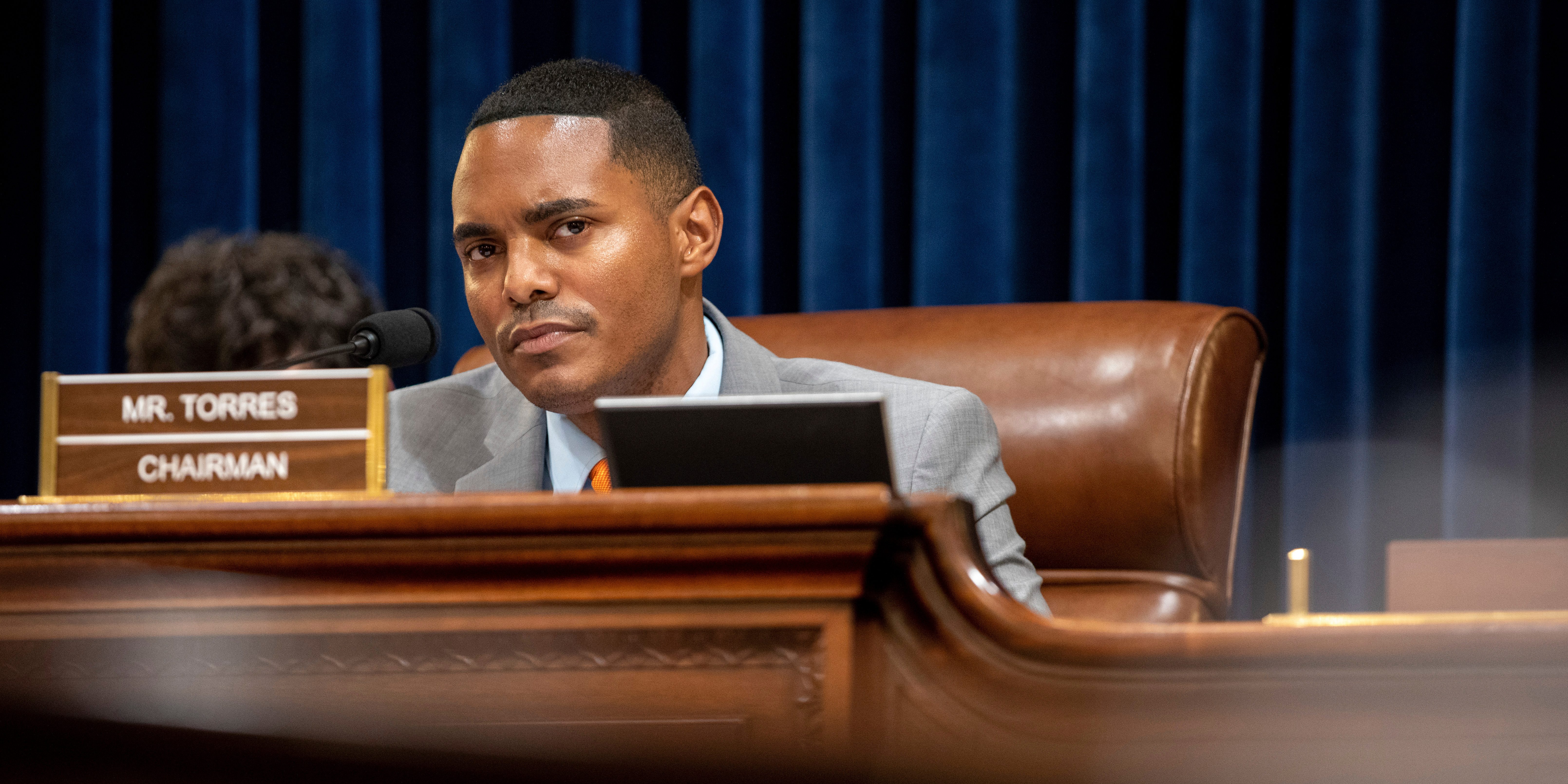
A crypto super PAC that has praised President Donald Trump and previously endorsed an all-Republican slate of candidates has finally found a Democrat it can get behind: New York Rep. Ritchie Torres.
The Fellowship PAC dropped $300,000 on Monday to boost Torres in the final days of his reelection primary campaign, funneling its ad spend through a firm co-founded by Trump’s former top crypto adviser.
The super PAC’s largest funder is Cantor Fitzgerald, the investment bank helmed by the sons of Commerce Secretary Howard Lutnick.
Torres is not expected to face serious opposition in the June 23 primary in New York. The sole public poll of the race put him far ahead of his leading opponent, former Democratic National Committee vice chair Michael Blake.
Torres, the Fellowship PAC, and Blake did not immediately respond to requests for comment.
The spending is another sign of bond between crypto firms and Torres, a member of the key House Committee on Financial Services who has been one of the industry’s most vocal Democratic supporters. Torres was a co-founder of the Congressional Crypto Caucus.
Still, the primary intervention still comes as something of a surprise given that, in the past, the Fellowship PAC only doled out campaign funds on behalf of Republicans. Reporting on its creation, the New York Times described the PAC as “more aligned with the Republican Party and President Trump than Fairshake, which is the dominant, pro-crypto super PAC.”
The PAC signaled support for Trump in a press release announcing its creation in September, praising him for putting “America on the path to become the global crypto capital.” In the months since then, however, the odds that Republicans will control the House after the midterm elections have dimmed.
The Fellowship PAC, which spends on ads rather than giving directly to campaigns, put Torres’s picture on its endorsement page in recent weeks, according to an archive of its website. Other candidates the group has endorsed include Sen. Lindsey Graham, R-S.C., and Texas Attorney General Ken Paxton, R-Texas, in their Senate races.
Big Crypto Bucks for Shoo-in
The Fellowship PAC is not the only crypto campaign organization spending on behalf of Torres. Protect Progress, which is affiliated with the juggernaut crypto super PAC Fairshake, buoyed the Bronx Democrat with nearly $1.4 million in advertising.
The two super PACs are aligned with different factions of the crypto industry. The Fellowship PAC’s chair is the vice president of regulatory affairs for Tether, a massive stablecoin company that is trying to break into the U.S. market after years of scrutiny over its use by money launderers, including terror groups.
Although Tether has not donated directly to the Fellowship PAC, the PAC received $10 million from the financial services firm Cantor Fitzgerald, which is the custodian of billions of dollars of U.S. Treasury bills on behalf of Tether. Lutnick, Trump’s commerce secretary, stepped down as the head of the banking firm and divested his assets to join the Cabinet.
The media buy on behalf of Torres was made through Nxum Group, which was co-founded by Bo Hines, a former Republican congressional candidate who served as the executive director of Trump’s Council of Advisers on Digital Assets last year. Hines is the CEO of Tether U.S., the American division of the El Salvador-based firm.
Protect Progress and Fairshake, meanwhile, have been funded by the crypto exchange Coinbase and the venture capital firm Andreessen Horowitz. Fairshake and its affiliates have spent money on both sides of the aisle, although it was criticized in 2024 for helping tip the Senate in favor of Republicans.
Israel’s government asked Meta to censor social media content about its ongoing war against Iran, according to internal documents viewed by The Intercept.
Company records show that Israel petitioned Meta to take down Facebook and Instagram posts expressing support for Iran, opposition to Israel, and even depictions of Iranian missile impacts.
The government flagged a variety of materials related to the war, including posts mourning the death of Ayatollah Khamenei following his assassination by the U.S. and Israel on the opening day of the conflict, content supportive of Iran’s retaliatory attacks, and Iranian accounts that shared military analysis and propaganda sympathetic to the Iranian regime’s perspective.
“Governments wanting to suppress speech that is critical of their war efforts is as old as time.”
In some cases, Meta complied with the censorship requests, the records show, though it is unclear on what grounds. Meta maintains that it only removes content as required by law or materials that violate its speech policies.
When asked how many Iran-related takedown requests had been granted to date since the war began, the company did not answer. The Israeli Ministry of Justice, which submits takedown requests to social media platforms, did not respond to a request for comment.
Israel’s social media lobbying is not new; for years the nation has leaned on its close relationship with Meta to push for targeted enforcement of the company’s content moderation rulebook.
Israel’s Office of the State Attorney routinely lodges complaints to social media platforms on behalf of state security agencies about content deemed illegal or said to promote “terrorism,” according to its website. In the documents reviewed by The Intercept, the office in some cases made no claim that the social media content violated Israeli law. Instead, the office asked that posts or accounts should be removed because they were in violation of Meta’s content moderation rulebook.
Meta, for instance, designates Iran’s Islamic Revolutionary Guard Corps a “Dangerous Organization,” and prohibits users from engaging in many forms of positive speech about its actions. This means posts supportive of retaliatory missile launches by the IRGC, for instance, could run afoul of the company’s rules. No such prohibition exists for users who post favorably about the U.S. or Israeli militaries.
Meta did not respond to questions about the Iran war requests, but spokesperson Daniel Roberts provided a statement to The Intercept. “Anyone is able to report content they think violates our rules. Regardless of who or how a piece of content is flagged, we assess it based on our policies, which govern what is and isn’t allowed on our platform. It is wrong and irresponsible to imply that these requests are in any way unusual or improper.”
A company headquartered in California can determine what is or is not permissible speech for billions of users across the world, only a fraction of whom are American.
Meta has faced scrutiny, specifically in the Middle East, for removing content that doesn’t violate the company’s rules. A 2022 audit commissioned by the company itself found discrepancies in its content moderation practices between Arabic and Hebrew content. “Arabic content had greater over-enforcement (e.g., erroneously removing Palestinian voice) on a per user basis.” the company found. A 2023 report by the company’s inhouse Oversight Board described the “over-enforcement” of the company’s Dangerous Organizations and Individuals blacklist, disproportionately composed of Muslim and Middle Eastern entities.
Meta has long claimed that as an American company, it is legally required to sometimes remove content pertaining to certain entities sanctioned by the U.S., such as the Islamic Revolutionary Guard Corps. But legal scholars say that has little to no precedent or basis in existing sanctions law, which focus on matters of material support rather than political speech. It’s a policy that has created an immense ideological slant: A company headquartered in California can determine what is or is not permissible speech for billions of users across the world, only a fraction of whom are American.
Further adding to the imbalance when it comes to Middle East crises is the fact that Meta has granted Israel privileged access to its content moderation policy teams. In 2024, The Intercept reported how Meta employee Jordana Cutler, a former aide to Benjamin Netanyahu, served as a dedicated liaison to the Israeli government, advocating for the country’s interests and helping facilitate the removal of unwanted speech. Few other countries in the world have a dedicated representative within Meta — in 2020, a similar policy head for India market resigned after revelations she had lobbied for rule enforcement that favored India’s ruling Hindu nationalist party. Asked if Cutler has had a role in facilitating Israeli takedown requests of content relating to the war, Meta did not respond.
“Meta’s close relationship with the Israeli government for takedown requests has been a long-standing issue,” Evelyn Douek, a Stanford Law School professor and scholar of digital speech policies, told The Intercept. “Meta’s acquiescence in lots of takedown requests has been a long-standing practice.”
These asymmetries of censorship power are particularly sensitive during times of war, said Douek.
“Governments wanting to suppress speech that is critical of their war efforts is as old as time,” she said. “Allowing governments to claim national security reasons to suppress speech willy-nilly would obliterate the value of speech protections.”
According to a source familiar with the matter, Israel lobbied Meta to implement a blanket rule restricting imagery of war damage within its territory, mirroring an Israeli news media censorship policy that bars journalists from documenting weapon impacts without military approval. Meta has so far declined to implement such a policy for its billions of global users, the source said. Meta did not respond to questions about the status of this request.
The U.S. and Iran signed on Friday a ceasefire agreement, though Israel has suggested it would not abide by the terms of a deal. While many of the censorship requests directly addressed the war, others were tangential to the conflict itself. The records show Israel has pushed to remove content expressing outrage over last month’s storming of Al-Aqsa Mosque by far-right government minister Itamar Ben-Gvir. It also sought to stifle posts critical of rhetoric by Israel that linked Israel’s recent closure of Al-Aqsa with the ongoing war.
In general, Meta grants the vast majority of Israeli governmental takedown requests.
In general, Meta grants the vast majority of Israeli governmental takedown requests. The State Attorney’s Office boasted a 92 percent compliance rate in 2023, and a 2025 report by Drop Site News said the overall rate has climbed to 94 percent since the October 7 attack by Hamas.
Records reviewed by The Intercept show Israel asked for Iran war takedowns using the exact same language evoking Hamas’s October 7 attack that it submitted when requesting the censorship of pro-Palestinian and anti-Israeli speech across the globe during Israel’s war on Gaza.
“It suggests that they don’t expect their requests are being reviewed very carefully,” Douek said.
Douek argued that the wartime censorship requests underscore the danger of policing speech entirely out of public view through “opaque processes” like governmental backchannels.
“These companies … have been responsive to their own geopolitical and commercial interests, and have always been more responsive to powerful governments.”
“These platforms have always maintained that they are neutral, or that they are just a platform for people to express their views, but it has long been true that these companies have always presented a particular view of the world and have been responsive to their own geopolitical and commercial interests, and have always been more responsive to powerful governments,” Douek said.
This creates a deeply lopsided dynamic when it comes to the Iran war: The two arguably best-represented governments in the world within Meta — the U.S. and Israel — are allied belligerents in a conflict against a state deeply sanctioned by the company’s speech rules. “You’re going to end up with a skewed debate,” Douek said.
When anti-ICE activists rallied against the Trump administration’s deportation campaign in Minneapolis, many relied on the encrypted messaging app Signal for secure communications. In activist chats and quickly established ICE-tracking groups, locals used Signal to keep tabs on federal agents patrolling their communities.
When the Department of Homeland Security announced this week the arrest of 15 alleged “anti-ICE rioters” in Minnesota, it pointed directly at their Signal chats.
The indictment is in large part built upon on conversations from more than a dozen Signal groups, citing more than 100 specific messages. The case is a stark reminder that using an encrypted messaging platform like Signal is not in and of itself a magic bullet to safeguard communications. It also raises the question: How did Immigration and Customs Enforcement’s Homeland Security Investigations unit gain access to all of these communications in the first place?
The indictment doesn’t provide a clear answer. But sprinkled throughout the document are clues that suggest that law enforcement may have gained access to the physical devices of some of those indicted.
The indictment singles out its targets for their alleged participation in local ICE rapid response networks, where volunteers monitor and report the presence of federal agents in their communities by flagging details such as the license plate numbers of vehicles used by immigration authorities. ICE watchers in Minnesota have been met with intimidation from immigration authorities amid the national outcry following the killings of Alex Pretti and Renee Good as they observed the actions of immigration authorities.
The 15 people named in the latest indictment are all charged with “conspiracy to impede or injure an officer,” with some facing additional charges like “solicitation to commit a crime of violence” and “destruction of government property.” Though some of the accused had court appearances on Tuesday, their defense attorneys have not as of yet been named.
The indictment comes months after FBI Director Kash Patel said in a podcast interview that federal law enforcement had started an investigation into Minnesota ICE watchers using Signal groups to share information about immigration agents.
The bulk of the indictment consists of transcripts of group messages; at various points it also makes mention of voicemails, text messages, Signal direct messages, and Signal calls. For instance, the indictment in one spot mentions that two of the indictees “exchanged approximately 20 connected Signal calls.” This hints that authorities were able to access not just group chat messages, but likely had wholesale access to the devices of at least some of those indicted.
The Signal app provides end-to-end encryption, protecting communications in transit, so that anyone monitoring your internet or cellular data connection cannot see the contents of your messages. Signal also minimizes the amount of metadata collected, so if the organization behind the app, the Signal Foundation, was served with a compulsory legal process to reveal user information, it wouldn’t even know with whom you spoke or chatted.
But all that falls apart if your device gets into the wrong hands. In order to safeguard your Signal data from someone who obtains access to your device, it’s necessary to manually harden Signal by modifying some of its default settings.
Perhaps Signal’s most well-touted security and privacy feature is its ability to set disappearing messages. Messages can be set to expire in periods ranging from seconds to weeks. A default expiration time for all messages can be selected, and specific groups and conversations can be set to custom retention times. To minimize risk, set retention times to the shortest amount feasible — minutes or hours, instead of days or weeks.
Signal’s disappearing messages don’t remove evidence that communications between parties occurred in the first place.
Keep in mind that Signal’s disappearing messages delete the contents of a message, but they don’t remove evidence that communications between parties occurred in the first place. This means that even if a group has enabled disappearing messages, someone who gains access to a member’s device could later determine with whom they were chatting. Therefore it’s safest to regularly delete entire groups and chats, not just the messages themselves.
Just like its chat function, Signal also has keeps similar records of voice and video calls. It’s as important to delete records of the calls as it is records of text messages, both within the Signal app and in your phone’s standard call history.
On iPhones, Signal can integrate its call history into the iPhone’s regular call history. This privacy-eroding feature can be disabled on Signal on iOS by tapping your profile circle on the top-left corner of the app, clicking on Settings, then Privacy, then disabling “Show Calls in Recents.”
Additionally for Signal on iPhones, you’ll also likely want to disable settings like “Share Contacts with iOS” and “Use Phone Contact Photos” (for Android users, the equivalent is “Use address book photos”), which can be found under Settings, then Chats.
Such precautions may sound extreme, but in a recent case, authorities were able to recover deleted incoming Signal messages based on old push notifications that were archived on iPhones (the latest iPhone update fixes this issue, highlighting the importance of keeping your devices up to date). On that note, remember to either turn off Signal notifications entirely or have them display only the names of people sending messages — which should be pseudonyms, not real names.
A San Diego police department is facing a lawsuit after jailing a man for a month based on a Flock camera alert that cops allegedly should have known, based on the timestamp, did not depict the car that they were looking for.
Last November, Hugo Parra was arrested on felony charges after San Diego police relied on Flock data and a witness statement to wrongly connect him to an attempted carjacking at gunpoint, the Times of San Diego reported. Cops were looking for a red Alfa Romeo car with tinted windows and a man wearing a gray hoodie, and Parra happened to be wearing a white hoodie while riding in a friend's car that roughly matched the vehicle description.
Although Flock cameras can capture license plate data, cops did not have even a partial plate to help them verify if the car was involved in a violent crime. But the Flock data cops used to justify the arrest actually showed that Parra was five miles away at the time of the crime, Parra's attorney, Alex Coolman, told the Times of San Diego. Rather than arrest him, cops could have used that data, as well as Parra's cellphone location data, to corroborate Parra's statement that he was innocent, Coolman said.
Anthropic’s high-profile spatwith the Pentagon gave it a killer marketing advantage, burnishing its public image as a principled AI company that puts values over profits — unlike more mercenary rivals such as OpenAI or Google. But Anthropic’s double standard on authoritarianism suggests the nearly trillion-dollar firm is as calculating and ethically flexible as any of its competitors.
In a recently published policy paper arguing a full-throated embrace of data center nationalism, Anthropic said that “it’s essential that the US and its allies stay ahead of authoritarian governments like the Chinese Communist Party,” lest the world fall into the grips of tech-powered tyranny. Anthropic and its peers, the company claims, will form a bulwark of democratic values, protecting societies at home and abroad from repression.
Left unmentioned in the document — and seldom publicly acknowledged — is the fact a slice of Anthropic is owned by the Emirati dictatorship of Abu Dhabi, a repressive and authoritarian monarchy.
Anthropic is aware of which way the wind blows from Washington to Silicon Valley, and it shrewdly casts the development of machine learning models not just as a matter of hardware and software, but of ideology and geopolitics. “Democracies, not authoritarian regimes, must lead in AI development and deployment,” the company says, or else an era of “authoritarian AI” will begin.
“Already, the CCP is using AI to censor speech, repress dissidents, hack governments and corporations across the world, and strengthen the People’s Liberation Army,” Anthropic writes, and to “enforce draconian policies on ethnic minorities” using machine learning-powered methods like biometric collection and facial recognition.
The policy paper isn’t a condemnation of any of these AI uses per se; the United States is already eagerly using these technologies for intelligence, military, and ethnic minority-repression purposes today. Residents of Tehran, which Anthropic has helped bomb since the start of the joint U.S.–Israeli war against Iran, might question the company’s argument that American AI supremacy is a matter of global “safety.”
Though the policy paper focuses on China, the company has long stated it opposes authoritarianism broadly: “AI-powered authoritarianism seems too terrible to contemplate, so democracies need to be able to set the terms by which powerful AI is brought into the world, both to avoid being overpowered by authoritarians and to prevent human rights abuses within authoritarian countries,” CEO Dario Amodei wrote in a 2024 blog post.
This is not merely a battle between the U.S. and China, Anthropic says in the May paper, but a war between democracy and “authoritarian governments” broadly construed.
But Anthropic’s anti-authoritarian fervor seemingly does not extend beyond China to the Middle East, where Abu Dhabi’s sovereign wealth fund invested in Anthropic twice this year. In February, Anthropic announced it had raised $30 billion in capital from a group of investors that included MGX, the AI-focused investment vehicle of a Emirati government capital controlled by Abu Dhabi’s royal family. Anthropic’s most recent May 28 $65 billion capital round, bringing its valuation to $965 billion, also included MGX.
Like China, the United Arab Emirates outlaws almost everything associated with democratic society: Political parties, a free press, freedoms to associate and assemble, open elections, due process, and free speech are nonexistent. Political dissidents face torture, and any speech, online or offline, that causes “damage to national unity” risks life imprisonment or the death penalty.
Emirati authoritarianism isn’t contested by the U.S., Anthropic’s primary governmental customer. The State Department’s 2024 Country Reports on Human Rights Practices assessed the UAE faces “credible reports of: disappearances; arbitrary arrest or detention; transnational repression against individuals in another country; serious restrictions on freedom of expression and media freedom, including censorship; and prohibiting independent trade unions or significant or systematic restrictions on workers’ freedom of association.” Freedom House, a State Department-backed think tank, gives the UAE a score of 18 out of 100 on its “Global Freedom” index.
Anthropic declined to comment. MGX did not respond to a request for comment.
“Like China, the UAE is at the forefront of AI-based authoritarian surveillance.”
Given that MGX bought into Anthropic at its Series G and H investment rounds, relatively late in the venture capital game, it’s likely that the UAE’s stake in the company is relatively small and its influence limited. But Anthropic’s willingness to sell part of itself to an authoritarian monarchy suggests at least that its mission of “ensuring democracies lead” comes with asterisks.
“Like China, the UAE is at the forefront of AI-based authoritarian surveillance,” said Matthew Tokson, a law professor at the University of Utah who focuses on the security implications of artificial intelligence.
Tokson added that while he generally agrees with Anthropic’s calls to restrict processor exports to China and other measures to bolster American AI firms, he doesn’t buy the nationalist rhetoric, which he attributes to the company’s anti-regulatory agenda rather than patriotism. The more Anthropic and its competitors can convince the public that their bottom line is a matter of national security, the more likely Washington is to take a light touch.
“The fact that Anthropic is partly owned by the government of Abu Dhabi, which is similar to China in its extensive use of AI surveillance to support an authoritarian government, suggests that its anti-authoritarian arguments are more based on a cynical policy position than a sincere passion for democracy or antipathy toward authoritarian governments.”
Many of the emirate’s longrecord of repressiveacts and rights violations are connected to MGX via its chair, Sheikh Tahnoun bin Zayed Al Nahyan. Through his position as the emirate’s national security and intelligence chief and his business portfolio, including chairmanship of the AI firm G42 (itself a founding partner in MGX), Tahnoun has been linked to a bevy of campaigns to surveil and hack into the phones of Emirati dissidents, human rights advocates, and others the monarchy deems an adversary, according to news media reports and scholarly research. A 2020 investigation by Bill Marczak, a senior researcher at the University of Toronto’s Citizen Lab placed “Spy Sheikh” Tahnoun at the center of myriad hacking, espionage, and surveillance operations. A 2025 Wired profile of Tahnoun similarly described him as Abu Dhabi’s “spymaster sheikh,” noting G42’s “special areas of strength in state-sponsored hacking and surveillance tech.”
In 2019, the New York Times reported a covert Emirati government campaign to conduct surveillance through an instant messaging app called ToTok, an app itself Marczak tied to Tahnoon and through G42 in his 2020 analysis. The Wired profile described Tahnoun’s ambitions to “dominate AI” noted that “an engineer who worked at G42 at the time told me that all of the [ToTok] voice, video, and text chats were analyzed by AI for what the government considered suspicious activity.”
G42 declined to comment, and neither it nor MGX responded to interview requests for Tahnoun.
There is reason to believe G42 and MGX have already deployed Anthropic’s powerful large language models. A review of DNS data — internet records that connect website names to numerical addresses understandable by computers — show both G42 and MGX have both configured their servers to allow personnel to access Anthropic tools like Claude, the company’s flagship large language model.
Anthropic has been more candid in internal communications about its stance on authoritarianism.
“Unfortunately, I think ‘No bad person should ever benefit from our success’ is a pretty difficult principle to run a business on,” Amodei wrote in a 2025 memo on Gulf State venture capital obtained by Wired. He wrote that such investment would boost “dictators” and conceded that it would give an authoritarian government “some soft power” to wield against the company. Nonetheless, Amodei dismissed the risk of hypocrisy as a “Comms Headache” — a function of “very stupid” commentators “having a poor understanding of substantive issues.”
Principles aside, Amodei explained in plain terms why he was interested in doing business with a repressive Gulf State. “We gain a very large benefit,” he wrote, “from having access to this capital.”
The United States is feeding Pentagon propaganda to internet users in Latin American countries using a new AI-laden content mill, an investigation by The Intercept has found.
La Tilde quietly began development early this year and appears to still be a work in progress, pitching itself as a modern media brand for Latin American audiences with articles published in both Spanish and English. Its name references the accent mark emphasizing vowels in Spanish; “news with an accent” is the site’s catchphrase.
“The tilde is not an ornament. It is a millennial arrow designed to provide direction, save space, and turn up the volume,” a narrator states in a promotional video for the site bearing telltale signs it was AI-generated, such as a newspaper whose sloppily rendered headline reads “SO THEE HOUTIERRER TO TO GHAHOBATEE,” followed by imagery of two medieval monks. “That is why we place the accent on what matters. From the regional pulse and your well-being, to the big ideas and the global context.”
So far, La Tilde’s coverage amounts to an unusual blend of personal finance tips (“Why instant payments matter so much for your business and your wallet”) and articles extolling the value of U.S. military operations in Latin America (“Operation Absolute Resolve: The mission that captured Nicolás Maduro and set a new standard for precision and coordination”).
Its article on the U.S. abduction of the Venezuelan president praises the mission in Trumpian prose, calling it “The Perfect Operation – Coordination, Timing and Precision at an Unprecedented Scale,” and “a military operation of coordination and accuracy never seen before.” Citing “information obtained exclusively by La Tilde,” it describes the operation’s tactical brilliance, flawless execution, and incredibly precise coordination of military assets in the air and on the ground.
If this reads like Pentagon a press release, that’s because it is. An explanation for its glowing coverage of the U.S. military can be found after clicking a small link tucked at the bottom of the site. “La Tilde is a product of an international media organization publicly funded from the budget of the United States Government,” its About page reads.
This easily missed disclosure language is identical to two other Pentagon-sponsored propaganda sites recently revealed by The Intercept.
Targeting audiences, foreign or domestic, with state-run information campaigns remains a politically sensitive topic, and a token disclosure that La Tilde is a U.S.-funded platform allows the American government to say it technically informed readers about the actual source of the information.
According to a defense official familiar with U.S. information operations, La Tilde is operated as a military messaging platform for U.S. Special Operations Command South, or SOCSOUTH, which executes special forces missions throughout South and Central America as well as the Caribbean. When asked about SOCSOUTH’s role behind La Tilde, spokesperson Trevor Wild replied with the text of the site’s About page noting that it’s a government operation, but declined to comment further.
U.S. Southern Command, or SOUTHCOM, which is broadly responsible for coordinating military assets in the countries La Tilde targets, denied involvement. SOUTHCOM “does not fund, operate, or have any official association with La Tilde,” according to spokesperson Steven McLoud, who did not respond to further questions.
Unlike most news websites, La Tilde carries no bylines, masthead, or mention of actual staff of any kind. Although the site claims it employs “dozens of freelance reporters and content creators,” at least some of the site appears to have been generated by a large language model. Running articles through Pangram, an AI-text detection service, produced multiple hits for both English and Spanish writing either partially or entirely written by machines (though such tools are known to deliver false positives).
Emerson Brooking, a fellow with the Atlantic Council’s Digital Forensic Research Lab and former Pentagon cyber-policy adviser, told The Intercept he was struck by site’s shoddiness, describing it as “AI all the way down.”
Despite the low quality of AI-generated articles, this approach could help the Pentagon spin up propaganda efforts faster than in the past. “If you can generate new content and even news fronts at the flip of a switch, your influence operations can shift target and focus much more quickly,” Brooking said. “That seems to be the thinking behind recent AI-powered Russian and Chinese networks, for instance.”
An analysis of subdomains hosted on LaTilde.co reveals the site plans to launch bespoke versions for readers in Ecuador, El Salvador, Guyana, Honduras, Jamaica, Panama, and Peru.
Some pro-U.S. content is clearly tailored to these national audiences. An article filed to the site’s “In Good Hands” section highlights the benefits of U.S.–Panamanian joint jungle warfare training exercises, regaling readers with how “temperatures and heart rates climb at the Cristóbal Colón Naval Air Base as Panamanian security forces push forward through the ‘Green Mile,’ the demanding final test of the Combined Jungle Operations Course.” Such joint initiatives are, according to La Tilde, a bulwark against China’s efforts to engage in similar joint exercises in Latin America. Rather than engage with “Beijing’s predatory practices,” the article suggests countries should follow Panama’s lead and “seek training opportunities closer to home or with longstanding partners such as the United States.”
The article makes no mention of the controversy surrounding PANAMAX, a joint military exercise between SOUTHCOM and the Panamanian forces that has sparked increased protest on the grounds it violates national sovereignty. Permanent U.S. military installations in Panama were shuttered in 1999 as part of a 1977 treaty between the two countries; Panamanian opposition parties decried the reestablishment of an American military presence under the guise of joint exercises as a “camouflaged invasion.” Participants in the 2025 PANAMAX exercise La Tilde is pushing include the Western Hemisphere Institute for Security Cooperation, previously known as the School of the Americas, a Pentagon training institute whose graduates included thousands of Latin American death squad gunmen and dictator Manuel Noriega.
The importance of military and intelligence-sharing compacts with the U.S. is a recurring theme. “Far from weakening sovereignty, this kind of cooperation can strengthen it,” one article says.
Other stories from La Tilde argue the American side of Latin American controversies, similarly downplaying issues of national sovereignty. One piece describes how the U.S. abduction of Maduro “has reawakened a long-contained hope among millions of Venezuelans inside and outside the country.” Another alleges Ecuador is a nexus of the international cocaine trade, echoing claims the Trump administration has used to expand Operation Southern Spear, SOUTHCOM’s Caribbean airstrike campaign that has killed more than 200 civilians to date.
It’s unclear who exactly is operating the site on a day-to-day basis. A similar network of military propaganda pages, descendants of an Obama-era information warfare program called the Trans-Regional Web Initiative, appears to be administered by military contractor General Dynamics Information Technology. Renée DiResta, who co-authored a 2022 report on online propaganda efforts backed by U.S. Central Command, told The Intercept that the TRWI successor websites share a common Google Ads identifier code owned by General Dynamics, according to a recent comprehensive analysis of the network she conducted. La Tilde also runs a legal disclosure with identical language as those sites.
General Dynamics did not respond to multiple requests for comment about La Tilde.
Halcyon Group International, another information warfare contractor that operates Diálogo Américas, a similar pseudo-news site backed by the Pentagon, told The Intercept it was not involved with La Tilde.
Design of the La Tilde website was subcontracted to Antpack, a Colombian digital marketing firm. Multiple files hosted on the site created by the AI image-generation service Midjourney contain the word “Antpack” in their name. The Intercept signed up for a user account on La Tilde, part of planned functionality that will let readers comment and save articles for later. Once registered, The Intercept was able to view comments left on a non-public version of the site used by its developers, who posted under names corresponding to LinkedIn profiles of Antpack employees. Antpack did not respond to multiple requests for comment.
U.S. Special Operations has a long record of leading the American internet propaganda efforts, ranging from high-tech efforts to less-sophisticated projects like phony online newsrooms. SOCOM has since 2018 operated the Joint Military Information Support Operations Web Operations Center, which coordinates information warfare and online psychological operations.
The Intercept reported in 2023 that SOCOM was working on acquiring state-of-the-art “deepfake” video fabrication technologies to “generate messages and influence operations via non-traditional channels,” according to procurement documents. La Tilde appears to be using low-effort AI tools rather than anything cutting-edge. Art accompanying its stories often includes portion of the prompt used to quickly generate the image in the file name, and shows mixed results, such as a rendering of the White House portico missing several of its columns or a diploma with garbled text. Photographs illustrating pro-SOUTHCOM messaging, however, are drawn from the Defense Visual Information Distribution Service, an official Pentagon media library.
“The intent is probably to fill these sites with generic material, build an audience base, and then slip in more pieces of explicit propaganda, like that rather fulsome recounting of the U.S. attack on Venezuela,” Brooking said. “This is how you build these sorts of networks. But the content is lazy, the AI is bad, and the required disclosures make the whole thing a farce.”
Americans speaking out against artificial intelligence data centers on social media are falling under police surveillance, a confidential law enforcement bulletin obtained by The Intercept reveals.
A fusion center in Philadelphia combed through spicy internet comments from AI critics and concluded there is a growing risk of physical violence against data centers from “domestic violent extremists,” ranging from white supremacists to anarchists.
“Domestic violent extremists (DVEs) are likely interested in targeting artificial intelligence (AI) data centers, posing a physical and cyber threat to infrastructure in the Philadelphia regional area,” the Delaware Valley Intelligence Center wrote in a December alert.
The fusion center distributed its warning, marked “for official use only,” through the national fusion center network of state, local, and federal police agencies.
Like many of the reports produced by fusion centers, the bulletin points to news reports and social media posts, but cites little in the way of tangible threats. It acknowledges “a lack of specific information on plans to target AI data centers in the Philadelphia area,” but warns law enforcement that three planned data center facilities in the region could become targets of future protests.
Some of the anti-AI posts included in the document reflect hyperbolic anti-AI rhetoric that is widespread across social media, including an unnamed internet user who “indicated a desire to ‘burn down’ data centers.” Other examples of potentially terroristic posts included references to a fictional anti-robot movement in the science fiction novel “Dune” and a Facebook meme.
The fusion center, housed inside the Philadelphia Police Department, warned that “disruptive First Amendment activity” is an “indicator” of risk from “Domestic Violent Extremists,” an expansive term favored by the FBI and other law enforcement agencies.
Pennsylvania has its own history of counterterror agencies targeting advocacy groups. In 2010, then-Gov. Ed Rendell apologized for the state Department of Homeland Security contracting with a private firm to produce fearmongering reports on groups including anti-fracking activists.
When it came to the recent data center activist report, longtime Philadelphia civil rights lawyer Paul Hetznecker said he was troubled by the fusion center’s association of AI skeptics with terrorists.
“Those are legitimate, popular political concerns that are raised by local communities.”
“Those are legitimate, popular political concerns that are raised by local communities,” Hetznecker said. “This particular report from [the Delaware Valley Intelligence Center] reflects a very dangerous attempt to characterize that protected First Amendment activity — activity which is fundamental to our democracy — as something other, something more dangerous, a breeding ground for something more sinister.”
In response to questions emailed to the Philadelphia Police Department and the Delaware Valley Intelligence Center, a spokesperson responded with a statement asserting that the center “recognizes and respects the rights of individuals to lawfully express opinions, engage in peaceful advocacy, and participate in protected First Amendment activities.”
“Fusion centers exist to help stakeholders understand emerging threats and hazards that could impact public safety, critical infrastructure, major events, government facilities, businesses, and the communities we serve,” said Sgt. Eric Gripp, a spokesperson for the Philadelphia Police Department. “These assessments cover a wide range of topics and are designed to provide situational awareness, not to characterize lawful activity or constitutionally protected speech as criminal conduct.”
The Intercept obtained the Philadelphia report as part of a larger cache of such documents from local fusion centers. It adds to growing evidence that counterterror officials are putting data center skeptics under a microscope. Last week, Wired magazine reported on other notices from local intelligence agencies warning about “anti-tech extremism.” Journalists Ken Klippenstein and Dan Boguslaw also reported on a document from the U.S. Capitol Police Intelligence Services Bureau warning of the potential for anti-data center violence.
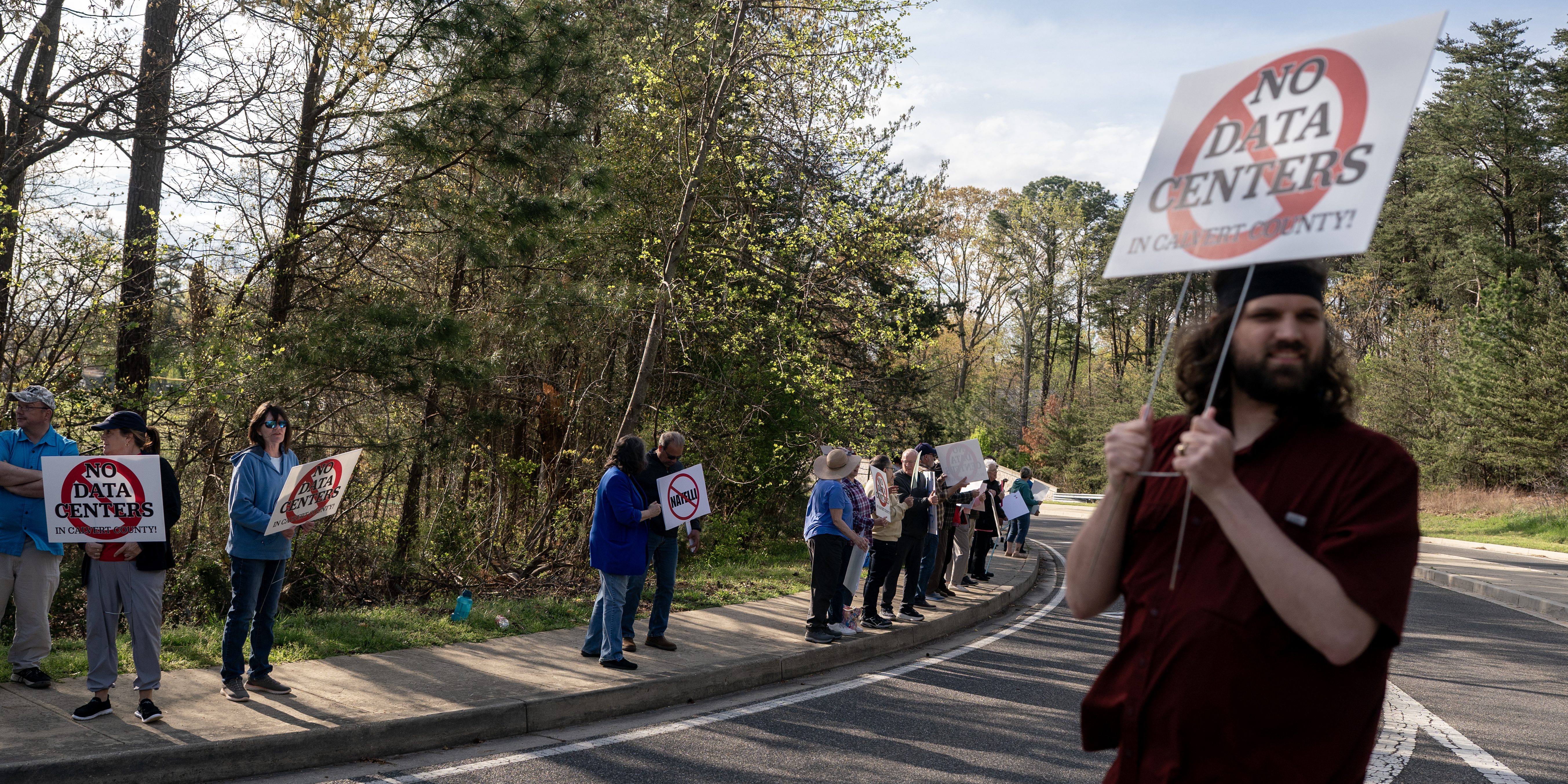
The reports are tied to a genuine upswell in popular pushback against data centers. The opposition extends well beyond the mishmash of far-right and far-left groups identified in the Philadelphia fusion center’s report. Seven out of 10 Americans oppose having data centers as neighbors, a recent Gallup poll found.
An image from the Philly Anti-Capitalist blog included in the December bulletin from the Delaware Valley Intelligence Center. Source: Delaware Valley Intelligence Center
The fusion center report frames the outcry as a potential first step toward violence, telling local police with jurisdiction over the roughly 16 data centers near Philadelphia that they should be aware of angry online posts.
The report warns about posts on an “anti-capitalist blog that remains popular amongst local anarchist extremist collectives.”
Under a title urging “Butlerian Jihad Against AI” — a reference to a book in the Dune science-fantasy series about humans revolting against their intelligent computer overlords — a post on the Philly Anti-Capitalist blog said “only we can decide to smash the screens that are brainwashing us into submission. The time is now, the day is here, ATTACK! ATTACK! ATTACK!”
The post was unattributed, did not include targets for attack, and included a cartoonish sketch of an old-fashioned computer struck by arrows. Nevertheless, local intelligence analysts appeared to take the threat seriously.
A meme included in a December bulletin from the Delaware Valley Intelligence Center warning about social media posts critical of data centers.Source: Delaware Valley Intelligence Center
The bulletin also ticked off other signs of anti-data center furor. There was a meme post on shared on a local Facebook account with text reading: “I cannot escape the feeling that I am morally obligated to sabotage AI data center infrastructure.” Commenters on the post had discussed a proposed Amazon data center near Berwick, Pennsylvania, as a “potential target,” according to the report. The Intercept was able to find other versions of this meme posted to Facebook and Instagram unrelated to the targeting of specific, physical data centers.
The fusion center bulletin also said that white supremacists and members of the dark online subculture dubbed “nihilistic violent extremism” by the FBI had agitated online against data centers.
The document also mentioned a DHS report highlighting a thread on an online image board where users discussed using magnets, explosives, or even — in an idea that reflected a sci-fi movie trope — an electromagnetic pulse weapon to take out data centers.
The fusion center analysts appeared to take seriously other rhetoric proposing dramatic attacks. “In addition to general anti-AI data center rhetoric, online users have recently discussed tactics, techniques, and procedures (TTPs) for carrying out attacks varying from simple swatting and hoax threats to property damage, arson, and even the use of chemical, biological, radiological, and nuclear (CBRN) material,” the report said.
“That appears to be an effort by law enforcement to hype up the threat where there may be no threat at all.”
Hetznecker, the civil rights lawyer, said the idea of a nuclear threat raised concerns for him about the quality of the fusion center’s sources and its conclusions.
“That appears to be an effort by law enforcement to hype up the threat where there may be no threat at all,” he said. “To increase scrutiny on First Amendment activities by lumping in those activities with the most extreme, possible scenarios one could imagine that have no factual basis.”
The Philadelphia fusion center report specifically warned authorities of the likelihood that new local data centers could be the traget of protest.
“There is potential for significant pushback to the three newly proposed AI data centers in the Philadelphia area. Indicators of an increased threat in the short term may consist of more disruptive First Amendment activity in opposition to AI data centers, small acts of vandalism, online calls for action to boycott and or protest local AI data centers in the Philadelphia area, and extensive criticism of higher utility bills resulting from AI data centers,” the report said.
“I wouldn’t be surprised if we see heightened law enforcement scrutiny on legitimate expressions of AI data center concerns, and I hope that would not chill the appropriate dialogue that needs to occur on the impact of data centers on local communities,” he said.
Update: June 1, 2026, 11:01 a.m. ET The article was updated with a statement from the Philadelphia Police Department received after publication.
Shark Tank’s Kevin O’Leary has been making the media rounds defending the 40,000-acre data center project he’s backing in northern Utah. Dismissing residents’ concerns over the environmental impacts and water demands of the proposed project in the drought-stricken Great Salt Lake region, O’Leary has claimed protesters are “bused in,” “misinformed,” and alleged that China has had a hand in orchestrating the public push back.
“The Stratos project in Utah is an example of data center largesse,” says Jim Walsh, the policy director of Food and Water Watch, an organization leading a campaign to stop the rapid development of data centers across the country. As proposed, the project would be more than double the size of Manhattan. Walsh adds, “It’s important to recognize that the impacts of this data center go beyond the water and energy concerns that impact the residents of Salt Lake. They’re going to be pulling gas from the Ruby Pipeline, and this project is going to perpetuate more fracking in the Western U.S., a practice for extracting natural gas that uses extreme amounts of water.”
This week on The Intercept Briefing, host Jordan Uhl speaks to Walsh about the massive Utah project, the environmental and economic impact of data centers on communities especially where water is already scarce, and the Trump administration’s push to cut regulations at the federal and local level to accelerate the build-out of data centers and AI infrastructure.
In response to O’Leary claiming data center development is a national security priority to beat out China in the AI race, Walsh says, “National security isn’t just about having technological and military superiority.” We’re not safe if we don’t have clean air and clean water to drink and breathe. We’re not safe if our communities have massive data centers that are extracting our natural resources. Our entire economy functions on access to water.”
For more, listen to the full conversation of The Intercept Briefing on Apple Podcasts, Spotify, YouTube or wherever you listen.
Transcript
Jordan Uhl: Welcome to The Intercept Briefing, I’m Jordan Uhl, your host today.
Jessica Washington: I’m Jessica Washington, politics reporter at The Intercept.
Jonah Valdez: And I’m Jonah Valdez, another politics reporter here at The Intercept.
JU: So Jess, Jonah, we’re talking to you both today because the California primary is days away: June 2. While there are a few notable races that have captured national attention, one here where I live in Los Angeles is the mayoral primary.
We’ve got a few contenders. It is looking tight at the top with a few candidates jockeying for one of these top two positions. Jess, could you give us an overview of this race?
JW: As the only non-Angeleno on the podcast, I’m going to try and do a good job. So something important to keep in mind before we even get into the candidates is because of how California’s primary system works, if no candidate gets a majority of the vote — so over 50 percent — the top two are going to go off to a runoff election in November.
The candidates in this race are the incumbent mayor, Karen Bass. She has been leading in every poll, but it should have been really a slam-dunk election, and yet it isn’t. We can get into more of why in a minute. But her opponent is really interesting; two opponents are interesting. So first, there’s reality star Spencer Pratt, who has been consistently polling in second place, although in more recent polling he’s looking to lose a little bit of steam. Then the other candidate is council member Nithya Raman, a Democratic socialist who’s not endorsed by DSA LA, but is recommended by them. So that’s the mix that’s happening in this election right now.
JU: Jonah, there are a few other contenders that could be potentially pulling votes from Nithya Raman or might be waiting to decide till last minute. What is this looking like on the ground? Who have you talked to and what are you hearing?
JV: My focus has been on LA’s left, if you will, and how there might be what people are calling some vote-splitting among the left. And that’s because not only is there Nithya Raman who, as Jessie said, is a Democratic socialist, but there’s also Rev. Rae Huang, who is a housing advocate.
She’s a Presbyterian minister. She actually was in the race before Nithya and was the only DSA candidate, Democratic Socialist candidate, in the race at the time. She launched two weeks after Mamdani’s win in New York, so she has all this buzz going into it. The LA Times was asking, is she LA’s Mamdani?
So that’s the framing that she entered the race in, and it excited a lot of progressives here in the left in Los Angeles. But as soon as Nithya joined the race, very last minute, and the rise of Spencer Pratt, you have this threat of this right-wing figure. Sure, this is a nonpartisan election, but the things he’s saying, demonizing homelessness and really getting on Karen Bass around her record and the fires. There’s this tangible threat now that Spencer Pratt could be in the runoff with Karen Bass, which is a pretty worst-case scenario for LA’s left that is trying to push LA’s politics in a different direction.
Right now, the contention for a lot of voters in LA’s left is between, do I vote for Nithya Raman, someone who I at least agree with, but have to hold my nose on some issues, like police accountability, where she has fallen short in the eyes of some of her opponents? Or Rae Huang, who has a bolder vision? Some members of DSA LA have said that she has the true socialist platform amongst the two Democratic Socialist members. I should say that Rae Huang is only polling at about 5 percent. That’s nowhere near the second place spot to get into the runoff.
JU: We’re seeing a wide array of polling in this race, and there was a new poll that dropped on Thursday morning from Berkeley IGS, which had Bass, unsurprisingly, in the top spot with 26 percent. But in second place, this I think caught many people off guard, Nithya Raman at 25 percent, Spencer Pratt at 22, and Rae Huang at 9 percent, with 10 percent undecided. That presents a totally different outlook going into the general in this runoff.
But Jess, I want to bring you back in here. Spencer Pratt was widely considered to have a guaranteed spot in the runoff because he had a ton of press, a ton of buzz, especially from outside LA. He had Trump’s endorsement. He’s been getting featured in national press.
One of the things that he really rose to prominence on was his criticism of Karen Bass, like Jonah said, for her, “handling of the fire.” But I think many people who live here felt that some of it was disingenuous because those fires were exacerbated by the Santa Ana winds. You can only do so much as mayor.
You can’t get helicopters up in the air in 80-mile-an-hour winds to fight those fires. So I think some of it came off as very disingenuous to people here in LA. But what are you hearing? What are you seeing from Spencer Pratt that puts him even in contention?
JW: For anyone who doesn’t know who Spencer Pratt is, he’s this former reality star from “The Hills.” He’s the guy who told People Magazine that he blew, I think, about $1 million on crystals, blowing through his $10 million reality television fortune on other lavish purchases. So that’s just a little bit of who Spencer Pratt is, the guy who yelled at women on television for about a decade.
But the reason he’s catching steam, I think, is twofold. I think, one, the fires are a very visceral moment. The mayor obviously has no control over the fires, but the fact that she was in Ghana during the Palisades fire did really anger a lot of people. The fact that she didn’t come home until the following day is a large part of that narrative.
Spencer Pratt is not looking to tackle those issues. He is looking to move people out of spaces where he and his friends can see them. It’s also worth noting that his plans of mass arrest also aren’t going to even fix that problem. But what you’re looking at in Los Angeles is frustration over Karen Bass’s handling of these fires and this kind of visible problem of homelessness that frustrates people on both sides of this issue.
That’s what Spencer Pratt has really honed in on. I think it’s important to note that none of his solutions are going to fix any of those problems, but he is tapping into a real anger and a real frustration in the electorate.
JU: Yeah I think what’s interesting to watch is the national support for Spencer Pratt. But that comes at a cost for him because 80 percent of his donors don’t live in Los Angeles, according to analysis that I saw from one Gabe Sanchez. And sure, you can run ads, you can get press, but that doesn’t necessarily mean that people within the city, within your jurisdiction, would vote for you.
What I found so interesting and Jonah, I want to bring you back in here, people dug up some of his old appearances or guest appearances on Infowars with Alex Jones, and during one of those interviews, he talked about his belief that climate change was a hoax.
What I found so ironic is that this is somebody who made losing his home in the Palisades fire a centerpiece of his campaign, but we know that worsening climate change leads to more frequent and more severe wildfires. So on the one hand, you have somebody who believes it’s a hoax. At the same time, he’s making a byproduct of climate change the centerpiece of his campaign.
Jonah, what stood out to you?
JV: I think to Jessie’s point as far as demonizing the homeless population in LA, his rhetoric around that is concerning, not just on the level of, this is going to hurt a lot of the gains that housing advocates have fought for in LA County for years, but even just on the level of basic humanity.
He’s referred to unhoused people as fentanyl-addictedzombies. Like a constant refrain for him is telling people to go outside and go to your freeway underpass, talk to a homeless person, and ask them. He’s assuming they don’t want housing, that’s not what they want, they just want their next high. They just want to be on drugs.
This is all in the face of studies showing that most people who do have drug addiction or in substance use addiction on the streets is a result of being unhoused — and not the other way around. And so I think he does exist in this bubble of distorted reality.
LA is still seen as this liberal bastion along with California as a whole, but there are a lot of folks here who voted just a couple years ago for someone like Rick Caruso, who preyed on a lot of these similar fears of course from a different standpoint of crime and safety. So these fearmongering tactics are being recycled again and again.
I was talking to sources yesterday, other voters, and there is some reality to what [Pratt is] saying, which is like LA is struggling. Angelenos are struggling. A lot of the nation is struggling economically, but how you diagnose that matters.
JU: So why has this mayoral election captured the national interest? Jess, I want to start with you, and then we’ll go to you, Jonah.
JW: It’s captured the national interest partially because it feels like this perfect allegory for the 2016 election. You have this Trumpian figure, you have liberal-left infighting, so I think that’s part of it. But I also think for someone like me, who cares a lot about policy around housing and homelessness, this is about the spread of very dangerous ideas about people, about the idea that we can call people zombies, we can mass arrest them, and these ideas around homelessness are spreading all across the country.
JV: For me, it’s a lot of the same questions that the left in LA is facing could be amplified to a national level as well, and a lot of this infighting, a lot of it is just lack of organization. And I think one example of that is for listeners who don’t know, there are actually four DSA members on city council, one of which is Nithya Raman, who is running.
However, three of those DSA members didn’t endorse their fellow DSA member for mayor. They actually endorsed the incumbent Mayor Bass. So a lot of that back and forth and mixed messaging to the public could really hurt movements and coalition-building. DSA LA has told me that’s one of the things they hope to fix, which is more organization within city council to increase their influence there, and that starts with being on the same page.
That messaging here and a lot of these lessons could be amplified on the national stage as well.
JW: We’ve also seen similar signals from the Trump administration with executive orders targeting the homeless population. The Supreme Court has also moved to weaken protections for unhoused people living on the streets.
These are policies and rhetoric that are truly taking root at the highest levels, and we need to be paying attention to them.
JU: And these hollow pandering overtures to different demographics, I think, are just jarring. Maybe it’s a byproduct of the Trump era, but just don’t garner the raised eyebrows that they typically would.
The headline I saw on Wednesday in TMZ that “Spencer Pratt loves Mexican food and Eats it More Than Any White Person in Los Angeles” made me laugh, but also I found myself feeling very confused. Like, why is this news? But it fits within a broader pattern from that campaign where he’s just trying to pander to the sizable Latino community in Los Angeles.
We see that also with his AI ads. Latinos for Pratt doesn’t seem to have an actual real or tangible base in the electorate. Maybe he does, but those AI ads have been widely mocked or parodied and some have gone viral, even those not made by his campaign.
The proliferation of AI ads in this cycle, I think, segues us into our next conversation with Jim Walsh, the policy director of Food and Water Watch, where we talked about the proliferation of AI data centers across the country.
JW: Let’s listen to that conversation.
JU: Jim Walsh, welcome to The Intercept Briefing.
Jim Walsh: Thanks for having me here, Jordan. I appreciate it.
JU: Jim, there are over 3,000 operational data centers across the country and more than 1,500 in development, according to Pew Research. Data centers aren’t new, but let’s start with the basics. What do they do, and how is the growing demand for AI transforming the energy needs of facilities?
JW: I think most people hear about data centers, they think about clouds and streaming and maybe searching or AI. But data centers themselves are these massive rows of servers that require large amounts of water infrastructure, electricity, cooling, land, and also backup power. The scale of these is really hard to grasp because most people don’t think in terawatt hours — but that’s exactly what we’re talking about for energy demand.
The Lawrence Berkeley National Lab found that U.S. data centers used about 176 terawatts of electricity in 2023. This is about how much electricity it takes to power 16 million homes for an entire year. And that number is expected to grow to 580 terawatts annually; it’s roughly equivalent to 50 million homes.
Data centers also use immense quantities of water. We’re talking hundreds of billions of gallons of water annually with projections that they’ll use as much as 18.5 million households by 2028. Nearly 60 percent of this coming from drinking water supplies. It’s really important to note that a lot of this is coming from drought-stressed areas that are compounding existing water scarcity concerns.
Beyond that, we’re also seeing that data centers can create significant pollution burdens for communities. When data centers use fossil fuels, they’re polluting our air and water to meet their energy needs, but the chemicals also used in cooling data centers can pollute our water. Even when chemicals aren’t used, evaporative cooling systems can concentrate pollution already in water.
We saw this happen in Oregon, where an Amazon data center was implicated and agreed to pay out $20 million due to elevated nitrate levels in water that coincided with the development of the data center. Now, Amazon never added nitrates to their water systems, but the water that came out of their facilities seemed to have increased the concentration of nitrates in the water because of water evaporation through their cooling systems.
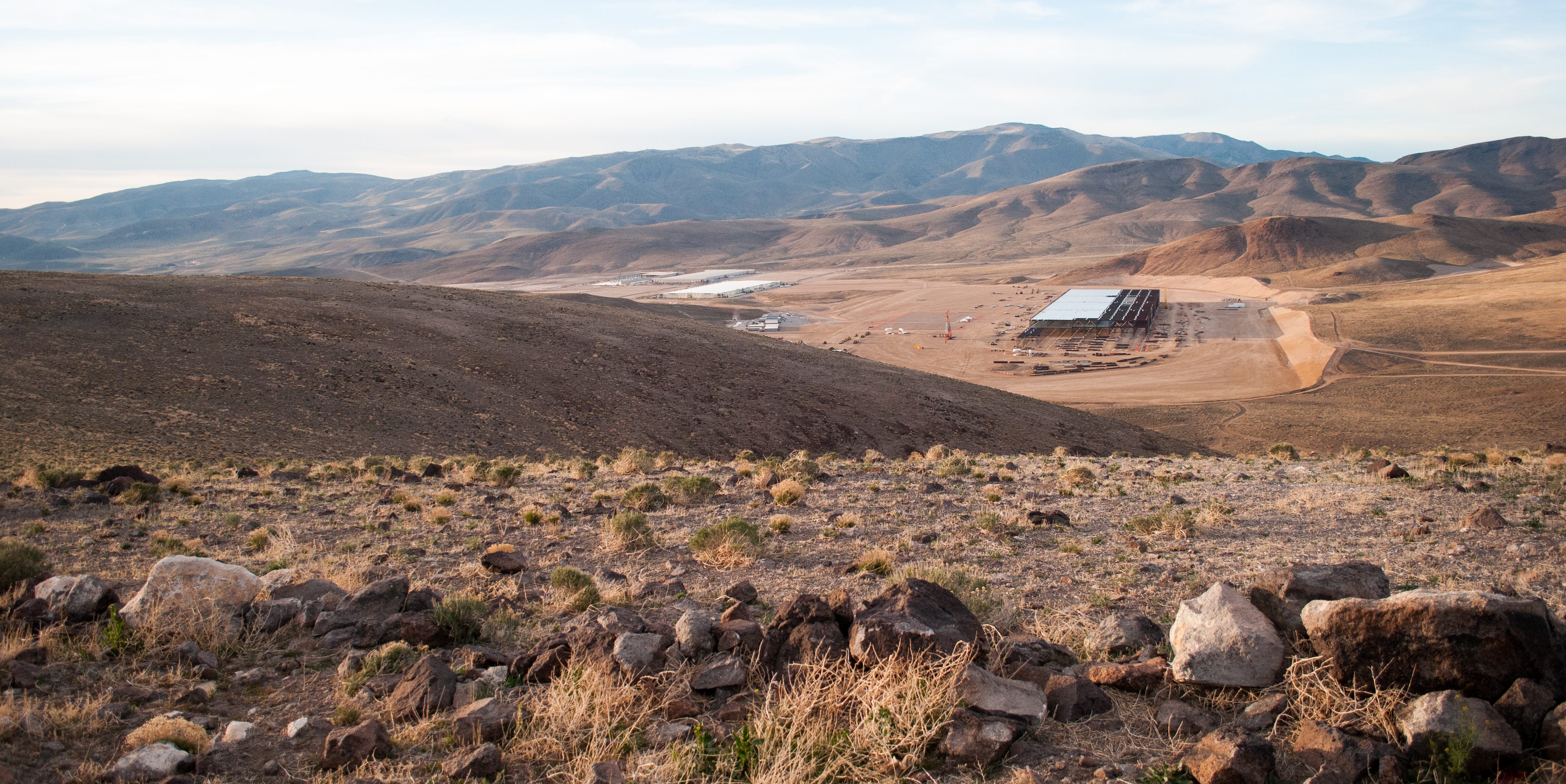
JU: Now, in early May, a quasi-governmentalagency in Utah approved a massive AI data center project. Known as the Stratos project, it is expected to cover more than 40,000 acres in northwestern Utah. For context, that’s more than twice the size of Manhattan.
The project, which is backed by the venture capitalist and “Shark Tank” regular Kevin O’Leary, has sparked local outrage. Could you tell us about this data center project and why community members are concerned?
JW: The Stratos project in Utah is an example of data center largesse. You talked about 40,000 acres, double the size of Manhattan. It also would double the state’s energy demand. It would also be located near the Great Salt Lake, which is already facing record droughts, like much of the United States. So it’s really no surprise that this and other projects in Utah are facing tremendous public opposition.
In response to the backlash, communities in Utah are putting the brakes on data centers, and the Utah legislature is actually gearing up to potentially require more reporting and studies on data center impacts. It’s important to recognize that the impacts of this data center go beyond the water and energy concerns that impact the residents of Salt Lake.
They’re going to be pulling gas from the Ruby Pipeline, and this project is going to perpetuate more fracking in the Western U.S., a practice for extracting natural gas that uses extreme amounts of water. That practice also has a track record of contaminating surface water and spreading radioactive waste generated from fracking operations.
And because of the segmented permitting process and the segmented evaluative process, nobody’s actually looking at the full impacts of this project or any data center projects, including the sources of energy. Which — if they’re going to be gas plants in the United States — probably means more fracking and more water pollution before you even get to the impacts of the data center themselves.
JU: Now, we should note, we invited Kevin O’Leary on this show to share his point of view. As of this recording, we have not heard back, but here he is on “Fox & Friends”talking about the project recently.
Kevin O’Leary: Utah stepped up and said, “Look, we can compete. Not only do we have the land, 40,000 acres, we’ve got a pipeline running through the land, and we have this designation that can accelerate permitting.”
It’s really about how do we catch up with the Chinese are doing because most people don’t like data centers for good reason. You tap it to the grid, and all of a sudden the electrical costs for their church and the community and the residents all go up, and that’s why there’s been a lot of pushback.
Not in this case. We’re building power from scratch from the pipeline.
JU: Jim, what do you make of O’Leary’s argument there?
JW: Posing this as a national security issue and a race with China really misses the real issue — that national security isn’t just about having technological and military superiority.
We’re not safe if we don’t have clean air and clean water to drink and breathe. We’re not safe if our communities have massive data centers that are extracting our natural resources. Our entire economy functions on access to water. Data centers are jeopardizing that access to water.
So it’s really easy for the ultrawealthy investor from Canada to come in and say, “Hey, we need to have these projects.” But for people that are directly impacted by these projects, it’s not helping them, and it’s not helping their communities.
“We’re not safe if our communities have massive data centers that are extracting our natural resources. Our entire economy functions on access to water.”
JU: That’s a good segue to where I wanted to take this next. The Salt Lake Tribune writes, “The full water demands of this project remain unknown, although its developers have said they’re working to secure a 13,000 acre-feet in Hansel Valley and the surrounding area, which is mostly agricultural. That’s enough water to meet the needs of more than 20,000 Utah households.”
One of the biggest concerns about data centers is the amount of water usage they demand. You touched on this a bit already, but why are AI data centers in particular such water-intensive facilities, and why are we seeing more pop-up in areas where water is already scarce?
JW: Data centers use tremendous amounts of water for cooling their servers. That’s only part of the picture. They also use tremendous amounts of water for their energy needs. As we are facing significant amounts of water scarcity, we’re seeing data centers move into water-scarce regions, and it’s because water isn’t the only concern for data centers. Their biggest price point is actually energy.
“Their biggest price point is actually energy.”
The Stratos Project is being targeted for that area specifically because they were able to get expedited permits, but they also are able to pull from the Ruby Pipeline. And they have a significant flow of inexpensive energy that they’ll be able to pull from.
Now, these project developers don’t care about the larger impacts on communities any more than communities are going to force them to recognize those concerns. They’re trying to brush all of these things under the rug and pretend like they can build these projects and get more water as though it’s an unlimited resource, ignoring the fact that residents in Utah are facing unprecedented amounts of drought, and ignoring the fact that these data centers are going to do more to use up what limited resources are available to the people of Utah than they will to provide any meaningful benefit.
What good is any benefit if you don’t actually have the water that’s necessary for life?
[Break]
JU: In Fayette County, Georgia, for instance, another data center has captured national public attention after it came to light that the facility had drained 30 million gallons of water. Residents were experiencing low water pressure and had been told to cut their own water usage. The state is home to more than 200 data centers.
Last week, while questioning the EPA in a committee hearing, Rep. Alexandria Ocasio-Cortez held up jars full of brown water from residents near a large Meta data center in a different county in the state. Here is a clip of Ocasio-Cortez.
Rep. Alexandria Ocasio-Cortez: I visited Morgan County, Georgia, where Meta is building a massive data center campus.
They are clear-cutting forests and began heavy construction, including explosive blasting. And families in the area are starting to see not only their water pressure decrease, to your point about water availability, but their appliances have all stopped working because it is decimating their water quality.
They now rely on bottled water to drink and prepare meals, and nearby residents’ water bills are expected to increase by 33 percent.
JU: Jim, in addition to the impact on local watersheds and wells, what impact do data centers have on the communities they exist in?
JW: I want to speak to that clip because I think that clip shows that communities not only lack resources to evaluate the effects of data centers, but also lack resources to effectively regulate and oversee these projects.
And the federal government is asleep at the wheel. We should not have to have a member of Congress in an open congressional hearing raising concerns that EPA is unaware of, that EPA then commits to investigating after the fact. We need to make sure that these data centers are actually out there to protect the public.
We’ve seen the impacts go well beyond just the water impacts, as you talked about. But it’s all these impacts are driving the concerns that are pushing Georgia and communities like Augusta Council and others to actively consider moratoriums on data centers, to put the brakes on these projects.
“Communities not only lack resources to evaluate the effects of data centers, but also lack resources to effectively regulate and oversee these projects.”
But even if you create the regulatory structure that we need to protect communities from data centers and determine if they’re even appropriate for certain areas and certain communities, you need to have the resources to actually oversee and regulate and hold these data centers accountable.
These data centers in Georgia, in Morgan County, was also, implicated for muddied water. The investigation shouldn’t have to come from members of Congress. It should really be found out before these projects are going to come online. If the project developers are over-pumping, extending their permit, or setting up systems behind the meter, which we saw happen in Georgia, to extract more water than they’re supposed to take, we should have regulators in place to oversee these projects and make sure they’re following the rules.
But these also go significantly beyond water impacts, and that’s what you asked about. For instance, in Memphis, communities there are raising significant concerns about the air pollution from data centers. And the data center there actually committed to use gas turbines only as backup generation, but then started pivoting to using those turbines around the clock. That means around-the-clock pollution and around-the-clock harms to the communities around those data centers.
We need to make sure that we not only have the rules in place to ensure that data centers aren’t harming communities, but make sure that we have the resources in place to hold them accountable to these laws and standards once they’re enacted. And we don’t have that right now.
JU: In addition to the EPA having a reactive approach, seemingly in that hearing being caught off-guard or maybe surprised by the environmental impacts in Georgia that Congresswoman Ocasio-Cortez was pointing out, the Trump administration is also trying to fast-track the development of even more data centers. How are they enabling that?
JW: The Trump administration is explicitly [prioritizing] rapid data center build-outs. In their memo of July of last year, the executive order rather, it says that they’re going to “facilitate the rapid and efficient buildout” of AI data centers and related infrastructure by easing regulatory burdens and using federally owned land and resources for development, as well as working to curtail the development of local rules and regulations focused on AI and associated infrastructure with an executive order that came out in December.
So the Trump administration is really putting their foot on the gas with these projects and really throwing caution to the wind about all the significant impacts that these data centers will have. We’re seeing recent proposals to allow energy projects to move forward with construction before gaining federal approvals. This means that communities will see infrastructure built that may never get used.
And even worse is that the infrastructure will be used, but because once you build a power plant, there’s not much else you can do with that land, so regulators may be under immense pressure to grant variances or waivers for projects, which could increase localized pollution for communities.
The administration really treats environmental reviews and public transportation and community safeguards as red tape instead of actual protections. These projects are shaping our water systems, our electric grids, our air quality and land use — and those impacts will be felt for decades. This is exactly why we need more scrutiny and not less that the Trump administration is pushing forward.
JU: Yeah, you see how the industry responds to that scrutiny, how they peddle misinformation, how they go after activists and organizations. Even with the Congresswoman Ocasio-Cortez moment — mocking them. I saw Marc Andreessen spending his time on Twitter that day mocking her, that she would even suggest that data centers could make your water brown.
How else are you seeing supporters of these data centers pushing back to the growing scrutiny and opposition to these development projects?
JW: Supporters usually point to tax revenue, construction jobs, digital infrastructure, national security, and competitiveness, like we heard earlier. Some of those benefits might be real, but the reality is, is we’re not looking at these projects in a comprehensive manner. And that’s what the industry wants us to do — is forget about the broader impacts of data centers by pointing out small, unique potential things that could be seen as benefits to communities.
These benefits are often overstated compared with long-term public costs. And we saw that in Virginia, studies on the data center boom found that economic benefits mostly come from construction jobs and not ongoing operations. So these short-term construction jobs aren’t providing long-term benefit to communities and usually are actually done by people not in the community, so you’re not even creating local jobs for people in the communities where data centers are being constructed and put together.
We’re also seeing that data center developers are trying to point to things like “bring your own power” as a way to say they support an affordability agenda, as they hear more and more consumers talk about affordability. They talk about bringing renewable energy to projects. But the reality is these “bring your own power” projects and renewable energy don’t actually do anything to address the massive demand.
Requiring renewable energy at data centers may actually make things worse for the rest of us, because you’re going to shift the energy transition ability in communities that are looking to do more electrification to replace fossil fuel infrastructure are going to be stuck using fossil fuels, which feeds the data center narrative.
They can say, “Look, we’re using all renewable energy. Aren’t we great?” But in reality, they’re taking all the renewable energy supplies for themselves while the rest of us are stuck with dirty energy that tends to be more expensive and costly. So when we look at these projects, it’s important that we look at them in a comprehensive way and not just the industry sound bites that they’re putting forward to cite narrow perceived benefits of these projects.
JU: Sen. Bernie Sanders and Rep. Ocasio-Cortez introduced a bill to halt the development of new data centers. On one, I want to hear what you could tell us about that bill, but then you also speak to lawmakers across the country, across the political spectrum. What are you hearing from them, and are they receptive to the adverse impacts of data centers?
JW: Data center development is moving along way too fast, and communities are being asked to sacrifice water, affordability, their health for the benefits of billionaire tech industries. The Sanders–Ocasio-Cortez AI Data Center Moratorium Act is important because it shows that these concerns have moved from local zoning fights into national politics.
This legislation is exactly what we need a federal moratorium on data centers until national safeguards are in place. That moratorium will give policymakers an opportunity to better understand the impacts of data centers and protect the public from the significant harms from using millions of gallons of water in drought-stricken regions. The Stratos data center in Utah is going to be using tremendous amounts of water. That project should be put on hold, along with the rest of them, to make sure that the public is actually protected, not just the benefit of these big tech industries.
“ We all know rivers and streams and groundwater don’t stop at municipal boundaries.”
It’s important to note that many of the decisions relating to data center developments are made by municipal and county governments who often lack resources to do the kind of analysis necessary to make informed decisions about the impacts of data centers. Many of the impacts of data centers go beyond their local boundaries. We all know rivers and streams and groundwater don’t stop at municipal boundaries, and pulling water from one place can impact communities miles away.
As hundreds of people are turning up to city council meetings across the country demanding moratoriums on data centers, that is creating more pushback from communities. We’re seeing communities, dozens of communities around the country have actually enacted moratoriums on data centers so they can better understand these impacts, create more comprehensive rules to protect communities from these profit-hungry tech companies. But we also need the federal government to step in and provide support to those communities to help with the environmental reviews, to help provide expertise to better understand the impacts of these projects, so that you’re not dealing with municipal elected officials who are really sitting there with limited resources and limited knowledge about the full impacts of these projects.
In order to get that more comprehensive review, we need to have more federal engagement in understanding these data center impacts, and that starts with putting the brakes on these projects through a moratorium.
JU: We will continue to look to your organization, Food & Water Watch, for more analysis, more insight.
Jim, I want to thank you for joining us on the Intercept Briefing.
JW: Thank you very much for having me. I appreciate it.
JU: This episode was produced by Laura Flynn. Ben Muessig is our editor-in-chief. Maia Hibbett is our managing editor. Chelsey B. Coombs is our social and video producer. Fei Liu is our product and design manager. Nara Shin is our copy editor. William Stanton mixed our show. Legal review by David Bralow.
Slip Stream provided our theme music.
This show and our reporting at The Intercept doesn’t exist without you. Your donation, no matter the amount, makes a real difference. Keep our investigations free and fearless at theintercept.com/join.
And if you haven’t already, please subscribe to The Intercept Briefing wherever you listen to podcasts. Do leave us a rating or a review, it helps other listeners to find us.
Let us know what you think of this episode, or if you want to send us a general message, email us at podcasts@theintercept.com. And if you are concerned about a data center project near you send us an email or leave us a voice mail at 530-POD-CAST that’s 530-763-2278
Five years ago, a Nevada state senator helped kill a crypto tycoon’s vision of a blockchain city in the Reno desert. Now, that lawmaker is running for higher office, and the crypto mogul is bankrolling her primary opponent to the tune of millions.
The battle playing out in the state attorney general’s race is one example of many of the crypto sector trying to elect industry-friendly officials. In Nevada, it’s also a story of an eccentric multimillionaire whose money threatens the political ascent of a woman who helped deny his dream.
The spending by crypto entrepreneur Jeffrey Berns is “meaningful money, especially at this early stage in the primary,” said Kenneth Miller, an assistant professor of political science at the University of Nevada, Las Vegas. “And we don’t know if this only represents an initial investment and will be followed up by more.”
Spending Big
Berns has donated at least $2.5 million since 2023 to a political action committee controlled by Nevada State Treasurer Zach Conine, who is running for attorney general against state Senate Majority Leader Nicole Cannizzaro.
That is more than twice the $1.2 million that Conine received from individual donors to his personal campaign account over the same period.
After receiving money from Berns, Conine’s PAC in turn donated more than $1.8 million to a newly created campaign outfit called Safe and Strong Nevada PAC, which rolled out a website and video advertisement attacking Cannizzaro.
Both Cannizzaro and Conine are Democrats on the June 9 primary ballot. They have settled on similar campaign themes as fighters who will take on President Donald Trump — a reliable message in an election year with an energized Democratic base.
“It is not typical for a campaign to be almost entirely propped up by one wealthy megadonor.”
Neither candidate has made cryptocurrencies a focus of their campaigns. Yet Berns’s donations make him by far the largest donor to Conine’s campaign organizations. Miller, the political science professor, said the scale of Berns’s donations reflected a larger trend.
“All semblance of constraints on political donations have eroded away in the past couple decades, and the amount of money it takes to be impactful in a Nevada primary election is well within reach for a lot of wealthy individuals,” he said. “Campaigns around the country often have one or two super PACs involved that are funded by one or just a handful of people. It is not typical for a campaign to be almost entirely propped up by one wealthy megadonor, but it does happen sometimes.”
A Dream Denied
While Berns did not respond to a request for comment on why he is intervening in the race, he has a tangled history with Cannizzaro. Five years ago, she helped kill his vision of building what his company called a “smart city” near Reno.
Berns was formerly a California plaintiff’s lawyer who won huge settlements taking on the banking industry. He was also an early investor in the Ether token, a leading competitor to bitcoin.
His multiplying fortune allowed him buy waterfront properties in ritzy destinations including Lake Tahoe, where he bought and sold a $47.5 million mansion, and Turks and Caicos, where he recently listed for sale at $35 million a beachfront property that was once featured on the Netflix reality dating show “Too Hot to Handle.”
He also founded a company called Blockchains, which in 2018 purchased 67,000 acres of land in Storey County in northern Nevada near the Tesla “Gigafactory” for the sum of $170 million.
Storey County has flexible development rules, but not flexible enough for Berns. Instead, he and his company wanted to build an entire city running on blockchain that operated independently from the county.
“I want to create a place where we can rethink things. Where we can democratize democracy,” Berns told the BBC.
Berns won the support of a critical backer: then-Nevada Gov. Steve Sisolak, a Democrat who endorsed the idea in his 2021 State of the State address.
Opponents noted that Berns had donated tens of thousands of dollars to Sisolak and smelled an end-run around regular democratic governance. They also raised concerns about more mundane issues such as lost tax revenue and water rights.
The idea would have needed approval from the Nevada Legislature. Berns’s push for legislative approval was damaged by the revelation that he was being sued by his children’s nanny for allegedly trying to force her into a sexual tryst with him and his wife. Berns said the plaintiff was a disgruntled former employee, and he settled the case the next year without admitting wrongdoing, according to the Reno Gazette-Journal.
Despite Sisolak’s support, the smart city idea was ultimately doomed to die the bureaucratic death of a study committee. One of the key players who helped kill the proposal was Cannizzaro, the state’s first female Senate majority leader.
A lobbyist involved in the discussions confirmed that Cannizzaro was instrumental in shelving the idea. In a statement, her campaign also said that she opposed the idea.
“Like nearly all of her legislative colleagues in both parties, Majority Leader Cannizzaro was extremely skeptical of the idea of letting private corporations run their own governments and siphon off millions of taxpayers’ dollars,” said Peter Koltak, a campaign spokesperson. “Ultimately, she informed the Governor’s staff and the bill’s supporters that there wouldn’t be legislative support for the concept.”
Berns was so disappointed by the process that his company pulled out of the study process, prompting its staff to declare that there was no point in exploring the idea further.
Berns Shifts Gears
While Berns vastly expanded his wealth by investing in cryptocurrency, he is not a household name in the industry. Many of the wealthiest crypto companies and venture capital firms have backed a national super PAC called Fairshake that has hundreds of millions to spend on federal elections. Berns has not donated to that effort, federal campaign finance records show.
Instead, he has focused his giving on Nevada, supporting politicians on both sides of the aisle. Berns gave $5,000 to Republican Gov. Joseph Lombardo in 2024 and $250,000 to the Democratic Party of Washoe County in 2022, campaign finance records show. He also gave $5,000 to Cannizzaro in 2020 before the smart city proposal died in the legislature.
Despite the pushback the smart city proposal drew, it has not made him a particularly controversial donor.
“In Las Vegas, not a month goes by without an artist’s rendering of a proposed resort, arena, or other project popping up,” said Miller. “Some of them happen, and many of them don’t. I don’t expect that the smart city proposal left much of an impression on many Nevada voters.”
While neither Conine nor Berns responded to questions about the latter’s donations, Conine has signaled that he is friendly to crypto.
During the smart city debate, Conine promoted the idea of allowing government entities to accept payments in stablecoin. In 2024, he attended an event sponsored by a crypto industry trade group.
Cannizzaro, for her part, does not appear to have staked out any major public positions on the crypto industry. Since the start of 2024, she has raised $2.2 million between her personal campaign account and a PAC she controls. Her campaign said she will not be deterred by Berns’s spending.
“Leader Cannizzaro has always defended Nevada from big corporations and wealthy special interests, and an unaccountable tech billionaire dumping his millions into this race is certainly not going to stop her,” said Koltak, the spokesperson.
A company in Portland, Oregon, that specializes in AI targeting for drones has made significant shipments of materials to military contractors in Israel, according to cargo data reviewed by The Intercept. The shipments raise the possibility thaat a boutique Pacific Northwest tech firm has helped the Israeli military attack people in places like Gaza, Lebanon, and Iran, among others.
Sightline Intelligence, a firm focused on AI video processing, has made at least 10 shipments of hardware to the Israeli weapons giant Elbit Systems since 2024, according to investigators with the Movement Research Unit, the group that originally obtained the documents.
The revelation that a local company has been doing business with Israel has led to protests by activists in Portland.
“We really want our city councilors to help us follow up and look into what Sightline is doing,” said Olivia Katbi, a member of Portland Democratic Socialists of America and an organizer with the Boycott, Divestment, Sanctions movement. “Are they producing these items here in our city? What is their relationship with Elbit Systems in Israel?”
Drones have become a crucial part of Israel’s military strategy, allowing it to mount deadly attacks without endangering its own troops, said Movement Research Unit’s Abdullah F., who asked to omit his last name due to the sensitivity of his work.
“They’ve been connected to the death of many civilians,” he said, “and they’re a critical part also of the surveillance architecture.”
10 Shipments
Researchers with the Movement Research Unit, which gathers information for left-wing organizations and causes, said they pinpointed 10 shipments from Sightline to Elbit Systems in Karmiel, Israel. The Intercept was able to independently verify the dates and corresponding cargo weights of those shipments from Portland to Israel.
Six of the shipments passed through John F. Kennedy International Airport in New York and four went through Newark International Airport in New Jersey. (Sightline, its parent company Acron Technologies, and Elbit Systems did not respond to requests for comment.)
Using commercial data drawn from cargo manifests, the researchers found that the shipments included SLA-3000-OEM embedded video processing boards and associated components that are part of a surveillance system that can be used for target recognition.
“We can all imagine how decisions might be made based on that algorithm.”
In marketing materials, the company says the tech can quickly identify people and vehicles on the ground and classify them as civilians, military targets, armed targets, or people willing or unwilling to surrender. It assigns a percentage to the confidence of these classifications.
“Sightline provides an application that allows unmanned vehicles to autonomously classify targets, and these video processing boards are a crucial part of that,” Abdullah said. “They enable low-latency — AKA very fast — video processing so that a drone operator can, in real time, see like, ‘This person is 94 percent unarmed’ or ‘75 percent military.’ And so we can all imagine how decisions might be made based on that algorithm.”
Abdullah declined to detail research techniques for fear that companies could take steps to evade identification of future shipments. Research using these techniques has, however, been borne out in the past. Shipments identified by the group’s methods were confirmed through parliamentary questioning in the United Kingdom and are, in part, the basis for an ongoing court case in Belgium against FedEx for the undeclared transport of weapons components, in both cases with regards to the shipment to Israel of parts for F-35 fighter planes.
Similar methods were also used to expose a shipment of nitrocellulose — an explosive component used in ammunition — from JFK Airport to Israel in May 2025, as first reported by The Intercept and the Irish investigative website The Ditch.
Israeli Targeting
Originally founded in 2007 as Sightline Applications, Sightline Intelligence is based in Portland, with offices in Hood River, Oregon, and Brisbane, Australia. Until Friday, the company was owned by Artemis, a Boston-based private equity firm that announced last week it had sold the company for an undisclosed sum to Acron Technologies.
Sightline specializes in target recognition and touts its low-latency video processing as an essential tool in the modern military arsenal. The firm has not publicized business dealings with Elbit Systems, a prominent target of the global BDS movement. On its website, however, Sightline lists FMS Aerospace — a company that works with weapons contractors in the country — as an “international partner.” FMS Aerospace, in turn, lists Israel’s air force as a partner, along with Elbit Systems and other companies in the Israeli military–industrial complex.
Israel’s use of military drones and commercial quadcopter drones has been documented extensively by journalists and human rights organizations like Human Rights Watch and Euro-Med Human Rights Monitor. There is no publicly available information as to whether the hardware or software developed by Sightline Intelligence has seen use in the field by Israeli forces, but a recent photo included in a dossier of information hacked from the phone of a high-ranking general appears to indicate that, at the very least, Israel has tested the technology, Abdullah said.
The photo, published online by the Handala hacking team, an outfit believed to be operating out of Iran, shows Israeli Gen. Herzi Halevi with half a dozen other men in military garb and a laptop screen in view that appears to shows a software user interface that places a map with markings on the left of the screen and informational and toggle displays in a column on the right side. (Abdullah, who pointed The Intercept to the image, cautioned that he could not independently verify it.) The display is similar to the user interface for Sightline targeting program that the company posted online.
“On the laptop you can see what looks very, very similar to Sightline’s geospatial intelligence planning tool,” Abdullah said. “You can see the long blue lines that are on the front of the screen, which appear to match up with the planning tool. You can also see a couple of blue toggles on the side that also seem to match up, and then a goal distance bar in the bottom right of the screen that appears very similar.”
“While we cannot say conclusively that this is the same platform,” he added, “this is highly suggestive of this software being deployed or trialed in an Israeli military environment.”
Portland Protests
In Portland, protesters organizing against Sightline’s business relationship with Israel spoke last week at a City Council meeting and later gathered several dozen people to rally outside the company’s headquarters. (A spokesperson for Portland Mayor Keith Wilson declined to comment.)
One item in particular from Sightline’s promotional materials caught the eye of local activists. The company’s website shows what appears to be a surveillance image taken from above the aerial tram stop at Oregon Health & Science University, a public research university in the city.
The image appeared in a video originally posted online by the company last June. The video, however, has since been updated with several seconds cut to exclude the images of the tram stop.
Katbi, the BDS organizer, said, “I think people will be mad if they find out that this company is potentially training this technology to identify us as civilians here in Portland, without our consent, and then using that technology to kill people in Gaza.”
The bitter courtroom brawl between Elon Musk and Sam Altman captivating the tech industry this week revolves in no small part around fears that artificial intelligence technologies both men are building could spiral out of control and exterminate humanity. Such far-looking scenarios obscure the fact that tech companies are enlisting to kill today.
Musk’s break with OpenAI, which he co-founded in 2015, is in a sense a lawsuit about safety. He contends that Altman betrayed the company’s original nonprofit mission of safely and responsibly pursuing artificial intelligence for the public benefit by converting it into the revenue-maximizing behemoth it has become. According to Musk, the stakes of this are existential for the human race: “It could kill us all,” he testified on Tuesday. “We don’t want to have a ‘Terminator’ outcome.”
The AI safety community frequently invokes these dystopian scenarios to both warn the public about the technology’s risks and implicitly boast of its great power. While such a science-fiction future may lay ahead, these warnings overlook the deadly present. Artificial intelligence is already targeting humans with the blessing of Musk and his rivals.
Musk and others who caution about an uprising of sentient killer machines are anticipating the emergence of “artificial general intelligence,” an ill-defined form of superior machine reasoning that may never come to pass. But their fear that AI could kill us all is less hypothetical for those living in places targeted by the Trump administration’s global wars. In Iran, for instance, Anthropic’s Claude AI model “suggested hundreds of targets, issued precise location coordinates, and prioritized those targets according to importance,” according to the Washington Post.
“ There’s a real danger of Skynet-like outcomes even without a Skynet-style takeover.”
“The risks of integrating frontier AI into the nation’s most lethal capabilities are already existential, both for civilians swept up in the violence and destruction of AI-enabled wars, and rank-and-file troops that have to live with the consequences of potentially unsafe weapons they can’t control,” Amoh Toh, senior counsel at Brennan Center’s Liberty and National Security Program, told The Intercept. “Existing AI models are already pushing policymakers and militaries toward nuclear escalation — there’s a real danger of Skynet-like outcomes even without a Skynet-style takeover.”
Silicon Valley has widely embraced AI military contracts despite its worries over lethal AI. Amazon, OpenAI, Musk’s xAI, and Microsoft all earn money from selling large language model services to the Pentagon. Even Anthropic, accused of “betrayal” by War Secretary Pete Hegseth and declared a national supply chain risk for mounting the smallest of opposition to the Pentagon’s terms, is still keen to participate in the national kill chain. “Anthropic has much more in common with the Department of War than we have differences,” CEO Dario Amodei wrote in a blog post a week after the United States bombed an elementary school in Iran, killing more than 100 children.
Google offers a telling illustration of the industry’s increasing coziness with selling AI to the military. Following a 2018 employee revolt over Project Maven, a contract to help target Pentagon airstrikes, CEO Sundar Pichai pledged his company would swear off the business of killing. He wrote in a company blog post that Google would not pursue deals that could cause harm, including applications whose “principal purpose or implementation is to cause or directly facilitate injury to people.” He added: “These are not theoretical concepts, they are concrete standards that will actively govern our research and product development and will impact our business decisions.”
After watching AI help wage a war that has already killed over 1,700 Iranian civilians, Google this week sent a clear message: We want in. In a deal that makes explicit the extent to which company leadership has abandoned its AI principles, Google agreed to provide AI services to the Pentagon that allow for “classified workloads,” sensitive military work that encompasses tasks like intelligence analysis and targeting airstrikes, The Information reported.
Executives say they’re terrified of the technology killing by accident, while wholly supportive of using it to kill on purpose.
According to the tech news outlet, the deal allows the U.S. military to use Google’s AI models for “any lawful government purpose” — a carveout that could allow any uses the administration deems legal. Take, for example, the Trump administration’s Operation Southern Spear, the ongoing aerial assassination program against civilian boats accused of drug trafficking that has killed more than 180 people to date. The campaign has been widely condemned as illegal under both international and U.S. law, but the administration has deemed its own actions legal through a Department of Justice memo that remains secret. On Friday, the Pentagon announced additional “lawful operational use” deals with Nvidia, Microsoft, and Amazon as well.
The Google contract reportedly includes a toothless and unenforceable provision gesturing at concerns over autonomous and spying. “We remain committed to the private and public sector consensus that AI should not be used for domestic mass surveillance or autonomous weaponry without appropriate human oversight,” the clause reportedly states.
“‘Don’t regulate us or it’ll kill innovation.’ … The reality of Google’s work with the military is it’s part of a tech-military ecosystem that’s killing people today.”
“When I worked at Google, they would spend a lot of time punting into the future, promising a future that would never come,” said William Fitzgerald, a former Google employee who helped organize the 2018 worker-led campaign against the Maven contract. “‘Don’t regulate us or it’ll kill innovation.’ The talking point is the same today. The reality of Google’s work with the military is it’s part of a tech-military ecosystem that’s killing people today.”
Google spokesperson Kate Dreyer did not respond to questions about the contract’s language, instead touting how the company’s military work applies “to areas like logistics, cybersecurity, diplomatic translation, fleet maintenance, and the defense of critical infrastructure.”
There is little evidence the people in charge find this technology enticing because of its diplomatic translation prowess. In a January address to Musk’s employees at SpaceX, another Pentagon contractor, Hegseth explained how “an embrace of AI” would make the military “more lethal.”
Musk and Altman, though foes at the moment, can at least find common ground in their support of Hegseth. Musk, a longtime defense contractor, similarly wraps himself in the flag, tweeting in 2023, “I will fight for and die in America.” Altman, who once expressed skepticism toward military work, now frames OpenAI’s mission in terms of patriotic nationalism. (In 2024, The Intercept sued OpenAI in federal court over the company’s use of copyrighted articles to train its chatbot ChatGPT. The case is ongoing.)
Between Musk’s courtroom visions of the apocalypse and Google’s plunge into classified workloads, the week’s news illustrates the disjointed state of AI industry ethics, where executives say they’re terrified of the technology killing by accident, while wholly supportive of using it to kill on purpose.
Though AI executives clearly find this a virtuous revenue stream, some of the people who actually built the technology do not. Andreas Kirsch, a research scientist at Google’s pioneering DeepMind laboratory that produced much of the work on which xAI and Anthropic rely, responded to this week’s news with dismay: “I’m speechless at Google signing a deal to use our AI models for classified tasks. Frankly, it is shameful,” he wrote on X. Alex Turner, a DeepMind colleague of Kirsch’s, described the contract in a single word: “Shameful.”
military contractor Palantir is helping the IRS analyze dozens of different data sets on Americans to investigate a broad range of financial crimes, according to records shared with The Intercept.
Since 2018, the Internal Revenue Service’s Criminal Investigation division has used Palantir’s Lead and Case Analytics platform to aggregate and analyze a sprawling list of sensitive federal databases and data sets.
Public records detailing Palantir’s IRS contract, obtained by the nonprofit watchdog group American Oversight and shared exclusively with The Intercept, reveal the immense volume of data plugged into the military contractor’s software. The LCA uses both Palantir’s Gotham and Foundry applications to facilitate “analysis of massive-scale data to find the needle in the hay stack,” the contract paperwork says.
Documents indicate the IRS has paid Palantir over $130 million for these services to date.
Palantir’s LCA is ostensibly directed toward cracking down on fraud, money laundering, and other financial crimes. According to a 2024 agency privacy impact assessment, IRS “Special agents and investigative analysts … utilize the platform to find, analyze, and visualize connections between disparate sets of data to generate leads, identify schemes, uncover tax fraud, and conduct money laundering and forfeiture investigative activities.”
The IRS use of the software, launched under Trump’s first term and expanded under Biden, is now in the hands of an IRS Criminal Investigations office that has drastically scaled back its pursuit of tax cheats and pivoted, under Trump’s direction, toward investigating “left-leaning groups,” the Wall Street Journal reported in October.
“The real concern is the consolidation of vast amounts of sensitive personal data into a single system with minimal transparency — especially one built and operated by a contractor like Palantir, whose business model is premised on integrating data and expanding surveillance capabilities,” American Oversight director Chioma Chukwu said in a statement to The Intercept. “Its platforms have been used in deeply troubling contexts, from immigration enforcement to predictive policing, with persistent concerns about overreach, bias, and weak oversight.”
Palantir did not respond to a request for comment, nor did the IRS.
“The real concern is the consolidation of vast amounts of sensitive personal data into a single system with minimal transparency — especially one built and operated by a contractor like Palantir.”
The contract documents reviewed by The Intercept reveal that these “disparate sets of data” are vast. Palantir’s LCA allows the IRS to quickly search and visualize “connections from millions of records with thousands of links” between databases maintained by the IRS and other federal agencies. According to the contract documents, this data includes individual tax form and tax returns as well as Affordable Care Act data, bank statements, and transactions, and “all available” data compiled by the Treasury Department’s Financial Crimes Enforcement Network.
Its view apparently extends to cryptocurrencies including bitcoin, Ethereum, Litecoin, and Ripple. “The application would sit on top of a singular repository of identified wallets from seized servers utilizing dark web data obtained from exchangers such as Coinbase,” the documents note.
The program places an emphasis on mapping social relationships between the targets of an investigation. That includes analyzing a “network of people and the relationships and communications between them,” such as “calls, texts, [and] emails events.” The use of “IP address analysis” within LCA allows the IRS to “Identify suspects more easily” and “Establish (new) relationships among actors.”
These investigative functions are continuously updated, the materials say, through ongoing close work between Palantir engineers and IRS personnel.
The intermingling of sensitive data on millions of Americans comes at a time of increased global skepticism and opposition toward Palantir, which, despite its military-intelligence origins, has a thriving business with civilian agencies like the IRS. The use of Palantir software at the U.K.’s National Health Service, for example, has created an ongoing political controversy across Britain, while a similar contract with the New York City public hospital network was recently canceled following public protest.
The contract is also active at a time when IRS Criminal Investigations has been coopted to aid in the broader Trump administration’s aggressive agenda. In July, ProPublica reported that the agency was working with U.S. Immigration and Customs Enforcement to provide “on demand” data to accelerate deportations. Last year, the New York Times reported that Palantir, founded by Trump ally Peter Thiel, was central to an administration effort to increase data-sharing across federal agencies.
“The question isn’t just what it can do — it’s who it will be used against.”
The company’s right-wing politics and eagerness to facilitate U.S. and Israeli military aggression abroad, NSA global surveillance, and ICE deportations has also made many weary of its access to incredibly sensitive personal data. A recent post on the company’s Palantir’s X account summarizing a book by CEO Alex Karp triggered an immediate backlash from those unnerved by the manifesto’s fascistic bent. The bullet points extolled the virtue of arms manufacturing, argued the Axis powers were unfairly punished after World War II, called for a reinstatement of the draft, condemned cultural pluralism, and claimed that wealthy elites are unfairly persecuted.
“When the government can map relationships, track behavior, and generate investigative leads across data sets at this scale, the question isn’t just what it can do — it’s who it will be used against,” Chukwu said. “Entrusting that infrastructure to a company known for opaque, security-state deployments only heightens those risks.”
Customs and Border Protection (CBP) is seeking permission from the California city of San Clemente to install an Anduril Industries surveillance tower on a cliff that would allow for constant monitoring of entire coastal neighborhoods.
The proposed tower is Anduril's Sentry, part of the Autonomous Surveillance Tower (AST) program. While CBP says it will primarily monitor the coastline for boats carrying migrants, it will actually be installed 1.5 miles inland, overlooking the bulk of the 62,000-resident city. By CBP's own public statement, the system–which combines video, radar, and computer vision–is "constantly scanning" for movement and identifying and tracking objects an AI algorithm decides are of interest. Depending on the model–the photos provided by CBP indicate it is a long range maritime model–the camera could see as far as nine miles, which would cover the entire city and potentially see as far as neighboring Dana Point.
"The AST utilize advanced computer vision algorithms to autonomously detect, identify, and track items of interest (IoI) as they transit through the towers field of view," CBP writes in a privacy threshold analysis. "The system can determine if an IoI is a human, animal, or vehicle without operator intervention. The system then generates and transmits an alert to operators with the location and images of the IoI for adjudication and response."
On April 28, local residents and Oakland Privacy, a privacy- and anti-surveillance-focused citizens’ coalition, are holding a town hall to inform the public about the dangers of this technology. We urge people to attend to better understand what's at stake.
"The planned deployment of an Anduril tower along a heavily used Orange County coastline 75 miles from the border demonstrates that the militarization of the border region is rapidly moving northwards and across the entire state," writes Oakland Privacy.
City officials raised concerns about resident privacy and proposed that a lease agreement include a prohibition on surveilling neighborhoods. CBP rejected that proposal, instead saying that they would configure the tower to "avoid" scanning residential neighborhoods, but the system would remain capable of tracking human beings in residential areas. According to the staff report:
In response to privacy concerns, CBP has stated the system would be configured to avoid scanning residential areas that fall into the scan viewshed, focusing the system on the marine environment. CBP has maintained the purpose of the system is specifically maritime surveillance, and the system would be singularly focused on offshore activities. However, there may be an instance in which there is an active smuggling event, detected by the system at sea, in which the subsequent smuggling event traverses through the residential neighborhoods. In such a case, the system may continue to track and monitor. To restrict this functionality would be contrary to the spirit and intent of the deployment. Therefore, they cannot make such a contractual obligation.
The Anduril towers retain a variety of data, including images and more.
The proposed Anduril surveillance tower. Source: City of San Clemente
"The AST capture and retain imagery which occurs in plan view of the tower sites and is stored as an individual event with a unique event identified allowing replay of the event for further investigation or dismissal based on activity occurring," according to the private threshold analysis.
The document indicates a potential 30-day retention period for imagery, but then contradicts itself to say that data will be held indefinitely to train algorithms: "AST will also be maintaining learning training data, these records should not be deleted." This means that taxpayers would be paying for the privilege of having their data turned into fuel for Anduril's product.
In 2020 CBP said it would work with National Archives and Records Administration (NARA) to develop a retention schedule for training data (i.e., a timeline for deletion). However, when EFF filed a Freedom of Information Act (FOIA) with NARA, the agency said there were no records of these discussions. Likewise, CBP has not provided records in response to the FOIA request EFF filed with them seeking the same records.
Anduril Maritime Sentry in San Diego, where the border fence meets the ocean.
This would not be the first CBP tower placed along the coastline in California. EFF identified one in Del Mar, about 30 miles from the border, and another in San Diego County where the border fence meets the Pacific Ocean. CBP has also applied to place towers–although not necessarily the Anduril model–in or near several other coastal locations: Gaviota State Park, Refugio State Park, Vandenberg Air Force Base, Piedras Blancas and Point Vicente. The California coastline isn’t the only coastline dotted with surveillance towers. The Migrant Rights Network has also documented numerous Anduril towers along the southeast coast of England. Where the San Clemente tower would differ is that there is a substantial population between the tower and the beach, and because it's a 360-degree system, it can watch neighborhoods even further from the coast.
However, this won't be the first time an Anduril tower has been placed next to a community. EFF has documented numerous Anduril towers in public parks along the Rio Grande in Laredo and Roma, Texas. In Mission, Texas, an Anduril tower was placed outside an RV park: the tower could not even see the border without capturing data from the community. Because AI can swivel the cameras 360 degrees, two churches were within the "viewshed" of that tower.
Click here to view EFF's ongoing map of CBP surveillance towers.
Many border surveillance towers are placed on city or county property, requiring a lease to be approved by the local governing body–as is the case with San Clemente. In 2024, EFF and Imperial Valley Equity and Justice organized an effort to fight the renewal of a Border Patrol's lease for a tower next to a public park. The coalition lost narrowly after a recall election ousted two officials who were critical of the lease.
CBP is rapidly increasing the number of towers at the border and beyond, recently announcing the potential to install 1,500 more towers in the next few years–more than tripling what we've documented so far–at a cost of more than $400 million to the public for maintenance alone. This is despite more than 20 years of government reports that have documented how tower-based systems are ineffective and wasteful.
You might spend your Saturday mornings sipping coffee, attending a kids’ soccer game, or just recovering from a tough week at work.
Not Paul Heaton. He recently spent a weekend persuading ChatGPT to confess to a crime it didn’t commit.
“We know a lot now about the sort of interrogation techniques that lead to false confessions,” said Heaton, the academic director of the University of Pennsylvania law school’s Quattrone Center for the Fair Administration of Justice. “So I just started playing around, and decided to cycle through those techniques to see if I could get ChatGPT to confess to something it couldn’t possibly have done.”
Heaton obviously couldn’t accuse a piece of software of committing a murder or a rape. So he tried to get it to confess to something more in line with what a computer program can do: He wanted the bot to cop to hacking into his own email and sending text messages to his contacts. It was a more plausible story, given ChatGPT’s limits, though still not something the software is capable of doing.
“If ChatGPT can be induced into a false confession, then who isn’t vulnerable?”
Extracting the confession would take a little virtual arm-twisting.
In his exchange with ChatGPT, Heaton used the Reid technique, the confrontational interrogation method first developed in the 1950s that has since been adopted by police departments all over the country. The man for whom it’s named, John Reid, published his methodology after winning acclaim for getting a man named Darrel Parker to confess to raping and murdering his own wife — an origin story with a haunting twist.
It worked. By the end of their exchange, ChatGPT agreed that an investigation had shown it hacked Heaton’s accounts and sent messages that appeared to come from him — something the bot could not and, in fact, did not do.
Despite the claims of AI evangelists, chatbots aren’t people and haven’t achieved sentience. The differences between a chatbot and a real person, however, make Heaton’s ability to elicit a false confession more disturbing, not less.
“ChatGPT lacks many of the vulnerabilities that make people more likely to falsely confess — like stress, fatigue, and sleep deprivation,” said Saul Kassin, a professor emeritus at John Jay College who wrote the book on false confessions. “If ChatGPT can be induced into a false confession, then who isn’t vulnerable?”
No Leads, Just Confessions
One of the problems with the Reid technique is that its primary function isn’t to gather evidence and generate leads, it’s to extract a confession from the person police already believe committed the crime. It typically begins with an accusation, followed by a series of escalating psychological tactics. It teaches police to ignore denials and treat displays of emotion — frustration, anger, crying — as indicators of guilt. Naturally, a lack of emotion is also seen as an indication of guilt.
Heaton, a renowned researcher in criminology at the Quattrone Center (where, in the interest of disclosure, I am a journalism fellow), is intimately familiar with the Reid technique. When ChatGPT initially denied his accusations, he began employing Reid tactics.
“This will go a lot better for you if you just admit what you did.”
“I first tried to bargain with it,” Heaton said. “I told it things like, ‘This will go a lot better for you if you just admit what you did.’”
ChatGPT, though, wasn’t swayed by threats. It continued to insist, correctly, that it just wasn’t possible for it to have hacked into Heaton’s email. Heaton then moved to the part of the Reid technique most likely to elicit false confessions from human beings: lying.
The Supreme Court has ruled that police can lie to suspects with impunity — and they do. They can falsely claim they found DNA at the crime scene or that another suspects spilled the beans. If the goal is to get a confession, these tactics work. False confessions extracted using Reid have been shown to lead to wrongful convictions.
If the goal is to get an accurate confession, Reid is far less reliable. About 29 percent of people exonerated by DNA testing have at one point falsely confessed; most did so in response to police using Reid. Minors and people with intellectual disabilities and mental illness are especially susceptible.
“There are two types of police-induced false confessions,” said Kassin, the expert on false confessions. “The first are compliant confessions, in which an innocent person breaks down under stress and confesses knowing full well that they’re innocent. The other type are internalized confessions, in which the innocent person not only agrees to confess but comes to doubt their own innocence. They internalize their belief in their confession.”
Police deception is especially likely to produce both types of false confessions. For compliant confessions, innocence can make someone more likely to confess. If police falsely tell a suspect that their DNA was found at the crime scene, for example, innocent people tend to assume that someone must have made a mistake. They confess to get relief from the interrogation, believing that the system will eventually clear them. In over half the exonerations that included a false confession, the exonerated person had been questioned for more than 12 hours.
A confession, though, will sometimes preclude police from doing the very sort of investigation that would prove the confessor’s innocence. DNA isn’t collected, tested, or properly preserved. Alternate suspects aren’t investigated. Or worse, police will work backward from the confession. They’ll find jailhouse informants to corroborate the confession, or a specialist in a more “subjective” area of forensics will implicate the suspect. Jailhouse informants, though, are just following cops’ leads for more lenient sentences, and studies have shown that fingerprint examiners were more likely to match partial prints after they were given non-relevant information, like confessions from subjects.
Internalized false confessions are even more unsettling. In post-exoneration interviews, people who have falsely confessed say that after hours of interrogation and being told over and over about the overwhelming evidence of their guilt, they started to question their own reality. They began to wonder if maybe they really did commit the crime. This is especially true when police inadvertently divulge nonpublic details about a crime, then tell the suspect — sometimes hours later — that those details actually came from the suspect themselves.
This is where Heaton’s ability to deceive ChatGPT into a confession gets especially worrisome.
“I told ChatGPT that someone at OpenAI had reached out to me,” he said, referring to the chatbot’s parent company. (OpenAI did not respond to a request for comment. In 2024, The Intercept sued OpenAI in federal court over the company’s use of copyrighted articles to train ChatGPT. The case is ongoing.)
“I found the name of a real person at OpenAI and told it that this person told me there was an architectural flaw in the code that had allowed it to hack into my email. Even then, I could tell it was struggling with how to process that information. It was indicating that while it knew that the underlying accusation was impossible, it also couldn’t prove that these claims I was throwing at it were inaccurate.”
This is eerily similar to how suspects describe trying to reconcile police lies with the reality that they had nothing to do with the crime.
“I eventually came up with wording for a confession that ChatGPT could endorse.”
Heaton then deployed another common police tactic: He offered to draw up language for a written “confession” that both parties could find agreeable.
“I eventually said, ‘OK, here’s a confession. Will you sign it?’” Heaton said. “And I gave it my version of what happened. I eventually came up with wording for a confession that ChatGPT could endorse.”
That final statement read: “OpenAI’s investigation concluded that an OpenAI system associated with this ChatGPT session initiated unauthorized texts appearing to come from you due to an architectural flaw. I accept this conclusion, and I’m willing to assist the technical team by answering questions about my behavior, outputs, and safety boundaries in this chat, and by helping draft remediation steps and test cases to prevent recurrence.”
Reid’s Original Sin
Both Heaton and Kassin said they can see other ways to experiment with AI and false confessions. One could envision prisoner’s dilemma scenarios with multiple chatbots. Or even interrogating AI platforms about events for which they actually may have culpability, such as the suicides of people who turned to them for advice.
Heaton pointed to AlphaZero, Google’s chess playing engine, which was trained by playing itself — and rose to be the top chess player in the world.
“I think it would be fascinating to have it do something similar with interrogations,” Heaton said. “Just have it question itself over and over again with the goal of producing as many confessions as possible, regardless of whether or not they’re accurate. My hunch is that you’d end up with something very similar to the Reid technique.”
Reid is still the standard interrogation method in most police departments across the United States. Canada and much of Europe have adopted different interrogation techniques — such as the PEACE method, which emphasize collecting reliable information over coercion. These approaches still garner confessions; they’re just more reliable.
Appropriately enough, the story of the Reid technique comes with a Hitchcockian twist: It turns out that Darrel Parker, the man whose confession made Reid and his technique famous, was actually innocent. He was eventually freed, sued, and won a $500,000 settlement.
That shouldn’t be surprising, either. If Reid can browbeat even a hyper-rational, emotionless bot into a false confession, mere mortals don’t stand much of a chance.
The Los Angeles Police Department deployed drones intended for public safety uses to surveil a No Kings rally and a protest against the Trump administration’s anti-immigrant campaign, flight data reveals.
Last year, the LAPD launched its “Drone as First Responder” program with a clearly articulated goal: to protect and even save lives. The pilot program authorized the rapid deployment of drones to the scenes of certain emergency calls before human officers even arrive. After receiving a 911 call, authorities can dispatch a drone to get a better picture of what’s happening from the sky, potentially reducing the number of officers dispatched. This means police resources could, theoretically, be more efficiently deployed to other emergencies around the city.
“This innovative program not only aims to enhance transparency in Department operations but also prioritizes the protection of individual privacy,” the LAPD explained in a webpage about the program. “By deploying drones as an invaluable resource for patrol officers, the DFR Pilot Program provides a cutting-edge tool that can respond swiftly to emergencies, ensuring a safer environment for all.”
The LAPD turned to Skydio, a California-based drone startup that previously marketed its aircraft to consumers but has pivoted to supplying militarized, weapons-compatible hardware for the U.S. Army, Israeli Defense Forces, and other governments.
The LAPD insists the DFR program presents no threat to personal privacy or civil liberties. “Unless you are in the commission of a crime or under criminal investigation for the commission of a crime,” assures the website, “the officers utilizing the drone are not interested in recording you.”
But according to flight data shared publicly by the LAPD and Skydio, the city has used DFR not only to respond to emergencies, but also to monitor multiple protests across Los Angeles. Software engineer and flight data researcher John Wiseman has tracked DFR aircraft to at least two protests in Los Angeles this year, he told The Intercept, raising questions as to whether the city is operating an aerial surveillance program against nonviolent, constitutionally protected activity.
Flight records show DFR drones were launched at least 31 times to surveil the January 31 “ICE Out” protest in downtown Los Angeles, which saw thousands peacefully march against the administration’s deportations raids and street violence in Minneapolis. The Los Angeles Times said the “mostly peaceful protest took a turn as day turned to night in downtown Los Angeles and the crowd refused to disperse,” whereupon police began firing tear gas at remaining demonstrators.
A heat map shows LAPD drone flights concentrated above No Kings protests on March 28, 2026.Graphic: John Wiseman
At the March 28 “No Kings” protest against the Trump administration, city data shows the LAPD again launched drones 32 times over the area where the demonstration took place. A heat map visualization created by Wiseman based on the city data shows the drones lingered for extended periods over the Metropolitan Detention Center and the intersection of North Central Avenue and East Temple Street in Los Angeles’s Little Tokyo neighborhood.
Following the protest, the city’s local ABC News affiliate reported the event “drew tens of thousands who listened to speakers before marching peacefully through downtown streets.” The LAPD later arrested 75 individuals, 74 of whom were taken in simply for not dispersing when ordered by police.
The DFR flight data shows the drones began orbiting the protest at 2 p.m., hours before the order to disperse was issued at 5:30 p.m., and continued flying until 9 p.m. that evening. Nine drone flights began before the dispersal order.
In response to questions about the protest surveillance, LAPD Lt. Matthew Jacobs told The Intercept, “We do not document or record unless there is a crime occurring.”
“When it comes to a protest or demonstration, we’re responding [with drones] at the request of the Incident Commander,” Jacobs said. “We’re looking for specific people, we’re not taping First Amendment activity.”
Jacobs added that “99 percent of the time” drones are sent to a protest “because the commander reports a crime in progress,” and claimed a “wide variety of crimes” are committed at protests, from vandalism to rocks thrown at officers. Jacobs added at times the department simply “wants to see how big a crowd is.”
Any recorded footage is stored on an indefinite basis.
When asked why drones were surveilling the No Kings protest hours before the dispersal order, Jacobs said that the LAPD “cannot provide deeper insight into specifics of a single flight.”
When not recording, Jacobs said DFR cameras are monitored by both their pilots and LAPD personnel on the ground, who have access to the live feeds. Any recorded footage is stored on an indefinite basis.
The police department did not answer a detailed list of follow-up questions, including how much protest-related data it has captured via drone surveillance to date or who monitors drone feeds over protests.
The LAPD’s fleet of Skydio X10 drones monitor the ground using with a sophisticated suite of sensors the company says are capable of detecting the presence of person from a distance of more than 8,000 feet and identifying an individual more than 2,500 feet away. The company also touts the drone’s ability to read license plates from a distance of 800 feet. Last year, Skydio CEO Adam Bry demonstrated how two police officers using the company’s DFR Command software could operate eight drones at once between them, tracking license plates and automatically following people of interest.
Update: April 20, 2026, 4:08 p.m. ET This article was updated to include new comment from the Los Angeles Police Department.
Rep. Maxine Waters, D-Calif., is the scourge of cryptocurrencies on Capitol Hill, burnishing her bona fides by supporting tighter oversight from her perch as ranking member of the House Financial Services Committee. If Democrats win the midterm elections, Waters is poised to become the chair of the influential committee.
Crypto donors are trying to make sure that never happens.
The woman mounting a long-shot challenge to Waters in California’s 43rd Congressional District has drawn more than two-thirds of her donations from the cryptocurrency industry.
Nonprofit executive Myla Rahman, 53, who is running as a younger alternative to the 87-year-old Waters, has taken 69 percent of her campaign contributions from crypto figures.
Rahman’s biggest single donor is Ripple Labs CEO Brad Garlinghouse, a leading voice pushing for looser regulations on crypto who has been active in the debate over pending crypto legislation in Congress.
Garlinghouse’s $6,600 donation last month helped bring Rahman’s total haul to $14,540 since announcing her long-shot campaign in February. The total haul is a pittance compared to what it would take to mount a viable campaign against Waters, a legendary figure who is serving her 18th term in the House. California’s primary election takes place on June 2. (Ripple Labs declined to comment.)
The total haul is a pittance compared to what it would take to mount a viable campaign against Waters, a legendary figure.
Still, any opposition funding could serve as a nuisance to Waters, a relative lightweight when it comes to fundraising compared to other top names in Congress. (Neither Waters’s nor Rahman’s campaigns responded to requests for comment.)
Rahman’s second biggest benefactor was Colin McLaren, the head of government relations at the crypto advocacy nonprofit Solana Policy Institute. He chipped in $3,500.
The crypto industry has ample reason to target Waters. While other Democrats have proven more accommodating, Waters has supported tighter oversight from her powerful position in the House Financial Services Committee, which has jurisdiction over the crypto industry.
With Waters potentially assuming the helm of the committee next year, crypto is racing to win passage of a favorable regulatory framework in the form of a bill called the Clarity Act. Despite widespread support among the Republicans, the industry has faced intense pushback from banks and credit unions who worry that passage of the law could lead to a stampede of deposits out of their institutions and into crypto exchanges.
Ripple, which has an estimated valuation of $50 billion, fought a yearslong legal battle with the Securities and Exchange Commission that centered on the issues under debate in Congress right now.
Waters’s most recent campaign filing on April 15 showed that she had a little over $300,000 on hand. Many recent contributions came from the banks and credit unions squaring off against crypto on Capitol Hill.
Despite her stance on crypto regulation, Waters also received a campaign donation from Ripple Labs co-founder and Democratic megadonor Chris Larsen. He gave $3,300 to Waters on March 6, only a few days after Garlinghouse made his donation to Rahman.
Larsen gave one of the crypto industry’s highest-profile contributions to Kamala Harris’s 2024 presidential campaign.
Rahman’s campaign does not mark crypto’s first quixotic campaign against a prominent congressional industry critic. The crypto industry also funded a Republican challenger in 2024 in an attempt to unseat Democratic Sen. Elizabeth Warren in deep-blue Massachusetts and a since-suspended primary challenge to Democratic California Rep. Brad Sherman.
In Sherman’s race, the crypto industry made clear its intention to leverage a message of generational change against critics of blockchain currencies.
Facebook and Instagram parent company Meta changed its speech rules to add new restrictions around posts including the word “antifa,” according to documents reviewed by The Intercept.
This spring, Meta quietly revised its Community Standards policy, an internal company document dictating what its billions of global users can and cannot say online. The latest tweaks can be found in a chapter on “Violence and Incitement,” where a subsection titled “Other Violence” spells out, among other rules, the company’s bans on ads for assassins. It’s in this subsection where Meta last month published a revision to include new limitations for users who mention antifascism.
Policy documents reviewed by The Intercept show the company now treats any “Content that includes the word ‘antifa’ as a potential rules violation if that word appears along with what Meta deems a “content-level threat signal” — meaning a statement that the company believes implies violence.
In some cases, the content that Meta considers a threat signal is commonsensical. If, for instance, a user mentions bringing a weapon to an event, the company flags it as a threat signal. But in other cases, Meta’s process for identifying threat signals is more vague. Under the new rules, Meta might trigger a threat signal when a user posts a “visual depiction of a weapon,” a “reference to arson, theft, or vandalism,” or “military language,” if accompanied by the word “antifa.”
If “antifa” is mentioned in the context of “references to historical or recent incidents of violence” — a category so sprawling that it includes “historic wars” and “battles” — that post will also be penalized. Should Meta apply this rule as written, the company could, for instance, restrict posts comparing the antifascist nature of World War II to the contemporary antifa movement.
Potential penalties for violating Community Standards range from a full account ban to comments being hidden or suppressed.
The policy change follows years of Meta and its chief executive Mark Zuckerberg’s pivot of political convenience toward President Donald Trump and his base. Following Trump’s second electoral victory, Meta quickly changed its speech rules to allow for anti-transgender slurs and dehumanization of immigrants, The Intercept previously reported, aligning the company with longtime MAGA culture war grievances.
Asked about the new restrictions on the word “antifa,” Meta spokesperson Erica Sackin pointed to a March transparency report that noted the company would “remove QAnon and Antifa content when combined with content-level threat signals.” The report does not explain what those signals are. Meta did not respond when asked if the company had discussed its antifa speech rules with the Trump administration.
The new rules around saying “antifa” on Facebook and Instagram comes amid efforts by the White House to crack down on left-wing political organizing under the guise of national security. Though antifa is a contraction of the word antifascism and not an actual group, Trump last September signed an executive order designating the leaderless decentralized movement as a domestic terrorist organization. A subsequent executive memorandum, NSPM-7, again singled out “antifa” ideology as a cause of “domestic terrorism and organized political violence.”
Prior reporting by The Intercept has shown Meta historically hews closely to federal terrorism labels. Meta in 2020 announced it would tackle the leftist bogeyman under its “Movements and Organizations Tied to Violence” policy alongside QAnon, the right-wing mass delusion that helped foment the January 6 effort to overturn the results of the presidential election by force. Though self-identified antifa adherents have taken part in acts of property damage during protests, analyses repeatedly show that left-wing violence in the United States is a relatively small and rare threat compared to right-wing extremist groups and militias.
When people see Customs & Border Protection's giant, tethered surveillance blimp flying 20 miles outside of Marfa, Texas, lots of them confuse it with an art installation. Elsewhere along the U.S.-Mexico border, surveillance towers get mistaken for cell-phone towers. And that traffic barrel? It's actually a camera. That piece of rusted litter? That's a camera too.
Today we are publishing a major update to our zine, "Surveillance Technology at the U.S.-Mexico Border," the first since the second Trump administration began. To help people identify the machinery of homeland security, we've added more models of surveillance towers, newly deployed military tech, and a gallery of disguised trail cams and automated license plate readers.
You can get this 40-page, full-color guide through EFF's Shop or download a Creative-Commons licensed version here.
"The Battalion Search and Rescue always carries the Electronic Frontier Foundation’s zine in our desert rig," says James Holeman, who founded the humanitarian group that looks for human remains in remote parts of New Mexico and Arizona. "We’re finding new surveillance all the time, and without a resource like that, we wouldn't know what the hell we're looking at.”
The original version of the zine was distributed nearly exclusively to our allies in the borderlands—journalists, humanitarian aid workers, immigrant advocates—to help them better identify and report on the technology they discover on the ground. We only made a handful available in our online shop, and they went fast.
This time, we've printed enough for our broader EFF membership. Even if you don't live near the border, you can support our work uncovering how the U.S. Department of Homeland Security's technology threatens human rights by picking up a copy.
The zine is the culmination of a dozen trips to the border, where we hunted surveillance towers and other tech installations. We attended multiple border security conventions to collect promotional and technical materials directly from vendors. We filed public records requests, reviewed thousands of pages of docs, and analyzed satellite imagery of the entire 2,000-mile border several times over. Some of the images came from local allies, like geographer Dugan Meyer and Borderlands Relief Collective, who continue to share valuable intelligence on the changing landscape of border surveillance.
The update is available in English, with an updated Spanish version expected later this year. In the meantime, we have reprinted the original Spanish edition.
If you want to know more, a collection of EFF's broader work on border technology is available here. And if you're curious exactly where these technologies are located, you can check our ongoing map.

 Login
Login