
 Login

Trump’s billionaire backers are looking beyond America
Money can’t buy me love, nor democracy, it seems. Donald Trump’s billionaire backers have just discovered that, even with extraordinary financial firepower behind them, they cannot always buy electoral success. The US midterms delivered a bruising rejection of the president and his wealthy political allies.
“We’ve just proved that all the money in the world is no match for the people of Texas,” declared James Talarico, celebrating his historic win over Republican Ken Paxton in the Texas Senate race. Talarico is the first Democrat to win a Senate seat in Texas since 1988.
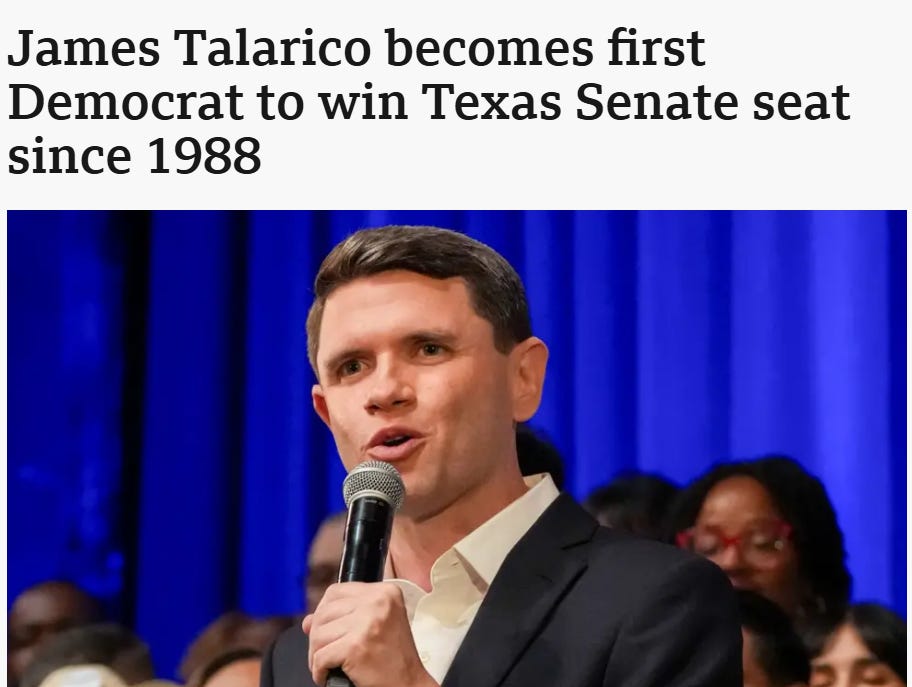
For all the money, influence and political machinery available to America’s wealthiest individuals, voters still have the final say.
But while Trump’s political project has suffered a setback at home, its financial backers and ideological allies are looking beyond America’s borders. Millions of US dollars have already flowed into British right-wing think tanks, political networks and organisations seeking to reshape the country’s political landscape.
The question is how much influence this money is buying, who stands to benefit and whether Britain’s democratic safeguards are strong enough to withstand it.
The billions behind America’s political battle
The scale of spending in the US midterms was extraordinary.
Federal Election Commission filings showed that more than $9.5 billion had been spent during the midterm election cycle.
The result is a political landscape in which a handful of extraordinarily wealthy individuals can spend sums beyond the reach of ordinary voters.
And there was a pronounced Republican and technology-sector bias among the biggest spenders, as New York Times analysis showed.
Thanks for reading Right-Wing Watch! Subscribe for free to receive new posts and support my work.
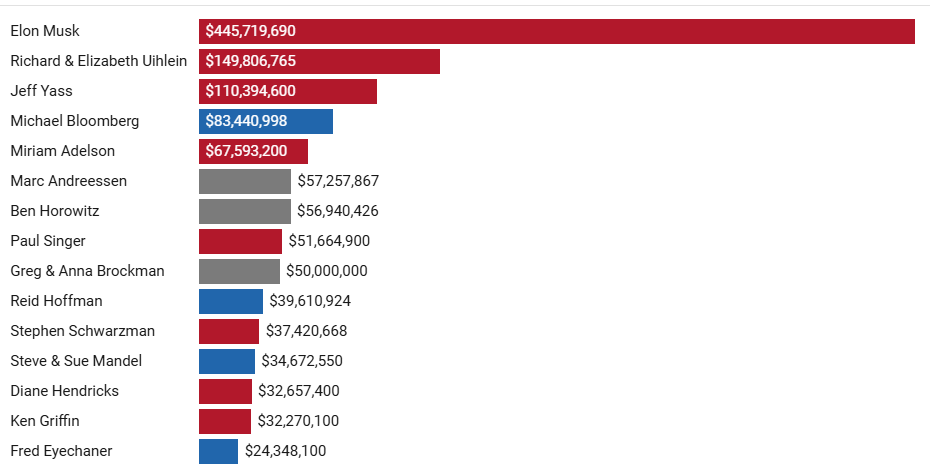
Musk’s $445 million spending spree
Leading the billionaire donor rankings was Elon Musk, whose spending on Republican candidates, political action committees and outside spending organisations exceeded $445 million, according to OpenSecrets.
The Texas Senate contest was a particular focus, with Musk throwing his financial weight behind Republican candidate Ken Paxton.
It was money on an almost unimaginable scale. Yet it was not enough to prevent Talarico’s victory.
Shipping supply billionaire Richard Uihlein and his wife, Elizabeth, were another major source of Republican funding, contributing $147.3 million to Republican causes.
Trading billionaire and early ByteDance investor Jeff Yass was the third-largest spender, directing more than $110 million towards Republicans, largely through Super PACs.
Yass has also been linked to more than $16 million in funding for anti-Muslim and pro-Israel organisations advocating hawkish policies in the Middle East, according to investigations by the Guardian and Responsible Statecraft.
As Hope not Hate chief executive Nick Lowles observed, the ability of one individual to wield such enormous financial power over an election makes a mockery of the principle that every vote should carry equal weight.
Yet the implications of this billionaire-backed political machinery extend well beyond America’s borders.
American money flowing into UK politics
Trump’s domestic political fortunes may have suffered a spectacular reversal, but the MAGA movement’s international ambitions have not necessarily disappeared with them.
Journalists Sam Bright and Max Colbert argue, authoritarian political influence can extend beyond national borders in an attempt to preserve its power even as domestic popularity wanes.
Britain has become an important part of that picture.
In 2025, it emerged that a Reform-linked think tank was attempting to raise more than £25 million to help make Nigel Farage prime minister by 2029, seeking financial backing from donors in both Britain and the United States.
The Centre for a Better Britain (CBB) intended to channel the money into developing radical policies, drafting legislation, polling, and selecting and training parliamentary candidates.
According to the Times, the organisation had also established a presence in Dallas, registering a US entity with the Internal Revenue Service in an attempt to attract inspiration, and millions of dollars, from the MAGA movement that twice propelled Trump to the White House.
This isn’t just a question of American donors supporting British political causes. It’s about the potential importation of an entire political playbook, complete with its ideological priorities, campaign tactics and networks of influence.
Consider Elon Musk.
In December 2024, Farage revealed that Musk, whose wealth fluctuates above and below $1 trillion, was giving “serious thought” to donating to Reform UK. Reports suggested the sum could reach $100m.
Musk later denied plans to bankroll Farage, but the prospect exposed serious weaknesses in Britain’s political funding rules, and intensified pressure on the government to tighten safeguards against foreign money entering UK politics.
Although foreign political donations are banned in Britain, loopholes have allowed overseas money to find its way into the system.
George Havenhand, senior legal researcher at Spotlight on Corruption, warned in early 2025, the rules contain “a series of loopholes and problems” that leave British democracy exposed to foreign influence and dirty money.
Labour pledged in its 2024 manifesto to “protect democracy by strengthening the rules on donations”. In March 2026, the government introduced tighter restrictions on overseas donors, followed by further safeguards in July, including a £100,000 annual cap on donations and loans from overseas voters and a ban on cryptocurrency donations.
But the reforms haven’t been without criticism. Transparency International UK welcomed tougher checks on foreign money but argued that the government was tackling the wrong end of the problem: restricting who can donate without limiting how much they can give.
Wealthy overseas donors could simply relocate to Britain, meet the qualifying requirements and resume making enormous political donations from within the UK.
So what happens if, heaven forbid, Elon Musk decides to move to Britain and bankroll Reform UK after all? The rules might stop foreign money entering our politics, but they do little to stop a billionaire buying an extraordinary amount of influence once they are here.
The Tufton Street bigshots
American money has also been finding its way into Britain’s network of right-wing think tanks, particularly those clustered around Tufton Street in Westminster.
Organisations including the Institute of Economic Affairs (IEA) and the Global Warming Policy Foundation are notorious for their lack of transparency around funding sources.
US election and corporate filings examined by Left Foot Forward showed at least 15 individuals and companies that have donated to Tufton Street organisations have also contributed $45.5 million to Trump’s campaigns, Trump-supporting political committees and Republican candidates in state races over the past decade.
Research has also exposed vast US funding to British right-wing think tanks since 2024, led by Policy Exchange, which received $1.1m, the Henry Jackson Society with $955,000, and the Institute of Economic Affairs with $609,000. The Global Warming Policy Foundation also received $222,000 from US donors.
And these connections are not merely financial. The IEA and other Tufton Street affiliates were vocal supporters of Liz Truss during her brief premiership, when her disastrous economic agenda sent financial markets into turmoil, triggering a crisis with far-reaching consequences.
British politicians and the MAGA circuit
The connections aren’t confined to think tanks.
A number of prominent British politicians, including Kemi Badenoch and Nigel Farage, have collectively accepted £335,000 for attending official Trump events, donor meetings and gatherings organised by right-wing American groups.
Reform MP Suella Braverman, who defected from the Conservatives in January, received £23,664 in expenses for attending four US events. These included a January 2025 speech at the Heritage Foundation, the organisation behind Project 2025, the radical right-wing blueprint for Trump’s second term.
Then there is Reform UK’s record-breaking £72 million in donations, coming from two cryptocurrency billionaires, Ben Delo and Christopher Harborne.
Harborne has financial connections to the White House, while Delo was pardoned by Trump last year after previously pleading guilty to violating the US Bank Secrecy Act.
Britain has a democratic warning to heed
These connections raise serious questions about the extent to which American political money and influence are becoming embedded in Britain’s right-wing political landscape.
Yet there is also a contradiction at the heart of this political project.
Trump and his MAGA allies may have enjoyed the backing of some of the world’s wealthiest individuals, but their politics remain deeply unpopular in Britain.
A YouGov poll in September found 83% of UK adults viewed Trump unfavourably, compared with just 13% who held a favourable opinion. His net favourability rating stood at minus 70.
The US midterms have shown that even hundreds of millions of dollars cannot guarantee electoral success. Musk failed to secure victory for his man in Texas, while the wider Republican spending machine could not prevent a Democratic electoral landslide.
But authoritarian political influence doesn’t stop at national borders. As its domestic popularity wanes, its networks, money and ambitions can be exported elsewhere in an attempt to preserve and extend its power.
That should be a warning to Britain, where who is funding our political organisations and what influence they are seeking to buy, needs to be scrutinised. Our democracy must not become a vehicle for someone else’s authoritarian ambitions.
Gabrielle Pickard-Whitehead is author of Right-Wing Watch
The post Trump’s billionaire backers are looking beyond America appeared first on Left Foot Forward: Leading the UK's progressive debate.
