Login
Login
Centrists Are Soft-Launching the Idea That We Have a Little Too Much Democracy

In case anyone was starting to feel that American democracy is just a little too secure, distaste for the common man is now finding purchase beyond the political right, with centrist liberals test-running their own brand of distaste for mass participation.
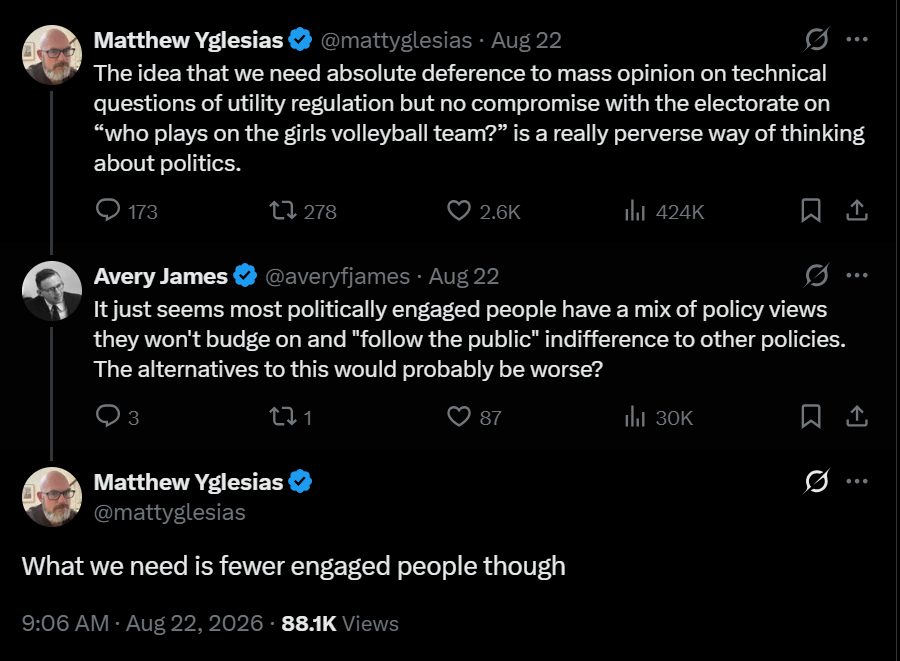
Over the past two years, centrist liberal writers have been emboldened to expressly call for less public participation in government and politics, sometimes just coming right out and saying, “What we need is fewer engaged people,” as prolific pedant Matthew Yglesias recently said over on the reanimated corpse of Twitter.
Nowhere is this more apparent than in the rampant hostility to small-dollar donors. In external communications, we’ve heard notions like Democrats needing to “move away from the dominance of small-dollar donors.” In writing not meant for a wide audience, the honest assessment from the Abundance Network is more extreme: Widespread grassroots fundraising “makes politics dumber.” The reasoning is that such donors tend to be more liberal than traditional big-dollar supporters and, as a result, push Democrats away from the preferences of the median voter. But in reality, the moderation bought by high-dollar contributions only serves to further cater to the interests of the wealthy.
Centrists have taken to characterizing the dueling ascendance of left-economic populism and right-chauvinistic “populism” as a pincer movement against the righteous “vital center.” In recent years, centrist publications have been replete with examples, urgently calling to safeguard liberalism, often from the masses.
The irony is that a leading contender for the ur-problem of liberalism’s failures is the purposeful destruction — by centrist liberals — of the organizing capacity that powered the postwar liberal order: organized labor, civil rights organizations, and robust state-level party infrastructure.
Years ago, as Donald Trump was first running for the presidency, political commentator Andrew Sullivan worried in a lengthy manifesto that too much populism would serve to “repeal” democracy. His conflating “liberalism” with a liberal technocratic elite class is a hallmark of the centrist canon.
This thinking has morphed into what could be called “Grownup Liberalism,” the belief that there is a class of wonky centrist experts who could fix so many things if the confused masses would just get out of their way — a notion that’s inherently undemocratic and increasingly discordant with the actual state of American politics.
As the center tries to cling to the tatters of institutional deference and justify why, even after building the hellscape we inhabit, they alone can steward our future, the right is waging an intense fight against the foundations of liberal society writ large.
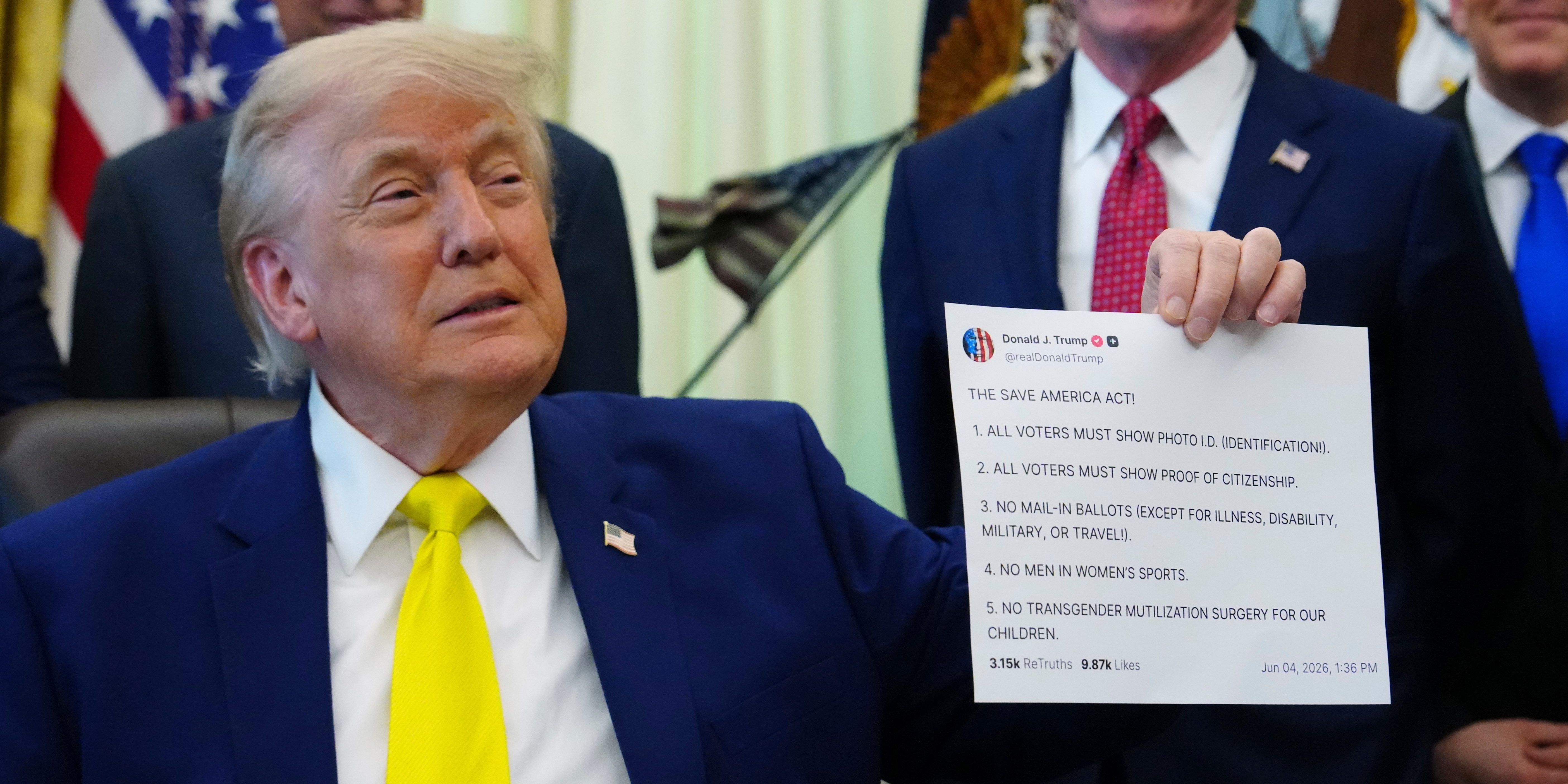
Republicans set off a gerrymandering war that reached its acme with Missouri trying to hoodwink federal courts into signing off on an illegal congressional map. Mail-in voting is under assault, and the SAVE Act, which risks endangering the rights of millions of Americans to vote, has been a conservative hobby horse for over a year. There are talks about deploying federal agents, including ICE agents, to polling places across the country and efforts to seize voter rolls.
To some, the mixed results of these efforts might show that institutionalists are the dam holding back an authoritarian flood. But these are the same institutionalists who dismantled the Voting Rights Act, created (nearly) carte blanche immunity for the president out of thin air, and opted not to enforce the law, emboldening further authoritarian power grabs.
As the center tries to cling to the tatters of institutional deference and justify why they alone can steward our future, the right is waging an intense fight against the foundations of liberal society writ large.
Now, however, the pontification on whether the little people have too much power is increasingly focused on American democracy as an institution. Much of the faddish “Abundance” movement draws heavily on the argument from Yale history professor Paul Sabin’s “Public Citizens” that providing new avenues for the public in politics undermined the project of liberal democracy itself. Some proponents have long championed a view of political dynamics centered on liberal and conservative elites dueling intellectually. Others explicitly believe that politics can only marshal material change when titans of industry take the lead, and some (to varying degrees) support ideas like the “network state,” which would replace democratic republicanism with techno-libertarian flavored fascism.
Abundance is just one strain of moderate-coded politics turning more and more of a cold shoulder to the idea of governance by the people. Not to be outdone, Third Way — a think tank that answers the question: What if we took all the preening and posturing of the Democratic Leadership Council but left out the charisma? — has been on a tear seeking to limit regular people’s input in political decision-making. The organization has tried to cast the idea of taking any economically populist position as caving to a “purity test” by the left and called for ending reliance on grassroots fundraising.
Never one to sit out the action, The Atlantic ran a review on September 1 of a Howard Zinn biography with the subhead “The historian believed that empowering the people would improve society. History hasn’t always proved him right.”
“One can agree with Zinn on the power of the people to make change and still wonder whether recent history has revealed the limits of his wisdom,” the author writes. But, he adds, the fact that conservatism has marshaled popular support “confounds his almost mythic sense of ‘the people’ as inevitably on the right side of history.” That is, ordinary folks have shown that they sometimes back distasteful conservative trends, so maybe we should stop empowering them.
Over at The Argument — the venture capital-funded Substack run by former Atlantic writer Jerusalem Demsas — the editor-in-chief recently attacked Democratic Connecticut Sen. Chris Murphy’s book on the common good as a “cult” in a sophomoric essay, which went so far as to condemn “the growing obsession with the common good among the postliberal right and left.”
Across the board, the message is that common people need to get their noses out of politics, go back to trusting the liberal technocrats, and maybe have a little democracy once in a while, as a treat.
It’s both stunning to see the contempt for popular government coming from the self-appointed champions of liberal thought and totally predictable for the vestiges of neoliberal power to veer away from democracy. At its core, the central premise of neoliberal thought is that the market must be the benchmark, with governance subverted to its will, and crucial economic policy cordoned off from the whims of popular rule.
The message is that common people need to get their noses out of politics, go back to trusting the liberal technocrats, and maybe have a little democracy once in a while.
If the stakes weren’t so profound, or these people so bafflingly influential, this would all be pretty funny. The bits about pro-corporate media figures and billionaire-funded political operatives throwing conferences about how we need more elite influence practically write themselves. Unfortunately, these are not niche figures who can be disarmed as mere old men yelling at clouds. Collectively, there are hundreds of millions of dollars flowing into organizations that are explicitly anti-small money in politics and want to make Democrats more allegiant to a wealthy donor class.
Even more unfortunate is that in a moment where our country is as close as it has ever gotten to full-blown authoritarianism, centrist thought leaders are flirting with the very ideas that justify the evisceration of popular democracy: that people cannot be trusted to take an active role in their own government, that there is a class of elites better positioned to lead, and that we ought to get out of the way of our betters.
This is a powerful illustration of how neoliberal politics warped postwar liberalism into a grotesque version of itself. The postwar consensus centered around the idea that in the duality of American liberalism, democracy is the senior partner and free markets the junior. Neoliberalism reversed this. For a while, the danger lurked in the background. But people will only allow their will and well-being to be subverted in the name of efficiency and growth for so long.
Across the democratic world, everyday people are calling the neoliberal bluff and revolting at the ballot box. The center for now still has resources and cache. Their choice is which pillar of liberalism they want to save: the free market-driven power of capital, or democracy itself.
The post Centrists Are Soft-Launching the Idea That We Have a Little Too Much Democracy appeared first on The Intercept.