Normal view

There are new articles available, click to refresh the page.
Before yesterdayMain stream

Keir Starmer failed the NHS. The next Labour leader must do better.

As Keir Starmer ended his resignation speech with tears in his eyes, we remember the rivers of tears flowing from the people of Gaza and the occupied territories. Closer to home is the lasting sadness among the families of 305 people dying avoidably every week from delays in emergency care, and those impacted by the deep social inequalities and poverty that have not been seriously addressed. 

Starmer, Chancellor Rachel Reeves and former Health Secretary Wes Streeting have conspired to deliver a prescription without hope for the NHS and for patients. In place of compassion and positivity, they have built their ambitions on fear of the bond markets, the worthless opinions of the right wing press and partnership with private corporations.

Reeves stubbornly wears her self-imposed fiscal rules straitjacket. This prevents serious investment in public services despite being essential infrastructure for a healthy population and successful economy. Starmer has lacked any vision or urgency in addressing manifest social inequalities that contribute to poverty, homelessness, rising racism, sickness and almost 3 million people out of the workforce for health reasons. Instead, his political compass led him to keep the two-child benefit cap for too long, impose a winter fuel payment cut and attack disabled people’s benefits – all of which contributed to his downfall. 

Starmer’s unforgivable ‘island of strangers’ speech asserting that immigration had caused ‘incalculable damage’ – regardless of his subsequent apology – poured petrol on the flames of racism targeting black and brown NHS staff and patients. Far from rowing back on the racism of Theresa May’s hostile environment, with its harsh and bankrupting charges to undocumented migrants and health surcharges for migrant workers, he has overseen Shabana Mahmoud’s new onslaught of punitive immigration law. 

In Streeting, Starmer appointed a powerful neoliberal voice, heavily funded by donors linked to the private health industry. He repeatedly asserted that the NHS needed ‘reform’ and partnership with the private sector, rather than funding and that AI, data and technology would replace the need for a health and care workforce delivering personal care. The prime minister lapped all this up and regurgitated it. 

Starmer’s legacy is a series of policy failures and acts of omission. He ignored Labour’s manifesto commitments to roll back outsourcing of public services to the private sector, to scrutinise existing contracts and to return them to the public sector. He and Streeting were silent when the East Suffolk and North Essex Foundation Trust (ESNEFT) outsourced 1000 NHS staff to Sodexo in April 2025. He allowed Streeting to announce arrogantly the abolition of NHS England, the 50% funding cut and merging of Integrated Care Boards, and the enforced financial cuts to trusts which, when totalled up, may lose the NHS between 50-100,000 clinical, technical, support services, admin and management staff – collective experience discarded without even a workforce or redundancy plan, and guaranteeing damage to clinical services. The 7.2 million waiting list simply cannot be addressed in this way.

The crisis in the NHS spans the whole service: inadequate numbers of GPs facing intense pressures and thousands of unemployed colleagues; insufficient community nurses making a mockery of Streeting’s ‘hospital to community’ shift; social care in crisis, with over a million people denied the support they need. Lack of community and social care support means around 13,000 hospital beds are occupied by patients unable to be discharged; A&E’s consequently overwhelmed, with patients experiencing delayed transfer from ambulances, many hours waiting for assessment, and in May, 3,000 patients a day needing admission but kept waiting in corridors, storage spaces and other unsafe areas for a hospital bed and definitive treatment. 

If one thing is unforgivable – and there are many, from maternity and infant deaths, to dental deserts and mental health failures – it is the silence from Starmer and Streeting on this crisis at the frontline in A&E: in 2025 there were 554,000 patients who waited on trolleys for over 12 hours for a hospital bed leading to 15,860 preventable deaths.

The 10 Year Health Plan for England, crafted by Alan Milburn – endorsed by Streeting and embraced by Starmer – is an open-door invitation to the private sector to continue its parasitisation of the NHS, with private health care funded by the NHS, the return of private finance for estate building, and involvement in commissioning and workforce planning. 

The starkest example of why this is so dangerous and wrong is the privatised cataract surgery industry. In 2023-24 the five main companies received £536 million in NHS cataract contracts, extracting 32% (£169 million) in profits while, at the same time, NHS Eye departments lost funding for healthcare for patients with serious eye conditions where delay in treatment can lead to blindness.

We need commitment to a publicly funded, provided and accountable NHS, not an ever-closer relationship with the parasitic private sector. Politicians must recognise that underfunding brings inefficiency and costs and that investment is essential to restore the NHS to its number one world-wide status up until 2014. While urgent action is needed to save thousands of lives, Starmer and his team have looked the other way, falsely claiming victory on waiting list reductions. We need an end to cronyism, yet we have Streeting’s mentor and Epstein associate Mandelson, Global Counsel, Palantir, Samantha Jones and Matthew Swindells mired in revolving door unethical influence and conflicts of interest. Instead of hope for millions of people that the social care system would be addressed, the Government kicked that can to beyond the next election. 

For too long, our national health service has been treated as an aberration to be corrected by neoliberals in both the private sector and in government. We need the stable to be cleansed and a new approach that sees the needs of the population and public services as a top priority. 

Tony O’Sullivan and John Puntis are co-chairs of Keep Our NHS Public

Image credit: Simon Dawson / Number 10 – Creative Commons

The post Keir Starmer failed the NHS. The next Labour leader must do better. appeared first on Left Foot Forward: Leading the UK's progressive debate.
Woke-bashing of the week: The Sun’s latest NHS panic

“Woke fury,” thundered Murdoch’s Sun this week, claiming that phrases like “raining cats and dogs” and “the early bird catches the worm” are now considered offensive under a new diversity guide from Lancashire Teaching Hospitals NHS Foundation Trust.

The paper cast the story as yet another example of equality and diversity spiralling out of control, complete with “fury,” “bans,” and the usual parade of indignant critics.

But strip away the outrage, and a different picture emerges.

The actual guidance does not “ban” phrases. It suggests that certain expressions, particularly those that may confuse non-native English speakers, might need explaining in a diverse workplace. In a health service where staff and patients come from a wide range of linguistic and cultural backgrounds, it’s a practical reminder that clear communication matters.

And guess who’s wheeled in for comment? Our old friend Toby Young, founder of the Free Speech Union, who warns of “witch hunts” and a creeping regime of linguistic control. According to Young, NHS staff risk being “cancelled” for everyday speech, part of a supposed effort to edge out older employees in favour of “pink-haired zealots.”

There is no evidence that NHS workers are being disciplined for using such phrases, nor that the guidance is designed to purge staff. Instead, a mild bureaucratic recommendation is inflated into a moral panic.

This is not a new tactic, for the Sun or Toby Young.

Earlier coverage in the Sun followed the same script: select a few debatable examples, strip them of context, and present them as proof of ideological takeover.

According to Young, Sutton Council’s language guide was an example of “woke” absurdity, with the newspaper gleefully reported that the council had banned the term “Christian name” because it might offend non-Christians, while also warning against calling people in their 30s “youngsters” or those over 65 “pensioners,” since these terms could be considered ageist.

This is the Toby Young who managed to secure a seat in the House of Lords from Tory leader Kemi Badenoch, despite having been forced to resign from the Office for Students in 2018 after a string of misogynistic and homophobic tweets, including one where he referred to George Clooney as “queer as a coot” and another joking about visiting a bar full of “hardcore dykes.”

But back to the smear on Lancashire Teaching Hospitals NHS Foundation Trust. The Sun also highlights the trust’s spending on diversity staff and its financial deficit, a familiar attempt to frame inclusion as waste.

No mention that the NHS workforce is more diverse today than at any point in its 75-year history, and that brings a multitude of benefits for patients and taxpayers alike.

Left Foot Forward doesn't have the backing of big business or billionaires. We rely on the kind and generous support of ordinary people like you.

You can support hard-hitting journalism that holds the right to account, provides a forum for debate among progressives, and covers the stories the rest of the media ignore. Donate today.

The post Woke-bashing of the week: The Sun’s latest NHS panic appeared first on Left Foot Forward: Leading the UK's progressive debate.
NEET young people with mental health conditions face disproportionate hospitalisation rates, new data shows

Young people not in education, employment or training (NEET) who live with mental health or neurodivergent conditions are more likely to be hospitalised than their working or studying peers, according to newly published data from the Office for National Statistics (ONS).

The analysis combines NHS hospital episode statistics with data from the 2021 Census to provide a snapshot of hospital admissions among 16 – 24-year-olds across England and Wales.

In total, 239,340 young people in this age group had been hospitalised for at least one day, accounting for more than 400,000 inpatient stays, around 5% of all young people at the time of the census.

However, the risk is not evenly distributed. Young people classified as NEET were more than twice as likely to be admitted to hospital compared with those in education, employment or training.

The data also highlights a notable concentration of hospitalisations among those with mental health and behavioural conditions, including neurodivergence. These conditions accounted for 46% of hospitalised young people, the highest share among all chronic illness categories, including cancer, respiratory and cardiovascular diseases.

Within this group, around one-third were NEET, underlining the overlap between economic inactivity and poor mental health.

The findings come against a backdrop of persistently high levels of youth inactivity. Official figures show that 957,000 people aged 16 to 24, 12.8% of that age group, were NEET in the final quarter of 2025.

Research by the Youth Futures Foundation suggests that rising levels of long-term sickness, mental illness and neurodivergence have been key drivers of this trend in recent years.

Ministers have largely attributed the increase in NEET figures to a rise in diagnoses of mental health and neurodivergent conditions.

But according to Disability News Service, government officials have made repeated insinuations around ‘overdiagnosis’ of neurodivergence and questioned the severity of young people’s mental health. The news agency points to comments former Labour health secretary Alan Milburn, who is leading an independent inquiry to look into the “drivers of the increase in the number of young people who are Not in Education Employment or Training (NEET) and claiming health and disability benefits, including childhood experience.”

In an interview for the Times in January, Milburn said  anxiety and depression are “normal”, to argue that the majority of young disabled people should not be claiming benefits for these conditions.

Critics argue that this narrative is undermined by the latest ONS data and have raised concerns that young disabled people are being unfairly targeted in welfare reforms aimed at pushing more people into work.

“… the high rates of hospitalisations in the ONS data for these conditions challenge Milburn’s narrative,” writes Disability News Service.

“The figures also rebuff the Labour government’s contention that work is always positive for young people’s mental health.”

Left Foot Forward doesn't have the backing of big business or billionaires. We rely on the kind and generous support of ordinary people like you.

You can support hard-hitting journalism that holds the right to account, provides a forum for debate among progressives, and covers the stories the rest of the media ignore. Donate today.

The post NEET young people with mental health conditions face disproportionate hospitalisation rates, new data shows appeared first on Left Foot Forward: Leading the UK's progressive debate.

Reform accused of fighting like ‘rats in a sack’ over its NHS policy

Reform is in chaos over its NHS policy, after the Welsh Reform leader went against Nigel Farage’s plans to fund the NHS via an insurance-based system.

Reform’s leader in Wales, Dan Thomas, told Politico that he would not consider “any kind of insurance-based system or privatisation” of the NHS.

However, Farage, who has consistently said he would consider switching to funding the NHS through private health insurance rather than taxes, said at Reform’s Wales manifesto launch on 5 March that “That would be a national decision ahead of a general election”.

However, Thomas said Farage had suggested that decisions on “devolved” issues such as the NHS would be decided by Reform in Wales.

Reform has said that it would keep the NHS free “at the point of use”. However, Farage has previously said some British families could be forced to pay health insurance to use the NHS if he was prime minister.

At a rally in Swindon last night, chair of Reform David Bull said he wrote Reform’s health policy, and that it is “a blatant lie” that Reform will privatise the NHS. He added that the NHS will remain “free at the point of need” under a Reform government. 

Responding to internal clashes in Reform over NHS policy, health secretary Wes Streeting told the Mirror: “Farage and his top team are hell bent on destroying our health service as we know it – weak attempts to hide their plan just don’t wash.

“Nigel’s Health Service will strip away part of the very fabric of Britain by ushering in a system of care only for those who can afford the bill.”

Health Minister Stephen Kinnock MP said the spat showed Reform were “fighting like rats”, and that destroying the NHS was a lifelong “ambition” for the Reform leader. 

He added: “Whether it be in England or in Nye Bevan’s Wales, we can’t afford to let Reform get within an inch of our NHS.”

UNISON assistant general secretary Jon Richards said: “Nigel Farage is on record saying he’d look at a US-style, insurance-based system for healthcare, but it’s no surprise even his cronies shy away from such a toxic policy. 

“It’s almost a given there’s dissent and confusion in the ranks of Reform given Farage and his band of Tory chancers are tying themselves in knots over Iran.”

Olivia Barber is a reporter at Left Foot Forward

Left Foot Forward doesn't have the backing of big business or billionaires. We rely on the kind and generous support of ordinary people like you.

You can support hard-hitting journalism that holds the right to account, provides a forum for debate among progressives, and covers the stories the rest of the media ignore. Donate today.

The post Reform accused of fighting like ‘rats in a sack’ over its NHS policy appeared first on Left Foot Forward: Leading the UK's progressive debate.

This is why you need to be worried about healthcare privatisation

On 26 February 2026, Members of Parliament and the House of Lords gathered at an event in Parliament sponsored by Richard Burgon to launch a new working paper and discuss growing concerns about NHS privatisation. The panel included experts from Keep Our NHS Public, the Nuffield Trust, and the 99% Organisation. The discussion addressed three central questions: What counts as healthcare privatisation? How much is really taking place? And does it matter, particularly for patients?

The debate often begins with denial. Successive governments have claimed that the NHS is not being privatised and never will be. Some rely on the phrasing that the NHS is not “for sale,” while others stress that it remains “free at the point of use.” The World Health Organization (WHO) defines privatisation as any process that increases private sector involvement in the financing or delivery of healthcare. This definition captures changes that political slogans do not.

Imagine if the NHS were gradually reduced to a small share of overall healthcare provision through underfunding—while remaining technically free at the point of use—it could still meet political definitions of being “not for sale,” yet the UK’s universal healthcare system would have disappeared. Under the WHO’s definition, such a shift would clearly constitute privatisation. The panel argued this broader definition is both more honest and more illuminating.

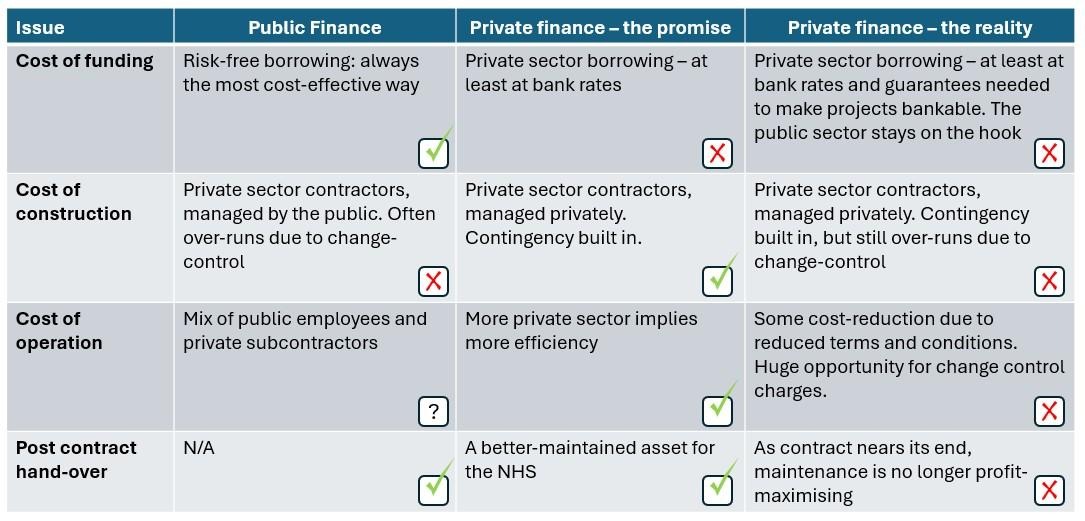
There are at least five routes through which privatisation can occur. The most common is contracting out: NHS-funded services delivered by private companies. Second, patients may be squeezed out  or even thrown out if services are rationed, withdrawn, or subject to new charges, forcing people into private payment. Third, the Private Finance Initiative (PFI) replaces public borrowing with more expensive private finance. Fourth, private firms can gain influence through governance or management roles within the NHS. Finally, assets or services may be directly sold off, though this is less common.

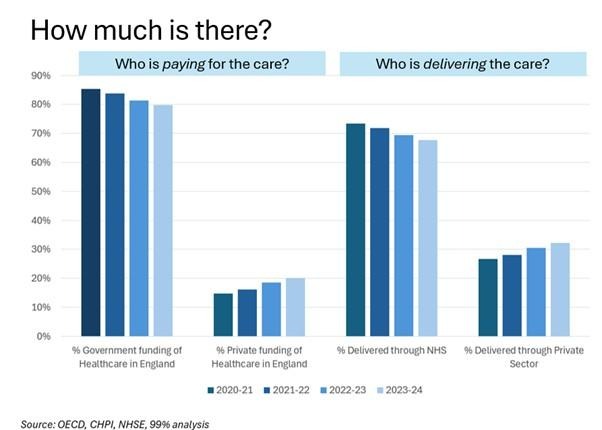
Public discussion frequently cites a figure of around 7% to suggest privatisation is minimal and stable. However, this figure captures only a narrow slice of contracting-out and ignores the growing share of care paid for privately by patients. Once those omissions are corrected, the picture changes substantially. 

Around 20% of UK healthcare is now paid for privately, either out of pocket or via insurance. When adding NHS-funded services delivered by private providers, over 30% of healthcare delivery is now in private hands, with some specialties exceeding 50%. Far from being marginal, private sector involvement is significant and expanding.

The most critical issue is whether this shift affects patients. 

Ophthalmology, particularly cataract surgery, illustrates the concern with contracting out. Simple cataract operations can be performed quickly and profitably, and private “cataract factories” specialise in high-volume delivery. While this may reduce waiting lists, it distorts clinical priorities. Early removal of mild cataracts offers limited medical benefit, while conditions such as glaucoma or macular degeneration require urgent treatment to prevent irreversible blindness. The president of the Royal College of Ophthalmologists described the result of the extensive use of cataract factories as patients with very mild cataracts “getting surgery at the expense of other patients going blind.”

The patient receiving swift surgery may be satisfied, but the patient who goes blind would be horrified.

Dentistry offers another example. Although NHS dentistry remains available in theory, many areas have become “dental deserts” where NHS appointments are nearly impossible to secure in practice. Some treatments have largely disappeared from NHS provision. Patients are effectively squeezed out into private care or left untreated. The poorest are hardest hit, and the British Dental Association reports widespread cases of attempted do-it-yourself dentistry. Here, privatisation does not expand choice; it restricts access.

Joint replacements reveal a similar pattern. While some patients choose private treatment to avoid long waits, others are thrown out of the NHS altogether. Despite guidance from NICE that obesity should not automatically block referral, many Clinical Commissioning Groups have applied body mass index thresholds that deny treatment. Patients who cannot access NHS care may have no realistic alternative. In these cases, privatisation is not about preference but exclusion.

Private finance has imposed long-term costs on public finances. Governments have sometimes used PFI to avoid the appearance of public borrowing. The theory was that bundling construction, financing, and management would deliver efficiencies offsetting higher financing costs. In practice, as the National Audit Office concluded, PFI schemes have delivered poor value for money. 

The public sector can borrow more cheaply, and promised efficiencies often failed to materialise. As a result, NHS budgets have been burdened with expensive long-term repayment commitments.

Governance presents further challenges. Private companies are legally required to prioritise shareholder returns. Under company law, directors must put profit first. This obligation often conflicts with the NHS’s mission to maximise patient care and value for taxpayers. Corporate providers must focus on profitable services, patients, and regions. When profits fall, they withdraw provision. In 2015, Circle Health exited management of Hinchingbrooke Hospital, citing financial viability concerns. In 2023, Centene withdrew from providing GP services in London when profits proved insufficient. Such exits leave gaps that the NHS must fill, or else services deteriorate.

The panel concluded that three common claims about privatisation are misleading: that it is not happening, that it is minimal, and that patients benefit from it. Evidence suggests privatisation is significant and increasing; its effects include distorted clinical priorities, exclusion of vulnerable patients, higher long-term costs, and governance conflicts. We urged Policymakers to recognise that current trends risk undermining patient care, straining public finances, and eroding the foundational principles of the NHS itself. We need our MPs to act now.

Mark E Thomas, Founder of the 99% Organisation

Image credit: Garry Knight – Creative Commons

Left Foot Forward doesn't have the backing of big business or billionaires. We rely on the kind and generous support of ordinary people like you.

You can support hard-hitting journalism that holds the right to account, provides a forum for debate among progressives, and covers the stories the rest of the media ignore. Donate today.

The post This is why you need to be worried about healthcare privatisation appeared first on Left Foot Forward: Leading the UK's progressive debate.

❌
❌