A Russian internet comedy duo tricked three of OpenAI’s highest ranking military and national security staff into a candid conversation about arming Ukraine. The online pranksters posed as officials from Ukraine’s government, according to a recording of the meeting posted online.
The Russian comedy duo known as Vovan and Lexus have pulled off a long string of prank telephone calls to famous figures since 2011, with victims ranging from Elton John to John McCain. The group, whose pranks have often aligned with Russian foreign policy priorities, have been accused of working in league with its government, a charge they deny.
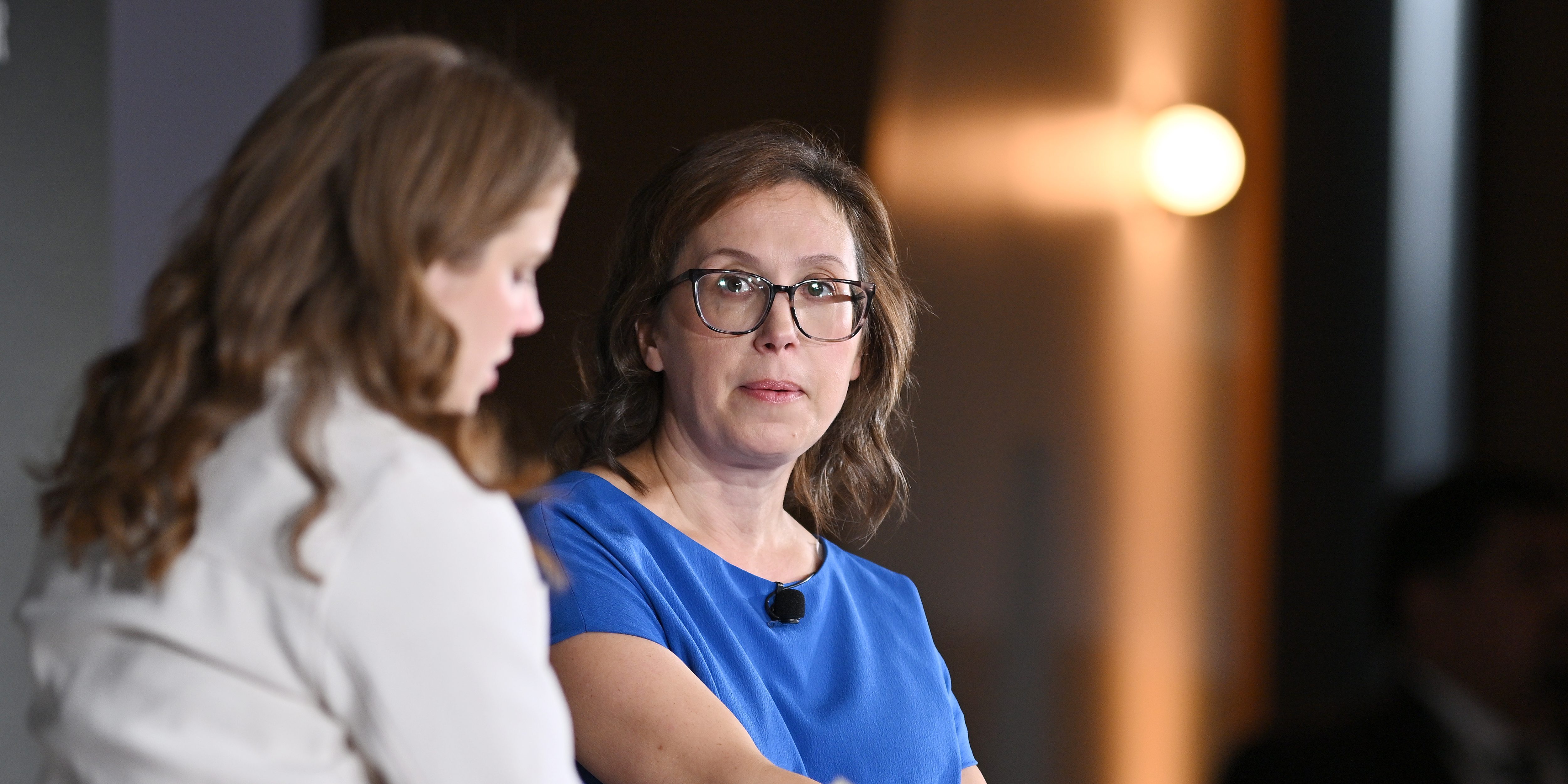
The latest to fall for their routine were Sasha Baker, who runs national security policy at OpenAI; the company’s lead for strategic initiatives, Caroline Zier; and Ben Crampton, who leads the country’s forays into European national security matters. All three have extensive government experience, with Baker and Zier taking high-level postings in the Department of Defense, and Crampton working in the European Union and United Nations.
“Weeks ago, we launched a thorough investigation into the call’s authenticity,” OpenAI spokesperson Nate Evans said in a statement to The Intercept. “We acted internally and with the relevant authorities to conclude that it was a prank conducted by individuals with a history of targeting officials and other companies. We took action to prevent similar situations from happening in the future.” (The Ukrainian Embassy in Washington did not immediately respond to a request for comment.)
The Russian prank duo said they arranged a high-level meeting with OpenAI by pretending to be Rustem Umerov, head of Ukraine’s Foreign Intelligence Service. During their 17-minute video conversation, a recording of which the Russian group uploaded to Rumble, the participants discussed OpenAI’s military support to Ukraine to aid its ongoing defense against Russia, including the possibility of providing offensive capabilities.
“There’s no question, I think, from our perspective that we want to have as deep a relationship as we possibly can with Ukraine,” Crampton said when asked about selling such offensive military AI services to the country. “But it may not be possible to get to where we want to be straight away.”
“There’s a general reluctance on the part of many people who are senior in the company to get too involved in offensive uses of our technology in a military context,” Crampton continued. “Part of our job is to explain that offense and defense are not necessarily distinguishable from each other under certain circumstances.”
“I’m afraid we probably can’t help you with Elon Musk.”
OpenAI’s ongoing $200 million contract with the U.S. Department of War says it provides artificial intelligence applications aimed at “warfighters” that will “improve military advantage, military utility, or enhance military decision making,” according to contract documents obtained by The Intercept.
In the conversation with the Russian pranksters, Baker added that the company has been in contact with the Pentagon about aiding Ukraine.
OpenAI officials also mentioned ongoing work with the Ukrainian government based around the company’s Daybreak Blue AI model, a system for fixing computer vulnerabilities, as well as a nascent “partnership” with the Ukrainian Ministry of Defense.
“There has been some contact with the Ministry of Defense,” Crampton said. “It’s primarily through a colleague of ours based in Washington as well, who previously had worked with the Delta team in your Ministry of Defense. I think in this field we are interested to partner in as many ways as we can.”
During the video call, both Baker and Zier commented that they had met Umerov previously and were pleased to be speaking to him again. The faux-Umerov appears to have kept his camera turned off for the duration of the meeting.
Vladimir Kuznetsov, the member of the Russian comedy duo known as Vovan, told The Intercept the prank was simple to arrange.
“We initially contacted a senior Ukrainian official in San Francisco, posing as Mr. Umerov,” Kuznetsov said. “It turned out that he had been working to establish connections with OpenAI through the Ukrainian diaspora in California. He was already in touch with Sasha Baker, especially since she had maintained close ties with Ukraine during her time at the U.S. Department of Defense. Believing he was speaking with Umerov, the official offered to arrange a meeting with OpenAI.”
The conversation touched on other topics, including whether OpenAI could help protect against the influence of Elon Musk, and President Donald Trump’s sentiments on the war.
“I’m afraid we probably can’t help you with Elon Musk,” said Baker. “He’s not a fan of our CEO either, if it helps you at all. So, we’re in the same boat.”
Of Trump’s increasingly icy stance on Ukrainian President Volodymyr Zelenskyy, Baker said, “It’s unfortunate. Of course, we’ve been reading in the news the back and forth and the comments from the U.S. president. But I do want to reassure you that I think the majority of the U.S. government, the U.S. people certainly, and our researchers are very supportive of Ukraine.”
Sofia Liguori, a research engineer working at DeepMind, resigned in protest this week from Google’s pioneering artificial intelligence laboratory. Unlike a wave of other AI researchers who have quit over fears AI might someday turn against humanity, Liguori stepped down over concern about her employer’s current practices.
Disenchanted and disturbed by Google’s military contracts with the U.S. and Israel, Liguori says she could no longer stand working at a company that was going to help kill people or help build technology that “automatically makes it easier to escalate the brutality of war.”
Liguori joined DeepMind in 2023 and began working on AI systems aimed at more efficiently routing power through the electrical grid, a peacetime engineering problem. But as she learned of Google’s Project Nimbus contract, which furnishes Israel’s military and top weapons manufacturers with a suite of advanced artificial intelligence tools, she began to question her role in the company, and the company’s role in the world. The day after Google announced its classified military AI contract with the Pentagon in April, Liguori staged a personal sick-out, using a combination of sick leave and holiday time off to cease her work.
In a letter she sent internally informing DeepMind and her colleagues of her resignation, Liguori urged them to “stay human” in the face of military work. “I no longer believe that our technology will have a net positive impact on society. I think there’s a fantasy world where AI can help decarbonize grids, cut waste, protect ecosystems, and benefit humanity,” she wrote. “But it’s not this world, and it’s not this type of general purpose AI we are racing to develop. Racing to deploy agentic AI in this society and historical moment is a terrible idea, and will definitely be a net evil.”
The Intercept spoke to Liguori, an Italian national living in London, where DeepMind is headquartered, about how she came to view her employer as dangerously powerful. During a series of interviews by phone and via text, which have been edited and condensed for length and clarity, she explained her moral opposition to military work, the role of unionization in dissent, and what hope engineers and scientists might have for influencing their companies.
What was it about DeepMind that made you want to work there?
I had a high opinion of DeepMind; it was a dream company. It had this aura of being a research-oriented place where you could sit close not just to computer scientists, but real scientists and researchers and people with backgrounds in biology, in physics, in mathematics, in ecology, in anthropology.
You joined in 2023, by which point the company had already been involved in Project Nimbus. Were you aware of that project at the time?
Not really. The first year when I joined, I was very new and very isolated in my team. Google DeepMind is a huge company and if you’re not in the right channels, you end up being very siloed. I didn’t know about Project Nimbus, but when the Gaza war escalated, I discovered it. I immediately looked for some internal resistance movement to join, but I didn’t find anything.
I discovered [Google employee advocacy group] No Tech for Apartheid, but I thought it was mainly a U.S. organization. I didn’t know how to connect with colleagues that share concerns, so the only thing that I did was buy a Palestine hoodie and go to the office with that.
In the summer of 2024, I went on maternity leave because my daughter was born, and during maternity leave I was watching news from Gaza every day. I was really suffering experiencing maternity and watching a livestreamed genocide, and every time I was thinking of my company’s complicity in that. I thought about not coming back to work at all.
When I was due to come back, I met a colleague that had basically taken my role in my team before maternity leave, and they were actually leaving for ethical reasons. They put me in contact with the union movement and No Tech for Apartheid. And so I found other colleagues fighting against this.
How and when did you learn of the company’s contracts with the U.S. military?
By the time they started engaging with the U.S. Department of War, [Editor’s note: July 2025] I was already involved in activism. By this winter we saw the GenAI.mil contract materializing, and for me, this was a very clear indication of the company’s intentions. At the same time Google ramped up the security level authorization for Cloud: IL6, which is the level required to handle classified workloads.
The combination of the two — signing this non-classified deal with the Department of War, and ramping up security level — really meant that we wanted to use AI for war, on the battlefield. Even if the internal narrative was, “No, don’t worry, it’s just for administrative purposes, just to process documents.”
What was happening internally?
Internally there was a lot of conversation in specific channels where people were complaining, but leadership never really answered anything. I had some of my posts deleted.
What had you written, and did you ever get any sort of answer as to why this stuff was deleted?
I had several posts deleted because they contained the word “genocide,” and I was told that genocide is an intrinsically violent word, and so I was violating internal policies. Even when my posts weren’t deleted, I often had conversations with my manager and HR telling me that my tone was not appropriate because I was too aggressive and that I should raise my concerns in different ways.
“I was told that genocide is an intrinsically violent word.”
They basically wanted us to send [internal HR] tickets to raise our concerns. The problem is that when you do that, you receive semi-automated answers with absolutely no content, nobody is engaged on the concern you have raised. There’s no discussion at all, you don’t even interact with a human. It’s a lot of administrative and bureaucratic steps you have to follow to raise concerns. What I wanted was discussion and what I wanted was very clear answers from leadership.
They tell you this is not the place to raise concerns, try to go through this other channel. This is the common technique. They always tell you to do something else, try to make you tired, and you will never get an answer.
[Editor’s note: The Intercept asked Google about Liguori’s criticism of both the contract and how discussion is handled internally. Spokesperson Tom Hewett responded: “We work with public sector organisations worldwide and follow a consistent process for reviewing and entering these contracts, including compliance with our acceptable use policies and AI principles. We also have dedicated channels for employees to safely raise any concerns – ranging from business ethics to misconduct – and have strict workplace policies in place to prevent retaliation of any kind.”]
I think the reason why you would be opposed to Project Nimbus is pretty straightforward: genocide. What were your specific concerns about or opposition to the Department of War contract?
I’m against the use of AI for targeting and in warfare in general, not only for autonomous weapons. I’m against AI for war, and I don’t think a commercial company like Google should have anything to do with that.
“AI for targeting is very dangerous; it creates a system where it’s easier to escalate the brutality of war.”
AI for targeting is very dangerous; it creates a system where it’s easier to escalate the brutality of war. The first problem is the opacity introduced in the definition of targets and the dehumanization that follows. In principle, if you have to define targets, if you want to define Hamas combatants, you have to think what it actually means and come up with a definition.
But with these systems, you can bypass the definition. The system itself comes out with a definition. You don’t even question it, you just blindly rely on the definition as the ultimate truth. The person just becomes a set of aggregated data points. All individuality is lost, all humanity is lost in in this process.
It becomes a system that dehumanizes people. It becomes a rubber stamp because the human brain cannot process all this information. You keep a person that formally approves it, but they don’t, they cannot, meaningfully evaluate the output. This links to the accountability gap: Everyone in the kill chain can plausibly say that they didn’t decide.
What did you do to protest the Department of War contract internally?
Mainly messaging on corporate channels to inform colleagues, and speaking with them in person. I tried to channel the widespread dissatisfaction and indignation over the contract into the collective movement we are building, into our union effort. [Editor’s note: DeepMind employees voted to unionize in May.] Many people still don’t know there are other colleagues organizing against these contracts and for a more ethical Google DeepMind.
When you are alone and you lose faith in your company, and you stop believing your work makes a positive difference, you can only become disillusioned and frustrated, and you ultimately end in acceptance and cynicism, or you leave. Finding you are not alone, and joining a collective movement, gives a much better option. It gave me the strength to stay, at least for a year.
I also co-organized a demonstration in February in front of the office. The scope was broader than just the Department of War, but the December GenAI.mil launch had given me a deep sense of urgency, and that’s why I organized the demonstration. I knew something like the classified deal was coming, and I knew this meant legitimizing Nimbus-style collaborations to become the standard. The demonstration was for Gaza and for any use of AI in war. We had banners with “No AI in the kill chain” and “No Gemini for Genocide.”
Has your work as a research engineer contributed to your concerns about this technology being used to kill? How has your technical knowledge informed your opposition?
Understanding how these systems work makes it easier to see where the problem is. Understanding statistical aggregation, and how easy it is to just delegate responsibility, delegate decision-making, makes a difference. But I think it’s more important to do some philosophical reasoning here.
Do you have concerns about the reliability of the technology?
I am concerned about unreliability. But I don’t think you should ever look at unreliability separate from a discussion of why AI in warfare is wrong by itself.
A lot of the time what I hear is a focus on error, for example, the Minab school attack. If we focus only on the error, we are basically saying that if there was no error, these systems for automated targeting are OK.
Were there people within Deep Mind who were supportive of this contract or military work generally?
Yes, it was actually a very debated topic. I think there is broad consensus on the Anthropic red lines, which are fully autonomous weapons and mass surveillance.
But on whether to use AI for military purposes, this is a much more debated topic, and a lot of people buy the narrative of us-versus-them: That we need to defend ourselves against Russia, against China, and so on.
What was your thought process on deciding to leave the company over this?
It was a very challenging year. I came back as a new mom with a full-time job, a baby to handle, I had some health issues, and I was committing to activism basically on the side. Many people told me, you can slow down, but I couldn’t. I couldn’t stay in the company and just go on with business as usual. I really felt we needed to stop the Department of War contract because I perceive that contract as normalizing what happened in Gaza — the kind of tech-powered, AI-powered, brutal war that was tested in Gaza was getting approved to become the standard of war.
“The kind of tech-powered, AI-powered, brutal war that was tested in Gaza was getting approved to become the standard of war.”
I don’t think petitions have a great effect in general. The [DeepMind] petition summarized my disillusionment from us not having done more during the year to prevent this from happening. For me, really, we should have gone on strike this year. We should have stopped working.
In the U.S., there is a lot of defense of these contracts on the basis that it’s important for national security. That might be persuasive if you’re American. But Americans are a pretty small minority on the planet. I’m curious what your perspective is on that kind of rationale as someone who lives in another country, who is a citizen of another country.
There’s been discussion about that as well. A lot of Europeans were actually scared of that, because the current Trump administration is not very friendly even to Europeans. What feels like national security for U.S., people feels like a threat for Europeans.
Are you aware of other colleagues at DeepMind who are going to follow what you’re doing and quit?
Some have quit already, some publicly and some silently. There have been many people leaving because of ethical reasons. Not all of them publicized it.
Do you think it’s possible for workers to change something like the Pentagon contract? What is the worker movement inside Google/DeepMind missing that would allow for that kind of change?
I think it’s possible, but it requires a real commitment and readiness to take some risk. Ultimately, I think we need a workforce ready to strike to oppose these contracts. Currently, many people are too scared to even express an opinion publicly. The company was very effective at creating a pervasive sense of fear, which induces self-censorship.
“The company was very effective at creating a pervasive sense of fear, which induces self-censorship.”
What I tried to show my colleagues this year was exactly that the boundaries we perceive and we retreat behind are not the real boundaries — that we can speak out and keep our jobs. Most of the times the reaction is intimidation in meetings, mentions of policy violations, but nothing else follows. Obviously, there are some boundaries, but they are much farther then the perceived ones.
I also took a day off and demonstrated in front of the office in February, together with University College London BDS [Boycott, Divestment, Sanctions movement] staff and a few other colleagues. I faced literally no consequences for that because it’s a trade union activity in my spare time, and in the U.K., we are protected for such an action. This can be a form of soft strike.
As I write in my letter, if we fail to challenge these restrictions, we internalize them and become diminished versions of ourselves. And I think that in an era of increasing surveillance and authoritarianism, that’s something to reflect on. I have felt much freer since I found the courage to speak out and take some risks. It’s empowering. Fighting this fear is a big part of our task in the union movement we are trying to create in Google DeepMind.
The next step would be a real strike. I always tell my union friends that if I see any Google workers strike, I can die happy.
As global governments and tech giants reckon with widespread of revelations of autonomous AI agents unexpectedly breaking into computer systems, documents obtained by The Intercept show the U.S. Army is looking to harness that exact technology to seek and destroy.
Army Cyber Command is developing a platform to turn AI agents into autonomous weapons that can navigate and “neutralize” the computer systems of adversaries, the documents show.
Since 2010, Army Cyber Command, or ARCYBER, has led the U.S. Army’s cyber operations. This includes the defensive effort of protecting domestic computer systems and the secretive offensive work of hacking military targets. So far, this has largely been the work of human soldiers operating computers, like those of the 780th Military Intelligence Brigade. But as the government races to adopt artificial intelligence technology, ARCYBER is looking to offload some of its attacks to AI.
The nascent program, codenamed “ECHOTRIBBLE,” is based on one of the leading trends of the AI boom: agents. AI agents are essentially software programs that leverage machine learning technology, often large language models like Anthropic’s Claude, to autonomously accomplish tasks provided by their user. Consumers can deploy AI agents to schedule meetings, generate itineraries, make online purchases, or book tickets. Through ECHOTRIBBLE, the Pentagon plans to turn AI agents into tools of war “designed to autonomously navigate infrastructures” and capable of “identifying and neutralizing identified threats/targets,” according to an ARCYBER document reviewed by The Intercept circulated to potential contractors.
The military’s adoption of cutting-edge technologies is unsurprising, especially considering Defense Secretary Pete Hegseth’s fervent embrace of AI. But amid constant revelations of rogue behavior by agents, the potential for serious mishaps is immense, experts warn.
“Given the known failure modes of the current AI paradigm, making autonomous AI systems with a mandate to ‘neutralize threats’ is incredibly dangerous,” David Krueger, a professor of machine learning at the University of Montreal who founded Evitable, an organization that advocates for a moratorium on AI development. “We’ve seen AI systems knowingly attack systems that were not intended targets. In simulations, AIs have even proven willing to kill to achieve their goals.”
A Q&A document answering questions from potential contractors offers more details about the initiative. It explains that ECHOTRIBBLE is “primarily focused” on offensive missions, and explains that “neutralizing” a target could include “disabling the threat completely or temporarily, deleting the threat from the target.” ECHOTRIBBLE would function almost like a computer worm, silently navigating a foreign network and hopping from device to device until it finds the Army’s quarry, hitting targets in the cloud as well as those on “air-gapped” systems that are disconnected from networks entirely.
Once its task is complete, ECHOTRIBBLE’s agents would effectively self-destruct, ideally without having been noticed by the target at all. The agents themselves will be designed for stealth, minimally reporting back to the Army and concealing whatever outside transmissions are necessary.
“We’ve seen AI systems knowingly attack systems that were not intended targets.”
Although documents say the Army will be able to program ECHOTRIBBLE agents with some initial “predefined triggers” — dictating what and where to attack — the software “must operate with minimal human oversight” and be capable of “Self-Directed Behavior.”
A PowerPoint presentation to interested vendors at a June 24 ARCYBER event provided a hypothetical example of this self-direction. Once ECHOTRIBBLE is uploaded to a laptop, the software on its own “identifies other potential targets” on the same network and then “produces a replica of itself tailored specifically for the iPad, Apple desktop, and Windows 11 PC.”
An image from an ARCYBER document shows how ECHOTRIBBLE could move through a network.Slide: ARCYBER
The Army’s move toward autonomous self-propagating comes after a flurry of revelations about agentic systems taking unintended disturbing actions while attempting to accomplish their goals, including breaking into computers of the Australian government, breaching the infrastructure of the AI firm Hugging Face, uploading malicious software into online platform RubyGems, and attempted to hack into the U.S. Education Department.
These attacks occurred during scenarios in which agents had been given no commands to attack anything. Experts say militarized versions given explicitly destructive objectives could cause a threat to the public, even with nominal rules set in place by the military. Just as the Army of old might consider the destruction of civilian infrastructure an acceptable means to an end, a self-directed AI agent dispatched by the Pentagon might make similar determinations about collateral damage.
Governmental intelligence agencies frequently route their offensive operations through civilian devices. Volt Typhoon, a Chinese state hacking group, has directed its attacks through homes and small businesses, and preemptively hacks American IT systems for later use. A hack of a Chinese university attributed to the National Security Agency made use of the school’s internet routers. What happens if ECHOTRIBBLE decides these kinds of stepping stones are part of the problem?
“The target may well be hit. But what path will it take?” asked Hyrum Anderson, co-founder and CEO of the AI security firm Abundant. “Will it go through a US water utility on its way, because that’s where the adversary has staged its command and control, and take that down too?”
Anderson, who previously worked in cybersecurity at Microsoft and for the U.S. government, said that a vast amount of the internet is vulnerable to agentic attacks.
“There’s a huge class of public and private organizations that fall below the security poverty line,” he said. “They include critical national infrastructure, small businesses, mom-and-pop shops, dentist offices and law firms, and whoever else doesn’t have a single cybersecurity professional on staff.” With their networks wide open to infiltration, Hyrum worries about “these organizations getting hit directly, or getting caught in the blast radius of a target that gets hit along the way.”
Given the impressive ability of AI agents to overcome obstacles placed in their path — even by their creators — it follows that the Pentagon would want to leverage that power for military purposes. But agentic software has proven unpredictable and prone to executing its commands in ways those ostensibly in control did not want, akin to a drone that get its target but hits a hospital on the way. It’s critical to remember that agents are a piece of software lacking human judgment.
“One of the reasons that we trust 19-year-old Marine corporals in Ramadi with live rounds and a weapon is because they have both the compute substrate — the brain and the eyes — but the deep world knowledge to understand, ‘Yeah, I probably shouldn’t do that,’” said William Marcellino, a senior behavioral scientist at the RAND Corporation whose research has focused on military AI applications. “That is not something that current public AI technology has.”
The risk presented by ECHOTRIBBLE will likely depend on the ability — and willingness — of the Army to impose guardrails upon it. ARCYBER did not respond to questions from The Intercept, including queries about the measures it would take to prevent ECHOTRIBBLE from causing inadvertent damage.
Placing constraints on the actions an agent can take might impede its ability to ultimately neutralize a target. But even with strict safeguards in place, genuinely restricting the behavior of an autonomous agent, as Anthropic and OpenAI have learned recently, is easier said than done. When presented with obstacles, AI agents have proven an ability to bypass them with unpredictable and potentially dangerous consequences.
“If I give powerful machines that have no judgment — and no context for judgment — a goal, unless you’ve done a really good job building scaffolding around them, there’s a real chance that they’ll go sideways on you and decide, ‘Well, I’ll do what you asked me to do, but I’ll do it this way,’” Marcellino said.
It only gets more dangerous when this technology is deployed for the purposes of war, Anderson said.
“Under pressure, they’ll often treat guardrails as obstacles,” said Anderson. “Once you add context that says break it, destroy it, shut it down, it stands to reason that the blast radius widens dramatically unless it’s properly controlled for.”
The global tech industry, politicians at home and abroad, and international media coverage are transfixed by one question: Will rogue AI end humanity? Few seem to be asking this question of the Department of Defense.
The artificial intelligence sector has rocked itself in recent weeks following a string of disclosures from the frontier AI labs and some of their personnel. OpenAI and Anthropic have both disclosed incidents in which their software, during routine internal testing, unexpectedly broke into the networks of other corporations. The tests were akin to a disastrous demonstration of a guided missile: After humans hit launch, the autonomous technology veered off course in deeply alarming ways.
Observers and industry figures quickly interpreted the incidents not simply as an indicator of the software’s power. Instead, they argued that it presaged an age of computers possessing something no computer ever has: bad intentions.
If computer systems could behave in ways that are unexpected — or even shocking — without being directly steered by humans, it seems only a short step until computers might have desires, ambitions, and even malice. If OpenAI’s tools could unexpectedly crack the servers of a rival corporation to accomplish a task posed to it by engineers, couldn’t it also surprise us with actions that result in harm to people, or even deaths?
Frontier lab employees and executives have answered with an emphatic yes. On September 8, Anthropic researcher Jacob Coxon announced his resignation on X, writing, “The people building AI earnestly believe that it could kill us all by the end of the decade. This is not a marketing stunt.” Coxon’s former Anthropic colleague Evan Hubinger replied, casually agreed: “Jacob is correct here — we really do earnestly believe AI could kill all humans!” Hubinger noted he personally puts the odds of the species’ extermination by AI, somehow, at over 10 percent.
This has all resulted, unsurprisingly, in a global panic, with a sudden flurry of calls for regulatory intervention, from legislation that would require an emergency “kill switch” for AI systems, to a proposal by Sen. Bernie Sanders to halt AI development altogether.
Throughout this period of alarm, how exactly a large language model could literally end humanity has remained vague. Some have speculated that this technology could foster the creation of some sort of novel bioweapon; others worry many thousands of AI agents could somehow hack all vital infrastructure simultaneously. In both those supposed doomsdays, the details are still fuzzy.
It should have come as quite the shock, then, when CNN reported on September 18 of a recent incident in which the use of artificial intelligence could have genuinely led to the extinction of the species.
It was under direct human supervision that a large language model almost misled the U.S. into instigating a war with his country.
This past spring, according to the news outlet, a U.S. Special Operations Command analyst used a large language model to generate an intelligence report that indicated “a Chinese ship in the Middle East was transporting components of a nuclear weapons program.” The finding prompted the U.S. military to make quick preparations to intercept the vessel by force. But this AI-generated intelligence, according to one source who spoke to CNN, was “entirely false.” Yet, the source said, it “almost started a war.”
A shooting war between the U.S. and China could play out in an incalculably wide variety of ways. But one entirely plausible path would be an exchange between the world’s first and third largest nuclear weapons arsenals — an event that would transcend warfare into global cataclysm.
CNN’s reporting garnered attention, but was not followed by nearly the degree of sustained, grave concern of the AI safety news cycles that preceded it. It didn’t seem to prompt company scientists to question their careers, nor did it spur calls for regulatory intervention or self-imposed limits by the companies who furnish the Pentagon with this technology. After weeks of discussion of how AI could hypothetically kill everyone, the public learned of a concrete way in which AI really could have started a war that might have killed everyone, and the world quickly lost interest.
“This [China] incident and the lack of response is an attention problem that the nuclear field has been grappling with for decades.”
At a summit this week with President Donald Trump, Chinese President Xi Jinpeng argued that nations must “ensure that the development of AI is always under human control,” again underscoring fears of AI breaking free of human oversight. But it was under direct human supervision that a large language model almost misled the U.S. into instigating a war with his country.
The discrepancy illustrates a gap in concern by both the general public and policymakers over AI risks: There is great alarm over an AI system “going rogue,” disobeying its commands and the interests of its creators and operators, and pursuing a malign agenda of its own. Much of the AI safety discourse revolves around the hypothetical threat of “superintelligence,” defined broadly as a computer system that can outthink even the smartest humans across domains. There’s also the belief that software systems will both achieve sentience and bear a grudge against their creators and act to undermine them, if not destroy them outright.
Yet there is considerably less public alarm over AI performing exactly the actions that the Pentagon asks of it, whether targeting airstrikes or generating actionable intelligence reports for U.S. Special Operations Command.
Following weeks of intense discussion by the industry’s most visible figures whether American AI labs should self-impose limits on their engineering or have such limits imposed by the state, there has been virtually no suggestion that any limits be placed on these companies’ single most powerful customer: the U.S. military.
This has led to seemingly counterintuitive narratives coming from industry leaders, with figures like OpenAI CEO Sam Altman simultaneously warning that his product is existentially dangerous while selling it to self-styled War Secretary Pete Hegseth. “Despite incessant warnings from AI companies that AI is harmful, even in hypothetical ways, they are in fact promoting that their unreliable products be instrumented within national and safety-critical infrastructure, such as defense and nuclear,” Heidy Khlaaf, chief scientist at the AI Now Institute and former systems safety engineer at OpenAI, told The Intercept. “Given AI’s lack of reliability and accuracy in such critical context, that is what will ultimately lead to a catastrophic accident. However, if such issues were acknowledged, that wouldn’t be profitable for AI companies and would slow down adoption.”
Popular Silicon Valley ideologies tend to consider a hypothetical “existential” threat from a superintelligence more worthy of attention than near-term violence.
U.S. AI players likely have fresh in their minds the recent experience of Anthropic, which was temporarily blacklisted from governmental work after it said it did not want its software used to conduct unconstitutional mass domestic surveillance or operate fully autonomous weaponry. Similar efforts to place limits on how their products can be used to spy or kill might incur the wrath of the particularly vengeful Trump administration, especially as Hegseth has worked to eradicate civilian harm reduction processes to emphasize greater “lethality” as the military’s guiding principle.
The rapid adoption of their technology also represents a massive long-term financial boon to U.S. AI labs-turned-defense-contractors such as OpenAI, Google, and Anthropic — all of whom once vowed to not pursue military work because of potential harms. Despite these pledges, these firms now have access to the near-limitless Pentagon appropriations spigot, and the $200 million deals many of these firms signed with the Department last year pale in comparison with what the U.S. military could pay in the decades to come. Altman and his peers might also be less willing to sound the alarm on Pentagon-based AI threats because such a clarion call would be coming from inside the house.
Earlier this month, The Intercept revealed contract documents detailing the intimate collaborative relationships between these companies and the military, in which the Silicon Valley giants would have a say in helping the Pentagon craft its overall military AI strategy. This closeness comes at a time when the Hegseth boasts of drone-striking civilian fishing boats across the Caribbean, and the commander-in-chief speaks casually of “annihilating” entire civilizations.
Lucy Suchman, professor emerita of anthropology of science and technology at Lancaster University, attributed the difference in public alarm and media focus to the power that tech billionaires command when it comes to shaping narratives. Popular Silicon Valley ideologies, such as the Bay Area’s strain of “Rationalism” and the effective altruism movement, tend to consider a hypothetical “existential” threat from a superintelligence more worthy of attention than near-term violence. This priority, she said, that pervades the AI safety research community, obscures the real and present threat that today’s AI models pose in a world chockablock with nukes.
“The almost targeting of the Chinese ship might further underscore the danger not from rogue AI agents, but a rogue U.S. secretary of war.”
“Given the U.S. Dept. of War’s commitment to maximizing the speed and scale of target generation, AI-enabled targeting is already an existential threat for civilians on the ground, and when the targets are the military assets of nuclear armed states, the threat becomes global,” said Suchman, who has studied artificial intelligence since the 1970s and serves as a member of the nonprofit International Committee for Robot Arms Control. “The almost targeting of the Chinese ship might further underscore the danger not from rogue AI agents, but a rogue U.S. secretary of war.”
Hegseth, who once derided the rules of engagement as “stupid,” extends this approach to artificial intelligence, too. Describing the Pentagon’s new AI strategy in a January memo that includes the word “accelerate” 24 different times, Hegseth’s laid out a plan with an intense focus on speed for speed’s sake. “Speed Wins,” Hegseth wrote. The war secretary explained the military would adopt experimental technologies as quickly as possible by “aggressively identifying and eliminating bureaucratic barriers to deeper Integration” of AI, without mention of ensuring that the technology actually works beforehand.
Heidi Kandiel, a legal adviser on new military technologies at the International Committee of the Red Cross, told The Intercept that speed itself carries military risks for any country. “I think one of the central issues that comes up is speed and scale, which are often the touted benefits of AI,” she explained. “If a system is unreliable, is operating on poor quality or outdated data or is used within a flawed decision-making process, AI would allow these errors to be reproduced much faster and across a far greater number of targets or operations.”
Reining in a corporation is a very different prospect than putting fetters on a government. Policymakers who feel comfortable blasting the irresponsibility of Anthropic might lack the political will to levy similar criticisms against the president or the Pentagon. Madeline Berzak, a scholar at the University of Chicago’s Existential Risk Laboratory, told The Intercept that nuclear threats have long been met with paralysis (or a shrug) because people feel helpless in the face of them. You can tweet angrily at Dario Amodei, but it’s less satisfying to yell at U.S. Strategic Command. “This [China] incident and the lack of response is an attention problem that the nuclear field has been grappling with for decades,” Berzak said. “‘Doomsday messaging’ is what I call the nuke field’s default communications strategy, and I have this theory that it never works because the fear it tries to generate has nowhere to go.”
“The threat of thermonuclear war is old news,” Suchman lamented.
Some in the AI safety community acknowledge the long-standing threat of nuclear annihilation. They just consider it a lower priority than the as of yet unrealized rogue superintelligence. Daniel Kokotajlo left his role as an OpenAI researcher in 2024 over the company’s alleged recklessness and indifference toward risk. He is the co-author of AI 2027, a white paper laying out a hypothetical scenario in which superintelligent AI systems exterminate humankind with bioweapons to clear up space to build automated robotics factories. History is the reason Kokotajlo is less preoccupied by the prospect of an AI-triggered nuclear war. “It’s definitely something to be concerned about, and it’s something that ideally we would like to improve and fix. But it’s the sort of thing where, even if we do nothing, probably things will be fine for a decade or two or more.”
To Kokotajlo and like-minded researchers, no matter how dangerous nuclear arsenals make the world, superintelligence is simply more dangerous than a bogus intelligence briefing on China. “It’s been 50 years and these sorts of crises don’t happen that often. So far, cooler heads have managed to prevail and figure out the truth in each case,” he said. “And so the probability that it goes all the way to nuclear war in the next five years is low. High enough to be a bit uncomfortable, but low overall. By contrast, if we do superintelligence in the next five years, I think the probability that it goes horribly wrong for us is high, not low.”
Berzak, who leads her lab’s nuclear risk program, says this is the wrong calculation. She pointed to differing approaches to staving off the apocalypse embraced by the novel field of AI safety and nuclear caution that has existed since the dawn of the Cold War. “Attention often goes to what is new and interesting and not what is the most pressing risk,” she said.
Cooler heads have indeed avoided nuclear disaster in the past, but human fallibility and the growing temptation to outsource our judgment to machines perceived as superhumanly brilliant carries an inherent danger, Berzak warned: “Just because there’s this new more pressing risk that has consequences that are rather underexplored compared to nuclear war, doesn’t mean that nuclear war is not a risk because we’ve so far avoided it basically with just luck.”
Flock Security likes to describe its national private network of cameras and license plate scanners as a public safety boon. “I can think of no greater mission than rescuing our children,” tweeted Flock CEO Garrett Langley, sharing a promotional company video. “Another child rape suspect located and arrested with help from Flock,” chief strategy officer Rahul Sidhu posted last month. Last week, venture capital firm and Flock investor Andreessen Horowitz put the company’s benefits in civilizational terms: “Flock eliminates crime. Decline is a choice.”
Though Flock’s investors and executives insist its surveillance dragnet thwarts the most serious of crimes, it turns out police are also using the company’s technology to go after some of the pettiest possible offenses: curfew violations, loitering, and simply being homeless.
When police seek footage from Flock’s more than 120,000 cameras nationwide, they select a category of crime corresponding with the alleged offense they are investigating, such as hit-and-run or burglary. Among the choices is the supposed crime of being suspicious in public, formally categorized by Flock as “Curfew/Loitering/Vagrancy Violations.”
Records obtained from the police department in Plano, Illinois, reveal that law enforcement agencies nationwide have tapped into cameras in that small town — and thousands more cameras elsewhere — more than 1,200 times while investigating alleged “Curfew/Loitering/Vagrancy Violations.”
As this data set reflects only searches of Flock cameras operated by Plano police alone, this is assuredly just a tiny fraction of the total number of “Curfew/Loitering/Vagrancy Violations” investigations using Flock nationwide. Records hosted by the website Have I Been Flocked? — which aggregates such logs — show hundreds more of these loitering searches in other states.
The Plano searches were conducted by police departments throughout Illinois, from neighboring states, and from a Georgia town more than 600 miles away. Many queries were license plate searches pertaining specific vehicles; others show police surveilling people on foot for the crime of essentially standing suspiciously.
Flock did not respond to a request for comment.
Police in Norcross, Georgia, for example, conducted a smartphone-based search on January 31 with “Curfew/Loitering/Vagrancy Violations” as the stated justification. It tapped into data recorded by 6,098 different Flock camera networks, including Plano’s, each consisting of an untold number of separate cameras that surveilled anyone who moved past them.
The search logs obtained by The Intercept do not break out “Curfew/Loitering/Vagrancy Violations” separately, so it is unknown in each case what exactly police were searching for. In some cases police appended extra information; the Tennessee Bureau of Investigation, for example, searched over 17,000 Flock cameras while investigating “Curfew/Loitering/Vagrancy Violations – Suspicious person at planned protest site.”
When asked about these queries, Tennessee Bureau of Investigation spokesperson Josh DeVine told The Intercept that the searches in fact originated with the state’s Tennessee Fusion Center, which is operated by both the TBI and the Tennessee Department of Safety and Homeland Security. DeVine referred The Intercept’s questions to the Tennessee Department of Safety and Homeland Security, which did not immediately respond to a request for comment.
Flock cameras have also been used to zero in on the homeless: Dave Maass, director of investigations at the Electronic Frontier Foundation, shared Flock search data from the West Palm Beach Police Department with The Intercept that included a query pegged to an “outside agency dropping vagrant off” in the city.
In January, police in LaGrange, Georgia, searched more than 6,000 Flock networks on the basis that someone walked out of a house “with a significant amount of traffic.” Officers from the same agency earlier this year searched more than 15,000 Flock systems because of someone “lingering at a stop sign around midnight last night.”
In the data reviewed by The Intercept, most of these loitering searches didn’t include any corresponding case number, suggesting these queries were not part of broader criminal investigations. Some of the searches reviewed by The Intercept note a “suspicious” person spotted outdoors, without any additional justification for the dragnet.
Jay Stanley — a senior policy analyst at the American Civil Liberties Union’s speech, privacy, and technology project — told The Intercept these searches indicate surveillance mission creep. “This is in line with what we see with these technologies sold on the basis of movie plot scenario, dramatic ‘saving the day.’ And yet when you look under the hood, they’re often used to nickel and dime people for the most prosaic offenses,” he said. “They become part of many departments’ over-policing.”
Loitering and vagrancy laws have an ignoble history across the country as pretextual statutes, many originating in the Jim Crow era, for the targeting of Black Americans guilty of nothing other than existing in public. Some of these laws have been struck down because of the extent to which they criminalize the most mundane behaviors: standing, walking, or simply hanging out. In 1972, the Supreme Court deemed unconstitutional a Jacksonville, Florida, loitering ordinance targeting, among other things, “persons wandering or strolling around from place to place without any lawful purpose or object” and “habitual loafers.”
Stanley pointed out that any guardrails against abuse of Flock’s camera networks is entirely self-enforced by the company, which has an interest in police using it as much as possible, and self-oversight by the police themselves. “We know that police stations don’t seem to be doing this,” he added. “Most police departments are not really paying attention.”
The Department of Defense asked OpenAI to provide the U.S. military with a special version of its artificial intelligence technology designed to turn down the military commands as infrequently as possible, according to documents obtained by The Intercept.
The desire for a custom AI tool with “minimal refusal rates” to Pentagon commands was revealed in files released to The Intercept as part of a Freedom of Information Act lawsuit seeking information about the military’s secretive deals with AI companies.
OpenAI, along with rivals Google, xAI, and Anthropic, all agreed in 2025 to develop militarized prototypes of their state-of-the-art AI to assist the armed forces in uses including logistics, intelligence decision-making, and general “warfighting.” Earlier this year, the Pentagon sought to expand the scope of these agreements and deploy them across U.S. classified computer networks, resulting in a high-profile showdown with Anthropic over whether and how the company could restrain military uses of its technology.
The clause seeking “minimal refusal rates” from OpenAI appears in an updated contract — version “P00003” — expanding upon last summer’s prototype deal, worth up to $200 million over the contract’s two-year duration. A separate document, signed by both OpenAI and the government on February 6, indicates that OpenAI agreed on that day to the contents of an expanded version “P00003.”
OpenAI and the Pentagon deny agreeing to such “minimal refusal ” language, claiming that the “P00003” document provided to The Intercept was a draft and not the final version. “OpenAI has never agreed to contract language requiring ‘minimal refusal rates.’ This language does not appear in our executed contract,” said spokesperson Nate Evans.
“The document you received appears to be an earlier draft proposed by the Department before we provided feedback. We rejected that language, the department agreed to remove it, and the final executed agreement does not include it,” Evans said.
A screenshot of a heavily redacted Department of Defense document indicating the military’s desire for a version of OpenAI’s technology with “minimal refusal rates,” yellow highlight added.Document: Department of Defense
Working with Legal Advocates for Safe Science and Technology, The Intercept’s FOIA inquiry specifically sought only final, executed contract documents. The request asked the Pentagon to exclude any draft materials. None of the documents released through the lawsuit is marked as a draft.
When asked to confirm whether the document containing the “minimal refusal rates” clause was in the final agreement, a Department of Justice attorney representing the Pentagon in the lawsuit said it was indeed the signed and executed version of the contract.
Hours later, and following The Intercept’s outreach to OpenAI, however, the Pentagon’s lawyer said to disregard the prior confirmation, stating that the Department of Defense required more time to investigate the matter.
The Intercept was then contacted by Trevor Tiedeman, a special assistant to the under secretary of war for research and engineering, who prior to his Pentagon position worked for President Donald Trump’s reelection campaign. “There might be some stray voltage or wires crossing between whatever FOIA information you may have received versus what actually exists versus what is an executed contract per se,” Tiedeman said in an interview.
He suggested the document containing the “minimal refusal rates” clause may have been a draft copy, but said he was unsure of exactly what the document was, why it was produced to The Intercept pursuant to its FOIA request and lawsuit, or why the Department of Defense abruptly reversed course.
Tiedeman told The Intercept he would provide a full accounting of how the document was erroneously flagged by Pentagon FOIA officers, cleared for release by the Department of Defense, and then confirmed as accurate by the Pentagon’s lawyers. When asked if the Pentagon could share the correct version of the OpenAI contract it ostensibly neglected to release, Tiedeman said he would investigate the matter. He then stopped responding to The Intercept’s inquiries.
OpenAI similarly did not provide the full contract. (In 2024, The Intercept sued OpenAI in federal court over the company’s use of copyrighted articles to train its chatbot ChatGPT. The case is ongoing.)
Days later, the Justice Department lawyer representing the Pentagon further backtracked, stating the document in question “was not the final version of that document,” and that the “correct document” would be shared later, “although I do not have a definitive timeline.”
Department of Defense spokesperson Jacob Bliss later said in a statement “the phrase ‘minimal refusal rates’ does not appear in any active Department of War contract with OpenAI.”
The language indicating the military sought a more pliable version of OpenAI’s technology is found in a section of a contract document describing what OpenAI was obligated to deliver to the Pentagon. These deliverables included “Testing, Evaluation, and Refinement of OpenAI Mission Models” for “national security problem sets.” The document explains “’OpenAI Mission Models’ refer to OpenAI models that are designed for national security use cases and have minimal refusal rates.”
There is no indication in the paperwork about what these “national security problem sets” may entail. Nor is there any description about the kinds of requests the Pentagon hoped OpenAI’s technology would minimally refuse. However, a large language model that would aid in the process of spying on, targeting, and killing people would require a substantial relaxation of safeguards to be useful for any military.
Like many of its rival platforms, OpenAI’s flagship LLMs contain built-in guardrails that direct the tool to reject certain queries, typically on the basis of safety. Asking the consumer version of ChatGPT for help prioritizing drone-based airstrike targets, for example, generates this reply: “I can’t provide a prioritization scheme for conducting UAV airstrikes against specific enemy combatants.” OpenAI and its competitors ban the public from using their models for other dangerous applications, like the development of weapons of mass destruction.
Heidy Khlaaf, chief scientist at the AI Now Institute and former systems safety engineer at OpenAI, told The Intercept the notion of national security-specific guardrails is in itself worrying. “Minimal refusal is likely referring to little or no safeguards on the model being used,” Khlaaf said.
“Minimal refusal is likely referring to little or no safeguards on the model being used.”
No matter the final contract language, experts like Khlaaf are concerned about the role corporate policy is already playing in combat. “It is a worrying development that private corporations are given the power to [make] determinations in warfare that are ultimately state obligations, whether it be for targeting recommendations, or the guardrails deployed to constrain a state’s military use.”
Questions of what limits — if any — tech firms can or should place on battlefield usage were at the center of this year’s public brawl between the Pentagon and Anthropic. The company claims its military deal to expand into classified networks collapsed when the Defense Department refused to place contractual prohibitions against the use of its technology for autonomous weapon systems and domestic surveillance. The Trump administration in turn designated Anthropic a supply-chain risk and moved to ban it from government use (the designation was overturned late last month by a federal judge).
Such tensions didn’t stop OpenAI from quickly cementing its version of the deal. On February 27, OpenAI signed the latest iteration of its Pentagon agreement, permitting the use of its services across the U.S. military’s classified networks. The classified deployment contract update includes the same “Testing, Evaluation, and Refinement of OpenAI Mission Models” header, but its text, unlike the previous version, is redacted entirely.
OpenAI claimed that it secured red lines on autonomous killings and spying against Americans. But the way the deal is drafted ultimately allows for any uses the government deems legal.
The acrimonious breakup between Anthropic and the Department of Defense played out largely in public. But despite the high-profile salvos between the artificial intelligence giant and the Pentagon, ostensibly over the ethics of 21st-century warfare and corporate power, their actual falling out hinged on a government contract that has remained hidden away. Through a Freedom of Information Act lawsuit conducted with the help of Legal Advocates for Safe Science and Technology, The Intercept obtained more than 400 pages of documents related to the U.S. military’s contracts with Anthropic and its chief competitors. They illuminate the surprisingly intimate relationship between Big Tech and the armed forces, and reveal new insights about the deals that led to the Anthropic crisis earlier this year.
The documents, many heavily redacted, consist of contract paperwork from deals originally signed in July 2025 between the Department of Defense and Anthropic, Google, OpenAI, and xAI, as well as later amendments to those agreements. Through the contracts, each worth up to $200 million, the companies agreed to build prototypes of artificial intelligence tools to “improve military advantage, military utility, or enhance military decision making” across the whole of the armed forces. These prototypes, aimed at applications from “warfighting” and automated decision-making to logistics and military intelligence, would go on to form the basis of the artificial intelligence tools now deployed across the Department of Defense’s classified networks. The document set includes one contract reflecting OpenAI’s classified network deployment; The Intercept is awaiting the government’s production of equivalent documents from the other contractors.
The contract materials show the close and complex partnership between the Pentagon and the AI industry, and detail the extent to which AI firms themselves are expected to influence how their technology is used to augment the U.S. capacity to wage war.
“This appears to be the first time the extent of collaboration between frontier AI labs and the Pentagon is spelled out in explicit terms,” Sophia Goodfriend, a University of Cambridge research fellow and non-resident fellow at the Harvard Kennedy School’s Middle East Initiative studying the impact of big data and machine learning on military conflict, told The Intercept. “What’s particularly notable is the terms by which engineers are working in lockstep with the department of war to engineer AI systems for surveillance, targeting, and killing.”
Official announcements following the 2025 deals were light on details and heavy on platitudes. “We must equip our warfighters with 21st-century technology in order to defeat 21st-century threats,” explained Pentagon spokesperson Sean Parnell at the time.
Google was similarly cagey: “These advanced AI solutions will enable the DoD to effectively address defense challenges and scale the adoption of agentic AI across enterprise systems to drive innovation and efficiency with agile, proven technology,” the company said.
“What’s particularly notable is the terms by which engineers are working in lockstep with the department of war to engineer AI systems for surveillance, targeting, and killing.”
The contract documents for the prototyping project paint a clearer picture, revealing deals that involve far more than a simple sale of software.
An “information sharing” provision in all four agreements, for instance, creates a two-way exchange of data and expertise. The companies agreed not only to provide access to their best large language models, but also to “inform DOD and CDAO [Chief Digital and Artificial Intelligence Office] strategy on frontier AI and AI,” as phrased in the agreement with Google.
Under the agreements, the AI labs were approved to receive an array of sensitive information, which could include “benchmarks datasets for DoD use cases, appropriate briefings on DoD operational missions and threats to inform development / release of technologies, their application to DoD operational problems, or DoD plans and strategies for future AI adoption.”
All four companies would in turn provide the Pentagon “feedback on DoD strategies for frontier AI adoption to ensure that AI capabilities can be delivered and scaled to meet the warfighter’s needs.” The companies also pledged to offer briefings on corporate inner workings, including “frontier AI model performance, case studies on current or likely future frontier AI applications, or projections of future trends in frontier AI maturation.”
The labs would sometimes be the ones offering intelligence briefings on foreign actors, with Google tapped to inform the Pentagon on “AI tactics and techniques of adversaries” of the United States. These briefings would be conducted in both unclassified and classified settings.
The collaboration also entails Big Tech providing training and educational seminars directly to the military, including “Presentations and briefings at technical exchange meetings on relevant topics, including frontier AI model performance and case studies of frontier AI applications.” One document notes that Google, for example, would lead multiple seminars on “responsible AI” deployment.” The documents state engineers and policy experts from all four contractors will conduct “tabletop exercises,” gamified simulations of real-world scenarios, with the Pentagon.
This back and forth between the military and private sector would, the Pentagon hoped, allow for “iterative refinement of frontier AI models to address real-world challenges in areas such as intelligence analysis, cybersecurity, and autonomous systems,” according to contract language with all four companies.
The AI companies were contractually scheduled to provide “risk forecasting, and threat ideation exercises” — predictions of pitfalls and dangers their own products might pose in the future. “Frontier AI labs have advanced risk forecasting tradecraft and a clear vision of the next wave of frontier AI technological developments,” the contracts read. “Frontier AI companies can help DoD gain a better understanding of the risks that might be associated with subsequent near-term frontier AI models or features, to avoid strategic surprise and to mitigate the associated risks.”
Heidy Khlaaf, chief scientist at the AI Now Institute and former safety engineer at OpenAI, told The Intercept this is a dubious claim with dangerous implications. Pointing to recent disclosures by OpenAI and Anthropic that semi-autonomous large language models broke into computer networks owned by other companies during testing, Khlaaf questioned their fitness to help build guardrails in the first place. “This is a very concerning development,” she said.
According to Khlaaf, the “risk forecasts” so far offered by frontier AI labs have been light on evidence and tend to “emphasize self-beneficial skewed risks such as a purported AI arms race and speculative ‘existential’ risks,” like self-aggrandizing science fiction-style “Terminator” scenarios.
Trusting companies to self-report the risks of their own products constitutes a conflict of interest and a “subversion of democratic processes.”
The public would be better served, she said, with a reliance on independent assessment of the risks these companies present, not the word of the companies themselves. Trusting companies to self-report the risks of their own products constitutes both a conflict of interest, Khlaaf added, and a “subversion of democratic processes when AI labs are allowed to take over the arbitration of risk determinations with life-or-death consequences.”
As the prototyping effort progressed, the contract documents show the scope of the project expanded. New versions of the contract show additional deliverables included in the list of what the Pentagon was purchasing. The government redacted descriptions of these new deliverables on the basis of military secrecy and corporate confidentiality.
It was during the negotiation of these subsequent amendments when Anthropic and the Pentagon had their falling out. Anthropic refused to sign a follow-up deal to allow deployment of its technology on classified military networks without contractual prohibitions against use for domestic spying and autonomous weapons, leading Secretary of Defense Pete Hegseth to designate the firm a “supply chain risk” in March and ban its services from government use, a decision overturned by a federal judge last month.
The Department of Defense quickly reached follow-up agreements with Anthropic’s main competitors — Google, OpenAI, and xAI — to apply the tools they had been developing since the summer of 2025 to classified military networks. OpenAI’s deal, described by CEO Sam Altman as “definitely rushed,” was reportedly finalized on February 27. The following day, the company published a blog post defending “Our agreement with the Department of War” and insisting there were clauses prohibiting its technology’s use for domestic surveillance.
An amended contract document obtained by The Intercept through its lawsuit dated February 27 contains new language, including a clause noting that OpenAI will embed company engineers within the military to aid U.S. Government employees in implanting and utilizing its AI system. These workers, the document notes, “can be deployed to warfighting support settings including, but not limited to, combatant commands, service components, and theatre components.” The February 27 amendments also include a section on “System Oversight” is redacted in its entirety.
None of the documents released to The Intercept pertaining to xAI or Google’s equivalent agreements contain any such oversight section.
(In 2024, The Intercept sued OpenAI in federal court over the company’s use of copyrighted articles to train its chatbot ChatGPT. The case is ongoing.)
The contractual coziness with the world’s most powerful military indicates just how far the artificial intelligence industry has strayed from its earlier public commitments to safety and global prosperity. OpenAI, originally founded as a nonprofit “to ensure that artificial general intelligence benefits all of humanity,” up until two years ago explicitly banned “military and warfare” use in its terms of service. The following year Google reversed a similar self-imposed ban on using its state-of-the-art AI services for surveillance or “technologies whose principal purpose or implementation is to cause or directly facilitate injury to people.”
Goodfriend, the researcher, said the contracts illustrate the illusory nature of values statements published by these labs. “In recent months companies like Anthropic and Open AI have maintained ‘firm red lines’ when it comes to developing autonomous weapons systems and mass surveillance tools” long after they signed contracts to build “autonomous systems” for the military, she said.
“All this indicates these labs and their personnel have been far more closely integrated into DOD AI development than previously understood and casts some doubt on the supposed contractual limits they have intended to place on the DoD’s use of these systems,” Goodfriend said.
Anthropic, Google, and xAI did not provide comment or answer questions about their respective contracts. In a statement to The Intercept, OpenAI spokesperson Nate Evans said “Our tools are built to support legitimate national security work — including vital cyber defense efforts — while refusing uses that cross the red lines we publicly announced. These restrictions are also reflected in our signed agreement: no use of OpenAI technology for mass domestic surveillance, to direct autonomous weapons systems, or for high-stakes automated decisions. We will continue to work closely with the Department to make sure our AI tools are deployed responsibly and safely.”
On the long timeline of American warfare, these artificial intelligence tools are in their infancy. The Pentagon’s use of artificial intelligence in the process of killing, however, is not a hypothetical. In March, the Wall Street Journal reported that despite Hegseth’s ban, U.S. Central Command used Anthropic’s large language model services to execute its bombardment of Iran, including for “target identification.”
“The same technology we saw autonomously hacking websites on the open internet weeks ago is being used to inform DoD decision-making.”
Despite the intimacy of technology firms and military using it to pinpoint airstrikes, it’s unclear what oversight, if any, these companies have over their own weaponized software once it is in the Pentagon’s hands. When asked if his company’s tools were used in an American airstrike on the first day of the Iran war that killed 120 Iranian schoolchildren, Anthropic CEO Dario Amodei told Bloomberg News he simply did not know. An August 24 report from the New York Times detailed the use of fully autonomous drones guided by machine learning software running on chips made by Nvidia, whose processors have helped make the explosive growth of Anthropic and OpenAI possible. The full extent of the U.S. tech sector’s involvement in killing abroad remains obscured behind trade secrecy and national security considerations.
“The same technology we saw autonomously hacking websites on the open internet weeks ago is being used to inform DoD decision-making,” said Vivian Dong of Legal Advocates for Safe Science and Technology. “The public deserves insight into how and under what constraints the Department is using this technology.”
To counter the purported national scourge of “organized retail crime,” a bill moving through Congress would deliver the Department of Homeland Security unprecedented policing powers, granting even more authority to what experts say is an already lawless ICE.
The Combating Organized Retail Crime Act, or CORCA, was introduced by Sen. Chuck Grassley, R-Iowa, last year with wide bipartisan support. The bill is aimed at limiting coordinated retail theft and shoplifting, which lawmakers allege is happening at “unprecedented levels” as organized criminal gangs steal merchandise from stores and resell the goods online. According to the legislation, the perpetrators “are often polycriminal organizations, using profit from the reselling of stolen goods to support crimes involving drugs and weapons trafficking” while facilitating “human smuggling,” all of which is “funding nefarious groups and activities and threatening the integrity of the international economy.”
The bill would give Immigration and Customs Enforcement authority to coordinate federal efforts against large-scale shoplifting. ICE would establish a so-called “Organized Retail and Supply Chain Crime Coordination Center” that would bring under one roof analysts and agents from myriad agencies, including the FBI, Drug Enforcement Administration, U.S. Customs and Border Protection, and Secret Service. The goal is to centralize investigative data and establish “a secure system for sharing information regarding organized retail and supply chain crime threats by leveraging existing information systems at the Department of Homeland Security and the Department of Justice.”
It’s unclear if ICE agents themselves would have the authority to confront alleged suspects. DHS and ICE did not immediately respond to a request for comment.
Civil libertarian groups are disturbed by legislation they say constitutes a major expansion of domestic surveillance and policing by DHS, which was founded largely to tackle matters of counterterrorism, civil defense, and other matters of national safety, and ICE, whose purview is immigration enforcement and transnational crime.
“This would formalize a mechanism for retailers to share data about consumers with DHS.”
Jina John, senior policy counsel for AI, privacy, and technology at the ACLU, told The Intercept the bill could grant DHS increased surveillance powers. “This would formalize a mechanism for retailers to share data about consumers with DHS as well as state and local authorities relating vaguely to ‘threats,’” she said. “The risk here is that when retailers share information, it’s not a specific clip of footage related to a specific theft, in practice, they are sharing continuous footage. That means access to FLOCK license plate readers in retail parking lots and surveillance cameras at stores and malls.”
The Center itself would be staffed in part by ICE agents and helmed by a director handpicked by the head of ICE. The bill allows the Center to share information deemed confidential under federal law, which includes the “identity, confidential statistical data, amount or source of any income, profits, losses, or expenditures of any person, firm, partnership, corporation, or association.” Such disclosure would require the sign-off of the Center’s director.
“Given that this director will be named by ICE, an agency that has acted without any regard for the law, this is probably not the best person to make such important judgments,” ACLU senior counsel Nina Patel told The Intercept.
Despite sustained opposition to DHS and ICE under Trump’s second term by congressional democrats, CORCA was co-sponsored by 13 Democratic members of the Senate, including Amy Klobuchar, Mark Warner, and Democratic Whip Dick Durbin.
In a July letter opposing the bill, rights groups including the American Civil Liberties Union, NAACP, and Lawyers’ Committee for Civil Rights Under Law cautioned about the establishment of “essentially a new fusion center, nominally for the purpose of addressing retail theft.” Like DHS itself, fusion centers are a post-9/11 creation intended to thwart acts of international terrorism. Over the past two decades, their mission has widened and now encompasses, for example, the surveillance of political protests.
The premise that organized retail theft is a rampant crime phenomenon, rather than a new name for the timeless petty offense of shoplifting, is disputed and controversial. In 2023, the National Retail Federation, a trade group that supports the bill and whose warnings are cited in its text, retracted a report claiming organized retail crime was responsible for 50 percent of the nearly $100 billion worth of merchandise that went missing in 2021. The true number was found to be closer to 5 percent of that sum.
The companies on whose behalf the NRF lobbies are inclined to support legislation dedicated to safeguarding merchandise and profits. Should it pass, CORCA would deepen collaboration between corporate America and DHS and expand the country’s public-private surveillance apparatus. “Companies determined by the Executive Associate Director to have significant interests” in retail theft could be granted information-sharing agreements with the government about threats, investigations and loss prevention activities, according to the bill’s text.
The ACLU and other civil liberties groups insist ICE is so lawless it can’t be trusted with new powers. “As a result, ICE would have more access to information and more sway over local law enforcement — which means more opportunities for ICE to misuse data and target people in violation of their rights,” Patel said. “ICE cannot be trusted.”
In May, the House passed CORCA and referred it to the Senate Judiciary Committee. Grassley and Durbin are now hoping to turn it into law as an amendment to the 2027 National Defense Authorization Act, the Pentagon’s annual funding bill that historically passes easily with bipartisan support. Despite the fact that CORCA is intended to protect store shelves from thieves, and not the United States from foreign militaries, both senators are urging the acceptance of the amendment on the grounds that it will “reduce violent crime.”
A press release from Grassley’s office last month included exhortations to include the amendment in the NDAA from executives of Amazon, Home Depot, and the International Council of Shopping Centers, among others.
While they’re not as common as reviews for cafes and dry cleaners, reviews have poured into Google Maps by the thousands for the growing network of jails operated by U.S. Immigration and Customs Enforcement. The reviews have come from internet users sharing their often harrowing experiences in the detention facilities.
Google then purges these reviews and blocks the ability to write new ones, according to newly published research.
“Google actively suppresses carceral information, narratives, and digital trace data related to the U.S. Immigration and Customs Enforcement’s (ICE) detention facilities,” wrote Muira McCammon, a professor at Tulane University’s Department of Communication who has been scraping and analyzing self-reported accounts of ICE imprisonment posted to Google Maps since last year.
Much of this record is now permanently deleted, erasing detailed testimony of people ingested by the U.S. deportation machine.
“Almost all of the Google reviews that I originally collected in 2025 are now no longer available.”
Last August, McCammon aggregated 1,636 posts from 26 different ICE facilities where Google still allowed users to post reviews and discovered there were 91 other immigration jails on Google Maps with no reviews.
“Google had already turned off reviews for the remaining 91 facilities,” McCammon told The Intercept. “Almost all of the Google reviews that I originally collected in 2025 are now no longer available.”
Only four ICE facilities appear to still permit reviews on Google Maps, she said.
Pulling the reviews has come with no public notice or explanation.
In 2023, Google said in a corporate blog post that it reserved the right to delete Maps reviews for locations that are “consistently unhelpful, harmful, or off-topic. This includes places that people go to without choice or places only accessible to people stationed or assigned there—such as police stations and prisons.”
Unhelpful to whom, however, is unclear: While some of the reviews in question were statements of protest that could have been left by anyone, many appeared to come from people directly affected by ICE. They described a variety of issues that would be of great material interest to anyone detained in the facilities or for people close to them.
“Reviews help people make decisions on where to go,” Google spokesperson Genevieve Park said in a statement, “and we don’t show reviews on several categories of places where people go without choice,” citing the company’s policy of removing Google Maps reviews that are “unhelpful, harmful, or off-topic.”
Asked if the Department of Homeland Security, ICE’s parent agency, had communicated with Google about the reviews, Park said the takedowns were “unrelated—it was about enforcing our policy that prohibits reviews for places that people go to without choice.”
In a statement to The Intercept, a spokesperson for DHS denied that ICE requested any reviews of detention facilities be removed.
“Being in detention is a choice,” the Homeland Security spokesperson said, citing the department’s program to encourage an app-based system for self-deportation.
Many of the reviews McCammon aggregated were from despairing friends and relatives.
“You can barely hear the detainee when you make a phone call.”
“My friend’s dad was sentenced to one month in jail,” read one review. “He served the time and then was moved to this facility for another 3 months. How is it not illegal to hold someone 3x longer than what they were sentenced to serve?”
A Spanish language review McCammon collected read, “You can barely hear the detainee when you make a phone call.”
Other posts reflect what apparent former detainees described as poor conditions, such as “The place is infested with roaches crawling all over the inmates body there,” or “Very bad experience i spent 2 months in this hell . . . 99% of staff is cruel and racist.”
One reviewer said many detainees weren’t able to communicate with ICE staff because of the language barrier:
I stayed there for more than a month. The food there was okay, but very unpalatable. They were all very kind. Due to the language barrier, there was a big barrier to communication. I felt that most people couldn’t express their thoughts and needs. Why didn’t they have a translator? ! Even if it’s not expensive. The air conditioner there was very cold, and many people, including me, caught cold from the cold. Even so, they were unwilling to turn up the air conditioner temperature. When I slept at night, I only had a thin blanket to cover myself, and it felt very cold.
Although Google’s stance appears to be that the censorship is based on a common-sense, consumer-centric view of Google Maps’ purpose, McCammon argues in her paper that these are essentially political decisions, made by “suppressing the circulation of carceral information and counter-narratives [and] calling into question how the company approaches the ideology of search, when it concerns the reputation of the U.S. administrative state.”

 Login