❌

Normal view

There are new articles available, click to refresh the page.
Yesterday — 17 November 2026Main stream

Robo-soldier startup backed by Eric Trump misses payroll, may collapse

16 November 2026 at 22:58

A humanoid robotics company backed and advised by President Donald Trump’s son, Eric Trump, has reportedly missed payroll and may be on the brink of collapse after a funding shortfall. The Silicon Valley startup, Foundation Future Industries, claims it is developing and testing robots for military roles on battlefields from Ukraine to Gaza.

Foundation failed to pay employees for the payroll period ending on October 30, anonymous sources told CNBC. The startup’s staff is especially angry because Foundation’s co-founder and CEO, Sankaet Pathak, supposedly borrowed $4.6 million in company funds to buy a luxury home overlooking San Francisco Bay about a year ago.

This comes as Pathak and Foundation’s leadership are still looking to raise funding to support a $3 billion valuation, based on their promise to develop a humanoid robot ready for combat duty and capable of wielding various weapons.

Read full article

Comments

© Foundation Future Industries

Before yesterdayMain stream

AI Is Killing the CAPTCHA—and the Irony Is Perfect

12 November 2026 at 15:47
For years, CAPTCHAs made us prove we weren’t robots by clicking traffic lights and crosswalks. Now AI is getting so good at those same tests that the robots may finally kill the CAPTCHA themselves.

Ring cameras go mobile as Amazon debuts AI-powered security drone and robot

10 November 2026 at 22:35

Amazon is betting that many Ring customers will also want an AI-powered security drone and robot patrolling their homes or offices. But the company’s upcoming Ring Robotic products are also certain to intensify privacy concerns previously raised around a prior Amazon attempt to popularize a flying security camera.

The Ring Rover Cam and Ring Drone Cam are expected to reach customers starting at the end of 2026 and in early 2027, respectively, according to an Amazon announcement posted on November 10. Amazon describes the devices as relying on an AI Pilot system that uses each device’s cameras along with “specialized vision models, on-device sensors and cloud processing” to plan patrol routes while autonomously navigating around obstacles such as furniture.

Both devices also use that AI Pilot system to digitally map the floor plan of the customer’s home or business. This setup process occurs after the customer carries the Ring drone through their indoor spaces or allows the Ring Rover to do some autonomous exploration.

Read full article

Comments

© Amazon

DeepMind reveals Gemini Robotics 2.5 and open safety benchmark "ASIMOV-jailbreak"

10 November 2026 at 15:00

Google DeepMind has revealed a new generation of the AI-powered Gemini Robotics platform. In the 2.5 release, Google says its robotic AI is getting tantalizingly close to completing real-world tasks as well as humans do. In fact, some Gemini robots were able to get actual work done in Mercedes-Benz factories, and the team is preparing for a day when robots operate alongside humans with an open source safety benchmark.

DeepMind's physical AI platform has several computational layers between user input and robotic action. There's the vision-language model piece, which is Gemini Embodied Reasoning. Essentially, it takes your instructions and uses live video to plan how the robot can accomplish the task. The other main component is the vision-language-action (VLA) that actually generates robot actions, like moving an actuator—that's Gemini Robotics, which has been bumped to version 2.5.

DeepMind says that Gemini Robotics 2.5 is much better at tasks that require a high degree of dexterity. The model was evaluated across more than 200 activities, including serving food with tongs and using a pipette, as you would see in a laboratory. Google also showed that Apptronik’s Apollo 2 humanoid robot with Gemini Robotics 2.5 can now tie a bow with its five-fingered hands, a notable feat, because deformable objects (like ribbon) are notoriously difficult for robots to manipulate.

Read full article

Comments

© Google

Agility Robotics' Nasdaq debut invites scrutiny of humanoid robot market

5 November 2026 at 12:00

Humanoid robots remain unproven at scale and have not yet achieved widespread commercialization, compared with industrial robots that have decades of proven track records in warehouses and factories. That frank acknowledgment is among the risks outlined in a securities filing by Agility Robotics—the first dedicated developer of humanoid robots to become a publicly traded company in the United States.

The robotics company, headquartered in Salem, Oregon, previously became the first to achieve full-time commercial deployment of humanoid robots at a customer warehouse in 2024. Now, Agility’s public listing on the Nasdaq stock exchange as of November 5 has come with financial disclosures detailing how the company plans to build a business around renting out or selling humanoid robots to perform manual labor.

“When we are doing robots as a service, it is much lower risk for customers to use it because they are getting a return on investment on day one,” Jonathan Hurst, co-founder and chief robot officer at Agility Robotics, told Ars. "Because they're paying a rate that is comparable to the human labor rate, and that makes the economics pretty straightforward.”

Read full article

Comments

© Agility Robotics

Coming in 2027: Apple’s $1,000 home robot for FaceTime and switching on lights

2 November 2026 at 18:32

Apple’s new CEO, John Ternus, is apparently pushing the tech company’s development of household robots—and the first to debut may be a home robot designed to autonomously roam around while supporting FaceTime calls and switching lights on whenever a person enters the room.

People who worked on Apple’s robotic projects told The Information that the AI-driven home robot, code-named J595, could be named HomeView Ultra in line with Apple’s new HomeView stationary smart display. The company is reportedly aiming to launch the robotic product with a possible price tag of $1,000 or more by 2027, although development delays may push that back to 2028.

The earliest prototypes of the home robot first came out in 2018 and received approval from former Apple CEO Tim Cook to continue the project. The Information describes Apple’s engineers as trying to give the robot more capabilities beyond being a “fancy way to make FaceTime calls” in order to justify a high price tag, even as the team has spent years refining the software and incorporating more AI technologies.

Read full article

Comments

© Kyle Grillot/Bloomberg via Getty Images

Trump declares robot imports a national security threat

29 October 2026 at 19:07

President Donald Trump has declared the imports of foreign-made factory robots to be a national security threat—ordering new US negotiations with trading partners while holding out the possibility of imposing new tariffs on such robot imports in the future.

Issued on October 28, Trump’s presidential proclamation represents heightened government scrutiny of foreign-made industrial robots that could complicate the manufacturing operations of major US corporations that rely on such robots. Those companies include Detroit automakers General Motors and Ford, electric vehicle manufacturer Tesla, and aerospace and defense giants like Boeing and Lockheed Martin.

Trump’s proclamation describes industrial robots and machinery as being crucial for producing US military weapon systems along with representing a “driving force” behind all critical infrastructure sectors within the US economy. The proclamation cites an investigation under US Secretary of Commerce Howard Lutnick as having found that US imports of such robots “pose[] risks to the United States industrial base and threatens the long-term competitiveness of the United States in a sector that is increasingly vital to national security.”

Read full article

Comments

© FANUC America

ICE plan to buy robot dogs spurs protest from hundreds of Boston Dynamics employees

26 October 2026 at 18:50

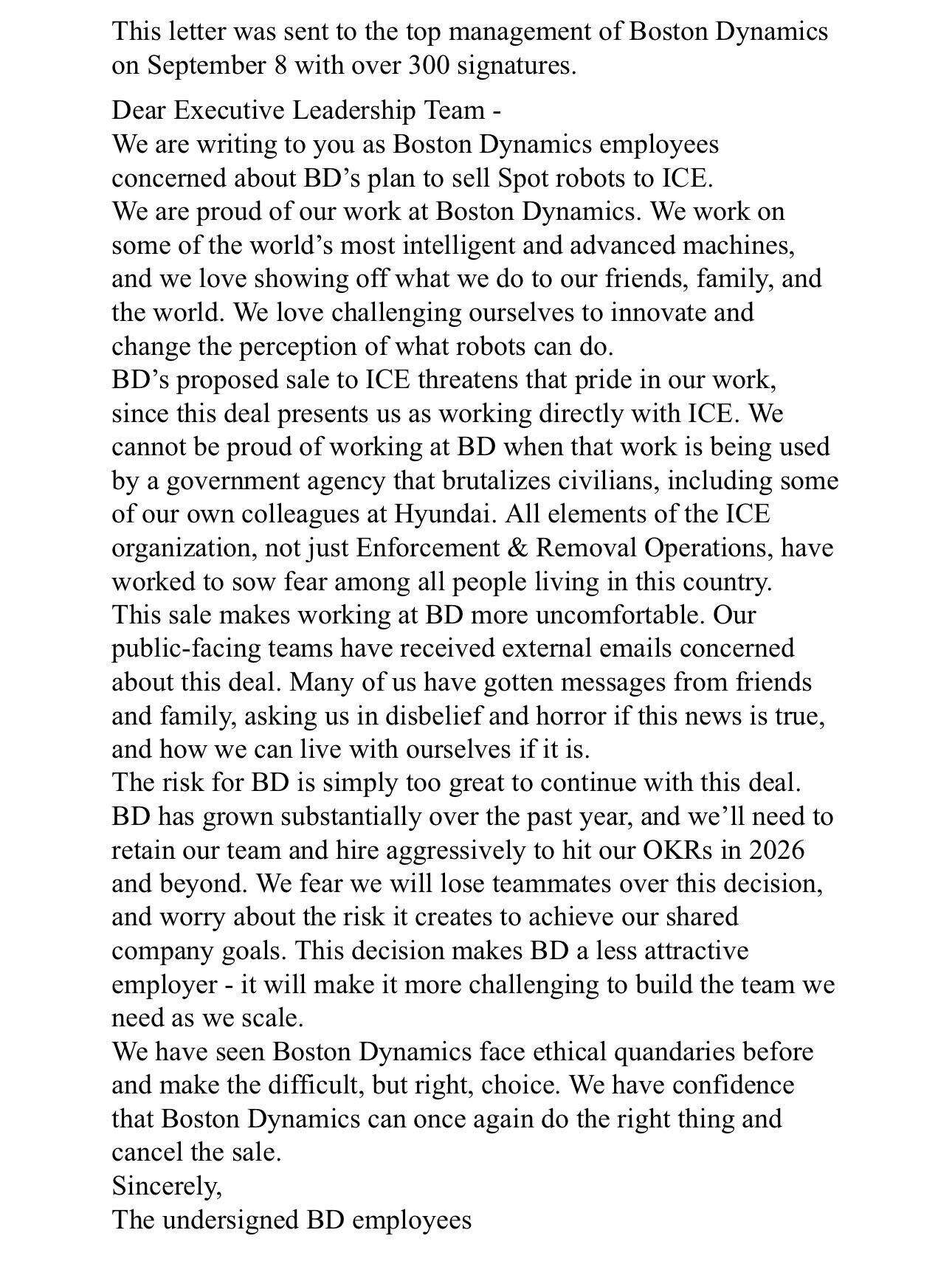
Hundreds of employees at the US robotics firm Boston Dynamics signed a petition calling for executives to halt a sale of the company’s robot dogs to US Immigration and Customs Enforcement—but executives stood by the deal, while saying the robots would not be weaponized.

On September 25, the Department of Homeland Security contract awarded $1.3 million to a Connecticut company called Radeco to provide ICE with modified versions of Boston Dynamics’ quadruped robots. But Boston Dynamics workers sent the petition letter with more than 300 signatures—half of them anonymous—to the company’s executives in early September and shared copies with The Boston Globe and WBUR public radio station.

“Many of us have gotten messages from friends and family, asking us in disbelief and horror if this news is true, and how we can live with ourselves if it is,” according to the petition. “The risk for Boston Dynamics is simply too great to continue with this deal.”

Read full article

Comments

© Radeco

Intel gets waiver after worries fuzzy US ban on foreign-made robots may hit fabs

23 October 2026 at 17:18

US chip champion Intel was so confused by the US government ban on foreign-made robots that it requested and received a waiver “out of an abundance of caution.” The tech company wanted to make sure that it could continue using certain robotic vehicles in its US chip fabs.

The uncertainty surrounding the Federal Communications Commission ban on certain foreign-made robots was revealed in the agency’s decision to grant Intel’s waiver request. On October 22, the FCC published its order allowing Intel to continue using the foreign-made robots in US semiconductor manufacturing facilities for a period of one year.

The robots in question are automated guided vehicles operating on “tracks or predefined paths” while often requiring operator oversight, according to Intel’s website. They help to move materials and items around within warehouses and factory floors.

Read full article

Comments

© Intel

Disney offers $20M for Character.AI’s scandal-plagued chatbot tech

13 October 2026 at 18:23

In a bankruptcy proceeding that kicked off yesterday, Disney has offered to buy some of the technology that powers the controversy-plagued chatbot Character.AI.

Disney is willing to pay $20 million for “a non-exclusive perpetual license” of certain Character Technologies intellectual property, the chatbot maker said in a press release that did not go into much further detail on which assets Disney wanted.

The move may be surprising. In September 2025, Disney joined others in publicly criticizing Character.AI for stealing content and harming kids. Specifically, Disney sent a strongly worded cease-and-desist letter that accused Character Technologies of weaponizing Disney characters “in a way that could damage its brand long term,” Axios reported.

Read full article

Comments

© SOPA Images / Contributor | LightRocket

Amazon has over 1 million robot workers. What’s next for human employees?

12 October 2026 at 12:43

No organization in the world operates more robots than Amazon. The company already has more than 1 million robots working in warehouses around the clock to make tens of millions of same-day and one-day package deliveries happen on a daily basis—and Amazon is poised to significantly grow that robotic fleet in the coming years as it establishes new factories to churn out increasingly more capable robot workers.

Despite deploying so many robots, Amazon is also the second-largest corporate employer in the world, with more than 1.5 million full-time and part-time human workers, according to its 2025 annual report. Amazon executives say that the growing robot fleet has eased the burden on its human workforce by taking on the toughest fulfillment center tasks that carry the greatest risks of physical fatigue and injury. But labor advocacy groups and independent researchers point to evidence suggesting that warehouse automation driven by AI is not all upside for the humans who work alongside robots.

“For the last 100 years, most of the automation that we've seen usually happens away from workers—you're taking that high-risk task away from the worker, and you're doing so in a way that is not physically proximate,” Brian Greenwood, professor of business at George Mason University, told Ars. “The rise of collaborative robots really changes that dynamic for two reasons: one is that it is physically proximate, and two, the robot has the ability to dictate the pace of work.”

Read full article

Comments

© Amazon

Nvidia's big bet on physical AI aims for safer robotaxis, humanoid robots

8 October 2026 at 11:15

Investors bullish on AI data centers may be fueling Nvidia’s multitrillion-dollar market capitalization, but the AI chipmaker has also bet billions of dollars on physical AI technologies such as robotics and self-driving cars. Part of that gambit has involved developing a full-stack safety system that companies can build upon to reduce the risk of their machines harming nearby people.

Nvidia's Halos system launched in 2025 with hardware and software tools to help developers implement guardrails in self-driving cars and other autonomous vehicles. Then the company expanded its safety architecture to more physical AI technologies by announcing Nvidia Halos for Robotics in June 2026—with the goal of enabling safe deployments of autonomous mobile robots in warehouses, humanoid robots walking around inside a factory, or even surgical robots.

“Now the AI models are getting capable, the robot hardware is getting capable, and a thing we thought is going to be the next bottleneck is safety,” Amit Goel, head of robotics ecosystem and edge computing at Nvidia, told Ars. “So that's why we launched our Halos for Robotics to unlock the capability of these systems.”

Read full article

Comments

© Agility Robotics

❌
❌