Login
Measure Psychological Safety – The Platform
Measure Psychological Safety – The Platform
This week we’re excited to officially launch Measure: our very own psychological safety survey that comes back with a plan, not a score.
This has been a long time in the making. Over years of working with (and measuring psychological safety in) teams and organisations all over the world, in different contexts and industries, we’ve finally released our measurement platform for general use. It’s been in limited preview for a while, which many of you tested and told us what to improve. Thanks so much to the beta testers!
Measure is built on the mechanism of the calculus of voice. Before speaking up, we weigh up, mostly without realising we’re doing: Can I predict the response? What might it cost me? Does anything change as a result? Someone who stays quiet because the space is unpredictable needs better clarity and structure. Someone who stays quiet because nothing ever changes needs to see evidence that it’s worth it. It’s all of this that Measure delves into and knowing this is what lets us shape what comes next.

Here are some key highlights of the Measure platform:
You get a plan, not a score.
We have found that numbers aren’t much use by themselves, so Measure’s report not only provides you with the numerical data – the metrics, ranges and distributions – but qualitative context for those numbers too. It tells you the main things holding people back, how predictable the space is, and what the range of responses means, not just the average. A team that scores 1,1,1,5,5,5 and a team that scores 3,3,3,3,3,3 both average 3.0, which is an accurate answer to the wrong question.
Asking people how safe they feel and then doing nothing is one of the fastest ways to teach them that speaking up is pointless. So the report mustn’t stop at findings. Most importantly, Measure suggests what to try next. The suggestions are based on what the responses show, so you get intelligent practices and approaches to try that actually align with what that team needs. As with everything in our approach, they’re experiments, not prescriptions.

It’s a tool that you shape.
Psychological safety doesn’t look the same to everyone. A tech team (for example) may care most about ideation, experiments and trying things that might not work. A healthcare team may care more about communication, learning from error and reducing harm. Those are different kinds of psychological safety, and they need different questions.
So we’ve made sure that you can tailor Measure to the team and context that you’re exploring. It’s not a single, cookie-cutter, one-size-fits-all (and fits nobody well), survey tool. It’s a platform that you tailor to context and culture as you need it.
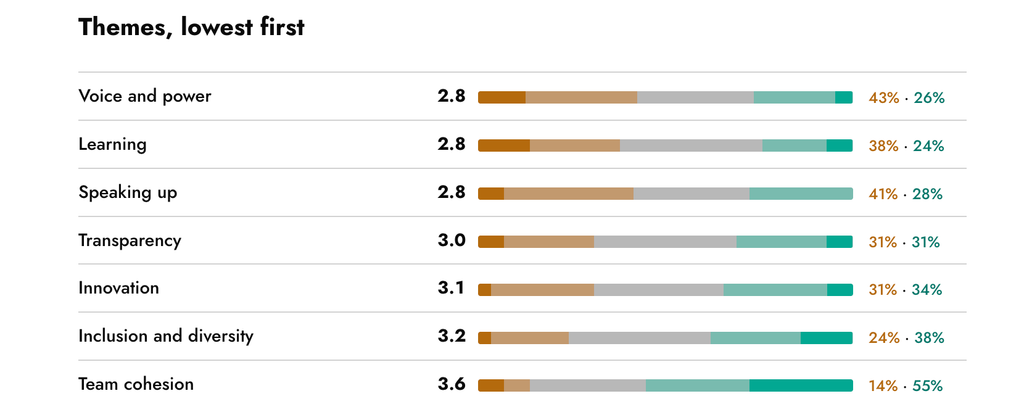
You choose up to 14 questions from a question bank, separated into themes of Voice and Power, Inclusion and Diversity, Innovation, Learning, Speaking Up, Team Cohesion, and Transparency. Or you can write your own (and with Org Plans, you can write questions that are asked of all teams). You can also select the seven questions, adapted to our instrument, from Amy Edmondson’s original research, what we call the “Edmondson Seven” (which sounds rather like a classic Western movie where Amy leads a gang to pull off a big heist).

It’s not a benchmark.
Measure doesn’t benchmark against other teams or organisations and it doesn’t give you a headline “score”. Imagine one organisation of 5,000 people, spread across offices in the UK, where all the team scores, when averaged out, come to 3.4. Imagine another of 20,000 people, across Europe and in a different industry, that scores 4.7. Is the second organisation psychologically safer? Does it have better managers? We can’t say. The work is different, the context is different, the same questions mean something different in each, and the distributions underneath those two numbers could be almost anything. In fact, the senior leaders in the 4.7 organisation might see that and think the work is done, so they don’t need to try any more. Even worse, they decide they’re happy with anything above 4, so 4.7 means they can turn the screws a bit harder, introduce a bit more fear.
Give an organisation a number and it will do what organisations always do with numbers, which is stop looking at anything else.

It also tells you what’s working well.
Measure also asks the question most surveys leave out: when speaking up does work here, what makes it possible? In the spirit of Safety-II as well as Safety-I we want to understand what goes well, not only what goes wrong. What is the team doing well to help people speak up? By surfacing this, we can do more of it, and we can protect it so that it doesn’t erode while our focus is elsewhere.
Open to everyone
Measure is currently available in English as well as “Easy Read English“. Spanish, German, French and Korean are available in public beta (and we’re looking for testers who are native speakers in these languages!). Even if the survey has been written in English, a respondent can respond in the language that suits them best. Easy Read may suit people with dyslexia or learning differences, or simply anyone who prefers it. A psychological safety survey shouldn’t hear only from the people best placed to read it.
It is also anonymous by design. Nobody answering is asked for a name, an email or an account, and no IP address is kept. No report opens until the survey has closed with at least four answers, and nobody, including us and whoever is paying, sees who said what.
What it isn’t
Measure is not a validated academic research instrument, and that’s deliberate. If we needed comparable psychological safety measurement for research, Edmondson’s original seven items, unchanged, would be the right tool. Measure is a sensemaking tool: it’s for helping teams and managers understand their own conditions and decide what to try. For that job, the ability to adapt to context, and its inherent usefulness, matter much more than comparability.
It also won’t suit every situation. A team of fewer than four can’t be surveyed anonymously, a short-lived project group may be better served by a conversation, and a survey won’t fix a team in acute conflict, just like a thermometer won’t put out a fire.
Try it
Your first survey is free, with the whole report and plan. Paid plans just differ in how often and how many teams you can measure, never in what you learn: £60 a year to keep measuring one team (with reports that show you what’s changed over time), £260 a year for practitioners and consultants working with up to ten teams (you also get a Practitioner/ Consultant licence for free if you complete the whole Psychological Safety Train The Trainer course), and an Organisation plan for wider rollouts, organisation-level dashboards, Single Sign-On, auditing, and more.
There’s a three-minute self-check to try, the complete how-to guide, and a sample report to read here. Let us know what you think!
The post Measure Psychological Safety – The Platform appeared first on Psych Safety.