
 Login
How Childhood Socioeconomic Status Shapes Psychological Safety and Career Risk-Taking at Work
How comparatively well-off we feel as children affects our later appetite for interpersonal risk taking in the workplace.
Authors: Tom Geraghty & Jade Garratt, Psychsafety.com
In our work and experience with teams and organisations all over the world, we always suspected that people’s early experiences, their socioeconomic status in more formative years, and resultant perspective on the workplace, shaped how safe they felt to take interpersonal risks. Those risks include speaking up with an idea or a mistake, as well as putting oneself forward for a high-profile, risky, but potentially rewarding (in a career sense) project.
Our sense was that people who experienced more financially precarious childhoods may be more likely to feel an innate risk aversion, partly due to learned behaviour, and partly as a result of having less of a financial safety net if it went wrong. We decided to carry out a survey to explore whether data would support this hypothesis. Our research question was “Do early-life socioeconomic conditions shape interpersonal and career-based risk-taking at work, and does that relationship change with age?”
Executive Summary
To test our hypothesis that there was a relationship between early-life socioeconomic status (SES) and interpersonal and career-based risk taking at work, we carried out a short survey and shared it with newsletter readers, community members, and via social media channels. We asked about respondents’ age, their comparative socioeconomic status through childhood, and two questions about risk in the workplace:
- One focused on general psychological safety (admitting mistakes, asking for help, etc) and
- One specifically on taking career risks: putting oneself forward for high visibility and/or high value projects and opportunities.
The results showed that greater comparative childhood socioeconomic status correlated with higher psychological safety (p=0.185) and opportunity taking (p=0.221) in the workplace. The effect was more pronounced and consistent for opportunity taking than for interpersonal psychological safety and both effects were relatively small (reflecting the myriad antecedents to interpersonal risk appetite in the workplace), but significant. Both effects appear to attenuate with age – suggesting that the advantage conferred by greater socioeconomic status in childhood lessens over time as people build experience, seniority, and accumulated social capital.
After accounting for age, there’s a positive, statistically significant association between higher childhood SES and feeling safer to speak up and safer to step into high-profile opportunities, and this effect declines over time. Respondents who ranked their childhood SES highly (scores 5–6) consistently reported the highest average safety scores for both interpersonal risks and putting themselves forward for high-profile career opportunities. For instance, the High SES group reported the highest average score for career risk-taking, whilst conversely, individuals reporting a low childhood SES (scores 0–2) showed the lowest average safety scores for both types of risk. Career progression and age appear to offset the disadvantages of a lower socioeconomic starting point.
Qualitative comments reinforce this correlation, suggesting that growing up in comparatively lower SES contexts taught people that there was “much more at stake” for them in the workplace.
Cite as: Garratt, J., Geraghty, T. (2025) How Childhood Socioeconomic Conditions Shape Psychological Safety and Career Risk-Taking at Work. psychsafety.com. Available at:
Why Socioeconomic Status Matters
Psychological safety: “the belief that one can speak up with ideas, questions, concerns or mistakes, and the team is safe for interpersonal risk taking” (Edmondson, 1999), is a prerequisite for collective learning, innovation, and workplace safety. Yet psychological safety is not evenly distributed – the interpersonal stakes are higher for some than others. Early-life socioeconomic conditions shape beliefs and expectations about what happens when you take risks: greater childhood deprivation generally predicts greater risk-aversion in economic games (Amir et al, 2018). These early conditions strongly influence our internalised beliefs about whose voice matters, who sounds more credible, who has safety nets if things don’t go to plan, and who must shoulder the higher perceived downsides of risk.
For those more accustomed to precarity in their formative years, limited family income, reduced access to professional networks, and smaller or non-existent financial safety nets, it makes sense that the voice calculus tilts toward greater caution. It’s unsurprising that this effect is exacerbated in status-visible contexts, such as presenting to senior leaders or putting oneself forward for high-profile and or high risk/high value projects. In contrast, more socioeconomically advantaged backgrounds may confer confidence, a sense of belonging, greater access to professional networks, workplace language fluency, and financial safety nets that lower the perceived cost of taking career and interpersonal risks at work.
Methodology
- Design & audience. We carried out an online cross-sectional survey, distributed via email to Psych Safety newsletter subscribers and through social channels (from 6–31 October 2025). This was a diverse and international sample, across a wide range of sectors and roles. We received 375 responses in total.
- Key questions (0–6 scales).
- Childhood comparative socioeconomic status (SES): “Thinking about your childhood (up to 18 yrs), what was your family’s overall social & economic position compared with others in your country? – If all the families in a country lined up in order of socioeconomic status, where would your family be in that line?”
- Note on rationale: Marmot’s work in public health shows that it’s not absolute SES that matters – it’s the comparative “social gradient” that most affects our ability to take part effectively in society.
- Interpersonal psychological safety: “How safe do you feel taking interpersonal risks (e.g., disagreeing with a colleague, admitting a mistake or raising a concern) in the workplace?”
- Attitude towards opportunity-taking: “When high-profile, higher-risk opportunities arise (e.g., cross-team projects with senior visibility), how safe do you feel putting yourself forward?”
- Age (bands): Under 20; 20–30; 30–40; 40–50; 50–60; 60–70; 70+. (Converted to approximate midpoints for modeling.)
- Open text for qualitative comments: “Is there anything you would like to add or comment on?”
- Childhood comparative socioeconomic status (SES): “Thinking about your childhood (up to 18 yrs), what was your family’s overall social & economic position compared with others in your country? – If all the families in a country lined up in order of socioeconomic status, where would your family be in that line?”
Consent/Ethics: Participation was voluntary; and no personally identifying information was collected other than email addresses when offered in order to follow up.
Key Results
1) Childhood SES is linked to interpersonal and career risk appetite in the workplace.
Higher childhood SES is associated with greater felt safety for both:
- Interpersonal psychological safety (p=0.185): everyday risk behaviours such as disagreeing, suggesting ideas, admitting mistakes, and raising concerns; and
- Opportunity-taking (p=0.221): volunteering for high-profile projects or visible roles that carry reputational or job-role stakes.
These findings suggest that early-life socioeconomic advantages generalise into lower perceived costs for taking interpersonal risks in the workplace.
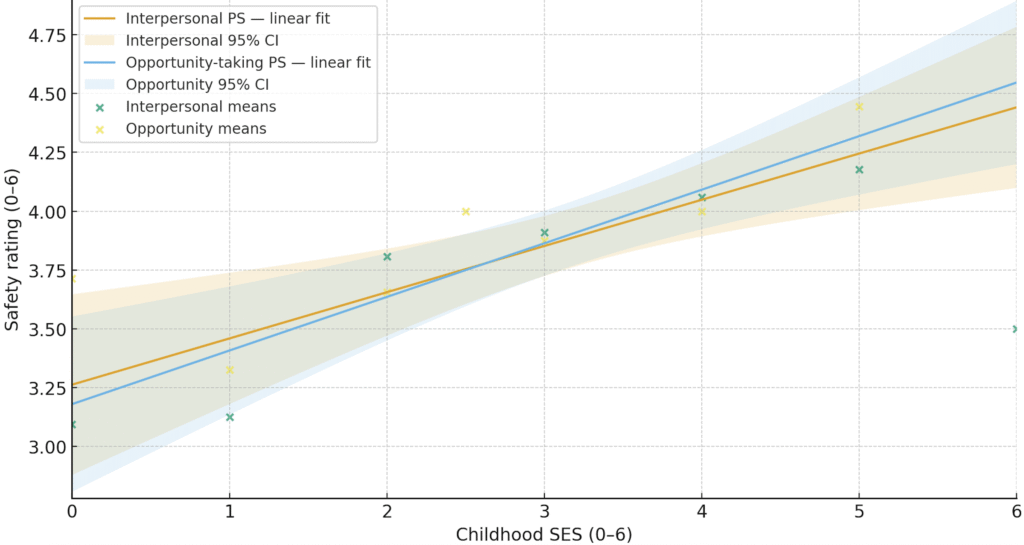
Figure 1: The effect of comparative childhood SES on workplace psychological safety and opportunity-taking safety (linear regression plot). Both psychological safety and workplace opportunity taking behaviour positively correlate with childhood comparative SES.
2) Opportunity-taking is more SES-sensitive than Psychological Safety
The SES link tends to be stronger for workplace opportunity-taking than for generalised interpersonal safety. This is likely because career opportunities also present risks – if a high value and/or high-visibility project fails, it can damage our reputation or increase the risk of losing our job. For people accustomed to smaller safety nets and a greater sense of financial precarity, these risks may seem not worth the potential payoff. Conversely, for those with a greater safety net and stronger professional networks, the risk of losing a job, or hunting for a new one with a different organisation, may pose lower risk, and thus lower fear.3) Age Attenuates the SES Effect
The SES advantage is largest earlier in our career and declines across adulthood. Figure 2 shows age-stratified correlations show the strongest SES influence (shown in the chart as gradients – with a steeper gradient representing a stronger effect) under 35 years (orange), a flatter gradient 35–50 (blue), and the flattest (with a generally higher risk taking stance overall) at 50+ years (green).
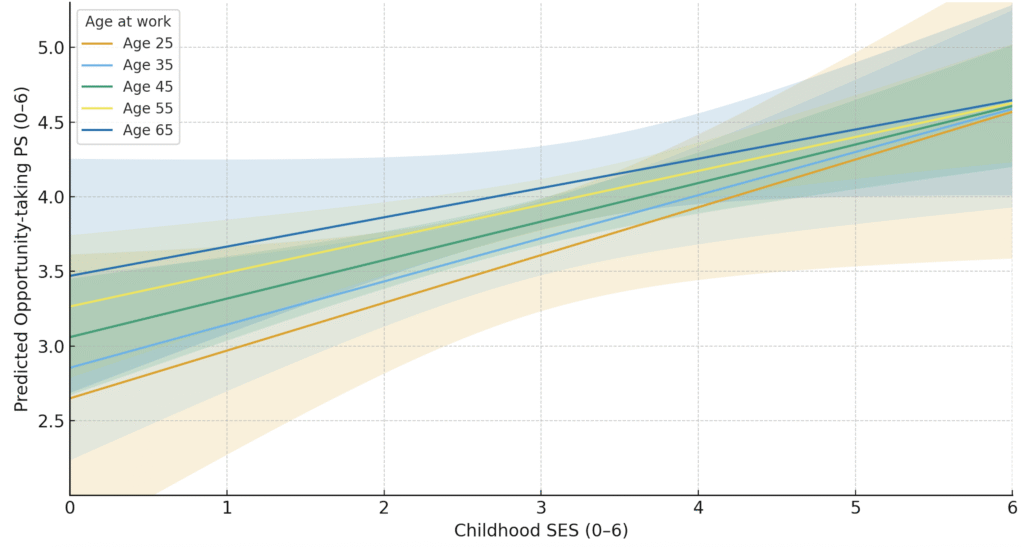
Figure 2: SES effect on Opportunity Taking, by age. The steeper the gradient, the stronger the effect of childhood SES on workplace opportunity taking behaviour. (Download the Python scripts to create these charts here)
In other words, as we age, our early-life financial status appears to have less impact. We interpret this correlation to suggest that tenure, seniority, increasing social capital and financial stability mitigate early-life disadvantages of lower SES. As one participant shared:
“My confidence to take interpersonal risks when I first joined this organization… was much lower. As someone from a solidly middle class background with limited education (college graduate) I did not feel safe to speak up among my highly educated upper class associates. Thankfully, 7 years later that is beginning to change.”
[Note: “college” in the UK refers to post-school education, but is not university – what college may refer to in the US)
For opportunity-taking, the SES gradient persists longer than fundamental psychological safety, which is consistent with our hypothesis that workplace visibility keeps perceived career stakes high and our childhood experience permanently shapes our perception of the workplace. Another participant interpreted this as:
“I think people from a lower socio-economic status tend not to take as much risk because in their history there has been so much more at stake for them. There would have been no rescue or hand-out, it would have been all or nothing.”
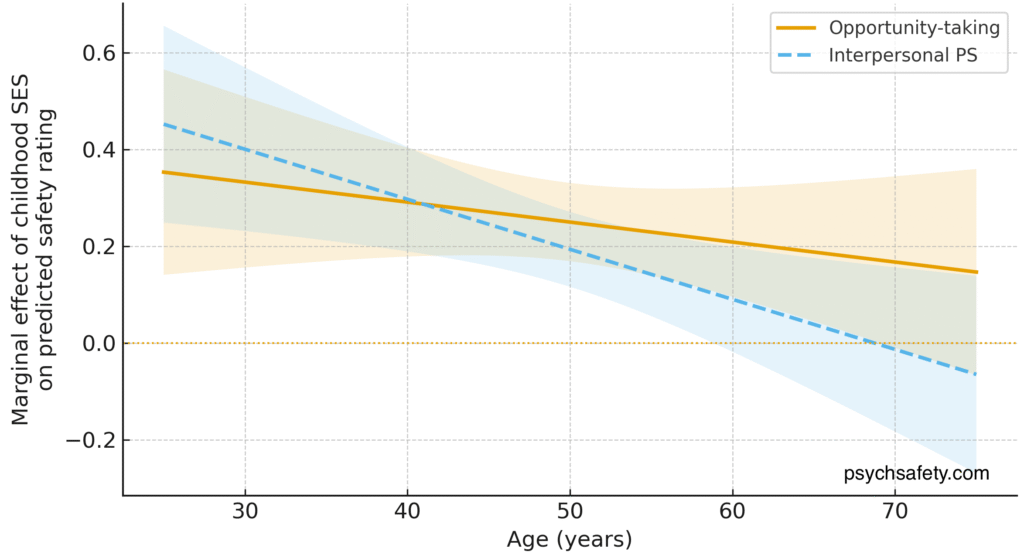
Figure 3: Strength of SES effect over time. As we age and gain experience, status and workplace collateral, our early life experiences still matter, but their influence is less over time. The wider 95% confidence intervals at each end represent fewer survey responses.
Qualitative Depth
While the quantitative data revealed clear patterns in how socio-economic background correlates to perceived interpersonal and career risk, the numbers could only tell part of the story. To understand why these patterns exist, and how they feel in people’s lived experience, we invited participants to share their additional comments and reflections with us, which many did. The qualitative comments added nuance to the data, revealing how people make sense of safety, risk, and belonging at work through the lens of their own histories.
Socio-economic background during childhood can play a part in that story, but it rarely stands alone. As one person wrote, “My feelings are more influenced by my gender than my background,” while another acknowledged, “What also helps with my sense of safety is I fall into a category that has the safety net of being white. Makes a huge difference here (in the US).” For others, family dynamics, health, and personal temperament were just as important: “Highly dysfunctional family dynamic might have had a bigger influence than the socio-economic background,” one participant reflected. Several emphasised the role of context: “The work environment matters too. The cultural norms, direct supervisor, and relationships with colleagues.” Together, these stories show how layered and interdependent these factors are. They remind us that when we look at workplace risk-taking, we’re really looking at the meeting point of many personal and systemic histories.
Many respondents expressed gratitude that we are exploring this dimension at all: “chuffed to bits that you’re asking these questions,” wrote one; another said they were “so grateful that you’re digging into this – socioeconomic background in a workplace environment is a topic that needs more attention.” This encouragement perhaps reflects how seldom class and socio-economic experience are explicitly recognised in organisational conversations about psychological safety and inclusion.
A number of participants drew attention to the quiet but persistent ways that privilege or deprivation shape confidence and opportunity. “I see a certain difference in self-confidence among peers who grew up in better conditions; they are more enterprising and slightly more self-confident,” wrote one, while another noted, “My race, class, country and education mean that I have a significant safety net — I’ve been able to fail many times and still be safe.” For some, early disadvantage became a source of motivation or moral clarity: “I used my harder environment to gain confidence by committing to not letting that hold me back.” Yet, as others described, this process of self-creation often takes years — one participant reflected:
“It took years for me to create safety for myself. Even now I wonder if it was the effects of poverty, neurodivergence, both?”
Across responses, age and experience emerged as powerful moderators. People repeatedly described how confidence and a sense of safety grew with time: “This has certainly improved with age and job experience,” and “With age, I have become more willing to ‘go out on a limb’ and push boundaries.” Some connected this to accumulated expertise, others to a more settled sense of identity. But this was not universal. One woman nearing retirement wrote that she still felt “worried about the impact of raising [her] profile in the workplace.”
Ultimately, what emerges from these comments is not a single narrative but a web of intersecting influences – including wealth, class, gender, race, health, family, leadership, culture and time. Each contributes to how much psychological safety we feel, and how much risk we feel that we can afford to take.
Implications
What does this mean for practice?
Firstly, the data makes it clear that if we simply demand that people “speak up”, “be courageous”, and adopt a “psychological bravery” stance, it won’t be enough. In fact, such approaches may even deepen existing inequalities. If people’s willingness to take interpersonal or career risks is associated with their socioeconomic background, exhortations to be braver can inadvertently privilege those who already feel safer taking those risks.
Secondly, the finding that SES appears to have a relationship with both interpersonal and career risk taking at work suggests that the effects of SES background may persist and even compound over generations. Higher SES in childhood may endow people with a greater ability to navigate and take advantage of workplace opportunities, furthering their careers and reinforcing their socioeconomic position – for both themselves and their families. Conversely, those from lower SES may be held back from taking advantage of workplace opportunities, reducing their ability to build stronger SES for their family, and perpetuating the cycle over generations.
Even if we were to disregard any societal or ethical basis for addressing inequality, there is a clear organisational case for doing so. Leaders who fail to recognise and mitigate the SES effect may overlook capable, talented people who simply feel less safe putting themselves forward. By creating environments that reduce the risk associated with speaking up or stepping up, organisations can tap into a broader and more diverse pool of skills and insights, ultimately leading to stronger performance as well as more equitable outcomes.
What Leaders Can Do To Address the SES Effect
This research suggests that how safe people feel to take risks – whether interpersonal or career-related – is about what people bring with them as well as what happens at work. And while leaders can’t change someone’s past, they can shape the present conditions that make risk-taking feel possible.
1) Open up access to ‘stretch’ work
Many workplace opportunities still depend on people putting themselves forward, and these “opt-in to opportunity” systems in the workplace favour those already confident, or financially secure enough to take a chance. As one participant reflected, the ability to take career risks often comes from “having a safety net.”
To counter this, leaders can make opportunities more transparent and less dependent on self-nomination. Advertise internal projects openly, invite peer nominations and ensure sponsorship and mentoring aren’t reserved for the well-connected. When someone is unsure whether they “belong” in those spaces, a personal invitation can make all the difference.
2) Reduce ambiguity costs, especially for early-career employees
Ambiguity comes at a cost, especially for those without insider knowledge or access to informal networks. Several participants described how much easier it felt to take risks once they understood the rules of the workplace game. Leaders can help by offering short pre-briefs, co-presenting options, or rehearsal time for those stepping into more visible roles. Be explicit about how decisions are made and what success looks like. For people from lower socio-economic backgrounds, the perceived risk of failure may be far higher than the reality: extra clarity and reassurance can help close the gap.
3) Track equity in advancement opportunities
Use engagement surveys and feedback from employees and leaders regarding who speaks up, who gets stretch work, and who takes on highly visible projects, to notice whose voices are heard and whose potential is recognised. If you can, cross-reference this with age/seniority and, where appropriate, class-origin indicators such as first-generation university attendance.
Are stretch projects, visibility, and promotions evenly distributed, or concentrated among those already buffered by privilege? Pair quantitative measures with qualitative listening, such as open comment boxes, focus groups or one-to-one conversations to understand the lived experience behind the numbers. If patterns emerge, treat them not as individual shortcomings but as signals that the system itself may need redesigning to enable broader and more equitable opportunities and risk-taking.
As one participant beautifully put it:
“If you never learned that your presence in the world matters, then showing up in that world feels very risky.”
The work of leadership, then, is to create environments where presence itself feels valued and where people can take risks not because they’ve always known they matter, but because the organisation shows them, day after day, that they do. Building psychological safety through a socio-economic lens is, in a practical sense, about widening the circle of who gets to step forward, speak up and be heard.
“…redistributive policies are needed to break the cycle of deprivation that limits opportunities and threatens social cohesion.” (Manstead, 2018)
Future Research
This was a cross-sectional survey, and shows correlation, not causation. Further longitudinal research would aim to establish causation, and the mechanisms thereof. It would also be interesting to study the intersectionality of this effect – to examine compounding and buffering by some of the additional factors participants recognised as important to them: gender, sexuality, ethnicity, neurodiversity and disability, first-gen university, and national culture.
Conclusion
Workplaces inherit the social gradient. Our research suggests that comparative childhood socioeconomic status (SES) shapes the perceived cost of speaking up and putting oneself forward, especially early in careers, yet this gap narrows with age.
To foster environments where everyone can contribute fully, organisations need to recognise that the perceived risks of speaking up or putting yourself forward for a career opportunity are higher for some than others. These perceptions are formed from our childhood experiences and sense of where we belong in society and our comparative socioeconomic security.
Appendix
The raw data is available here to run your own analyses. Qualitative data has been removed to protect respondents’ identities. Please reference and cite appropriately.
References
Amir, D., Jordan, M.R. and Rand, D.G., 2018. An uncertainty management perspective on long-run impacts of adversity: The influence of childhood socioeconomic status on risk, time, and social preferences. Journal of Experimental Social Psychology, 79, pp.217-226.
Detert, J.R. and Burris, E.R., 2007. Leadership behavior and employee voice: Is the door really open?. Academy of management journal, 50(4), pp.869-884.
Edmondson, A., 1999. Psychological Safety and Learning Behavior in Work Teams Amy Edmondson. Administrative Science Quarterly, 44(2), pp.350-383.
Manstead, A.S., 2018. The psychology of social class: How socioeconomic status impacts thought, feelings, and behaviour. British Journal of Social Psychology, 57(2), pp.267-291.
Marmot MG. Understanding social inequalities in health. Perspect Biol Med. 2003 Summer;46(3 Suppl):S9-23. PMID: 14563071.
The post How Childhood Socioeconomic Status Shapes Psychological Safety and Career Risk-Taking at Work appeared first on Psych Safety.
