Reading view

There are new articles available, click to refresh the page.

Elon Musk finally launches X Money. What could possibly go wrong?

Imagine you’re an X user who's actually excited to make the app your primary payments app after X Money finally launched Monday, after years of delays, for US Premium and Premium+ subscribers.

You transfer funds and set things up so that your paychecks automatically deposit to X, where you expect to receive cashback rewards and a high annual yield of 6 percent on your funds—a rate that’s genuinely competitive with some banks.

But once you’ve put your money in the app, you realize that X Money has a lot of limitations. Most glaringly, you can currently only send peer-to-peer payments to other X users who have access to X Money and are 18 and older.

Read full article

Comments

© Anadolu / Contributor | Anadolu

Doing the Math on Art Shows (and Other Ways to Sell My Silversmithing Work)

I take an objective, dollars and cents look at the various ways I can sell my jewelry to see how they stack up financially.

Last weekend, I made the nearly 5-hour drive to Sequim, WA to attend a 3-day Lavender Festival that featured, among other things, artists and vendors selling their wares. I was one of those artists.

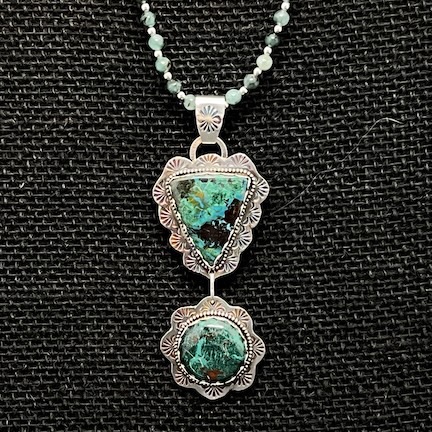
Malachite and Azurite Pendant
I was very pleased that this double pendant sold for $229 at the Lavender Festival, along with the $99 sterling silver and emerald necklace I’d paired it with. (Those beads were expensive!)

I’ve done plenty of art shows before. I’ve done a handful here in Washington State and a handful down in Arizona. I’ve had mixed results, mostly depending on the stage I was in in my silversmithing journey and the kind of show I was attending. Some shows are good for low-end items, other shows are good for fine art items. My work straddles those two worlds, for a variety of reasons.

But rather than talk about the evolution of my work, I want to talk about something I know well: the finance end of things. After all, I do have a BBA in Accounting with Highest Honors from Hofstra University. (LOL.) And even though I don’t use that degree in my daily work, I haven’t forgotten a lot of what I learned along the way, including marketing and finance. It is, after all, what makes it possible for me to handle the financial records and do the marketing for all of the businesses I operate, even if I can never really count how many there are.

And here’s what I learned about the various ways I sell my work.

Item Costs

When you’re making something for sale, you need to get a good handle on what each item costs to make. Costs include a few things, some of which are more obvious than others:

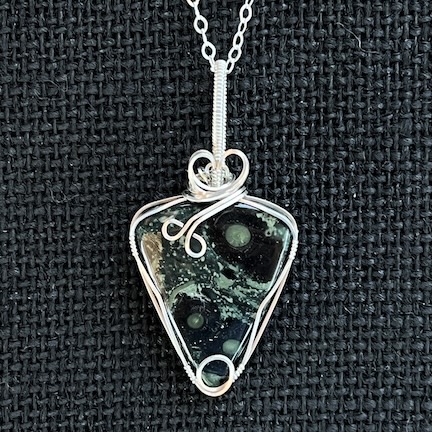
  • Wire framed pendant
    Remarkably, these wire-framed pendants still sell. I make them when I’m sitting idle in my booth at a show. They are the least expensive pendants I make, but with the price of silver rising 50% in the past two years, I’ve had to raise my prices on them, too.

    Materials cost. I’m using sterling silver and gemstone cabochons for most of my work. There was a definite identifiable cost to acquire these materials. I try to record the cost of materials where I store those materials. There’s a cost code on a sticker on the bottom of every cabochon in my collection. I also write the cost per square inch on flat pack silver packages and the cost per inch on the spools or coils of silver wire. Although I’m not quite anal enough to track the exact materials cost for every item I make, I do have a fair idea. I can tell you this: bezel-set stones on backplates cost a heck of a lot more for materials than wire framed pendants.

  • Supplies cost. I use a variety of supplies when making jewelry. Solder, flux, torch fuel, sanding and polishing wheels, etc. In most cases the amount of supplies I use are minimal, but they were purchased at a cost and I need to keep that cost in mind when calculating what an item costs to make.
  • Want a good idea of what kinds of tools I use? Watch this YouTube video tour of my shop.

    Tools cost. Tools are the things I use to manipulate the metal and can include hand tools like pliers, wire cutters, hammers, and saws; desktop tools like my flex shaft, rolling mill, metal shear, and torches (Big Shot with butane refills and Smith Little Torch with propane and oxygen tanks); and other tools like mandrels, templates, soldering boards, annealing tray, third hand, anvil, etc. There are literally too many to list. Tools can be used over and over — often for years and many projects — but they still cost money to obtain. I have literally thousands of dollars invested in shop equipment and all of that is eventually paid for with the sales of my jewelry.

  • Time cost. Time really is money and my time ain’t cheap. If it takes me 4 hours of active work time to make a pendant, don’t you think I should be compensated for it? I build the cost of my time into my price.

I’m fortunate. My jewelry studio is in my home. I don’t need to rent a space and deal with associated costs. Other folks do. That has to be taken into consideration as well.

These are the costs of actually making items. Selling them is another story.

Cost of Sales is More than Item Costs

Artists can sell their work one or two ways: directly or through a middleman. Each way has its own costs.

Direct Sale: Selling in Person

This is the sweetest way to sell your work: sell it directly to someone who wants it who is meeting with you face to face. This could be a friend or a friend of a friend or perhaps at another place where you happen to be with your merchandise.

The best example I have of this is selling at an Artists Table at a boating event I attend every year. There’s one table for each artist (unless you get there early and hog multiple tables) and there’s no fee. For three hours, other event attendees check out what’s for sale and buy. I bring just a table cover and about a dozen pendant displays. I bring all of my pendants and about 1/4 of my other inventory. And I sell at retail price. My only cost is packaging and credit card fees. My return is roughly 95% at these events. I love them because they’re short and sweet and I’m there anyway. I can set up and tear down in about 15 minutes. Of course, I don’t make very much money at these events, but it’s nice to get compensated for my work.

Direct Sales: Selling online

I have an online shop that I use to sell my work directly to customers. This is actually the least expensive way for me to sell because I use an extremely cost-effective platform to sell on: Square. Square is my credit card provider and when I sell online, it just charges me the credit card fee, which is generally around 3%. I still have to buy packaging (my cost) and ship items out (usually my cost because large sales ship free). But looking at an example, suppose someone buys a $50 pendant, which ships free. I spend about $1.50 for credit card fees, $1.00 for packaging, and $4 to $10 on shipping. If I keep it as cheap as possible, I net $43.50 on that $50 item or 87%.

I should note here that not all online sales solutions are this cost effective. Etsy, for example, will charge a percentage of the sales price after it already charged you to list it and can charge an additional marketing fee if it claims people found your item through one of its Google ads. You can learn my thoughts about Etsy and why I won’t use it here.

I like direct sales through my website. It’s easiest and most cost effective for me to do.

Direct Sales: Selling at Art Show and Other Venues

I do most of my selling at art shows. Art shows have a variety of costs associated with them.

  • Jury or application fees, which range from $10 to $50, are non-refundable and you’ll pay them even if your work isn’t judged good enough to be part of the show.
  • Booth fees can range from $35 to $1,200 or more, depending on the show. You’ll pay those to get your booth.

But that’s not where the costs end. You still have to get to and from the show, pay for overnight accommodations if the show is more than one day, and cover the cost of fees for credit card sales.

And some shows require you to pay a percentage of sales. One I do quite regularly charges only $35 for my booth for the weekend — which can be up to 5 days, depending on how summer holidays fall — but also keeps 21% of all sales. They also handle sales centrally, so at least I don’t have to pay credit card fees. The good thing about this arrangement is that if I have a crappy weekend, I can’t lose money. But, on the other hand, if I have a kickass weekend, I still gross only 77-78%.

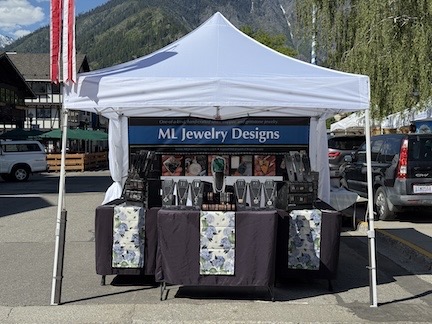
My Booth
My booth at a recent Leavenworth show. Canopy, tables, table covers, table runners, necklace displays, earring displays, bracelet displays, signage, chair, point-of-sale supplies. It all costs money.

And don’t forget your booth. You’ll need a white fire retardant canopy with zip-up sides, four 30-40 pound weights to hold it in place, and tables, walls, or other display equipment. Just outfitting your booth could cost $1000 or more; mine has a tent, three tables, table covers, dozens of custom pendant display “necks,” bracelet displays, and special boxes to display earrings. You’ll also need a vehicle to schlep all that stuff around. Fortunately, these are mostly one-time expenses, but you need to maintain and replace these items periodically. Before my last show, I re-finished every single one of my pendant displays. And two months ago, I replaced my aging canopy.

Finally, your sales depend quite a bit on a few factors:

  • Is your work with your price points a good match for the people attending the show? If you’re overpriced or your work is too highbrow for the people attending, you won’t get sales. If you’re underpriced, your work could be seen as junk.
  • What’s your competition like? I sell jewelry, which is often a very popular category at art shows. A smart promoter will use the jury system to select jewelry artists whose work is different. Then they’ll lay out the show so all of the jewelry artists aren’t together. If my work is very similar to another artists, we’ll have to split the sales for work like ours between us.
  • Is the show well attended? If people don’t show up because the show was poorly advertised, promoters charge a hefty entrance fee, or the weather was crappy for an outdoor event, sales will suffer.
  • Are people actually spending money? One of the things I hate about doing shows in tourist towns is that show browsers might just be walking around to kill time. The state of the economy comes into play here.
  • Do you accept credit cards? If you don’t, you’re in the wrong business. Cash might be king, but few customers use it these days.

Either way, you have to remember the other costs of direct sales, which includes packaging. My packaging is simple: drawstring bags for pendants and plastic zip bags for earrings on cards. For multiple item purchases, I have larger drawstring bags. But other vendors might have bubble wrap, boxes, shopping bags with tissue paper, or more. All of these things cost money and need to be considered as part of the cost of sales.

So let’s look at some numbers. I’ll compare a recent weekend at Leavenworth Village Art in the Park with the Lavender Festival in Sequim.

Item Leavenworth
(July 3-6)
Sequim
(July 18-20)
Days 4 3
Jury Fee $15 $25
Booth Fee $35 $495
Overnight Lodging $0 (home) $100 (dry camping)
Gross Revenue $2,094 $4,064
Commissions $440 $0
Credit Card Fees $0 $109
Net Revenue (excluding travel costs*) $1,619 $3,335
Percentage of Gross 77% 82%


* I excluded travel costs because I figure that driving to and from Leavenworth 4 times is about equal to driving to and from Sequim once, despite the much longer distance to Sequim.

My takeaway from this? My percentage return was only 5 percentage points higher in Sequim for the Lavender Festival than it was in Leavenworth (a tourist town) on a holiday weekend.

But the interesting thing to remember here is that my percentage return in Leavenworth will always be the same because of their commission fee structure: 77-78%. If I’d grossed $5,000, for example, in Sequim, my return percentage would have been closer to 85% (even considering more credit card fees). But if I’d grossed just $3,000 in Sequim, my percentage return would have been about 76%. Clearly, the more expensive a show is to attend, the more you have to sell.

I’ll tell you why the percentage return is important in a moment, although I expect most of you to be able to figure it out.

Middleman Sales: Consignment

I want to start out by saying that I hate consignment sales.

In consignment sales, you drop off some of your merchandise with the owner/manager of a shop or gallery and they sell it for you. Sounds good, right? Well here are some of the problems:

  • Consignment fees. The shop or gallery keeps between 20% (which is crazy low and pretty much unheard of these days) to 50% (which is crazy high). The average I’ve paid is 35%-40%. (I will not sell on consignment if they want 50%.) Take 100% and deduct that percentage and you get your percentage return: 60% to 65%. To be fair, it’s easy, takes hardly any time at all, and has no other costs like credit card fees or packaging.
  • They have your inventory so you can’t sell it. You can’t sell something you don’t have. And if they don’t sell it, it doesn’t get sold.
  • There’s no provision for loss due to shoplifting. If someone steals your work from where it’s displayed in the shop or gallery, it’s your loss. After all, the shop or gallery hasn’t paid you for it.
  • If they go out of business you might lose your work. I’ve heard these horror stories. A shop goes out of business and the owner/manager disappears with all the inventory, never to be seen again. This has not happened to me, but that’s because I’m very careful about who I leave items with on consignment.
  • You have to rely on their honesty. If they’re dishonest, you work will disappear and you’ll never see a penny for it. Again, I don’t think this happens very often.
  • Items can be shop worn or broken. I can’t tell you how many times I’ve gone to a gallery I work with to give them new items and get items back that are either severely tarnished — we are talking about silver after all — or broken. That means I need to work on them before I can put them back into my inventory and sell them.

The main reason I don’t like consignment sales is because I have to keep track of what’s out there. Letting inventory sit elsewhere, unsold or perhaps not even on display, is also problematic. I currently sell on consignment in only two places and I’m not bringing anything new to one of them.

Middleman Sales: Wholesale

Wholesale is a lot like consignment sales but once you sell it, it’s gone. You don’t have to track it or worry about getting it back in bad shape or worry about it getting stolen. You sell it and it’s gone.

The drawback, of course, is that the buyer wants a deep discount — perhaps as much as 50%. I’ve been lucky so far. I’ve done all of my wholesale sales at 35% with payment by check right on the spot. Although that means my percentage return is only 65%, at least the item is sold with zero additional cost or effort on my part.

Needless to say, if I’m going to use a middleman, I want it two be a wholesale client.

Why the Percentage Return Matters

Let’s put it all together now.

When you make an item, you have direct and indirect costs as discussed at the beginning of this article. When you sell at item you have additional costs. You need to price your item with a profit margin that makes it profitable to sell no matter how you sell it.

Suppose I make a pendant that takes me 4 hours and uses about $15 worth of silver and stones. I price my time at $25/hour (which is a steal). So my direct costs are $115. Add another $5 for the cost of supplies and a portion of the equipment costs. Now we’re up to $120. If I price this item at $199, I’ve got a 65.8% profit margin. (Calculate as (199-120)÷120.) So if I sell it at consignment and they get 35%, I’m barely breaking even.

I have three options:

  • Price it higher
  • Accept less for my time (or work faster)
  • Don’t sell anywhere I’ll make less than 65.8% percentage return

If I sold this at Leavenworth or at the Lavender Festival, I’d still only have a profit margin of 12% or 17%. That means that for every $1 of costs, I’d earn a profit of 12¢ or 17¢. Ouch.

This is the problem faced by all artists and makers. People don’t understand our costs to make or sell. They just see the end product. And then they value it based on what it might cost in Walmart or on Amazon or from an “artist” who has her work mass produced overseas with inferior quality materials — maybe silver plate and plastic “stones”? — and passes it off as handmade.

Advancing My Art

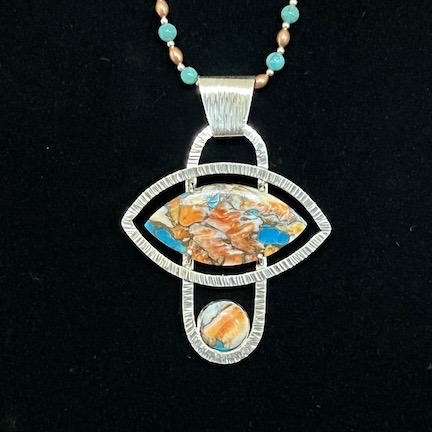
Kingman Turquoise Pendant
This is probably the weirdest piece I ever made. Thick, square hammered sterling silver wire with two Kingman Turquoise and orange spiny oyster shell cabochons set in it. I showed it for several months before it finally sold in Leavenworth, along with the silver, copper, and turquoise necklace I’d made to go with it.

Right now, I’m in an in between world. I’m still making low end items like certain earring styles and wire-framed pendants. These are priced to sell at tourist art shows and festivals. But I’m also making better quality, more artistic items that some folks refer to as “statement pieces.” These take a lot of time and effort to make with high quality materials and specialized tools. I’m charging more money for these things because I have to.

Unfortunately, the only way to sell these items is to attend better art shows. The better art shows have higher booth fees. So it’s a gamble. Is my work good enough to get into the show? Once I’m in, will I get the sales I need to not only break even on the show itself, but to get the percentage returns I need to actually profit?

I think the shows I attend this winter in Arizona will answer that question once and for all.

Don’t Tell Me How to Spend My Money

I tell yet another long backstory and get a few things off my chest. Sorry about the dirty laundry.

The other day, I did something I didn’t want to do: I bought a new monitor for my computer on Amazon.com.

The Monitor Backstory

It isn’t that I didn’t want to buy the monitor — I definitely did. Years ago, when I wrote books for a living, I had a wonderful computer setup that consisted of a 27″ iMac with a 24″ second monitor. I needed all that real estate for the work I was doing, laying out book pages on one screen and working with images, files, email, social media, and who knows what else on the other. It made my work easier and more pleasant to do, especially when I started getting involved in video projects for my helicopter YouTube channel, FlyingMAir.

But things change. I sold the helicopter and stopped doing videos. I bought a boat and started spending months on it at a time. I didn’t need a desktop computer so I traded it in for a new laptop. Along the way, I sold that second monitor, which, in all honesty, wasn’t that good anyway.
Dell Monitor
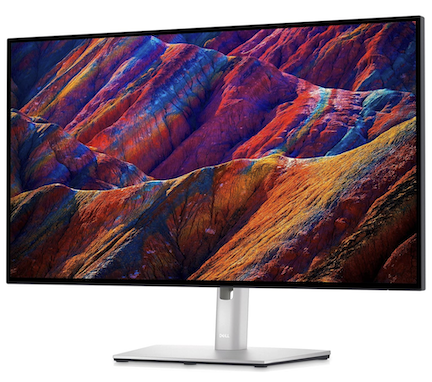
Here’s the marketing photo of the monitor I bought. Looks like a photo from Death Valley near Dante’s Point with a shit-ton of post processing and the saturation amped up, no?

But now I’m spending more time at home again, prepping to lay out another book, and making boating videos for my personal YouTube channel. So I bought a Mac Mini from Apple and bought a 27″ Dell UltraSharp monitor from Amazon to go with it.

The monitor is great and has more useful features than I need to cover here. It was working okay, but I really did miss that second monitor. So when I got home from my brief (comparatively speaking) trip south this winter, I decided it was time. I’d buy another monitor — preferably the same model — and set it side by side with the one I already had. It would make me more productive, I reasoned (whether rightly or wrongly). And yes, I’ll admit that the desire for some retail therapy weighed into the purchase decision.

And that brings me to Wednesday’s purchase.

The Amazon Backstory

I have been using Amazon.com since the only thing it sold was books. I was a Prime member when it was $49 (or maybe $39?) a year and all it got me was free 2-day shipping. I have spent thousands of dollars on Amazon over the years — sometimes more than $10,000 in a single year.

Sounds like I’m a real fan, right? Well, maybe I was but I’m not anymore. I dumped Prime when it got up to $149/year. (I think that’s what it is now, no?) I don’t watch TV and 2-day shipping is something Amazon stopped doing to my home back around Covid. I don’t like the way Amazon dominates the market and is putting smaller businesses out of business. I didn’t like the way “marketplace” vendors could be unreliable. I didn’t like the way search results — unless you had a specific make/model in mind — brought up so much crappy Chinese junk. And when it screwed up three of my orders right before Christmas, I started wondering why I was using Amazon at all. Surely I could just find stuff elsewhere.

So around mid-December 2024, I stopped buying at Amazon. Completely.

It wasn’t easy. You don’t realize how easy it is to fire up the Amazon app on your phone or tablet, find what you want (or think you want), and order it. With Amazon out of the picture, I had to source the things I couldn’t find locally elsewhere. It was a struggle. But I was succeeding. Up until Wednesday, I hadn’t ordered a single thing from Amazon. That’s about two months.

And I would have kept up the streak if it weren’t for the damn monitor.

Shopping for This One Specific Thing

Before you comment with advice on what I should have done, please read this…
  • I wanted this monitor, not some other make or model.
  • I wanted a new monitor, not a used or refurbished one.
  • I wanted to buy from a reputable source, not some guy selling on eBay or Craig’s List.
  • I know Best Buy will match prices, but not online. The closest Best Buy is a 2 1/2 hour drive from me.
  • Costco does not carry every single make/model of monitor and I am not a Costco member anyway.

I really did think this through. This post might be long, but it doesn’t include every single thing I did and thought about this.

You see, I wanted the exact same monitor. I knew it would work well with my Mac. I confirmed that it could be daisy-chained, via USB C, to the one I already had. I knew that my little Mac Mini could support two UHD displays. Not only that, but because they were identical, they’d line up perfectly, side by side, on my desktop, making a seamless ultra-wide monitor with plenty of easily accessible real estate.

So I fired up Duck Duck Go — my current search engine of choice; don’t get me started on Google — and put in the monitor’s model number: U2723QE. Of course, Amazon appeared at the top of the search results, but I ignored it. I figured that I’d buy it at B&H, which is where I’d seen it at a slightly higher price than Amazon in autumn.

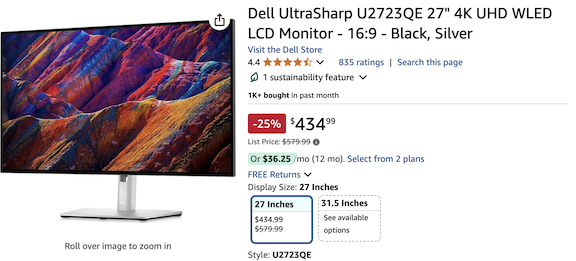
But that price had gone up. And, to make an already too long story a tiny bit shorter, I’ll summarize my shopping experience: the monitor was more than $100 less on Amazon than anywhere else. And I think I looked just about everywhere.
Dell Monitor on Amazon
Although most pricing I saw was in the $540 to $590 range, I actually saw this monitor for more than $600 on AliExpress, which someone on social media suggested.
My Dilemma
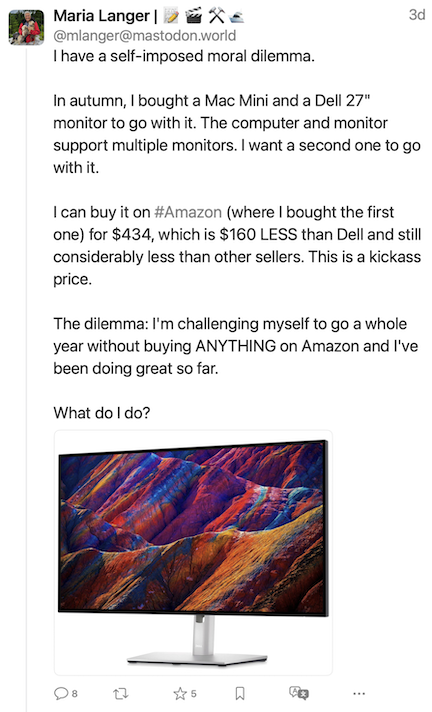
My Mastodon post. Imagine me getting the whole story in less than 500 characters!

I stressed over this purchase. The way I saw it was that I had two choices: (1) I could save more than $100 by breaking my No-Amazon streak and buying it on Amazon or (2) I could skip buying it. There was no way I was going to spend $100 more than I had to.

I discussed this dilemma on my social media network of choice, Mastodon. The replies started coming in. The general consensus was that avoiding Amazon purchases when possible was a good thing. But when I needed to make a purchase and Amazon’s price was far better than anyone else’s, I should just go for it.
Bought Monitor
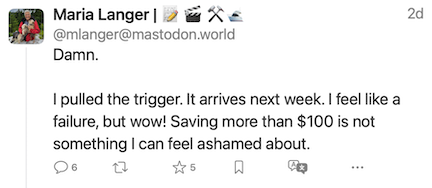
I posted this on Mastodon on the thread about my self-imposed moral dilemma.

So I did.

And Now to the Point of this Post

All that is backstory. What would one of my blog posts be without backstory?

It was one of the replies to my post about the purchase that really got under my skin. I don’t want to put the poster in the spotlight because maybe that person didn’t mean to trigger me. But I was definitely triggered and that’s what this post is all about.

The reply was:

You could always donate a portion of the money you saved to an organization you support…

I was (possibly unreasonably) offended by this.

The main and somewhat obvious reason this might offend me is the insinuation that I don’t normally contribute to charitable organizations. That cannot be farther from the truth, as I attempted to make clear (with possibly some humor?) in my response:

The organization I support right now is my grocery bill, which was $200 yesterday for one person for one week. And I didn’t even buy eggs. ;-)

Throughout the year, however, I donate to NPR, Wikipedia, World Kitchen, Pro Publica, Goodwill, the Humane Society, and others. That comes to a lot more than what I saved today.

Ben had it right: a penny saved is a penny earned. The more I save, the more I can spend elsewhere, whether its on me or for charitable donations.

(The Ben I’m referring to here is Ben Franklin, of course. He was a smart guy, even if he never really did say “A penny saved is a penny earned”.)

But the deeper reason it offended me was because I saw it as someone trying to tell me how to spend my money — and that is a particularly sore spot with me.

Don’t Tell Me How to Spend My Money

The way I see it is this: I earned everything I own, either through hard, smart work or through good investments. No, I didn’t get everything right, but I got enough right to put me where I am today as a financially secure home owner with enough money in the bank to make money one of my lesser concerns in life. There’s no generational wealth propping me up — as a few people with giant chips on their shoulders seem to think. Since graduating from college back in 1982, I have never asked for or received any financial help from anyone in my family or elsewhere, no matter how much I needed it.

Factory Photo
Here’s a blast from the past: on November 23, 2004, I took my sister and brother to the Robinson Helicopter factory for a tour. By an amazing coincidence, it was the same day they put my helicopter on the assembly line. Here I am standing next to hull #10603, holding a photo of a mockup based on a friend’s helicopter.

One of the ways I got to financial security was by making enough good financial decisions. The purchase of this monitor at Amazon for a savings of $100 is an example on a micro level. The purchase of a $346K helicopter, straight from the factory, that formed the basis of a lucrative 15-year career as an agricultural pilot is an example at a more macro level.

I spend my money the way I see fit. Yes, I have three vehicles, but the newest one is 12 years old. (The oldest is 26 now.) They all run, they all serve their purpose. And they’re all paid for. Why should I replace any of them if they’re doing what I need them to do? Why would I want to spend money on something with no real benefit? I’m not trying to impress anyone with what I drive. Why should I?
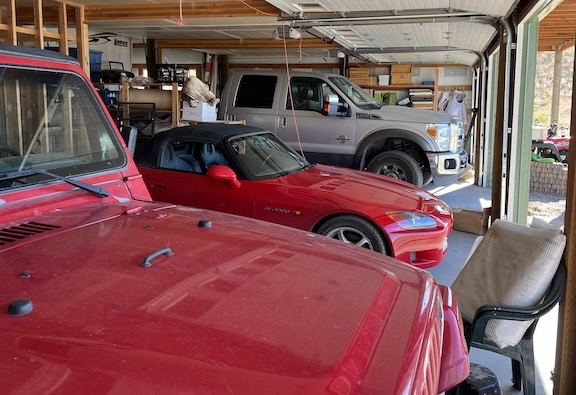
The Fleet
I’d rather have three old vehicles in my garage than just one with a loan on it.

Do you realize that the money I saved by not buying a new (to me) vehicle every two years — as my wasband was so fond of doing — is probably why I was able to pay off the mortgage on my home in less than 10 years? Do the math, folks. Home ownership might be more within reach than you think if you just adjust what you’re spending your money on.

And that’s the point. We all need to decide what’s important to us. It’s more important to me to have financial security with a paid-for home than to drive something new and flashy every few years. It might be more important to you to get your kid into a special school than to buy a home. Or more important to buy assets or get specialized training to build your business than take a vacation in Europe. We need to make our own decisions — and to respect the decisions of others.

The Sore Spot

Two and a half years ago, after spending a total of 10 weeks with two different boat captains on their boats along the Great Loop, I decided I wanted to cruise the Loop in my own boat. I had sold my helicopter and my charter business and had money to spend on a relatively new (but admittedly costly) “pocket yacht” that would meet my needs. I was very excited about the purchase and my upcoming journey. I wanted to share that excitement with people who meant a lot to me.

Boat for Sale
This is one of the photos on the brokerage website. I have a fondness for red, but that’s not what drew me to this boat. It was absolutely perfect for me — and a good deal, to boot.

But rather than them accept my purchase decision, they decided that they needed to tell me what a bad idea it was and to tell me what I should do instead. Their reaction made a few things clear:

  • They didn’t know me very well. This is nuts considering I already had a track record of doing unusual things.
  • They didn’t trust my ability to make my own financial decisions. This is also nuts given that I’m probably in better financial shape than they are.
  • They thought they had the right to tell me how to spend my money. This is also nuts given that neither one of them did very much of interest with theirs.

This situation put a rift in our relationship that has yet to be mended. I was offended by their stance and made it clear to them. They have neither apologized nor made any efforts to repair the rift.

And this is what makes people telling me how to spend my money a sore spot.

I should mention here that, like the helicopter, the boat and the experiences it has made possible have given my life a new trajectory at a time I really needed one. I completed the 8000+ mile Great Loop trip and am working on a book about it. I’ve already written articles about it. I’ve become a USCG licensed boat captain and have already done some paying work for people who needed training on their own new boats and have secured gigs with at least two boat training organizations. I’ve become a certified boat instructor for single and twin engine power boats. And I’ve put my boat — which is a valuable asset, after all — into a charter program where it will earn money for me this coming boating season and possibly seasons beyond. None of this would be possible if I had not bought the boat that they told me not to buy.

They might be satisfied sitting at home, pulling pages off their calendars as the days of our lives tick by, but I’m not.

Are you still reading?

This post has been an unusually circuitous drive. Like so many of my blog posts these days, I wrote it, in part, to clear my mind of things that were bothering me. Someone insinuating that I didn’t make charitable contributions — by suggesting I do so with the savings on a computer monitor purchase — both bugged and triggered me. I felt a need to get this — including the dirty laundry that went with it — off my chest.

I guess the message I have for you is this: money is probably one of those topics we shouldn’t be talking about, like religion and politics. If you feel the need to tell someone how to spend — or not spend — their money, why not hold back? Unless the person is making a lot of seriously dumb decisions that are causing financial harm, they probably don’t need or want your advice.

Instead, why not take a closer look at your own spending habits and how they are serving you?

❌