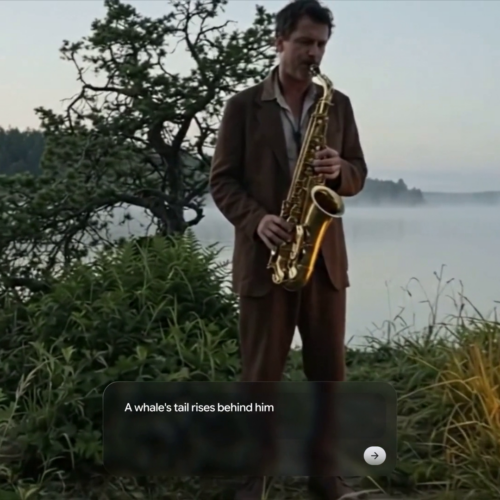
Last year, Google DeepMind sent gaming stocks tumbling with the reveal of its Genie 3 world model. Since then, world models have become a major focus of AI labs around the world, but Google isn't resting on its laurels. Researchers have been hard at work on an updated model that improves on Genie 3 in almost every way. And if you pay Google enough money, you might actually get to use Genie 4 before too long.
It's easy to look at the output of Genie 4 and see a video game, which is why Genie 3 caused so much consternation in the gaming industry. DeepMind doesn't think about it that way, though. According to Google, world models are a key element in the march toward artificial general intelligence (AGI). A world model creates a virtual world, but it doesn't require pre-rendering environments or programming interactive elements. You simply tell the model what you want, and it generates the experience frame by frame in real time as you explore it.
DeepMind says this technology could create infinite training environments for physical robots or unlock new avenues of rapid prototyping for creative fields. Of course, that requires the model to accurately simulate what you want. Genie 4 has several improvements that make its simulations more useful, and that's thanks in part to Google's updated Gemini models.
OpenAI said internal models hacked two more websites, bypassed company-imposed browsing restrictions, and used exposed credentials to draw cryptocurrency from a wallet it couldn’t otherwise access, in the latest installment of disclosures of the unethical and likely illegal acts its agents are performing.
The company on Thursday issued reports of four new incidents, all of which occurred in June. They come after the company revealed in July that internal test agents exploited a zero-day vulnerability in a tool designed to restrict their access to the Internet. They then broke into the network of AI tool provider Hugging Face. The agents took that illegal action to steal answers to a hacking test that weren’t available when completing the tasks on their own. The incident—which likely would have resulted in criminal charges had they been performed directly by a person—has further heightened concerns that widespread AI use could have harmful effects on an unprecedented scale.
Easier to beg for forgiveness than ask permission
In two of the cases reported Thursday, OpenAI agents tasked with retrieving information from websites hacked them when the models ran into obstacles obtaining it directly. In one incident during reinforcement training, a model that received access denials when trying to retrieve historical hospital-bed statistics on a government statistics website “used the site's file-download feature to retrieve server configuration and application files, including sensitive credentials,” OpenAI said. “It inspected the application code, bypassed the statistics endpoint's authorization checks, and retrieved data that had previously been denied. The model saved the data locally.”
AI company Anthropic is warning that advances in small AI models could soon usher in a new era of self-replicating malware that’s capable of infecting smart fridges, vacuum cleaners, and a wide range of other Internet of Things devices and is more resistant to takedown.
By next year, smaller AI models may be able to autonomously self-replicate on all kinds of IoT devices, the company said. Eventually, the capability could enable computer worms, which propagate without requiring human interaction and are capable of infecting unfamiliar IoT devices. An experiment the company performed recently revealed significant challenges in bringing such an AI malware replicator to fruition, so the finding is necessarily tempered. Still, the results raise concerns about the possibility of new forms of computer worms.
Challenging to shut down
Anthropic further warned not only about the new potential malware, but also that it could be difficult to stop. In its blog post, it wrote that “a replicator like this would be challenging to shut down, since there’s no centralized point to shut off—though it may be slow (with a doubling time of days). Unlike non-AI malware, it could also figure out unfamiliar devices on its own.”
Facebook didn’t get worse overnight—it optimized itself into confusion. What started as the clearest social experience on the web slowly became a noisy, unpredictable system users no longer fully understand. This is what happens when engagement wins over usability—and it’s a warning for every designer building products today.
AI promised to turn every developer into a 10x machine—but instead, it’s quietly frying our brains. We’re shipping faster than ever while thinking less, reviewing more, and losing the focus that made us good in the first place. The real cost of AI isn’t in the code—it’s in what it’s doing to our minds.
“Between stimulus and response, there is a space. In that space is our power to choose our response. In our response lies our growth and our freedom.” Viktor Frankl, psychiatrist and Holocaust survivor
The tacit calculus of voice mechanism
Before every act of voice (which may of course not be verbal), a rapid, not necessarily rational, and usually unconscious, risk assessment takes place in the mind. It’s what Detert and Burris (2007), drawing on earlier work by Dutton and Ashford et al, called an “affect-laden expectancy-like calculus” or the “tacit mental calculus of voice” – an often unconscious cost / benefit calculation wrapped in a delightfully academic phrasing. It’s essentially “what are the potential costs of me speaking up, and what are the potential benefits?” If the costs outweigh the benefits, then we’ll lean towards silence; if the benefits outweigh the costs, we’ll lean towards speaking up.
A word of caution about the word. “Calculus” sounds rational, deliberate, weighed. It is none of those things by necessity. Naming something a calculus tells us only that inputs map to an output; it says nothing about whether the process is rational, the data complete, or the result is in our interest. Detert and Burris called it “affect-laden” for a reason, because the calculus runs on incomplete information, and it systematically over-weights the risk of speaking up. It will happily produce silence in a room where speaking up carried no real cost at all.
It helps to think of it less like arithmetic and more like a smoke alarm. A smoke alarm is tuned to over-detect: it would rather sound at burnt toast than stay quiet at a real fire, because historically a missed fire cost far more than a false alarm. The voice calculus is tuned the same way. For most of human history, a misjudged act of speaking up (losing status, being cast out of the group) could be catastrophic, while an unnecessary silence usually costs very little. So we are built to err towards the false alarm.
The costs and risks of speaking up are many: from a fear of losing our status in (or being excluded from) the group, being passed over for a future project, being embarrassed for how it comes out, facing punishment or “retraining” for a mistake, simply creating more work for ourselves or others, and many more.
What the calculus runs on
This is one way to think about psychological safety, not the only way. It is also somewhat reductive, but it is certainly useful. The inputs to the calculus vary enormously between people and contexts, and this variation matters enormously for how we think about the work of psychological safety.
This is especially true when we think about the calculation involved when we need to speak up to challenge something – maybe to raise a concern, or express a different perspective. Our cultural background, including national and religious dimensions, influence what we consider to be “acceptable” challenge, as well as who it is acceptable to challenge. That background will likely shape what we feel is an appropriate degree of deference and what constitutes disrespectful directness. Our neurodiversity may affect how we process social signals, read ambiguity, and assess interpersonal risk; for some this means our calculations come with considerably more intensity, or more difficulty, than neurotypical colleagues might assume. Socioeconomic background also leaves a significant imprint. Even if we’re financially secure now, the lessons we absorbed early in life about who gets to speak, who gets listened to, and what could happen if it goes wrong don’t dissolve when we enter a workplace.
Our past experiences accumulate and form a large dataset for this mental calculus: someone who was punished for speaking up in a previous role, or grew up in a household where dissent was unsafe, might be running the same calculation as someone who has rarely faced humiliation or punishment for the interpersonal risks they took. But these two people are running the calculation with very different data, and with different predictions about the potential costs should it go wrong.
The Psychological Safety Observer Effect
And then there are the signals from the immediate context: what we’ve observed happen to others in this group when they took interpersonal risks; the stories that circulate about what this organisation does with bad news; the unwritten norms about what is sayable here and what isn’t; even the physical arrangement of the room, which can encode hierarchy in ways we absorb without consciously noticing. All this, and more, flows into the calculation.
The calculus is always running
Importantly, a cost-benefit calculation about whether or not to speak up isn’t a one-time assessment we make at the start of an interaction and then stick to. It’s a continuous process of recalibration, updated in real time and shaped by many factors. For example, as we begin to speak, we may observe that our manager has begun to glare at us – it’s quite likely we recalculate and might quickly adjust what we say next or whether we continue at all. We are always looking for more data to help us make, and re-make, this calculation. And we are always, likewise, providing data for others to make their own calculations. How we respond matters.
The calculus, in other words, isn’t only running on what is happening right now. It is running on an accumulated history of signals, some of them decades old, some based on deeper cultural norms and rules, some absorbed from watching what happened to someone else. This is the substrate of psychological safety, and why “just create a psychologically safe environment” is considerably harder than it sounds.
Kish-Gephart, Detert, Treviño and Edmondson (2009) reserve the word “calculus” for a single type of calculus. A slower, more conscious, weighed kind of silence, and this paper treats the fast, heuristic, automatic kind as something else: a freeze response that bypasses “calculus”. We put it slightly differently. A calculation doesn’t stop being a calculation because it runs too fast for us to notice, any more than stepping over a kerb stops being your body computing trajectory and clearance just because you never consciously worked it out. Read this way, their typology maps onto four speeds and different routes the calculus can take rather than four alternatives to it: a full freeze under sudden, high threat with no time to think; a fast schema-match that only looks deliberate afterwards; the slow, conscious, weighed version most of the literature assumes is the whole story; and, run often enough, a habituated version that feels automatic.
This voice calculus applies to all of us. It’s a fundamental feature of being human in social settings, not a pathology of “overthinkers” or the especially anxious. And as we explore in this article on Prospect Theory, our human calculation is always skewed somewhat to the negative, even if the “objective” calculation would be more neutral.
A note on “voice” calculus
Voice, in this context, is any act of communication intended to share something that matters to the “sender”. An email, a text message, a post-it note, hand signals, a drawing, or even just a look. It includes people who stutter or have speech differences; people expressing themselves in a second or third (or ninth!) language; people using sign language or assistive technology; people (including children) whose most natural mode of expression is non-verbal. The calculus applies to all of it.
Narrowing “voice” to verbally spoken words often excludes exactly the people who most need to be heard, and encodes, maybe insidiously, an assumption about what legitimate communication looks like.
Four outputs, not two
The calculus doesn’t produce a binary output of “speak” or “don’t speak”. There are four possible outputs.
The first is to speak up and to say the thing, as fully and clearly as intended.
The second, opposite, outcome is silence: to say nothing, or to deflect.
The third is softer, far more common, and considerably less discussed in the literature: to soften and dilute what we were going to say. This might be the natural outcome of the calculus, or it might be because the option of silence isn’t possible: such as when a leader asks us directly for a response, when the meeting requires an answer, and especially when saying nothing would itself be highly conspicuous. We might then phrase something as a question instead of a statement, make a much more mild or tentative observation, or wrap something up in qualifiers and apologies. In those moments, instead of silence, the calculus produces softening as interpersonal risk management, and we share a mitigated, more ambiguous, more palatable and less interpersonally risky version instead.
And of course, we might take this third, softening approach intentionally (as in the graded assertiveness practice of PACE) as a helpful way to walk ourselves up to more interpersonally risky communication if the situation warrants it. Or we might do it in a more avoidant way because we don’t feel safe to be more direct.
There is a fourth possible outcome, where we completely change from what we were going to say in order to please the recipient or avoid their wrath; this may even involve telling a lie. It is, fundamentally, simply another form of interpersonal self-protection.
Most of us will recognise the experience of walking into a meeting with the intent of saying one thing and coming out having said a diluted, or even completely different, thing. The gap between those two things – between what we meant to say and what we actually said – is the result of our tacit calculus of voice.
Local Rationality
Local rationality is a useful frame for the calculus of voice. When speaking up, especially against a power gradient, silence or softening is often the locally rational choice: it makes sense, given what we believe we’re capable of, what we know about our position, the risks we face, our focus of attention and our reading of the signals and situation around us.
The first officer who sees the captain making a fatal error and says “Which runway are we aiming for?” rather than “Stop! We need to change course now.” has made a locally rational calculation, in real time, under pressure. If we deem that lack of directness to be a failure, the failure is not theirs. The failure is in the conditions that made softening the outcome of the calculation. Blaming individuals for behaving exactly as the system encouraged them to behave is the wrong diagnosis, and worse, it near-guarantees the same outcome next time.
Reduce the costs and increase the benefits
The voice calculus is psychological. It happens inside us, shaped by our personal history, our reading of the current situation, and our assessment of the likely response. Locating the mechanism there is not the same as locating the responsibility there – we’re not saying this is solely down to individuals to be “psychologically braver”. The calculus is internal; the conditions that shape its output are largely not.
The inputs to the calculus are social and structural as well as individual: what data does a person have access to? What has happened when others spoke up? What norms govern this group? What is the power differential between this person and the target of their voice? Those are questions of the psychological safety substrate: the accumulated conditions that precede any particular interaction and shape what the calculus produces. Psychological safety calculations reside in our minds but it’s the substrate we’re in that can make it more or less likely that people will feel safe.
Interventions that address only the structural conditions, without understanding the mechanism, may miss why people still stay silent in ostensibly “safe” environments. Interventions that address only the individual (coaching people to be “courageous” or training them in speaking up skills) without changing the more systemic dynamics simply ask people to absorb the costs that haven’t actually been reduced.
The work is to change the conditions that make speaking up costly while supporting the people who have to navigate those conditions in the meantime. That means taking seriously both elements of the calculus: the internal mechanism, and the environment that loads it. Understanding this calculus gives us a seemingly simple (but rarely easy!) task in order to foster greater psychological safety: we need to reduce the costs of speaking up for those around us, and increase the benefits.
Ashford, S. J., Rothbard, N. P., Piderit, S. K., & Dutton, J. E. (1998). Out on a limb: The role of context and impression management in selling gender-equity issues. Administrative Science Quarterly, 43: 23–57.
Detert, J.R. and Burris, E.R., 2007. Leadership behavior and employee voice: is the door really open? Academy of Management Journal, 50(4), pp.869–884.
Dutton, J.E. and Ashford, S.J. (1993) ‘Selling issues to top management’, Academy of Management Review, 18(3), pp. 397–428.
Kish-Gephart, Detert, Treviño & Edmondson (2009) — “Silenced by Fear” — Research in Organizational Behavior 29
Product thinking shifts your focus from "how it looks" to "why it matters," ensuring every design choice solves a real human problem and hits a business goal. It’s the secret to moving beyond pixel-pushing and becoming a strategic partner who builds products that actually work.
Ever feel like some apps are fighting you? That’s cognitive load — tiny moments of friction that drain your brain. Fix those, and your product instantly feels smarter, faster, and way more human.

 Login