
 Login
Mistaks we’ve made (so far)
We publish about once a week, and have done so for about six years. There are now over 350 articles on psychsafety.com as a result. So, despite our best efforts, the odd error has slipped through, and here I’m writing about some of our most egregious and/or funny ones. Many of these we found ourselves after publication, and some of them we were informed about by our wonderful readers – you folks (and we’re very grateful for that!).
I’m genuinely rather embarrassed about a few of these, but if we can’t admit mistakes and learn from them in a newsletter about psychological safety, then where can we? So here’s a list of various mistakes we’ve made, some followed by a Safety-I style “how do we prevent this happening again” measure:
Numbers we fucked up
We said exponential when we meant quadratic. Dunbar’s Number, Psychological Safety and Team Size (October 2022) said communication complexity “increases exponentially” with group size, then gave the formula n(n−1)/2, which is quadratic, not exponential. The point stands, in that: it grows fast. But the word was definitely wrong.
We labelled r-values as p-values. How Childhood Socioeconomic Status Shapes Psychological Safety and Career Risk-Taking (November 2025) This is probably the one I’m most embarrassed about. It’s a straightforward typo, but it stuck through edits and proofing. In the study results, we reported psychological safety as p=0.19 and opportunity-taking as p=0.21, but those are r-values, not p-values. The findings themselves don’t change: both correlations are significant at p < 0.001. Figure 2 also didn’t quite match the text, so we’ve redrawn it and published the script behind it. The check: more reviewers (i.e. we just reinvented peer review).
We got bogged down. Rewetting the Organisational Substrate (March 2025) said peat bogs store “44% of soil carbon”. The UNEP assessment we linked to says peatlands (bogs are only one kind) hold “up to one-third”. The 44% came from an IUCN briefing that gives “up to 44%” for all peat soils without saying where the number comes from. The check: reread the source we’re actually linking to.
We couldn’t count to seven. The Chatham House Rule (November 2024) said the rule has been translated “into six languages”, then listed seven. Oops.
People we really shouldn’t have quoted
We quoted a eugenicist as an authority. Déformation professionnelle (February 2025) opened with a line about specialists who think they understand the whole person, credited to “Alexis Carrel, Nobel laureate”. The line fits the article, but its author certainly doesn’t. The quote comes from Man, the Unknown (1935), which we also linked. The book argues for eugenics, and proposes gassing some criminals and the criminally insane in “small euthanasic institutions”. Carrel later headed a Vichy-era foundation whose work included eugenics and population research. We replaced the epigraph with Kenneth Burke: “A way of seeing is also a way of not seeing.” We’ve removed the link that pointed readers to Carrel’s book, and because this was a big mistake, added a correction note. The check: look up the people we quote, not just the authenticity of the quote.
We cited Dan Ariely after one of his papers had been retracted. Psychological Safety & Agile (January 2023) cited Ariely’s “Human Capital Factor” as showing that companies whose staff feel better about them do better financially. More than a year earlier, in 2021, a paper he co-authored was retracted after independent analysts found strong evidence that data in one of its studies had been fabricated. The Human Capital Factor itself came from commercial research by J.P. Morgan and Irrational Capital, a firm Ariely co-founded. We’ve since replaced it with peer-reviewed research: Alex Edmans found that the “100 Best Companies to Work For” outperformed their industry benchmarks by 2.1% a year between 1984 and 2009. The check: search a researcher’s name with “retraction” before relying on them.
Studies and ideas we mangled
We defined cognitive load loosely. Cognitive Load and Psychological Safety (March 2023) defined intrinsic load as “all the stuff you already know”. In cognitive load theory, intrinsic load is the complexity of the task itself, and what you already know affects how heavy it feels rather than being the load. The correct definitions actually make our point stronger: the paper our model came from counts emotions, including anxiety, as extraneous load.
We credited Schein with someone else’s paper. Edgar Schein’s Three Layers of Organisational Culture (February 2023) listed a 1986 paper by Kilmann, Saxton and Serpa under Schein’s name. Two readers told us. Thank you to them.
Data Visualisation gave the fifth of Alberto Cairo’s qualities of a good visualisation as “exploratory”. In The Truthful Art it’s “enlightening”.
Psychological Safety: Yogic Philosophy (September 2022) defined aparigraha as “non-stealing, non-possessiveness”. Non-stealing is asteya, listed two lines earlier; aparigraha is non-possessiveness.
Blametropism (December 2024) credited the essay “Moral Luck” to Bernard Williams in the text, then cited Thomas Nagel’s essay of the same name. Both Bernard Williams and Thomas Nagel published papers called “Moral Luck”, alongside one another in the 1976 Proceedings of the Aristotelian Society supplementary volume. It’s almost like the system was set up for us to fail with this one…
Dates, details and names
We gave Dewey a date after his death. Déformation professionnelle said “In 1968, John Dewey described… ‘occupational psychosis'”. Dewey died in 1952. 1968 is the edition of Robert Merton’s Social Theory and Social Structure that we were citing, which discusses Dewey’s term.
We put Chernobyl in the wrong country. Our What is Psychological Safety? page said the Chernobyl disaster happened in Russia. It happened in Soviet Ukraine, and a Ukrainian reader rightly told us so in 2023. We corrected it, and they kindly confirmed the fix.
We had Goodhart criticising a government that didn’t exist yet. Goodhart’s Law, Campbell’s Law and the Cobra Effect (July 2024) dated Goodhart’s article to 1975, then said it criticised “the then Thatcher government”. Thatcher became Prime Minister in 1979. A reader spotted the contradiction. What we meant was that the law was later used to criticise her government’s monetary targets, which is what the article now says.
We got the language wrong. In May 2023 we thanked a reader for translating one of our leadership vs management graphics into Spanish. It was Portuguese. Another reader pointed this out, then translated it into Spanish herself, and we shared her version the following week. A great example of how mistakes can be generative.
The small ones.
They’re worth a mention because they show the real nature of weekly publishing. For example, I misspelt WEIRD in an issue about WEIRD (I’ve always had trouble with i before e…), and misspelt Kahn in our piece on the definition of psychological safety.
Experiments, bets and probes (August 2024) dated the Challenger disaster to 1987. It was January 1986.
Our Barcelona Psych Safety Day page gave the date as 1 July 20233, which would have left you about 18,000 years to book. A reader spotted it.
Certainly not the last
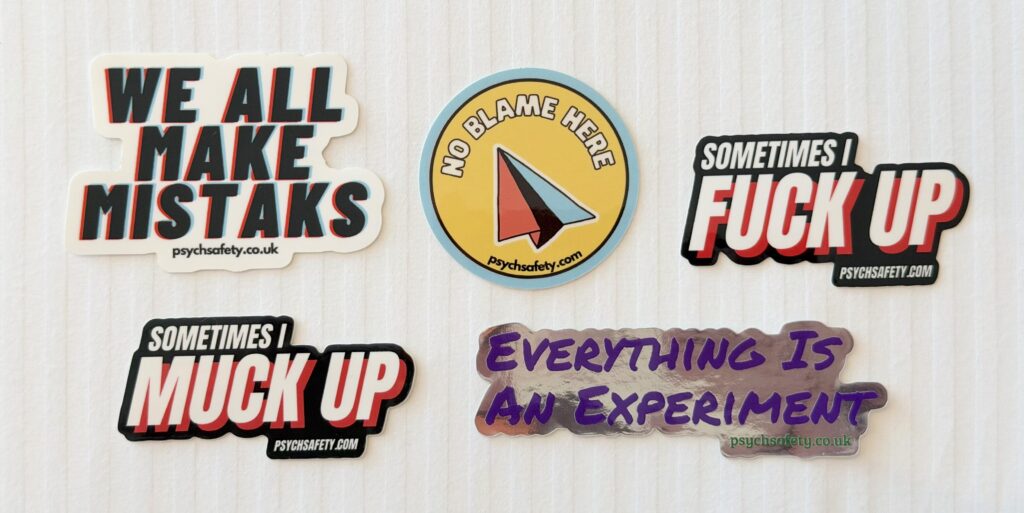
No doubt many mistakes still remain. Some probably even in this article itself. If you spot something we’ve got wrong, tell us by emailing tom@psychsafety.com with the subject line “you f*cked up”  If possible, we’ll send you some stickers as a thank you.
I’ll admit, I felt nervous writing this piece, for many of the reasons we all feel nervous about admitting mistakes: that we might be thought of as sloppy, less expert, or lazy. And frankly, for some of these mistakes, I’ve judged myself pretty harshly. So, as always, it’s rarely easy to admit mistakes – especially big ones. But these are all mistakes we have made with the very best of intentions, trying to do a good job, trying to get the work done. Some of them are mistakes that have led us to make systemic improvements. For some, a specific cause is less easy to identify. And ultimately we will make mistakes again. But I do hope that by committing to being as honest and open as we can about it, it might help, even just a little bit, normalise admitting our mistakes, and talking how they happen and what they teach us.
We all make mistaks.
The post Mistaks we’ve made (so far) appeared first on Psych Safety.
