❌

Reading view

There are new articles available, click to refresh the page.

How do you measure inequality?

If you’ve been with us for any time, you’ll probably know that we care less about averages than about distribution. A team is only as safe as its least safe person, and a high average can hide the people who feel least able to speak. Addressing inequality is a thread running through our core principles.

I first encountered the tools for measuring inequality during my masters studies in global health: the Gini coefficient and its ilk, used to describe how income, wealth and healthcare are shared. The Gini index for the USA is 41.8 (equivalent to Djibouti and Papua New Guinea) whilst for Norway it’s 26.5 (as is Azerbaijan). Those figures on their own tell us something, but they beg more questions than they answer. No metric is sufficient on its own, which probably says more about metrics than it does about inequality.

Same group, different verdicts

Imagine two groups of ten people, where each has 100 units to share out. In both groups, the average number of units per person is 10. But in the first group, the units are shared so that two people have 2 units each and the other eight have 12. In the second, nine people have 8 each and one has 28. Which group is more unequal?

The Gini says the second, by a whisker: 18 vs 16. The Palma ratio, which compares the share of the top 10% with the share of the bottom 40%, also says it’s the second group, but by twice as much: 0.88 against 0.43. The Atkinson index, which lets us decide how much weight to give the worst off, says in fact the first group is the most unequal, by nearly three times as much: 0.40 against 0.14, when it’s set to weight the worst off heavily. None of them is wrong. Each is looking at something different, and each builds in a judgement about what matters most.

The Atkinson index makes us choose what we think matters before it gives us a number. If we turn that dial all the way up, it emphasises the person at the bottom of the gradient, which is the measure behind “A team is only as safe as its least safe member”. Ecologists will recognise the idea from Liebig’s law of the minimum: an organism grows only as well as the nutrient in scarcest supply, however plentiful everything else is. Teams are similar. 

Teams have shapes too

Most psychological safety tools report an average. But a team scoring 1,2,3,4,5 has the same average as a team scoring 3,3,3,3,3. Those are very different teams with very different needs. And a team scoring 1,1,4,4,5 has both the same average and range as the 1,2,3,4,5 team, but again, those teams are very different shapes. Most psychological safety surveys would show them to be the same.

We also know which way inequality tends to run. In neonatal intensive care units, Ingrid Nembhard and Amy Edmondson found that psychological safety followed professional status and formal power: physicians felt safest, then nurses, then respiratory therapists. It echoes the Whitehall studies I wrote about in Good Management Saves Lives, where health improved at every step up the civil-service hierarchy, not just between the bottom grade and everyone else. Psychological safety, like health, tends to run along a gradient, and gradients tend to follow power.

Introducing the team’s gradient

So we’ve built a recognition of the gradient into our Measure tool.

The graph shows the shape of the team, from least safe on the left to most safe on the right. That shows how low psychological safety goes, how high it goes, how steep the gradient is between lowest and highest, and what shape it takes. A single number describes the steepness using the same building block as the Gini coefficient: on average, how far apart any two people in the team are on the 1 to 5 scale. The report then puts the shape into words, because a steady climb, or one person far below everyone else, or a team split in two each call for a different conversation.

When a team measures again, the psychological safety gradient shows what other reports can’t. In the example above, the lowest score rose from 1.9 to 2.1 and the highest from 3.1 to 3.9. Both ends rose and so did the average, but the gap widened and the gradient got steeper. An average would have reported only good news.

The gradient is always drawn from five points, however many people responded, to protect anonymity. And by design, Measure doesn’t ask about role, grade or demographics, because those questions make people easier to identify and less likely to answer honestly. So it can’t tell us whether a slope follows rank, gender or tenure. Instead it hands that conversation to the people themselves: whether it follows expertise, tenure, seniority or something else.

Measurement isn’t neutral

“Measurement is a technology with power, harnessed by those able to use it.”
– Sally Engle Merry, The Seductions of Quantification. 

All survey and engagement metrics decide (intentionally or not) whose experience counts and where we should pay our attention. And no measure can tell us whether a difference is unfair – inequality is a description; inequity is a judgement, and that judgement is ours to make.

The team’s gradient is in Measure reports now. If you’ve already measured a team, it’s waiting in your report. If you haven’t, measure.psychsafety.com is the place to start.

Sources

The post How do you measure inequality? appeared first on Psych Safety.

DHS Inspector General Finds That TSA is Not Properly Safeguarding Passenger Facial Recognition Data

EFF legal intern Gabrielle Ladun was the principal author of this post. 

The Department of Homeland Security Office of Inspector General (DHS OIG) has published a summary of findings from its audit of the Transportation Security Administration’s (TSA) facial recognition technology. While the detailed findings are classified, the summary states that the OIG’s audit uncovered a “significant weakness” in the technology’s ability to protect the privacy of passenger data. This has massive privacy implications for the millions of passengers who travel and don’t opt out of the TSA’s biometric surveillance technology verification process. 

TSA uses facial comparison technology for identity verification of airline passengers. A camera takes a photo of passengers to verify that their provided identification matches their live photo. Although TSA states that it is “committed to protecting traveler privacy,” the audit highlights that this has not been the case.  

The OIG found that TSA’s Credential Authentication Technology 2’s (CAT-2) vendor “was able to access and extract sensitive passenger information, including driver’s license and passport images, during system troubleshooting and enhancements, without TSA’s knowledge.”  

The OIG further admonished the agency:  

TSA lacked clear policies, did not track when this data was extracted, could not verify that extracted information was properly deleted, and did not notify passengers when their biometric and biographic information may have been stored. As a result, although passenger information was generally protected during routine operations, weaknesses in vendor oversight created a risk that sensitive personal information could be retained or exposed. 

We hope the TSA will fix these issues. The OIG summary states: 

We issued one finding and three recommendations to strengthen controls, improve oversight, and ensure transparency and the proper handling of passenger data. TSA concurred with all three recommendations. Two recommendations are open and resolved, and one remains open and unresolved. 

Why EFF Opposes the Government’s Use of Facial Recognition Technology 

EFF has a long history of opposing governmental use of facial recognition technology. As the OIG’s audit underscores, this technology presents privacy risks associated with unsecured data, unauthorized access, and data breaches. The government’s use of this technology also creates a mass surveillance system and facilitates the creation of warrantless biometric records for unconsenting parties.  

The biometric data captured by this technology is not without errors. There have been multiple instances of law enforcement agencies using facial recognition technology to misidentify and arrest innocent individuals.  

Reminder: Opting Out of TSA Photos Is Possible 

Given that facial recognition technology is prone to mistakes, combined with the OIG’s audit revealing significant privacy weaknesses, it is imperative that travelers remember that opting out is possible. TSA’s own website emphasizes that travelers who wish to decline to have their photo taken for facial comparison can do so without any delay, disruption, or recourse.  

Considering the data protection weaknesses exposed by the OIG’s audit, EFF will continue to oppose this governmental system of mass surveillance and spread awareness to ensure that no one is forced to relinquish their biometric data without consent. 

Measure Psychological Safety – The Platform

Measure Psychological Safety – The Platform

This week we’re excited to officially launch Measure: our very own psychological safety survey that comes back with a plan, not a score.

This has been a long time in the making. Over years of working with (and measuring psychological safety in) teams and organisations all over the world, in different contexts and industries, we’ve finally released our measurement platform for general use. It’s been in limited preview for a while, which many of you tested and told us what to improve. Thanks so much to the beta testers!

Measure is built on the mechanism of the calculus of voice. Before speaking up, we weigh up, mostly without realising we’re doing: Can I predict the response? What might it cost me? Does anything change as a result? Someone who stays quiet because the space is unpredictable needs better clarity and structure. Someone who stays quiet because nothing ever changes needs to see evidence that it’s worth it. It’s all of this that Measure delves into and knowing this is what lets us shape what comes next.

psychological safety gradient chart

Here are some key highlights of the Measure platform:

You get a plan, not a score.

We have found that numbers aren’t much use by themselves, so Measure’s report not only provides you with the numerical data – the metrics, ranges and distributions – but qualitative context for those numbers too. It tells you the main things holding people back, how predictable the space is, and what the range of responses means, not just the average. A team that scores 1,1,1,5,5,5 and a team that scores 3,3,3,3,3,3 both average 3.0, which is an accurate answer to the wrong question. 

Asking people how safe they feel and then doing nothing is one of the fastest ways to teach them that speaking up is pointless. So the report mustn’t stop at findings. Most importantly, Measure suggests what to try next. The suggestions are based on what the responses show, so you get intelligent practices and approaches to try that actually align with what that team needs. As with everything in our approach, they’re experiments, not prescriptions. 

Measure- experiments to try afterwards

It’s a tool that you shape.

Psychological safety doesn’t look the same to everyone. A tech team (for example) may care most about ideation, experiments and trying things that might not work. A healthcare team may care more about communication, learning from error and reducing harm. Those are different kinds of psychological safety, and they need different questions.

So we’ve made sure that you can tailor Measure to the team and context that you’re exploring. It’s not a single, cookie-cutter, one-size-fits-all (and fits nobody well), survey tool. It’s a platform that you tailor to context and culture as you need it. 

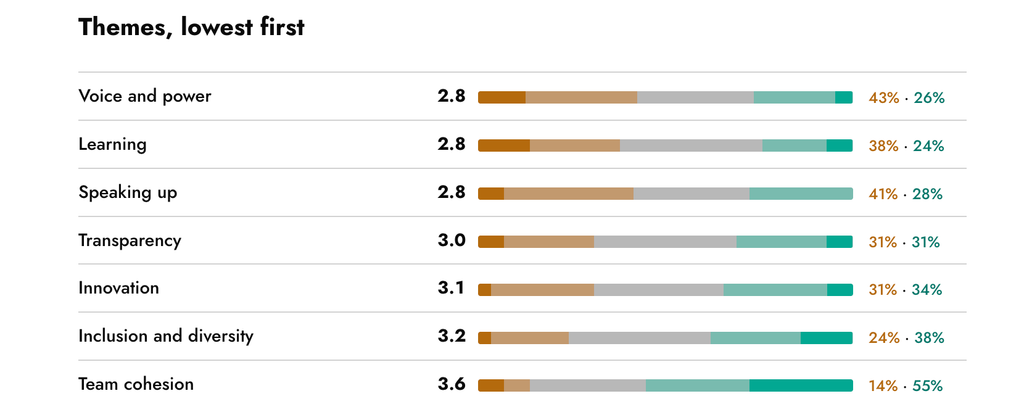
You choose up to 14 questions from a question bank, separated into themes of Voice and Power, Inclusion and Diversity, Innovation, Learning, Speaking Up, Team Cohesion, and Transparency. Or you can write your own (and with Org Plans, you can write questions that are asked of all teams). You can also select the seven questions, adapted to our instrument, from Amy Edmondson’s original research, what we call the “Edmondson Seven” (which sounds rather like a classic Western movie where Amy leads a gang to pull off a big heist).

measure-what hold people back from speaking up

It’s not a benchmark. 

Measure doesn’t benchmark against other teams or organisations and it doesn’t give you a headline “score”. Imagine one organisation of 5,000 people, spread across offices in the UK, where all the team scores, when averaged out, come to 3.4. Imagine another of 20,000 people, across Europe and in a different industry, that scores 4.7. Is the second organisation psychologically safer? Does it have better managers? We can’t say. The work is different, the context is different, the same questions mean something different in each, and the distributions underneath those two numbers could be almost anything. In fact, the senior leaders in the 4.7 organisation might see that and think the work is done, so they don’t need to try any more. Even worse, they decide they’re happy with anything above 4, so 4.7 means they can turn the screws a bit harder, introduce a bit more fear.

Give an organisation a number and it will do what organisations always do with numbers, which is stop looking at anything else.

measure- voice and power

It also tells you what’s working well.

Measure also asks the question most surveys leave out: when speaking up does work here, what makes it possible? In the spirit of Safety-II as well as Safety-I we want to understand what goes well, not only what goes wrong. What is the team doing well to help people speak up? By surfacing this, we can do more of it, and we can protect it so that it doesn’t erode while our focus is elsewhere.

Open to everyone

Measure is currently available in English as well as “Easy Read English“. Spanish, German, French and Korean are available in public beta (and we’re looking for testers who are native speakers in these languages!). Even if the survey has been written in English, a respondent can respond in the language that suits them best. Easy Read may suit people with dyslexia or learning differences, or simply anyone who prefers it. A psychological safety survey shouldn’t hear only from the people best placed to read it.

It is also anonymous by design. Nobody answering is asked for a name, an email or an account, and no IP address is kept. No report opens until the survey has closed with at least four answers, and nobody, including us and whoever is paying, sees who said what.

What it isn’t

Measure is not a validated academic research instrument, and that’s deliberate. If we needed comparable psychological safety measurement for research, Edmondson’s original seven items, unchanged, would be the right tool. Measure is a sensemaking tool: it’s for helping teams and managers understand their own conditions and decide what to try. For that job, the ability to adapt to context, and its inherent usefulness, matter much more than comparability. 

It also won’t suit every situation. A team of fewer than four can’t be surveyed anonymously, a short-lived project group may be better served by a conversation, and a survey won’t fix a team in acute conflict, just like a thermometer won’t put out a fire.

measure psychological safety - organisation view - themes
Screenshot from the Measure: Organisation Dashboard

Try it

Your first survey is free, with the whole report and plan. Paid plans just differ in how often and how many teams you can measure, never in what you learn: £60 a year to keep measuring one team (with reports that show you what’s changed over time), £260 a year for practitioners and consultants working with up to ten teams (you also get a Practitioner/ Consultant licence for free if you complete the whole Psychological Safety Train The Trainer course), and an Organisation plan for wider rollouts, organisation-level dashboards, Single Sign-On, auditing, and more.

There’s a three-minute self-check to try, the complete how-to guide, and a sample report to read here. Let us know what you think!

The post Measure Psychological Safety – The Platform appeared first on Psych Safety.

Digital Hopes, Real Power: How the Arab Spring Fueled a Global Surveillance Boom

This is the third installment of a blog series reflecting on the global digital legacy of the 2011 Arab uprisings. You can read the first post here, and the second here.

When people recall the 2011 uprisings across the Middle East and North Africa (MENA), they often picture crowded squares, raised phones, and the feeling that the internet had finally shifted the balance of power toward ordinary people. But the past decade and a half is also a story about how governments, companies, and platforms turned those same tools into the backbone of a powerful state surveillance apparatus.

For activists, journalists, everyday users, that means now living with a constant threat. The phone in your pocket, the platforms you organize on, and the systems you rely on for safety and connection can be weaponized at the flip of a switch. A global surveillance industry has treated repression by many MENA governments as a growth opportunity, and the tactics refined there now shape digital authoritarianism worldwide. This essay traces how that shift unfolded: security agencies upgraded older systems of repression with new surveillance tools and permanent monitoring infrastructure; cybercrime laws and mercenary spyware markets turned digital control into standard operating procedure; and biometrics, facial recognition, and ‘smart city’ projects laid the groundwork for AI‑driven surveillance that now shapes protests, borders, and everyday life far beyond the region. 

Remembering the Arab Spring means seeing the events of 2011 as both a remarkable moment of movement history when people leveraged networked tools in their fight for freedom and the beginning of a long, grinding effort to turn those same tools into mechanisms of state control.

Old‑School Repression, New‑School Tools

Long before Facebook and Twitter, regimes in countries like Egypt and Syria already knew how to crush dissent. They leaned on informant networks, physical surveillance, and wiretaps, backed by emergency laws that let security agencies monitor and detain critics with almost no restraint. Research on the use of surveillance technology in MENA shows that, even before the Arab Spring, states were layering early digital tools like internet monitoring, deep packet inspection, and interception centers on top of that older machinery of control.

At the same time, connectivity was racing ahead. Cheap smartphones and social media suddenly let people share information at scale, coordinate protests, and broadcast abuses in real time. In 2011, EFF described both the excitement around “Facebook revolutions” and the early signs that governments were scrambling to upgrade their capacity to watch and disorganize popular dissent.

After the uprisings, Western critics endlessly debated how much credit to give social media itself. While in the background, security agencies across several MENA states reached a much simpler conclusion: if networked communication can help topple a dictator, then they needed to embed themselves deep inside those networks. Analyses of the rise of digital authoritarianism in MENA show how quickly officials pivoted from being surprised by online organizing to building systems to monitor and pre‑empt it.

In the years after 2011, governments across the region poured money into tools that let them systematically watch what people said and did on major platforms. Foreign vendors set up monitoring centers and interception systems that let security agencies block tens of thousands of sites, scrape and analyze social media at scale, monitor activist pages and online communities, and track activists in real time. They built a new, pre‑emptive model of digital control, one that assumes the state should see as much as possible, as early as possible.

As we noted in 2011, exporting permanent surveillance infrastructure to already‑abusive governments doesn’t “modernize” public safety; it locks in an architecture of control that is primed to abuse dissidents, journalists, and marginalized communities.

Domestic Lawfare and Cyber-Mercenaries

After the uprisings, a number of governments also rewrote the rules that govern online life. Cybercrime laws, “fake news” provisions, and overbroad public‑order and ‘morality’ offences gave prosecutors and security agencies legal cover to act with impunity. Governments in Saudi Arabia, Tunisia, Jordan, and Egypt combined counterterrorism, cybercrime, defamation, and protest laws into a legal thicket designed to make online dissent feel dangerous and costly. Morality laws and cybercrime provisions are used to target queer and trans people based on identity and expression.​

At the United Nations, a new global cybercrime convention now risks baking this logic into international law. The convention was adopted by the UN General Assembly in late 2024, despite serious human rights concerns raised by civil society. Echoing our partners, EFF warned at the time that the UN cybercrime draft convention remained too flawed to adopt and urged states to reject the draft language because it legitimized expansive surveillance powers and criminalized legitimate expression, security research, and everyday digital practices around the world. While on paper, these instruments gesture to “public safety” objectives, in practice they function as pathways for state security agencies to monitor, prosecute, and silence the communities most at risk. For state-targeted communities, that makes being visible online a calculated risk, not a neutral choice.​​

Criminal codes are only half the story; mercenary tech is the other. As governments worldwide looked for ways to outpace their critics, a parallel market emerged to help them infiltrate and take over devices. Companies like NSO Group marketed Pegasus and similar tools as off‑the‑shelf capabilities for governments that wanted to hack a target’s cellphones or other devices to read messages, turn on microphones, and monitor entire social networks while bypassing the courts. 

In 2019, UN Special Rapporteur David Kaye called for a global moratorium on the sale and transfer of private surveillance tools until real, enforceable safeguards exist. Two years later, forensic work by Amnesty and media partners showed how the same spyware used to hack phones of Palestinian human‑rights defenders was used to surveil journalists, activists, lawyers, and political opponents across dozens of countries. 

Regional groups responded by demanding an end to the sale of surveillance technology to autocratic governments and security agencies, arguing that you cannot keep selling “lawful intercept” tools into systems where law itself is an instrument of repression. Commercial spyware is at the center of digital repression, not at its margins. Surveillance vendors are not neutral suppliers. Safeguards remain weak, fragmented, or nonexistent in most of the countries buying these tools, yet vendors continue seeking new contracts and new militarized “use cases.” Put bluntly, the companies that design, market, and maintain these systems precisely because they enable this kind of control profit from (and help entrench) authoritarian power.

Biometrics, Facial Recognition, and AI‑Powered Surveillance Cities

On top of this rapidly intensifying interception and spyware stack, governments and companies began layering biometrics and face recognition into everyday systems, creating pathways for bulk data collection, automated analysis, and risk profiling. In parts of MENA, national ID schemes, border and migration controls, and centralized biometric databases have been rolled out in environments with weak or captured data‑protection laws, making it easy to link people’s movements, services, and political activity to a single, persistent identifier.​

Humanitarian programs are not exempt from this protocol. In Jordan, Syrian refugees have been required to submit iris scans and biometric data to access cash assistance and food, turning “consent” into a precondition for survival. When access to aid depends on enrollment in centralized biometric systems, any breach, misuse, or repurposing of that data can have severe, life‑altering consequences for people who have no realistic way to opt out. Investigations into surveillance‑tech firms complicit in abuses in MENA show that vendors profit from supplying biometric and surveillance tools for migration management and internal security, even when those tools are used in discriminatory or abusive ways.​

Like elsewhere, mass surveillance technologies in MENA were first piloted on people who were already criminalized or made vulnerable by poverty. But their use quickly expanded from narrow, security‑framed deployments to routine use in city streets. As hardware sensors, cameras, and data storage got cheaper, “smart city” surveillance systems promised seamless security and services, and it became easier and less politically contentious to keep these systems running everywhere, all the time.​

Unlike targeted hacking tools, these broad, city‑wide surveillance infrastructures erase any practical line between people under investigation and the broad public, normalizing bulk, indiscriminate monitoring of public space and everyday movement. In the Gulf, facial recognition and dense sensor networks are increasingly built into high‑profile “smart city” and mega‑project plans that lean heavily on biometric and AI‑driven monitoring. These are security‑first development projects where biometric and sensor infrastructures are designed from the outset to embed policing, migration control, and commercial tracking into the urban fabric. In this vision of the Gulf’s “smart city” future—often sold as seamless services and digital opportunity—“smart” is the branding, and pervasive monitoring is the operating principle.​​

EFF has consistently opposed government use of face recognition and biometric surveillance, in some instances calling for outright bans. In contexts that treat peaceful dissent as a security threat, embedding biometric surveillance into everyday infrastructure locks in a balance of power that favors militarized policing and state control. That infrastructure is now the starting point for a new set of risks. Surveillance systems built over the last decade are being repackaged as the foundation for a new generation of “AI‑enabled” defense and security products. 

Companies that once focused on video management or perimeter security now advertise “defense applications” for AI‑driven situational awareness and threat detection, using computer‑vision models to scan camera feeds, compare against existing watchlists, and flag “suspicious” people or behaviors in real time. Drone and sensor platforms are being upgraded with embedded AI that tracks and classifies targets autonomously and with “drone‑based AI threat detection and intelligent situational awareness,” turning aerial surveillance into a continuous data feed for security agencies and militaries. In smart‑city and defense expos from the Gulf to Europe and North America, similar systems are marketed as neutral efficiency upgrades or tools to “protect critical infrastructure,” even where they are explicitly designed to scale up border enforcement, protest surveillance, and internal security operations.

As these systems are folded into AI‑driven defense products, the line between “civilian” infrastructure and militarized surveillance disappears, turning streets, borders, and aid sites into continuous input for security operations. That is the landscape that human rights and accountability efforts now have to confront.

Templates of Control, Networks of Resistance

The patterns established in heavily securitized MENA states after the Arab Spring now shape how states monitor and crush more recent uprisings, from Iran’s use of location data and facial recognition to track down protesters to long‑running crackdowns elsewhere in the region. This model of “digital authoritarianism” built on spyware, data‑hungry ID systems, platform control, and emergency‑style security laws has emerged everywhere from Latin America to Eastern Europe to here in the United States. As the new UN Cybercrime Convention moves toward implementation, its broad offences and surveillance powers risk turning this ad hoc toolkit into a formal template for cross‑border data‑sharing, repression, and an all‑purpose global surveillance instrument.

For people on the ground, none of this is theoretical. Human‑rights defenders, journalists, and ordinary users across the region face arrest, long prison sentences, and exile based on their digital traces. In that context, commercial spyware is not a marginal issue but part of the core machinery of repression. Pegasus has been used to hack journalists’ phones through zero‑click exploits and compromise human‑rights defenders and watchdog organizations themselves, including staff at Amnesty’s Pegasus Project partners and Human Rights Watch. These deployments give practical effect to the “cybercrime” and “terrorism” frameworks described earlier: person‑by‑person campaigns against particular communities, contacts, and networks, rather than “neutral,” generalized security measures.

Under these conditions, everyday security becomes a second job. People describe carrying multiple phones, keeping one for relatively “clean” uses and others for riskier conversations, splitting identities across platforms, using coded language, and moving their organizing off mainstream services when possible. Pushing this burden onto users is a political choice: states, platforms, and vendors could build systems that are safe by design; instead, they externalize risk to the people they watch and punish.

Even against that backdrop, civil society organizations have refused to capitulate to security agencies and vendors. Regional coalitions have demanded strict export controls and outright bans on selling intrusive surveillance tech to autocratic governments. Advocates have also pushed companies to do more than box‑ticking “due diligence.” Work with surveillance‑tech firms in the context of migration and border control has repeatedly shown that most are still far from serious human‑rights assessments, let alone willing to turn down these lucrative contracts.

Many of the same governments that have been critical of others on the issue of human rights have hosted or licensed companies that build these tools, in some cases buying similar capabilities for their own security agencies. European authorities, for instance, have investigated FinFisher’s export of spyware “made in Germany” to Turkey and other non‑EU governments. Meanwhile, the NSO Group has at least 22 Pegasus contracts with security and law‑enforcement agencies in 12 EU countries. This is a transnational industry, not a localized problem.

Against near impossible odds, people continue finding pathways to freedom. The global surveillance sector reinforces the same hierarchies and violence that people have found ways to survive for generations. Queer activists and others at the sharpest edges of this system have had to develop their own forms of resistance, including against biometric and data‑driven targeting. Encryption, circumvention tools, and security training are not silver bullets, but they remain essential for anyone trying to organize, document abuses, or simply exist online with a bit less risk. Resources like EFF’s Surveillance Self‑Defense are one piece of that ecosystem, alongside trainers and groups who have been doing this work on the ground for years.​

Defending the Future of Digital Dissent

The Arab Spring is often remembered through images of packed squares and hopeful tweets. But contending with its aftermath means confronting the surveillance architecture built in its shadow: laws that turn online speech into a crime, spyware and biometric systems that turn phones and faces into tracking beacons, and platform practices that routinely sacrifice the people most at risk. None of that is inevitable, and none of it is confined to one part of the world.

Accountability has to reach both governments and the companies that profit from arming them with these tools. That means pushing for far stronger limits on how surveillance tech is built, sold, and deployed; demanding meaningful transparency when these systems are used; and defending the tools people rely on to communicate and organize safely, including robust encryption and secure channels. It also means taking direction from the people and communities who have been navigating and resisting this landscape for years.

Surveillance itself is transnational: tools, playbooks, and data moves across borders as easily as money. And so we, too, continue our work, documenting abuses, sharing security knowledge, and collectively organizing against these violent systems.

​This is the third installment of a blog series reflecting on the global digital legacy of the 2011 Arab uprisings. Read the rest of the series here.

The Streetlight Effect

The Streetlight Effect

Measuring the really important stuff is hard. How do we measure inclusion, or safety, or happiness? We can probably all agree that these things matter, but when it comes to measuring them, where do we start? In fact, some would go as far as to suggest that what matters can’t be measured.

As sociologist Willam Bruce Cameron explained in 1963:

“It would be nice if all of the data which sociologists require could be enumerated because then we could run them through IBM machines and draw charts as the economists do. However, not everything that can be counted counts, and not everything that counts can be counted.” 

And yet, much of the world of work remains fixated on measurements, on pinning everything down to quantitative metrics, as if the only way to prove something matters is indeed to measure it. But because measuring the important stuff is either very hard, or impossible, I’m increasingly convinced that a lot of the time (maybe most of the time?) what we are doing is not measuring what matters, but measuring what we can, and making it matter. 

And of course this is not just a technical problem of how to measure the difficult stuff, but a moral one – who gets to decide what’s important? When we flatten people’s lived realities into metrics, who decides what we quantify and what we disregard? Who has that institutional power? Measurement choices are about power. They determine whose experience is rendered visible, whose risks are legitimised, and whose realities remain structurally invisible.

“Measurement is a technology with power, harnessed by those able to use it.”
Sally Engle Merry, The Seductions of Quantification

There are so many small and large examples of this. We know there are organisations who measure the number of story points completed by software developers as a way to monitor their productivity. Or they record how “active” someone is whilst at their desk by measuring their mouse movement. Consultancies use consultant “utilisation” as a measure of both productivity and efficiency (and nobody records it honestly anyway). Even the typical annual employee engagement survey is an example – we ask what is convenient to ask and will fit into neat bar charts ready for reporting and year-on-year comparison. We measure what we can, or what we already have the data for, but this is no guarantee that the numbers we generate are a good reflection of what actually matters. Customers, patients, and service users don’t care about hours spent on a task or what time someone arrived at the office. They care about good outcomes. Am I being well looked after? Am I treated as a whole person, not a collection of symptoms? Does this product meet my needs, maybe even the needs I didn’t know I had? But these are much harder to measure, so we tend to look for other things to measure instead.

Activity does not necessarily equal value, just as compliance does not necessarily equal safety. 

In safety-critical contexts, we often count incidents and audit compliance, while the more significant determinants of risk such as time pressure, understaffing, misaligned incentives, fear of blame and more, remain largely unmeasured. As Carsten Busch reminds us: 

“An absence of accidents is not the same as the presence of safety.” 

But what is easier to count becomes what is taken most seriously. We look for answers where it’s easiest to look, not where the answers are most likely to be.

Looking Where the Light Is: The Streetlight Effect

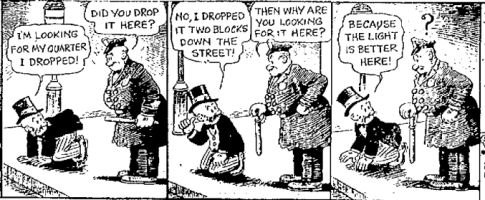
This idea is known as the Streetlight Effect – a term that dates back to at least 1942, when it appeared in a Mutt and Jeff comic strip by Bud Fisher, published in the Florence Morning News. The idea however predates 1942 considerably, with a story of the Islamic folklore character Nasreddin, who loses a ring in a dark room of his house but instead looks for it in the yard because there is “much more light” out there.

A police officer is patrolling a neighbourhood when he sees a drunk man crawling around underneath a streetlight. The officer asks if there is a problem. The man explains that he dropped a quarter, and is trying to find it. The officer has a look, and after finding no quarter, he asks the man where exactly he dropped it. The drunken man replies that he dropped it two blocks away. When the confused police officer asks him why he is searching here instead of there, the man replies, “Because the light is better here.”

The streetlight effect

It’s hard to look in the right place, so he looks in the easy one instead – even though it’s the wrong place. The drunk man chooses convenience. Organisations, more often than not, institutionalise it.

From bias to design principle

The drunken man chooses where to look based upon convenience, whilst in organisations, the Streetlight Effect becomes almost a measurement design principle based upon four “streetlight” criteria:

  1. Visibility (we’ll measure what we can see)
  2. Legibility (we’ll measure what easily fits into reports and dashboards)
  3. Defensibility (we’ll measure what can be justified to management, regulators, or exec teams)
  4. Appearance (we’ll measure what makes us look good – compared to other people, teams, or organisations)

Together, these criteria determine not just what is measured, but what is believed, funded, and prioritised. Anything that falls outside them risks becoming organisationally invisible.

And these criteria often distract us from the  much more important question of “is this information useful?” Does this data actually tell us anything? More often than not, data simply begs more “but why?” questions. Were we even looking in the right place to begin with?

Organisations fall into this trap all the time – we gather the data that we can, not the data that actually matters. Psychological safety is far from immune to this – just because we can run a psychological safety survey, should we? Even if we successfully measure how safe people feel in their team, at a certain point in time, for any given value of “team”, what are we going to do with that information? At best, surveys give us more questions than answers; at worst, they can lead us down the wrong path altogether or distract us from the real issues at play. 

Measurement Theatre

One reason for our tendency to measure what we can, and then make it matter, is the seductive nature of “measurement theatre” – it feels good, productive, busy and (importantly) highly visible to measure stuff. It can feel like we’re doing something valuable and having an impact. Nobody ever got sacked for generating more data. We can create impressive looking dashboards, slide decks, reports and analyses, and use these to elevate our own status and visibility within the organisation by presenting it to senior leaders or sharing the findings with the whole organisation. Yet if we never do anything meaningful with this information, or if the measurement was pointing us in the wrong direction anyway, measurement can ultimately allow organisations to appear proactive and responsible without actually confronting harm, inequality, or imbalanced power.

This happens in academic research too, not just organisational research. As Battaglia and Atkinson argue in their analysis of medical research, the pressure to publish, secure funding, and advance careers increasingly drives people toward “safe” work: studies that affirm existing paradigms rather than challenge them. They describe this explicitly as a form of the streetlight effect: studies look where it is easiest and most defensible to gather data, not where the most important questions actually lie. 

What gets measured is often what careers can be built on. It influences what can get funded, resourced, and noticed, and it risks distracting us from the things that really matter. 

“It is wrong to suppose that if you can’t measure it, you can’t manage it – a costly myth.”
– W. Edwards Deming, The New Economics.

Methods for seeing in the darkness

What’s harder, but often far more instructive than looking where the light is, is going to the places where the answers are more likely to reside. This usually means actually talking to people, and inviting them to speak and share what’s really going on for them in the messy, lived complexity of their work. We need to explore the dark, as well as check what we can see in the light. 

And there are tools that can help us here. In our work, it often involves approaches like action research (learning whilst doing the work), listening carefully to stories (sometimes described as narrative capture), and qualitative sense-making, where people surface meaning together, rather than having it extracted from them by analysts. Underpinning all of this is a simple belief: that organisational knowledge should be participatory instead of merely observational – measurement should be in service of learning, not the other way around.

“What gets measured gets managed — even when it’s pointless to measure and manage it, and even if it harms the purpose of the organisation to do so”
Simon Caulkin in 2008, summarising VF Ridgway 1956.

Measurement doesn’t just describe reality (or our idealised version of it), but it shapes reality. And if metrics shape reality, then choosing what to measure is an act of governance. So by only measuring what is easy – the things that we can see under the streetlight – we don’t just notice those things, we make them important. We alter the very substrate of the system by influencing attention, behaviour and decision making. 

In that sense, the Streetlight Effect becomes a form of organisational self-deception. It preserves the status quo, reinforces hierarchies, and legitimises “power over”, all while appearing neutral and “objective”  And if we take that seriously, then the begging question isn’t what we can measure, but what kind of organisation and what kind of world are our measurements shaping?

“There’s beggary in the love that can be reckoned.”
Shakespeare; Antony and Cleopatra.

References

Fisher, B. Mutt & Jeff Florence Morning News, 3 June 1942, p. 7

1963, Informal Sociology, a casual introduction to sociological thinking by William Bruce Cameron, Page 13, Random House, New York. (Google Books snippet view) 

Battaglia M, Atkinson MA. The streetlight effect in type 1 diabetes. Diabetes. 2015 Apr;64(4):1081-90. doi: 10.2337/db14-1208. PMID: 25805758; PMCID: PMC4375074. https://pubmed.ncbi.nlm.nih.gov/25805758/ 

Caulkin, S., 2008. The rule is simple: Be careful what you measure. The Guardian. 
https://www.theguardian.com/business/2008/feb/10/businesscomment1

Deming, W. E. (1994). The New Economics for Industry, Government, Education (2nd ed.). Cambridge, MA: MIT Center for Advanced Engineering Study. https://amzn.to/4swn0YX 

Ridgway, V.F., 1956. Dysfunctional consequences of performance measurements. Administrative science quarterly, 1(2), pp.240-247. https://www.jstor.org/stable/2390989

Carsten Busch. If You Can’t Measure It… Maybe You Shouldn’t: Reflections on Measuring Safety, Indicators, and Goals Paperback – 30 Oct. 2019 https://amzn.to/4jw1L5r 

Merry, S.E., 2016. The seductions of quantification: Measuring human rights, gender violence, and sex trafficking. University of Chicago Press. https://amzn.to/4pnGmMZ 

The post The Streetlight Effect appeared first on Psych Safety.

Reflections – Part Three: The Safety to Dissent

Part 3: The Safety to Dissent

In part one we discussed the power and danger in naming psychological safety. In part two, we explored power and diversity. This week we’re continuing our series of reflections with some of the things we’ve found make some folks uncomfortable about psychological safety work. We dive into dissent, non-determinism, and the danger of targets, KPIs, diagnostics and benchmarks.

Sometimes psychological safety is presented as something akin to comfortable conformity. Really, it’s the opposite – safety in discomfort and safety in dissent and difference. Psychological safety is what allows us to feel safe to be different, safe to dissent, and safe to deviate in our behaviours from cultural or organisational norms – even (and perhaps especially) if that deviation challenges the system itself or results in positive change at the expense of compliance. 

In many domains (such as healthcare), it’s not formal policies, processes or procedures that keep things running: it’s the constant human deviation and adaptation from those rigid and defined processes to make things work in the complexity of the real world. Systems (and people) survive because people at the sharp end are bending rules, solving complex problems on the fly, and compensating for gaps between work as imagined and work as done. Success comes not from conformity and compliance, it emerges from adaptation, diversity and difference.

Psychological safety is quite the opposite of conformity and comfort – it’s working to create the conditions where it’s safe to dissent and be uncomfortable together. This means safety in difference and intelligent adaptation. After all, most systems, in practice, run on deviance.

There are no guaranteed outcomes

Like all organisational dynamics, psychological safety is non-deterministic, and we cannot reduce it to simple cause and effect interventions. In complex systems (i.e. organisations), we cannot guarantee that any intervention will produce the intended effect, and it would be naive or misleading to pretend otherwise. The work of psychological safety is much more ecological than engineering. It’s about creating conditions where it can emerge, differently, in different contexts, with attention to local dispositions, histories, and contexts. This, as I’ve described previously in Rewetting Organisations, is about making small changes to the substrate – that foundation upon which the collective organisation thrives. Psychological safety is not fostered through Gannt Charts, plans and roadmaps. They may provide some utility, but we should remember that they are, ultimately, works of hopeful fiction.

What we can do, however, is guide, assist and empower people to experiment:

This is about providing people with ideas and patterns and inspiration rather than prescriptions – there’s no one-size-fits-all, cookie cutter approach to human interaction. Practices, tools, and behaviours can and should be adapted to the local context, because we trust that people understand and can navigate their own workplaces, and apply their learning intelligently. For example, PACE works in many contexts, but not all. Lean Coffee is excellent for many collaborative settings, but not all. The key is in intelligently deciding which practices and behaviours to experiment with, and ensuring that we hold on to them lightly, adapting or moving on entirely if they don’t work (whilst, of course, learning as much as possible from the experience). The practices and interventions may work, or they may not, but either way they teach us something. And if they don’t work, being honest about our failed attempt may in fact provide an opportunity to demonstrate that it’s safe to humbly and intelligently fail, and learn from the process – thus nudging us towards greater psychological safety after all.

Not every interpersonal risk will succeed (and some will certainly fail).  And this brings us to an important question that often comes up – how do I speak up if my workplace or team really isn’t at all psychologically safe? It’s important to be honest here: sometimes there’s really no “safe-to-fail” option.  Psychological danger can be very real, and in those situations, the most locally rational choice could well be to stay silent. If, for example, we work for a boss who will genuinely fire us for admitting a mistake, then the fear of being honest is justified. No amount of conceptual reframing will make that situation safe to speak up and admit it. 

What we can do is work to create the conditions where, iteratively, it gets safer to take those interpersonal risks. This starts by recognising that the group can only ever be as safe as the least safe person. In the case above, that might mean creating psychologically safer spaces for the team members when their boss isn’t there, or opening up alternative channels for raising concerns through the organisational hierarchy. And there are things you can try, even when the person you’re trying to foster psychological safety with is your boss. But it’s important to acknowledge that none of this is easy or guaranteed.

We’re never “done”

Progress in complex systems isn’t linear, and it’s never complete. Psychological safety is emergent, contextual, and it can’t be “implemented” or imposed. It arises from conditions, constraints, and repeated interactions and patterns, not through top-down rollouts. We can always do better, and if we’re not actively working to improve, we’re probably regressing. 

Having said that, continuous improvement should be opportunistic and adaptive, not an end in itself (or, god forbid, a metric target to be gamed). Sometimes the term “continuous improvement” can itself become a dangerous attractor if it’s imposed as constant pressure, and can be weaponised. What I guess I mean is that it’s ok to just keep doing a good job. Good things often come from persistence: sometimes just sustaining and keeping on going is more valuable than chasing the next improvement initiative. To quote the great Nemo, “Just keep swimming!” 

Resisting measurement and targets

Persistence matters more than chasing shiny new initiatives, but that doesn’t mean progress can (or should) be reduced to numbers. I’m generally pretty dubious about psychological safety “diagnostics”, benchmarks, KPIs and targets. Metrics in complex systems often serve as retrospective distortions (i.e. someone, somewhere, chose what to measure, what that measure means, and how to interpret the data – and those decisions are rarely made by the people actually being measured). The sheer existence of a measure alone can be enough to invoke Goodhart’s Law (more strictly Strathern’s Law) and distort or harm the very thing that we’re measuring. Even worse, if the results of an engagement or psychological safety survey are incentivised, punished or rewarded, then that effect is amplified. If a manager gets a bonus or promotion for their team scoring high in the psychological safety survey, are we actually measuring psychological safety, or how much influence that manager has over the team members’ survey responses? Since measurement appears to be the current orthodoxy (and is likely to remain so for some time), then the task is to ensure that the way we measure is as faithful as possible to the phenomenon itself, not a proxy that ends up undermining it.

“What gets measured gets managed — even when it’s pointless to measure and manage it, and even if it harms the purpose of the organisation to do so”

Simon Caulkin in 2008, summarising VF Ridgway 1956.

Another danger we come across with measurement is survey fatigue, where employees are endlessly surveyed about any and all aspects of their work experience, and the related phenomenon, survey theatre, where despite these near-constant requests to complete yet more engagement surveys, very little seems to change as a result. In these cases, the surveys are performative – they serve to provide the appearance of “doing employee engagement” or “consulting staff” without taking on any of the hard work of actually changing things for the better.  When survey metrics replace actual dialogue, measurement has become part of the problem. 

Along with cautions around surveys and measurement, we also advise against trying to establish a single measure of “organisational psychological safety”, despite this being quite a popular idea. This is because as neat and tidy as it feels to have one metric that represents the entirety of psychological safety across an organisation, in reality it’s completely meaningless, and tells us little to nothing about the lived experience of employees within that organisation. Aggregating psychological safety in teams to an organisational measure is a category error.

Worse, these aggregated metrics can risk allowing leaders to take comfort in a good looking score, while overlooking the uneven distribution of safety across different groups. In that sense, aggregation probably does more harm than good.

We sometimes jokingly call ourselves the “anti-measurement club”, but there’s a serious point here: as soon as we measure psychological safety, we risk incentivising people to perform it rather than live it. 

Metrics, averages and snapshots can give false reassurance. Instead, we focus on action research (learning whilst doing the work), narrative capture (stories of lived experience), qualitative sense-making (drawing insights from the interactions and outputs from workshops), and prioritising directional movement rather than magnitude (working iteratively towards “better” rather than a numerical target or goal). I believe that moving in a good direction is more important than a simple measure telling us where we are now. Knowing you’re 30,000 feet in the air is less useful than knowing that you’re plummeting at a rate of 500 feet per second.

To be continued! Read part four here.

Next week, we explore a completely different lens on psychological safety, and look to the future of the field.


Introducing the Trainer Toolkit!

We’re excited to share something brand new: the Psychological Safety Trainer Toolkit!

This incredible digital resource has already had a fantastic reception from our Train the Trainer course graduates and our Psych Safety community – and now we’re opening it up to newsletter readers too!

The Trainer Toolkit is designed to make it easier for you to deliver impactful, practical psychological safety sessions, whether you’re working with your own team or with clients.

psychological safety trainer toolkit

Inside, you’ll find:

  • 11 exclusive training videos, walking you through the key ideas and practices
  • Guidance on marketing psychological safety training to colleagues or clients
  • Advice on tailoring sessions to different contexts and audiences
  • Principles of good design and facilitation to support your delivery
  • Templates, fresh ideas and practical resources to use with teams
  • A ready-made slide deck to support your sessions

It also comes with a commercial licence, so you can use it both in-house and externally.
Get the Trainer Toolkit here 

We hope the Trainer Toolkit helps you gain more clients and deliver more value to existing clients – and we can’t wait to hear how you use it.

Tom Geraghty and Jade Garratt

The post Reflections – Part Three: The Safety to Dissent appeared first on Psych Safety.

❌