❌

Reading view

There are new articles available, click to refresh the page.

The “Utility” of Psychological Safety

The Futility of Utility

If we want to make the argument for psychological safety in most organisations, we often need to speak the language of value. There is genuinely strong evidence that psychological safety is associated with better team performance, including decades of work linking psychological safety to reduced error rates in healthcare, aviation, and high-stakes industries. There are real, measurable outcomes of high psychological safety: better retention, more innovation, fewer incidents and faster learning.

And if we can’t make this case, we often won’t get in the room. Budgets are limited, and if we can’t demonstrate value, programmes don’t get funded – and psychological safety becomes a privilege of only exceptionally well resourced organisations rather than reaching the places that need it most.

I’ve made these arguments myself when pitching, justifying a budget line, or helping a client make the case internally. The evidence is real and it’s worth citing.

So the impulse to frame psychological safety in utilitarian terms: to ask what it’s for, what it produces, what return it delivers, is not cynical. It comes from a legitimate place.

But there’s a problem with it too.

What utilitarian logic actually does

Utilitarianism, in its classical form, aggregates welfare across a population and optimises for the greatest good for the greatest number of people. On the surface, this sounds fair: everyone counts, everyone’s interests are included in the calculation. But the utilitarian framework contains a structural flaw that philosophers have been wrestling with for centuries: the welfare of a minority can always be legitimately overridden if the aggregate calculation favours doing so. This isn’t a misapplication of utilitarianism. It’s how it works.

“A man’s virtue is tested by whether he treats those who are useful to him and those who are not useful to him in the same way.”
Simone Weil, The Need for Roots

When we ask whether psychological safety “delivers ROI”, we’re (whether we intend to or not) invoking this logic. We are setting up a calculation in which the value of each person’s ability to speak up is weighed against organisational cost. And once that calculation is running, its conclusions are unfortunately rather predictable.

Who loses?

Helping people speak up is not equally easy across a workforce. For some people – those who are already confident, possess more power, or who resemble the leadership – many of the conditions for speaking up exist more or less by default. Creating psychological safety for these people is low-cost, because the system was largely built around (or by) them.

For others, it’s much harder. Improving psychological safety for someone who is neurodivergent, for a person of colour in a predominantly white organisation, for a woman in a male-dominated team, for LGBTQ+ folks in more conservative cultures, for a manual worker in a professional environment, for people from lower socioeconomic backgrounds, or for anyone with a “marked identity” (something that marks them as different from the contextual norm), this work is often slower, more structural, more disruptive and challenging to existing habits and hierarchies. Essentially, in terms of resources, time and money, it may be genuinely more expensive.

A utilitarian approach can keep finding reasons why this particular work, for these particular people, is not quite “worth it”. Not because anyone is being deliberately cruel, but because the framework itself will keep producing that answer. The least safe people are often the most costly to serve, and in a cost-benefit world, cost wins.

And it’s worth noting that it always seems to be other people who are judged to be receiving “too much” psychological safety – as costing too much. The people (who are almost always people for whom speaking up is already safe) making that argument never seem to volunteer themselves for experiencing less psychological safety.

A different framework: capabilities and rights

The philosopher Amartya Sen argued in Development as Freedom, that human wellbeing cannot be captured by utility measures (such as GDP) alone. What matters is whether people have genuine capabilities (the real and practical freedoms to do and be). Martha Nussbaum extended this to describe central human capabilities that function as threshold conditions that must be met regardless of what an utilitarian argument might warrant. The key point is that these capabilities are not inputs to an equation. They are things that must be in place, for everyone.

I believe that the safety to speak up without fear of punishment or humiliation fits squarely within this framework. It is not (solely) a productivity lever. It is a basic condition of full participation in our own working lives. 

“Each person is an end, and none is merely a means to the ends of others.”
Martha Nussbaum, Creating Capabilities

This is also what rights-based thinking has always understood. Rights function not as goods to be weighed against other goods, but as constraints on what we are permitted to do regardless of the cost / benefit calculation. We don’t ask whether freedom of speech delivers ROI. We don’t (or shouldn’t) evaluate the right to education, or to bodily autonomy, or to freedom of conscience in terms of economic return. We treat them as things that cannot be sacrificed even when the utilitarian maths might point that way. In the human rights sphere at least, the opposite way lies fascism.

Psychological safety belongs in this category of capabilities. Not as a productivity lever, but as a fundamental condition of dignity at work.

Noting the benefits is not the same as measuring utility

None of this means we should stop talking about what psychological safety produces. We should talk about it. Better innovation, improved quality, reduced harm, greater retention, stronger wellbeing are real and very important outcomes and they’re worth naming. 

But there is a difference between noting the benefits of something and making those benefits the justification for its existence. We note the benefits of free speech in that it produces better public discourse, more accurate information, and more accountable institutions, without treating those benefits as the reason we defend it. The defence comes from somewhere more foundational.

And I wonder if the same shift is needed for psychological safety. We can point to what it produces but we should not make production the point.

What this means in practice

Framing psychological safety as a right rather than a utility makes the practice of it more honest. It means we stop asking “what might it cost us to foster psychological safety” and start asking “who are we currently excluding, and what does that cost them?”

It means that the people for whom creating safety is hardest: the people with the least power, who are the least visible or represented, and with the least resemblance to whoever set the norms, are no longer at risk of being deprioritised when budgets get tight or attention moves on. And it means we can hold a clearer line when the utilitarian cost/benefit pressure mounts (as it always eventually does) and someone asks whether all of this is really “worth it.”

The answer is that it’s not a question of worth. It’s a question of what kind of organisation, and what kind of working life, we think people are entitled to. 

The post The “Utility” of Psychological Safety appeared first on Psych Safety.

Growth Mindset

Growth Mindset

When American psychologist Carol Dweck published her book “Mindset” in 2006 it made waves in the education world and beyond. Drawing on her work developing mindset theory, it offered a shift in perspective: instead of assuming that someone’s ability was fixed, it invited us to see ability, intelligence and competence as things that could be developed over time, through effort, feedback and sometimes struggle. Her work sits within a broader school of psychological thought that recognises how strongly our beliefs shape our behaviour, and, ultimately, our lives. In the case of “growth mindset”, the claim is that what we believe about our abilities and intelligence profoundly influences how we respond to challenge, the effort we make and therefore the opportunities we have to learn and grow

As Dweck puts it:

“In a growth mindset, people believe that their most basic abilities can be developed through dedication and hard work – brains and talent are just the starting point.”

For many educators, this felt hopeful and also perhaps a little confronting. It asked us not to locate difficulty or failure in the student and instead to look more closely at the beliefs shaping the learning environment – both our own and theirs. Rather than asking “What’s wrong with this student?”, we were encouraged to ask “What messages are they receiving about effort, ability and failure?”

School student with her hand raised in a classroom, smiling

Photo by  Anastasia  Shuraeva

Perhaps because I came across Dweck’s work on mindset fairly early in my career, when I was thinking a lot about how to orient myself and be in work and education, it undoubtedly shaped my own world view. When my three-year-old gets frustrated because she can’t write her name perfectly, I remind her that she can’t do it yet. I make a conscious effort to praise her for effort rather than “cleverness” (despite my entirely biased view of her intelligence!). Not because I necessarily think praise alone changes outcomes, but because I do want to reinforce the idea that it’s good to keep trying at things that are hard.

Are psychological safety and growth mindset connected?

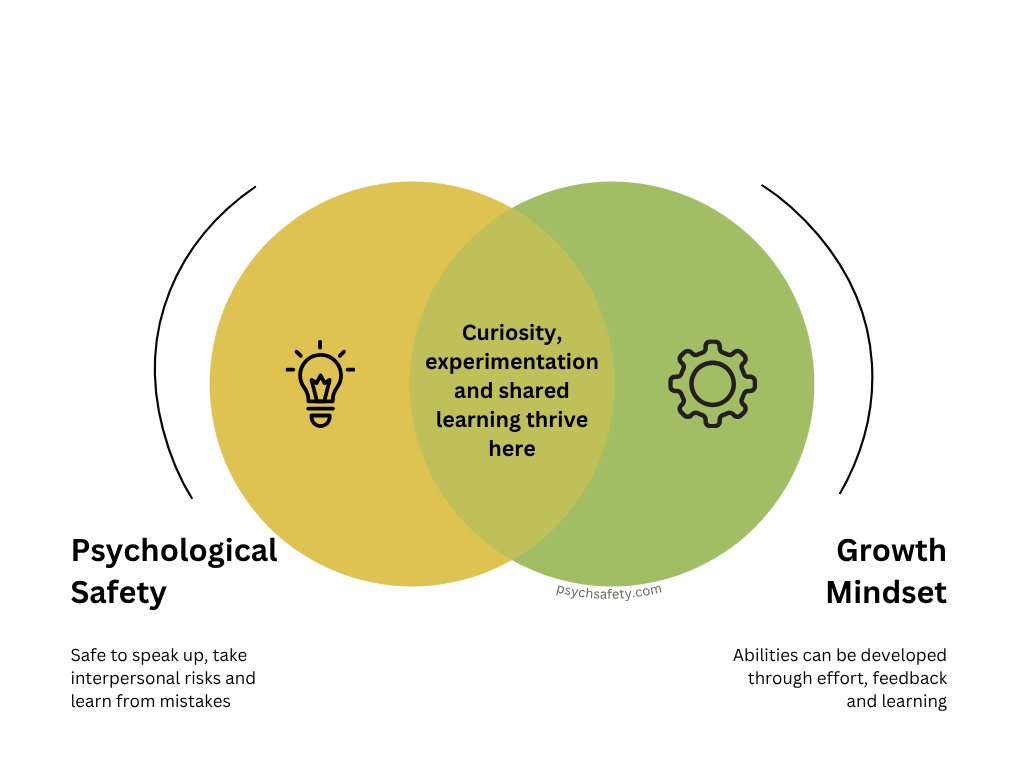
So when, recently, I started to hear more organisations and businesses talk about growth mindset, my ears pricked up. I was asked by a couple of people how psychological safety connects with growth mindset, and my initial response was pretty positive: the two concepts support each other, they’re complementary.

Much of what we’re doing when we talk about fostering psychologically safer workplaces is creating the conditions for people to learn together. Teams that can share ideas, ask questions, raise concerns and admit mistakes are teams that can adapt and improve.

And these behaviours are exactly the sort of behaviours we would expect and hope to see when someone has a growth mindset. If we see people asking questions, admitting uncertainty, sharing half-baked ideas and trying things that might not work, they’re all reasonably good indicators that the person has a growth mindset – they believe they can learn and get better. But we also need to remember that every one of those behaviours carries interpersonal risk: the risk of looking foolish, being judged, losing status or being blamed for trying something that didn’t work.

Psychological safety lowers that risk. In a sense, psychological safety reduces the interpersonal cost of learning together enough for people to act on their growth-oriented beliefs. Even if we have a growth mindset, and believe deeply that learning is possible, without psychological safety we may well still decide it’s not safe to “learn out loud” here.

growth mindset and psychological safety

There’s a second, subtler connection too – we know that fostering psychological safety often means we need to do the difficult work of changing our behaviours and approaches, even unlearning behaviours we previously thought were helpful. If instead, we adopt an entrenched view about our abilities, something more akin to a fixed mindset, perhaps telling ourselves we’re just “not a team player,” or “not cut out for leadership,” or as I heard recently “bad at communication,” then we miss the fact that all of this is learnable too. 

So a growth mindset, at its best, can support the work of building psychologically safer environments, and sustaining that over time. If we genuinely believe that people, ourselves included, can grow through effort and feedback, then interpersonal risk-taking has a purpose. Believing in the possibility of growth and improvement gives us a reason to share feedback rather than avoid it, and even more importantly, a reason not to write someone off after a single mistake.

One way I sometimes frame the distinction is this: psychological safety is about our beliefs regarding the environment we’re in; growth mindset is about our beliefs regarding the people in that environment, including ourselves.

The problem with growth mindset

Where things start to go wrong is when “growth mindset” is lifted out of its original context and used in ways that stretch, or outright distort, Dweck’s work. It’s not uncommon to see organisations urging employees to “adopt a growth mindset” as the business scales or targets become more demanding. And this is where things get tricky from a psychological safety perspective.

Growth mindset was never about relentless positivity, believing harder, or insisting that everything is possible if you just try hard enough. It’s grounded in effort, struggle, feedback and learning over time. When it gets reduced to “just be positive” or “push through”, the term becomes a flimsy platitude, and one that can easily be weaponised. “You’re struggling because you don’t have enough of a growth mindset,” is not helpful feedback; it’s dismissal. When growth mindset is misrepresented in this way, it is all too often used to judge people for not performing at 100% (or more) all the time, or manipulate them into accepting unreasonable workloads or demands.

Used this way, growth mindset rhetoric can damage psychological safety, much like toxic positivity does. It risks creating spaces where only good news and confident updates are welcome. 

This is especially true when organisations talk about growth mindset without attending to power, context or collective responsibility. Behaviour does not arise in a vacuum; it is shaped by the conditions people are working in. When that context remains unchanged, growth mindset language can feel hollow and even coercive. Responsibility shifts from the organisation “we need to listen better and make it safer” to the individual “you need to be bolder, braver and more ambitious.”

And I have noticed that doggedly insisting everyone adopts a growth mindset can easily slide into the moralistic or judgemental. Even the way the concept divides people into two camps – those who have a growth mindset and those who have a fixed one – can be quite damaging. I once heard a headteacher say they would never employ a teacher who talked in their job interview about helping students “meet their potential”, reading the phrase as evidence of a fixed mindset. Now, you might reasonably want to explore what the teacher meant – whether they were imagining potential as a ceiling or an open-ended capacity – but dismissing someone’s entire professional capability on the basis of a single phrase uttered at an interview feels somewhat harsh, and leaves little room for discussion, nuance or learning.

The thorny ethical bit

There’s also a broader ethical issue here about organisations seeking to “change people’s mindsets”, rather than recognising an important boundary, which is people’s right to cognitive sovereignty. What organisations ultimately need is behaviour: people doing the work well, and also speaking up, experimenting, learning and improving so the work can be done better next time. But is it appropriate for employers to stray into employees’ inner worlds – into their beliefs, attitudes and ways of making sense of themselves? 

As psych safety community member Paul Tevis puts it:

“I think that mindset and beliefs are a perfectly reasonable focus for your own development, but it’s the wrong thing for managers and organizations to try to affect… what organizations should actually care about is behavior, because that’s what drives performance… and your employer doesn’t own your brain. They only rent it.”

This is where work on psychological safety offers an important corrective. It helps guard against the risk of overreach – of making psychological judgements or attempting interventions we’re neither qualified to make nor entitled to impose. It helps keep us focused on the environment, not on “fixing people”. 

And although we define psychological safety as a “shared belief”, what we’re really talking about is the perceived interpersonal risk of a situation. We don’t shift that by trying to implant different beliefs into people’s minds. We shift it by changing the environment – by ensuring that we provide consistent social proof that it really is safe to speak up, to question, to make mistakes and to learn.

I think where I land is this: mindset doesn’t override context and we can’t simply will our way into growth if the environment punishes learning behaviours. If it’s a choice between asking how we can change our behaviour to make workplaces safer for everyone, and asking everyone else to change their mindsets, I’ll choose the former every time. 

Further Reading

Individual Resilience

Safety and the Myth of Self-Reliance

Reflections – Part Two: Power and Difference

Just Culture

Psychological Safety Doesn’t Mean Feeling Comfortable

The post Growth Mindset appeared first on Psych Safety.

❌