Login
James Webb telescope finds ice older than the star it orbits
Beta Pictoris is a young star, roughly 20 million years old, and located about 64 light-years away from Earth. It is surrounded by a vast disk of dust and rubble where planets are still forming—astronomers have already found three. In a new Science study, a team led by Sarah Betti, an astronomer at the Space Telescope Science Institute in Baltimore, used the James Webb Space Telescope to look for ice in this disk. Researchers found both water and carbon dioxide ice.
The water ice is glassy rather than crystalline, and it is mixed with carbon dioxide in roughly the same proportions we see in comets of our own Solar System. This suggests ingredients necessary to form water-rich worlds might be common around young stars.
The missing ice
Beta Pictoris is one of the best studied stars in the sky. Its disk was among the first ever imaged, back in 1984, and we see it almost exactly edge-on, which makes it a natural laboratory for studying how planetary systems grow. It's what astronomers call a debris disk, where the dust is constantly replenished by collisions among comets and planetesimals, small bodies that are the building blocks of planets.
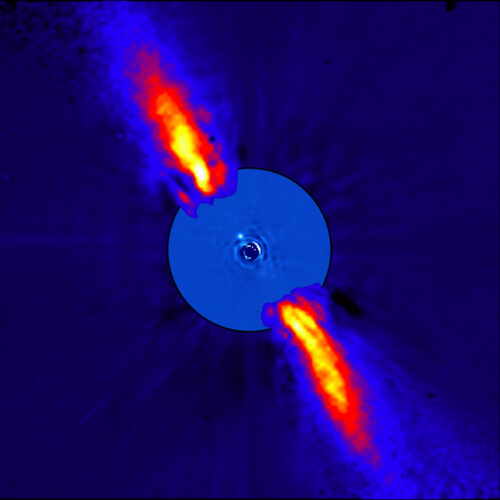
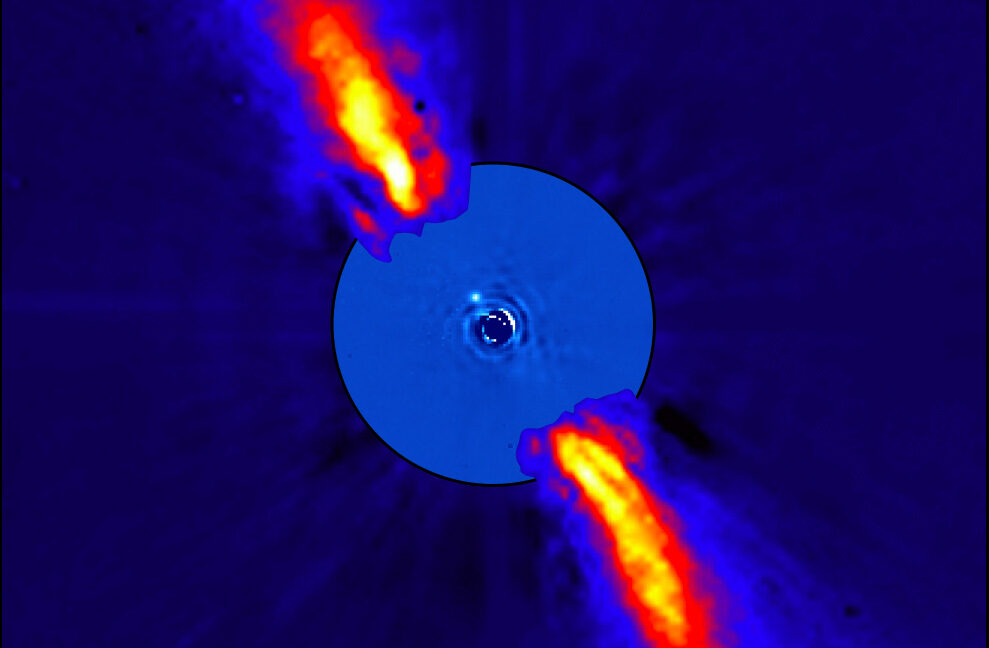
© ESO/A.-M. Lagrange Et Al.