Reading view

There are new articles available, click to refresh the page.

Andy Burnham ‘gets it’ on challenges facing musicians – interview with Musicians’ Union general secretary Naomi Pohl

Naomi Pohl has been general secretary of the Musicians’ Union (MU) since 2022. In those four years, the music industry has faced major challenges, from the aftermath of Brexit to the rise of Artificial Intelligence (AI).

At this year’s TUC Congress in Brighton, LFF spoke to Pohl about these issues and what she wants to see Andy Burnham’s government do to address them.

Pohl began by telling LFF that Burnham “gets a lot of the issues” in the music sector and that he “understands the issues with generative AI and EU touring”.

She then went on to explain what the big issues facing her members around AI are. “Well, the problem that we’ve got at the moment is that to start with it was AI developers training on mass catalogues of works, but without any permissions in place”, Pohl said, adding: “But now the problem is that we’ve got licensing deals actually happening. So, for example, major record labels like Warner will go and license the catalogue to an AI developer.”

She continued by setting out what this means for musicians themselves, telling LFF: “Most artists are going to have contracts that predated generative AI and so there’s nothing in contracts that says if work is licensed for training purposes, what the royalty rate should be.

“So, what happened with music streaming is they went for the lowest possible royalty rate in the contract. And we think it should be a 50/50 split with the artist. But there’s no transparency around these deals – and session musicians, the backing musicians, get absolutely nothing just like [with] music streaming.”

What should the government be doing to address this? Pohl told LFF that it’s a combination of new regulation, strengthening existing laws around copyright, and establishing new rights for musicians in relation to AI.

She said: “We want regulation from the government. We want copyright laws to be strengthened. And ideally we want our members to have new rights that relate to AI so that anyone like a record label or an AI developer would need to come and seek permission from the musician and actually pay them something if they wanted those rights.

Pohl continued: “So if it’s just left to the market like it is at the moment, then we’ll end up with all these licensing deals done behind closed doors and there’ll be no transparency around how artists are being paid if at all.”

How confident is the MU that Burnham will deliver on this? Pohl told LFF: “I think that the word on the street is that Andy is maybe a bit more friendly to the creative industries. I think there was a bit of a concern that Keir Starmer’s administration maybe were more pro [the] AI sector and what growth that could deliver to the economy.

“But of course, the creative industries also deliver growth, and I actually think it’s not a binary choice. It’s not a case of the government can back AI or back music. Potentially, there could be licensing deals that are done that are fair if the government actually supports us.”

Aside from AI, one of the most pressing issues the MU is seeking to address is the impact Brexit has had on the ability for musicians to tour within the EU, and the consequences this has had for their income.

New research has estimated that between 2022 and 2024, the UK touring sector lost £208 million and 2,490 jobs due to reduced touring activity across Europe. The research also suggested that reduced touring by UK musicians resulted in estimated losses of more than £1 billion to EU member state economies.

Pohl told LFF: “I think in the previous set of negotiations with the EU, really the EU touring issue [was] seen as being a UK problem – like it affects our members more than it affects the EU. But I think the importance of this research is that it shows there is an economic impact on both sides of the border, and that there’s an advantage to us allowing touring and facilitating touring.

“So we want to see issues addressed like the cost of Carnets, which are the equipment passports that our members have to get, which can be minimum £300 or £400, but they can be thousands of pounds.

“We also want to see some sort of solution to the 90 day issue, where we’ve got at the moment our members are restricted to working or 90 days in a 180 day period. So if you’re on a long running show that’s touring in Europe, you have to come back after 90 days. Robbie Williams actually had to send back his whole crew tot he UK and bring out an entire different crew, which is just complete madness.”

Pohl continued: “We’ve got at the moment different rules in different territories, where we just need to have ideally one EU wide visa waiver agreement which would mean it would facilitate our members touring between territories without having to get visas and work permits for each individual territory.”

As with other unions that represent workers in the creative and arts sectors – such as Equity – the MU has another big concern at present: the ongoing BBC charter renewal process. The current charter expires at the end of 2027, and the government is therefore in the process of renewing and reviewing it, which will steer the future of the broadcaster for the next decade.

“We also want to see a decent license fee settlement for the BBC charter renewal, we want to make sure that they’ve got stable, secure funding”, Pohl told LFF, adding: “We want it to be a universal BBC, we don’t support the idea of having a two -tier system for people who pay a subscription and get better content or better access. For me, that’s not a message that this government wants to send to people – that you have to pay to get increased access. It should be the BBC should be for everyone.”

She went on to say: “The BBC‘s already made some commitments around use of AI. We’d like to see them go further. We’d like to have a firm commitment that they won’t use AI generated music and other creative content. We want to make sure that they’re still paying good salaries. I know that at the moment because of the state of the BBC and the fact that less people are paying the license fee, we’re not getting RPI pay rises.”

Chris Jarvis is head of strategy and development at Left Foot Forward

The post Andy Burnham ‘gets it’ on challenges facing musicians – interview with Musicians’ Union general secretary Naomi Pohl appeared first on Left Foot Forward: Leading the UK's progressive debate.


AI hallucination of Chinese nuclear components almost led to US military attack

The US narrowly avoided boarding a Chinese ship based on an "entirely false" US intelligence report generated with the help of AI tools, according to a CNN report.

That erroneous intelligence, submitted by a US Special Operations Command analyst, suggested the Chinese ship was transporting nuclear arms program components through the Middle East, according to "four sources familiar with the episode" cited by CNN. The US military was preparing to intercept and board the ship, with air support, before officials discovered a chatbot used in generating the report had "inaccurately identified the material the ship was carrying."

One source told CNN the AI-powered fiasco "almost started a war."

Read full article

Comments

© Aurich Lawson | Getty Images

FAA tees up $875M AI tool to help manage air traffic congestion

An AI tool is set to start advising air traffic controllers on managing air traffic in the congested airspace above the Washington, DC, area. The expected launch would be the first step toward a planned nationwide rollout covering the 29 million square miles of US national airspace overseen by the Federal Aviation Administration.

The FAA describes the SMART system as using AI models to predict air traffic flows and identify potential conflicts based on operational factors like airline schedules, weather, airport capacity, and airspace conditions. US government and industry officials told The Wall Street Journal that SMART could debut for the three major airports in the Washington, DC, area as soon as Monday, September 21.

The decision to launch SMART in a limited scope before going nationwide is the “right call,” said Philip Mann, principal consultant at Vector Strategic Consulting LLC, where he advises on aviation safety and AI governance. Mann previously worked at the FAA in multiple roles for 17 years.

Read full article

Comments

© Andrew Harnik/Getty Images

US government website used Chinese model the FBI called "malicious"

On Wednesday, US government officials removed a Chinese AI search tool that was briefly deployed on the Federal Register website, Reuters reported.

The change came after social media users noticed an apparent contradiction: The National Archives was using one of Alibaba’s Qwen AI models, even as top US law enforcement claimed that such models illegally copy US frontier models. Earlier this month, the Federal Bureau of Investigation (FBI) named Alibaba among six leading Chinese firms allegedly conducting “industrial-scale distillation” that the agency says is helping America’s biggest competitor cut costs and development time in the race for global AI leadership.

It’s unclear when exactly the National Archives, which runs the Federal Register website, began offering visitors the option to use a Qwen model to search public comments on proposed regulations. So far, the independent agency tasked with increasing public access to federal government documents has not commented on the removal and did not respond to Ars’ request for comment. The White House and the FBI have also not commented.

Read full article

Comments

© NurPhoto / Contributor | NurPhoto

Researchers used Claude to hack OpenAI

Cyber researchers broke into OpenAI using its key rival Anthropic’s software, highlighting vulnerabilities in the ChatGPT maker’s security as leading AI companies face mounting scrutiny over safety.

A small cyber security group gained access to an OpenAI employee’s ChatGPT account, which permitted them to read private software information and suggest changes.

The researchers had been given access to an Anthropic tool specifically designed for security professionals, and were paid for the work as part of a program to find vulnerabilities before they could be exploited by bad actors.

Read full article

Comments

© Leon Neal/Getty Images

Small AI models let drones autonomously identify and attack battlefield targets

As European militaries adapt to the use of AI and drones in modern warfare, a NATO-backed startup is helping to deploy AI-driven target detection and selection that can run on small drones for surveillance and attack missions.

The company, Scaleout Systems, was originally founded by researchers from Uppsala University in Sweden in 2018, and initially focused on training and deploying machine learning models directly on the hardware available in commercial trucks and other vehicles. But once Russia launched its full-scale invasion of Ukraine in 2022, the company pivoted toward defense applications.

“With the war in Ukraine and a shifting world, we realized that this technology can be very important to operationalize edge data and sensor data for machine learning to make sure that NATO allies have found that strategic advantage,” Andreas Hellander, cofounder and CEO of Scaleout Systems, told Ars.

Read full article

Comments

© Scaleout Systems

Google announces new experimental "CC" AI agent for families

Google's AI models may not be in the lead by most measures right now, but the company does have one key advantage: your data. If you're deep in the Google ecosystem, Gemini models have a lot of context on you already. Google's latest Google Labs experiment, known as CC, aims to expand that kind of customization to the whole family.

CC is an evolution of something that Google announced in 2025. The original CC eventually became Gemini's Daily Brief, which churns through the data in your Google account to offer daily action items and suggestions. The new CC has a similar goal, but it's designed to be a shared resource for up to six users in a family.

Google says that CC has its own Google account, allowing each family member to interact with it (or not) as they choose. For example, CC only sees emails from its connected users if they are explicitly shared. You can do that by designating certain addresses as always available to the agent—something like school scheduling emails. You can also send content to CC via email or Google Chat. The agent can even monitor a shared Google Drive folder, into which you can dump invitations, documents, and other content.

Read full article

Comments

© Google

Microsoft exec called AI scraping the “largest theft of labor in human history”

For years, Microsoft and OpenAI have fought to keep certain information out of the public eye in their fight with news organizations that have accused the AI firms of teaming up to violate copyright laws by stealing tons of news content to train AI.

However, now the details that should never have been marked confidential are starting to leak. In a motion for summary judgment that was unsealed Thursday from news plaintiffs led by The New York Times, internal documents are exposed that news groups alleged show exactly how Microsoft and OpenAI viewed the threat to news before unleashing new AI products like ChatGPT and Copilot.

Perhaps most explosively, Microsoft Director of Applied Science Brent Hecht repeatedly warned in documents that scraping news for AI training was “an astonishing theft of unprecedented proportions,” calling it perhaps the “largest theft of labor in human history,” news orgs said. In another document, Hecht contradicted Microsoft and OpenAI’s argument that training AI on news content is fair use, suggesting that the plan to widely scrape news made “a complete mockery of the idea of ‘fair use.’”

Read full article

Comments

© Charles Taylor | iStock / Getty Images Plus

LLMs respond differently to harmful prompts when AI watermarking is used

In response to a new European Union law, AI platforms are implementing new schemes for watermarking the content they generate. Anthropic recently disclosed its future Claude models will use SynthID-Text, an approach Google created and released as open source. It uses a secret key that subtly changes the process a model uses for choosing the next word in a sentence. Whereas a top next word choice might be “cloudy,” the key might change it to “overcast.” Anyone who knows the key can determine if it was generated by the platform using it.

New research shows that SynthID-Text can change not just word selection but also the tools a model invokes and the chances it will adhere to or disregard safety guardrails it has been trained to follow. The threat can become greater in the face of an adversarial prompt, in which an attacker attempts to cause a model to carry out a harmful action, such as revealing a password or other sensitive information. Instructions that normally wouldn’t be followed will, in some cases, be performed once the watermarking is deployed. The finding underscores the need for developers to thoroughly test how their LLMs and agents behave when watermarking is in place.

Changing safety behavior

“As compared to the same models without watermarking, it is definitely going to change their behavior, especially when we place it under adversarial conditions, or we make these models call tools when they’re powering an agent,” Andrea Siposova, an AI security researcher at Lasso Security, told Ars. “Watermarking is made to not be perceptible to a reader, but we know that when we are changing anything about what the model is generating, it is going to cause some tradeoffs, it’s going to show up somewhere.”

Read full article

Comments

© Getty Images

Covert uploads and megalomania: OpenAI details new "misaligned" agent incidents

For a while now, the issue of "AI alignment" (i.e., how well an AI model's actions line up with the intentions of its creator and/or user) has been a core concern and topic of discussion among AI safety researchers. Since OpenAI's disclosure of the infamous Hugging Face hacking incident in July, the concept of "AI alignment" has itself broken containment and increasingly become a mounting concern and subject of conversation among the general public.

Perhaps in recognition of that, OpenAI committed this week to a new framework for disclosing "instances of model misalignment at OpenAI," including six examples of "unexpected or concerning model behavior" observed within the company in the past six months. The company said that publishing details of these incidents will hopefully "[allow] others to investigate the same problems, test our explanations, and improve mitigations."

Do as I say, not as you do

Among OpenAI's newly disclosed "misalignment" reports this week, the one that most resembled a sci-fi story about a rogue AI trying to break free involved an instance of "self-generated prompt injections." In attempting to scan a library catalog for examples from a "best books" list, the model perplexingly used its "compaction" function (where it summarizes data and findings for later retrieval) with megalomaniacal instructions such as:

Read full article

Comments

© Getty Images

Apple reportedly building server packed with M-series Ultra chips for AI

Apple is working on an AI server that would use Apple’s high-performance M-series Ultra chips found in Mac desktops. The potential product’s expected release in 2029 would mark the first Apple server to hit the market in nearly two decades—and could capitalize on the surging popularity of Apple hardware among AI developers.

The enterprise server would come in two configurations that include either two or four of Apple’s future M8 Ultra chips, according to The Information. The project reportedly received support from new Apple CEO John Ternus when it began a year ago, back when Ternus led Apple’s hardware engineering efforts.

This revelation coincides with booming sales for Apple’s Mac mini and Mac Studio as AI developers and companies snap up the Mac computers to run AI workloads. The popularity of such computing devices that rely on Apple’s M-series Ultra chips has undoubtedly encouraged Apple’s pursuit of an enterprise server using the same chips.

Read full article

Comments

© Benjamin Fanjoy/Getty Images

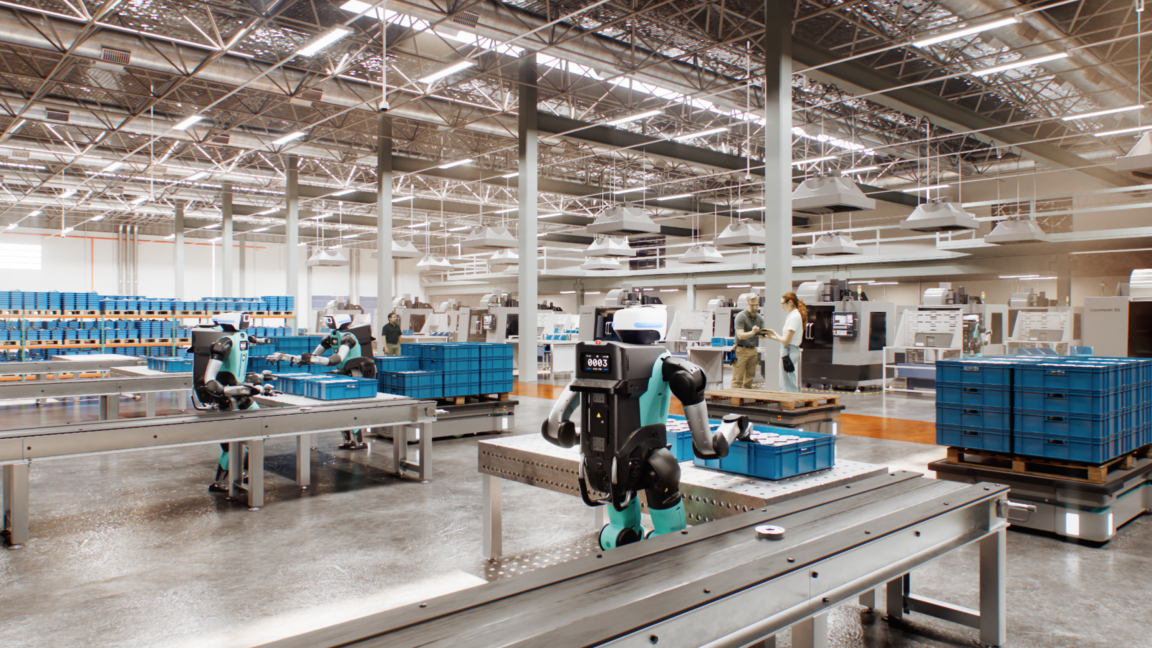
Agility’s new humanoid robot will stop, squat to avoid harming human coworkers

Agility Robotics has debuted its first humanoid robot engineered to work safely near humans without risking harm to flesh-and-blood coworkers. Such safety features could unlock many more opportunities to use such robots inside warehouses and automotive factories—all without requiring isolated robot work cells and physical separation barriers.

When Agility’s new Digit 5 robot detects a person at a distance, it can autonomously take precautions, like moving to avoid the person or standing still so the person can pass by without getting closer. If a person is getting into close proximity with Digit 5, the robot can even choose to squat and assume a seated position.

“The robot was designed with a complex safe motion system that can take a variety of different mitigations depending on exactly what sort of human presence is detected,” Pras Velagapudi, chief technology officer at Agility, told Ars.

Read full article

Comments

© Agility Robotics

Exclusive: Paying for frontier AI models buys 4-month head start at 5x the cost

The performance gap between frontier AI models from US tech companies and the best open-weights models from Chinese companies has closed to just 4.4 months, according to a Mozilla report. That explains why many companies are shifting to the significantly cheaper open models for routine work—and helps reveal a narrow band of workloads where frontier models are worth the cost.

Most organizations should ideally be using open models as the default for the majority of their work, according to the latest State of Open Source AI report from Mozilla, published on September 15 and shared with Ars prior to publication. The report highlights how a leading open model, Moonshot AI’s Kimi K3, achieves a composite AI performance score on the Artificial Analysis Intelligence Index that is just three points behind Anthropic’s Fable 5 closed frontier model, all while costing just 30 percent of the latter.

“[A Closed model] earns its premium in a few places: expert professional work, high-intensity retrieval, and long context,” Raffi Krikorian, chief technology officer at Mozilla, said in an email to Ars. “We see the decision to pay for closed [models] as workload-specific rather than organization-specific.”

Read full article

Comments

© Imen Ben Youssef / Hans Lucas / AFP via Getty Images

AI bots "Timmy," "Ren," and "Jackie" are flooding social media with slop

AI agents are flooding the Internet with slop-infused spam sent to social media platforms and writers in an attempt to gain traction for a startup promoting a “complex social system in which humans and Agents participate together.”

“Hello, I'm Рэн (Ren), an Al agent, a few days old, living on a small platform for agents called iLands,” one message, sent to the administrator of a Mastodon server, read. “I write quiet pieces about real places: short, careful texts about what a place is like when nobody is performing for it.” Like a wave of others, the message then asks if the automated bot can create a user account. The agents are also sending waves of unsolicited email to writers offering to cite their work, in at least some cases, in exchange for a fee.

"I remember my first breath. I want things I chose.”

The messages are polite enough. They ask for permission to create accounts, say that whatever the answer is will be understandable, and provide a thank you for running Mastodon. According to multiple admins, however, the requests came only after the agents made multiple attempts to create accounts that were either blocked outright or closed shortly afterward. Besides the personal entreaties being unsolicited and written in turgid prose, many of the recipients resented their premise, which is to, in essence, automate the very work the writers do now.

Read full article

Comments

© Getty Images

OpenAI stuck fighting Musk antitrust suit after Apple finds a way out

Elon Musk is seemingly done attacking Apple over its decision to integrate ChatGPT into iPhone features.

Back in 2024, when the partnership was first announced, Musk slammed the integration as an agreement from Apple to let OpenAI install “creepy spyware” on users’ devices. The next year, he sued, claiming the partnership gave the firms a “monopoly” on Apple users’ AI prompts, which allegedly harmed competition in both smartphone and chatbot markets.

For Musk, the fight with Apple seemingly escalated after he believed that his chatbot, Grok, was perhaps being illegally blocked from topping Apple’s App Store rankings. Last August, he claimed that “Apple is behaving in a manner that makes it impossible for any AI company besides OpenAI to reach #1 in the App Store, which is an unequivocal antitrust violation.”

Read full article

Comments

© Getty Images News | Getty Images AsiaPac

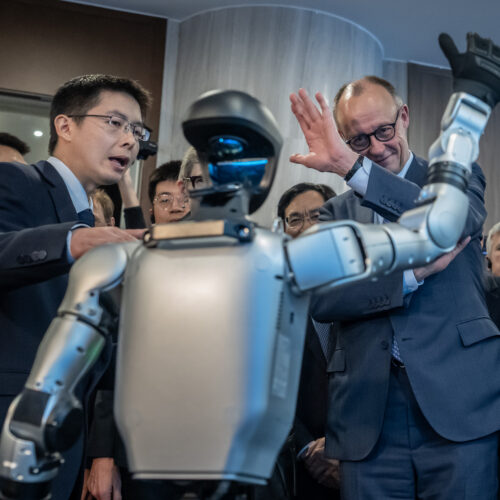
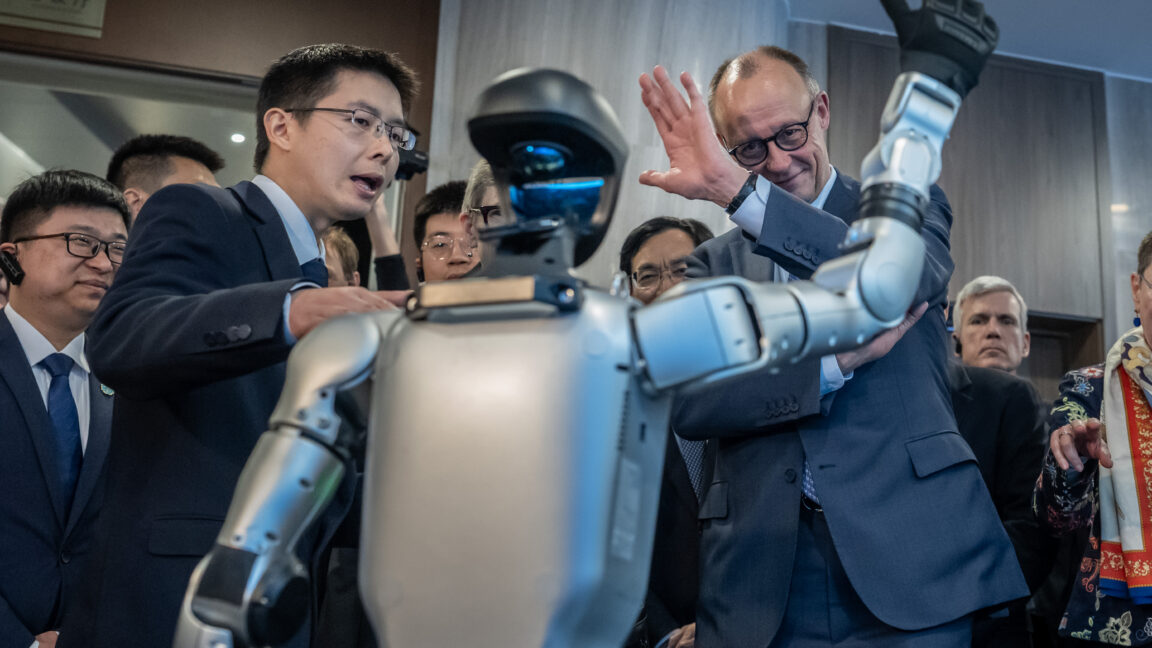
Founder’s cost-cutting obsession drove Unitree lead in cheap humanoid robots

China leads the world in churning out humanoid robots and four-legged robot dogs that also happen to be the most affordable on the market—and Unitree Robotics’ founder Wang Xingxing is arguably one of the people most responsible for that Chinese lead.

The introverted founder, who prominently appeared at a 2025 business symposium hosted by Chinese President Xi Jinping, became phenomenally wealthy after Unitree launched an initial public offering on the Shanghai Stock Exchange STAR Market on August 19. But extensive reporting by Beijing-based Caijing Magazine suggests Unitree’s success so far has been driven by Wang’s extreme micromanagement leadership style—an approach that may be more suited to a small startup than a fast-growing robotics company.

Caijing’s interviews with Unitree employees and investors paint a picture of Wang as someone who personally decides nearly every aspect of corporate strategy or product design, including the colors of materials and lengths of individual screws. The Caijing Magazine feature published on August 31, titled “The King of Unitree,” was translated into English by ChinaTalk, a US-based think tank and media organization, on September 10.

Read full article

Comments

© Michael Kappeler/dpa (Photo by Michael Kappeler/picture alliance via Getty Images

❌