Last month’s Budget granted England’s mayors more power over the money their regions raise. The question is, will the public be any more in control than when Whitehall was in charge?
The Chancellor announced £285 million for new Good Growth funds and areas preparing for devolution, alongside a £1.5 billion borrowing facility for mayoral authorities. From 2027, mayors will receive 20% of business rates revenues – with 100% of business rates to be retained by local and regional governments by 2030 – followed by a share of income tax receipts in 2028. They will also be able to charge a tourist tax.
Together with the English Devolution and Community Empowerment Act, which extends the map of mayoral government and deepens its powers over housing, planning and transport, this represents a substantial transfer of power from Whitehall.
So far, so good, right? The Prime Minister shares Unlock Democracy’s enthusiasm for devolution. We both believe communities should have much greater control over their own affairs, with decisions made as close as possible to the people they affect.
But giving mayors more power does not necessarily give the public more control. That depends on whether people can hold them to account. The Devolution Act makes some provision in this space, beefing up local scrutiny committees. That is welcome. But scrutiny can only go so far, particularly when establishing something as basic as who a mayor has met, and what they discussed, is far harder than it should be.
Take Andy Burnham’s foray into the Manchester City cheating scandal as an example. Only following the PM’s intervention – made in the wake of City being found guilty of colossal, systematic cheating – was the fact of a formal meeting in 2021 between Burnham, then Greater Manchester mayor, and City’s chairman made public. Meanwhile, records of two matchday dinners with the chairman had to be unearthed by the BBC, having been removed from the Greater Manchester authority website.
None of this is to allege wrongdoing by Andy Burnham. The issue is different, and it extends further: why was it so difficult to extract such information? In Whitehall, ministers must publish quarterly reports listing their meetings with outside organisations. Admittedly, their contents and the frequency leave a lot to be desired, but at least they establish minimum standards of transparency. England’s metro mayors face no equivalent obligation.
Research by Unlock Democracy found no regularly published diaries of external meetings for the mayors of Greater Manchester or Liverpool City Region. We could find none for West Yorkshire, either. The Mayor of London does publish a diary of formal engagements every six months, though publication stalled for two years after Mayor Khan’s re-election in May 2024 (this has since been rectified). Even then, entries can be remarkably perfunctory, revealing little to nothing of what was discussed.
Declarations of gifts and hospitality are just as inconsistent. The Local Government Association’s model code recommends declaring gifts worth £50 or more within 28 days, but authorities adopt their own codes. As a result, what the public knows about those in power depends on where they live.
Of course, the existence of disclosure rules does not guarantee their application. A recent investigation by the BBC and the Bedford Independent uncovered records suggesting that Bedford mayor, Tom Wootton – owner of land worth more than £2.7 million affected by the proposed East West Rail route – failed on 15 separate occasions to declare an interest when necessary. Tom Wootton disputes this assessment.
The rights and wrongs of the case will not be settled here. What’s crucial to note is it took a team of journalists examining court documents, land records and meeting minutes to bring these questions to light.
Not only is the hollowing out of local media bad for accountability, it’s bad for governance. A healthy local media is one way that authorities get their message out and discover where they’re going wrong: where services are failing, which grievances are going unanswered and what citizens actually make of their priorities.
Without it, mayors risk gaining powers while losing touch with the communities they’re there to serve. The resulting distrust and alienation will serve nobody except bad-faith actors looking to make political capital – or simply a quick buck – off people’s discontent.
Devolution promises greater local control, and rightly so. But bringing power closer to people is only one part of the picture. Giving mayors the means to act must go hand in hand with giving the public the means to hold them accountable. Otherwise, we risk fixing one democratic deficit only to create another.
Accountability, quite literally, is the ability to give an account: account-ability. An account is a narrative – the telling of an honest story about what happened, why we did what we did, what was known at the time and what wasn’t, told from our particular position, and situated within the context of what was actually happening. To be accountable is to have the ability to give an account. This isn’t a wordplay or a clever rhetorical manoeuvre. It’s the simple etymology of the word – accountability is meant to be about our capacity for honest explanation. To be accountable is not the same as to be punishable.
But accountability has been colonised by blame. In the world of work, almost without us noticing, the meaning of accountability has been displaced by its near-opposite. The tell is the phrase “Someone must be held accountable” (or something similar), and what that usually means in practice is that someone should suffer consequences. It’s rarely used to mean that someone should be given the conditions in which they can honestly explain what happened, but that someone should bear the cost of it happening. Accountability has turned into blame with better marketing.
Roberts (1991) formalised accountability as a relational tension between an account giver and a recipient, and that framing is important. Accountability requires at least two parties, someone willing to give an account and someone capable of receiving it; it’s relational and dynamic. Philip Tetlock’s work on accountability and cognition shows why the receiving end is so consequential. What he found was interesting but unsurprising: when people know who they’re accountable to and can anticipate what that audience wants, the account they give is shaped accordingly – designed to satisfy the audience rather than give the truest description of events as they actually happened. Every performance review, every post-incident investigation, every board report is subject to this dynamic. The account we receive is the account that the teller believed the audience wanted.
Accountability as a construct has been studied extensively across public administration (Bovens), organisational behaviour (Tetlock, Frink & Ferris), philosophy (O’Neill), and safety science (Dekker), and what strikes anyone who reads across these fields is how rarely any of them mean the same thing by it. The kaleidoscopic definitional confusion is part of the core problem with accountability. Even the classic RACI matrix (the popular tool that gives the appearance of clarity while achieving the texture of a spreadsheet) gets accountability wrong. Much of that confusion is semantic and probably unavoidable, but some of it has structural consequences. The most significant conflation is between accountability and responsibility. Ieraci (2007, via Parris, 2025) draws the distinction clearly: responsibility involves doing, accountability involves reporting. Responsibility is about the work itself, and accountability is about the account of the work. They overlap and interact, but they are not the same thing, and treating them as synonyms has problematic consequences.
Misunderstanding Accountability
Accountability and responsibility have been used interchangeably for so long that even legislation gets it wrong. This isn’t just pedantry. The conflation matters because once accountability is understood to mean “being responsible for outcomes,” the logical next step is: if the outcome was bad, the accountable person is at fault. Consequence then follows automatically and the account (the narrative, the context, the conditions that were actually present) gets dismissed before it can be heard. And accountability for outcomes is, in any case, the wrong target. Outcomes are partly beyond any of our control. What we can reasonably ask people to account for is their reasoning, their decisions, and their actions, situated within their context. Not the outcome.
“People aren’t just people, they are people surrounded by circumstances.”
— Terry Pratchett
Karl Weick’s sensemaking work is useful here, and shows why this is even worse than it first appears. Accountability in organisations is almost always exercised retrospectively, after the outcome is already known, and hindsight does much of the work before the inquiry begins. The account becomes a post-hoc justification exercise rather than a genuine rendering – an attempt to prove innocence in a process that has already assumed guilt. Structural bias is at play, and the knowledge of the outcome contaminates the inquiry before it begins.
Parris’s example from maritime law shows both mechanisms operating at once. New Zealand’s Maritime Transport Act assigns responsibility to vessel Masters where it clearly means accountability in the liability sense, and the confusion has structural consequences for who gets blamed when things go wrong. The Master at the sharp end becomes legally exposed for outcomes shaped by systemic decisions made at the blunt end. The legislative conflation and the retrospective framing work together: context and conditions get set aside because the outcome is already known, and the law reaches for the nearest human rather than the most relevant cause.
“…they took the captain to court, even though there was not a thing I could have done to have stopped it, to have known about it, or anything… I was held accountable… But I wasn’t responsible.” Parris, 2025 pp.35
And here’s the crux: responsibility is actually closer to what organisations think they mean by accountability. Responsibility is about roles, obligations, and the act of doing. We can assign responsibility, but we cannot assign accountability – an account is given, not extracted, and every organisational system built around ‘holding people accountable’ rests on a category error with real-world consequences. If accountability cannot be assigned, only taken, then the pressure organisations apply in its name does not produce genuine accounts. It only produces performances of them.
Accountability without context is blame
When we strip the account (the narrative, the context, the local rationality of the person who was there) and retain only the assignment of fault, we haven’t done accountability. We’ve dressed something much older and more primitive in accountability’s clothes.
Blametropism is the organisational tendency to orient toward fault, the way a plant orients toward light, regardless of whether finding fault serves any operational (rather than emotional) use. The organisational or political apparatus of accountability (the investigation, the finding, the consequence) is seldom deployed to truly understand what happened, but instead to locate where the fault should land. The true account is rarely sought; what’s more often sought is a name, a goat that we can expel from the village, laden with our sins. Accountability-as-blame is blametropism in its business suit. It gives the impression of rigour while reliably producing the outcomes of blame.
Marilyn Paul’s systems framing captures the consequences well: blame generates fear, fear generates cover-up, cover-up degrades information quality, degraded information produces more errors, more errors generate more blame. The feedback cycle is self-sustaining and self-defeating, and as reliable as it is depressing. An organisation that uses accountability as a pressure tool destroys its own capacity to learn what’s really happening inside it.
When people learn that giving an account: an honest one, with all its uncertainty and complexity and acknowledgement of error, leads to punishment, they naturally stop giving honest accounts. Instead they give performed accounts – narratives designed to survive scrutiny rather than enable learning.
And the demand for a single account is itself part of the problem. Real situations are experienced differently from different positions within a system. The account of the nurse who administered the wrong medicine, the ward manager who created the rota, the software developer who designed the drug cabinet interface, and the executive who approved the staffing budget are all partial, all genuine, and all necessary. Accountability-as-blame doesn’t just suppress honest accounts. It demands that a complex, plural reality be rendered as a single story with a single author.
Take the cases of Hadiza Bawa-Garba and RaDonda Vaught: both clinicians who made errors in systemically compromised conditions, both of whom were honest about what happened, and both of whom were subsequently prosecuted. In both cases, the logic was that someone had to be held to account. Investigations were conducted, findings were made and severe consequences followed. What was not sought, in any meaningful sense, was a genuine account. Both clinicians were already carrying the burden of what happened before their prosecutions even began, and the prosecutions compounded an existing problem by converting private grief into public liability. The systemic conditions and the context behind the errors (staffing levels, equipment failures, normalised workarounds and more) were noted but set aside. The apparatus of “accountability” produced the outcome that blame always produces: a conclusion that foreclosed rather than opened inquiry. Our simulation of that day in Leicester in the Learning Lab lets a team see those systemic conditions from the inside.
The lesson that clinicians drew from both cases was not “be more careful.” It was “be less transparent.” That is what accountability without context reliably produces. Onora O’Neill saw the same mechanism from a different vantage point: systems designed to demonstrate transparency often produce performances of transparency rather than the thing itself. The safety audit, the Ofsted inspection and the compliance checklist all create the appearance of account-giving while systematically degrading the conditions in which genuine accounts are possible. The mechanism defeats its own purpose.
An organisation that punishes honest accounts will eventually receive only dishonest ones.
You can’t assign accountability, only take it
The moment an account is compelled, demanded, or extracted under threat of consequence, it ceases to be an account and becomes testimony. Modern societies do not treat confessions given under duress as genuine, and for good reason – what is said under compulsion is shaped more by the compulsion than by the truth. The same mechanism operates inside organisations. Forced accountability produces self-protection, not transparency. A performance of accountability, not learning. It’s worth noting in this light that we tend to call the most common formal accountability mechanism in organisations an “annual performance review”.
“Currently fashionable methods of accountability damage rather than repair trust.” – Onora O’Neill
A genuine account has to be a voluntary act. It requires the account-giver to be willing to be seen: to expose their reasoning, their uncertainty, their errors, and their context. That exposure carries real interpersonal and career risk, and where candour carries significant risk but little benefit, most of us will err on the side of caution and silence. This isn’t a character flaw, it’s a rational response to the environment, and changing that calculus is the only reliable route to better accounts.
The distance between the account an organisation says it wants and the account it actually rewards is navigated through social inference: reading the room, calibrating our degree of honesty to the audience, knowing instinctively how much truth is too much. It’s also a skill that is unevenly distributed in most organisations. For many neurodivergent people, candour is simply how to communicate, not a choice to be weighed against consequences. An organisation that performs a desire for honesty while punishing it in practice fails those workers and risks actively deceiving them.
Cultivating the conditions for honesty is considerably more difficult than demanding it, and considerably more effective. The phrase “holding people accountable” implies a power that organisations do not have. We cannot hold someone else accountable. We can only nurture the organisational substrate in which people are able and willing to give an honest account.
What real accountability looks like
Real accountability is dialogic rather than monologic. Roberts draws on Senge’s distinction between discussion and dialogue: discussion in this sense, is like a debate, with positions defended and a winner declared. Dialogue is different: meaning, nuance, context and information flow freely between parties, with the intention of surfacing something neither party could reach alone. Organisational accountability processes are almost universally structured as a defensive discussion – and a genuine account cannot be extracted through cross-examination. It can only emerge through a more open, reflective dialogue, which requires the account-giver to feel safe enough to think out loud, be uncertain, and say “I don’t know” without it becoming evidence against them. Both giving and receiving are equal components of accountability, and the receiving requires its own kind of discipline: the willingness to be changed by what we hear, rather than confirm what we already believed. Maybe the hardest part is the moment right after the event, when everyone is nervous and the pressure to find a name is enormous, and someone has to be the person who says: let’s slow down, let’s find out what actually happened.
Parris’s typology reinforces this binary. Backward/hierarchical accountability is structurally monologic: it already knows what it’s looking for. Forward/process accountability requires dialogue, because it’s genuinely interested in what the system contributed, which can only be discovered, rarely confirmed.
“But surely there have to be consequences sometimes?” Yes, but consequences and accountability are separate questions. We can impose consequences without ever actually receiving an honest account. And if negative consequences are attached to the account, we will never receive an honest one. Consequences cannot come first without contaminating everything that follows. The desire for consequence after failure is often a desire for justice, and that is a fundamental human impulse worth taking seriously. But retributive justice and learning are different projects, and the accountability mechanisms most organisations use are poorly designed for either.
The question after a failure, Dekker argues, is not just “who is accountable?” but (more importantly) “how do we learn?”, and answering the second question well requires the conditions that make genuine accounts possible. It follows that psychological safety and true accountability are mutually dependent. We cannot give a true account if we don’t feel safe, and accountability as punishment makes honesty unsafe. A genuine account shouldn’t feel like a confession. It should feel like a contribution to our collective understanding, and treating it as the former guarantees we will never receive it as the latter. Building the conditions in which genuine accounts are possible is what accountability, properly understood, actually requires.
Account-ability
In the vast majority of organisations, accountability is expected to flow upwards. The powerful receive accounts; whilst they are seldom required to honestly account for themselves to those ‘below’ them. And I’d argue that the most valuable accounts are actually those that flow sideways, worker to worker, where honesty isn’t calibrated to hierarchy.
We have collectively spent considerable energy perfecting the art of demanding honesty from the people for whom we have made honesty unsafe. “Accountability”, a word that belonged to everyone who needed to give an honest account, was appropriated by institutions that needed a more respectable name for blame. Blame is cognitively cheap, emotionally satisfying, and operationally useless. It produces a very clear answer to the question of what to do next, and it is almost always the wrong one.
However, blame is also often politically useful. Blame doesn’t just emotionally satisfy: it secures power. When the investigation concludes and the name is named, someone’s position is secured and someone else’s is eroded, or ended. The apparatus of “accountability” in this case is functioning exactly as designed, just for purposes that aren’t on the tin.
This is why genuine accountability remains so rare. It asks the powerful to submit to the same conditions they currently use accountability to avoid: to give an honest account of themselves, to be uncertain in public, and to say “I don’t know” to the people they lead. In cultures where blame secures position, a genuine account risks it. The rarity of genuine accountability in organisations is its rational consequence.
Many organisations “hold people accountable” by imposing negative consequences for failure. The organisations that actually handle failure best are the ones that make it safe to give an honest account – they foster account-ability. They are not the same thing. They are, in fact, complete opposites.
References
Bovens, M. (2007) ‘Analysing and assessing accountability: a conceptual framework’, European Law Journal, 13(4), pp. 447–468.
Dekker, S.W.A. (2012) Just Culture: Balancing Safety and Accountability. Farnham: Ashgate. (See also:Dekker (2011) in the map)
Frink, D.D. and Ferris, G.R. (1998) ‘Accountability, impression management, and goal setting in the performance evaluation process’, Human Relations, 51(10), pp. 1259–1283.
Ieraci, S. (2007) ‘Responsibility versus accountability in a risk-averse culture’, Emergency Medicine Australasia, 19(1), pp. 63–64.
O’Neill, O. (2002) A Question of Trust. Cambridge: Cambridge University Press. → Explore in map
Parris, R. (2025) Accountability: A Lived Experience. MSc thesis. Lund University. → Explore in map
Paul, M. (1997) ‘Moving from blame to accountability’, The Systems Thinker.
Roberts, J. (1991) ‘The possibilities of accountability’, Accounting, Organizations and Society, 16(4), pp. 355–368. → Explore in map
Roberts, J. (1996) ‘From discipline to dialogue: individualizing and socializing forms of accountability’, in Accountability: Power, Ethos and the Technologies of Managing, pp. 40–61.
Tetlock, P.E. (1985) ‘Accountability: the neglected social context of judgment and choice’, Research in Organizational Behavior, 7, pp. 297–332. → Explore in map
If, like me, you grew up during the Friends era, you might remember the scene where Ross is upset because he has to tell Rachel that Emily insists they can’t be friends.
Ross: “I don’t want Rachel to hate me. I don’t know what to do.” Joey: “You want my advice?” Ross: “Yes! Please!” Joey: “You’re not gonna like it.” Ross: “That’s ok.” Joey: “You got married too fast.” Ross: “That’s not advice!” Joey: “I told you.”
For once, Ross is absolutely right. That isn’t advice. It’s a counterfactual: a redundant statement that sounds wise because the outcome is already known. It’s the illusion of clarity after the fog has lifted, after the complexity has collapsed into certainty. We all know the feeling of wanting to tell someone (or rather often ourselves) what should have been obvious. But that sense of “obviousness” only exists from where we’re standing now, in 20/20 hindsight, not from where the decision was made.
Counterfactuals are seductive. They tidy up messy stories. “If only we’d done X.” “If only they’d noticed Y.” They sound analytical, but they’re fictional. As the saying goes, “If my grandmother had wheels, she’d be a bicycle.” Once we start changing the facts, we’re not talking about reality anymore: we’re imagining a different one that didn’t happen.
It’s easy to laugh at Joey, but we all do it. Just look at all the hot takes on the large AWS outage this week. We look back at a failed project, a near miss, an incident or accident, and feel the seductive pull of “they should have..” or “they shouldn’t have…” because we crave causality and coherence. When something goes wrong, we want to believe that there was a single point of failure that we can fix for next time, reassuring ourselves that it won’t happen again. But as Dekker reminds us,
“…[counterfactuals] make you spend your time talking about a reality that did not happen (but if it had happened, the mishap would not have happened.)” (Dekker, The Field Guide to Understanding Human Error, 2006, p. 39).
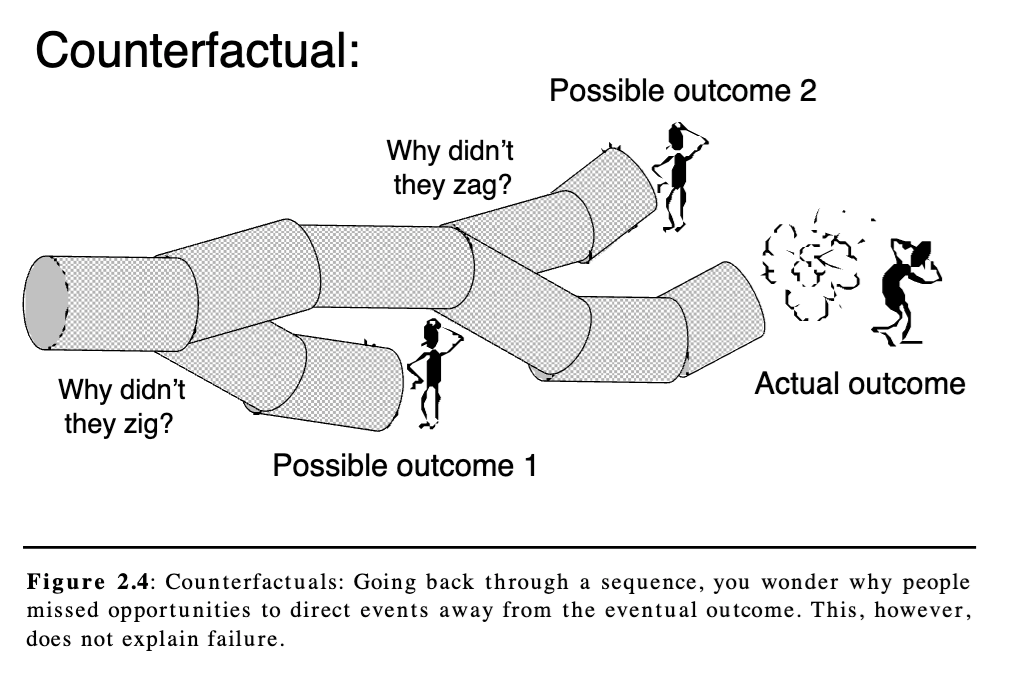
Counterfactuals don’t actually explain why people acted as they did.
Hindsight gives us the feeling that we’re seeing more clearly, when in fact we’re seeing differently. It turns messy events into clean, neat, linear stories where the outcome seems inevitable. After the fact, we reconstruct a chain of events so neatly that it feels like it couldn’t have unfolded any other way. But at the time, it could have unfolded many ways.
In complex systems, whether in tech, healthcare, or flying planes, everything seems to make sense until it suddenly doesn’t. Karl Weick describes this as the “collapse of sensemaking”, where a lack of relevant information, conflicting or contradictory data, distractions, or cognitive biases prevent accurate interpretation of the situation. As Richard Cook said, “All practitioner actions are gambles.” Every decision is made under various degrees of uncertainty, using local cues, imperfect data, and competing goals, constraints and pressures. When we uncritically apply hindsight, we risk erasing that uncertainty and turning those gambles into moral judgments. A decision that led to a failure is considered a mistake; but the same decision, if it led to success, is considered high expertise. The same action has a different label depending on its outcome.
This is the core of counterfactual thinking: imagining an alternative world where things turned out differently. Psychologists describe two main types:
Upward counterfactuals: “We’d have been ok if we had…”, which can be painful but sometimes useful. If we’re careful in their use, they help us see what might be improved for the future.
Downward counterfactuals: “It could have been worse…”, which might feel comforting and soothing, but is rarely instructive.
Both kinds risk making the world seem more controllable than it really is. Counterfactuals whisper in our ear that different choices would have guaranteed a different outcome. But the real world doesn’t work like that – if we change one variable, the network of interactions shifts in unpredictable, potentially cascading ways. And there’s no control group for the past: we can’t A/B test reality, so we can’t really say that another approach would have turned out differently.
Dekker calls counterfactual reasoning one of the biggest traps in investigation. It’s not that counterfactuals are evil, because used effectively, they can help us think about future prevention – but they can’t explain human behaviour. Saying what people didn’t do tells us nothing about why they did what they did. To learn, we have to reconstruct what the world looked like from their perspective at the time, not ours. To paraphrase Dekker – we need to get in the tunnel with them.
Dekker’s Tunnel. From The Field Guide To Understanding Human Error. P.33
That reconstruction (the “unfolding mindset”) is the work of effective investigation and learning. It means asking what information was available and visible, what explicit and implicit goals were people working towards, what pressures, constraints and distractions were present, and what state the people were in. It’s slower and messier than counterfactual shortcuts, but it’s the only way to understand Local Rationality – why a decision that now looks foolish made sense at the time.
This connects directly to psychological safety. Psychological safety isn’t just about speaking up in the present: it’s about how we talk about the past. Do people feel safe to be candid about their past actions, decisions, perspective and pressures? When we replay an incident, do we talk about what people missed, or do we ask what they saw? Do we focus on what should have happened, or on what actually made sense given their constraints and context? Do we treat decisions as expert gambles rather than tests of character? The way we tell the story shapes whether we learn or blame (and in the majority of cases, we can’t do both).
Put hindsight, counterfactuals, and the fundamental attribution error together, and we get a recipe for unhelpful investigation:
Hindsight bias says the outcome was obvious.
Attribution error says someone failed to see it because of who they are.
Counterfactuals provide the tidy fix: “They should have done X.”
A disturbing number of real incident reports follow this pattern.
“He should have dived to his right.”
The alternative is slower but more honest: reconstruct rather than rewrite. We can attempt to reconstruct the unfolding mindset of the people involved. We can ask what looked risky or safe from their vantage point. As Dekker and David Woods both emphasise, people’s actions almost always make sense in context, even if that context is now invisible to us.
James Reason’s “substitution test” can help here – asking whether another well-motivated, equally competent person might have done the same thing in that situation.
“Substitute the individual concerned, for someone else coming from the same domain of activity and possessing comparable qualifications and experience. Then ask the question ‘In the light of how events unfolded and were perceived by those involved in real time, is it likely that this new individual would have behaved any differently?’”
If the answer is yes, the issue isn’t the person, it’s the system. However, there’s a big caution here: the substitution test is highly vulnerable to hindsight too because we still have to reconstruct the at-the-time context before we apply the test.
Substitution decision tree. From James Reason, 2003
Here are a few practical ways to mitigate counterfactual reasoning and shift our posture from judgment to learning:
Consider various alternatives to the actual outcome. Explore how it may have unfolded in different ways
Name the bias early. Simply saying, “Let’s watch for hindsight bias.” can help people notice when it creeps in. It’s not a fix though.
Reconstruct, don’t rewrite. Ask things like “What did we know then?” and “What options looked viable?” Try to keep current knowledge out until the end.
Use neutral language. “The decision was made based on X,” instead of “Bob failed to see Y.”
Broaden the view. Bring in different roles, disciplines, and perspectives. Complexity looks different from other angles.
Reframe counterfactuals as system questions. Instead of “They should have…” ask “What features of the system made that outcome more likely?”
Separate accountability from blame. Accountability can coexist with empathy, apologies and amends, but without context, accountability is just punishment.
Don’t ignore emotional counterfactuals. “I wish I’d done X instead of Y” can be a healthy part of processing regret. It helps us move on before real learning begins.
Joey, like most of us, was satisfied by a simple story, rewritten with 20/20 hindsight. But the real world doesn’t work that way. The goal of learning isn’t to find who “should have known better” – it’s to understand how the system and context made that decision a rational one at the time, and how we can make better outcomes more likely in the future.
Meadows, S., Baker, K. and Butler, J., 2005. The incident decision tree: guidelines for action following patient safety incidents. Advances in patient safety: from research to implementation, 4, pp.387-399.
Weick, K. (1993). The collapse of sensemaking in organizations: The Mann Gulch disaster. Administrative Science Quarterly, 3: 628–652.
Woods, D. D., Dekker, S., Cook, R., Johannesen, L., & Sarter, N. (2010). Behind Human Error (2nd ed.). Farnham: Ashgate Pub Co.
Vaughan, D. (2009). The Challenger Launch Decision: Risky Technology, Culture, and Deviance at NASA. University of Chicago Press.
Dekker, S. (2003). Failure to adapt or adaptations that fail: contrasting models on procedures and safety. Applied Ergonomics, 34(3), 233—238. doi:10.1016/S0003-6870(03)00031-0
REASON, J. (1990). Human error. New York: Cambridge University Press.
Reason J. Managing the risks of organizational accidents. Aldershot: Ashgate Publishing Group; 2003. pp. 191–222.
For people who stammer, stutter, tic, or have other speech differences, phone calls can be a nightmare. Just the pressure of having to speak at the right time, and the fear that being silent for too long means the call could be dropped, can be overwhelming. Everyone who knows me knows that I absolutely hate speaking on the phone!
If you stammer, it could mean that when you finally get through to your GP after a long wait, you get hung up on because they think you’re not there. This report shows that many people with a stammer often can’t get through voice recognition systems, and are sometimes hung up on when they stammered on a call.
This amazing campaign by Stamma encourages businesses “Don’t hang up, hang on” and give people time to speak. Find out more here.
Imagining and implementing a responsibility culture in healthcare
Here’s a great paper by Philip Berry about patient safety and investigations, and trying to find the balance between delivering what many patients wish to see and fostering a culture that is not centred on blame – which seems very hard to achieve.

 Login