Sifting through the internet for the right’s latest beef with ‘wokeism’, I came across something rather amusing: a section of GB News devoted to what it calls ‘woke madness.’
Headline after headline announces another supposed example of ‘woke madness’.
“National Lottery branded ‘scandalous’ for funding organisation promoting puberty blockers guide” was one predictable offering.
“Outrage as Civil Service calendar fails to mark Remembrance Sunday but celebrates trans day” was another trans-bashing tirade.
And “Oxford University sparks backlash over bearded lecturer with prosthetic breasts” provided yet another opportunity for an anti-trans pile-on.
But perhaps the most ludicrous headline was: “Woke paper straws revealed to be WORSE for planet than plastic ones.”
Intrigued, I clicked.
It turns out that ‘woke straws’ are, rather unsurprisingly, paper straws. Apparently, these have now become sufficiently ideologically suspect to earn a place in GB News’s catalogue of cultural grievances.
The channel reported that paper straws, supposedly ‘pushed on consumers in environmentalist drives,’ may actually have a greater environmental impact than plastic alternatives.
The report is based on research commissioned by South Korea’s Ministry of Climate, Energy and Environment, which compared paper, conventional plastic, biodegradable plastic and sugarcane-based straws. It found conventional plastic straws performed better across several environmental measures.
Paper straws reportedly produced more than six times the carcinogenic impact of standard plastic ones, referring to environmental emissions, not direct health risks to consumers, and caused twice as much acidification. Conventional plastic straws had the smallest environmental footprint in 10 of the 16 categories assessed.
The article also cited separate Greek research from 2025 reaching similar conclusions.
The findings are certainly worth discussing. But GB News appears less interested in the environmental evidence than in using it to declare another victory in the culture wars.
The piece quotes South Korean lawmaker Kim Wi-sang, who accused the government of pursuing a failed ‘greenwashing policy.’ It also drags in Donald Trump, noting his February 2025 executive order reversing restrictions on plastic straws in the US, before reminding readers of the UK’s own restrictions on plastic straws.
And, just in case readers weren’t outraged enough, it threw in a 2023 poll showing 48 percent of Britons disliked paper straws, with 30 percent disliking them ‘a lot.’
So there we have it: a study about the environmental impact of drinking straws transformed into another instalment in the supposed war on woke. And, since when was GB News so concerned about the environment, anyway?
Britain’s self-styled strictest headteacher, Katharine Birbalsingh, is back in the headlines, warning that celebrating children’s ethnic heritage in schools risks deepening divisions and could even lead to civil unrest.
Birbalsingh is a familiar voice in the right-wing press, regularly called upon by publications like the Daily Mail to offer her views on education, identity and what she sees as the dangers of progressive thinking. Her latest tirade comes in a self-penned column for the newspaper, in which she argues an “obsession with celebrating the ethnic heritage of children – while feeling shame at Britain’s history – is wrong, divisive and may end in civil unrest.”
She begins by recounting an encounter with two hooded boys, one waving a Jamaican flag and the other a Palestinian flag, alongside Turkish and Romanian flags.
Rather than seeing young people expressing pride in their diverse backgrounds as a positive example of multiculturalism, Birbalsingh takes issue with schools encouraging pupils to bring in flags representing their heritage.
“Almost all these children will have been born here. Some may have only visited their ‘home’ country a handful of times. Their school – which will not fly the Union Jack for fear of seeming racist – is implicitly telling them that by celebrating ‘their’ flag, the alienation suffered by minority pupils will subside,” she writes.
Birbalsingh continues by saying that she “begs to differ.”
“At my school, Michaela Community in Wembley, north-west London – now recognised as one of the finest state schools in Britain – we fly the Union Jack. And we all sing the National Anthem.”
This is the same headteacher who attracted criticism in 2022 after suggesting it was “natural” for girls to avoid physics A-level because “there’s a lot of hard maths.” Two years later, she was widely mocked for claiming children were identifying as pasta.
In 2024, she also dominated headlines after her school successfully defended its ban on Muslim prayer rituals.
Birbalsingh acknowledges that visitors sometimes question whether flying the Union Jack is a little colonial, although she dismisses these concerns as generally coming from progressive, middle-class white people. She adds that neither parents nor members of the local community have complained.
Her central contention is that celebrating different cultural backgrounds undermines the national identity pupils share. She claims schools advance victimhood among minority children while instilling “white privilege” and colonial guilt in others, warning that the consequences could ultimately be civil unrest.
But this overlooks a fundamental point; how celebrating different cultures doesn’t have to come at the expense of a shared British identity.
My mum, a former headteacher of a predominantly white, working-class school in a deprived area of south Manchester, understood this. She saw introducing children to different cultures as an opportunity to build tolerance and understanding, not undermine their sense of belonging.
As she explained to RWW:
“It was my clear aim to provide those young children with a school community that instilled tolerance in everyone.
“Ignorance breeds the intolerance and hostility we see in society today. Knowledge of others, through first-hand experiences and creative opportunities, provides the understanding and tolerance needed to appreciate different cultures and ethnicities.
“Undoubtedly, diversity enriches the school community for everyone.”
Indeed, for children growing up in deprived communities, who may never have travelled beyond the UK, school activities involving flags, food, music and cultural traditions can offer a valuable window into a wider world they might otherwise have little opportunity to experience.
The real danger is teaching children that their identities are competing loyalties. A Jamaican, Palestinian, Turkish or Romanian flag need not represent a rejection of Britain, just as flying the Union Jack does not require someone to abandon their family’s heritage.
Diversity is not a threat to national identity. It’s part of what makes Britain what it is.
April saw Hungary’s long-serving prime minister Viktor Orbán and his far-right Fidesz party lose power after 16 years. In October, a grassroots student-led opposition movement in Serbia unseated long-serving leader Aleksandar Vučić and his right-wing populist Serbian Progressive Party after 14 years.
Meanwhile, Brazil’s president Lula defeated far-right challenger Flávio Bolsonaro, prompting celebrations among progressive politicians who regard the result as important not only for Brazil but for the wider struggle over progressive politics. In Israel, Benjamin Netanyahu’s Likud Party failed to secure a majority, with record turnout among Arab citizens helping to strengthen the opposition.
Then came the US midterm elections, in which the Democrats took control of both chambers of Congress and made gains in traditionally Republican territory, including Texas, Kansas and by a whisker, Mississippi.
“The US results should give confidence to progressives everywhere,” said former shadow chancellor John McDonnell.
There is certainly plenty to celebrate. But progressive victories are never guaranteed to last and Europe is approaching a particularly consequential electoral cycle.
“The far right has been a problem for Europe for more than a decade,” says Charles Grant, director of the Centre for European Reform. “But the problem is getting worse. It is going to be harder to find a way to work around, as the EU did with Viktor Orbán. It is going to be more systematic and serious.”
With elections approaching in Spain, France, Poland, Italy, Finland, Estonia, Greece and Slovakia, 2027 could reshape Europe’s political landscape.
The concern isn’t just that nationalist and far-right parties could make further gains. Centre-right parties are increasingly willing to share power with them, while centre-left parties are moving rightwards on issues such as immigration in an attempt to win back voters.
The question is whether Europe is heading for a political earthquake, with far-right parties entering government or strengthening their grip on power in some of its most influential countries.
Pedro Sánchez’s political survival test
Spain is first into the electoral firing line, with a snap election scheduled for November 29. Prime Minister Pedro Sánchez called it after the conservative People’s Party (PP), far-right Vox and Catalan pro-independence party Junts blocked his major housing reform package in parliament in September.
Despite Sánchez’s reputation for political survival, the latest polling suggests he faces a difficult contest. His career has been defined by repeated comebacks, including his forced resignation as PSOE leader in 2016, his extraordinary return to the party leadership in 2017 and his subsequent ability to forge unlikely parliamentary alliances to remain in power. But even his formidable political resilience may not be enough this time.
The PP is polling ahead of Sánchez but require support from Vox to secure a parliamentary majority. Meanwhile, the left’s prospects have been weakened by the failure of far-left parties to agree on a common electoral list. The resulting fragmentation risks splitting the progressive vote and weakening mobilisation around housing, social justice and opposition to the far right.
A right-wing victory would have consequences well beyond a change of government. It could reverse some of Spain’s progressive policies, bringing tougher immigration measures, tighter border controls and restrictions on irregular migration.
That would threaten one of Spain’s most distinctive departures from Europe’s increasingly anti-immigration politics. Its relatively open migration policies have helped address labour shortages and support economic growth by enabling migrants to contribute to the workforce and wider society. Indeed, the Economist named Spain the world’s best-performing economy in 2024.
Climate policy could also take a hit. Under Sánchez, Spain has become a leading advocate of the green transition, backed by substantial EU funding and regulatory reforms. Vox, meanwhile, has called for elements of the European Green Deal to be dismantled. A change of government could therefore undermine Spain’s climate ambitions and its influence over European environmental policy.
Foreign policy could shift, too. Sánchez’s criticism of Israel over the war in Gaza has distinguished Spain from other European governments. A right-wing coalition could move towards a more traditionally pro-Israel position and closer ties with international conservative and nationalist movements.
Yet Sánchez’s predicament offers a wider lesson for progressives.
As Paolo Gerbaudo, senior researcher at the faculty of political science and sociology at Complutense University in Madrid, observes: “A thriving economy, a model green transition, social advances – Spain’s PM shouldn’t be in trouble. Yet he is, and it’s a lesson for progressives everywhere.”
Policy achievements alone don’t guarantee political support. Economic growth and social reform matter, but voters also need to see and feel the difference in their everyday lives, especially on housing costs which are becoming the defining issue beyond Spain.
If Sánchez’s latest gamble fails, it could mark a turning point in Europe’s political direction.
France’s political centre in danger of collapse
France is equally worrying. Recent polling suggests that far-right leader Marine Le Pen and hard-left rival Jean-Luc Mélenchon are consolidating their positions ahead of next year’s presidential election.
As Reuters has observed, Emmanuel Macron’s second and final presidential term is drawing to a close, leaving behind an unpopular presidency, a weakened political centre and a fragile economy. That creates fertile ground for political extremes to exploit public discontent.
A far-right breakthrough in one of the EU’s most powerful founding members would have enormous implications for the bloc, particularly if accompanied by nationalist advances elsewhere.
The nationalist challenge grows in Italy and Poland
Italy’s Giorgia Meloni may also face pressure from further to the right. Recent polling suggests the nationalist prime minister could be forced to consider an alliance with the newly formed hard-right National Future, led by pro-Russian former army general Roberto Vannacci, who was suspended from active military service after publishing a book containing anti-immigrant, anti-feminist and homophobic remarks.
“Meloni faces pact with devil to stay in power,” splashed the Telegraph earlier this year.
Poland, meanwhile, is also experiencing a far-right surge ahead of its next election. The gains threaten to undermine the liberal-left coalition led by Donald Tusk’s Civic Coalition, which ended eight years of Law and Justice (PiS) rule in 2023.
Disillusionment with PiS’s compromises with the EU has pushed some right-wing voters towards more radical alternatives. Konfederacja (Confederation), a libertarian-leaning hard-right coalition, has attracted support, particularly among younger voters and men, with its anti-establishment, tax-cutting messaging and opposition to EU regulations.
Even further to the right, the Confederation of the Polish Crown (KKP), led by extremist MEP Grzegorz Braun, openly advocates Poland’s withdrawal from the European Union, a Polexit, and promotes an even more radical nationalist agenda.
Recent polling puts the combined support of four right-wing parties at 47%, potentially placing them in a position to challenge the current governing coalition.
The consequences would extend well beyond Poland. A government committed to confronting the EU, or even leaving it, would pose a serious challenge to European unity at a time of mounting economic, geopolitical and security pressures.
And the shift is not confined to countries governed by the right. Centre-left governments in Denmark, Sweden and the UK have also adopted tougher positions on immigration and integration, showing how far the political centre ground has moved.
This wider shift presents a challenge for advocates of closer UK-EU relations. Andy Burnham has been opening the door to a more ambitious relationship with Europe, but he could find himself making that case at an awkward moment.
While Britain increasingly recognises the economic costs of Brexit, nationalist and Eurosceptic movements elsewhere are questioning the EU’s authority and, in some cases, advocating withdrawal altogether. Poland’s Polexit movement is one example, while France’s increasingly polarised politics could further destabilise the bloc. A defining year for Europe
The flurry of elections in 2027 could affect the EU even before the votes are counted. Governments preoccupied with domestic campaigns may become less willing to compromise on contentious European issues, including the EU budget, for fear of being accused of sacrificing national interests.
“It is pretty extraordinary that these elections are happening at the same time, but also because there are very, very similar dynamics taking place,” Mark Leonard, director of the European Council on Foreign Relations, told the Financial Times.
The stakes could hardly be higher. If nationalist parties were to dominate governments in Spain, France, Poland and Italy simultaneously, the consequences for European integration would be profound.
“I don’t think it’s hyperbolic to say it’s the end of the European Union as we’ve known it,” warned Nathalie Tocci, professor at the European campus of Johns Hopkins School of Advanced International Studies in Bologna.
It’s a sobering prospect. But victories in Hungary, Serbia, Brazil and the United States demonstrate that the far right is not invincible. Voters can mobilise and seemingly unstoppable populist movements can be defeated. But what happens next when progressive politicians gain power matters hugely if they are to retain that power long enough for people to experience a beneficial impact on their lives. Today’s volatile politics and fractured lines of communication between people and government make that challenge all the greater.
Gabrielle Pickard-Whitehead is author of Right-Wing Watch
The Royal British Legion (RBL) has refused to bow to pressure from a Reform UK councillor who branded the charity’s decision to sell LGBTQ+ Pride badges an insult to veterans and accused the charity of indulging in “woke virtue signalling.”
Joseph Boam, who represents Whitwick ward on Leicestershire County Council, took aim at the RBL over its decision to feature Pride badges in its online shop. Taking to Facebook, Boam wrote:
“This is an insult to every veteran who wore the poppy with pride. I am deeply disappointed.
“People support the Poppy Appeal every year to honour those who served. Not to push political agendas.
“Who else has had enough of this woke virtue signalling crap!”
His outburst prompted a backlash, with people pointing out the uncomfortable history of discrimination against gay people in the British Armed Forces.
Homosexual acts were once criminalised under British military law, with service personnel facing court martial, imprisonment or dismissal. As one commenter pointed out: “For the fact Homosexual acts (‘indecency’) were illegal under British military law and could lead to court-martial, prison sentences, or dismissal yes, I think we do owe them remembrance.”
Rather than retreat in the face of the criticism, the RBL stood by its decision, explaining that the badge represents solidarity with LGBTQIA+ Armed Forces personnel who have experienced discrimination or marginalisation because of their sexual orientation or gender identity.
The ban on gay and bisexual personnel serving openly in the UK military was lifted in 2000, following a change in Ministry of Defence policy.
The RBL has previously faced criticism over its treatment of LGBT+ veterans, including allegations that Pride wreaths had been ordered to be removed and destroyed.
In 2022, the charity apologised for its historic discrimination against the LGBT+ community and veterans, following pressure from activist Peter Tatchell. He had called on the organisation to issue a public apology for its past actions, accusing it of failing to acknowledge LGBT+ people serving in the Armed Forces and opposing LGBT+ veterans’ participation in a Remembrance Sunday parade.
Explaining the purpose of its Poppy Pride badge to LBC, the charity said it was intended to show support for those who had faced discrimination or marginalisation because of their sexual orientation or gender identity, particularly those who served before the ban was lifted in 2000.
“Providing visible symbols of support for the LGBTQIA+ Armed Forces community is an important show of allyship and a demonstration that the RBL is a safe and inclusive space,” it added.
Boam’s indignation about supposed political agendas might carry more weight if his own conduct had not attracted considerable scrutiny.
The Reform councillor has been sanctioned following multiple breaches of the council’s code of conduct. Complaints from former monitoring officer Lauren Haslam and Conservative councillor Ozzy O’Shea resulted in findings that he had repeatedly breached the code. He was ordered to apologise over what were described as “reckless” and “disingenuous” social media posts, as well as an “insidious form of public pressure” directed at a former council employee.
Another Reform councillor behaving badly. Thank goodness the RBL refused to pander to such seemingly discriminatory demands.
There was no shortage of promises during the Brexit referendum campaign. What was missing was an honest assessment of the economic and political consequences of leaving the EU. A decade on, those consequences have become part of the national conversation, while polling consistently suggests public opinion has shifted towards reversing the decision.
Now, with the prospect of a more open debate about Britain’s future relationship with Europe, the Brexit-supporting right appears keen to shut that conversation down before it gathers momentum.
Enter the Daily Express.
The newspaper began the week with an especially combative front-page splash, declaring:
“WE MUST NOT INDULGE THE PM’S EU FANTASY”
The words came from Tory leader Kemi Badenoch, who warned reopening the Brexit debate would “put the country on pause.”
“Labour’s plans to rip up Brexit are threatening to tear Britain apart,” the front page announced, reporting Badenoch’s criticism of Andy Burnham’s calls for an honest discussion about Britain’s relationship with the EU. It also suggested reopening old wounds could reignite family arguments and bring the country to a standstill.
The article turned its attention to Rachel Reeves, who has argued Britain’s future lay inside the European Union and described Brexit as having made the country “poorer, weaker and less secure.”
The Express presented this as Labour joining a push to drag Britain back into the EU, while reminding readers of the party’s 2024 election commitment to remain outside the bloc and rule out free movement, single market membership and a customs union.
Needless to say, the frontpage was mocked online, with critics questioning the newspaper’s apparent determination to dismiss any discussion of reversing Brexit.
“Not even now that it’s the ‘will of the people’?” asked Sheffield for Europe.
“The Express in its own fantasy world,” one person replied.
“In a very unstable world we are much stronger together, both economically and militarily. Our future lies within the EU,” another commented.
“A good policy for a happy life is always do the opposite of what the Express or Daily Mail advise,” read another post.
Rather than Labour being the ones reopening old wounds, it’s the right, it seems, which is dragging up the very arguments it claims it wants to leave behind.
At Prime Minister’s Questions last week, Badenoch was already attacking Burnham over his call for an honest discussion about Britain’s future relationship with Europe. She demanded to know why he had chosen Budget week to reopen the Brexit debate.
Burnham defended his position, pointing to the upcoming UK-EU summit aimed at reducing trade barriers and improving cooperation on migration.
Badenoch went even further, insisting that the government was already benefiting from the freedoms secured by the Conservatives.
There is an irony here. The very politicians and newspapers accusing others of reopening Brexit are repeatedly dragging the issue back into the headlines themselves. Rather than engaging with the evidence about Brexit’s consequences or the public’s changing attitudes, the response is to portray any reconsideration as a threat to national stability.
And then there is the question of what the public actually thinks.
A major new Ipsos poll found 56 percent of Britons would vote to apply to rejoin the EU, up four percentage points since May.
Just 30 percent said they would vote to stay out, a three-point fall.
Among those considered likely to vote in a future referendum, support for rejoining rose to 63 percent, against 34 percent opposed.
The survey also found that 54 percent believe EU membership would benefit Britain’s economy in the long term, while 53 percent think it would improve national security.
The Express and its fellow Brexit cheerleaders might prefer to pretend that the 2016 referendum settled the matter for all time. But if anything, the latest polling suggests the bigger fantasy is the idea that Britain can simply ignore the growing appetite for a different relationship with Europe.
Perhaps it’s time the Express stepped out of its own fantasy world and confronted the reality that, for an increasing number of Britons, the future of Brexit is very much up for discussion.
Money can’t buy me love, nor democracy, it seems. Donald Trump’s billionaire backers have just discovered that, even with extraordinary financial firepower behind them, they cannot always buy electoral success. The US midterms delivered a bruising rejection of the president and his wealthy political allies.
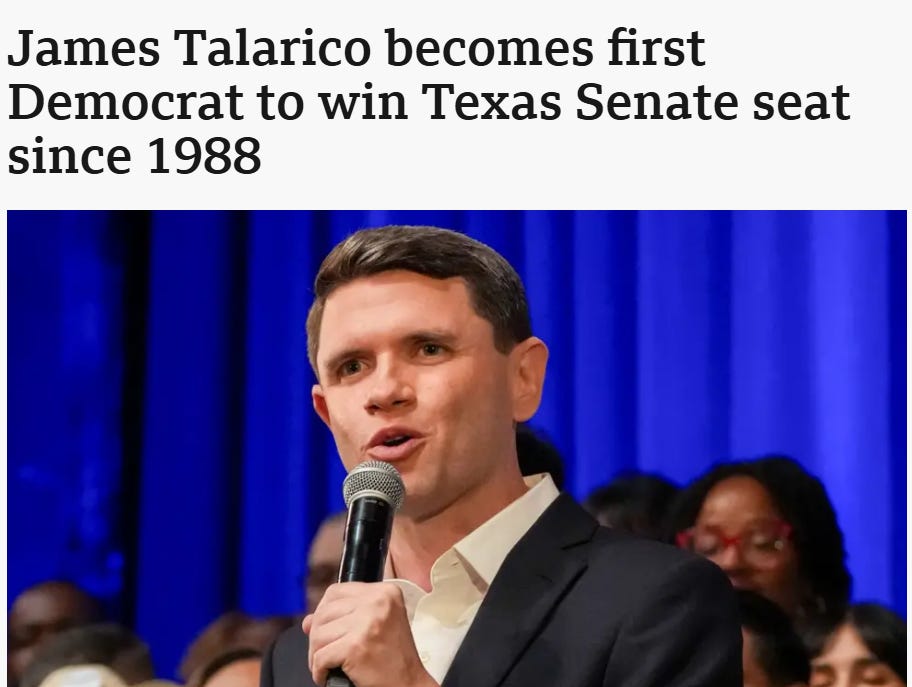
“We’ve just proved that all the money in the world is no match for the people of Texas,” declared James Talarico, celebrating his historic win over Republican Ken Paxton in the Texas Senate race. Talarico is the first Democrat to win a Senate seat in Texas since 1988.
For all the money, influence and political machinery available to America’s wealthiest individuals, voters still have the final say.
But while Trump’s political project has suffered a setback at home, its financial backers and ideological allies are looking beyond America’s borders. Millions of US dollars have already flowed into British right-wing think tanks, political networks and organisations seeking to reshape the country’s political landscape.
The question is how much influence this money is buying, who stands to benefit and whether Britain’s democratic safeguards are strong enough to withstand it.
The billions behind America’s political battle
The scale of spending in the US midterms was extraordinary.
The result is a political landscape in which a handful of extraordinarily wealthy individuals can spend sums beyond the reach of ordinary voters.
And there was a pronounced Republican and technology-sector bias among the biggest spenders, as New York Times analysis showed.
Thanks for reading Right-Wing Watch! Subscribe for free to receive new posts and support my work.
Musk’s $445 million spending spree
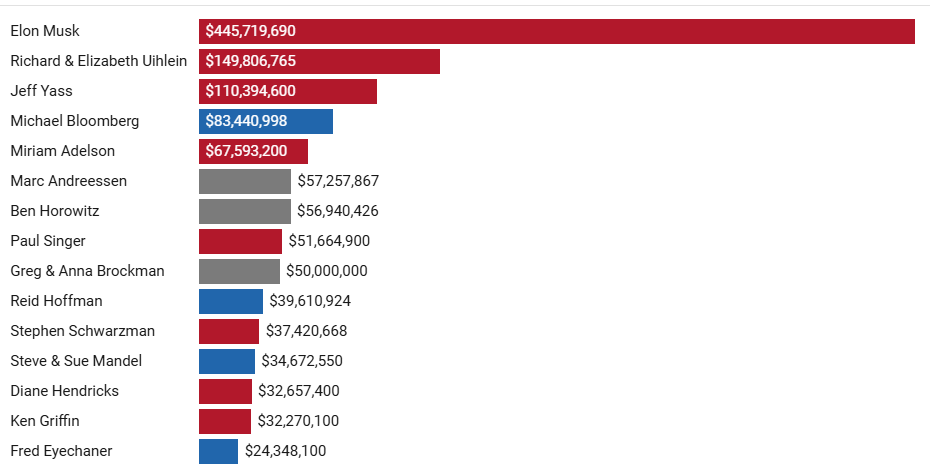
Leading the billionaire donor rankings was Elon Musk, whose spending on Republican candidates, political action committees and outside spending organisations exceeded $445 million, according to OpenSecrets.
The Texas Senate contest was a particular focus, with Musk throwing his financial weight behind Republican candidate Ken Paxton.
It was money on an almost unimaginable scale. Yet it was not enough to prevent Talarico’s victory.
Shipping supply billionaire Richard Uihlein and his wife, Elizabeth, were another major source of Republican funding, contributing $147.3 million to Republican causes.
Trading billionaire and early ByteDance investor Jeff Yass was the third-largest spender, directing more than $110 million towards Republicans, largely through Super PACs.
Yass has also been linked to more than $16 million in funding for anti-Muslim and pro-Israel organisations advocating hawkish policies in the Middle East, according to investigations by the Guardian and Responsible Statecraft.
As Hope not Hate chief executive Nick Lowles observed, the ability of one individual to wield such enormous financial power over an election makes a mockery of the principle that every vote should carry equal weight.
Yet the implications of this billionaire-backed political machinery extend well beyond America’s borders.
American money flowing into UK politics
Trump’s domestic political fortunes may have suffered a spectacular reversal, but the MAGA movement’s international ambitions have not necessarily disappeared with them.
Journalists Sam Bright and Max Colbert argue, authoritarian political influence can extend beyond national borders in an attempt to preserve its power even as domestic popularity wanes.
Britain has become an important part of that picture.
In 2025, it emerged that a Reform-linked think tank was attempting to raise more than £25 million to help make Nigel Farage prime minister by 2029, seeking financial backing from donors in both Britain and the United States.
The Centre for a Better Britain (CBB) intended to channel the money into developing radical policies, drafting legislation, polling, and selecting and training parliamentary candidates.
According to the Times, the organisation had also established a presence in Dallas, registering a US entity with the Internal Revenue Service in an attempt to attract inspiration, and millions of dollars, from the MAGA movement that twice propelled Trump to the White House.
This isn’t just a question of American donors supporting British political causes. It’s about the potential importation of an entire political playbook, complete with its ideological priorities, campaign tactics and networks of influence.
Consider Elon Musk.
In December 2024, Farage revealed that Musk, whose wealth fluctuates above and below $1 trillion, was giving “serious thought” to donating to Reform UK. Reports suggested the sum could reach $100m.
Musk later denied plans to bankroll Farage, but the prospect exposed serious weaknesses in Britain’s political funding rules, and intensified pressure on the government to tighten safeguards against foreign money entering UK politics.
Although foreign political donations are banned in Britain, loopholes have allowed overseas money to find its way into the system.
George Havenhand, senior legal researcher at Spotlight on Corruption, warned in early 2025, the rules contain “a series of loopholes and problems” that leave British democracy exposed to foreign influence and dirty money.
Labour pledged in its 2024 manifesto to “protect democracy by strengthening the rules on donations”. In March 2026, the government introduced tighter restrictions on overseas donors, followed by further safeguards in July, including a £100,000 annual cap on donations and loans from overseas voters and a ban on cryptocurrency donations.
But the reforms haven’t been without criticism. Transparency International UK welcomed tougher checks on foreign money but argued that the government was tackling the wrong end of the problem: restricting who can donate without limiting how much they can give.
Wealthy overseas donors could simply relocate to Britain, meet the qualifying requirements and resume making enormous political donations from within the UK.
So what happens if, heaven forbid, Elon Musk decides to move to Britain and bankroll Reform UK after all? The rules might stop foreign money entering our politics, but they do little to stop a billionaire buying an extraordinary amount of influence once they are here.
The Tufton Street bigshots
American money has also been finding its way into Britain’s network of right-wing think tanks, particularly those clustered around Tufton Street in Westminster.
Organisations including the Institute of Economic Affairs (IEA) and the Global Warming Policy Foundation are notorious for their lack of transparency around funding sources.
US election and corporate filings examined by Left Foot Forward showed at least 15 individuals and companies that have donated to Tufton Street organisations have also contributed $45.5 million to Trump’s campaigns, Trump-supporting political committees and Republican candidates in state races over the past decade.
Research has also exposed vast US funding to British right-wing think tanks since 2024, led by Policy Exchange, which received $1.1m, the Henry Jackson Society with $955,000, and the Institute of Economic Affairs with $609,000. The Global Warming Policy Foundation also received $222,000 from US donors.
And these connections are not merely financial. The IEA and other Tufton Street affiliates were vocal supporters of Liz Truss during her brief premiership, when her disastrous economic agenda sent financial markets into turmoil, triggering a crisis with far-reaching consequences.
British politicians and the MAGA circuit
The connections aren’t confined to think tanks.
A number of prominent British politicians, including Kemi Badenoch and Nigel Farage, have collectively accepted £335,000 for attending official Trump events, donor meetings and gatherings organised by right-wing American groups.
Reform MP Suella Braverman, who defected from the Conservatives in January, received £23,664 in expenses for attending four US events. These included a January 2025 speech at the Heritage Foundation, the organisation behind Project 2025, the radical right-wing blueprint for Trump’s second term.
Then there is Reform UK’s record-breaking £72 million in donations, coming from two cryptocurrency billionaires, Ben Delo and Christopher Harborne.
Harborne has financial connections to the White House, while Delo was pardoned by Trump last year after previously pleading guilty to violating the US Bank Secrecy Act.
Britain has a democratic warning to heed
These connections raise serious questions about the extent to which American political money and influence are becoming embedded in Britain’s right-wing political landscape.
Yet there is also a contradiction at the heart of this political project.
Trump and his MAGA allies may have enjoyed the backing of some of the world’s wealthiest individuals, but their politics remain deeply unpopular in Britain.
A YouGov poll in September found 83% of UK adults viewed Trump unfavourably, compared with just 13% who held a favourable opinion. His net favourability rating stood at minus 70.
The US midterms have shown that even hundreds of millions of dollars cannot guarantee electoral success. Musk failed to secure victory for his man in Texas, while the wider Republican spending machine could not prevent a Democratic electoral landslide.
But authoritarian political influence doesn’t stop at national borders. As its domestic popularity wanes, its networks, money and ambitions can be exported elsewhere in an attempt to preserve and extend its power.
That should be a warning to Britain, where who is funding our political organisations and what influence they are seeking to buy, needs to be scrutinised. Our democracy must not become a vehicle for someone else’s authoritarian ambitions.
Gabrielle Pickard-Whitehead is author of Right-Wing Watch
The right-wing press has found another target in the so-called culture wars: Egyptian mummies.
As first reported by the Daily Mail, Kelvingrove Art Gallery and Museum in Glasgow has removed several ancient Egyptian human remains from display, citing a desire to treat the deceased with respect. Visitors are informed of the decision by a sign reading: “We have removed human remains from this display as a mark of respect.”
The decision reflects growing recognition within the museum sector that displaying human remains raises ethical questions, particularly when there is no evidence that the deceased consented to their bodies being exhibited.
But for the woke-bashing media, the move was an opportunity to wheel out a familiar culture-war bogeyman.
“Woke’ museum slammed after removing mummies due to ‘lack of consent’,” the Express’s headline declared.
The article explains that the exhibits removed include a mummified male head and right foot, a mummified right hand recovered from the Valley of the Kings in Luxor, and a painted coffin containing the remains of a priest.
It also reports Glasgow Life, the charity that runs the museum with funding from Glasgow City Council, says the decision reflects contemporary museum practice.
Nevertheless, the article gives prominent space to critics eager to portray the move as absurd.
Scottish Conservative MSP Murdo Fraser branded it “woke madness at its most ridiculous.”
“Even Egyptian mummies are now being cancelled by a society so obsessed with modern sensibilities that it has lost all sense of perspective,” he said.
Chris McGovern, chairman of the Campaign for Real Education and a former adviser to the Policy Unit at 10 Downing Street, similarly dismissed the decision as “more virtue-signalling, woke nonsense.”
He argued that it was impossible to seek permission from people who died thousands of years ago.
Yet this misses the point. The absence of consent is precisely the ethical dilemma, not a reason to dismiss it. The question is whether the fact that human remains can be displayed means they necessarily should be.
Glasgow Life has offered a clear explanation for its decision, pointing to the International Council of Museums’ revised Code of Ethics, published in June 2026, which states that museums should uphold the inherent dignity of human remains and respect their significance.
The charity also cited the All-Party Parliamentary Group on Afrikan Reparations’ 2025 report, Laying Ancestors to Rest, which raises concerns about displaying ancient Egyptian remains without sufficient regard for the wishes of the deceased or the communities that laid them to rest.
Glasgow Life’s draft Human Remains Policy proposes that such remains should only be displayed where documented, informed consent exists from the deceased or, where appropriate, their descendants.
“In the absence of such consent, we believe removing ancient Egyptian human remains from display is more respectful to the deceased individuals,” a spokesperson said.
That’s a considered ethical position, not an attempt to erase history. The remains have not ceased to exist, nor has the history of ancient Egypt been rewritten. The museum has simply decided that displaying human bodies is not the only way to educate visitors about the past.
Of course, museums must balance educational value, historical preservation and public access with respect for the dead.
Reasonable people can disagree about where that balance should lie. But dismissing the issue as ‘woke’ does little to engage with those competing responsibilities.
The Express and other critics also give little attention to those who welcome the decision.
Writing for Vice in an article entitled Why This Museum Is Removing Egyptian Mummies From Its Exhibits, journalist Jillian Drachman argues the move was entirely sensible, questioning why the remains of people who had been carefully mummified in accordance with their beliefs should be displayed for public consumption.
“If the ancient Egyptians took great pains to mummify the body so that it might rise again,” the writer asks, “why are we figuratively spitting on their belief systems under the guise of ‘education’?”
It’s a question worth considering.
But reducing that debate to a sneering headline and predictable denunciations of ‘wokeness’ is not an argument; it’s a way of avoiding one.
Phone theft and robbery offences in London fell to their lowest August level in four years. Yet, if you relied on the right-wing press for your news, you might never know it.
New figures shared by the Metropolitan Police show phone theft and robbery offences fell to their lowest August level since 2022. In the West End, where nearly half of all phone thefts in London take place, offences have fallen sharply, with over 9,000 fewer thefts recorded in the last 12 months.
Commander Andy Featherstone, the Met’s lead for tackling phone theft, noted how phone theft offences are now at a four-year low “because of the Met’s relentless campaign to crack down on these criminals’’.
“This was our biggest operation yet, with officers targeting every stage of the organised criminal chain, including street thieves, handlers and exporters.”
London Mayor Sadiq Khan welcomed the progress, saying the “tide is definitely turning” on mobile phone crime in London with 16,000 fewer mobile phones stolen in the past year and neighbourhood crime falling further too.
“Record funding from City Hall is empowering the Met to go after every single part of the £50million-a-year trade in stolen phones.”
Yet this is precisely the sort of development that has struggled to attract the attention lavished on stories portraying London as a crime-ridden dystopia.
One of the few outlets to give the issue attention was LBC, which published an article by Khan, arguing that progress on phone theft and other crime “has not happened by chance.”
“Backed by massive investment and support from City Hall, the Met has launched the largest anti-phone theft operation in the history of the UK,” he wrote.
Predictably, the article’s comments section became a platform for racist abuse and hostility towards the London Mayor, with some contributors seeming more interested in attacking the mayor than engaging with the figures.
“Loving the comments on this thread, denying the facts and angrily stating their hate,” one commenter observed.
The reaction reflects a wider pattern in the political campaign against Khan, from the hostility directed at his Ultra Low Emission Zone (ULEZ) expansion to the relentless attempts to discredit his record as mayor.
As we have previously explored, Khan has become a convenient whipping boy for the right, with opposition to ULEZ often descending into a campaign of personal attacks. The irony is that the policy was originally conceived under Boris Johnson when he was London mayor.
And this selective approach to London’s record on crime is nothing new.
Figures released earlier this year by City Hall and the Metropolitan Police showed that neighbourhood crime had fallen by around 14 percent over the preceding 12 months, equivalent to roughly 35,000 fewer offences across the capital.
Several outlets, including the BBC, LBC and the Independent, reported the figures prominently. Yet, much of the right-wing press showed considerably less enthusiasm for reporting evidence that challenged its preferred narrative.
The Daily Mail, the Sun and the Daily Express have all found plenty of column inches for stories depicting London as a city in decline. Evidence of falling crime, however, has proved far less enticing.
Consider the Daily Express’s coverage of the previous year’s crime figures, when it declared that Khan had been “humiliated” by supposedly “buried” statistics exposing the “true extent of lawless London.”
Rather than offering a balanced assessment of crime trends, the paper presented the figures as ammunition against the mayor. When crime figures worsen, the public deserves to know. When they improve, the public deserves to know that, too.
Yet the disparity in coverage suggests that, for much of the press, crime is newsworthy primarily when it reinforces an established political narrative. Stories that portray London as a lawless mess are useful weapons against a Labour mayor; evidence of progress is considerably less convenient.
It’s been almost impossible to escape coverage of the court poceedings involving Russell Brand and allegations of rape. Amid the endless headlines, one detail has emerged: Brand and his wife pray together before he heads to court.
Once an anti-capitalist, anti-establishment comedian who urged people not to vote, Brand has reinvented himself as a Christian influencer, aligning himself with populist, conspiracy-theorists and right-wing circles.
His X account, followed by more than 10 million people, now features regular broadcasts about his faith, alongside videos of him baptising people in a river, in his underpants.
While Christianity is built around the possibility of redemption, Brand’s newfound faith sits within a broader trend that deserves scrutiny: the growing convergence of far-right politics, manosphere culture and traditional Christianity.
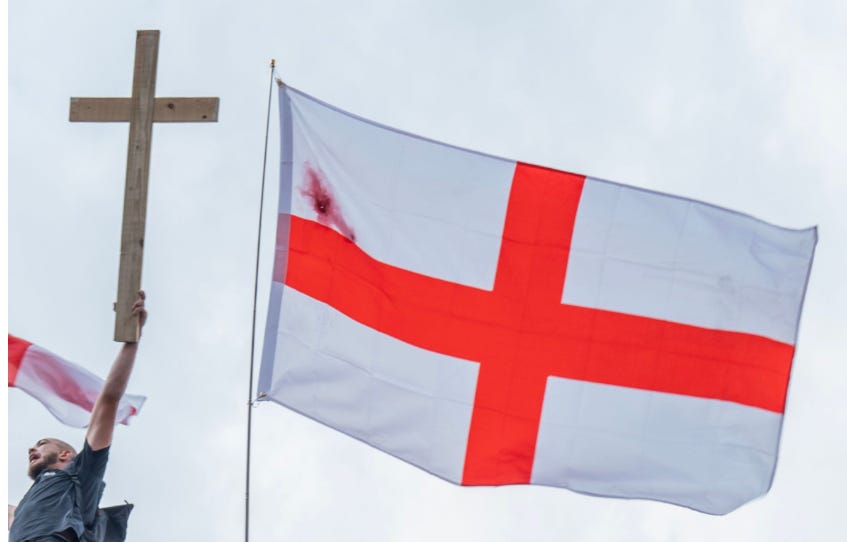
Tommy Robinson has also embraced Christian imagery and rhetoric, with his rallies featuring Bible verses and crosses amid a sea of St George’s flags. He has even proclaimed a revival of “masculine Christianity” will replace what he dismisses as the established church’s “weak drivel.”
When Dame Sarah Mullally was named the next Archbishop of Canterbury, Robinson pointed to an earlier statement she had made in support of Black Lives Matter, declaring that “masculine Christianity” was coming to replace such supposedly weak expressions of faith.
“Their churches will stay empty, a Christian revival will grow on the streets. Masculine Christianity [sic] is coming not this weak drivel,” he wrote.
Christianity as a weapon in the culture wars
Research suggests this political appropriation of Christianity, in which central teachings of compassion, humility and care for the vulnerable are being repurposed as a political weapon against immigrants, Muslims and those deemed insufficiently patriotic, has little to do with regular religious practice.
A recent report by the think tank Theos, Beyond ‘Christian nationalism’: Measuring attitudes to Christianity and Britishness today, identified a group it calls “identity integrationists,” accounting for 11 percent of respondents. They see Christianity as fundamental to British identity and believe its heritage must be defended against threatening outside influences.
Yet just 13 percent of this group regularly attended church. Its members were also strongly hostile to immigration and Islam, while only 19 percent agreed that Christian values required welcoming and supporting asylum seekers.
For many, Christianity, it seems, appears to function less as a faith to practise than an identity to defend.
One Tommy Robinson supporter told the BBC he didn’t necessarily believe in God but felt compelled to attend church because he feared Christianity was being replaced.
This is religion shaped less by spiritual conviction than by cultural anxiety: an attempt to reclaim a supposedly lost national identity, with Muslims and immigrants cast as threats.
And church leaders have pushed back. In September 2025, Church of England bishops joined other Christian leaders in condemning the “co-opting of the cross” at Robinson’s Unite the Kingdom rally to divide people and exclude others.
Their message was that the cross represents sacrifice for others, while Jesus called on people to love their neighbours. Former Archbishop of Canterbury Rowan Williams similarly urged people to recognise migrants as vulnerable human beings.
But conservative figures have challenged the Church’s authority to speak on these issues. Ceirion Dewar, a bishop in the traditionalist Confessing Anglican Church, led a prayer at Robinson’s rally, describing his participation as a Christian duty. He argued that people there sincerely believed Britain’s Christian foundations were being eroded.
From the clergy to the courtroom
The battle is not confined to rallies and online influencers. It’s playing out within the Church of England itself.
Project Spire, a £100 million initiative addressing the Church’s historical links to transatlantic slavery, has become a target for Conservative politicians and religious traditionalists.
Critics argued that spending the money was wrong when churches across the country were struggling to keep their doors open.
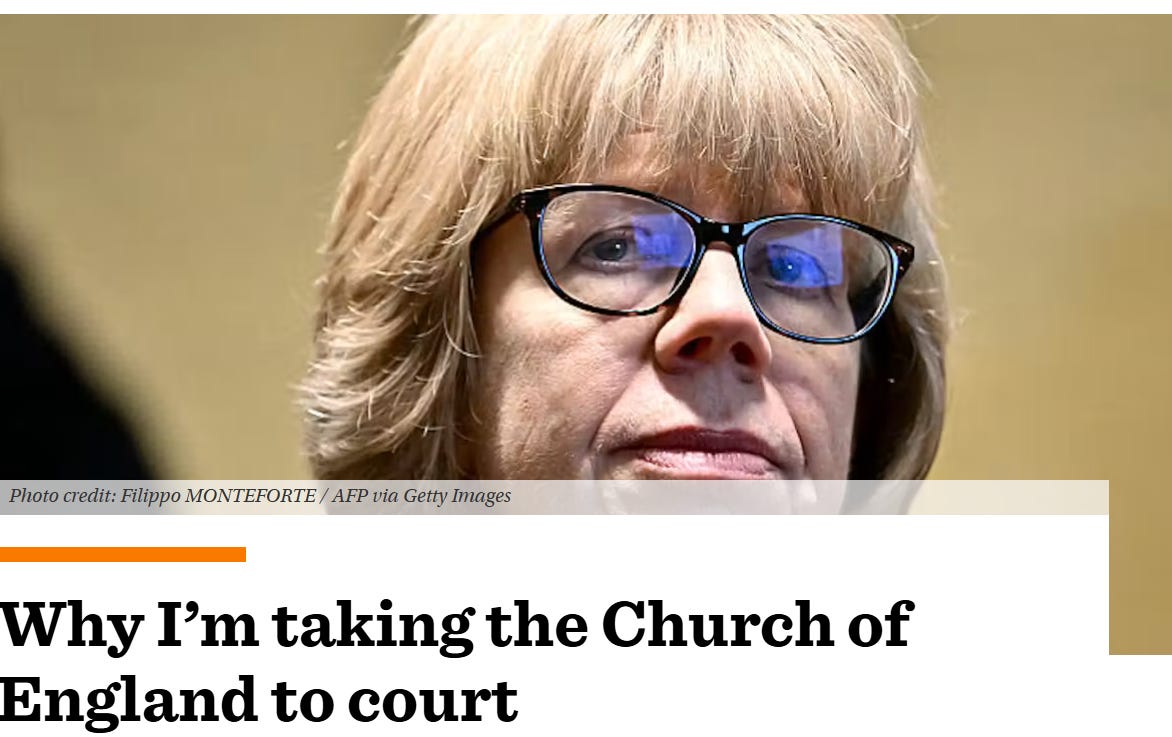
Jamie Franklin, a Church of England priest, went even further, taking legal action against the Church over the project. Writing in the right-wing magazine The Critic, he described it as legally, historically and morally dubious.
Thanks for reading Right-Wing Watch! Subscribe for free to receive new posts and support my work.
While the dispute might raise legitimate questions about how the Church should allocate its resources, it also illustrates how efforts to confront Britain’s historical injustices have become another front in the culture wars, with critics framing attempts at restitution as an attack on the institution itself.
Franklin’s claim to be defending the Church sits uneasily with his decision to take it to court. If the aim is to protect the institution, the question is whether this approach strengthens it or deepens its divisions.
A familiar right-wing playbook
Sadly, the fight over the Church of England fits a wider pattern. Institutions that embody aspects of Britain’s social and cultural life have repeatedly found themselves targeted by right-wing campaigns against so-called ‘wokeness.’
The National Trust has faced years of attacks from campaigners who object to its treatment of colonialism, slavery and Britain’s past. The NHS, meanwhile, remains a source of national pride, yet chronic underfunding under consecutive Tory governments has helped undermine public confidence and create opportunities for greater private-sector involvement.
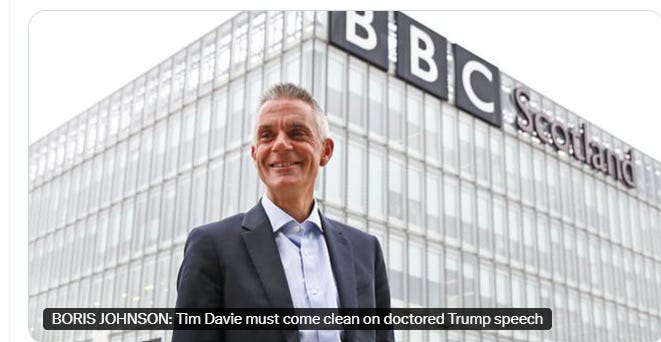
The BBC has also long been a target. In November 2025, following controversy over its clumsy editing of a Donald Trump speech, Boris Johnson demanded that director-general Tim Davie either explain the changes or resign, declaring he would not pay his licence fee. Within days, Davie and the corporation’s news chief, Deborah Turness, had announced their resignations.
The recurring pattern is notable; institutions are portrayed as corrupted by progressive values, their authority undermined, and their defenders cast as enemies of the nation.
The Church of England is now caught in the same struggle, with its commitment to confronting historical injustice and welcoming vulnerable people increasingly at odds with a political movement that claims Christianity as its own. It does seem though that the far right’s capacity to co-opt fundamental values as exclusively their own – see patriotism, free speech, democracy itself – is meeting real resistance from Christians and their churches.
A global struggle for Christianity – ‘Judeo-Christian’ values
This battle is not uniquely British.
Across Europe, far-right parties increasingly invoke ‘Judeo-Christian values’ not as a commitment to religious principles, but as a cultural identity marker, defining a supposedly shared European civilisation against an imagined Islamic threat.
Research by Dr Toby Greene, a lecturer at Bar-Ilan University, found widespread references to Europe’s ‘Judeo-Christian’ roots among radical-right parties. The Alternative for Germany (AfD), for example, declares it:
“Opposes Islamic practice which is directed against our liberal-democratic constitutional order, our laws, and the Judeo-Christian and humanist foundations of our culture.”
Greene identifies comparable rhetoric from Marine Le Pen in France and Nigel Farage. Italy’s Giorgia Meloni has similarly cultivated an image of herself as a Christian mother, using religious identity as a political badge rather than advocating a consistent commitment to Christian doctrine.
The Catholic Church has also faced fierce opposition from conservative and traditionalist factions over its direction.
Pope Francis, who led the Church from 2013 to 2025, angered right-wing critics through his outreach to LGBTQ+ Catholics, his support for blessings for same-sex couples and his emphasis on climate change and economic inequality.
His successor, Pope Leo XIV, has likewise attracted attacks from MAGA-aligned figures in the United States. Steve Bannon and Laura Loomer have criticised Leo over his support for migrants and opposition to nationalist rhetoric, branding him “anti-MAGA,” “pro-open borders” and a “globalist.”
Such hostility exposes the political fault line running through Christianity: between a faith that calls for solidarity across borders, and one increasingly harnessed to nationalism, exclusion and cultural grievance.
The question is not whether Christians should engage in politics, nor whether churches should be immune from criticism. It’s whether religious institutions can retain their moral independence when political movements seek to define faith on their own terms.
If the right truly wants to defend the Christian tradition, it might start by taking its central teachings on compassion, humility and care for the vulnerable seriously.
Gabrielle Pickard-Whitehead is author of Right-Wing Watch
Cyclists have a hard enough time as it is. Between dodging potholes and enduring the occasional middle finger from motorists, we now apparently must contend with being branded woke by America’s car-obsessed MAGA brigade.
Enter Sean Duffy, Donald Trump’s transportation secretary, former Fox News host and enthusiastic culture warrior. Duffy has made dismantling what he calls ‘woke’ diversity, equity and inclusion (DEI) policies a priority, targeting Biden-era initiatives, bike infrastructure and university research grants as supposedly wasteful spending.
“Remember when Biden and Boot-edge-edge used YOUR MONEY for DEI bike lanes and climate change? THAT’S OVER,” Duffy posted on X in July, claiming he had redirected $1.73 billion in federal transportation grants away from “Biden-era DEI pet projects” towards roads, bridges and ports.
His department has also restricted funding for speed cameras and pedestrian safety projects, while dismissing investment in cycling infrastructure as “crap” and “DEI pet projects” associated with his predecessor, Pete Buttigieg.
Apparently, even making roads safer for people who don’t drive has become a culture-war offence.
Duffy’s priorities have already attracted criticism. Earlier this year, he faced accusations of being spectacularly out of touch after announcing The Great American Road Trip, a reality TV show following his family on a seven-month journey across the country by van, amid transportation crises and rising fuel prices.
“How much more unfocused, unserious, and out of touch can you be?” asked Chasten Buttigieg, husband of the former transportation secretary.
But the concerns go beyond tone-deaf television appearances. Critics argue Duffy is jeopardising road safety by allowing MAGA ideology to dictate transport policy.
Barbara McCann, who worked on road safety policy at the US Department of Transportation for more than a decade, has warned the administration’s attacks on cycling infrastructure risk sidelining evidence-based approaches to preventing deaths and injuries.
“You pick someone who’s vulnerable and attack them,” McCann told the Guardian. “They decided that bicyclists are vulnerable and that they could use that as a political wedge. It didn’t seem to have anything to do with actual safety.”
Duffy insists his department remains committed to safer roads and reducing fatalities. Yet critics fear that decades of road-safety evidence are being sacrificed to a political agenda that treats cyclists, pedestrians and climate-friendly transport as ideological enemies rather than legitimate parts of the transport system.
McCann also sees parallels between the administration’s attacks on bike lanes and its crackdown on immigrant truck drivers. Both, she argues, reflect an effort to assert dominance over vulnerable groups.
“That’s just a classic feature of the autocratic playbook,” she said. “They pick scapegoats and go after them. That has absolutely nothing to do with safety.”
As a cyclist, I know that sharing roads with motorists can be challenging enough without politicians actively turning cycling into a culture-war target. Potholes, dangerous junctions and inconsiderate driving are problems that need practical solutions, not partisan point-scoring.
When making roads safer becomes ‘woke,’ it’s clear that MAGA’s culture warriors have lost sight of common sense, leaving cyclists in the firing line of a political crusade against progress.
GB News, the right-wing news channel, owned by British hedge fund manager Paul Marshall and Dubai-based investment firm Legatum Group, has announced plans to launch an ‘all-British’ digital radio station in November.
Called GB Music Radio, the new 24-hour station promises to be a “Fearless Champion of British Music,” playing exclusively artists from Great Britain and Northern Ireland. U2 fans, presumably, will have to look elsewhere and Christmas without the Pogues’ Fairytale of New York just won’t be the same.
The station will feature programmes including the Great British Breakfast and the Great British Drive Home, combining its music output with hourly news bulletins and traffic and travel updates. A dedicated website, GBMusicRadio.com, will also carry the station’s broadcasts.
According to GB News, the launch is the first in a series of initiatives designed to take the broadcaster’s content into new formats and celebrate Britain’s cultural contribution.
The station will stream around the clock, with every track performed by an artist from Great Britain or Northern Ireland, or by a band whose main proportion of members are British.
A GB Media spokesperson said: “We are a media company that has demonstrated its commitment to celebrating Britain and its rich culture.”
They added that the station would showcase artists from Great Britain and Northern Ireland “across the generations,” describing British music as one of the country’s “extraordinary achievements on the world stage.”
GB News chief revenue officer Ross Sergeant was equally enthusiastic, saying: “GB Music Radio gives advertisers something genuinely new: a station built around a single, warm idea that almost everyone in this country can get behind.”
British music, but who decides what counts?
The announcement attracted considerable attention online, although not all of it has been the enthusiastic reception GB News might have hoped for.
“British music for British people…” posted campaign group Leeds for Europe, capturing the nationalist overtones of a station whose central selling point is the nationality of the people making the music.
“Can artists refuse to have their music played on it?” asked one commenter, probing at the practicalities of a patriotic playlist.
Another wondered: “What happens if the British artists are signed to US labels or singing songs written by foreigners?”
The station’s inclusion of Northern Ireland also prompted mockery. “The press release explicitly mentions ‘Northern Ireland’, so I’m expecting loads of Kneecap,” one person joked.
Another commenter imagined artists “queuing up to remove the rights for this station to play their music.”
British music has, of course, never been a neatly bounded national product. The Blues, born out of African American experience, helped shape British rock and roll, while Caribbean rhythms transformed everything from ska and reggae to punk and British pop. Yes, British music has been enriched by migration, international collaboration and artists who routinely cross national borders. GB News’ promise only to play British music for British people, is therefore a little short-sighted, to put it mildly.
And whether the artists themselves will be keen to join the party, well that remains to be seen.
From Donald Trump’s crypto empire to Nigel Farage’s £72m windfall, wealthy cryptocurrency backers are pouring money into right-wing politics, raising questions about whose interests politicians ultimately serve.
Reform UK’s £72m donation from cryptocurrency investors Christopher Harborne and Ben Delo in September was an enormous political story. It exceeded the total received by all UK political parties in 2025, while the pair have accounted for more than 80% of Reform’s funding since its founding in 2019.
But while the scale of the donation made headlines, its potential political significance is an even bigger story. The money is more than a spectacular boost to Reform’s finances. It shines a light on the growing influence of cryptocurrency interests in politics, and the increasingly close relationship between wealthy crypto investors and right-wing politicians.
The concern goes beyond the ability of the ultra-rich to bankroll political parties. It’s whether politicians who benefit from such extraordinary generosity will shape policy in ways that advance their donors’ financial interests. The real story is not simply how much money crypto can buy politicians, but what that money might buy in return.
Crypto’s political spending spree
As is so often the case with the latest developments on the right, America provides an indication of what could lie ahead in Britain.
Analysis of Federal Election Commission records by CNBC found 14 of the 20 biggest donors and donor groups in the 2026 US midterm election cycle had backed exclusively, or almost exclusively, Republican candidates and aligned organisations.
A new wave of political money is coming from cryptocurrency, artificial intelligence and online gambling executives and companies. Together, these interests have poured more than $377m into candidates, political action committees and industry-backed groups.
Super PACs, which are political organisations that can accept unlimited contributions from individuals, corporations and other permitted sources, can spend vast sums supporting or opposing candidates, provided they operate independently of the campaigns they seek to influence. Although they can’t donate directly to candidates or coordinate their spending with them, they offer wealthy interests a powerful means of shaping electoral outcomes.
The scale of this spending raises an obvious question: what do these donors expect in return?
We only have to look at Trump as a troubling case study. Trump’s crypto conversion
In 2021, Trump dismissed cryptocurrency as a “scam,” telling Fox News: “I like the currency of the United States.”
Fast-forward a few years and the picture looks very different. The President has embraced the industry, championed its expansion and rolled back regulatory constraints, while his family has established commercial interests in the sector.
In 2024, Trump formally announced his support for the family-linked cryptocurrency venture World Liberty Financial. Its website describes the business as “Inspired by Donald J Trump,” presenting it as part of a new era of finance.
Trump also turned cryptocurrency into a campaign issue. As the 2024 presidential election approached, his campaign announced that it would accept digital currency donations, declaring: “We proudly offer you a chance to contribute to the campaign with cryptocurrency.”
On Truth Social, he promised that all remaining Bitcoin should be “MADE IN THE USA,” claiming this would help America achieve energy dominance. For Trump, crypto was no longer a threat to the American financial system but an industry his administration should actively promote.
The financial stakes are enormous. Analysis published by Public Citizen shows cryptocurrency interests accounted for $274m of corporate political spending in the 2024 election cycle, representing 44 percent of the total covered by its analysis. That dwarfed the $28.25m in contributions cited for Koch-linked political organisations.
Trump’s family has also profited hugely from its crypto ventures. Deutsche Welle reported that Trump made more than $1bn from cryptocurrency sales in 2025.
This is where the relationship becomes particularly troubling. A president who can influence the rules governing an industry while his family benefits commercially from that same industry, presents an obvious conflict-of-interest concern.
As Peter Geoghegan, editor of Democracy for Sale, put it: “What Big Oil took decades to achieve, crypto has done in one election cycle: it’s bought the political process.”
Could Britain could be heading in the same direction? Farage’s crypto revolution
Reform is among a small number of British political organisations to have accepted cryptocurrency donations, alongside the far-right Homeland Party and the Other Party, which describes itself as a direct-democracy movement.
Byline Times reports that Reform uses the Polish company Radom Pay to process crypto donations and check donors’ eligibility. Byline’s report also raises questions about other parties’ arrangements. Advance, the short-lived party founded by former Reform deputy leader Ben Habib, also reportedly considered accepting Bitcoin and Ethereum. Habib said the party was wound up in July 2026 to avoid splitting the right and clear the way for Rupert Lowe’s Restore party.
For Reform, however, cryptocurrency is about more than a convenient way to collect donations. Farage has made the industry’s interests a clear part of his political agenda.
The Reform leader has insisted that Harborne expects nothing in return for the millions he has donated to the party and the separately reported £5m personal gift disclosed in April. But there is no need to assume an explicit bargain to recognise the potential for a conflict of interest when a politician receives such extraordinary financial backing from an industry stakeholder.
Farage has already signalled where he stands on one issue of direct relevance to crypto investors, that is the proposed digital pound, dubbed ‘Britcoin.’
In June, Farage reportedly urged Bank of England governor Andrew Bailey to abandon the plans. Speaking at the Zebu Live cryptocurrency conference in 2025, he told an audience of crypto enthusiasts that he would be “prepared to go to prison” to stop a central bank digital currency being introduced under a digital ID system.
Farage presents his opposition as a defence of personal freedom and privacy. But while such concerns may deserve consideration in any debate about digital money and state surveillance, the wider commercial implications also matter.
Harborne is a major shareholder in Tether, holding an estimated 12% stake in the company behind USDT, the world’s most widely traded stablecoin. Stablecoins are digital currencies designed to maintain a stable value, typically by being pegged to a conventional currency such as the US dollar.
Industry representatives have argued that a digital pound could threaten demand for privately issued stablecoins. A state-backed alternative could therefore have consequences for companies operating in this market, like Tether.
Tax breaks, Bitcoin reserves and lighter regulation
Speaking at a cryptocurrency conference in Las Vegas in 2025, Farage unveiled a draft Crypto Assets and Digital Finance Bill, promising a ‘crypto revolution,’ if Reform entered government.
His proposals included cutting capital gains tax on crypto assets to 10%, compared with the then maximum rate of 24%, and establishing a Bitcoin digital reserve at the Bank of England.
The announcement came a month after then chancellor Rachel Reeves published draft legislation to bring crypto asset firms within a regulatory framework similar to traditional finance.
While clear regulation can protect consumers without stifling innovation, it’s very different from offering tax cuts and other favourable policies to an industry whose wealthy participants have helped finance a political party.
Farage’s proposals would raise fundamental questions about who benefits from his vision of Britain’s financial future. A lower capital gains tax rate could deliver substantial savings to investors, while a state-backed Bitcoin reserve would expose public policy to a notoriously volatile asset.
Reform must explain how these measures serve the public interest and why their benefits justify the risks. The extraordinary financial support Reform has received from crypto investors makes those questions all the more pressing.
Could crypto undermine British democracy?
The more immediate problem with cryptocurrency donations is establishing who is really behind the money.
Digital wallets can facilitate rapid cross-border transactions, while the use of intermediaries and complex ownership structures can make it harder to establish the ultimate source of funds. Crypto transactions aren’t inherently anonymous, and many can be traced on public blockchains. But tracing a transaction is not necessarily the same as establishing the identity, eligibility or intentions of the person ultimately funding a political donation.
That creates risks in a system that restricts foreign donations and requires political funding to be transparent. Crypto donations could provide a route for ineligible foreign interests to influence British elections, particularly where checks are inadequate.
The government has moved to address these concerns. Before Parliament’s summer recess, ministers announced plans to amend the Representation of the People Bill to ban cryptocurrency donations and introduce an annual £100,000 cap on political donations from British citizens living overseas, alongside a corresponding limit on regulated transactions such as loans.
The measures are intended to protect UK democracy from foreign interference and financial influence. A ban would close one potential route for money of uncertain origin to enter politics, although effective enforcement and transparency would remain essential.
Electoral integrity requires more than preventing fraud. Voters must also trust that political parties cannot be financially captured by powerful private interests.
In America, Trump’s transformation from crypto sceptic to presidential champion has coincided with the expansion of his family’s commercial interests in the sector. In Britain, Farage is promising tax cuts, a Bitcoin reserve and a crypto-friendly economic revolution as his party receives extraordinary sums from cryptocurrency investors.
Crypto may promise a financial revolution. But if its richest investors can use their wealth to influence politics and secure favourable treatment, the rewards risk flowing to those who already have the most – at everyone else’s expense.
Gabrielle Pickard-Whitehead is author of Right-Wing Watch
The Trump administration’s campaign against ‘woke’ art has taken another turn, with the US State Department reportedly seeking to sell a painting by Kehinde Wiley, the celebrated artist behind Barack Obama’s official presidential portrait.
Wiley is known for his large-scale paintings celebrating Black identity, often placing Black subjects in compositions inspired by traditional European portraiture. His portrait of Obama was unveiled in 2018 and now hangs in the Smithsonian’s National Portrait Gallery.
But the artist’s work has become a target of the Trump administration’s cultural purge. In August, a painting Wiley created for the US State Department in 2013 was removed from the US Embassy in Santo Domingo, Dominican Republic, on ideological grounds.
Young Artists After Siamesas 1960 depicts four Dominican models against an elaborate floral backdrop. Before its removal, the painting was hidden behind a tarp emblazoned with an image of the American flag.
Announcing the move on social media, US ambassador to the Dominican Republic Leah Campos said: “In the Trump Administration and under my leadership we are turning away from globalist and woke ideologies and instead embracing American patriotism and the beauty of our great country!”
Yet neither Campos nor Erin Scavino, director of the State Department’s Art in Embassies programme, has clearly explained what makes Wiley’s painting objectionable. As the New York Times has reported, the criticism has instead focused on the artist himself and his association with Obama.
Scavino took over the programme at the beginning of Trump’s second term. She has emphasised acquiring and displaying art featuring patriotic imagery. Her previous experience includes working as an attorney and appearing as a contestant on Trump’s reality television show the Apprentice. She is also married to White House deputy chief of staff Dan Scavino.
This summer, she organised an exhibition in Washington titled Passport to Patriotism: 250 Years of Diplomacy, featuring 56 works incorporating 68 representations of the American flag.
Established in 1963, Art in Embassies was designed to advance cross-cultural dialogue and strengthen international relationships through art. Wiley’s painting formed part of the embassy’s permanent collection, and in 2015 the state department awarded him its Medal of Arts in recognition of his contributions to the programme.
Now, according to the New York Times, the department wants to sell the very work it commissioned.
Virginia Shore, who commissioned the painting and served as the programme’s director of acquisitions and chief curator between 2000 and 2017, said the work was nonpartisan. She also noted that there was no precedent for selling embassy artworks.
“Calling this woke is difficult for me to understand,” she said. “This is a program validated and financially backed under Bush.
“There is a science of building trust and empathy across borders.”
Her comments highlight what is at stake. A programme intended to build relationships between the US and the wider world risks being repurposed to promote a narrow, politically approved vision of American identity.
Wiley has previously attracted criticism from conservative commentators over his 2012 painting Judith and Holofernes, which depicts a Black woman holding the severed head of a white woman. Wiley described the work as a play on the “kill whitey thing”.
He also faced scrutiny in 2024 over allegations of sexual assault, which he denies.
In an executive order issued in March, Trump directed the Smithsonian to remove what he called “improper ideology” and “divisive narratives,” while placing greater emphasis on what he described as American greatness. That same month, his administration reduced the federal workforce responsible for preserving a collection of 26,000 publicly owned artworks.
Ultimately, this brand of patriotism looks less like celebrating American greatness and more like deciding whose art, identities and stories deserve to represent the country.
The Sunday Express served up another Brexit howler last week, declaring on its front page: “EU would ‘plunder’ Britain if Brexit reversed.”
The article centres on warnings to Andy Burnham that reversing Brexit would allow the EU to “plunder” Britain and betray his Makerfield constituents. The source of this alarm is Conservative leader Kemi Badenoch, who accused the PM of wanting to plunge the country into another era of “tedious and divisive Brexit debates,” ahead of the landmark UK-EU summit next month.
What the Express conspicuously omitted was the growing evidence that public opinion has shifted since the 2016 referendum.
A recent YouGov poll found that most Britons would vote to rejoin the EU if given another referendum, with just 27% opting to remain outside.
Nor does the Express’ scare story stand up particularly well in Burnham’s own constituency. Although 65% of Makerfield voters backed Leave in 2016, a Best for Britain poll found that just 38% would now vote to stay outside the EU, compared with 45% who would vote to rejoin.
These figures hardly support the idea that closer ties with Europe would amount to a betrayal of local voters. Instead, they suggest the political ground has shifted considerably since Brexit, something the Express’ front page was in no hurry to acknowledge.
Needless to say, the article prompted criticism online.
“The Express and its readers are running scared,” wrote Sheffield for Europe.
“If it’s in the Express, I automatically believe the opposite,” was another comment.
One reader joked that the Express was useful for “lining the rabbit hutch.”
A selection of previous Daily Express front pages also circulated online, reminding how confidently the newspaper has thrown its weight behind political figures and predictions that have subsequently aged rather badly.
Among them were “Only Cameron can save Britain,” “Vote May or we face disaster,” “Down but not out! Why we MUST put faith in Boris,” and, perhaps most memorably, “Put faith in Truss to deliver for Britain.”
The common thread is a style of political campaigning that relies on dramatic warnings, urgent appeals and emotive language, rather than a sustained examination of the evidence. The paper’s latest Brexit headline follows the same familiar formula: present renewed engagement with Europe as a looming catastrophe while giving little attention to polling suggesting that public attitudes have moved on.
For a newspaper so fond of predicting disaster, Express front pages offer a timely reminder that its political certainties have a habit of ageing badly.
Imagine ‘The Reformer’ landing on your doorstep: an eight-page newspaper bearing Nigel Farage’s beaming face, loaded with anti-immigration messaging, and giving Reform UK another platform to tell voters why they should support them.
It may sound like political propaganda delivered free to your door. That, in essence, is the plan.
According to The Spectator, Reform UK is preparing to distribute The Reformer to 15 million households nationwide, a potential reach exceeding that of Metro, Britain’s most widely distributed free newspaper. Former Spiked editor Mick Hume is expected to play a leading role, with the publication featuring Reform policies, party announcements and comment pieces by Farage.
The party’s stated ambition is to bypass the traditional press and online gatekeepers. But this is about more than getting its message out. Reform is building a media operation capable of putting its own narrative directly in front of millions of voters, with little of the scrutiny that independent journalism is supposed to provide.
From Mussolini to Trump: the politics of controlling the message
Reform’s plans might be dismissed as an expensive propaganda exercise, but the wider implications deserve serious attention.
There are troubling parallels with the media strategies of other populist and authoritarian leaders.
Benito Mussolini founded Il Popolo d’Italia in 1914, initially as a pro-war newspaper. It later became a key instrument of fascist propaganda and political mobilisation. Donald Trump, meanwhile, has used his Truth Social platform to communicate directly with supporters, bypassing conventional press channels and issuing announcements that are quickly amplified across the wider media. As News24 has reported, Truth Social helps sustain a right-wing media ecosystem in which Trump’s posts are repeatedly circulated and echoed by sympathetic outlets.
Hungary offers another warning. Over 16 years in power, Viktor Orbán’s government and its allies consolidated much of the country’s media landscape through regulatory changes, financial pressure and takeovers. Pro-government outlets benefited from state advertising, while public service media increasingly served the government’s interests.
These examples demonstrate how political power can be strengthened when leaders don’t simply seek favourable coverage but build systems designed to control the flow of information itself.
Reform is not operating in the same circumstances as Mussolini’s Italy or Orbán’s Hungary, but its ambition to combine direct-to-voter publishing, digital journalism, video broadcasting and an enormous financial war chest raises legitimate questions about the balance between political communication and independent scrutiny.
A £72m war chest and a newsroom of its own
The Reformer freebie newspaper is only one part of the operation.
Reform has announced plans for a national publishing operation, including an expanded digital newsroom and a video channel, Reform TV, on YouTube.
Press Gazette reports that the party has built a video studio in Westminster and intends to recruit around 25 staff, including editors, multimedia reporters, social media specialists and a data and analytics lead. The aim is to turn its website into a national publishing operation ahead of the next general election and beyond.
The scale of the financial backing is terrifying. Reform is reportedly seeking to raise £100 million for the next election, with £72 million already raised. Two £36 million donations from cryptocurrency billionaires Ben Delo and Christopher Harborne have provided colossal firepower.
That level of funding could give Reform a communications operation with a reach few political parties could hope to match.
The concern is what happens when a political organisation with such resources builds an integrated media operation designed to dominate the conversation, while simultaneously attacking the credibility of independent outlets that scrutinise it.
GB News: Farage’s awkward double act
Yet, ironically, Reform TV could also create an awkward problem for GB News, where Farage has presented a prime-time programme for five years.
After a break of more than six months for campaigning, the Reform leader recently returned to his three-evenings-a-week presenting schedule. But how will the channel respond when its star presenter becomes the face of a rival operation with its own studio, newsroom and substantial funding?
Writing in the i, broadcaster Michael Crick has suggested Reform’s financial resources could threaten GB News, potentially setting up a battle between two right-wing channels built around the same political figure.
Farage’s media ambitions could undermine one of his most prominent platforms. But the more consequential issue perhaps, is the role political figures play in broadcasting, and the rules designed to prevent news coverage from becoming an extension of party campaigning.
Unlike newspapers, broadcasters in the UK are subject to statutory requirements for due accuracy and impartiality. Those safeguards are intended to protect audiences from the unchecked political influence that can accompany broadcast power.
Yet GB News has repeatedly attracted complaints and regulatory scrutiny. Between its launch in 2021 and March 2024, Ofcom received 21,671 complaints about the channel, according to figures previously reported by Left Foot Forward.
In March 2025, following a High Court ruling overturning earlier findings against Jacob Rees-Mogg’s GB News programme, Ofcom discontinued six remaining investigations into politicians presenting news programmes, including those involving Farage. The case intensified debate about whether the regulatory framework is adequate for a broadcasting landscape in which politicians can combine presenting roles with direct party leadership.
Former Guardian editor Alan Rusbridger has warned that Britain has, almost by stealth, allowed one political party to acquire what amounts to its own television station. The concern isn’t just that a broadcaster has right-wing views, but that political campaigning and news presentation can become increasingly difficult to distinguish.
Former prime minister Gordon Brown has also called for stronger media regulation, and for Ofcom to “be given more teeth.”
“I think we’ve got to look very carefully at GB News and all these broadcast companies that are emerging, because we’ve got a far wider range of broadcasters and the system of regulation is not good enough to cope with it,” he told Sky News.
Attack the watchdog, discredit the press
Farage’s ambitions extend beyond building his own platforms. He has repeatedly attacked the BBC, accusing it of left-wing bias, election interference and double standards, with Reform pledging to scrap the TV licence.
His response to critical reporting has followed a familiar pattern.
During the 2024 general election campaign, Channel 4’s undercover investigation captured a Reform canvasser making racist remarks about then-prime minister Rishi Sunak and saying the army should “just shoot” asylum seekers crossing the Channel.
Farage dismissed the investigation as a stitch-up, alleging that the canvasser was a paid actor. After facing criticism on Question Time, he accused the BBC of rigging its audience and attacked both broadcasters as partisan institutions.
Repeatedly portraying critical journalism as a conspiracy, risks eroding public trust in the very institutions responsible for holding politicians to account. And that is particularly concerning when the same politician is expanding his own media platforms and seeking to discredit the outlets that might scrutinise them.
Observer editor-in-chief James Harding has warned against assuming Trump-style attacks on the media could never happen in Britain. He argues the BBC’s independence was at stake and called for reforms to strengthen its protection from political interference, including removing the prime minister’s power to appoint its chair and board.
The question isn’t whether the BBC or other broadcasters should be immune from criticism. It’s whether independent journalism can survive if political leaders systematically undermine its credibility while building alternative channels over which they exercise far greater control.
The right-wing press: Farage or Badenoch?
Farage’s relationship with the established right-wing press seems to be a bit more complicated. The Daily Mail, Telegraph and Express have often amplified Reform’s agenda, but their loyalties can shift between Farage and Kemi Badenoch.
Following the Conservatives’ recent party conference, the Mail enthusiastically declared “Kemi’s the new Thatcher,” embracing Badenoch’s promise to return the party to old-school values.
That enthusiasm coincided with polling suggesting the Conservatives had overtaken Reform to take second place nationally.
The Times reported that the figures would worry Farage’s strategists as the party struggled to halt its decline in support.
But when the Conservatives suffer setbacks or prominent figures defect, the same newspapers can quickly return to treating Farage as the dominant force on the right. In January, the Telegraph gave former Conservative leadership contender Robert Jenrick a platform to declare: “I’ve joined Reform, and you should too.”
Brexbox TV – who?
Yet there is, perhaps, one tangible reason not to assume Reform’s media ambitions will succeed.
Farage has been there before. In 2019, his Brexit Party launched Brexbox, a short-lived YouTube and social media venture intended to bypass traditional journalists and deliver political commentary directly to voters.
“We thought we’d take matters into our own hands,” said Brexit Party MEP Belinda De Lucy at the launch.
But rather than being a broadcasting revolution, the show produced just 13 episodes before fading away into oblivion.
Its surviving broadcasts, which you can still watch on YouTube – if you dare – provide a glimpse of a predictable format: Brexit triumphalism, attacks on the press and theatrical denunciations of the EU. In one episode, presenting from the European Parliament in Brussels, host David Bull announced, “the big bananas are in town,” as the UK and EU approached a Brexit deal.
Nigel Farage propped up the panel, decrying the deal as a dark chapter in what he’d spent 25 years of his life fighting for. Brexbox’s demise is no guarantee that Reform TV will meet the same fate. The party now has vastly greater financial resources, an even more prominent leader and a more robust media strategy.
But it does illustrate that bypassing journalists doesn’t automatically create an audience or a lasting media operation.
The stakes are nevertheless considerably higher this time. Reform is not merely launching a newspaper or a YouTube channel, it’s attempting to build an interconnected political media machine, backed by extraordinary sums of money and fronted by a leader who already enjoys extensive exposure in the legacy media.
Independent journalism isn’t perfect, and broadcasters and newspapers should always be held to account. But a democracy cannot function properly if political parties become their own newsrooms, their leaders their own broadcasters, and criticism is routinely dismissed as bias.
So, if The Reformer lands on your doorstep, you’ll know exactly where to shove it.
Gabrielle Pickard-Whitehead is author of Right-Wing Watch
We’ve said it before and we’ll say it again, since the dawn of the culture wars, the right has insisted that woke means broke.
The phrase has become a favourite among critics of corporate social responsibility, implying that companies face a binary choice: embrace progressive values or make money.
The latest company to be wheeled out as supposed proof is Nike, following footballer Kylian Mbappé’s decision to leave the sportswear giant for rival brand On.
The Telegraph was quick to frame the move as further evidence of Nike’s supposed malaise, pointing to the company’s removal from the S&P 100 after 18 years, its falling share price and the more than £150bn wiped off its market value since 2021.
Nike has had a difficult few years but presenting its current struggles as the inevitable consequence of being ‘woke’ is a very different proposition, and one the evidence doesn’t support.
The article dredges up the Republican boycott of Nike following its 2018 decision to feature former NFL quarterback Colin Kaepernick in its ‘Dream Crazy’ advertising campaign.
Kaepernick had protested racial inequality and police brutality by taking the knee during the US national anthem. His decision to work with Nike provoked fury on the American right, with some Trump supporters burning their Nike trainers and clothing in protest.
Donald Trump declared that Nike was being “killed” by anger and boycotts and wondered whether the company had anticipated the backlash.
There was just one problem with that particular culture-war prediction.
Nike’s US sales rose by 31 percent in the three days after the Kaepernick advert was released.
The Telegraph’s own article therefore contains evidence that rather neatly undermines its central thesis.
The ‘go woke, go broke’ myth
The piece quotes Republican Senator Ted Cruz celebrating Nike’s falling share price and boasting about buying other trainers after the Kaepernick controversy.
“Go woke, go broke,” the article concludes, has become a popular expression for Nike’s ‘malaise’ and its supposed prioritisation of social justice over making good trainers.
Except there is a rather large hole in that argument.
Nike remains one of the world’s biggest and most profitable sportswear companies, generating more than $11bn in quarterly revenue and maintaining one of the most impressive portfolios of athlete endorsements in global sport.
According to Players Couture, Nike remained the undisputed leader in athlete endorsements in 2025, with a strategy built around elite sporting talent, cultural relevance and storytelling.
And Nike is hardly unique.
Research challenges the wider “go woke, go broke” narrative. A 2025 study by film data analyst Stephen Follows, presented at the Zurich Film Festival, examined whether supposedly “woke” films really perform worse at the box office.
The answer was considerably more complicated than the culture warriors would have us believe. Follows’ research suggested that some genres, including horror, sport, drama and music-themed films, could actually benefit commercially from diverse casting and identity-driven storytelling.
Meanwhile, economic research has found no direct causal relationship between inclusive policies and corporate financial failure, while identifying economic benefits from greater inclusion, reduced discrimination and lower poverty.
So perhaps progressive values aren’t quite the corporate death sentence the right keeps promising.
Which brings us back to Mbappé.
After almost two decades with Nike, a relationship that began when the French football star was just eight years old, he has reportedly signed a deal with On.
It is entirely possible that this has rather more to do with business than wokeness.
Nike has paid Mbappé hundreds of millions of dollars since he turned professional and continues to sponsor the youth team he played for.
But On has reportedly offered Mbappé a deal involving both cash and equity, similar to the arrangement Roger Federer received when he left Nike for the Swiss brand in 2019.
Sportswear companies also have commercial limits on how much they can spend on individual sponsorships. Nike reportedly has a rule of thumb of spending no more than 10 per cent of a department’s revenue on sponsorships, a factor that has previously been cited in the loss of Federer.
Perhaps, then, Mbappé’s departure is not evidence of Nike being punished by the woke gods after all. Perhaps one of the world’s most commercially successful footballers simply decided another company was offering him a better deal.
Spain is heading for a snap general election on November 29, and the right-wing press has wasted no time celebrating what it clearly projects to be the beginning of the end for Pedro Sánchez’s Socialist government.
Sánchez announced the early election after his minority government suffered a parliamentary defeat over emergency measures designed to tackle Spain’s housing crisis, following intense public outrage after a high-profile eviction of an 87-year-old woman in Madrid. The proposals, which included stronger protections against evictions and measures aimed at increasing access to affordable housing, were voted down after the conservative People’s Party (PP), the far-right Vox and the Catalan pro-independence party Junts opposed them.
The PP is currently ahead of Sánchez’s Spanish Socialist Workers’ Party (PSOE) in the polls, while support for Vox has also been rising. If those numbers translate into parliamentary seats, the PP could need Vox’s support to form a government, potentially bringing the far-right party into national government for the first time since the end of Franco’s dictatorship.
For the right-wing media, however, the result is apparently already written.
‘European Left on verge of collapse’
No sooner had the election been announced than the knives were out.
Its article presents Sánchez as an increasingly isolated figure on the European Left, highlighting his criticism of Israel’s war in Gaza, his migration policies and his confrontations with Donald Trump over the war in Iran and Nato defence spending.
It also notes Sánchez’s emergence as a prominent figure on the European Left, including how Andy Burnham sought him out at the UN General Assembly in New York, where the two leaders strolled through Central Park.
The piece points to Sánchez’s political survival after previous electoral setbacks, but argues that, this time, the stakes are higher.
“If Mr Sanchez’s gamble backfires this time,” it writes, “the already small number of centre-Left leaders in Europe will be reduced to Mr Burnham, Denmark’s Mette Frederiksen and Malta’s Robert Abela.”
And should the PP and Vox prevail, the Telegraph predicts it would “build momentum behind Europe’s insurgent populist parties”.
The piece looks ahead to elections in France, Italy and Poland, arguing that victories for Marine Le Pen, Giorgia Meloni and Poland’s Law and Justice party would see the EU “swing further to the Right and the Left further diminished”.
The Spectator declares victory before the votes are counted
The right-wing magazine argues Spain now faces the prospect of a “markedly more right-wing government, dependent on Vox’s support”.
It highlights Vox’s calls for “national priority” in access to social housing and benefits, deportation of people living in Spain illegally, and the deportation of legal immigrants who commit crimes.
The article concludes that Sánchez is relying on voters’ fear of bringing a party he describes as “far right” into government overcoming dissatisfaction with his own record.
“On present evidence,” it says, “that looks a forlorn hope.”
There are, of course, serious reasons why Sánchez faces a difficult election.
His minority government has struggled to pass legislation, and his administration has been hit by political and corruption controversies. Social and housing tensions are high following the Ceuta incident with 80,000 migrants from Morocco and rising rents and evictions fuelling large demonstrations across the country.
But there is an important detail that rather gets lost amid the right-wing media’s celebrations.
The election has not happened yet.
Sánchez is undoubtedly taking a political gamble. But the immediate trigger for the election was a housing crisis that has generated huge public anger, and which the right-wing parties themselves helped prevent his government from addressing through the proposed emergency measures.
Sánchez has explicitly framed the election as a choice about whether Spain can continue pursuing progressive policies and secure a broader parliamentary majority capable of delivering reforms on inequality, public services and housing.
The Telegraph and Spectator may have already written Sánchez’s political obituary but on November 29, Spanish voters, not the right-wing press, will decide whether it was premature.
If anyone thought the Conservatives might use their time in opposition to reflect on why they lost power after 14 years, Kemi Badenoch’s conference blitz offers a pretty emphatic answer – apparently, they think they simply weren’t right-wing enough.
At this week’s Conservative Party conference in Birmingham, Badenoch unveiled a raft of policies that would take the party further to the right, promising tax cuts, deregulation, a smaller state and a series of measures that would disproportionately benefit wealthier households.
In the process, the Tories aren’t only abandoning the centre ground. They are also junking, attacking or attempting to rewrite policies introduced by their own governments.
And then there is Andrew Griffith, Badenoch’s newly appointed shadow chancellor, a former Liz Truss minister who backed her leadership bid and was heavily involved in her disastrous economic strategy.
If this is the Tories’ economic reset, the Truss-shaped elephant in the room is hard to miss.
Kemi’s Thatcher tribute act
In her essay The Right Way, a 100-page statement on her guiding principles and a deliberate echo of Margaret Thatcher’s 1976 essay The Right Approach, Badenoch argues that the last Conservative government failed because it didn’t know what it stood for.
“The next Conservative government will have one central principle: business, not government, creates growth,” she writes, promising to deliver it through tax cuts, cutting red tape and reducing the civil service to pre-pandemic levels.
She also says politicians need to have “the stomach to say no to good causes when the resources simply are not there to do everything”.
The Tory press, unsurprisingly, lapped it up.
“Kemi’s the new Thatcher,” declared the Daily Mail, praising Badenoch’s pledge to remake the party in the Iron Lady’s image and return it to “old-school” values.
But beneath the Thatcherite rhetoric is a familiar political choice: shrinking the state while finding ways to make life easier for those at the wealthier end of the income scale. In the words of the old music hall song, as ever ‘it’s the tich wot gets the pleasure, it’s the poor wot gets the blame.’
A policy blitz for the better-off
Take childcare. Badenoch wants to abolish the £100,000 household income cut-off for free childcare, allowing all parents working 16 or more hours a week to claim the support.
On the face of it, extending childcare provision sounds like a welcome policy. The Tories acknowledge that the measure would cost around £700m a year, money they propose to find partly by cutting jobs at organisations including Arts Council England and the Environment Agency.
In other words, more state support for higher earners, paid for by shrinking public bodies and cutting elsewhere.
Then there is stamp duty.
Badenoch wants to abolish most stamp duty, presenting it as a measure that would help homeowners. But the distributional impact tells a rather different story.
Many first-time buyers already pay no stamp duty on properties worth up to £300,000, meaning the biggest gains from abolition would go to those buying more expensive homes. And because 60 percent of stamp duty is paid in southern England, according to Zoopla, the benefits would be concentrated disproportionately in London and the South.
In other words, scrapping the tax rather than reforming it would do little for many first-time buyers while handing a much bigger benefit to wealthier homeowners and those purchasing more expensive properties.
As would the abolishing of inheritance tax on a family home, another old-school Tory manoeuvre that would shovel £6bn of taxpayer money to the already-wealthy.
The proposal prompted accusations that the Tories were prioritising wealthy families over those struggling to make ends meet.
Tax Justice UK condemned it as a massive giveaway to some of Britain’s richest people, warning that it would deprive public services of vital funding at a time when they are already under pressure.
“The biggest beneficiaries would be those with the highest wealth and the most valuable homes – and their descendants. This is a very well-off group, mainly living in London and the South-East of England.”
Let’s not forget, it was George Osborne’s headline-grabbing promise to “take the family home out of inheritance tax” in 2007 that put Gordon Brown off calling a snap general election.
While Andy Burnham talks about levelling up the country and taking power and wealth away from London, Badenoch’s economic agenda promises the opposite, concentrating more of the gains in the wealthiest parts of the country.
More prisons, less overseas aid
The policy blitz doesn’t stop there.
Badenoch has promised 50,000 new prison spaces in England and Wales, a 50 percent expansion in capacity, partly funded by slashing overseas aid to £1bn a year, around a 90 percent cut from current plans.
That echoes a proposal previously made by Reform UK, which prompted warnings from aid organisations that such a cut would not even cover Britain’s existing contributions to international institutions such as the UN and World Bank, thereby shredding Britain’s influence in these spaces.
“UK aid is an investment in a safer, healthier and more resilient world. Protecting the UK aid budget protects us all,” said Gideon Rabinowitz, director of policy and advocacy at Bond, the UK network of NGOs.
And then came the high-profile pledge of an ‘Iron Dome’ for Britain. £10bn for an Israeli-style missile defence system to protect the country from missile and drone threats of Russian and Iranian aggression, paid for by welfare reform and reprioritisation of other spending.
It’s quite a pitch from a party whose 14 years in government cut defence spending to the bone.
Yet the Tory press loved it.
“Britain needs an ‘Iron Dome’ to keep us safe,” screamed the Daily Express’s front page.
“Iron Dome lady,” announced the Sun.
The headlines may have been loud but the argument behind them is rather less convincing.
Enter the Truss connection
Perhaps the most ironic part of the Conservative conference was not Badenoch’s Thatcher-harpooning rhetoric but the man standing beside her economic agenda: Andrew Griffith, the party’s newly appointed shadow chancellor.
Griffith backed Liz Truss for prime minister in 2022 and served as her financial secretary to the Treasury, where he was closely involved in her disastrous mini budget, which led to a surge in gilt yields triggering her abrupt exit from Downing Street.
“Congratulations to Andrew Griffith on becoming Shadow Chancellor,” she wrote. “The economic establishment of the last three decades has failed Britain. They must be taken on.”
In his keynote conference speech, the shadow chancellor promised to follow in the footsteps of Thatcher’s chancellor Nigel Lawson by cutting at least one tax at every budget under a future Conservative government. This rather ignores the fact that the famous Lawson 1987 budget restoked the flames of inflation which the Thatcher government and even more the British people, had worked so hard to bring under control.
Griffith’s Lawson re-tread includes scrapping Labour’s so-called “mansion tax,” the additional council tax levy on properties worth more than £2m due to come into effect in 2028.
Griffith called it a “vindictive levy,” claiming it would hit people living in “ordinary homes”.
An ordinary home worth more than £2m? I’m not sure I know many people who live in one.
He also pledged to scrap the net-zero-related “grocery tax,” which is actually the extended producer responsibility levy that charges businesses for the packaging they use and is intended to encourage less environmentally damaging packaging.
Yet another policy developed under the Conservatives, during Michael Gove’s time as environment secretary no less, before being implemented by Labour.
Yet Griffith now wants to axe it in the name of cutting red tape.
The Truss lesson – apparently learned, but not quite
And here the Tories’ economic argument becomes particularly interesting.
Griffith has criticised Andy Burnham for failing to explain how his policy commitments will be funded, warning that the Labour government risks making the same mistake as Liz Truss’s 2022 mini budget.
This is a particularly bold criticism coming from someone who backed Truss.
Griffith has continued to defend the underlying tax-cutting ambitions of the mini-budget, while arguing that its fatal flaw was failing to set out clearly how the tax cuts would be paid for.
As he himself put it, that was the “mistake of Liz Truss’ mini budget”.
Quite.
Because the problem with the Conservatives’ latest blitz is not simply that it contains lots of tax cuts and spending commitments. It’s that the party appears to be repeating the same ideological impulse that helped produce the Truss experiment in the first place: slash taxes, shrink the state, deregulate and hope growth follows.
The difference, apparently, is that this time they promise to explain how they will pay for it.
Hard choices – after 14 years of avoiding them
Griffith also accused previous Conservative leaders of failing to govern as genuine free-market conservatives, attacking Burnham and John Healey for supposedly wanting to return Britain to a “socialist fever dream of the 1970s”. Of course, returning the country to the 1950s and ‘60s when levels of growth far exceeded anything achieved since is never mentioned. Strange that!
There is something rather extraordinary about hearing Conservatives who governed Britain for 14 years accuse others of avoiding hard choices.
As LabourList noted, one of the more tone-deaf moments in Griffith’s speech came when he claimed the Conservatives would be “the ones to make the hard choices”.
That is a curious boast from a party whose record in government included enormous increases in national debt, years of austerity and a mini budget that sent financial markets into turmoil.
And if Griffith’s conference speech was supposed to demonstrate the political force of this new Conservative economic agenda, it was not exactly an electrifying display.
The Guardian’s John Grace described it as the “worst speech ever heard”, noting the empty seats and lacklustre response that was “like watching a less sentient version of the PG Tips monkey.” It’s a world apart from the Thatcher-Lawson supposedly glory days the Conservatives appear so desperate to recreate.
The same old Tory economics, just further right
Strip away the Thatcher references and Iron Dome Lady headlines and Badenoch’s vision looks remarkably familiar: more tax cuts, less regulation, a smaller state and policies tilted towards the better-off.
The Conservatives appear to believe they lost power because they were not right-wing enough. But with a former Truss minister now sitting in the shadow chancellor’s chair, their supposed fresh start looks less like a reset than a rerun – only further to the right.
Gabrielle Pickard-Whitehead is author of Right-Wing Watch
Donald Trump’s second-term assault on so-called ‘woke’ America is being used to determine where billions of dollars of public money go, including money intended to fund scientific research.
Since he returned to the White House, the Trump administration has cut, frozen, delayed or otherwise disrupted up to $177 billion in federal grants, affecting every US state, according to analysis by the States United Democracy Centre and Grant Witness. The disrupted funding spans 17 policy areas, with health, nutrition, environmental programmes and disaster relief among those most affected. The organisations estimate that the disrupted funding amounts to almost 10% of federal discretionary spending.
The administration’s anti-woke drive has turned words such as “equity,” “gender,” “racist” and “climate change,” into ideological red flags to hinder funding for scientific research.
A class-action lawsuit filed by researchers alleges that the National Institutes of Health (NIH) has been using a list of keywords to identify research that could conflict with the administration’s political priorities. Researchers claim that some grants have been terminated or denied, while others have been subjected to demands that scientists remove flagged language from their applications.
And now the administration appears to be considering taking political oversight of that process even further.
The White House is reportedly drafting an executive order that would establish an external committee with the power to veto NIH grant awards that don’t conform to Trump’s political agenda. The proposed board would include Russell Vought, director of the Office of Management and Budget, and NIH director Jay Bhattacharya, with unanimous agreement reportedly required for grant awards.
The proposal follows a reported clash in the Oval Office in which Vought accused the NIH of continuing to fund what he described as ‘woke’ initiatives that conflict with Trump’s priorities. According to the Washington Post, officials discussed creating a commission to subject NIH grant-making to additional political scrutiny.
That would represent a huge shift in how scientific funding is decided.
The NIH is the world’s largest public funder of biomedical research, supporting work into diseases and conditions including cancer, heart disease and infectious diseases. Traditionally, research proposals are assessed through expert scientific review rather than according to whether they fit the political preferences of the president.
The administration, of course, has a legitimate interest in deciding how taxpayers’ money is spent. But there is a crucial difference between questioning whether a research project represents good value and deciding that an area of research is unacceptable because it has acquired the political label of ‘woke.’
Research into health inequalities, gender, racial disparities or the effects of climate change does not become less scientifically valid because those subjects have become targets of the American right’s culture war. Nor does removing a particular word from a grant application make the underlying subject disappear.
Yet this is precisely where Trump’s anti-woke agenda becomes more consequential than the familiar political arguments about pronouns, diversity training or university speech. The language of the culture war is being translated into decisions about what gets funded, what gets researched and which scientific questions are considered legitimate.
The administration has already explicitly presented cuts to programmes involving racial, gender and climate-related initiatives as part of its drive to eliminate what the White House calls ‘woke’ programmes. Its own budget materials describe efforts to eliminate funding associated with what it characterises as “radical gender and racial ideologies”.
Now that logic is reaching deeper into scientific research.
And when the government starts deciding which scientific subjects are acceptable according to the president’s ideological agenda, the culture war stops being just a war of words. It starts shaping what America is allowed to study.

 Login