❌

Reading view

There are new articles available, click to refresh the page.

The ADHD Guide to Smoother Life Transitions

Whether starting a new job, moving to a new town, or sending a child off to college, transitions are equal parts exciting and uncomfortable for neurodivergent individuals.

The struggle often looks different in children and adults, but the demand is much the same: Stop what you are doing, shift your attention, figure out the next step, manage your emotions, and move into a different role, task, place, or expectation. The bigger the transition, the harder it feels.

Why Transitions Are Difficult

Typical transitions include returning to work after a vacation, adjusting to a new schedule, shifting from work to parenting mode, navigating relationship changes, and recovering from illness or injury.

[Free Download: Get Control of Your Life and Schedule]

From the outside, the response of an adult with ADHD may look like procrastination, avoidance, irritability, disorganization, or poor follow-through. Internally, they are likely dealing with anxiety, emotional overload, decision fatigue, time blindness, or the frustration of knowing exactly what needs to be done but struggling to begin.

“I struggle so badly with transitions (they feel almost literally painful) that I spend up to five hours in a state of crippling inertia before handling a task that needs to be done,” wrote one woman with ADHD in a social media post, pleading for help.

Transitions can be especially difficult when they involve uncertainty. A new job may bring excitement and anxiety about performance. A vacation may feel adventurous and overwhelming. Even a positive life change can feel unsettling when structure falls away.

“I don’t travel much,” says Layla, an ADDitude reader from California. “Transitions are hard for me.”

[Get This Free Download: Finish Your To-Do List Today]

6 Ways to Make Transitions Easier

Shave the rough edges off transitions by doing the following seven things:

  1. Name what you think is changing and what will stay the same.
  2. Write down the first step to prepare for the transition.
  3. Use calendar reminders to know when tasks should start and when they should end.
  4. Prepare for the next day before each day ends.
  5. Build in recovery time after travel, big meetings, family events, or schedule changes.
  6. Make a simple re-entry plan after vacations, weekends, or emotionally demanding events.

Most importantly, adults with ADHD should keep in mind that embracing change easily is not necessarily a sign of maturity. Feelings of anxiety around transitions may just mean that your brain needs more preview, structure, recovery, and support to move from one demand to the next.

Life and Task Switching: Next Steps

Dawn K. Brown, M.D., is a psychiatrist and the author of The ADHD Lifestyle Series, Volume 1: Secrets from an MD with ADHD: Building Balanced Meals and Exercise Routines for Children. #CommissionsEarned As an Amazon Associate, ADDitude earns a commission from qualifying purchases made by ADDitude readers on the affiliate links we share.


ADDITUDE IS HUMAN
Artificial intelligence does not create or edit any written content published by ADDitude. Our editorial team is 100% human, and our mission is simple: listen to and serve our readers with hand-crafted, expert-informed resources. To support ADDitude, please consider subscribing. Your readership and support help make our commitment possible. Thank you.

Science says your boss should talk less in meetings

Close to 1 billion meetings take place each day around the world. CEOs spend nearly three-quarters of their workdays in meetings. Planning for and spearheading meetings eats up the lion’s share of managers’ time. In much of the industrialized world, meetings are both the metronomes and menaces of people’s working lives.

Given the enormous time spent in workplace meetings, do we know what they accomplish or how to make them as worthwhile as possible? For decades, the answer was… not really. Meetings weren’t a particularly accessible subject of study. But that has changed. Once a tiny niche area, “meeting science” is a growing specialization among organizational and social psychologists. The field is accelerating as archived virtual meetings provide vast swaths of data. And it is providing a fascinating window into human behavior.

Meeting to talk helps fulfill basic human needs to connect, communicate, and cooperate. People have long come together—in caves, fields, market squares, and town halls—to get something done, share ideas, get on the same page, or just to remark on the weather. But meeting scientists define their subject as gatherings of people “with some goal or structure to the event,” says organizational psychologist Liana Kreamer of the Florida Institute of Technology, who coauthored a review of over three decades of meeting science in the 2026 Annual Review of Organizational Psychology and Organizational Behavior.

Read full article

Comments

© https://www.gettyimages.com/detail/photo/hangover-at-the-office-royalty-free-image/1770771124

The Lost Art of Saying “No”

A major part of maintaining productivity is managing others’ expectations around how we spend our time and energy. Fear of criticism, feelings of inadequacy, past challenges with consistency, and problems prioritizing compel people with ADHD to stretch themselves too thin — sometimes at great cost to their mental health and work relationships.

While saying “yes” by default can feel like the correct response, self-care and personal power often come from the lost art of saying “no” — an underutilized but transformative productivity skill. Practice how to politely but firmly decline requests with responses such as:

  • “I don’t want to set myself up for failure or set you up for disappointment.”
  • “I’m maxed out this week and wouldn’t want to slow you down.”
  • “Thank you for the opportunity. I must pass, but please keep me in mind later.”
  • “I can’t take this on, but I can recommend someone who might help.”

[Free Resource: Get Control of Your Life and Schedule]

If you’re not sure whether to decline or accept a particular request, recall moments when overloading your plate backfired. Otherwise, circumstances and what is left over at the end of the day will determine what you get done.

Embrace Transparency

You already know that people-pleasing is a flawed coping mechanism that, in many cases, often becomes the quickest route to “people-disappointing.” So, if you need more time on a proposed deadline, for example, ask for a few extra days. Keep your request simple and clear.

Because ADHD interferes with predictability, it’s important to excel at transparency. Say, “You know what? I completely forgot about that, and I’m sorry. Here’s my plan to fix it.” It’s better to “disappoint” early, when there’s still time to develop a Plan B.

What’s Your (Self) Worth?

Consider how ADHD-related challenges have shaped your ideas about productivity, especially if you were diagnosed later in life. How much do you link self-worth to output? How comfortable are you setting boundaries? How much do you sacrifice in the name of productivity? Reflecting on your past experiences will help you abandon toxic practices.

[Webinar Replay: Stop People Pleasing!]

Saying “yes” to what is beyond our capacity can lead to burnout and resentment. At the same time, a history of productivity challenges and unmet expectations can lead us to feel like we don’t have the right to say “no.” But no one can take away our agency. ADHD or not, we are allowed to decide how we use our time and energy — without guilt or shame.

How to Say “No:” Next Steps

Ari Tuckman, Psy.D., MBA, is a psychologist and the author of The ADHD Productivity Manual(#CommissionsEarned).


ADDITUDE IS HUMAN
Artificial intelligence does not create or edit any written content published by ADDitude. Our editorial team is 100% human, and our mission is simple: listen to and serve our readers with hand-crafted, expert-informed resources. To support ADDitude, please consider subscribing. Your readership and support help make our commitment possible. Thank you.

The ADHD Entrepreneur’s Guide to Actually Following Through

“I’ve got 47 browser tabs open right now.”

This used to be my default on a daily basis. 

I’d have three tabs dedicated to different project management tools I swore would be “the one.” Two might have been half-finished sales pages. One was a focus app I opened to calm down after realizing I forgot about a Zoom call I had to be on. And the rest? Honestly, I have no idea. But I was afraid to close them because what if one of them was important?

This is the ADHD entrepreneur‘s existence. 

We’re brilliant at starting things. World-class idea generators. We can see opportunities everywhere, connect dots others miss, and get so fired up about a new direction that we’ll stay up until 3am building the landing page.

And then… nothing.

The follow-through rarely comes. The course stays 80% done. The email sequence gets three emails deep and dies. The “game-changing” offer gets mentioned once on social media and then forgotten when the next shiny idea arrives.

I know this pattern intimately because I’ve lived it. And I’ve watched it destroy good businesses run by brilliant people who just couldn’t get out of their own way.

But here’s what I’ve learned after years of fighting my brain and finally figuring out how to work with it instead: You don’t have a follow-through problem. You have a systems problem.

The Friction Points That Kill Your Projects

Let me show you where neurodivergent entrepreneurs actually fall apart.

Friction Point #1: The “I’ll Remember” Delusion

You have a great idea during a client call. You’re sure you’ll remember it later. You don’t write it down because you’re in the middle of something and writing it down feels like friction.

Six hours later, it’s gone. Maybe you remember you had an idea, but the idea itself? Vanished into the ADHD void of your brain.

This is the result of working memory issues meeting the chaos of entrepreneurship. And every time it happens, you lose a little more trust in yourself. Eventually, you lose all trust in yourself, and then you’re REALLY stuck.

Friction Point #2: Context Switching Costs You Everything

You sit down to write that email sequence. But first, you need to check Slack. Oh, and there’s a notification about that ad campaign. And didn’t you need to invoice that client? Two hours later, you’ve done 24 different things, none of them the email sequence.

Neurotypical productivity advice tells you to “just focus.” Cool. Helpful. Might as well tell someone with bad eyesight to “just see better.”

The real issue? You’re trying to hold too much context in your head. According to a recent study by Cornell, every switch costs you 9.5 minutes of momentum. By the time you’re back in flow, something else pulls you away.

Friction Point #3: Perfectionism Paralysis Dressed Up as “Standards”

The project is 90% done. You just need to record that one video, write that one section, fix that one thing.

But it’s not quite right yet. So you wait for the perfect moment, the perfect energy, the perfect clarity.

Spoiler: That moment never comes.

What’s really happening? Your ADHD brain is protecting you from the discomfort of shipping something that might not be perfect. So it keeps you in the “preparing to launch” phase forever, where you’re busy but never vulnerable.

The Systems That Actually Work

Here’s what I do now. Not what I should do. What I actually do that gets things finished.

The Immediate Capture System

Every idea goes into one place immediately. Not later. Not when it’s more developed. Immediately.

I use voice memos on my phone because typing feels like friction and friction kills momentum for ADHD brains. I’ll record a 30-second ramble about the idea while I’m thinking it. Doesn’t have to be coherent. Just has to be captured by something. 

Once a week, I go through the voice memos and decide: build it, save it for later, or delete it. Most get deleted. That’s fine. The point isn’t to build everything. The point is to stop losing the good ideas.

The Single-Context Rule

I only work on one project per session. Not one project while checking email. Not one project with Slack open “just in case.” One project. Everything else is closed.

This feels impossible at first. What if something urgent comes up? What if someone needs you?

That fact is, nothing is as urgent as you think. And the cost of context switching is way higher than the cost of responding to something two hours later.

I use time blocks. Mondays I have ZERO meetings. I use that day to create content. Tuesday through Thursday mornings are for building my business. Tuesday through Thursday afternoon are for client work. Monday and Wednesday afternoons are for content. Friday is for admin, cleanup, and meeting with my coach. Saturday morning is a work block for writing, followed by a maximum of two client coaching calls. If something doesn’t fit the day’s context, it waits.

This is a protection system. Protection from my own brain’s tendency to fragment my attention into uselessness.

The “Done is Better Than Perfect” Forcing Function

I ship on deadlines, not quality thresholds.

If I’m creating a lead magnet, I give myself two days. The lead magnet goes out whether it’s perfect or not. Because “perfect” is a moving target my ADHD brain will chase forever.

Here’s the forcing function: I tell my coach or a trusted friend that it’s coming. I create external accountability because internal motivation is unreliable for ADHD brains.

Does this mean I ship imperfect things? Absolutely. But imperfect and shipped beats perfect and stuck in your Google Drive every single time.

The Energy-Based Task Matching

Not all tasks require the same energy. Writing sales copy requires high focus. Scheduling social posts requires low focus.

I stopped trying to power through low-energy moments with high-focus tasks. That’s a neurotypical approach that doesn’t work for ADHD brains.

Instead, I keep a list of low-energy tasks for when I’m fried. Email cleanup. Canva graphics. Invoice follow-ups. When my brain is mush, I do mush-brain work. When I’m sharp, I protect that time fiercely for the hard stuff.

This alone has probably doubled my output because I stopped spending three hours trying to force my brain to do something it wasn’t capable of in that moment.

The Uncomfortable Truth About Follow-Through

You’re never going to follow through on everything. And you shouldn’t.

The ADHD brain is wired to explore, not execute. We’re the people who see possibilities everywhere. That’s a gift. But it becomes a curse when we treat every idea like a commitment.

Most of your ideas should die. They should die quickly, quietly, and without guilt.

The goal isn’t simply to follow through on more things. The goal is to follow through on the right things. The things that actually move your business forward. The things that serve your clients and build your freedom.

Everything else? Let it go.

What This Looks Like in Practice

Last month, I had an idea for a new offer. My brain immediately went into overdrive. I could see the sales page, the delivery method, the marketing angle, everything.

Old me would’ve spent three days building it, gotten 80% done, and abandoned it when the next idea hit.

New me? I voice-memo’d it. Sat with it for a week. Realized it was a distraction from the client work that actually pays my bills. Deleted the memo. Moved on.

That same week, I needed to finish a marketing strategy for a client. My brain didn’t want to do it. Too hard. Too much thinking. The new offer seemed way more fun.

But I had a deadline. I told the client it’d be done Friday. So I blocked Thursday morning, closed everything else, and finished it. Was it perfect? No. Did it deliver massive value and move their business forward? Absolutely.

This is what follow-through looks like for ADHD entrepreneurs. Not superhuman discipline. Just systems that work with your brain instead of against it.

Your ADHD is a Gift

The business world is built for neurotypical brains. Linear thinkers. People who can “just focus” and “just be consistent.”

If you have ADHD, that’s not you. That’s not me.

But here’s what we have that they don’t: Pattern recognition. Creative problem-solving. The ability to see connections others miss. Hyper-focus when something catches our interest.

These are superpowers. But only if you build systems that let you use them without burning out or drowning in unfinished projects.

Stop trying to follow through like a neurotypical entrepreneur. Start following through like an ADHD entrepreneur who’s figured out how to work with their brain instead of fighting it.

Your business doesn’t need you to be someone else. It needs you to be you, with systems that actually work.

Now close some of those browser tabs and go finish something.


What’s your biggest follow-through friction point? Hit reply and tell me. I read every response, and your answer might become the next article. If you suspect you’re an ADHD entrepreneur, watch this video with me and Craig Ballantyne to learn more.

The post The ADHD Entrepreneur’s Guide to Actually Following Through appeared first on Early To Rise.

4 Simple Steps to Change Your Life

If you want to change your life—like really, seriously, no bullshit, actually change your life—do this:

Step 1: Write down everything you care about.
Step 2: Arrange the list from most important to least important.
Step 3: Cross out everything but the top 3 things.
Step 4: Re-organize everything you do around those three things.

People make this mistake of setting new goals every January 1st, but forget that goals are the path, not the destination.

Your real destination is your purpose.
Your goals just inform that purpose.

“Cool, Mark. Now WTF does that actually mean?”

For example: My goals change every year. But my purpose hasn’t budged over the last decade.

I want to improve the quality and resources for personal growth and development to help move humanity forward.

So every year, I set new goals to further that purpose.

Some years, it was writing books. Other years, it was creating communities. In 2025, it was building the Purpose App, and in 2026, it will be getting Purpose into the hands of anyone who wants to improve their lives.

The methods evolve.
The mission doesn’t.

Define your values, clarify what matters, and remove every single fucking obstacle that saps your energy, robs your time, or muddies your purpose.

The pretty truth is that you have a purpose on this planet.
The gorgeous truth is that you get to define that purpose.

And the most beautiful, 10/10, neck-breaking truth of all is that no one gets to stop you from fulfilling that purpose.

Not even yourself.

Getting Sucked In to the Traveler’s Notebook Craze, Part 4

For the final (I hope) installment for this multi-part series of posts, I got lazy and just shot a 7-minute video.

My Traveler’s Notebook Saga:
– Part 1
– Part 2
– Part 3
– Part 4 (this part)

As I alluded somewhere in this blog, I’ve updated my Traveler’s Notebook solution by remaking the leather binder that holds the notebook pages. I wanted to blog about it, but I’ll be honest with you: I simply did not feel like spending a lot of time writing, photographing, and laying out a blog post show-and-tell when a short video could do the job a lot better.

So I shot the video.

I then wound up spending a hour editing it. I was hoping to knock it out with Screenflow, which has been my go-to app for quick video production. But for some reason, Screenflow can’t import audio from iPhone video. (I really need to figure this out because I definitely can’t use anything else for video editing while I’m traveling. I’m apparently too dense to figure out iMovie.) So I wound up using DaVinci Resolve, the amazing video editing tool I used to edit most of my flying videos. Trouble is, I haven’t used it in months so I’ve pretty much forgotten how. That’s why it took me so long.

Anyway, I finished the video and uploaded it to YouTube. So if you want to get a better idea of how I created a nice leather binder for my Traveler’s Notebook style productivity solution, here you go:

More Thoughts on Claude’s AI Summary of a Video Transcript

An update to my October 13, 2025 blog post about the Claude AI system summarizing the transcript of a video I really liked.

I’ve been thinking about the 30 Habits video I shared earlier this month a lot. Maybe too much.

First of all, I really do like the 30 “habits” listed in the video. Maybe not all of them, but most of them. I really think they are good things to make part of your life. (If you haven’t watched the video and are looking for little things to make your life better, please take less than 20 minutes of your day and watch it.)

I decided that in order to make them part of my life I needed to be reminded of them. The idea was to make myself a little cheat sheet that I could put in my daily planner and look at once in a while. No one can expect me (or anyone else) to remember all 30 things on the list.

So I went back to the Claude summary and used it as the basis for my cheat sheet. The initial design would be bullet points. But I quickly realized that for some of the items, a bullet point would not be enough. For example, what does “small trust deposits” mean? Clearly, I needed more info on my cheat sheet.

Tips Sheet
The laminated insert fits into my Traveler’s Notebook in the middle of the bullet journal I use for miscellaneous notes.

I changed the design to a folding insert with the bullet list on the cover and the details inside and finishing up on the back. And rather than rewrite the summary myself, I just copied and pasted the Claude AI summary. I edited it a bit for length and clarity — honestly, it didn’t need much in the way of changes — and applied a font size that would make it fit while retaining legibility. After a little formatting, it was finished. I printed it, laminated it, and inserted it into my Traveler’s Notebook style planner. (The planner, by the way, has gotten yet another upgrade since Part 3 of that series and I may blog about it briefly.)

This is exactly what I needed to keep these 30 Habits front and center — or at least within arm’s reach — in my life.

This has changed my view of AI — at least a little. Clearly MDY’s use of Claude has a lot of merit — maybe even more than I originally admitted. (I have since messaged her on Mastodon and told her this.) While she used it to summarize the video’s transcript and used the summary as a decision-making tool for watching it, I can see it as a way to summarize something I’ve already watched that means a lot to me. Yes, I’m talking about letting it take notes for me.

I’m wondering if it always does such a good job or if this was a fluke. I’m also wondering whether Claude is better at it than its competitors.

But I’m not wondering enough to actually try it for myself. At least not yet. I don’t want to support AI and I believe that using it is supporting it. I really do want to think for myself, to keep my own summarization skills. And I sincerely hope that folks who have not built those skills yet try to do so without leaning on AI.

And there’s another 500 words for you. ;-)

A Short Self-Improvement Video, an AI Summary of It, and What I Think about Both

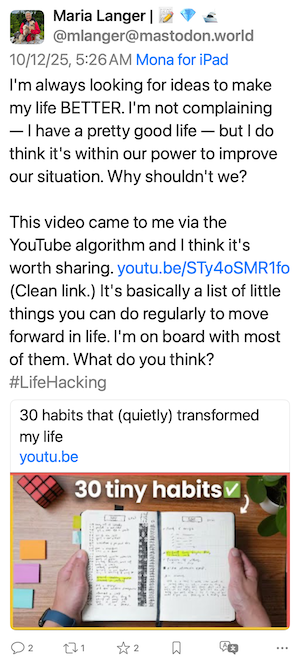
I’m impressed by a 15-minute you tube video and surprised by how the Claude AI/LLM summarized it.

I’ll try to keep this short. Let’s see how I do.

As some people know, I often watch boring YouTube videos on my iPad in the middle of the night to help me sleep. The other morning — probably too late to get back to sleep anyway — this one was suggested to me. I tapped it and was soon pulled in by the concise way the creator presented 30 excellent tips in about 15 minutes.

If you’ve got 15 minutes to spare and think your life could use some improvement, I highly recommend watching this. (If you don’t think your life can use some improvement, you’re only fooling yourself; we can all improve.)

My post on Mastodon
I shared the video on Mastodon, as I often do when I see something I believe is really worth watching.

Now if you were expecting some talking head with a big microphone in front of his face and lots of letters after his/her name to read off a teleprompter while mostly unrelated stock footage appears randomly in the background, you will be disappointed. Or, in my case, pleased — I hate those kinds of videos.

This video has some simple graphics to look at while listening, but it doesn’t need to be seen. You can just listen. Or you can do what my Mastodon friend MDY did: feed the transcript to Claude AI and let it summarize it. She shared the link on Mastodon, too: https://claude.ai/public/ artifacts/d5ad56a1-46fe-47ab-9fc7-5f3958dd1b08.

I clicked the link and was immediately impressed (and a little surprised) by the well-organized summary that appeared. I was impressed because, on first glance (and subsequent analysis), it appears to be both accurate and correct — something I’m not accustomed to seeing with AI results. That’s why I was surprised.

Now I’m no fan of AI systems. Not only are they failing miserably most times they’re used to take a human out of a process, but they have huge environmental impacts, sucking power and water that is already costly to produce or downright stupid to waste. I have read more than my fair share of AI horror stories, from lawyers idiotically trusting them to write briefs (that clients are paying hundreds of dollars per hour for a legal processional to write) to programmers spending more time fixing AI-generated code than writing it from scratch.

But at the very top of my list of reasons to hate AI systems is the simple fact that they are being developed and promoted as a way to cut labor costs — yes, the primary purpose is to add to worldwide unemployment.

Mastodon Post
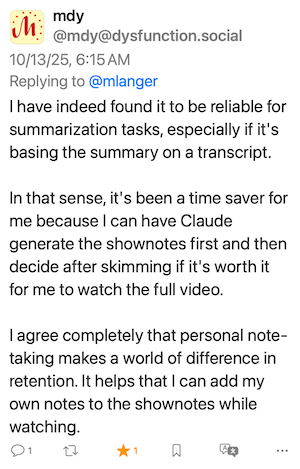
MDY explained how and why she uses AI to summarize content.

During our subsequent discussion on Mastodon, MDY made a good argument for using an AI like Claude to summarize video. She uses it to summarize content in seconds and then uses that summary to decide whether it’s worth watching the video (or one can assume, reading the article). I have to agree that if the content is long and the summary is concise, AI can save someone a lot of time, enabling them to focus on details in the content they find most valuable.

I do wonder how much time was saved in this example, though; the summary was more than 1600 words.

I also worry about people leaning on AI for tasks like this and losing the ability to create summaries for themselves. I compared an AI summary to the book reports we were required to write in school. What happens if we all just use AI for tasks like this and are then put into a position where we have to do it for ourselves?

I compare the potential loss of this skill to my own loss of spelling capabilities. I used to be a good speller. Really! But that skill is slipping away. I find myself more and more dependent on my computer or mobile device to flag or correct spelling on the fly. Sometimes, rather than look up or make an educated guess at the spelling of a word, I’ll type in something close and let my computer tell me the word I want. I’m not happy about this, but not motivated to turn off spelling check and tackle spelling on my own.

(For the record, I don’t and won’t use a grammar checker. For Pete’s sake, I am a writer. If I can’t get grammar and related style issues correct, I shouldn’t be writing at all.)

And has anyone ever considered the motivations of AI developers to get us addicted to using their systems for things we should be able to do on our own? Do you think the free systems will be free forever?

I guess my thoughts can be summarized as follows:

  • This video (and yes, the AI summary) is chock full of useful tips that can make your life better. Seriously, if you haven’t watched it yet or read the summary, why the hell not?
  • Yes, there are things an AI can do for you to make your life easier. But I still don’t think that includes creating original content that requires thought and creativity.
  • AI should not be replacing people in jobs. Related: A person’s job should not be to check and correct “original” content created by AI.
  • People should avoid technologies that do the thinking for them. “Use it or lose it” applies to your brain, too.

I don’t know about you, but I like to think for myself. While I can see the utility of the Claude summary MDY shared, I won’t be playing with AIs to summarize content for me any time soon. I’d rather do it the old fashioned way: by paying attention to what’s in front of me and, when appropriate, taking my own notes for future reference.

And look at that! I kept it under 1,000 words!

How to Conquer Your Biggest Fear

What is your biggest fear? What would it mean if you could overcome that fear, once and for all?

In this article, I’m going to help you do exactly that by teaching you five tactics to conquer anything you might be afraid of. Heights, spiders, small spaces, strangely-shaped clouds—whatever makes your knees turn to water and keeps you up at night.

These five tactics are universal and proven. In fact, last year I used them to help two readers who were afraid of driving overcome their fear over a single weekend, then shared the results on my YouTube channel.

Ready for those five tactics?

Let’s hear them.

1. Exposure Therapy

The core of attacking any fear is something in psychology known as exposure therapy.1

Exposure therapy is exactly what it says. You take something you’re afraid of and gradually expose yourself to it, first in small doses, then in larger doses, until finally you become desensitized to the experience.

If you’re afraid of heights, you don’t want to start at the top of the Eiffel Tower. You want to start on a second-floor balcony and work your way up until it becomes comfortable to stand at the top of the building.

Exposure therapy works because the human mind is an association machine.2 For most of us, our greatest fears are derived from some past traumatic episode or set of experiences.

In the case of my two readers afraid of driving, one survived a car accident when she was young, while the other had internalized her father’s neurotic insistence that she was going to die if she drove too fast.

And these associations had controlled both women ever since.

Exposure therapy helps us associate the experience we’re afraid of with different, more helpful beliefs.3

Not tumbling to your death from a second-floor balcony shows you height doesn’t bring inevitable doom. As for my two readers, I chose a slow drive in a retirement community to weaken their association of driving with horrific crashes.

But—and here’s the problem we run into with exposure therapy—they were still terrified even at 20 miles an hour.

Even though exposure therapy helps us create new, more helpful associations with our fears, it’s inherently stressful and scary because in doing it we’re forced to confront the fears we’ve spent our lives running away from.

To make exposure therapy more palatable, some people practice visualization. Psychologists are known to have their patients visualize their biggest fears and strategize responses to those fears in their mind.

Others go so far as to create VR simulations of the scary activity to mentally prepare for the real-life experience.4

One less discussed method is my next tactic: orthogonal exposure.

2. Orthogonal Exposure

Orthogonal exposure is basically giving yourself a break from the daunting activity you’re facing, and doing something that is different but highly related instead.

Surprisingly, this can have a lot of success with people’s fears.

Paul Graham, the famous investor, claims that he overcame his fear of flying on airplanes by learning to hang-glide. A friend of mine once told me that he overcame his fear of heights by learning to ski, by standing on top of a steep slope and looking down the mountain.

By attacking related, but different activities to the actual fear, we give ourselves a wider surface area to create new associations and build self-confidence.

As orthogonal exposure for my two fear-stricken drivers, I took them go-cart racing. I hoped that the incentive to beat each other in the race would motivate them to drive faster and push their boundaries.

I guess I should have known that wouldn’t work. Despite my urgings, both women finished dead last. Which brings me to the next tactic…

Before we move on, think about a fear that you have.

  1. What would your first level of exposure therapy be?
  2. What would orthogonal exposure look like for your fear?

3. Altitude Training

Eliud Kipchoge is the best marathon runner who has ever lived. In his 20-year career, he has won over 70% of the races he has entered and is the only human who has ever run a sub-two hour marathon.

One thing that’s notable about Kipchoge’s training is that he trains in the mountains of Western Kenya at an altitude of 8,000 feet above sea level.

For people like you and me, this altitude is absolutely crippling. We’d be gasping after a couple laps, but for Kipchoge, this is his standard practice. And when he comes back down to sea level in Berlin or London or Tokyo, he demolishes his competition.

This is known in sports as altitude training,5 and it can work for fears as well.

If you take whatever activity scares you and amplify the difficulty or complexity of that activity, returning to the normal activity afterwards will feel easy by comparison.

At least that’s the theory.

With fear, it’s tricky. Because facing fear operates in a kind of Goldilocks zone. If the activity you’re doing feels too easy, you won’t make any progress. But if the activity feels impossibly hard, then you can become overwhelmed and panic and end up creating more fear for yourself.

So the goal is to find something that is at the very edge of what feels possible, in the Goldilocks zone. Not too easy, but not too hard.

I took the two women to the racetrack and rented some of the fastest streetcars in America. The challenge was to go over 120 miles per hour, more than double the speed people drive at on the freeway. And one of them succeeded.

What’s more, she said she had fun doing it.

4. Make It Fun

Will Smith has a great saying:

The best things in life are on the other side of our fears.

—Will Smith

The greater the fear, the greater the joy waiting for you on the other side.

This raises an important question for you and whatever fear you might be struggling with: How can you make it fun?

When you have fun doing something that previously scared you shitless, that’s when you begin to tear down those associations that terrorized you your entire life.

Are you intimidated of dating? Well, how can you make it fun? Can you turn it into a little game for yourself? Do a double date with a friend you enjoy spending time with?

Insecure about your body image, afraid to go to the gym? How do you make it fun? Can you make bets with yourself on how much weight you can lift? Choose a workout where you feel less inhibited? Or go all out and join a pole dancing class?

Return to the fear you’ve been working on.

  1. What altitude training can you subject yourself to?
  2. How can you make the whole experience fun?

5. Identity Formation

It’s at this point that we get into the fifth and deepest strategy of conquering fear—identity formation.

I mentioned before that the mind was an association machine. Take the sum total of those associations and you get a person’s identity.

Statements like “I am a writer,” “I like long hikes,” “I’m afraid to drive” are all based on associations.

You have positive associations with some things, so you do them repeatedly. You have negative associations with other things, so you avoid them repeatedly.

These repeated and avoided activities then become your identity.

Prior to their weekend with me, my two readers’ identities were in part shaped by their inability to drive.

So I gave them an experience that would reshape their perspective. I rented a Lamborghini for each of them to drive down the Las Vegas strip.

As they took turns doing so, people kept waving and snapping pictures and calling out to us. That scariest thing that had been so intimidating to them their whole lives, now they were being socially rewarded and validated for it.

They can never say again, “I’ve never enjoyed driving,” because they have.

They can never say again, “I have no good memories in a car,” because they do.

They can never say again, “I’ve never driven on a road trip,” because I didn’t buy return tickets for our Las Vegas weekend. The only way to get home in Los Angeles was to drive.

And they did.

The two women drove from the Las Vegas strip to the beaches of Santa Monica. A drive that’s 294 miles through the desert, various towns, mountains, freeways, and notorious LA traffic. They took turns, had rest stops, and at no point did I touch the wheel.

Any fear can be conquered. It’s a matter of choice, persistence, and a little strategy.

But I haven’t told you what is maybe the most important one yet…

Bonus: Do It With a Friend

That strategy is called friendship.

My two readers had each other. They encouraged each other, they kept each other accountable, while I kept them both accountable.

The biggest asset in conquering any fear is an ally. Someone who can help you tackle your biggest demons. Who can hold you up when you start to fall. Who can lend a helping hand when you need that extra push.

What’s also understated is the commitment that results from tackling your fear with a friend.

My two readers made a commitment to each other. Neither one of them wanted to be the one that bailed. And so by them both being there, they kept each other going.


You can’t half-ass a fear. You have to go all in.

You need to set stakes for yourself and create consequences, and then find the allies and support networks to keep you accountable.

From there, you ramp up gradual exposure. Give yourself a little bit of altitude training and reward yourself for each of the small victories.

My weekend with the two readers was a triumph not because of the road trip home, though that was pretty badass. It was a triumph because we did it together. We created positive memories and showed one another what was possible.

This is what matters most, creating those positive associations. Making those lasting memories. Redefining what is possible.

Footnotes
  1. Exposure therapy. (2024). In Wikipedia.↵
  2. Mayes, A., Montaldi, D., & Migo, E. (2007). Associative memory and the medial temporal lobes. Trends in Cognitive Sciences, 11(3), 126–135.↵
  3. Tryon, W. W. (2005). Possible mechanisms for why desensitization and exposure therapy work. Clinical Psychology Review, 25(1), 67–95.↵
  4. Rothbaum, B. O., Hodges, L., Smith, S., Lee, J. H., & Price, L. (2000). A controlled study of virtual reality exposure therapy for the fear of flying. Journal of Consulting and Clinical Psychology, 68(6), 1020–1026.↵
  5. Altitude training. (2023). In Wikipedia.↵

40 Life Lessons I Know at 40 (That I Wish I Knew at 20)

Today is my 40th birthday.

When I turned 30 a decade ago, I wrote an article sharing life lessons to survive your 20s and crowd-sourced advice on how to excel in your 30s. And apparently you guys loved it.

So, here’s more of the good stuff: 40 life lessons I now know at 40 that I wish I knew at 20.

Dig in.

1. Your relationship with others is a direct reflection of your relationship with yourself

If you treat yourself poorly, then you will also unconsciously seek out and tolerate others who treat you poorly.

If you treat yourself with dignity and respect, then you will only tolerate others who treat you with dignity and respect.

Get right with yourself, get right with the world.

2. The only way to feel better about yourself is to do things worth feeling good about

Respect is earned, not given.

3. The only failure is not trying

The only rejection is not asking. The only mistake is not risking anything.

Success and failure are fuzzy concepts that only exist in your mind before you do something. Not after.

After the fact, everything will be a mixture of both. The only real failure is doing nothing.

4. No one is coming to save you

No single thing will solve all your problems. No goal, no achievement, no relationship.

No one will ever fix you. You will always feel mildly inadequate and somewhat dissatisfied with your life.

Nothing is wrong with you for feeling this way.

On the contrary, it might be the most normal thing about you.

5. Be the partner you want to have

If you want a healthy and fit partner, then be healthy and fit yourself. If you want a loyal and trustworthy partner, then be loyal and trustworthy yourself.

To put it another way, would you date you?

If not, then that’s a fucking problem.

6. The most valuable things in life compound over a long period of time

I’m talking about health, wealth, knowledge, confidence, relationships.

These things will frustrate you when you’re young because they are slow.

But if you start building them from a young age and you don’t stop, by the time you’re in your 30s and 40s you will have an incredible life.

7. The most sexy and exciting things in life are the opposite

These things start out extremely fun, but then have intense diminishing returns.

When you’re young, these things distract you and occupy a lot of your time and attention. I’m talking about social media, casual sex, drugs and alcohol, video games, gambling, vacations, and blowjobs.

The first time is incredible. The second time is almost as good. But then it’s all downhill from there.

Be sure to experience all of these things for a little bit, but then quickly move on.

Well, except the blowjobs. Don’t move on from the blowjobs.

8. If you’re not turning down things that excite you, then you’re not focused enough on what matters

Our world is overflowing with stimulation and opportunity.

If you aren’t struggling to turn down options, then you haven’t correctly prioritized what matters to you.

9. Taking responsibility for all of your problems alleviates more suffering than it creates

Most people assume that if you take responsibility for all the pain in your life, then you will just feel worse about it.

But the opposite is actually true. The more responsibility you take, the more you empower yourself to actually do something about that pain.

That’s because…

10. You give power to who you blame

When you blame someone else for your problems, you’re giving them power over you. You’re allowing them to define and dictate your happiness and well-being.

This is fucking stupid, so don’t do it.

It’s not worth it.

11. If you have to tell someone you’re that, then you’re not that

A rich man doesn’t feel the need to show people he’s rich.

A smart man doesn’t feel the need to tell people he’s smart.

A confident person doesn’t have to show people he’s confident. He just is.

Don’t say it. Be it.

12. Motivation is not the cause of action, but the effect

If you want to feel motivated to do something, take the smallest action towards doing it.

Then let the momentum carry you forward.

13. Love is not the cause of commitment, but the effect

You don’t wait until you have a perfect relationship to commit to a person.

You commit to the person in order to create the perfect relationship.

14. Passion is not the cause of good work, but the effect

You don’t wait until you find something you love doing.

You learn to do something well, and the process of developing competency and agency then causes you to become passionate about it.

15. The person you marry is the person you fight with

The house you buy is the house you repair. The dream job you take is the job you stress over.

Everything comes with an inherent sacrifice. Whatever makes us feel good will inevitably also make us feel bad.

16. A happy life is not a life without stress. It’s a life of meaningful stress

Nuff said.

17. Don’t view exercise as an exchange for something

You don’t work out to lose a few pounds or earn that hamburger or an ice cream. With this mindset, you will lose motivation quickly and quit.

Instead, view exercise as an investment. For every unit of energy you put in, you will receive multiple units of energy back.

The catch is that these units of energy you get back will be spread out over weeks, months, and years.

This is why exercising hardcore occasionally is far inferior to exercising a little bit every day.

18. Trust people

Most people are good. And while you might get hurt or embarrassed sometimes, the alternative is just way worse.

19. There’s no such thing as a life without problems

Warren Buffett has money problems. A homeless guy has money problems.

Buffett’s money problems are way more desirable than the homeless guy’s. But problems don’t just disappear, they get exchanged and upgraded for better problems as you grow and evolve.

The solution to today’s problem will be the seed of tomorrow’s.

Set your expectations accordingly.

20. Growth is rarely accompanied by joy and celebration

On the contrary, growth is usually painful to some degree.

That’s because growth requires loss—a loss of your old values, your old behaviors, your old loves, your old identity.

Change always has a component of grief to it, so be sure to let yourself grieve.

21. Fuck being normal

Statistically speaking, a normal person is physically unhealthy, emotionally anxious and depressed, socially lonely, and financially in debt.

So yeah, fuck being normal.

22. If you can’t say no, then your yeses mean nothing

We are defined by what we give up, what we sacrifice, and what we reject.

If you sacrifice nothing and reject nothing, then you have no identity. You are merely a reflection of the preferences and demands of the people around you.

In other words, if you don’t decide who you are, other people will decide for you.

23. Be careful how you define yourself

Your identity is a self-constructed mental prison, confining you to a life of desperately seeking and finding things to validate whatever you’ve chosen to become.

Define yourself as loosely and ambiguously as possible. You will feel less defensive towards the world and be willing to change when it’s necessary.

24. Don’t make assumptions about people

You have no fucking idea what they’ve been through.

Don’t make assumptions about yourself either. Chances are you have no idea what you’re talking about.

The last person we’re objective about is ourselves.

25. No one thinks about you as much as you think about yourself

Whatever you’re insecure about, chances are 99% of people around you haven’t even noticed it.

This is because everybody else is too busy thinking about themselves.

This may strike you as a little bit depressing, but it’s actually liberating. It means that you are judged far less than you think.

26. Confidence does not come from an expectation of success. It comes from a comfort with failure

There’s a word for someone who feels a need to succeed in everything: a fucking narcissist.

Don’t be a narcissist. Embrace your flaws. Embrace failure.

27. Develop a willingness to be disliked

This will grant you the freedom to do what needs to be done, even if it’s unpopular.

28. You cannot be a life-changing presence to some people without also being a complete fucking joke to others

Part of the price of having impact is some hate. And usually that hate is proportional to the impact.

29. Floss and wear sunscreen every day

Look, I know I sound like your mom right now, but trust me, in 20 years you’re going to be thanking me.

30. Extraordinary results come from repeating ordinary actions over an inordinate amount of time

Any overnight success is secretly the result of quietly working in obscurity for years, if not decades.

31. Choosing a partner is not about romance

You’re also choosing a confidant, counselor, career advisor, therapist, investor, teacher, travel buddy, roommate, best friend, business partner.

And no, I’m not saying you should make your partner be all these things.

I’m saying whether you want to or not, your partner is going to become all of these things. That’s what a relationship is.

So choose fucking wisely.

32. Don’t overestimate romantic love

Love doesn’t fix relationship problems. It doesn’t make trust issues go away.

The truth is, love can harm as much as it heals. It’s an amplifier. It makes a good relationship better and a bad relationship much worse.

Don’t get me wrong, love is great. Love is beautiful when it works.

But to make a healthy relationship, by itself love is not enough.

33. Trust is the currency of all relationships

Every good relationship is built off the back of years of trust.

Every failed relationship fails because of broken trust.

Therefore, honesty and integrity are the backbones of a life of healthy relationships and therefore happiness.

Dishonesty and a lack of integrity might be a shortcut to some short-term gains, but you’re completely fucking yourself in the long run, so fucking stop it.

Speaking of which…

34. If all of your relationships have the same problem…

Newsflash: you’re the fucking problem.

35. There’s no such thing as a bad emotion, only a bad response to an emotion

Every emotion can be used constructively or destructively.

One of the most useful things you can ever learn in your life is to figure out how to channel your negative emotions constructively.

36. Go to bed and wake up early

My whole life, I always promised myself I would never be that guy who went to bed at 9PM on a Friday and got up at 5AM to hit the fucking gym.

But kids, I hate to tell you, mornings are the real shit. Sorry.

37. You don’t have to prove anything to anyone, including yourself

Let me say that again: you don’t have to prove anything to anyone, including yourself.

38. Life advice is like clothing

Try it on. And if it doesn’t fit, discard it and try something else.

Also: like clothing, bad advice will be useless within a few weeks, but good advice will last you a lifetime.

39. Nothing meaningful in life is easy, nothing easy in life is meaningful

We think we’d like to have everything handed to us on a silver platter. But the truth is that we don’t appreciate or enjoy things that we don’t struggle for.

So stop avoiding the difficult things in your life and instead find the difficult things you enjoy.

And finally…

40. It’s never too late to change

A friend of mine once told me a story about his grandmother. He said that when her husband died, she was 62 and for the first time in her life, she began to take piano lessons.

For weeks, she practiced all day, every day.

At first, the family thought it was just a phase, a way for her to process her grief. But months went by and she continued to play every day.

People started to wonder if she was crazy or something was wrong with her. They told her to give it up, face reality. But she kept going.

By the time she was in her 90s, she’d been playing piano every day for over 30 years, longer than most professional musicians have been alive. She had mastered all of the classics—Mozart, Beethoven, Bach, Vivaldi.

Everyone who heard her play swore that she must have been a concert pianist in her youth. No one believed her when she said that she took her first lesson in her 60s.

I love this story because it shows that even at an impractical old age, you still have more time left to learn something than most professionals at that thing have even been alive.

I didn’t start writing until I was 27. I didn’t start my YouTube channel until I was 36.

In every phase of my life, I’ve started five to ten years later than most people. Yet it didn’t matter.

I get emails all the time from people asking me, hey, I’m 20 or 40 or 60 or 80, is it too late? Can I change? Is there time?

The answer is it’s never too late. There’s always time.

The only question is how long we’re going to sit here and make excuses and pretend there’s not.

How to Be Successful in Life

The internet is inundated with countless videos and advice columns promising to teach you how to become more successful than 99% of the world’s population.

Most of these claims revolve around setting goals, developing discipline, and eliminating distractions.

But let’s face it: if you take a close look at the habits of highly successful people, you’ll quickly realize that they don’t strictly adhere to a regimented lifestyle or adopt monk-like behavior.

So, what is it that truly sets the wildly successful apart from the rest?

The Real Pillars of Extreme Success

To genuinely rise above 99% of the population, you must:

  1. Develop a contrarian idea
  2. Be correct about that idea
  3. Execute on it on a massive scale

The most significant challenge lies in disagreeing with the majority, being right in your contrarian stance, and having the courage to put everything on the line for your beliefs.

People often fixate on the execution aspect because it’s the most visible and easiest to emulate.

However, execution alone does not determine the extent of a person’s success.

Correct Contrarianism: The Key Ingredient to Groundbreaking Achievements

Some of history’s most significant breakthroughs, such as the theory of relativity by Albert Einstein or the Wright brothers’ invention of the airplane, were once correct contrarian ideas that were initially deemed ridiculous and dismissed by many.

The willingness to challenge widely-held assumptions, adopt unpopular beliefs, and remain steadfast despite the ridicule and criticism that may come your way is what paves the way for groundbreaking success.

The Overlooked Downside of Extreme Success

But before setting your sights on becoming more successful than 99% of people, take a moment to consider the following potential drawbacks:

  1. You will be unpopular – Achieving extreme success can often alienate you from friends and family who may not understand or support your unconventional path.
  2. You will fail—a lot – To become a correct contrarian, you must first accept the fact that you’ll be an incorrect contrarian many times, which can lead to numerous setbacks and failures along the way.
  3. The happiness myth – Success doesn’t automatically equate to happiness. In reality, success often amplifies who you already are and how you feel, so it’s not a cure-all for life’s problems.

Redefining Success: Identifying Your True Motivations

Rather than obsessing over the notion of outperforming 99% of people, take some time to reflect on your underlying motivations for seeking such a high level of success.

Make sure you’re setting the right definition of success for yourself, and pursue your passions and goals for the right reasons.

By doing so, you’ll be more likely to achieve genuine fulfillment and satisfaction in life.

3 Steps to Becoming Great at Anything

Today, we’re going to talk about a question I get asked all the time:

How do I become great at this one thing?

And you know what? I’ve broken it down into three easy repeatable steps that will help you become an expert in any field.

Let’s dive right in.

Step 1: Master the Fundamentals

First things first, you need to figure out the 20% that drives 80% of the results. This is based on the 80/20 rule, also known as the Pareto Principle. It applies to nearly everything, from economic output to customer purchases, taxes, and even corruption.

To become great at something, you must identify the 20% of actions that will yield 80% of the results.

Take writing, for example. Editing is the 20% that drives the 80% of results. Ernest Hemingway famously said, “The first draft of everything is shit.” It’s through revisions and rewrites that you get a sparkling, clean, beautiful piece of writing.

Similarly, you’ll see the 80/20 rule crop up in many fields, like music, chess, and more. So, focus on figuring out where the 80/20 is in the pursuit you’re trying to become an expert in.

Step 2: Set Up a Feedback System

You can’t become an expert in anything unless you receive feedback that will help you get better.

Feedback can come in many forms, such as criticism from a teacher or coach, or even opinions from friends and family. The key is to have a consistent system of feedback and evaluation on your performance. This will help you iterate and improve.

Many people make two mistakes with feedback: they either don’t receive it (due to fear of criticism) or they receive it but refuse to listen to it (due to ego). A good coach can help with this by pointing out when you’re protecting your ego or ignoring proper feedback.

Remember, be realistic and honest about the criticism you receive.

Step 3: Iterate for 5,000 to 10,000 Hours

Now for the harsh truth: there are no shortcuts. You have to put the time in and iterate for 5,000 to 10,000 hours. Embrace failure and learn from it. The sooner you get those failures out of the way, the sooner you’ll start experiencing success.

Don’t fall for the myth of overnight success stories. The Beatles, for instance, grinded by playing for hours in dank German bars before they became famous. The same goes for Facebook’s co-founder Dustin Moskovitz. He didn’t become an overnight billionaire—he worked all night, every night, for seven years.

There is no shortcut. If you want to become great at something—anything—you gotta put in the work. And there’s your harsh truth of the day.

Are You Entertained—Or Addicted?

In David Foster Wallace’s classic novel, Infinite Jest, there’s a movie that is so entertaining that anyone who views even a small portion of it will give up all desire to do anything else in life in order to keep watching. Throughout the book, characters who see it give up family, friends, careers, even eating and sleeping, just to continue watching the film.

The overarching theme of Infinite Jest is that it’s possible, both as an individual and as a society, to be too entertained. And much of the book’s 1000+ pages are about the absurdity of such a society. Wallace wrote Infinite Jest in the early 1990s, a time when televisions were just starting to get dozens of channels, news was being broadcast 24 hours per day, video games were taking over the minds of young kids, and blockbuster movies were earning unheard of amounts of cash at the box office each summer.

At the time, Wallace had just gone through a recovery program for alcohol and drug abuse. Yet, despite getting clean for the first time in his adult life, he noticed something strange: he couldn’t stop watching television.

Wallace seemed to understand that as media multiplies, so does competition for attention. And as competition for our attention multiplies, content is no longer optimized for beauty or art or even enjoyment—but rather for its addictive qualities. When there are two TV channels, the channel doesn’t really have to worry about you clicking away, they just make the best show they can. But when there are 200 channels, suddenly that channel must do everything it can to keep you watching as long as possible. Wallace saw this problem coming decades in advance, and with his personal understanding of addiction based on his recovery experience, he seemed to grasp the addict culture we’d all soon be a part of.

Today, we regularly mistake this addictive media for entertainment. There’s some psychological function deep in our brains that tells us, “Well, I just spent six hours watching this show, I must like it a lot.” When, no, its script is actually a mediocre piece of hot trash and you’re being manipulated by cliffhangers and bad writing for hours on end to keep watching. The same way you get hijacked into scrolling through social media way more than you’d actually like to, your brain gets hijacked to watch “just one more episode” to find out if so-and-so really died or not.

In social media, this “it’s addictive, but I also kinda don’t like it” phenomenon has been recognized and discussed to death. But in other areas of media and entertainment, we haven’t caught on yet.

Streaming services and Hollywood are the obvious culprits here. How many more mediocre Marvel Universe movies do we need to prove this point? How many more bad Star Wars spin-offs? How many bad Netflix shows with every episode ending in a cliffhanger? Everyone complains about how Hollywood doesn’t have any new ideas anymore. Well, there’s a reason nothing new is getting made: endlessly adding content to the same well-worn storylines keeps people hooked. Constantly playing to people’s sense of nostalgia and remixing classic genres is a risk-free way of guaranteeing viewership.

Music is in a similar place. For a while now, market research on music streaming services has found that people spend more time listening to old music instead of new music and the trend on this is in the wrong direction. Music lovers are voting with their mouse buttons and those mouse buttons are going back in time, not forward.

Veteran music producer Rick Beato has made a number of videos lately talking about how popular music the past few years has gotten simplified to the point where it’s one or two chords and a single melody, repeated over and over for two or three minutes. No chorus. No bridge. No variation. No build-up or release. Just an endless hodgepodge of catchy sounds repeated, one after another.

Part of this is because the economics of music streaming is such that artists have incentive to not create the best songs or albums possible, but rather to create as many small, simple songs that prevent you from clicking away as possible. It’s created an artistic environment where it’s better to have 200 decent, listenable songs rather than 20 brilliant songs.

A similar problem plagues YouTube, where the biggest creators rack up millions of views doing inane things like opening a thousand Amazon boxes or giving away cars to their friends, over and over and over again. On the one hand, it’s not that interesting. On the other, you find yourself mindlessly clicking on the next video, and the next, and the next, and the next.

When everything is measured in terms of engagement, content will be optimized for addictiveness. Not entertainment or artistic merit. Not intellectual substance or creativity. Pure, plain addictiveness. That means we, the consumers, get a higher quantity of more predictable, less innovative, less interesting art in our lives.

In the realm of art and music and film and television, this is really annoying and frustrating. It requires each of us to sift longer and harder to find something new and great. But where this optimization for addictiveness gets dangerous is another part of culture that I want to talk about… *takes a deep breath* …politics.

I’ve written before about how most people in the United States agree about most things, yet somehow our political parties and government continually find ways to do things most people don’t like. Many pundits have attributed this inconsistency between the public’s desires and the government’s actions with theories about the primary system or entrenched special interests or polarizing social media.

But what about this? Politicians—like Hollywood executives, pop stars, and YouTube creators—are incentivized to generate more engagement. Not great results. Just more engagement, all the time. Therefore, their actions are not optimized to produce smart policy or common sense bills or a shrewd compromise, but instead to grab and hold our attention as long as humanly possible.

David Foster Wallace saw this coming too. The president of the United States in Infinite Jest is a former pop singer who obsesses over his television ratings, thinks policy discussions are too boring and considers war with Canada based on how good his photo ops would be in military camo fatigues. In the book, terrorist groups run rampant, as the battlefield is not for territory or resources, but for eyeballs and headlines.

Ultimately, nobody can manage our attention but ourselves. We can get mad at Netflix or Spotify or the Senate. But ultimately, these systems are loose reflections of our own attention habits shining back at us. Change our attention, change the systems. There’s an old saying that people “vote with their feet.” Well, today you need to vote with your eyeballs and mouse clicks. Don’t watch the next episode of that poorly written piece of garbage that keeps teasing you with characters almost dying. Don’t listen to the next half-assed album with 27 different two-minute tracks. Don’t click on clickbait. Don’t mindlessly scroll through TikTok and YouTube, rewarding people for attention-grabbing stunts. And don’t watch or respond to politicians and pundits who try to blather on and on about pet issues but never actually get anything done.

In the chaotic, entertaining mess of Infinite Jest, there is the story of Don Gately, a recovered alcoholic who would literally rather die than relapse into his substance abuse. When I first read the book years ago, Gately’s storyline seemed out of place. Amid all this futuristic mayhem of short attention spans and insanely addictive entertainment and neurotic teenagers, Gately’s narrative seemed like an oddly conventional story of personal triumph over one’s demons and an ability to sacrifice oneself for others.

What I realize now is that Wallace wrote the character of Don Gately as an example of what we would all need to aspire to become: recovered addicts. People who can cut themselves off cold turkey, who can turn off the drug. People who can manage their own attention and not fall victim to endless streams of mindless engagement. People who can step above the fray of political addiction and demand substance over bluster. And not just for our own sake. For everyone else’s as well.

❌