❌

Reading view

There are new articles available, click to refresh the page.

Lessons Learned From 'AdFection' and What To Do Next

Last week, researchers at Citizen Lab revealed a horrifying new malware campaign, dubbed “AdFection.” It used an ad network to distribute spyware to journalist’s devices to infect them without the target ever needing to click anything. This sort of attack on journalists is dangerous and incredibly concerning, especially since it’s built on the backbone of a technology we already object to: behavioral advertising. Although this type of attack has only been described targeting journalists, you can take a few steps we outline in the next section to mitigate the risk no matter who you are.

A few factors combined to make this attack a noteworthy first-of-its-kind. First, it utilized the surveillance ad-tech ecosystem to specially target the malicious code. Second, the spyware it delivered was so-called “zero-click,” meaning it required no interaction from the user to be infected: all that is required is for the ad to be delivered and code bundled along with it to be run, which happens automatically. Neither malvertising nor zero-click attacks are new on their own. What’s novel about the AdFection attack is combining them, creating a highly targeted, extremely dangerous attack which is difficult to defend against and even harder to detect.

Let’s take a deeper look from the perspective of one of the Windows devices supplied to the researchers from Al Jazeera. Here’s how the report describes the infection happening: 

  • Someone browsing the web or using an app on that machine is served an ad created by Discover-Tech, a company exposed in the report as “purporting to be a legitimate advertising company, [but] appears to be a front for large-scale ad espionage abuse.” 
  • The ad contains a small snippet of JavaScript code which is automatically executed when rendered in the app or website. 
  • This code reaches back out to a Discover-Tech server, referred to as their “NOAS server,” with detailed information about the machine rendering it: its cookie-set advertising ID, IP address, and more.

So far, nothing particularly unusual has happened. Ads that contain JavaScript code and reach back out to their servers with lots of information on your device—and by extension you—are commonplace. It’s all part of the data-driven advertising ecosystem. What happens next is more interesting:

  • The NOAS server uses this detailed information to determine it is an Al Jazeera machine requesting the ad. 
  • Instead of returning an empty response (as it does most of the time), it responds with a malicious, zero-click spyware payload. That payload was created by Discover-Tech’s partner Candiru/Integrity Labs, a company previously exposed for involvement in sophisticated malware attacks. 
  • The payload is then executed and infects the targeted machine.

Companies targeting zero-click malware attacks against journalists might seem like the plot of a blockbuster spy thriller. But this attack was enabled by the everyday practices of ad-tech companies, which unfortunately have extreme latitude in the collection of users’ data. By leveraging the tracking identifiers and data collected on devices for the purpose of delivering targeted ads to specific individuals, mercenary spyware companies can repurpose this data in order to fine-tune who they infect—and hide that they’re doing it from everyone else. 

Most ads are not delivered directly by the ad creators, but rather by intermediaries that facilitate Real-Time Bidding auctions. Nonetheless, winning bidders are given the ability to execute JavaScript code in the browser of the person who receives the targeted ad. This allows for interactive ads to be displayed, but also (as we’ve seen) for the compromise of a device just by delivery of malicious code.

While the different components in this attack chain are not novel on their own, the exposure of this combined attack is significant because it reveals a technique to hyper-target individuals and organizations for infection. Luckily, there are steps you can take to protect yourself from the myriad of dangers presented by the ad-tracking industry. Here’s how.

What You Can Do About It

As we work towards fundamental fixes to the ad ecosystem and banning online behavioral ads altogether, the onus is on all of us to protect ourselves. This is especially important for higher risk individuals or journalists working in states with heavy surveillance. Citizen Lab outlines several steps, depending on your threat model, to take to help protect yourself:

These steps can be very helpful in protecting yourself, but there is only so much you can do as an individual. Banning behavioral ads like this would be a good place to start. Behavioral ads aren’t just a privacy nightmare as designed. They are the perfect vehicle for malvertising and similar threats, just as we see here.


Announcing Privacy Badger for Safari on macOS

Exciting news for Safari users: Privacy Badger is now available on Safari for macOS! You’ll need Safari version 26.5 or higher to use it.

Whether you want to protect yourself from data brokers or just don’t want Big Tech profiting off your browsing data, Privacy Badger is here to help. More than 4 million people already use EFF’s free tracker-blocking extension to take a stand against online surveillance. Safari users can now join them and EFF in the fight for a better web.  

Install Privacy Badger

Support the Fight Against Online Tracking

Safari support has been one of Privacy Badger’s most requested features for years. Thanks to recent improvements in Safari's extension support, we’ve finally made it happen for Safari version 26.5 and higher. Privacy Badger is now available on all major desktop browsers. And before you ask, yes, we will look into supporting Safari for iOS once we've ironed out any issues on macOS.

Why Install Privacy Badger on Safari? 

Most websites contain invisible tracking code that lets companies collect, share, and profit from your personal data. Some of those companies are data brokers that sell your information to anyone willing to pay. Creepy ads are just the tip of the iceberg when it comes to the harms of online tracking: Once your information enters the data broker ecosystem, it’s nearly impossible to know who buys it or what they’re doing with it. Privacy Badger blocks online trackers to prevent your browsing data from being used against you.  

Privacy Badger goes beyond Safari’s built-in privacy features to provide additional protection against online tracking. In its default browsing mode, Safari limits the information that trackers can access but still allows them to load. Privacy Badger blocks trackers from loading in the first place, preventing them from tracking you using techniques that bypass Safari’s protections. 

Privacy Badger works well by itself, and will continue to enhance your privacy when installed along side an ad blocker or with Safari’s Advanced settings to block trackers in all windows. Since Privacy Badger automatically learns to block trackers, Privacy Badger will block trackers that other tools don’t know about or choose not to block. 

For example, Privacy Badger blocks tracking from widgets like embedded tweets, comments sections, and video players. These widgets can share your data even if you never click on them. Privacy Badger prevents these trackers from loading and replaces them with click-to-activate placeholders. 

Beyond tracker blocking, Privacy Badger automatically sends the Global Privacy Control (GPC) signal to tell websites not to sell or share your personal information. The GPC signal is already legally binding in a growing number of states, including California, Colorado, New Jersey, and Connecticut.  

All these features (and more) work together to help keep your browsing activity private on Safari. 

Try It Out and Spread the Word 

If you use Safari on macOS, give Privacy Badger a try. You’ll install Privacy Badger through the App Store on your macOS device. Installing extensions is a little more complicated on Safari than other browsers, so follow Apple’s directions here if you’re having trouble.  

This is our first release of Privacy Badger for Safari, and we will keep improving it based on your feedback. If you run into any problems, let us know by emailing extension-devs@eff.org, or by opening an issue on GitHub. And if blocking harmful trackers causes issues on a website you visit, you can disable Privacy Badger for that specific site while keeping it enabled and protecting you everywhere else. You can also let us know about broken sites by using the “Report broken site” button found next to the “Disable for this site” button in Privacy Badger’s popup window. 

When you use Privacy Badger, you join EFF and millions of other users in the fight for a better web. Help spread the word by telling your friends and family who use Safari that they can use Privacy Badger too!  

Install Privacy Badger 

Support the Fight Against Online Tracking 

DraftKings Is Using AI to Supercharge the Harms of Online Behavioral Advertising

Online sports betting company DraftKings is using AI to target customers who are most likely to place losing bets and respond to gambling promotions. This kind of targeting is a form of online behavioral advertising, which is when companies personalize the ads they show you based on the data they’ve collected about you. The more data a company has, the more personalized the ad can be. While DraftKings is using AI to supercharge the harmful effects of online behavioral advertising, EFF has long argued that all behavioral advertising should be banned. 

According to the New York Times, DraftKings is using its customers’ betting records to train a machine learning model to find losing gamblers. Once found, DraftKings sends these customers targeted advertising designed to lure them back to the site to place more bets—bets that DraftKings thinks will be losing ones. DraftKings has a business incentive to keep losing gamblers coming back to their site, because these are the users actually making DraftKings money. Unfortunately, those considered “problem gamblers” (people who repeatedly gamble despite harm to themselves, their finances, and their relationships) are highly likely to be targeted by this model. By re-engaging these individuals through targeted promotions aimed at keeping them on the platform, DraftKings is capitalizing on their vulnerability for profit instead of mitigating their risk. 

Predatory online behavioral advertising isn’t new, but companies’ use of AI to process data and target customers has magnified its harms. Online behavioral advertising incentivizes the collection of vast quantities of data to power ad tech. Adding AI into the mix means that even more data is collected to train and refine models. Because AI operates as a black box, the humans building the models can rarely predict which data points are the most useful to the AI, driving them to continuously collect more data. AI also allows companies to process enormous data sets much faster, and, as a result, supercharges the harms of online behavioral advertising. 

A direct consequence of online behavioral advertising is that it provides the data the surveillance industry needs to run. Data collected for targeted placement of ads is being sold to insurance companies, banks, and state and federal government law enforcement agencies such as CBP. ICE is also taking an interest in the data fueling ad tech: earlier this year, ICE published a Request for Information “seeking information to better understand how the industry’s commercial Big Data and Ad Tech providers can directly support investigations activities.”  

DraftKings seems to be using solely “first party data” to target their ads, meaning that they’re using only the data they collect directly from their users and are not buying any additional data from third parties to fuel their machine learning model. This highlights how policy solutions that only limit third-party data sharing and selling would not be enough to prevent these predatory advertisements. Rather, policymakers must ban online behavioral ads.   

What DraftKings is doing with their targeted promotions is just one example of how online behavioral advertising causes real harm to real people. But there are ways to take back control over your own data: EFF offers resources such as our Surveillance Self Defense project, along with other tips for how you can protect yourself on mobile apps and on websites.  

DraftKings’ use of AI to target losing gamblers illustrates how ad tech evolves and how companies find new ways to use our data against us. This is why EFF believes that all behavioral advertising should be banned. If companies can’t send personalized ads, they’ll have less incentive to collect the behavioral data powering them.  

EFF to Grindr: This Pride Month, Put Safety and Privacy Over Profits

This Pride month, we’re calling on the dating app Grindr to prioritize LGBTQ+ user safety by making privacy the default across its platform. That means no more sharing personal data with advertisers or training AI on private information without users’ opt-in consent.

Grindr is a dating app for the LGBTQ+ community; and for queer people, privacy violations can have life-altering consequences. Information that reveals someone’s sexual orientation, gender identity, or HIV status can be used by employers, governments, family members, scammers, or bad actors to inflict harassment, discrimination, arrest, or violence. For example, data from Grindr and other gay dating apps was sold by data brokers and used to 'out' (the act of disclosing someone's sexual orientation without permission) a gay priest in 2021. 

Despite being the world's most popular gay dating app, Grindr has repeatedly mishandled users' sensitive data. Grindr has been caught sharing users' HIV status and precise location with advertisers without obtaining valid consent, resulting in reprimands and fines in several countries. Its former Chief Privacy Officer even sued, alleging the company fired him for raising concerns about Grindr prioritizing “profit over privacy."

Grindr ended several of its most egregious data sharing practices after they were exposed. But more changes are needed if Grindr wants to earn back trust and prove its commitment to users’ privacy and safety. This Pride month, we’re calling on Grindr to make privacy the default and ensure the immediate implementation of two changes to better protect its users:

Opt Users Out of Behavioral Advertising by Default

Grindr currently allows users to opt out of behavioral advertising, but that protection is not enabled automatically (except in some unspecified regions). As we’ve long warned, behavioral advertising relies on the collection and sharing of personal data across a vast network of advertisers, intermediaries, and data brokers. Once information enters this ecosystem, users have little control over where it goes or how it is used: people’s most private and intimate information can be aggregated, sold, and combined with information from other sources to create detailed personal profiles.

By default, Grindr appears to share data with numerous advertising and tracking companies. Using TrackerControl, an app developed by privacy researcher Konrad Kollnig, we recorded Grindr contacting 20 third-party tracking domains during 15 minutes of app activity (see Grindr_TrackerControl_06-23-2026.csv for exported results). TrackerControl observed Grindr contacting Big Tech companies and ad-tech intermediaries, many of which have faced significant legal scrutiny for privacy violations. Several of these companies auction off ad space through a process called “real-time bidding,” which can expose user data to hundreds of additional companies and be exploited by data brokers. 

The dangers of Grindr’s default settings exposing users’ personal data to this ecosystem are not hypothetical. Between approximately 2017 to 2020, a location data broker collected the precise movements of millions of Grindr users from digital advertising networks and made them available for sale. The commercially available data was allegedly so detailed that, in some cases, it could be used to infer romantic encounters between specific Grindr users. 

Although Grindr has stated that it no longer shares precise location data or profile information with advertisers, it acknowledges sharing other personal data, including mobile advertising identifiers (MAIDs)—unique, persistent device IDs that allow advertising companies and data brokers to connect data about the same individual across different sources. MAIDs are not anonymous, and an entire industry exists to link them to more directly identifying information, like emails and phone numbers. According to Grindr’s privacy policy, companies receiving users’ MAIDs “are aware that such data is being transmitted from Grindr,” which could expose a users’ sexuality to the advertising and data broker ecosystem.

Opt Users Out of AI Training on Personal Data by Default

Grindr should stop training its AI models on users’ personal data without opt-in consent. 

Grindr has been investing heavily in AI features as its CEO strives to make Grindr an “AI-first business.” New AI features include a wingman chatbot, profile recommendations based on users’ inferred “type”, summaries of previous interactions with other users, and AI-generated insights about other profiles (like responsiveness, typical online hours, and engagement patterns). By default, Grindr uses its users’ personal data to train the AI models behind these features.

Grindr claims to never use sensitive health information for AI training and requires users to opt-in to AI training on “special-category” data, which includes chat content and precise location. But Grindr automatically enrolls users in AI training on other private information, including profile photos, age, taps, and display names. Users must navigate several levels of Grindr settings to prevent these personal details from being used to train Grindr’s AI.

AI systems trained on personal data create new privacy risks, including the possibility that personal information may be retained, reproduced, or exposed in unexpected ways. For example, researchers have been able to extract training data from AI systems like ChatGPT.

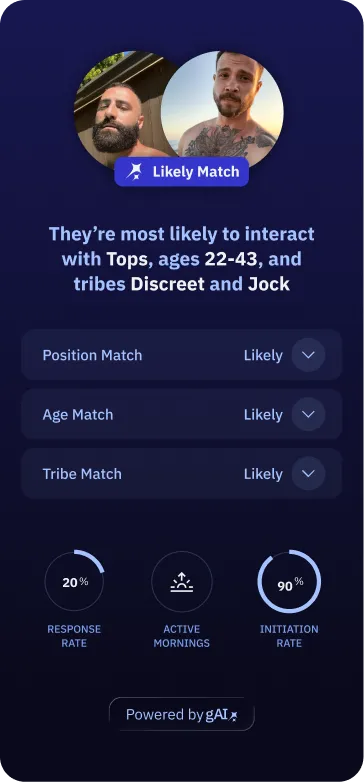
Beyond AI training, Grindr enables AI-powered features by default and allows both “special-category” data and other personal information to be processed by those features. Even users without access to premium-subscription AI features could have their data automatically used to power those features for other users. “Behavior-based profile insights” (pictured below) could expose information that users would never choose to share publicly, like the types of people they interact with on Grindr, their typical online hours, and how often they initiate conversation with other users.

AI-powered profile insight stating that a Grindr user is "most likely to interact with Tops, ages 22-43, and tribes Discreet and Jock." Insight also displays the user's response rate, initiation rate, and when they're most active on Grindr.

Image of the “Profile Insights” feature from a Grindr blogpost promoting its premium, AI-first subscription

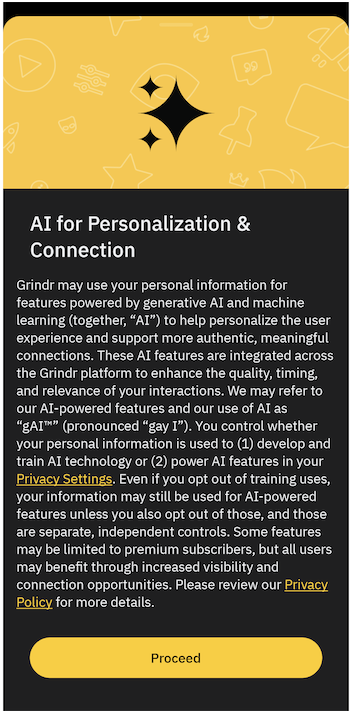
Regardless of whether new AI features leak private information, users deserve meaningful control over how their personal data is used and by whom. Grindr notifies users that their personal information may be used to train AI and that they can opt out on a separate settings page, but this notice does not specify the type of data used (i.e. profile photos, taps) and it is unlikely that people carefully read or understand it. Closing the notice or clicking its only button (which is “Proceed”) maintains Grindr’s default of using personal information for AI training. To respect users’ autonomy, Grindr should require opt-in consent before training AI models on personal data.

Notice entitled "AI for Personalization & Connection" describes the use of personal data for AI features. The only prominent button is "Proceed"

Notice displayed in the Grindr app about the use of personal data for new AI features

Celebrate Pride by Demanding Better Privacy

Grindr must immediately stop prioritizing profits over users’ safety. The ability to opt-out is not an acceptable substitute for opt-in consent, especially given the added risks of data sharing for LGBTQ+ users. Defaults matter—studies show that most people cannot or do not change the default settings of technologies they use.

If Grindr wants to back up its claim that it “takes user privacy very seriously,” it should make privacy the default across its platform, rather than something users need to go through complicated processes to opt in to. 

❌