If you’ve been with us for any time, you’ll probably know that we care less about averages than about distribution. A team is only as safe as its least safe person, and a high average can hide the people who feel least able to speak. Addressing inequality is a thread running through our core principles.
I first encountered the tools for measuring inequality during my masters studies in global health: the Gini coefficient and its ilk, used to describe how income, wealth and healthcare are shared. The Gini index for the USA is 41.8 (equivalent to Djibouti and Papua New Guinea) whilst for Norway it’s 26.5 (as is Azerbaijan). Those figures on their own tell us something, but they beg more questions than they answer. No metric is sufficient on its own, which probably says more about metrics than it does about inequality.
Same group, different verdicts
Imagine two groups of ten people, where each has 100 units to share out. In both groups, the average number of units per person is 10. But in the first group, the units are shared so that two people have 2 units each and the other eight have 12. In the second, nine people have 8 each and one has 28. Which group is more unequal?
The Gini says the second, by a whisker: 18 vs 16. The Palma ratio, which compares the share of the top 10% with the share of the bottom 40%, also says it’s the second group, but by twice as much: 0.88 against 0.43. The Atkinson index, which lets us decide how much weight to give the worst off, says in fact the first group is the most unequal, by nearly three times as much: 0.40 against 0.14, when it’s set to weight the worst off heavily. None of them is wrong. Each is looking at something different, and each builds in a judgement about what matters most.
The Atkinson index makes us choose what we think matters before it gives us a number. If we turn that dial all the way up, it emphasises the person at the bottom of the gradient, which is the measure behind “A team is only as safe as its least safe member”. Ecologists will recognise the idea from Liebig’s law of the minimum: an organism grows only as well as the nutrient in scarcest supply, however plentiful everything else is. Teams are similar.
Teams have shapes too
Most psychological safety tools report an average. But a team scoring 1,2,3,4,5 has the same average as a team scoring 3,3,3,3,3. Those are very different teams with very different needs. And a team scoring 1,1,4,4,5 has both the same average and range as the 1,2,3,4,5 team, but again, those teams are very different shapes. Most psychological safety surveys would show them to be the same.
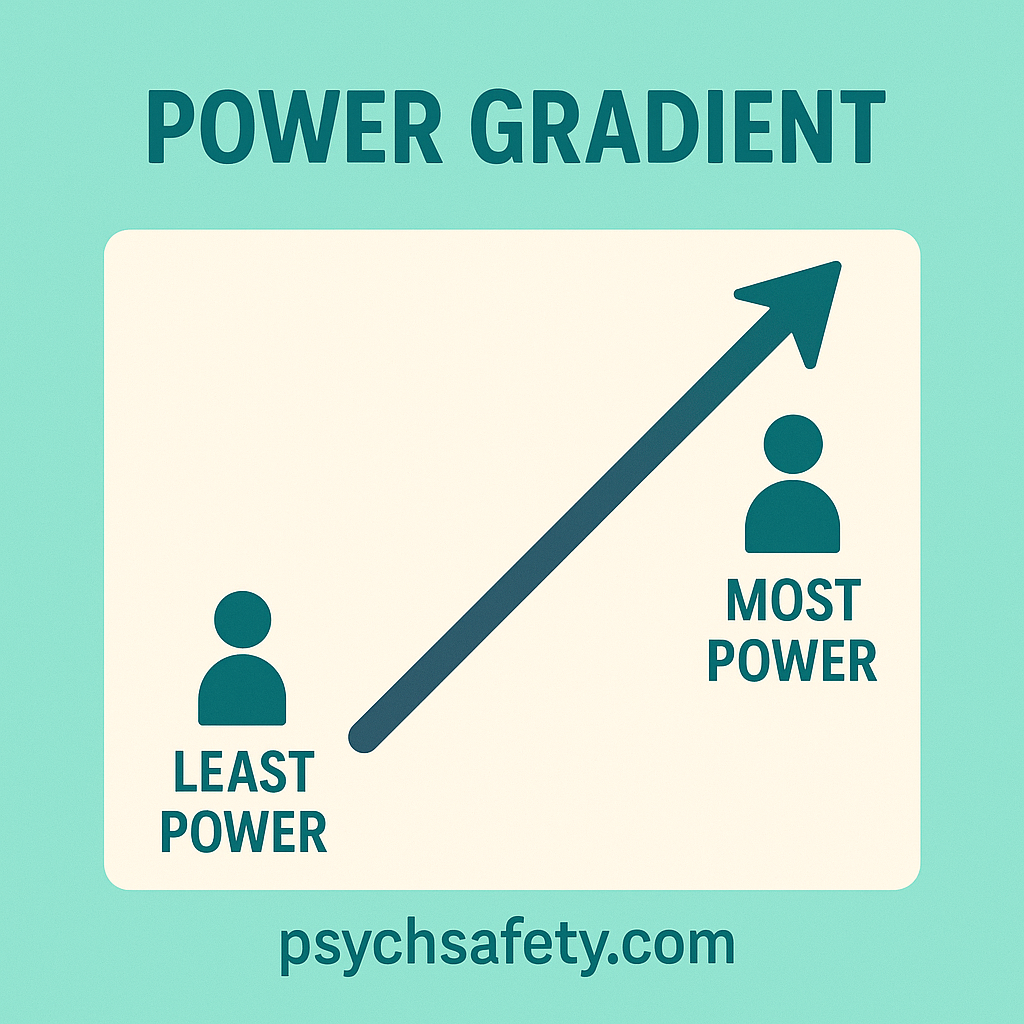
We also know which way inequality tends to run. In neonatal intensive care units, Ingrid Nembhard and Amy Edmondson found that psychological safety followed professional status and formal power: physicians felt safest, then nurses, then respiratory therapists. It echoes the Whitehall studies I wrote about in Good Management Saves Lives, where health improved at every step up the civil-service hierarchy, not just between the bottom grade and everyone else. Psychological safety, like health, tends to run along a gradient, and gradients tend to follow power.
Introducing the team’s gradient
So we’ve built a recognition of the gradient into our Measure tool.
The graph shows the shape of the team, from least safe on the left to most safe on the right. That shows how low psychological safety goes, how high it goes, how steep the gradient is between lowest and highest, and what shape it takes. A single number describes the steepness using the same building block as the Gini coefficient: on average, how far apart any two people in the team are on the 1 to 5 scale. The report then puts the shape into words, because a steady climb, or one person far below everyone else, or a team split in two each call for a different conversation.
When a team measures again, the psychological safety gradient shows what other reports can’t. In the example above, the lowest score rose from 1.9 to 2.1 and the highest from 3.1 to 3.9. Both ends rose and so did the average, but the gap widened and the gradient got steeper. An average would have reported only good news.
The gradient is always drawn from five points, however many people responded, to protect anonymity. And by design, Measure doesn’t ask about role, grade or demographics, because those questions make people easier to identify and less likely to answer honestly. So it can’t tell us whether a slope follows rank, gender or tenure. Instead it hands that conversation to the people themselves: whether it follows expertise, tenure, seniority or something else.
Measurement isn’t neutral
“Measurement is a technology with power, harnessed by those able to use it.” – Sally Engle Merry, The Seductions of Quantification.
All survey and engagement metrics decide (intentionally or not) whose experience counts and where we should pay our attention. And no measure can tell us whether a difference is unfair – inequality is a description; inequity is a judgement, and that judgement is ours to make.
Nembhard, I. M. and Edmondson, A. C. (2006). Making it safe: the effects of leader inclusiveness and professional status on psychological safety and improvement efforts in health care teams. Journal of Organizational Behavior, 27(7), 941–966.
Marmot, M. G. et al. (1991). Health inequalities among British civil servants: the Whitehall II study. The Lancet, 337(8754), 1387–1393. See also our piece Good Management Saves Lives.
Engle Merry, S. (2016). The Seductions of Quantification: Measuring Human Rights, Gender Violence, and Sex Trafficking. University of Chicago Press.
Whitehead, M. (1992). The concepts and principles of equity and health. International Journal of Health Services, 22(3), 429–445.
We recently went to see “Mud is Everything” at Nottingham Contemporary, an exhibition by the Paraguayan sculptor Julia Isídrez: bulbous anteaters, yawning hippos and strange cylindrical beings, made from clay she gathers herself from the earth near her home in Itá. Her description of that clay echoes our pieces on the organisational substrate, only she says it with the mud in her hands: it is sediment, minerals, microorganisms, insects, mycelia and plant roots. And “it is full of ancestors.”
“All mud used to be something else, and it will be something else again. Mud is malleable but also holds memory.” – Julia Isídrez
Anteater, from “Mud is Everything” by Julia Isídrez
In the last piece on organisational substrate, I described it as the accumulated structures, technology, incentives, institutional memory and past stories in an organisation that determine what can thrive and what cannot. There’s an informal set of tests I think about for deciding what counts as organisational substrate and what doesn’t: roughly, does it change what can thrive in the organisation? Is it a condition of the organisation rather than an event?* And does it survive the turnover of people? If all or most of the answers are yes, it’s likely to count as substrate.
Just like Julia says, the past shapes the substrate; and in some ways the past is the substrate. Peat, for example, is basically nothing but past life, layer upon layer of sphagnum moss that grew and died faster than it could decompose, accumulating at about a millimetre a year. A ten-metre peat bog is ten thousand years of autochthonous moss: a landscape built from its own dead. And a coral reef is perhaps the purest example of this sort of substrate (and just like peat, very fragile and under-threat) – a living community growing on the accumulated calcified skeletons of its own ancestors.
“Land, then, is not merely soil; it is a fountain of energy flowing through a circuit of soils, plants, and animals.” — Aldo Leopold, A Sand County Almanac
Substrate is made by past life, influences the potential of future life, and is continuously reshaped by those living in it in the present.
The substrate contains memory of past conditions: the flood that deposited a layer of silt or the forest fire that is now represented by a thin dark layer in the soil. The Rothamsted Park Grass experiment shows how even an English meadow contains a detectable trace layer of nuclear weapons testing in the 1960s.
Organisations lay down similar layers in their substrate too, many of them made of stories. There’s a classic study from 1961 by Jacobs and Campbell, two social psychologists interested in how traditions outlive the people who start them. They used an optical illusion where a stationary point of light in a dark room appears to wander, and they asked people to judge how far it moved. As a group, they tended to settle on a shared answer. Into each group the researchers planted a stooge, who gave a confident and wildly inflated estimate, and the group’s shared answer settled higher. Then the stooge left, and members were gradually replaced one at a time until nobody from the original group remained. The inflated answer persisted even though every founding member was gone; the group was still giving an answer that was seeded by a person none of them had ever met.
The story that taught a factory to keep quiet
There’s also a far more recent real world example: Claudia Pferner spent nearly three years inside a German car plant, exploring the spread of cultures of silence. The whole study landed on a single event years earlier. Karl, who’d been at the company for years as a quality foreman, asked a question at the company-wide management meeting: why was one production area measured on volume when every other area was measured on quality? A few days later he was summoned to a meeting and given a “disciplinary measure involving personal coaching”. Thirteen other interviewees cited Karl’s case as the reason they no longer ask questions in those meetings, even though many of them weren’t even in the room at the time of the incident, and some joined the company after the event and learned the story from colleagues, who retold it as a warning.
A leaf decomposes and becomes part of the ground in the same way that folklore like Karl’s story does in organisations. New joiners absorb it as the conditions of life, simply what happens here to people who do that.
A caution, however, about stories like Karl’s: when we hear them, most of us cast ourselves as Karl. Very few of us hear it and recognise ourselves as the superiors who disciplined him. If we carry any power in our organisation, the honest question isn’t “would I have asked Karl’s question?”. It’s “have I ever responded like this to a question, and would anyone tell me if I had?”.
“People think that stories are shaped by people. In fact, it’s the other way around.” — Terry Pratchett, Witches Abroad.
Humans are storytelling animals; folklore, folk music, legend, myth and gossip are how we’ve deposited experience into communal knowledge for as long as we’ve been a species. Maybe it’s what actually makes us a species. The substrate is turned over constantly by the small, unglamorous work of people talking to each other, just like the unglamorous but essential work of earthworms. Darwin, in his worm book, said: “It may be doubted whether there are many other animals which have played so important a part in the history of the world, as have these lowly organised creatures.”
Institutional Memory as Substrate
There was a Roman fort called Trimontium in the Scottish Borders, named after the three Eildon Hills nearby, and during hot dry summers, marks appear in the fields where it once stood, showing the walls, tracks and ditches of the huge ancient complex that occupied them, clearly visible from the air. Of course, we’re not actually seeing the ditches and walls, only the crop’s indications of them. Crops growing over an ancient ditch might stay greener and ripen later than their neighbours, because they can root deeper; whilst crops growing over an old wall or a Roman road grow slower and less green. Most of the time this tiny effect is invisible, but drought, hot weather, and resultant stress exacerbate it, so much so that it becomes clearly visible.
Trimontium from the air. Photo by Tim Garratt. This archaeological technique was pioneered by O.G.S. Crawford, a WWI aerial observer who realised reconnaissance photography could read the past as well as the enemy.
Organisations are also full of backfilled ditches, old walls and connections that are no longer there, and whilst the memory of these may often be invisible, during times of stress, these old loyalties, rivalries and fractures can reappear, sometimes with a vengeance. In either case, stress didn’t create these patterns: it just revealed them.
“Learning belongs to the roots, while education belongs to the branches.” – Munir Fasheh, Palestinian thinker and writer
Which leaves the question: who gets a say in how the substrate is shaped? If the substrate is something we all live in and pass on to those who follow, then it follows that we should collectively maintain, improve and steward it for others and those who come after. This sounds rather like a commons, and commons come with very well-studied structures, rules and practices. That’s the next piece.
*an event can certainly affect the substrate, in much the same way that a forest fire isn’t substrate, but it surely affects it.
Darwin, C. (1881) The Formation of Vegetable Mould, through the Action of Worms, with Observations on their Habits. London: John Murray.
Haudricourt, A.-G. (1962) “Domestication des animaux, culture des plantes et traitement d’autrui”, L’Homme 2(1), 40–50.
Jacobs, R.C. & Campbell, D.T. (1961) “The perpetuation of an arbitrary tradition through several generations of a laboratory microculture”, Journal of Abnormal and Social Psychology 62(3), 649–658. Worth noting that the inflated answer did fade over enough generations: traditions with no function eventually die out.
Leopold, A. (1949) A Sand County Almanac. New York: Oxford University Press.
Pferner, C. (2026) “‘Have you heard!?’ The narrative roots of organizational silence”, German Journal of Human Resource Management, OnlineFirst. 48 managers, 128 interviews, over nearly three years at a German automotive site.
Pratchett, T. (1991) Witches Abroad. London: Victor Gollancz.
When we opened this research pulse in March, we had some expectations about where we thought it would land. For individuals, especially neurodivergent folks, we expected AI to sometimes make speaking up a little easier; we’ve had many conversations in workshops with folks who have said they use AI tools as a way to rehearse a difficult conversation, or to find the words for something they want to say and aren’t sure how to put. For organisations though, we expected AI might pull us in the opposite direction, with the risk of jobs being replaced by AI and raising expectations about pace and quality of work leaving people feeling more precarious and that they have less room to get things wrong.
We asked three questions: whether you use AI tools at work, how that has affected how psychologically safe you feel with colleagues, and what’s behind your answer. 110 people replied. Some of what people told us matched our hypotheses closely, some of it somewhat complicated them, and one theme turned up that we hadn’t thought to look for at all.
The headline figures
Of the 90 people who use AI at work and answered our main question, the largest group said AI had made no real difference to how safe they feel with colleagues. The rest split in both directions, with about a third feeling safer and about a fifth feeling less safe.
For us, that spread is more interesting than the average. It points to several different experiences sitting side by side, and the comments people left to elaborate on their responses give an indication of what those experiences are.
AI is a place to rehearse
This was the clearest pattern in the comments, and it held up across people who otherwise appeared to have little in common. Those who said AI had made them feel safer mostly described using it to get ready for interacting with a colleague. One person has built meeting simulations and profiles of colleagues they find difficult, and now goes into tense meetings feeling much more prepared. Another asks it for “lines to take” because, in their words, “sometimes in the heat of a conversation I can’t immediately frame what I want to say well.” Someone else gets it to think like their manager and point out what they’re missing. One respondent described the whole cycle: practising emails, being coached through a situation with a colleague before speaking to them and stress-testing ideas before sharing them.
Only one person connected this to neurodivergence directly, explaining that they have ADHD and use AI to practise what they want to say.
All of these examples speak to change that happens in the person rather than in the team. Rehearsal helps us feel more prepared to walk into the room, and perhaps better able to predict what will happen next, even though the room itself, and what happens there when we say the thing, hasn’t changed.
One respondent raised a concern though around what might happen if rehearsal turns into replacement. A colleague had told them they talk things through with an AI chatbot, and this led them to wonder whether people who feel unsafe at work are now working through it with AI instead of raising it with a person, and whether that may leave them feeling more isolated. Rehearsal that leads into the real conversation looks like a potential benefit of using AI, but replacing interaction with AI conversation instead may leave the team less connected, and potentially feeling less safe than before. Interestingly, no one in our research described actually doing this, but the concern was there that others might.
AI leaves less room to get it wrong
Our second prediction, that AI might make people feel less secure in their roles held up too, though the comments were actually a little more nuanced than we’d anticipated. Very few people who felt less safe said they were frightened of AI itself. What came through instead was a sense that their own value had become harder to see. One person summed it up in a phrase they’d heard from colleagues: “You can use AI for that.” Someone working with developers described the boundary between their roles blurring, so that it was suddenly obvious how little they knew about code, and the power, along with some impatience, now sat with the developers. Others wrote about AI adding strain to existing overload, feeling that it was “yet another thing to learn and be good at, just to prove I can do my job”. In a similar vein, others described feeling pushed into using it, and feeling that it was leading to workplaces where there was “more pressure and less time to think”.
Admitting you don’t know something is one of the everyday risks that a psychologically safe team makes affordable. When AI seems to make those gaps in knowledge less forgivable, and is perceived to be continually raising the bar for performance at work, understandably people are going to find it harder to admit when they don’t know.
One comment pointed to where this might lead: “There’s worry about competence gap, there’s more isolation, more ‘team of one’ than before.” If people respond to feeling exposed by withdrawing, the team loses the conversations that would help everyone work out how best we work with this rapidly evolving technology.
Keeping it to yourself: stigma around AI use
Separate from worries about jobs, a handful of people described AI use as something they keep from colleagues, perhaps because in certain areas it is considered lazy, or even a form of cheating. Someone in academia put it bluntly: “everyone is using AI, but nobody dares admit it. The choice is either to use it and pretend we’re not, or not use it, and be left behind.” Another, also from higher education, said AI can feel like cheating, and wondered whether acknowledging it diminishes their capabilities in the eyes of their team. Given that so much of the discussion in higher education has been around detecting and potentially punishing students for inappropriate AI use, it makes sense that staff would find it hard to say openly that they use it themselves.
A trainer who has seen similar fears play out with e-learning described themselves as a “quiet AI enthusiast”, because their colleagues are scared enough that discussing how to use AI at work doesn’t feel safe. A team leader told us their own position makes it less risky for them to be honest about using AI, while recognising that people in their team seem nervous about saying what they use it for.
This isn’t the case across all teams and organisations, and indeed some respondents described a very different experience. One respondent who felt much safer wrote: “We all use AI in some form and discuss our use openly. We have frameworks to govern how we use it.” Another team treats anything from AI as not fully credible by default, which they said gives them an easy way to start conversations and question assumptions together.
It seems openness and transparency around use, and guardrails of using AI help to make it a safe conversation.
The biggest group: no change, for now
The largest single answer was to how AI was affecting people’s psychological safety was “no change”, and the reasons people gave for it fall into two camps. One was the people who are using AI but not in a way which has (yet) impacted on their interactions with colleagues, the things that actually shape psychological safety. One person, for instance, uses AI only as a starter for ideas and then abandons it; others said they’re “still at the experimenting stage” or that it’s early days where they work. For them, AI hasn’t yet reached the part of work that happens between people, so it’s had little chance to change how safe that feels. One respondent also captured the job security angle of this, saying fear of being fired isn’t a threat for them, “yet”.
The second camp said their team was already a safe place to speak up, and AI hadn’t shifted that. One described a very psychologically safe culture where the conversation about AI had been transparent from the start; another said their workplace had given people time in workshops to explore it together. That fits the pattern in the previous section. Where AI arrives into a team that already talks openly, and people are given time and space to explore AI, people can then talk openly about AI too.
Psychological Safety by proxy
Writing in HBR, Jayshree Seth and Amy Edmondson describe what they call safety by proxy: people using AI to surface a concern when they don’t feel safe enough to raise it directly. They argue that when that happens, it tells leaders something about the culture.
Nobody in our survey described passing a concern onto the team through AI in place of saying it themselves, but the person who described their team openly acknowledging the fallibility of AI as an easy way into questioning assumptions hits on an important point. If the idea on the table belongs to the tool and not to a colleague, it can be easier to critique it without worrying about the interpersonal cost. It is easy to see how that may extend to presenting your own ideas or concerns through AI as a way of slightly distancing yourself from them and lowering the perceived interpersonal cost of raising them.
A group that needs a proxy at the interface before it can disagree is a group where disagreeing directly still feels risky. Safety by proxy might become a rehearsal for the ‘real thing’ of disagreeing person to person. It might just as easily become a more comfortable way to avoid it completely.
What this means for teams and managers
One interpretation of this is that AI amplifies whatever a team already does with uncertainty. Where people can say what they’re trying, what they don’t understand and what worries them, AI becomes one more thing to learn about together. Where they can’t, it becomes one more thing to manage alone.
For managers, that points to a few practical suggestions:
Go first. Say how you use AI, including where it has gone wrong for you. The team leader in our survey noticed that seniority made disclosure less risky for them, which makes them the person best placed to take the first step.
Make “I don’t know how to do this yet” an ordinary thing to say. The people who felt least safe were the ones who felt exposed by having gaps in their knowledge.
Agree how the team uses AI, explicitly. Several of the people who felt safest had shared ground rules, or a shared habit of treating AI output as a starting point for discussion. Shared norms make the space more predictable and therefore (usually) safer.
Notice if anyone has gone quiet or appears to be pulling away from the team. If someone has become a “team of one”, ask what’s changed for them.
Welcome the rehearsal, whilst encouraging people to make sure the real conversation still happens afterwards.
The most hopeful comment in the whole survey was also one of the shortest. “We all use AI in some form and discuss our use openly.” What matters when it comes to psychological safety perhaps isn’t the use of AI as much as the habit of talking about it; making AI itself a safe topic of conversation.
About the data
This research pulse ran on an open survey link from 25 March to 6 October 2026, with a sticker-pack prize draw as a thank you. We received 110 responses (97 complete and 13 partial). 96 people said they use AI tools at work, and 90 of them answered the question about psychological safety. Around 60 left a comment.
It’s a small, self-selected sample, and people who already care about psychological safety are more likely to have taken part, so we should read the findings as a snapshot of experiences rather than a measure of how universally common they are. The themes above reflect our reading of the comments. Quotes have been lightly tidied for typos, and we’ve left out anything that might identify the person who wrote them.
Thank you to everyone who took the time to answer, and especially to those who told us what was behind their answer.
This week we’re excited to officially launch Measure: our very own psychological safety survey that comes back with a plan, not a score.
This has been a long time in the making. Over years of working with (and measuring psychological safety in) teams and organisations all over the world, in different contexts and industries, we’ve finally released our measurement platform for general use. It’s been in limited preview for a while, which many of you tested and told us what to improve. Thanks so much to the beta testers!
Measure is built on the mechanism of the calculus of voice. Before speaking up, we weigh up, mostly without realising we’re doing: Can I predict the response? What might it cost me? Does anything change as a result? Someone who stays quiet because the space is unpredictable needs better clarity and structure. Someone who stays quiet because nothing ever changes needs to see evidence that it’s worth it. It’s all of this that Measure delves into and knowing this is what lets us shape what comes next.
We have found that numbers aren’t much use by themselves, so Measure’s report not only provides you with the numerical data – the metrics, ranges and distributions – but qualitative context for those numbers too. It tells you the main things holding people back, how predictable the space is, and what the range of responses means, not just the average. A team that scores 1,1,1,5,5,5 and a team that scores 3,3,3,3,3,3 both average 3.0, which is an accurate answer to the wrong question.
Asking people how safe they feel and then doing nothing is one of the fastest ways to teach them that speaking up is pointless. So the report mustn’t stop at findings. Most importantly, Measure suggests what to try next. The suggestions are based on what the responses show, so you get intelligent practices and approaches to try that actually align with what that team needs. As with everything in our approach, they’re experiments, not prescriptions.
It’s a tool that you shape.
Psychological safety doesn’t look the same to everyone. A tech team (for example) may care most about ideation, experiments and trying things that might not work. A healthcare team may care more about communication, learning from error and reducing harm. Those are different kinds of psychological safety, and they need different questions.
So we’ve made sure that you can tailor Measure to the team and context that you’re exploring. It’s not a single, cookie-cutter, one-size-fits-all (and fits nobody well), survey tool. It’s a platform that you tailor to context and culture as you need it.
You choose up to 14 questions from a question bank, separated into themes of Voice and Power, Inclusion and Diversity, Innovation, Learning, Speaking Up, Team Cohesion, and Transparency. Or you can write your own (and with Org Plans, you can write questions that are asked of all teams). You can also select the seven questions, adapted to our instrument, from Amy Edmondson’s original research, what we call the “Edmondson Seven” (which sounds rather like a classic Western movie where Amy leads a gang to pull off a big heist).
It’s not a benchmark.
Measure doesn’t benchmark against other teams or organisations and it doesn’t give you a headline “score”. Imagine one organisation of 5,000 people, spread across offices in the UK, where all the team scores, when averaged out, come to 3.4. Imagine another of 20,000 people, across Europe and in a different industry, that scores 4.7. Is the second organisation psychologically safer? Does it have better managers? We can’t say. The work is different, the context is different, the same questions mean something different in each, and the distributions underneath those two numbers could be almost anything. In fact, the senior leaders in the 4.7 organisation might see that and think the work is done, so they don’t need to try any more. Even worse, they decide they’re happy with anything above 4, so 4.7 means they can turn the screws a bit harder, introduce a bit more fear.
Give an organisation a number and it will do what organisations always do with numbers, which is stop looking at anything else.
It also tells you what’s working well.
Measure also asks the question most surveys leave out: when speaking up does work here, what makes it possible? In the spirit of Safety-II as well as Safety-I we want to understand what goes well, not only what goes wrong. What is the team doing well to help people speak up? By surfacing this, we can do more of it, and we can protect it so that it doesn’t erode while our focus is elsewhere.
Open to everyone
Measure is currently available in English as well as “Easy Read English“. Spanish, German, French and Korean are available in public beta (and we’re looking for testers who are native speakers in these languages!). Even if the survey has been written in English, a respondent can respond in the language that suits them best. Easy Read may suit people with dyslexia or learning differences, or simply anyone who prefers it. A psychological safety survey shouldn’t hear only from the people best placed to read it.
It is also anonymous by design. Nobody answering is asked for a name, an email or an account, and no IP address is kept. No report opens until the survey has closed with at least four answers, and nobody, including us and whoever is paying, sees who said what.
What it isn’t
Measure is not a validated academic research instrument, and that’s deliberate. If we needed comparable psychological safety measurement for research, Edmondson’s original seven items, unchanged, would be the right tool. Measure is a sensemaking tool: it’s for helping teams and managers understand their own conditions and decide what to try. For that job, the ability to adapt to context, and its inherent usefulness, matter much more than comparability.
It also won’t suit every situation. A team of fewer than four can’t be surveyed anonymously, a short-lived project group may be better served by a conversation, and a survey won’t fix a team in acute conflict, just like a thermometer won’t put out a fire.
Screenshot from the Measure: Organisation Dashboard
Try it
Your first survey is free, with the whole report and plan. Paid plans just differ in how often and how many teams you can measure, never in what you learn: £60 a year to keep measuring one team (with reports that show you what’s changed over time), £260 a year for practitioners and consultants working with up to ten teams (you also get a Practitioner/ Consultant licence for free if you complete the whole Psychological Safety Train The Trainer course), and an Organisation plan for wider rollouts, organisation-level dashboards, Single Sign-On, auditing, and more.
We publish about once a week, and have done so for about six years. There are now over 350 articles on psychsafety.com as a result. So, despite our best efforts, the odd error has slipped through, and here I’m writing about some of our most egregious and/or funny ones. Many of these we found ourselves after publication, and some of them we were informed about by our wonderful readers – you folks (and we’re very grateful for that!).
I’m genuinely rather embarrassed about a few of these, but if we can’t admit mistakes and learn from them in a newsletter about psychological safety, then where can we? So here’s a list of various mistakes we’ve made, some followed by a Safety-I style “how do we prevent this happening again” measure:
Numbers we fucked up
We said exponential when we meant quadratic.Dunbar’s Number, Psychological Safety and Team Size (October 2022) said communication complexity “increases exponentially” with group size, then gave the formula n(n−1)/2, which is quadratic, not exponential. The point stands, in that: it grows fast. But the word was definitely wrong.
We labelled r-values as p-values.How Childhood Socioeconomic Status Shapes Psychological Safety and Career Risk-Taking (November 2025) This is probably the one I’m most embarrassed about. It’s a straightforward typo, but it stuck through edits and proofing. In the study results, we reported psychological safety as p=0.19 and opportunity-taking as p=0.21, but those are r-values, not p-values. The findings themselves don’t change: both correlations are significant at p < 0.001. Figure 2 also didn’t quite match the text, so we’ve redrawn it and published the script behind it. The check: more reviewers (i.e. we just reinvented peer review).
We got bogged down.Rewetting the Organisational Substrate (March 2025) said peat bogs store “44% of soil carbon”. The UNEP assessment we linked to says peatlands (bogs are only one kind) hold “up to one-third”. The 44% came from an IUCN briefing that gives “up to 44%” for all peat soils without saying where the number comes from. The check: reread the source we’re actually linking to.
We couldn’t count to seven.The Chatham House Rule (November 2024) said the rule has been translated “into six languages”, then listed seven. Oops.
People we really shouldn’t have quoted
We quoted a eugenicist as an authority.Déformation professionnelle (February 2025) opened with a line about specialists who think they understand the whole person, credited to “Alexis Carrel, Nobel laureate”. The line fits the article, but its author certainly doesn’t. The quote comes from Man, the Unknown (1935), which we also linked. The book argues for eugenics, and proposes gassing some criminals and the criminally insane in “small euthanasic institutions”. Carrel later headed a Vichy-era foundation whose work included eugenics and population research. We replaced the epigraph with Kenneth Burke: “A way of seeing is also a way of not seeing.” We’ve removed the link that pointed readers to Carrel’s book, and because this was a big mistake, added a correction note. The check: look up the people we quote, not just the authenticity of the quote.
We cited Dan Ariely after one of his papers had been retracted.Psychological Safety & Agile (January 2023) cited Ariely’s “Human Capital Factor” as showing that companies whose staff feel better about them do better financially. More than a year earlier, in 2021, a paper he co-authored was retracted after independent analysts found strong evidence that data in one of its studies had been fabricated. The Human Capital Factor itself came from commercial research by J.P. Morgan and Irrational Capital, a firm Ariely co-founded. We’ve since replaced it with peer-reviewed research: Alex Edmans found that the “100 Best Companies to Work For” outperformed their industry benchmarks by 2.1% a year between 1984 and 2009. The check: search a researcher’s name with “retraction” before relying on them.
Studies and ideas we mangled
We defined cognitive load loosely.Cognitive Load and Psychological Safety (March 2023) defined intrinsic load as “all the stuff you already know”. In cognitive load theory, intrinsic load is the complexity of the task itself, and what you already know affects how heavy it feels rather than being the load. The correct definitions actually make our point stronger: the paper our model came from counts emotions, including anxiety, as extraneous load.
We credited Schein with someone else’s paper.Edgar Schein’s Three Layers of Organisational Culture (February 2023) listed a 1986 paper by Kilmann, Saxton and Serpa under Schein’s name. Two readers told us. Thank you to them.
Data Visualisationgave the fifth of Alberto Cairo’s qualities of a good visualisation as “exploratory”. In The Truthful Art it’s “enlightening”.
Psychological Safety: Yogic Philosophy(September 2022) defined aparigraha as “non-stealing, non-possessiveness”. Non-stealing is asteya, listed two lines earlier; aparigraha is non-possessiveness.
Blametropism(December 2024) credited the essay “Moral Luck” to Bernard Williams in the text, then cited Thomas Nagel’s essay of the same name. Both Bernard Williams and Thomas Nagel published papers called “Moral Luck”, alongside one another in the 1976 Proceedings of the Aristotelian Society supplementary volume. It’s almost like the system was set up for us to fail with this one…
Dates, details and names
We gave Dewey a date after his death.Déformation professionnelle said “In 1968, John Dewey described… ‘occupational psychosis'”. Dewey died in 1952. 1968 is the edition of Robert Merton’s Social Theory and Social Structure that we were citing, which discusses Dewey’s term.
We put Chernobyl in the wrong country. Our What is Psychological Safety? page said the Chernobyl disaster happened in Russia. It happened in Soviet Ukraine, and a Ukrainian reader rightly told us so in 2023. We corrected it, and they kindly confirmed the fix.
We had Goodhart criticising a government that didn’t exist yet.Goodhart’s Law, Campbell’s Law and the Cobra Effect (July 2024) dated Goodhart’s article to 1975, then said it criticised “the then Thatcher government”. Thatcher became Prime Minister in 1979. A reader spotted the contradiction. What we meant was that the law was later used to criticise her government’s monetary targets, which is what the article now says.
We got the language wrong. In May 2023 we thanked a reader for translating one of our leadership vs management graphics into Spanish. It was Portuguese. Another reader pointed this out, then translated it into Spanish herself, and we shared her version the following week. A great example of how mistakes can be generative.
Our Barcelona Psych Safety Day page gave the date as 1 July 20233, which would have left you about 18,000 years to book. A reader spotted it.
Certainly not the last
No doubt many mistakes still remain. Some probably even in this article itself. If you spot something we’ve got wrong, tell us by emailing tom@psychsafety.com with the subject line “you f*cked up” If possible, we’ll send you some stickers as a thank you.
I’ll admit, I felt nervous writing this piece, for many of the reasons we all feel nervous about admitting mistakes: that we might be thought of as sloppy, less expert, or lazy. And frankly, for some of these mistakes, I’ve judged myself pretty harshly. So, as always, it’s rarely easy to admit mistakes – especially big ones. But these are all mistakes we have made with the very best of intentions, trying to do a good job, trying to get the work done. Some of them are mistakes that have led us to make systemic improvements. For some, a specific cause is less easy to identify. And ultimately we will make mistakes again. But I do hope that by committing to being as honest and open as we can about it, it might help, even just a little bit, normalise admitting our mistakes, and talking how they happen and what they teach us.
We’ve made the case before that the mainstream advice about eye contact and psychological safety is highly western-centric and neurotypical, and lacks context and nuance. Not only does it get causation backwards, but in reality, advising people to make more eye contact in order to foster greater psychological safety is potentially harmful and exclusionary.
So here, I thought it’d be interesting to explore a completely different angle on eye contact. What if we could foster greater psychological safety by intentionally reducing eye contact?
Three shapes of conversation
Most conversations at work take one of three physical shapes, each a different geometry of interaction. We can (1) face each other; we can (2) sit or walk side by side, oriented in the same direction; or (3) we can triangulate, all facing a third thing (a whiteboard, a screen, the thing we’re working on). Most psychological safety advice assumes the first is the ideal and the other two are somewhat lesser, degraded forms: that a “real” conversation only happens facing each other, maintaining eye contact, with full and intense focus on the person we are in conversation with. A lot of evidence suggests the truth could be the opposite, especially for difficult or intimate conversations.
Eye contact theory
First some theoretical background, because surely all the research is in favour of lots of eye contact? Not exactly. In 1965 Argyle & Dean proposed in Sociometry that intimacy is jointly regulated across gaze, physical proximity, and topic intimacy: i.e. we only have a limited capacity bucket that needs to hold all these things. So by reducing gaze, we can provide more space for topic intimacy. When we intentionally reduce eye contact, it means we can have more intimate, potentially more challenging, conversations. It’s a 60-year-old theory that mainstream eye-contact evangelism has essentially forgotten.
We can also explore this through the lens of cognitive load. Kajimura and Nomura (2016) found evidence that eye contact shares domain-general cognitive resources with speech production. Specifically, maintaining direct gaze slowed people down when words were harder to find. Reducing eye contact appears to free up cognitive resources to think about how we want to articulate something important. Glenberg, Schroeder and Robertson (1998) showed that gaze aversion facilitates remembering, and Doherty-Sneddon’s research programme showed that both adults and children avert gaze especially when questions are difficult, and that aversion increases with question difficulty. Phelps, Doherty-Sneddon and Warnock even found that teaching children to look away while thinking improved their answers. Eye contact uses up some of our brain beans that might be better spent on actually working stuff out and saying the thing.
There’s psychophysiological and neurological evidence too. Hietanen’s (2018) review of affective eye contact shows how direct gaze reliably raises physiological arousal (in the psychophysiologist’s sense of heart rate, skin conductance and a sense of vigilance, not anything romantic): which is useful in some contexts, but arousal is not necessarily safety, and for many people it’s the opposite. Hadjikhani and colleagues (2017) found that constraining autistic participants in conversations to look at the eyeregion produced abnormally elevated activation in subcortical threat-processing systems. A number of studies, including Trevisan and colleagues (2017) have gathered first-hand accounts describing eye contact as intrusive, draining and aversive.
We’ve heard from the psychologists and the neuroscientists; we should hear from the sociologists too. Erving Goffman described face-to-face interaction as a performance, and “face” for Goffman wasn’t just the area on the front of our head: it’s the social value we claim in an interaction, the image of ourselves as competent, reasonable, and worth listening to. “Face-work” is the continuous, mutual effort we all make to protect that image; our own and each other’s. And much of that work is conducted through our actual face, which is where threats to ourselves land and where we watch our words land on other people. With difficult conversations, the hard things worth saying are almost always threats to someone’s face: ours, theirs, or both. Facing each other, we watch the exact moment our words reach the other person and the ripples they make in their facial topography; a flinch or a fleeting frown. Reduce the facing, and we reduce the price of speaking for everyone involved.
Forced eye contact therefore, as we described in our last article on it, is for many people a stressor rather than a connector. So that being the case, as well as throwing out a lot of popular leadership advice, what can we do?
I have a good friend, Glen, who’s a walking therapist, and there’s a great deal of literature on the effectiveness of “side-by-side” conversations and disclosure, in part by reducing any perceived hierarchy, but in larger part by the necessary reduction in eye contact; it’s hard to maintain eye contact while we’re walking with someone, at least for any more than a few seconds before we walk into a tree or lamppost. As Glen describes, there are many benefits from walking therapy, including the calming effects of movement, being in the natural world, and walking itself can help free us from any sensations of feeling “stuck”. Therapists practising walk-and-talk formats consistently report that walking side by side, with minimal eye contact, helps clients open up (McKinney, 2011; Cooley, Jones, Kurtz and Robertson, 2020). And walking tends to occur in public, and connects to Goffman’s “civil inattention” concept; the implicit social permission for our eyes to wander and for our attention to be momentarily or slightly elsewhere.
And of course Freud’s infamous couch was itself an eye contact reduction strategy — he stated openly that he couldn’t bear being stared at all day, but the design also freed the patient to be more candid. He positioned himself out of sight so the patient’s associations and discourse wouldn’t be shaped by his facial reactions; a continuous stream of micro-verdicts that steer or suppress the conversation.
“I cannot put up with being stared at by other people for eight hours a day (or more). Since, while I am listening to the patient, I, too, give myself over to the current of my unconscious thoughts, I do not wish my expressions of face to give the patient material for interpretations or to influence him in what he tells me.” – Freud. “On Beginning the Treatment” (1913) pp123-144
The Men’s Sheds movement even made it a slogan: “men don’t talk face to face, they talk shoulder to shoulder“. Polly Wiessner’s PNAS study of Ju/’hoansi firelight talk is a delightful study of deep and meaningful conversation: daytime talk among the Ju/’hoan (!Kung) Bushmen of southern Africa was largely economic and practical, whilst fireside talk (with everyone facing the flames rather than each other) was where stories were shared and social imagination happened. Triangulating our most intimate conversations around a third point of focus is likely primeval.
On walking and creativity, Oppezzo and Schwartz (2014) found creative ideation was consistently higher while walking than sitting, indoors or out, and persisted after sitting back down. So if our conversations are intended to surface new ideas, maybe going for a walk is better than collectively standing in front of a whiteboard.
Designed for disclosure
None of this is new. We’ve been designing eye contact out of some of our most difficult conversations for centuries; occasionally on purpose. The confessional booth is a 450-year-old piece of psychological safety architecture: after the Council of Trent, Carlo Borromeo’s design specifications introduced the grille precisely to engineer better disclosure. Samaritans and other crisis lines are maybe a telephonic descendant, whilst barbers’ and hairdressers’ chairs (with eye contact softened via a mirror), and conversations in the car, are where many powerful conversations are able to be had that might not be otherwise. It’s a well-known parent hack: driver and passenger both face the road, so that sustained eye contact is impossible and mildly dangerous, and there’s no social obligation to fill any silence. It may take a long drive, but the important stuff will likely come out, probably somewhere around junction 8 of the M4.
I do a similar thing with my daughter, who’s four years old. I have an extra seat for her on my mountain bike, with her own little handlebars, which means she can come on rides with me, facing forward, sitting in front of me between my arms. We have some great conversations like this, as well as some long periods of contemplative silence, and songs from “Frozen”.
What all of these share is that the reduction in eye contact is a property of the setting and the context, not a request or accommodation we have to make. Nobody in a walking meeting has to explain why they’re not looking at you. Nobody in the car has to disclose that they’re neurodivergent and struggle with eye contact, or that direct eye contact is interpreted as disrespect in the culture they grew up in. The accommodation is a side effect of the context (even though it may be intentional). Asking people to disclose their needs beforehand may be requiring them to do something that does not yet feel safe to do.
Interestingly, the traditional police interview room, a space that is architected to produce pressure, is centred around forced facing. With its plain furniture, chairs facing each other, and nothing else to look at but the interviewer’s face, the design of the space is part of the “Reid Interrogation Technique”. So the arrangement that many LinkedIn posts prescribe for psychological safety is the one interrogators choose for pressure.
The converse effect of low eye contact
It isn’t all good news for the power of reducing eye contact. There’s a converse effect too: Lapidot-Lefler & Barak found that absence of eye contact was the single factor with a major effect on inducing ‘flaming’ and aggressive behaviour online. Their 2015 follow-up also found that anonymity, invisibility and lack of eye contact significantly increased self-disclosure. The point is that reduced eye contact lowers the cost of candour and of cruelty.
The difference lies in what goes alongside the reduced eye contact. The walk and the car pair it with being physically together, moving in the same direction, experiencing the same thing (the sun, rain, car radio, etc). The anonymous forum pairs it with near-invisibility and possibly a disposable online identity. So it isn’t simply “remove eye contact”; it’s “rethink the visual context while keeping people together”.
I’ll caveat this too. As someone with a stutter, telephone calls terrify me. Because the only means of communication in a telephone conversation is verbal, that’s the entire focus of the other person’s attention. The phone strips out eye contact, but it also strips out visual co-presence with it. The other person’s attention is entirely on the thing that I’m anxious about (voice), and they can’t see that I’m still there, thinking about what to say, how to say it, or getting over a short block. They might think the call has been disconnected, or they might simply get frustrated with me. So personally, I prefer video calls over phone calls – whilst appreciating that for others, it may be the other way around.
Choice over prescription
So we can actually foster psychological safety through reducing eye contact, whether that’s side by side walking together, going for a drive, or using a confessional booth (would be unorthodox – let me know if you try it). Or maybe it’s triangulation, talking whilst focusing on another thing, whether it’s studying a whiteboard or roasting potatoes in a campfire. Some things are easier said to a potato than a face.
But as always, it’s more complex than that. Lipreaders and people with hearing difficulties often need to see faces, walking conversations may exclude some people, cars are private and the person who’s driving has a degree of power-over, and some conversations might not be suitable for outdoors where other people might overhear. And some people, in some moments, genuinely want, or need, to be looked at.
The effects of eye contact are different across people and contexts, so I believe that the way forward is towards optionality: choice, consent, and multiple formats. The prescription to maintain eye contact fails because it’s a prescription; and replacing it with a prescription to avoid eye contact would be flawed in exactly the same way. What we can do is to create environments, platforms and practices in which people, including us, can regulate their own eye contact without penalty, and without explanation.
Argyle, M. and Dean, J. (1965) Eye-contact, distance and affiliation. Sociometry, 28(3), pp. 289–304. doi:10.2307/2786027
Cooley, S.J., Jones, C.R., Kurtz, A. and Robertson, N. (2020) ‘Into the Wild’: A meta-synthesis of talking therapy in natural outdoor spaces. Clinical Psychology Review, 77, 101841. doi:10.1016/j.cpr.2020.101841
Doherty-Sneddon, G. and Phelps, F.G. (2005) Gaze aversion: A response to cognitive or social difficulty? Memory & Cognition, 33(4), pp. 727–733. doi:10.3758/BF03195338
Doherty-Sneddon, G., Bruce, V., Bonner, L., Longbotham, S. and Doyle, C. (2002) Development of gaze aversion as disengagement from visual information. Developmental Psychology, 38(3), pp. 438–445.
Freud, S. (1913) On Beginning the Treatment. In: The Standard Edition of the Complete Psychological Works of Sigmund Freud, Vol. XII. London: Hogarth Press, pp. 121–144.
Glenberg, A.M., Schroeder, J.L. and Robertson, D.A. (1998) Averting the gaze disengages the environment and facilitates remembering. Memory & Cognition, 26(4), pp. 651–658.
Goffman, E. (1955) On Face-Work: An Analysis of Ritual Elements in Social Interaction. Psychiatry, 18(3), pp. 213–231. Reprinted in Interaction Ritual: Essays on Face-to-Face Behavior (1967). New York: Anchor Books.
Goffman, E. (1959) The Presentation of Self in Everyday Life. New York: Anchor Books.
Goffman, E. (1963) Behavior in Public Places: Notes on the Social Organization of Gatherings. New York: Free Press.
Golding, B. (ed.) (2021) Shoulder to Shoulder: Broadening the Men’s Shed Movement. Champaign, IL: Common Ground Research Networks.
Hadjikhani, N., Åsberg Johnels, J., Zürcher, N.R., et al. (2017) Look me in the eyes: constraining gaze in the eye-region provokes abnormally high subcortical activation in autism. Scientific Reports, 7, 3163. doi:10.1038/s41598-017-03378-5
Hietanen, J.K. (2018) Affective Eye Contact: An Integrative Review. Frontiers in Psychology, 9, 1587. doi:10.3389/fpsyg.2018.01587
Inbau, F.E., Reid, J.E., Buckley, J.P. and Jayne, B.C. (2013) Criminal Interrogation and Confessions. 5th edn. Burlington, MA: Jones & Bartlett Learning.
John E. Reid and Associates (2010) Designing an Interview/Interrogation Room. Investigator Tips. Available at: https://reid.com/resources/investigator-tips/designing-an-interview-interrogation-room
Kajimura, S. and Nomura, M. (2016) When we cannot speak: Eye contact disrupts resources available to cognitive control processes during verb generation. Cognition, 157, pp. 352–357. doi:10.1016/j.cognition.2016.10.002
Lapidot-Lefler, N. and Barak, A. (2012) Effects of anonymity, invisibility, and lack of eye-contact on toxic online disinhibition. Computers in Human Behavior, 28(2), pp. 434–443. doi:10.1016/j.chb.2011.10.014
Lapidot-Lefler, N. and Barak, A. (2015) The benign online disinhibition effect: Could situational factors induce self-disclosure and prosocial behaviors? Cyberpsychology: Journal of Psychosocial Research on Cyberspace, 9(2), article 3. doi:10.5817/CP2015-2-3
McKinney, B.L. (2011) Therapists’ perceptions of walk and talk therapy: A grounded theory study. Doctoral dissertation, University of New Orleans.
Oppezzo, M. and Schwartz, D.L. (2014) Give your ideas some legs: The positive effect of walking on creative thinking. Journal of Experimental Psychology: Learning, Memory, and Cognition, 40(4), pp. 1142–1152. doi:10.1037/a0036577
Phelps, F.G., Doherty-Sneddon, G. and Warnock, H. (2006) Helping children think: Gaze aversion and teaching. British Journal of Developmental Psychology, 24(3), pp. 577-588.
Trevisan, D.A., Roberts, N., Lin, C. and Birmingham, E. (2017) How do adults and teens with self-declared Autism Spectrum Disorder experience eye contact? A qualitative analysis of first-hand accounts. PLOS ONE, 12(11), e0188446. doi:10.1371/journal.pone.0188446
Wiessner, P.W. (2014) Embers of society: Firelight talk among the Ju/’hoansi Bushmen. Proceedings of the National Academy of Sciences, 111(39), pp. 14027–14035. doi:10.1073/pnas.1404212111
You may well have heard the phrase ‘psychological safety’ thrown around – perhaps referenced in a workshop title, mentioned as part of a training day or in an article someone forwarded you.
In the last few years, ‘psychological safety’ has become a term that a lot of people recognise but far fewer can actually define. This is a short read aimed at closing that gap, so that whatever brought you here, you get an accurate picture rather than the vague and sometimes contradictory version the phrase has picked up as it’s gained popularity.
What psychological safety actually means
Psychological safety was defined by Harvard’s Amy Edmondson as the shared belief that a team is safe for interpersonal risk-taking: that you can ask a question, admit a mistake, raise a concern or share an idea without being punished or humiliated for it. Put simply, it’s whether people feel it’s ok to speak up in that group. The speaking up doesn’t have to be verbal – it might be popping something in an email, writing it on a whiteboard or typing it in a chat, but the outcome is the same – they’re able to raise the thing they wanted or needed to do, without worrying that it will be held against them.
Note that we’ve said nothing here about people being ‘brave’. Someone feeling psychologically safe is about the conditions and context they find themselves in – and how safe they perceive themselves to be in those conditions. They don’t have to be braver than everyone else in the room; instead what we need is for the team around them to, over time, show them that it is genuinely safe to speak up in this group.
The “over time” part matters a lot here too. Nobody can decide once and for all that their team is safe to speak up in and mandate that everyone must therefore speak up without hesitation. Well, they could try (and some have!), but we wouldn’t recommend it. Psychological safety is a felt experience, and one that gets worked out in the realities of everyday work: what when someone admits they’ve missed a deadline, or tells their manager an idea won’t work, or asks a question everyone else seems to already know the answer to. Each of those moments offers a tiny piece of data. With enough good data, people recognise it’s safe to bring their thinking to the table. Enough data showing that it’s unsafe, and they learn to keep their head down instead. Again, this is not a failure of courage, but a wholly rational, sensible, and human, response to the risk of punishment or humiliation.
If pointing out a flaw might get you labelled difficult, or asking a question might make you look stupid, then you may sensibly perceive the costs to outweigh the benefits and keep quiet.
In order to foster greater psychological safety therefore, we have two main levers – we try to decrease the cost for people of speaking up, and increase the benefit.
What psychological safety isn’t
The term gets stretched to cover things it was never meant to, so it’s worth being clear about where its edges lie.
It isn’t the same as comfort. A psychologically safe team can still have conflicting views, which can mean hard, direct and difficult conversations. In fact, people feeling psychologically safe may make it more likely that we have those conversations, rather than suppressing any disagreement.
It isn’t a mental health intervention. Psychological safety is about how a team behaves and communicates at work: whether ideas, concerns and mistakes get heard. The two can certainly affect each other, but conflating psychological safety and mental health does neither any favours. Psychological safety isn’t a substitute for the wellbeing or mental health support someone might need.
It isn’t a personality trait someone either has or lacks. It’s an emergent property of a specific group, on a specific topic, at a specific point in time. The same person can feel entirely safe to speak up in one team and stay completely silent in another.
What it actually looks like
It’s rarely anything very dramatic. In a psychologically safe team, we might notice someone junior correcting someone senior in a meeting without being reprimanded for it. Or maybe we hear someone say: “I don’t understand, would you mind going back a step?” when we’re in the thick of a presentation. Perhaps it’s as simple as someone sharing a few half-baked ideas in an email to kick off a brainstorming session. None of this looks remarkable from the outside, which is rather the point: the absence of psychological safety is usually invisible too, right up until it isn’t.
A team with very low psychological safety may well look like a well-behaved, low-friction team, where people are getting along quite nicely with each other. It’s often only once something goes wrong we realise that people have been holding back from saying things that were important, but felt too risky.
Why it’s worth knowing properly
We don’t just see psychological safety as an optional extra for improving teamwork and performance. We would primarily say that we work on psychological safety because it’s the right thing to do. It is important for people to have a voice at work, and to feel that they can speak up without fear of punishment or humiliation.
But beyond that, there are clear performance benefits for teams with greater psychological safety, and a large and growing body of research into how that manifests in all kinds of different workplaces. When Google’s Project Aristotle studied what actually made their best teams effective, psychological safety came out ahead of experience, seniority or how many ‘superstar players’ were on the team at all.
Teams with psychological safety are more likely to catch errors earlier, surface problems so that they can address them and make better decisions. They’re also more likely to be able to do productive, constructive, creative work, because they can share ideas, work through challenges and learn together.
Where to go from here
This piece is deliberately short (ish). If you want to go further, three places to start:
What is psychological safety? for the full definition, the nuance, and the most common misconceptions in more depth.
“It has often been said that, as far back as we can trace man, we find him a tiller of the ground; but long before he existed, the land was in fact regularly ploughed, and still continues to be thus ploughed by earth-worms.”
— Charles Darwin, The Formation of Vegetable Mould through the Action of Worms (1881)
I’ve used the term “organisational substrate” for years, and introduced it in previous Psych Safety pieces, I think the earliest of which is my ecotones one in 2022. But I have not, so far, actually defined or explored it in writing. This is the article that does so. But first, beavers.
St Mary’s Loch, Scotland.
I recently went swimming in St Mary’s Loch in Scotland, where, according to nearby signs, beavers have made their home. Beavers are engineers: not ones with dirty overalls, oily hands and big spanners, but ecosystem engineers, organisms that physically alter their habitat, affecting it for everything else that lives there. A beaver fells trees and drags them into a stream to build a dam, which slows the water and creates a pond behind it deep enough that the beaver’s lodge entrance sits safely underwater. The beaver doesn’t have a Gantt chart, Change Advisory Board or project managers, and yet their dam will outlast most organisational transformation programmes.
The beaver’s work outlasts the beaver. Over time, especially if a dam is abandoned, the pond gradually silts up, the dam breaks down, and the pond behind it drains away downstream, turning into wet, rich grassland. These are called “beaver meadows“, and they last long after the last beaver has left. The sediment the dam trapped becomes the soil that the grasses and wildflowers of the meadow grow in, and what the engineer built is no longer a structure and is instead the foundation of a habitat.
Ecologists call this base layer of a habitat the substrate: the soil, peat, sediment, water, rock or any combination of these things and more. It’s what everything else grows in, and its composition and stability determine what can thrive and what cannot. If you’ve read the indicator species piece or any of my ecological pieces, you’ll have come across the term a few times.
So what is an organisational substrate?
I define organisational substrate as the accumulated physical and non-physical matter that an organisation lives in and on: the power structures, tooling, incentives and punishments, memory and story that determine what can thrive and what cannot. We build the organisational substrate continuously by living and working in it, the way a willow tree’s roots hold a river bank together and sphagnum moss acidifies the bog.
Some of our organisational substrate is as solid, though as brittle, as reef. The clunky old legacy software system that everyone works around, the office layout that determines who bumps into whom, and the capital reserves that influence the organisation’s appetite for risk. These things were all built (intentionally or not) by someone, for reasons that made sense at the time; the builders may have long gone and the thing might no longer be serving its original purpose. Beaver meadows.
The substrate is constructed
It’s tempting to think of substrate as the passive bit: the inert stage on which the interesting living things perform. Soil is just there, right? But soil is a lot of stuff, both living and not: minerals ranging from microscopic particles to boulders; water; and millennia of accumulated organic matter — every leaf that fell, every plant that died, every organism that died and decomposed (or got eaten, which is essentially the same thing). And soil has a very real structure: roots, fungi, water and burrowing creatures continually create and remake networks of pores and channels. The result is a complex, layered, sometimes fractal-like structure across multiple scales, worked over endlessly by animals, fungi, bacteria, and earthworms. As the ecologist Frank Egler put it: “Ecosystems are not only more complex than we think, they are more complex than we can think.”
Galerina marginata, the “funeral bell” mushroom. Deadly, and its preferred substrate is rotting wood.
The same is true of our organisational substrate – it’s far from an inert, neutral background, but is something that was built over time, by people and things, and continues to be built every day, as we will see.
The soil outlasts the worm
Darwin’s final book, published six months before he died, was about earthworms: The Formation of Vegetable Mould, through the Action of Worms, with Observations on their Habits (1881). He’d first raised the subject of worms at the Geological Society in 1837, a year after the Beagle came home, and it fascinated him for the rest of his life. He anticipated others might be less enthralled by the topic, conceding in his introduction that “the subject may appear an insignificant one”, but he carried on anyway.
He kept worms in pots in his study, breathed on them, shouted at them and got his son Francis to play the bassoon at them and wife Emma to play the piano at them. On establishing they were deaf (the worms, not his family), he then put the pots on the piano and found they responded to vibration through their bodies. He tested their intelligence by offering them paper triangles and recording which corner they seized to drag leaves into their burrows: they mostly chose the efficient (sharp) end, which he took cautiously as evidence of something like judgement in an animal with almost no brain.
His main field site for worm studies though was his lawn at Down House, where he spread a layer of cinders over the grass and then waited 29 years before digging a trench to see how far the worms had buried it. You can trust a man who spends twenty-nine years watching a lawn, partly because he isn’t going anywhere. By his calculation, the collective worms of an average English pasture pass about ten tons of earth per acre through their bodies every year, endlessly turning the country’s surface over. Worms are some of the most important ecosystem engineers on the planet.
“”All that you touch, you change. All that you change, changes you.”” — Octavia Butler, Parable of the Sower.
We are all ecosystem engineers
Like the worm, a willow tree doesn’t intend to be an ecosystem engineer, but it is: it creates substrate stability. Bits of willow twig break off, float along the river, get stuck in the riverbank, and start growing. Its roots begin to bind the riverbank together against the incessant flow of water, the bank is held together more strongly, and a whole community of species gets a stable margin to live on and expand just because the willow is there. Ecologists call this niche construction: organisms don’t merely adapt to their conditions, they make them, constantly, as a side effect of being alive.
Sphagnum moss goes further still. It doesn’t just tolerate the acid bog; it manufactures it: pumping out acid in exchange for nutrients, holding water in its dead cells to keep the ground wet, creating the anaerobic conditions in which very little else can grow, decompose, or compete. Sphagnum makes the world more like sphagnum. There’s a wonderful paper about this called: “How Sphagnum bogs down other plants“.
We all do this at work too. Simply by being there, we’re altering the organisational substrate; in fact we’re very much part of it, inside it, altering it continuously, through our presence and actions. When we find ourselves in a substrate that suits us, we will often unconsciously reinforce that same substrate, potentially to the detriment of other people that it doesn’t suit very well. This is particularly true for people in power; people seldom dismantle the power structures that got them into power, for much the same reason that trees seldom destroy the ground they’re rooted in.
The substrate would still remain if every one of us were replaced steadily one by one. Not because it can survive without us, but because it is passed to each of us in turn.
“A real gardener is not a man who cultivates flowers; he is a man who cultivates the soil.” – Karel Čapek
Whatever it is that we call “culture“, it sits on and within the substrate. If the substrate is the accumulated ground (the tooling, the incentives, the capital, the time pressure, the memory, the stories, etc), then culture (what we say and do, how we say and do it) is what’s currently growing in it: the living, human, present-tense expression of those conditions. Which is why culture-change programmes that address only culture, not the conditions that give rise to the culture, have the approximate effectiveness of shouting at a lawn.
There’s one more consequence of being in the system rather than above it, and it’s methodological. We have to be in the substrate in order to read it. There’s no remote observatory; the reading is done from ground level, by people who are themselves, inevitably, altering the ground just by walking it. This is the same discipline as reading the habitat before the indicator species, the context before the signal. It just reminds us of a need for a little humility: the reader is part of what’s being read.
Ground that never stays still
There’s a corollary to the idea that a substrate’s composition and stability determine what can thrive: if ground is disturbed frequently (if the substrate changes too often), it’ll be inhabited only by those suited to change: pioneer species like fast-growing, quick-to-seed nettles or willowherb. More mature communities (a word as contentious in ecology as in organisational dynamics, but still useful) need ground that stays still long enough for slow things like oak trees to establish, their acorns maybe present all along in the soil, just waiting for the right conditions to emerge and thrive.
In organisations that change very frequently (such as restructures every year or two), nothing sticks, and the constant new initiatives are colonised by the pioneer species of the politically nimble. Stability is the precondition for anything that takes longer than a planning cycle to grow: life rarely thrives on persistently unstable substrates. A counter example makes the point well: given enough stability, life can endure incredibly harsh conditions. A crustose lichen, Rhizocarpon geographicum, the map lichen, for example, can live for millennia, growing a millimetre a decade on mercilessly exposed, high altitude mountain rock, enduring weather that would kill most gardens in a day. Change can be good; but a stable substrate is precisely what makes successful change possible for those living on it.
By Tigerente in Wikipedia – CC BY-SA 3.0, https://commons.wikimedia.org/w/index.php?curid=215043
Drained peat doesn’t come back
If we can build organisational ground simply by being in it, it’s tempting to assume we can rebuild it just as readily once it’s damaged. We can’t, or at least not in the way we imagine. Peat is an important example of this. Peat is almost nothing but past life: dead sphagnum accumulating at about a millimetre a year, so a ten-metre bog is ten thousand years of moss. Draining a peat bog happens quickly. Someone cuts drainage channels, water flows, the water table drops and the moss dries out and dies, as does the peat underneath. What follows is a loss rather than a pause, because exposed to air, the peat oxidises and releases huge amounts of carbon dioxide, and the entire substrate shrinks at rates that can reach centimetres a year.
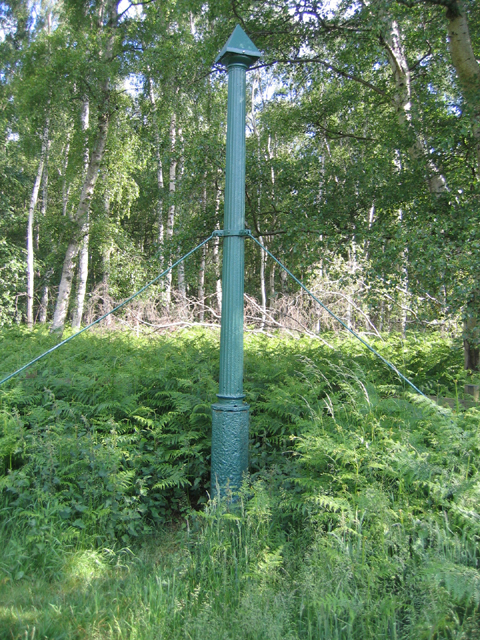
You can go and measure this for yourself, in the Fens where I grew up. In 1851, before the great mere at Holme Fen in Cambridgeshire was drained, a post was driven down through the peat and anchored in the clay beneath, its top set level with the ground. Immediately after drainage a subsidence of nine inches a year in the soil level was recorded, and today it stands roughly four metres proud of the surface. Four metres of substrate, thousands of years in the making, gone in under two centuries; the land around it is now the lowest in Britain.
“Every layer they strip seems camped on before.” — Seamus Heaney, “Bogland”.
When restoration finally comes, rewetting doesn’t bring the old peat back. What rewetting does is restart the accumulation, at a millimetre a year, and the bog that eventually grows is a new bog: similar, perhaps eventually even better in whatever way we mean by better, but not the old one.
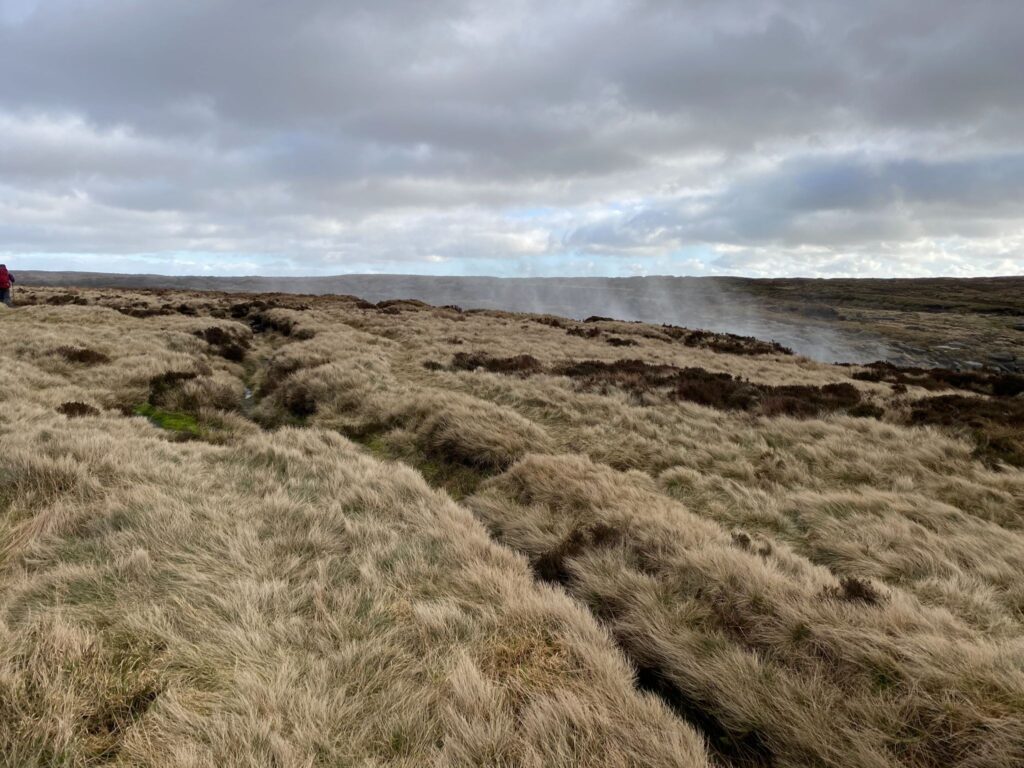
Semi-drained peat in the Peak District, UK.
Organisational substrate obeys the same devastating asymmetry. It’s so much easier to destroy something than it is to create. Degradation is fast; a round of redundancies, a public shaming of a mistake, a broken promise by leadership, and trust that took years to accumulate can oxidise in days. Restoration is slow, and it is not resurrection. The organisation that does the patient work of rewetting does so in ground that now includes the memory of the draining, and the new growth carries the scar. That doesn’t have to be a bad thing; a bone grows back stronger from a fracture.
Disturbed ground has another trick, too: real soil holds a seed bank, dormant seeds from earlier communities that can germinate the moment the ground is disturbed and conditions are right for them. If we tear things up in an organisation, we shouldn’t be surprised when what springs up first is not the new behaviour the redesign intended but the old stuff that we thought was long gone, whose seeds were just dormant in the substrate.
This is why “getting back to how things were” is the wrong ambition, and not only because the good old days were rarely as good as the folklore says. It’s the wrong ambition because it’s not available. What restoration offers, in bogs and in organisations, is the conditions for new and healthy things to thrive. They may resemble the old ones, or new ones, or they may be the otters that we thought were extinct. The honest version of hope is forward-facing rather than a longing for the past.
If there’s a single discipline to take away, it’s the beaver’s-eye view of every intervention we’re tempted to make. Before introducing the new practice, redrawing the org chart, or announcing rebranded company values, ask what ground they’re expected to thrive in. The answers to why our organisational change programme worked, or didn’t, are often underneath us.
A different way of seeing isn’t something one can be handed; it’s something we develop, over time, in the field. That’s what our Thinking Like An Ecologist workshop is for: not a new set of tools, but an exploration of a different kind of seeing.
References
Berger, J. (2018) Divine Polity: Religion and Re-Imagining the Role of NGOs in Global Governance. PhD thesis, University of Kent. The earliest use of “organisational substrate” I can find, there meaning an organisation’s underlying rationale, developed by analogy with DNA. My use is ecological rather than genetic: the shared ground built by past life that everything present grows in.
Darwin, C. (1881) The Formation of Vegetable Mould, through the Action of Worms, with Observations on their Habits. London: John Murray. To the Victorian public’s credit, it sold 3,500 copies in its first month, rivalling the sales of On the Origin of Species.
Egler, F.E. (1977) The Nature of Vegetation: Its Management and Mismanagement. Norfolk, CT: Aton Forest.
Jones, C.G., Lawton, J.H. & Shachak, M. (1994) “Organisms as ecosystem engineers”, Oikos 69, 373–386.
Mars, M.M. & Bronstein, J.L. (2023) “Ecological Metaphors in Organizational Science: An Interdisciplinary Critique”, Issues in Interdisciplinary Studies 41(2), 15–46. Ecological concepts borrowed into organisational writing tend to drift from their source meaning unless they’re traced back to the ecology and held to it.
Odling-Smee, F.J., Laland, K.N. & Feldman, M.W. (2003) Niche Construction: The Neglected Process in Evolution. Princeton: Princeton University Press.
Ramsay, A. (2024) My Dad Brought Beavers Back, illustrated by Abigail Little. Edinburgh: Scotland Street Press. The story of how the ecosystem engineers returned to Britain, by the family who brought them. Aimed at children, and better than many books aimed at adults.
van Breemen, N. (1995) “How Sphagnum bogs down other plants”, Trends in Ecology & Evolution 10(7), 270–275.
I’m by no means a serial corporate dinner attendee, but I do feel I’ve sat through my fair share of after-dinner leadership talks. The speakers are usually held up as shining examples of courage, resilience and leadership under pressure. Their stories have a reliable shape, generally including a man, a mountain and some frostbitten fingers – the typical hero’s journey. They run longer than scheduled. As my colleague put it the morning after one particularly arduous tale, by the end of the evening we felt we’d been up and down the mountain with him.
I don’t want to be too dismissive, because the power of storytelling is huge. Hearing stories of extreme peril offers an inspiring reminder that people can act well under extraordinary pressure and that teams can hold together when everything is falling apart. Stories like these, told well, are worth hearing. The problem is that these stories tend to gloss over the most helpful parts for anyone trying to build a team that will actually perform in a crisis. The mountain story always focuses on the leader’s heroism at the moment of peak drama, but the evidence about what makes a difference for teams in crisis points somewhere else entirely.
Mary J. Waller and Seth A. Kaplan’s Crisis-Ready Teams draws on ten studies, nine of which compare high and low performing teams under crisis conditions. What emerges from that body of research cuts against the mountain-summit view of crisis leadership: performance under pressure is shaped less by what happens at the peak than by what happens before it.
Setting the tone
For teams that work together already, the patterns of behaviour that will matter in a crisis are built – or not – in ordinary working conditions. Whatever interaction patterns they settle into will be the ones they fall back on when things get hard; they are unlikely to change once pressure mounts.
In contrast, in ‘swift-starting teams’ – groups brought together specifically to manage a crisis such as an accident response team – there are no established patterns to fall back on. These teams are usually composed of experts; highly trained people who may not know one another already, but must immediately “engage in the immediate interdependent performance of complex tasks.” What distinguishes the high performing from the low performing swift-starting teams turns out to be remarkably similar – it’s still about what happens first, but in this case that means how deliberately and effectively they set the tone for working well together in the very short opening phase of their teaming.
You can see this in a simulation study into medical teams that only met for a short period before a patient arrived for resuscitation. The teams with more balanced communication during that initial window went on to engage in higher levels of implicit coordination – the kind of fluid, almost wordless teamwork that looks, from the outside, like a well-oiled machine. However, teams where the lead physician dominated that early forming time by monologuing at their new teammates performed less well. A parallel finding in flight crew research found that greater reciprocity and stability in pre-flight conversations predicted higher performance in the air. The teams who hadn’t been able to have open and reciprocal communication from the start struggled to perform in their respective crisis contexts.
But what does ‘balanced’ communication mean? There is nuance here, and balance does not mean enforced equal airtime, where everyone must contribute the same number of words or talk for the exact same amount of time before the meeting can end. But it is about giving everyone a chance to speak and making sure everyone’s voice is heard. Connected to this, ‘reciprocity’, another early indicator of later performance, is about responsiveness – a pattern of exchange in which information offered is acknowledged and built on by other team members, rather than landing in silence or being cut across.
So establishing from the start how the team will work together matters. What we want to hear is a balance of voices with no single voice dominating, and people listening and responding to each other.
Structuring – clarifying roles, knowing who will do what
Information sharing – finding out what each person knows about the situation, and what they can find out
Decision making – deciding what to do with this information to try to solve the problem
Interestingly, high performing teams appeared slower at getting going, tending to spend longer in both structuring and information sharing phases. This, it turns out, is especially important when we bring together individuals from diverse professional backgrounds; they might individually come to quite different conclusions about similar information, so we actually need those interpretations to be spoken and shared so that other team members can “compare the voiced interpretations with their own understanding and, if needed, correct or add to this interpretation.” The outcome is a better overall understanding of the situation than any single team member could have reached by themselves.
Lower performing teams moved far quicker to decision making, but with little shared understanding to build on, their decision making was laboured and often inconclusive, a kind of meandering indecision. Because they’d never fully established how to best work together, they struggled to make good decisions as the situation unfolded.
A helpful way of thinking about it is that crisis-ready teams carry multiple shared mental models, including one that they’ve constructed together about how to best work together. They understand that a crisis is not a single moment requiring one quick response, but a sequence of phases, where their understanding of the situation and therefore the ‘best next thing’ to do will keep changing. There is no space in this picture for a competing-for-the-right-answer dynamic, where team members vie for power, and there’s also no room for the unilateral hero, who pushes forward with a solution without discussing it with or listening to the rest of the team.
During the crisis
So the research is clear that adaptability is essential, and crisis-ready teams need to do far more than simply execute a plan. This requires an ability to let go of existing work structures and move into active, collective sensemaking – to co-construct a shared understanding of what is actually happening, rather than what was anticipated.
The pull in the opposite direction is threat-rigidity: the tendency, under pressure, to fall back on established patterns even when those patterns no longer fit. As Staw, Sandelands and Dutton (1981) found, under threat a team restricts the information it takes in, narrowing its attention to a few dominant cues, and it also constricts control, so that power and decision-making concentrate upwards to whoever sits highest in the hierarchy. This is unsurprisingly corrosive for psychological safety and can tip a team into solution fixation: it locks onto an early answer, and few voices are able to challenge it. Yet crisis situations keep moving, so a fixed answer defended by a single voice is unlikely to remain the best answer. The reflex to shift authority upwards and narrow who gets heard strikes just at the point that teams need to be able to gather wide input and have many eyes, minds and voices working together to come up with solutions.
Adapting well starts with going out to meet the changing situation. In Waller’s (1999) aviation study, the difference that stood out during the crisis itself was that the high performing crews collected and moved information between each other earlier: they built a picture of the situation as it unfolded, passed it quickly to the people who needed it, and were faster to sort what mattered from what did not.
And this prioritisation of the information in the room is also key. In their own research, described in the book, Waller and Kaplan and their colleagues studied mine rescue teams and found that the faster-acting teams did two things more than the slower ones. They used more closed-loop communication, in which the sender speaks their message, the receiver reads it back and the sender confirms that they have it correct. While it might seem slow, this makes it clear to all what has been heard, not just what has been said.
Related to this, the faster teams also used more explicit coordination, spelling guidance out in detail rather than leaving it to be inferred. This looks like it should contradict the earlier point about implicit coordination being the marker of a well-functioning team, but as Waller and Kaplan argue, implicit coordination only works when the whole team already shares the same picture. In a novel crisis situation, you cannot count on that, so the faster teams say the thing rather than assume it goes without saying and have to repair the misunderstanding later. This is low-context communication under pressure, the explicit, spelled-out kind I’ve written about before. The kind of explicit communication that already earns its place in ordinary work, for reasons of clarity, inclusion and psychological safety, matters even more in a crisis.
What the research actually shows
The after-dinner speaker is not wrong that crisis performance is visible in the moment, whether that’s up the mountain, in surgery or managing a critical incident. But we miss the most important part if we don’t pay more attention to what gets built before that. The team that moves fluidly through a crisis shares information, speaks up, listens, builds on each other’s ideas and adapts without freezing – and that team has been working on this since they first started working together. The mountain story locates the heroism in the ascent. Waller and Kaplan locate it in the preparation, the patterns, the reciprocity, the quality of the communication and the willingness to structure before acting. It’s less dramatic, perhaps, and not such a compelling story. But it is far more effective.
Zijlstra, F. R. H., Waller, M., & Phillips, S. (2012). Setting the tone: early interaction patterns in swift starting teams as a predictor of effectiveness. European Journal of Work and Organizational Psychology, 21(5), 749-777. https://doi.org/10.1080/1359432X.2012.690399
Uitdewilligen S, Waller MJ. Information sharing and decision-making in multidisciplinary crisis management teams. J Organ Behav. 2018; 39: 731–748. https://doi.org/10.1002/job.2301
Staw, B. M., Sandelands, L. E., & Dutton, J. E. (1981). Threat Rigidity Effects in Organizational Behavior: A Multilevel Analysis. Administrative Science Quarterly, 26(4), 501–524. https://doi.org/10.2307/2392337
Waller, M. J. (1999). The timing of adaptive group responses to nonroutine events. Academy of Management Journal, 42(2), 127–137. https://doi.org/10.2307/257088
Su, L., Kaplan, S., Burd, R., Winslow, C., Hargrove, A., & Waller, M. (2017). Trauma resuscitation: can team behaviours in the prearrival period predict resuscitation performance?. BMJ simulation & technology enhanced learning, 3(3), 106–110. https://doi.org/10.1136/bmjstel-2016-000143
There’s a whole industry, and a lot of terrible advice, built on the promise that we can read people’s minds through their “body language”. Common tropes include things like averted eyes or a lack of eye contact meaning that someone is trying to deceive us, expansive open postures revealing confidence and warmth, closed postures signalling defensiveness or annoyance, and fidgety body movement indicating boredom or a lack of attention. Leadership courses teach it, hiring managers apply it, and a disturbing amount of psychological safety advice echoes the usual “maintain eye contact”, “mirror their body language”, and other awful suggestions to build trust.
“There’s no art to find the mind’s construction in the face.”
Shakespeare, Macbeth, I.iv
Non-verbal communication is real – we convey meaning with our bodies in intentional and unintentional ways, but calling it “communication” is part of the problem. It’s more like signals, and some of those signals may be significant, some less so, and some mean something completely different to how we interpret them. Non-verbal communication is context-dependent, strongly cultural, very different for neurodivergent people, and far less useful as a diagnostic tool than popular books or LinkedIn articles would claim. And there’s a bigger problem: it’s not just that the evidence to support a lot of this body language advice is weak, it’s that the popular advice functions as a normative tool – it teaches people to confirm and perform a narrow set of usually Western, neurotypical norms, and it licenses the hiring manager or the leader to judge people who can’t or won’t adhere to those norms. Joseph Pelrine says we should downgrade our confidence in it, but I’d go further – the standard body language advice isn’t just unhelpful, it’s actively harmful.
Photo by Vitaly Gariev: https://www.pexels.com/photo/young-woman-showing-thumbs-down-gesture-36763589/
The non-verbal communication myths that won’t die
Most of us have heard some version of the claim that 93% of communication is non-verbal. It’s on slides in a thousand leadership courses and all over LinkedIn. But where does it come from, and is there anything in it? In 1967, Albert Mehrabian conducted laboratory studies in which participants judged how much a speaker liked them when a single word, tone of voice and facial expression sent “contradictory” signals. The word was “maybe”, chosen because it was considered most neutral. Three speakers (all women) recorded it in three tones (positive, neutral, negative), which were paired with black-and-white photographs of three different women expressing liking, neutral and disliking expressions (Mehrabian & Ferris 1967). So the stimuli were: one word, spoken by strangers, paired with still photographs of different strangers’ faces. What they found was that when the channels (spoken and visual) conflicted, facial cues outweighed vocal cues by roughly three to two in judging whether the speaker liked the listener. That ratio is where the 55% and 38% come from.
But it wasn’t a conversation, it wasn’t even the same person’s face and voice. The studies measured nothing about normal conversation, and Mehrabian since spent decades pointing out that his equations (7% [literal meaning] +38% [tone] +55% [facial expression]) apply only to communications of feelings and attitudes, and only when the channels conflict.
The formula isn’t even a single finding. The 7% for words comes from a separate experiment, with different stimuli and different participants (Mehrabian & Wiener 1967), and the three numbers were arithmetically bolted together afterwards into one equation. Attempts to reproduce the ratios since have produced very different numbers.
That was the myth about reading other people’s bodies. The next one is about how we’re supposed to hold our own. In a now infamous 2010 study, Carney, Cuddy and Yap randomly assigned 42 participants to briefly adopt either expansive, “powerful” postures, or contractive “powerless” ones. The results showed that the power posers subsequently sought higher risk, and showed higher testosterone and lower cortisol, based upon a $2 gamble plus a self-report of how “powerful” they felt (Carney, Cuddy & Yap 2010). The claim was that a simple one-minute power pose boosted your power and influence. Cuddy’s 2012 TED talk became one of the most watched in history, and currently stands at over 60 million views.
By Erik (HASH) Hersman from Orlando – Power pose by Amy Cuddy at PopTech 2011, CC BY 2.0, https://commons.wikimedia.org/w/index.php?curid=63505316
Then came the takedown. Ranehill et al. ran a much larger replication in 2015 and found no effect on hormone levels and no effect on risk taking. The only thing that survived was how powerful participants said they felt, which is the single thread the theory’s defenders have pulled on ever since (Ranehill et al. 2015). After the p-curve analysis found no evidential value, Carney walked back the claims, stating publicly “I do not believe that ‘power pose’ effects are real.” and “the evidence against the existence of power poses is undeniable.” She also alluded to what is now called “p-hacking” – selecting the results that provide the lowest p-values, to imply greater statistical significance than the whole sample would suggest.
The more damning aspect is that these poses were often pushed hardest to the people with the least power, as a substitute for having any. If the powerless can simply stand differently to gain power, then structural inequity becomes reframed as a personal failure of posture.
There’s also an echo here with that HBS eye contact paper, which concluded that leaders should use sustained eye gaze as a strategy for building psychological safety. That conclusion came from a small sample, at an elite university, in a lab, which was turned into headline generalisation followed by an enthusiastic uptake by the advice industry before any replication had a chance to refute it.
“A lie can run around the world before the truth has got its boots on.” Terry Pratchett, “The Truth”
Detecting Deception
In 2007, SPOT (Screening of Passengers by Observation Techniques) was introduced in the US, a post-9/11 initiative loosely modelled on Israeli airport questioning techniques and developed with input from Paul Ekman of “microexpressions” infamy. Roughly $1bn was spent on the programme, with 3,000 Behaviour Detection Officers (BDOs) trained to spot “indicators” of deception and allocate their interviewee points according to the number of signs they spotted. These “signs of deception” (consider this is after an often long flight) included covering one’s mouth, blinking a lot, fidgeting, yawning, whistling, sweaty palms, which incurred one point each. “Arrogance”, a “cold penetrating stare” or “rigid posture” incurred two points each, and if an individual accumulated more than six points they would get interrogated. Points were deducted for demographics, with married couples over 55 getting two points back and women over 55 one point back. Profiling was literally built into it (Winter & Currier 2015, The Intercept), and reports suggest that 80% of those who were pulled from security lines under SPOT were minorities.
In 2013, the GAO (Government Accountability Office, the audit office of the US Congress) reviewed four meta-analyses covering over 400 studies across 60 years and found that the human ability to identify deception from behavioural indicators is the same as or slightly better than chance. TSA revised its list of indicators in response, but when the GAO audited the revised list four years later, it found no valid scientific evidence for 28 of the 36 behavioural indicators, with only 3 of 178 cited sources holding up at all. A BDO manager put it bluntly: “The SPOT program is bullshit… Complete bullshit.” This is body language ideology at state scale, and the impact of it is greatest on people whose baseline demeanour differs from Western, neurotypical expectations. Those from cultures with different norms around gaze, proximity and expressiveness, and those for whom being scrutinised by uniformed authority is already, understandably, stressful. Body language advice then is more than just corporate training room nonsense and has become an instrument of state power, whilst in organisations the same machinery operates at smaller scale in interviews where candidates are marked down for “poor eye contact” and performance reviews that record “closed body language”.
No “universal” non-verbal signals
The LinkedIn version of body language advice rests on the idea that certain expressions and postures carry the same meaning everywhere: that there is a universal human non-verbal code. It was, to be fair, the dominant scientific view for a long time. It is coming apart though. Studies comparing Western and East Asian observers show they use different strategies to decode the same faces, confusing expressions that the universal model says should be unmistakable (Jack et al. 2009, Jack et al. 2012). Research with the Himba in Namibia, the Hadza in Tanzania and Trobriand Islanders found that, without Western emotion concepts supplied by the experimenters, participants rarely produced the “universal” labels at all (Gendron, Crivelli & Barrett 2018). Behavioural ecologists instead argue that facial displays are tools for social influence, acts performed for an audience, shaped by culture, context and relationship – social tools rather than emotion readouts (Crivelli & Fridlund, 2018). I like this interpretation, because it mirrors actual ecosystems – a signal only has meaning within context – if we treat a raised eyebrow as “contempt”, we’re ignoring everything else that gives the signal its meaning.
Body language and neurodiversity
In 2017, Sasson and colleagues showed observers ten-second clips of autistic and non-autistic people. Participants’ first impressions of the autistic participants were formed quickly, were markedly less favourable across nearly every trait judged, and didn’t improve with longer exposure. But when observers were given only the conversational content, with no audio-visual cues, the bias disappeared entirely (Sasson et al. 2017). It was the neurotypical reading of body language and facial expression that catalysed the exclusion.
This is connected to what Damian Milton calls the autistic “double empathy” problem: communication misunderstanding runs in both directions, not a deficit of the autistic person. Neither autistic nor non-autistic people lack empathy, it just looks different to each (Milton 2012). Catherine Crompton demonstrated it well in her 2020 research: information passed along a chain of autistic people survived just as well as it did along a chain of non-autistic people, and only information passing along the mixed chains degraded (Crompton et al. 2020). The difficulty is at the allistic/autistic interface, not in the individual.
The mainstream literature on psychological safety and body language has absorbed the body language advice uncritically in two ways. One is that we’re encouraged to read certain gestures as signals that someone feels unsafe, such as crossed arms (but maybe they’re just cold), lack of eye contact (but maybe they’re neurodivergent or it feels culturally inappropriate for them), fidgeting (but maybe that’s how they regulate, or they’ve just had a strong coffee). This leads to misinterpretation of signals as well as a sense that we’re being surveilled rather than supported.
The other way is the converse: we’re told to adopt certain non-verbal behaviours, adopt open postures, shake hands firmly, maintain eye contact, sit still, etc. This asks those already spending the most effort to conform (neurodivergent people, people from non-dominant cultures, people without access to particular social norms) to these Western, neurotypical norms. And it’s a nasty feedback loop, because the more that people conform, the more it looks like these norms are universal when they’re not. When we tell people that psychological safety looks like sustained eye contact and an open posture, many people will oblige, because the cost of not doing so is read as different or difficult. We then observe a great deal of eye contact and open posture, which works as confirmation that this is what psychological safety looks like. We conflate compliance with inclusion.
Meanwhile, those who cannot or will not comply are deemed exceptions rather than evidence against the norm. It gets filed as a personal shortcoming rather than as a signal that the norm didn’t actually fit. And if the expected behaviours happen to be our native ones, the room will look welcoming, cooperative and entirely natural, largely because other people are working quite hard to make it look that way for us.
Photo by Diego Sandoval : https://www.pexels.com/photo/a-man-scuba-diving-4765931/
What to do
We all convey things, sometimes very important things, non-verbally. It might be intentional, with a thumbs-up or a wink (both of which mean very different things in different cultures and contexts – don’t give a thumbs-up when you’re diving unless you mean to return to the surface) or unintentional, such as yawning (Morris et al. 1979).
The point is that tone, timing, movement, eye contact, posture, and facial expression do carry information, but that information is non-deterministic, local rather than universal, culturally influenced, and very dependent upon knowing the person and the context. Just like indicator species: we must read the context before the signal.
The lesson is almost embarrassingly basic: pay more attention to what people say, and less on how they say it. Treat non-verbal “communication” as weak signals: opportunities for humble inquiry rather than judgement. Agree on team norms, and make our own needs and preferences explicit, and encourage others to do the same, so we can reduce the need to “read the air”.
The magic universal non-verbal Babel fish was never real. What’s real is the often frustratingly slow process of actually getting to know people and understand them, in their own contexts, and give them space to be themselves. A monoculture is not evidence of what the land can grow.
References
Mehrabian, A., & Ferris, S. R. (1967). Inference of attitudes from nonverbal communication in two channels. Journal of Consulting Psychology, 31(3), 248-252. https://doi.org/10.1037/h0024648
Mehrabian, A., & Wiener, M. (1967). Decoding of inconsistent communications. Journal of Personality and Social Psychology, 6(1), 109-114. https://doi.org/10.1037/h0024532
Carney, D. R., Cuddy, A. J. C., & Yap, A. J. (2010). Power posing: Brief nonverbal displays affect neuroendocrine levels and risk tolerance. Psychological Science, 21(10), 1363-1368. https://doi.org/10.1177/0956797610383437
Ranehill, E., Dreber, A., Johannesson, M., Leiberg, S., Sul, S., & Weber, R. A. (2015). Assessing the robustness of power posing: No effect on hormones and risk tolerance in a large sample of men and women. Psychological Science, 26(5), 653-656. https://doi.org/10.1177/0956797614553946
Cesario, J., Jonas, K. J., & Carney, D. R. (2017). CRSP special issue on power poses: What was the point and what did we learn? Comprehensive Results in Social Psychology, 2(1), 1-5. https://doi.org/10.1080/23743603.2017.1309876
US Government Accountability Office (2013). Aviation security: TSA should limit future funding for behavior detection activities (GAO-14-159). https://www.gao.gov/products/gao-14-159
US Government Accountability Office (2017). Aviation security: TSA does not have valid evidence supporting most of the revised behavioral indicators used in its behavior detection activities (GAO-17-608R). https://www.gao.gov/products/gao-17-608r
Jack, R. E., Blais, C., Scheepers, C., Schyns, P. G., & Caldara, R. (2009). Cultural confusions show that facial expressions are not universal. Current Biology, 19(18), 1543-1548. https://doi.org/10.1016/j.cub.2009.07.051
Jack, R. E., Garrod, O. G. B., Yu, H., Caldara, R., & Schyns, P. G. (2012). Facial expressions of emotion are not culturally universal. PNAS, 109(19), 7241-7244. https://doi.org/10.1073/pnas.1200155109
Gendron, M., Crivelli, C., & Barrett, L. F. (2018). Universality reconsidered: Diversity in making meaning of facial expressions. Current Directions in Psychological Science, 27(4), 211-219. https://doi.org/10.1177/0963721417746794
Crivelli, C., & Fridlund, A. J. (2018). Facial displays are tools for social influence. Trends in Cognitive Sciences, 22(5), 388-399. https://doi.org/10.1016/j.tics.2018.02.006
Sasson, N. J., Faso, D. J., Nugent, J., Lovell, S., Kennedy, D. P., & Grossman, R. B. (2017). Neurotypical peers are less willing to interact with those with autism based on thin slice judgments. Scientific Reports, 7, 40700. https://doi.org/10.1038/srep40700
Crompton, C. J., Ropar, D., Evans-Williams, C. V., Flynn, E. G., & Fletcher-Watson, S. (2020). Autistic peer-to-peer information transfer is highly effective. Autism, 24(7), 1704-1712. https://doi.org/10.1177/1362361320919286
Cook, J., Hull, L., Crane, L., & Mandy, W. (2021). Camouflaging in autism: A systematic review. Clinical Psychology Review, 89, 102080. https://doi.org/10.1016/j.cpr.2021.102080
A Critique of The Four Stages of Psychological Safety – a second edition
We’ve written about the Four Stages of Psychological Safety before (way back in 2020 in fact), and that earlier piece was somewhat generous. It concluded that the model is potentially useful despite being wrong (though I didn’t, at the time, clarify in which way it was wrong), and potentially harmful if applied uncritically. Now I’m revisiting the Four Stages and reflecting on a few years of practice since then.
In the spirit of applying an inappropriate numerical structure to a complex phenomenon that doesn’t actually arrange itself in numbered steps, here is my Six Stage critique of the Four Stages model. They’re not really stages, and don’t need to be read in order. You can skip some, double back, or read it in reverse, which is kind of the point.
Before we begin, I want to be fair: the Four Stages model does some potentially useful things. It gives people a vocabulary for noticing that psychological safety is not a binary on/off, and that (for example) feeling safe to suggest an idea is not the same as feeling safe to dissent. That’s useful, and conversations that start with “which kind of thing isn’t safe to say here?” are probably better than conversations that don’t happen at all. I’m not arguing that the model is worthless. I am suggesting that it is far weaker, and in places actually counterproductive and harmful, than its popularity suggests.
Stage One: The Empirical Problem
The first thing to ask of any model that arranges human behaviour into stages is: how do we know the stages actually exist?
For the Four Stages, the honest answer is that we don’t. There is no body of peer-reviewed research demonstrating that teams move through stages of inclusion, learner, contributor, and challenger safety in that sequence (or at all), or that the two proposed drivers — respect and permission — are the variables that move them. The model is presented with the confidence of a finding, without the evidence that a finding requires.
This is the moment at which one may reach for George Box: all models are wrong, but some are useful, so why are we being so demanding? But “wrong” is not just one type or degree of wrongness, and as Dave Snowden has argued in this excellent piece (which inspired this article), the habit of treating wrongness as one thing is precisely how the aphorism gets weaponised to shut down inquiry and facilitate the uncritical commercialisation of a model.
So what kinds of wrong can a model be? Firstly there’s the justifiably wrong model that is merely a simplified version of reality — a map that’s wrong only in the unavoidable sense that the map isn’t the territory. That kind of wrong is usually useful. Secondly there is the model that is incoherent, that contradicts itself or makes unfalsifiable claims that cannot be tested. Like a map that claims a teapot that is too small to detect with a telescope exists in solar orbit between Earth and Mars – we can’t prove that it’s wrong, but we know it is. Thirdly there is the model that is coherent in itself but applied far outside the domain where it holds – a map that isn’t actually of the place it claims to be. Box was talking about the first kind of wrong (the simple map of the real territory). The Four Stages, as we will see, is also wrong in the other two ways: incoherent in the sense that its central claim can’t be tested (Stage Two), and applied outside the domain where any stage model could hold (Stage Three).
The map isn’t the territory.
A defender might say the Four Stages is not a model but a framework, and that frameworks, as Snowden notes, cannot be wrong in Box’s sense. That distinction is real, but it doesn’t come to the rescue here. The Four Stages asserts a numbered sequence, names two driving variables, and claims that we can progress through them. That’s the grammar of a model: claims that can in principle be tested. A thing that helps itself to the authority of a model does not get to retreat to the modesty of a framework when it’s convenient.
There is possibly a structural reason the claims have never been seriously tested. The model’s vocabulary is trademarked, its assessment instrument is proprietary, and the certification that authorises one to teach it is sold. A framework that generates consultancy revenue, certification fees, and assessment licences has a powerful interest in remaining stable, recognisable, and certifiable, and if not proven to be true, at least not proven to be false. Commercialisation does not make a model wrong but it does create disincentives for genuine testing through which a model may be challenged, altered or abandoned. The commercial architecture helps to explain why many commercial (and often weak) models tend to go unexamined.
Academically, whilst the model has been cited as a descriptive framework, its vocabulary, “inclusion safety,” “learner safety,” “contributor safety” and “challenger safety,” has barely been taken up by researchers even as terminology to argue with. A search for the Four Stages model in Google Scholar returns a few hundred results, many of them the creator’s own. Edmondson and Kahn have a two- or three-decade head start, so the raw numbers aren’t a fair fight, but the pattern is. Edmondson’s 1999 paper was being tested, extended and argued with within a few years of publication. Six years on, the Four Stages vocabulary is still rare in the academic literature. Edmondson’s terms saturate the field precisely because people test, extend and evolve them, and (importantly) dispute them. This marks the difference between an idea circulating openly in research and practice, where it can be built on and challenged by anyone, and a product in a market, where it’s less likely to.
Fundamentally, a model that adopts the visual and rhetorical grammar of leadership and organisations — numbered stages, 2×2 diagrams, and a progression curve (if only it also had an iceberg image it would qualify for the full business-grade quadrumvirate) — while resting on the evidential basis of a well-organised opinion borrows the authority of research without having done the work. And this is largely invisible to the person who sees the neat diagram and reasonably assumes someone, somewhere, actually checked it.
Of course, we don’t need to demand years of randomised controlled trials before anyone is allowed to try something. The only RCT ever conducted on the effectiveness of parachutes involved jumping from a plane parked on the ground, which, if I relied solely on research trials instead of experience, would leave me rather nervous about flying. Practitioner experience is real evidence, but the absence of any significant attempt to rigorously test the claims of the Four Stages over several years stops being a minor footnote and starts being the headline.
Stage Two: The Structural Problem
Even setting the evidence aside, the model makes a fundamental structural error. It takes a thing that doesn’t exist in discrete stages, and arranges it in discrete stages.
Inclusion, learning, contributing, and challenging are not rungs on a ladder. They are different aspects, outcomes and interpretations of the same underlying thing, and they vary independently, contextually and culturally. We’ve worked with teams where people challenged ideas from authority robustly while remaining anxious of raising concerns. We’ve encountered software engineers who contribute ideas freely whilst being reluctant to ask for help. (These are anecdotes, offered as exactly the class of evidence the model itself rests on.) And there are many other examples too. These are not people stuck at one stage on their way to stage four. They are people whose experience of psychological safety is shaped by complex power dynamics, and by their own history, culture and context.
This is where the model slides into Snowden’s second kind of wrong. Ask what observation would count against the sequence. A team that challenges freely while being anxious to ask for help is not treated as a counterexample; it is described as having “skipped” a stage, or having “incomplete” learner safety. A programme that fails is explained by the team being “stuck” at a stage rather than by the stages being wrong. The two drivers, respect and permission, are defined loosely enough that any outcome can be read back into them. A claim that no evidence could contradict is not a finding.
The ladder metaphor then does not merely fail to describe this; it actively misdirects the response to it. If we believe safety develops in sequence, we intervene sequentially: shore up “inclusion”, then “learning”, then “contribution”, and challenge will follow. But if the real constraint is, say, the threat of a public inquiry and negative newspaper headlines, then regardless of how warm and inclusive the team feels, the sequential intervention is not just inefficient. It is aimed at the wrong layer entirely, and the leadership comfort it generates often masks the problem it was meant to solve. The frame we adopt determines what we see, and a frame that says “ladder” makes the sociotechnical, ecological, multidimensional reality of psychological safety harder to see, not easier.
Psychological safety is complex, multidimensional and both collective and individual. The Four Stages structure is not a simplification of reality, it is a distortion of it.
Stage Three: The Complexity Mismatch
There is a deeper version of the structural problem, and it concerns the kind of phenomenon psychological safety actually is.
Some systems are merely complicated. They have many parts, but the parts relate to each other in stable, predictable ways, so that with enough expertise we can diagnose the problem, apply the correct intervention, and predict the result. A model that says “do these things in this order and you will get this outcome” is well suited to a complicated system such as a gearbox, an electrical circuit or a Rubik’s Cube.
Psychological safety does not live in a complicated system. It lives in a complex one: non-linear, emergent, sensitive to context and history, prone to producing outcomes that were not intended and in which the same intervention, a second time, produces different results. The same intervention (let’s say, visualising work) may facilitate candour in one team and suspicion in another, not because it was applied “wrongly” but because the teams and their contexts were different. In a complex system, the relationship between what we do and what happens is probabilisitc, and any model that promises a predictable path from intervention to outcome is selling a promise that the underlying reality cannot deliver (though I must point out that this doesn’t excuse inaction).
This is the trap, and it is the third kind of wrong from Snowden’s taxonomy: not a model that is incoherent, but a model applied outside the domain where it works. A stage model applied to a complex phenomenon creates a false sense of control. It tells leaders that psychological safety is a project with milestones, that progress can be tracked against deliverables, that stage three is behind them and stage four lies ahead. The map looks so much more navigable than the territory that we begin managing the map – comfortingly believing that it is the territory. And when the team’s actual, messy, non-linear experience stubbornly refuses to match the diagram, the conclusion is often that we did it wrong (or they – the team themselves – did), rather than the more simple and correct answer – the model was never going to fit.
Stage Four: The Leader as Gatekeeper
Outside of Snowden’s taxonomy, there’s another problem with the model; in its politics.
The Four Stages places the leader at the centre of the field. It is the leader who cultivates safety, the leader who extends respect, and — in the model’s own terminology — the leader who grants permission. Psychological safety, in this telling, flows downward from the person with the power to bestow it. The whole apparatus is organised around what those in charge do for those who are not.
I should be precise here, because it would be easy to overshoot. Leaders do have a role, and a large one at that. The behaviour and decisions of people with power often shape the conditions for psychological safety more than anyone else, and pretending otherwise would be dishonest. The problem is not that the model involves leaders. The problem is that it positions the leader as the architect and grantor of a thing that, by its own account, reaches its summit in the freedom to challenge that very leader. The model itself describes contributor safety as offered “in exchange for effort and results”, and challenger safety as “air cover” offered “in exchange for candor”.
Nor is the model unusual in centring leaders; Edmondson’s own toolkit is largely a list of leader behaviours. The difference is in the verb. Edmondson’s leader frames, invites and responds: she works primarily on conditions. Clark’s leader grants. Safety that is cultivated can outlast the person who cultivated it; safety that is granted is held on licence.
In a model where safety is something authority dispenses, permission to challenge is itself granted by the person being challenged. The summit of the model depends on the leader voluntarily authorising dissent against themselves. The model thus reproduces, at its highest level, the very power asymmetry it claims to dissolve. A framework for distributing the capacity to speak truth to power turns out to route that capacity through power’s permission, and a permission that can be withheld is not psychological safety. It is a licence, and licences are revocable.
None of this is particularly hard to see. Mary Parker Follett saw it over a century ago: the difference between power-over, dispensed downward by those who hold it, and power-with, which is co-active and develops jointly between people. Her “law of the situation” is power-with (and predates later concepts like Gemba and deference to expertise): authority that derives from what the circumstances genuinely demand, rather than from rank, so that the person who defers is responding to the situation and not to status. We cannot create power-with by perfecting the dispensation of power-over, and a model whose summit is “the leader permits dissent” has not flattened the power gradient; it has merely made the leader at the top of it appear gracious.. Follett’s point was sharper: the goal is not for authority to permit challenge but to dissolve the premise that challenge even needs permitting.
Stage Five: The Equity Problem
As we’ve just seen, in the Four stages, the two drivers of “respect” and “permission” are things conferred by those with more power on those with less. You are respected; you are permitted: they describe a transaction in which psychological safety is something the privileged extend to the disadvantaged, conditional on the goodwill, attention, and continued approval of the person doing the extending.
A team is only as safe as the least safe person. The Four Stages model has little concept of deeper organisational substrate or intersectionality: structural power, individual upbringing, cultural (particularly non-western) defaults, neurodiversities, and the socioeconomic conditions that existed before the team even formed. It operates entirely in the interpersonal here and now, as though every team exists only in that context at that time, rather than bringing all our baggage with us. But for the woman who is talked over in meetings by a man, for the neurodivergent employee whose access needs are treated as an imposition, for the minoritised worker whose accented speech is read as lower competence, for the junior member of staff from a background that taught them deference to authority as survival — for these people the constraint was never a shortage of respect or permission.
The constraint is that the cost of speaking is borne unequally. To be fair, the model’s more recent material does name this: hierarchy, tenure, upbringing, socialisation are all acknowledged as setting each person’s “price”. It names the substrate and then does nothing with it. Every remedy on offer is interpersonal: a phrase for the leader to use, a question to ask by name, a one-to-one to book. The conditions that set the price are noticed and then left exactly where they were. It assumes the only barrier is whether the leader has opened the door, when for a great many people the door was never the problem. Many people didn’t even know that there was a door at all.
Psychological safety is impacted most where power gradients are steepest, and a framework built on respect-and-permission reinforces power gradients rather than reduces them. Granted, the model may be well fitted to a relatively homogeneous, flat, equally privileged team in which the main obstacle to speaking up is that no one thought to actually invite contributions. Those cases, however, are somewhat rare. Conditional psychological safety, especially for the people who most need it, is not psychological safety at all
Stage Six: The Iatrogenic Risk
Which brings us to the most serious point, and the one the previous five have been building toward. It is not that the model is empirically thin, structurally confused, mismatched to its domain, leader-centric, or blind to structural power, though it is all of those. It is that being wrong in these particular ways does not fail neutrally. Under certain conditions, its simplicity and apparent success can make the underlying problem harder to see. It thus risks harming the people it claims to support, while signalling to everyone that the opposite has happened.
If an organisation adopts the Four Stages, runs some assessments, delivers some workshops, and writes a report, leadership, reasonably enough, may conclude that the work has been done. The box on psychological safety is ticked and attention moves on to the next priority.
But the people that the Four Stages model serves least well (those who were already least safe – including neurodivergent, LGBTQ+, and people who don’t fit the Western cultural ideals that the model assumes), are not psychologically safer. In many cases they are less safe, because the organisation has now officially concluded The Problem Is Solved. In this way, it doesn’t just harm the people in the organisation subject to the programme, but it harms the field of psychological safety itself, through damaging the credibility of the concept and distorting it away from the original and true meaning.
This is the iatrogenic stage: harm caused by the treatment itself. It’s worse than doing nothing, because doing nothing at least leaves us aware the problem is still there. The Four Stages doesn’t just fail to help the least safe, but risks removing them from view, whilst congratulating leadership on a job well done.
We haven’t conducted controlled trials on this; that literature barely exists for any of the model’s claims, in any direction. What I’m describing is what the mechanism predicts, and what we see repeatedly in our own work with organisations. A meaningful share of the organisations that come to us arrive because the Four Stages didn’t work for them, or made things worse: scores improved while reality did not, and the gap was carried, as usual, by the people with least capacity to carry it. I’m aware of the sample bias: nobody calls us to say their Four Stages programme went great. So this can’t tell us how often it happens. What it does show is that when it happens, it happens in the way the mechanism predicts, and it lands on the people the model was least built for.
After the Stages
None of this means we should never use the Four Stages, though we must use it with great caution. A model held lightly, in full knowledge of its limits, can still open a useful conversation, and I would rather a team talked about inclusion safety than did not talk about safety at all. It can also be useful to explore many different models, critically and exploratively, to see what lands with us and what doesn’t.
But the Four Stages is a misleading metaphor, the complex thing it describes will not march in step with it, and safety dispensed by authority is not the same as nurturing the conditions in which psychological safety can emerge for everyone.
Psychological safety is better understood as a shifting profile than a ladder: nebulous, multidimensional, relational, context-specific and unequally distributed. It varies by risk, person, audience, history and power gradient. We should examine patterns, trends and distributions rather than assign teams to stages; we should attend to the deeper substrate as well as just leader behaviour; and we should treat interventions as probes from which to learn, rather than steps in a predetermined sequence of milestones.
All models are wrong, but they are not all wrong in the same way: there is the forgivable wrong of the honest simplification, there’s the wrong of the incoherent model, and there’s the wrong of the model dragged far outside its relevant domain. And then there are ethical and political wrongs, the ones that matter most: resulting in a model that hurts the people it claims to protect, while telling everyone it has done the opposite. The Four Stages manages all of these. “All models are wrong” can forgive the first of them, but cannot forgive the last.
“A scientist must also be absolutely like a child. If he sees a thing, he must say that he sees it, whether it was what he thought he was going to see or not. See first, think later, then test. But always see first. Otherwise you will only see what you were expecting.” — Wonko the Sane (Douglas Adams)
Organisations spend a great deal of time and effort trying to understand themselves, through engagement surveys, benchmarks, maturity models and more. And yet many leaders will admit that they don’t feel like they know enough: the dashboards and the metrics aren’t quite the full picture. Many of the things that matter most in an organisation are the things that are hardest to measure directly: things like alignment, buffer capacity, expertise, safety, and ambition.
The more elaborate and expensive our system for understanding something, the less we may actually understand it, because we end up paying attention to the numbers instead of the actual organisation. This is worse than simply not knowing, because it doesn’t feel like not knowing. It feels good, it feels like control.
Riverbank with Himalayan balsam [Tom Geraghty]
Ecologists have spent a very long time on the same sort of problem: we usually can’t measure and quantify the health of an ecosystem directly either; there’s no eco-mometer that we can put in a stream to give us a measure of its health. So ecologists instead read these things indirectly, through what’s present or absent, what is thriving or struggling, what’s changed and what persists. In “Five Ecological Concepts for Working in Organisational Change” I described one of the ecologist’s most useful tools, the indicator species: organisms whose presence or absence reveals the health of a habitat in ways that would otherwise be difficult or impossible to measure directly.
And this is why I think ecology isn’t just a metaphor for organisational dynamics, but one of the richest lenses we have for them. Organisations are complex adaptive systems, and reading complex adaptive systems is exactly what ecology has spent centuries learning to do. When we borrow from it, we’re borrowing practices from a mature discipline built for precisely the kind of thing an organisation is.
And it is a discipline, which is important. Reading organisations ecologically is not a method or a tool. It’s a practice. The difference is that a method can be written in a manual or explained in a training session, whereas a practice has to be developed. What I’m describing here is closer to what an experienced field ecologist does when they walk a habitat — a kind of trained, attentive seeing that draws on their experience and everything they know without consulting a checklist. That takes time, and exposure to many different habitats. And it takes someone occasionally pointing at the thing you walked past and saying: oh, did you see that? This piece describes that way of seeing, not a checklist of things to look for.
First Sight and Second Thoughts, that’s what a witch had to rely on: First Sight to see what’s really there, and Second Thoughts to watch the First Thoughts to check that they were thinking right. Terry Pratchett – The Wee Free Men
The caddisfly Stenophylax permistus, Baltasound by Mike Pennington
What do we mean by indicator species?
Bear with me through a few plants and freshwater invertebrates; because every one of them is teaching a habit of attention we’ll take back to the workplace. All species can tell us something about the habitat they occupy. Even very common species carry information. Nettles (Urtica dioica) typically indicate nutrient-rich, recently disturbed soil and often signal human activity — a place where things were moved or the ground was disturbed. Rye grass, hardy and tolerant of compaction, can suggest grazing or trampling pressure. Rosebay willowherb is sometimes called fireweed, because it will rapidly colonise burnt ground, telling us something about the history of the land – during WW2 it was also known as bombweed, because it thrived in bomb sites. Fruticose lichens, and some fungal diseases such as sycamore tar spot, are particularly susceptible to air pollutants (classically, sulphur dioxide), so we tend to only find them where the air is clean, away from heavy industry and traffic. All these tell us something about the habitat they’re in, and by identifying multiple species in one place, we can triangulate a fairly precise picture of the local conditions without actually measuring anything.
Rosebay willowherb [Tom Geraghty]
(Note, I’m using primarily British examples throughout — the specific species will be very different in other parts of the world, and that is, in fact, kind of the point.)
Some species are more discriminating than others. The organisms that ecologists find most useful as indicators tend to be those with narrow tolerances — sensitive to specific conditions in ways that make their presence or absence genuinely informative. Among the most useful are the “EPT” taxa: Ephemeroptera (mayflies), Plecoptera (stoneflies), and Trichoptera (caddisflies). These freshwater invertebrates are highly sensitive indicators of water quality: they require high oxygen levels and low levels of pollutants. A single kick-sample from a healthy stream, containing stonefly nymphs and caddis fly larvae, tells an ecologist more about water quality than laboratory tests (and far more quickly too), because these organisms are living indicators of conditions, not just a metric analysis of nutrient and pollutant levels.
Now, consider Tubifex tubifex, a small and ostensibly very boring aquatic worm. Also known as the sludge-worm, or sometimes, if it’s feeling fancy, the sewage worm. In a fast-flowing stream that we would expect (and hope) to be oxygen rich, the presence of tubifex could be a warning: it tolerates low oxygen and organic pollution that most other invertebrates cannot, and its presence signals that the conditions might be too degraded for more sensitive species. The same organism in the sediment of a large lake is entirely unremarkable and somewhat reassuring — those conditions suit it fine, and its presence there tells us relatively little. The same species in different contexts tells us different things.
Tubifex tubifex by Stefano on Flickr: https://www.flickr.com/photos/81918877@N00/
This is the first thing to understand about indicator species, biological or organisational: context precedes reading. There is no universal indicator; no signal that means the same thing in every habitat. In organisations we often forget this: we read a behaviour, a metric, a structure, and assume it means what it meant somewhere else. It doesn’t, necessarily. The same signal, in a different organisation or a different stage of the same one, can mean a different or even opposite thing. So the first move is never to interpret the signal. It’s to read the habitat.
Reading organisational indicator species
Let’s explore what that might look like inside an actual organisation. I was once part of the senior leadership team of a fast scaling tech startup and in the very early stages, we had very few managers (we also didn’t have heating, and our primary server was one we pulled out of a skip). Everyone just did stuff, made decisions quickly, rarely asked for permission, and we moved fast. But as we scaled, we hit the usual issues that rapidly scaling organisations do: work got more complex and interdependent, and as a result, tasks and deliverables would more often collide and conflict with each other, which meant that we needed increasing alignment and oversight to make sure we weren’t getting in each other’s way. We needed team and product managers to provide oversight, coordination and prioritisation. This growing concentration of managers as an indicator species was a healthy organisational signal: structure was emerging where there had been early productive chaos, processes were forming around the places where coordination at scale was breaking down, and the indicator species of governance roles were doing what they do — stabilising the substrate so that more long term and mature species could take root. However, two years later the project management layer had thickened beyond what the work required; handovers had become excessively elaborate and approval boards had become blockers rather than enablers. What had been a healthy response to early-stage complexity had begun to signal high institutional anxiety: a defensive response to an environment that felt fearful of failure and far more brittle than it once had.
The same species at different stages of an organisation result in a different reading.
This is where ecological succession matters as a companion concept. We can’t read an indicator without understanding where the system is in its developmental trajectory. An ecologist doesn’t look at pioneer species on recently cleared land and conclude that something is wrong — those are exactly the species we’d expect to see at that stage. The same species on an established woodland floor might be cause for concern: it would suggest a recent disturbance, a localised regression to an earlier successional stage.
Recently disturbed land with pioneer species emerging [Tom Geraghty]
A caution, though, about pushing this metaphor too far. Succession in a woodland tends towards something we can broadly predict, because the conditions are somewhat stable and we have repeatedly watched many woodlands do it. Organisations are not like that: there is no fixed end-state they’re heading for, arguably no climax community, and the trajectory can stall, reverse, or branch. The organisation now is as different to the past organisation as it is to another organisation, so restoration never means turning the clock back to some idealised point; it means asking how to move towards a better future.
Whilst succession doesn’t tell us the end state, it still tells us something important about order. A disused pasture does not become woodland in a single step; it has to pass through stages like scrub first, because some states are preconditions for others. We can’t skip them, however much we desire the end result, because the later stage is not merely later; it’s dependent on what the earlier stage builds.
Organisations work the same way. The mature thing cannot be installed before the conditions that make it possible actually exist. We will not (for very long) get people openly challenging senior decisions in a place that hasn’t first built the more basic conditions that make challenge safe and survivable; we cannot introduce otters into a river that cannot yet support them. So succession is useful here not as a ladder with a known top rung, but as a reminder of two things: that the same signal means different things depending on where a system has come from, and that some things simply cannot happen before others.
Presence isn’t establishment
One of the subtler lessons from ecological restoration work is the difference between presence and establishment. A conservation project might introduce specialist species (for example, round-leaved sundew [Drosera rotundifolia] to a recovering peat bog) as part of a restoration programme. To a passing observer, their presence looks like success: the specialist indicator species are there, therefore the habitat must be recovering and healthy. But an ecologist must look more carefully: are these plants thriving and reproducing? Is the substrate actually supporting them, or are they merely persisting on the back of the intervention, dependent on continued artificial implementation and support to survive?
Sundew. Photo by Ian at https://naturalbornblogger.co.uk/?p=1888 (CC BY-NC 4.0)
Organisations do this constantly. Fixating on “what worked there” instead of considering “what will work here?”. Adopting the “Spotify model”, implementing 360 degree reviews, putting a poster up telling employees we have a “Just Culture”. These are introduced species. Their presence may tell us relatively little, because the question we need to ask is whether they are self-sustaining: whether the conditions in the substrate actually support them, whether they are spreading and reproducing without continued top-down mandates, whether they’re actually the right species for this habitat at all. If the answer is no, what we have is a display, not a thriving habitat. The trap is flipping causality, in thinking that because many healthy organisations run regular team retrospectives (for example), that running regular retrospectives means we’re a healthy organisation.
“The more one learns of this intricate interplay of soil, altitude, weather, and the living tissues of plant and insect (an intricacy that has its astonishing moments, as when sundew and butterwort eat the insects), the more the mystery deepens. Knowledge does not dispel mystery.” ― Nan Shepherd, The Living Mountain
This is where “rewetting organisations” comes in. In environmental restoration of a peat bog (incidentally, from the Gaelic bogach, meaning soft), we don’t begin by introducing specialist species. We begin by restoring the substrate: slowing down change, raising the water table, allowing sphagnum moss to re-establish, so that the conditions exist in which native species can return and thrive of their own accord. The specialist species come last, not first, and their arrival is evidence of recovery rather than its cause. Organisations that naively introduce practices they’ve seen others do, carry out restructures that mirror a different organisation, or apply goals and targets without attending to the substrate that supports them (including capabilities, power structures, incentive systems, institutional memory, and more), are at risk of planting sundews in dry, drained peat. They may, if we’re lucky, persist for a while, but they will not thrive.
What are we actually looking for?
An ecologist asked to assess a habitat doesn’t arrive with a fixed checklist to tick items off. They arrive with a trained capacity for attention, developed over years of looking at many different habitats in many different conditions, and they read what is in front of them against everything they know about what could and should be there, what has been there, and what the current conditions suggest about where things are heading.
Some signals are generalist: ubiquitous enough that their presence tells you relatively little. Others are discriminating: their presence or absence in this habitat, at this stage, under these conditions, is genuinely interesting. The skill is knowing which is which; and that knowledge is inseparable from knowing the habitat. Organisational “seeing” means looking at, and doing our best to understand, the context first – before interpreting what the signals may be telling us. If we read the signal without reading the organisation first, we risk confidently misreading it.
With that caveat stated, some organisational signals tend to warrant attention:
A proliferation of committees and change advisory boards often (but not always) indicates an institutional fear of failure: we’d rather not do anything than try something that incurs risk, and the accountability sink of decision-making is distributed so widely that responsibility becomes impossible to locate. Heavy, bureaucratic handover processes between teams frequently signal low inter-team trust: paperwork and process act as a surrogate for trusting relationships. An abundance of individual metric targets for performance, particularly where they are tracked publicly and tied to reward, often suggests that leadership doesn’t trust the workers to be intrinsically motivated, and tends to suppress exactly the lateral knowledge-sharing that collective performance requires.
But (and this is the tubifex point) none of these signals means the same thing in every habitat. Individual targets are appropriate in some cases where there is little interdependence between people. Heavy duty approval boards and signoff may be appropriate in safety-critical, highly complex contexts such as nuclear power. Read the context first. Always read the context first.
The positive organisational indicators
What’s the organisational equivalent of otters?
Otters returned to many British rivers as water quality improved — because the conditions finally supported them. They sit near the top of the freshwater food chain, and their sustained presence signals that the entire system beneath them is functioning: clean water, healthy invertebrate populations, plenty of fish, stable bankside vegetation. We cannot fake otters. We cannot introduce them into a degraded system and expect them to hang around for long. Their sustained presence is evidence of genuine, systemic recovery.
Otter at the British Wildlife Centre, Newchapel, Surrey by Peter Trimming, CC BY-SA 2.0 , via Wikimedia Commons
The organisational equivalent is the signal that could only exist if everything beneath it was working. Not the signal that has been managed into existence and kept on life support, but the one that emerged because the conditions were finally right. A junior team member openly disagreeing with a room full of senior leaders and being thanked for it, not “performance managed” afterwards. Genuine productive dissent surfacing in formal meetings rather than only in corridors and car parks. Lateral knowledge-sharing and ideation across teams that are nominally in competition with each other for resources or recognition.
These things cannot be “performed” sustainably. They can’t be introduced by policy – we cannot simply tell people to “speak up”. These signals are the otters: evidence that the substrate has genuinely changed, that the water is clean, that something has actually been restored rather than imposed or mandated. If we are regularly seeing these things, they are typically very good signs of organisational health.
The measurement-industrial complex
We’re all familiar with organisational surveys — the engagement survey, the pulse survey, the psychological safety survey. Ecologists do surveys too, but the two things share little more than a name. When an ecologist surveys a habitat, we’re exploring, looking, seeing, sensing: reading what is present and what is absent, what is thriving and what is struggling. A staff survey, by contrast, is a snapshot, abstracted from the habitat, often in language that doesn’t quite fit the context.
There is by now a substantial industry built around the measurement of organisational health — engagement platforms, culture diagnostics, psychological safety scales, maturity frameworks, and benchmarking services of all kinds. Much of this is well-intentioned. Some of it is useful, particularly when applied carefully, longitudinally, and in combination with richer and more qualitative reading. But the industry as a whole rests on an assumption that the ecological approach exposes as problematic: that the same indicators mean the same things across contexts, and that the path to understanding an organisation runs through the consistent application of validated instruments.
This isn’t true. At least not primarily. The more elaborate and expensive our system for understanding something, the less we may actually understand it: because the apparatus of measurement tends to substitute for the discipline of attention rather than supporting it. When we have a dashboard, we watch the dashboard. When the dashboard tells us that engagement is 7.2, we manage towards 7.8. And in doing so, we invoke Goodhart’s Law in its most destructive form: the indicator becomes the target, and in becoming the target, it stops being an indicator. We end up improving nothing, or, in many cases, actually making it worse (you may already be thinking of cobras as indicator species!). The sludge worm at the bottom of the dashboard keeps trying to tell us the actual conditions, but nobody is paying any attention to it because it’s boring and small.
The measurement-industrial complex trades in what Aristotle would have called episteme: systematic, generalisable, transferable knowledge. The kind that (at least claims that it) can be packaged, certified, and applied by someone who wasn’t there and doesn’t know the habitat. What the organisational ecologist1 develops over time is closer to phronesis: practical wisdom that is irreducibly situated, inseparable from experience and context and judgement, and not available as a downloadable checklist. We can learn the names of the EPT taxa in an afternoon. Knowing what their presence or absence means, in this particular stream, at this particular time of year, given what happened upstream last year, takes much longer, and it takes practice.
What the organisational ecologist actually does
An ecologist doesn’t “fix” ecosystems: we work to restore the conditions in which the system itself can recover, and then we pay attention to what emerges. Organisations are complex adaptive systems, not machines to be upgraded by swapping a component in the right place.
Silver birch establishing on heathland [Tom Geraghty]
The capacity of being an organisational ecologist, of “seeing things properly”, develops over time, through practice and attention and the accumulation of many habitats read carefully. It is not a generic framework to be applied or a checklist to be ticked off. A real woodland restoration plan is a strange document to an organisational eye. It works across decades, sometimes with no end point at all, and contains almost no deadlines. Its phases overlap rather than run in sequence. Its operations are conditional: we fell trees only if they’re diseased, we intervene only where needed, and we support regeneration where it appears. A phase is complete not in Q3 but when the assessment suggests it is — when the system itself says so. The plan describes conditions and directions, not dated milestones, because habitats don’t consult plans. Neither do organisations.
None of this resolves into a simple organisational checklist, and it would betray the whole argument if it did. But there are dispositions, habits of attention, that the organisational ecologist develops.
Weread the habitat before the signal, because the same signal means different things in different places.
Weconsider where the organisation is in its own development, because a structure that is healthy in a young system may be pathology in an old one.
Weimplicitlydistrust the introduced species: the practice imported because it worked elsewhere, and ask whether it is actually thriving or being propped up.
We triangulate across many weak signals rather than trusting a single strong number, because a number is the feeling of knowledge and rarely the thing itself.
We look for the signals that can’t be faked: the ones that could only exist if the conditions beneath them were sound.
And we attend to the substrate, because we’re working with a living system that will not consult our plan, and the most useful thing we can do is often to make the ground more hospitable and pay attention to what grows.
Most of all, we keep looking. The habitat changes, the stage moves on, the indicator that meant one thing last year means another now. We’ll never stop trying to look at things properly, because the work is never finished.
See first, think later, then test. But always see first.
A different way of seeing isn’t something one can be handed; it’s something we develop, over time, in the field. But it helps to start somewhere. That’s what our Thinking Like An Ecologist workshop is for: not a new set of tools, but the beginning of a different kind of seeing.
1* Note: Through all of this I should be clear that I mean something quite different from the sociological field of “organisational ecology” (Hannan and Freeman), which studies why whole populations of businesses are founded and die under impersonal environmental selection. In this piece I mean something smaller and almost opposite in spirit: reading and tending the living dynamics inside a single organisation, on the premise that its conditions can be shaped.
These two pieces originally went out in the Psychological Safety Newsletter, the second (“I was wrong about the parachutes”) a couple of weeks after the first. They have proven rather popular, so we’ve posted them online here too.
Psychological safety suffers a similar attack frequently by folks who claim to be robustly “evidence based”, when in reality they often simply dislike the idea of psychological safety for various, often ideological reasons and, as our own research suggests, from positions of relative structural advantage they may not see.
Psychological safety is the parachute. It is absurd to say that it may be better to not find out about problems, incidents, concerns or ideas for improvement. The evidentiary base for that isn’t only the academic literature — it’s the catastrophe record. Tenerife, Chernobyl, Deepwater Horizon, Challenger, the run-up to 2008 crisis: each is a case where a concern existed at the sharp end and did not travel to where it was needed, and the disaster followed. It’s a mechanism made visible by its failures, over and over, across many domains. Psychological safety’s successes are usually structurally invisible, because the averted disaster leaves no trace; which is exactly the parachute’s epistemic signature. To run the trial honestly, we would have to take a disaster we could see coming, prevent it in one arm by speaking up, and in the other simply let it happen, which sounds as sensible as jumping out of a plane without a parachute, just to see what happens.
So the demand, from a certain kind of critic, that psychological safety prove itself through a randomised controlled trial before we take it seriously isn’t rigour. It’s precisely the parachute review’s target.
The argument has another edge though, because the catastrophe record proves the mechanism: we can’t fix a secret, we can’t utilise an idea we haven’t heard, and we can’t learn from a mistake that we don’t know about. But it does not prove the commercial models and constructs of psychological safety: the company survey, the stage model, or a metric on the dashboard.
The parachute absolutely works, but not every parachute is made equal. Some do, in fact, fail. So whilst the RCT demand for the mechanism of psychological safety is absurd, we are right to be critical of much of the commercial apparatus around it. Nobody should be allowed to sell parachutes that don’t open.
I was wrong about the parachutes
A few weeks ago I told you that no RCT of parachutes existed. Sorry – I was wrong, there is one.
The results: parachute use did not significantly reduce death or major injury (0% v 0%, P>0.9), consistent across all subgroups. In fact, “the parachute did not deploy in all 12 (100%) owing to the short duration and altitude of falls.“
So parachutes don’t work, right?
It’s worth noting that the trial struggled somewhat with enrolment. Investigators approached strangers seated near them on commercial flights, mid-flight, and asked whether they’d be willing to be randomised to jump at current altitude and velocity. Curiously, everyone declined. The authors note that owing to “difficulty in enrolling patients at several thousand meters above the ground,” the team expanded recruitment to friends, family, and themselves.
Which brings us to a key point: the 69 people who declined to participate were on commercial aircraft at a mean altitude of 9,146metres, travelling at 800 km/h. The 23 people who opted in to the study were on stationary aircraft: a parked biplane at Martha’s Vineyard and a museum helicopter in Michigan, at a mean altitude of 0.6 metres, travelling at 0 km/h.
Fig 2 | Representative study participant jumping from aircraft with an empty backpack. This individual did not incur death or major injury upon impact with the ground.
The trial is a joke, of course — a sequel to Smith and Pell’s 2003 paper, published in the same BMJ Christmas issue tradition. But like its predecessor, the joke makes a serious but different point.
The 2003 paper argued that you can’t run the trial because the counterfactual is unethical, whilst the 2018 paper demonstrates something subtler about sampling. They actually did run the trial, the methodology was genuinely rigorous: nothing about the randomisation or the analysis is wrong, but it still produced an answer that is both statistically sound and completely absurd, because the conditions required to make the trial possible were precisely the conditions that removed the effect. Parachutes work as a function of altitude. Everyone at altitude declined to enrol. The trial measured the sample rather than the intervention.
“When beliefs regarding the effectiveness of an intervention exist in the community, randomized trials evaluating their effectiveness could selectively enroll individuals with a lower likelihood of benefit, thereby diminishing the applicability of trial results to routine practice.” Yeh et al, 2018.
And it measured the sample not because the investigators were careless, but because the real version of the trial can’t be run. To test parachutes honestly we’d need to randomise people at 9,000 metres, and give half of them empty backpacks instead of parachutes just to see what happens. No ethics board would approve that, nor would participants consent to it. The only RCT that can exist is the one on the tarmac.
Instead, we could look at the observational record, and we have done (not we, I mean, but people have done). On one side (with a parachute): six deaths in 110,000 Danish sports jumps; 35 in 6.2 million French ones. On the other: falling from high altitude without a parachute is almost universally fatal. Known survivors of such events number in the dozens: survival is extraordinary.
The Dramatic Effect
Epidemiologists call this a dramatic effect: when the gap between intervention and non-intervention is this large, we don’t need an RCT. (Glasziou et al, 2007)
It’s quite clear through examining past cases of parachutes failing that the outcome leans towards bad for the subject. This isn’t an RCT though – it’s empirical data, which is exactly what the vast amount of data from disasters such as Challenger, Amagasaki, Grenfell, Chernobyl and others show about psychological safety: a lack of it results in bad things happening.
And it also speaks to a certain kind of psychological safety critic. You know the sort – the people who claim that we don’t need psychological safety – “people should just speak up“. They are, in a sense, right — but only for themselves, because they already have psychological safety. They’re standing on the tarmac, exposed to very little risk. It’s the people making the big leap out of the plane in the sky who need the parachute.
References
Ellitsgaard, N. (1987). Parachuting injuries: a study of 110,000 sports jumps. British Journal of Sports Medicine, [online] 21(1), p.13. doi:10.1136/bjsm.21.1.13.
Fer, C., Guiavarch, M. and Edouard, P. (2021). Epidemiology of skydiving-related deaths and injuries: A 10-years prospective study of 6.2 million jumps between 2010 and 2019 in France. Journal of Science and Medicine in Sport, [online] 24(5), pp.448–453. doi:10.1016/j.jsams.2020.11.002.
Glasziou, P., Chalmers, I., Rawlins, M. and McCulloch, P. (2007). When are randomised trials unnecessary? Picking signal from noise. BMJ, [online] 334(7589), pp.349–351. doi:10.1136/bmj.39070.527986.68.
Smith, G.C.S. and Pell, J.P. (2003). Parachute use to prevent death and major trauma related to gravitational challenge: systematic review of randomised controlled trials. BMJ, 327(7429), pp.1459–1461. doi:10.1136/bmj.327.7429.1459.
Yeh, R.W., Valsdottir, L.R., Yeh, M.W., Shen, C., Kramer, D.B., Strom, J.B., Secemsky, E.A., Healy, J.L., Domeier, R.M., Kazi, D.S. and Nallamothu, B.K. (2018). Parachute use to prevent death and major trauma when jumping from aircraft: Randomized controlled trial. BMJ, [online] 363(363), p.k5094. doi:10.1136/bmj.k5094.
Seven principles for measuring people without mistaking them for data.
In theory at least, we measure psychological safety because we want more of it. That, in fact, is often part of the problem. The act of measuring changes the thing being measured, and not always for the better: as soon as a survey score becomes something a manager is rewarded for, we stop measuring safety and start measuring how much influence that manager has over the answers (such as whether they decide to simply fire the psychologically unsafe members of the team!).
Measurement isn’t neutral. Someone chooses what to count, what it means and how to present it, and those people are rarely the ones being counted. A heat map of red and amber squares may tell us where safety is low but it cannot tell us why, and it does not tell the person filling it in that anything will change as a result. In fact sometimes it suggests the opposite, because one of the fastest ways to teach people that speaking up is pointless is survey theatre – asking them how psychologically safe they feel and then doing nothing about it.
This newsletter issue is a collation of all our primary pieces on measuring psychological safety using both quantitative and qualitative approaches, what the risks are (and they are significant!), why there’s a tendency to measure the easy thing, not the important thing, and what to think about before we even start.
The seven principles below are our attempt to codify our fundamental approach to measurement, inspired by UKRI’s principles of ethical research. They’re constructed about psychological safety, but they apply to most, if not all, aspects of surveying and measuring people in organisations.
Psych Safety Principles of Ethical Measurement in Organisations
Measure to benefit, not to surveil. Ask only for what you need and only what you’re going to use. What people tell you should serve their working conditions and not be turned back on them.
Make participation voluntary and informed. Tell people what they’re being invited to contribute to, who will see it and what happens next. Declining should cost nothing.
Be honest about power. Measurement is not neutral. Name who’s asking, who’s answering, and what the gap between them means for what gets said.
Protect the people who answer. Confidentiality must be built into the process, not an afterthought. Nobody should be worse off for having told the truth.
Focus on learning, not judgement. Read scores as data about conditions, looking for learning opportunities, not who can be fixed or blamed.
Work with integrity and transparency. Be honest about what the data can and can’t tell you. Don’t overstate certainty and don’t bury inconvenient findings.
Close the loop, or don’t open it. People have given you their time and their honesty. Tell them what you found and what you’re doing about it, or don’t ask at all.
Further reading
1. Measuring Psychological Safety The fundamental question: what are we actually capturing when we measure psychological safety, and what does the measuring do to it? This piece works through the epistemology (why averages obscure the least safe person, why the act of measuring shapes what gets valued) and ends on caution: reach for qualitative understanding over metric fixation.
2. Goodhart’s Law, Campbell’s Law and the Cobra Effect When a measure becomes a target, it stops being a good measure. Goodhart’s Law, Campbell’s Law and the Cobra Effect explain why: even just the existence of a metric results in optimising for the metric, not the thing it was meant to stand for. Applied to safety surveys, this is how a programme designed to increase safety can end up creating the appearance of it instead, masking much more serious problems.
3. The Streetlight Effect We sometimes search where the light is, not where the thing is. Measurement gravitates towards what is easy to count rather than what matters, and those choices are never neutral: deciding what to measure is deciding whose experience counts. A short, sharp argument that the convenience of a metric and its importance are two entirely different, and easily confused properties.
4. Beyond Metrics John Snow found the Broad Street pump by going beyond the numbers, not by collecting more of them. This piece uses his 1854 cholera map to show that over-reliance on metrics produces measurement-shaped knowledge rather than reality-shaped knowledge, and that the things which matter most are often precisely the ones that resist counting.
5. The Strange Confidence of 360° Feedback Every problem in this edition shows up in a single tool. Jade traces 360° feedback from 1930s officer selection to its 1980s trademarking, finds an evidence base far thinner than its ubiquity would suggest, and shows how averaging many biased ratings does not cancel the bias but smooths it into something harder to challenge. Anonymity, she argues, cannot be a shortcut to safety. 360 Feedback is the real world example that this whole edition points towards.
6. The Qualitative Measurement of Psychological Safety A survey can tell you where safety is low; a conversation can tell you why: the competitive bonus scheme, the threat of redundancies, or the unclear purpose behind a team. The best research is talking to people: Jade makes the case that words are not softer data than numbers, and offers concrete ways to gather them.
7. Measuring Psychological Safety: Questions First Before we measure anything, a pre-flight checklist. What is the measurement for? Longitudinal or cross-sectional, quantitative or qualitative? This piece walks through the questions worth answering before we send a single survey. Poorly designed measurement is worse than none at all.
See also
Explore this Trail on the Psych Safety Knowledge Map, and take detours into relevant academic papers too. If this edition leaves you wanting more, here’s two more from the archive. A team is only as safe as the least safe person makes the case that reporting safety as an average actively hides the one person it most matters to. And Reflections Part Three: The Safety to Dissent is where survey theatre is explored, and where the decisions about what and how to measure are shown to be usually made by people other than those being measured.
360 degree feedback promises that it will offer truth in all directions. It will illuminate blind spots, reveal the development areas people couldn’t see before and unlock potential they didn’t know they had. It promises, above all, to make honesty safe, offering confidentiality and anonymity for the people with less power, so they can finally tell the truth about the people with more. It is an appealing set of promises, but whether it can keep them is another matter.
The Murky History of 360 Degree Feedback
Let’s just clarify first what we mean by 360 degree feedback. Generally, the term refers to a process of gathering feedback about an individual from the people around them, perhaps their manager, but also peers and direct reports, hence the full circle – 360 degrees. This is ostensibly to support their development, to feed into an appraisal, or both. Responses are typically anonymised, often pooled in groups of three or more so that in theory no single rater can be identified (although that’s rarely watertight in practice).
So where does this popular practice actually come from? Rumours abound. I once heard a version involving a KGB sabotage manual, which I’d love to believe as it would make a great story. Unfortunately, I’ve found no evidence for it. The more likely history, referenced widely online, traces an early version to officer selection in the German Reichswehr around 1930, under a military psychologist named Johann Rieffert. Nobody called it 360 degree feedback, but multiple observers would feed into a single judgement about who should make the cut.
The name “360-degree feedback” was coined in the mid-1980s by an assessment firm called TEAMS Inc, who registered the phrase as a trademark, and then spent years trying to enforce their ownership of it until the company was sold. There has always been money in this, and attempts to trademark concepts and practices should always raise an eyebrow, if not a red flag.
None of which stops 360 degree feedback being treated today as a solid, almost scientific HR default. For a practice this murky in its origins, that’s quite a leap, and as we’ll see, neither the evidence nor people’s experiences of it seem to justify the confidence.
Experiences of 360 Degree Feedback
I’ve worked in organisations running 360 degree feedback processes, and I know the anxiety of waiting on anonymised comments, followed, almost always, by one of two deflations:
You’re handed some critical but cryptic line, spend an unreasonable amount of energy trying to guess who wrote it and have to actively resist the urge to go and just ask them what they mean, or:
You get the other thing entirely: bland, school-report style platitudes about being a great colleague, which are technically positive, but don’t really say anything at all.
Both versions arrive by the same route. The 360 degree feedback process tips into a tick-box exercise, and once it has, it doesn’t just fail to start a constructive, developmental conversation; the anonymity built into it often makes sure that conversation can never happen at all.
None of this is unique to me. I have these conversations regularly with clients, people in mid-sized and large organisations where 360 degree feedback has become so completely entangled with performance management or appraisal that all ideas of feedback get drawn into this dreaded annual cycle. It seems like once an organisation has a formal annual mechanism for feedback, that mechanism exerts a gravitational pull over all other feedback instances. The ordinary, day-to-day, low-stakes, useful versions of feedback – like a quick check in after a meeting or small flagging of a blind spot – start to feel like something to save up rather than say now. People batch it all up for judgement day and the process that’s designed to surface feedback ends up suppressing many more useful, and low-threat, day-to-day exchanges.
And then there are the others, the ones just starting out on their 360 degree feedback ‘journey’, asking important questions before they commit: why are we doing this, and what is it actually going to do to psychological safety here?
The Evidence Gap
It turns out that the case for 360 degree feedback is pretty underwhelming, given how embedded all this is. Despite three decades of near universal corporate enthusiasm, nobody has ever managed to show, convincingly, that it does what it’s supposed to do. The Institute for Employment Studies spent a year interviewing organisations running these schemes and combing through the available research, and concluded that widespread adoption of 360 degree feedback reflects “faith rather than proven validity,” which is, it turns out, a rather generous way of putting it. Evidence of actual impact on individual development or organisational performance was, in their own words, “scant.” Similarly, the most authoritative meta-analysis in the field, pulling together twenty-four longitudinal studies, found that improvement in ratings over time, the entire point of the exercise, was ‘generally small’. As the authors put it, “practitioners should not expect large, widespread performance improvement after employees receive multisource feedback.”
That meta-analysis was published in 2005. Two decades on, the more recent literature isn’t full of fresh studies overturning or confirming it, it’s largely quiet, with prominent practitioners in the field noting a “glaring absence” of new research even as usage of 360 feedback keeps climbing. The honest answer to “does this work?” still sits somewhere closer to “a bit, maybe, for some people, under conditions nobody’s fully pinned down” than anything resembling a “yes!”
None of which has slowed adoption down. Which brings me back to the money. Google “360 degree feedback” (a reasonable start for any investigative dive into the practice!) and the first page is dominated by sponsored placements and paid products, all companies selling their own version of a 360 degree feedback tool. Twenty years ago, the IES were already noting the volume of “spin from external providers” surrounding this practice. If there was a lot of spin then, I suspect there’s a great deal more now.
More Raters, More Bias
All feedback is subjective. I’ve written about why that matters elsewhere, so I won’t revisit the whole argument, except to say that the moment you treat a rating as a fact about a person rather than an impression formed by another person, you’re already in trouble.
What’s worth adding in this context is a particular claim some 360 degree tools lean on, implicitly or explicitly: that gathering feedback from many sources cancels out individual bias and delivers something more objective than a single manager’s view. It’s an appealing idea, but averaging several biased judgements doesn’t remove the bias, it just blends it into something that looks smoother and harder to attribute while carrying the original distortions inside it. Gender and racial bias don’t disappear when you collect more ratings; in fact they may well accumulate while becoming harder to see, hidden behind an aggregate score that feels objective and is anything but.
There’s another issue too: 360 asks how a person is performing, rarely about what pressures and constraints they were facing. The forms have feedback for the individual and rarely for the conditions, so the subject of the feedback ends up holding the weight of the system around them.
The Trouble with Anonymity
Anonymity exists in these practices for an obvious reason: people are supposed to feel safer telling the truth if they can’t be identified for it. Aside from the (very real) risk that this reinforces the idea that it’s actually not safe to speak up unless we’re anonymous, the IES researchers did find this working roughly as intended – raters giving upward feedback anonymously were more critical than those who knew their names would be attached. But they also found the protection failing in two different ways. In some cases, managers asked direct reports to provide them directly with “anonymous” feedback, which of course undermines the anonymity from the start. In other cases, raters who had been promised anonymity colluded with each other, with several colleagues agreeing in advance to write identical negative comments about their manager so that no single person could be singled out and blamed. They didn’t trust the protection the system offered, so they built their own on top of it.
There’s a further risk in anonymous feedback – it can easily mask people over- or under-rating for political reasons, which is most likely when the stakes are high. In some organisations, 360 degree feedback has reportedly been folded into the machinery of ‘rank and yank,’ the practice of ranking people by their performance ratings and firing the bottom 10%, a practice which is (thankfully) effectively unlawful in many parts of the world. But where it, or practices like it, still exist, are you really going to risk rating a colleague higher than yourself?
When the IES researchers looked at places where anonymity was removed instead, some people reported being approached and made to feel uncomfortable for giving honest upward feedback. Yet others preferred it that way, worried that anonymity would let others use the process to settle old scores under cover rather than to give honest feedback. “At least the feedback can be challenged if the names are on it,” as one of them put it, and I see their point. We know feedback is most useful when it’s context-rich – when it can be located in specific incidents and relationships – and when it’s part of a two-way conversation. Anonymised 360 degree feedback removes both the context and the conversation.
So take anonymity away, and people fear retaliation for their honesty. Leave it in place, and people suspect the cover is being used to settle scores or game the system. Either way, the distrust is still there. The problem was arguably never about anonymity at all, but that nobody in the system trusted that honest feedback would be received well, used fairly, or kept safe, regardless of whether names were on it.
Which brings us back to psychological safety. What people need in order to offer honest feedback, is consistent, demonstrated, lived experience that speaking honestly won’t cost them anything. That can only be developed slowly, through what actually happens when people speak up – we can’t shortcut our way to it via an anonymous feedback form.
The Costs of 360 Degree Feedback
There is a financial and relational cost to 360 degree feedback which is easy to overlook when it becomes ‘the norm’. We work with a number of large organisations stuck with a frustrating annual ritual, gathering and inputting reams of data into a system most people resent, kept alive less by conviction that it actually works than by a software licence they’re tied to. These platforms cost a significant amount of money, and the decision to buy one was often made a long way up the organisation. The cost is sunk; the plan is the plan, and questioning it means telling someone senior that their expensive choice isn’t working. It’s often easier, on balance, to just keep doing it.
In another organisation, someone told me their HR team was considering bringing 360 feedback in specifically to deal with one ‘bad manager’. The logic, as it was explained to me, was that this was the only way to get that manager some direct, unfiltered feedback from the people reporting to them. Which might be true. But it also means reaching for an entire organisation-wide measurement system, with all its cost, fatigue and risk, to solve a problem that’s really about one person — a siege engine wheeled up to a door that only needed knocking on.
So where does that leave us?
Not, unfortunately, with a tidy verdict. I’m not here to tell you 360 degree feedback never works, or that everyone running it should stop tomorrow. The honest position is that we don’t really know what it does, the evidence has been thin for twenty years and a great many organisations are running these processes at real cost to time, money and trust without properly questioning whether they’re helping or harming.
If there’s a structural point underneath all of this, it’s that candid feedback isn’t a system we install. The IES researchers, after all their interviews and analysis, landed somewhere strikingly modest: that organisations might do better simply reminding people to give honest, regular feedback as a matter of ordinary practice, rather than building elaborate machinery to extract it once a year.
I don’t think the story of 360 degree feedback is over. The tools are still being sold, the licences still being signed, the annual cycles still grinding on in organisations full of people wondering what they’re for. I suspect I’ll be having these conversations with clients for a long time yet. But maybe we can at least take a step back and ask what problem this process is actually meant to solve, and whether this is a good way to solve it.
If this leaves you wondering what good feedback actually looks like, the more personal, everyday kind that doesn’t need an annual cycle or an anonymous form, that’s exactly what we cover in our Delivering Effective Feedback workshop. Full details are here.
Tenerife, the power gradient, and the calculus of voice
On 27 March 1977, two Boeing 747s collided on a runway in the Canary Islands, and 583 people died. It was the worst disaster in the history of civil aviation, and it happened on the ground, at Los Rodeos airport on Tenerife.
Neither flight was ever meant to be at Los Rodeos. They were bound for Gran Canaria, until a separatist group detonated a bomb in the terminal there and fear of a second one meant the airport was closed for safety. All flights headed to Gran Canaria were diverted to nearby airports such as Los Rodeos: a small, typically rather foggy airport on Northern Tenerife, with a single runway and a handful of taxiways. By the afternoon the apron was full of large international aircraft that had been diverted, and many of the taxiways were blocked by the planes parked on them. When the all-clear to start leaving finally came, the planes that wanted to leave couldn’t taxi around to the runway as usual, because there was no room. They had to taxi down the active runway itself, turn around, and take off back the way they had come.
By Mtcv for Dutch wikipedia. CC BY-SA 3.0, https://commons.wikimedia.org/w/index.php?curid=1091580
Speaking up on the flight deck
The KLM 747 was piloted by Captain Jacob van Zanten (11,700 flight hours), with First Officer Klaas Meurs (9,200 flight hours) beside him and Flight Engineer Willem Schreuder (17,031 flight hours) behind. Van Zanten taxied down the runway, turned the aircraft around, and got ready to depart. Behind them, the Pan Am 747 was still taxiing down the same runway, under instruction to turn off at the third exit.
Van Zanten pushed the throttles forward and began preparing for takeoff. Meurs, somewhat surprised, told him they didn’t have ATC (Air Traffic Control) clearance for taking off. Van Zanten replied and briskly said (in Dutch) “No, I know that. Go ahead, ask.”
The ATC tower then radioed KLM a route clearance, the instructions for after departure, which contained the word “takeoff” without actually being a clearance to take off. Meurs read it back and tailed off with the words “we are now at takeoff.” Van Zanten, already releasing the brakes, said two words over the top of him:“We’re going.”The controller, who could not see the runway through the fog, answered “OK,” and then, after a pause, “Stand by for takeoff, I will call you.“ At that exact moment however, the Pan Am crew keyed their microphone to say they were still on the runway. The two radio transmissions collided, producing a squeal that meant neither were audible. The only word that reached the KLM cockpit cleanly was “OK.”
The tower then told the Pan Am to report when it was clear of the runway, and Pan Am acknowledged. It turns out that the big 747 was too long to make the sharp turn left onto taxiway 3, and so they were still on the runway, heading to taxiway 4 instead. This much was audible in the KLM cockpit, and Schreuder heard it. He then asked the question that could have prevented disaster:
Schreuder: “Is he not clear then?”
van Zanten: “What did you say?”
Schreuder: “Is he not clear, that Pan American?”
van Zanten, emphatically: “Oh, yes.”
As he replied, Van Zanten increased the throttle, accelerating the 747 along the runway.
And then both Schreuder and Meurs remained quiet. For the ten or fifteen seconds that remained, while the KLM 747 sped up to takeoff speed, they said nothing, until the fog ahead cleared, at about 160 miles an hour, showing the Pan Am 747 directly in their path, pointing straight at them. Both crews tried to take evasive action. The Pan Am pilot turned left toward the grass verge beside the runway; whilst van Zanten pulled back hard enough to drag the tail along the tarmac, trying to take off straight up and over the Pan Am. However, Van Zanten had sensibly decided to refuel during the long wait, and combined with the full complement of passengers and luggage, it meant the KLM was heavy, and they didn’t make it. The wheels and one engine of the KLM ripped into the Pan Am, and the KLM hit the ground. The collision killed everyone aboard the KLM and most of those aboard the Pan Am. 583 people died as a result.
Wreckage on the runway of Los Rodeos after the Tenerife airport disaster of March 27, 1977
“But if it really matters, won’t people speak up?”
If we take one thing from this, it is this: people do not speak up with their concerns, and they especially do not speak up again once they have spoken up and been dismissed, even when their own lives and the lives of others are at stake. The interpersonal costs and risks of speaking up loom so large that they outweigh the benefits of doing so – even when lives are on the line.
Willem Schreuder was not inexperienced. He had more flying hours than either of the men in cockpit with him. He was aware of a potential problem and named it, twice. And then, having seen his concern bounce off the captain’s apparent confidence, he stayed silent, in an aircraft accelerating along a runway he had good reason to think was occupied by another plane. This isn’t cowardice or stupidity. It is how the interpersonal cost of speaking up feels for all of us. The official investigation reached the same conclusion. “Perhaps influenced by his great prestige, making it difficult to imagine an error of this magnitude on the part of such an expert pilot, both the copilot and flight engineer made no further objections” (quoted in Weick, 1990, p. 574). Van Zanten’s expert power in the cockpit actively suppressed the correction of his error.
This the outcome of the tacit calculus of voice, combined with Prospect Theory: we weigh the almost certain and immediate cost of speaking up against a possible benefit in the future. The cost of pressing the experienced captain a third time is immediate, social, and certain. We will be the person who second-guessed the chief instructor, out loud, on the basis of a belief, and if the runway turns out to be clear we will have aborted his takeoff for nothing. We all tend to over-estimate the immediate costs of speaking up, especially against someone with greater seniority or experience, so the calculus tips towards the negative and we remain silent. This is all very human and normal.
And we should take note of the form the doubt took. Schreuder did not say “there is an aircraft on that runway, stop.” He asked whether the Pan Am was clear. This is normal: we tend to raise concerns in mitigated forms, as hints and questions rather than statements and commands, and the softer the form, the lower risk it is to us, but also the easier it is to dismiss (Fischer and Orasanu, 1999). The calculus of voice also shapes how we say something as well as whether we say it at all.
Here’s the main takeaway though – if the calculus still tips toward silence when the downside is death for ourselves and others, then we should not be surprised that it tips toward silence in a marketing meeting, an ideation session, or a finance catch-up. In most of the meetings and conversations we have at work, the risk of death is fairly low. The high stakes that might justify the risk of speaking are not even close to this example, which means the silence makes even more sense. Tenerife is actually a fairly ordinary case of low psychological safety, but with a particularly tragic outcome.
KLM captain Jacob Veldhuyzen van Zanten featured in a 1977 advertisement for the airline
Whilst the disaster was playing out, as the Pan Am taxied through the fog toward an aircraft they couldn’t see, the crew talked about the KLM captain: “he’s anxious, isn’t he,” one said, “after he held us up half an hour, now he’s in a rush.” (The KLM had unintentionally blocked the Pan Am in while they refuelled). The Pan Am crew had read the situation well – crew members in both cockpits felt that something wasn’t right.
The Power Gradient
The second thing this disaster surfaced was the difference in power between the most powerful person in the space, and the least. The aviation safety literature of the period called it various things, the authority gradient, the cockpit gradient, the power gradient. They are all pointing at the same thing: the steeper the difference in power between the person at the top and the person who has something to say, the harder it is to say it. The literature at the time called this “safety silence”, “attenuated voice” or “mitigated speech”, but it’s all describing a lack of psychological safety. There is a great deal of evidence on how status differences shape cockpit communication and coordination (Milanovich et al., 1998, Hagen, 2013). The steeper the gradient, the more that voice is suppressed – it’s much harder to speak up against someone with greater power – power over your future, your reputation, your job, or your status. Power gradients are one of the most important things, perhaps the most important thing, governing whether people speak up.
“Power” is a large and ambiguous word though, so it helps to break it down. Drawing on French and Raven, we talk about four kinds of power.
Formal power (positional power) is the obvious kind, the kind that is described and written down on an org chart. Role, rank, title, seniority, grade, etc. It is the most legible form of power, and being visible, it’s also often the easiest to navigate.
Informal power is much harder to see, because it is rarely written down. It’s affected by social standing, reputation, popularity, the size and shape of our networks, our reputation, who we know and how many people we know. It’s largely invisible, which makes it harder to navigate.
Demographic power is mostly the power we have little or no control over – height, race, age, gender, sexuality, class, accent, socioeconomic background and more. It endows, or otherwise, different degrees of power in different contexts.
Expert power is what we know: our qualifications, our experience, our demonstrated competence in this particular context. A brain surgeon in a cockpit has very little of it (probably, although they may also be a qualified pilot). A highly trained and experienced surgeon in an operating theatre probably has a lot of expert power.
The Four Types of Power
Pulled apart, you can see that all four are usually in play at once, each to a greater or lesser degree. Sometimes one takes precedence, sometimes one compensates for another and sometimes they accumulate into something larger than any of them alone
In van Zanten they all stacked up. His informal power was significant: he was the face of KLM’s advertising, the man in the in-flight magazine, photographed under the line about the people who made punctuality possible. He was, at least in the world of the airline, a minor celebrity. There was demographic power too, in the tall, tanned, silver-haired Dutchman in a captain’s uniform. And his formal and expert power was as high as it went: he was KLM’s Chief Instructor on the 747, the man who taught other pilots how to fly, the airline’s recognised authority on this type of plane. He was who KLM would later try to reach to help investigate the crash, before they realised that he had been at the controls. Just a few weeks earlier, conducted Meurs’s qualification check on the 747. The first officer beside him owed his certification on the aircraft to the man he was trying to challenge.
All that combined meant the power gradient in that cockpit was incredibly steep.
It’s also worth noting that as Chief Instructor, Van Zanten had spent almost the preceding three months in the simulator, where the instructor clears himself to take off, and one likely explanation for starting to roll without clearance is simply that he reverted to the habit his role had built into him. Karl Weick, in the classic scholarly analysis of the disaster, calls this regression: under pressure, people fall back on what they learned first and know most thoroughly. He was also very aware of his own reputation for being punctual – indeed, that was what he was famous in KLM for – and combined with recently introduced safety rules on operational hours that meant if they didn’t take off soon, they’d be grounded overnight, this likely led to a great sense of urgency for Van Zanten. The reputation he was known for was now driving the throttle forward under his hand.
An easy version of this story makes van Zanten a tyrant, but the evidence doesn’t support it. Colleagues who knew him, including Jan Bartelski, a fellow KLM captain and later president of the international pilots’ federation, describe him as studious and introverted but warm, a believer in partnership who insisted his first officers call him “Jaap” rather than “Captain.” Here was a man trying, by temperament and stated belief, to lessen the gradient, but it still wasn’t enough, and psychological safety eroded in his cockpit regardless. The gradient doesn’t dissolve because the person above you is, personally, a good sort. We can work to mitigate the power gradient and we should, but being decent alone won’t do it.
So it’s not helpful here to say it was Van Zanten’s fault, or that having power is something to feel guilty about. Power is how we get things done. Most of us will, in some room at some time, be the most powerful person in it. What we are obliged to do is recognise and acknowledge it, because the gradient forms whether or not we want it to, and it has effects whether or not we intend them.
What we learned from the wreckage
The response to Tenerife, and to the accidents around it, was Crew Resource Management. It came out of a NASA workshop on human factors in 1979, which itself was catalysed by the Tenerife disaster, along with others, and was first adopted comprehensively by United Airlines in the early 1980s. Within a remarkably short space of time, it was taken up by nearly every airline in the world. It is, with some justification, often called the most successful safety programme humanity has ever created and is a large part of the reason that getting into an aeroplane is now one of the safest way to travel.
CRM emerged in aviation specifically to reduce catastrophic errors by changing culture: communication norms, authority gradients, briefing practices, and coordination under pressure. It has also been adopted in medicine, especially in emergency response and surgical teams. It trains people how to speak up when something looks or feels wrong, to challenge decisions regardless of seniority, to cross-check decisions, and to share situational awareness. In doing so, it creates a structured environment in which speaking up becomes expected and legitimate (Weller, Boyd and Cumin, 2014). The sense that it is safe to raise a concern is not a mysterious precondition that must somehow emerge. It is, at least in part, the result of concrete practices, training, and norms that make voice a normal part of the work.
It began life as Cockpit Resource Management and became Crew Resource Management, as further disasters taught more lessons. At Kegworth, cabin crew outside the cockpit could see what the pilots could not, and the information never made the journey forward. A steep power gradient between cockpit crew and cabin crew held it back. Accidents like this aught us that it is not enough to train only the people at the controls. Cabin crew, ground crew, air traffic control, operations staff: everyone in the system needs to be able to speak up to power at the moment it matters, and everyone needs the people above them to listen when they do. The safest crews are the ones where leadership is, in effect, shared: cabin and cockpit prompting and correcting one another rather than information travelling in one direction (Bienefeld and Grote, 2014).
CRM works on the problem from both ends. It scaffolds the act of speaking up against a gradient, giving people recognised, legitimate ways to push information upwards. And it works on the gradients themselves, building in practices that share power and distribute authority so that the slope is shallower before we have to climb it. Both are necessary. We can’t just teach the person at the bottom of the slope to be braver; we also have to make the slope less steep. And it’s a continuing effort – mitigated speech still persists even in trained crews, which is why CRM has to be lived rather than merely delivered (Perkins et al., 2022).
Walking ourselves up the ladder
One of the practices that came out of this world is PACE, a graded assertiveness tool, which is a scaffold built precisely for the situation Schreuder and Meurs found themselves in.
We begin with a Probe: a low-threat question that surfaces the concern without confronting anyone. “Is that red light meant to be on?”, “That Pan Am, is he clear yet?” Schreuder’s question was, in effect, a probe. If the probe doesn’t get traction, if it doesn’t draw attention to the thing we are actually concerned about, we escalate to an Alert, which names the hazard more clearly. “Oxygen is at 90% and falling.” or “We don’t have ATC clearance for takeoff.” Meurs’s first objection was an alert. If the alert doesn’t work either, we go to Challenge: stating the problem and proposing a different course of action, which is much harder, because now we‘re not just raising a worry, we’re suggesting the powerful person does something other than what they have decided. “I don’t think it’s safe to take off yet. There may be an aircraft on the runway. Let’s hold and check.” And if even that fails, we reach Emergency, an unambiguous command: “Stop. This is unsafe.” This is very interpersonally challenging and risky, but is less so if we’ve walked ourselves up the PACE steps already – and hopefully we don’t need to get to Emergency anyway, having addressed it somewhere down the ladder.
We see the same pattern far outside aviation. Elaine Bromiley died in 2005 during what should have been a routine operation, when her anaesthetists became fixated on intubating her and lost track of the time she’d spent without oxygen. The nurses in the room saw what was happening, and someone even fetched the kit for an emergency tracheotomy. But they didn’t speak up and directly challenge the anaesthetists, because the power gradient between nurses and consultants was just as steep as the one in the KLM cockpit (Harmer, 2005). Elaine’s husband Martin, an airline pilot, went on to found the Clinical Human Factors Group, and has spent the years since bringing aviation’s hard-won human-factors lessons into healthcare.
What Tenerife taught us
We have learned an enormous amount from this disaster, as we have from many others. The conditions that produced the silence in that cockpit are not rare or unique to aviation. A steep gradient, a confident expert in charge, and a team under time pressure isn’t just a description of a 1977 runway. It is a description of an ordinary leadership meeting in a board room, a weekly catchup with our manager, or any number of other comparatively mundane contexts (with the merciful difference that the stakes are usually lower). The silence itself is a natural outcome of conditions that organisations produce and reproduce in themselves (Morrison and Milliken, 2000).
That difference between a cockpit and a meeting is also a risk. Because the stakes are lower, silence is cheaper, and the scaffolding that aviation was forced to build under the pressure of mass fatalities is scaffolding that many of us are never offered. If two skilled people would not press a third time with their own lives on the line, we cannot reasonably expect anyone to press in a meeting where the worst case outcome is mild embarrassment or relationship damage, unless we have deliberately built the conditions that make speaking up worth the cost.
Weick’s 1990 analysis remains the best single account of how this happens. He described Tenerife as a vulnerable complex system: interrupted routines, interdependencies pulling tighter, pressure eroding cognitive capacity, and power gradients distorting communication, combining so that small errors multiplied and spread. None of them were using the term psychological safety because it wasn’t yet in mainstream use, but they were describing the exact same thing. The power gradient suppresses voice; the silence risks disaster; and the work is to build the conditions, structural as well as interpersonal, in which the least powerful person can say the thing, to the most powerful person, that needs saying while there is still time to act on it. Van Zanten’s last two words on the matter were ‘We’re going.‘
If you enjoyed this piece on the Tenerife Disaster, Jan Hagen’s Confronting Mistakesis a great book to read, because it works through similar disasters and explores why they happened, what might have prevented them, and what we learned from them. For the fullest blow-by-blow reconstruction of the accident itself, Admiral Cloudberg’s account is an excellent and detailed writeup. Under nearly all of them sits the same thing the human-factors investigators surfaced at Tenerife, decades before psychological safety became a recognised term outside of a narrow field of academia.
References
Bienefeld, N. and Grote, G. (2014) ‘Shared leadership in multiteam systems: How cockpit and cabin crews lead each other to safety’, Human Factors, 56(2), pp. 270–286.
Fischer, U. and Orasanu, J. (1999) ‘Cultural diversity and crew communication’. Paper presented at the 50th International Astronautical Congress, Amsterdam, October 1999.
Milanovich, D.M., Driskell, J.E., Stout, R.J. and Salas, E. (1998) ‘Status and cockpit dynamics: A review and empirical study’, Group Dynamics: Theory, Research, and Practice, 2(3), pp. 155–167.
Morrison, E.W. and Milliken, F.J. (2000) ‘Organizational silence: A barrier to change and development in a pluralistic world’, Academy of Management Review, 25(4), pp. 706–725.
Perkins, K., Ghosh, S., Vera, J., Aragon, C. and Hyland, A. (2022) ‘The persistence of safety silence: How flight deck microcultures influence the efficacy of crew resource management’, International Journal of Aviation, Aeronautics, and Aerospace, 9(3).
Weick, K.E. (1990) ‘The vulnerable system: an analysis of the Tenerife air disaster’, Journal of Management, 16(3), pp. 571–593.
Weller, J., Boyd, M. and Cumin, D. (2014) ‘Teams, tribes and patient safety: Overcoming barriers to effective teamwork in healthcare’, Postgraduate Medical Journal, 90(1061), pp. 149–154.
Reading the air: high and low context communication in teams
Picture the scene: you’re in a meeting with your new team. You ask what you think is a reasonable question, and knowing glances are exchanged across the room. A couple of people suppress laughter, and the team lead moves on. It’s clear that you’ve said something wrong, but you have no idea what. The rest of the team are picking up on, and sharing, cues you can’t read and you are suddenly and obviously the outsider. There is an implicit communication at play, and you’re not in on it.
This dynamic can be thought of in terms of the context of the communication. The rest of the team are operating with a high level of shared context – they are reading something into your words, and implicitly communicating something back to you, but you don’t have the shared context, the shared substrate, to understand what that is. This is a concept that anthropologist Edward Hall identified through his work which began in the 1930s, exploring how different groups of people communicate in different ways with their own shared norms, including how people who have known each other for a long time often communicate more implicitly than strangers who have just met. He later came to term this ‘high and low context’ communication, a framing which Erin Meyer brought to a wider organisational audience through her book The Culture Map. The idea of high and low context communication is a framework that has a lot to offer anyone thinking about how teams actually function.
High and low context: what the framework says
In high context communication, a great deal of meaning is carried implicitly. It lives in relationship history, shared understanding, tone, non-verbal signals and what is deliberately left unsaid. The speaker may be saying one thing explicitly while something else entirely is being communicated, and the onus is on the listener to read between the lines. Japan is often cited as a key example of a high context culture; Meyer describes how someone who fails to pick up on implicit cues risks being labelled a kuuki yomenai – literally, “a person who can’t read the air.” Korea, Indonesia and Iran are also broadly high context cultures.
High context communication tends to flourish in societies with long, dense shared histories – populations who have had many centuries, sometimes even millennia, to develop layered, sophisticated codes of meaning and to become fluent in interpreting them with each other.
Read the air: Mammatus clouds form when cold, sinking air (laden with ice crystals or water droplets) descends into warmer, drier air below, creating distinctive rounded lobes. They’re usually found on the underside of cumulonimbus anvils: the spreading top of a large thunderstorm
Low context communication works differently. Meaning is made as explicit and external as possible – it lives in the words themselves, in clear and precise instructions and in expectations that are named directly rather than gestured toward. The US is Meyer’s go-to example of a very low context culture. She explains that in the US, a country shaped by successive waves of immigration, with diverse populations bringing different languages, histories and backgrounds, people quickly learned that if you wanted your message to land, you had to make it as explicit as possible. Australia, Canada and the Netherlands sit similarly on the low context end of the spectrum.
But the framework isn’t only about national culture, it cuts across many kinds of grouping. A tight-knit friendship group who have grown up together will often have developed a highly implicit, almost private communication style that is opaque to anyone outside it. A group of students thrown together in university halls of residence for the first time will need to be much more explicit if they’re going to organise anything at all. The same applies in organisations. A small, long-established, relatively autonomous team will often communicate in a higher context style than a newly convened multidisciplinary group drawn from across different functions.
The problem with high context in diverse teams
And here is where we go beyond something that’s academically kind of interesting into something that’s really important for the way we work…
High context environments favour insiders. They require a depth of shared knowledge and reference that takes time and proximity to build. Anyone who doesn’t share that implicit frame – for instance new joiners, people from different cultural backgrounds, neurodivergent folks, people from outside the dominant professional culture – is operating with less information, greater ambiguity and a greater risk of getting things wrong. They’re having to work harder just to follow what everyone else seems to be understanding effortlessly. And they’re typically far less likely to speak up when they’re uncertain, because, as we know, uncertainty makes speaking up feel more risky.
This is where high context communication becomes an equity issue, not just a style preference. The implicit meanings, unspoken norms and in-jokes that mark the insiders all create gradients of access to conversation that track closely with who was there first, who shares the dominant cultural background and whose communication style is treated as the default.
This connects directly to how teams foster psychological safety. When norms are implicit, expectations are gestured at rather than named and people are expected to absorb the rules by osmosis, the barrier to speaking up rises sharply, especially for those newest to the group or furthest from the implicit reference frame. When we make our communication norms explicit, we widen the circle of people who can understand what kind of participation is welcome and how to make their voice heard.
Multidisciplinary teams
The challenge of communicating across contexts compounds when you bring together people not just from different cultural or social backgrounds but from different professional disciplines. A product manager, a clinician, a data scientist, a policy specialist and a sales lead have all been shaped by the norms, language and implicit assumptions of their respective fields. They each bring a professional context and assumed way of working and communicating that the others aren’t party to. Perhaps the clinician uses clinical terminology, which they assume everyone else will understand, while the policy specialist has a knowledge of the legislative landscape that underpins all that they say but is never made explicit. Perhaps the sales lead starts from the assumption that the team’s goal is purely commercial. None of them are wrong to carry their expertise, and in fact it’s the diversity of their backgrounds that could allow the work they do together to be hugely successful. But when their contextual assumptions go unexamined, misunderstandings and misalignments proliferate.
This is why taking some time to get to know one another’s ways of working, and, even more importantly, to establish some explicit, shared team norms at the outset of a multidisciplinary project matters so much. What this means in practice is a deliberate, intentional move to lower context communication – being as explicit and clear with each other as possible. All the dialogue that flows from there can be built on shared understanding.
When the stakes are highest: crisis and time pressure
The case for practising low context communication in ordinary conditions becomes even harder to ignore when you consider what happens when those conditions break down.
Under pressure, in a crisis, where decision making is time pressured but the stakes are high, we might feel as if we need to communicate more implicitly in order to go faster, but actually the time cost of ambiguity and flawed assumptions can be even higher.
In their work on ‘Crisis-Ready Teams’ Waller and Kaplan described the characteristics of high-performing teams in terms of their early interaction patterns, and discovered that higher performing teams spent significantly more time in what they called the early structuring phase, where they clarified team member’s roles and created ground rules around communicating – what we would call the social contract. They observed:
“While other teams seemed to jump into the problem feetfirst with very little effort given to structuring activities, high performing teams seemed to approach the crisis situation knowing if all team members weren’t on the ‘same page’ from the beginning, coordination would become more problematic as things became more complex.”
What these high performing teams were effectively doing was taking the time to build shared mental models of their work environment and how they could work together. They were explicitly building shared context. What’s more, these high-performing crisis teams also spent more time in what Waller and Kaplan call the information sharing phase – where they pool the information they have individually with each other to augment each other’s understanding. And the authors are keen to emphasise that this doesn’t mean pausing and deliberating before you ‘stop the bleeding’ or take any immediate actions needed as part of the first response phase of a crisis. But it does mean that as we tackle complex and evolving crises, we need teams who can continually monitor the situation, “freely sharing information about the situation without fear of reprisal,” as Waller and Kaplan put it. In other words, the teams need psychological safety.
Making low context communication an explicit group norm in ordinary conditions is partly preparation for these times. Teams that have practised stating expectations clearly and treating explicit communication as a mark of respect rather than an insult to intelligence are much better placed to communicate effectively when clarity becomes critical.
Building the habit: low context as a team norm
In practice this means taking time to build a social contract deliberately, and discussing the value of low context communication with the team from the start, not assuming that clarity will emerge naturally, but treating it as something the group actively commits to.
A happy outcome of this, of course, is that the more we work on making expectations explicit, encouraging information sharing and getting clear about our roles, the more we are actually building a shared context. In time that can mean more of our coordination becomes implicit again, the team reading each other well without needing to spell everything out. The difference is that this is an implicit understanding the group has built, rather than one it took for granted at the start.
A note on the costs
So does this mean the real goal was never low context communication at all, only creating the shared context that lets us work implicitly again? Not quite. In most teams the conditions for that never fully stabilise. New joiners arrive, team boundaries shift and the shared reference frame that makes implicit working reliable is always partly under construction. Diversity of background, discipline and cognitive approach adds to this: the assumptions any group builds will always be more accessible to some members than others. As Meyer puts it, “Multicultural teams need low-context processes” – and we would extend that further: so do teams with diversity of any kind, whether of discipline, background, neurodiversity or anything else.
But it is worth acknowledging that low context communication is not a universal good that everyone will welcome naturally. For those accustomed to high context styles, a move toward explicitness can feel slow, or even patronising: “You don’t need to spell it out – I get it!”.
There is a risk that imposing low context communication without acknowledging this discomfort lands as a power move in its own right, as if the explicit style were simply better, rather than better suited to working with team members who come from different contexts and have different histories. As Meyer describes, we might need to be really honest and upfront about why we’re communicating like this, saying things like:
I’ll put what we discussed and agreed in writing, not because we don’t trust each other but because then we have a clear agreement we can refer back to and catch any misunderstandings or confusions.
We can apply the principles of low context communication even to the process of moving to lower context approaches!
What a team is really developing is the capacity to move between the two styles deliberately: to grow enough shared context that it can work implicitly where that genuinely serves the group, while maintaining the discipline to switch to something more explicit whenever the situation demands it (which it often will). The way in is an honest conversation about how we communicate, and that conversation is itself an act of low context communication. We start by naming what we’re doing and why.
Who gets to decide if psychological safety matters?
Is scepticism about psychological safety a luxury position? What the LinkedIn discourse reveals about who has positive or negative opinions on psychological safety, and why it might matter more than we think.
Psychological safety is one of the most discussed (and critiqued) concepts in the workplace. It generates a vast amount of research papers, conference talks, podcasts, blogs and videos, and an almost continuous stream of LinkedIn posts. But the conversation about psychological safety is also a thing in its own right, distinct from the concept itself. So we wanted to ask who is actually having it, and what do they think?
To do this, we carried out a small exploratory study into the LinkedIn discourse around psychological safety: who is talking about it, what they are saying, and whether patterns emerge around gender and organisational position.
Executive summary
This exploratory study analysed sentiment in 14 LinkedIn threads discussing psychological safety, covering approximately 170 substantive comments from around 200 unique authors across 12+ countries. We coded sentiment and inferred demographics from names, profile photographs, and job titles.
Three distinct discourse communities emerged: an advocacy stratum, an academic-critical stratum, and an inner circle stratum.
The data directionally supports a privilege hypothesis: scepticism about psychological safety appears to correlate with societal advantage. In regard to professional status, senior academics and executives are the most negative groups; clinical and operational safety professionals are among the most positive. With regard to gender, women are substantially more positive (55%) and less negative (9%) than men (42% positive, 24% negative). The single most over-represented group among negative voices is senior men, who account for 46% of negative comments despite being a much smaller share of the dataset overall.
The most significant finding may be structural: the people most likely to benefit from psychological safety (junior employees, frontline workers, those in genuinely unsafe workplaces) are almost entirely absent from the LinkedIn discourse. The conversation is conducted among the relatively privileged, largely in the absence of the people it is ostensibly about.
Methodology
We manually collected 14 LinkedIn threads in which psychological safety was discussed substantively through March 2026 – the criteria were that there had to be more than 15 comments on it, more than a day old at the time of collecting them, and the posts were not explicitly promotional or commercial. The Linkedin threads were selected to represent a range of post authors, sectors, and audience types. This gave us the best chances of analysing the most substantive posts.
Some important context to add. I’m a practitioner, researcher and facilitator in the psychological safety field, with an active (though somewhat reluctant) LinkedIn presence including in threads of the type analysed here. I am, in other words, part of what I’m describing. That seemed worth saying out loud: who gets to write a piece about who is having the conversation is itself a question about who is having the conversation. Also, as a practitioner in this space, I sit in the “advocacy” stratum, and by my own hypothesis, that is precisely the stratum most likely to hold positive views about psychological safety. To manage that bias where possible, my own comments have been excluded from the dataset.
Across the 14 threads we collected approximately 320 comments, of which around 170 were substantive (through excluding tag-only entries, hashtag-only comments, and too-brief affirmations) from around 200 unique authors (after excluding commercial actors – a small number of individuals who used comment threads to promote their own products or services rather than engage substantively). One commercial actor appeared across five separate threads with near-identical promotional content. This itself is an observation that says something about the commercial ecosystem that has grown around psychological safety.
We used Linkedin names, profile photographs, and profile text to infer the various demographics that we’re interested in – gender, seniority and job function. Gender presentation was inferred from typical first name conventions, and profile photos were used to increase confidence. We wanted to look at ethnicity too, and tried name origin as a proxy. However it was, frankly, too crude, even if only treated as directional. So we left it out of the findings. Seniority and function were established from LinkedIn headlines and job titles. We coded comment sentiment into five categories: positive, mixed, negative, contextualising, and affirmation only. Comment sentiment was coded using an AI assistant (Claude, Anthropic), with categories reviewed and verified by the team.
There are some key limitations, of course: LinkedIn itself is a platform of the already relatively privileged. The most marginalised voices (junior employees, frontline and gig-economy workers, manual workers and tradespeople, for example) are much less likely to be on LinkedIn discussing the concept. This is not an incidental limitation. It is, in fact, part of the finding.
Three distinct discourse communities
One of the clearest patterns to emerge was that the LinkedIn psychological safety conversation is not one conversation. It is at least three almost distinct conversations running in parallel, with limited crossover.
The first is an advocacy stratum: these are posts by practitioners, coaches, healthcare workers, HR professionals, organisational leaders and more who are broadly positive about psychological safety and engage with fostering psychological safety as a practical concern. The post authors were predominantly women, and generated little negative sentiment in the comments: negative sentiment was only around 3% of organic comments across these advocacy threads.
The second is an academic-critical stratum: posts by researchers, scholars, and subject matter experts who engage critically with psychological safety – its evidence base, construct validity, and the various claims made about it. This stratum generated a high proportion of mixed and contextualising sentiment, suggesting genuine intellectual engagement and interest in the concept. It also contained the most methodologically rigorous engagement with the concept in the dataset, and several of the critiques raised deserve serious attention. It was also the most negative stratum in the dataset, with approximately 38% of comments expressing critical or negative views. The commenters were predominantly men.
The third is an inner circle stratum: posts by and around the psychological safety field’s most prominent figures: people who have written books and built professional identities around the concept. This stratum, predictably, was almost entirely positive. It generated the highest engagement figures and the least substantive debate. When a concept reaches this mature stage of its life, much of the conversation around it largely functions as a community of agreement, which is neither sinister nor surprising. It is, however, worth noticing.
Three strata, three different conversations, with surprisingly little crossover between them. The advocacy stratum generates warmth, support and agreement. The academic-critical stratum generates intellectual friction. The inner circle generates celebration. It’s the same concept with three almost completely separate conversations.
It’s worth noting that these strata are descriptive rather than fixed categories – individuals move between them, and occupy more than one at once. We use the framing as a way of seeing the discourse, not as a claim about stable groupings of people.
The privilege hypothesis
Our core research question was whether patterns exist linking gender, ethnicity, and position in the organisational hierarchy (a proxy of positional/formal power) to sentiment about psychological safety. We had a working hypothesis that we considered this data might disprove:
People who are most sceptical of PS tend to be those for whom speaking up has been, or is, less costly.
This may be (typically, but not always) men, people from non-marginalised backgrounds, those in secure, senior or tenured positions, and people operating nearer the “blunt” end of organisations rather than the “sharp” end.
The data supports this hypothesis directionally, with some caveats, namely that the demographic categories were inferred rather than self-reported, the sample is small enough that subgroup percentages should be read as indicative rather than precise, and LinkedIn is itself a platform of the relatively privileged – which means the full range of the pattern we’re describing is likely underrepresented in the data rather than overstated. With that in mind, the findings were as follows.
On gender, the pattern was a consistent finding in the dataset. Women were substantially and consistently more positive about psychological safety (approximately 55% positive) and substantially less negative (approximately 9% negative) than men (approximately 42% positive, 24% negative). This gap was widest in the academic-critical stratum, where men were around twice as likely as women to express outright critical or negative views about psychological safety. This is an interesting pattern that supports the privilege hypothesis.
Figure 1: Sentiment by gender. Women and men are roughly equally represented in mixed and contextualising comments; the gap appears almost entirely at the two ends, with women leaning positive and men carrying most of the negative sentiment.
On seniority and positional power, the pattern was the most striking. Using a blunt-end to sharp-end framing borrowed from Human and Organisational Performance (where blunt end describes those furthest from the work, and sharp end those closest) the gradient was very clear. Academics were the most negative group in the dataset at approximately 48% negative. Founders and C-suite executives came next at approximately 20%. In contrast, workers closer to the “Sharp End”, such as clinical NHS staff, operational safety professionals, and frontline practitioners were among the least negative at approximately 6%.
Figure 2: Sentiment by organisational position. The gradient runs the way the privilege hypothesis predicts: positivity rises and negativity falls as we move from blunt end towards sharp end.
At least on Linkedin, it appears that the people who are most sceptical of PS tend to be those with the most institutional power. The people who appear most enthusiastic for it are those whose working lives most regularly involve the difficult and precarious dynamics that a lack of psychological safety describes: very hierarchical environments (where they are typically lower) and less agency in rapidly changing, complex, sometimes high-risk, environments.
It is worth acknowledging one obvious objection directly. Is it possible that the negative sentiment groups are simply more knowledgeable about psychological safety, and that their scepticism reflects greater expertise rather than greater privilege? The data can’t rule this out. However, the advocacy stratum contains clinical psychologists, safety scientists, NHS consultants, and human factors specialists: people with deep professional knowledge of the conditions that psychological safety describes. The academic-critical stratum contains organisational psychologists and management researchers whose expertise is in the evidence base, though not necessarily in the lived experience of the concept. These are different kinds of knowledge, and neither outranks the other. A surgeon who has spent twenty years navigating the dynamics of clinical hierarchy understands something about psychological safety that a management professor who has read every paper on it may not. A nurse who has seen a colleague punished for raising a concern knows a lot that a think-piece cannot capture.
The hypothesis is not that critics are ignorant. The hypothesis is that those who engage most critically with psychological safety tend to be people whose professional lives have not required them to test the concept against personal cost – that this shapes which questions feel urgent to them, and which feel abstract. For the people at the sharp end, psychological safety isn’t abstract, it’s very real, and incredibly important.
Figure 3: The composition of positive and negative voices, broken down by gender and seniority. Broadly, women and non-senior people are more likely to feel positively about psychological safety. Senior men make up 11% of positive comments and 46% of negative ones.
Who isn’t in the conversation
As we mentioned, there is also another angle that the data points towards.
The people that the hypothesis most predicts would be positive about psychological safety: junior employees, frontline workers, and people in genuinely unsafe workplaces, are broadly absent from this dataset. LinkedIn is by its nature a platform of the relatively privileged. A warehouse worker, in one of the threads, described starting a new job and being laid off seven days later. They had heard all the right language about psychological safety from their employer in those seven days and they were one of the very few genuinely front line voices in the entire dataset. Their working life is the kind of life this discourse is supposedly about, but their voice is the kind of voice the discourse mostly doesn’t contain. The people who get hurt by low psychological safety at work are not in this conversation whilst the people who write articles about it (like me) are. The lack of these voices is an important finding in itself.
The popular psychological safety discourse is a conversation among the relatively privileged, conducted almost entirely in the absence of the people it’s ostensibly about.
If scepticism about psychological safety is correlated with more rarely having needed it (as this data suggests), that is not an argument that psychological safety is unimportant, not real, not useful or is invalid. It’s an argument that those doing the most publicly sceptical work are operating from a position of structural advantage that may well be invisible to them.
Reading the pattern
The data shows that the distribution of sentiment across the LinkedIn psychological safety discourse isn’t random, and that the pattern of who feels positively about psychological safety and who does not correlates with structural characteristics in ways that are hard to explain without reference to lived experience. People who operate in environments where speaking up is potentially higher stakes, such as clinical staff, operational safety professionals, people further down organisational hierarchies, are more consistently positive about psychological safety than those who do not. That pattern is consistent across our Linkedin thread analysis, as well as our previous research on socioeconomic background and willingness to take interpersonal risks at work.
None of this is claiming that sceptics of psychological safety are wrong, or that their critiques lack substance. Some of the most intellectually serious engagement with psychological safety in our dataset came from the academic-critical stratum, and several of those critiques around measurement confounds, misinterpretation and misapplication, and the gap between some claims and evidence are valid critiques and deserve engagement. We often find ourselves saying the same thing as the critics.
Neither is it claiming that being senior and male makes someone’s views on psychological safety invalid.
The privilege hypothesis is one explanation, but not the only one. Several alternatives plausibly account for at least part of the pattern. Academia rewards critique, and the professional incentives of research careers may shape how scholars appear to engage with applied concepts. The advocacy and academic strata may also simply differ in their relationship to the concept: practitioners use psychological safety as a working tool, while academics tend more to study it as a body of literature, and people who use a concept practically tend to be more positive about it than people who study it in the abstract. Some scepticism is also likely an understandable reaction to concept dilution (due to the wellness industrial complex, the LinkedIn thought-leadership ecosystem, and the commercialisation of the term) rather than to the genuine underlying construct.
We don’t think any of these alternatives entirely displace the privilege hypothesis. The pattern we’ve identified is consistent with several explanations, not just one. What we are confident about is that there is a pattern worth paying attention to, and that the absence of frontline voices from the discourse is significant regardless of which causal story best explains the rest.
Scepticism about psychological safety, then, may be a luxury position. One can afford to question whether psychological safety matters when speaking up has rarely cost you much.
The question worth asking
What people say about psychological safety on LinkedIn tells us something, but certainly not everything, about what people experience in workplaces. In a subsequent piece, we will explore the different types of scepticism we surfaced: the various distinct critiques, their positions, intellectual grounds, and what psychological safety advocates might learn from them.
For now, the conversation about psychological safety is happening. This isn’t a debate about whether psychological safety is “real” or not – it’s about how much it matters to us. And maybe it matters most to those for whom the stakes are highest – to the people we are least likely to hear from. Which is, of course, the point.
“…the powerful play goes on, and you may contribute a verse.” Walt Whitman
This research was conducted using publicly available LinkedIn posts and comments. All individuals have been anonymised. Demographics were inferred and should be treated as directional only.
Accountability, quite literally, is the ability to give an account: account-ability. An account is a narrative – the telling of an honest story about what happened, why we did what we did, what was known at the time and what wasn’t, told from our particular position, and situated within the context of what was actually happening. To be accountable is to have the ability to give an account. This isn’t a wordplay or a clever rhetorical manoeuvre. It’s the simple etymology of the word – accountability is meant to be about our capacity for honest explanation. To be accountable is not the same as to be punishable.
But accountability has been colonised by blame. In the world of work, almost without us noticing, the meaning of accountability has been displaced by its near-opposite. The tell is the phrase “Someone must be held accountable” (or something similar), and what that usually means in practice is that someone should suffer consequences. It’s rarely used to mean that someone should be given the conditions in which they can honestly explain what happened, but that someone should bear the cost of it happening. Accountability has turned into blame with better marketing.
Roberts (1991) formalised accountability as a relational tension between an account giver and a recipient, and that framing is important. Accountability requires at least two parties, someone willing to give an account and someone capable of receiving it; it’s relational and dynamic. Philip Tetlock’s work on accountability and cognition shows why the receiving end is so consequential. What he found was interesting but unsurprising: when people know who they’re accountable to and can anticipate what that audience wants, the account they give is shaped accordingly – designed to satisfy the audience rather than give the truest description of events as they actually happened. Every performance review, every post-incident investigation, every board report is subject to this dynamic. The account we receive is the account that the teller believed the audience wanted.
Accountability as a construct has been studied extensively across public administration (Bovens), organisational behaviour (Tetlock, Frink & Ferris), philosophy (O’Neill), and safety science (Dekker), and what strikes anyone who reads across these fields is how rarely any of them mean the same thing by it. The kaleidoscopic definitional confusion is part of the core problem with accountability. Even the classic RACI matrix (the popular tool that gives the appearance of clarity while achieving the texture of a spreadsheet) gets accountability wrong. Much of that confusion is semantic and probably unavoidable, but some of it has structural consequences. The most significant conflation is between accountability and responsibility. Ieraci (2007, via Parris, 2025) draws the distinction clearly: responsibility involves doing, accountability involves reporting. Responsibility is about the work itself, and accountability is about the account of the work. They overlap and interact, but they are not the same thing, and treating them as synonyms has problematic consequences.
Misunderstanding Accountability
Accountability and responsibility have been used interchangeably for so long that even legislation gets it wrong. This isn’t just pedantry. The conflation matters because once accountability is understood to mean “being responsible for outcomes,” the logical next step is: if the outcome was bad, the accountable person is at fault. Consequence then follows automatically and the account (the narrative, the context, the conditions that were actually present) gets dismissed before it can be heard. And accountability for outcomes is, in any case, the wrong target. Outcomes are partly beyond any of our control. What we can reasonably ask people to account for is their reasoning, their decisions, and their actions, situated within their context. Not the outcome.
“People aren’t just people, they are people surrounded by circumstances.”
— Terry Pratchett
Karl Weick’s sensemaking work is useful here, and shows why this is even worse than it first appears. Accountability in organisations is almost always exercised retrospectively, after the outcome is already known, and hindsight does much of the work before the inquiry begins. The account becomes a post-hoc justification exercise rather than a genuine rendering – an attempt to prove innocence in a process that has already assumed guilt. Structural bias is at play, and the knowledge of the outcome contaminates the inquiry before it begins.
Parris’s example from maritime law shows both mechanisms operating at once. New Zealand’s Maritime Transport Act assigns responsibility to vessel Masters where it clearly means accountability in the liability sense, and the confusion has structural consequences for who gets blamed when things go wrong. The Master at the sharp end becomes legally exposed for outcomes shaped by systemic decisions made at the blunt end. The legislative conflation and the retrospective framing work together: context and conditions get set aside because the outcome is already known, and the law reaches for the nearest human rather than the most relevant cause.
“…they took the captain to court, even though there was not a thing I could have done to have stopped it, to have known about it, or anything… I was held accountable… But I wasn’t responsible.” Parris, 2025 pp.35
And here’s the crux: responsibility is actually closer to what organisations think they mean by accountability. Responsibility is about roles, obligations, and the act of doing. We can assign responsibility, but we cannot assign accountability – an account is given, not extracted, and every organisational system built around ‘holding people accountable’ rests on a category error with real-world consequences. If accountability cannot be assigned, only taken, then the pressure organisations apply in its name does not produce genuine accounts. It only produces performances of them.
Accountability without context is blame
When we strip the account (the narrative, the context, the local rationality of the person who was there) and retain only the assignment of fault, we haven’t done accountability. We’ve dressed something much older and more primitive in accountability’s clothes.
Blametropism is the organisational tendency to orient toward fault, the way a plant orients toward light, regardless of whether finding fault serves any operational (rather than emotional) use. The organisational or political apparatus of accountability (the investigation, the finding, the consequence) is seldom deployed to truly understand what happened, but instead to locate where the fault should land. The true account is rarely sought; what’s more often sought is a name, a goat that we can expel from the village, laden with our sins. Accountability-as-blame is blametropism in its business suit. It gives the impression of rigour while reliably producing the outcomes of blame.
Marilyn Paul’s systems framing captures the consequences well: blame generates fear, fear generates cover-up, cover-up degrades information quality, degraded information produces more errors, more errors generate more blame. The feedback cycle is self-sustaining and self-defeating, and as reliable as it is depressing. An organisation that uses accountability as a pressure tool destroys its own capacity to learn what’s really happening inside it.
When people learn that giving an account: an honest one, with all its uncertainty and complexity and acknowledgement of error, leads to punishment, they naturally stop giving honest accounts. Instead they give performed accounts – narratives designed to survive scrutiny rather than enable learning.
And the demand for a single account is itself part of the problem. Real situations are experienced differently from different positions within a system. The account of the nurse who administered the wrong medicine, the ward manager who created the rota, the software developer who designed the drug cabinet interface, and the executive who approved the staffing budget are all partial, all genuine, and all necessary. Accountability-as-blame doesn’t just suppress honest accounts. It demands that a complex, plural reality be rendered as a single story with a single author.
Take the cases of Hadiza Bawa-Garba and RaDonda Vaught: both clinicians who made errors in systemically compromised conditions, both of whom were honest about what happened, and both of whom were subsequently prosecuted. In both cases, the logic was that someone had to be held to account. Investigations were conducted, findings were made and severe consequences followed. What was not sought, in any meaningful sense, was a genuine account. Both clinicians were already carrying the burden of what happened before their prosecutions even began, and the prosecutions compounded an existing problem by converting private grief into public liability. The systemic conditions and the context behind the errors (staffing levels, equipment failures, normalised workarounds and more) were noted but set aside. The apparatus of “accountability” produced the outcome that blame always produces: a conclusion that foreclosed rather than opened inquiry. Our simulation of that day in Leicester in the Learning Lab lets a team see those systemic conditions from the inside.
The lesson that clinicians drew from both cases was not “be more careful.” It was “be less transparent.” That is what accountability without context reliably produces. Onora O’Neill saw the same mechanism from a different vantage point: systems designed to demonstrate transparency often produce performances of transparency rather than the thing itself. The safety audit, the Ofsted inspection and the compliance checklist all create the appearance of account-giving while systematically degrading the conditions in which genuine accounts are possible. The mechanism defeats its own purpose.
An organisation that punishes honest accounts will eventually receive only dishonest ones.
You can’t assign accountability, only take it
The moment an account is compelled, demanded, or extracted under threat of consequence, it ceases to be an account and becomes testimony. Modern societies do not treat confessions given under duress as genuine, and for good reason – what is said under compulsion is shaped more by the compulsion than by the truth. The same mechanism operates inside organisations. Forced accountability produces self-protection, not transparency. A performance of accountability, not learning. It’s worth noting in this light that we tend to call the most common formal accountability mechanism in organisations an “annual performance review”.
“Currently fashionable methods of accountability damage rather than repair trust.” – Onora O’Neill
A genuine account has to be a voluntary act. It requires the account-giver to be willing to be seen: to expose their reasoning, their uncertainty, their errors, and their context. That exposure carries real interpersonal and career risk, and where candour carries significant risk but little benefit, most of us will err on the side of caution and silence. This isn’t a character flaw, it’s a rational response to the environment, and changing that calculus is the only reliable route to better accounts.
The distance between the account an organisation says it wants and the account it actually rewards is navigated through social inference: reading the room, calibrating our degree of honesty to the audience, knowing instinctively how much truth is too much. It’s also a skill that is unevenly distributed in most organisations. For many neurodivergent people, candour is simply how to communicate, not a choice to be weighed against consequences. An organisation that performs a desire for honesty while punishing it in practice fails those workers and risks actively deceiving them.
Cultivating the conditions for honesty is considerably more difficult than demanding it, and considerably more effective. The phrase “holding people accountable” implies a power that organisations do not have. We cannot hold someone else accountable. We can only nurture the organisational substrate in which people are able and willing to give an honest account.
What real accountability looks like
Real accountability is dialogic rather than monologic. Roberts draws on Senge’s distinction between discussion and dialogue: discussion in this sense, is like a debate, with positions defended and a winner declared. Dialogue is different: meaning, nuance, context and information flow freely between parties, with the intention of surfacing something neither party could reach alone. Organisational accountability processes are almost universally structured as a defensive discussion – and a genuine account cannot be extracted through cross-examination. It can only emerge through a more open, reflective dialogue, which requires the account-giver to feel safe enough to think out loud, be uncertain, and say “I don’t know” without it becoming evidence against them. Both giving and receiving are equal components of accountability, and the receiving requires its own kind of discipline: the willingness to be changed by what we hear, rather than confirm what we already believed. Maybe the hardest part is the moment right after the event, when everyone is nervous and the pressure to find a name is enormous, and someone has to be the person who says: let’s slow down, let’s find out what actually happened.
Parris’s typology reinforces this binary. Backward/hierarchical accountability is structurally monologic: it already knows what it’s looking for. Forward/process accountability requires dialogue, because it’s genuinely interested in what the system contributed, which can only be discovered, rarely confirmed.
“But surely there have to be consequences sometimes?” Yes, but consequences and accountability are separate questions. We can impose consequences without ever actually receiving an honest account. And if negative consequences are attached to the account, we will never receive an honest one. Consequences cannot come first without contaminating everything that follows. The desire for consequence after failure is often a desire for justice, and that is a fundamental human impulse worth taking seriously. But retributive justice and learning are different projects, and the accountability mechanisms most organisations use are poorly designed for either.
The question after a failure, Dekker argues, is not just “who is accountable?” but (more importantly) “how do we learn?”, and answering the second question well requires the conditions that make genuine accounts possible. It follows that psychological safety and true accountability are mutually dependent. We cannot give a true account if we don’t feel safe, and accountability as punishment makes honesty unsafe. A genuine account shouldn’t feel like a confession. It should feel like a contribution to our collective understanding, and treating it as the former guarantees we will never receive it as the latter. Building the conditions in which genuine accounts are possible is what accountability, properly understood, actually requires.
Account-ability
In the vast majority of organisations, accountability is expected to flow upwards. The powerful receive accounts; whilst they are seldom required to honestly account for themselves to those ‘below’ them. And I’d argue that the most valuable accounts are actually those that flow sideways, worker to worker, where honesty isn’t calibrated to hierarchy.
We have collectively spent considerable energy perfecting the art of demanding honesty from the people for whom we have made honesty unsafe. “Accountability”, a word that belonged to everyone who needed to give an honest account, was appropriated by institutions that needed a more respectable name for blame. Blame is cognitively cheap, emotionally satisfying, and operationally useless. It produces a very clear answer to the question of what to do next, and it is almost always the wrong one.
However, blame is also often politically useful. Blame doesn’t just emotionally satisfy: it secures power. When the investigation concludes and the name is named, someone’s position is secured and someone else’s is eroded, or ended. The apparatus of “accountability” in this case is functioning exactly as designed, just for purposes that aren’t on the tin.
This is why genuine accountability remains so rare. It asks the powerful to submit to the same conditions they currently use accountability to avoid: to give an honest account of themselves, to be uncertain in public, and to say “I don’t know” to the people they lead. In cultures where blame secures position, a genuine account risks it. The rarity of genuine accountability in organisations is its rational consequence.
Many organisations “hold people accountable” by imposing negative consequences for failure. The organisations that actually handle failure best are the ones that make it safe to give an honest account – they foster account-ability. They are not the same thing. They are, in fact, complete opposites.
References
Bovens, M. (2007) ‘Analysing and assessing accountability: a conceptual framework’, European Law Journal, 13(4), pp. 447–468.
Dekker, S.W.A. (2012) Just Culture: Balancing Safety and Accountability. Farnham: Ashgate. (See also:Dekker (2011) in the map)
Frink, D.D. and Ferris, G.R. (1998) ‘Accountability, impression management, and goal setting in the performance evaluation process’, Human Relations, 51(10), pp. 1259–1283.
Ieraci, S. (2007) ‘Responsibility versus accountability in a risk-averse culture’, Emergency Medicine Australasia, 19(1), pp. 63–64.
O’Neill, O. (2002) A Question of Trust. Cambridge: Cambridge University Press. → Explore in map
Parris, R. (2025) Accountability: A Lived Experience. MSc thesis. Lund University. → Explore in map
Paul, M. (1997) ‘Moving from blame to accountability’, The Systems Thinker.
Roberts, J. (1991) ‘The possibilities of accountability’, Accounting, Organizations and Society, 16(4), pp. 355–368. → Explore in map
Roberts, J. (1996) ‘From discipline to dialogue: individualizing and socializing forms of accountability’, in Accountability: Power, Ethos and the Technologies of Managing, pp. 40–61.
Tetlock, P.E. (1985) ‘Accountability: the neglected social context of judgment and choice’, Research in Organizational Behavior, 7, pp. 297–332. → Explore in map

 Login


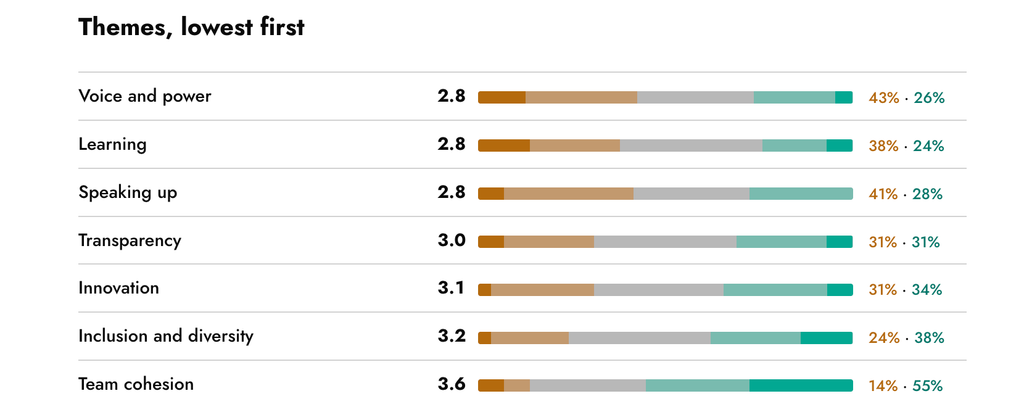
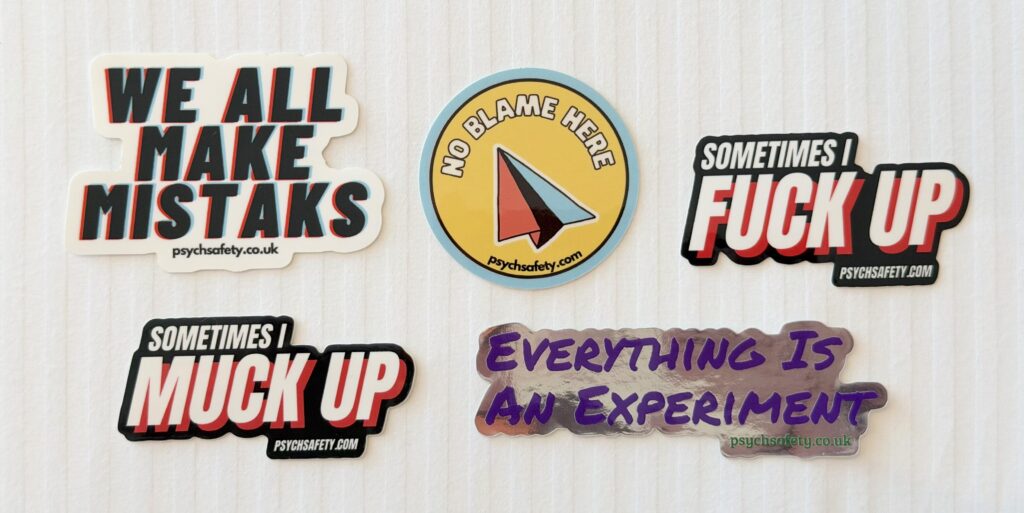
 If possible, we’ll send you some stickers as a thank you.