❌

Reading view

There are new articles available, click to refresh the page.

The Android lockdown seems under-theorized

When you get a cold, the virus hijacks your cells and uses them to make copies of itself, destroying the cells in the process. The virus does not care about you. And yet, if you get a cold, your body doesn’t dissolve into a pile of virus-enriched goo as a result of all your cells disregarding survival to focus on virus manufacturing.

Why? Well, you have an immune system. But also, if that did happen, other people would say, “Oh no, Alice has dissolved into a pile of virus-enriched goo; we should stay away lest we also become goo piles.” Better to just hijack some of your cells, so you can walk around and spread the virus to other people. Thus, the theory of optimal virulence says that a more laid-back cold virus will be more successful in the long run, which is why the cold viruses that thrive today are the non-goo-pile-converting kind.

Anyway. Most people reading this have paid Apple $400-$1600 for a phone on which you can’t do anything without Apple’s permission and monitoring. That was a strange decision, but on Android phones you can run whatever you want. For example, I noticed a couple of months ago that all RSS apps were terrible, so I spent 15 long minutes having AI make me a non-terrible one. I copied the file to my phone, installed it, and entered RSS nirvana, no registration, no app store, no nothing. It seems ludicrous that I wouldn’t be able to do that.

And yet, Google plans to change things. Soon, you won’t be able to run any app on an Android phone unless the person who made it bends the knee by paying a fee, giving Google their government ID, listing all apps they’ve ever made, etc. There will be an “escape hatch” for users to install other apps, but it involves secret menus and scary warnings and a 24-hour waiting period. Google says they’re doing this for security reasons, to prevent people from installing malware that does things like steal financial information.

Three things that any credible analysis of this situation must acknowledge

  1. The security issue is real, and this change will help. Lots of people are in fact getting tricked into installing malware on their phones, and common sense says that this will accelerate with AI. Common sense also says that during that 24-hour waiting period, some of those people might wonder if it’s really normal for OfficialMicrosoftSupportProfessional021 to contact them on WhatsApp to send totally-safe-virus-scanner.apk. It would be convenient for lockdown opponents if the security issue was fake, but it isn’t.

  2. For 95% of people reading this, these restrictions would not be a big deal. You click a few buttons, wait 24 hours once, and then you have the same freedom you have now. That’s still far better than Apple phones where there is no process at all. Oddly, it’s also better than Apple computers, where installing programs from non-verified developers has all sorts of friction that can never be removed. Most people I know use Apple computers anyway and just tolerate the indignity.

  3. If Google cared about freedom or privacy, they could have achieved their security goals without as much harm to freedom or privacy. For example, instead of making themselves the sole arbiter, they could have allowed for multiple certifying entities, and could have allowed users to add others (perhaps after a 24-hour waiting period). Arguably, that would be more secure: That way, grandma could install my RSS app without leaving herself open to random malware. Or, Google could have used private on-device malware scanning, or lots of other things. Google didn’t do that because they don’t care about freedom and privacy and because they like money.1

I think that’s a fair summary. This change addresses a real issue, but it does so in a self-serving way that needlessly destroys freedom. Even so, it only destroys a bit of freedom. This change, by itself, isn’t really a huge deal.

Reading between the lines, I think the real concern is what this might portend. Having made this change, maybe Google will gradually add further restrictions, slowly boiling the frog and moving ever-closer to an Apple-style dictatorship.

But will they? Maybe! Still, this whole situation seems under-theorized. There are good reasons to think that a full lockdown would not be in Google’s interest. And if you care about digital freedom, you could argue that a full lockdown would be a good thing.

Some other analogies

Switching insurance sucks, so some insurers offer a low initial rate and then gradually raise it over time. But they don’t want to raise it too much. Maybe they can charge you $50 more per year than a competitor, because it’s not worth your time to switch to save $50. But if they tried to charge you $5000 more per year, you’d be gone.

Or try this: Say it’s 1750 AD and you’re the King of France. You care nothing about your subjects and only want to extract the maximum possible loot for yourself, no offense Louis XV. How high should you set taxes? High, because you want loot. But not too high, because you don’t want your subjects to revolt and kill you. But still pretty high, because revolting is hard, and your subject know that even if they succeed, they might just end up with another ruler that’s just as rapacious as you.

Or: Say you put a frog in a pot of water and slowly heat it up. What do you think actually happens?

Back to phones

Why are there no Linux phones?

OK, technically there are Linux phones. There are various Linux phone operating systems (PureOS, postmarketOS, Mobian, Manjaro Mobile, Fedora Mobility, openSUSE Mobile) as well as sorta-Linux-sorta-Android operating systems (Ubtuntu touch, Droidian, FuriOS, Sailfish OS) and manufacturers who support them (Purism, Pine, Fairphone, Shift, FuriLabs, {J,V}olla). While I love and support these (♡), the general consensus is that they don’t currently offer an experience that’s remotely comparable to stock Android or iOS, especially for the price.

(Even more technically, Android is itself a kind of Linux, but you know what I mean.)

Obviously, the laws of physics do not forbid Linux phones from being just as good and cheap as an Android phone. They currently aren’t because:

  1. Making cheap phones requires huge economies of scale.
  2. Making a good operating system requires a huge amount of work.
  3. For a phone to be useful it needs good apps, which requires a huge amount of work.

Linux phones don’t have those economies of scale because few people buy them. So, there isn’t enough money to pay people to perfect the operating systems, and most companies don’t bother making apps, and so few people buy those phones.

Meanwhile, there are also various Android-except-de-Googled phone operating systems (LineageOS, GrapheneOS, /e/OS, CalyxOS), and the consensus is that these do come reasonably close to the experience of stock Android or iOS.

Personally, I used Android for a long time while trying to disable as much of Google’s apps and telemetry as I could. A while ago, I got fed up with this and switched to Graphene, one of the most popular Android-except-de-Googled variants. I don’t enjoy tech support bullshit, so I expected some pain, but I was willing to tolerate it for freedom/privacy/whatever. In practice, I found that everything was easy and worked flawlessly and there was no pain at all. Using Graphene made me realize that I had forgotten what it feels like to be “respected” by technology.

So, on a personal level, I recommend that you use Graphene. But this whole situation is full of weird tensions. For one thing, the Graphene project depends on Google for the base of their operating system, and only really survives because of Google’s tolerance. And, at the moment, the only way to use Graphene is to… buy a phone made by Google.

And while I recommend you use Graphene, what I’d prefer you do is switch to a true Linux phone. That would mean that you pay a lot of money for a poor phone experience. But it would help grow the Linux phone ecosystem. If enough people did that, then Linux phones might become become good enough that selfish people like me would switch, further growing the Linux phone ecosystem, et cetera.

That seems unlikely, because digital freedom weirdos face a collective action problem: Linux phones are bad and people are selfish, so we keep buying Android phones and Linux phones stay bad.

There are two ways to solve that collective action problem. Either some entity could invest a ton of money to make Linux phones good, or some entity could do something to make Android worse.

The status quo is good for Google

You may already see the argument I’m making here. Currently Android is just open enough that weirdos like me can run a variant that gives us most of what we want. But doing that is annoying enough that 99.9% of people don’t. This gives Google almost all the benefits of full control, while also sucking up all the oxygen and preventing a real alternative from emerging.

(Apple, incidentally, is laughing. They get to enjoy a full dictatorship while Google does all the hard work.)

Suppose that in six months, Google decides to escalate the lockdown and completely removes the ability to run independent apps. What then?

In the short-run, not much. Tech freedom weirdos would howl, normies wouldn’t notice, and the world would keep turning. But let’s look at some numbers. A rough estimate is that 3-5 million people currently use private de-Googled Android variants like Lineage or Graphene. That’s a crisp 0.1% of the global Android market. Meanwhile, it’s thought that 300-500 million people install Android apps outside the Google store. (That’s excluding China and things like the Samsung and Epic Games Stores.) The biggest reasons are (i) piracy, (ii) modified YouTube/Spotify/WhatsApp clients, (iii) region-locked games, (iv) forbidden gambling or crypto apps, (v) local sharing to save on mobile data, and (vi; least common) open-source app repositories like F-Droid.

In an escalated lockdown, some of this might still be allowed, e.g. local sharing. And many people would simply accept the new restrictions. But I expect that a substantial number would suddenly become interested in de-Googled Android variants that don’t enforce the lockdown. That would be dangerous for Google: If a significant fraction of those 300-500 million people switched, there’s a risk of a vicious/virtuous cycle, where people tell their friends, manufacturers start to cater to those variants, and so on.

If that happened, what would Google do? Might they clamp down on those Android variants, too? Again, maybe! Technically, Android is open-source, but if Google really wanted to kill Lineage or Graphene, there are about 200 different ways they could do that.

So say they did. What would the people currently using those variants do? Again, many would simply submit. That’s good for Google. Others would decide that if they must have an overlord, they’d prefer Apple. That’s not good for Google, but probably not a huge problem given the numbers. But others would decide to look elsewhere, likely to true Linux phones.

Currently, it’s estimated that less than 100 thousand people daily-drive true Linux phones, 30-50 times less than the number of people who use de-Googled Android variants. I’m too lazy and selfish to use a Linux phone now, but Google will take my RSS app from my cold dead hands, so in this scenario, I’d likely switch. If a fraction of people do that—or even get a second Linux phone—it would still represent a huge infusion of money and energy into the Linux phone ecosystem. If this pushed Linux phones from “bad” to “sort of OK”, that could kick off a growth cycle. Eventually, there would be a risk that Europe—eager to decouple from an unreliable US—might embrace them by mandating that government employees use them, or passing a law that popular apps must provide a web-app version that works on Linux phones, or whatever.

Would that actually happen? I don’t know, but neither does Google. My point is that the downside risk of losing their phone duopoly seems vastly larger than the upside, so why risk it? The smart move is to crush alternative app stores and fight malicious apps while making the bare minimum concessions to keep the freedom and privacy people onside. That’s exactly what what Google appears to be doing.

Of course, they might go for a full lockdown anyway. Corporations do dumb things all the time. But I really don’t see how it would be in their self-interest, and I’m not sure it would be a bad thing if they did.

  1. Dynomight: could google achieve the security aims of the android lockdown without so much harm to freedom or privacy

    Google Gemini 4: Yes. Security experts, privacy advocates, and open-source developers widely agree that Google’s primary security objectives—protecting users from malware, financial fraud, spyware, and social engineering—can be achieved through architectural containment, transparent auditing, and informed consent rather than centralized gatekeeping and surveillance. […] The reason Google chooses centralized lockdown over user-controlled security is largely economic and strategic, not technical:

    1. Ecosystem Lock-in: Tying security APIs (like Play Integrity) to Google Play Services makes it nearly impossible for competitors or open-source forks to build a viable alternative Android ecosystem that supports banking and media apps.
    2. Advertising Revenue: Features that dramatically improve both security and privacy—like a native network firewall, revocable internet permissions, or frictionless support for system-wide ad blockers—directly threaten Google’s primary revenue stream.
    3. Liability & Support Reduction: Treating all users as untrusted and removing root/power-user capabilities reduces the surface area of user error, even if it removes the user’s ownership of their own hardware.


    ↩

Buying My New Car

I buy a new car a lot sooner than I expect to because — well, why not?

For a single person living alone with no kids, I have a lot of cars. I occasionally refer to them as my fleet.

  • I have my 1999 Jeep Wrangler, which I bought brand new, beat the crap out of, and use as my local around-town vehicle. It’s in decent shape but wouldn’t win any awards at a car show, despite it’s age. A trailer hitch on the front makes it the perfect vehicle for shuffling around trailers in the garage or driveway.
  • Jeep Wrangler
    My Jeep in its younger days, crawling over rocks in Sedona AZ. It’s on its third soft top now.

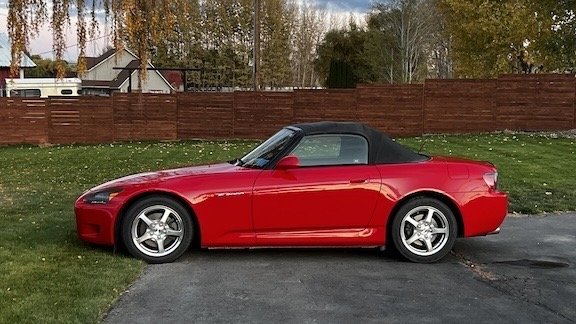
  • I have my 2003 Honda S2000, which I bought brand new and took good care of. It’s my Joy Machine and makes me happy every time I drive it. It’s fast with tight steering and good brakes. The convertible top makes it almost as good as a motorcycle for feeling the air around me — but no helmet required! It’s impractical as a vehicle, but has decent fuel efficiency and is oh so fun. I use if on road trips when I don’t need to carry a lot of luggage, as well as on day trips up into the mountains.
  • Honda S2000
    I can’t imagine any car being more fun to drive than my Honda S2000.

  • I have my 2012 Ford F35 SuperDuty Diesel Crew Cab with an 8-foot bed, which I bought in 2015. It’s my workhorse and I use it to haul just about anything that needs hauling: building or garden supplies, my slide-in truck camper, and my (oversize load) boat. I also used it on my trips to and from the marina in Bellingham where my boat lives, mostly because it can haul all the stuff I need to drag along with me when I go out on my boat.
  • Truck with Boat
    My boat weighs 13,000 pounds on its trailer. Good thing my truck can tow 16,000 pounds.

Each vehicle is different. Each has its pros and cons. If I had to get rid of one of them, I’d have a hard time choosing because they each do different things for me.

They’re also each paid for in full and have their own space in my larger-than-average — okay, humungous — garage. Cheap to keep, easy to take care of. Always ready when I need them.

I Want a New Car

But I’ve been wanting a new car for a while. Remember, the last new-to-me vehicle I bought was my truck, 11 years ago. Before that, it was my Honda, 22 years ago. Sheesh.

It would be nice to buy something more fuel efficient, possibly to take advantage of the cheap power where I live. Electric would be nice, but not on a road trip. Hybrid would be nice for a road trip, but it wouldn’t really take advantage of the cheap power at home. The answer was, of course, a plug-in hybrid. Something I can keep plugged in when not in use and then use for virtually free local driving and more fuel efficient road trips.

And wouldn’t it be nice to have a vehicle with all the new bells and whistles I’d experienced in new rentals cars over the years? All those cameras and Apple Car Play?

I certainly did not need a fourth car. And I couldn’t get rid of any of the ones I have because they each do their own special things for me. So I figured I’d wait until I started downsizing. The truck wouldn’t be needed when I sold the boat; I’d sell the slide-in truck camper with it. The Jeep wouldn’t be needed when I got rid of my utility trailer and the boat trailer. When I sold those, I’d buy a nice plug-in hybrid SUV or “crossover” vehicle to replace them. Then I’d be down to just two cars, like a more normal person.

That was the plan, anyway.

In early June, as I steered my truck through the mountains on the long drive back from Bellingham, I started questioning this plan. I wasn’t getting any younger. Why should I wait? It’s not as if I’d get a big windfall from the sale of a 27+ year old Jeep and a truck with nearly 200,000 miles on it. I was turning 65 at the end of the month. Didn’t I deserve a big birthday present for such a big birthday? And why shouldn’t I have a new car while I was young enough to enjoy it?

And wasn’t my boat named Do It Now for a reason?

So just like that, I decided to buy myself a new car for my birthday.

Choosing the Car

I’ll be the first to admit that I didn’t do much research. Most of the folks I spoke to raved about the Toyota RAV4, which was now available as a plugin hybrid. Toyota is the maker of one of the first hybrid cars out there: the Prius, which they first sold in December 1997. They still made and sold that car and I suspected that they’d learned a lot in the nearly 20 years since its first release. Everything I read and saw online in car guy videos confirmed this.

So I went to look at one, all ready to buy. The local Toyota dealer only had one on the lot and it was sold. But I got to see it and sit inside. It met my needs as an eventual replacement for the truck and Jeep as far as practicality was concerned. It even had limited towing capabilities. I could keep the Honda for fun and use this as my every day car.

The local dealer didn’t seem to understand that I was ready to buy the car. He kept saying I should think it over and get back to him. Instead, I asked when more were coming in. I told him I was ready to buy. It’s a shame (for him) that he didn’t have one to sell me. This was early on in my limited research and I didn’t know much about the various “trims” they sold. I probably would have bought the first one he offered me. But there was a list and he put me on it. The car was in high demand. It might be a few weeks.

In the meantime, I did a bit more homework and decided that I wanted the Woodland trim. This was a middle-range trim with some good rough road features. There was even a video on YouTube of a guy taking one “off road.” I told him I’d take any color except white, black, or green. (That left a shade of blue and a shade of dark gray.)

Waiting for the Car

Just shut up about how buying new cars is dumb.

Yeah, yeah. I’ve heard it all before. When you buy a new car, it loses thousands of dollars of value as soon as you drive it off the lot. Blah, blah, blah.

Pardon me, but bull-fucking-shit. That might be true if you’re one of those idiots who needs a different set of wheels every two years, but it definitely does not apply when you keep your car for a very long time. My 1999 Jeep cost $24K and I’ve been driving it for 27 years. I think I got my money’s worth out of it. My 2003 Honda S2000 cost $33K and I’ve been driving it for 23 years. Last summer, a car dealer offered me $25K for it. I’m not worried about its value.

But I can tell you this from experience: when you buy a used car, you’re buying a complete unknown that could have all kinds of problems the previous owner caused or at least knew about and didn’t tell you. Those problems are now your problems.

Tow Truck
I bought my truck after it had come in from a 3-year lease. I suspect the previous owner never bothered to change the oil while he had it. Thank heaven it was still under warranty when the engine needed replacement after 6 weeks of ownership.

So sure, buy a used car if you can’t or don’t want to invest in your future. But this car? I’ll probably own and drive it for the rest of my life. I don’t give a flying fuck how much value it lost when I took delivery.

And then I waited. For more than a week, nothing. I called to see if anything was coming in and he said there was but they were already spoken for. I reminded him I was ready to buy.

I sold 100 shares of Apple stock for a generous downpayment and put the money in my savings account.

After that, every once in a while he’d text me about cars coming in that did not match my criteria. The first was a low-end SE model. Another was a white Woodland. And then there was the XSE model that he said was very rare and he’d have to charge a $5k premium for it. I didn’t want it and now he was pissing me off.

So I started working the phones. I talked to Toyota dealers in Washington, Arizona, Nevada, Utah, Idaho, and Oregon. A few said they only sold locally, which honestly made no sense to me. Wouldn’t they rather sell the car to someone out of the area so they wouldn’t have to deal with warranty service and repairs? Some made promises and started sending me info about what was coming in. One guy even called on his private cell phone because he claimed they were required to sell locally but he was willing to make an exception for me.

WTF?

Eventually, I struck a deal with Troy in Boise. He managed to find the car in inventory being prepped for shipping to the US. Did I want it? Blue Toyota RAV4 Plugin Hybrid with moon roof. Yes. Sign this contract and send a $2K deposit. I did.

That was in late June. The car would be ready sometime between July 5 and August 11.

Life went on. My friend Janet came to stay with me for about two weeks at the end of June and into July. We camped with the truck and camper in the North Cascades and then took the boat out around the San Juan Islands and into Canada for 10 days. The local Toyota dealer kept texting me about cars that didn’t match my criteria.

Then I got a date from Troy. The car would be ready on July 13.

The timing couldn’t be better. I would be back from my boat trip and had a full two weeks before my next boat trip. (Long story there.) Plenty of time to get out to Boise and have a nice, leisurely road trip back. We set the pickup date for July 14, exactly two weeks after my 65th birthday.

Picking Up the Car

One of the things few people know about me is that I am a logistics whiz. I quickly determined that the quickest and easiest way for me to get from the Wenatchee area to Boise ID was to rent a car. I got a one-way car rental out of Wenatchee with Enterprise, left my pups with a neighbor, and headed out early in the morning of July 12. By 5 PM local time, I was checking into a nice hotel about a mile from the car dealer.

The next morning, I dropped off my luggage at the dealer, returned the rental car, and made the short walk back to the dealer. By then, my car was out in front of the building.

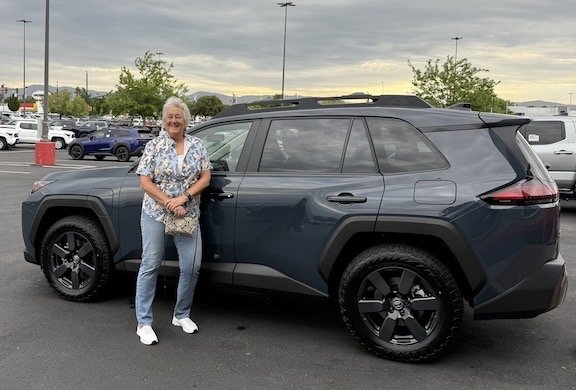
Me and my new car
Troy took this photo of me with my new car before I’d even sat inside it. The funny thing is that I wore that shirt to match the car, thinking the color was the light blue in the shirt. It turned out to match the dark blue in the shirt. The other color was weird, but I was mentally prepped for it. This color is a lot more normal and although I like it, I’m not sure if normal is a good thing for me.

Then there was the paperwork. There was a lot of it. Payment was made more complicated because Toyota Financing’s systems were down and, for some reason, my transfer of $30K from my savings to checking account was delayed. Finally, things were settled. I did buy the 10 year extended warranty — remember, this is probably the last car I’ll ever buy. They got me a good loan rate because my credit score is “exceptional.” By 1 PM, I had all my stuff loaded into the car, shook hands with Troy, and drove out of the lot.

Since Then

That was just over a month ago. I did a 3-day road trip through central Idaho and into the Hells Canyon area before coming home. The car drove great. It was comfortable and had a lot of features. In many ways, it’s a computer with a car attached. I learned a lot about it on that long drive and have learned a lot since.

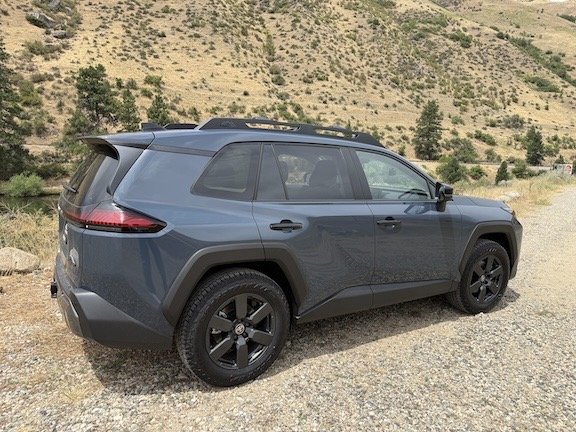
RAV4 in Idaho
I stopped at a riverside parking area to eat the lunch I bought at a supermarket after leaving the dealer. From here, I drove up to McCall ID, a place I last visited in 2005 in my Honda.

But this blog post is already long enough. I’ll have to write another one with my observations.

I’ll just say one thing for now: I’m glad I didn’t wait.

The US is facing its Suez moment – the outcome could change the world order

The US is facing its Suez moment – the outcome could change the world order

It is now clear that the war against Iran is going badly for Donald Trump. Binyamin Netanyahu and the Israeli Defence Forces (IDF) may be determined to carry on, but Trump is the war leader in deep trouble.

So radical is this unexpected outcome that the United States may even be facing its Suez moment, like the one that saw France and the UK lose status in 1956, hastening decolonisation in the 1960s. If so, the effects of the Iran conflict could last for decades, well beyond the immediate conflict, and have impacts that change the current world order – with unpredictable consequences.

Consider the past month and a half. Iran’s theocratic leadership had been crippled by assassinations within days of the start of the assault, but leaders were quickly replaced, and the much-anticipated popular uprising simply did not happen.

From Green Growth to Ecological Ungovernability: Why Degrowth Is No Longer Optional

Jacobo Rivas Sanmartín* In the series, Degrowth and Ecosocialism: the global picture. 1. Disaster, Transition, and the Political Vacuum When the DANA weather system brought heavy rain and catastrophic floods to Valencia, the event was seen as a ‘natural disaster’, something out of the ordinary. That, however, is misleading: such events are not something that… Continue reading From Green Growth to Ecological Ungovernability: Why Degrowth Is No Longer Optional

Make product worse, get money

I recently asked why people seem to hate dating apps so much. In response, 80% of you emailed me some version of the following theory:

The thing about dating apps is that if they do a good job and match people up, then the matched people will quit the app and stop paying. So they have an incentive to string people along but not to actually help people find long-term relationships.

May I explain why I don’t find this type of theory very helpful?

I’m not saying that I think it’s wrong, mind you. Rather, my objection is that while the theory is phrased in terms of dating apps, the same basic pattern applies to basically anyone who is trying to make money by doing anything.

For example, consider a pizza restaurant. Try these theories on for size:

  • Pizza: “The thing about pizza restaurants is that if they use expensive ingredients or labor-intensive pizza-making techniques, then it costs more to make pizza. So they have an incentive to use low-cost ingredients and labor-saving shortcuts.”

  • Pizza II: “The thing about pizza restaurants is that if they have nice tables separated at a comfortable distance, then they can’t fit as many customers. So they have an incentive to use tiny tables and cram people in cheek by jowl.”

  • Pizza III: “The thing about pizza restaurants is that if they sell big pizzas, then people will eat them and stop being hungry, meaning they don’t buy additional pizza. So they have an incentive to serve tiny low-calorie pizzas.”

See what I mean? You can construct similar theories for other domains, too:

  • Cars: “The thing about automakers is that making cars safe is expensive. So they have an incentive to make unsafe cars.”

  • Videos: “The thing about video streaming is that high-resolution video uses more expensive bandwidth. So they have an incentive to use low-resolution.”

  • Blogging: “The thing about bloggers is that research is time-consuming. So they have an incentive to be sloppy about the facts.”

  • Durability: “The thing about {lightbulb, car, phone, refrigerator, cargo ship} manufacturing is that if you make a {lightbulb, car, phone, refrigerator, cargo ship} that lasts a long time, then people won’t buy new ones. So there’s an incentive to make {lightbulbs, cars, phones, refrigerators, cargo ships} that break quickly.”

All these theories can be thought of as instances of two general patterns:

  • Make product worse, get money: “The thing about selling goods or services is that making goods or services better costs money. So people have an incentive to make goods and services worse.”

  • Raise price, get money: “The thing about selling goods and services is that if you raise prices, then you get more money. So people have an incentive to raise prices.”

Are these theories wrong? Not exactly. But it sure seems like something is missing.

I’m sure most pizza restauranteurs would be thrilled to sell lukewarm 5 cm cardboard discs for $300 each. They do in fact have an incentive to do that, just as predicted by these theories! Yet, in reality, pizza restaurants usually sell pizzas that are made out of food. So clearly these theories aren’t telling the whole story.

Say you have a lucrative business selling 5 cm cardboard discs for $300. I am likely to think, “I like money. Why don’t I sell pizzas that are only mostly cardboard, but also partly made of flour? And why don’t I sell them for $200, so I can steal Valued Reader’s customers?” But if I did that, then someone else would probably set prices at only $100, or even introduce cardboard-free pizzas, and this would continue until hitting some kind of equilibrium.

Sure, producers want to charge infinity dollars for things that cost them zero dollars to make. But consumers want to pay zero dollars for stuff that’s infinitely valuable. It’s in the conflict between these desires that all interesting theories live.

This is why I don’t think it’s helpful to point out that people have an incentive to make their products worse. Of course they do. The interesting question is, why are they able to get away with it?

Reasons stuff is bad

First reason stuff is bad: People are cheap

Why are seats so cramped on planes? Is it because airlines are greedy? Sure. But while they might be greedy, I don’t think they’re dumb. If you do a little math, you can calculate that if airlines were to remove a single row of seats, they could add perhaps 2.5 cm (1 in) of extra legroom for everyone, while only decreasing the number of paying customers by around 3%. (This is based on a 737 with single-class, but you get the idea.)

So why don’t airlines rip out a row of seats, raise prices by 3% and enjoy the reduced costs for fuel and customer service? The only answer I can see is that people, on average, aren’t actually willing to pay 3% more for 2.5 cm more legroom. We want a worse but cheaper product, and so that’s what we get.

I think this is the most common reason stuff is “bad”. It’s why Subway sandwiches are so soggy, why video games are so buggy, and why IKEA furniture and Primark clothes fall apart so quickly.

It’s good when things are bad for this reason. Or at least, that’s the premise of capitalism: When companies cut costs, that’s the invisible hand redirecting resources to maximize social value, or whatever. Companies may be motivated by greed. And you may not like it, since you want to pay zero dollars for infinite value. But this is markets working as designed.

Second reason stuff is bad: Information asymmetries

Why is it that almost every book / blog / podcast about longevity is such garbage? Well, we don’t actually know many things that will reliably increase longevity. And those things are mostly all boring / hard / non-fun. And even if you do all of them, it probably only adds a couple of years in expectation. And telling people these facts is not a good way to find suckers who will pay you lots of money for your unproven supplements / seminars / etc.

True! But it doesn’t explain why all longevity stuff is so bad. Why don’t honest people tell the true story and drive all the hucksters out of business? I suspect the answer is that unless you have a lot of scientific training and do a lot of research, it’s basically impossible to figure out just how huckstery all the hucksters really are.

I think this same basic phenomenon explains why some supplements contain heavy metals, why some food contains microplastics, why restaurants use so much butter and salt, why rentals often have crappy insulation, and why most cars seem to only be safe along dimensions included in crash test scores. When consumers can’t tell good from evil, evil triumphs.

Third reason stuff is bad: People have bad taste

Sometimes stuff is bad because people just don’t appreciate the stuff you consider good. Examples are definitionally controversial, but I think this includes restaurants in cities where all restaurants are bad, North American tea, and travel pants. This reason has a blurry boundary with information asymmetries, as seen in ultrasonic humidifiers or products that use Sucralose instead of aspartame for “safety”.

Fourth reason stuff is bad: Pricing power

Finally, sometimes stuff is bad because markets aren’t working. Sometimes a company is selling a product but has some kind of “moat” that makes it hard for anyone else to compete with them, e.g. because of some technological or regulatory barrier, control of some key resource or location, intellectual property, a beloved brand, or network effects.

If that’s true, then those companies don’t have to worry as much about someone else stealing their business, and so (because everyone is axiomatically greedy) they will find ways to make their product cheaper and/or raise prices up until the price is equal to the full value it provides to the marginal consumer.

Conclusion

Why is food so expensive at sporting events? Yes, people have no alternatives. But people know food is expensive at sporting events. And they don’t like it. Instead of selling water for $17, why don’t venues sell water for $2 and raise ticket prices instead? I don’t know. Probably something complicated, like that expensive food allows you to extract extra money from rich people without losing business from non-rich people.

So of course dating apps would love to string people along for years instead of finding them long-term relationships, so they keep paying money each month. I wouldn’t be surprised if some people at those companies have literally thought, “Maybe we should string people along for years instead of finding them long-term relationships, so they keep paying money each month, I love money so much.”

But if they are actually doing that (which is unclear to me) or if they are bad in some other way, then how do they get away with it? Why doesn’t someone else create a competing app that’s better and thereby steal all their business? It seems like the answer has to be either “because that’s impossible” or “because people don’t really want that”. That’s where the mystery begins.

Dating: A mysterious constellation of facts

Here are a few things that seem to be true:

  1. Dating apps are very popular.
  2. Lots of people hate dating apps.
  3. They hate them so much that there’s supposedly a resurgence in alternatives like speed dating.

None of those are too controversial, I think. (Let’s stress supposedly in #3.) But if you stare at them for a while, it’s hard to see how they can all be true at the same time.

Because, why do people hate dating apps? People complain that they’re bad in various ways, such as being ineffective, dehumanizing, or expensive. (And such small portions!) But if they’re bad, then why? Technologically speaking, a dating app is not difficult to make. If dating apps are so bad, why don’t new non-bad ones emerge and outcompete them?

The typical answer is network effects. A dating app’s value depends on how many other people are on it. So everyone gravitates to the popular ones and eventually most of the market is captured by a few winners. To displace them, you’d have to spend a huge amount of money on advertising. So—the theory goes—the winners are an oligopoly that gleefully focus on extracting money from their clients instead of making those clients happy.

That isn’t obviously wrong. Match Group (which owns Tinder, Match, Plenty of Fish, OK Cupid, Hinge, and many others) has recently had an operating margin of ~25%. That’s more like a crazy-profitable entrenched tech company (Apple manages ~30%) than a nervous business in a crowded market.

But wait a second. How many people go to a speed dating event? Maybe 30? I don’t know if the speed dating “resurgence” is real, but it doesn’t matter. Some people definitely do find love at real-life events with small numbers of people. If that’s possible, then shouldn’t it also be possible to create a dating app that’s useful even with only a small number of users? Meaning good apps should have emerged long ago and displaced the crappy incumbents? And so the surviving dating apps should be non-hated?

We’ve got ourselves a contradiction. So something is wrong with that argument. But what?

Theory 1: Selection

Perhaps speed dating attendees are more likely to be good matches than people on dating apps. This might be true because they tend to be similar in terms of income, education, etc., and people tend to mate assortatively. People who go to such events might also have some similarities in terms of personality or what they’re looking for in a relationship.

You could also theorize that people at speed dating events are higher “quality”. For example, maybe it’s easier to conceal negative traits on dating apps than it is in person. If so, this might lead to some kind of adverse selection where people without secret negative traits get frustrated and stop using the apps.

I’m not sure either of those are true. But even if they are, consider the magnitudes. While a speed dating event might have 30 people, a dating app in a large city could easily have 30,000 users. While the fraction of good matches might be lower on a dating app, the absolute number is still surely far higher.

Theory 2: Bandwidth

Perhaps even if you have fewer potential matches at a speed dating event, you have better odds of actually finding them, because in-person interactions reveals information that dating apps don’t.

People often complain that dating apps are superficial, that there’s too much focus on pictures. Personally, I don’t think pictures deserve so much criticism. Yes, they show how hot you are. But pictures also give lots of information about important non-superficial things, like your personality, values, social class, and lifestyle. I’m convinced people use pictures for all that stuff as much as hotness.

But you know what’s even better than pictures? Actually talking to someone!

Many people seem to think that a few minutes of small talk isn’t enough time to learn anything about someone. Personally, I think evolution spent millions of years training us to do exactly that. I’d even claim that this is why small talk exists.

(I have friends with varying levels of extroversion and agreeableness, but all of my friends seem to have high openness to experience. When I meet someone new, I’m convinced I can guess their openness to ±10% by the time they’ve completed five sentences.)

So maybe the information a dating app provides just isn’t all that useful compared to a few minutes of casual conversation. If so, then dating apps might be incredibly inefficient. You have to go through some silly texting courtship ritual, set up a time to meet, physically go there, and then pretend to smile for an hour even if you immediately hate them.

Under this theory, dating apps provide a tiny amount of information about a gigantic pool of people, while speed dating provides a ton of information about a small number of people. Maybe that’s a win, at least sometimes.

Theory 3: Behavior

Maybe the benefit of real-life events isn’t that they provide more information, but that they change how we behave.

For example, maybe people are nicer in person? Because only then can we sense that others are also sentient beings with internal lives and so on?

I’m pretty sure that’s true. But it’s not obvious it helps with our mystery, since people from dating apps eventually meet in person, too. If they’re still nice when they do, then this just resolves into “in-person interactions provide more information”, and is already covered by the previous theory. To help resolve our mystery, you’d need to claim that people at real-life events act differently than they do when meeting up as a result of a dating app.

That could happen as a result of a “behavioral equilibrium”. Some people take dating apps seriously and some take them casually. But it’s hard to tell what category someone else is in, so everyone proceeds with caution. But by showing up at an in-person event, everyone has demonstrated some level of seriousness. And maybe this makes everyone behave differently? Perhaps, but I don’t really see it.

Obscure theories

I can think of a few other possible explanations.

  1. Maybe speed dating serves a niche. Just like Fitafy / Bristlr / High There! serve people who love fitness / beards / marijuana, maybe speed dating just serves some small-ish fraction of the population but not others.

  2. Maybe the people who succeed at speed dating would also have succeeded no matter what. So they don’t offer any general lessons.

  3. Maybe creating a dating app is in fact very technologically difficult. So while the dating apps are profit-extracting oligopolies, that’s because of technological moat, not network effects.

I don’t really buy any of these.

Drumroll

So what’s really happening? I am not confident, but here’s my best guess:

  1. Selection is not a major factor.

  2. The high bandwidth of in-person interactions is a major factor.

  3. The fact that people are nicer or more open-minded in person is not a major factor, other than through making in-person interactions higher bandwidth.

  4. None of the obscure theories are major factors.

  5. Dating apps are an oligopoly, driven by network effects.

Basically, a key “filter” in finding love is finding someone where you both feel optimistic after talking for five minutes. Speed dating is (somewhat / sometimes) effective because it efficiently crams a lot of people into the top of that filter.

Meanwhile, because dating apps are low-bandwidth, they need a large pool to be viable. Thus, they’re subject to network effects, and the winners can turn the screws to extract maximum profits from their users.

Partly I’m not confident in that story just because it has so many moving parts. But something else worries me too. If it’s true, then why aren’t dating apps trying harder to provide that same information that in-person interactions do?

If anything, I understand they’re moving in the opposite direction. Maybe Match Group would have no interest in that, since they’re busy enjoying their precious network effects. But why not startups? Hell, why not philanthropies? (Think of all the utility you could create!) For the above story to hold together, you have to believe that it’s a very difficult problem.

Opinions and Theories are Not the Same as Facts

Please understand the differences in what you’re finding online.

It’s March 2025 and eggs — the kind that come out of chickens and are a staple in American breakfasts — are not only in short supply, but more expensive than ever. This is a fact that you can confirm for yourself by visiting any supermarket or grocery store that sells them.

Bird flu is spreading throughout the US. It has caused the death or destruction of millions of commercial egg farm hens. This is also a fact. Here are some recent trustworthy references to support this:

Hens
These were two of my hens, back when I kept chickens. I had as many as 18 at one time and was selling eggs to my neighbors for $4/dozen. I miss them but have trouble getting them cared for in the winter when I’m away.

Hens lay eggs. Fewer hens mean fewer eggs. This is a combination of fact and logic. As someone who has had a backyard flock of hens on and off for the past 30 years, I can assure you that the more hens I have in my flock, the more eggs I get.

The economic concept of supply and demand states that, well, you can read it for yourself in this quote from the Supply and Demand entry in Britannica Money:

supply and demand, in economics, [is the] relationship between the quantity of a commodity that producers wish to sell at various prices and the quantity that consumers wish to buy. It is the main model of price determination used in economic theory. The price of a commodity is determined by the interaction of supply and demand in a market. The resulting price is referred to as the equilibrium price and represents an agreement between producers and consumers of the good. In equilibrium the quantity of a good supplied by producers equals the quantity demanded by consumers.

I was a business major in college so I took Economics 101 and 102. I know this stuff. It makes sense to me. And if you think about it, it should make sense to you. Prices on items that are scarce but in demand are generally higher than the same item if it’s available in higher quantities. This can be a natural result of marketplace economics, as the above paragraph suggests, or it can be manipulated by sellers to either increase profits on scarce commodities or control the sale of them.

An example of using price to control sales is what I recently saw in a local supermarket that had some eggs available for sale. If you bought one or two dozen, they were about $7/dozen. But if you bought more than two dozen, the price went up to about $10/dozen. Hoarding has become a problem with the egg shortage and this supermarket was trying to discourage that behavior by jacking up the prices for hoarders.

That’s not to say that some producers, wholesalers, or retailers aren’t trying to cash in on the shortages. There will always be people and organizations that take advantage of a situation.

In the case of producers, I don’t blame them one bit. If you had a flock of a 10,000 chickens and lost 7,500 of them to bird flu — science says it’s 75% to 100% deadly to birds — you’d not only have to spend a boatload of cash to make sure your facility was free of the pathogens, but you’d have to buy 7,500 replacement birds. Commercial hens might be different, but I know I had to wait four to five months for any of the chicks I obtained to start laying in my backyard. That’s a huge cash outlay and reduced productivity for months. I don’t think it’s unreasonable to want to cash in on the eggs being laid by the 2,500 birds I have left. Supply and demand supports this, especially since the loss of hens is so widespread.

But this is still an opinion. You might think it’s fine for farmers to take a hit that might actually drive them out of business. That’s your opinion.

The farther you go up the chain from the producer with suddenly less product to sell, the less acceptable it is to cash in on the scarcity. But that’s still a moral judgement or opinion. It is not a fact.

And then there are the conspiracy theories. Big Henhouse is controlling the price of eggs and using bird flu as an excuse. There really isn’t a shortage at all. They’re just pretending it is to separate consumers from their money.

Is this a fact? No. Is it based on facts? Perhaps a few. Maybe egg prices are unreasonably high in an area that hasn’t been hit by bird flu. But maybe those producers are also sending their eggs out to areas that have been devastated by bird flu.

What is the truth? What are the facts? Are these Big Henhouse price gouging conspiracy theories what’s actually going on? Or are they just a tool to focus your hate and anger on big business?

If you’re actually trying to answer what I’ve posed as rhetorical questions, don’t just share the first Google hit that supports your view. Look at the source of the information. Far left? Far right? Anti-big business? Or a news outlet that tends to focus on fact-based reporting? Don’t respond to this post with something you read on the New Republic or in Mother Jones or in a blog post in a popular blog. That’s not news. It’s opinion and/or theory based on cherry-picked data.

I don’t know about you, but now that I’m not producing my own eggs and feeling forced to eat them every day just to keep up with production, a dozen lasts me more than a week. Yes, I’m one person and I understand that larger households probably eat more eggs. Although the prices will never get down to what they used to be — ever heard of inflation? — they should eventually come down as the bird flu problems are resolved and flocks are rebuilt. Until then, if you find them too expensive for your household, eat fewer eggs. You don’t need them for breakfast every morning. And you don’t need as many as you think you might.

Otherwise, just stop stressing over the price of eggs and worrying about who is profiting in the current situation. Despite what your super socialist friends might think, price fixing by the government is not a reasonable long term solution — especially with the current government. Buy only what you need to help prevent scarcity. If everyone did this — remember supply and demand? — the prices will likely come down sooner than later.

❌