Reading view

There are new articles available, click to refresh the page.

Victory! Appeals Court Rejects Expansive New Copyright Claim

 The U.S. Court of Appeals for the Ninth Circuit handed internet users and programmers a big win today, by rejecting an attempt to stretch a narrow provision of the Digital Millennium Copyright Act (DMCA) into a new source of copyright liability.  

The case involves Section 1202 of the DMCA, which prohibits intentionally removing copyright management information (CMI) like an author’s name or a copyright notice, from a copyrighted work. Open AI and Microsoft used code from Github as part of the training data for their LLMs, along with billions of other works. A group of anonymous Github contributors sued, alleging the new code coming out of these LLMs was similar to theirs—but with the CMI stripped out.  

The Ninth Circuit correctly agreed with what we said in our briefremoving copyright information from a copyrighted work is fundamentally different from creating a new work that didn't have CMI in the first place. Section 1202 of the Digital Millennium Copyright Act was intended to serve as a backstop for traditional copyrights in the digital age—not to create a new, more expansive right to inhibit otherwise non-infringing uses. 

As we also explained, accepting the Does’ theory would have created a brand-new source of liability for otherwise perfectly lawful activities, undermining creativity and innovation far beyond the specific context of AI development. Copyright holders would be able to file costly lawsuits against all kinds of legitimate users, such as artists making remixes based on older works, teachers adapting works for a classroom presentation, engineers reverse engineering code to understand it better, and search engines that help us all navigate the web. The risks would have fallen especially hard on independent software developers and other small creators. Large companies can afford to litigate these claims in federal court for years, if necessary. But an independent programmer facing massive statutory damages may simply have to settle, even when their underlying use is completely lawful. That’s why EFF fights to make sure courts don’t expand copyright beyond what Congress authorized.  

Copyright law still protects programmers when their work is unlawfully copied. They can still bring copyright infringement claims if someone uses a model to reproduce their code. Additionally, the plaintiffs’ contract claims against the AI companies are still in play. The specific holding here was narrow but important: that the absence of copyright information from a new work does not mean, by itself, that someone illegally removed it.  

That’s the correct result. New technologies will keep raising hard questions about copyright. Courts should answer those questions by applying the rights that Congress actually authorized, not by inventing new rights that could harm expression and lawful use for everyone.  

Additional Reading:  

Victory: Court, Using a New Test, Rules Embedding Links is Legal

Courts have for two decades found that linking and embedding someone else’s web content, be it a photo, music, or an article, doesn’t violate copyright law–the entity that controls the server that hosts a copyrighted work, not the user or website that merely directs others to it, is directly liable if the content turns out to be infringing.

News publisher Emmerich Newspapers sought to convince the Fifth Circuit Court of Appeals to chart a new and dangerous course, arguing that an aggregator website that published links to its copyrighted articles was in effect “displaying” them and can be directly liable for infringement. EFF, along with several other public interest organizations and trade associations, filed a brief urging the court to follow multiple other circuits and reject that theory.

Fortunately, the Fifth Circuit Court of Appeals did just that. While it rejected the server test–the rule courts have used to determine copyright liability rests with whoever serves up the content–the court came to the same practical conclusion by focusing on who is responsible for transmitting content. 

Applying that test, the court found that pointing or directing a user’s browser to request and receive the copyright owner’s own copy residing on its computers does not involve transmitting or communicating the content. “Although we take different routes to get there, both the server test and the test we announce end up in a similar place: a website cannot transmit a work that it does not have,” the court said

We told the court that accepting Emmerich's theory would make the common act of embedding links a legally fraught activity, one that many websites might be unwilling to risk, which would seriously damage the internet as a tool for creating and disseminating ideas and knowledge,

We applaud the court’s decision–even though it applied a different test, it correctly concluded that a user linking pictures, video, or articles isn’t in charge of transmitting that content to the world. The user doesn’t control what’s located on the other end of the link—that’s up to the person who controls the server.

Emmerich also claimed linking violates the Digital Millennium Copyright Act (DMCA), arguing its URLs were copyright management information (CMI) and when the aggregator displayed Emmerich’s articles under its own URL, it tampered with Emmerich’s CMI, which violates the DMCA. 

Under that logic, unsuspecting internet users could face ruinous legal risk for doing something as simple as using a link shortener, particularly given potential statutory penalties of up to $25,000 per violation.  

In our brief, we told the court that URLs don’t necessarily equate to a copyrighted work or provide sufficient information about the nature of the underlying content, making it highly unlikely that anyone would expect a URL to contain CMI. Quoting EFF’s brief, the court concluded that URLs are first and foremost a locational reference tool and while it may be possible for a URL to contain CMI, the bar to that conclusion is high.

Overall, this was a good and sensible decision that will protect ordinary online expression, communication, and access to knowledge. Hopefully this issue is laid to rest at last.

Court Rules Against Citizen Journalists in DMCA Takedown Case—EFF Will Appeal

A federal court in Massachusetts has ruled that copyright holders can issue online takedown notices based on a subjective belief of copyright infringement, even when that belief is unreasonable and self-serving. The case was brought by our client, Channel 781 News, after takedown notices temporarily shut down the citizen journalism group's YouTube channel. We think the court set the bar far too low for copyright takedowns, and we plan to appeal.

Channel 781 is a group of independent, volunteer journalists who report on local affairs in Waltham, Massachusetts. That includes posting short, newsworthy excerpts from recordings of city government meetings produced by Waltham Community Access Corporation (WCAC), the city's public access television station.

In September 2023, WCAC sent three copyright takedown notices to YouTube targeting fifteen of Channel 781's videos. YouTube removed the videos and, under its three-strikes policy, temporarily disabled Channel 781's entire account—just days before a local election.

Represented by EFF and Brown Rudnick LLP, Channel 781 sued WCAC under Section 512(f) of the Digital Millennium Copyright Act (DMCA), which provides a remedy when a copyright holder knowingly makes material misrepresentations in a takedown notice.

When Is a Copyright Holder Responsible for a Wrongful Takedown?

Fair use is the legal right to use copyrighted material without permission, when doing so serves purposes like criticism, commentary, or creating something new. Fair use is not copyright infringement, and courts have recognized that copyright holders must consider fair use before using the DMCA's powerful notice-and-takedown process.

In this case, Channel 781 argued that WCAC accused it of copyright infringement without making a good-faith assessment of whether its videos were fair use.

The evidence showed that WCAC's analysis was seriously deficient. The court noted that Chris Wangler, the WCAC employee who sent the notices, didn’t consider several facts relevant to fair use. For instance, Channel 781 used relatively small portions of WCAC's recordings, and the underlying recordings were factual public meetings, not a creative work. WCAC also gave little or no weight to whether Channel 781's use harmed any market for the recordings.

There’s also strong evidence that WCAC had motivations unrelated to copyright. WCAC objected to its footage being used to criticize local officials and advance political viewpoints. And WCAC sent the takedown notices during a local election, shortly after Channel 781 posted a campaign statement by Waltham's mayor that WCAC had mistakenly made available online.

Despite this evidence, the court concluded that WCAC had a subjective good-faith belief that Channel 781's videos were infringing. We disagree.

A Subjective Belief Should Not Be a Free Pass

Channel 781 argued that a copyright holder’s belief that material is infringing must be both genuinely held and objectively reasonable. WCAC argued that a subjective good-faith belief is good enough. Unfortunately, the court agreed with WCAC.

The court emphasized that Wangler had read up on fair use, watched a short YouTube video explaining the doctrine, and distinguished between videos he thought might qualify as fair use and those he believed did not. That was enough, the court concluded, to establish subjective good faith—even though Wangler’s analysis ignored important facts relevant to fair use. As the court put it, Section 512(f) does not require “a perfect or even reasonable fair use analysis.”

That is an alarmingly low bar for copyright holders seeking to remove someone else’s speech from the internet. A DMCA takedown can cause lawful speech to disappear almost immediately. As Channel 781 experienced, multiple notices can even result in an entire channel being disabled.

If a copyright holder can avoid liability despite a cursory, incomplete, and objectively unreasonable analysis that ignores important facts—even when there’s evidence that the copyright holder wanted to suppress critical speech—the obligation to consider fair use risks becoming little more than a box-checking exercise. That interpretation threatens to strip Section 512(f) of much of its force.

Even Under a Subjective Standard, WCAC Fell Short

Even accepting the court’s subjective standard, WCAC's cursory consideration of fair use should not have been enough. WCAC disregarded important fair use considerations, and the record included statements suggesting that it believed people generally needed permission to reuse its footage—an understanding at odds with fair use. There was also evidence that WCAC objected to Channel 781's political use of its footage, and had motivations for the takedowns unrelated to copyright.

Taken together, these facts raise serious questions about whether WCAC genuinely considered fair use, rather than using copyright as a rationale for removing material it did not like.

The Court Did Not Find That Channel 781's Videos Infringed

Importantly, the court's analysis recognized Channel 781’s strong fair use argument: the group used short excerpts from factual recordings of public government proceedings, selecting clips for their newsworthiness, and making them easier for the public and journalists to find, share, and discuss.

The opinion even states that WCAC's fair use analysis “may have been deficient.” But under the purely subjective standard it adopted, the court concluded that it could not reject WCAC's professed belief—even if the court itself “would have reached the opposite conclusion” on fair use.

We plan to appeal this decision to the First Circuit Court of Appeals. Copyright law should not allow a rightsholder to suppress critical reporting or political speech through the DMCA and escape accountability simply by claiming it believed the speech was infringing. Section 512(f) is supposed to provide protection against wrongful takedowns. We will keep fighting to ensure that safeguard actually protects people. 

EFF to Courts: Don’t Rewrite Copyright Over AI Hype

The history of technology is rife with copyright panics.  In the 1980s, major rightsholders ran to Congress and the courts, claiming that videotape recorders (VTR) were “to the American film producer and the American public as the Boston strangler is to the woman home alone.” Then, the Supreme Court declined to embrace the hype, noting that the VTR was capable of all kinds of non-infringing uses, like time-shifting and cautioning courts to avoid rewriting copyright law in response to new technologies. We believe that courts now should be similarly wary about the hype surrounding AI.

Hollywood’s hyperbole has echoed that of composer John Phillip Sousa, who claimed in 1906 that the player piano and the gramophone would destroy music composition; portrait artists who feared the camera would replace the paintbrush. None of these things happened. Cameras, for example, sparked a resurgence of portraiture and, by making it possible for more people to create images, led to unexpected developments—like the rise of photojournalism.

New markets, new ideas, and new creators are actually what copyright is supposed to promote, not restrict. Using copyright to lock in existing gatekeepers and massive rightsholders’ profits helps neither the public nor individual artists.

Generative AI has sparked the latest wave of anxiety and with it a massive wave of litigation. In multiple cases around the U.S. and the world, rightsholders are asking courts to do precisely what the Supreme Court warned against: dramatically expand copyright protections based in substantial part on hyperbole and speculation. They should decline to do so.

Copyright owners claim that unless courts abandon 300-year-old copyright principles—and give rightsholders the power to control non-infringing works created by others—an imagined flood of AI-generated works will devastate creative markets. Under this “market dilution” theory, building generative AI tools cannot be fair use because those tools might be encourage the proliferation of competing works.

As EFF has explained to the courts in multiple amicus briefs in Concord Music Group, Inc. v. Anthropic PBC and In re Mosaic LLM Litigation, that’s not how copyright works. In fact, accepting this theory would undermine copyright’s constitutional purpose: promoting the creation of expressive works for the public’s benefit. Because copyright law is designed to encourage others to build freely on existing works, it punishes infringement, not competition. The “market dilution” theory would eviscerate not only the fair use doctrine, but also other limits on copyright that work specifically to prevent rightsholders from unfairly suppressing competition by claiming broad ownership over tropes, genres, styles, and so on. In other words, publishers would wield unchecked veto power over any expression that might conceivably compete with a work they own.

The result? Art doesn’t get created, ideas are never expressed, and we’re all worse off. Copyright shouldn’t be a tool to silence future creative competitors—whether or not they use AI in their work.

And the plaintiffs in these cases get at least two other things wrong. First, research shows that large generative AI models are unlikely to produce infringing works because the more data on which a model is trained, the less any individual training example matters to any particular output.

Second, AI tools aren’t necessarily displacing human creativity. To take a just a few examples:

  • Boston-based artist Nettrice Gaskins uses AI to create Afro-futurist art, including a portrait of Octavia Butler displayed at the San Francisco Airport
  • Indian artists Prateek Arora and Varun Gupta use generative AI to reimagine Western science fiction.
  • Philadelphia-based artist Alex Smith uses generative AI to reimagine Afrofuturism with queer, plus-sized Black superheroes.
  • Ana Miljački, a professor of architecture at MIT, used generative AI to create a “non-liner documentary” film on Yugoslav World War II memorials and the values they embodied.
  • A research-creation project used AI generated visual art to both amplify the voices of activists in the Iran Woman Life Freedom Movement and evaluate AI’s role in sociopolitical advocacy through art.
  • AI company Bronze works with musicians like Disclosure and Jai Paul to create songs that never sound the same when played back twice, challenging audience conceptions of what music could be.

It is not the place of courts to say these people are not artists or that AI cannot augment human creativity in a positive way.

Given this range of experimentation, courts should be reluctant to decide in advance what tools do and do not foster “human creativity.” Like the VTR, large language models are general purpose tools, used by humans to do a broad variety of things far beyond generating lyrics. The effects of this particular technological innovation will doubtless be far-reaching, disruptive, and potentially harmful for some—but distorting copyright law is not the way to address those harms.

The CHATBOT Act Forces One Parenting Model On Every Family

Artificial intelligence is rapidly changing education, and the way people search for information. Parents, teenagers, teachers, and schools are struggling with tough questions about when AI should, and should not, be used. It makes sense for Congress to hold hearings and examine how AI should be used by minors. But the recently introduced CHATBOT Act answers those questions with a one-size-fits-all mandate governing how teenagers access AI through federally prescribed parental monitoring systems. 

The Bill Requires AI Companies To Build Family Monitoring Systems 

Parents are approaching AI in different ways. Some closely supervise how their children use chatbots, while others might set more general rules about technology. Many families are still figuring out what role AI should play in schoolwork and everyday life. 

The CHATBOT Act would take that decision away from families and AI providers. Instead of letting families and AI providers decide what parental controls should look like, Congress would require every covered AI chatbot to build the same federally prescribed “family account” system. 

As part of the required parental-consent process for teens, AI companies must offer parents a "family account" that provides access to a "full record of the conversations and activity" of teen users and tools to "monitor, analyze, and understand, at scale" those conversations. They must also send alerts if a teen attempts to bypass or disable parental controls. 

This isn’t simply an optional parental-control feature. The bill requires every covered AI provider to build this monitoring infrastructure, and present it as part of the parental consent process. Congress is prescribing a single, highly invasive model of how families should supervise teenagers’ use of AI. 

The CHATBOT Act Creates New Privacy Risks For Families 

Parents and families have different ideas about how much independence teenagers should have. Understandably, they also have very different expectations for 8-year olds, 13-year-olds, and 17-year-olds. The CHATBOT Act effectively requires AI providers to build the same monitoring architecture for users of very different ages. 

And this mandated data collection will create new privacy and security risks. Once Congress requires AI companies to create a permanent, centralized record of teen AI conversations for parental review, that will be a valuable vault of extremely personal information. That raises serious questions about what would happen in cases where someone else gains access to it through account compromise, family disputes, or other security failures. 

The vast archives of conversations created by the government-mandated family accounts won't be interesting only to parents. They will become valuable targets for hackers, identity thieves, civil litigants, and anyone else seeking access to the deeply personal information of others. The CHATBOT Act requires the records to exist, but addresses none of those risks. 

Families are still figuring out what role AI should play in schoolwork and everyday life. Congress shouldn’t freeze one answer into federal law by requiring every AI company to build the same prescribed monitoring system. 

The CHATBOT Act Applies A Children’s Law To Teenagers 

The CHATBOT Act takes the basic structure of COPPA, a nearly 30-year-old law that applies to children aged 12 and under, and applies the same “verifiable parental consent” to older teenagers. 

That’s a dramatic expansion of the law. Congress enacted COPPA to prevent kids from handing over detailed personal information to online services without making sure parents approved. For nearly three decades, Congress has required parental consent before websites collect personal information from any user under 13. COPPA is not simple to comply with, which is why so many internet companies, large and small, simply bar kids under 13 from having accounts. That includes major social media sites and AI. Facebook, Instagram, TikTok, X, YouTube, Snapchat, Discord, Spotify, and blogging platforms like WordPress all keep out users under 13. Children under 13 are also not allowed to use Microsoft Co-Pilot, Google Gemini, or ChatGPT. Anthropic does not allow users under 18 to use its AI model, Claude. In cases where younger kids maintain social media accounts despite the rules, studies show the vast majority of them are creating those accounts with parental consent.  

In short, COPPA’s protections against collecting personal information from minors without parental consent already apply to the AI services CHATBOT Act seeks to regulate. Worse, the CHATBOT Act takes COPPA’s privacy protections and inverts them—it will result in AI services likely collecting more information about young users. 

But the CHATBOT Act extends that model to high school students using AI assistants that are rapidly becoming tools for learning, research, writing, coding, and creative work. It then mandates specific, invasive surveillance tools that go well beyond anything COPPA requires. 

The bill requires providers to offer these “family accounts,” with these specific features, as a default for teenagers. By doing so, CHATBOT effectively treats a high school senior the same way it treats an elementary school student. 

Supporters may argue that parents of teens don’t have to create a family account. But every family with a teenager will still have to go through the bill’s parental-consent process before a teenager can use a covered AI system. Providers will need practical ways to verify that an adult is, in fact, the teenager’s parent. And parents of kids under 13 have no option to consent to their kids’ use of an AI systemthe bill’s only option is to create a family account.

Congress should not extend the COPPA parental-permission model to millions of older teenagers, and it would be harmful to do so. The government does not require COPPA-style parental permission before a 17-year-old checks out a library book, uses Wikipedia, types search terms into Google, or reads a newspaper online. It shouldn’t require parental permission simply because the same question gets asked of an AI assistant. 

The CHATBOT Act Will Pressure AI Companies To Check Users’ Ages 

The bill says it doesn’t require age verification. But like many recent “kids online safety” bills, it imposes obligations that depend on a company knowing whether a user is under 18. 

Specifically, the bill requires AI systems to either disable access to young kids, get parental consent, or the creation of a family account if a service has reason to believe a user is a minor. The standard means that services don’t need to have actual knowledge of a user’s age to be later held liable for improperly letting them use their AI tools. That creates a practical problem. Given the potential liability of getting something wrong, AI companies will likely require stricter forms of age verification to figure out who is under 13, a teenager, and who is a parent. Some providers might ask for government-issued identification.  Other companies may rely on age estimation systems that use facial scans or other signals to guess a user’s age. Neither of these approaches is good for users’ privacy or security. One collects more information than is necessary, and the other inevitably makes mistakes. 

Congress shouldn’t force companies into that choice, or families into this position. In the name of protecting children, the CHATBOT Act will result in online services collecting even more information from kids and families, creating privacy and security risks. Parents who want family accounts like those described in the bill should be free to choose AI services that offer them. But Congress shouldn’t pressure every provider to collect more information about everyone’s age simply to comply with the law. 

A Better Way Forward

Congress doesn't have to choose between doing nothing and creating a sweeping new federal parental-monitoring mandate. Existing law allows regulators to police deceptive AI products, protect children's privacy under COPPA, and hold companies accountable when they market unsafe or misleading products to families. 

Lawmakers have urged the FTC to crack down on AI-enabled toys that make unsubstantiated educational claims or illegally collect children's data. Those are regulatory actions that can be taken right now. 

Finally, the FTC is currently investigating how AI companies test their products, protect children and teens, comply with COPPA, and enforce age restrictions. The results of that inquiry could be useful guidance to Congress, and to the public debate around these issues. 

Cracking down on bad actors, while learning more about how families are already making decisions about AI use, is a much better path forward than building one, federally-prescribed model of parenting or product design.

Don’t Repeat NY’s 3D Printing Blunder

This year the state of New York had the dubious honor of being the first to pass a controversial provision to mandate all 3D printers come with surveillance and censorship. That means not only is there a ticking clock to protect every artist, researcher, engineer, and hobbyist in the state, but there is a real risk of other states thoughtlessly following suit—prior to the New York rules even taking effect.

We, along with many other experts, already warned about this bill buried in the state’s crowded budget process. Hundreds of our supporters and 3D printing enthusiasts in New York reached out to their representatives hoping to kill this farcical bill. While there were some welcome amendments in response to the outcry, Albany passed it anyway.

It might be well-intentioned, but bills like these sell a fantasy that can only have an untold negative impact on the privacy, free expression, and consumer rights of anyone using these general purpose devices. Behind the banner of reducing gun violence, which is nearly always committed with commercial firearms, New York lawmakers have passed draconian legislation that will let manufacturers lock in users and collect their data.

Now that the bill has passed and been signed by Governor Hochul, let’s look at two important ways the final legislation changed since we last wrote about it, and why states like California shouldn’t make the same mistake.

Reduced Risk for Lawful File Sharing 

The New York bill includes language that criminalizes access to firearm print files, a proposal correctly dropped by states like Colorado due to First Amendment concerns. While this made it through to the passed legislation, a few wins were still gained.

Originally the legislation threatened felony charges for the storing and sharing of files, potentially impacting researchers, artists, and journalists with no intention of printing a firearm component. These charges were downgraded to a Class A misdemeanor.

Two provisions criminalized file sharing. The first of the two provisions criminalizing this file sharing, which pertains to the sale or distribution of files in the state, gained an important exception for when a sender has a reasonable belief that the recipient won’t illegally print these components. However the second provision, pertaining to criminalizing file possession, complicates this. Under 2.12 of the subpart, people who possess the file with intent to share the files do not clearly get this same reasonable belief exception.

In other words, if you share one of these files the actual sharing is covered by the exception, but the law makes it ambiguous whether possessing those same files is covered when you intend to share them.

While this exception could have created some breathing room for researchers and journalists operating in good faith, this slapdash bill language leaves plenty of ambiguity and potential speech-chilling effects. However, these changes do offer a modicum of harm reduction in this unconstitutional law.

Saving Face by Preserving Online Sale

Originally the bill had a strange requirement for all 3D printers and Computer Numerical Control, or CNC, machines to be sold and delivered face-to-face, with no exception. That would have meant a major barrier to access, particularly for people in agricultural and rural areas of the state who uniquely benefit from in-home fabrication and repair. It also would have meant a major inconvenience for businesses using these devices. For everyone though, it meant fewer retailers to choose from and facing more stigma for using these devices. 

Fortunately this was dropped from the bill entirely. 

Next Step: We Find Out What Was Actually Passed

In addition to being buried in the complicated legislative process of the NY budget and avoiding proper scrutiny, this bill also kicked the can down the road in determining what exactly is being mandated. In many respects, legislators passed a vibe. We’ll see how the actual law be developed over the next year by a working group with no mandated transparency to the public. Further, they have no obligation to ensure consumer safeguards in developing this state-mandated censorware.

We are still concerned by the possibility of a biased working group acting in the interest of manufacturers or facing pressure to accept consumer harms in the standards they produce. Our remaining hope is this working group convened by the Department of State and the state university system is composed of actual experts who are aware of how unfeasible and harmful this mandate is, and prevent it from being realized.

The Fight Continues

New York is the first to go down this path of state-mandated censorship and surveillance software on 3D printers, but it’s far from the only one to entertain it. It is now more urgent that we fiercely oppose this trend in other states, like California,  as they attempt to join the bandwagon—before even seeing the real-world impacts. 

Take action

Don’t Let California Repeat NY’s Mistake

We cannot allow this to be the foundation for future restrictions on speech and design, or serve as a playbook for the state and corporations to wrest control over our tools.

Sony Nerfs Videogame Ownership

Legal intern Suzanne Castillo co-authored of this post.

Playstation’s decision to kill physical game discs is the latest attack on our diminishing rights to access and engage with culture digitally. Rent-seeking corporations and negligent lawmakers share the blame — and they can do better. 

We’ve seen the same playbook used in the move to digital distribution of  film, TV, and music: draw in customers with the convenience of a digital download, then limit physical access and move the goalpost on what it actually means to “own” a piece of media. The end goal is to turn the customer into a renter, stuck making regular subscription payments for access. Gamers are right to sound the alarm, and we must take this moment to fight for digital ownership before it’s too late.

Disk Space Invaders

Depriving gamers of physical discs leads to another obvious and immediate cost: data.  Unlike other digital media like film and TV, video games require a ton of storage. Access to high speed internet is still abysmal in the US, making the high-speeds needed for digital game downloads a luxury some of us may take for granted. For many, a modern game can take days and exceed their data caps. 

This made physical discs, particularly for the biggest AAA titles, a logical choice that also largely spared gamers from losing traditional ownership rights. With physical disks, the cost of storing the game was included in the purchase.

Own or Be Pwned

Limiting customers to digital copies also pushes gamers further into rent-only copyright culture.

Physical media comes with a "right of first sale," which means you can lawfully share, resell, alter, or destroy your own copy of a copyrighted work. This right has also helped protect the emergence of alternative community servers, and emulator addition of online play to games from the dial up era.

But courts have held that digital media doesn't carry the same right, meaning no such protection is afforded to digital purchases. Your ability to freely share games with friends or pass them on to family members becomes totally subject to the whims of the distributor. 

So, for example, a digital-only approach effectively guts the second-hand market for games. Saving some money with a used game and recouping the costs by reselling are no longer an option. Even with steep discounts and holiday sales, this raises the minimum cost of engaging with the medium at all.

The inevitable conclusion of the move to digital-only purchases is to lock gamers into  subscription models, making their access totally dependent on the distributor — or, several distributors, as we’ve seen with major TV and movie streamers. A handful of companies actually own the games, and your only option is to regularly pay for fractured libraries of games you may never play and will never truly own.

Achievement Locked

Since digital games are easy to copy, distributors and publishers argue that they are in an arms race against piracy. The irony is that law-abiding customers consistently suffer collateral damage. 

Most digital distributors lock down the content they offer with restrictive user agreements and digital rights management (DRM) software. DRM software, in particular, imposes onerous controls on the game — like forcing internet connection for single player games or modifications that harm performance — and can even introduce serious privacy and security concerns. Any gamer or researcher in the US who wants to reduce this burden by removing or modifying that DRM risks a lawsuit, thanks to Section 1201 of the Digital Millennium Copyright Act (DMCA). This federal law makes it illegal to alter DRM software, and is a beloved tool for companies trying to restrict how we can lawfully use our purchases — whether it’s a copy of the newest tractor simulator or a literal tractor

And since much of this DRM is tied to user accounts, ownership of a game is also revocable and modifiable for any number of reasons outside of your control. Error in your subscription payment? Your account got hacked? Licensing deal falls through with a major publisher? Developers want to kill the game in an update? All of this can limit or change your ability to access the game long after your so-called “purchase.”

Level-up Ownership

Policymakers can and should work to restore our ownership rights for the digital age. 

That starts with legal protections ensuring that the same rights that apply to physical media apply to digital media. Next up? Reform Section 1201 of the DMCA to clarify that it does not forbid fair uses.  

At the state level, we need meaningful consumer protections. Some promising models include California’s AB 1921, which would clarify what customers are actually paying for on digital storefronts and ensure some protections for maintaining discontinued games. The gaming industry has done its best to kill the bill, including claiming that private community servers are illegal

If you bought it, you should own it, and EFF will continue working to mitigate some of the worst harms of the DMCA 1201, defending modders, and fighting deceptive licensing that makes culture less free.

We Can Still Stop California’s 3D Printer Surveillance Scheme

Ignoring EFF’s warnings about the dangers and impossibility of implementing a new mandate for 3D print surveillance software, the California State Assembly has signed off on legislation to do just that. In the process, legislators amended the bill to make it even more confusing, while failing to address the risks to privacy, speech, and consumer rights. We must renew our call on legislators to drop this bill as it heads to the state senate, and protect the tools of creators in the state.

Take action

Tell CA Senators to stand with creators

What’s changed about the bill?

Since we first wrote about AB  2047, a bill targeting 3D printers for the rare, impractical, and already outlawed practice of manufacturing firearms without a license, it has picked up several amendments. Some are welcome changes, but most have only highlighted the technocratic absurdity of the proposed scheme. Our core concernsthat this mandate censors lawful speech, builds out corporate surveillance, and criminalizes open source experimentationhave not been remedied. 

Removes criminalization of resale

Starting with one silver lining, the current bill includes a carveout for the private resale of devices. The original bill would have made it a criminal offense for an individual to resell 3D printers purchased before this mandated censorship and surveillance software. This is a clear win for the 3D-printing community, but it is unfortunately not enough.

Ineffective carveouts for open source

One of the most dangerous aspects of the bill is that it criminalizes individual users for common practices, like creating and using alternative open source programs with their 3D printer. New amendments provide a carveout for the use of an open source tool, but only if it includes compliant censorship software. The bill burdens open source developers with ambiguous and unrealistic standards for print blocking, and continues to create a chilling effect for open source users.

Removes any actual requirement to work

To reiteratethere is no world where the mandated technology actually works as intended. It will both block lawful use of 3D printers, and allow firearms to be printed by anyone determined to do so. There is no amendment that can change this reality.

Instead, the current bill simply drops the pretense that this mandate is expected to work. The performance standard of algorithms changed from “effectively prevent[ing] a technically skilled user from evading [the algorithm]” to “substantially reduce the likelihood of foreseeable circumvention attempts…” The bill will still require all prints to be surveilled, but instead of testing efficacy against a skilled user, it just plays whack-a-mole with the (literally) infinite number of circumventions that any user can employ. 

Further, the bill now leaves us with an unclear process that relies on non-governmental third parties to define standards, and now relies on manufacturers and resellers to self-police.

Hollywood gets a cut

The bill includes yet another carve out for commercial users. This time for the entertainment industry, which makes extensive use of 3D printers for props and costumes. 

That’s fine for big studios, but it leaves out indie filmmakers, cosplayers, and many other small creators. 

This is simply a defensive edit to limit corporate opposition. There isn’t a clear division in 3D-printing between consumer and commercial tools. These are general purpose tools which might be picked up by a prop department of a big studio, or an artist getting ready for Comic Con. Indeed consumer level products are not only used by amateur artists and engineers developing their skills. Commercial 3D printers, like their traditional 2D equivalents, are frequently used in workplaces, as well as by professionals honing their skills or just trying to get some work done at home. 

Commercial carveouts hands printer manufacturers the ability to sell a more expensive tier of printers, locking-in and up-charging their commercial customers. Some of those customers will choose to buy general retail versions, but that carries its own price: increased risk of IP theft as all printed files are surveilled the same way they are for hobbyists. That means a real risk of businesses leaking any prototypes or new designs to not only the printer manufacturer, but potentially snooping governments and/or the general public through data breaches.

Demand  your senator oppose AB 2047

This updated version of AB 2047 downgrades performance standards and removes oversight while still threatening privacy and choice for users of 3D printers. A printer surveillance system won’t work for its intended purpose, and will only harm law abiding users. 

Act now to demand your senators to vote no on this ineffective and invasive bill.

Take action

Tell CA Senators to stand with creators

The NO FAKES Act Could Silence Satire, Commentary, And News

The NO FAKES Act is supposed to target harmful AI-generated impersonations. But in reality, it will make it easier to suppress commentary, satire, and other lawful speech. That's why EFF has signed a letter urging the Senate Judiciary Committee not to advance the bill in its current form.

Take action

Tell Congress to Say No to NO FAKES

In the letter, EFF joins a coalition of civil society groups in pointing out that the bill would import many of the worst features of the DMCA notice-and-takedown system into an even broader range of online expression. Faced with a “heckler’s veto” over legal speech, platforms will have incentives to remove content first and ask questions later. 

The bill offers no protection for a platform’s judgment about an often difficult question—whether a particular piece of content is satire, parody, commentary, or news. Any platform that guesses wrong faces penalties of up to $750,000 per work. 

NO FAKES could also undermine the rights of the people it is supposed to protect. The new federal “likeness” right could be licensed or transferred to others, so individuals will lose control over the use of their own face and voice. That’s not theoretical—workers in the entertainment industry are routinely asked to sign broad contracts about the future use of their likenesses.

As the letter notes: 

A background actor who signs a release on set or an ordinary person who clicks through a platform's terms of service could end up with the right to their own face and voice in someone else's hands, for years, with federal enforcement behind it. 

EFF and the other signatories urge Congress to examine existing legal remedies and pursue narrowly tailored solutions to genuine harms. The last thing we need is a sweeping new intellectual property right that threatens free expression. 

In addition to EFF, the letter is signed by the Center for Democracy & Technology, the American Civil Liberties Union, Fight for the Future, Foundation for Individual Rights and Expression, the Organization for Transformative Works, Public Knowledge, the R Street Institute, The Future of Free Speech, and the Woodhull Freedom Foundation. Read the full letter here. 

Take action

Tell Congress to Say No to NO FAKES

Congress Just Rushed Through a Disastrous Copyright Office Overhaul

In a voice vote earlier this week, the House of Representatives passed H.R. 6028, the “Legislative Branch Agencies Clarification Act.” The legislation is presented as a technical reorganization of some government agencies, but it’s much more than that. 

H.R. 6028 would fundamentally change the U.S. Copyright Office, and not in a good way. The bill removes the Library of Congress’ current supervisory role over the Copyright Office, transfers several powers directly to the Register of Copyrights, and makes the Register a presidential appointee, confirmed by the Senate. 

These changes would make an office that’s already hugely influential in copyright and tech policy much more political. EFF first explained why that’s a terrible idea when it came up nearly a decade ago. This bill, like the older one, weakens the few public-interest checks and balances that do exist.  We hope the Senate promptly rejects this bill. 

The Copyright Office Doesn’t Need More Politics—Or More Power

The Copyright Office's main responsibilities are administrative and advisory. It registers copyrights, maintains records, grows the Library of Congress’s collections, and provides expertise to Congress on copyright law. But over the past two decades, the Office has also become increasingly influential in copyright policy debates that affect free expression, libraries, educators, competition—and everyday internet users. Unfortunately, it has not been a neutral advocate. The office’s recent report on the role of AI severely bungled the issue of fair use, prioritizing private licensing market “solutions” over user rights. 

Going further back, the Copyright Office supported one of the most infamous anti-internet proposals of all time—the Stop Online Piracy Act (SOPA), a disastrous internet censorship proposal that sparked one of the largest online protests in history. The Office has repeatedly advanced positions that favored large entertainment-industry interests over the public interest.

The Office also plays a major role in the Digital Millennium Copyright Act (DMCA) Section 1201 rulemaking process, which determines when the public may lawfully bypass digital locks for activities such as security research, repair, preservation, or accessibility. EFF has used this process repeatedly to mitigate some of the worst harms of the DMCA. H.R. 6028 would move rulemaking authority over 1201 from the Librarian of Congress to the Register of Copyrights, further consolidating power within the Copyright Office itself.

The bill also makes the Register of Copyrights a presidential appointee confirmed by the Senate. Each administration will be pressured to pick nominees aligned with their own policy preferences, and the powerful copyright owning industries will invest even more heavily in lobbying to get their way, and influence the selection. This position should be focused on administrative ability and actual expertise, not lobbying and politics. 

The Copyright Office Should Stay Connected To The Library of Congress

H.R. 6028 would do more than change who appoints the Register of Copyrights. It would sever the Copyright Office from Library of Congress supervision and transfer many Librarian powers directly to the Register. 

The supervisory relationship exists for good reason, as the nation’s libraries have pointed out for years. The Library, while far from perfect, at least has the mission of preserving and providing access to knowledge. That should be an important public-interest counterweight in copyright debates. Congress has not explained how weakening the ties between the Library and the Copyright Office would serve the public better, or even seriously inquired about it. 

This Bill Was Rushed Through

Back in March, EFF joined Public Knowledge, the Center for Democracy and Technology, library organizations and tech groups, urging Congress not to fast-track this legislation. We told them changes to the Copyright Office will have major consequences for the “speech rights, educational opportunities, and creative freedoms of all Americans.” 

Yet Congress moved forward without any hearings on the bill, and without meaningful examination. H.R. 6028 creates a years-long separation of the Copyright Office from the Library of Congress, transfers significant legal authority, and restructures the appointment process for the nation’s top copyright official. Changes like that deserve hearings, debate, and public scrutiny. H.R. 6028 got none of that. 

The Senate Should Stop This Bill

Copyright law exists to serve the public and “promote the progress” of science and learning. The institutions that administer copyright law should do the same. 

H.R. 6028 would move the Copyright Office further away from that goal. Congress should be strengthening public-interest oversight of copyright policymaking, not looking for ways to concentrate more authority in a single presidentially appointed official. 

The Senate should reject H.R. 6028. The Copyright Office should serve the public—not presidential administrations, and not industry lobbyists. 

Enshittification Merch That Actually Fights Enshittification 

Enshittification isn't just a sweary word to describe the accelerating decay of the online platforms, apps, and services that we rely on.  

It's a framework for understanding the structural incentives that make tech companies enemies of their own users over time—the surveillance business model, the erosion of privacy, the monopoly power that eliminates alternatives, the regulatory capture that prevents accountability.  

SUPPORT EFF

GET LimITED EDITION MERCH + FIGHT ENSHITTIFICATION

These are some of EFF's core fights and have been for over 35 years. EFF sues. EFF advocates. EFF codes. And EFF wins. EFF is the most profound and powerful disenshittifying force on the planet Earth, and I’ve been proud to fight alongside them for nearly 25 of those years.  

One of the lessons you learn in battles with very long timelines against very powerful actors is that these battles are deeply serious, and because of that they must also be fun. “Enshittification” took off as a shorthand in part because of the minor license to vulgarity it confers. It's slightly crass for a reason: getting people to engage with the abstract issues of tech policy can be hard at the best of times. No one knows this better than my colleagues at EFF, who consistently surprise me with their ability to make complex, technical concepts concrete, memorable, and sometimes even joyful. 

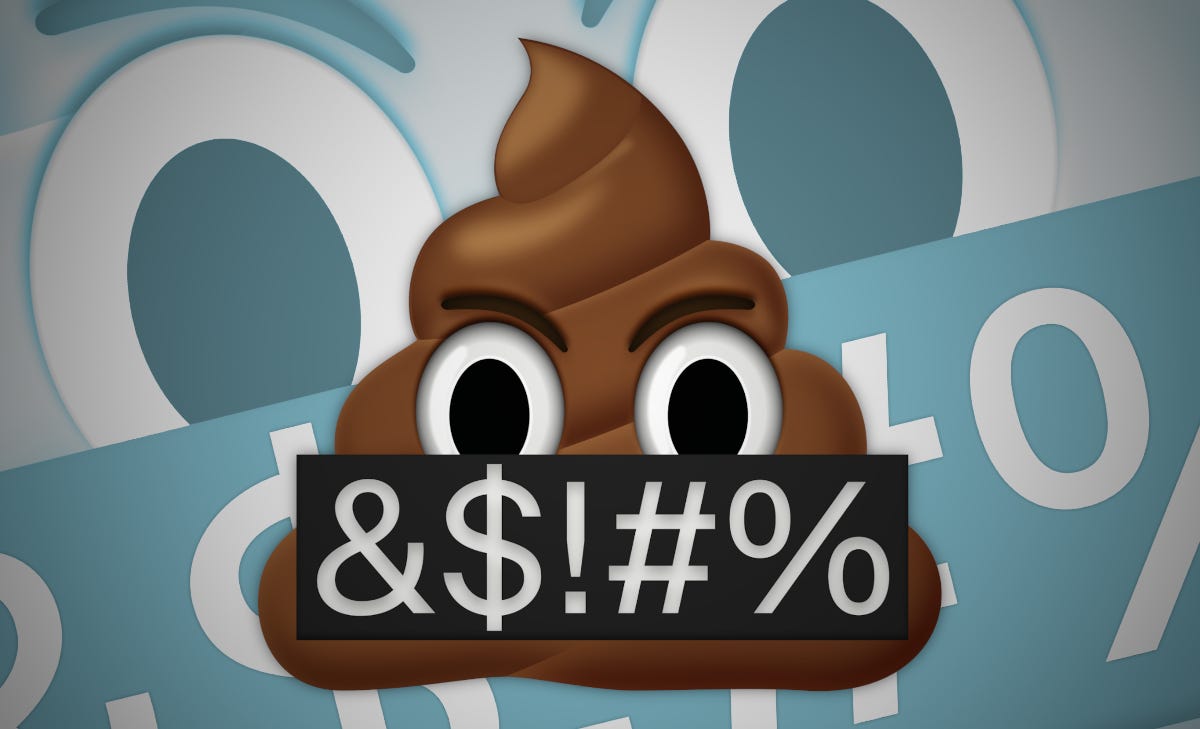
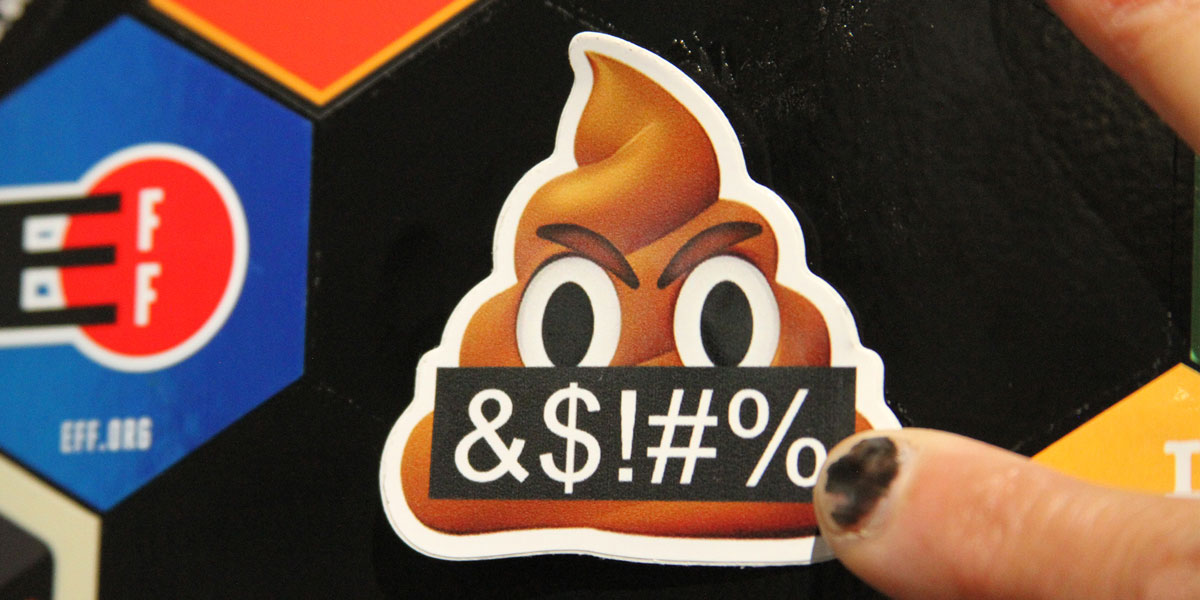
Words matter, but so do visuals. For the cover of the U.S. edition of my book, Enshittification, designer Devin Washburn of No Ideas studio created an iconic variation of the "pile of poo" emoji, with angry eyebrows and a grawlix-scrawled censor bar over its mouth. It instantly became the symbol of enshittification I’d been looking for. 

A digital illustration of an angry poop emoji holding a black sign reading "&!#%", set against a blue and gray background tiled with oversized "& !#%" characters.

I liked it so much I ordered a couple hundred enamel pins and a couple thousand vinyl stickers and handed them out to people I met on my 33-city book tour. Even when giving them away, I was inundated with requests to buy more of them.  

I've since bought out Devin's rights to the image and released it under a Creative Commons Attribution 4.0 license—free for anyone to use, remix, or build on, including commercially, with attribution. The high-resolution files are on Wikimedia CommonsFlickr, and the Internet Archive (including a PSD with an ink-density adjustment layer). It belongs to the commons now. 

But I made sure EFF had first crack at the design for their “official merch,” and they've done right by it. There are two items available now in the EFF shop, and all proceeds go directly to EFF's work defending digital rights. I’ve spent years admiring EFF’s merch and consistent, creative visual identity, so it fills me with pride to see this more-than-a-mere-poop-emoji in their shop.  

A recognizable visual shorthand is a genuine organizing tool. When someone sees the enshittification emoji, they know what the conversation is about. When you wear the pin or slap the sticker on your laptop, you're signaling that you understand what's happening to the internet, and that you know we can do better.  

You can get a $5 sticker:

An angry poop emoji sticker affixed to the coiled spring mechanism inside a vending machine. The sticker depicts a scowling poop emoji holding a black sign reading "&$!#%".

A hand with black nail polish and a gold ring holds an angry poop emoji sticker against a white door. The sticker shows a scowling poop emoji holding a black sign reading "&$!#%".

Or a $10 pin:

A close-up of an enamel pin on the lapel of a tan jacket. The pin depicts an angry poop emoji holding a black banner reading "&$!#%".

An enamel pin clipped to the nose bridge of black-framed sunglasses resting on a wooden surface. The pin depicts a scowling poop emoji holding a black banner reading "&$!#%". 

 Because the design is CC-licensed, you don't have to buy one. You can make your own merch, your own swag, your own illustrations. I made a lawn flag for my front garden.

A  small white garden flag on a metal stake, planted among cacti and succulents in a sunny yard. The flag depicts an angry poop emoji holding a sign reading "&$!#%". 

But if you do want to buy a sticker or pin, you can do so while supporting the most profound and powerful disenshittifying force on the planet Earth—the Electronic Frontier Foundation.

SUPPORT EFF

GET LimITED EDITION MERCH + FIGHT ENSHITTIFICATION


Tell Congress: Just Say No to NO FAKES

The Senate Judiciary Committee is set to consider and vote on the Nurture Originals, Foster Art, and Keep Entertainment Safe Act (NO FAKES). Instead of targeting the real privacy harms posed by AI-generated replicas, this law would create another layer of internet censorship on top of the already existing legal and voluntary takedown systems. Congress should reject NO FAKES.

Take action

Tell Congress to Say No to NO FAKES

As currently written, NO FAKES proposes to tackle the problems of misleading AI-generated replicas by creating a broad property right in someone's look, voice, and general style. However, there are all kinds of First Amendment-protected expression that would be swept under the NO FAKES regime—think about parody, news, criticism.

NO FAKES also does a laughable job of protecting artists from use of their image in misleading ways. It doesn’t create a privacy right, but rather a property right that can easily be signed away—as major studios and record labels are almost certain to require in their contracts with artists. As a result, NO FAKES actually creates a new avenue for the exploitation of artists by companies instead of protection from misleading replicas. 

The bill also makes it trivially easy for protected speech to be censored. It is a supercharged version of the already flawed copyright takedown regime. It would essentially require platforms to institute filters that don't just look for exact matches of copyrighted material, as current filters do, but anything that might be a digital replica. Even though the latest version of this bill adds some forms of redress for bad faith takedowns, those provisions lack the teeth required to deter a malicious actor. 

NO FAKES targets speech, tools, and innovation instead of focusing on the real concern posed by these replicas: privacy. This bill was a bad idea when it was introduced, and got even worse when it was amended last year. Tell Congress to just say no to NO FAKES.

Take action

Tell Congress to Say No to NO FAKES

California’s AB 412 Still Demands Developers Do The Impossible

California lawmakers are again considering A.B. 412, a bill that would require AI developers to identify and disclose copyrighted works used to train generative AI systems.

The problem this year is the same as last year: it’s practically impossible to comply with this law. The bill demands information that often does not exist, and cannot realistically be obtained. 

EFF submitted an opposition letter to the California Senate Privacy Committee explaining why we continue to believe A.B. 412 is simply unworkable. To the extent developers do follow this law, it will have the effect of locking in the power of the largest companies in AI. 

A Burden That Can’t Be Met

A.B. 412 sounds simple: just have AI developers create and keep a list of all the registered copyrighted works they use in AI training. 

That may seem straightforward. In practice, it’s anything but. 

There is no machine-readable “list” of copyrighted works at the U.S. Copyright Office. And many copyright holders can get a copyright without even depositing a publicly viewable sample of the work—for example, software companies may register copyright on proprietary code without revealing it to the public. 

And on the open internet, copyright information is often incomplete, unavailable, or impossible to verify. One image may be registered with the copyright office, while the next is licensed under a free Creative Commons license (like the images that EFF creates), and the next is public domain. A message forum user might post an original story, photograph, or poem without any indication of ownership or registration status. 

The bill effectively asks developers to continuously cross-reference massive batches of online data against a copyright system that simply wasn’t designed to do so. If California passes A.B. 412, its impact will go far beyond the large AI companies we read about in the headlines. 

Not Just Big Tech

Supporters often frame this bill as a way to help creative workers have some leverage against Big Tech, but the bill reaches much further than the big AI companies. 

Its definition of “developer” extends to anyone who makes a generative AI model available to Californians. That includes indie developers tinkering with an existing model, open-source initiatives, nonprofits, and other non-commercial efforts. Recent amendments added exemptions for universities and government entities, which is important, but that still leaves out a vast swathe of non-commercial tech work that’s done by people without full-time jobs in government or academia. 

Large companies will hire compliance teams and lawyers to navigate these requirements. Smaller organizations and independent developers usually can’t. The result will be fewer opportunities for startups and new entrants. Faced with this massive compliance burden, some won’t even try. 

Courts Are Already Deciding These Questions

The bill is premised on the idea that copyright owners currently don’t have good remedies if they’re mistreated by AI companies. That simply isn’t true. And the growing wave of federal court filings in this space prove it. Content companies that want to sue tech companies, large or small, have no problem doing so. Those courts are still working through important questions about fair use and transformative use. Some courts have already concluded that many AI training activities qualify as fair use. Others continue to evaluate the issue.

California lawmakers should not rush to impose new state regulation while those questions remain unresolved. This is why copyright is governed at the federal level: both creators and fair users benefit from a single set of nationwide rules. 

At this point, the bill remains a solution in search of a problem. Rights holders already have powerful tools to protect their interests under existing federal law. What this bill adds isn’t clarity or transparency, but a costly and essentially impossible compliance burden that will discourage small developers and researchers. 

California has been able to support both artistic creativity and tech innovation for decades now.  But A.B. 412 does not strike the right balance. 

If you are a California resident and interested in speaking out about this bill, you can find and contact your representatives through this website

A Bridge to Somewhere: How to Link Your Mastodon, Bluesky, or Other Federated Accounts

One of the central promises of open social media services is interoperability—the idea that wherever you personally decide to post doesn’t require others to be there just to follow what you have to say. Think of it like a radio broadcast: you want to reach people and don't care where they are or what device they're using. For example, in theory, a Bluesky user can follow someone on Mastodon or Threads without having to create a Mastodon or Threads account. But these systems are still a work in progress, and you might need to tweak a few things to get it working correctly.

Right now, broadcasting your message across social platforms can be a funky experience at best, deliberately broken up by oligopolists. The idea of the open web was baked into the internet via protocols like HTML and RSS that made it easy for anyone to visit a website or follow most blogs. The fact social media isn’t similarly open reflects an intentional choice to privatize the internet. 

Bridging and managing your posts so they’re viewable outside a singular source is part of the broader philosophy of POSSE, short for Post Own Site Syndicate Elsewhere (sometimes its Post Own Site, Share Everywhere). Instead of managing several accounts across different services, you post once to one primary site (which might be your personal website, or just one social media account), then set it up so it automatically publishes everywhere else. This way, it doesn’t matter where you or your audience is, and they're not walled off by account registration requirements. 

We’ll come back around to POSSE at the end of this post, but for now, let’s assume you just want your current main open social media account to actually have a chance to reach the most people it can. 

Why Post to the Open Social Web

Because the Fediverse and ATmosphere use different protocols, we need to use a third-party tool so accounts can communicate with each other. For that, we’ll need a bridge. As the name suggests, a bridge can connect one social media account to another, so you can post once and spread your message across several places. This isn’t just some niche concept: major blogging platforms like Wordpress and Ghost integrate posting to the Fediverse.

Bridging is an important facet of POSSE, but also something more people should consider, even if they don’t run their own websites. For example, if you don’t want to create a Threads account just to interact with your one friend who uses that platform, you shouldn’t have to. The good news is, you don’t. There are several bridging services, like Fedisky, RSS Parrot, and pinhole, but Bridgy Fed is currently the simplest to use, so we’ll focus on that. 

How to Post to Bluesky from Mastodon

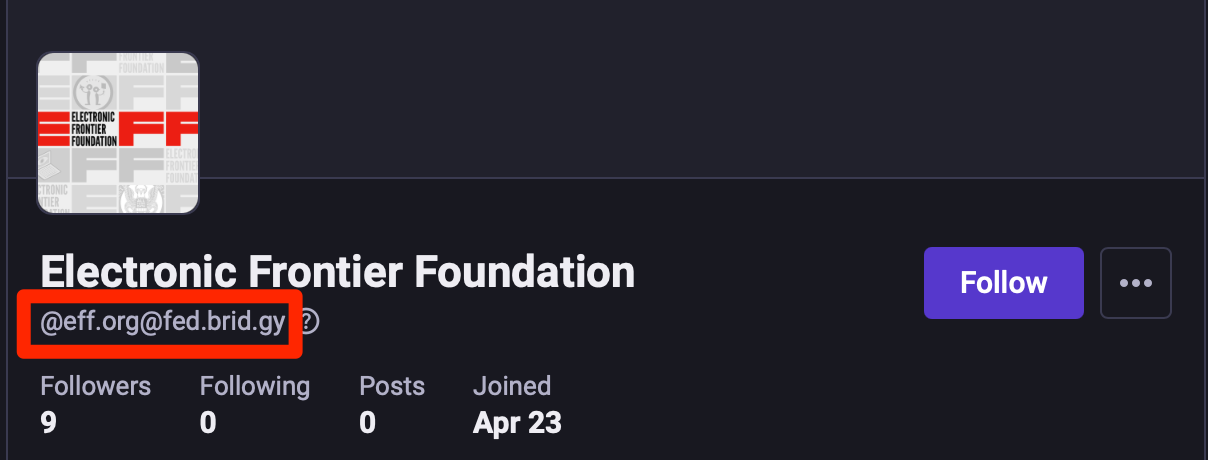
From your Mastodon account (or other Fediverse account, for simplicity’s sake we’ll stick to Mastodon throughout), search for the username @bsky.brid.gy@bsky.brid.gy and follow that account. Once you do, the account will follow you back and you’ll be bridged and people can find you from their Bluesky account. You should also get a DM with your bridged username. If you don’t see the @bsky.brid.gy@bsky.brid.gy user when you search, your Mastodon instance may be blocking the bridging tool. 

Threads users who have enabled Fediverse sharing will be able to find you with your standard Mastodon username (ie, @your_user_name@mastodon.social), but if they haven’t enabled sharing, they will not be able to see your account. While this search is still a beta feature, you might find it easier to share the full URL, which would look like this: https://www.threads.net/fediverse_profile/@your_user_name@mastodon.social

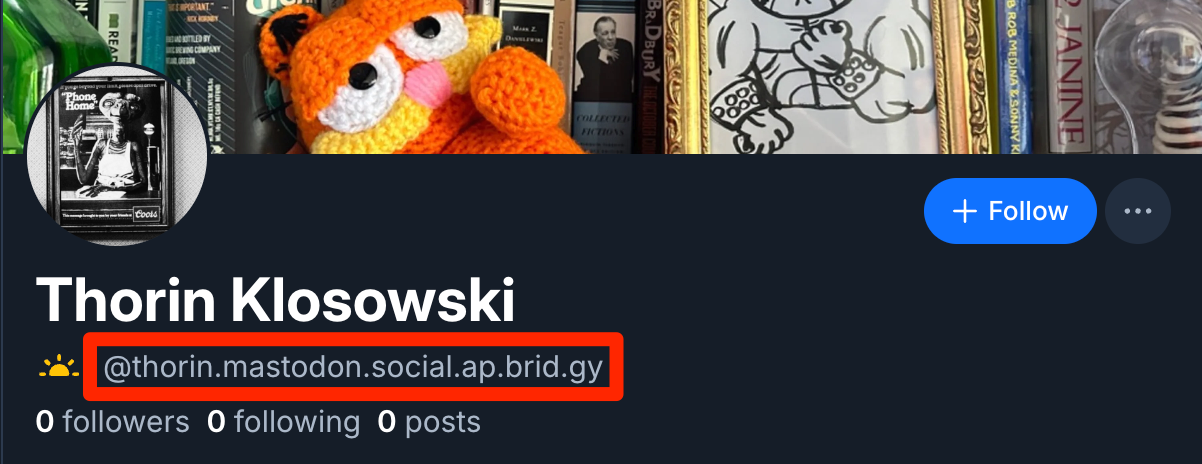
People on Bluesky can find you by: Either searching for your Mastodon username, or if that doesn’t work, @your_user_name.instance.ap.brid.gy. For example, if your username is @eff@mastodon.social, it would appear as @eff.mastodon.social.ap.brid.gy.

an example of a mastodon user profile viewed from threads

An example of a Mastodon username from the Bluesky web client.

How to Post to Mastodon and Bluesky from Threads

Yes, Threads is technically on the Fediverse, and you can bridge your Threads account to Mastodon or Bluesky (unless you’re in Europe, where the feature is disabled), but it’s a different process than on Bluesky and Mastodon.

  • Open Settings > Account > Fediverse Sharing and set the option to “On.” This will make your posts visible to Mastodon (or other Fediverse) users, and vice versa. 
  • Once the Fediverse sharing is enabled, you’ll likely need to wait a week, then you can bridge to Bluesky. Search for and follow the @bsky.brid.gy@bsky.brid.gy account (it may take some digging to find it, but if that doesn’t work you can try visiting the profile page directly

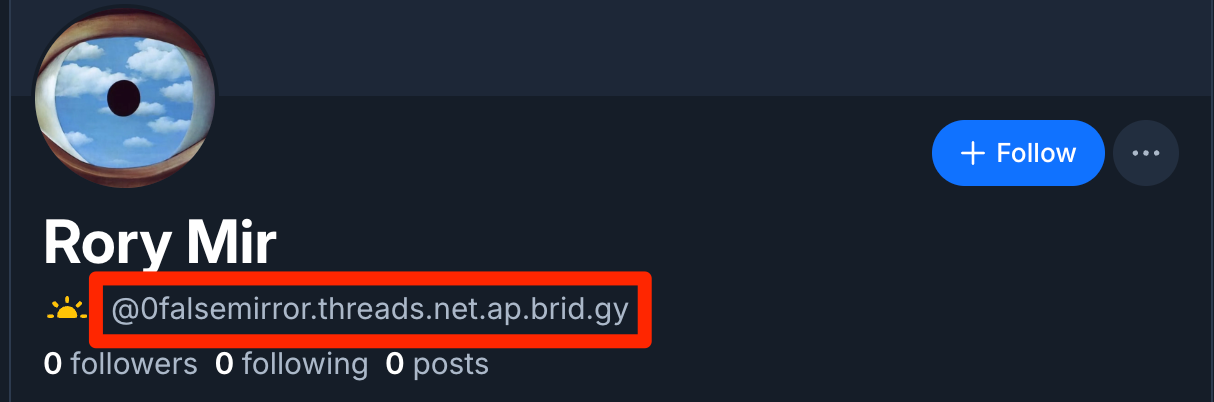
People on Mastodon (or other Fediverse accounts) and Bluesky can find you by: Mastodon users can find you at, @your_threads_username@threads.net while Bluesky users will find you at, @your_threads_username.threads.net.ap.brid.gy (seriously, that will be the username). Note that some Mastodon instances may block Threads users entirely.

an example of a threads post viewed from mastodon

An example of a Threads username from the Mastodon web client.

an example of a threads user profile viewed from bluesky

An example of a Threads username from the Bluesky web client.

How to Post to Mastodon and Threads from Bluesky

From your Bluesky (or other ATProto) account, search for the username, “@ap.brid.gy” and follow that account. Once you do, the account will follow you back and you’ll be bridged, so people can follow you from Mastodon or other Fediverse accounts. You should also get a DM with your bridged username.

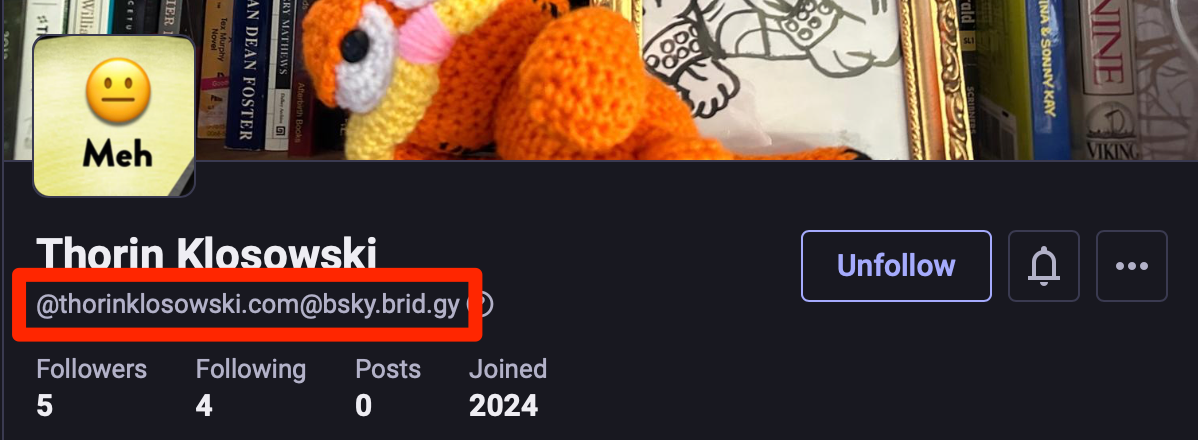
People on Mastodon (or other Fediverse account) and Threads can find you by: Your username will appear as @your_bluesky_username@bsky.brid.gy. For example, if your Bluesky username is @eff@bsky.social, it would appear as @eff.bksy.social@bsky.brid.gy.

an example of a bluesky user profile viewed from mastofon

An example of a Bluesky username from the Mastodon web client.

How to Post Everywhere from Your Own Website

You can bridge more than social media accounts. If you have your own website, you can bridge that too (as long as it supports microformats and webmention, or an Atom or RSS feed. If you have a blog, there’s a good chance you’re already good to go). When you do so, the bridged account will either post the full text (or image) of whatever you post to your personal site, or a link to that content,  depending on how your website is set up. You’ll also probably want to log into your Bridgy user page so you can manage the account. 

Where people can find your bridged account: Usually, a user can just search for your website’s URL on their decentralized social network of choice, or enter it on the Bridgy Fed page. But if that doesn’t work, they can try @yourdomain.com@web.brid.gy from Mastodon or @yourdomain.com.web.brid.gy from Bluesky.

an example of a website profile viewed from mastodon

An example of a bridged website username in the Mastodon web client.

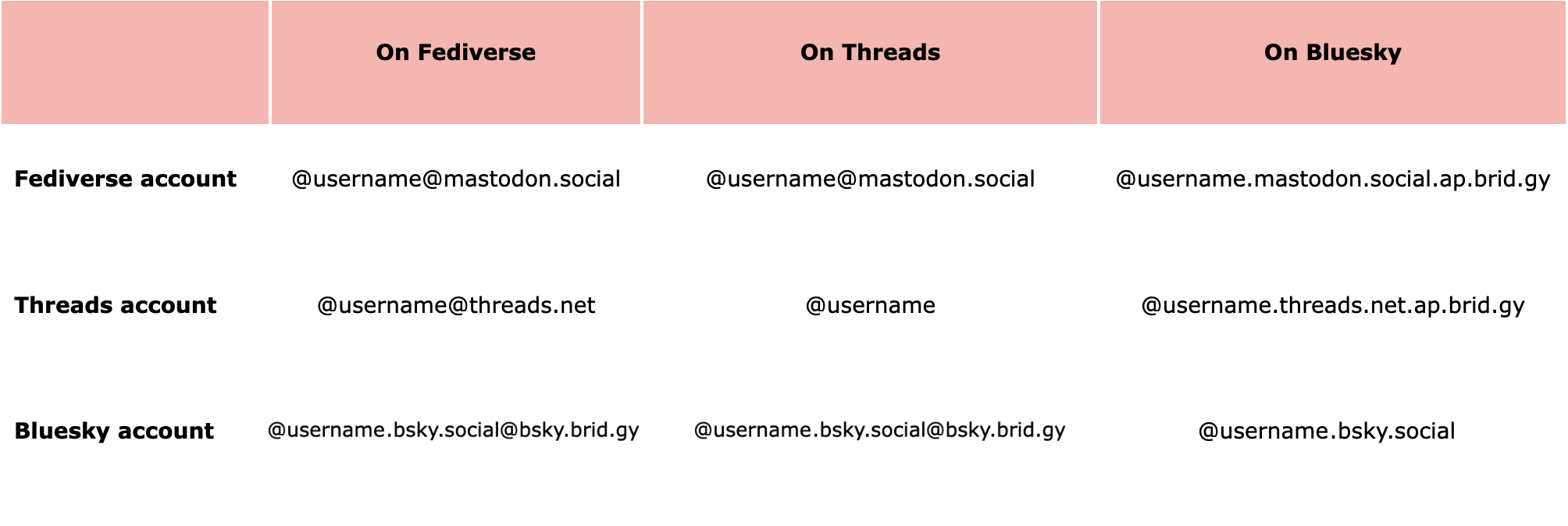
How Your Account Username Looks on Each Platform

   Examples of how each social media username looks on other platforms

You’re Bound to Run Into Some Quirks

  • Sometimes messages take a little while to crossover between networks, and sometimes they don't crossover at all.
  • You can’t log into a bridged account like a regular account, but Bridgy Fed does provide some tools to see incoming notifications and recent activity in case they’re not coming through properly.
  • ActivityPub and ATProto don’t have the same feature set, so you will have certain capabilities for one account you might not have in another. For example, you can edit posts on Mastodon, but not on Bluesky. If you edit a post that’s bridged from Mastodon to Bluesky, the Bluesky post will not be updated. 
  • Replies can sometimes get lost, especially if the person (or people) replying to you doesn’t have sharing turned on.
  • Ownership of accounts can get weird. For example, if you post to your own website and use a tool like Wordpress or Ghost for federation (more info below), you don’t necessarily get access to a “normal” social media account, with a standard login and password.
  • And more! This is still a work in progress that has some technical quirks, but it’s improving all the time, and it’s best to keep telling yourself that troubleshooting is part of the fun.

Other Cool Stuff You Can Do

As mentioned up top, there’s a lot more you can do, and an increasing number of tools are making this process simpler. Bridgy Fed is one way to post to more places from a single account, but it’s far from the only way to do so. Here are just a few examples.

  • Micro.blog is a paid service where you can blog from your own domain name, then post automatically to Mastodon, Bluesky, Threads, Tumblr, Nostr, LinkedIn, Medium, Pixelfed, and Flickr.
  • Ghost is a blogging and newsletter platform that offers direct integration with the Fediverse, as well as support for Bluesky. Wordpress offers the option to join the Fediverse through a community plugin. Other newsletter platforms, like Buttondown, also have plans for federation. 
  • Surf.social is a landing page and social media utility where you can show off all your various accounts (Federated or not). From the reader point of view, you can follow one publications numerous types of posts in one place. For example, 404 Media’s Surf.social feed includes its YouTube feed, podcast feed, and its journalist’s social media posts.
  • If you think these new handles are a bit ugly, you can use a custom domain for Bluesky or fediverse account from your website. 

Of course, there are plenty of other tools, blogging platforms, and other utilities out there to help facilitate posting and bridging accounts, with new ones coming along every day. 

With proper support, time, and effort, eventually we will all be able to seamlessly interact across platforms, take our follows and followers to other services when a platform no longer suits our needs, and interact with a variety of web content regardless of what platform hosts it. Until then, we still need to do some DIY work, support the services we want to succeed, and push for more platforms and services to support federated protocols.

Correction: an earlier version of this blog was missing the full Bluesky username in the account username chart.

The Open Social Web Needs Section 230 to Survive

If you want to overthrow Big Tech, you’ll need Section 230. The paradigm shift being built with the Open Social Web can put communities back in control of social media infrastructure, and finally end our dependency on enshitified corporate giants. But while these incumbents can overcome multimillion-dollar lawsuits, the small host revolution could be picked off one by one without the protections offered by 230.

The internet as we know it is built on Section 230, a law from the 90s that generally says internet users are legally responsible for their own speech — not the services hosting their speech. The purpose of 230 was to enable diverse forums for speech online, which defined the early internet. These scattered online communities have since been largely captured by a handful of multi-billion dollar companies that found profit in controlling your voice online. While critics are rightly concerned about this new corporate influence and surveillance, some look to diminishing Section 230 as the nuclear option to regain control. 

The thing is, that would be a huge gift to Big Tech, and detrimental to our best shot at actually undermining corporate and state control of speech online. 

Dethroning Big Tech

We’re fed up with legacy social media trapping us in walled gardens, where the world's biggest companies like Google and Meta call the shots. Our communities, and our voices, are being held hostage as billionaires’ platforms surveil, betray, and censor us. We’re not alone in this frustration, and fortunately, people are collaborating globally to build another way forward: the Open Social Web. 

This new infrastructure puts the public’s interest first by reclaiming the principles of interoperability and decentralization from the early internet. In short, it puts protocols over platforms and lets people own their connections with others. Whether you choose a Fediverse app like Mastodon or an ATmosphere app like Bluesky, your audience and community stay within reach. It’s a vision of social media akin to our lives offline: you decide who to be in touch with and how, and no central authority can threaten to snuff out those connections. It’s social media for humans, not advertisers and authoritarians.

Behind that vision is a beautiful mess of protocols bringing open social media to life. Each protocol is a unique language for applications, determining how and where messages are sent. While this means there is great variety to these projects, it also means everyone who spins up a server, develops an app, or otherwise hosts others’ speech has skin in the game when it comes to defending Section 230.

What exactly is Section 230?

Section 230 protects freedom of expression online by protecting US intermediaries that make the internet work. Passed in 1996 to preserve new bubbling communities online, 230 enshrined important protections for free expression and the ability to block or filter speech you don’t want on your site. One portion is credited as the “26 words that created the internet”:

“No provider or user of an interactive computer service shall be treated as the publisher or speaker of any information provided by another information content provider.” 

In other words, this bipartisan law recognizes that speech online relies on intermediaries — services that deliver messages between users — and holding them potentially liable for any message they deliver would only stifle that speech. Intuitively, when harmful speech occurs, the speaker should be the one held accountable. The effect is that most civil suits against users and services based on others' speech can quickly be dismissed, avoiding the most expensive parts of civil litigation. 

Section 230 was never a license to host anything online, however. It does not protect companies that create illegal or harmful content. Nor does Section 230 protect companies from intellectual property claims

What Section 230 has enabled is the freedom and flexibility for online communities to self-organize. Without the specter of one bad actor exposing the host(s) to serious legal threats, intermediaries can moderate how they see fit or even defer to volunteers within these communities.

Why the Open Social Web Needs Section 230

The superpower of decentralized systems like the Fediverse is the ability for thousands of small hosts to each shoulder some of the burdens of hosting. No single site can assert itself as a necessary intermediary for everyone; instead, all must collaborate to ensure messages reach the intended audience. The result is something superior to any one design or mandate. It is an ecosystem that is greater than the sum of its parts, resilient to disruptions, and enables free experimentation with different approaches to community governance.

The open social web’s kryptonite though, is the liability participants can face as intermediaries. A greater potential for liability comes with more interference from powerful interests in the form of legal threats, more monetary costs, and less space for nuance in moderation. And in practice, participants may simply stop hosting to avoid those risks. The end result is only the biggest and most resourced options can survive.

This isn’t just about the hosts in the Open Social Web, like Mastodon instances or Bluesky PDSes. In the U.S., Section 230’s protections extend to internet users when they distribute another person’s speech. For example, Section 230 protects a user who forwards an email with a defamatory statement. On the open social web, that means when you pass along a message to others through sharing, boosting, and quoting, you’re not liable for the other user’s speech. The alternative would be a web where one misclick could open you up to a defamation lawsuit.

Section 230 also applies to the infrastructure stack, too, like Internet service providers, content delivery networks, and domain or hosting providers. Protections even extend to the new experimental infrastructures of decentralized mesh networks.

Beyond the existential risks to the feasibility of indie decentralized projects in the United States, weakening 230 protections would also make services worse. Being able to customize your social media experience from highly-curated to totally laissez-faire in the open social web is only possible when the law allows space for private experiments in moderation approaches. The algorithmically driven firehose forced on users by antiquated social media giants is driven by the financial interests of advertisers, and would only be more tightly controlled in a post-230 world.

Defending 230

Laws aimed at changing 230 protections put decentralized projects like the open social web in a uniquely precarious position. That is why we urge lawmakers to take careful consideration of these impacts. It is also why the proponents and builders of a better web must be vigilant defenders of the legal tools that make their work possible. 

The open social web embodies what we are protecting with Section 230. It’s our best chance at building a truly democratic public interest internet, where communities are in control.

Copyright and DMCA Best Practices for Fediverse Operators

People building the future of the social web — interoperable and decentralized — need to protect themselves against copyright liability. Like anyone who creates and operates platforms for user-uploaded content, the hosts of the decentralized social web can take preventive measures to reduce their legal exposure when a user posts material that violates someone’s copyright.

This post gives an overview of the steps to take. It’s meant for operators of Mastodon and other ActivityPub servers, Bluesky hosts, RSS mirrors, and other decentralized social media protocols, and developers of apps for those protocols — but it will apply to other hosts as well. This isn’t legal advice, and can’t substitute for a consultation with a lawyer about your specific circumstances. It focuses on U.S. law — the law may impose different requirements elsewhere. Still, we hope it helps you get started with confidence.

Why should I care? Copyright’s Sword of Damocles

In some circumstances, the operator of a platform that handles user content can be legally responsible for content that infringes copyright. That can happen when the platform operator is directly involved in copying or distributing the copyrighted material, when they promote or knowingly assist the infringement, or when they benefit financially from infringement while being in a position to supervise it. But these judge-made rules are often difficult and uncertain to apply in practice — and the penalties for being found on the wrong side of the law can be severe. Copyright’s “statutory damages” regime allows for massive, unpredictable financial liability. That’s why it’s important to limit your risk.

For Server Operators: Limiting Risk with the DMCA Safe Harbors

If you run a social network server, the safe harbor provisions of the Digital Millennium Copyright Act (DMCA) are an important way to limit your liability risk. The DMCA shields server operators from nearly all forms of copyright liability that can result from “storage at the direction of a user” — in other words, hosting user-uploaded content. But to qualify for this protection, there are steps a server operator has to take.

1. Designate A Contact To Receive Copyright Infringement Notices

First, you’ll need to provide contact information for someone who can receive infringement notices (a “designated agent”). That information needs to be posted in at least two places: on your server in a place visible to users (such as a “DMCA” page or post, or as part of your Terms of Service), and in the U.S. Copyright Office’s “Designated Agent Directory.” To post that information to the directory, you have to create an account at https://www.copyright.gov/dmca-directory/ and pay a small fee. The directory listings expire after three years, and once expired, your safe harbor protection goes away, so it’s important to keep that listing current.

2. Respond Promptly to Notices and Counter-notices

When you receive infringement notices, it’s important to respond to them promptly. Notices are supposed to identify the copyright holder, the copyrighted work they claim was infringed, and the post they claim is infringing. By deleting or disabling access to the posted material, you protect yourself from liability with respect to that material.

The theory behind Section 512 is that hosts don’t have to be in a position of deciding whether a post infringes someone’s copyright — it’s up to the poster, the rights holder, and potentially a court to decide that. A host who takes down posts whenever they receive an infringement notice is well-protected. But it’s equally important to recognize that hosts aren’t required to take down content in response to every notice. Infringement notices are frequently wrong, misguided, or abusive, or simply incomplete. Hosts who want to stand up for their users’ speech can choose to disregard infringement notices that seem suspect. While this risks losing the automatic protection of the safe harbor in each instance, it can still be done safely with careful preparation, ideally using a plan crafted with help from a lawyer. Bear in mind that people sending false notices, including by failing to consider whether a post is a fair use before asking a host to take it down, can be liable for damages under the DMCA.

The DMCA also allows the person who posted the material to send a “counter-notification” asserting that they really did have the right to post and that there’s no copyright infringement. Responding to counter-notifications is a good way for a host to demonstrate that they look out for their users. When a host receives a counter-notification, they should forward it on to the person who sent the original takedown notice and let them know that the post will be restored in 10 business days. Then, after that waiting period has elapsed, the host can restore the posted material. Just like with infringement notices, a host isn’t required to honor a counter-notification that appears to be fraudulent, but there’s no penalty for honoring it anyway.

3. Have A Repeat Infringer Policy

The next requirement is to have a policy of terminating the accounts of “subscribers and account holders” who are “repeat infringers” in “appropriate circumstances,” and to carry out that policy. Yes, that’s a vague requirement. It doesn’t require a “three strikes” policy or any other sports analogy. It just needs to be reasonable. Be sure your policy is spelled out in your website terms or “DMCA” page.

4. Don’t Ignore Known Infringement

Hosts need to take down user posts whenever the host actually knows that the post is infringing. In other words, a host isn’t protected if they ignore takedown notices based on technicalities in the notices, or if they learn about the infringement some other way. But hosts don’t need to actively look for infringement on their servers — only to act when someone notifies them.

5. Don’t Encourage Infringement

Finally, make sure that nothing you post or advertise actively encourages copyright infringement. For example, don’t post examples of users uploading copyrighted music or video without permission, or insinuate that your server is a good place for infringing content.

There are some other technicalities in the DMCA that can affect the safe harbor, which is why it’s always a good idea to consult with a lawyer. But following these steps will help protect you when you run a social media server — or any other kind of user-uploaded content platform.

Stop New York's Attack on 3D Printing

New York's proposed 2026-2027 budget currently includes provisions that will require all 3D printers sold in the state to run print-blocking censorware—software that surveils every print for forbidden designs. This policy would also create felony charges for possessing or sharing certain design files. The vote on the state budget could happen as early as next week, so New Yorkers need to act fast and demand that their Assemblymembers and Senators strip this provision from the budget.

Take action

Tell Your Representative to Stand with Creators

State legislators across the US are rushing to regulate 3D-printed firearms under the syllogism something must be done; there, I've done something.” The most reckless of these proposals is a mandate for manufacturers to implement print blocking on all 3D printers. We, and other experts, have already pointed out that this algorithmic print blocking is simply unfeasible and will only serve to stifle competition, free expression, and privacy. While most detrimental to the creative communities lawfully using these printers, every New Yorker will be impacted by this blow to innovation.

This policy is unfortunately buried in Part C of the New York State’s proposed budget for the 2026-2027 fiscal year (S.9005 / A.10005), which is urgently moving toward a vote after facing extensive delays. It’s also bundled with a policy that would allow felony charges to be brought against researchers and journalists for sharing design files restricted by the state.  The worst of these impacts won’t be known until after it is negotiated behind closed doors, with no safeguards for creative expression or privacy.

Researchers and Journalists Could Face Felony Charges

Part C Subpart A of the budget includes two particularly concerning provisions: §2.10 and 2.11. These threaten Class E felony charges for distributing or possessing 3D-printer files that would produce firearm parts with a 3D printer or CNC machine. 

Under these provisions merely sharing a print file with any of them could result in criminal charges

The first provision, 2.10, makes it a felony to sell or distribute files that can produce major firearm components to someone who is not a federally and NY-licensed gunsmith. Under 2.11, it’s also a felony to possess these files if you intend to illegally print a firearm or share them with someone you believe is not permitted to own or smith a firearm.

A journalist reporting on 3D-printed guns. A researcher studying printable firearms. An artist incorporating parts into a new work commenting on gun culture. Under these provisions merely sharing a print file with any of them could result in criminal charges, even if no one involved intends to assemble a firearm.

Criminalizing information doesn’t work. Someone intent on illegally printing a firearm is already subject to charges for that act. Adding felony liability for simply possessing a file or design piles on additional charges while doing nothing to stop printing. New charges for someone distributing these files won’t make them inaccessible to lawbreakers, but they will have a chilling effect on legitimate and entirely legal work. 

Unsurprisingly, a similar law was proposed and subsequently scrapped in Colorado due to First Amendment concerns. We recommend New York do the same.

Take action

Tell Your Representative to Stand with Creators

Mandated Surveillance, Less Access

Part C Subpart B would require every 3D printer and CNC machine sold in New York to include algorithms that scan your design files and block prints the system identifies as producing firearm components. Furthermore, all sales and deliveries of these machines must be made face-to-face. 

Unlike other bills we have seen, there are no exceptions to this mandate. These restrictions apply to sales to researchers, commercial manufacturers, and—oddly enough—federally and state-licensed gunsmiths.

Applying these restrictions to CNC machine sellers is particularly absurd. These cousins of 3D printers, which make 3D objects by removing materials, are often tens of thousands of dollars and used by commercial manufacturers. Automotive, aerospace, medical manufacturers, and many others industries will be subject to the in-person sales, surveillance risk, and all the other problems with these print-blocking algorithms introduce.

Industries will be subject to the in-person sales, surveillance risk, and all the other problems

Even limiting the focus to individual buyers—hobbyists and artists who use these machines at home—this restriction to face-to-face sales comes with its own issues. Beyond unnecessarily complicating the use of printers in the state, this barrier to access will hit rural New Yorkers the hardest. People in rural or remote locations can stand to benefit from the saved time and costs of printing useful parts at home. With this restriction, they will need to drive to one of the few retailers who actually sell this equipment and settle for the models they stock. 

That is, if sellers continue to stock these printers despite the risk. Subpart B §§ 2.3 and 2.5 open sellers up to liability, including anyone on the second-hand market, for selling out-of-date printers. Meanwhile, buyers hoping to illegally print firearms can simply build their own printer with widely available equipment.

The Law Won’t Work as Advertised 

Here’s what makes Subpart B of the New York budget particularly reckless: the technology it mandates is not capable of doing what it is supposed to. 

There is very little detail provided about requirements for the mandated algorithms. What the bill does outline boils down to this: the algorithms must evaluate print files to determine whether they would produce a firearm or illegal firearm parts, and if so, block the print. In an attempt to enable this, New York state would also create and maintain a library of forbidden files with tightly restricted access. 

We’ve already gone over why this idea simply won’t work. Design files are trivially easy to modify, split into segments, or otherwise alter to evade pattern detection. Even if printers fully rendered and analyzed the print with cloud-based AI, any number of design or post-print tricks can be used to dodge detection. Meanwhile, such fuzzy AI interpretation will rapidly increase the percentage of lawful prints censored. 

Firearms aren’t a highly specific design like paper currency; these proposed algorithms are futilely attempting to block an infinite number of designs capable of—or that can be made capable of—the few simple mechanical functions that make up a firearm. 

This group has no peer review requirements, so it could easily be loaded with profiteers or incumbent manufacturers

As we’ve said before: the internet always routes around censorship. Anyone determined to print a prohibited object has straightforward workarounds. The people who get surveilled and blocked are the people trying to follow the law.

The bill aims to enforce this impossible mandate by creating a working group to define the actual technical requirements of enforcement—but only after the law passes. This group has no peer review requirements, so it could easily be loaded with profiteers or incumbent manufacturers who are already lining up to participate. These incumbents stand to profit from shutting out new competitors and locking in users to their devices, and sellers into their platform, subjecting both to the type of enshittification seen with Digital Rights Management (DRM) software. There are also no safeguards in the law to prevent the most surveillance-heavy approaches to print scanning, or to stop this censorship infrastructure from being further weaponized against lawful speech.

On the other hand, unbiased experts in open-source manufacturing in the working group can at best pause the clock by showing such algorithms are unfeasible. That is, until a new snake oil company comes along to restart it. 

New York Won't Be the Last Stop 

New York is one of the largest consumer markets in the country. When it mandates a feature in hardware, manufacturers hardly ever build a New York-only version. They build the New York version and sell it globally. A print-blocking mandate adopted in New York will become the national standard in practice.

New Yorkers deserve more than this rush job buried in a budget bill. This is an unfeasible tech solution, built without the consumer protections that would be required of any serious policy proposal, and creates new costs and inconveniences amidst a protracted annual budget process. It also threatens First Amendment protections. This policy will take shape without consumer guardrails, behind closed doors, and risks the worst outcomes for grassroots innovation and creativity enabled by these machines. Worse still, these practices can become the norm across other states and among 3D-printer manufacturers worldwide. 

Your representatives could vote on this ill-conceived measure in the next week.  If you're a New Yorker, email your legislators now, and tell them to strip this measure from the budget today. 

Take action

Tell Your Representative to Stand with Creators

The Dangers of California’s Legislation to Censor 3D Printing

California’s bill, A.B. 2047, will not only mandate censorware — software which exists to bluntly block your speech as a user — on all 3D printers; it will also criminalize the use of open-source alternatives. Repeating the mistakes of Digital Rights Management (DRM) technologies won’t make anyone safer. What it will do is hurt innovation in the state and risk a slew of new consumer harms, ranging from surveillance to platform lock-in. California must stand with creators and reject this legislation before it’s too late.

3D printing might evoke images of props from blockbuster films, rapid prototyping, medical research, or even affordable repair parts. Yet for a growing number of legislators, the perceived threat of “ghost guns” is a reason to impose restrictions on all 3D printers. Despite 3D printing of guns already being rare and banned under existing law, California may outright criminalize any user having control over their own device. 

This bill is a gift for the biggest 3D printer manufacturers looking to adopt HP’s approach to 2D printing: criminalize altering your printer’s code, lock users into your own ecosystem, and let enshittification run its course. Even worse, algorithmic print blocking will never work for its intended purpose, but it will threaten consumer choice, free expression, and privacy.

A misstep here can have serious repercussions across the whole 3D printing industry, lead the way for more bad bills, and leave California with an expensive and ineffective bureaucratic mess.

What’s in the California Proposal?

Compared to the Washington and New York laws proposed this year, California’s is the most troubling. It criminalizes open source, reduces consumer choice, and creates a bureaucratic burden.

Criminalizing Open Source and User Control

A.B. 2047 goes further than any other legislation on algorithmic print-blocking by making it a misdemeanor for the owners of these devices to disable, deactivate, or otherwise circumvent these mandated algorithms. Not only does this effectively criminalize use of any third-party, open-source 3D printer firmware, but it also enables print-blocking algorithms to parallel anti-consumer behaviors seen with DRM.

Manufacturers will be able to lock users into first-party tools, parts, and “consumables” (analogous to how 2D printer ink works). They will also be able to mandate purchases through first-party stores, imposing a heavy platform tax. Additionally, manufacturers could force regular upgrade cycles through planned obsolescence by ceasing updates to a printer’s print-blocking system, thereby taking devices out of compliance and making them illegal for consumers to resell. In short, a wide range of anti-consumer practices can be enforced, potentially resulting in criminal charges.

Independent of these deliberate harms manufacturers may inflict, DRM has shown that criminalizing code leads to more barriers to repair, more consumer waste, and far more cybersecurity risks by criminalizing research.

Less Consumer Choice

The bill favors incumbent manufacturers over newer competitors and over the interests of consumers.

Less-established manufacturers will need to dedicate considerable time and resources to implementing the ineffective solutions discussed above, navigating state approval, and potentially paying licensing fees to third-party developers of sham print-blocking software. While these burdens may be absorbed by the biggest producers of this equipment, it considerably raises the barrier to entry on a technology that can otherwise be individually built from scratch with common equipment. The result is clear: fewer options for consumers and more leverage for the biggest producers. 

Retailers will feel this pinch, but the second-hand market will feel it most acutely. Resale is an important property right for people to recoup costs and serves as an important check on inflating prices. But under this bill, such resale risks misdemeanor penalties. 

The bill locks users into a walled garden; it demands manufacturers ensure 3D printers cannot be used with third-party software tools. By creating barriers to the use of popular and need-specific alternatives, this legislation will limit the utility and accessibility of these devices across a broad spectrum of lawful uses.

Bureaucratic Burden 

A.B. 2047’s title 21.1 §3723.633-637 creates a print-blocking bureaucracy, leaning heavily on the California Department of Justice (DOJ). Initially, the DOJ must outline the technical standards for detecting and blocking firearm parts, and later certify print-blocking algorithms and maintain lists of compliant 3D printers. If a printer or software doesn’t make it through this red tape, it will be illegal to sell in the state.

The bill also requires the department to establish a database of banned blueprints that must be blocked by these algorithms. This database and printer list must be continually maintained as new printer models are released and workarounds are discovered, requiring effort from both the DOJ and printer manufacturers. 

For all the cost and burden of creating and maintaining such a database, those efforts will inevitably be outpaced by rapid iterations and workarounds by people breaking existing firearms laws.

Not just California

Once implemented, this infrastructure will be difficult to rein in, causing unintended consequences. The database meant for firearm parts can easily expand to copyright or political speech. Scans meant to be ephemeral can be collected and surveilled. This is cause for concern for everyone, as these levers of control will extend beyond the borders of the Golden State.

While California is at the forefront of print blocking, the impacts will be felt far outside of its borders. Once printer companies have the legal cover to build out anti-competitive and privacy-invasive tools, they will likely be rolled out globally. After all, it is not cost-effective to maintain two forks of software, two inventories of printers, and two distribution channels. Once California has created the infrastructure to censor prints, what else will it be used for?

As we covered in “Print Blocking Won’t Work” these print-blocking efforts are not only doomed to fail, but will render all 3D printer users vulnerable to surveillance either by forcing them into a cloud scanning solution for “on-device” results, or by chaining them to first-party software which must connect to the cloud to regularly update its print blocking system.

This law demands an unfeasible technological solution for something that is already illegal. Not only is this bad legislation with few safeguards, it risks the worst outcomes for grassroots innovation and creativity—both within the state and across the global 3D printing community.

California should reject this legislation before it’s too late, and advocates everywhere should keep an eye out for similar legislation in their states. What happens in California won't just stay in California.

❌