Reading view

There are new articles available, click to refresh the page.

Studying ITIL Foundations: What I learned and what I questioned

Working in information technology, I have been aware of ITIL for a while but had never formally studied it. I attended a three-day training course and passed the ITIL Foundation exam. Here, I share my reflections and my review of ITIL.

ITIL (Information Technology Infrastructure Library) originated in the 1980s, developed by an agency of the UK government as a way to standardise IT service management practices. It’s now owned by AXELOS and used globally across a range of industries, including Higher Education. The University of Edinburgh uses ITIL to structure aspects of organisational governance as well as many of its processes. I was curious to learn about ITIL as I felt it would help me make sense of the way some things work within ISG.

Read more about ITIL:

ITIL website

I studied the ITIL 4 Foundation course, which covers concepts like the Service Value System, value co-creation between provider and consumer, the four dimensions of service management, guiding principles, and key ITIL practices like the service desk, service request management, incident management and change management. Going through the course and completing the exam, I came away with several reflections about ITIL and its application to modern digital services.

First rule of ITIL: It’s not supposed to just be about IT (but it mainly is)

For a discipline with IT in its title, it was surprising to learn that ITIL is actually intended as a more generic service management framework, supposed to be applicable to non-technical as well as technical services. ITIL’s IT roots were clear, however, as many of the examples intended to ground the abstract concepts related to management of very traditional technical services, and it was hard to visualise practices like deployment management applied to non-technical realms. Conversely, it was difficult to visualise ITIL flexing to be applicable to the management of emergent technical services, such as machine or AI-based services with rapidly evolving operating models.

Service dominant logic, continuous improvement and systems thinking were familiar

Many of the ITIL artefacts are expressions of service value, based on a fundamental concept that value from a service can only come if it is co-created. In other words, if a service is not used, it cannot create value (no matter how good it is). I’d previously learned about Service Dominant Logic, (described in 2004 as a marketing concept by Stephen Vargo and Robert Lusch), so it was interesting to make the connection between these two disciplines. Whereas Vargo, Lusch and others focus on value dimensions, and the interplay between operand and operant resources, however, ITIL delineated service value through models like the Service Value System and the Service Value Chain.

Continuous improvement was another key ITIL focus, but guided by artefacts like Service Level Agreements and practices like Service Request Management, and motivated by efficiency and compliance focused targets rather than user-focused improvement drivers like UX or CX.

Systems thinking was another thread running through ITIL, however, it seemed limited in its use to describe sequences of inputs and output from different activities in value streams – without inclusion of Soft Systems Methodology (described by Peter Checkland in 1989), universally useful as a way to diagnose problems.

ITIL’s terminology tended to overwhelm the logic and the purpose

Naming things is hard and changing the names of things can lead to even more confusion. When it came to the words used in ITIL, it seemed that those who developed ITIL had thought long and hard about what to call the models, processes, practices and so on. For the uninitiated coming to ITIL fresh, however, it was natural to question why things were named in certain ways and to forget and mix up the terms, as well as question the absence of certain concepts. There seemed little scope to mould the rigid ITIL glossary to real-life scenarios, instead it seemed at risk of institutions trying to fit ITIL rather than the other way around.

Considering this conundrum, I was reminded of work I began a while ago to reduce jargon in Drupal, and of my ongoing work to shape the Web Sustainability Guidelines to be universally applicable. In both instances I had learned of the difficulty in choosing the right words and phrases to meaningfully describe abstract concepts, and therefore could appreciate the length of time it could take small changes to take effect in such a well-established standardisation mechanism as ITIL.

Read about my work on Drupalisms in this blog post:

De-jargoning Drupal – working with the community to open up Drupal’s terminology

Read about my work on the W3C Web Sustainability Guidelines in this blog post:

Shaping the future of the sustainable web: The advent and development of the W3C Web Sustainability Guidelines


From recommendations to reality: Applying UX design thinking for a technical solution for staff profiles

The Role of Profiles project produced 10 recommendations for an improved University profile provision. To start actioning these, I assembled a working group of specialists and drew on UX design principles – implementing practical prioritisation while seeking innovative solutions that addressed the research findings.

Recognising the widespread value and strategic importance of communicating the work, accomplishments and status of University staff, the UX Service undertook a research project to investigate the needs and requirements for an improved provision to publish profile content within the University web estate. The project uncovered many insights, brought together in a series of technical and non-technical recommendations. Since the research project closed, I have been looking for ways to act upon the recommendations, in a bid to make them happen and crystallise a new profile provision for the University.

Read about the profile research project in our series of blog posts

To start bringing the recommendations to life, I needed a UX design process to follow

In the absence of a formal follow-up project to implement the recommendations, and recognising the unwavering importance of profile content being available on University websites, I was keen to retain momentum and to keep profiles on the agenda. Having worked as a UX Lead in different realms, I have learned about various UX design processes to effect technical builds. I was keen to experiment with an approach based on the Agile Squad method, which brings together individuals from multidisciplinary teams to focus on specific feature areas of a technological solution. This seemed like a good fit for profiles, firstly as a way to break down the recommendations into smaller tasks, and secondly as a way to harness the University-wide knowledge and expertise about profiles my team had uncovered as part of the research.

Read more about the Agile Squad Model in project management in an article on daily.dev

I set up a specialist squad to continue making progress on profiles

In the latter stages of the profiles research project, I had ran two successful co-creation workshops, bringing together colleagues from different teams, Schools and Groups, all with different perspectives yet a shared interest in profiles. These workshops had demonstrated that, across the University, there were colleagues already developing profile solutions, and that there was a bank of innovative ideas to tap into – to help achieve an improved profile solution.

In the interests of starting small and keeping things simple, I formed a Teams channel which included staff from the Business School, the School of Engineering, the PURE team, IS Apps and EDINA. I initiated a round of discussions, brainstorms and show-and-tells to harness expertise and gather perspectives from each team in turn.

Reviewing the recommendations, I ranked them by what to tackle first

With the help of squad colleagues, I revisited the 10 recommendations from the research project to better understand the dependencies and complexities and accordingly, sort them into a prioritised order. The recommendations that required EdWeb2 expertise needed to be accommodated within the existing EdWeb2 roadmap and therefore were placed in a queue behind other priorities. Recommendations relating to profile creation and maintenance had dependencies on the updated provision being in place, and similarly, it was logical to schedule training sessions to help colleagues write effective profiles to occur once the new provision was available to use.

See the full list of project recommendations in my blog post: The Role of Profiles is to represent our staff: Recommendations and reflections from our project

It made practical sense to start by investigating data exchange solutions

One of the more sizeable recommendations from the profiles project was as follows:

Profiles should support the display of content from other repositories using technical solutions where feasible

This recommendation recognised the tendency of profile owners to publish content about themselves and their work in multiple sources, and their wish to be able to bring those content sources together, to display in a University of Edinburgh profile. To address this recommendation, I began some investigation work – primarily to find out about existing solutions for data exchange (both for profiles and more broadly) that would provide food for thought about how to break the recommendation down into small tasks.

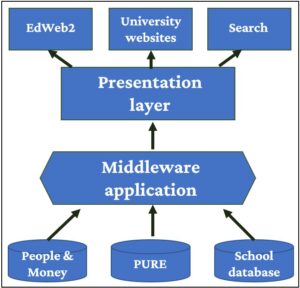
A simple diagram served as a boundary object to align thinking and prompt collaboration

In technology design and innovation, reference is often made to the value of prototypes and wireframes as a way to crystallise thinking and to spark ideas. In this piece of work, a diagram depicting the expected interactions to achieve data sharing between different systems served as a useful artefact to bring a shared way of thinking across the teams and to prompt ideas for achieving the different aspects of the proposed idea.

Diagram to show proposed model for data sharing. On the bottom are three data sources: People and Money, PURE and a School database, these feed into a middleware application which feeds into a presentation layer which ultimately feeds into EdWeb2, University websites and Search

Diagram of the boundary object used to describe the proposed model to achieve presentation of profile data on EdWeb2, other University websites and search via a middleware app, pulling from sources such as People and Money and PURE.

A workshop with Business School colleagues helped formulate a proof of concept

UEBS operates a non-EdWeb site, and to meet the need to display profile content of UEBS colleagues, the technical team had devised a solution that parsed data from fields within PURE (the University’s primary research repository, operated by Elsevier) and displayed it in UEBS staff profiles. As part of the profiles squad, the UEBS team shared details of their solution to enable critique and assessment of its suitability for wider, scaled-up production.

Having learned about what worked, what didn’t and the associated requirements and dependencies, and keeping in mind the user requirements from the research project, it felt appropriate to propose developing a minimal viable product (MVP) for the University-wide profile solution. Defining the MVP was helpful to give us something to aim for in the short-term, and we recognised that in the process of working towards delivering the MVP, we would learn along the way and ultimately get closer to a solution that was feasible to deliver for the whole University.

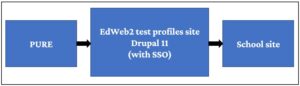
The MVP contained three parts:

  1. Profile data coming from PURE or from another identity source, such as People and Money or the Active Directory
  2. A Drupal 11 site within EdWeb2 with a profile entity to handle the data
  3. A School site to ingest the data
Diagram to show the MVP where data from PURE is ingested into a Drupal 11 site ready to be presented on a School site

Diagram to show the MVP where data from PURE enters a Drupal 11 site ready to be ingested by a School site

Breaking this down further, we agreed that the first step would be to make some PURE profile data available to be consumed by the Drupal 11 site – envisioned to be achieved with a single PURE ID of a person. A subsequent step would be to expose the data as a JSON feed from the Drupal 11 site, ready to be consumed by the School site.

Meeting the PURE team helped tease out typical repository dependencies

Given a key part of the MVP was data-sharing from PURE, the next logical step was to learn from the PURE team about the possibilities for data extraction from this system. On the technical side, the team shared PURE API documentation with details of data endpoints and new data formats to help with modelling the data consumption planned for the MVP. They also shared information about PURE’s upgrade path and ongoing maintenance needs which was important to consider within the context of the planned profile solution. Reflecting on requirements of PURE end-users, the team revealed trends for PURE profile data – for example, the need for academics to not only capture detail of their publications but also of their research activities within PURE. This was interesting to hear as it mirrored a finding from the profiles research project relating to profile content.

Furthermore, the team provided insight into broader requirements for the use of PURE data, including integrations with other systems, for the purpose of support and publicising research activities in alignment with high-level University strategic objectives (such as REF 2029). Understanding the wider landscape was helpful to reinforce the potential of the improved profiles provision we are aiming to achieve and the key role of PURE within that.

Learning about integrations from IS Apps colleagues offered an innovative way to look at data sharing

The team from IS Apps recently presented about their use of Choreo – a cloud-native platform which powers their newly-launched integration service. Choreo has the capacity to manage APIs and integrate services and systems, affirming its potential usefulness as part of our improved profile provision. Meeting the IS Apps team to explain our goals for a profiles MVP, we began to consider options for being able to make use of identity data APIs to receive baseline data to populate profiles for part 1 of the MVP.

Read more about the Choreo technology on the WSO2 website

Wider interest from the Higher Education Drupal community suggested opportunities for contribution

Having contributed to open-source Drupal for several years, I have built up a network of useful contacts for shared learning about Drupal solutions. Raising awareness of our profiles project in the Drupal community provoked a response from people in other institutions trying to achieve similar goals, leading to knowledge-sharing with institutions such as the University of Cambridge, Stanford University and the University of Bergen. As our squad progresses with its work, I hope that the University of Edinburgh can contribute an open-source technical solution that may benefit organisations like ours, and that may be taken and adapted for more and more use cases.

With EDINA and Drupal we ideated for potential use of AI: balancing opportunities with risks

Reflecting on ways of achieving data exchange between systems, it was natural to consider how AI could assist. Consulting colleagues from the ELM team within EDINA we explained our plans for the MVP as a provocation to understand the potential for AI. Between us, we identified the potential for MCP servers for contextual data transformation, to potentially deliver repository data dynamically in AI-ready formats. We also identified an idea for ELM to potentially deliver profile data from defined sources conversationally, in response to queries. Both ideas were subject to dependencies and further investigation.

Drawing on earlier learnings about use of AI to formulate profile content, we recognised the need for profile owners to be able to sense-check the content before it was displayed, to ensure it did not misrepresent them. For this reason, we resolved that if either of our suggested AI ideas proved technically viable, user research with profile holders should occur to inform actions and progress, to ensure full agency for personal data remained with those the data belonged to.

Read about a project experimenting with AI to generate profile content in the blog post: An AI tool for generating academic staff profiles using a pre-trained LLM – findings from a study

Considering tried-and-tested use cases for ELM, we identified that profile owners may like to make individual use of ELM to assist with the wording of their profile content, in particular to undertake tasks like writing the content in particular styles conference abstracts, providing ELM with the necessary contextual sources to be used to shape profile content in particular ways. I identified a potential test use case for a new Drupal AI module I have been contributing to, the AI Context Control Center (CCC), currently under rapid development within the Drupal community.

Read more about the development of the AI Context Control Center on Drupal.org

We have a way to go to implement the recommendations, but we’ve made a good start

All things considered, we’re getting incrementally closer to an improved profile provision, but we’re not there yet. Taking a UX design lead on developing a profile solution is helping to ensure we keep sight of the recommendations formed from the research project. Working in a squad that brings together people from multiple disciplines from the wider University provides a welcome way to learn about different colleagues’ ways of working, ideas and approaches. It is heartening and motivating to see the appetite and interest in profiles from colleagues around the University and from the wider content management community, and I feel confident that, with continued support, we will, in time, arrive at a better profiles provision to serve staff at the University.

Concept testing: The UX research approach driving user-centred development of Drupal’s interfaces

Drupal is the University’s content management system and Drupal CMS – its new ready-to-use site-building product – is developing apace. As Drupal UX Research Lead, I’ve used concept testing to gather quick insights that keep interface decisions user-focused and keep development moving.

As part of the Drupal CMS leadership team, I take responsibility for improving Drupal’s UX based on findings from user research. In this blog post, I reflect on how I’ve adapted my research approach to ensure we have evidence to hand ready to guide rapid, iterative product decisions at the interface level, while remaining faithful to the overarching product goals.

Ensuring UX research informs agile product development is a well-known challenge

I first grappled with fitting UX into Agile as UX Lead on the University’s Web Publishing Platform (WPP) project. Defining a UX and Design process to keep the project focused on user needs prompted me to think about how UX research and development complemented each other and the need for data-based feedback.

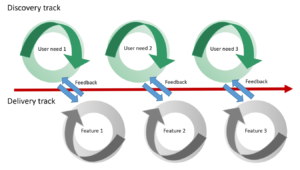
Dual-track Agile emerged as a good way to align the disciplines – with a UX strand focused on continuous discovery around tasks feeding into a staggered development strand focused on defining features.

Dual-track process with a 'Discovery track' on the top with a 3 loops each representing research around a user need. Beneath is the delivery track with 3 loops each representing a feature being built following the research. Feedback occurs at points between the 2 series of loops

Diagram depicting the dual-track Agile process, adapted a diagram by Jeff Patton, from his book ‘User Story Mapping: Discover the Whole Story, Build the Right Product’


When I considered how to implement this in Drupal, I realised the importance of defining a prioritised list of user tasks to act as the target for research and therefore the basis for future feature development.

In September 2025 I blogged about three key task areas on my shortlist for Drupal CMS UX improvement. These included:

  1. How people make sense of Drupal interfaces through the Drupal labels on different features and functionalities
  2. How people maintain and extend their Drupal sites, to keep things up-to-date and add in extra functionality
  3. How people use Drupal AI functionality in a range of contexts within Drupal sites

Keeping these broad task areas front-and-centre helped me remain clear on our research priorities, to ensure I gather appropriate data to pass to the development strand to inform the ongoing build and configuration of the Drupal CMS product.

Read my earlier blog post about aligning UX and Agile:

Making Agile and UX work together – reviewing the UXD process for the Web Publishing Platform project

For the long-term, the Drupal CMS product strategy keeps high-level priorities in focus

When working in tight development cycles, concentrating closely on shaping a product, it is easy to get lost in the small decisions and lose sight of the wider product purpose. When Drupal CMS began (initially as Drupal Starshot), it was launched with a product strategy. Using the framework from the book ‘Playing to Win: How Strategy Really Works’ by A.G. Lafley and Roger L. Martin’ the strategy set out:

  • Our winning aspiration: Putting the power of Drupal into the hands of marketers, content creators and other non-technical users
  • Where we will play: Focusing on marketers, targeting organisations in the mid-market segment
  • How we will win: Prioritise ease of use, ability to grow and scale, directed use of innovative technologies (such as AI) towards marketer and content creator use cases
  • The capabilities we must have: interfaces that are intuitive for non-technical audiences, out-of-the-box marketing and content creation capabilities, and simplified ways to extend site functionality

Keeping points of the product strategy front-and-centre has been essential for me to ensure I design the right research approach, to enable learning about what’s most important in the least amount of time to unblock technical development decisions. It has also helped me remain grounded when working in a constantly-changing development environment.

Read more about the initiation of Drupal CMS in my blog post from 2024:

UX leading the newest developments in Drupal – a mindset shift for Drupal CMS

Read more about Drupal CMS in the Drupal CMS product strategy (on Drupal.org)

Read my post from September 2025 setting out the research priorities for Drupal CMS:

UX leadership in open-source Drupal: Insights, lessons and future aspirations

In the short-term, Drupal interfaces can be constantly changing

As content management systems go, Drupal CMS is no ordinary product. The fact that it is an open-source product means the pace of development and innovation associated with it is particularly rapid and changeable as it can be shaped by an ecosystem of factors in a dynamic global community.

Most recently, innovative solution opportunities have arisen due to the development and launch of Drupal Canvas (Drupal’s newest visual page builder). The launch of Drupal Canvas in November 2025 signalled a new approach to creating and handling content in Drupal, and was a perfect fit for Drupal CMS given the target audience of marketers and content creators, therefore it was added into the v2.0 release of Drupal CMS.

Referring back to my three prioritised task areas, the inclusion of Drupal Canvas in Drupal CMS brought considerations of Drupal interfaces to the forefront. I identified the need to understand how target audiences would make sense of Drupal features and functionalities based on how they were presented in Drupal CMS.

Read more about Drupal Canvas within Drupal CMS in the announcement of Drupal CMS 2.0 on Drupal.org

Concept testing gathers user insights quickly, to support a fast pace of development

Given the rate of change in Drupal, I realised I needed a fast way to seek user feedback on interface designs, so I could feedback findings while development was in flight. Concept testing is a research technique deployed to test product ideas to assess whether they are worth progressing, to sense-check understanding of content and interaction patterns, and to gauge how people instinctively react to interface layouts and arrangements. This approach follows the Lean UX methodology – doing the least amount of work to learn the most important thing – and is particularly valuable in new product development, to avoid wasting effort and time developing solutions or heading in directions which may not align with user expectations.

Access the Lean UX Canvas (Jeff Gothelf)

By continually capturing ideas as visual mock-ups, I’ve built up a bank of concept testing material

Drupal’s flexibility lends itself to experimentation and many ideas and concepts arise from people setting up a Drupal instance and playing with the functionality it provides. Following the progression of Drupal innovations I have started the habit of collecting screenshots of the concepts being mooted on the fly. As things progress, I have been able to use prototyping and wireframing to turn the screenshots into visual representations for test participants to look at. Developing appropriate test scenarios around these visuals, I have been able to run quick online sessions with test participants to gather insights to feed into ongoing development.

Findings from my concept tests with users have provided direction in ambiguous circumstances

Over the past 6 months, I’ve completed multiple rounds of concept testing, drawing on my network of contacts for help shaping appropriate scenarios and recruiting participants that match the Drupal CMS target audience. In some cases, the sessions have focused on engaging participants around a single concept (sometimes referred to as monadic testing), in others I have asked participants to view multiple concepts in sequence to make comparisons and contrast.  My test findings have helped guide Drupal CMS interface choices in changing circumstances – I’ve summarised a selection of the learnings and the decisions made.

Changing the label ‘CMS’ to ‘CMS Content’ will improve understanding while we work out the wider architecture

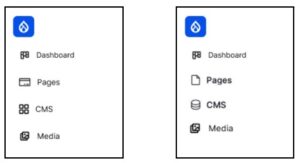
Drupal Canvas was included in the release of Drupal CMS v2.0, however, it was not technically feasible for Canvas to replace the form-based node-editing content interface traditionally found in Drupal. Therefore, in v2.0, both types of content creation mechanism needed to be present and it was unclear of the best way to present these options, recognising that the architecture could change. Distilling the different possibilities into a series of mock-ups, I ran several tests to find out which made most sense to users. One test sought to discover whether the label ‘Pages’ to access the Drupal Canvas editing interface and the label ‘CMS’ to access different content types was something users would understand.

In a test scenario, I asked participants to imagine they were responsible for a website and needed to look at content that had been published to review it. I presented them with the mock-ups and asked them to talk through what they would expect to find by selecting the different options in the left-hand menu. When they had described their expectations, I showed them what they would actually find, in order to check alignment.

Results of the test revealed that participants associated ‘Pages’ with an editor for individual pages, indicating that it was an acceptable label for entry into the Drupal Canvas editing interface. Participants were less clear of what to expect by choosing ‘CMS’, and they did not associate it with content. When they saw the content types they would find by selecting this label, they grasped the concept. These findings affirmed ‘CMS Content’ would be a better signifier for users, at least in the short term until bigger architectural decisions were made.

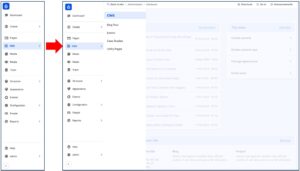
Screenshot of Drupal CMS showing the 'CMS' label (outlined in red) and the screen that appears once 'CMS' is selected

Screenshot of Drupal CMS showing the ‘CMS’ label and the screen that appears once ‘CMS’ is selected

Removing icons  for menu labels will reduce ambiguity and cognitive load

As the test participants analysed and commented on the different menu labels, I took the opportunity to seek their interpretation and understanding of the icons associated the labels themselves. There was no clear consensus on the icon meanings from the participants, therefore the decision was made to remove the icons in the interim, to avoid unnecessary confusion or misinterpretation.

Screenshot showing the different icon options for the 'Pages' and the 'CMS' menu labels

Screenshot showing the different icon options for the ‘Pages’ and the ‘CMS’ menu labels

Removing ‘Create’ will make the menu options simpler in the interim

In the same series of tests probing users’ understanding of the labels for the different content options, I asked test participants when they thought they might choose the ‘Create’ option compared to the ‘Pages’ and the ‘CMS’ options. From their responses, it emerged that they were unclear when they would choose ‘Create’, signalling that this label was a ‘nice to have’ rather than a necessity. In the interests of decluttering the interface and making it easier to access content options, this label was removed.

Screenshot showing side-by-side Drupal CMS dashboard designs, the one on the left has the create option (outlined in red) the one on the right has the create option removed

Screenshot showing side-by-side Drupal CMS dashboard designs, the one on the left has the ‘Create’ menu option (outlined in red), the one on the right has the ‘Create’ menu option removed.

Using a vertical arrangement of filter options provides more flexibility than an horizontal layout

Engaging participants further in the test scenario, I sought to gather their preferences for finding content using the Drupal CMS interfaces. By questioning them about their usual search and filtering approaches, it became clear that there were many different facets and factors they could draw on to find content. It became clear that arranging these in a horizontal way would lead to unsightly wrapping and a clunky interface design, which prompted a decision to opt for a vertical filter arrangement.

Reflection: Concept testing is delivering strong returns for minimal effort

Findings from my short series of experiments demonstrate the value and usefulness of concept testing as a research approach, and I am keen to apply it in more areas of my work. The ease with which it can be executed highlights it as an excellent entry-level UX research technique, and as such I am especially motivated to work with both technical and non-technical colleagues in the community to coach it so that others may realise the benefits for themselves.

Repositioning Effective Digital Content as a short online course: A product approach

Following a successful launch of Effective Digital Content, our internal course that staff complete to learn and practice fundamental content design skills, the UX Service saw an opportunity to make the course more widely available, on the University’s Short Courses platform.

In May 2025, after months of user research-informed development work, my UX Service team delivered a new Effective Digital Content course to University staff. To date, hundreds of staff have successfully completed the course with some staff openly celebrating their achievement by sharing their digital badge.

Read more about how the team adopted a staff-centred approach to developing the Effective Digital Content course:

Series of blog posts about the Effective Digital Content course

Demand for the course from other universities prompted us to think bigger

After the launch of the Effective Digital Content (EDC) course, the UX team presented their work to various forums and groups. Following a showcase of the course at the UCISA UX Community Day in September 2025, we received interest in the course from the wider Higher Education sector, with colleagues from other UK universities requesting access to the course content, so that they could apply the concepts to content publishing in their respective institutions. There were various options to make the course public, and following conversations with University colleagues in Open Education and the Short Courses platform, we decided to pursue adding Effective Digital Content to the short online courses portfolio, to make it part of the University’s continuing professional development offering.

University of Edinburgh short courses website

Market research confirmed EDC a good fit for the short online courses portfolio

As the team behind the course, we acknowledged our bias in deeming it suitable for inclusion in the Short Courses platform. In order to make a more objective assessment of its suitability, we needed to do some research into the external target market and also, to identify related courses and programmes. Google Trends data revealed a growth for the content design sector in recent years, and further market analysis showed that although competitor content design courses were available, none were offered by universities or were targeted specifically at the Higher Education sector, suggesting our EDC could fill a market niche.

Content professionals from the public sector were defined as a target audience

Taking into account competitor courses and their respective offerings and critiquing the content in each of the EDC modules we defined the kind of person we felt would be interested in and would benefit from taking the EDC course. These included:

  • Staff working in communications, marketing, academic or administrative roles in the public sector, working with text-heavy content to ensure compliance with standards
  • People with responsibility for creating or managing digital content on websites, social media or other platforms
  • Those new to content design with broader writing or content creation experience
  • Professionals interested in growing skills and confidence working with content as part of continuing professional development.

Our proposal to reposition EDC as a short online course was approved

Supplying the market research findings together with an appraisal of the course against University-wide criteria such as alignment with strategic objectives and sustainability goals meant the proposal for EDC to be included in the Short Courses portfolio was approved by senior management, giving us the green light to proceed with making it happen.

Design and technical constraints prevented us lifting and shifting the existing course

Excited by the prospect of seeing EDC in a new platform, the UX team dived in, familiarising with Canvas and Eduframe – the dual technologies underpinning the Short Courses platform. After some initial experimentation, however, it quickly became clear that a straight migration of the course content wouldn’t work for several reasons:

  • The section headings of the existing EDC course didn’t map directly into the structure of Canvas
  • Some of the existing EDC video module content was directly Edinburgh-centric (referring to systems like EdWeb for example)
  • The workbook element of the course (where learners receive feedback on worked example) wasn’t feasible to scale beyond an internal audience

Considering these problems one-by-one made them difficult to solve, as there were dependencies between them, as well as additional unknowns still to be worked out.

Read more about Learning Management System software Canvas and Eduframe on the Instructure website

I brought in a product development framework to keep things on track

Having worked as a UX Lead on various projects, I recognised that when decisions become difficult, it is worth taking a step back to consider the bigger picture, to avoid getting lost in the details and potentially making decisions based on short-term logic that may have adverse consequences in the longer-term. Drawing on my most recent experience, working as part of the Drupal CMS product team, I referred to a useful product design framework, the Product Kata, from ‘The Build Trap’ book by Melissa Perri.
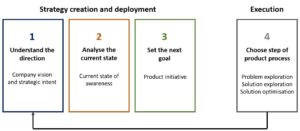
Adaptation of the Product Kata diagram from Melissa Perri's book 'The Build Trap' showing the stages: Understand the direction, (Company vision and strategic intent), Analyse the current state, (Current state of awareness), Set the next goal, (Product initiative), Choose step of product process (Problem exploration, Solution exploration and Solution optimisation)

Adaptation of the Product Kata diagram from Melissa Perri’s book ‘The Build Trap’ showing the 4 stages: Understand the direction, Analyse the current state, Set the next goal, and Choose step of product process.


This framework follows a classic UX design process whereby the product strategy and vision provide the direction, and an analysis of the current state indicates the work to be done to achieve the vision. With the gulf between the current state and the vision defined, it is possible to set milestone goals and establish the relevant product process step to achieve these: problem exploration, solution exploration or solution optimisation.

I used details from our approved proposal document to define a product vision

Using examples from ‘The Build Trap’ as inspiration, and drawing on the information supplied in the proposal, I pulled together a product vision for EDC as a short online course, outlined as follows:

Product vision

To become the first-choice digital content training course for professionals in Higher Education – equipping them with the practical knowledge and confidence they need to create content that is clear, accessible, transparent and sustainable.

The problem our product is solving

As public sector institutions, universities have strict accessibility, legal and transparency obligations. Thousands of people working for universities are responsible for creating and maintaining digital content – but many have not received support or dedicated training. The result is content that’s difficult to read, costly to maintain and runs the risk of being inaccessible to many users.

The gap our product is addressing

There are lots of content design courses available, but few address the practical realities of writing digital content in the Higher Education sector, where accessibility compliance, inclusivity and  transparency are non-negotiable.

Who our product is serving

The main audience for our product are staff in professional roles who publish digital content a part of their broader roles and need practical guidance they can absorb at their own pace and can immediately apply to their own contexts. A secondary audience  is those wishing to move into content design roles, perhaps from related fields such as copywriting or social media communications.

What makes our product stand out from the competition

Our course was built by content professionals working inside a prestigious Russell Group university, responding to real needs identified by years of research with staff with content publishing responsibilities. It has been refined over years and has been completed by over one thousand staff. Unlike competitor course which are marketing led or are UX-oriented, our course specifically addresses:

  • Hands-on guidance on making content accessible
  • Ways to improve the efficiency of finding information, reducing cognitive load and friction
  • Responsible practices to reduce unnecessary digital waste and promote sustainability
  • Real-world context – with examples and exercises grounded in the Higher Education environment
  • Practical application of theory, designed to be adaptable and applicable in learners’ own contexts.

The strategic value associated with our product

Our course stands to bring value to the University of Edinburgh by:

  • Extending the reach and impact of our in-house content design expertise to a wider audience
  • Positioning the University as a leader in digital content practice
  • Demonstrating commitment to knowledge-sharing and sector collaboration

It also promises to deliver value to learners and their respective organisations by:

  • Building a common language and baseline standard for content design across the sector
  • Addressing growing regulatory and accessibility obligations
  • Supporting staff professional development
  • Helping to reduce costly content errors and accessibility failures.

At a more granular level, I teased out learning outcomes for each course module

Regarding the collection of modules in the internal version of the EDC to represent the ‘current state’, I wrote learning outcomes for each module, to epitomise the purpose of each one.

To form the learning outcomes, I  firstly thought about the practical skills learners would gain on completion, but that felt limited. Perhaps more important for the learners to take away was an appreciation of what these skills could achieve with them and therefore why they were important. Added to this, I felt that each module should also leave learners with an impetus to take the skills and apply them to content in own contexts.

Recalling how we developed EDC for internal staff, I remembered how we worked hard to avoid a static learning experience – and instead provide an experience where the learner is actively guided to apply what they have learned, both to supplied examples in the course but also to their own real-life circumstances.

In the book ‘Learning Experience Design: How to Create Effective Learning that Works’, author Donald Clark refers to this set of emotions as ‘Reflective feeling’:

One important facet of reflective feeling comes through the follow-up, actually doing something. This can be triggered by nudge learning so that the learner gets their kicks through going back to their job and actually implementing a challenge” – Donald Clark, Learning Experience Design: How to Create Effective Learning that Works, 2022

With this in mind I grouped the learning outcomes under ‘practical skills’, ‘knowledge and understanding’ and ‘attitude and awareness’. Examples of each for the module ‘Get link text right’ were as follows:

Practical skill

  • Write link text that is clear, meaningful and make sense on its own out of context

Knowledge and understanding

  • Understand why certain phrases like ‘click here’, ‘more’ and ‘further information’ should never be used as link text

Attitude and awareness

  • Appreciate that good link text improves the experience for all users, not just those with accessibility needs.

The learning outcomes serve as principles to guide content trade-offs and define a proof-of-concept

Having learning outcomes for each module has helped us critique the existing EDC content, to establish what is needed to meet the learning outcomes, what is a nice-to-have and what might be missing. This is, in turn helping to set a blueprint for the minimal content of each module for EDC within the short courses platform.

Referring back to the Product Kata, these outcomes serve as a way to progress from the stage 2 current state to stage 3 where we set our next goals. In real terms this means that as we continue to make decisions about course content – for example, whether to include videos, or how to provide learner feedback, how to replace the workbook element of the course, we can use the outcomes as guardrails to refer to, to drive our decision-making in an auditable way. Collectively these decisions or milestone goals will inform a proof-of-concept ready for testing with representative audiences – the results of which will guide stage 4 and our path of execution – problem exploration, solution exploration or solution optimisation as appropriate.

We’re working with colleagues to deliver the proof-of-concept by summer 2026

Repositioning our EDC course for a new platform has been a learning curve so far, and we’re continuing to draw on the expertise of University colleagues in the teaching and learning realm to ensure we make best use of the technology to deliver a course which meets the need of our target audiences and is an attractive proposition for them to engage with to learn content design.

We’ve set a target to achieve a proof-of-concept course by summer 2026, and are working towards this through a series of three-week long sprints, each focused on one of the course modules – including review of content against learning outcomes, ideation around activities and exercises and testing with at least one user. When we reach the end of these planned sprints, we have a view to testing the entire course with participants representative of the target audience, to iterate on research learnings and deliver a version one of our EDC product by the start of the next academic year 2026/2027.

Exciting times ahead! We’re grateful to the support of the Short Courses team, the Learning Technology team and others to help us bring our content design expertise to life in a new EDC short online course.

❌