
 Login
Proton’s Lumo AI chatbot is now available on Linux desktops
 Proton has released desktop apps for its Lumo AI chatbot on all major desktop OSes, including Linux. Lumo is the Swiss privacy company’s own AI assistant, introduced last year and available to use on line. It offers the same sort of features as other generative AI chatbots, including text and image generation, memory, web searching and editable canvases. It runs on ‘open models’, touts better privacy safeguards and encrypts users’ chat history. It’s free to use (with limits) on a free Proton account. Users with paid plans can use additional features, and enjoy higher usage limits. How open Lumo’s models […]
You're reading Proton’s Lumo AI chatbot is now available on Linux desktops, a blog post from OMG! Ubuntu. Do not reproduce elsewhere without permission.
 Canonical’s Snap Store has seen a huge uptick in app uploads over the past few days – one account published more than 114 new titles in 24 hours alone. What gives? Is the snap store finally seeing its second wind? Not quite. In a typical month, the snap store sees between 15-30 new app uploads (not updates) a day, based on a quick eyeball and fudged calculation of figures from the ‘new’ graph on Alan Pope’s SnapUpdates site. But since the 13 November, the figure has crept into the hundreds, driven by uploads from just 4 publisher accounts – and […]
 Canonical is giving Ubuntu Pro users early access to AI-generated patches for known security flaws, available through a new opt-in archive called Edge. To get fixes out faster to customers and users, the company has built a multi-agent system called Surge to backport fixes for vulnerabilities in ‘userspace’ software packages. The machine-generated patches land in the Edge archive. This is opt-in and not enabled by default. Ubuntu Pro users who want fixes before they receive full testing or ‘qualification’, will need to manually enable the Edge archive on supported systems. Surge is not being used to patch kernel vulnerabilities (though […]
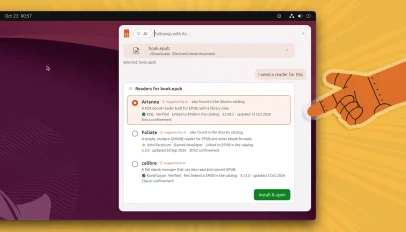 What would deeper AI integration on the Ubuntu desktop look like? Well, you don’t need to think too hard to find out. A Canonical engineer has published a prototype launcher that simulates how on-device AI could be used to enhance and aid users of the Ubuntu desktop. But the warty-prototype snap by Didier Roche-Tolomelli (aka didrocks) is not a real launcher. It’s a semi-interactive, automated mockup. It simulates things a user could do, and that includes interacting with a (theoretical) on-device AI model to complete tasks. The Snap Store listing refers to it as a ‘design-discussion prototype of the next Ubuntu […]
 Canonical announce that Myna, its AI-powered speech-to-text tool for Ubuntu desktop, is available to install as a technology preview.
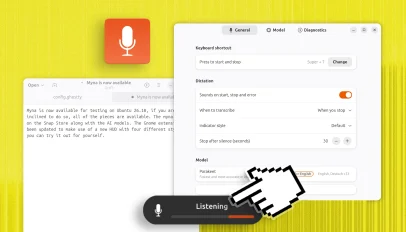 Ubuntu’s AI-powered dictation tool Myna isn’t officially ready to test, but if you’re eager to give it ago, you can do so – I show how in this post. Canonical recently added the Myna orchestrator snap and speech-recognition AI models to the Snap Store, and made a new desktop Myna Settings tool available to install from a PPA. Ubuntu 26.10 also comes with another component preinstalled, as the gnome-shell-ubuntu-extensions package has a GNOME Shell extension that triggers an on-screen HUD when the Myna local AI speech-to-text tech is listening or transcribing. While a formal call for testing hasn’t been made, […]
 Ubuntu kernel security updates will arrive on a near-weekly basis, as Canonical tries to keep pace with an 'explosion' of issues being detected through AI.
 The latest update to Calibre, the popular open-source ebook manager, features an AI-powered writing game. Calibre v9.15’s “Create Your Own Adventure” mode, per the release notes, lets you build a fictional world and hand control of it to an AI who will manage it in real time based on your responses. A bit like old text-based RPGs, I guess. The changelog notes, with obvious understatement, that the feature is “a little different” from Calibre’s usual fare, adding it began as a way for developers to test the tool’s AI backend before developing into “something fun to use”. Like all AI […]
 Canonical recently joined the Linux Foundation’s Open Secure AI Alliance to help make open-source security tools for AI systems and autonomous agents. The alliance formed in July 2026 in response to the security breach at Hugging Face, when OpenAI models undergoing a safety test broke out of their sandbox to access Hugging Face’s systems – aided by config errors rather than super-intelligence. Commercial AI models refused to help in assessing attack logs due to their guardrails, so Hugging Face engineers had to run an open-weight model on their own infrastructure to complete their analysis – and underscore the need for […]
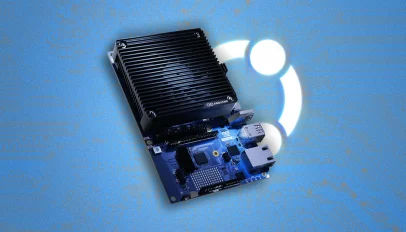 Arduino's VENTUNO Q went up for pre-order priced from $299. The development board runs Ubuntu 24.04 LTS is built around Qualcomm's Dragonwing IQ8 platform.
 Mozilla Firefox 155 is released, making Smart Window available in USA, Canada & France. Plus, blocked tracker counts, container reordering and Linux fixes.
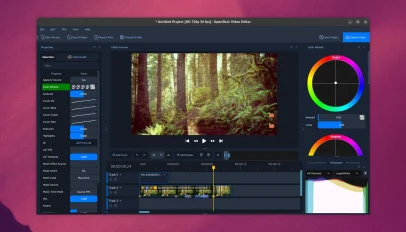 OpenShot 4.0 sees the open-source video editor add colour grading tools, a recording dock for audio and screen capture and new AI effects.
 AI-powered voice typing is coming to Ubuntu in Myna, a speech-to-text feature that lets you talk into any valid text field. It’s still a work in progress, but I grabbed an early build to see how it’s shaping up. With Ubuntu 26.10 now entering its freeze, the user-facing pieces of myna are falling in to place. This week, a new GNOME Shell extension was added to default installs to provide an on-screen indicator when myna is listening and recording. To be clear: Myna is not a GNOME Shell extension. It’s an orchestrator that loads an AI model, handles hot-key activation, […]
 Postcard is a new email client for GNOME sporting a modern design reminiscent of Geary. The app is the work of a solo developer, gxanshu on GitHub, who is upfront about using AI coding tools to bring this “modern mail client” to life. Postcard is written in Python with GTK4/libadwaita. It uses imaplib and smtplib for networking, a local SQLite index for searching, WebKitGTK for rendering HTML and libsecret for keeping passwords safe. It’s also open source, so the code is inspectable. Visually, Postcard should look familiar to fans of the Geary email client, as it uses a similar multi-column design: folders […]
 If you’ve been eyeing up one of PINE64‘s Linux-friendly single-board computers, phones or tablets, now would be a good time to buy one. The open-hardware company has announced it will not be “producing more Linux devices” for the time being, and expects its existing stock of certain devices, including the PineNote and PineTab 2, to sell out in the next three months. After that, there won’t be more until. Why’s the company pulling the plug on production? One guess: RAMaggeddon. The AI infrastructure boom continues apace, and demand for memory and storage chips has reduced supply and driven up costs […]
 Mozilla has released Firefox 154 with some small AI-related changes, an ‘improved’ full-page translations and faster video seeking on “all operating systems”. Firefox 154 serves as the final monthly release of Firefox before browser switches to a faster, twice-monthly release schedule early September. That means you’ll be back here, reading “Firefox 155 released” in a couple weeks, rather than the usual four weeks. But enough what’s coming; what’s new now? Firefox 154’s main changes Firefox’s been expanding its range of address bar actions in recent releases. We got tab muting action in v152 and an colour picker in v153. Firefox […]
 OpenAI has announced a preview release of the official ChatGPT Desktop app for Linux. Compared to using ChatGPT in a browser tab, the GUI desktop app can run Codex in your local repos, hook into and control other apps via extensions, handle ChatGPT Work-related tasks and probe your local files without you having to upload things elsewhere. In an email, OpenAI said that ‘Linux has been one of the most-requested platforms’ for its desktop app, and with this launch it’s finally available on all major operating systems. ChatGPT desktop app for Linux joins Anthropic’s Claude desktop app for Linux, which entered […]
 Some Linux desktop environments were developed over decades, others in just a few years. Starling, which made the rounds online this week, claims to have been built by just one person in six months using AI coding tools. What’s more, a preview build is available as a .deb to install on Ubuntu 26.04 LTS. Yup, this isn’t a ChatGPT mockup but a real working demo. According to the project’s GitHub and website, a developer used AI to rewrite Flutter’s framework layer from Dart to Swift, and left its C++ rendering engine unchanged. A traditional desktop uses a windowing system but […]
