❌

Reading view

There are new articles available, click to refresh the page.

Doctors pull knife from man's eye that went through his brainβ€”and he's fine now

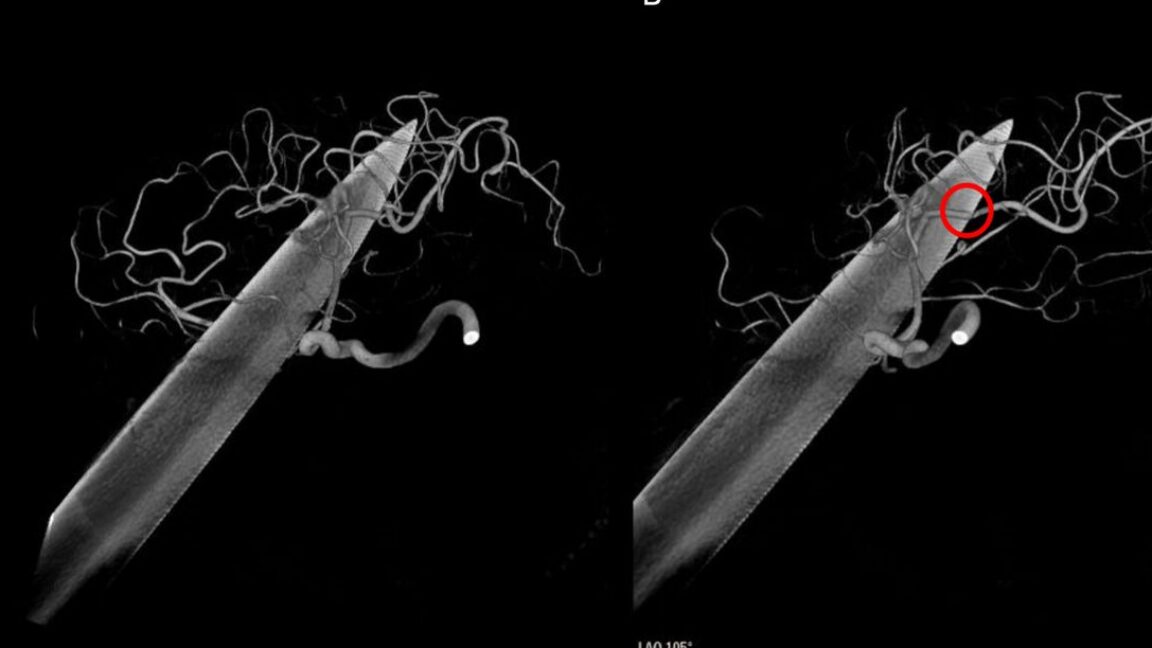
A man in his 20s showed up to a UK hospital with the hilt of a knife sticking out of his face. The 15 mm-wide blade hidden within went completely through his right eye and through his brain, with the tip of the blade hitting the top of his skull.

Despite the ghastly injury, the man was alive and conscious when he arrived. He could still talk and move all four limbs. His doctors described him as being in a state of agitation. On the Glasgow Coma Scale, he scored a 12 (E3 V4 M5), indicating a "moderate" brain injury, just one point above "mild." He could open his left eye when told, but otherwise kept it closed (E3 score); he could talk and answer questions, but was confused (V4); and he intentionally moved away when pressure was applied to his body (M5).

In a report published Friday in BMJ Case Report, his doctors said they were concerned that in his confused, agitated state he may try to pull the knife out on his own. So, they swiftly sedated and intubated him. They put him on prophylactic treatments for bacterial infections, including tetanus. Then they used images to see what was going on in his head.

Read full article

Comments

Β© BMJ Case Reports, 2026

One with the world? A new look at brains transformed by psychedelics.

For about a decade, the mainstream understanding has been that psychedelics cause chaos in the brain. Brain networksβ€”the stable patterns of communication that handle vision, attention, or our sense of self, and moreβ€”loosen and start talking to each other all at once. EEG traces get noisier and more complex. β€œThink of the networks of the brain as highways,” says Devon Stoliker, a neuroscientist at Monash University. β€œUnder psychedelics, these highways break down into many different directions.”

In a recent Nature study, Stoliker’s team designed an experiment to test whether these directions are truly chaotic and random. Researchers gathered 62 people who had never taken a psychedelic before, gave them 19 milligrams of psilocybin, a common psychedelic found in certain fungi, and scanned their brains. Then, they used AI to analyze the drugged and sober brain scans. What emerged was not exactly chaos.

An uninterrupted trip

Stoliker thinks chaos is not a satisfactory explanation for psychedelics’ effect on the brain. β€œIt never really explained why an individual would have a meaningful experience, why they might have insight, why they might experience clarity, and why these might translate into positive psychological changes,” Stoliker says. To investigate if there are other explanations, he and his colleagues designed a study called PsiConnect.

Read full article

Comments

Β© Tashi-Delek

❌