❌

Reading view

There are new articles available, click to refresh the page.

When the Watchdogs Are Silenced: India's Crackdown on Those Documenting Online Censorship

On November 3, our colleagues at the Software Freedom Law Center, India (SFLC.in) received notifications from X that the Delhi Police had issued takedown requests targeting 42 URLs. Among the accounts and posts targeted were those belonging to SFLC.in, the Internet Freedom Foundation (IFF), and X account @geoblockedindia, as well as posts documenting legal notices and instances of online censorship. 

Takedown requests targeting SFLC.in and other digital rights groups threaten not only their work, but the public’s ability to know when and how online speech is being restricted. 

The requests cite grounds including hate speech, alleged defamation of the Hindu nationalist organization Rashtriya Swayamsevak Sangh (RSS), and concerns relating to safety and security. But the context in which these requests have emerged is particularly troubling: they target organizations and individuals whose work involves documenting restrictions on online expression and making those restrictions visible to the public. 

In other words, the organizations being targeted are among those trying to tell the public when and how its speech is being censored. 

SFLC.in is one of India's most important digital rights organizations and promotes innovation and open access to knowledge by helping developers make great free and open-source software, protects privacy and civil liberties for Indians by educating and providing free legal advice, and helps policymakers make informed and just decisions about use of technology. In 2025, we recognized their work with an EFF Award for Defending Digital Freedoms. 

IFF (the Internet Freedom Foundation) is another of EFF's close allies in India. Like EFF, IFF combines advocacy campaigns and strategic litigation to advance digital rights. They write frequently about internet shutdowns and have filed several lawsuits contesting them. 

Among SFLC.in's initiatives is its Free Speech Tracker, which documents instances of online censorship, content restrictions, and account takedowns in India. In a country where government orders to restrict online content are often opaque, this work is absolutely essential. 
 
Recent legal notices object to the tracker itself, as well as the organization’s documentation of restricted content and geo-blocked material. The allegations against SFLC.in include claims that it is "continuously opposing government directions" and publicly circulating information about restricted content, thereby undermining measures taken in the name of national security and public order. 

But documenting government censorship is not the same as undermining public safety. Reporting that content has been restricted is not an endorsement of that content, nor does it constitute an attempt to circumvent the law. It is an exercise in transparency and accountability, and one that allows journalists, researchers, civil society organizations, and the public to understand how governments exercise their power over the information landscape. 

Censorship thrives in the absence of transparency 

The use of legal complaints and platform takedown mechanisms against organizations documenting censorship creates a particularly troubling dynamic. When those who monitor restrictions on expression are threatened with having their accounts or reporting removed, the result is a chilling effect that extends far beyond the immediate targets. Other organizations or journalists may think twice before documenting controversial takedowns or challenging government orders, and the public loses access to an independent record of decisions that affect its ability to speak and access information online. 

There is also an important role here for platforms like X. Platforms must be transparent about the requests they receive, provide meaningful notice to affected users, and ensure that any restrictions are subject to appropriate scrutiny and avenues for appeal. When governments seek to restrict speech, platforms have a responsibility to avoid becoming opaque intermediaries through which censorship is quietly carried out. 

These developments are part of a broader pattern of pressure on independent civil society organizations working to defend freedom of expression and access to information in India. Digital rights groups play an indispensable role in documenting the effects of government policies, identifying patterns of censorship, and challenging restrictions that undermine fundamental rights. Their ability to do so independently is not a peripheral concern; it is a cornerstone of a healthy democratic society. 

The right to freedom of expression includes the right to scrutinize the exercise of government power. That includes the right to document censorship, question the reasons given for it, and make that information available to the public.  

EFF stands in solidarity with SFLC.in, the Internet Freedom Foundation, @geoblockedindia, and all those working to document and challenge restrictions on online expression in India. We urge the authorities in India to respect the rights of digital rights organizations to conduct their work without intimidation or retaliation, and to ensure that any restrictions on online expression comply with international human rights standards. 


Independent Digital Media Is Not a Privilege Governments Can Revoke: The Fight to Save Egypt’s Mada Masr

On November 11, Lina Attalah, founder and editor-in-chief of the independent Egyptian news outlet Mada Masr, will face trial for the second time in just two weeks. This time, she faces charges of spreading false news, an accusation that has become one of the Egyptian government's most frequently used tools for prosecuting journalists. 

The trial follows a conviction on October 27, when Attalah was found guilty of managing an unlicensed news website. The Mada Masr team had repeatedly applied for a license, but their attempts went unacknowledged. The proceedings took place in a single hearing, which Mada Masr states included serious violations of her right to a fair trial. She was sentenced to the maximum fine of 3 million Egyptian pounds (approximately 55,000 USD), forcibly removed from the courtroom, and held for seven hours until the fine was paid. The court also ordered Mada Masr's closure and the confiscation of all equipment belonging to the organization. 

The current wave of repression has also targeted Matsada2sh, a fact-checking and open-source intelligence initiative. Its entire six-person newsroom was violently arrested, illegally detained, and interrogated under torture before being charged with terrorism-related offenses and spreading false news. The team remains in pretrial detention. 

According to CPJ, at least 25 other journalists are currently incarcerated in Egypt. 

Governments seeking to control the flow of information increasingly rely on a combination of legal harassment, financial pressure, criminal prosecution, and restrictions on the infrastructure that makes independent publishing possible. Egypt's media licensing regime is a particularly troubling example. Requiring news organizations to obtain government authorization to operate creates an obvious mechanism for restricting who gets to publish and whose voices are allowed to reach the public.  

The charge of spreading false news is similarly dangerous. Governments around the world have increasingly invoked the language of misinformation to justify restrictions on speech, often without meaningful safeguards against political abuse, as we laid out in our recent submission to the United Nations Office of the High Commissioner for Human Rights. Governments should never be the arbiters of which reporting is permissible, particularly when that reporting concerns their own conduct. 

Why Mada Masr matters 

Founded in 2013, Mada Masr has spent more than a decade doing the kind of journalism that authoritarian governments find most threatening: documenting abuses, amplifying marginalized voices, and reporting on issues that powerful institutions would prefer remain hidden. 

Its reporting has given torture survivors and the families of political prisoners a platform. It has opened space for debate about reproductive rights. It has brought frontline reporting from Sudan and Gaza, and stood alongside refugees facing xenophobic attacks and security crackdowns. 

Emerging as a digital-first publication, in a media environment where traditional outlets were increasingly constrained, being purely digital allowed Mada Masr’s founders to build an independent publication outside the structures of legacy media.  

At a time when only 43% of Egyptians had access to the internet, going fully digital meant taking a big risk, but it was one that has been rewarding: Despite being blocked by the Egyptian government since 2017, Mada Masr has continued to reach Egyptian and global audiences, and Attalah has received numerous accolades, including the Knight International Journalism Award, the Ordre des Arts et des Lettres, and a spot in TIME Magazine’s 100 most influential people (2020). 

Mada Masr has also consistently engaged with technology and advocated for a free and independent internet for the global majority. It has covered dozens of hot-button tech stories in recent years, from Egypt’s Cybercrime Bill and Israel’s use of AI weaponry in Gaza, to stories about the “privacy chaos” caused by biometrics to more personal essays about the importance of the internet and tech. In August, they launched an open call for proposals on original critical reporting on artificial intelligence. 

Mada Masr may be thoroughly Egyptian, but it doesn’t belong just to Egypt. Its team has made into a publication that represents the kind of independent, local, grounded journalism that international audiences need, particularly at a time when international reporting on state repression is lacking. They built on-the-ground networks to center local voices in Sudan (publishing in both English and Arabic on the conflict) and Gaza out of a sense of cross-border responsibility and solidarity. 

This is precisely why its potential closure should concern everyone who cares about a free press. The ability to publish independently, investigate powerful institutions, and to share information without government interference is fundamental to the exercise of free expression.  

From solidarity to action 

The international community has repeatedly expressed concern about restrictions on press and internet freedom in Egypt. More than 100 organizations have now joined statements of solidarity with Mada Masr, and with Matsada2sh.  

These expressions of support matter, particularly when journalists are increasingly isolated and under threat—but solidarity must also translate into sustained political and institutional pressure. 

The international governments and institutions that maintain relationships with Egypt—including those in the European Union, the United Kingdom, and the United States—should make clear that the prosecution of journalists and the forced closure of independent media outlets are unacceptable.  

The cases against Lina Attalah, Mada Masr, and Matsada2sh must be dropped. The journalists who remain in detention must be released. And Egypt's licensing regime, with its profound chilling effects on access to information and independent knowledge production, must be brought to an end. 

There is a particular urgency to defending independent media at a moment when governments are finding ever more ways to restrict the circulation of information. Whether through internet shutdowns, platform restrictions, surveillance, or the criminalization of reporting, the result is often the same: fewer opportunities for people to understand what is happening around them, to challenge official narratives, and to hold power accountable. 

We cannot allow the closure of one of Egypt's most important independent newsrooms and the prosecution of its editor-in-chief to become another routine episode in the global erosion of press freedom. Nor should we wait until the last independent journalists have been silenced before recognizing what has been lost. 

To learn more about Lina Attalah in her own reads, you can read our Speaking Freely interview from January 2026. 


EFF to Brazil’s ANPD: Data Privacy and Free Expression Must Underpin Platform Regulations

The Brazilian National Data Protection Agency (ANPD) plays a pivotal role in the regulation of digital platforms according to new legislation approved in Brazil. Throughout this year, EFF has presented comments, filed submissions, and met with the agency to emphasize crucial guardrails that the enforcement of new regulations should ensure. 

ANPD is responsible for detailing and applying obligations set in Law n. 15.211/2025, which established rules for the protection of children and adolescents in the digital space. While some provisions establish important privacy safeguards, like prohibiting advertising based on profiling of underage users, the law created mandatory age assurance mechanisms for accessing digital products and services. 

We have raised alarms on the privacy and free expression issues around age-gating the internet. Age verification technology is often inaccurate and privacy-invasive. Examples also show how it’s prone to enforcement overreach, resulting in sites blocked beyond legal requirements. In the UK, providers disproportionately restricted several counseling, support and mental health sites under the Online Safety Act. Current age assurance methods risk wrongly walling off adults with no valid IDs, facial differences, physical disabilities, among others. 

We highlighted these concerns in our comments and submissions underscoring that ANPD should avoid a blanket approach to age assurance obligations. Following the legislation, restrictions should apply only to products and services that are inadequate or prohibited to children and adolescents according to categories already set in regulation, with robust protections against subjective and overbroad interpretations. Guarantees such as access to information, freedom to participate in society and meaningful access to technologies also compound what constitutes the best interests of the child.  

Moreover, we stressed that zero knowledge proofs alone fail to ensure strong user privacy, including safeguards that the law itself sought to secure. Our submission explains why other requirements, such as unlinkability, selective disclosure, batch issuance and processing on device, are crucial for achieving greater levels of protection and mitigating privacy harms. Minimum information being shared to the verifier and no “phoning home” to the issuer of a user’s accepted credentials are conditions that prevent actions like collusion and data sharing about the user. 

We also shared inputs about the scope of the law, asking more clarity on which providers are covered by its obligations and the importance of treating differently non-dominant players like federated networks and free software applications. Without that clarity, this could negatively impact beyond gaming and major platforms that are the main target of these regulations. We elaborated on the agency’s regulation of prevention duties, the relevance of modulating them according to the type and structure of providers, and alerted them that their interpretation should not result in general monitoring obligations. 

On another but related front, we sent comments regarding Brazil’s new internet intermediary rules. Here too, ANPD has a critical regulatory role after a Supreme Court’s decision and presidential decrees changed the liability regime initially set in the law known as “Marco Civil.”  

With the turn to notice and takedown mechanisms and duty of care obligations, we emphasized measures to prevent censorship of protected content. These involve ensuring solid means for appeals of restricted posts, avoiding overreliance on AI-based content moderation, strictly tailoring the application of concepts like duty of care and systemic failure, and not normalizing the blocking of platforms and websites.  

We raised concerns about a trend reflected in the new regulation requiring platforms to proactively report user to authorities with unclear guarantees. Finally, we urged the agency to advance essential transparency and accountability measures for enabling greater public oversight over the application of the new regime. 

As we said before, platform accountability under the new rules ultimately hinges on how accountable its enforcement will be by platforms and state institutions. Rigorous commitment to fundamental rights, including freedom of expression, privacy and data protection, is required so that intended protections don’t instead lead to harms. ANPD must uphold this commitment and make sure that new regulations don’t backfire. 

When No ID Means No Internet: Age Verification and the Right to Access Information

This post was co-authored by Sheila B. Lalwani, a doctorate student and recent COMPASS Fellow hosted by EFF.

Age verification proposals are often presented as a simple tradeoff: sacrifice a little privacy to better safeguard children online. But that framing overlooks a more fundamental question. What happens to people who cannot verify their age at all? This is particularly a problem when users are required to prove their age with identity documents.

Age-related restrictions are developing quickly around the world. While they differ radically across jurisdictions, in the past year, we’ve witnessed a sharp uptick toward mandatory age assurance for social media access but also for other high-risk digital services.

For example:

  • In late 2025, Australia became the first country to implement a minimum age requirement for prohibiting children under age 16 from creating or holding social media accounts. 
  • India passed the Digital Personal Data Protection (DPDP) Act that includes mandatory verifiable parental consent and has undertaken ongoing discussions for social media restriction.
  • The United Kingdom passed the Online Safety Act requiring age verification across a swath of services hosting content considered harmful to users under 18. More than half the states across the U.S. have enacted age verification laws. 
  • An EU Commission’s expert report recommends a ban on social media access for users under 13. It also recommends mandatory age verification for platforms to ensure that users are ‘age appropriate.’ 

The Access Problem 

Age verification laws that are predicated on the necessity of users possessing a current passport, driver’s license, credit card, or similar documents proving their identity exclude critical sections of populations.  And this problem is global in nature: Millions of people lack government-issued identification or encounter regular challenges to obtaining or updating it. 

Roughly 15 million adult U.S. citizens lack a driver’s license, and a further 2.6 million lack any government photo ID; leaving large groups blocked from online content or services. The UK has a similar predicament: proof-of-age checks are often reliant on passports, driver’s licenses, or other recognized alternatives, which can pose unique challenges to people without these documents.

Much of the advocacy around age verification discusses the privacy harms of age verification. Yet these measures also threaten something more fundamental: equal access to information and the ability to exercise the right to freedom of expression. 

Unfortunately, age verification systems foster unequal access to information and provide an asymmetric solution to find essential information, build community, and weigh in on public discourse. As governments and companies increasingly require users to prove their age before accessing online services, these individuals risk being excluded from large parts of the internet altogether. 

Effects on Global Majority Countries 

Age verification laws reshape who can speak, who can access information, and who gets excluded from the digital public sphere. In other words, age verification is not a neutral safety measure: it presents a structural barrier to disproportionately exclude certain groups—particularly those in the global majority—and alters the architecture of global online expression. Some of these groups are already marginalized offline, and age verification extends that exclusion into digital spaces.

For instance, 850 million people globally do not have ID. Most of these individuals exist in primarily low and middle income countries in Sub-Saharan Africa and South Asia. The World Bank points out that many are members of marginalized groups and more than half of those lacking access to identity documentation also have children whose births have not been registered. Women are particularly vulnerable and are 8% less likely than men to have an ID. Other vulnerable groups, such as adults in low income countries, are less likely to have an ID when they fall below 25 years, as are those with a primary school education or less or those in rural areas. 

A policy paper from EDRi points out that age verification laws provide quick tech solutions but overlook longstanding structural challenges and undermine the universality of the internet. The analysis finds that age verification laws have serious human rights implications and ironically harm the very individuals they deem to protect. Moreover, these laws depend on the collection of harmful mass data that human rights organizations, including EFF, is fighting against—and has for decades. 

For example:

  • In Morocco, a push to restrict children’s access would ban under-13s from creating accounts on gaming platforms. This could potentially create challenges for those with IDs that have incomplete information concerning the year of birth. In addition, this push would also impact those who attempt to leave Morocco.
  • In Egypt, the lack of ID cards has created challenges for minority groups such as the Baha’i.
  • Stateless individuals would also struggle under age verification laws. The Rohingya, the world’s largest population of stateless people, often lack IDs. 
  • Kuwait’s Bidoon population also lacks proper identification materials. According to Amnesty International, this leads many to rely on standard civil identity cards, which can be restrictive.  
  • Nigeria launched a national program to provide ID cards to its population in 2007. Since then, 64.4 million have registered, but that represents just over 30% of the national population.
  • The Kafala system, a practice in several countries across the Middle East, also introduces challenges for age verification laws. Under this legal framework, migrant workers’ legal residency and employment status are bound to a specific employer. This potentially leaves stateless persons or migrant workers vulnerable to forced labor and restricted movements. 

No ID, No Access

Age verification laws are less about confirming the age of a user and more about creating barriers to online participation that many people cannot reliably scale. The net result is reduced access, more data collection, and an increased chance of unequal or mistaken exclusion from accessing information online. 

Nobody doubts the importance of protecting children online. While proponents assert that age verification laws protect minors from harmful material, online harassment, and digital addiction, these laws are not the solution. They subvert fundamental freedom of expression rights and pose significant privacy risks.  

EFF has long warned against age-gating the internet. Age verification technology itself is often inaccurate and privacy-invasive, and as more countries considering implementing ID-based checks, the risks move beyond censorship and surveillance toward excluding some people entirely. That’s why we’re working with groups in the U.S. and around the world to push back against these laws, and why we hope you join our effort.

For more information on how to fight back against dangerous age verification laws, visit our resource hub at eff.org/age

Ola Bini Ordered to Leave Ecuador Under Obscure Accusations

In a new blow to Ola Bini’s legal guarantees, Ecuadorean authorities retained the free software developer and security expert yesterday in Quito and ordered his immediate deportation from the country. He is barred from returning to Ecuador for 10 years. 

According to information released by his lawyer, Bini was intercepted by a car with four people who identified themselves as immigration agents. He was then taken to an immigration office without further information or a formal order from a competent authority. There, officials told Bini that his visa had been revoked but didn’t show any supporting document.  

Bini's defense filed a habeas corpus to safeguard his freedom and prevent his deportation. Yet, Ecuadorian authorities affirmed that the developer represents a threat or risk to public security and the state structure, and must leave the country. The ground for deportation is a secret report which allegedly asserts that Bini committed acts against the security of Ecuador. The defense could not access its contents.  

The deportation hearing started yesterday at 5pm Quito time. Human rights organizations tried to attend the hearing but were denied entry. The hearing was suspended but later reconvened establishing his immediate deportation. Ola Bini was relocated to Quito's airport and must stay there until he flies back to Sweden. 

The case that led to Bini's unfounded criminal conviction has expired (the statute of limitations ran out) and the court had already formally lifted all precautionary measures against him. Yesterday's events open a new chapter in the nefarious persecution of Ola Bini by Ecuadorean authorities.  

Since Bini’s arbitrary arrest in 2019, EFF has reported about his criminal prosecution fraught with misconceptions and rights violations. The script of what happened yesterday follows the same patterns we saw in the entire case, from its outset with unjustified allegations that Bini was a national security risk. The Observation Mission of Ola Bini’s case, joined by EFF and other digital and human rights organizations, has published reports and raised international awarenness about the perils of this case to the protection of rights online and the beneficial work of security experts.  

In a case surrounded by political interests, Ola Bini’s unanimous acquittal by the lower court in 2023 was overturned after the prosecution’s appeal. The majority of the appeals court convicted Bini for attempted unauthorized access of a telecommunications system without actual evidence to corroborate the accusation claims.  

Now, once again we must sound the alarm. Ecuadorean authorities must explain the accusations against the security expert. We will remain vigilant and ensure that at least this time his rights are respected.  

Digital Sovereignty: What It Is, What It Could Be

The term “digital sovereignty” has become ubiquitous. European officials invoke it in debates about cloud infrastructure, AI, semiconductors, and platform regulation. Governments throughout the global majority use it to argue for greater control over data and communications infrastructure and boost their economies. Companies market “sovereign cloud” products designed to reassure their customers that their information stays under local jurisdiction. But digital sovereignty could be something more: an opportunity for users around the world to build more resilient, open  systems and the skills and infrastructure to maintain them.

There is no singular definition of digital sovereignty, nor is there a single coherent position in the digital rights space. Despite its growing popularity, the term remains frustratingly vague. Policymakers, regulators, civil society groups, and others can mean very different things when they use the term. But to start simply with a broad definition, we can say that it means having the capacity to control one’s digital destiny—though the implications of that will obviously differ considerably whether you’re talking about an individual or a country.

We can start by developing  a shared understanding of what digital sovereignty actually means. We’ve also included a glossary of terms at the bottom of this post. 

In Europe and other places where digital sovereignty has become a topic of policy, discussions focus on reducing dependency: on foreign (and particularly American) cloud infrastructure, chips, platforms, and at times, foreign political priorities. The concern is both economic and geopolitical. If essential infrastructure is controlled by companies elsewhere—and thus subject to the laws of another jurisdiction—then what control does a country actually have over its own digital future?

In global majority countries in particular, wars, sanctions, and the growing fragmentation of the internet have demonstrated for many that the physical infrastructure that underlies digital life is neither neutral nor invulnerable. 

Amidst this increasing geopolitical instability governments and civil society should consider whether digital sovereignty can help shore up that infrastructure. 

What are we talking about when we talk about digital sovereignty? 

A recent Franco-German joint paper on digital sovereignty defines it as the “capability and capacity to develop, provide, use, adapt and control digital technologies including hardware in an independent, self-determined and secure manner” and puts forward a framework to operationalize Europe’s capacity to act in the digital domain. 

Some governments, such as Germany’s, have started to put funding behind sovereignty efforts through initiatives like the Sovereign Tech Agency, which “invest[s] globally in the open software components that underpin Germany's and Europe's competitiveness and ability to innovate.” 

Positions on digital sovereignty among EFF’s allies across Europe vary. Open Rights Group have defined digital sovereignty as “the ability of a country to have control over its digital infrastructure, data, and technology” and states it to be “critical for the UK’s economic and national security.” 

Similarly, the European Partnership for Democracy has expressed concern that “a few Big Tech corporations decide our collective destiny,” and argue that the EU should explore “alternative ownership models for tech companies and clearly [define] their purpose and mission.” And our friends at EDRi (of which EFF is a member) have stated clearly that “Europe’s digital sovereignty starts with open source.” Some initiatives, such as DI.DAY, consider digital sovereignty an opportunity to free users from Big Tech dependencies.

Elsewhere in the world, conversations about digital sovereignty often take a different shape. Indigenous discussions of the topic have been ongoing for more than a decade and focus on the inherent right of Native nations to govern their own digital ecosystems. In Southeast Asia, the desire for digital sovereignty has created growth in the sovereign cloud industry, but the conversation isn’t purely economic: Concerns about jurisdiction for where data is held are driving much of the conversation. 

In Latin America, digital public infrastructure is often a key aspect of debates. Across Africa, leaders speak of a desire to shift the continent from being consumers of technology to becoming architects of their own digital infrastructure and data ecosystems. And in the Middle East and North Africa, concerns about reliance on U.S. technology companies—which have engaged in conflict and disproportionate censorship (particularly of Palestinian voices) in the region—are often paramount.

Reem Almasri, a senior researcher based in Jordan, recently spoke to EFF about digital sovereignty, which she sees as “the ability of people and communities to choose, control, and use technology that serves their needs and values,” particularly in light of the role that U.S. companies have played in regional conflicts.

In a January article, Almasri pointed to growing concerns about granting greater sovereignty and influence to governments over citizens’ data, communications, and websites, writing: “This is particularly worrisome in countries that impose high levels of internet and media censorship and run unaccountable surveillance programs on their citizens’ data.”

Indeed, while pushing for greater sovereignty from Big Tech has benefits, there is an inherent risk that some states will pursue digital sovereignty as a means of cutting off or splintering access—as we’ve already seen in Iran, Russia, and elsewhere.

For that reason, it’s no surprise that some, such as Iranian professor Azadeh Akbari, believe that “the current wave pushing digital sovereignty as the key to ending dependency on American and Chinese technology is negligent of its Eurocentric bias.” 

What does EFF believe?

In a world where people have digital sovereignty, civil society should be able to communicate freely, privately, and anonymously if they wish. People should be able to easily understand where their data lives and who has access to it. That data should be easily portable between platforms and services.

At EFF, we view digital sovereignty not as a walled garden, but as an opportunity for resilience and development of industries and skills. We believe that governments can and should take a role in crafting digital sovereignty that centers the autonomy of users rather than just re-creating a state of digital dependency with a new set of companies. Governments should support and use free and open source tools and projects built using principles of interoperability and data portability. This support should include employing full-time developers, UX designers, and community managers. Government policy and legislation should grant users control of their own data and a clear understanding of who can lawfully access it. Digital sovereignty should foster users’ ability to choose how they use digital products and services, free from unfair lock-ins, coercive terms and manipulative defaults. It should also foster the broader public interest internet, the part of the web that provides public goods and useful services without requiring the scale or the business practices of the tech giants.

Encryption backdoors are fundamentally incompatible with a vision of data sovereignty that centers user control. Governments should support the development and normalization of reputable end-to-end encrypted communications as well as strong encryption for data at rest. This support should include employing cryptographers and contributing to strong, peer-reviewed encryption standards strengthened by data minimization as a fundamental design principle, as well as refraining from legislating mandates for “lawful access” or any other reason.  

As technologists, we don’t have to wait for governments to act in order to create the digital sovereignty we want. We get the internet that we build. We can contribute to open source, decentralized, and end-to-end encrypted projects. We can build standards that make interoperability and data portability a feature from the very beginning. We can resist the call of proprietary solutions, user lock-in, and encryption backdoors.

And finally, while digital sovereignty is often framed as a response to the dominance of Big Tech, that does not mean that there is no role for private companies to play. There is no point in replacing the influence of a few mostly US-based tech companies with a handful of giants based elsewhere. Companies can and should build platforms and services on top of open source, decentralized protocols and contribute to the ecosystem. Companies should also minimize processing a person’s data except as strictly necessary to provide them what they asked for, and only with opt-in consent that makes it clear to users what data they are gathering, where it is stored, and who has access to it. And companies should build their tools and platforms in a way that allows interoperability and that makes it easy for users to leave with their data. Some of these practices are already required by law in some jurisdictions, but companies don’t have to merely do the bare minimum the law demands: they should respect their users and support data sovereignty right now.

A glossary of terms

The following terms are useful for understanding this blog post as well as the broader conversation about Digital Sovereignty:

Intermediary liability: the legal responsibility of online service providers (ISPs, websites, social media platforms) for unlawful activities by their users, such as defamation, copyright infringement, or illegal hate speech.

The stack: a secure, open-source technology framework, often focusing on European alternatives, designed to break dependencies on (mostly) US-based technology providers. It comprises interoperable, vendor-neutral, and transparent digital infrastructures designed to regain control over data, infrastructure, and technology.

Digital sovereignty: the ability of people, as nations, organizations, and individuals, to control their own digital destiny by retaining authority over their own data, technology, and infrastructure.

Data sovereignty: the principle that digital information is subject to the laws and governance frameworks of the country or region where it is physically collected, stored, or processed. It dictates that data remains bound by the specific privacy protections and regulations of its originating jurisdiction, regardless of where the collecting organization is located.

Digital commons: a shared, online resource, such as knowledge, software, and data, that is collectively produced, governed, and maintained by a community, intended for public access. Examples include Wikipedia, open source operating systems such as Linux, and Creative Commons licensed content.

Data portability/interoperability: the ability to easily transfer personal data from one service provider to another, or to a personal system, in a structured, machine-readable format. It empowers users to move away from "walled gardens," reducing vendor lock-in and enhancing user autonomy.

Digital dependency: the opposite of digital sovereignty. The inability of people as nations, organizations, and individuals to control their own digital destiny through control over their own data, technology, and infrastructure. 

Decentralization: a shift away from relying on centralized, often US-based, corporate platforms toward a distributed, user-centric internet where individuals, communities, and nations maintain control over their data, digital identity, and infrastructure.

End-to-end encryption (e2ee): a secure communication process where only the sender and intended recipient can access, read, or decrypt messages or data.

Fairness (à la the Digital Fairness Act): the absence of deceptive, manipulative, or addictive design practices that distort consumer choice and exploit vulnerabilities. 

User sovereignty: the concept that individuals possess absolute control over their personal data, digital identity, and online privacy, rejecting the centralization of power by large technology platforms. It emphasizes user consent, decentralization, and the ability to manage personal data using secure and independent tools.

EFF and Allies on Brazil's Elections: Privacy Protections are Crucial to Electoral Integrity

EFF, Access Now, and Data Privacy Brasil are putting forward recommendations to strengthen robust privacy and data protection safeguards in the context of Brazil's elections. The recommendations stress the close relationship between violations of personal data protection and challenges to the integrity of electoral processes. They underscore how privacy and data protection guarantees are a crucial tool for curbing the targeted spread of false or manipulative content and other problematic strategies used by political actors that are amplified by digital technologies such as artificial intelligence systems. 

The recommendations are part of a broader regional initiative and build on the legal and institutional safeguards already in place in Brazil. They seek to promote greater coordination among oversight institutions, civil society, and digital platforms, and encourage the solid implementation of privacy and data protection guarantees as drivers of electoral integrity. Read the full document below. 

The Link Between the Integrity of the Electoral Process and Privacy 

Protecting the integrity of the electoral process in the face of internet and social media use is a challenge that many policymakers are addressing or are willing to address. Online, content that can affect the integrity of the electoral process is increasingly personalized. This phenomenon is so concerning that it has been identified as one of the main global short- and medium-term risks. 

In an era of generative AI, the economic cost and technical difficulty of producing and spreading false or synthetic content to deceive, manipulate, or simulate authenticity have been considerably reduced. That intensifies concern over the integrity of the electoral process. Meanwhile, online privacy and personal data protection remain unfinished business in Latin America. 

There is an intrinsic connection between the ability to collect and process large amounts of personal data and the way false or manipulative content is created and distributed—on social media and messaging apps in particular, and on the internet in general. For this reason, applying strict laws and policies on personal data protection and privacy makes it possible to reduce the impact of false or manipulative content. This is especially important in electoral contexts, where such content affects and impoverishes public debate, directly affecting political and electoral rights and the integrity of the electoral process. 

This phenomenon predates the emergence of the internet. However, the rise of new technologies accelerates the generation and spread of false and manipulative content. This is supported by the very economic model that sustains the platforms, amplifying its effectiveness and reach. On the one hand, social media platforms have content recommendation algorithms that use personal data to generate profiles to which they can then serve targeted advertising content, including explicitly political propaganda. This technique is known as "microtargeting." 

Political microtargeting seeks to have a direct or indirect impact on democracy. It is used to persuade voters, to encourage or discourage turnout at the polls, or to raise funds using information that is deliberately taken out of context, inaccurate, or erroneous. 

The control exercised by these companies raises serious concerns about people's rights. By having access to massive amounts of personal information, these companies have the ability to shape the content that users see and interact with. This happens through the construction of profiles that can reveal habits, social relationships, political preferences, and opinions, to mention a few examples. Personal data is the fuel that amplifies risks to the integrity of the electoral process. That’s true whether it’s provided by the users themselves or generated by the platforms from their interactions online. 

For disinformation actors, access to sophisticated tools—such as those used to create "deepfakes" through generative AI, or "bots" programmed to spread content and seek to manipulate public opinion—boosts the effectiveness of this microtargeting in terms of quality and scalability, making it harder to detect as false or manipulative content. AI-generated avatars and synthetic characters that simulate voters, influencers, hosts, commentators, or community leaders can produce footage that appears spontaneous, fabricate the voices of artificial political actors, and make it harder for users to identify if a given public statement was created or mediated by technology. 

In this context, paid promotion with nanotargeting seeks to reach increasingly specific profiles with customized content, and AI-based tools are used to assess and map its impact on social networks. Drawing on the personal data of groups of voters, profiles of "synthetic voters" are created to test messages or strategies in search of the most efficient way to influence real voters. 

This rapid expansion of AI systems and hyper-personalization with data can lead to a problem of "epistemic erosion" for democratic societies, as pointed out by the UN's Independent Scientific Panel on AI Governance in 2026. 

At Access Now, Data Privacy Brasil, and the Electronic Frontier Foundation, we point to the enforcement of personal data protection laws and public privacy policies as an efficient mechanism for improving the quality of our democracies and reducing the manipulation of public discourse in digital environments and its impact in electoral contexts. Measures to broaden access to information for electoral decision-making, and to ensure transparency about campaigns' and political parties' use of digital technologies built on the massive processing of personal data, also play a relevant role in guaranteeing the integrity of the electoral process. 

Recommendations for Safeguarding the Integrity of Electoral Processes in Brazil in the Face of New Technologies 

Concern about the effects of spreading false, manipulative, or deliberately decontextualized content is particularly heightened in electoral contexts. From Argentina to Mexico, many countries in Latin America, including Brazil, are holding or will hold significant electoral processes in the coming period. 

Providing the public with quality information from a range of sources is an essential element for the exercise of political rights. In order to safeguard the electoral process, these countries must enforce their privacy and personal data protection laws through their competent authorities, in coordination with their judiciaries and electoral courts. 

Access Now, Data Privacy Brasil, and the Electronic Frontier Foundation propose the following recommendations to protect the integrity of the electoral process by guaranteeing privacy and data protection during electoral contexts: 

1. Strengthen personal data protection guarantees and policies as a key element for the integrity of the electoral process, in particular the principles of necessity, purpose, and proportionality:

  • Prohibit the processing of sensitive personal data (such as philosophical beliefs and the labeling of ideological leanings), including inferred data, that reveals or could reveal people's political preferences for the purpose of targeting political content. In electoral contexts, the processing of sensitive personal data is only legitimate when the person has given their consent in advance, explicitly, and with strictly limited and clearly disclosed purposes of use and transfer. 
  • Processing must be carried out only on personal data that is strictly necessary for the purpose being pursued. 
  • Prohibit adding users to instant messaging groups for political outreach purposes, except in exceptional cases involving lists of political party members or where prior and informed consent has been given by the data subject. 
  • Free, specific, and informed consent means that the person is able to make a real choice, set apart from other choices, and does not run any risk of deception, intimidation, coercion, denial of access to products or services, or other significant negative consequences if they do not give their consent. 

2. Political parties, federations, and coalitions must improve the information made available to the general public about their personal data processing activities in electoral contexts, including: 

  • The personal data processing policy adopted, in compliance with data protection legislation and electoral legislation, including the measures adopted to prevent breaches of the general protection principles, to record personal data processing operations, to obtain consent appropriately, and to ensure technical and administrative security in data processing; 
  • Communication channels where the data subject can obtain information about the processing of their personal data, exercise the rights provided by law, and request to opt out of receiving electronic and instant messages. 
  • Information about the profiling they carry out for electoral purposes and about the procurement and use of data-based digital technologies in this context, including for purposes of paid promotion, microtargeting, network analysis, and prediction of voters' reactions or behavior. 

3. Strengthen cooperation mechanisms between the National Data Protection Authority (ANPD) and the Superior Electoral Court in order to: 

  • Improve communication channels and strengthen joint initiatives to oversee compliance with data protection guarantees in the electoral context, with the publication of periodic enforcement reports. 
  • Identify and dismantle coordinated strategies that compromise the integrity of the electoral process and carry out online activities that pretend to be "organic" and citizen-based when they are in fact funded or coordinated by a party, government, or company, such as bot farms, fake personal accounts managed by a single entity, AI avatars and synthetic characters that simulate real voters in order to manipulate public opinion, among others. 
  • Within the scope of their powers, require the preparation and publication of a data protection impact assessment in cases involving the use of sensitive personal data or emerging technologies for voter profiling. 

4. Authorities, political parties, communicators, and social media platforms must ensure, as far as possible, that the population has access to adequate and relevant information for electoral decision-making. 

  • Political parties, electoral authorities, and data protection authorities must allocate a percentage of their communications budget to warning about the consequences of microtargeting in electoral contexts; and about the use of AI avatars or synthetic voters to simulate support, rejection, outrage, or spontaneous political mobilization. 
  • Strengthen alliances with fact-checkers and other relevant communicators, such as civil society organizations, influencers, and others, to identify campaigns that compromise the integrity of the electoral process and to inform the public about such alliances through different channels, including official government channels.
  • Systematize the electoral proposals developed by candidates and their electoral platforms according to thematic areas to facilitate comparison between political parties. 
  • Agree on strategies between authorities and online platform companies, including social media platforms and chatbots, at the start of electoral periods, so that priority is given to content developed by electoral authorities. 
  • Every body, protocol, or policy created that involves authorities or public entities must be communicated in accordance with proactive transparency standards. 

5. Platforms must disable microtargeting tools for political and electoral content during previously established periods. 

6. Authorities, technical actors, academics, civil society, and/or social media platforms must collaborate in creating an algorithmic impact analysis lab that makes it possible to oversee compliance with these recommendations. 

  • Produce reports on the results achieved, in particular those that document the existence of microtargeting, the use of personal data for targeting, and exposure to varied content in electoral contexts. 
  • Establish strict cybersecurity protocols so that the labs prevent access to real users' private information. 

7. The authorities responsible for overseeing personal data protection and electoral matters must have sufficient functional, economic, and technical autonomy and independence to guarantee the proper exercise of their powers. 

Intermediary Liability in Brazil: The Intricate Path Ahead

Brazil's new internet intermediary liability regime is underway. The implementation of changes established by the Supreme Court includes notice and takedown mechanisms and duty of care obligations. Caution is crucial as these measures can create problematic incentives for enforcement overreach and over censorship of protected speech.  

The court in June issued a new decision clarifying elements of its 2025 finding that the previous liability regime was partially unconstitutional. The government also published in late May two presidential decrees that detail how the new rules apply. 

Under the new regime, social media platforms and other internet applications that curate or interfere with posts can be held liable for third-party content if they don’t remove it after being notified by the user seeking take down unless there's a reasonable doubt that the content is unlawful. For certain specific cases, like crimes against honor (e.g. defamation), platform liability still depends on failing to comply with a judicial order.  

For some serious crimes, like human trafficking and crimes against women, applications have a duty of care to remove related content immediately and can be held liable when systemically failing to do so. The precise limits of what constitutes a systemic failure are still unclear. There are also stricter rules for paid ads, boosted content, and bots. 

The previous regime, set by Article 19 of the law known as the Brazilian Civil Rights Framework for the Internet (“Marco Civil da Internet” in Portuguese), sought to protect freedom of expression online by holding internet application providers liable for user content if they failed to comply with a judicial order to remove it. There were specific, limited exceptions to this rule, like the unauthorized disclosure of nude or private sexual images. This was meant to prevent providers from over-removal of user content to avoid legal action. Yet, the court found that this provision failed to sufficiently safeguard democracy and fundamental rights. 

We outlined the thorny context leading to this shift in Brazil’s intermediary liability rules, including Big Tech’s alignment with the far right and hurdles to approve platform regulation in Congress, through a proper legislative process. 

Brazil’s shift is part of broader discussions and changes in response to growing concerns over online harms and digital platforms’ abuses. However, responses focused on platforms’ liability of user-generated content carry important traps and risks—from entrenching dominant platforms’ power over the information flow to escalating arbitrary online surveillance and censorship. The path ahead must prevent this to the extent possible, and the new presidential decrees provide a mixed contribution towards this task. 

New Decrees: Strengths and Flaws  

The government published two decrees regulating the new regime set by the Supreme Court. One introduces changes to its previous regulation, the Decree 8.771/2016, detailing elements of the decision, including additional duties that the court only briefly addressed (Decree 12.975). The other regulates measures to tackle violence against women online (Decree 12.976). 

The Supreme Court's decision didn't establish guidelines to protect users' due process rights when facing content take down and removal demands. Instead, it relies on providers to self regulate, which could lead to over censorship.  

The decrees’ provisions on user notification systems are helpful in this sense. They stipulate that providers must inform users (both the notifier and the content author) about the decision to remove or keep the content up, why, and the means to appeal. The guidance makes explicit that a platform may reconsider and reinstate content after an appeal and must explain its reasons to the party requesting removal and content author. The decrees also address concerns with the weaponization of notification systems, establishing that internet applications must adopt measures to prevent abuses. 

Decree 12.795 reinforces that applications can keep content up after notification when there’s reasonable doubt that the post is unlawful, stating that the analysis should consider the context of the publications, freedom of religion and belief, and any informational, educational, or critical, satirical, or parodic purpose with the aim of ensuring freedom of expression. With these guidelines, it aims to mirror the Digital Services Act's "notice-and-action" approach. Moreover, for sexual related, intimate content, platforms will provide a specific and easily accessible notice channel where victims or their representatives can follow the case. 

One of the most concerning provisions requires applications to proactively report content related to criminal conduct on their platforms to government authorities. Applications must send the post along with information that can identify the user. The Ministry of Justice will regulate this provision, something the Supreme Court didn't touch on in its decision. While it seems to apply just to those providers already required to comply with new content-related obligations (exempting email and videoconference providers, for example), it takes a disastrous step beyond. It’s not only about preventing the spread of unlawful content online; it gets platforms to police and report users to authorities by handing identification information apparently without a court order. 

Decree 12.795 also details the definition of messaging applications that are exempt from notice and duty of care obligations. It excludes features for public dissemination of content and open groups so that the exemption doesn't apply. It's still unclear what exactly open groups mean. Especially regarding end-to-end encrypted applications, it's crucial that duties to monitor and take down don't affect conversations that are under this security architecture. Perhaps more troubling, the Supreme Court stated in its clarification ruling that a judicial order can determine email, voice and video conference, and messaging providers to take down content of private communications. Any measure must respect privacy and free expression safeguards and refrain from undermining end-to-end encryption. 

Furthermore, decree 12.976 importantly addresses the protection of women online, but it contains a broad definition of online violence against women that will guide how platforms handle takedown notices they receive. This definition involves "any act, conduct, or omission that causes (...) psychological, political, or economic suffering (…) in any aspect of their lives, committed, instigated, facilitated, or aggravated, in whole or in part, by the use of digital technologies." Its breadth could unfortunately result in censoring legitimate criticism and other protected speech, which platforms and authorities must avoid. 

The decrees also establish powers to the Brazilian Data Protection Agency (ANPD) to oversee and regulate the new regime. Among controversies, the decrees give ANPD the power to apply penalties for breaches of content-related obligations. These obligations go beyond agency competencies set in the Data Protection Law and the Law 15.211/2025, focused on the online protection of children and adolescents. They are also not clearly covered by Article 12 of Marco Civil as it stipulates administrative penalties for violations of its data privacy provisions.  

We appreciate that ANPD has been open to civil society's demands and concerns. While it’s crucial that the agency conducts its oversight role preserving a proportionality commitment and keeping solid participation channels, sanction powers must be prescribed by law. 

Alerts for the Path Ahead 

It’s true that there are critical platform accountability problems we must address, especially regarding the big players. And yes, platforms should align their policies and practices with human rights standards, including by dealing diligently with the dissemination of unlawful, toxic content. But accountability efforts should look at platforms’ systems and processes and promote measures to put checks on the power of tech giants, instead of having a prevalent focus on policing and reporting user behavior.  

Key digital competition measures to regulate gatekeeper platforms are under discussion in bill 4675/2025, but the proposal is pending in Congress with no clear timeline for approval.  

One important measure is to ensure accountability of take-down requests, including by the government. The Supreme Court’s decision stipulated that internet applications should publish transparency reports of the removal notices they receive. Government institutions should follow suit by periodically disclosing aggregate data of their own requests to online platforms, covering various types of user data and demands for content and account restrictions. Back in 2016, Marco Civil’s regulation decree established that all federal bodies must annually publish statistical reports on their requests of subscriber data to providers. To the best of our knowledge, federal bodies generally fail to meet this provision. ANPD can play a crucial role in stepping up transparency in the implementation of the new rules. 

Ultimately, platform accountability under the new liability regime hinges on how accountable its application will be by platforms and state institutions, and on the regime's commitment to protecting fundamental rights, including freedom of expression and privacy.  


EFF at DragonCon

September 3, 2026 - 6:00am PDT to September 7, 2026 - 3:00pm PDT
September 3, 2026 - 9:00am EDT to September 7, 2026 - 5:00pm EDT
Atlanta, GA

Join EFF at Dragon Con! We're excited to be back with a bunch of talks on the Electronic Frontiers Forum track @ Dragon Con.

Join the Cause

Interested in supporting the fight for privacy and free expression online? Become an EFF member today to support the lawyers, activists, and technologists pushing f0r your rights online. You can also check out some new EFF swag, including our liquid core dice, playing cards, and more!

Become AN EFF MEMBER

Learn More About EFF's Work

EFF will be at a variety of panels and events on the Electronic Frontiers Forum track, so be sure to check them out and say hi when you see us!

Thursday, September 3, 2026

Killer Robots: Myth and Reality
We'll discuss drones, robots, and other police tech as it moves from the battlefields and borders to the interior of America's urban (and rural) landscape.
8:30 pm ET | Hilton Room 313-314
EFF Senior Policy Analyst Matthew Guariglia

Saturday, September 5, 2026

Operational Security for Protestors
Going to a protest? Good for you! We'll discuss how to stay as safe and anonymous as possible while exercising your First Amendments rights to peacefully protest.
4:00 pm ET | Hilton Room 313-314
EFF Senior Staff Technologist Bill Budington

Hegseth vs. Anthropic: The Push to Remove All of the AI Safeties
We'll discuss the legal and ethical issues over the use of AI in a military setting, and how the government can use its power to bend corporate ethics to its will.
5:30 pm ET | Hilton Room 313-314
EFF Senior Policy Analyst Matthew Guariglia

Hacking 101
Hacking 101 returns for another glorious year! Just what is a hacker anyway? Culture, history, contacts, resources, and pointers for more info.
7:00 pm ET | Hilton Room 313-314
EFF Senior Staff Technologist Bill Budington

Drones as First Responders (DFR)
We'll discuss drone systems being sold and used to arrive at the scene of a crime or disturbance ahead of police officers, and whether they truly live up to their promises to enhance safety for all involved.
8:30 pm ET | Hilton Room 313-314
EFF Director of Investigations Dave Maass

Sunday, September 6, 2026

A Virtual Tour of Surveillance Technology at the US-Mexico Border
EFF's Dave Maass showcases research and reconnaissance of surveillance technology being sold and used to secure America's borders, and how some of these systems are making their way to America's interior.
10:00 am ET | Hilton Room 313-314
EFF Director of Investigations Dave Maass

Defending YOUR Phone Against Cellebrite, Pegasus, GrayKey, etc.
We'll discuss strategies for protecting sensitive data on your phone from commercial solutions that are often used without warrants, or in legally warrantless situations such as at the border.
4:00 pm ET | Hilton Room 313-314
EFF Senior Staff Technologist Bill Budington

Hacking 201
Q&A from our panel of experts; play “Stump the Hacker†!
10:00 pm ET |Hilton Room 313-314
EFF Senior Staff Technologist Bill Budington

Monday, September 7, 2026

Police Surveillance As A Business Model
We'll discuss policing for profit, surveillance business models, and whether they can provide any real benefits to society.
10:00 am ET | Hilton Room 313-314
EFF Senior Policy Analyst Matthew Guariglia

About Dragon Con

Dragon Con is the largest multi-media, popular culture convention focusing on science fiction & fantasy, gaming, comics, literature, art, music, and film in the universe. Call us a phenomenon, call us one of the most well attended pop-culture conventions in the country, call us the most fan fun you can have in five days: Dragon Con is where you want to be on Labor Day Weekend.

Dismiss Church’s Trademark Lawsuit Against “Mormon Stories” Podcast, EFF Urges Court

Imagine if McDonald’s could use trademark law to control how you use the term “fast food.” Or if the Canadian government could stop you from using the word “Canada” in the title of a book about the country and its people. That wouldn’t just be absurd; it would be an unacceptable obstacle to criticism of and commentary about those institutions. Yet the Church of Jesus Christ of Latter-day Saints (the “LDS Church”) has a track record of claiming exactly that kind of authority over the word “Mormon,” using the threat of expensive litigation to pressure speakers into compliance.

We at EFF have opposed the LDS Church’s abuse of trademark law for over a decade. In 2014, we filed an amicus brief when the church sued an online dating service for church members called Mormon Match. In 2016, it threatened legal action against our client the Mormon Mental Health Association, a nonprofit association for mental health professionals who work with members of Mormon faiths. In 2025, the church tried to pressure our client Burke Sorenson into changing the name of his Mormon News Roundup podcast. Now, the LDS Church has brought a lawsuit over a podcast called Mormon Stories that examines Mormonism and Mormon culture. With the help of attorneys at Ballard Spahr, EFF has filed an amicus brief in the case.

Our brief urges the district court to dismiss the case as soon as possible. Trademark is supposed to be about helping consumers identify the sources of the products they buy, not controlling criticism. That’s why our brief asks the court to use a test that’s more protective of speech than what’s applied in most trademark cases. This test, known as the Rogers test, has been adopted by many courts (but not yet this one) for cases where someone is using a trademark as part of an expressive work, rather than just as a brand name. We explain to the court that the Rogers test is an important First Amendment safeguard in part because it makes it easier to throw out meritless trademark claims before the most expensive parts of litigation, allowing more speakers to confidently stand up for their rights.

Our brief goes on to explain that First Amendment safeguards are especially important in cases like this one, where a plaintiff is seeking to control the use of a common term for its common meaning. Trademark law isn’t even supposed to extend to generic terms, and for good reason. Otherwise, we risk giving trademark owners power to control discussion and debate over entire topics.

It’s about time that a court shut down the LDS Church’s trademark bullying. We hope the court will do so here, while also taking the opportunity to endorse the Rogers test.

Meta Must Stop Silencing Reproductive Health Information

Access to accurate information about reproductive and maternal health can be critical. But on Meta's platforms, simply talking about prescription medication, abortion care, or one's own medical experiences can be enough to trigger content removals and account restrictions.

That's why EFF recently submitted a public comment to the Meta Oversight Board in its consideration of a case involving an Instagram post about prescription drugs during pregnancy and childbirth. The case touches upon a topic we’ve been documenting for some time; last year we collected stories from individuals who had experienced censorship of reproductive health information on various platforms. Meta in particular stood out: Its moderation systems routinely fail to distinguish between prohibited drug transactions and legitimate discussion of medications, including educational information and people's firsthand experiences with healthcare.

Through our Stop Censoring Abortion project, EFF collected nearly 100 submissions from healthcare providers, clinics, educators, advocates, researchers, and others whose reproductive health content had been removed or suppressed by social media platforms. What we found was alarming: systemic over-enforcement, confusing policies, arbitrary takedowns, sudden account bans, de-ranking, and appeals that too often went nowhere.

Talking About Medication Isn't the Same as Selling It

In almost every case we reviewed, the censored posts and accounts did not actually violate the platforms' stated rules. Meta frequently cited its Restricted Goods and Services policy, which prohibits attempts to buy, sell, trade, donate, gift, or request pharmaceutical drugs. But the content EFF documented overwhelmingly consisted of factual or educational information—not attempts to sell or distribute drugs.

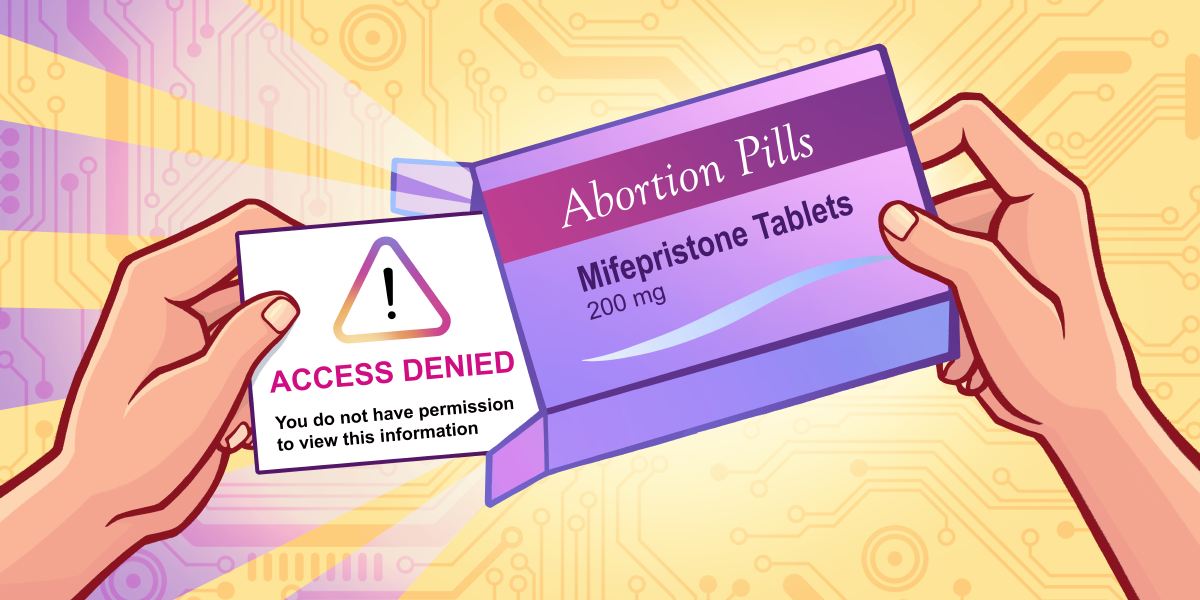
The consequences were significant. For example, the Miscarriage+Abortion Hotline had its Instagram account restricted and posts removed even though it was providing information about legally obtaining medication rather than offering pharmaceuticals for sale. Red River Women's Clinic and the RISE reproductive health research center at Emory University had accounts locked after posting about mifepristone.

Other users reported having their content quietly de-ranked or “shadowbanned,” limiting its reach without giving them meaningful notice or recourse. We believe educational content and people's experiences involving reproductive healthcare and medication should not be suppressed in this way.

And when Meta gets these decisions wrong, the appeals process too often fails to fix them. In several cases EFF documented, accounts were restored only after journalists drew attention to the problem or someone with a personal connection inside Meta intervened. A moderation system shouldn't require knowing the right person to get an erroneous decision reversed.

Meta Can—and Must—Do Better

Our submission calls on Meta to make five changes—the same five changes we asked for last year.

First, Meta should publish clear, understandable policies so users can know what content is permitted and what might result in removal, downranking, or account suspension. Second, those rules must be enforced consistently and fairly. Third, Meta must provide meaningful explanations for enforcement decisions, including what rule was violated and how users can appeal. Fourth, users need a functional appeals system that doesn't depend on insider access.

Finally, Meta should expand human review. Reproductive healthcare is precisely the sort of nuanced and context-dependent subject that automated moderation systems struggle to understand. As our research shows, automated systems can mistake education for drug sales, misinterpret terminology, overlook cultural and political context, and even classify legitimate advocacy as dangerous content. Human moderators should therefore play a greater role when automated systems flag sensitive healthcare information or political expression.

Meta has chosen to allow discussion of reproductive healthcare, including abortion, on its platforms. That commitment means little if its moderation systems nevertheless prevent people from accessing or sharing that information.

At a moment when reproductive rights are under attack around the world, the stakes are particularly high. Restricting access to essential healthcare information can have profound consequences, especially for people who already face barriers to reproductive care.

Users deserve a system in which rules aren't applied arbitrarily, appeals actually work, and vital health information isn't silenced because an automated system failed to understand its context. Meta can—and must—do better.

You can read our comment in full below.

EFF at BSidesLV, Black Hat, and DEF CON 👨‍💻

It's time. Time for tinkerers, security researchers, hackers, and fellow nerds to gather together in signature black hoodies and utilikilts to beat the heat in Las Vegas for the summer security conferences: BSidesLV, Black Hat USA, and DEF CON.

EFF's lawyers, activists, and technologists are excited, as always, to support this community of folks that push computer security forward. If you're attending the conference and have any legal concerns about an upcoming talk or sensitive infosec research—during the Las Vegas conferences or anytime—don't hesitate to reach out to info@eff.org where our intake team is ready to assist! Share a brief summary of the issue, and we'll do our best to connect you with the right resources. You can also learn more about our work supporting technologists on our Coders' Rights Project page.

Be sure to swing by the expo areas at all three conferences to say hello to your friendly neighborhood EFF staffers! You'll probably spot us roaming the conference halls, but we'd love for you to stop by our booths to catch up on our latest work, get on our action alerts, and become an EFF member! For the whole week, we'll have our limited-edition DEF CON 34 t-shirt on hand. We're excited to see them—and other EFF gear—take over each conference!

EFF Staff Presentations

Privacy's Defenders: How Hackers Helped and Can Do So Again

Hackers have a long history standing up for justice and that history has a lot to teach and inspire the hackers of today as we face a world with 360-degree surveillance that is increasingly marshaled against us by both companies and governments. My talk will tell background and stories from my book, Privacy's Defender, that tells the story of my 30 years working with EFF to try to protect security and privacy in the digital age. Cards on the table: I'm trying to recruit you to join in the fight.
WHERE: Florentine F | BSides Las Vegas
WHEN: Monday, August 3 @ 11:00
WHO: Cindy Cohn - Former EFF Executive Director 

Ask EFF at BSidesLV

Panelists from the EFF Staff will give brief updates on key topics in their expertise before turning it over to BSides attendees to ask their burning questions about policy, advocacy and making the future of tech brighter. It's a dynamic session fostering engaging discussions on digital rights featuring an EFF staff attorney, activist, and public interest technologist.
WHERE: Florentine F | BSides Las Vegas
WHEN: Tuesday, August 4 @ 14:00
WHO: EFF's Rory Mir, Kenyatta Thomas, Alexis Hancock, Haley Pederson, and Cindy Cohn

What Election Security Researchers Need to Know about Section 1201 of the Digital Millennium Copyright Act

WHERE: Voting Village | DEF CON
WHEN: Friday, August 7, 10:30-11:00
WHO: EFF Staff Attorney Tori Noble

Privacy's Defender: How Hackers Protected the Internet Before and Can Do It Again

EFF's Outgoing Executive Director Cindy Cohn' presents her first-person stories from her recently published book, Privacy's Defender, that take you Inside the privacy battles that have shaped today's Internet. It includes the hackers who helped free up encryption technology from US governmental control, allowing us to have the still imperfect privacy and security we now have online, and the battles to stop the mass NSA spying and eternal gag orders that arose from the governments formerly secret mass spying programs in the aftermath of the 9/11 attacks. She then draws from that long career of legal activism to the fights of today and tomorrow, featuring the role that hackers can play in helping to bring about a better, more just future.
WHERE: Creator Stage 1 | DEF CON
WHEN: Friday, August 7, 15:00-16:30
WHO: Former EFF Executive Director, Cindy Cohn

Why Mandatory Age Verification Keeps Us All Less Safe

WHERE: Creator Stage 7 | DEF CON
WHEN: Saturday, August 8, 13:30-14:30
WHO: EFF Director of Engineering Alexis Hancock & EFF Social Media and Video Manager Kenyatta Thomas

ESP32 As A Counter-Surveillance Platform

Privacy should be accessible to all. Historically, counter-surveillance tools have been expensive, complex, and inaccessible to most individuals, often limited to well-funded researchers and costly hardware configurations. The ESP32 offers a transformative alternative. This presentation will demonstrate how an affordable microcontroller has become the foundation for a growing suite of open-source, user-friendly anti-surveillance tools. We will discuss the technical features that make the ESP32 a compelling choice for these applications, including passive 802.11 and Bluetooth monitoring, OUI-based device fingerprinting, and robust cryptographic capabilities. Applications include detecting police body cameras in operational environments, mapping Flock Safety automatic license plate recognition (ALPR) infrastructure, identifying unauthorized drones, detecting radio frequency jamming across 2.4GHz, 5GHz, and cellular bands, and tracking autonomous robots operating with known-vulnerable firmware. These tools are cost-effective and freely available. We will also consider future developments in accessible counter-surveillance hardware, such as the ESP32-S5 with 5GHz support, GPS, displays, haptics, etc. Advancing anti-surveillance culture requires designing devices that individuals are motivated to use and carry.
WHERE: Main Track 1 | DEF CON
WHEN: Sunday, August 9, 10:00-11:00
WHO: EFF Senior Staff Technologist Cooper Quintin

Tactical Advocacy: Panel & Peer Sessions with EFF

WHERE: Policy Village | DEF CON
WHEN: Sunday, August 9, 12:30-14:00
WHO: EFF's Thorin Klosowski, Cooper Quintin, Alexis Hancock, Tori Noble, Rory Mir & Cindy Cohn

EFF Contests at DEF CON 34

EFF Benefit Poker Tournament

We’re going all in on internet freedom. Take a break from hacking the Gibson to face off with your competition at the tables—and benefit EFF! Your buy-in is paired with a donation to support EFF’s mission to protect online privacy and free expression for all. Join us on Friday, August 7 at 12:00 at theHorseshoe Poker Room. Play for glory. Play for money. Play for the future of the web.
WHERE: Horseshoe Poker Room, 3645 S Las Vegas Blvd, Las Vegas, NV 89109

WHEN: Friday, August 7, 12:00-15:00

Beard and Mustache Contest

Yes, it's exactly what it sounds like. Join EFF at the intersection of facial hair and hacker culture. Spectate, heckle, or compete in any of four categories: Full beard, Partial Beard, Moustache  Only, or Freestyle (anything goes so create your own facial apparatus!). Prizes! Donations to EFF! Beard oil!
WHERE: Contest Stage (near the entrance to Hall 1)
WHEN: Friday, August 7, 13:00-15:00

Tech Trivia Contest

Join us for some tech trivia on Saturday, August 8! EFF's privacy and security experts have crafted a new trivia challenge for DEF CON 34! Compete as a team in our no-holds-barred showdown to prove mastery over the obscure facts of digital security, online rights, and internet culture. The First Place team wins a set of custom Cybertiger Champion Badges and EFF swag. Second and third place teams will also win Badges and EFF gear. Invite your friends OR show up and make new friends! Did someone say BRIBES? The world is unfair! You too could influence the judges to add a point or two to your team's tally. Overall Bribe winner also wins a custom badge!
WHERE: Contest Stage (near the entrance to Hall 1)
WHEN: Saturday, August 8, 17:00-20:00

Privacy's Defender Book Signing with Cindy Cohn

Grab a copy of former EFF Executive Director Cindy Cohn's new book, Privacy's Defender—and get it signed—while at DEF CON 34!
WHERE: Exhibit Hall West 4 (Book Signings)
WHEN: Saturday, August 8, 11:00-12:00 AND 13:00-14:00 

Join the Cause!

Come find our table at BSidesLV (Middle Ground), Black Hat USA (back of the Business Hall), and DEF CON (Vendor Hall) to learn more about the latest in online rights, get on our action alert list, or donate to become an EFF member. We'll also have our limited-edition DEF CON 34 shirts available starting Monday at BSidesLV! These shirts have a puzzle incorporated into the design. Snag one online for yourself starting on Tuesday, August 4 if you're not in Vegas!

Join EFF

Support Security & Digital Innovation

🏃 Fitness Tracker Privacy Fails | EFFector 38.14

Watches, bands, and rings—if you want to digitally monitor your fitness, more companies than ever are selling devices to do it. And more Americans than ever now own at least one wearable health device. But what are the companies that make fitness trackers doing to protect our sensitive data from prying eyes? A lot less than they could be, it turns out. We're explaining what companies can do to protect your health data, and more, with our EFFector newsletter. 

JOIN OUR NEWSLETTER

For over 35 years, EFFector has been your guide to understanding the intersection of technology, civil liberties, and the law. This issue covers the rapid rise of police drone programs, a disappointing ruling on electronic device searches at the U.S. border, and how fitness trackers are falling down when it comes to protecting our health data.

Prefer to listen in? EFFector is now available on all major podcast platforms. This time, we're chatting with EFF Senior Security and Privacy Activist Thorin Klosowski about the health fitness tracker landscape and your privacy. You can find the episode and subscribe on your podcast platform of choice:

play
Privacy info. This embed will serve content from simplecast.com
Privacy info. This embed will serve content from simplecast.com

Listen on Spotify Podcasts Badge Listen on Apple Podcasts Badge  Subscribe via RSS badge

Want to protect your right to digital privacy? Sign up for EFF's EFFector newsletter for updates, ways to take action, and new merch drops. You can also fuel the fight for privacy and free speech online when you support EFF today!

Missed EFF's Livestream with Adam Savage and iFixit? Listen Here!

EFF’s first EFFecting Change livestream was all the way back in July of 2024. Maybe you've caught each stream, or maybe you’ve only caught a few. Or maybe you’re like me and prefer to listen to conversations like these on your daily commute! Either way, if you want to stay on top of these monthly conversations, you can now subscribe to our new podcast feed for EFFecting Change—starting with our conversation on the Right to Repair movement with Adam Savage and iFixit CEO Kyle Wiens:

play
Privacy info. This embed will serve content from simplecast.com

Listen on Spotify Podcasts Badge Listen on Apple Podcasts Badge  Subscribe via RSS badge

This new feed will include the full conversations with our panelists, posted after the livestream ends. Subscribe today to get each stream straight to your podcast player of choice. You can also find other podcasts by EFF at eff.org/podcast.

And mark your calendar for the next EFFecting Change livestream: Who the Machine Serves. EFF Executive Director Nicole Ozer and Cory Doctorow will be having a conversation on AI, tackling what needs to happen now to ensure AI actually works for everyone, not just those in power. RSVP today!

Want to ensure EFF can keep inviting expert panelists to chat about the future of technology and how it impacts you? Support our work today.

Donate to EFF

EFF at BSides Las Vegas

August 3, 2026 - 9:00am PDT to August 5, 2026 - 2:00pm PDT
Tuscany Suites Hotel & Casino | Las Vegas, NV

Once again, EFF is excited to be back at the Tuscany Suites & Casino for BSides Las Vegas. Come see our talks and membership table at the now 2.5 day annual infosec and hacker conference! 

Stop by the EFF booth to chat with some of our team and learn about the latest developments in defending digital freedom for all. You can even pick up a special gift as a token of our thanks when you take advantage of our membership specials or donate!

Can't make it to this year's BSidesLV, but need to renew your donation? No problem. You can browse our membership options, make a donation, and grab some gear online! All of the additional EFF gear we'll have at our booth will also be in our online shop.

As in past years, EFF staff attorneys will be present to help support the community. If you have legal concerns regarding an upcoming talk or sensitive infosec research that you are conducting at any time, please email info@eff.org. Outline the basic issues and we will do our best to connect you with the resources you need.

EFF Talks

Privacy's Defenders: How Hackers Helped and Can Do So Again

Hackers have a long history standing up for justice and that history has a lot to teach and inspire the hackers of today as we face a world with 360-degree surveillance that is increasingly marshaled against us by both companies and governments. My talk will tell background and stories from my book, Privacy's Defender, that tells the story of my 30 years working with EFF to try to protect security and privacy in the digital age. Cards on the table: I'm trying to recruit you to join in the fight.
Monday, August 3 @ 11:00 am - Florentine F
Cindy Cohn - Former EFF Executive Director 

Ask EFF

Panelists from the EFF Staff will give brief updates on key topics in their expertise before turning it over to BSides attendees to ask their burning questions about policy, advocacy and making the future of tech brighter. It's a dynamic session fostering engaging discussions on digital rights featuring an EFF staff attorney, activist, and public interest technologist.
Tuesday, August 4 @ 2:00 pm - Florentine F
EFF's Rory Mir, Kenyatta Thomas, Alexis Hancock, Haley Pederson, and former EFF Executive Director Cindy Cohn

More about BSidesLV:
BSides Las Vegas is a nonprofit organization formed to stimulate the Information Security industry and community by providing an annual, two-day conference for security practitioners and those interested in entering or looking to enter the field.

EFF and ARTICLE 19 Submission to the European Commission on the DSA Trusted Flagger Guidelines

EFF and ARTICLE 19 have submitted joint comments to the European Commission on draft guidelines for the Digital Services Act’s trusted flagger mechanism. Having long advocated for a DSA that protects freedom of expression while preserving intermediary liability protections and the prohibition on general monitoring, we welcome the Commission's effort to provide practical guidance on how the trusted flagger system should operate. 

The DSA’s trusted flagger system can help platforms identify illegal content more efficiently. But if implemented poorly, it could also encourage over-removal of lawful speech, weaken due process, and give government authorities disproportionate influence over online expression. 

We support the Commission's focus on good practices and illustrative examples, rather than legal interpretations that could inadvertently steer platforms toward particular enforcement outcomes—and argue that the guidelines should include stronger safeguards to protect freedom of expression, due process, and the impartiality of the trusted flagger system. 

We also support the Commission's clarification that the DSA itself does not define "illegal content"; that determination must come from applicable national or EU law. Trusted flaggers submit prioritized notice, but platforms remain responsible for determining whether content is actually illegal. Platforms must therefore conduct careful, informed assessments and should not assume that a trusted flagger notice necessarily warrants restricting content. 

Our submission highlights several areas where the guidelines could be strengthened: 

  • Cross-border assessments require caution. Platforms should not rely on a trusted flagger notice to assess legality across Member States, where national legal frameworks may differ. 
  • Systemic risks extend beyond content moderation. The DSA's systemic risk framework should not rely too heavily on individual moderation decisions, but should also consider broader platform design choices, including recommender systems. 
  • Law enforcement authorities should generally not be granted trusted flagger status. They already have statutory powers under Article 9 of the DSA, and combining those powers with trusted flagger status creates a risk that platforms may treat trusted flagger notices as de facto removal orders, undermining due process and the rule of law. 
  • Civil society organizations play an essential role. Civil society organizations help identify illegal content and report human rights abuses, but the guidelines should also recognize that these organizations may face retaliation for their work and should be protected from abusive campaigns that threaten their independence. 
  • Trusted flaggers should complement—not replace—existing partnerships. The new mechanism should not sideline existing trusted partnership programs, including collaborations with civil society organizations that do not or cannot hold trusted flagger status, especially those outside of the EU with valuable regional expertise.  

Read the full submission here:

🚫 Don't Let Congress Age-Gate the Internet | EFFector 38.13

The effort to age gate the internet is back in Washington—and now it has a new name. Recently passed by the House of Representatives, the KIDS Act is a sprawling package of proposals to control what we can see and say online. Supporters claim the KIDS Act is needed to protect minors online. But if lawmakers really want to make the internet safer, why are they encouraging more surveillance instead of protecting our privacy? We dive into this question with our EFFector newsletter.

JOIN OUR NEWSLETTER

For over 35 years, EFFector has been your guide to understanding the intersection of technology, civil liberties, and the law. This issue covers a victory for location privacy in the Supreme Court, disturbing developments in the militarization of domestic drones, and a controversial Congressional bill to control what we can see and say online.

Prefer to listen in? EFFector is now available on all major podcast platforms. This time, we're chatting with EFF Senior Policy Analyst Joe Mullin on what would happen to the open internet if the KIDS Act becomes law. You can find the episode and subscribe on your podcast platform of choice:

play
Privacy info. This embed will serve content from simplecast.com

Listen on Spotify Podcasts Badge Listen on Apple Podcasts Badge  Subscribe via RSS badge

Want to protect your right to online anonymity and access to the open web? Sign up for EFF's EFFector newsletter for updates, ways to take action, and new merch drops. You can also fuel the fight for privacy and free speech online when you support EFF today!

EFF at Black Girl Nerds Meetup at San Diego Comic-Con

July 23, 2026 - 5:00pm to 8:00pm PDT
The Pool Club, Hilton Bay Front | San Diego, CA

Black Girl Nerds (not EFF) will host this event. Find EFF Director of Investigations Dave Maass and EFF Social Media and Video Manager Kenyatta Thomas at the event! You can also find all EFF panels and events at San Diego Comic-Con here.

From the Organizers: 

Black Girl Nerds is hosting another meetup during San Diego Comic-Con 2026, and it’s going to be a cataclysmic comic crossover! This year, we’re teaming up with pop culture outlet Nerd Initiative and welcoming our special guests from the Electronic Frontier Foundation for the 2026 Black Girl Nerds Initiative Meetup.

If you’ve attended one of our meetups before, then you already know the vibes, it’s the perfect place to mix, mingle, network, and geek out with fellow fans across pop culture, gaming, comics, TV, film, and fandom.

When:

Thursday, July 23
Time: 5:00 - 8:00 pm PDT

Where:

The Pool Club at Hilton San Diego Bayfront
1 Park Blvd, San Diego, CA 

Cost:

None

Event Requirements:

Registration is required. No San Diego Comic-Con badge needed!

About Black Girl Nerds: 

Black Girl Nerds is an online publication and multimedia space that is the intersection of geek culture and Black feminism. I named this site Black Girl Nerds because the concept of Black women as geeky-dorky beings is somewhat of an anomaly. It’s against the order of things in the “Black Girl” world. We represent a wide array of dive rse women who embrace all cultures and refuse to conform to the status quo.

This event is organized not by EFF, but by Black Girl Nerds. 

Automated Moderation Is Here to Stay—Accountability Must Keep Pace

This post is part 2 in a series about automated content moderation. Read the first post here.

When whistleblower Frances Haugen leaked a set of documents from Meta in 2020, among the revelations was a jarring statistic: The company’s algorithms designed to detect terrorist content incorrectly deleted nonviolent Arabic-language content 77 percent of the time, while failing to detect hate speech under the company’s own policies in many instances. Meta’s own transparency report released later that year demonstrated similar findings. Five years later, researchers in the region report that overzealous moderation remains a problem, while paths to remedy have all but collapsed.

Where these systems are faltering in Arabic, they’re positively failing in less-resourced languages. As a 2025 report from the Center for Democracy and Technology found, labeled datasets in certain languages and dialects such as Maghrebi Arabic and Kiswahili contain inconsistencies, bias, and inaccuracies due to the limited hiring of annotators who actually speak the languages as well as shifts in the languages themselves. An investigation into ChatGPT’s outputs in several low-resource languages demonstrates the depth of problem.

But language disparities are just one of several concerns as automated moderation becomes more widespread. From the systemic suppression of content from Palestine to the repeated misclassification of LGBTQ+ content as adult or explicit material, these varied examples demonstrate the risks of overreliance on automated moderation—and the need for stronger safeguards.

Transparency, Cultural Competence, Appeals

As we discussed in Part 1 of this series, automated systems can process content at a scale that humans never could, potentially enabling better moderation at scale and alleviating the psychological load on ill-paid moderators whose jobs require them to view incredibly disturbing content. But automated systems also reproduce existing biases, struggle to understand context, and often make mistakes that disproportionately affect journalists, activists, artists, and other vulnerable and marginalized communities.

As Rachel Griffin wrote in 2023, “Perfectly accurate moderation is not only technically out of reach but intrinsically impossible.” Despite those intrinsic flaws, there is a great deal companies, policymakers, and civil society can do to help ensure that highly-automated systems operate in ways that respect human rights, minimize predictable harms, and provide meaningful accountability when they fail. If companies are going to continue relying on automation to moderate users’ speech—and there is little reason to believe they won’t—then accountability must evolve alongside these technologies.

That evolution can start with committing to the Santa Clara Principles 2.0. These principles, first outlined in 2020 and re-launched in 2021 after substantial international input, reflect the needs and expectations of the global community and specifically address automation. The first Foundational Principle states:

Companies should ensure that human rights and due process considerations are integrated at all stages of the content moderation process, and should publish information outlining how this integration is made. Companies should only use automated processes to identify or remove content or suspend accounts, whether supplemented by human review or not, when there is sufficiently high confidence in the quality and accuracy of those processes. Companies should also provide users with clear and accessible methods of obtaining support in the event of content and account action. 

Drawing on the Santa Clara Principles 2.0, international human rights standards, and years of research documenting the shortcomings of automated moderation, we propose eight recommendations for policymakers thinking about regulation and companies deploying AI-assisted content moderation systems.

  1. Automated technologies should help, not replace, human moderators. For example, automated systems can help flag and prioritize content for review, while humans can interpret context, handle sensitive cases, and refine system performance.
  2. Companies must be transparent about when and how automation is used in content decisions.
  3. Companies must regularly audit their automated systems for bias, with particular attention to low-resource languages, vulnerable and marginalized communities, and conflict zones.
  4. Users must have the ability to appeal, and to provide context when they believe human or automated moderation decisions have wrongfully removed their content. Appeals should be promptly evaluated and decided by human moderators.
  5. Companies should regularly assess the human rights impact of their moderation decisions, and issue public statements of the results
  6. If they rely on third-party vendors, companies should carefully (and regularly) audit those vendors for compliance with these same principles
  7. Lawmakers should avoid promoting and passing legislation that effectively or explicitly mandates automated moderation systems
  8. Policymakers should also refrain from attempting to dictate platforms technical and design choices to favor or disfavor particular expression.

These recommendations understand that automated content moderation isn’t just a technical problem for clever engineers and product teams to solve. Because content moderation shapes public discourse and fundamental rights, its design and oversight must respond to the concerns of policymakers, civil society, independent researchers, and the communities most affected by these systems.

This is the second post in a 2-part series on automated content moderation. Read the first post here.

❌