❌

Reading view

There are new articles available, click to refresh the page.

Mistaks we’ve made (so far)

We publish about once a week, and have done so for about six years. There are now over 350 articles on psychsafety.com as a result. So, despite our best efforts, the odd error has slipped through, and here I’m writing about some of our most egregious and/or funny ones. Many of these we found ourselves after publication, and some of them we were informed about by our wonderful readers – you folks (and we’re very grateful for that!). 

I’m genuinely rather embarrassed about a few of these, but if we can’t admit mistakes and learn from them in a newsletter about psychological safety, then where can we? So here’s a list of various mistakes we’ve made, some followed by a Safety-I style “how do we prevent this happening again” measure:

Numbers we fucked up

We said exponential when we meant quadratic. Dunbar’s Number, Psychological Safety and Team Size (October 2022) said communication complexity “increases exponentially” with group size, then gave the formula n(n−1)/2, which is quadratic, not exponential. The point stands, in that: it grows fast. But the word was definitely wrong.

We labelled r-values as p-values. How Childhood Socioeconomic Status Shapes Psychological Safety and Career Risk-Taking (November 2025) This is probably the one I’m most embarrassed about. It’s a straightforward typo, but it stuck through edits and proofing. In the study results, we reported psychological safety as p=0.19 and opportunity-taking as p=0.21, but those are r-values, not p-values. The findings themselves don’t change: both correlations are significant at p < 0.001. Figure 2 also didn’t quite match the text, so we’ve redrawn it and published the script behind it. The check: more reviewers (i.e. we just reinvented peer review).

We got bogged down. Rewetting the Organisational Substrate (March 2025) said peat bogs store “44% of soil carbon”. The UNEP assessment we linked to says peatlands (bogs are only one kind) hold “up to one-third”. The 44% came from an IUCN briefing that gives “up to 44%” for all peat soils without saying where the number comes from. The check: reread the source we’re actually linking to.

We couldn’t count to seven. The Chatham House Rule (November 2024) said the rule has been translated “into six languages”, then listed seven. Oops.

People we really shouldn’t have quoted 

We quoted a eugenicist as an authority. Déformation professionnelle (February 2025) opened with a line about specialists who think they understand the whole person, credited to “Alexis Carrel, Nobel laureate”. The line fits the article, but its author certainly doesn’t. The quote comes from Man, the Unknown (1935), which we also linked. The book argues for eugenics, and proposes gassing some criminals and the criminally insane in “small euthanasic institutions”. Carrel later headed a Vichy-era foundation whose work included eugenics and population research. We replaced the epigraph with Kenneth Burke: “A way of seeing is also a way of not seeing.” We’ve removed the link that pointed readers to Carrel’s book, and because this was a big mistake, added a correction note. The check: look up the people we quote, not just the authenticity of the quote.

We cited Dan Ariely after one of his papers had been retracted. Psychological Safety & Agile (January 2023) cited Ariely’s “Human Capital Factor” as showing that companies whose staff feel better about them do better financially. More than a year earlier, in 2021, a paper he co-authored was retracted after independent analysts found strong evidence that data in one of its studies had been fabricated. The Human Capital Factor itself came from commercial research by J.P. Morgan and Irrational Capital, a firm Ariely co-founded. We’ve since replaced it with peer-reviewed research: Alex Edmans found that the “100 Best Companies to Work For” outperformed their industry benchmarks by 2.1% a year between 1984 and 2009. The check: search a researcher’s name with “retraction” before relying on them.
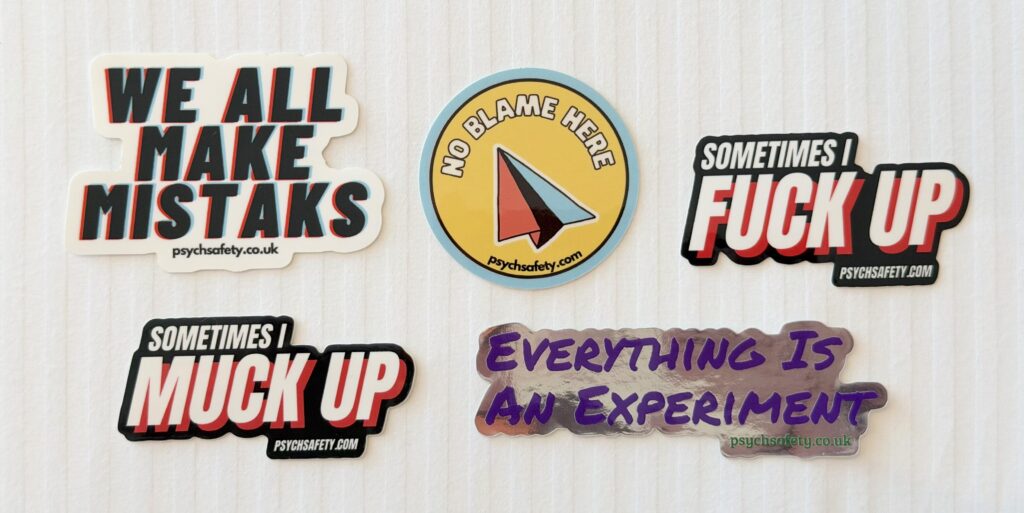
mistakes stickers

Studies and ideas we mangled 

We defined cognitive load loosely. Cognitive Load and Psychological Safety (March 2023) defined intrinsic load as “all the stuff you already know”. In cognitive load theory, intrinsic load is the complexity of the task itself, and what you already know affects how heavy it feels rather than being the load. The correct definitions actually make our point stronger: the paper our model came from counts emotions, including anxiety, as extraneous load. 

We credited Schein with someone else’s paper. Edgar Schein’s Three Layers of Organisational Culture (February 2023) listed a 1986 paper by Kilmann, Saxton and Serpa under Schein’s name. Two readers told us. Thank you to them.

Data Visualisation gave the fifth of Alberto Cairo’s qualities of a good visualisation as “exploratory”. In The Truthful Art it’s “enlightening”.

Psychological Safety: Yogic Philosophy (September 2022) defined aparigraha as “non-stealing, non-possessiveness”. Non-stealing is asteya, listed two lines earlier; aparigraha is non-possessiveness.

Blametropism (December 2024) credited the essay “Moral Luck” to Bernard Williams in the text, then cited Thomas Nagel’s essay of the same name. Both Bernard Williams and Thomas Nagel published papers called “Moral Luck”, alongside one another in the 1976 Proceedings of the Aristotelian Society supplementary volume. It’s almost like the system was set up for us to fail with this one…

Dates, details and names

We gave Dewey a date after his death. Déformation professionnelle said “In 1968, John Dewey described… ‘occupational psychosis'”. Dewey died in 1952. 1968 is the edition of Robert Merton’s Social Theory and Social Structure that we were citing, which discusses Dewey’s term.

We put Chernobyl in the wrong country. Our What is Psychological Safety? page said the Chernobyl disaster happened in Russia. It happened in Soviet Ukraine, and a Ukrainian reader rightly told us so in 2023. We corrected it, and they kindly confirmed the fix.

We had Goodhart criticising a government that didn’t exist yet. Goodhart’s Law, Campbell’s Law and the Cobra Effect (July 2024) dated Goodhart’s article to 1975, then said it criticised “the then Thatcher government”. Thatcher became Prime Minister in 1979. A reader spotted the contradiction. What we meant was that the law was later used to criticise her government’s monetary targets, which is what the article now says.

We got the language wrong. In May 2023 we thanked a reader for translating one of our leadership vs management graphics into Spanish. It was Portuguese. Another reader pointed this out, then translated it into Spanish herself, and we shared her version the following week. A great example of how mistakes can be generative.

The small ones. 

They’re worth a mention because they show the real nature of weekly publishing. For example, I misspelt WEIRD in an issue about WEIRD (I’ve always had trouble with i before e…), and misspelt Kahn in our piece on the definition of psychological safety.

Experiments, bets and probes (August 2024) dated the Challenger disaster to 1987. It was January 1986.

Our Barcelona Psych Safety Day page gave the date as 1 July 20233, which would have left you about 18,000 years to book. A reader spotted it.

Certainly not the last

No doubt many mistakes still remain. Some probably even in this article itself. If you spot something we’ve got wrong, tell us by emailing tom@psychsafety.com with the subject line “you f*cked up” 🙂 If possible, we’ll send you some stickers as a thank you. 

I’ll admit, I felt nervous writing this piece, for many of the reasons we all feel nervous about admitting mistakes: that we might be thought of as sloppy, less expert, or lazy. And frankly, for some of these mistakes, I’ve judged myself pretty harshly. So, as always, it’s rarely easy to admit mistakes – especially big ones. But these are all mistakes we have made with the very best of intentions, trying to do a good job, trying to get the work done. Some of them are mistakes that have led us to make systemic improvements. For some, a specific cause is less easy to identify. And ultimately we will make mistakes again. But I do hope that by committing to being as honest and open as we can about it, it might help, even just a little bit, normalise admitting our mistakes, and talking how they happen and what they teach us.

We all make mistaks.

The post Mistaks we’ve made (so far) appeared first on Psych Safety.
Learning Teams

Learning Teams

Often, when we’re trying to improve how work gets done, we start with principles. We agree what we believe in, or are working towards, at a high level, and then figure out how those ideas translate into day-to-day practice. This piece takes a different route.

Instead of beginning with abstract principles, I want to start with a concrete practice: Learning Teams, from the world of HOP (Human and Organisational Performance). Through the excellent work of Sam Goodman and others, Learning Teams have evolved into a reasonably well-defined way of bringing people together to learn from everyday work.

By looking closely at how Learning Teams are designed and facilitated, we can surface the deeper principles they rest on – principles that reach far beyond pure safety contexts, and have important things to say about learning, power and psychological safety at work.

Let’s dive in…

What Are Learning Teams?

Learning Teams are a way of creating space to learn from events at work, from work as it is done, not work as imagined or prescribed in tidy process maps or policies. They focus on real work – the complex, sometimes messy and often adaptive way that real work gets done, shaped as it is by context, constraints and trade-offs. 

The purpose of a Learning Team is to bring together the people who are closest to the work, those at the sharp end, to share their knowledge of how the work really happens, so that the organisation can learn.

Learning Teams can lead to many different outcomes, but there is only one true requirement: that we learn more about “normal work.” If a Learning Team helps an organisation better understand how work is actually done, then it has been a success. 

Events with Learning Potential

When we get stuck into the world of organisational learning, it quickly becomes clear that, in theory, we could learn from absolutely everything that happens at work – the good, the bad and the truly horrific. 

In practice though, running a Learning Team requires an investment of time, so it simply wouldn’t be possible to do one for everything that happens at work. So the question becomes, which events are most worth learning from?

Rather than automatically choosing the things that went most wrong or had the most severe impact, Learning Teams invites us to consider which events have the most learning potential (as does PSIRF). This might be a failure or breakdown, but it might also be something that went unexpectedly well, or a situation that could have gone wrong but didn’t, perhaps a “good catch”.

We’re often looking for “goldilocks” events that sit in the middle ground. Not so rare that they tell us very little about everyday work (a meteorite strike), but not so common that we’re already well aware of what’s happening. Not so severe that they automatically trigger a formal investigation, with all the emotional, regulatory or legal burden that can bring, but not so trivial that there’s nothing very interesting to explore.

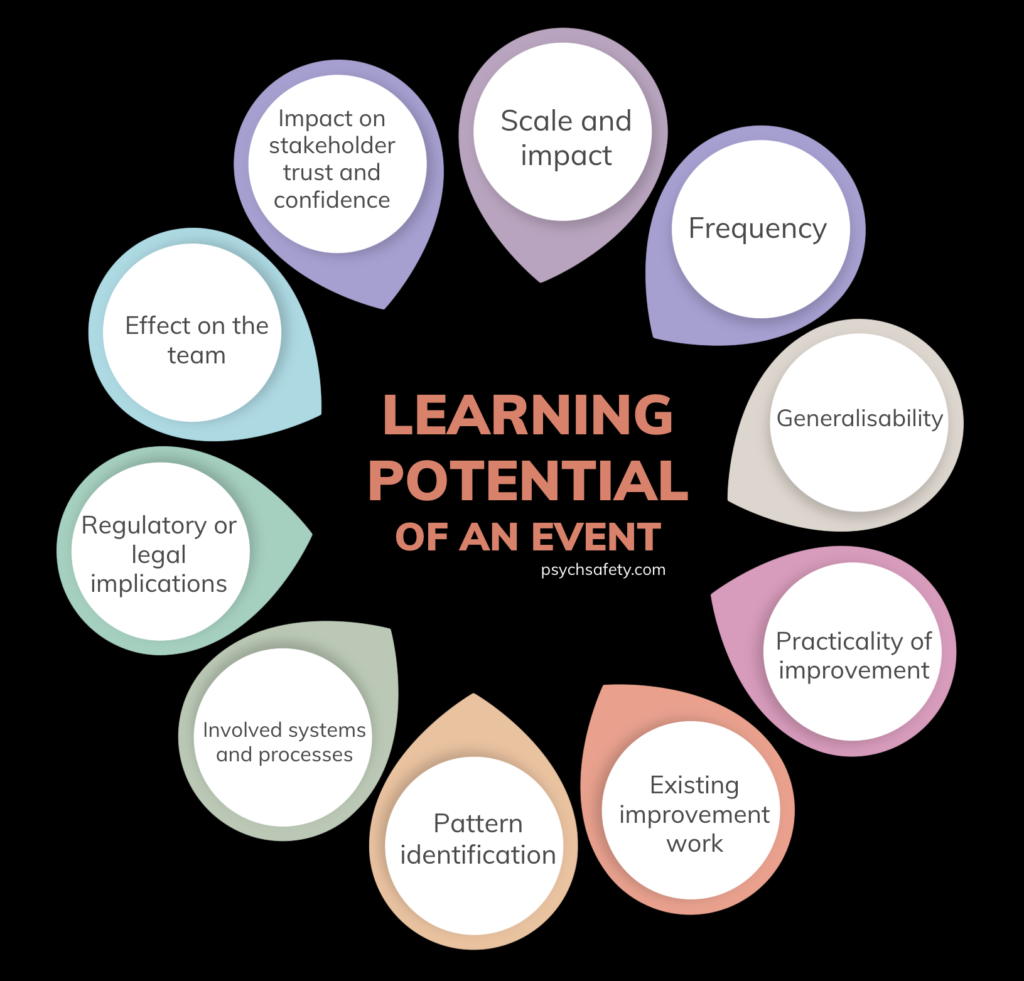
This isn’t a precise science. We can never know in advance exactly what learning a conversation will surface. But when deciding whether an event is a good candidate for a Learning Team, it can be helpful to weigh up factors such as:

  • the effect on the team
  • scale and impact
  • frequency
  • how generalisable the learning might be
  • regulatory or legal implications
  • alignment with existing improvement work
the factors affecting the learning potential of an event

When we explore Learning Teams in our HOP workshops, this is often the point where people start to see themselves in it. The examples of what might trigger a Learning Team vary wildly, depending on the kind of work people do.

For some, it’s a spike in complaints after a shiny new IT system goes live. For others, it’s a team restructure that didn’t quite go as planned. And sometimes it’s something more positive – like a particular store or location suddenly outperforming the rest, leaving everyone asking, what on earth are they doing differently?

It doesn’t really matter whether these are successes or failures, as long as they spark some organisational curiosity. We can see all of these as opportunities to ask better questions about how work is really getting done, and what people are adapting to in order to make things work.

Roles in a Learning Team

Once we’ve chosen an event with learning potential, the next question is to decide who to include in the Learning Team.

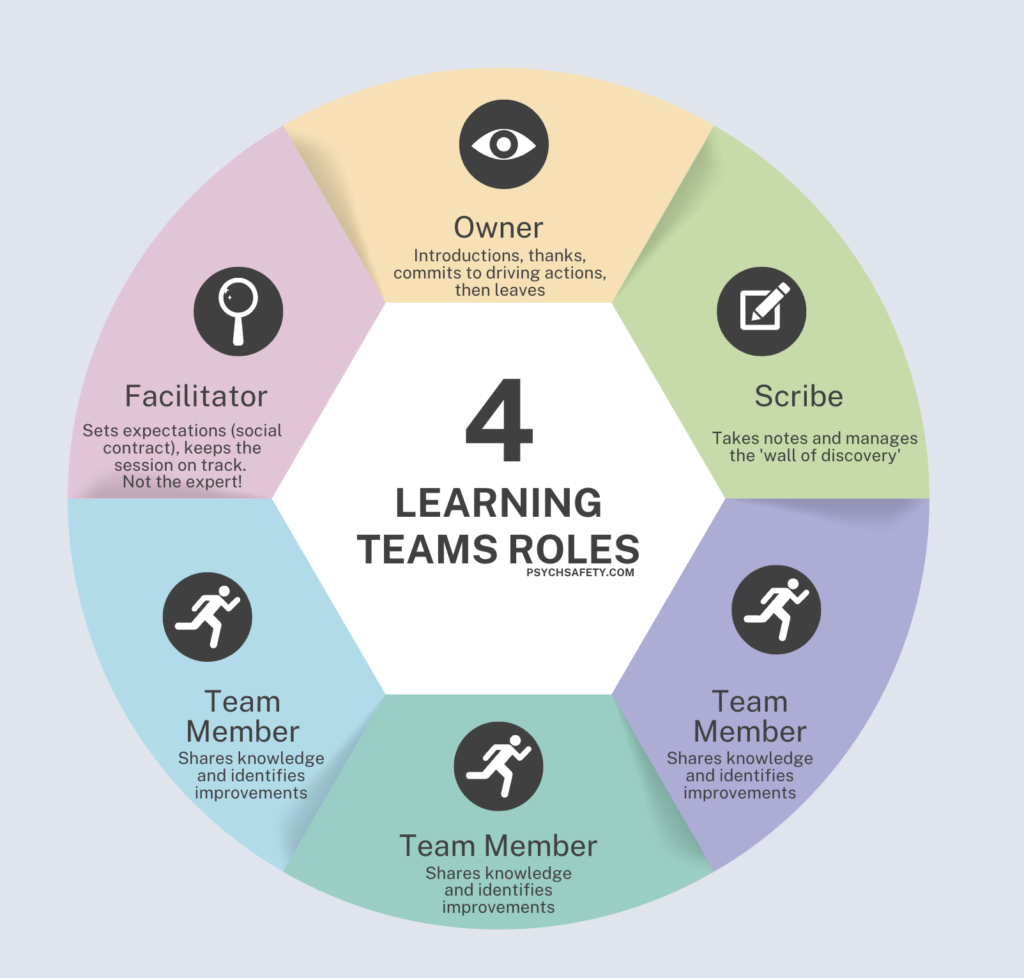
the various roles of a HOP learning team - owner, facilitator, team members

There are a small number of distinct roles, each with a specific purpose:

Owner: The Owner is someone with enough organisational authority to get the Learning Team off the ground. They ensure the right people are invited, and they commit to championing any organisational actions that emerge afterwards. Crucially, the Owner opens the session, welcoming people and setting the intent, and then leaves. (We’ll explore why this matters shortly.)

Facilitator: Sometimes referred to as the Coach, they are there to facilitate the learning, not to be the technical expert. They don’t have detailed knowledge of the event being discussed, but they are skilled in holding the process. They set expectations, often through a social contract, keep the conversation on track, and help the group stay focused on learning. 

Scribe: The Scribe plays another essential, but often underestimated, role. Like the Facilitator, they are not someone with direct knowledge of the work being discussed. Their focus is on capturing the qualitative richness of the conversation as it unfolds. They manage the “wall of discovery”, where insights and learning are made visible to the group.

Team members: There may be two, three, or more team members in the Learning Team. These are the people closest to the work, who hold first-hand knowledge of how work is actually done at the sharp end and ideally, they were present during the event being discussed. Their primary role is to share that knowledge. They may identify improvements along the way, but that is not their main aim. 

Learning Teams may also include people who weren’t directly involved in the specific event, but who do similar work or interact with the same system. This broadens any learning beyond a single episode and helps surface patterns in normal work that might otherwise remain invisible.

Structure of a Learning Team

One of my favourite things about Learning Teams is their intentional structure. They are deliberately designed in two distinct parts, with a pause in the middle. 

Before the Learning Team itself, there is some preparation required: being clear about the focus of the learning, identifying who needs to be involved, and making the practical arrangements to bring people together. Then we have the meetings:

Meeting 1: Learning from the work
The first meeting typically lasts around 60–90 minutes – long enough to allow for depth, but not so long that we lose focus. If it feels like we need more time than this, it’s often a signal that the event we’ve chosen is too broad and needs narrowing.

The sole purpose of this meeting is to understand what happened, or what happens, in the flow of real work. This is not a space for jumping to solutions or improvements, however tempting that might be. The Facilitator’s role here is to protect that intent, and they may need to be quite firm about it! This is in deliberate contrast with many “traditional” investigations, which tend to focus on a single incident and work backwards to identify where things failed. Learning Teams spend proportionally more time understanding how work usually succeeds, what people were adapting to, and why actions made sense in their context at the time.

“Soak time”
Between the two meetings, it’s helpful to allow some “soak time” – often around a day. This pause gives people space to process and reflect on what emerged, and sometimes realise what was missing or left unsaid in the first conversation.

Photo by cottonbro studio

Meeting 2: Making sense and improvements
The second meeting brings the group back together. The Facilitator supports the group to recap what was learned in Meeting 1, invites them to add any new reflections, and only then opens up the conversation about possible improvements or changes. This meeting is usually a similar length to the first.

Outputs of Learning Teams

As already touched on, the only essential outcome of a learning team is an improved understanding of normal work.

Sometimes, depending on the event, this learning will naturally surface areas where things can be improved, and maybe even some ideas for improvement. But improvements are a possible by-product of Learning Teams, not their primary purpose.

A Learning Team that ends with richer insight, a more nuanced understanding of work, and perhaps the ability to ask better questions about how work happens, has still been successful – even if it doesn’t produce a tidy list of actions. 

Evidence supports this shift in emphasis. Interestingly, a comparative study in a large NHS hospital found that Learning Teams generated more actions overall, and a substantially higher proportion of system-focused improvements, than conventional root cause analyses, possibly because they explore work across multiple contexts rather than compressing learning into a small number of technical or individual “root causes”. 

Reducing Power Gradients

The success of a Learning Team hinges on psychological safety. Do the people in the team feel safe to be honest about what happened? If not, we’re unlikely to learn very much.

This sits at the heart of why the Owner of a Learning Team will usually step out after the introductions. The Owner is, by definition, someone with greater organisational authority – they have the clout to convene the Learning Team and the responsibility to act on what emerges afterwards. But their presence in the discussion itself can unintentionally introduce a power gradient that makes candour harder.

This isn’t because of bad intention, or a failure on their part to reduce the power gradient. It’s a very pragmatic recognition that hierarchy shapes behaviour. When someone with formal authority is in the room, people are more likely to soften their accounts, or steer away from what feels risky to say.

There’s also a more practical reason for the Owner leaving. The Owner typically doesn’t hold first-hand knowledge of the work at the sharp end; their role in the Learning Team is to enable learning and respond to it, not to be the source of it. By stepping out, the Owner helps create the conditions for more open, real conversations, where the people closest to the work can speak with fewer filters.

A different way of learning

In many organisations, when something happens that we want to learn from, we default to an investigation. A group is brought together, often with more senior people in the room, and the focus quickly turns to understanding what went wrong, often who did wrong, and what needs to change.

Learning Teams take a different approach.

Rather than being judged from on high, the people who do the work are treated as the ones who know most about it. Time is spent first on understanding what work looks like in practice, before determining whether anything needs to be fixed. We put a bit of space between learning and decision making. 

“I learned very early the difference between knowing the name of something and knowing something.”
― Richard P. Feynman

This doesn’t mean Learning Teams replace formal investigations altogether. Some events will always need a formal response. But if we’re serious about learning from everyday work, not just from catastrophic failures, then we need approaches that make it easier for people to speak honestly about how work actually gets done.

That, for me, is what Learning Teams really offer. They invite us to take a better stance, one that starts with curiosity, treats people at the sharp end as experts in the work, and accepts that understanding has to come before improvement.

Taking it further

Interested to learn more? Join our next HOP Fundamentals workshop, where we explore Learning Teams and much, much more. 

Further Reading

Work as Imagined vs Work as Done

The Sharp End and Blunt End of Education

Reducing Power Gradients

Just Culture

Robbins, T., Tipper, S., King, J., Ramachandran, S.K., Pandit, J.J. and Pandit, M., 2021. Evaluation of learning teams versus root cause analysis for incident investigation in a large United Kingdom National Health Service Hospital. Journal of Patient Safety, 17(8), pp.e1800-e1805.

The post Learning Teams appeared first on Psych Safety.

❌