Reform has been forced to suspend two councillors in Nigel Farage’s own constituency this week, one over “serious misconduct” and another for “damaging the party’s interests”.
On Wednesday, Bradley Thompson was suspended. Thompson is a councillor for Clacton West and St Osyth ward on Essex County Council, as well as for West Clacton and Jaywick Sands for Tendring District Council.
Reform says he was suspended “following several serious and well-documented allegations of misconduct”, but has not provided any details of the allegations.
On 17 September, Reform issued a blanket statement saying councillor Chris Perera had been suspended after a party investigation found “he damaged the party’s interests”.
Perera is a councillor for Mersea and Pyefleet ward on Essex County Council.
Thompson and Perera both won their council seats in Farage’s constituency on 7 May this year.
In Lichfield, councillor Dean Robertson was suspended from Reform pending an investigation earlier this week.
Matthew Wallens, a Lichfield District and Staffordshire County Councillor, was also suspended by Reform pending investigation this week.
In Durham, three Reform councillors – Lyndsey Fox, Nicole Brown and Paul Sexton – quit the party last week after Sky News did an investigation into political chaos and bullying allegations at the Reform-led local authority.
Reform were supposed to come into local government and deliver for working people and yet if anything, they’ve made their lives harder with council tax hikes, broken promises and closures of essential services.
It’s been revealed that South Tyneside Council, which is run by Reform, confirmed this week that it will close the publicly-run South Tyneside Accredited Network for Learning in the Early Years (Stanley’s) nurseries.
The BBC reports that the decision was made by councillors during a cabinet meeting at South Shields Town Hall during which shouts of “shame” were heard from the public gallery, where a number of nursery workers and parents had gathered.
“It’s really hard for working parents to get back to work and this just makes it even harder – it’s just devastating,” one parent told the BBC.
The closure of the 10 publicly run nurseries comes after a review was carried out by the council into local childcare services and it was recommended that the Stanley’s close by July 2027 because they were ‘no longer financially viable’ for the council.
South Tyneside Council’s lead member for children’s services, Michelle Fascione, said it had been a “horrendous” situation for decision-makers involved, but that the closures were the best option.
“The council unfortunately doesn’t have a statutory obligation to provide these nurseries and it’s been costing us £1.1m a year to subsidise and it’s not viable for the future,” she told the BBC.
Nonetheless that has left many parents disappointed and angry at the closures.
Rather than delivering for working families, Reform are making their lives harder.
Reform-run North Northamptonshire Council is set to propose a motion to scrap the council’s climate emergency declaration at a meeting this evening.
Leon Gibbs, a Reform councillor who has seconded the motion, says that Reform is scrapping the declaration because it does not believe in declaring an emergency “while simultaneously working towards a target 24 years away”.
Gibbs also said that Reform “care deeply about the future of North Northamptonshire’s environment and believe the council should focus its efforts and resources on the areas where it can make a real difference”.
The climate emergency declaration was adopted in 2021 under the then Conservative-run administration.
Last year, the Reform-run executive voted to scrap the council’s target to achieve carbon neutrality by 2030, delaying it to 2050 in line with the national net-zero target.
Ben Williams, deputy leader of the Green group, pointed out that the net zero target is now 24 years away because Reform pushed it back.
Reacting to Gibbs’ comment that Reform cares about the future of North Northamptonshire’s environment, Williams said: “Their actions so far don’t reflect that sentiment.”
He added: “There are so many opportunities on the table that they could invest in whether it’s renewable energy or insulating people’s homes, there’s no evidence of any of that.”
“For them to delay the net zero target from 2030 to 2050 is one thing, then to now not declare an emergency and not measure carbon is another,” he said.
Williams noted that over 20 members of the public have requested to speak on the motion at the meeting today.
“Reform can’t say residents don’t care about this because it’s an item that has had such an insane amount of interest from the public,” Williams said.
The motion is likely to pass as Reform has a majority of 12 on the council. However, there is widespread opposition to scrapping the climate emergency declaration among opposition councillors.
The Northamptonshire Telegraph has also reported that protesters plan to gather outside Corby Cube, the council building, this evening to oppose the motion.
Despite several Reform having scrapped climate emergency declarations at several councils it runs, including in Derbyshire, Durham, Newcastle-under-Lyme and Kent, voters are concerned about climate change.
Polling by Ipsos in August found that 74% of voters report being concerned about climate change.
Reform UK leader Nigel Farage is being brutally mocked for claiming that Prime Minister Andy Burnham is setting up a ‘Ministry of Truth’ to attack free speech.
Farage made a video shared on social media where he decried Burnham’s decision to set up The National Centre for Information Defence which will be tasked with tackling disinformation and deepfakes from hostile states such as Russia.
Burnham made the announcement during his first speech as Prime Minister at the UN yesterday, saying that the government had an interest in tackling disinformation from hostile actors.
The National Centre for Information Defence will “detect, attribute and disrupt” information attacks by foreign powers, many of which are enabled by AI, bringing together the intelligence agencies, law enforcement and social media companies.
It will be tasked with ensuring that the UK is able to combat information warfare with Burnham saying that the country would have to go into the next decade “eyes wide open” about “insidious” campaigns, many of which had been orchestrated by Russia, which “twisted” what people at home felt about their own country and community.
While such efforts should be applauded, Farage posted a clip on social media claiming that the Prime Minister was setting up a Ministry of Truth to clamp down on free speech.
“You know what will happen with this government, already he’s said its to stop far-right tropes. This will be like George Orwell’s ministry of information. This will be used to clamp down on free speech.”
His comments were criticised online, with one social media user writing: “The National Centre for Information Defence will be tasked with tackling Russian disinformation. It’s unclear why Farage, whose former colleague Nathan Gill is currently in prison for accepting bribes to make pro-Russian statements, is against this.”
Another addded: “Andy Burnham is setting up a Ministry of Truth to clamp down on Farage’s links to Russia. There fixed it for you.”
Reform in local government was supposed to be an advertisement of how they would govern in national office and yet the record of Nigel Farage’s party has been one of broken promises, infighting and resignations.
They came to power in councils pledging to cut waste, find millions in savings and to reduce council taxes and instead areas under Reform’s control have been hit with council tax hikes and their version of Doge unit, which was supposed to tackle waste, has fallen flat.
The party’s councillors have also been suspended for posting hateful views, while others have resigned over infighting and a toxic culture.
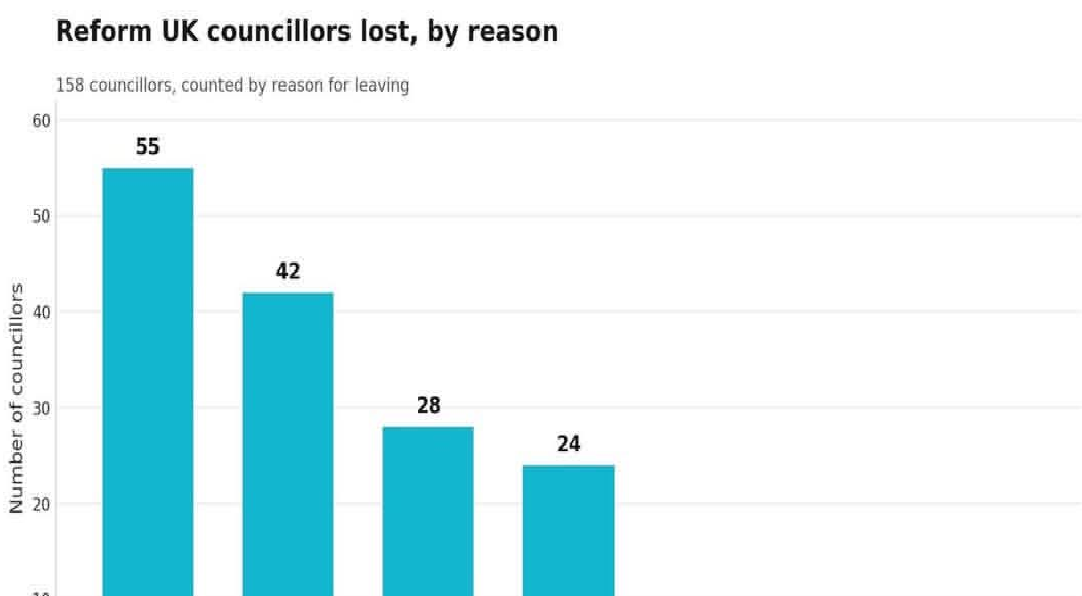
The below chart being shared online sums up just how much of a disaster Reform have been office and the reasons for its councillors leaving the party just four months after the local elections in May.
Around 158 councillors have left Reform since May, including 55 who have resigned, while 42 went independent and 28 defected to other parties. 24 were booted out of the party.
Nigel Farage’s woes are continuing as Reform continue to slide in the polls, with the latest finding that his party has now dropped to third place behind Labour and the Tories.
The poll, carried out by More in Common, found that support for Reform has dropped to 22%, its joint-lowest in 18 months.
That puts them behind the Tories who are on 23%, and 4 points behind Labour who are on 26%.
Meanwhile, the Lib Dems are on 11%, with the Greens on 8% and Restore Britain on 6%.
A number of polls now have shown Reform undergoing a collapse in support over recent months, a contrast to when Nigel Farage’s party were riding high in the polls last year hovering around the 30-point mark.
Despite Reform receiving millions in donations from crypto billionaires the party is yet to recover from its decline in the polls due to a number of scandals. These include two senior aides having to resign during the party’s conference after footage from undercover reporters emerged showing them trying to get around electoral law on donations.
Farage is also facing a probe from the standards committee over his failure to adequately declare £5million in donations he received.
The Metropolitan Police have also launched an investigation following undercover reporters exposing Reform officials for trying to solicit an illegal donation from a foreign donor.
The Centre for a Better Britain, a think tank linked to Reform UK, has released a new report which calls for the state pension to be scrapped and for several key taxes to be abolished.
The think tank has said that the state pension, which everyone receives as long as they have paid national insurance contributions, should be replaced with an income and asset-based system.
This means people’s retirement income would come more from their savings than from government support.
The CFABB, formerly known as Resolute 1850, was founded by Jonathan Brown, the former chief operating officer of Reform UK.
The paper also calls for the Local Government Pension Scheme, which guarantees a secure retirement income for public sector workers based on their income and years of service, to be closed to all new entrants.
Alongside its pension proposals, Centre for a Better Britain (CFABB) also advocates for several tax-cutting measures that would disproportionately benefit those with wealth contained in assets.
The report calls for the abolition of inheritance tax and capital gains tax, the tax paid when an asset is sold.
The Office for Budget Responsibility projects that revenues from inheritance tax will climb to nearly £11.7 billion by 2027-28.
Capital gains tax receipts generated over £22 billion for the public purse in 2025/26.
CFABB also calls for corporation tax to be slashed from 25% to 15%. The report claims that the tax rate makes Britain “uncompetitive”. However, the UK’s corporation tax rate is comparable with corporate tax rates in other Western European economies including France and Germany.
Reform has pledged to end the generous defined benefit pension schemes currently available to public sector workers for all new entrants if it wins power.
The party has said it would replace the Local Government Pension Scheme with a defined contribution scheme after 2030.
In their 2024 manifesto, Reform said it would raise the inheritance tax threshold to £2 million and reduce corporation tax to 15% as part of a raft of £90 billion in tax cuts.
In November last year, Reform U-turned on the tax cut proposals, stating that the “substantial tax cuts” were “not realistic” citing “the dire state of debt and our finances” in the UK.
Support for Reform UK has collapsed to its lowest level in two years according to a latest poll of voting intention, as the party fails to recover from political scandals engulfing its leadership and as it faces a threat to its right from Restore.
The latest poll by YouGov has put Reform on its lowest support for two years on 21 points, neck and neck with the Tories in second place, while Labour maintain their lead on 23 points.
In third place is the Green Party, up three points with 14 per cent support. The Liberal Democrats, meanwhile, are on 12 points, down by one.
A number of polls now have shown Reform undergoing a collapse in support over recent months, a contrast to when Nigel Farage’s party were riding high in the polls last year hovering around the 30-point mark.
Despite Reform receiving millions in donations from crypto billionaires the party is yet to recover from its decline in the polls due to a number of scandals. These include two senior aides having to resign during the party’s conference after footage from undercover reporters emerged showing them trying to get around electoral law on donations.
Farage is also facing a probe from the standards committee over his failure to adequately declare £5million in donations he received.
His party’s collapse in the polls comes just days after another YouGov poll found that Farage’s personal popularity rating had reached a record low.
The poll published earlier this month shows that almost seven in ten Britons (69 per cent) say they have an unfavourable opinion of the Reform leader – the highest figure recorded by YouGov’s tracker for Mr Farage in the ten years it has run.
Reform-run Sunderland City Council has been condemned over its decision to withdraw support for a campaign day organised by local anti-racism charity Show Racism the Red Card.
In a council meeting on 16 September, Reform council leader Chris Eynon said the council would no longer support Show Racism the Red Card’s Wear Red Day, their campaign day on 16 October.
Show Racism the Red Card says Wear Red Day is “a national moment of allyship and solidarity with those who are facing racist abuse and hostilities”.
Participation from the council would have involved council staff showing their support for the campaign day and encouraging others to do the same.
It would have also involved lighting key public assets red, such as Sunderland’s Penshaw monument, on 16 October as a show of solidarity.
Leader of the opposition on Sunderland City Council, Paul Edgeworth, called the decision “terrible” and “really pig-headed”.
Eynon said Reform had made the decision because of the “very very stark political bias” of the anti-racism charity’s founder Ged Grebby.
In the meeting, Eynon read out some posts Grebby had published on X that were critical of Reform, including him saying that “Reform is a very very dangerous organisation” and that “racists have been emboldened by Farage”.
Eynon also cited Grebby attending Labour Party conference and having met with trade unions and Labour MP Kim McGuinness as reasons for Reform withdrawing support for the organisation.
Eynon said “we don’t mind supporting good causes, we’re really happy to get behind things like carers’ week and the White Ribbon campaign but we have no plans on supporting politically charged organisations with an agenda.”
Edgeworth told Left Foot Forward that the decision was “terrible”, adding “Just recently we had Romaine Mundle, who’s a Sunderland player suffering racist abuse at a match so it’s clearly still happening in Sunderland and across the country.”
On 22 February, Sunderland AFC put out a statement condemning the “vile online racist abuse” that Mundle was subjected to after a match against Fulham.
The Lib Dem councillor for Grindon and Thornley Close added: “Whatever Reform’s view is of individuals involved with the campaign, it just sends a terrible message.”
He said of Reform’s decision: “It’s not representative of Sunderland, we are a welcoming place where people from all over the world have chosen to make their home.”
“It just sends completely the wrong signal and is really pig-headed of Reform.”
In a statement, Ged Grebby, Chief Executive of Show Racism the Red Card, said: “Show Racism the Red Card have worked with Sunderland City Council throughout its 30 year history, and are proud of the charity’s North East roots. We are disappointed in the statement made by the Leader of Sunderland City Council stating that they will not be supporting Wear Red Day this year.
“In our experience, the people of Sunderland have traditionally demonstrated a welcoming, inclusive and anti-racist attitude, and believe it is important that voters see this decision as further evidence that the Council are unsupportive of Equality, Diversity and Inclusion initiatives.”
James Kingett, an education team manager at Show Racism the Red Card, said that the campaign group was “disappointed with the justification for the decision being aligned with the personal views of the chief executive”.
On Eynon’s accusation that Show Racism the Red Card is a “politically charged organisation”, Kingett said that the charity is “apolitical organisation” adding: “We educate people against racism, we help people understand where it comes from [..] and the impact is has on black and global majority people and traditionally minoritised communities.”
In his statement, the Reform council leader said the council would still support anti-racism initiatives.
Kingett said “this positive to a certain extent”, adding: “We would just question why they felt that Show Racism the Red Card and the Wear Red Day initiative was an initiative that they could no longer support”.
This comes after Reform UK-led administration pulled £10,000 in council funding for the city’s Pride events in June.
Just weeks after taking over control of Sunderland City Council from Labour in May, Reform also announced that it would “never” fly the Pride flag outside City Hall.
The Labour Party continues to maintain a lead in the polls ahead of its conference due to take place later this week, while Reform continues to decline.
According to the latest weekly poll carried out by YouGov on behalf of the Times and Sky, Labour is on 23 points with no change, while Reform are on 21 points, down two points last week. Meanwhile, the Tories are on 21 points (up one point), while the Greens are on 14 points, up three points.
The latest polling will now doubt give a boost to Andy Burnham who is set to attend his first party conference as Labour leader and Prime Minister.
Despite Reform receiving millions in donations from crypto billionaires the party is yet to recover from its decline in the polls due to a number of scandals. These include two senior aides having to resign during the party’s conference after footage from undercover reporters emerged showing them trying to get around electoral law on donations.
Farage is also facing a probe from the standards committee over his failure to adequately declare £5million in donations he received.
The Labour Party has a four point lead in the polls ahead of its party conference due to take place later this week.
In a boost to Prime Minister Andy Burnham, who has presided over a turnaround in the party’s performance since he became leader, Labour are on 27%, while Reform are on 23%. Meanwhile, the Tories are on 21% and the Green Party on 13%.
Labour (-1), Reform UK (-2) and the Lib Dems (-1) all see a small drop since last month.
The polling was carried out by Ipsos between 10th – 15th September and comes ahead of the budget later next month.
Reform has continued to face a decline in the polls after Farage’s numerous scandals, including over his failure to adequatley declare a £5million donation from crypto billionaire Christopher Harborne and is currently facing a standards committee probe into the matter.
Nigel Farage has spent years presenting himself as the voice of the people. But the people reading his own local newspaper appear to have a rather different view.
The Colchester Gazette, which covers local news across Essex, including the seaside town of Clacton, and its sister title, the Clacton Gazette, recently asked readers whether Farage should quit as an MP.
The local news outlet wasn’t exactly coy about the result.
And the figures made for uncomfortable reading for the Reform UK leader.
More than eight in 10 of the 1,001 people who responded, 818, or 82 percent, said Farage should step down as an MP following investigations into Reform UK’s finances.
Just 177 people, or 18 percent, said he should not, while six were unsure.
The poll also asked whether readers thought Farage would become the next prime minister.
Of the 714 people who answered, 85 percent said no. Just 14 percent thought he would, while nine were unsure.
The Gazette also set out the allegations behind the latest controversy engulfing Reform.
A Channel 4 News investigation by Verbatim Investigations reported that senior Reform UK figures had discussed ways of obtaining support from an American donor that would not be permitted under UK electoral law.
The investigation alleged that a US company paid for three Reform-commissioned polls costing £32,500, while discussions also took place about a proposed £500,000 donation that would have been made via a UK-based son.
Channel 4 reported that the larger payment was never made. Reform denies wrongdoing and has launched an internal investigation.
But perhaps the most entertaining part of the Gazette article for Farage’s critics was the accompanying reader reaction.
One reader argued that investigations into expenses, misappropriation of funds and bribery should apply to politicians regardless of party.
“It just happens that Reform Ltd, its CEO and employees tend to bend the rules more than the other parties and to a much larger extreme, so it makes more exciting reading,” they wrote.
“All parties make mistakes, but Reform Ltd, just can’t help themselves and just don’t learn – they jump from scandal to scandal and it’s always someone else’s fault.”
And then came the social media pile-on.
“When you’ve lost the Clacton and Frinton Gazette…” posted campaign group Leeds for Europe.
One commenter joked: “Can he be an MP while being in jail?”
Another wrote: “The clue here is in the word ‘readers’, which rules out most Reform acolytes.”
“He’s done it once, so he’s had the practice!” said another, referring to Farage’s earlier resignation as the local MP.
“How would anyone notice?” someone else said in reference to the MP’s notorious absence from his constituency.
Hungary’s former prime minister wasted little time making his intentions clear. At the annual Kötcse gathering of Fidesz politicians and allies, he delivered what was described as a “fiery speech,” declaring the “grace period for the neo-communists is over,” and that his party was ready to fight. He accused Péter Magyar’s government of overseeing the “recolonisation” of Hungary and claimed Brussels, rather than Hungarian national interests, was driving the country’s direction.
Orbán may have lost power, but he has no intention of disappearing from politics.
And his comeback matters well beyond Hungary.
Voters decisively rejected him at April’s parliamentary election, ending his 16-year tenure and handing Magyar’s Tisza party a two-thirds majority. But the political networks, ideas and relationships cultivated during those years did not disappear with him.
Reform could face a similar situation. Even if it loses an election, that wouldn’t necessarily mean the end of its political influence. Like UKIP before it, Reform could succeed in pulling the mainstream parties towards its positions on issues such as immigration, net zero and taxation, achieving some of its political goals without holding a parliamentary majority.
It also has assets that can survive an electoral setback: a high-profile leadership, extensive media exposure, substantial financial backing and an established institutional presence. With elected representatives across local councils, the London Assembly, the Scottish Parliament and the Welsh Senedd, Reform is already building a political infrastructure that extends beyond any single election. Its reported £72 million in combined donations from billionaires Christopher Harborne and Ben Delo could further help it maintain that infrastructure and its campaigning networks.
In other words, electoral defeat would not necessarily amount to political disappearance. Orbán’s experience shows how a movement can retain influence through networks, ideas, institutions and sympathetic media even after losing power. That is an important part of understanding what Reform’s long-term impact could look like.
Orbánism has travelled
For years, Orbán presented Hungary as a blueprint for what he called an “illiberal” state, built around national sovereignty, traditional family values and hostility towards perceived foreign interference.
His government was criticised by opponents at home and abroad for taking Hungary in an authoritarian direction, but its influence was never confined to Hungary.
Orbán cultivated relationships with politicians, intellectuals, think tanks and media organisations across Europe and the US, and government-backed Hungarian institutions became part of an international conservative network, providing platforms, funding and opportunities for political collaboration.
Hungary became a reference point for politicians seeking to challenge liberal institutions, strengthen national sovereignty and oppose what they portrayed as the influence of Brussels and international organisations.
That network now stretches across Europe, and into Britain’s populist right.
The Reform-Orbán connection
A DeSmog investigation published in April mapped links between Reform figures and Orbán-linked organisations. It found that senior Reform figures had appeared on Orbán-backed platforms and that organisations associated with Reform figures had received funding from institutions connected to the Hungarian government.
One prominent link is James Orr, Reform’s head of policy until his recent resignation following an undercover investigation into Reform’s handling of foreign donations.
Orr is a trustee of the Roger Scruton Legacy Foundation, whose UK board includes figures such as Michael Gove. The foundation has been identified as a recipient of Hungarian-linked funding, with investigations reporting substantial funding from the Orbán-linked Mathias Corvinus Collegium (MCC).
Orr is also UK chairman of the Edmund Burke Foundation, which organises National Conservatism conferences, which are also sponsored and coordinated by the Brussels arm of the MCC.
NatCon has provided a meeting place for politicians and intellectuals sympathetic to Orbán’s brand of national conservatism.
At its 2024 conference in Brussels, Orbán was the headline political figure, while Orr and Nigel Farage were also on the programme. Suella Braverman, who defected to Farage’s party in January, also spoke at the event. As has Matthew Goodwin, GB News presenter who stood as Reform UK’s candidate for the Gorton and Denton parliamentary by-election. In an interview with Hungary Today earlier this year, Goodwin praised the Orbán model, saying that “Britain can learn from countries like Hungary.”
These connections matter because Orbán’s influence has never depended solely on formal political alliances. Conferences, think tanks, intellectual networks and cultural organisations have helped create a common political narrative and goal across borders.
Patriots for Europe – the far-right gains ground
The pattern is visible across Europe.
Orbán has openly cultivated relations with Germany’s Alternative für Deutschland (AfD). In February 2025, shortly before Germany’s federal election, he met AfD co-leader Alice Weidel and declared that Berlin had been a “city of walls” and that it was time to tear down another one.
The AfD subsequently achieved a landmark result in Saxony-Anhalt’s state election on September 6, winning around 44% of the vote.
In the Czech Republic, billionaire populist Andrej Babiš’s ANO won just under 35% of the vote in the 2025 parliamentary election, taking 80 of the 200 seats. Babiš, who was prime minister from 2017 to 2021, is a founding member of Patriots for Europe, the right-wing populist European Parliament group established by Orbán in 2024.
Following Orban’s election loss in April, the Patriots declared renewed vigour.
“The Patriots Group is more united than before and determined to intensify its efforts, committing to continue and strengthen the political struggle for sovereignty, prosperity, and freedom for all European nations,” they said in a statement.
The group also includes Austria’s Freedom Party (FPÖ), France’s National Rally, Portugal’s Chega and other nationalist parties. With 84 of the European Parliament’s 720 seats, it is the chamber’s third-largest political group. Its chairman is Jordan Bardella, National Rally president, Marine Le Pen’s party that has developed particularly close political ties with Orbán, sharing positions on immigration, national sovereignty and opposition to the EU establishment.
Portugal has also seen the rapid rise of the far-right sovereigntist party, Chega. In the 2025 snap election, the party won 60 seats and 22.8% of the vote, becoming the second-largest party and the largest opposition force. Chega joined Orbán’s European alliance in 2024.
Sweden offers another example of how far-right influence can outlive an electoral setback. After a desperately tight race, voters rejected the prospect of the far-right in government. The Sweden Democrats’ share of the vote fell for the first time since it began as an openly neo-Nazi party in the late 1980s, slipping from second to third place behind the conservative Moderates. It may have lost ground, but the party remains a potent political force, spending years exerting considerable influence over Sweden’s centre-right government from outside the cabinet.
Across Europe, ideas once associated with the political fringe have entered mainstream political debate, particularly around migration, crime, national sovereignty and cultural identity.
Hungary is trying to dismantle the Orbán model
Yet there is, thankfully, counter forces to Orbán’s comeback, providing a glimmer of hope.
While he is attempting to mobilise supporters against Hungary’s new government, his successor, Péter Magyar, is moving in the opposite direction.
His government has promised to reverse parts of Orbán’s legacy and has already begun dismantling parts of the political and institutional infrastructure built during Orbán’s tenure, including replacing Orbán-era appointees and pursuing anti-corruption measures. This week, the government submitted legislation to roll back Orbán-era anti-LGBTQ+ rules and intends to reverse the effective ban on same-sex adoption introduced under the previous government.
And something else to make progressives smile – Orbán’s comeback should not be mistaken for a resurgence in domestic popularity. A Europion poll conducted on September 7 – 8 put Fidesz on just 26 percent, compared with 56 percent for Péter Magyar’s Tisza party. Tisza retains an absolute majority in Budapest, where it has 56 percent support, county-seat cities with 51 percent, voters under 40 with 52 percent and, most notably, university graduates with 62 percent.
The model survives
For Britain, the Orbán story is particularly relevant because his relationship with the British populist right is hardly new.
Since then, the political networks surrounding Orbán and Britain’s populist right have become increasingly interconnected through National Conservatism, MCC-linked organisations, conferences and think tanks.
This is what can be missed when Orbán is treated simply as a Hungarian phenomenon.
His most consequential export may not be a particular policy, but a political model – sovereignty placed above international institutions, liberal elites portrayed as enemies of the people, migration and cultural change framed as existential threats, traditional family values turned into political weapons, and independent institutions presented as obstacles to popular will.
Orbán may be out of power in Hungary. The political ecosystem he helped build is not. It reaches from Budapest to Brussels and Berlin, and, through networks linking the European and British populist right, into Britain too.
Orbán might be physically back but in terms of influence, he never really went away.
Gabrielle Pickard-Whitehead is author of Right-Wing Watch
BBC Question Time presenter Fiona Bruce roasted Reform MP Danny Kruger on the programme for his party’s hypocrisy and confected outrage over laws applying retrospectively.
Reform have been facing questions over donations the party has accepted from two crypto billionaires, Christopher Harborne and Ben Delo, who both gave £36 million each last week.
Questions have been raised over whether the donations are legal and if they would have to be returned.
Even before the current donations to Reform, the government was already looking at tightening the rules following the Rycroft Review into foreign financial influence. The government then said it would introduce a £100,000 annual cap on donations from overseas electors.
And the rules go further than simply stopping somebody living abroad from writing an enormous cheque. They would also continue to restrict some people who return to Britain, until they have been resident here for a full calendar year.
Crucially, the government intends the new limit to apply retrospectively to donations made since 25 March this year. Donations caught by the new rules and above the limit could therefore eventually have to be returned.
Reform have tried to claim that laws which apply retrospectively are undemocratic and unconstitutional and Kruger tried to make the same point on Question Time.
Bruce asked the East Wiltshire MP: “Do you think laws should never be applied retrospectively?”
When he replied that this is a “very important principle,” Bruce asked: “Then why does Reform want to retrospectively change the law by rescinding indefinite leave to remain to people that already have it?”
Reform MP Danny Kruger drew much laughter and ridicule after claiming that the two crypto billionaires who donated an eye watering £72 million to Nigel Farage’s party expected ‘nothing in return’.
Last week, crypto billionaires Christopher Harborne and Ben Delo donated £36 million each to the party in the space of just 24 hours.
Questions have been raised over whether the donations are legal and if they would have to be returned as well as over what Delo and Harborne are expecting in return from the party.
Even before the current donations to Reform, the government was already looking at tightening the rules following the Rycroft Review into foreign financial influence. The government then said it would introduce a £100,000 annual cap on donations from overseas electors, a move that could apply retrospectively.
Critics have pointed out that Reform has already given the crypto billionaires what they want, including a pledge to cut their taxes, lighter regulation of their industry, and to limit competition.
Kruger insisted on Question Time that the two donors would get nothing in return for their donation, which prompted much laughter from the audience.
He said: “I think that it’s an admirable thing that these two men – who will get nothing for it, no peerage, no policy. They’re not getting anything for it. There’s absolutely nothing in it for them.”
Reform continues to make the headlines for all the wrong reasons after its party leader in Wales announced he was stepping down following his arrest on suspicion of assault.
Dan Thomas, who became Reform UK Wales leader in February this year, was arrested on suspicion of assault and controlling or coercive behaviour. He was released without charge.
Thomas said in a statement: ““It has been the honour of my life to have been the leader of Reform Wales and see this party go from zero to 34 elected members and become the largest opposition group in Welsh history.
“With deep regret, I am now standing down from this position due to personal reasons.
“Over the weekend, I was reported to the police and was released without charge.
“I stress that I have done nothing wrong, but I do not want the coming headlines to be a distraction from the fantastic work our Senedd team is doing in holding this government to account.”
Gwent Police said: “On Sunday 13 September a 45-year-old man, from the Aberbargoed area, was arrested on suspicion of assault and engaging in controlling/coercive behaviour.
Reform continues to be exposed for having links with far-right thugs and groups, after an investigation revealed that a Facebook group involved in the recent far right anti migration protests which saw balaclava clad men block roads and cause disruption, was set up by a Reform activist.
Earlier this month, hundreds of men wearing all black and balaclavas took part in two anti-migrant protests in Dover and Portsmouth. In Dover they blocked the town’s two main roads for several hours and in Portsmouth they blocked migrant coaches.
Ministers condemned the “thuggish and intimidating behaviour” of far-right activists who blocked roads, and who were coordinated by Danny Thomas, a close associate of anti-migrant and anti-Muslim activist Tommy Robinson.
While Reform leader Nigel Farage issued condemnation of the far-right protesters, saying it was ‘disgusting’ and that nobody, ‘whether they’re on the left or right, should be wearing balaclavas’, it seems not everyone in Reform shares his sentiments with some keen to support Thomas’ far-right thugs.
HOPE not hate has discovered that the North East Patriot Platform and Tyneside Patriots Facebook pages, part of the Patriot Platform network that launched the intimidating masked vigilante actions in Dover and Portsmouth last week, have been set up by Mark Thorn, a Reform activist from Gateshead.
The anti-extremist group added: “Thorn describes himself as the “Reform UK Representative/Campaigner” for Gateshead Central & Whickham Constituency on his social media accounts, which contain a mix of pro-Reform and pro-Patriot Platform content, and appears to believe that the party’s criticisms of the movement are not sincere.
“Responding to criticism of Farage’s response from another member, Thorn argued that Farage public stance was guided by political necessity and might not match his “secretly and privately personal opinions”:
In the same Facebook group, five Reform councillors indicated that they were keen to support Patriot Platform’s activities. They included Cllr Trevor Shonk of Kent County Council, Cllrs Sandra Pickering and James Wright of Gateshead Council and Cllrs Paul Goldingay and Jamie Campbell of Solihull Council.
Reform UK has been plaugued by yet another crisis at its flagship local authority after three more councillors quit.
The three councillors quit Durham Council for a number of reasons, bringing Reform’s majority on the local authority down from 65 to 51.
Durham council was supposed to be one of Reform’s flagship local authorities, showing how the party would govern if elected in national office and yet far from being a success, it has been plagued by bitter infighting and defections.
One of the councillors who has quit, Lyndsey Fox, said: “I’ve been thinking of resigning for some time, and the reason is because I reported a very serious safeguarding issue on July 14, and we’re now two months on and I’ve heard nothing.”
Reform’s record in local government has been defined by bitter infighting, broken promises and incompetence.
Self-proclaimed ‘man of the people’ Nigel Farage has said that he will seek to stop trade unions giving money to the Labour Party.
Scandal hit Farage has said that he is willing to take drastic measures if the goverment forces Reform to hand back £72 million it has received from two crypto billionaires.
Christopher Harborne and Ben Delo donated £36m each to the party in the space of just 24 hours at the weekend. Questions have been raised over whether the donations are legal and if they would have to be returned.
Even before the current donations to Reform, the government was already looking at tightening the rules following the Rycroft Review into foreign financial influence. The government then said it would introduce a £100,000 annual cap on donations from overseas electors.
And the rules go further than simply stopping somebody living abroad from writing an enormous cheque. They would also continue to restrict some people who return to Britain, until they have been resident here for a full calendar year.
Crucially, the government intends the new limit to apply retrospectively to donations made since 25 March this year. Donations caught by the new rules and above the limit could therefore eventually have to be returned.
A panicked Farage, who claims to represent working people, has threatened to stop unions giving cash to the Labour Party in retaliation.
Writing in the Telegraph, Farage said he would look to retaliate by ending the unions’ historic funding of the Labour Party if he becomes prime minister.
He said: “The Unite union alone has given the Labour party over £50m over the course of the last few years. They’ve got the Employment Rights Act, not to mention big pay rises for bus drivers. If anybody is giving money to do political bidding, it’s the trade unions.
“So I would just warn the Labour party here and now: If you try and ban our donors, we in government would certainly ban funding from the trade unions. I don’t want to go down that route. But it’s something we would be prepared to do.”
Business secretary Jonathan Reynolds hit back telling HuffPost that trade union donations are different to those from billionaires.
He said: “When we talk about union donations, that is not one entity. That is tens of thousands of ordinary people choosing to make that donation, and it’s banded up and given from the union. But it’s very easy to opt out of that.

 Login
Login